The Mysteries of the B2
August 20, 2002
Page 3
The B2’s Armament:
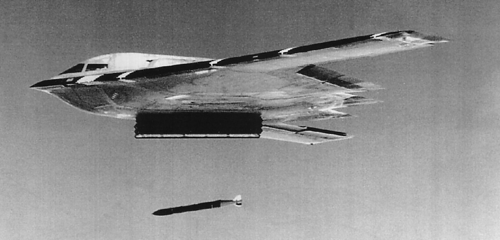
If one reads the brochure dedicated to the B2, it seems that this aircraft was designed, among other things, to carry extremely precise self-guided bombs, allowing for surgical strikes in enemy territory while minimizing “collateral damage”. Nowadays, the challenge isn’t simply to overwhelm an opponent with a barrage of bombs; rather, it’s to destroy their military capabilities selectively and “in peacetime”, even when those targets are located amidst urban areas or densely populated regions. In such cases, the “defensive weapon” becomes “international public opinion”, which reacts negatively upon seeing images of innocent women and children killed after a U.S. air raid.
More important than the bomber itself is the bomb and its guidance system. These are described in detail in the B2 brochure. It should be noted, however, that aside from stealth capabilities, all these features can also be incorporated into ordinary B-52s (synthetic aperture radar, “smart” bombs, etc.). Before considering the bomber’s performance and specifications, it’s necessary to analyze the entire mission profile.
The brochure lists various types of munitions the B2 can carry; these must be examined carefully.
AGM-129: Cruise Missile
Production ceased at the end of the Gulf War in 1991. A total of 461 units were produced. This missile carries a nuclear warhead with a yield ranging from 5 to 200 kilotons. It’s 6.5 meters long, with a wingspan of 3 meters when deployed. Weight: 1.5 tons. Range: 7,225 kilometers.
B61
Unguided nuclear bombs with ballistic trajectories. Yield: 340 kilotons. Used when precision isn’t required.
B83
These are the most powerful thermonuclear bombs used by the U.S. Their yield is 1.2 megatons. After the 9-megaton bombs carried by B-52s (which can carry up to 9 such bombs, resulting in a total yield of 81 megatons per plane), these are the next most powerful bombs. For the B2, these bombs are optimized for low-supersonic flight against “hard targets” – targets that require penetration before detonation. They can also be detonated in mid-air, with or without parachutes. The B2 can carry sixteen 2,000-pound thermonuclear bombs, each with a yield of 16 megatons. That’s a total of 15 tons of thermonuclear bombs. The number sixteen isn’t arbitrary; see below for details regarding the B2’s rotary bomb-dropping mechanism (used on other aircraft as well; the Russians have had similar systems for years). Since there are two bomb bays, this results in 2 x 8 = 16 bombs.
Presumably, the B2 is designed to carry conventional, non-nuclear bombs. Although it has only two bomb bays (compared to three on the B-1B), it can still carry roughly the same amount of payload as the B-1B or the “Big Belly” B-52, a modified version used during the Vietnam War.
Mk 82 (80)
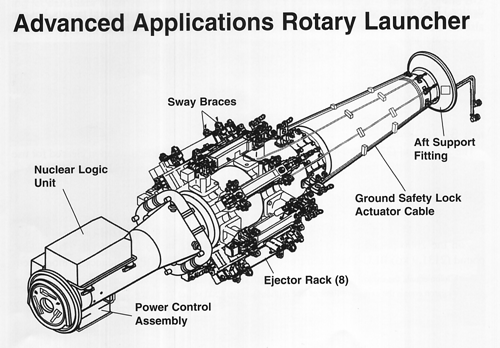
A 500-pound (226 kg) bomb with a ballistic trajectory, designed specifically for the B2. In 2003, the B2 will receive a JDAM version of this bomb, called GBU-30. Eight such bombs can be mounted on an Advanced Applications Rotary Launcher (AARL).
GPS-Aided Munitions (GAMs) (16)
The U.S. Air Force has developed bombs equipped with GPS technology, both general-purpose bombs and penetration bombs. Approximately 100 such bombs were dropped by the 509th Wing during operations against Yugoslavia (Operation Allied Forces).
Joint Direct Attack Munitions (JDAMs) (16)
The original conventional bomb planned for the B2 was the GBU-32, weighing 2,000 pounds. It’s estimated that 700 GBU-32s were dropped during this operation, with a destruction rate of 87% (and a failure rate of 13%).
CBU-87 (36)
This is a 2.3-meter-long, 0.4-meter-wide bomb that releases smaller bombs measuring 20 cm in length and 6 cm in diameter. Effective against personnel and lightly armored vehicles.
CBU-89 (36)
Another bomb (2.3 meters long, 38 cm in diameter) that releases anti-personnel and anti-tank mines. The dispersal pattern depends on the altitude at which the bomb is released; typically, it creates a rectangular area measuring 150 meters by 400 meters.
CBU-97 (36)
Yet another composite bomb weighing 400 kilograms; its dispersal area is 140 meters by 400 meters. The submunitions are programmed to automatically target infrared radiation sources.
AGM-154 Joint Standoff Weapon (JSOW) (16)
This is a gliding bomb 4 meters long, weighing 680 kilograms. Its cost is relatively low, and it can travel distances ranging from 30 to 80 kilometers, depending on the altitude at which it’s released. It’s a versatile weapon capable of performing multiple functions.
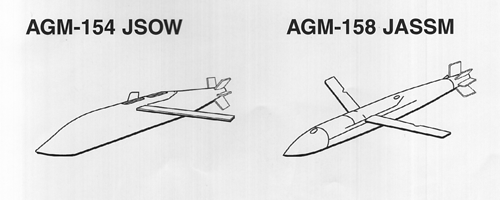
AGM-158 Joint Air-to-Surface Standoff Missile (JASSM) (16)
A precision cruise missile. Uses infrared imaging for target identification. Length: 4.3 meters; weight: 1 ton. Range: 370 kilometers.
BBU-37/B
Tested since March 1997, this 4,700-pound (2,131 kg) “bunker buster” is a JDAM. Released from an altitude of 13,000 meters, it can penetrate three to four layers of reinforced concrete. A sensor in its tail determines how many layers of concrete have been penetrated, allowing for precise control over where the explosion occurs.
Previous Page Table of Contents Next Page
Counter initialized on October 7, 2002. Number of times this page has been viewed: