The Mysteries of the B2
August 20, 2002
Page 4
The missions of the B2.
Information regarding the B2 can be found in interviews, in subsequent sections of the brochure, or in photographs. In an interview with Major Scott Vander Hamm in March 1998, he answered a question about the lifespan of the B2, estimating that these aircraft should remain operational until the year 2030. He added that “since it’s made mostly of non-metallic components,” meaning that since it consists of 80% non-metallic composite materials, it would be less susceptible to corrosion compared to other aircraft. He also stated that the stealth capabilities of the B2 and F-117A are “comparable.” Both types of aircraft serve the same purpose: penetrating heavily defended airspace and delivering precise strikes. The B2 can carry out such missions starting from within the United States and returning to its base afterward.
(In a 1998 Washington Post article discussing controversies surrounding the B2’s viability. At the time, the aircraft hadn’t yet been used in any combat missions. Some criticized the fact that its radar-absorbing coating was sensitive to rain! Proponents of the project argued that it would be difficult to establish B2 bases worldwide due to the need for expensive air conditioning systems in hangars. Thus, this “all-weather” bomber seems highly sensitive to temperature and humidity fluctuations.)
That’s precisely what makes this aircraft so peculiar. The Americans have bases worldwide, which can serve as launch points for various missions targeting numerous countries. The insistence that these aircraft must depart from and return to U.S. soil seems rather odd. Near the end of the brochure, there’s mention of Operation Enduring Freedom on November 5, 2001, following the September 11 attacks on the Twin Towers. Six B2s from the 509th Bomb Wing took off from Whiteman Air Force Base in Missouri, flew to Kabul and Diego Garcia in the Indian Ocean, and dropped 900-kilogram bombs guided by satellites from an altitude of 15,000 meters. Incidentally, the 509th Bomb Wing was responsible for dropping atomic bombs on Japan in 1945; later, in 1947, it became the focus of attention related to UFO sightings. According to the brochure, this round trip took 40 hours. The B2s briefly stopped at Diego Garcia where crews were changed, fuel was replenished, and they immediately headed back home without even shutting down their engines. This return journey lasted 30 hours. Thus, the engines ran continuously for 70 hours.
Note: On the Northrop-Air Force website, different figures are given regarding this mission: “The B2 has repeatedly demonstrated its ability to penetrate hostile airspace undetected; its all-weather capabilities were evident during Operations Allied Force and Enduring Freedom, with missions lasting up to 44 hours.” Translation: “The B2 has proven its ability to operate in hostile environments and execute missions under all weather conditions; these missions lasted up to 44 hours.” This second set of figures appears more reliable than those provided in James Goodall’s brochure. Indeed, if we calculate speeds based on a 70-hour mission duration, accounting for the 40-hour outbound journey, we get unrealistically slow speeds. It’s possible that there’s an error in James Goodall’s brochure—or perhaps it’s simply a poorly thought-out document.
It’s interesting to plot these round trips on a map.
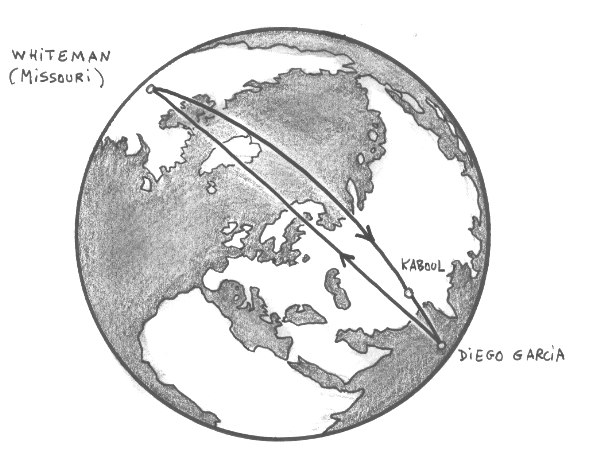
The outbound journey covers over 16,000 kilometers. Three refuelings are necessary; these must occur at altitudes below 7,500 meters and at speeds between 250–350 knots. One of these refuelings had to occur over Russia. Even though Russia is now considered a “friendly country,” it’s worth noting that during refueling, an aircraft becomes extremely vulnerable. It flies low and slowly, making it an easy target for surface-to-air missiles. Additionally, the tanker plane itself is unarmed and thus vulnerable too. If the entire mission depends on successful refueling, failure means disaster. According to André-Jacques Holbecq, refueling takes roughly 15–20 minutes. Let’s assume it takes an hour. Subtracting three hours spent refueling, we’re left with 37 hours of flight time. For 16,000 kilometers, this equates to a speed of 432 km/h. No matter how you look at it, these figures defy logic. An aircraft cannot fly so slowly at 15,000 meters altitude without losing control. Regarding the raid on Yugoslavia (lasting 30 hours), the outbound journey took 16 hours, leaving 14 hours for the return trip. This doesn’t make sense since on the outbound journey, planes benefit from jet streams (similar to transatlantic flights at high latitudes). Moreover, we know that an aircraft maintains the same speed regardless of whether it carries bombs or not. There’s still much to clarify...
Note: The Air Force website states:
“This extraordinary capability allows the aircraft to reach any location worldwide and deploy various weapons within 24 hours.” This incredible ability enables the aircraft to travel anywhere on Earth and deploy weapons within 24 hours. Given the distance involved (20,000 km) and the number of refuelings required, these figures seem more reasonable than those listed in James Goodall’s brochure. Back to the brochure…
In an interview, Major Przybyslawski said:
“The B2 combines stealth capabilities, long range, heavy payload capacity, and high-precision weaponry, making it the most effective long-range bomber in the world.”
It’s unclear which aircraft he’s referring to. Below is a three-view diagram and specifications of the B2.
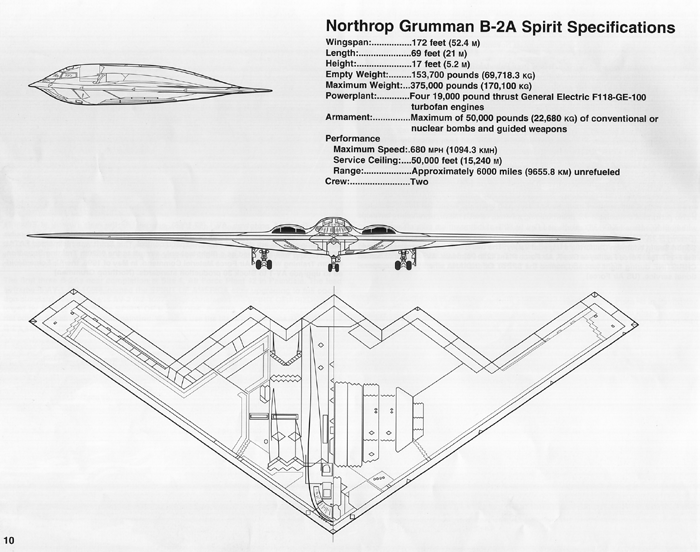
B2: Three-view diagram
9,000 km represents a feasible distance.
On page 49 of the brochure, it says:
“The flight from Whiteman AFB to Afghanistan required six aerial refuelings.”
It seems this sentence should read:
“The raid on Kabul required six refuelings along the way.”
But that’s quite a lot. The text suggests this type of mission is typical for the B2. However, refueling isn’t easy. The standard altitude is 7,500 meters, half of the B2’s cruising altitude. Thus, the B2 must descend to meet its tanker, then climb back up to its cruising altitude. Why can’t refueling occur at higher altitudes? Because the tanker is fully loaded. Refueling points can be anywhere—mid-ocean or above former Soviet territory. The tanker must carry enough fuel for its own journey plus that needed by the B2. These constraints mean it can’t fly very high or fast. The photo below shows a B2 being refueled by a KC-10; the speed appears to be around 350 knots, or 700 km/h.
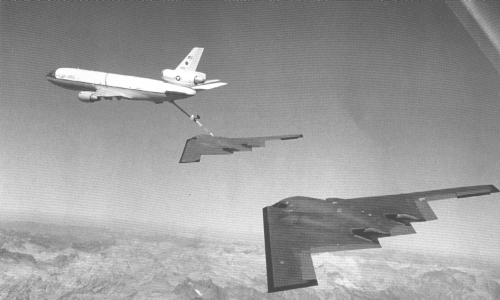
The tanker is slightly nose-up. Both B2s in the photo show this attitude, along with slightly raised flaps acting as air brakes. Approach speed must be less than one foot per second. During refueling, the B2 shouldn’t push against the tanker, otherwise controlling it becomes difficult. During refueling, a fighter jet is extremely vulnerable (due to low altitude and speed).
The brochure mentions another long-distance mission, this time to Yugoslavia (Operation Allied Force, March 1999). Two B2s dropped 16 tons of bombs (900 kg each) after a 16-hour flight. Two refuelings occurred on the way there, and two on the way back—four refuelings total for a single bombing mission. After dropping their bombs, the B2s turned around and returned directly, resulting in a continuous 30-hour flight.
Regarding this mission, the brochure quotes Brigadier General LeRoy Barnige:
“This mission proved that the B2 could be deployed quickly during crises without needing forward bases.”
He implies that the B2 (or rather, the B2 combined with its refueling system) can operate from U.S. bases anywhere globally. This is presented as one of the B2’s key features: operating from U.S. soil. Clearly, only 21 B2s will ever be deployed worldwide. Countries that can be targeted from Whiteman AFB without refueling are limited. Thus, this subsonic aircraft was designed for long-duration missions. Given its cost ($2 billion per unit; $260 billion overall development costs), it’s inconceivable that crew rest wasn’t planned for. Yet, according to the general’s statements (page 40):
“Crew members took turns sleeping. These ‘power naps’ were part of mission planning. One crew member slept on a beach lounger bought at a local Walmart store. This particular model fit perfectly in the space behind the cockpit.”
This statement seems unbelievable. Here’s the original English text:
“They slept in shifts. These ‘power naps’ were part of mission planning. One crew member slept on a beach lounger purchased at a local Walmart store. This particular model fit perfectly in the space behind the Aircraft Commander’s station.”
It’s impossible to believe that aircraft costing $2 billion apiece were built without considering crew rest during 30–40-hour missions. Flying is exhausting and requires concentration. The longest missions planned for B-52s lasted around 12 hours, max 20. Each crew consisted of six people, forming two pilot-navigator pairs who could rotate duties. They had far better accommodations than a simple beach lounger. For such critical missions, crew fitness can’t be left to chance. Apparently, one crew member had the good fortune to find such a lounger; otherwise, he’d have had to rest in his ejection seat. But ejection seats aren’t adjustable.
Previous page Table of contents Next page
Counter initialized October 7, 2002. Number of times this page has been viewed: