The Mysteries of the B2
August 23, 2002
Page 6
The air intakes of the B2. Final reflections.
Let’s examine them more closely. On page 7 it is stated that the aircraft is powered by four General Electric F118-GE-100 engines without afterburners. It’s worth noting that these engines, which were already used in the B1, didn’t require any further development; they certainly can’t explain the B2’s exorbitant cost. The Spirit’s speed is 1,094 km/h—this corresponds to “high subsonic” speeds—with a ceiling of 15,000 meters. Also on page 7, we learn that in order to prevent radar echoes from reflecting off the turbine blades, the engines are positioned within the wings, recessed inward. This aligns with the images of the air intakes shown on pages 14 and 15.
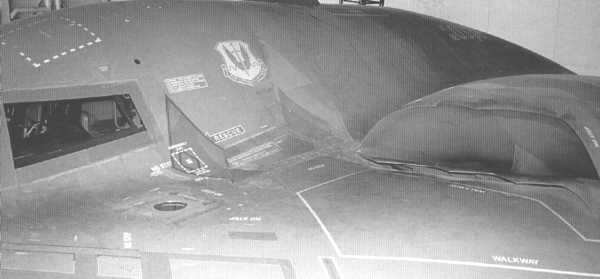
The air intake for the left engine assembly. The leading edge resembles a “sawtooth” pattern. The same applies to the boundary layer traps located near the wing surface.
In the center, there seems to be a partition separating airflows destined for both turbojets (which lack afterburners). This incoming airflow, captured by these “boundary layer traps,” is then mixed with exhaust gases to reduce its infrared signature. The following image shows this air intake from another angle.
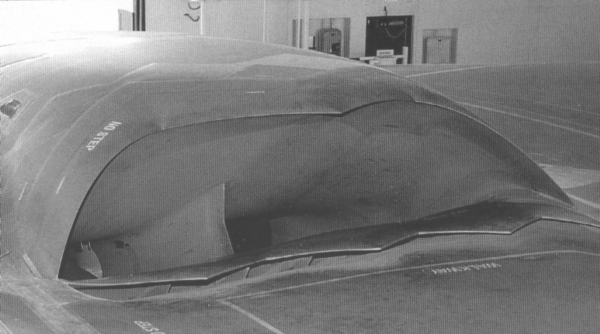
On the photo on page 15, though somewhat distorted due to its frontal perspective, one can see a zigzag-shaped connection on the upper portion of the engine cowling. We know that such zigzag structures help minimize electromagnetic signals emitted from any leading or trailing edges, which act like antennas. This zigzag pattern is a classic stealth feature, ensuring that opposing surfaces cancel out each other’s signals. Such zigzag patterns appear not only along any edges acting as leading or trailing edges but also at junctions between materials of differing natures (or even similar ones, as seen on various access panels on the aircraft). In the photo, this zigzag pattern is clearly visible on the upper portion of the engine cowling. This suggests a system designed to ensure the stealth characteristics of the air intakes. The wall deflecting airflow from the outer surface toward the engine compressor is presumably transparent to radar waves. Immediately behind it lies a 45-degree reflector that redirects those waves upward through another radar-transparent window; this zigzag pattern marks its boundary where it connects to a more durable material forming the air intake cowling, which must withstand considerable stress (possibly metallic).
We have a side view showing how the engine cowlings protrude above the wing surface:
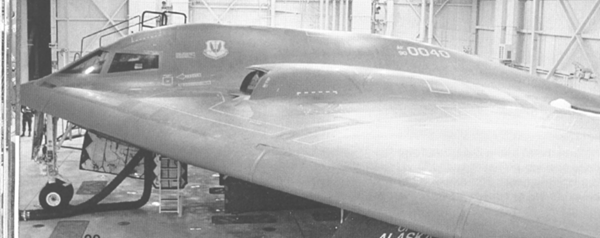
This illustrates how the engines are positioned (they’re short since they lack afterburners, as noted in the documentation).
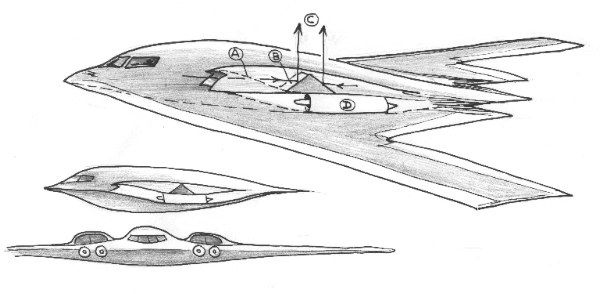
As stated in the documentation, all four standard General Electric F118-GE-100 engines are placed within the wings in such a manner that radar waves cannot reach their turbine blades, neither at intake nor exhaust points. This implies some kind of stealth mechanism. All that’s required is that partitions deflecting airflow remain transparent to radar waves; additionally, metal partitions redirect these waves back outward, much like the air intake design used on the F-117A, described in my book. Yet, a problem remains regarding stealth capabilities. Page 38 notes that the B2 lacks leading-edge flaps. Its 33-degree sweep angle necessitates a steep nose-up attitude during landing.
The B2’s wing features a sharp leading edge ahead of the fuselage (which doesn’t contribute to lift generation). However, subsequent photos reveal that the actual leading edges of the wings are quite rounded. This aligns with typical subsonic wing designs, yet it creates a large reflective surface for radar waves. We’re told that the aircraft’s surface is covered in a very thick (7–10 cm) yet fragile coating, necessitating rapid storage of B2s in hangars; moreover, this coating is vulnerable to weather conditions. This seems contradictory, given that an aircraft flying at 15,000 meters altitude must endure various meteorological stresses, including rain, hail, and radiation.
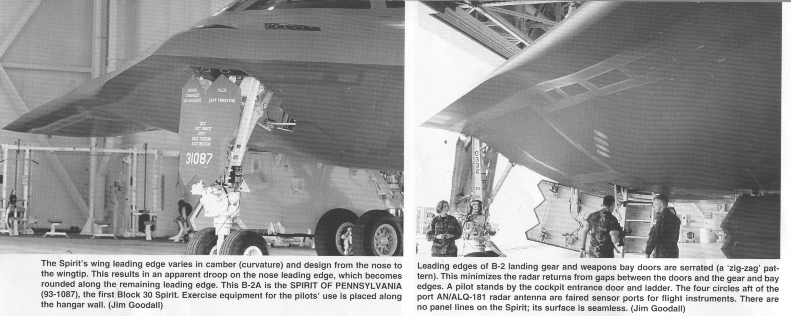
It’s also noteworthy that this supposedly thick protective coating isn’t present on wheel wells or bomb bay access panels shown elsewhere. If anyone knows why, please let us know...
The documentation briefly mentions a method involving embedding fine metallic particles throughout the coating thickness. The cockpit glass, likewise, is said to possess a thickness ranging from 7–10 cm.
Page 14 states that the B2 utilizes GPS positioning, a ring-laser gyro platform, and star-tracking systems to determine its location within mere meters. The same page adds that its 7–10 cm thick windshield contains two grids of gold wires functioning as reflectors/diffusers for both incoming and outgoing radar waves. Pilots can eject via the cockpit roof; these locations are marked with dashed lines. The leading edges of both wings (in later models, designated “Block 30”) are single pieces, eliminating hairpin joints.
The B2’s 33-degree sweep angle requires a steep nose-up attitude during landing. Had its leading edge been knife-like, it would need to tilt downward to maintain proper airfoil curvature and avoid stall. Instead, the chosen solution involved rounding the leading edge significantly, as seen in photos from page 20. The downside here is reduced stealth effectiveness against frontal radar waves. Page 20 also specifies that aircraft are stored promptly in hangars to shield their radar-absorbent coatings from environmental damage—though what exactly causes such damage remains unclear; surely not solar radiation, given these aircraft operate at 15,000 meters altitude. I suspect there’s another reason entirely, yet to be determined.
Page 22 indicates that photographing the B2 from behind is impossible, as its exhaust system visible from this angle remains classified.
Conclusion
The biggest mystery surrounding the B2 is its price: $2 billion per unit. For comparison, a B-52 costs $50 million. Thus, one B2 equals forty B-52s! Why? Note that these engines had previously been used in the B1 and other aircraft; hence, no major investment was made in developing new propulsion systems. Its landing gear and bomb bays are standard designs. The sole truly innovative element is its airframe. How can one justify such a staggering price tag?
Another mystery: why were only 21 units built, with production halted in 1997?
Reading the documentation, studying photographs, and reviewing mission reports reveals a genuine problem. In my book, I propose an explanation: just as the Northrop T38 “Talon” trainer jets stationed at Tonopah served as decoys during F-117A tests and training missions conducted solely at night, these B2s might similarly mask other aircraft sharing only their planar shape. This recalls nighttime observations near Edwards AFB detailed elsewhere on my website. Below, an aviation expert reconstructed his observations using Photoshop. The lights near the engine intakes don’t resemble illumination from landing lights reflecting off clouds; besides, the Mojave Desert climate is far too arid for such effects.
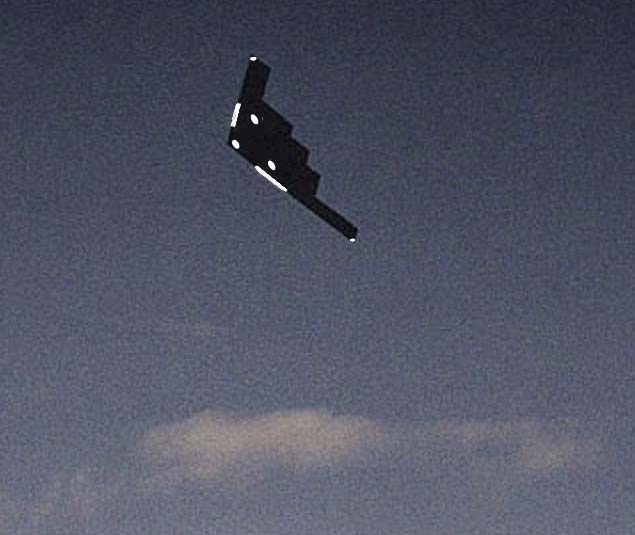
I believe this “mini-fleet” of B2s serves as a screen for a fleet of hypersonic bombers boasting extremely long range, capable of traveling at 10,000 km/h at 60 km altitude without generating shockwaves. Such capabilities would allow them to strike targets worldwide without refueling, even from opposite sides of Earth, within a single night. No longer would forward bases be necessary for any conflict scenario. I describe all principles underlying these aircraft in my upcoming book. MHD technology would play a key role here: encased in a plasma cocoon, these aircraft would become nearly invisible. At such speeds and altitudes, they’d also evade missile fire. This plasma shell would also protect them from directed-energy weapons (like microwave-based weaponry, heavily researched for years).
The next two images demonstrate how the artist’s sketch aligns with actual landing light placements on the landing gear:
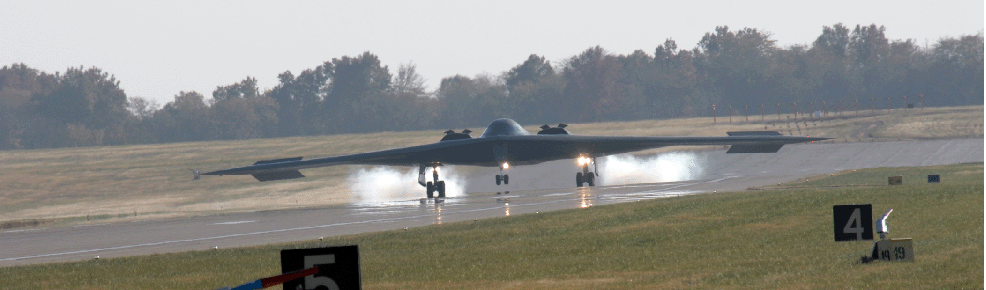
Landing lights mounted on landing gear
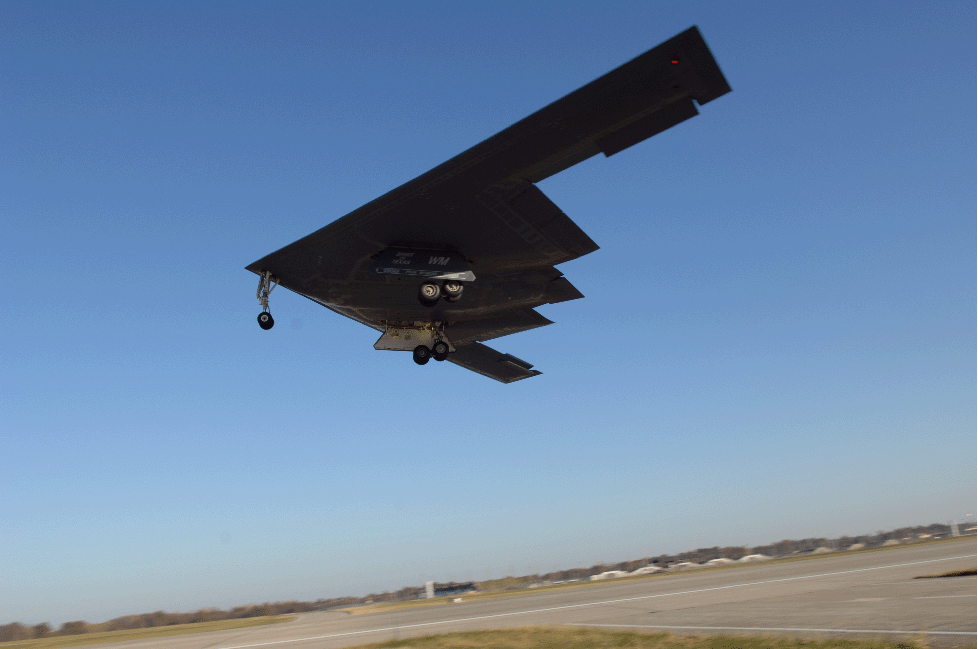
Position of B2 landing gear. Note the lowered “beaver tail” at rear.
Recently, I reviewed proceedings from a June 2002 conference on ramjet and scramjet propulsion hosted by ONERA. Here’s the link:
http://www.onera.fr/conferences/ramjet-scramjet-pde/
Little new information emerges here except for some striking photos:
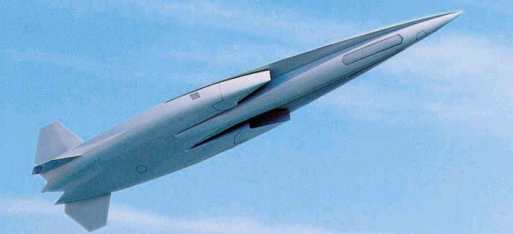
Various Mach limits for different propulsion types are listed. One diagram amused me greatly: authors Paul Kuentzmann and François Falempin briefly mention Russia’s Ajax craft conceived by engineer Fraidstadt. This is the resulting sketch:
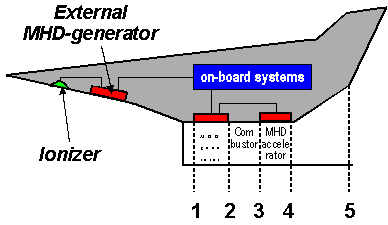
Regarding Ajax, if memory serves, an article by Alexandre Szamès appeared in Air et Cosmos in December 2000. It contained wind tunnel photos depicting the craft more realistically than this sketch. Essentially, this crude drawing borrows elements from Szamès’ article; he once remarked, “The editor insisted on a cross-sectional illustration. Since we knew nothing about its workings, we drew whatever came to mind.” Hence, this sketch represents pure speculation. Both authors conclude:
“A fascinating concept, but beyond current technological capabilities.”
This concept isn’t beyond U.S. technical capabilities; rather, it exceeds European imagination. While Russia’s Ajax never progressed beyond wind tunnel trials due to funding issues, its American counterpart Aurora has flown at 10,000 km/h at 60 km altitude since 1990. It’s a satellite-capable spy craft. I’ll detail all aspects in my upcoming book. Meanwhile, this “cover” fleet of B2s likely never flew to Yugoslavia or Afghanistan; instead, while real hypersonic bombers executed missions without refueling, these decoy B2s remained safely stored in hangars, evading detection via ground-based radar, even at night. Undoubtedly, they’re decent bombers—capable of carrying stated payloads, possessing a 9,000 km range, and capable of subsonic cruising and aerial refueling. Their stealth qualities are adequate, but nowhere near those of the true hypersonic craft they’re meant to conceal. Those latter craft indeed cost $2 billion apiece.
My conclusion: this fleet of 21 subsonic B2s with unlimited range (requiring only three or four refuelings each way) constitutes a massive disinformation effort masking a far more ambitious project: a hypersonic antipodal bomber leveraging MHD technology, detailed in my January 2003 book “OVNI, LE VOILE SE DECHIRE, l’Arsenal Secret Américain Révélé.” Skeptics may doubt this. Recently, Gwénaël, a clever fellow, reminded me of a comparable deception case: in the 1960s, Howard Hughes launched a media campaign centered on recovering “polymetallic nodules.” To achieve this, he built a giant ship equipped with a massive claw meant to harvest these nodules. In reality, this was a CIA/Army operation aimed at salvaging a sunken Russian nuclear submarine and its missiles off California coastlines. Unable to conceal such a massive undertaking, they fabricated this story with Hughes’ cooperation, diverting public attention from their true motives. Financially, this wasn’t cheap either...
Final note:
Numerous websites discuss “anti-gravity,” referencing various “effects” like “Machin” or “Glapion.” It’s risky to assert anything definitively on such topics. Here’s a little puzzle for readers: What twelve-letter term describes someone capable of making definitive statements on subjects they know nothing about and haven’t bothered to research?
Answer follows below:
Is it permissible to voice absolute opinions on matters one knows nothing about? Risky. But what criterion could apply? I suggest functionality. On August 22, my publisher informed me that my book’s release is slated for January 2003. Given its numerous illustrations, producing such a volume isn’t trivial. Publishers juggle multiple projects simultaneously; thus, future readers must wait at least four months. Nevertheless, this book will include extensive technical appendices substantiating proposed concepts, rendering them functional. When I state that America possesses a satellite-capable spy craft named Aurora capable of takeoffs, flights, and reentries without thermal shielding since 1990, I base this on solid evidence. I understand its construction principles, though I can’t divulge specifics—that’ll be a major revelation in my upcoming book. Similarly, the hypersonic antipodal bomber mirroring the B2’s planar shape (the sole similarity between them, as the 21 Whiteman-based B2s serve purely as decoys) also flies without generating shockwaves. Neither requires anti-gravity technology. Still, some folks speculate on its viability; I believe this stems from disinformation efforts steering people toward simpler, technically feasible MHD-based solutions. Anti-gravity “explains” how leading/trailing edges might generate electrical discharges as secondary effects of phenomena like “Glapion-Barachkof effects.” Future observations may confirm this; better to anticipate them now.
Currently, anti-gravity lacks any theoretical foundation; all experiments remain dubious and likely artifacts. Twenty-five years ago, a Dr. Pagès claimed to make discs fly via rapid rotation. Actually, this resulted from fluid dynamics: paint the lower side smooth, glue sandpaper atop, spin rapidly—Bernoulli’s principle creates lift. Pagès ignored this physics; perhaps his discs featured unevenly sanded surfaces. In my sci-fi tale “Pataphysique,” I describe another mechanical artifact causing minor electrostatic effects. Many experimenters replicate such results using basic lab equipment; however, these don’t function in vacuum environments. Take “point effect”: a thin cross-shaped object can spin rapidly under high voltage, but this fails in vacuum. Countless witnesses claim UFOs silently glide overhead without air disturbance; the “Amarante case” investigated by GEPAN fits this pattern. Lift here can’t stem from MHD; a genuine solution exists, outlined in my books. My speculative theory involves alternating travel between our universe and its twin, creating hyper-spatial transfers; this reverses mass direction, enabling lift. Alternating stays in both universes ensures balanced motion.
For a quarter-century, skeptics have argued “UFOs can’t rely on MHD.” Possibly their behavior defies this technology, though it’s highly functional. The Amarante craft didn’t employ MHD; such tech fails in space (a “MHD saucer” would crash on the Moon). Moreover, it doesn’t address interstellar travel needs; I propose another viable solution therein. Conversely, MHD absolutely enables craft to fly at 10,000 km/h at 60 km altitude, even as satellites; this I’ll demonstrate in my book. Here, I suspect U.S.-originated disinformation aims to steer interest toward anti-gravity, diverting attention from MHD (“electro-aerodynamics” in France). This works because virtually anyone can dabble in this field, including UFO enthusiasts. This parallels a 1970s disinformation campaign spearheaded by French-American Jacques Vallée, who encouraged UFOologists to pursue “paranormal interpretations”—a catch-all excuse for unfounded claims. Twenty years ago, I debated Vallée on Michel Polac’s show; I declared, “I’d be disappointed if UFO sightings merely indicated alien visits!” Likewise, NASA’s stance on UFOs or Peter Sturrock’s comments in a special VSD UFO issue echo this sentiment: “Scientists must revisit UFO research.”
My book will delve into disinformation, offering examples. I’m confident this constitutes a defining phenomenon of our era; it thrives thanks to scientists and ONERA engineers declaring, “Physics laws apply universally; thus, these American ideas are absurd” (referring to hypersonic flight feasibility and overcoming heat barriers).
Don’t miss the next page (January 17, 2003) showcasing B2 MHD in action.
Previous page Table of contents Next page
Counter initialized October 7, 2002. Number of views of this page: