Hit Parade of Human Stupidity
The Hit Parade of Human Stupidity
December 3, 2008 – Updated December 5, 2008, thanks to information provided by readers
Six months ago, I posted on my website a video showing a member of the American Rifle Society teaching an eight-year-old girl how to shoot a machine gun. This society aims to guarantee every U.S. citizen the right (enshrined in the Constitution) to carry a firearm, and its president for many years was actor Charlton Heston, who passed away in 2007.

Charlton Heston portraying Moses in The Ten Commandments
(here in the role of Pharaoh’s adopted son)
I should note in passing that in this film, when "Moses—Charlton Heston," reinterpreted by Hollywood, intervenes, it's because he sees an old Jewish woman whose scarf has become caught under a stone being dragged by Hebrew slaves. He tries to step in, but the foreman tells him, "No, you can't stop a moving stone!" Moses then fights the heartless Egyptian, who dies accidentally.
This morning, I was alerted to a video showing an American man teaching his two-year-old son how to shoot a large-caliber pistol, filmed by the mother.

American citizen teaching his two-year-old son to shoot a pistol, filmed by the mother
I thought I had reached the bottom of human stupidity.
Not at all. Immediately afterward, a reader pointed me to a video showing a Middle Eastern national, at a café terrace, pulling out a 9 mm pistol in front of children during a wedding (with musical background). He fires a shot into the air, hands the gun to his young son, who immediately pulls the trigger and shoots his father in the stomach. The video then cuts off.
December 5, 2008: Stupidity squared.
My website is highly interactive. It's my readers who send me information they find online. I relay it, commenting when possible. If I were a "good journalist," I'd be obliged to verify all this information. But I'd spend my days and nights doing so. Fortunately, my numerous readers do it for me—post-facto verification.
On December 4, following the upload of the previous videos, a reader alerted me to a website selling baby protection accessories:
http://bulletproofbaby.net/home%20page.html
 http://bulletproofbaby.net/home%20page.html
Left: Insure your baby against bullet impacts, fires, kidnappings.
Right: "My first riot helmet."

At the end of the sequence, we're supposed to see the mother retrieving her baby from the stroller.
Coming from America, the country that gave us the taser and so much more, anything is possible. Einstein once said:
"America is the first people to have passed directly, without transition, from barbarism to decadence."
A first reader, accustomed to handling weapons, initially doubted the recoil of the gun held by the mother and the impact marks on the stroller's cover.
Then another reader, clicking on the products for sale, found only one response: "This product is out of stock."
A third, more familiar with online scams, noticed the "wink" on one of the pages:

It's... an ad for a thriller starring Monica Bellucci!
Translation: As shown in the film "Shoot 'em Up" ("Shoot 'em up!"), thanks to the bulletproof baby, we can now create truly stunning stunts. Signed Michael Davis, Director (I assume the film's author).
The explanation becomes clear. This fake video is a "teaser," a remarkably tasteless advertisement for this film.
Violence and a taste for brutal scenes exist in all cultures. Here, we witness fights between dogs, camels, roosters, grasshoppers, and just about anything else—since time immemorial. We also see fights between men. My son’s mother loved boxing matches. She dragged me to one once. I saw young men hitting each other until they bled, inflicting pain, while the audience went wild. I didn’t like it—neither what happened in the ring nor what I saw in the crowd. It had nothing to do with a well-conducted judo match, where everything is about speed of reflexes and balance. There are fascinating ways to fight between men, like... tennis.
- You know, boxers don’t live this at all in a hateful way. For them, it’s just technique. Afterward, they sometimes go out for a drink together, my son’s mother once told me.
I don’t blame men who seek to escape mediocre lives by playing this card. I blame the fools who pay to watch such spectacles.
I don’t know if you’ve ever been to the Colosseum, that vast Roman circus where tens of thousands of gladiators perished. Back then, spectacles were daily events. "Panem et circenses": "Bread and games." Roman emperors fed the people, the mob, and intoxicated them with violent spectacles so they’d stay quiet. Fights between animals, men against animals, men against men—until death. "Pollice verso": "Thumbs down." That’s how the audience voted for the death of a fallen man, without risk. Sitting on their benches, at a distance, spectators could kill. It was absolute bliss, wildly exciting. Elegant Roman women could, for a price, spend the night with a man who might be dead the next day. Guaranteed high-quality orgasm. Ancient Rome was the stage for every perversion.
Are we different today? Not really. The constant stream of news reports shows that monstrous acts occur daily, everywhere, treated as pathologies. Elsewhere, organized cults use child murder to cement their bonds. There are satanic sects that feed on the evil they create. All of this exists, outside films and novels, hidden behind faces of fine porcelain.
Cinema has allowed us to simulate crime, torture, sadism, monstrosity. How far will we go? How far can we go? For those with a bit of perspective, we can say that since the end of the war, it’s been an escalation. Before the war, special effects were extremely limited. A little explosive, some powder. Boom! Pssht! Crack! Trained stuntmen managed spectacular horse falls. Wounded heroes leaned against trees, pressed their hands to their shirts, crushing a small pouch of tomato sauce, and that was it. They’d die with dignity, cleanly, after uttering a few inspiring words. In 1950s crime films, Eddie Constantine, the tough-faced actor, would punch villains, missing their chins by a good five centimeters, then adjust his tie. Police officers held their Herstal 7 mm 5 pistols at arm’s length, like fencing foils or flower bouquets. Very little was shown. Few people were killed.
Then came the explosive vest, remotely controlled. I remember very well the first film where this technique was used. It was a Western starring actor William Holden. It showed gunfighters, North American mercenaries, settling scores in a confined space against nasty Mexicans who had hired and betrayed them. Amazingly, when a character was hit, blood would spurt from the wound. In fact, from a distance, an assistant to the director pressed a button. Piff! Paff! At the same time, the actors, hit by bullets, were violently thrown backward. No one had ever seen anything like it before. It caught on immediately.
The scene was a huge success, and directors decided to use these remotely controlled explosives—spraying tomato sauce and leaving 2- to 3-centimeter holes in clothing, even in the actors’ "skin." We got used to seeing bullets throw people... several meters.
All of this is utterly unrealistic. By chance, I served as a shooting officer at the Bordeaux-Mérignac air base in 1961 during my military service. The officer’s standard weapon at the time was the MAC 50 (MAC for "Manufacture des Armes et Cycles de Saint-Étienne," a company that made guns and bicycles indiscriminately). Caliber: 9 mm.
I don’t know if you’ve ever fired such a "pistol." Well, the recoil won’t send you into the scenery. Stand in front of someone. Ask them to hold out their palm, then give them a light punch with your fist. They’ll feel exactly the same as if they’d fired a 9 mm pistol. Action-reaction principle: How can you, by transferring such a small impulse, knock a man down ten paces and send him crashing into the scenery? What miracle of ballistics?
The same applies to bullet wounds. I once worked in a Paris hospital about twenty years ago alongside a young journalist who had been shot in the early 1980s during a report in Africa. At the time, he felt nothing. He realized he was wounded, he told me, only when he saw his arm fall limp along his body. A bullet from a rifle, casually fired from a truck carrying a soldier he was photographing, had severed his humerus. I shared a room with him, having been bitten on my right index finger by a stray cat, which broke one of its fangs in my tendon sheath. I came within a hair’s breadth of amputation—the "cat scratch disease" or "pasteurellosis," resistant to antibiotics.
So all this theatricality, these crater-like impacts, these blood spurts are completely fake. If we showed how people are truly wounded when hit by bullets, audiences would be utterly disappointed. Thus, we’ve created a world of violence that is entirely virtual. We’ve created a media monster, a soulless media Moloch, devouring us and our children at an exponential rate. The image of violence normalizes violence. Everyone knows that a twelve-year-old child has seen, on television since infancy, an absolutely staggering number of murders, scenes of violence, carnage, and absolute sadism.
Hitchcock once made a fantastic black-and-white short film. In a small American town, a young couple lives with their five-year-old son, wearing a cowboy hat. One day, the couple receives the brother of one of them. A career soldier, he’s come to spend a few days with family. The boy remembers his uncle promised to bring him a gift. While the uncle is away, he opens his suitcase and discovers a splendid revolver and a box of cartridges.
There’s the gift! Quickly, he loads a single bullet into the cylinder and spins it. Now he’s out of the house, wearing his cardboard cowboy hat and his shiny pistol. He spots a shopkeeper, aims. The man smiles, plays along.
- You’ve got a nice gun, huh. Oh, I’m scared, I’m scared!...
- Bang! cries the child, pulling the trigger.
The cylinder turns one-sixth of a turn. He continues his walk, reenacting the scene with everyone he meets: a classmate, a police officer in uniform. Very amusing...
Suddenly, back at home, the couple and the uncle notice the suitcase wide open on the bed, and the box of cartridges. The pistol is gone. They rush to the phone. The police mobilize—not to hunt a man, but a... child, through the city. I’ll skip the details of this chase. In the end, the boy returns home and plays the "final scene" with the nanny, who naturally plays along. The mother screams. The child still pulls the trigger. This time, the shot fires. The bullet dislodges the ceiling fixture. The nanny collapses unconscious. The boy, terrified, bursts into tears. His mother comforts him:
- Calm down, Mike. It’s over. It’s over...
Good heavens, what justifies filling Christmas presents with machine guns and grenades? Psychologists will tell you it’s good for young children to express their natural violence, externalize it, and thus release it. But what is the price we pay in return?
Some will say it’s always been like this. Wooden swords, dart guns, lead soldiers.
- Come on, let’s play war.
What if one day we decided to do without all this? What if we decided to play other games?
The media Moloch we created. It’s the product of our inner chaos. An esotericist would use the word "égrégor." Lévi-Strauss would use "structure." Doesn’t matter: the result is the same. This entity lives beyond our control, feeds on public demand, and reinforces it. The feedback loop is terrifying. It produces toys like this one:

A children’s toy. A manual pump makes fake blood flow.
LClick here to visit this page, now five years old. You recognize it—it’s from the film Scream ("The Scream"). You can still find this "children’s toy" in stores. Of course, "it’s just pretend," but what sick fantasy will this unhealthy image imprint on your child’s mind?
How can anyone be so foolish as to institutionalize something like Halloween, the festival of the monstrous, the unhealthy, the diabolical?
How can we be surprised that violence descends into schoolyards? What a complete fool, this Rachida Dati, Minister of Justice, who wants to lower the age of criminal responsibility to 12. She focuses on the effect, ignoring the cause, talking about "common sense." Worse: by flaunting her taste for flashy luxury, she provokes French citizens, openly mocks justice officials who lack funding to perform their duties.
But no one will condemn those who create such toxic toys for the mind. Look at this complex, mediocre woman, a magnificent example of family cement, strutting through the National Assembly with a 16,000-euro ring on her finger!
Look at these foolish, greedy bankers, whom citizens will rescue at the last minute to "save the system," while in the U.S., thousands of indebted families are thrown onto the streets. I’ll return soon to what I saw in Dubai, that monstrous waste (a ski slope for emirs), while in Haiti, mothers feed their children clay cakes to stave off hunger.
This is the source of a violence you can’t even imagine, which "prudent" governments plan to contain using tasers, microwave crowd-control systems, and concentration camps. Elsewhere, companies offer hyper-billionaires massive, hundred-meter-long yachts, armed, to retreat to sea if things ever go bad.
Irony of history: Do you know what the "United Arab Emirates" were called before the oil lobby created this artificial state, as artificial as "Saudi Arabia" or "Kuwait"?
The Pirate Coast
It’s in old atlases. Violence is brewed everywhere. We feed it, deepen the gap of inequality, fuel the fire of despair. At the same time, we scatter images of delirious violence. Either these images are the product itself, like this bloody mask. Or they’re a "teaser," like this video where we’re supposed to see a mother shooting an automatic weapon at her son’s armored stroller.
It would make sense if it were a film like Michael Moore’s "Bowling for Columbine," showing the devastation of this violence. But the film itself is of the same ilk—just as foolish. The actors have weapons, shoot, kill. Nowadays, a thriller without dozens of deaths doesn’t sell.
What I want to tell you: these images will have an impact on you, on your children. An uncontrollable impact, one you can’t measure.
I’ll recall a real-life incident. Earlier, I said we’ve turned bullet wounds into fantasy. We’ve done the same with beatings, cinematic thrashings. Now, if men fight in front of a camera, the winner kicks the fallen loser in the stomach. That’s how it’s done, because that’s what we see in films. But a kick to the stomach can rupture a liver, trigger internal bleeding, quickly fatal. But that doesn’t happen in movies. The beaten man gets up, rubbing his jaw. In reality, things can turn out differently.
A few years ago, a fight broke out between two motorists in the middle of Cours Mirabeau, in central Aix-en-Provence. Punches were exchanged. One motorist fell to the ground. The other delivered a kick "like in the movies." Liver rupture, internal bleeding, death. That’s it...
I tell you: we will pay dearly for this violent education now rampant in films, on television, and online. Do you remember the line from Jean-Louis Barrault in "Drôle de drame," playing the "butcher killer"?
- By constantly talking about horrible things, they eventually come true.
A twelve-year-old child’s unconscious is no longer what his father’s was at the same age. Things have changed, and we are responsible. I, too, am evolving, in my own way. Violent scenes in movies now make me leave the theater. I can no longer bear them. Will you go see this film "Shoot 'em Up"? Apparently, it’s of such mediocrity and banality it’s almost laughable. Out of curiosity? Because the ad has done its job? Maybe the poster will read:
- We warn viewers that some scenes are difficult to endure...
We are in the nave of fools. But reality exists. Look at the photo below—it’s not a computer-generated image. George W. Bush recently expressed regret for having launched military operations in Iraq based on false information provided by his intelligence services, claiming Saddam Hussein possessed weapons of mass destruction. I saw his interview. Below, Bush with a slightly battered veteran, but still smiling:
Bush was lying, like so many others.

No, this one isn’t a computer-generated image.
I’ll show you further down how we can now pass off not just still images, but videos, as real footage. This example will show you that more than ever, we must learn to think for ourselves before other fools carve destructive images into our minds and cultivate a taste for the morbid.
We don’t know whether Bush fired anyone in his intelligence services after being so outrageously misled by incompetent people. On the contrary, all personnel responsible for monitoring U.S. airspace on September 11 benefited from comfortable promotions. The world upside down, the world according to Bush. Obama, meanwhile, retains the Secretary of Defense in his post and declares deeply concerned about Iran’s growing stockpile of fissile material and the risk of it acquiring weapons of mass destruction.
Is history an eternal repetition, or...?
When I finish a page like this, I remind myself how fortunate I am to have my own "corner of blue sky," http://www.savoir-sans-frontieres.com, which I share with my translators and donors. By the way, we’re a bit victimized by our own success lately. Check the site: finances are slightly down. You’ll find these figures on the homepage. Please consider contributing a little. There are no small donations. In fact, Savoir sans Frontières operates on very modest donations, just a few tens of euros. No large checks, no big transfers from the wealthy. That’s how it is.
The project to teach literacy using "talking bubbles" remains stalled. We’d need to create echo sites in various countries and manage them. Gilles and I, volunteers, can’t handle this. We’d need to be able to afford a modest salary. But how?
We’d need the association to obtain the "public interest" label. It will be difficult and long, a friend who knows these matters told me. Probably true.
December 5, 2008: How far can video manipulation go?
If you watch../VIDEOS/Pilotomago.wmv:
http://rcuvideos.com/video/thebestever-wmv
You’ll find a video showing an aerobatic plane during an emergency, yet still managing to land. It’s a fake. Here are some screenshots from key moments of this sequence.

"The plane" approaches the camera

First close-up pass

"The plane" begins a maneuver. A brief moment of image blur

Full climb: image becomes sharp again

After an upward roll, one wing begins to fold

Then... detaches

The next image is... empty

"The plane" loses altitude, on its side

It approaches the ground

Moves horizontally, hooked to its engine

The moment of contact with the ground. The image is blurred

But this pilot is a real virtuoso. He managed to right his aircraft and land it. Meanwhile, the spot where the wing should have been torn off has cleared up. The landing gear cover and the propeller cover: same thing. We see the flaps descending. And the engine cover has noticeably shortened...

The aircraft makes its turn off-screen. The wing root, which should have been torn off, is not visible.

No harm done...
Now let’s examine two of the images. The first appearance of "the plane," then its roll on the ground after the acrobatic landing.

We’re facing clever manipulation, using blurs to transition between different views—the real plane (final sequence, right image) and a model (left image). Unfortunately, the differences are abundant. The model’s fuselage is slimmer, and so is the engine cover. On the left, the wheel covers are dark; on the right, they’re light. Yet the lighting is the same. Same for the propeller cover. Etc.
Anyway, for an aerospace engineer, such a maneuver would be... impossible. A plane that loses a wing automatically goes onto its side and stays there or enters a rapid spin. Model planes have propeller thrust that can exceed their weight. This is rarer in full-size propeller planes. We’ve already shown you still images... that could fool you.
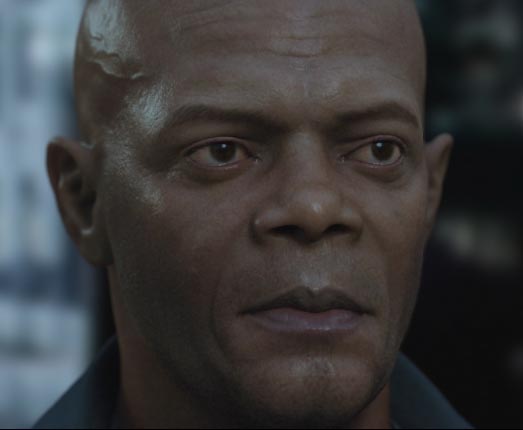
Synthetic image created by Belgian artist Jacques Defontaine
Or alternatively, the manipulations at the end of this page

Faked? How?
This plane landing with one wing missing is just a glimpse of what a skilled trickster can achieve without relying on computer-generated imagery. The more time passes, the harder it will become to distinguish reality from manipulation. In the examples shown on this page, two companies wanted to gain publicity—the first with a rare lack of taste.
What will happen when it comes to "news footage"?
The biggest is yet to come.
I’ll reserve it for a long interview I’ll give in the next issue of the magazine Science and the Unexplained.
You’ll see, it’s... heavy. Really serious stuff.
Nouveautés Guide (Index) Home Page


