About Crop Circles
Posted on August 28, 2002; updated September 19, 2002
You may have seen the October 11, 2002 episode of “C’est au programme” on Antenne II. Journalists typically prepare reports around the release of movies. This time it was in connection with the release of “Signs” starring Mel Gibson—a film where viewers must choose between two hypotheses: one being a simple hoax, and the other involving extraterrestrial intervention. The journalist assigned to cover this topic contacted me. In theory, I was supposed to appear on the show alongside aviation journalist Bernard Souanel, but my participation was canceled at the last minute. Thus, the program unfolded in an atmosphere of triviality that French media tend to favor. They interviewed “UFO expert” Dominique Caudron, who summarized possible explanations under three categories:
– Hoax
– Extraterrestrial intervention
– “Land art” (artistic practice conducted in open fields).
But what else can one expect from a “UFO expert”?
Had I been invited, I would have presented my own hypothesis—one far more disturbing: experiments involving weapons capable of killing, based on pulsed microwave radiation acting on the nodes of wheat stalks. Such experiments have been conducted since 1981 by Anglo-Americans. Thanks to Bernard Souanel’s presence, the program didn’t completely descend into absurdity. One memorable line came from one of the journalists, quoting a viewer’s comment:
“Why must we necessarily understand everything?”
That’s one way of looking at it. It simply reflects the utter superficiality of French media. If people still believe they can be properly informed or engage in meaningful debates about certain topics by watching television, they’re living in illusions. After twenty-five years of experience, I’ve come to realize that there’s nothing more superficial or manipulable by authorities than a French journalist.
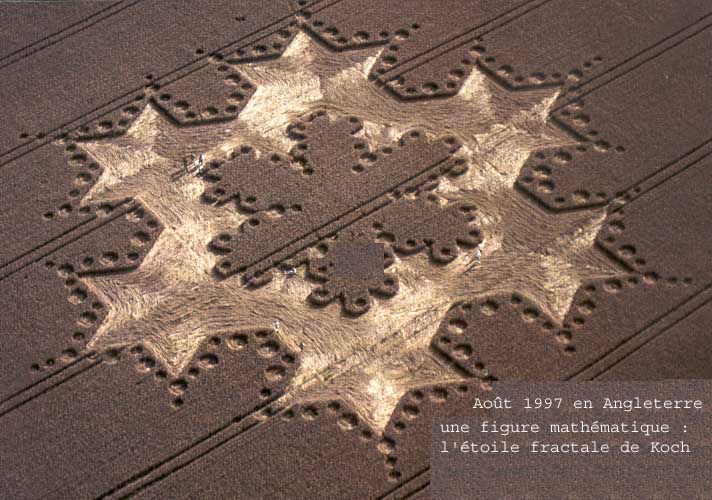
For many years now, these patterns in wheat fields have puzzled us. Readers can find images and studies related to this phenomenon in the references below, provided by André-Jacques Sobecq, who personally investigated several sites.
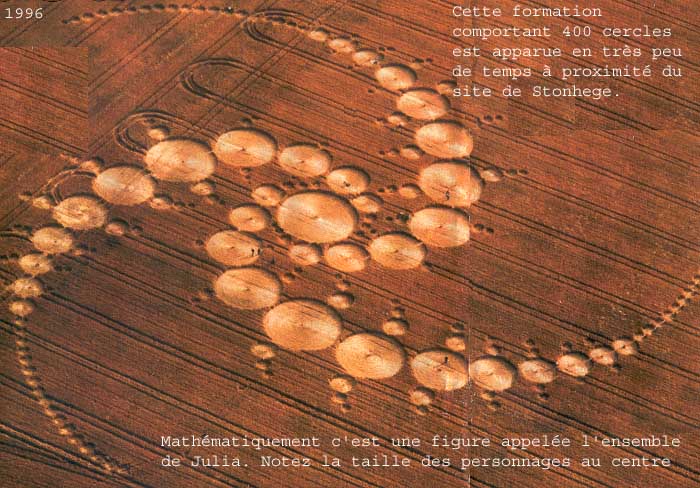
Another pattern that could hardly have been created by pranksters. Note also the size of the figures inside the central circle.
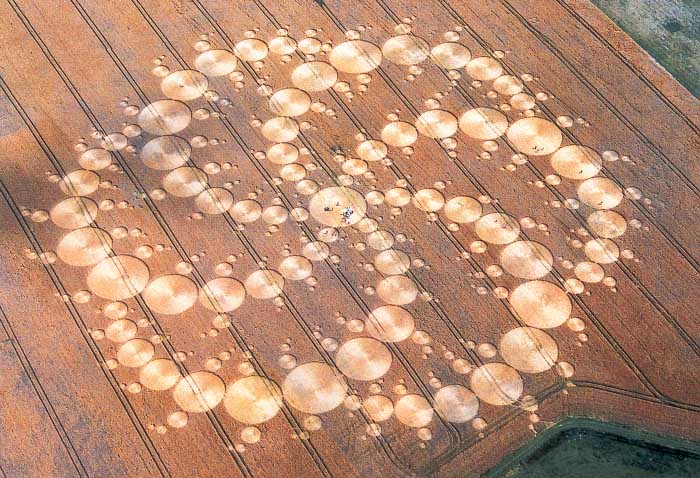
One more noteworthy pattern:
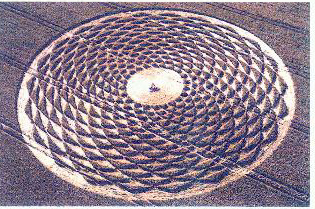
Some links regarding Crop Circles:
Images:
http://www.temporarytemples.co.uk/default-lib.html (archive from 03/09/2011)
Scientific studies:
http://www.bltresearch.com/index.html (archive from 10/04/2009)
http://www.xs4all.nl/%7Eicircle/dcircles/Levengood_Physiologia.htm
http://www.xs4all.nl/%7Eicircle/dcircles/Levengood_MeteoricIron.htm
Crop circles first appeared in southern England in the early 1980s, initially featuring fairly simple geometric shapes (1980: simple circles; 1981: first sets of three circles; 1983: first sets of five circles, etc.), which gradually became increasingly complex over time. Certain characteristics are typical: residual electric and magnetic fields whose intensity varies depending on depth. Several witnesses have observed such patterns forming within mere seconds. In 2001, an outbreak of foot-and-mouth disease led to strict police surveillance of rural areas; yet the number of crop circles remained unchanged that year.
Obviously, some “agroglyphs” are indeed the work of pranksters. Yet in genuine crop circles, wheat stalks aren’t broken or bent. Something appears to affect the node closest to the ground; the stalk then bends at a variable angle.
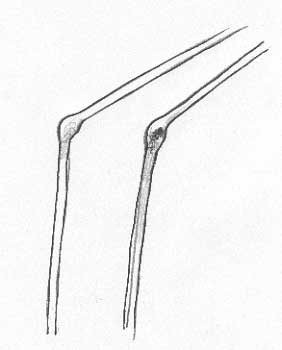
Researchers have conducted numerous studies on altered wheat stalks. In many cases, chemical changes were observed at those nodes: dehydration and sometimes even carbonization at the node level (see right-hand diagram). Temperatures are estimated at 500°C. Photos show nodes literally “exploded.” This hardly fits the actions of mere pranksters, as creating such patterns would require treating millions of stalks—and how?
André-Jacques Sobecq visited one site and witnessed the emergence (the next morning) of a pattern near his hotel. Upon entering the area, he suffered unbearable headaches, forcing him to leave. Others reported similar symptoms elsewhere. Sobecq collected “bent” wheat stalks on-site. Indeed, these patterns result from bending stalks at their first node, the one nearest the ground. Biological analyses indicate dehydration of that section of the stalk.
In the July-August-September 2002 edition of Effervesciences, it is stated: “In one pattern, a dead bird was found, its body literally exploded, as if cooked alive in a microwave oven. In others, dried hedgehogs were discovered. Wheat grains also appear dehydrated and brittle. According to Dr. Levengood’s research, they conduct electricity less efficiently.”
Contact information for this magazine:
Effervesciences (published by Éditions Midinnova), 51 route d’Espagne, 31100 Toulouse. Fax: 05 61 40 23 99
Website: http://www.effervesciences.com
Jacques Costagliola sent me a photo of a crop circle appearing in 1989 near Estevan, Saskatchewan (Canada). It shows a dead porcupine, charred, found within the pattern.
A side note from September 26, 2002: Microwave radiation kills hedgehogs in English countryside; however, when modulated into very low frequencies (for submarine communication, see the HAARP file), it might also kill whales.
I’ll share my personal opinion here. Recently, certain facts have begun surfacing. My website readers often provide valuable leads. Take the HAARP project, for instance; someone will soon remind me of relevant websites and authors. I’ll promptly add a link. For years now, the idea of “weather weapons” has circulated. As a scientist, I wondered how such things might be accomplished. I envisioned powerful phenomena like nuclear winter—a theme I first introduced in Europe, inspired by my friend Vladimir Alexandrov, murdered in Madrid in the early 1980s for attempting to publicize this issue too much, thereby upsetting military-industrial lobbies. He now presumably rests in some concrete tomb in Spain, forgotten by all. Details can be found in my book “Les Enfants du Diable,” published in 1995 by Albin Michel.
Another factor affecting climate: high-altitude nuclear explosions. We know that dozens occurred during the 1960s, both in the West and East, to assess “EMP effects” (electromagnetic pulses capable of disabling electronic systems over vast areas).
Yet one thing hadn’t crossed my mind until now: microwave effects, as described in the HAARP documents.
Information from Fatyk@wanadoo.fr (August 27, 2002): The official HAARP website: http://server5550.itd.nrl.navy.mil/projects/haarp/ ; another site posing questions: http://www.haarp.net/
There exists a French-language study on HAARP by GRIP: http://www.grip.org/pub/rap/rg98-5_haarp.pdf. I recommend downloading this clear and comprehensive PDF file.
GRIP is the Group for Research and Information on Peace and Security. Address: rue Van Hoorde, 33, B-1030 Brussels, Belgium. Email: admi@grip.org; Website: www.grip.org
The HAARP report (dated October 1998) was written by Luc Mampaey, commercial engineer and research associate at GRIP. It won the Philippe Bourdeau Prize awarded by the Institute for Environmental Management and Regional Planning (IGEAT) at the Free University of Brussels (ULB). Here’s a summary.
I believe there are very real aspects to all this we’ve ignored until now. The range of applications mentioned in the HAARP documents is staggering; yet I don’t rule out their authenticity. The basic concept involves creating an ionized layer acting as a mirror above a large region. Everything depends on power output. We now know extremely powerful microwave generators can be built; their capacity is virtually unlimited. A radar is essentially a microwave source; the most powerful ones reach a megawatt, if not more. Pulse-based systems could even reach terawatts, or a million megawatts.
A brief aside on ultra-powerful pulsed electrical energy sources: Initially, capacitor banks were used. The first lasers at Livermore, California, capable of delivering a terawatt each (a million megawatts) relied on capacitor banks storing ten thousand joules of energy. I saw this firsthand in 1976. The calculation is simple: to achieve a terawatt, i.e., 10¹² watts, you need to discharge those 10⁴ joules in 10⁻⁸ seconds. Those capacitors occupied an entire hall. One calorie equals 4.18 joules; thus 10,000 joules equals 2,393 calories. One calorie raises one cubic centimeter of water by one degree; consequently, such a powerful discharge in a liter of water would raise its temperature by 2.4 degrees. Conclusion: capacitors, while excellent for sudden energy bursts, aren’t ideal for energy storage. Similarly, powerful capacitor banks were once used to generate strong magnetic fields in France’s first Tokamak reactor at Fontenay-aux-Roses. Back in the 1960s, I myself employed half a cubic meter of costly capacitors to produce two teslas in a two-liter volume for a thousandth of a second—requiring a current of 50,000 amps. The Tokamak magnet operated on the same principle, though it required mountains of capacitors and countless ignitrons (power switches). Later, these were replaced by much simpler “homopolar generators.” Their mechanism is straightforward: accelerate a generator rotor to impart kinetic energy; then short-circuit it onto a low-impedance load (like a solenoid). This generates millions of amps for brief intervals. The rotor undergoes violent braking; however, it’s quicker to restart it than to recharge capacitors. Other, even more powerful systems employ “flux compression,” converting chemical explosion energy into electricity via magnetohydrodynamics. All this complements the HAARP documents describing what appear to be gigantic power generators. Apparently, continuous operation isn’t necessary, nor is it needed to produce the ionized mirror layer. With pulsed methods, truly enormous powers become conceivable. End of technical digression.
Microwave weapons are studied extensively worldwide. There are plans to install such devices on missiles, possibly reusable ones. A low-energy beam at several gigahertz constitutes a radar signal; at higher power levels it becomes a weapon of seemingly limitless effectiveness. Primary energy source: explosives. Since the early 1960s, we’ve known how to convert such energy into electromagnetic waves. These are called “flux compression systems.” I believe they’re referenced somewhere on my site; if I locate it, I’ll add a link. If the source is a “small nuclear bomb,” power output becomes astronomical. Hence, those assuming underground nuclear tests have ceased in developed nations are deluding themselves; they’ve merely been rendered undetectable. Countries foregoing such tests would also miss out on developing high-power microwave weapons. We’ll return to this crucial topic later.
Beyond this digression on microwave weapons, the concept of creating an ionized layer acting as a mirror in upper atmosphere seems highly plausible. Nature does something similar via solar radiation, allowing radio amateurs using shortwave bands to communicate across vast distances before satellites existed—thanks to waves reflecting off ionospheric layers formed by solar wind.
How is it that scientists failed to consider such possibilities for so long? To answer this, we must recall that every technological advancement prompts us to ask: “What horrible, monstrous uses could this be put to?” Usually, we’re spot on. Consider my recent article on Japanese biological weapons development between 1931 and WWII. Reality exceeds any nightmare scenario. No one would dare depict such atrocities in a horror film. What we learned from the Arte broadcast on October 11, 2002, defies belief.
It now seems obvious that scientists could remotely manipulate environments using electromagnetic waves, exploiting reflection off artificially ionized layers—that is, creating an “invisible mirror.” Two concepts intertwine here: the mirror itself, produced by powerful electromagnetic emitters generating artificial ionosphere; and the effector weapon—a beam reflecting off that mirror and striking distant targets. Altitude matters greatly: a stratospheric mirror yields hundreds of kilometers range; an ionospheric one could span thousands. Moreover, one beam can reflect off multiple mirrors, making range virtually infinite. We’t know exactly what we’re dealing with. Possibly, humans have been playing sorcerer with a phenomenon whose consequences remain unknown. If such “directed energy” aims to locate submerged submarines or communicate with them, no moral or ecological argument would deter our strategists given the stakes.
We’ve learned that England hosts a facility called “Echelon” near Leeds, designed to monitor radio signals across Europe. It seems HAARP and Echelon are linked—first clue. But let’s return to the core subject: crop circles. They fascinate the world; ever more sophisticated patterns emerge. In a recent issue of Scientific American, an editor mocked this phenomenon with the facile excuse: “These circles in wheat? I made them myself!” Frankly, this is pathetic debunking. On a TV show I attended, an English “prankster” gleefully explained how he and a friend fabricated such patterns using two ropes and a wooden stick. That footage has gone viral worldwide. I’ve already expressed my contempt for such theories in a book. British wheat harvests occur only briefly and over limited areas; thus, to create all those patterns in such a short time, those “pranksters” would have had to traverse immense distances. Absurd. After that broadcast, an English retiree claimed he and a friend caused those circles; when asked about his occupation, he replied: “Oil painting.” My friend Frédéric then asked if he used regular turpentine; “Yes,” came the reply—falling right into the trap. Frédéric added: “I use ordinary gasoline; turpentine gives equally good results.” Clearly, he’d never painted before.
Thus, two concepts combine: the “invisible mirror” created by ionizing upper atmosphere; and the effector weapon, a beam reflecting off that mirror to strike distant targets. Altitude determines range; stratospheric mirrors allow hundreds of kilometers coverage; ionospheric ones thousands. One beam can bounce off multiple mirrors, yielding unlimited range. We’t know precisely what’s at play. Likely, humans have been experimenting for decades without realizing consequences. If these “wheat circles” result from Anglo-American tests on civilian land (rather than a dedicated test site like Australia), it’s a grave matter. If such weapons kill birds and hedgehogs, they can obviously kill humans too—since 1981, in fact. Anglo-Americans would thus be testing lethal weapons in civilian areas. Why not restrict tests to designated ranges? Simple: testing under varied conditions (including diverse weather) is essential. Nevada offers isolated sites, but its climate is arid; England’s humid, foggy weather also suits testing. Hence, such experiments make sense there.
A new theory concerning countless U.S. livestock mutilations:
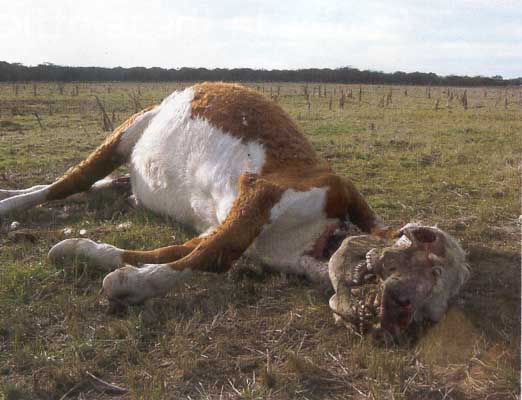
This photo illustrates a typical case: tongues, eyes, ears removed; genitals and mammary glands similarly excised; animals completely drained of blood. Clean wounds rule out predator activity; organs are neatly extracted. In the U.S., this phenomenon began in 1967; currently, 2,860 cases documented. Only Quebec remains untouched in North America. Sometimes animals are tossed to the ground after extraction. Americans possess helicopters capable of lifting such weights.
Between April and July 2002, similar cases emerged in Argentina. Nine times out of ten, owners report nothing, perhaps because they’re compensated. Outside the U.S., Argentina provides remote, sparsely populated lands perfect for such covert operations. Normandy’s densely populated farmland would hardly suit this purpose. Mutilations target specific organs; experimenters wish to verify weapon efficacy while leaving no traceable evidence (e.g., carcinogenic effects).
If mucous membranes (tongues, rectums) are primarily removed, it suggests testing for carcinogenic weapons. Experimenters want to confirm weapon performance and conceal evidence simultaneously. Yet if such weapons induce cancer cells, they should also provoke immune responses (lymph nodes, etc.). Investigators should therefore analyze immune status in affected animals.