SL9 Schumaker Levy impact on Jupiter
Summary of the study regarding the SL9 file
December 9, 2003
First part
It is recalled that a mysterious document had been discovered on an internet forum and published from a cybercafé in Bordeaux, casting doubt on the artificial nature of the phenomenon that was later described as the effect of the fragmentation and impact in July 94 of the object detected by astronomers Eugene Schumaker and Carolyne Levy. The full text can be found in one of the appendices at the end of my last book. In this study, carried out by astronomer A.Cohen, member of GESTO, he listed the facts confirming or refuting the different theses, citing the associated references.
**In summary, **A.Cohen highlights many strange things in the official thesis regarding "the capture, breakup and impact of a comet on Jupiter". The key points are:
-
It is hard to see how a "comet", or any object, can be "captured" by a giant planet. It is a "two-body problem" in which only Kepler's laws of motion are involved. A comet is by definition an object with a non-periodic or very long-period trajectory, moving along a conic path with the Sun as its focus. A capture involves a "three-body problem" (J.M.Souriau). At most, one can consider a drastic change in the trajectory of a comet interacting with Jupiter (three-body problem: comet - Jupiter - Sun). However, under these conditions, the comet remains always attracted by the Sun "centered on it", gravitationally, even if the eccentricity of its elliptical orbit is altered. Regarding the different satellites of the planets in the Solar System, it is recalled that these captures of various terrestrial objects probably occurred at the very moment of the birth of our planetary system, very chaotic, centered on the Sun. Moreover, publications mention a capture that would have occurred in 1920-1930. The SL9 object (non-fragmented) would have then orbited around Jupiter (with a very eccentric trajectory) for nearly seventy years, without being detected.
-
The fact that an object, comet or asteroid, breaks up, or even disintegrates, when passing through the "Roche sphere" of a planet is a phenomenon well understood by astrophysicists. The rings of Saturn, as well as the years of the different giant planets, probably have this origin. It is recalled that the 21 objects were detected in March 1993 by Eugene Schumaker (who died three years later in a car accident in Australia) and Carolyn Levy were still in the process of moving away (near the aphelion) relative to Jupiter. They then plunged onto the giant planet. Cohen doubts that this SL9 object could be a comet (why would it not have outgassed for 70 years, and then suddenly do so after its fragmentation). Moreover, the emission spectrum of the nebulae surrounding the objects does not correspond to the classical spectrum of comet tails. These objects, qualified "atypical" by astronomers, emitted lithium. The fact that object G emitted magnesium ions Mg+ a few hours before plunging into Jupiter remains completely incomprehensible. A.Cohen concludes that at the extreme limit, the object could correspond to a carbonaceous chondrite meteorite, with a very low albedo, which would explain its non-detection before fragmentation (...). Following this thesis, it would still remain to explain why all the objects would have started to emit gaseous environments after fragmentation. Qualifying an object as "an atypical comet or asteroid" (which is the "official conclusion") is a euphemism to say that ultimately nothing definitive could be concluded from the analysis of the data from these objects.
-
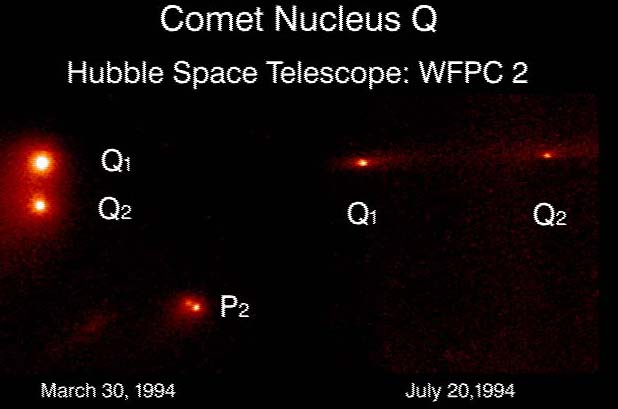
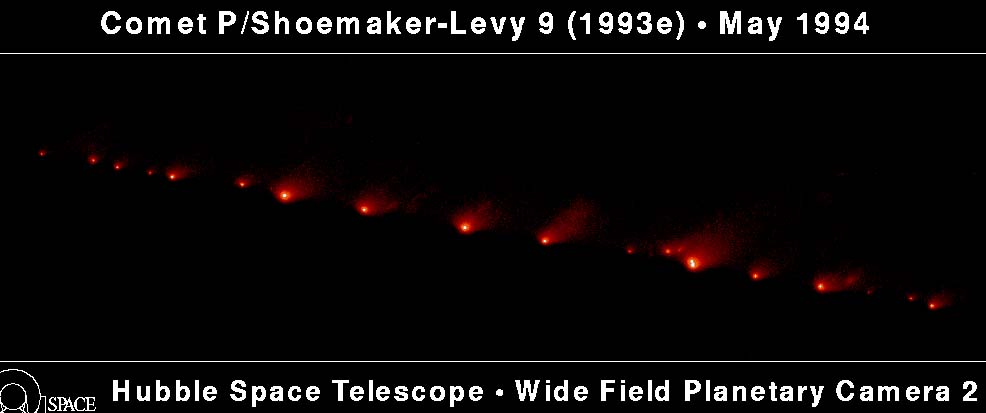
On the photos below, it can be seen that the clouds surrounding the objects emit in red (this is the real color). This is not the color of comets, usually, and it is also in this line that lithium emits. So here is a very strange comet. Cohen, for his part, supports the hypothesis of a pulverized mass that was dispersed after the fragmentation, near Jupiter. These micro-particles released would re-emit in red. The matter remains .. unclear, one must agree.
-
But the most incomprehensible fact is that this sequence of objects, which would have become emissive immediately after the fragmentation, located in time by calculation on July 8, 1992, would have escaped detection until March 1993. Of course, Jupiter is not observable anytime. The planets do not remain stationary. The Earth rotates. But the planetary configuration makes it that the event, detected by Schumaker and Lévy in March 93, could have been observed in the few months before, where the planet was still very observable. As soon as Jupiter is amenable to observations, it is immediately tracked by legions of astronomers. A. Cohen recalls that excellent photographs, after detection in 93, could be obtained by amateurs with small telescopes equipped with CCDs, having only ten centimeter mirrors! He also mentions programs conducted with wide-field telescopes, installed in large observatories, exploring the Jovian environment. The question at a hundred euros is therefore: why was there no detection in the months preceding March 1993, where the train of objects was supposedly already observable with relatively modest means? ---
**A.Cohen's comment: **
1/ Introduction and some images
The purpose of this document is to summarize the various characteristics of the SL9 object, to mention its sources, compare it with data established for known celestial bodies (comets, asteroids, Kuiper belt, etc.) to finally highlight the points that raise problems or require further investigation ****
The presentation will follow the chronological order of the event, namely: the comet's capture and orbit around Jupiter, fragmentation, observation before impact, observations during the impact, and post-impact observations.
Photos taken by the Hubble Space Telescope of SL9 present on many sites
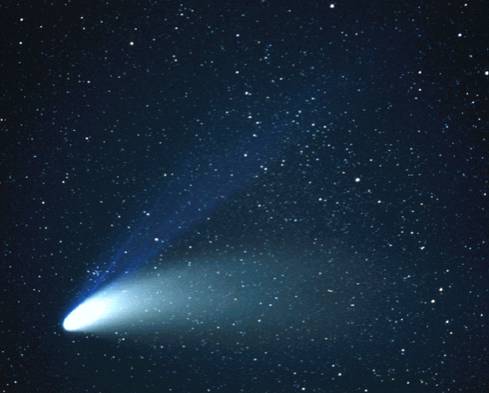
Above, a classic comet Hale Bope**
2/ Orbitography, discovery and non-detection before March 1993
The circumstances of its discovery are mentioned in several articles and sites, including (2), (3), (4):
***(2) « The comet of Schoemaker-Levy 9 », ***
(3) http://www.astrosurf.org/lombry/sysol-jupiter-sl9-2.htm which summarizes all episodes up to the impact with a beautiful gallery of photos
(4) http://www2.globetrotter.net/astroccd/biblio/berdtb00.htm which summarizes its detection by an amateur with a small instrument
However, according to the various articles on SL9, the analysis of the orbit made by astronomers (5) shows that it would have been captured around the years 1920/1930 by Jupiter and would have orbited around Jupiter without ever being detected until its breakup on July 7, 1992 (confirmed by Z Sekanina (16) Fig 2 with an accuracy of one hour) passing below the Roche limit before its detection in March 1993.****
It is generally normal for comets to be detected very late and usually by amateur astronomers, since the work and field of view of the giant telescopes of professionals do not generally allow it. However, in the case of SL9, this object orbited around Jupiter for more than 70 years, so it is not a random but repeated passage and in a plane close to that of the ecliptic (the orbital period is estimated around two years) .
2.1 Was it too weak to be detected?
We must distinguish here, two phases: before the disintegration and after the disintegration of the comet in the Roche limit of Jupiter on July 7, 1992
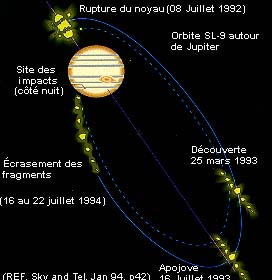
2.1.1 Detection after disintegration (after July 7, 1992)
In fact, as shown by the Quebec site (4), a small telescope of 10cm allows to record it, albeit weakly, and a telescope of 25cm leaves no doubt. Therefore, its detection is not the privilege of wealthy amateurs, but within the reach of owners of classical or modest instruments, especially since it is in the "suburb" of Jupiter, which is shot by amateurs.
It is evident that post-disintegration detection is possible and even certain as long as someone took pictures in this area between July 1992 and March 1993 . What is actually surprising is that thousands, if not millions, of amateur photos of Jupiter are taken. During the period July / August 1992, this object of global magnitude 13/14 near the immediate vicinity would have necessarily appeared in these photos. It would be extremely interesting to find them! ! No reference to professional photos of Jupiter at this time has been recovered to date. The detail below, extracted from the above Quebec site, reprints Sky and Telescope February 1994, gives a sky map to locate each month the position of Jupiter (at the top) and the comet (at the bottom) until the impact in July 1994 .
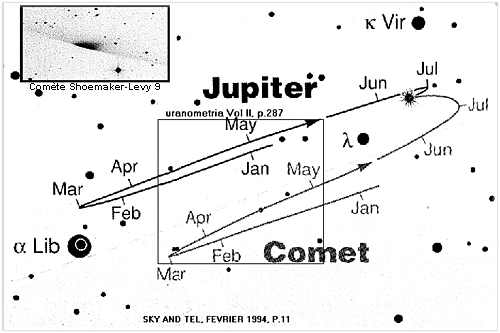
Below is an excerpt from the Quebec site, showing how an amateur with a modest telescope could have recorded it on his camera:
« I hurried to ask him for the exact position of the comet and he indicated that it was exactly where the ephemerides indicated. Examining my CCD images taken with my small 10cm telescope at F6, taken at the same time as Denis Martel, I realized that it was there, but it was very faint. I simply lacked resolution due to the short focal length of my small 10cm telescope. I reinstalled my camera on my main telescope and on March 11, 1994, I finally obtained my first image of the comet*. The magnitude of this one must have been around +16 and those of the nuclei +17 to +18**. As expected, its position was exactly where the ephemerides indicated. What a spectacle to see on the computer screen a comet that looked like a LINE OF POINTS IN THE SKY »*
« As equipment, I used a Meade Schmidt-Cassegrain telescope of 25cm F10 LX-200 equipped with a focal reducer lens from F10 to F6 (1500 mm focal length), a CCD camera SBIG model ST-6 and URANOMETRIA 2000 star maps, whose stars can reach magnitude +9.5. I had noted the positions of the comet in the American magazines «Sky and Telescope» and «Astronomy» and I had transcribed them on my maps. My first attempts began in February 1994. Jupiter was visible in the morning sky to the southeast and I had to get up around 03:00 to set up my instruments and try to locate the comet. I had to face polar cold with temperatures sometimes reaching -37°C. Remember the record cold of the winter of 1994! » (the problem of positioning comes from the already very narrow field of the 25 cm Cassegrain)
2.1.2 Detection before disintegration (before July 7, 1992)
At least two professional research programs did not detect it, one looking for distant objects in the Solar System (Kuiper Belt Jane Luu and David Jewitt) (6), the other looking for comets near Jupiter Tancredi and Lindgren (7), (8) .******
Article by Luu and Jewitt:
« Since 1987 we have started an observation campaign to find out if the Solar System is really empty beyond the orbit of Pluto or if it is populated with small cold bodies. To collect the weak light reflected by such distant stars, we abandoned the classic photographic plates and used electronic charge-coupled device (CCD) detectors, which are more sensitive, installed on a large telescope. We carried out most of our study on the 2.2-meter telescope at the top of Mauna Kea in Hawaii. With a CCD detector coupled to this telescope, we took series of four images of a region of the sky. Each image was exposed for 15 minutes and a computer displayed the sequence of the four images in a rapid succession. Objects that move slightly from one image to another relative to the background stars are members of the solar system . For five years we found nothing ..... »
Tancredi and Lindgren report a negative search for comets near Jupiter in 1992 during a search conducted at ESO in March 1992, that is, one year before the SL-9 discovery and several months before its disintegration by Jupiter. The telescope used was the 100 cm Schmidt telescope of the ESO. The detection magnitude limit was estimated at B = 21.5 (See Appendix 2 for calculation of the probable magnitude of SL9). What would be the characteristics of such an object at this distance for a magnitude of this order?
Referring to Z. Sekanina (14), (16), he deduces (14) §6 that the largest fragment has a diameter of about 4 km (assuming an albedo of 0.04), other objects are about 2 to 4 km (14) Figure 2 and (14) Table 1. As for the estimate of the size of the comet before its passage in the Roche limit, it is (Z Sekanina (16) § 6) about 10 km, with a mass of 1017 grams assuming a density of 0.2g/cm3. These values derived from measurements are confirmed by Sekanina's models (16) § 5.4.
According to J Crovisier (5) relying on Tancredi and Lindgren (7), the magnitude of 21.5 would have corresponded to a body of maximum diameter of 7.2 km .
It seems that this body could have been detected before its disintegration (the transition from 7 to 10 km corresponds to an equivalent surface doubled, therefore to a doubled reflection, so roughly to a gain of a small magnitude) .
It should also be noted that this estimate assumes the hypothesis that the comet was completely inactive before disintegration. In the other case, the observed magnitudes (D.E Trilling et al. (15) Figure 1 in red/blue/green), the different fragments (W, V, S, R, Q, L, K, H, G) have magnitudes ranging between 21.5 and 18 (with diameters of about 1 to 4 km !) and a magnitude in the red of about 18 to 19. One can also refer to G.P. Chernova et al. (11) Figure 1 which shows that the fragment Q (diameter of 4 km) has a visual magnitude of 18.2 and the smaller fragments (diameter of about one kilometer or less) have visual magnitudes of about 20.8 .
Consider also. D. Jewitt (9) Figure 2 where one sees a plot of all the fragments, whose magnitude with a red filter is between 17.5 and 19.2 in March 93 and 20 and 22 in June 1994. This shows that there is a decrease in the dissipation, which suggests that during the period July / August 1992 these magnitudes must have been higher (between one and two magnitudes, i.e. Mag 15/16?
Note on albedos, orders of magnitude: Moon: 0.073, Lava of Etna: 0.04, Basalt: 0.05, Ash of Vesuvius 0.16 (19) Atlas of Astronomy, Asteroid 951Gaspra 0.23, asteroid 253 Mathilde 0.04, Earth 0.36, Asteroids Carbonaceous chondrites type C (0.03-0.08 albedo) (20) The New Cosmos § 3.3.2 pp71
Mathilde is considered to have a very very low albedo .
**It therefore seems extremely surprising that this SL9 object went unnoticed for so many years . **
To continue in this direction, we will try to recover photos of professionals and amateurs of Jupiter during the period July 1992, we will also try to contact the authors Luu and Jewitt to know more precisely their detection limits, periods and observation directions during these 5 years .
At the current state, this aspect does not contradict the SL9 document, which, according to its logic, explains its absence simply because it did not exist before. Nothing allows to justify this non-detection, pre or post disintegration at this stage of the study nor the classic or "normal" nature of this object .****
We consider it very important to be able to recover photos of Jupiter and its surroundings during the period July 1992 to March 1993 .****
3/ SL9 a rare comet orbiting around Jupiter ? ?
***(6) « The Kuiper Belt » by Jane Luu et al. ***
« The Kuiper theory remained unknown until Paul Joss of the Massachusetts Institute of Technology calculated in the 1970s that the low probability of gravitational capture by Jupiter was not compatible with the large number of short-period comets observed . ....
In 1988, the Canadians Martin Duncan, Thomas Quinn and Scott Tremaine used numerical simulations to study how the giant gaseous planets captured comets. Just like P Joss, they concluded that the capture mechanism is inefficient ..... »
(19) The Solar System / Comets II pp 121 and 126
« The most remarkable perturbations are those during which a long-period orbit is transformed, during a close passage to a planet, into an ellipse whose aphelion is located approximately on Jupiter's orbit or a little beyond: the comets thus captured constitute a family of comets*. The Jupiter family* has 68 comets or even more, whose periods range from 5 to 8 years »
But of these 68, none are in orbit around Jupiter, all are around the sun. Cf p 126
It therefore appears that the capture even of this "comet" and its placement in orbit around Jupiter is an EXTREMELY RARE event in the life of the solar system. The analysis of the orbit of this comet shows that it extends up to the outer limit of Jupiter's gravitational zone .****
Consider now the observations that have been made on "the appearance" of this object:
D. Jewitt (9), « Physical observations provide no answer to the comet versus asteroid issue »
R.M West et al. (10), « The main result is therefore that each condensation has two « tails », a fainter one that appears « normal », and a stronger, clock-wise curved one that continues to be directed towards Jupiter. The reason for the presence of this anomalous tail and its shape is not known at present.
***G.P. Chernova et al. ***(11), « No change of appearance of the comet occurred when the comet passed minimum phase angle . This makes it likely that the tails of the subnuclei are synchronic i.e that dust production is not going on at the same time of the observations »
« As we observed the comet very close to opposition, the opposition angle of the tails close to the subnuclei should change significantly. The fact that this is NOT observed speaks against the idea of ongoing dust production as favoured by Sekanina. If, as we think, the tails are synchronic features, they would lie in the comet orbit plane, if the comet were moving under solar force only. Since the earth must pass this plane when the comet passes zero angle, the aspect of the tails as seen from the earth must change. As this was not observed we must conclude that, because of Jupiters influence on the cometary orbit, this orbit was not anymore located in a plane. Undoubtedly the mechanicial theory of comet tails, when applied to this peculiar object, can give important clues to the history of the observed dust cloud.
**J.A. Stüwe et al. (12), **« The average colour indices over all fragments and all data sets listed in Table 3 show that the dust of SL-9 is somewhat redder than the Sun, as is expected for sunlight reflected by micro-sized dust particles »
« Our analysis of the spectra in the range 320 nm to 940 nm is consistent with a solar spectrum reflected by the sun**, with NO additional emission** »
**F. Colas et al. ****(13), **« Only the grains larger than 0.1 mm can have stayed close enough to the fragments for two years to be observed on CCD frames. In our opinion, this is more likely to happened because we did not observe any structure in the cloud, as expected if it is a product of the fragments activity. » .../ ..
« this demonstrates that these grains can be residual of the comet breakup in July 1992, although part of it could come from a faint emission of small grain by the fragments. »
« The exact interpretation of these comae and tails is not obvious. It could be the result of a weak cometary activity or large dust or sub-fragments created during the break up in July 1992 »
**D. E. Trilling et al. ****(15), **« We do not find significant differences in color among the fragments. We find that the fragments are redder than the sun, and that the colors of SL9 are consistent with those of typical comet. However, changes in color with respect to distance from the center of the fragment are unusual . »
« On the other hand, Chernova et al. (1995) find a reddening trend with increasing distance up to 50 000 km for many but not all fragments. A trend in color with increasing distance may be an indication of a change in particle size distribution with increasing distance. »
Zdenek Sekanina (16), « Although the appearance of P/Shoemaker-Levy 9 was unquestionably unique among observed comets, certain similarities, however remote, can be found with two other tidally split comets, P/Brooks 2 (1889 V) and the Sungrazer 1882 II .
It seems that, upon analysis of the different observations (9,10,11,12,13,14,15,16), the atypical nature of this object is agreed by the majority. The same goes for the phenomenon of its capture and orbit (6), (19) .
The « tail » does not correspond to a classical comet tail and seems to be better interpreted by the residue of dust generated by the fragmentation of the « comet » during its passage in July 1992 (red color, millimeter/centimeter dust, fading, and especially G.P. Chernova et al. (11))), the spectroscopic aspect will also show (Cf. Infra) the complete absence of gaseous emission characteristics (OH, CN, ..), in addition, all the fragments appear completely identical.**
**At the current state, this does not allow to contradict the SL9 document (reddish halo due to the presence of fluorescent Lithium/Baryum reflecting the sunlight) . The fading aspect can be explained by a rarefaction of the gas, the non-production of dust (*G.P. Chernova et al. (11)) * **is evident in this case, the absence of outgassing as well. The slight difference in redness depending on the distance remains to be explained .
4/ Composition / Spectroscopy of the SL9 object before impact
**The SL9 document refers to the AMPTE experiment as a preamble to generate a fake comet. See the specific AMPTE file in Appendix 1, whose conclusions confirm that tests were indeed carried out with this objective, using artificial clouds of Barium and Lithium ions by the solar wind . ******
This is not enough at the moment to assert that the rest of the reasoning is true .****
It is also recalled UCL (21)
http://www.mssl.ucl.ac.uk/www_plasma/missions/ampte.html
« Lithium and baryum ions are good tracers ions since they are unusual in naturally occuring space plasmas, so a detection would almost certainly indicate that IRM had been the source »
University College of London (UCL) is the laboratory that provided one of the three satellites of the AMPTE experiment.****
We will therefore focus on studying all the spectral analyses and other ones that have been conducted by observatories around the world on the SL9 object****
It is emphasized that ALL the research conducted in the coma and carried out by both terrestrial telescopes and the HST, as well as by radio telescopes, have all been negative regarding all the following species: OH, CN, CO+, CO .
J.A Stüwe et al. (12) Table 4 « The spectral of the individual nuclei in this region show no evidence for molecular emission ../.. since no emission was detected, we determined 3 sigma upper limits to the CN production rate for the five fragments . The upper limits on Qcn are one order of magnitude lower than the values previously determined for the entire cometary train (Cochran et al., 1994 , Icarus) However our average value of log(Qcn)=23.4 is still in the range of production rate values actually measured for low activity comets like for example P/Howell (23.3) or P/Haneda-Campos 1978 J (23.6) » .
J. Crovisier (5) Table 2 Spectroscopic Limits (3 sigma) on gas production rates in SL-9 prior to the impacts, confirms the non-detection by 5 major professional observatories with a high limit of the same order .
When it is mentioned that such spectroscopic detections at distances greater than 5 UA are extremely rare, this argument is debatable, as detections have indeed occurred (Chiron 10 UA, P/SW1, 6 UA, P/Halley 4.8 UA) with less powerful means
J. Crovisier (5) §2 « Indeed recent radio observations of P/Schwassmann-Wachmann 1 (P/SW1) an active comet with a nearly circular orbit at Rh=6UA (i.e beyond Jupiter) revealed that its activity may be governed by CO sublimation . The cometary activity which is observed far from the sun now revealed in more and more comets with the increasing sensitivity of modern techniques is presumably due to the sublimation of such very volatile species .
No comet has been observed by as many teams, with as many telescopes, as well as as sophisticated and for as long. One can reasonably think that such detection methods used on comets in general would have shown many detections of these bodies at these distances .
**Hale Bope (23) ******
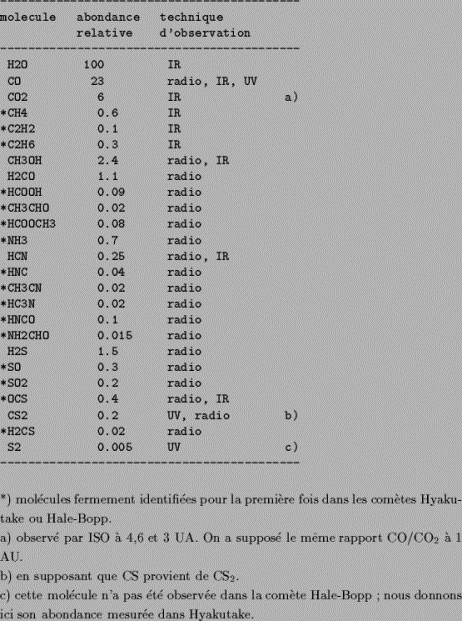
This comet has been studied in detail, and gives an idea of the orders of magnitude between the different species detected on a comet. One can assume that these ratios can vary widely depending on the observed bodies, nevertheless, the order of magnitude of the ratios of the major bodies should be characteristic.**** * ***** ** ** * *****
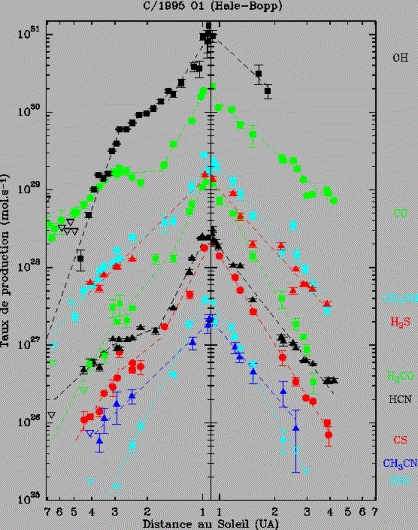
This second graph is very interesting because it gives an idea of the minimum distance from which the comet begins to evaporate and generate gases, as well as the type of gas and the order of magnitude of the amount associated with the distance from the sun in Astronomical Units .
It is evident that water and CO are predominant and by far and appear from about 5 UA .****
Regarding the absence of water, the distance from the sun of 5 UA, J. Crovisier (**5) §3, **it is a fact that the temperature reached does not allow the sublimation of water theoretically. Nevertheless, it has already been observed at these distances:
· detections have already occurred on other comets located at similar distances with emission rates much higher (10e29) Bowell 1982 I, J Crovisier (5) §3 / (A Hearn et al. 1984)
and (20) The New Cosmos § 3.1.2 pp 48
« On the other hand, infrared measurements for the major planets, Jupiter, Saturn, and Neptune indicate radiant losses which are 2 to 3 times greater than the absorbed solar radiation . Jupiter : 1.7 +/- 0.1 . This energy is due to the release of gravitational energy or to heat remaining from the time of the formation of the planets . »
· If one wants to make a complete energy balance of SL9, one must add to the solar energy received at the distance of Jupiter, the energy radiated by Jupiter itself which represents 70% of the previous one, as well as part of the solar energy reflected by Jupiter (Albedo 0.73, so 3/4 of the energy received by Jupiter from the sun is re-emitted) . If one looks at the orbital distance of SL9 to Jupiter even at its minimum, it is at 50,000 km. Considering the solar constant at the distance of 5.4 UA, Jupiter receives 45 W/m2 from the sun, its internal energy allows it to emit 32 W/m2 in addition to the reflection by Albedo of 31 W/m2, which means that SL9 would receive about 50 W total considering a cross section of 1 km2, negligible compared to the solar constant of 45 W/m2 .
Therefore, the "proximity" of Jupiter does not change the total energy received by SL09 in its course around the planet .
It is finally worth noting once again the hypothesis of the albedo retained in the detection calculations: 0.04 which is extremely low, and which means that 96% of the solar energy received is absorbed by the SL9 body, that is, about 43 W/m2, which corresponds to an equivalent temperature of 117 K. We find here the value displayed by J Crovisier of 120 K. It seems indeed likely that the temperature of the body is not sufficient for significant sublimation of water. Indeed, it is more likely that the real albedo is higher and in this case the temperature would be even lower .
In conclusion, we note that the absence of detection in SL9's coma of any type of gas (OH, CN, CO+, CO) across all wavelengths, by the most powerful ground-based and space telescopes, over long periods, by multiple experienced teams equipped with the best detectors ever built, is not fundamentally abnormal when considering OH radical detection. However, for CO species, the observations appear, in light of measurements from typical comets, to suggest either that comet SL9 is atypical due to its extremely low CO outgassing rate, or more likely, that no actual outgassing occurred.
Final point, extremely important: the fortuitous detection (by chance!) of Mg+ emission (doublet around 280 nm) observed by the HST on fragment G on July 14, 1994, four days before impact. To date, no solid, fact-based explanation has been found for this phenomenon.
J. Crovisier* (5) §3 p 9 / Weaver et al. 1995 ; Feldman et al. 1995*
5/ Conclusion on the analysis of object SL9 prior to impact
The analyses conducted before impact (§2/3/4) allow us to establish the following facts:
Object SL9 is, a priori, atypical—both in terms of its orbit, capture mechanism, lack of detection before March 1993, non-standard tail, and complete absence of outgassing. This atypical nature is confirmed or mentioned by the majority of cited authors.****
**((27) Sichao Wang et al.) **« No outgassing detected, only a small amount of water detected from dark spots (post-impact), and low albedo of the dark spots suggest that comet Shoemaker-Levy 9 is a new class of object different from known comets and asteroids. »
Let us attempt to classify these various elements in relation to potential explanations.
Legend: NC: Not compatible, C: Compatible, I: Further investigations required
SL9 Origin Comet Asteroid Type Doc SL9
Carbonaceous chondrites
Type C
No detection
Before disintegration NC/I1 NC/I1 C/I1
No detection
After disintegration NC/I1 NC/I1 C/I1
Dusty tail NC C C
No emission
Orbit C C C
Absence of outgassing NC/I2 C C
Reddish appearance / + red sun C C C/I3
Fading of red halo C C C
Albedo 0.04 NC C C
Detection of Mg++ C ? ? C C
Further investigations/information are needed on at least three points:
I1: Obtain images around Jupiter during July/August 1992
I2: Obtain very recent data on CO outgassing statistics for comets at distances greater than 5 AU
I3: Obtain additional information on the subtle color shift from red as a function of distance in the tail
At this stage of the study, none of the three possibilities can be ruled out. However, the hypothesis of a comet appears far less likely than that of a carbonaceous chondrite-type C asteroid—typically located in the outer asteroid belt—characterized by an extremely low albedo of 0.04 and low density, captured by Jupiter following gravitational perturbations.
The SL9 document hypothesis cannot be rejected either; all mentioned facts are consistent with the explanation provided in the document.****
The extreme improbability of capture, orbit, and non-detection remain highly problematic but are not yet decisive at this stage.
6/ Analysis of object SL9 post-impact
It should be noted that given the energy released during impact, strong recombination processes and diverse chemical reactions very likely occurred, partially or completely recombining all or part of the molecules and ions originally present in object SL9. (26) Borunov et al.
Therefore, spectroscopic studies allow identification of atoms, but certainly not of molecules, which may have had various origins and undergone extremely turbulent chemical histories. Furthermore, Jupiter’s composition—particularly in its upper layers (those affected by impact)—shows a complete absence of metallic elements, while clouds of varied composition are present, including NH3, NH4SH, H2O. Thus, it would be illusory to attempt to infer anything about the presence of such molecules or their post-impact derivatives.
It is worth noting preliminarily that the strongest impacts observed were not necessarily linked to fragments initially estimated to be the most massive. This has been emphasized by numerous observers.
6.1 / Post-impact Spectroscopic Analysis of SL9
J. Crovisier (5) §4 / The list of identified spectral lines is clearly reproduced in J. Crovisier’s document, and we reproduce a slightly more synthetic version below:
Table 4-1
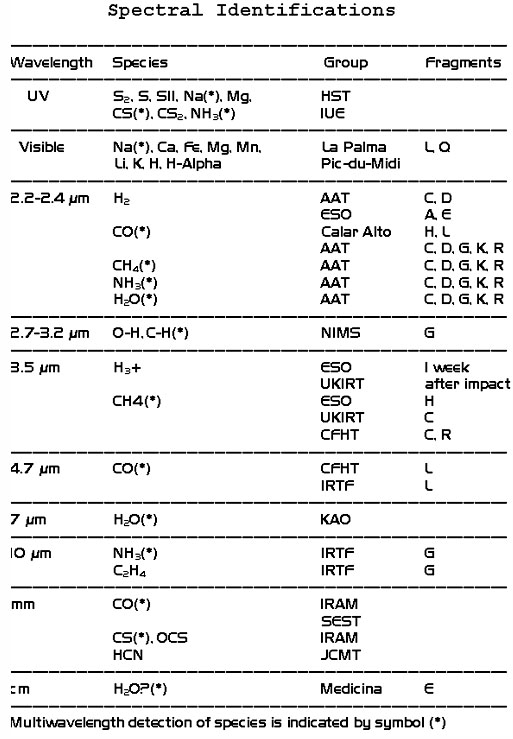
Another list is reproduced in (24) M. Roos-Serote et al. Table 2.
It emerges that some lines could not be identified, and moreover, extremely important lines of Na, Ca, Fe, and Li were observed post-impact by numerous observers.
The article notes that these were identified directly in the raw spectrum without any processing required! Moreover, detections of Mg, Mg+, Fe, and Fe+ were also confirmed. The lines are completely saturated, meaning that total quantity estimates cannot be made and can only result in a significantly underestimated value.****
Furthermore, the very high presence of Lithium (saturated lines) is extremely puzzling.
In (24) M. Roos-Serote et al.* « Metallic atoms or compounds are normally not present in Jupiter’s atmosphere. Therefore, we conclude the metals observed during impacts L and Q1 were released from cometary refractory material. Prior to the SL9 event, such atomic lines had only been observed in spectra from cometary material in meteor fireballs (Borovicka 1993, 1994) and in sun-grazing comets. The best-documented case is Comet Ikeya-Seki 1965 VIII, which approached the Sun to within just 0.0078 AU (i.e., within the corona) on October 21, 1965. Lines of several metal atoms (Na, K, Ca, Ca+, V, Cr, Mn, Fe, Co, Ni, Cu) were observed at that time, and relative abundances could be retrieved (Preston 1967; Arpigny 1979). The lithium resonant line could not then be detected.»
Sodium resonant lines were also observed in several comets that passed within less than 1 AU of the Sun. The elemental composition of Comet Halley’s dust, including metals up to nickel, was also investigated via in situ mass spectroscopy aboard the VEGA and Giotto space probes (Jessberger et al. 1988). Abundances close to solar were found for elements from Carbon to Nickel AGAIN Li WAS NOT OBSERVED. » J Crovisier (5) §4 p14 « Saturated line cannot exceed .... This intensity was exceeded for the lines observed by the IUE as well as for most lines observed in the visible »
See also reaction (28) http://www.jpl.nasa.gov/sl9/news35.html cited below
Let us now review reference compositions of comets, asteroids, and the solar system:
(5) J Crovisier Table 1, (24) M. Roos-Serote et al Table 4, (20) The New Cosmos § 7.2.7 Table 7.5 pp 216-217
Lithium is absent in comets; lithium is present in meteorites and the solar system, with a Li/Na ratio of 0.001. (20) The New Cosmos notes that lithium abundance in the solar system is about 1,000 times lower than in meteorites, as Li is gradually destroyed in solar nuclear reactions—but confirms the classic 1,000:1 ratio between Li and Na in meteorites, particularly carbonaceous chondrites of type C1.
Therefore, the detection of lithium in the post-impact spectrum proves that SL9 could not have been a comet.
The lithium abundance in SL9 is problematic if interpreted as an asteroid of type C1 chondrite, as it appears to be initially overabundant by a factor of 60! However, referring to (24) M. Roos-Serote et al Table 3, we observe that the sodium, calcium, and potassium lines are saturated—meaning their estimates are underestimated—while the lithium line is not saturated. In this case, a C1 chondrite interpretation remains possible and consistent with the classic 1,000:1 ratio, provided we accept an upward adjustment of sodium, potassium, and calcium quantities, consistent with underestimation due to saturation.
Regarding molecular lines, it is extremely difficult to draw any conclusions, given once again the immense impact energy and the potential for chemical reactions involving pre-existing components in Jupiter’s atmosphere. We find it extremely difficult to conclude on the origin of the detected water and other molecules, which could very well have resulted from post-impact recombination of jovian atmospheric constituents.
The only potentially discriminative measurement was not performed (Deuterium/H ratio).
(5) J Crovisier § 4.4 Clues from Aerosol / Nicholson et al. 1995
Aerosol detection was made in the 10-micron band immediately after impact of fragment R, at the Palomar Observatory, corresponding to silicates with an approximate mass of 6×10¹² grams, grain radii on the order of microns, and a density of 3.3 g/cm³.
Number of visits to this page since December 3, 2003:
Back to News Back to Guide Back to Home Page