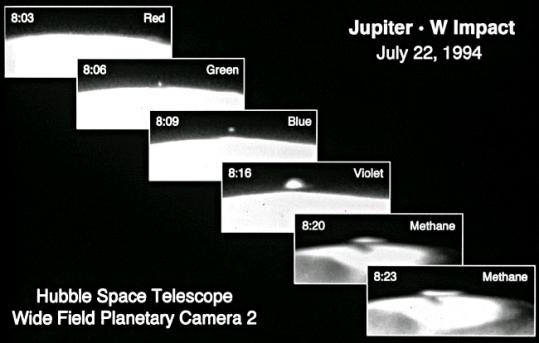
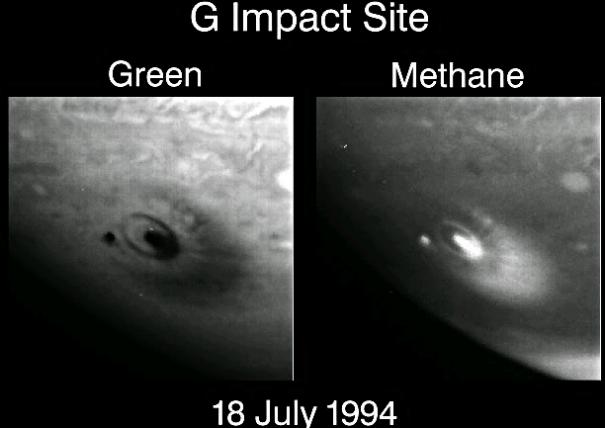
Schumaker Levy SL9 impacts on Jupiter
Summary of the study on the SL9 file
December 3, 2003
Second part
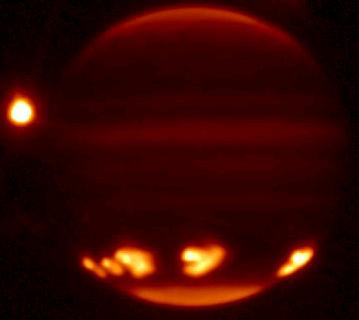
7/ Impacts - Photos
7/ Conclusions - Open points****
Taking back the table of partial conclusions of the analysis before the impact, it appears that
Legend: NC: not compatible, C: compatible, I: additional investigations to be carried out
SL9 Origin Comet Asteroid type Doc SL9
Carbonaceous chondrites
** type C**
Non detection
Before disintegration NC/I1 NC/I1 C/I1
Non detection
After disintegration NC/I1 NC/I1 C/I1
Dusty tail NC C C
No emission
Orbit C C C
Absence of outgassing NC/I2 C C
Red color / more red than the sun C C C/I3
Fading of the red halo C C C
Albedo 0.04 NC C C
Detection of Mg++ C ? ? C C
Silicates C ? ? C NC
Lithium lines NC C C****
Absence of Barium C C NC ?
The additional information (Lithium line, Silicates, absence of Barium) allows to advance in the interpretation. It is not a comet (absence of Li)
The hypothesis of an asteroid of type Carbonaceous Chondrite C1, in the outer asteroid belt captured by Jupiter, allows to explain all the observations: absence of outgassing, very low albedo 0.04 explaining the non-detection at the extreme limit (a point that remains problematic), pseudo-tail composed of debris from the dislocation, presence of Silicates, Lithium line coherent with the others if one takes into account the differential saturation.
Regarding the SL9 document, the presence of Silicates and the detection of many metals is problematic as well as the complete absence of Barium.
Regarding the amount of energy from the impact, taking the following hypotheses (Z Sekanina (16) § 6, mass of 1017 g, diameter of 10 km, density of 0.2, speed of 10 km/sec (and not 60 km/sec because it is certainly more accurate to take the classical entry speed of meteors after atmospheric braking to calculate the energy at the point of impact), this gives an energy of the order of 5. 1021 Joule, or in equivalent E = mc2, a total mass of the order of 50 tons (half of antimatter), for the sum of all the impacts.
Taking an entry hypothesis of 30 km/sec, globally we would have about 500 tons, or about 250 tons of antimatter to produce for the sum of all the impacts.
For the most important impact corresponding to the 4 km diameter fragment, with an entry speed of always 30 km/sec (very likely greatly overestimated), 32 tons, so half of antimatter to produce.
Therefore, the orders of magnitude of mass to carry are not in contradiction with the carrying capacity and the number of trips.
Therefore, the most probable hypothesis seems to be that of a Carbonaceous Chondrite C1 asteroid, the comet hypothesis must be eliminated, as for the SL9 hypothesis, it does not explain the presence of silicates, many metals and the absence of barium, although all the mass calculations are consistent.
The only point remaining to clarify is the non-detection before Mars 1993, only photos taken of Jupiter during the months of July / August 1992 would allow to finally settle the question.
****
8/ Bibliography
(1) * European SL-9/Jupiter Workshop February 13-15 1995 ESO Headquarters, Garching bei München , Germany Proceedings N° 52 Edited by R. West and H. Böhnhardt ISBN 3-923524-55-2*
(2) « The comet of Shoemaker-Levy 9 », Pour La Science Special Issue April 1999 « The Celestial Lands «
(3) http://www2.globetrotter.net/astroccd/biblio/berdtb00.htm
(4) http://www.astrosurf.org/lombry/sysol-jupiter-sl9-2.htm
(5) Observational Constraints on the Composition and Nature of Comet D/Shoemaker-Levy 9 Jacques Crovisier Observatoire de Paris Meudon
(6) Pour La Science Special Issue April 1999 The Celestial Lands pp 120-126 Jean Luu and David Jewitt 1999 The Kuiper Belt
(7) Searching for Comets encountering Jupiter : first campaign Icarus 107, 311-321 Tancredi G. Lindgren M 1994
(8) IAU Circ N° 5892 Tancredi G. Lindegren M, Lagerkvist CI (1993)
(9) Pre-Impact Observations of P/Shoemaker-Levy 9 David Jewitt Institute for Astronomy, 2680 Woodlawn Drive, Honolulu, HI 96822
(10) A Morphological Study of SL-9 CCD Images Obtained at La Silla (July 1- 15, 1994) RM West (ESO), RN Hook (ESO), O. Hainaut (Institute for Astronomy, Honolulu, Hawaï, USA)
(11) Imaging Photometry and Color of Comet Shoemaker-Levy 9 G.P. Chernova, N.N. Kiselev, K Jockers , Max Planck Institut für Aeronomie, Postfach 20, D-37189 Katlenburg-Lindau Germany
(12) NTT Observations of Shoemaker-Levy 9 Imaging and Spectroscopy J.A Stüwe, R Schulz and M.F. AHearn , Max Planck Institut für Aeronomie, Postfach 20, D-37189 Katlenburg-Lindau Germany, Department of Astronomy, U of Maryland , College Park, Md 20742 USA
(13) Pre-Impact observations of Shoemaker-Levy 9 at Pic du Midi and Observatoire de Haute Provence F Colas, L Jorda, J Lecacheux, JE Arlot, P Laques, W Thuillot, Bureau des Longitudes, 3 rue Mazarine, F-75003 Paris FRANCE, Observatoire de Paris-Meudon, ARPEGES, F-92195 Meudon Cedex FRANCE, Observatoire du Pic du Midi, Bagneres de Bigorre, FRANCE
(14) Nuclei of Comet Shoemaker-Levy 9 on images taken with the Hubble Space Telescope, Zdenek Sekanina, Jet Propulsion Laboratory, California Institute of Technology Pasadena, California 91109, USA
(15) Observations of P/Shoemaker-Levy 9 in Johnson B, V, and R Filters from Calar Alto Observatory on 2/3 June 1994, D.E. Trilling, H.U. Keller, H. Rauer, R. Schulz, N. Thomas Max Planck-Institut für Aeronomie, 37189 Katlenburg Lindau Germany
(16) The Splitting of the Nuclueus of Comet Shoemaker-Levy 9, Zdenek Sekanina, Jet Propulsion Laboratory, California Institute of Technology Pasadena, California 91109, USA
(17) Dust Magnetosphere Interaction at Comet Shoemaker-Levy 9 Impacts W.-H .Ip Max Planck Institut für Aeronomie, Postfach 20, D-37189 Katlenburg-Lindau Germany, Department of Astronomy
(18) Some timing and Spectral Aspects of the G and R Collision events as observed by the Galileo Near Infrared Mapping Spectrometer, R.W. Carlson, P.R. Weissman, J Hui, M Segura, W.D. Smythe, K.H. Baines,T.V. Johnson (Earth and Space Sciences Division, Jet Propulsion Laboratory), P. Drossart and T. Encrenaz (DESPA, Observatoire de Paris), F Leader and R Mehlman (Institute of Geophysics and Planetary Physics UCLA)
(19) Atlas dAstronomie Stock (1976)
(20) The New Cosmos 5th Edition - 2002 An Introduction to Astronomy and Astrophysics A. Unsöld / B. Bascek Springer
(21) University College of London Exp. AMPTE http://www.mssl.ucl.ac.uk/www_plasma/missions/ampte.html
(22) SL9 Composition http://www.seds.org/~rme/sl9.html
(23) Typical composition of a comet Comet reference: Comet Hale Bope **
*Référence : Bockelée-Morvan, D., Lis, D. C., Wink, J. E., Despois, D., Crovisier, J., Bachiller, R., Benford, D. J., Biver, N., Colom, P., Davies, J. K., Gérard, E., Germain, B., Houde, M., Mehringer, D., Moreno, R., Paubert, G., Phillips, T. G., Rauer, H. : 2000, New molecules found in comet C/1995 O1 (Hale-Bopp). *Investigating the link between cometary and interstellar material. Astronomy and Astrophysics 353, 1101
Contacts : Dominique Bockelée-Morvan, Jacques Crovisier, Observatoire de Paris, ARPEGES
(24) Pic du Midi Observations of Atomic Lines Following impacts L and Q1 of Comet SL-9 with Jupiter / M. Roos-Serote, A Barucci, J. Crovisier, P. Drossart, M. Fulchignoni, J. Lecacheux and F. Roques Observatoire de Paris (Section de Meudon)
(25) Fast Spectral Variability of the Plumes on Jupiter from the Secundary Nuclei of D/Comet Shoemaker-Levi 9 / Churyumov K.I, Tarashchuk V.P. (Astronomical Observatory of Kiev University, Ukraine), Prokofeva V.V (Crimean Astrophysical Observatory , Ukraine)
(26) High temperature chemistry in the fireball of the SL9 impacts / S Borunov, P. Drossart, Th Encrenaz / DESPA, Observatoire de Paris-Meudon
(27) Observations and Studies of Chinese Jupiter Watch / Sichao Wang, Bochen Qian , Keliang Huang / Purple Mountain Observatory Chinese Academy of Sciences, Shangaï Observatory, Department of Physics Nanjing University
(28) Spectral SL9 composition .. http://www.jpl.nasa.gov/sl9/news35.html
| ANNEXE 1 |
|---|
****| Experience AMPTE |
|---|
** **
Active Magnetospheric Particle Tracer Explorers
1/ Links and Existence
The AMPTE experiment is cited in the SL9 document as a preliminary experiment that was used to test the camouflage of the SL9 object by releasing lithium and barium ions that would have been made fluorescent by the solar wind, thus giving the illusion of a comet .
This memo aims to
-
verify if this experiment actually took place
-
describe this experiment with references - identify the exact role of the ions - see what are the hypotheses and constraints necessary for it to be transposable to the SL9 case
The AMPTE experiment did take place . It was the subject of a joint development by Germany, England and the USA . It consists of three satellites :
CCE : Charge Composition Explorer IRM : Ion Release Module UKS : United Kingdom Satellite NASA Germany obviously GB Applied Physics Laboratory John Hopkings Laboratory Max Planck Institute for Extraterrestrial Research Mullard Space Center (UCL)
Source : NASA Historical Handbook pp 386-388 and Table 4-36, 4-37, 4-38
The three were launched on August 16, 1984 on elliptical orbits :
Type CCE IRM UKS Apogee 49 618 km 113 818 km 113 417 km Perigee 1174 km 0402 km 1002 km Inclination 02.9° 27.0° 26.9° Period 939.5 mn 2653.4 mn 2659.6 mn Mass 242 kg 705 kg 077 kg End of life 14/07/1989 November 1987 out of service after 5 months
The IRM module contains (among other things) 16 ejection boxes assembled in pairs, 8 containing a mixture of Li-CuO and 8 others containing Ba-CuO, which when fired more than one kilometer from the satellite ejects hot lithium and barium gas .
Source : NASA Historical Handbook pp 455 Table 4-37 « Ion Release Module Characteristics »**
The modules contain a wide variety of measuring devices, spectrometers, ion analyzers, magnetic field meters, particle energy analyzers, etc. etc. ..
One of the missions of AMPTE is to (among other things): « Study the interaction between an artificially injected plasma and the solar wind »
It is also clearly mentioned: « One expected result was the formation of artificial comets, which were observed from aircraft and from the ground »
Source : NASA Historical Handbook p 386
There were four lithium / barium ejections. It is clearly mentioned:
« In addition to the spacecraft observations, ground stations and aircraft in the Northern and Southern Hemispheres observed the artificial comet and tail releases »
It is also worth noting and will be mentioned in other articles:
« No tracer ions were detected in the CCE data , a surprising result, because, according to accepted theories, significant flux of tracers should have been observed at the CCE »
as well as: « The spacecraft also formed two barium artificial comets. In both instances a variety of ground observation sites obtained good images of these comets » .
Source : NASA Historical Handbook p 387
The ejections can be precisely dated:
http://sd-www.jhuapl.edu/AMPTE/ampte_mission.html
2 lithium clouds on September 11 and 20, 1984
2 artificial barium comets on December 27, 1984 and July 18, 1985
2 barium and 2 lithium ejections on March 21, April 11, April 23 and May 13, 1985
A map of the ejections is given:
http://www-ssc.igpp.ucla.edu/personnel/russel/ESS265/CR-1863.html
where it is seen that the lithium clouds seem extremely extended while the barium comets are much more compact .
All the experiments are described in more detail on the sites:
http://nssdc.gsfc.nasa.gov/database/MasterCatalog
Hot Plasma Composition Experiment (HPCE) NSSDC ID: 1984-088A-1
Etc etc .. MEPA / CHEM/MAG/
The complete description is given in* IEEE Transactions on Geoscience and Remote Sensing GE-23 1985 Special Issue*
What is unfortunate is that the 6.4 minutes CDAW9 Mass Energy Spectra Data on Magnetic Tape concerning the HPCE of the CCE NSSDC ID: SPMS - 00170, 84-088A-01C is classified! it depends on the Applied Physics Laboratory, contact Mr. Stuart R. Nylund stuart_nylund@jhuapl.edu
An interesting description is given in: Ion Release Experiment NSSDC ID: 1984-088B-1
Mission name: AMPTE/IRM
Where it is said that a pair of Li/Ba containers produced a total of 2E25/7E24 Li / Ba atoms .
See particularly the article: IEEE Transactions on Geoscience and Remote Sensing GE-23 1985 Special Issue p.253 G. Haerendel
Principal investigator: Dr Arnoldo Valenzuela Max Planck Institute
As well as Dr Gerhard Haerendel, investigator Max Planck Institute, hae@mpe.mpg.de
It is therefore established that the AMPTE experiment did take place. It did release barium and lithium ions in order to study the Earth's magnetosphere and to create artificial comets (and/or clouds?).
2/ Role of Lithium and Barium Ions****
The articles are retrieved through www.ntis.gov, then using the search engine
It is worth noting that the site: http://library.lanl.gov/catalog has removed all online articles, including:
« Observations and Theory of the AMPTE magnetotail barium releases » LA-10904-MS
Los Alamos Technical Report
Even by going through: http://nuketesting.enviroweb.org/lanltech
Or http://www.envirolink.org/issues/nuketesting/
« Simulation of Ampte Releases: A Controlled Global Active Experiment.
Science and Engineering Research Council, Chilton (England). Rutherford Appleton Lab.;
California Univ., Los Angeles. Dept. of Physics. »
Product Type: Technical report
NTIS Order Number: PB91-224782
Page Count: 31 pages
Date: Jan 1991
Author: R. Bingham, F. Kazeminejad, R. Bollens, J. M. Dawson
The Ampte spacecraft releases in 1984 involved two chemical species: Lithium which ionizes by photoionization in about 1 hour and barium which ionizes in about 30 seconds. Both types of chemicals were used to study different physical processes, the lithium releases were used to investigate the path solar wind particles enter earth's magnetosphere the barium releases were used to investigate the interaction of a neutral gas and a flowing plasma. The barium releases produced for the first time man-made artificial comets while the lithium releases produced the largest man-made objects. The Ampte releases have been simulated using 2- and 3-D hybrid codes with kinetic ions and massless fluid electrons. The codes are generalized to include the production of plasma by a gradually ionizing gas in a flowing plasma. In the simulations of the AMPTE artificial comet, the authors have been able to demonstrate the generation of a diamagnetic cavity, which slows and deflects the solar wind protons, comet particle acceleration and the sideways deflection of the comet head and density ripples appearing on one side of the comet head which are explained in terms of the Rayleigh Taylor instability.
Report Number: RAL-91-006
Contract Number: N/A
Project Number: N/A
Task Number: N/A
NTIS announcement issue: 9121
Two points are particularly worth noting: the barium ions produced the first artificial comets and the lithium ions produced the largest objects ever made by man .
It should also be noted in a second report, that the barium ions would be the cause of the formation of a more or less unstable diamagnetic cavity in the solar wind .
This instability is also mentioned in « Hall magnetohydrodynamics in space and laboratory plasmas » by J.D Huba
Beam Physics Branch, Plasma Physics Division, Naval Research Laboratory, Washington DC 20375
Phys. Plasmas 2 (6) June 1995 pp 2504-2513,
Where it is mentioned the AMPTE experiment (and also its successor the CRRES experiment G-10 on January 20, 1991):
« During the NASA AMPTE mission, barium releases were made in the earth magnetotail at an altitude R = 11 Re. In these experiments, the neutral barium atoms expand radially with a velocity of 1 km/sec and photoionize on a time scale of 28 sec . The ensuing plasma expansion is a high kinetic beta plasma (betak= 4piMoVo²/B²>>1, where Mo is the mass of the barium ions) and is sub Alfvenics (Vo<<Va=180km/sec). The following dynamic occurred: (1) the barium plasma formed a dense shell ; (2) a diamagnetic currents were set up on the surface of the shell which generate a magnetic cavity ;(3) the expansion stopped when the initial kinetic energy was comparable to the « swept up » magnetic field energy ;(4) the magnetic cavity eventually collapsed, returning the system to prerelease conditions .
One unexpected feature of the experiment was the onset of instability during the expansion phase of the releases, large scale, field aligned density perturbations formed on the shell. ... additional high-altitude barium releases were made during the NASA CRRES (Combined Released and Radiations Effects Satellite) mission, and similar phenomena were observed . During the CRRES G-10 release, analysis of in situ magnetometer data revealed large scale oscillations in the magnetic field . Finally , Hall MHD has also been used to explain the unexpected transverse motion of the AMPTE barium release in the solar wind . »
It seems that there are poorly understood interaction phenomena, the non-detection of ions (Li and Ba) after the ejections is highlighted in several papers:
http://www-ssc.igpp.ucla.edu/personnel/russel/ESS265/Ch3.html
http://www-scc.igpp.ucla./edu/scc/textbook/mmm.html
in « Multipoint Magnetospheric Measurements » Advance in space Research 8(9) . Pergamon Press Oxford 1988
« Studies of the interaction with the cloud were spectacularly successful but no ions were detected in the inner magnetosphere as a result of these releases » .
and finally
http://www-istp.gsfc.nasa.gov/Educatcc/Sconct15.html
« Clouds of barium ions » which explains the method and the appearance with a beautiful photo « soon a bluish ion cloud separate from the green one, usually elongated or striped in the direction of the magnetic field lines, which guide the ions » without forgetting the lithium clouds
http://spacelink.nasa.gov/NASA.Projects...tmosphere/CRRES/Status.reports/91-01-18
A lithium canister was ejected from the satellite as planned, resulting in formation of a glowing reddish cloud at 11 :20 pm CST (Jan. 17)
**The two types of ions are used, Barium and Lithium. ****Barium appears green with slight blue traces. **Lithium appears red
**It seems ? ? that Barium is unstable ? **It seems that Lithium forms more stable traces over larger areas ?
It remains to clarify Barium, which has not been detected / observed .
The lines should be:
** Neutral Ba : 553.5 nm**
** ****Ionized Ba : 455.4 nm / 493.4 nm , **the strongest being at 455.4 nm
**http://ftp.aer.com/users/pad/moddpac/v062001.ps ******
It is worth noting that it comes from the spectrum of Pic du Midi and is at the limit for La Palma
**( Pic du Midi (5500-7000 A) and La Palma (INT; 4000-6000 A) **
Other observatories have not observed in this spectral range .**** ---
Annexe 2
Estimation of the magnitude of SL9
before its disintegration
on July 7, 1992****
Taking the following hypotheses P = 45W/m2 (i.e. solar constant on Jupiter)
Body diameter: 10 km, albedo: 0.04,
we deduce:
Radiated power: 1.8 108 Watts
Power received on Earth: 4 1017 Watts/m2 (I rounded Jupiter - Earth to 4 AU)
I took as reference the standard star Vega (Alpha Lyrae) Mag 0 approximately whose spectral distribution is given Fig 6.7 p 176 of "New Cosmos"
Average spectral density: 5 10-11 W/m2/nm
I approximated an average spectral density over the spectrum of 400 to 800 nm and integrated to have the average power in the visible as a reference of magnitude 0 .
Then applying the classic Pogson formula (M2-M1=-2.5 logM2/M1) we find a visual magnitude of the SL9 object of 21.7 .
This roughly confirms Lindgren's calculations, indeed the star is blue, but the sensitivity of its plate or its CCD at the time is certainly rather red, the distance values are slightly rounded, nevertheless the order of magnitude is there.
If we change the albedo: very low passing from 0.04 to 0.08 we gain 0.75 Mag (the equivalent of a diameter change by a factor of square root (2)).
Therefore, the magnitude of the object (if it did not emit) before its disintegration at the Roche limit passage, should be in the range of Magnitude 21 / 22 .
This means that it was certainly at the detection limit, one would need the exact characteristics of the 1 m Schmidt telescope of ESO and the plates or CCDs at the focal plane to conclude by calculating the necessary S/N ratio, but globally we can really say that it is at the limit of detectability .
(It should not be forgotten that the sky noise is of the order of Mag 22 per square arcsecond)
Therefore, it is not impossible that its detection failed, it depends essentially on the detection equipment and the exposure times that were carried out during this search . ****
** Number of visits to this page since December 3, 2003** :
Return to News Return to Guide Return to Home Page