Davy Crocket A (mini) tactical nuclear weapon (1961)
February 17, 2005
The Davy Crocket weapon (shown here on the Maryland test range, in March 1961) is the smallest operational nuclear device (known) developed to date by the Americans (but it is known that there were many variants of these mini-nuclear weapons, some of which could be carried in backpacks by commandos or transported underwater by combat swimmers). The Davy Crocket device had been designed to be used in Europe against concentrations of Soviet troops. The range of this device is 1.24 miles (a little more than two kilometers). It is a device that weighed about thirty kilos and whose maximum diameter was 27 centimeters. With such a short range, this device would have been practically as dangerous for those who deployed it as for those who were targeted, because of the fallout. This shows how little regard the Americans could have, even at the beginning of the sixties, for the lives of their own soldiers.
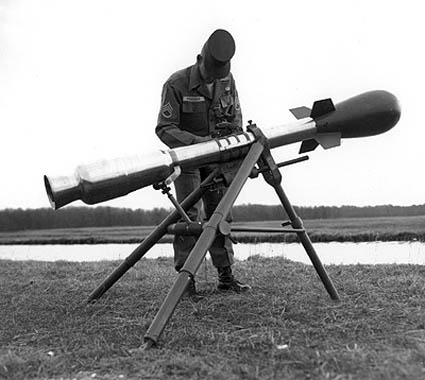
The "Davy Crocket" short-range tactical atomic bomb
In 1961 there was thus a hallucinatory trivialization of the nuclear weapon, as if it were a weapon like any other. It is likely that the operation commanders, after sending such a weapon toward the enemy, would have exclaimed: "good, now, guys, forward!".
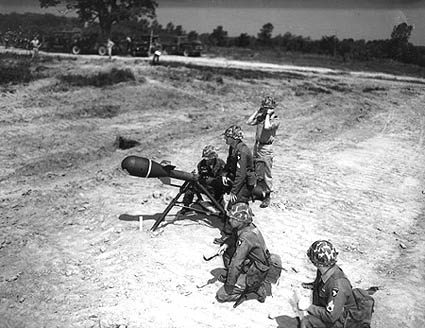
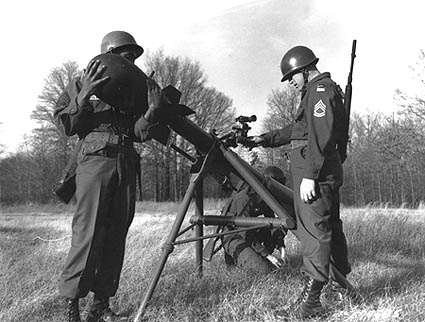
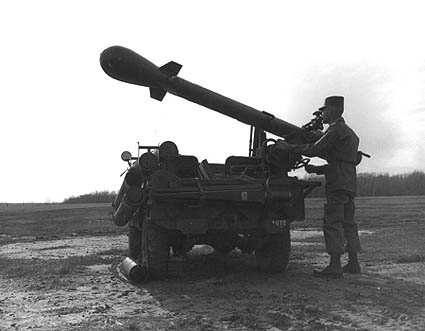
Here, the Davy Crocket mounted on a Jeep
The nuclear warhead used on the Davy Crocket weighed just 25 kilos. It was a fission device. (with a so-called implosion charge, a hollow plutonium shell, surrounded by chemical explosive). The yield was 10 tons of TNT. A variant, the B 54, was used between 1964 and 1989 by the SADM (Special Atomic Demolition Munition). Its weight was 30 kilos and its yield ranged from 20 to 1000 tons of TNT. This device was deployed in Europe, South Korea and on the island of Guam as a mine. In fact the reduction of the bomb's yield was obtained with a "malfunction", by reducing the fission yield, but not the mass of plutonium used and the extent of the toxic releases.
Between 1956 and 1963 more than two thousand of these devices were produced, for a total cost of half a billion dollars. The W54s were tested at the Nevada site, the yields corresponding to 18-22 tons of TNT. These were the last atmospheric nuclear explosions carried out by the Americans in the presence of Attorney General Robert F. Kennedy. The file was declassified in 1997.
**Sources:**U.S. Nuclear Weapons Cost Study Project; Thomas B. Cochran, William M. Arkin, Milton M. Hoenig, U.S. Nuclear Forces and Capabilities, Volume I, Nuclear Weapons Databook (Cambridge, Massachusetts: Ballinger Publishing Company, 1984), pp. 60, 311; Robert Standish Norris and Thomas B. Cochran, "United States Nuclear Tests: July 1945 to 31 December 1992," (Washington, D.C.: Natural Resources Defense Council, 1 February 1994), NWD-94-1, p. 35; Chuck Hansen, U.S. Nuclear Weapons: The Secret History (New York: Orion Books, 1988), pp. 197-198; Ted Nicholas and Rita Rossi, U.S. Historical Military Aircraft and Missile Data Book (Fountain Valley, California: Data Search Associates, 1991), pp. 3-95, 3-101; U.S. Department of Energy.
Back to New Items Back to Guide Back to Home page
Number of visits to this page since February 17, 2005: