Footballers net of taxes
May 27, 2005
Here is an article written by one of my readers, very well informed, since he works in the tax administration. Nowadays we see a "two-speed" society being built, to use the established expression. We know that politicians already enjoy impressive advantages and substantial salaries, otherwise they would not fight to win their seats. And that even if they are not corrupt.
Depending on whether you are powerful or miserable, the tax authorities do not hit you the same way. As Largo Winch says in one of the comic books of his series:
*- We pay taxes in the countries where our companies are domiciled. *
In these comics, all his companies are domiciled in ... Liechtenstein.
That is what these tax havens like Monaco are for (why does this "country" so "sporty" have such a prominent football team?), Liechtenstein, the Cayman Islands, etc.
Large multinationals can relocate their activities to countries where social charges and taxes on profits are the lowest. On the other hand, French craftsmen, who employ French people and cannot domicile their company in Liechtenstein, take it full in the face. And that is not from yesterday.
When I think of Chirac I say to myself "how can one lead a population where there are lots of people who eat for two euros a day (I have a friend who is in that situation) while living in ... a castle?" (restored at the state's expense as a building classified as a historic monument and whose surrounding land was bought back by a humanitarian association, the Georges Pompidou foundation).
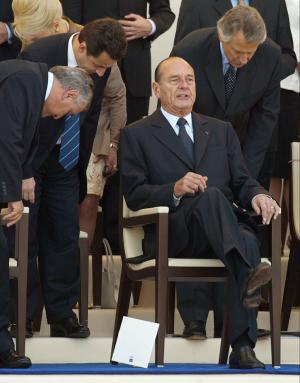
The footballer, the star team play an important role in French political life (according to the old principle "bread and circuses"). It was therefore normal that the political class do its best to prevent them from going off to reinforce foreign teams. You will find below how they go about keeping our football stars in "our national teams".
Footballers net of taxes
Unknown author. Found on the "internal messaging on the tax service" by Guillaume Dereuder, who describes himself as a "fouinaute"
The tax exemption for professional players is a tailor-made law in France, or offshore accounts for the Arsenal gunners, making it possible to "save" millions in tax... On October 14 last, the National Assembly adopted the bill from two UMP deputies, authorizing the remuneration of professional athletes in the form of "image rights". 30% of the gross salary of these athletes, henceforth treated as "artists", escapes employer charges and defines a more favorable taxation for the players, to the great happiness of all — and of the League in particular, which had made this measure one of its priority political objectives. Welcomed in general indifference, this law proved that one could make tax exceptions for slices of "citizens" as privileged as footballers, without the ordinary taxpayer finding anything to say about it, although it is he who finances the gift...
Footballers, these dear intermittent workers of the entertainment industry
The measure was then discussed as to its methods of application. Thus, it supposedly assumed a priori that the footballer would henceforth have to declare himself as a self-employed worker, and therefore, as such, invoice his image rights and thus pay VAT, the business tax. But that was asking too much of them, and Jean-François Lamour insisted that they be exempted from these taxes and social contributions, as Frédéric Thiriez, president of the League, had urgently requested.
All those who, in this country, work "freelance", will appreciate not benefiting from the same largesse despite the precariousness of their status and their income. Not everyone has the luck to have Thiriez as a lawyer. "In the end, our athletes should escape all the taxes that could be collected on image rights except the CDG and the CRDS, and obviously income tax (...) Morality, the law exempts athletes (...), the league defines the conditions for implementing the law and the taxpayer pays the charges!", noted the site infosport.org at the end of January last. Negotiations also took place between the UCPF (the organization of the clubs) and the UNFP (the players' union) on this "collective right to image", resulting in a text that applies to players whose emoluments are at least 120,000 euros gross annually (1). It is now L2 — by lowering the ceiling to 60,000 euros, as the law allows —, but also the other professional sports, that hope to obtain similar provisions.
Off-shore, of course
As L'Équipe magazine pointed out (26 March), the principle of image rights was already in force in many clubs, under particularly opaque conditions — in particular with the payment of sums to players into offshore accounts, for example via the foreign subsidiaries of the club's sponsors. The experts interviewed by the weekly doubt that these practices will cease entirely, but believe that reducing the "tax disparities" between France and neighbouring countries would make it possible "to stem the flight of our best players abroad". One may doubt it, because the lure of a juicy transfer, immediately lucrative, will never cease to be a temptation for our training clubs... In any case, the dogma of "French football handicapped by national taxation" is only a worn-out ideological tool, and even in a country as generous with big salaries as England — the official paradise of the football business — clubs still find the motivation (and the means) to escape tax. Thus last July, the Sunday Times revealed the legal (!) tax-avoidance scheme set up by Arsenal. The hare was started under rather picturesque conditions, since it was because of financial disputes in the context of Ray Parlour's divorce that the arrangement was revealed... The latter allowed the players (and Arsène Wenger) to reduce their taxation by 25%.
The information was almost totally ignored in France, despite its particularly edifying nature. We reproduce here extracts from the article by Robert Winnett and David Robertson, published last 18 July (2).
**
"Arsenal stars divert millions in tax" - Sunday Times**
Arsenal, top of the first division, has set up a tax-avoidance scheme for its players and its manager. Thanks to anonymous shell companies and offshore trust companies, the club can provide substantial rewards to its players and ensure that they escape tax on a few million pounds sterling each year. [...] Thus, foreign players such as the French striker Thierry Henry or the Dutch star player Dennis Bergkamp, as well as the sporting director Arsène Wenger, are "exempt from tax" on their six-figure bonuses [...].
These players in fact sign two contracts. The first covers a basic annual salary taxed for the most part in the classic way at the maximum rate of 40%, to which the social contribution is added. However, the players also have a second "ghost" contract concerning bonuses linked to their results [...]. These bonuses can represent up to half of their total remuneration and are paid through two shell companies. It was in 2001 that Arsenal set up, as discreetly as possible, a company under the name Sevco 1270, a company whose players of its flagship team are shareholders. The club's official accounts do not mention the existence of this company, whose purpose is to ensure the payment of match bonuses in the form of dividends.
The most recent tax documents from Sevco reveal that these payments were made to a trust firm established in the Anglo-Norman island of Jersey. Through this channel, the players thus remunerated can, in complete legality according to experts in financial transactions, avoid all tax and the social insurance obligations linked to salary. [...] Thierry Henry, for example, has probably made a "saving" of around 70,000 pounds sterling, or a little more than 110,000 euros. [...] Other clubs use such schemes described by an accountant, who wished to remain anonymous, as being "at the forefront of strategies aimed at avoiding tax by staying one step ahead of the tax authorities". [...] These techniques were until then the almost exclusive preserve of financial firms active in the risky speculation sector and of the investment banks of the City of London. [...] The firm Deloitte and Touche (at the origin of the financial arrangement of Arsenal) did not wish to comment on these facts; the club merely recalled the confidential nature of the contracts binding it to its players.
(1) The average annual salary of a L1 player is 480,000 euros gross (i.e. 26 "bricks" per month)
Number of visits to this page since 27 May 2005: