Untitled Document
The Backup Guru
October 31, 2007
About a year ago, I was dining with a group of Buddhists from Aix. One of them had just returned from India, where she had gathered the teachings of particularly important lamas. I asked her:
*- So, what do these lamas say?
- They confirm the general impression. We are heading toward a very troubled period.
- And what do they recommend?
- They say we must increase our meditative activities, so we’ll be better positioned for future reincarnations.*
That’s it. Everything that happens to us, to you, has no real gravity. It will be better in the next reincarnations. Anyway, everything is just illusion. Man seeks to escape suffering. And liberation comes through detachment.
We shouldn’t reject metaphysical interpretations of the world we live in. They are merely facets of a vast kaleidoscope. The absolute materialism of the "scientist" is just another belief. In fact, it worships a new god—the "god of chance." A self-organizing chance that, according to followers of this sect, could create thought, consciousness of being, and moral awareness ex nihilo. A self-organizing chance that, according to the dogma of gradual Darwinism, gives rise to a progression toward complexity, which would simply be encoded in the laws of physics. And so on, and so forth...
In a few pages of comic strip, we saw that disorganized states are actually far less probable than expected. Let’s revisit the experiment with small wooden cylinders, one end having a hook and the other an eyelet. It’s interesting. In a school, students could perform many throws: all these pieces, completely disassembled, are placed in a box. The box is shaken and the objects thrown like dice to gather statistical data.
*- How many unconnected elements?
- How many two-element structures, three-element, more...*
Successive experiments would allow us to determine typical configurations, assigning them a probability based on the frequency of their occurrences. If I were an informatician, I could simulate such a "game" numerically. This kind of experiment was once called "the game of life." It has probably already been done. For example, suppose our box contains 50 cylinders. Among all possible configurations:
*- All 50 cylinders connected together, forming a closed loop
- All 50 cylinders, none connected to any neighbor*
These two configurations are highly improbable. The experiment might show that the completely disorganized state is just as unlikely as highly organized ones like "the loop."
Thus, it was natural and predictable that the universe would become more complex. But to what extent? Does the emergence of life simply fall within the constraints of physics? We’ve seen that syntheses attributed to biological phenomena could be recreated from inorganic chemistry in laboratory experiments. But a later discovery revealed that these "biological syntheses" also occur in interstellar gas clouds—true culture vats. An astrophysicist more knowledgeable than I could list the impressive array of biomolecules detected in space.
How were these biomolecules detected? Through their spectral signature. All substances are identifiable by their emission or absorption spectrum, which consists of distinct lines. So, if we place a filter on a telescope that captures only light matching this spectral signature, we can measure the abundance of a given substance in a specific region of the universe.
In fact, we could have realized much earlier that these biomolecules exist in space. We didn’t, simply because we hadn’t imagined they could be there. We began by timidly asking the universe:
- Could there possibly, somewhere in the cosmos, be some carbonaceous stuff or sulfur anhydride? (I’m just guessing—I’m not a biochemist.)
The answers came back in overwhelming numbers. I recall that urea was among the biomolecules drifting randomly through the galaxy. When these measurements were presented at a conference, one researcher said:
- Hey, could it be an alien who relieved himself during a journey?
And the other replied:
- If that’s the case, he must’ve had a hell of a bladder, judging by the quantities I measured!
Yes, we were surprised to learn that near the galactic center, a cloud containing "organic matter" equivalent to 500 solar masses was drifting.
We see again the theme of the small wooden cylinders with an eyelet on one end and a hook on the other. But what we must then grasp is the dynamic, evolutionary nature of systems. The universe isn’t a fixed whole. Gravitational instability gives birth to stars. The most massive explode, creating heavy elements that later become dust, eventually forming planets.
A planet: now that’s an interesting new object. At its center, molten magma cools slowly, yet maintains some temperature thanks to radioactive decay, which supplies 80% of "maintenance energy." Volcanoes erupt, releasing gases and creating a primitive atmosphere. Miller showed, with his famous experiment, that this environment is highly morphogenetic. Simple electrical discharges led to the synthesis of amino acids, which, when assembled, could form proteins.
So chance is capable of creating very complex things. But can it go so far as to create life, consciousness? People like Joël de Rosnais believe so, and he explained this in the section of the book "The Most Beautiful Story in the World," co-written with Reeves and Coppens.
I’d be less certain than he is.
Well, perhaps it was God who created the world and the laws of physics, adjusting parameters so that the universe could give birth to its most elaborate creature: astrophysicist Brandon Carter, who then formulated the anthropic principle.
When Laplace clarified the stability of planetary orbits—contrary to Newton’s view, which held that God would immediately correct planets if they strayed—Napoleon asked him during a meeting at Malmaison, paraphrasing Jacques Chancel:
- And where does God fit into all this?
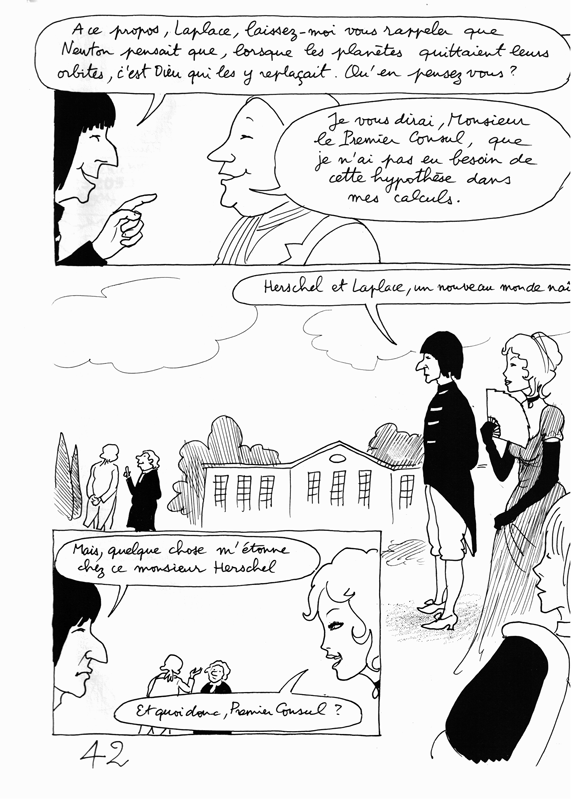
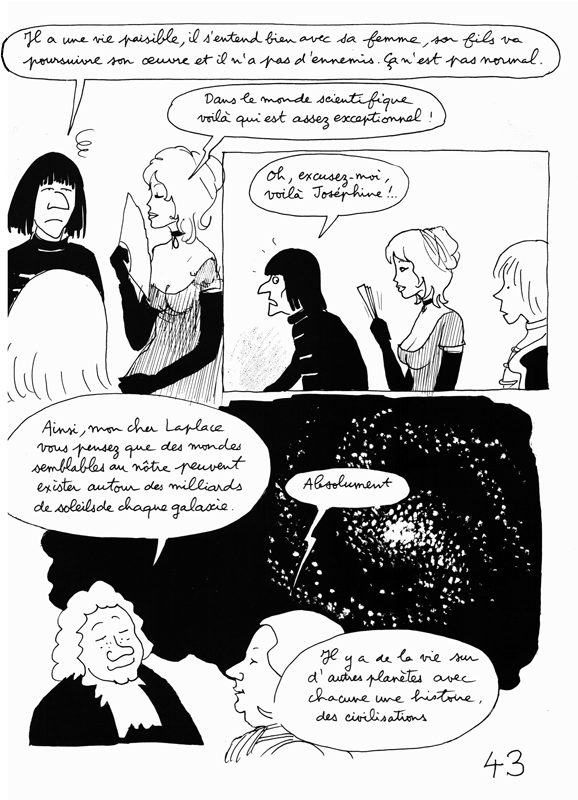
You'll find this in my free-to-download comic book Cosmic Story at:
http://www.savoir-sans-frontieres.com/JPP/telechargeables/Francais/cosmic_story.htm
Yes, the intervention of God or any metaphysics wasn’t necessary to explain the origin and evolution of the solar system (which, by the way, is organized around... the golden ratio. See the planetary research of mathematician Jean-Marie Souriau). But then, how far does this "chance god’s" influence extend?
That’s the whole question. The wooden cylinder experiment shows that disorganization is improbable. But the universe isn’t structured only in space—it evolves. Completing this idea, we can say:
The non-evolving is improbable.
For decades, computer scientists have tried to simulate the morphogenetic and evolutionary aspects of living systems by creating "games of life." Through these, we see virtual objects that associate, fight, devour each other, mate, etc. This leads to the concept of spatiotemporal structures—what René Thom called chreodes. To illustrate this, imagine something richer, more complex: suppose a "game of life" gave rise to a chess-playing program. We know computers can play against themselves. They can then generate nearly infinite possible games. But they can also analyze these games, enrich them, and beyond that, modify their own behavioral setup.
White plays against Black. White moves first ("has the move"). Then Black responds, and so on... Imagine a chess program completely devoid of experience. The first move by White would thus be... random. Black could respond by activating a strategic analysis subroutine. And the game begins. But not all openings are good. Try, for example, in a chess tournament, starting your game—assuming you’re playing as White—with a move like:
a2 - a4
You advance the pawn on the far left two squares. The members of the club would immediately say:
- I don’t know where you learned to play, but generally, this kind of opening leads nowhere good. Experience has proven it.
A "virgin" computer playing against itself could, after millions of games, acquire experience. The goal in chess is to win, to "capture the opponent’s king." It’s just another goal. Among the vast number of possible games, "streaming lines" of preferred paths emerge. At the beginning of the game, these are called "standard openings"—the French Defense, the Sicilian, the Truc Variation, or the Machin Variation...
Openings validated by experience and memorized. Beyond that lies the jungle of games where the outcome isn’t determined. We notice that a chess program, learning from its successes and mistakes, can evolve. Each game could be seen as a reincarnation of a "player." Under these conditions, is it possible to anticipate or converge toward "the best possible strategy"?
A game is played on Earth. There, it’s more complicated. Not only do we poorly understand the rules, but we’re ignorant of the goals. A materialist would say:
- It’s simple—there are no goals. It’s just a game of chance.
And then we return to the pages of the comic Joyeuse Apocalypse, where Ronald Reagan, in his dream, feels the spaceship of history is going nowhere.
No goals? That’s one way of seeing it. Others might perceive cycles with periodic returns to less organized states. This is a philosophical view one can entertain calmly if the horizon of the next cycle seems distant enough. But currently, that doesn’t seem to be the case.
There’s fire at the lake, my friends.
Our technological evolution simply suggests that some games end badly. In short, humans ask: "What’s the point of evolution’s hair?" with the corollary: "Let’s avoid going against the flow of evolution."
Capitalists will tell you:
- Rich or poor, what difference does it make, as long as we have money?
Darwinists will say:
- Strive, and let the best win!
The Nazis tried to put this into practice. It didn’t yield excellent results, and Hitler, deeply disappointed, preferred to vanish in smoke in the garden of his bunker. We’re beginning to realize that introducing nuclear weapons into Darwinism might lead to catastrophes—even if Americans think moderate use of tactical nuclear weapons could be useful.
So? How does the world evolve? What are the keys to this evolution? On this matter, answers are diverse and varied. There are religions that codify this in laws: the Ten Commandments, the Torah, Sharia, etc.
What do Buddhists say? That the only intelligent thing to do in this world is to live in compassion and detachment, awaiting future reincarnations until reaching final Nirvana (which they compare to a fire repeatedly relit, where nothing remains that can burn). Incidentally, one can improve one’s own evolution by seeking guidance from a Guru. This theme recurs frequently in India. Progress is possible only through the advice of a Master. But this shifts the problem:
- Good grief, who trains the masters?
In France, we’re told that a great Indian master, Sri Tathata, will be visiting soon—summer 2008. It will be his first visit to the West.

The Indian Master Sri Tathata
What does this good man say? Let’s revisit his 2005 message:
When Sri Tathata learned that September 21 is a day of peace in the world, and that many movements organize gatherings on this occasion, he was inspired to deliver the following message:
The evolution of humanity and of the universe has reached an important stage. To free humans from failure in their lives, and to free the world from its inability to live in peace and harmony, there is only one path: the path of Dharma (spiritual teachings). Every being on Earth was created with a specific purpose. It particularly falls upon humans to realize the purpose of their lives and to act in accordance with it. This is the path of Dharma, and only this will truly help both individuals and the world. We are like seeds. Each seed has a purpose: with sun and rain, it develops into a plant, then flowers, finally bearing fruit for the benefit of other beings. In the same way, the Divine must blossom within each human. Their purpose is to bloom and bear fruit, thus helping other human brothers. Living without purpose, without understanding the purpose of Nature, leads to the destruction of both humanity and Earth. True knowledge is knowing the purpose of Nature. All other knowledge leads to destruction. This is the teaching the world needs today.
When Sri Tathata learned that September 21 is a day of peace in the world, and that many movements organize gatherings on this occasion, he was inspired to deliver the following message:
The evolution of humanity and of the universe has reached an important stage. To free humans from failure in their lives, and to free the world from its inability to live in peace and harmony, there is only one path: the path of Dharma (spiritual teachings). Every being on Earth was created with a specific purpose. It particularly falls upon humans to realize the purpose of their lives and to act in accordance with it. This is the path of Dharma, and only this will truly help both individuals and the world. We are like seeds. Each seed has a purpose: with sun and rain, it develops into a plant, then flowers, finally bearing fruit for the benefit of other beings. In the same way, the Divine must blossom within each human. Their purpose is to bloom and bear fruit, thus helping other human brothers. Living without purpose, without understanding the purpose of Nature, leads to the destruction of both humanity and Earth. True knowledge is knowing the purpose of Nature. All other knowledge leads to destruction. This is the teaching the world needs today.
I know from experience that such phrases have the power to plunge French Buddhists I know into a state of ecstatic rapture. They prostrate easily (this is called devotion in their circles). It’s very nice, but it doesn’t offer much in response to the question raised by our backup guru—a sort of spiritual Nicolas Hulot:
True knowledge is knowing the purpose of Nature.
We also read: Each being on Earth was created with a specific purpose.
We won’t learn more. But I know plenty of people for whom these overwhelming revelations are more than enough.
If I have any news, I’ll keep you posted. ---