Avian flu: a global danger due to the contamination of migratory birds
" Birds " by Alfred Hitchcock, 2005 version
May 21, 2005
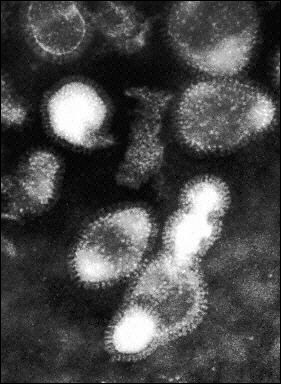
The H5b avian flu virus
Below is an AFP bulletin
see: http://www.grog.org/grippeaviaire.html
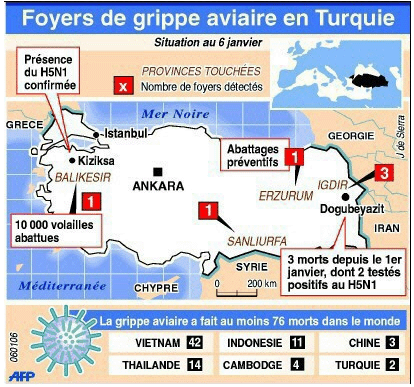
Sunday, May 22, 2005, 3:51 AM
China takes emergency measures after discovering dead birds with avian flu
BEIJING (AP) - China announced emergency measures, including closing nature reserves to the public, to prevent a new outbreak of avian flu, after investigators found dead migratory birds, killed by the virus, in the west of the country.
These measures require local authorities to monitor signs of disease in wild birds and to impose quarantines if necessary, according to the official news agency Xinhua (China News).
Farmers must vaccinate their poultry, while the public has been asked to "cease all contact with poultry."
The Ministry of Agriculture earlier announced that birds found dead on May 4th in Qinghai province had been killed by the H5N1 strain of the virus.
The epidemic has killed 37 people in Vietnam, 12 in Thailand, and four in Cambodia since late 2003.
The World Health Organization announced on Thursday that the avian flu virus could be capable of spreading from human to human, fearing that a potentially deadly global pandemic could occur.
Experts fear that a mutation of the virus could facilitate its transmission between humans, and that the disease could then spread rapidly and cause millions of deaths.
AP
Sunday, May 22, 2005, 3:51 AM
China takes emergency measures after discovering dead birds with avian flu
BEIJING (AP) - China announced emergency measures, including closing nature reserves to the public, to prevent a new outbreak of avian flu, after investigators found dead migratory birds, killed by the virus, in the west of the country.
These measures require local authorities to monitor signs of disease in wild birds and to impose quarantines if necessary, according to the official news agency Xinhua (China News).
Farmers must vaccinate their poultry, while the public has been asked to "cease all contact with poultry."
The Ministry of Agriculture earlier announced that birds found dead on May 4th in Qinghai province had been killed by the H5N1 strain of the virus.
The epidemic has killed 37 people in Vietnam, 12 in Thailand, and four in Cambodia since late 2003.
The avian flu virus could be capable of spreading from human to human, the World Health Organization announced on Thursday, fearing that a potentially deadly global pandemic could occur.
Experts fear that a mutation of the virus could facilitate its transmission between humans, and that the disease could then spread rapidly and cause millions of deaths.
AP
My comment:
A confrontation between China and the United States is an eventuality not to be ruled out in the coming decades. The Chinese take this threat very seriously. One could say that they are beginning to arm themselves accordingly, as their Long March rocket was initially designed to have a range of 12,000 km, supposedly to consider a reprise of the lunar conquest. In fact, it is exactly the distance separating China from the USA. This was also the case when the Americans and the Russians developed their space arsenal. As the Americans had bases surrounding the entire Soviet Union, they did not feel the need to have rockets with very long ranges. Their first powder rockets had ranges of 2,500 km. The Russians, on the other hand, opted for a range of 8,000 km, which was the range of the Smiorka rocket, designed by Korolev and which amazed the westerners in the 1950s. I remember very well that at that time the "experts" were wondering whether the Soviets had developed a new, revolutionary fuel. In fact, it was not the case. Their rockets were simply real monsters compared to the American firecrackers (remember the Vanguard rocket that could carry ... a grapefruit). The shock was brutal.
It is therefore perfectly legitimate to link the unprecedented range of Chinese rockets with the distance between China and the USA. This does not mean that in the end the Chinese have the intention of attacking the Americans, but that global paranoia is far from dying down and the danger is increasing year by year. In this context, it is entirely logical that the Chinese have turned to biological weapons (the "poor man's atomic bomb"). Before them, the Japanese had done the same, who had considered since the 1930s that the United States could one day become their designated enemy and that they could attack this country with biological weapons carried by balloons. See on this subject the file dedicated to the work of Professor Hishi, who tested these weapons on Chinese people after Japan had taken control of Manchuria with rare violence. Since the early 1930s, the Japanese, aware of their inferiority compared to the United States, had studied the impact of anthrax strains and plague-carrying fleas on civilian populations. These strains and infected fleas would then have been directed towards the USA by balloons, exploiting jet streams that the Japanese had discovered. During the war, several balloons sent by the Japanese reached the American west coast. However, by maintaining a complete blackout, the Americans did not encourage the Japanese to continue this endeavor.
Let us also recall that after its collapse in 1989, Russia intensified, "just in case," the development of its biological weapons. These threats should therefore be taken very seriously. Biologists will tell you that viruses mutate naturally and that it is this kind of accidental mutation that caused the appearance of the Spanish flu, which, at the end of World War I, killed nearly eight million people. Indeed. One can also consider the emergence of the HIV virus as an accident. However, the military have long known how to mutate viruses, and retroviruses using pulsed microwaves, modulated at very low frequencies. It is absolutely not impossible that the HIV virus came from research conducted by the Americans in their Atlanta laboratories, as part of the Jason commission created by Nixon during the Vietnam War, at a time when the Americans were looking for a biological or viral weapon specific, capable of targeting only a specific ethnicity (for example, the yellow race). Tests of dissemination would have been carried out in Zaire, on this species of small monkeys, the size of a cat, called green monkeys. Unexpectedly, the modified retroviruses, which were commensals of these monkeys, proved to be deadly for humans.
Two facts to take into account:
- China cannot but develop "defensive" or "deterrent" biological weapons, in view of a possible future conflict with the USA
- The use of biological weapons can always be the result of an accident, an artificial dissemination. Revisit the movie "Outbreak" with Dustin Hoffman.
With nuclear weapons, we have already passed from a global holocaust in the late 1970s. By tinkering with bacteria and viruses, the military are playing a game that could prove even more dangerous. In fact, with this biological engineering, both civil (GM) and military, we have no idea what we are doing. Avian flu may either correspond to a natural mutation, or be the result of the uncontrolled dissemination of genetically modified organisms for military purposes. We are evolving in the unpredictable and the unforeseen, like the one according to which the avian flu virus could today reach ... migratory birds! We are swimming in a nightmare.
In truth, all military research in all fields should be stopped as soon as possible, in all countries of the world. But it is as if trying to stop a high-speed train with one hand.
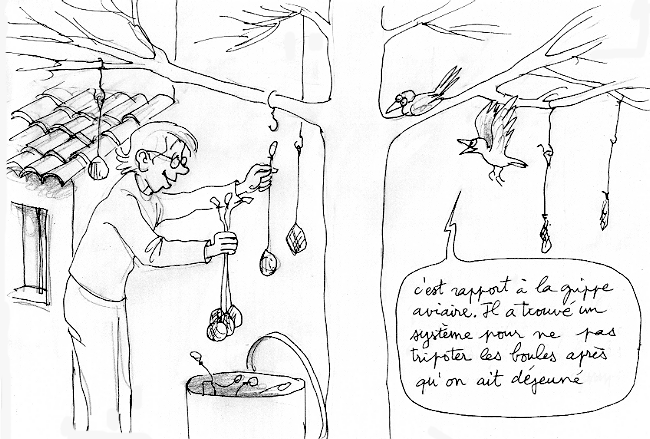
May 27, 2005: Continuation of this page html dedicated to the spread of avian flu ****
More than a thousand migratory birds dead from avian flu in China
BEIJING (AFP) - More than a thousand migratory birds have died from avian flu in Qinghai province (west), announced a Chinese government official on Friday.
"By May 26, more than a thousand birds have been found dead," said Jia Youling, director of the national veterinary services, during a press conference.
China first announced on May 21 the death of these migratory birds in the Qinghai Lake area, where their presence in a nature reserve is a tourist attraction.
After initially announcing that 178 birds had died from the H5N1 virus, a report from the Ministry of Agriculture to the World Health Organization later reported 519 bird deaths.
Mr. Jia assured that strict measures had been taken to prevent contamination of poultry or transmission of the disease to humans, while the H5N1 virus has already killed 54 people in Southeast Asia, including 38 in Vietnam.
"The Qinghai province has taken emergency prevention and control measures for the contaminated areas, including a strict access ban and disinfection measures, to prevent domestic birds from coming into contact with wild species," added the Chinese official.
He added that a spread towards the densely populated eastern part of China was unlikely.
The government announced on Thursday the development of a vaccine against the H5N1 avian flu virus, as well as the launch of a vaccination campaign for three million animals.
During the first half of 2004, 50 outbreaks of avian flu appeared throughout China in poultry farms, but no human contamination was reported.
More than a thousand migratory birds dead from avian flu in China
BEIJING (AFP) - More than a thousand migratory birds have died from avian flu in Qinghai province (west), announced a Chinese government official on Friday.
"By May 26, more than a thousand birds have been found dead," said Jia Youling, director of the national veterinary services, during a press conference.
China first announced on May 21 the death of these migratory birds in the Qinghai Lake area, where their presence in a nature reserve is a tourist attraction.
After initially announcing that 178 birds had died from the H5N1 virus, a report from the Ministry of Agriculture to the World Health Organization later reported 519 bird deaths.
Mr. Jia assured that strict measures had been taken to prevent contamination of poultry or transmission of the disease to humans, while the H5N1 virus has already killed 54 people in Southeast Asia, including 38 in Vietnam.
"The Qinghai province has taken emergency prevention and control measures for the contaminated areas, including a strict access ban and disinfection measures, to prevent domestic birds from coming into contact with wild species," added the Chinese official.
He added that a spread towards the densely populated eastern part of China was unlikely.
The government announced on Thursday the development of a vaccine against the H5N1 avian flu virus, as well as the launch of a vaccination campaign for three million animals.
During the first half of 2004, 50 outbreaks of avian flu appeared throughout China in poultry farms, but no human contamination was reported.
May 28, 2005: It's moving very fast....
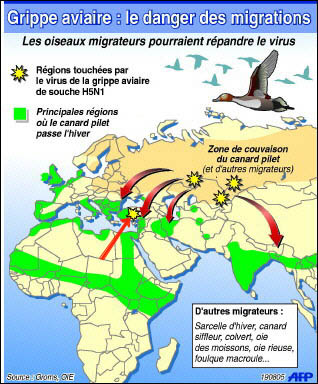
Saturday, May 28, 2005, 7:06 PM
Avian flu: urgent decisions to be made in France
PARIS (AFP) - France must take urgent decisions to deal with a potential pandemic of avian flu that could kill tens of millions of people worldwide, said two French specialists on Sunday.
In case of a mutation of the virus, causing a global pandemic, "it is estimated that between 9 and 24 million cases of human flu could occur in France if preventive measures are not taken," write professors Jean-Philippe Derenne and François Bricaire, from the Pitié-Salpétrière Hospital in Paris, in the weekly Journal du Dimanche.
The two doctors point out that in France, the population that should be treated preventively (healthcare, security, rescue, some transport or service personnel) is estimated at around 4 million. Tamiflu, an antiviral that is both preventive and curative, is part of the arsenal. However, "at a dose of one tablet per day for three months, about 360 million tablets are needed. Current stocks are 130 million," they warn, emphasizing that these figures do not take into account the use of Tamiflu for already sick patients.
Several global experts have been sounding the alarm for several months about
the state of unpreparedness of most countries in the face of this unprecedented health risk.
The World Health Organization (WHO) estimates that a pandemic could cause up to
100 million deaths worldwide
if the H5N1 avian flu virus mutates and becomes easily transmissible between humans.
The European Union inaugurated on Friday in Stockholm a European Centre for Disease Prevention and Control (ECDC), tasked with developing epidemiological surveillance at the community level and guaranteeing with the EU member states the capacity to react in a coordinated manner in case of an alert.
Saturday, May 28, 2005, 7:06 PM
Avian flu: urgent decisions to be made in France
PARIS (AFP) - France must take urgent decisions to deal with a potential pandemic of avian flu that could kill tens of millions of people worldwide, said two French specialists on Sunday.
In case of a mutation of the virus, causing a global pandemic, "it is estimated that between 9 and 24 million cases of human flu could occur in France if preventive measures are not taken," write professors Jean-Philippe Derenne and François Bricaire, from the Pitié-Salpétrière Hospital in Paris, in the weekly Journal du Dimanche.
The two doctors point out that in France, the population that should be treated preventively (healthcare, security, rescue, some transport or service personnel) is estimated at around 4 million. Tamiflu, an antiviral that is both preventive and curative, is part of the arsenal. However, "at a dose of one tablet per day for three months, about 360 million tablets are needed. Current stocks are 130 million," they warn, emphasizing that these figures do not take into account the use of Tamiflu for already sick patients.
Several global experts have been sounding the alarm for several months about
the state of unpreparedness of most countries in the face of this unprecedented health risk.
The World Health Organization (WHO) estimates that a pandemic could cause up to
100 million deaths worldwide
if the H5N1 avian flu virus mutates and becomes easily transmissible between humans.
The European Union inaugurated on Friday in Stockholm a European Centre for Disease Prevention and Control (ECDC), tasked with developing epidemiological surveillance at the community level and guaranteeing with the EU member states the capacity to react in a coordinated manner in case of an alert.
****http://www.e-sante.fr/magazine/article.asp?idArticle=8676&idRubrique=225
Source:
Avian flu: experts multiply warnings
Although not absolutely proven, it is highly likely that avian flu will mutate and transmit from human to human in the near future. It is estimated that between 9 and 24 million cases of human flu could occur in France. In addition to the considerable number of victims, the speed with which the global pandemic would spread fully justifies the urgent implementation of preventive measures. However, treatment stocks are insufficient and the virus has been lost.
According to the World Health Organization (WHO), the latest identified strains of the virus could be increasingly infectious to humans. It is urgent to prepare.
No one can predict when the flu pandemic could erupt. However, it is certain that the international spread will be particularly rapid and unprecedented. Previously, pandemics spread by sea routes and became global after six to eight months. With the development of air routes, this period will be significantly reduced and many outbreaks will occur simultaneously in several regions of the world.
A good response will mainly involve good surveillance and knowledge of the virus.
Information circulates poorly
Unfortunately, experts have lost track of the virus. Laboratories need to have biological samples of the circulating viral strains, especially at a time when it seems to be changing. Unfortunately, no analysis of infected poultry has been received for eight months, and of the twelve patients infected with the deadly strain, only six samples have been obtained.
Stocks of treatment?
Tamiflu® is an effective antiviral against all influenza strains. It represents the curative and preventive treatment in case of an epidemic.
The former Minister of Health, Philippe Douste-Blazy, recalls that France is the first European country to have prepared for a potential pandemic, by ordering 13 million treatments from the Roche laboratories, of which the vast majority will be available before the end of 2005.
Tamiflu® (oseltamivir) prevents the flu virus from entering the cell. Since it needs the chromosomes of the host to reproduce, it can no longer develop. Tamiflu® thus stops the infection. The only condition: to start the treatment within the first 48 hours following the first symptoms.
Source:
Avian flu: experts multiply warnings
Although not absolutely proven, it is highly likely that avian flu will mutate and transmit from human to human in the near future. It is estimated that between 9 and 24 million cases of human flu could occur in France. In addition to the considerable number of victims, the speed with which the global pandemic would spread fully justifies the urgent implementation of preventive measures. However, treatment stocks are insufficient and the virus has been lost.
According to the World Health Organization (WHO), the latest identified strains of the virus could be increasingly infectious to humans. It is urgent to prepare.
No one can predict when the flu pandemic could erupt. However, it is certain that the international spread will be particularly rapid and unprecedented. Previously, pandemics spread by sea routes and became global after six to eight months. With the development of air routes, this period will be significantly reduced and many outbreaks will occur simultaneously in several regions of the world.
A good response will mainly involve good surveillance and knowledge of the virus.
Information circulates poorly
Unfortunately, experts have lost track of the virus. Laboratories need to have biological samples of the circulating viral strains, especially at a time when it seems to be changing. Unfortunately, no analysis of infected poultry has been received for eight months, and of the twelve patients infected with the deadly strain, only six samples have been obtained.
Stocks of treatment?
Tamiflu® is an effective antiviral against all influenza strains. It represents the curative and preventive treatment in case of an epidemic.
The former Minister of Health, Philippe Douste-Blazy, recalls that France is the first European country to have prepared for a potential pandemic, by ordering 13 million treatments from the Roche laboratories, of which the vast majority will be available before the end of 2005.
Tamiflu® (oseltamivir) prevents the flu virus from entering the cell. Since it needs the chromosomes of the host to reproduce, it can no longer develop. Tamiflu® thus stops the infection. The only condition: to start the treatment within the first 48 hours following the first symptoms.
**June 13, 2005 ** ** **
http://news.independent.co.uk/world/environment/story.jsp?story=646217
Birds carrying avian flu threaten to kill millions
By Geoffrey Lean, Environment Correspondent
June 12, 2005
Original text:
International experts fear that avian flu may mutate into a global pandemic, killing millions of people after the mass death of wild birds in China.
Unconfirmed reports indicate that more than 100 people have already died, suggesting that the virus may have evolved to pass from one person to another
thus breaking the last barrier that could prevent a global catastrophe.
The Chinese government, while denying reports of human deaths, has taken emergency measures in Xinjiang, a remote northwestern province, and isolated the affected areas with roadblocks and then closed all nature reserves.
"We are worried," says Noureddin Mona, one of the representatives of the Ministry of Agriculture in Beijing. "We should prepare for the worst."
Shigeru Omi, the Western Pacific regional director of the WHO, notes that "the virus has become highly pathogenic for an increasing number of species."
"It is unstable, unpredictable, and very mutagenic."
"Anything can happen because, given the way the virus has evolved, it can still surprise us with new and very unpleasant surprises."
Experts have long known that the virus has spread with wild birds, but until now they thought they were immune to its effects. However, last month, more than 1,000 dead birds with avian flu were found in the Qinghai Lake nature reserve.
Then a second infection was discovered in the city of Tacheng, located on the border with Kazakhstan, 1,600 km east of the lake, with more than 1,000 domestic geese affected, 460 of whom died.
A Chinese website called Boxun News and an online medical alert system called pro-MED report that 200 people have been infected and 121 have died.
These are the same two sites that first alerted the world to the appearance of SARS in 2003, when Chinese authorities strongly denied it.
This time, China denies that a single person could have been infected, but the government acknowledges the need to alert all health departments in all neighboring provinces of the affected one to prevent the spread of the disease and has decided to open special wings in hospitals for "patients presenting fever symptoms."
Birds carrying avian flu threaten to kill millions
By Geoffrey Lean, Environment Correspondent
June 12, 2005
Original text:
International experts fear that avian flu may mutate into a global pandemic, killing millions of people after the mass death of wild birds in China.
Unconfirmed reports indicate that more than 100 people have already died, suggesting that the virus may have evolved to pass from one person to another
thus breaking the last barrier that could prevent a global catastrophe.
The Chinese government, while denying reports of human deaths, has taken emergency measures in Xinjiang, a remote northwestern province, and isolated the affected areas with roadblocks and then closed all nature reserves.
"We are worried," says Noureddin Mona, one of the representatives of the Ministry of Agriculture in Beijing. "We should prepare for the worst."
Shigeru Omi, the Western Pacific regional director of the WHO, notes that "the virus has become highly pathogenic for an increasing number of species."
"It is unstable, unpredictable, and very mutagenic."
"Anything can happen because, given the way the virus has evolved, it can still surprise us with new and very unpleasant surprises."
Experts have long known that the virus has spread with wild birds, but until now they thought they were immune to its effects. However, last month, more than 1,000 dead birds with avian flu were found in the Qinghai Lake nature reserve.
Then a second infection was discovered in the city of Tacheng, located on the border with Kazakhstan, 1,600 km east of the lake, with more than 1,000 domestic geese affected, 460 of whom died.
A Chinese website called Boxun News and an online medical alert system called pro-MED report that 200 people have been infected and 121 have died.
These are the same two sites that first alerted the world to the appearance of SARS in 2003, when Chinese authorities strongly denied it.
This time, China denies that a single person could have been infected, but the government acknowledges the need to alert all health departments in all neighboring provinces of the affected one to prevent the spread of the disease and has decided to open special wings in hospitals for "patients presenting fever symptoms."
July 13, 2005 ** ** ** **
. Section: World, Wednesday, July 13, 2005, 11:29 AM
Birds in China infected with a very deadly form of avian flu
BEIJING (AFP) - Migratory birds currently staying in northwest China are carrying a more deadly form of the H5N1 avian flu virus than previously known, according to Chinese scientists cited by the Wenhuibao newspaper on Wednesday.
About 6,000 migratory birds have died from this disease since May in a nature reserve in Qinghai province.
The scientists, who tested the virus and established its genetic sequence, say it is a more pathogenic form than in previous outbreaks, according to the Shanghai daily.
In laboratory tests, chickens to which the virus was injected died within 20 hours and mice within three days, according to the Wenhuibao.
"The results show that the new H5N1 form is very virulent," said Gao Fu, director of the Institute of Microbiology at the Chinese Academy of Sciences.
"The mortality rate of the virus far exceeds that of the virus types found previously in waterfowl in northern China," added Mr. Gao, cited by the newspaper.
World Health Organization (WHO) officials had previously stated last month that they believed the latest form of the virus was more deadly than previous ones due to the unprecedented number of infected migratory birds.
Moreover, species that had not been affected so far have now fallen ill.
The WHO and the Food and Agriculture Organization (FAO) have asked China for samples of the virus to conduct tests in international laboratories, but UN officials said on Wednesday that they were still waiting for them.
Birds that gather around Qinghai Lake in May to breed usually leave the area by late July and August, heading south and southwest, especially to Thailand, India, and Pakistan, according to specialists, who also add that their migration routes are not always well known.
. Section: World, Wednesday, July 13, 2005, 11:29 AM
Birds in China infected with a very deadly form of avian flu
BEIJING (AFP) - Migratory birds currently staying in northwest China are carrying a more deadly form of the H5N1 avian flu virus than previously known, according to Chinese scientists cited by the Wenhuibao newspaper on Wednesday.
About 6,000 migratory birds have died from this disease since May in a nature reserve in Qinghai province.
The scientists, who tested the virus and established its genetic sequence, say it is a more pathogenic form than in previous outbreaks, according to the Shanghai daily.
In laboratory tests, chickens to which the virus was injected died within 20 hours and mice within three days, according to the Wenhuibao.
"The results show that the new H5N1 form is very virulent," said Gao Fu, director of the Institute of Microbiology at the Chinese Academy of Sciences.
"The mortality rate of the virus far exceeds that of the virus types found previously in waterfowl in northern China," added Mr. Gao, cited by the newspaper.
World Health Organization (WHO) officials had previously stated last month that they believed the latest form of the virus was more deadly than previous ones due to the unprecedented number of infected migratory birds.
Moreover, species that had not been affected so far have now fallen ill.
The WHO and the Food and Agriculture Organization (FAO) have asked China for samples of the virus to conduct tests in international laboratories, but UN officials said on Wednesday that they were still waiting for them.
Birds that gather around Qinghai Lake in May to breed usually leave the area by late July and August, heading south and southwest, especially to Thailand, India, and Pakistan, according to specialists, who also add that their migration routes are not always well known.
Health officials from the World Health Organization (WHO) had already stated last month that they believed the latest form of the virus was more deadly than previous ones due to the unprecedented number of infected migratory birds.
Moreover, species that had not been affected so far have now fallen ill.
The WHO and the Food and Agriculture Organization (FAO) have asked China for samples of the virus to conduct tests in international laboratories, but UN officials indicated on Wednesday that they were still waiting for them.
Birds that gather in May around Qinghai Lake to breed usually leave the area by late July and August, heading south and south-west, including to Thailand, India, and Pakistan, according to experts, although they add that their migration routes are not always well known.
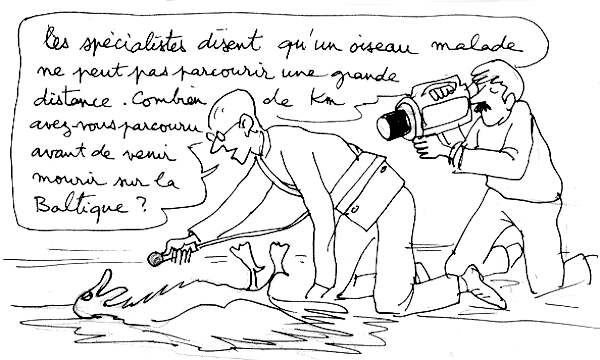
Friday, July 15, 2005, 7:31 AM
Avian influenza suspected in the death of three Indonesians
DJAKARTA (AP) - The avian influenza virus is suspected in the death of an Indonesian man and his two daughters, but there is no evidence that the three presumed victims of the virus had contact with poultry, raising concerns about possible human-to-human transmission, said the Indonesian Minister of Health on Friday. AP
The victims, a 38-year-old man and his two daughters, aged 1 and 9, would be the first human cases linked to the disease. They lived in the outskirts of Jakarta and died last week, said Health Minister Diti Fadillah Supadi.
"These are suspected cases of avian influenza," said Supadi at a press conference attended by officials from the World Health Organization (WHO). "We have sent samples to Hong Kong to confirm the results, which will take between seven and ten days."
Hundreds of millions of birds have died or been culled across Asia over the past two years due to the deadly virus, which has also killed 51 people in Vietnam, Thailand, and Cambodia.
Last month, Indonesia reported its first human case, a poultry worker, but the man did not develop symptoms of the disease and is in good health.
Associated Press
Friday, July 15, 2005, 7:31 AM
Avian influenza suspected in the death of three Indonesians
DJAKARTA (AP) - The avian influenza virus is suspected in the death of an Indonesian man and his two daughters, but there is no evidence that the three presumed victims of the virus had contact with poultry, raising concerns about possible human-to-human transmission, said the Indonesian Minister of Health on Friday. AP
The victims, a 38-year-old man and his two daughters, aged 1 and 9, would be the first human cases linked to the disease. They lived in the outskirts of Jakarta and died last week, said Health Minister Diti Fadillah Supadi.
"These are suspected cases of avian influenza," said Supadi at a press conference attended by officials from the World Health Organization (WHO). "We have sent samples to Hong Kong to confirm the results, which will take between seven and ten days."
Hundreds of millions of birds have died or been culled across Asia over the past two years due to the deadly virus, which has also killed 51 people in Vietnam, Thailand, and Cambodia.
Last month, Indonesia reported its first human case, a poultry worker, but the man did not develop symptoms of the disease and is in good health.
Associated Press
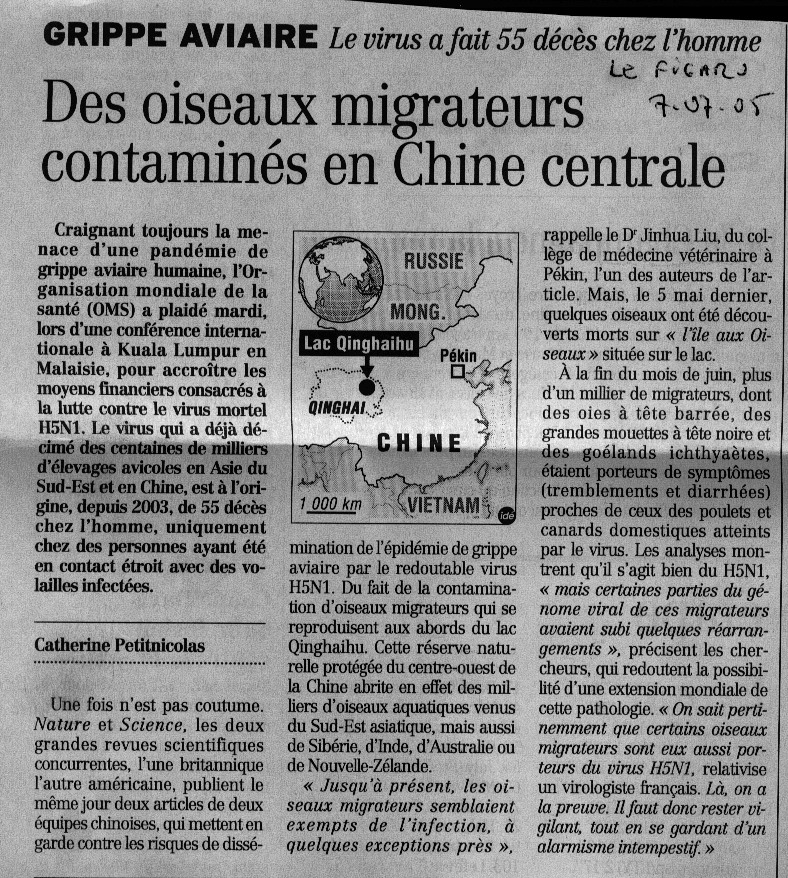
July 24, 2005
Hello,
I read with interest your articles about avian influenza. I talked about it with my wife, who works in a medium-sized provincial hospital. By chance, she came into contact with a pharmacist from the hospital who confirmed the hospital's concerns about this disease.
But this morning, another chance brought her into contact with her supervisor, who had just received an emergency health notice about avian influenza.
Such notices are not trivial. I think there are reasons to be concerned.
Thank you for keeping this source confidential,
Sincerely,
Hello,
I read with interest your articles about avian influenza. I talked about it with my wife, who works in a medium-sized provincial hospital. By chance, she came into contact with a pharmacist from the hospital who confirmed the hospital's concerns about this disease.
But this morning, another chance brought her into contact with her supervisor, who had just received an emergency health notice about avian influenza.
Such notices are not trivial. I think there are reasons to be concerned.
Thank you for keeping this source confidential,
Sincerely,
Monday, July 25, 2005, 11:33 AM
Three new avian influenza outbreaks in Russia
MOSCOW (AFP) - Three new outbreaks of avian influenza have appeared in Russia in the Novosibirsk region, in Siberia, announced the federal veterinary service on Monday, following initial cases of sick poultry in a village in the region the previous week. "The investigations conducted by the animal health control center have shown that in the Novosibirsk region, in the districts of Dovolnoe, Kupino and Chistoozernoe, the avian influenza virus is circulating in poultry farms," said the head of the federal veterinary service, Sergei Dankvert, to Interfax agency.
Initial cases of avian influenza in poultry had been detected last week in the village of Suzdalka, in the same Novosibirsk region.
The village has since been placed in quarantine, said Mr. Dankvert. "In case of development of the situation, quarantine measures may be expanded," added the official, assuring that "all necessary measures are being taken to prevent the spread of the disease."
He stated that in a few days, more than 500 birds had died in the Novosibirsk region, nearly twice as many as the figure announced last Thursday for the village of Suzdalka alone.
He assured that additional tests should be conducted this week, including at the Moscow veterinary control institute.
Monday, July 25, 2005, 11:33 AM
Three new avian influenza outbreaks in Russia
MOSCOW (AFP) - Three new outbreaks of avian influenza have appeared in Russia in the Novosibirsk region, in Siberia, announced the federal veterinary service on Monday, following initial cases of sick poultry in a village in the region the previous week. "The investigations conducted by the animal health control center have shown that in the Novosibirsk region, in the districts of Dovolnoe, Kupino and Chistoozernoe, the avian influenza virus is circulating in poultry farms," said the head of the federal veterinary service, Sergei Dankvert, to Interfax agency.
Initial cases of avian influenza in poultry had been detected last week in the village of Suzdalka, in the same Novosibirsk region.
The village has since been placed in quarantine, said Mr. Dankvert. "In case of development of the situation, quarantine measures may be expanded," added the official, assuring that "all necessary measures are being taken to prevent the spread of the disease."
He stated that in a few days, more than 500 birds had died in the Novosibirsk region, nearly twice as many as the figure announced last Thursday for the village of Suzdalka alone.
He assured that additional tests should be conducted this week, including at the Moscow veterinary control institute.
**Friday, August 5, 2005, 5:38 PM **
A poorly known pig virus worries experts
NEW YORK -- Experts are worried about the emergence of a particularly virulent form of swine streptococcus, a virus relatively common in pigs but rare in humans, which has already killed 37 people in China.
Streptococcus suis causes isolated cases in humans but not clustered cases at once. "We want to understand what is happening. This virus has something different from what we know," says Marcelo Gottschalk, one of the world's leading experts on the disease, who works in the only laboratory in the world specializing in the study of Streptococcus suis, at the University of Montreal in Canada. He points out that no one in China has sought his help since the outbreak emerged last month.
Since so few people know about the disease, it is not certain that the Chinese are able to make the diagnosis and implement an appropriate vaccine. The official Chinese press claims that a sufficient number of vaccine doses have been sent to 350,000 pigs by a laboratory in Guangdong province, and that a total of ten million pigs are planned to be vaccinated.
According to Professor Gottschalk, swine streptococcus can cause meningitis, followed by partial or complete hearing loss. Most people recover after antibiotic treatment, and the cases are generally few and spaced out in time.
Thailand, for example, has less than 20 cases per year. China reports more than 200 confirmed cases or suspected human cases since June. Infected farmers, who had contact with sick animals, suffered from nausea, fever, vomiting, and subcutaneous bleeding. A case was also reported in Guangdong province, far from Sichuan and neighboring Hong Kong. As for the former British colony, it reported two infections.
For the WHO and FAO, the virus's virulence could be explained by the fact that Streptococcus suis may have combined with other infectious agents. "Why is the virus behaving so differently?" asks Juan Lubroth, an animal health specialist at the Food and Agriculture Organization (FAO) in Rome. "This could be explained by the overlap of several problems, and Streptococcus suis would not be the only cause."
Thomas Alexander, a pioneer in the study of this virus and former deputy director of the veterinary school at Cambridge, recalls that the bacteria is frequently found in the tonsils of healthy pigs in different parts of the world. The bacteria can become pathogenic when too many pigs are concentrated in poor hygiene conditions. "In my experience, the infection is chronic. Regarding China, they talk about death within 24 hours. What they describe does not resemble the classic picture," he explains.
The disease is transmitted from pigs to humans through skin wounds. Cooked pork is not dangerous, but eating raw or undercooked meat can be a source of contamination.
For now, Marcelo Gottschalk does not seem concerned about a potential epidemic outside of China. There is currently no human-to-human transmission. However, he would like the Chinese to send him samples that would allow him to identify the viral strain in question. AP
A poorly known pig virus worries experts
NEW YORK -- Experts are worried about the emergence of a particularly virulent form of swine streptococcus, a virus relatively common in pigs but rare in humans, which has already killed 37 people in China.
Streptococcus suis causes isolated cases in humans but not clustered cases at once. "We want to understand what is happening. This virus has something different from what we know," says Marcelo Gottschalk, one of the world's leading experts on the disease, who works in the only laboratory in the world specializing in the study of Streptococcus suis, at the University of Montreal in Canada. He points out that no one in China has sought his help since the outbreak emerged last month.
Since so few people know about the disease, it is not certain that the Chinese are able to make the diagnosis and implement an appropriate vaccine. The official Chinese press claims that a sufficient number of vaccine doses have been sent to 350,000 pigs by a laboratory in Guangdong province, and that a total of ten million pigs are planned to be vaccinated.
According to Professor Gottschalk, swine streptococcus can cause meningitis, followed by partial or complete hearing loss. Most people recover after antibiotic treatment, and the cases are generally few and spaced out in time.
Thailand, for example, has less than 20 cases per year. China reports more than 200 confirmed cases or suspected human cases since June. Infected farmers, who had contact with sick animals, suffered from nausea, fever, vomiting, and subcutaneous bleeding. A case was also reported in Guangdong province, far from Sichuan and neighboring Hong Kong. As for the former British colony, it reported two infections.
For the WHO and FAO, the virus's virulence could be explained by the fact that Streptococcus suis may have combined with other infectious agents. "Why is the virus behaving so differently?" asks Juan Lubroth, an animal health specialist at the Food and Agriculture Organization (FAO) in Rome. "This could be explained by the overlap of several problems, and Streptococcus suis would not be the only cause."
Thomas Alexander, a pioneer in the study of this virus and former deputy director of the veterinary school at Cambridge, recalls that the bacteria is frequently found in the tonsils of healthy pigs in different parts of the world. The bacteria can become pathogenic when too many pigs are concentrated in poor hygiene conditions. "In my experience, the infection is chronic. Regarding China, they talk about death within 24 hours. What they describe does not resemble the classic picture," he explains.
The disease is transmitted from pigs to humans through skin wounds. Cooked pork is not dangerous, but eating raw or undercooked meat can be a source of contamination.
For now, Marcelo Gottschalk does not seem concerned about a potential epidemic outside of China. There is currently no human-to-human transmission. However, he would like the Chinese to send him samples that would allow him to identify the viral strain in question. AP
**Monday, August 8, 2005, 7:15 AM **
A French laboratory launches a vaccine that could protect against avian influenza
WASHINGTON (AP) - A hope for avian influenza. Mass production of a new vaccine, possibly capable of preventing an avian influenza epidemic, and manufactured by the French laboratory Sanofi-Pasteur, could begin as early as mid-September, announced U.S. health authorities on Sunday.
Preliminary data from the first tests, conducted on 450 healthy adults, show an immune response that scientists believe is strong enough to protect against avian influenza, which is spreading in Asia and Russia.
The U.S. government, which has already purchased 2 million doses from Sanofi-Pasteur, is ready to order many more if the tests are successful, said Dr. Anthony Fauci, director of the National Institute of Allergy and Infectious Diseases. Last week, a health official announced that the government wanted to purchase 20 million doses.
The vaccine still needs to be tested on the elderly and children.
The avian influenza epidemic has killed millions of birds, but only 50 humans have died, and human-to-human transmission of the virus has not been demonstrated so far. AP
A French laboratory launches a vaccine that could protect against avian influenza
WASHINGTON (AP) - A hope for avian influenza. Mass production of a new vaccine, possibly capable of preventing an avian influenza epidemic, and manufactured by the French laboratory Sanofi-Pasteur, could begin as early as mid-September, announced U.S. health authorities on Sunday.
Preliminary data from the first tests, conducted on 450 healthy adults, show an immune response that scientists believe is strong enough to protect against avian influenza, which is spreading in Asia and Russia.
The U.S. government, which has already purchased 2 million doses from Sanofi-Pasteur, is ready to order many more if the tests are successful, said Dr. Anthony Fauci, director of the National Institute of Allergy and Infectious Diseases. Last week, a health official announced that the government wanted to purchase 20 million doses.
The vaccine still needs to be tested on the elderly and children.
The avian influenza epidemic has killed millions of birds, but only 50 humans have died, and human-to-human transmission of the virus has not been demonstrated so far. AP
August 11, 2005 ****
Avian influenza spreads in Asia:
WHO prepares its stockpiles
ATS, August 10, 2005 at 3:41 PM
ALMATY/BEIJING/GENEVA -
The avian influenza virus is spreading in Central Asia. The strain detected in Kazakhstan is H5N1, transmissible to humans, said officials in Almaty. The infected area in the north of the country has been placed in quarantine.
The Kazakh Ministry of Agriculture first reported the appearance of the virus on August 4. The farm where the outbreak occurred, near the village of Golubovka, was immediately placed in quarantine. The Ministry also strengthened veterinary controls at the Russian-Kazakh border on July 31 and ordered the culling of thousands of poultry.
The H5N1 virus was diagnosed in Russia at the end of July in the Novosibirsk region (Siberia). According to the Russian emergency ministry's figures, the number of dead birds increased from 5,583 to 8,347 between Tuesday and Wednesday in Siberia.
Mongolia also reported at the beginning of August the discovery of several dozen swans, geese, and other birds dead near a lake in the Khuvsgul province, said a representative of the United Nations Food and Agriculture Organization (FAO) in China, North Korea, and Mongolia.
Faced with this worrying situation, the European Union announced on Monday its intention to ban poultry imports from Russia and Kazakhstan starting Friday to prevent the spread of the disease. Several countries of the Commonwealth of Independent States (CIS, former USSR minus the three Baltic states) have also taken this decision. Switzerland has not yet taken a similar measure.
About 60 people have already died from avian influenza in Southeast Asia since 2003. Health authorities fear that the virus circulating in the region for several months could cause an epidemic with devastating effects similar to the Spanish flu, which killed between 20 and 40 million people at the beginning of the 20th century.
In Geneva, the World Health Organization and the Swiss pharmaceutical company Roche indicated on Wednesday that they are about to stockpile one million doses of antiviral drugs in preparation for a possible pandemic.
WHO stocks antiviral drugs
GENEVA (AFP) - The World Health Organization and the Swiss pharmaceutical company Roche are about to stockpile one million doses of antiviral drugs in preparation for a possible influenza pandemic, said Roche on Wednesday.
"We are in discussion (with the WHO), we are in the final phase," said an AFP spokesperson for Roche, Martina Rupp.
This cooperation "has been going on for some time already," confirmed Ian Simpson, WHO spokesperson. "It is a continuous process."
Roche and the WHO have refused to give details about this cooperation, which concerns Roche's antiviral drug Tamiflu. Reserves of this drug are being built up in at least 25 countries. The WHO is also trying to build an emergency stockpile to respond quickly to the possible emergence of a new strain of the influenza virus, especially in the poorest countries least prepared. This possibility has gained importance since a particularly virulent avian influenza virus, H5N1, has spread in Asia and some regions of the former Soviet Union.
This virus has killed 55 people in Asia since 2003 and raises fears of a mutation that would make it transmissible from human to human and trigger a catastrophic epidemic. According to a recent study, three million doses of antivirals would be needed in Southeast Asia to effectively respond to such an epidemic. According to Ian Simpson, WHO Director-General Lee Jong Wook wants to start with a stockpile of one million doses, which would likely be increased later. "It would probably be stored in several locations, including our regional office in Manila," he said. "We would like to have it as soon as possible to be able to respond if an influenza epidemic breaks out."
For now, the WHO has a small reserve intended to protect health workers who may be called upon to intervene in an emergency and has urged concerned countries to intensify their own preparations.
Avian influenza spreads in Asia:
WHO prepares its stockpiles
ATS, August 10, 2005 at 3:41 PM
ALMATY/BEIJING/GENEVA -
The avian influenza virus is spreading in Central Asia. The strain detected in Kazakhstan is H5N1, transmissible to humans, said officials in Almaty. The infected area in the north of the country has been placed in quarantine.
The Kazakh Ministry of Agriculture first reported the appearance of the virus on August 4. The farm where the outbreak occurred, near the village of Golubovka, was immediately placed in quarantine. The Ministry also strengthened veterinary controls at the Russian-Kazakh border on July 31 and ordered the culling of thousands of poultry.
The H5N1 virus was diagnosed in Russia at the end of July in the Novosibirsk region (Siberia). According to the Russian emergency ministry's figures, the number of dead birds increased from 5,583 to 8,347 between Tuesday and Wednesday in Siberia.
Mongolia also reported at the beginning of August the discovery of several dozen swans, geese, and other birds dead near a lake in the Khuvsgul province, said a representative of the United Nations Food and Agriculture Organization (FAO) in China, North Korea, and Mongolia.
Faced with this worrying situation, the European Union announced on Monday its intention to ban poultry imports from Russia and Kazakhstan starting Friday to prevent the spread of the disease. Several countries of the Commonwealth of Independent States (CIS, former USSR minus the three Baltic states) have also taken this decision. Switzerland has not yet taken a similar measure.
About 60 people have already died from avian influenza in Southeast Asia since 2003. Health authorities fear that the virus circulating in the region for several months could cause an epidemic with devastating effects similar to the Spanish flu, which killed between 20 and 40 million people at the beginning of the 20th century.
In Geneva, the World Health Organization and the Swiss pharmaceutical company Roche indicated on Wednesday that they are about to stockpile one million doses of antiviral drugs in preparation for a possible pandemic.
WHO stocks antiviral drugs
GENEVA (AFP) - The World Health Organization and the Swiss pharmaceutical company Roche are about to stockpile one million doses of antiviral drugs in preparation for a possible influenza pandemic, said Roche on Wednesday.
"We are in discussion (with the WHO), we are in the final phase," said an AFP spokesperson for Roche, Martina Rupp.
This cooperation "has been going on for some time already," confirmed Ian Simpson, WHO spokesperson. "It is a continuous process."
Roche and the WHO have refused to give details about this cooperation, which concerns Roche's antiviral drug Tamiflu. Reserves of this drug are being built up in at least 25 countries. The WHO is also trying to build an emergency stockpile to respond quickly to the possible emergence of a new strain of the influenza virus, especially in the poorest countries least prepared. This possibility has gained importance since a particularly virulent avian influenza virus, H5N1, has spread in Asia and some regions of the former Soviet Union.
This virus has killed 55 people in Asia since 2003 and raises fears of a mutation that would make it transmissible from human to human and trigger a catastrophic epidemic. According to a recent study, three million doses of antivirals would be needed in Southeast Asia to effectively respond to such an epidemic. According to Ian Simpson, WHO Director-General Lee Jong Wook wants to start with a stockpile of one million doses, which would likely be increased later. "It would probably be stored in several locations, including our regional office in Manila," he said. "We would like to have it as soon as possible to be able to respond if an influenza epidemic breaks out."
For now, the WHO has a small reserve intended to protect health workers who may be called upon to intervene in an emergency and has urged concerned countries to intensify their own preparations.
August 12, 2005
**
Avian influenza virus
TAMIFLU THERAPEUTIC INDICATIONS
Treatment of influenza: in adults and children aged one year or older presenting typical symptoms of influenza during the period of virus circulation. The effectiveness has been demonstrated when treatment is initiated within two days of the onset of symptoms. This indication is based on clinical studies of naturally acquired influenza, in which infection by an influenza A virus was predominant (see Pharmacodynamic Properties). Prevention of influenza:
• Post-exposure prevention in adults and adolescents aged 13 years or older after contact with a clinically diagnosed case of influenza, during the period of virus circulation.
• The appropriate use of Tamiflu in the prevention of influenza must be determined on a case-by-case basis, depending on the circumstances and the population to be protected. In exceptional situations (for example, in the case of antigenic mismatch between the virus strains in circulation and those in the vaccine, or a pandemic situation), seasonal prevention could be considered in adults and adolescents aged 13 years or older. Tamiflu is not an alternative to the seasonal influenza vaccine. The use of antivirals for the treatment and prevention of influenza must be determined based on official recommendations, taking into account the epidemiology and impact of the disease in different geographical areas and patient populations.
Avian influenza virus
TAMIFLU THERAPEUTIC INDICATIONS
:
Treatment of influenza: in adults and children aged one year or older presenting typical symptoms of influenza during the period of virus circulation. The effectiveness has been demonstrated when treatment is initiated within two days of the onset of symptoms. This indication is based on clinical studies of naturally acquired influenza, in which infection by an influenza A virus was predominant (see Pharmacodynamic Properties). Prevention of influenza:
• Post-exposure prevention in adults and adolescents aged 13 years or older after contact with a clinically diagnosed case of influenza, during the period of virus circulation.
• The appropriate use of Tamiflu in the prevention of influenza must be determined on a case-by-case basis, depending on the circumstances and the population to be protected. In exceptional situations (for example, in the case of antigenic mismatch between the virus strains in circulation and those in the vaccine, or a pandemic situation), seasonal prevention could be considered in adults and adolescents aged 13 years or older. Tamiflu is not an alternative to the seasonal influenza vaccine. The use of antivirals for the treatment and prevention of influenza must be determined based on official recommendations, taking into account the epidemiology and impact of the disease in different geographical areas and patient populations.
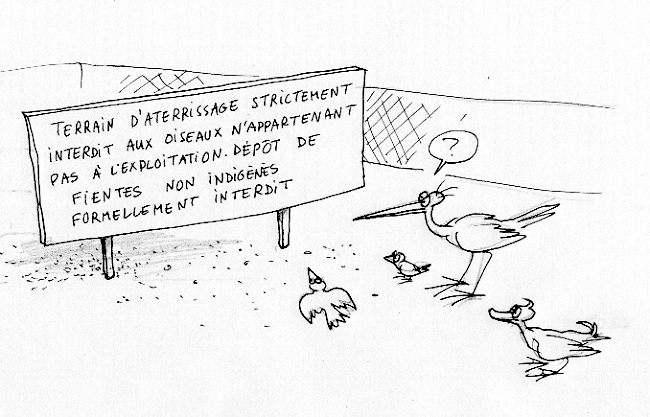
August 15, 2005
Another point of view, in the spirit of free expression:
Hello,
I am writing to share my thoughts on avian influenza. I am a fifth-year pharmacy student, and wanting to work in a specific area of the pharmaceutical industry, I have become interested in some less appealing aspects of this business, which is indeed a business, let's not forget.
Overall, this whole situation makes me think of another attempt by big pharma to scare everyone.
So, what do we have:
-
55 deaths since 2003... a big deal, I think bee stings kill more.
-
Fear of a mutation of the virus that could become transmissible to humans:
Indeed theoretically possible, and why wouldn't the classic flu virus also become deadly and yellow with green spots, while we're at it? Mutations are quite unpredictable, why this strain rather than another? The selective pressure experienced by these creatures is invoked, I'll accept that, but in this case the virus has no interest in killing its host, but rather to become silent like most of its fellow viruses and multiply freely in peace.
- The risk of an epidemic:
According to what I've read, it's referred to as a flu, until proven otherwise, a flu, under normal living and hygiene conditions, is not often deadly. 50 or 100 million deaths seems very exaggerated to me. People infected with avian flu have not been struck down, according to the information we have.
- Prophylaxis with Tamiflu, here we go...
It's an easy move, guaranteed success and low production costs, antivirals are a well-established and rather ineffective class, by the way (virustatic and not virucidal... you don't kill a virus). A windfall for laboratories that haven't found much in a while, why not take it? It's always something gained. I won't go into the subject of vaccinations, which has a lot to say, but simply, we are being played the same old fear trick, similar to the evil sun and its associated cancers... (no, no, heavy metals and estrogens in creams have nothing to do with it, it's definitely the sun that's mainly to blame...).
I'll take the bet that within the next five years we will all be vaccinated against avian flu, and that inevitably this will increase the number of deaths, thus contributing to the ambient fear. (attenuated vaccines on vulnerable populations, of course). There are quite a few doctors who currently don't prescribe the regular flu vaccine.
Fear is the stock in trade of health, I've seen with my own eyes some quite revealing recommendations from consulting companies: scare both the public and the family doctor and health care staff, make the customer feel guilty, etc... It's always the same tricks, no need to be very subtle, there are two areas where people question what they're told even less than usual: health and finance... You can make people swallow even the most absurd things (launching the pill at the very moment when people were screaming against hormone-treated chickens, my cynical side finds this very funny).
We are currently in phase 1, we scare the educated people, discreet and alarming memos in hospitals... prophylactic treatment for example. Soon, these people will sincerely prescribe the whole arsenal that has been given to them to the general population.
There is still the hypothesis that avian flu is a military virus intended for bacterial warfare that escaped from its lab, but in that case it would have already caused a catastrophe, I think?
That's it, I want to point out that I am neither a Scientologist, nor a Witness of Jehovah, nor a member of any sect, nor even religious. It's just pragmatism.
Some points could be refined and argued.
Sincerely,
Gérard Lavigne
My personal comment
Biologists and doctors talk about a pandemic. This is true, even though the number of human victims has been relatively low, it's because a large number of birds have been slaughtered in China and elsewhere, and the virus has infected migratory birds ( ... ). In the face of such a phenomenon, doesn't the "precautionary principle" apply? If these fears prove to be founded, what would happen? There is another hypothesis: that this fear of an epidemic is a manipulation intended to provoke a wave of vaccinations that would allow millions of people to be injected with submillimeter "tags" that already exist. We are in ... the indeterminate.
Anyway, these news only reflect the general global anxiety, in all areas, unfortunately, justified. Nature has already given us some very bad surprises at a time when we didn't yet know how to manipulate it (the 1917 Spanish flu epidemic). But today we know that many countries are conducting biological experiments for military purposes that could have unpredictable consequences. GMOs exist in all "kingdoms". Again, this is a game of the apprentice sorcerer.
August 15, 2005
Another point of view, in the spirit of free expression:
Hello,
I'm writing to share my thoughts on avian flu. I'm a fifth-year pharmacy student, and wanting to work in a specific sector of the pharmaceutical industry, I've become interested in some not very shiny aspects of this business, it's definitely a business, let's not forget that.
Overall, this whole affair makes me think of another attempt by big pharma to scare everyone.
Concretely, what do we have:
-
55 deaths since 2003... what a big deal, I think bee stings kill more.
-
Fear of the virus mutating and becoming transmissible to humans:
Indeed theoretically possible, and why wouldn't the classic flu virus also become deadly and yellow with green spots, while we're at it? Mutations are quite unpredictable, why this strain rather than another? The selective pressure experienced by these creatures is invoked, I'll accept that, but in this case the virus has no interest in killing its host, but rather to become silent like most of its fellow viruses and multiply freely in peace.
- The risk of an epidemic:
According to what I've read, it's referred to as a flu, until proven otherwise, a flu, under normal living and hygiene conditions, is not often deadly. 50 or 100 million deaths seems very exaggerated to me. People infected with avian flu have not been struck down, according to the information we have.
- Prophylaxis with Tamiflu, here we go...
It's an easy move, guaranteed success and low production costs, antivirals are a well-established and rather ineffective class, by the way (virustatic and not virucidal... you don't kill a virus). A windfall for laboratories that haven't found much in a while, why not take it? It's always something gained. I won't go into the subject of vaccinations, which has a lot to say, but simply, we are being played the same old fear trick, similar to the evil sun and its associated cancers... (no, no, heavy metals and estrogens in creams have nothing to do with it, it's definitely the sun that's mainly to blame...).
I'll take the bet that within the next five years we will all be vaccinated against avian flu, and that inevitably this will increase the number of deaths, thus contributing to the ambient fear. (attenuated vaccines on vulnerable populations, of course). There are quite a few doctors who currently don't prescribe the regular flu vaccine.
Fear is the stock in trade of health, I've seen with my own eyes some quite revealing recommendations from consulting companies: scare both the public and the family doctor and health care staff, make the customer feel guilty, etc... It's always the same tricks, no need to be very subtle, there are two areas where people question what they're told even less than usual: health and finance... You can make people swallow even the most absurd things (launching the pill at the very moment when people were screaming against hormone-treated chickens, my cynical side finds this very funny).
We are currently in phase 1, we scare the educated people, discreet and alarming memos in hospitals... prophylactic treatment for example. Soon, these people will sincerely prescribe the whole arsenal that has been given to them to the general population.
There is still the hypothesis that avian flu is a military virus intended for bacterial warfare that escaped from its lab, but in that case it would have already caused a catastrophe, I think?
That's it, I want to point out that I am neither a Scientologist, nor a Witness of Jehovah, nor a member of any sect, nor even religious. It's just pragmatism.
Some points could be refined and argued.
Sincerely,
Gérard Lavigne
My personal comment:
:
Biologists and doctors talk about a pandemic. This is true, even though the number of human victims has been relatively low, it's because a large number of birds have been slaughtered in China and elsewhere, and the virus has infected migratory birds ( ... ). In the face of such a phenomenon, doesn't the "precautionary principle" apply? If these fears prove to be founded, what would happen? There is another hypothesis: that this fear of an epidemic is a manipulation intended to provoke a wave of vaccinations that would allow millions of people to be injected with submillimeter "tags" that already exist. We are in ... the indeterminate.
Anyway, these news only reflect the general global anxiety, in all areas, unfortunately, justified. Nature has already given us some very bad surprises at a time when we didn't yet know how to manipulate it (the 1917 Spanish flu epidemic). But today we know that many countries are conducting biological experiments for military purposes that could have unpredictable consequences. GMOs exist in all "kingdoms". Again, this is a game of the apprentice sorcerer.
August 15, 2005
Avian flu reaches a sixth Russian region, Moscow fears
MOSCOW (Reuters) - Russia, which is trying to contain an avian flu epidemic in Siberia, has warned the international community that migratory birds could export the deadly virus to Europe and the Middle East in the coming months.
Previously limited to five remote areas of Siberia, the epidemic seemed to be spreading westward on Monday, the virus having reached the large industrial region of Chelyabinsk, in the Urals, which separates Asia from Europe.
"In addition to southern Russia, migratory birds could spread the virus to neighboring countries (Azerbaijan, Iran, Iraq, Georgia, Ukraine, Mediterranean countries) as the migration routes from Siberia also pass through these regions in autumn," said Guennadi Onichtchenko, Russia's chief epidemiologist.
Russian authorities have been fighting avian flu, which can kill humans, since mid-July. On Monday, they closed roads around affected villages and killed hundreds of birds to contain the epidemic, which has also affected two neighboring countries, Kazakhstan and Mongolia.
It is unknown whether the virus detected in the Chelyabinsk region corresponds to the H5N1 strain that has killed more than 50 people in Asia since 2003.
Carried by wild birds migrating from Siberia to warmer regions, the disease has gradually moved westward through the Siberian regions of Novosibirsk, Tyumen, Omsk, Kurgan, and Altai.
In a letter addressed to regional health authorities, Onichtchenko notes that the disease could also reach Russia's major agricultural regions of Krasnodar, Stavropol, and Rostov.
"The most likely infection factor in the Siberian and Urals federal regions comes from bird migrations from Southeast Asia and their contact with domestic birds," says the letter published on the official consumer protection agency's website.
Although no one has been infected so far in Russia and Kazakhstan, there is concern that the disease could reach humans on the Eurasian continent, which could trigger a global flu epidemic.
Still located in Siberia, the Chelyabinsk region, separated from European Russia by the Urals, is the westernmost area affected so far. It is located a thousand kilometers from Moscow, as well as from the area where the epidemic first appeared. All sick and infected birds there are being culled, said the Ministry of Agriculture.
Avian flu reaches a sixth Russian region, Moscow fears
MOSCOW (Reuters) - Russia, which is trying to contain an avian flu epidemic in Siberia, has warned the international community that migratory birds could export the deadly virus to Europe and the Middle East in the coming months.
Previously limited to five remote areas of Siberia, the epidemic seemed to be spreading westward on Monday, the virus having reached the large industrial region of Chelyabinsk, in the Urals, which separates Asia from Europe.
"In addition to southern Russia, migratory birds could spread the virus to neighboring countries (Azerbaijan, Iran, Iraq, Georgia, Ukraine, Mediterranean countries) as the migration routes from Siberia also pass through these regions in autumn," said Guennadi Onichtchenko, Russia's chief epidemiologist.
Russian authorities have been fighting avian flu, which can kill humans, since mid-July. On Monday, they closed roads around affected villages and killed hundreds of birds to contain the epidemic, which has also affected two neighboring countries, Kazakhstan and Mongolia.
It is unknown whether the virus detected in the Chelyabinsk region corresponds to the H5N1 strain that has killed more than 50 people in Asia since 2003.
Carried by wild birds migrating from Siberia to warmer regions, the disease has gradually moved westward through the Siberian regions of Novosibirsk, Tyumen, Omsk, Kurgan, and Altai.
In a letter addressed to regional health authorities, Onichtchenko notes that the disease could also reach Russia's major agricultural regions of Krasnodar, Stavropol, and Rostov.
"The most likely infection factor in the Siberian and Urals federal regions comes from bird migrations from Southeast Asia and their contact with domestic birds," says the letter published on the official consumer protection agency's website.
Although no one has been infected so far in Russia and Kazakhstan, there is concern that the disease could reach humans on the Eurasian continent, which could trigger a global flu epidemic.
Still located in Siberia, the Chelyabinsk region, separated from European Russia by the Urals, is the westernmost area affected so far. It is located a thousand kilometers from Moscow, as well as from the area where the epidemic first appeared. All sick and infected birds there are being culled, said the Ministry of Agriculture.
August 16, 2005
Avian flu detected in Russia, dangerous to humans
MOSCOW (Reuters) - Russia announces that the strain of the avian flu virus detected in the industrial region of Chelyabinsk, in the Urals, is potentially dangerous to humans.
The Russian emergency ministry specified that 497 birds had died from the H5N1 virus in 24 hours. The virus strain is similar to that which has killed more than fifty people in Asia and millions of poultry since 2003, it added.
On Monday, Moscow warned the international community that migratory birds could export the deadly virus to Europe and the Middle East in the coming months.
Previously confined to five remote areas of Siberia, the epidemic has spread in Russia on Monday, reaching the large Chelyabinsk region that separates Asia from Europe.
Avian flu detected in Russia, dangerous to humans
MOSCOW (Reuters) - Russia announces that the strain of the avian flu virus detected in the industrial region of Chelyabinsk, in the Urals, is potentially dangerous to humans.
The Russian emergency ministry specified that 497 birds had died from the H5N1 virus in 24 hours. The virus strain is similar to that which has killed more than fifty people in Asia and millions of poultry since 2003, it added.
On Monday, Moscow warned the international community that migratory birds could export the deadly virus to Europe and the Middle East in the coming months.
Previously confined to five remote areas of Siberia, the epidemic has spread in Russia on Monday, reaching the large Chelyabinsk region that separates Asia from Europe.
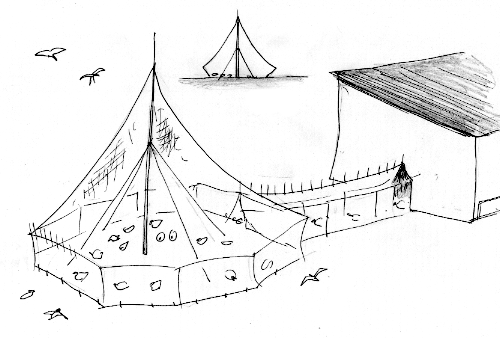
August 19, 2005
Avian flu:
Europe better prepared than Asia, according to experts
LONDON (AP) - Although the avian flu virus is currently heading towards Europe via Russia, health experts are rather optimistic: they believe that European countries are capable of controlling the epidemic before the virus is transmitted from human to human.
"For most of us, there is no doubt that avian flu is heading towards Europe," confirms Michael Osterholm, an expert in this field and director of the Center for Infectious Disease Research at the University of Minnesota (USA).
If the situation worsens, he and his colleagues consider that Europe is better equipped than Southeast Asia to deal with an attack that specialists fear could evolve into a pandemic.
The scenario of an epidemic emerging in Europe would be very different from what is happening in Asia, says Juan Lubroth, a veterinary expert at the Food and Agriculture Organization (FAO), a UN agency responsible for monitoring viruses.
According to him, the virus would not only be detected more quickly. In Europe, people do not live close to animals as in Asia. The European poultry industry is better able to protect its birds from contact with wild ducks, which are responsible for the spread of the disease. Italy and the Netherlands have already managed to contain several avian flu outbreaks.
Moreover, experts point out that the European healthcare system is better equipped to deal with exposure to avian flu or any other animal-borne infection. "Theoretically, since the disease will be stopped in its tracks, it should not infect humans. Its rapid detection will not give it any chance to adapt to humans," says Juan Lubroth.
On Wednesday, employees of Russian veterinary centers incinerated thousands of birds to prevent the epidemic from spreading beyond the mountains of the Urals, which extend for about 1,200 kilometers east of Moscow and separate the eastern part of Russia from its European part.
The origin of the Russian epidemic, whose first case was recorded in July in western Siberia, has been attributed to two types of wild ducks (mallard and pochard), which migrated from Southeast Asia, according to the ministerial spokesperson Sergei Vlasov.
The country's public health chief warned this week that the virus could well reach the Black Sea and Caspian Sea regions later in the year, then spread to the western part of Russia in the spring.
The biggest concern is that the virus mutates and takes on a human-to-human transmissible, deadly form. Most flu epidemics come from avian flu viruses. But although it has destroyed poultry flocks in Asia and caused deaths among humans, it has not yet been transmitted from human to human.
However, Michael Osterholm adds that every time the virus passes from one bird to another, it has the opportunity to mutate. "It's a genetic roulette," he explains. For any transmission, the risk of mutation increases until a strain that is more easily transmitted from human to human is obtained.
Scientists are tracking the migration of birds from Siberia to Africa through Western Europe. Ornithologists and birdwatchers working for Dutch virologist Albert Osterhaus of Erasmus University in the Netherlands collect fecal samples from wild animals every week so scientists can discover any possible traces of avian flu. So far, no trace of the H5N1 strain, which has decimated the Asian poultry flock, has been found.
Following Michael Osterholm's advice, the Dutch have asked poultry farmers to bring their birds indoors, just in case. AP
Avian flu:
Europe better prepared than Asia, according to experts
LONDON (AP) - Although the avian flu virus is currently heading towards Europe via Russia, health experts are rather optimistic: they believe that European countries are capable of controlling the epidemic before the virus is transmitted from human to human.
"For most of us, there is no doubt that avian flu is heading towards Europe," confirms Michael Osterholm, an expert in this field and director of the Center for Infectious Disease Research at the University of Minnesota (USA).
If the situation worsens, he and his colleagues consider that Europe is better equipped than Southeast Asia to deal with an attack that specialists fear could evolve into a pandemic.
The scenario of an epidemic emerging in Europe would be very different from what is happening in Asia, says Juan Lubroth, a veterinary expert at the Food and Agriculture Organization (FAO), a UN agency responsible for monitoring viruses.
According to him, the virus would not only be detected more quickly. In Europe, people do not live close to animals as in Asia. The European poultry industry is better able to protect its birds from contact with wild ducks, which are responsible for the spread of the disease. Italy and the Netherlands have already managed to contain several avian flu outbreaks.
Moreover, experts point out that the European healthcare system is better equipped to deal with exposure to avian flu or any other animal-borne infection. "Theoretically, since the disease will be stopped in its tracks, it should not infect humans. Its rapid detection will not give it any chance to adapt to humans," says Juan Lubroth.
On Wednesday, employees of Russian veterinary centers incinerated thousands of birds to prevent the epidemic from spreading beyond the mountains of the Urals, which extend for about 1,200 kilometers east of Moscow and separate the eastern part of Russia from its European part.
The origin of the Russian epidemic, whose first case was recorded in July in western Siberia, has been attributed to two types of wild ducks (mallard and pochard), which migrated from Southeast Asia, according to the ministerial spokesperson Sergei Vlasov.
The country's public health chief warned this week that the virus could well reach the Black Sea and Caspian Sea regions later in the year, then spread to the western part of Russia in the spring.
The biggest concern is that the virus mutates and takes on a human-to-human transmissible, deadly form. Most flu epidemics come from avian flu viruses. But although it has destroyed poultry flocks in Asia and caused deaths among humans, it has not yet been transmitted from human to human.
However, Michael Osterholm adds that every time the virus passes from one bird to another, it has the opportunity to mutate. "It's a genetic roulette," he explains. For any transmission, the risk of mutation increases until a strain that is more easily transmitted from human to human is obtained.
Scientists are tracking the migration of birds from Siberia to Africa through Western Europe. Ornithologists and birdwatchers working for Dutch virologist Albert Osterhaus of Erasmus University in the Netherlands collect fecal samples from wild animals every week so scientists can discover any possible traces of avian flu. So far, no trace of the H5N1 strain, which has decimated the Asian poultry flock, has been found.
Following Michael Osterholm's advice, the Dutch have asked poultry farmers to bring their birds indoors, just in case. AP
August 22, 2005
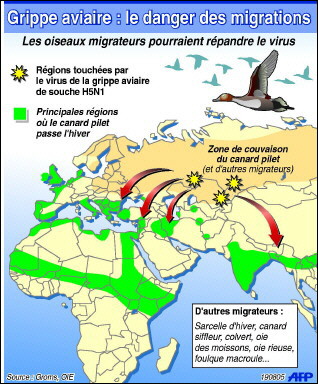
THE HAGUE (AFP) - The Netherlands, where avian flu decimated poultry farms in 2003, were the first on Friday to decide to confine the poultry, but, on the eve of bird migrations, all of Europe is on high alert against a virus potentially dangerous to humans.
The European Commission indicated that veterinary experts would meet next week, on Thursday according to Luxembourg, to assess the situation. The Netherlands will then explain their measures to the other member states.
Some 5 million out of a total of 80 million chickens, ducks, and other poultry in the Netherlands, those raised outdoors, must be confined starting Monday, announced the Ministry of Agriculture. This decision aims to limit the risk of transmission of avian flu during the bird migration period, in an attempt to prevent the spread of the epidemic currently raging in Russia, Kazakhstan, and some Asian countries. In 2003, about 25 million poultry, or a quarter of the poultry population at the time, had died from avian flu or had been slaughtered to try to stop the epidemic.
Exports had been banned for several months. Only Germany mentioned a similar project to that of the Netherlands, which would come into effect by September 15 at the latest if the virus crossed the western part of the Urals. Other European Union countries were waiting for a possible decision from the European institutions. In Spain, where the majority of chickens already live confined, "any preventive measure of this type will be taken within the framework of the European institutions," according to the Ministry of Health.
The 25 had banned imports from several Asian countries (Cambodia, China, Indonesia, Laos, Malaysia, North Korea, Pakistan, Thailand, Vietnam), adding Russia and Kazakhstan to their list on August 8, effective from August 12.
Switzerland followed suit, although noting that "the risk is low" of contamination by migratory birds, as sick birds do not reach the Confederation.
Italy, which has had strict legislation since a dramatic epidemic at the end of the 1990s, feels protected.
Many European countries have only renewed the information to the sector professionals (Belgium, Austria, Lithuania), the Czech Republic or Estonia considering the current surveillance sufficient in countries where farming is done indoors. Croatia, on the other hand, has advised farmers to try to avoid contact between farm poultry and wild birds...
However, the World Health Organization (WHO) issued a new warning on Thursday evening, estimating that the spread of the H5N1 virus "causes concern because it creates new opportunities for human exposure."
The WHO emphasized that "the density of poultry and the farming methods practiced in certain countries" could also have an influence on a possible transmission to humans.
The H5N1 virus has caused 61 human deaths since 2003. It is currently unable to be easily transmitted from human to human, but a mutation or genetic reassortment (gene exchange with a common human flu virus, for example) could cause a pandemic.
No vaccine has been developed yet, but research is underway. | THE HAGUE (AFP) - The Netherlands, where avian flu decimated poultry farms in 2003, were the first on Friday to decide to confine the poultry, but, on the eve of bird migrations, all of Europe is on high alert against a virus potentially dangerous to humans. | The European Commission indicated that veterinary experts would meet next week, on Thursday according to Luxembourg, to assess the situation. The Netherlands will then explain their measures to the other member states. | Some 5 million out of a total of 80 million chickens, ducks, and other poultry in the Netherlands, those raised outdoors, must be confined starting Monday, announced the Ministry of Agriculture. This decision aims to limit the risk of transmission of avian flu during the bird migration period, in an attempt to prevent the spread of the epidemic currently raging in Russia, Kazakhstan, and some Asian countries. In 2003, about 25 million poultry, or a quarter of the poultry population at the time, had died from avian flu or had been slaughtered to try to stop the epidemic. |
About 5 million out of a total of 80 million chickens, ducks and other poultry in the Netherlands, those raised outdoors, must be confined starting Monday, the Ministry of Agriculture announced. This decision aims to limit the risk of avian influenza transmission during the bird migration period, in an attempt to prevent the spread of the current epizootic in Russia, Kazakhstan and some Asian countries. In 2003, about 25 million poultry, or a quarter of the poultry population at the time, had died from avian influenza or were slaughtered to try to stop the epidemic.
What should one think of all this? We are in an undecided situation. Everything is possible in terms of genetics. Recently, a laboratory highlighted the fact that a weed, recovering genetic material implanted in agricultural products, genetically modified organisms (GMOs), had become resistant to herbicides. This says a lot about the risks we take, mainly out of greed, by pursuing this type of activity, a real apprentice-sorcerer game.
Species-to-species transmissions are established facts. The concerns raised by biologists regarding avian influenza are therefore not baseless. A pathogen is not automatically specific to a given species. The avian influenza virus, the bird flu, has thus passed from this bird to migratory birds, and this precise point has made us realize potential risks that no one had considered: migratory birds can carry pathogens all over the world.
Pigs are the domestic animal whose meat is consumed, whose genome is closest to that of humans. A transmission of avian influenza virus could be conceivable, where this animal would serve as an intermediary for this new infection. One ends up wondering if one day this animal will not appear on the list of food prohibitions. I sigh thinking that, once, I really liked eating lamb's brains with butter, with a squeeze of lemon. It was one of my favorite dishes. Now, only memories remain.
Nature is already capable of being the site of deadly genetic mutations (Spanish flu). What is worrying is that many countries are conducting very active research in the field of biological weapons, particularly China, which, in doing so, considers the USA as a potential enemy (see the recent speech by the minister of war of the Middle Kingdom, quite worrying). Let us recall that the British conducted active research during the war on anthrax to face an eventual German invasion, which was considered imminent and only averted by "the Battle of Britain." They tested the strains on sheep on the island of Grunard, which has since become permanently uninhabitable, the earthworms having carried the bacteria into the depths of the soil ( ...). These military researches could be the source of unforeseen and uncontrollable genetic deviations. There are no longer any biologists who exclude the possibility that AIDS may have resulted from research conducted on monkeys, these small monkeys (actually gray) very common in Africa. A genetic manipulation of the virus would have been done, to test on this population the speed of propagation, a virus to which humans would have proven sensitive. Particularity of AIDS: a very slow development and transmission through sexual relations.
It is not clear what would prevent the bird flu virus from now crossing Europe by taking advantage of its new hosts' migrations. To be followed.

Tuesday, August 23, 2005, 6:55 PM
The FNSEA invites poultry farmers
to take "maximum precautions" against avian influenza
PARIS (AP) - The president of the FNSEA, Jean-Michel Lemétayer, expressed concern over the spread of avian influenza and called on Tuesday poultry farmers to take "maximum precautions" against the threat of the epidemic.
"Our farmers have an interest in taking the maximum sanitary precautions," said the president of the National Federation of Agricultural Operators' Unions (FNSEA), questioned on BFM. Mr. Lemétayer said he was "obviously" concerned about the progression of the disease, which has already affected ten countries, including Russia. "We cannot take any risks," he said, "we know what such an epidemic costs on livestock." The Ministry of Agriculture announced on Tuesday that it had reminded poultry professionals of their obligations regarding the monitoring of farms. It also recommended that farmers avoid contact between domestic and wild birds. However, the French Agency for Food Safety (AFSSA) estimates that the risk of contamination of European farms by migratory birds from the east is "low."
The FNSEA invites poultry farmers
to take "maximum precautions" against avian influenza
PARIS (AP) - The president of the FNSEA, Jean-Michel Lemétayer, expressed concern over the spread of avian influenza and called on Tuesday poultry farmers to take "maximum precautions" against the threat of the epidemic.
"Our farmers have an interest in taking the maximum sanitary precautions," said the president of the National Federation of Agricultural Operators' Unions (FNSEA), questioned on BFM. Mr. Lemétayer said he was "obviously" concerned about the progression of the disease, which has already affected ten countries, including Russia. "We cannot take any risks," he said, "we know what such an epidemic costs on livestock." The Ministry of Agriculture announced on Tuesday that it had reminded poultry professionals of their obligations regarding the monitoring of farms. It also recommended that farmers avoid contact between domestic and wild birds. However, the French Agency for Food Safety (AFSSA) estimates that the risk of contamination of European farms by migratory birds from the east is "low."
AP
August 27, 2005
First suspected case of avian influenza detected in Finland on gulls
HELSINKI (AFP) - Finland announced on Friday its first suspected case of avian influenza, which is not dangerous to humans according to health authorities, detected on gulls in the Oulu region (northwest).
The final results of the analyses conducted in a British laboratory are expected within three weeks, the Ministry of Agriculture stated in a press release.
"Several gulls, both alive and dead, were taken for analysis in Oulu, and the suspected virus was detected in these birds," said a ministry official, Riitta Heinonen, to the STT/FNB agency.
According to her, the virus would not be of the H5N1 type, which is transmissible to humans, which has caused 61 deaths in Southeast Asia since 2003.
This announcement by the Finnish authorities comes the day after a meeting of health experts from the member states of the European Union following the appearance of the epizootic in Russia.
These experts judged the risk of extension to the EU to be "remote or low" while recommending a strengthening of the monitoring of migratory birds.
The day before the meeting, an expert from the Finnish Ministry of Agriculture, questioned by AFP, also judged the risk of an epidemic in Finland to be minimal.
"The migration route of birds in Russia does not pass through Finland. Moreover, due to climatic conditions, we raise little poultry outdoors," said Sirpa Kiviruusu.
Since 2002 in Finland, blood samples are regularly taken from poultry and analyses are also conducted on the feathers of wild birds. The 2006 campaign, which allowed the detection of the suspected virus on gulls, has just begun.
First suspected case of avian influenza detected in Finland on gulls
HELSINKI (AFP) - Finland announced on Friday its first suspected case of avian influenza, which is not dangerous to humans according to health authorities, detected on gulls in the Oulu region (northwest).
The final results of the analyses conducted in a British laboratory are expected within three weeks, the Ministry of Agriculture stated in a press release.
"Several gulls, both alive and dead, were taken for analysis in Oulu, and the suspected virus was detected in these birds," said a ministry official, Riitta Heinonen, to the STT/FNB agency.
According to her, the virus would not be of the H5N1 type, which is transmissible to humans, which has caused 61 deaths in Southeast Asia since 2003.
This announcement by the Finnish authorities comes the day after a meeting of health experts from the member states of the European Union following the appearance of the epizootic in Russia.
These experts judged the risk of extension to the EU to be "remote or low" while recommending a strengthening of the monitoring of migratory birds.
The day before the meeting, an expert from the Finnish Ministry of Agriculture, questioned by AFP, also judged the risk of an epidemic in Finland to be minimal.
"The migration route of birds in Russia does not pass through Finland. Moreover, due to climatic conditions, we raise little poultry outdoors," said Sirpa Kiviruusu.
Since 2002 in Finland, blood samples are regularly taken from poultry and analyses are also conducted on the feathers of wild birds. The 2006 campaign, which allowed the detection of the suspected virus on gulls, has just begun.
| The President of the Republic asked to "fully apply the precautionary principle" to protect the French against avian influenza. |
|---|
Jacques Chirac asked the government on Thursday, August 25, to "fully apply the precautionary principle" by taking "all prevention measures" to protect the French against avian influenza. "Our goal is to take all prevention measures and do everything possible so that, in case of the disease's appearance, each French citizen is protected or can be treated, whether they live on the national territory or abroad," said the head of state during the government's back-to-school council. "It is a matter of fully applying the precautionary principle," added Jacques Chirac, whose words were reported by the government spokesperson, Jean-François Copé. The head of state invited the government to "update and improve in full transparency" the plan against avian influenza put in place since the appearance of the epizootic in Southeast Asia in January 2004. "No obstacle, especially economic or financial, will be opposed to a useful measure to protect the health of the French," he said.
Jacques Chirac notably asked the Prime Minister, Dominique de Villepin, to appoint an interministerial delegate for the prevention of this risk. He also wished that the government "examine with our partners, the competent international organizations and the pharmaceutical industry, what measures can be taken to ensure that, in case of need, stockpiles of treatment will be available to stop an eventual pandemic in its early stages in the first affected countries."
Mr. Bertrand reported to the Council of Ministers on the first conclusions of the experts of the AFSSA (French Agency for Food Safety) "on the risks of contamination of French farms by birds infected with the avian influenza virus" and the "first measures" taken by the government.
Emphasizing that this risk was considered "low," the minister listed "three objectives" set by the government: "to detect as early as possible any potentially sick or virus-carrying birds, to protect our domestic farms from the epizootic, and to prevent the virus from becoming transmissible from human to human."
In this perspective, "it will be recommended to all professionals in the poultry sector in contact with animals to be vaccinated against the seasonal flu," he recalled.
Source :
http://permanent.nouvelobs.com/europe/20050825.OBS7502.html
Footsteps of boots :
Are these concerns justified? The WHO (World Health Organization) has repeatedly warned countries about the possibility of the virus spreading to humans. In such situations, the precautionary principle must be applied, the cost per inhabitant remaining moderate. According to some rumors, orders have been given to French soldiers to "secure the convoys bringing vaccine doses to medical centers." Currently, France does not have the doses of vaccine or medicine to treat this condition, which has already caused several dozen deaths worldwide. The production of the vaccine is not instantaneous, far from it. The orders that have circulated in the French "Defense" sector aim to prepare for potential panic movements in case an epidemic affecting humans breaks out, while the equipment of medical centers with vaccine doses would not be carried out. The available doses would then be reserved for healthcare workers.
| The President of the Republic asked to "fully apply the precautionary principle" to protect the French against avian influenza. |
|---|
| The President of the Republic asked to "fully apply the precautionary principle" to protect the French against avian influenza. |
|---|
France organizes its health response
The State has already purchased 5 million treatments and 50 million masks.
By Sylvie BRIET
Friday, August 26, 2005 (Liberation - 06:00)
The precautionary principle now applies to avian influenza. And, if one believes Jacques Chirac, the cost of the operation will not be an obstacle. Vaccines, antivirals, protective equipment, hospital preparations... An enormous organization is being set up. "The plan to fight a pandemic flu must be continuously updated and improved," said the President in the Council of Ministers yesterday. It is not simple, given the number of unknowns.
40 dollars.
In case of an epidemic, according to experts from the Institute for Health Surveillance, the number of cases in France could reach 20.9 million people, resulting in 200,000 deaths. If the virus, which has become transmissible from human to human, arrives, a race against time will immediately begin. The main human health measures concern the acquisition of medicines. Thus, antivirals: only one is really effective,
Tamiflu, produced by a single laboratory in the world, the Swiss Roche
.
The French government has already purchased 5 million treatments (one treatment allows the care of one person). It will have 9 million by the end of October, 14 million by the end of December.
"France is the best equipped country in relation to its population," says Nicolas Postel-Vinay, spokesperson for the General Directorate of Health.
This treatment is very expensive,
around 40 dollars (
32.50 euros
), but governments negotiate the prices.
Perishable,
this antiviral, which also treats other flu viruses, will be distributed first to professions exposed (health, firefighters, etc.)
and to the most vulnerable, such as children.
But in the case of a catastrophic scenario, the situation would become complex. Example: the supermarket cashier should also be protected.
Only a vaccine can be administered on a large scale, but it takes time to develop, as there is none yet. The government has already purchased from Aventis-Pasteur a first batch of 20 million vaccines, in anticipation. A prototype vaccine has been developed and clinical trials are underway, in France and elsewhere. The first results have shown that this vaccine works. However, experts will have to make it more effective. With a big unknown: "Will the strain that emerges be close enough to the current strain, H5N1, for this vaccine to work?" asks Jean-Thierry Aubin, deputy director of the National Reference Center for Influenza at the Pasteur Institute. In any case, it will take between three and six months in the best case to obtain the vaccines, hence the importance of antivirals to combat the pandemic while waiting.
Filtering masks.
A second series of measures concerns people's behavior. A comprehensive information campaign will have to be carried out. If there is an epidemic, it will be necessary to clear out places of gathering of people (subway, stadiums, places of worship...) that favor contagion. Frequent hand washing will become essential. 50 million filtering masks have already arrived, destined for healthcare teams. Kits for detection and sampling are distributed to hospitals. Despite the concern caused by migratory birds, experts consider it more likely that the virus will mutate in Southeast Asia and arrive by plane with an infected traveler. Therefore, the Minister of Health is studying the possibility of installing thermal cameras in airports to detect passengers with fever... From the point of view of health, France seems able to quickly control an eventual epidemic. Because it has the means to obtain effective weapons. This will not be the case for poorer countries...
Avian influenza
The "luxury" chickens fear losing their feathers. In case of an epidemic, farmers may be forced to give up outdoor rearing.
French quality poultry is holding its breath. The avian influenza issue is beginning to scare professionals of high-end chicken, turkey and pheasant. The statements of Jacques Chirac, who called yesterday to "fully apply the precautionary principle" against the threat of avian influenza (see below), will not calm their concerns. This is the slogan that appeared during the mad cow disease and the sheep foot-and-mouth disease. For now, nothing yet very serious: "screening" tests will be put in place, and outdoor farmers, whose poultry walk almost freely, are "invited" not to feed them with water or food outside.
Cold sweat.
But in case of worsening of the situation, one could, like in the Netherlands, be forced to confine the birds in enclosed spaces "to protect the health of the French." Such statements give cold sweats to farmers of "good" chickens. If 75% of French poultry production (3.9 billion euros of annual turnover) is raised in cages - therefore less affected by this type of measure - the taste quality of high-end chickens depends on their ability to roam on "grass paths" carefully designed. These daily green walks in the open air complement the birds' diet with minerals and insects. It is one of the conditions established by the very precise specification sheet that allows the awarding of the precious "Label rouge" quality label, and/or benefit from a Protected Geographical Indication (IGP), guarantees of prestige and a higher selling price.
That is why, in the small world of Bresse chickens, one of the IGP and also one of the two only Appellations of Origin (AOC) in the meat sector, the idea of enclosing the poultry makes them shudder: "It would be a catastrophe if we had to keep our poultry indoors in covered enclosures. This would take us out of the framework defined by our specification sheet, and we would no longer be able to market them under the Bresse label. I don't see how we could do it, unless we get exemptions," worries Christophe Boucault, technical director of the Maison de la volaille de Bresse, in Branges (Saône-et-Loire), which groups 252 farms and puts a large million of these tasty and appreciated chickens on the market every year, with their blue legs and bright red crests. In case of confinement measures, the farmers would be directly affected financially: at the local butcher's, the "Bresse" is sold for 11 to 12 euros per kilogram, twice as much as a Label rouge chicken and four times more than an industrial chicken. At this price, the Bresse chicken offers a first-class health traceability: "In case of a problem, we would have no difficulty in finding the origin of the faulty chicken, its parents, siblings, to proceed with the destruction before entering the food chain," assures Christophe Boucault.
Precaution.
The fear of the "precautionary" confinement also gives cold sweats in the slightly less prestigious world of IGP poultry, which alone represent 31 of the 75 French IGP, according to figures from the National Institute of Appellations of Origin (Inao). "All these poultry, 101,000 tonnes annually, are also subject to more or less important grass paths depending on the quality sought. If they had to be confined, they would no longer be able to benefit from the IGP," comments the public institute. The blow would be hard for the farmers of white farm chickens of Auvergne, the farm chickens of Velay or the blacks of Forez. Not to mention the famous Label rouge chickens of Loué, the stars of hypermarket shelves. In the Sarthe, as a precaution, "the watering of the chickens is already done indoors," explains Yves de La Fouchardière, director of the Fermiers de Loué.
The H5N1 threat
It is the most worrying influenza virus in recent years. The one through which the next pandemic could arrive. H5N1 is highly pathogenic for birds, but, according to researchers, it could well expand its harmful capacity to humans. It was first detected in 1997, during an avian influenza epidemic in Hong Kong. H5N1 infected thirteen people there, and killed six of them. "Mostly children," recalls Professor Antoine Flahault, of the Sentinelle network. A horrifying mortality rate, since 50% of the patients died. In comparison, the Spanish flu of 1918, "the worst memory," according to Antoine Flahault, must have killed only 1 to 2% of the infected. H5N1 "is not a human virus, it is an avian virus. There has never been human-to-human transmission. Today, all human victims have had a kind of virus intoxication, most often on poultry markets." It's as if they had found themselves under a rain of viral particles dispersed by sick birds. All the cells of the lungs have been infected by H5N1. "In this case, the virus does not spread, but it can kill." According to Antoine Flahault, "it cannot therefore cause a pandemic for now. But no one knows yet the pathogenic power of this virus in humans." The virus is trying to become human, but it always falls into an impasse. Will it ever be able to cross the barrier? It can do so by infecting someone already carrying a common flu virus, "a mallard hunter, for example," explains Antoine Flahault. The human does not die. However, from the mixture of the two viruses, a hybrid capable of spreading from human to human emerges. A theoretically possible situation, although never seen. Gene reassortments seem more effective when they occur in pigs. Hence the danger of the close proximity of birds, pigs, and humans on the markets of Southeast Asia. And for Dr. Flahault, the threat "can come from anywhere. From the Netherlands, from France, from Hong Kong or the United States." According to him, the pandemic could be stopped if it is detected in time. "Otherwise, we will have to face it."
France organizes its health response
The State has already purchased 5 million treatments and 50 million masks.
By Sylvie BRIET
Friday, August 26, 2005 (Liberation - 06:00)
The precautionary principle now applies to avian influenza. And, if one believes Jacques Chirac, the cost of the operation will not be an obstacle. Vaccines, antivirals, protective equipment, hospital preparations... An enormous organization is being set up. "The plan to fight a pandemic flu must be continuously updated and improved," said the President in the Council of Ministers yesterday. It is not simple, given the number of unknowns.
40 dollars.
In case of an epidemic, according to experts from the Institute for Health Surveillance, the number of cases in France could reach 20.9 million people, resulting in 200,000 deaths. If the virus, which has become transmissible from human to human, arrives, a race against time will immediately begin. The main human health measures concern the acquisition of medicines. Thus, antivirals: only one is really effective,
Tamiflu, produced by a single laboratory in the world, the Swiss Roche
.
The French government has already purchased 5 million treatments (one treatment allows the care of one person). It will have 9 million by the end of October, 14 million by the end of December.
"France is the best equipped country in relation to its population," says Nicolas Postel-Vinay, spokesperson for the General Directorate of Health.
This treatment is very expensive,
around 40 dollars (
32.50 euros
), but governments negotiate the prices.
Perishable,
this antiviral, which also treats other flu viruses, will be distributed first to professions exposed (health, firefighters, etc.)
and to the most vulnerable, such as children.
But in the case of a catastrophic scenario, the situation would become complex. Example: the supermarket cashier should also be protected.
Only a vaccine can be administered on a large scale, but it takes time to develop, as there is none yet. The government has already purchased from Aventis-Pasteur a first batch of 20 million vaccines, in anticipation. A prototype vaccine has been developed and clinical trials are underway, in France and elsewhere. The first results have shown that this vaccine works. However, experts will have to make it more effective. With a big unknown: "Will the strain that emerges be close enough to the current strain, H5N1, for this vaccine to work?" asks Jean-Thierry Aubin, deputy director of the National Reference Center for Influenza at the Pasteur Institute. In any case, it will take between three and six months in the best case to obtain the vaccines, hence the importance of antivirals to combat the pandemic while waiting.
Filtering masks.
A second series of measures concerns people's behavior. A comprehensive information campaign will have to be carried out. If there is an epidemic, it will be necessary to clear out places of gathering of people (subway, stadiums, places of worship...) that favor contagion. Frequent hand washing will become essential. 50 million filtering masks have already arrived, destined for healthcare teams. Kits for detection and sampling are distributed to hospitals. Despite the concern caused by migratory birds, experts consider it more likely that the virus will mutate in Southeast Asia and arrive by plane with an infected traveler. Therefore, the Minister of Health is studying the possibility of installing thermal cameras in airports to detect passengers with fever... From the point of view of health, France seems able to quickly control an eventual epidemic. Because it has the means to obtain effective weapons. This will not be the case for poorer countries...
Avian influenza
The "luxury" chickens fear losing their feathers. In case of an epidemic, farmers may be forced to give up outdoor rearing.
French quality poultry is holding its breath. The avian influenza issue is beginning to scare professionals of high-end chicken, turkey and pheasant. The statements of Jacques Chirac, who called yesterday to "fully apply the precautionary principle" against the threat of avian influenza (see below), will not calm their concerns. This is the slogan that appeared during the mad cow disease and the sheep foot-and-mouth disease. For now, nothing yet very serious: "screening" tests will be put in place, and outdoor farmers, whose poultry walk almost freely, are "invited" not to feed them with water or food outside.
Cold sweat.
But in case of worsening of the situation, one could, like in the Netherlands, be forced to confine the birds in enclosed spaces "to protect the health of the French." Such statements give cold sweats to farmers of "good" chickens. If 75% of French poultry production (3.9 billion euros of annual turnover) is raised in cages - therefore less affected by this type of measure - the taste quality of high-end chickens depends on their ability to roam on "grass paths" carefully designed. These daily green walks in the open air complement the birds' diet with minerals and insects. It is one of the conditions established by the very precise specification sheet that allows the awarding of the precious "Label rouge" quality label, and/or benefit from a Protected Geographical Indication (IGP), guarantees of prestige and a higher selling price.
That is why, in the small world of Bresse chickens, one of the IGP and also one of the two only Appellations of Origin (AOC) in the meat sector, the idea of enclosing the poultry makes them shudder: "It would be a catastrophe if we had to keep our poultry indoors in covered enclosures. This would take us out of the framework defined by our specification sheet, and we would no longer be able to market them under the Bresse label. I don't see how we could do it, unless we get exemptions," worries Christophe Boucault, technical director of the Maison de la volaille de Bresse, in Branges (Saône-et-Loire), which groups 252 farms and puts a large million of these tasty and appreciated chickens on the market every year, with their blue legs and bright red crests. In case of confinement measures, the farmers would be directly affected financially: at the local butcher's, the "Bresse" is sold for 11 to 12 euros per kilogram, twice as much as a Label rouge chicken and four times more than an industrial chicken. At this price, the Bresse chicken offers a first-class health traceability: "In case of a problem, we would have no difficulty in finding the origin of the faulty chicken, its parents, siblings, to proceed with the destruction before entering the food chain," assures Christophe Boucault.
Precaution.
The fear of the "precautionary" confinement also gives cold sweats in the slightly less prestigious world of IGP poultry, which alone represent 31 of the 75 French IGP, according to figures from the National Institute of Appellations of Origin (Inao). "All these poultry, 101,000 tonnes annually, are also subject to more or less important grass paths depending on the quality sought. If they had to be confined, they would no longer be able to benefit from the IGP," comments the public institute. The blow would be hard for the farmers of white farm chickens of Auvergne, the farm chickens of Velay or the blacks of Forez. Not to mention the famous Label rouge chickens of Loué, the stars of hypermarket shelves. In the Sarthe, as a precaution, "the watering of the chickens is already done indoors," explains Yves de La Fouchardière, director of the Fermiers de Loué.
The H5N1 threat
It is the most worrying influenza virus in recent years. The one through which the next pandemic could arrive. H5N1 is highly pathogenic for birds, but, according to researchers, it could well expand its harmful capacity to humans. It was first detected in 1997, during an avian influenza epidemic in Hong Kong. H5N1 infected thirteen people there, and killed six of them. "Mostly children," recalls Professor Antoine Flahault, of the Sentinelle network. A horrifying mortality rate, since 50% of the patients died. In comparison, the Spanish flu of 1918, "the worst memory," according to Antoine Flahault, must have killed only 1 to 2% of the infected. H5N1 "is not a human virus, it is an avian virus. There has never been human-to-human transmission. Today, all human victims have had a kind of virus intoxication, most often on poultry markets." It's as if they had found themselves under a rain of viral particles dispersed by sick birds. All the cells of the lungs have been infected by H5N1. "In this case, the virus does not spread, but it can kill." According to Antoine Flahault, "it cannot therefore cause a pandemic for now. But no one knows yet the pathogenic power of this virus in humans." The virus is trying to become human, but it always falls into an impasse. Will it ever be able to cross the barrier? It can do so by infecting someone already carrying a common flu virus, "a mallard hunter, for example," explains Antoine Flahault. The human does not die. However, from the mixture of the two viruses, a hybrid capable of spreading from human to human emerges. A theoretically possible situation, although never seen. Gene reassortments seem more effective when they occur in pigs. Hence the danger of the close proximity of birds, pigs, and humans on the markets of Southeast Asia. And for Dr. Flahault, the threat "can come from anywhere. From the Netherlands, from France, from Hong Kong or the United States." According to him, the pandemic could be stopped if it is detected in time. "Otherwise, we will have to face it."
That is why, in the small world of Bresse chicken, one of the IGP (Protected Geographical Indication) products, which is also one of the two only Appellations d'origine contrôlée (AOC) in the meat sector, the idea of caging the poultry makes people shudder: "It would be a catastrophe if we had to keep our birds inside enclosures. This would take us out of the parameters defined by our specifications, and we would no longer be able to market them under the Bresse label. I don't see how we could do it, unless we obtain exemptions," worries Christophe Boucault, technical director of the Maison de la volaille de Bresse, in Branges (Saône-et-Loire), which groups 252 farms and puts a large million of these tasty and highly appreciated chickens on the market every year, with their blue legs and bright red combs. In case of confinement measures, the farmers would be directly affected financially: at the local butcher's, "Bresse" chicken is sold for 11 to 12 euros per kilogram, twice as much as Label rouge chicken and four times more than industrial chicken. At this price, Bresse chicken offers top-level sanitary traceability: "In case of a problem, we would have no difficulty in finding the origin of the faulty chicken, its parents, brothers, and sisters, to destroy them before they enter the food chain," assures Christophe Boucault.
Precaution.
The fear of "precautionary" confinement also causes cold sweats in the slightly less prestigious world of IGP poultry, which alone represent 31 of the 75 French IGP, according to figures from the National Institute of Appellations of Origin (Inao). "All these birds, 101,000 tonnes annually, are also subject to grassy pastures of varying importance depending on the quality sought. If they had to be caged, they would no longer be eligible for IGP," comments the public institute. The blow would be hard for the farmers of white farm-raised chickens of Auvergne, the chickens of Velay, or the black chickens of Forez. Not to mention the famous Label rouge chickens of Loué, stars of supermarket shelves. In Sarthe, as a precaution, "the chickens are already watered indoors," explains Yves de La Fouchardière, director of the Fermiers de Loué.
The H5N1 threat
It is the most worrying bird flu virus in recent years. The one through which the next pandemic could arrive. H5N1 is highly pathogenic for birds, but according to researchers, it could also expand its capacity to cause harm to humans. It was first detected in 1997 during an avian flu outbreak in Hong Kong. H5N1 infected thirteen people and killed six of them. "Mostly children," recalls Professor Antoine Flahault from the Sentinelle network. "An appalling mortality rate, since 50% of the patients died." In comparison, the Spanish flu of 1918, "the worst memory," according to Antoine Flahault, must have killed only 1 to 2% of those infected." H5N1 "is not a human virus, it is an avian virus. There has never been human-to-human transmission. Today, all the human victims have had some kind of viral intoxication, usually on poultry markets." It's as if they had been caught in a rain of viral particles dispersed by sick birds. All the cells in the lungs became infected with H5N1. "In this case, the virus does not spread, but it can kill." According to Antoine Flahault, "for now, it cannot cause a pandemic. But no one knows yet the pathogenic power of this virus in humans." The virus is trying to become human, but it always ends up in a dead end. Will it ever be able to cross the barrier? It could do so by infecting someone already carrying a common flu virus, "a mallard hunter, for example," explains Antoine Flahault. "The person does not die. However, the mixture of the two viruses produces a hybrid capable of spreading from human to human." A theoretically possible situation, although never seen before. Gene reassortments seem more effective when they occur in pigs. Hence the danger of the close contact between birds, pigs, and humans on the markets of Southeast Asia. And for Dr. Flahault, the threat "can come from almost anywhere. From the Netherlands, from France, from Hong Kong, or from the United States." According to him, the pandemic could be stopped if detected in time. "Otherwise, we will have to face it."
Wednesday, September 7, 2005
Avian influenza threatens the world, warns WHO
COLOMBO (Reuters) - The world will face a deadly avian flu pandemic as Thailand is the only country in Southeast Asia prepared to deal with it, warns the WHO.
The World Health Organization stated that the virus could mutate into a form that is transmissible from one human to another, which would facilitate its spread and could result in the death of one to seven million people.
"The question is no longer whether the avian flu pandemic will occur, but when," said Dr. Jai P. Narain, director of the Department of Communicable Diseases at the WHO, during a South Asian health summit in Sri Lanka.
"Thus far, only one country in Southeast Asia has a pandemic preparedness plan: Thailand. They have stockpiles of antiviral drugs," emphasized Narain.
Migratory birds represent a serious risk of spreading the disease worldwide and Asia, the preferred destination of these species in winter, is more vulnerable.
Avian influenza has claimed another victim in Vietnam last week, bringing the total number of deaths caused by this disease in Asia to 63.
The virus has affected Kazakhstan and part of Russia this month, resulting in the death of 14,000 poultry.
Avian influenza threatens the world, warns WHO
COLOMBO (Reuters) - The world will face a deadly avian flu pandemic as Thailand is the only country in Southeast Asia prepared to deal with it, warns the WHO.
The World Health Organization stated that the virus could mutate into a form that is transmissible from one human to another, which would facilitate its spread and could result in the death of one to seven million people.
"The question is no longer whether the avian flu pandemic will occur, but when," said Dr. Jai P. Narain, director of the Department of Communicable Diseases at the WHO, during a South Asian health summit in Sri Lanka.
"Thus far, only one country in Southeast Asia has a pandemic preparedness plan: Thailand. They have stockpiles of antiviral drugs," emphasized Narain.
Migratory birds represent a serious risk of spreading the disease worldwide and Asia, the preferred destination of these species in winter, is more vulnerable.
Avian influenza has claimed another victim in Vietnam last week, bringing the total number of deaths caused by this disease in Asia to 63.
The virus has affected Kazakhstan and part of Russia this month, resulting in the death of 14,000 poultry.
Thursday, September 15, 2005, 0h14
Avian influenza: At the UN, Washington and Paris sound the alarm
NEW YORK (AFP) - US President George W. Bush and French Prime Minister Dominique de Villepin called on the UN on Wednesday to mobilize internationally against avian influenza, a "new emergency" that could lead to a global pandemic.
"If nothing is done, this virus could cause the first pandemic of the 21st century and we must not let this happen," said George W. Bush before the UN General Assembly. The term pandemic - which refers to an epidemic causing many deaths over a large geographical area - was also used by Dominique de Villepin: "We must today avert the risk of an avian flu pandemic. The scale of the threat imposes an immediate response," he said at a meeting on development financing. The US president urged his audience of heads of state and government to join "a new international partnership" against avian influenza, in which any affected country would commit to immediately sharing "information" and "samples" with the World Health Organization (WHO).
The H5N1 avian flu virus belongs to the same pathogen family responsible for the 1918 Spanish flu, which killed up to 40 million people worldwide. Regular flu epidemics cause 1.5 million deaths annually. The H5N1 virus has killed 61 people in Southeast Asia, mainly in Vietnam and Thailand, since 2003. It has since spread to other countries in the region and recently appeared on poultry in Siberia, where it was transported by migratory birds. The more the H5N1 virus circulates, the higher the risk of human infection, as well as the risk of the virus acquiring the ability to spread easily from human to human, and triggering a global epidemic, according to the WHO.
The French Prime Minister advocated for joint work by international organizations, national authorities, and the pharmaceutical industry to strengthen "early detection capabilities" for human-transmissible viral strains and "establish an international emergency stockpile of antiviral drugs." The French Prime Minister said "we must accelerate the research and development of a sufficient quantity of vaccine." A prototype vaccine developed by the French laboratory Sanofi Pasteur is currently being tested in the United States, where it has shown encouraging results, according to a public health official (NIH). However, producing enough doses is a race against time, as only three laboratories in the world produce vaccines, according to Julie Gernerding, director of the Centers for Disease Control and Prevention (CDC) in the United States. Without efforts to produce this vaccine and facilitate access to treatment, "it is the entire world, our countries, and our populations, that could be affected. All our efforts for development could then be ruined," warned Mr. de Villepin. In Europe, veterinary experts from the 25 EU member states have outlined the surveillance measures to be taken to combat avian influenza at the beginning of September, while minimizing the risks of extension to the EU, considered "low." President Jacques Chirac and the Director General of the WHO had already announced at the end of August their intention to intensify international mobilization on this issue. The spread of the H5N1 virus will also be the central theme of the annual meeting of the WHO Regional Committee for the Western Pacific, bringing together 37 countries, which will take place from September 19 to 23 in Nouméa (New Caledonia).
Thursday, September 15, 2005, 0h14
Avian influenza: At the UN, Washington and Paris sound the alarm
NEW YORK (AFP) - US President George W. Bush and French Prime Minister Dominique de Villepin called on the UN on Wednesday to mobilize internationally against avian influenza, a "new emergency" that could lead to a global pandemic.
"If nothing is done, this virus could cause the first pandemic of the 21st century and we must not let this happen," said George W. Bush before the UN General Assembly. The term pandemic - which refers to an epidemic causing many deaths over a large geographical area - was also used by Dominique de Villepin: "We must today avert the risk of an avian flu pandemic. The scale of the threat imposes an immediate response," he said at a meeting on development financing. The US president urged his audience of heads of state and government to join "a new international partnership" against avian influenza, in which any affected country would commit to immediately sharing "information" and "samples" with the World Health Organization (WHO).
The H5N1 avian flu virus belongs to the same pathogen family responsible for the 1918 Spanish flu, which killed up to 40 million people worldwide. Regular flu epidemics cause 1.5 million deaths annually. The H5N1 virus has killed 61 people in Southeast Asia, mainly in Vietnam and Thailand, since 2003. It has since spread to other countries in the region and recently appeared on poultry in Siberia, where it was transported by migratory birds. The more the H5N1 virus circulates, the higher the risk of human infection, as well as the risk of the virus acquiring the ability to spread easily from human to human, and triggering a global epidemic, according to the WHO.
The French Prime Minister advocated for joint work by international organizations, national authorities, and the pharmaceutical industry to strengthen "early detection capabilities" for human-transmissible viral strains and "establish an international emergency stockpile of antiviral drugs." The French Prime Minister said "we must accelerate the research and development of a sufficient quantity of vaccine." A prototype vaccine developed by the French laboratory Sanofi Pasteur is currently being tested in the United States, where it has shown encouraging results, according to a public health official (NIH). However, producing enough doses is a race against time, as only three laboratories in the world produce vaccines, according to Julie Gernerding, director of the Centers for Disease Control and Prevention (CDC) in the United States. Without efforts to produce this vaccine and facilitate access to treatment, "it is the entire world, our countries, and our populations, that could be affected. All our efforts for development could then be ruined," warned Mr. de Villepin. In Europe, veterinary experts from the 25 EU member states have outlined the surveillance measures to be taken to combat avian influenza at the beginning of September, while minimizing the risks of extension to the EU, considered "low." President Jacques Chirac and the Director General of the WHO had already announced at the end of August their intention to intensify international mobilization on this issue. The spread of the H5N1 virus will also be the central theme of the annual meeting of the WHO Regional Committee for the Western Pacific, bringing together 37 countries, which will take place from September 19 to 23 in Nouméa (New Caledonia).
Sunday, September 18, 2005, 6:07 PM
Avian influenza:
Jakarta Zoo closed, 2 new suspected cases in Indonesia
JAKARTA (AFP) - Two new children are suspected of having contracted the avian flu virus in Indonesia, while it has been decided to close the Jakarta Zoo where 19 birds have been infected, announced officials on Sunday.
The capital's zoo will remain closed to the public until October 17 to allow cleaning of the site and treatment of the infected animals, said the Minister of Agriculture Anton Apriantono on radio ElShinta.
According to him, of 27 samples taken from birds at the zoo, including eagles and dwarf chickens, 19 tested positive for the avian flu virus.
Meanwhile, two new children are suspected of having contracted the avian flu virus, and tests taken from them have been sent to Hong Kong for possible confirmation, announced a spokesperson for the Ministry of Health, Sumardi, on the information website Detikcom.
Indonesia confirmed its fourth human death from avian flu on Friday, while the alarm was raised last week at the UN General Assembly.
This death brought the total number of people infected by the H5N1 virus, responsible for avian flu, to 63 since the disease was discovered in Southeast Asia at the end of 2003.
Avian influenza:
Jakarta Zoo closed, 2 new suspected cases in Indonesia
JAKARTA (AFP) - Two new children are suspected of having contracted the avian flu virus in Indonesia, while it has been decided to close the Jakarta Zoo where 19 birds have been infected, announced officials on Sunday.
The capital's zoo will remain closed to the public until October 17 to allow cleaning of the site and treatment of the infected animals, said the Minister of Agriculture Anton Apriantono on radio ElShinta.
According to him, of 27 samples taken from birds at the zoo, including eagles and dwarf chickens, 19 tested positive for the avian flu virus.
Meanwhile, two new children are suspected of having contracted the avian flu virus, and tests taken from them have been sent to Hong Kong for possible confirmation, announced a spokesperson for the Ministry of Health, Sumardi, on the information website Detikcom.
Indonesia confirmed its fourth human death from avian flu on Friday, while the alarm was raised last week at the UN General Assembly.
This death brought the total number of people infected by the H5N1 virus, responsible for avian flu, to 63 since the disease was discovered in Southeast Asia at the end of 2003.
Monday, September 19, 2005 ****
Avian influenza: WHO urges countries to prepare for a pandemic
A three-year-old child in Jakarta is being treated for confirmed avian flu.
NOUMEA (AFP) - The World Health Organization (WHO) has again urged countries in Nouméa (New Caledonia) to prepare for an avian flu pandemic to avoid being "taken by surprise" in the face of an "obvious" threat.
"No government, no head of state can be taken by surprise. It is very important for all of us to be prepared," said Lee Jong-wook, Director-General of the WHO, on the first day of the annual meeting of the Western Pacific Regional Committee of the organization.
Some 200 delegates from 37 countries and territories, including several countries affected by the H5N1 avian flu virus, such as Vietnam or Cambodia, are participating in this meeting until Friday, dominated by the threat of a pandemic. After the alert raised last week by US President George Bush and French Prime Minister Dominique de Villepin at the UN, Mr. Lee emphasized the need for "each country to have a national pandemic preparedness plan." Currently, only about 40 countries out of the 192 WHO member states have a detailed plan to deal with a mutated strain of the H5N1 virus, which could spread between humans and cause millions of deaths, like the 1918 Spanish flu. Since 2003, the H5N1 virus has killed 63 people in Southeast Asia, who had contact with infected poultry, but the human adaptation of the virus is now considered inevitable.
"It is obvious that a pandemic will occur, all the conditions are in place. The problem now is time," said Dr. Lee. To allow "the earliest possible detection of the start of this pandemic," the WHO Director-General called "a partnership between countries, the private sector, and the international community" essential.
Dr. Lee praised President Jacques Chirac for his commitment to mobilizing France to train personnel in Southeast Asia and Africa to prevent the disease. While several speakers expressed concerns about medical aid to poor countries, the most vulnerable in the event of a pandemic, the WHO wished that "the wealthiest countries" who have already stockpiled antivirals could reserve some for countries that need them. Mr. Lee also reminded that the WHO had signed an agreement with the Swiss pharmaceutical company Roche for the supply of 30 million doses of antivirals, which could treat three million people. An action plan against avian influenza in Asia-Pacific, valued at 160 million dollars and to be the subject of a donors' meeting at the end of the year, has also been developed by the WHO. However, the organization highlighted the difficulties encountered on the ground in some Asian countries in monitoring the spread of the disease. "It is important to remember that in many rural areas where poultry is raised, there are not enough means for adequate surveillance," said Shigeru Omi, Director of the Western Pacific Region of the WHO. He also emphasized the weakness or absence of compensation for farmers, which discourages them from reporting the disease.
Avian influenza: WHO urges countries to prepare for a pandemic
A three-year-old child in Jakarta is being treated for confirmed avian flu.
NOUMEA (AFP) - The World Health Organization (WHO) has again urged countries in Nouméa (New Caledonia) to prepare for an avian flu pandemic to avoid being "taken by surprise" in the face of an "obvious" threat.
"No government, no head of state can be taken by surprise. It is very important for all of us to be prepared," said Lee Jong-wook, Director-General of the WHO, on the first day of the annual meeting of the Western Pacific Regional Committee of the organization.
Some 200 delegates from 37 countries and territories, including several countries affected by the H5N1 avian flu virus, such as Vietnam or Cambodia, are participating in this meeting until Friday, dominated by the threat of a pandemic. After the alert raised last week by US President George Bush and French Prime Minister Dominique de Villepin at the UN, Mr. Lee emphasized the need for "each country to have a national pandemic preparedness plan." Currently, only about 40 countries out of the 192 WHO member states have a detailed plan to deal with a mutated strain of the H5N1 virus, which could spread between humans and cause millions of deaths, like the 1918 Spanish flu. Since 2003, the H5N1 virus has killed 63 people in Southeast Asia, who had contact with infected poultry, but the human adaptation of the virus is now considered inevitable.
"It is obvious that a pandemic will occur, all the conditions are in place. The problem now is time," said Dr. Lee. To allow "the earliest possible detection of the start of this pandemic," the WHO Director-General called "a partnership between countries, the private sector, and the international community" essential.
Dr. Lee praised President Jacques Chirac for his commitment to mobilizing France to train personnel in Southeast Asia and Africa to prevent the disease. While several speakers expressed concerns about medical aid to poor countries, the most vulnerable in the event of a pandemic, the WHO wished that "the wealthiest countries" who have already stockpiled antivirals could reserve some for countries that need them. Mr. Lee also reminded that the WHO had signed an agreement with the Swiss pharmaceutical company Roche for the supply of 30 million doses of antivirals, which could treat three million people. An action plan against avian influenza in Asia-Pacific, valued at 160 million dollars and to be the subject of a donors' meeting at the end of the year, has also been developed by the WHO. However, the organization highlighted the difficulties encountered on the ground in some Asian countries in monitoring the spread of the disease. "It is important to remember that in many rural areas where poultry is raised, there are not enough means for adequate surveillance," said Shigeru Omi, Director of the Western Pacific Region of the WHO. He also emphasized the weakness or absence of compensation for farmers, which discourages them from reporting the disease.
September 28, 2005
WHO, World Health Organization, gives an update
Avian influenza ("bird flu") and the importance of transmission to humans
The disease in birds: impact and control measures
Avian influenza, caused by a strain A of the influenza virus, is an infectious disease affecting birds. Identified for the first time in Italy over 100 years ago, it occurs worldwide. It is believed that all birds are susceptible to this infection, although some species are more resistant than others. It can have a wide range of symptoms, from a mild form to a highly contagious and rapidly fatal disease that causes severe epidemics. In this case, it is called highly pathogenic avian influenza, characterized by a sudden onset, severe symptoms, and a rapid progression to death, with a mortality rate approaching 100%. There are 15 subtypes of influenza virus in birds, which therefore constitute a vast reservoir of viruses that can potentially circulate in bird populations. To date, all outbreaks of the highly pathogenic form have been caused by influenza A viruses of subtypes H5 and H7. Waterfowl - particularly wild ducks - constitute the natural reservoir of avian influenza viruses. These birds are also the most resistant to infection. Domestic poultry, such as chickens and turkeys, are particularly susceptible to rapidly fatal epidemics. Direct or indirect contact between domestic birds and migratory waterfowl has often been the cause of epidemics. Live bird markets have also played an important role in the spread. Recent research has shown that weakly pathogenic viruses can sometimes, after circulating briefly in a poultry population, mutate and become highly pathogenic. During the 1983-1984 epidemic in the United States, the H5N2 virus, initially not very deadly, became highly pathogenic in six months, with a mortality rate approaching 90%. To contain this epidemic, more than 17 million birds had to be culled and nearly US $65 million was spent. During the 1999-2001 epidemic in Italy, the H7N1 virus, initially weakly pathogenic, mutated in nine months. More than 13 million poultry died or were slaughtered. Quarantining infected farms and destroying infected or potentially exposed poultry are the classic measures of control aimed at preventing the spread to other farms and the establishment of the virus in the poultry population of a country. In addition to their high contagiousness, avian influenza viruses can easily spread from one farm to another through mechanical means: equipment, vehicles, feed, cages or contaminated clothing. Highly pathogenic viruses can survive for a long time in the environment, especially if the temperature is low. However, strict sanitary measures applied on farms can provide some protection. If control measures are not taken quickly based on quality surveillance, epidemics can last for years. An H5N2 virus epidemic thus began in Mexico in 1992. Initially weakly pathogenic, it evolved into a form causing high mortality and was not contained until 1995.
A constantly mutating virus: two consequences
All type A influenza viruses, including those regularly responsible for seasonal epidemics in humans, are genetically unstable and well adapted to evade the host's immune defenses. They do not have mechanisms for "error detection" and repair that occur during replication. As a result, their genetic composition changes as they replicate in humans or animals, and a new antigenic variant soon replaces the original strain. These constant and usually minor changes in type A influenza viruses are called "antigenic drift." This tendency of influenza viruses to undergo frequent antigenic changes constantly forces humans to monitor the situation worldwide and to adjust the composition of seasonal influenza vaccines each year. These are two fundamental activities of the World Health Organization's global influenza program since its launch in 1947. Influenza viruses present a second very concerning characteristic for public health: type A viruses, including subtypes from different species, can exchange, that is, "reassort" their genetic material and merge. This process leads to a "major antigenic change," resulting in the creation of a new subtype different from the two viruses from which it originated. Since populations have no immunity against this new subtype and no vaccine can protect against it, these major antigenic changes have led to the emergence of pandemics with high mortality in the past. For such an event to occur, the new subtype must have genes from human influenza viruses that allow it to transmit easily and persistently from one person to another. It was long believed that the favorable conditions for major antigenic changes are met when humans live in close proximity to poultry and pigs. Since pigs are susceptible to infections by both avian and mammalian viruses, particularly human strains, they can serve as a "mixing vessel" for the genetic material of human and avian viruses and the emergence of a new subtype. However, recent events have established a second possible mechanism. Increasingly more facts show that, for at least some of the 15 avian virus subtypes circulating in bird populations, humans themselves can serve as a "mixing vessel."
History of human infections with avian influenza viruses
Avian viruses do not normally infect other species than birds and pigs. The first documented case of human infection occurred in Hong Kong in 1997, when an H5N1 strain caused severe respiratory illness in 18 people and killed six of them. This infection coincided with an outbreak of highly pathogenic avian influenza, caused by the same strain, affecting the poultry of Hong Kong. Thorough investigations of this outbreak revealed that close contact with contaminated live poultry was the source of infection in humans. Genetic studies later established that the virus had passed directly from birds to humans. There was limited transmission to health workers, without causing severe forms of the disease. The rapid culling - within three days - of all the poultry in Hong Kong, about 1.5 million birds according to estimates, reduced the chances of new direct transmissions to humans and may have prevented a pandemic. This event alarmed health authorities: it was indeed the first time that an avian influenza virus had transmitted directly to humans and caused a severe illness with high mortality. These concerns were rekindled in February 2003, when an outbreak of H5N1 avian influenza in Hong Kong resulted in two cases and one death in a family that had recently traveled to southern China. Another child in the family died during this visit, but the cause of death is unknown. Two other avian viruses have recently caused illness in humans. An outbreak of highly pathogenic H7N7 avian influenza started in the Netherlands in February 2003. Two months later, it caused the death of a veterinarian and manifested as a mild form in 83 people. Mild cases of H9N2 avian influenza occurred in children in Hong Kong in 1999 (two cases) and in mid-December 2003 (one case). H9N2 is not highly pathogenic for birds. It was in January 2004 that the most recent alert occurred, when laboratory analyses confirmed the presence of an H5N1 avian virus in people suffering from severe respiratory illness in northern Vietnam.
Why is H5N1 so concerning?
Among the 15 subtypes of avian influenza virus, H5N1 is the most concerning for several reasons. It mutates rapidly and has a proven tendency to acquire genes from viruses infecting other species. Its ability to cause severe infections in humans has been established on two occasions. In addition, laboratory studies have shown that isolates of this virus are highly pathogenic and can cause severe illness in humans. Birds that survive this infection excrete the virus for at least 10 days, orally and in feces, which facilitates its spread in live bird markets and through migratory birds. The outbreak of highly pathogenic avian influenza caused by the H5N1 virus that began in mid-December 2003 in the Republic of Korea and is now observed in other Asian countries, therefore raises particularly serious concerns for public health. H5N1 variants have shown their ability to directly infect humans in 1997 and have reoccurred in Vietnam in January 2004. The spread of infection among birds increases the chances of direct human infection. If the number of human infection cases increases over time, the probability also increases that people infected simultaneously with human and avian strains will serve as a "mixing vessel" for the emergence of a new subtype with enough genes from the human virus to have the ability to transmit easily from one person to another. This would then mark the beginning of a pandemic.
Can pandemics be prevented?
Based on historical trends, one can expect on average three to four pandemics per century, with the emergence of new viral subtypes that transmit easily from one person to another. However, it is impossible to predict exactly when they will occur. In the twentieth century, the great 1918-1919 pandemic, which caused between 40 and 50 million deaths worldwide according to estimates, was followed by two other pandemics in 1957-1958 and 1968-1969. Experts agree that another influenza pandemic is inevitable and perhaps imminent. Most influenza experts also recognize that the rapid culling of all poultry in Hong Kong in 1997 probably prevented a pandemic. Several measures can be taken to reduce as much as possible the risks that large outbreaks of highly pathogenic H5N1 avian influenza in birds could pose to global public health. The immediate priority is to stop any spread within poultry populations. This strategy helps to limit human exposure to the virus. Administering effective vaccines against circulating human strains to people who are highly exposed to the risk of contact with infected poultry can reduce the probability of co-infection in humans by avian and human strains and therefore the risk of gene exchange. It is also necessary to protect those who work in poultry slaughter by equipping them with appropriate clothing and equipment. They should also receive antiviral drugs as a preventive measure. When cases of avian influenza occur in humans, it is urgent to obtain information on the extent of the infection in animals and humans and on the viruses in circulation to be able to assess the public health risks and decide on the best measures to implement. A thorough investigation of each case is also essential. While the WHO and members of the global influenza surveillance network, as well as other international organizations, can contribute to many of these activities, containing the public health risks depends, for success, on the epidemiological resources of the affected countries, their laboratories, and the surveillance systems already in place. If all these activities can reduce the probability of an emerging strain causing a pandemic, it is not certain whether it is possible to prevent it.
Clinical evolution of H5N1 avian influenza in humans and treatment
The information published on this subject is limited to the study of cases that occurred during the outbreak in Hong Kong in 1997. Patients presented symptoms of fever, sore throat, cough, and, in the case of fatal cases, severe respiratory problems due to viral lung infection. Adults and children who were previously healthy as well as chronic patients were affected. Tests to diagnose all human and animal influenza strains are reliable and rapid. Many laboratories in the WHO global network have the necessary biosafety facilities and reagents to perform them and have extensive experience. There are also rapid tests that can be performed at the patient's bedside for the diagnosis of human influenza, but they are not as accurate as the more complete laboratory analyses, which are currently necessary to fully understand the most recent cases and determine whether human infection is spreading, either directly from birds or from one person to another. Antiviral drugs, some of which can be used both for prevention and treatment, are effective against influenza A strains in healthy adults and children, but they have their limitations. Some of them are expensive and the supply is limited. There is also extensive experience in the production of influenza vaccines, particularly because their composition changes every year to adapt to the antigenic drift of the circulating viruses. However, it takes at least four months to produce a large quantity of an effective vaccine against a new viral subtype.
WHO, World Health Organization, provides an update
Avian influenza ("bird flu") and the importance of transmission to humans
The disease in birds: impact and control measures
Avian influenza, caused by an A strain of the influenza virus, is an infectious disease affecting birds. Identified for the first time in Italy more than 100 years ago, it occurs worldwide. It is believed that all birds are susceptible to this infection, although some species are more resistant than others. It can have a wide range of symptoms, from a mild form to a highly contagious and rapidly fatal disease that causes severe epidemics. In such cases, it is called highly pathogenic avian influenza, characterized by a sudden onset, severe symptoms, and a rapid progression to death, with a mortality rate approaching 100%. There are 15 subtypes of influenza virus in birds, which therefore constitute a large reservoir of viruses that can potentially circulate in bird populations. To date, all outbreaks of the highly pathogenic form have been caused by A influenza viruses of H5 and H7 subtypes. Migratory waterfowl - particularly wild ducks - constitute the natural reservoir of avian influenza viruses. These birds are also the most resistant to infection. Domestic poultry, such as chickens and turkeys, are particularly susceptible to rapidly fatal influenza epidemics. Direct or indirect contact between domestic birds and migratory waterfowl has often been the cause of epidemics. Live bird markets have also played an important role in the spread. Recent research has shown that weakly pathogenic viruses can, after circulating for a short time in a poultry population, mutate and become highly pathogenic. During the 1983-1984 epidemic in the United States, the H5N2 virus, initially not very deadly, became highly pathogenic in six months, with a mortality rate approaching 90%. To contain this epidemic, more than 17 million birds had to be sacrificed and nearly US $65 million spent. During the 1999-2001 epidemic in Italy, the H7N1 virus, initially weakly pathogenic, mutated in nine months. More than 13 million poultry died or were slaughtered. Quarantining infected farms and destroying infected or potentially exposed poultry are the classic control measures aimed at preventing the spread to other farms and the establishment of the virus in the poultry population of a country. In addition to their high contagiousness, avian influenza viruses can easily spread from one farm to another through mechanical means: equipment, vehicles, feed, cages or contaminated clothing. Highly pathogenic viruses can survive for a long time in the environment, especially if the temperature is low. Rigorous sanitary measures applied to farms can nevertheless provide some protection. If control measures are not taken quickly based on quality surveillance, epidemics can last for years. An H5N2 virus epidemic thus began in Mexico in 1992. Initially weakly pathogenic, it evolved into a form causing high mortality and was not contained until 1995.
A virus in constant mutation: two consequences
All type A influenza viruses, including those regularly responsible for seasonal epidemics in humans, are genetically unstable and well adapted to evade the host's immune defenses. They do not have mechanisms for "error detection" and repair that occur during replication. As a result, their genetic composition changes as they replicate in humans or animals, and a new antigenic variant soon replaces the original strain. These constant and usually minor changes in type A influenza viruses are called "antigenic drift." This tendency of influenza viruses to undergo frequent antigenic changes constantly forces humans to monitor the situation worldwide and to adjust the composition of seasonal influenza vaccines each year. These are two fundamental activities of the World Health Organization's global influenza program since its launch in 1947. Influenza viruses present a second very concerning characteristic for public health: type A viruses, including subtypes from different species, can exchange, that is, "reassort" their genetic material and merge. This process leads to a "major antigenic change," resulting in the creation of a new subtype different from the two viruses from which it originated. Since populations have no immunity against this new subtype and no vaccine can protect against it, these major antigenic changes have led to the emergence of pandemics with high mortality in the past. For such an event to occur, the new subtype must have genes from human influenza viruses that allow it to transmit easily and persistently from one person to another. It was long believed that the favorable conditions for major antigenic changes are met when humans live in close proximity to poultry and pigs. Since pigs are susceptible to infections by both avian and mammalian viruses, particularly human strains, they can serve as a "mixing vessel" for the genetic material of human and avian viruses and the emergence of a new subtype. However, recent events have established a second possible mechanism. Increasingly more facts show that, for at least some of the 15 avian virus subtypes circulating in bird populations, humans themselves can serve as a "mixing vessel."
History of human infections with avian influenza viruses
Avian viruses do not normally infect other species than birds and pigs. The first documented case of human infection occurred in Hong Kong in 1997, when an H5N1 strain caused severe respiratory illness in 18 people and killed six of them. This infection coincided with an outbreak of highly pathogenic avian influenza, caused by the same strain, affecting the poultry of Hong Kong. Thorough investigations of this outbreak revealed that close contact with contaminated live poultry was the source of infection in humans. Genetic studies later established that the virus had passed directly from birds to humans. There was limited transmission to health workers, without causing severe forms of the disease. The rapid culling - within three days - of all the poultry in Hong Kong, about 1.5 million birds according to estimates, reduced the chances of new direct transmissions to humans and may have prevented a pandemic. This event alarmed health authorities: it was indeed the first time that an avian influenza virus had transmitted directly to humans and caused a severe illness with high mortality. These concerns were rekindled in February 2003, when an outbreak of H5N1 avian influenza in Hong Kong resulted in two cases and one death in a family that had recently traveled to southern China. Another child in the family died during this visit, but the cause of death is unknown. Two other avian viruses have recently caused illness in humans. An outbreak of highly pathogenic H7N7 avian influenza started in the Netherlands in February 2003. Two months later, it caused the death of a veterinarian and manifested as a mild form in 83 people. Mild cases of H9N2 avian influenza occurred in children in Hong Kong in 1999 (two cases) and in mid-December 2003 (one case). H9N2 is not highly pathogenic for birds. It was in January 2004 that the most recent alert occurred, when laboratory analyses confirmed the presence of an H5N1 avian virus in people suffering from severe respiratory illness in northern Vietnam.
Why is H5N1 so concerning?
Among the 15 subtypes of avian influenza virus, H5N1 is the most concerning for several reasons. It mutates rapidly and has a proven tendency to acquire genes from viruses infecting other species. Its ability to cause severe infections in humans has been established on two occasions. In addition, laboratory studies have shown that isolates of this virus are highly pathogenic and can cause severe illness in humans. Birds that survive this infection excrete the virus for at least 10 days, orally and in feces, which facilitates its spread in live bird markets and through migratory birds. The outbreak of highly pathogenic avian influenza caused by the H5N1 virus that began in mid-December 2003 in the Republic of Korea and is now observed in other Asian countries, therefore raises particularly serious concerns for public health. H5N1 variants have shown their ability to directly infect humans in 1997 and have reoccurred in Vietnam in January 2004. The spread of infection among birds increases the chances of direct human infection. If the number of human infection cases increases over time, the probability also increases that people infected simultaneously with human and avian strains will serve as a "mixing vessel" for the emergence of a new subtype with enough genes from the human virus to have the ability to transmit easily from one person to another. This would then mark the beginning of a pandemic.
Can pandemics be prevented?
Based on historical trends, one can expect on average three to four pandemics per century, with the emergence of new viral subtypes that transmit easily from one person to another. However, it is impossible to predict exactly when they will occur. In the twentieth century, the great 1918-1919 pandemic, which caused between 40 and 50 million deaths worldwide according to estimates, was followed by two other pandemics in 1957-1958 and 1968-1969. Experts agree that another influenza pandemic is inevitable and perhaps imminent. Most influenza experts also recognize that the rapid culling of all poultry in Hong Kong in 1997 probably prevented a pandemic. Several measures can be taken to reduce as much as possible the risks that large outbreaks of highly pathogenic H5N1 avian influenza in birds could pose to global public health. The immediate priority is to stop any spread within poultry populations. This strategy helps to limit human exposure to the virus. Administering effective vaccines against circulating human strains to people who are highly exposed to the risk of contact with infected poultry can reduce the probability of co-infection in humans by avian and human strains and therefore the risk of gene exchange. It is also necessary to protect those who work in poultry slaughter by equipping them with appropriate clothing and equipment. They should also receive antiviral drugs as a preventive measure. When cases of avian influenza occur in humans, it is urgent to obtain information on the extent of the infection in animals and humans and on the viruses in circulation to be able to assess the public health risks and decide on the best measures to implement. A thorough investigation of each case is also essential. While the WHO and members of the global influenza surveillance network, as well as other international organizations, can contribute to many of these activities, containing the public health risks depends, for success, on the epidemiological resources of the affected countries, their laboratories, and the surveillance systems already in place. If all these activities can reduce the probability of an emerging strain causing a pandemic, it is not certain whether it is possible to prevent it.
Clinical evolution of H5N1 avian influenza in humans and treatment
The information published on this subject is limited to the study of cases that occurred during the outbreak in Hong Kong in 1997. Patients presented symptoms of fever, sore throat, cough, and, in the case of fatal cases, severe respiratory problems due to viral lung infection. Adults and children who were previously healthy as well as chronic patients were affected. Tests to diagnose all human and animal influenza strains are reliable and rapid. Many laboratories in the WHO global network have the necessary biosafety facilities and reagents to perform them and have extensive experience. There are also rapid tests that can be performed at the patient's bedside for the diagnosis of human influenza, but they are not as accurate as the more complete laboratory analyses, which are currently necessary to fully understand the most recent cases and determine whether human infection is spreading, either directly from birds or from one person to another. Antiviral drugs, some of which can be used both for prevention and treatment, are effective against influenza A strains in healthy adults and children, but they have their limitations. Some of them are expensive and the supply is limited. There is also extensive experience in the production of influenza vaccines, particularly because their composition changes every year to adapt to the antigenic drift of the circulating viruses. However, it takes at least four months to produce a large quantity of an effective vaccine against a new viral subtype.
October 7, 2005: Displayed at Nice Airport since September 27:
**( photo Phlippe Vachey ) **
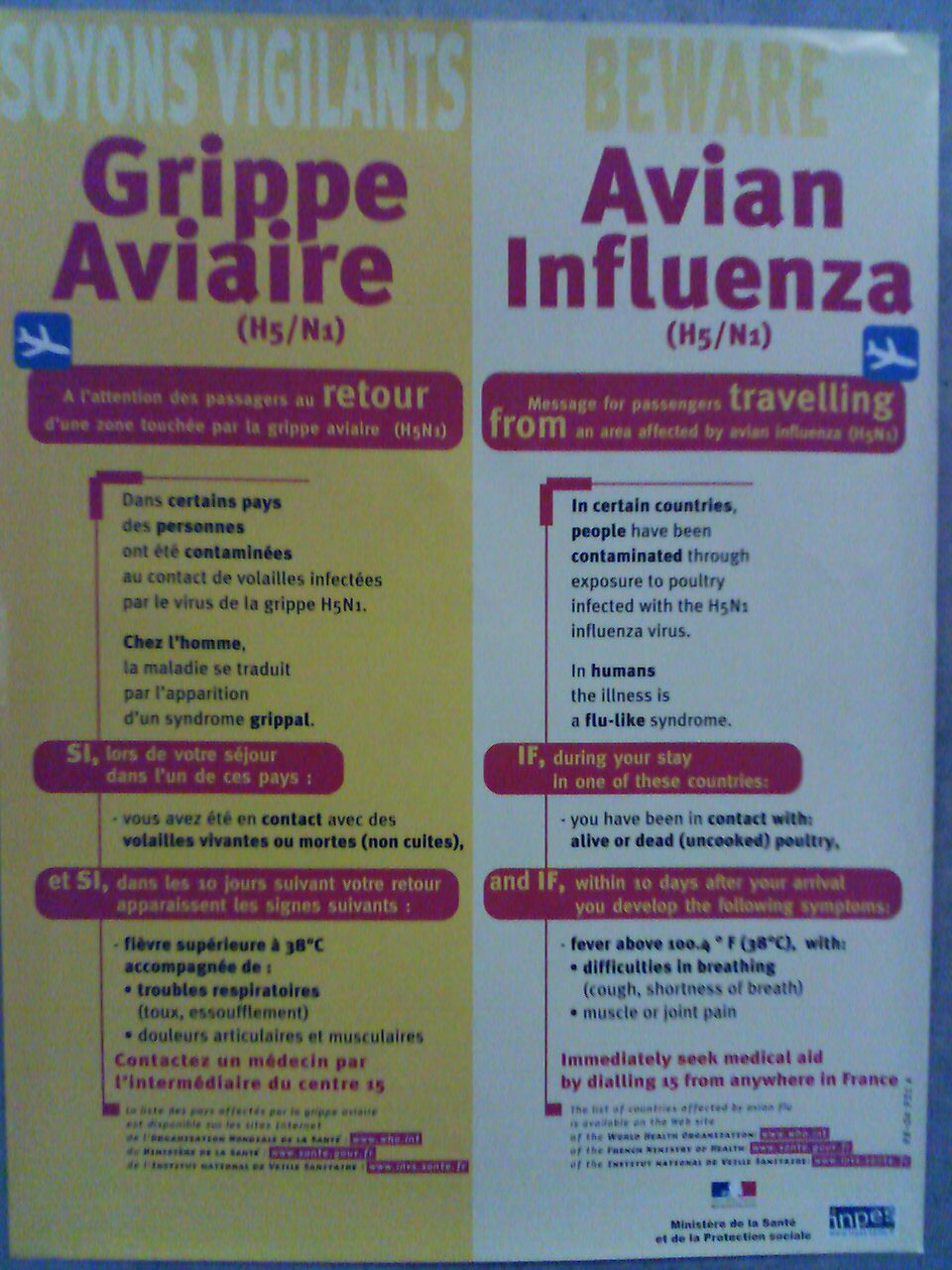
http://www.lemonde.fr/web/article/0,1-0@2-3244,36-696824,0.html
American researchers recreate the Spanish flu virus in vitro
LE MONDE
07.10.05
14h19 • Updated on 08.10.05
11h39
Ten years ago, their quest was at best laughed at: today, their results are fascinating a world that believes it is exposed to a pandemic catastrophe of the same magnitude as that which, towards the end of the 1910s, caused the death of 20 to 50 million people. Two groups of molecular biologists and virologists from the United States, led by Dr. Jeffery Taubenberger (Institute of Pathology, Washington), report in two articles published in Science (dated October 7) and Nature (dated October 6) how they succeeded in recreating in the laboratory the virus responsible for the so-called "Spanish" influenza pandemic and why this highly pathogenic virus for humans was likely of avian origin. The authors hope that these results will help establish the molecular basis of viral pathogenicity and thus facilitate the development of effective vaccines and medicines.
More than ten years ago, Dr. Taubenberger and his colleagues were on the trail of the virus that began to spread in 1918. In 1997, this team announced that they had found fragments of this virus in tissues taken from an American who died of this flu, aged 21, on December 26, 1918, in South Carolina. After genetic amplification of this biological material, these researchers explained that they had been able to identify several genes of this virus. They thus established that it was an H1N1 virus, considered to be close to a swine strain, which led to the assumption that the pig, hosting an avian virus, had infected humans. This hypothesis was all the more plausible that, according to Dr. Taubenberger, the Spanish influenza pandemic began in March 1918 at Camp Fuston (Kansas) in one of these farms where there was then a great proximity between ducks, pigs, and farmers. The virus then spread throughout much of the United States, and then to Europe via American troops engaged in the First World War.
The American researchers then found the trace of the same virus in Alaska, in the lung tissues of a woman who died in November 1918. With the help of the sophisticated techniques of reverse genetics, these researchers were able to identify the eight genes of the virus. They also succeeded in creating this "naked" genetic material (in the form of a plasmid) which, when integrated into human kidney cells in culture, allowed, within 48 hours, to recreate a pathogen that was believed to have disappeared 85 years ago.
DIRECT TRANSMISSION TO HUMANS
Several million samples of this virus are now stored in a highly secure laboratory of the Centers for Disease Control and Prevention (CDC). They should not leave. Nevertheless, the results obtained will be shared with the entire international scientific community via the "GenBank" of the National Institutes of Health, in order to facilitate research aimed at developing new vaccines and antiviral drugs.
"We have indeed recreated this virus and conducted these experiments to understand the biological properties that made the 1918 virus so exceptionally deadly," explains Terrence Tumpey (Division of Viral Diseases, National Center for Infectious Diseases, CDC), first author of the Science article. The researchers observed and analyzed its lethal effects on mice and on chicken embryos (a characteristic it shares with the current H5N1 avian virus), as well as on human lung cell cultures.
These researchers also explain that they were able to establish how this virus, capable of replicating in the absence of trypsin, differs from today's H5N1 viruses. Its high virulence seems to originate from the gene that directs the synthesis of one of its surface receptor proteins, hemagglutinin, which allows it to "attach" to a surface protein of human lung cells before entering them and replicating while destroying them.
The authors of the Nature publication conclude, based on the analysis of the reconstructed virus's genes, that the Spanish flu pandemic resulted from a direct transmission from birds to humans: a conclusion that can only reinforce those who believe that a catastrophe similar to that of 1918 is now only a matter of a few years, if not a few months.
This new threat was the subject of an international conference held on October 6 and 7 in Washington, aimed at improving international coordination efforts in case of a pandemic.
American researchers recreate the Spanish flu virus in vitro
LE MONDE
07.10.05
14h19 • Updated on 08.10.05
11h39
Ten years ago, their quest was met with - at best - laughter: today, their results are fascinating a world that believes it is exposed to a pandemic catastrophe of the same magnitude as that which, towards the end of the 1910s, caused the death of 20 to 50 million people. Two groups of molecular biologists and virologists from the United States, led by Dr. Jeffery Taubenberger (Institute of Pathology, Washington), report - in two articles published by Science (dated October 7) and Nature (dated October 6) - how they succeeded in recreating in the laboratory the virus responsible for the so-called "Spanish" flu pandemic and why this highly pathogenic virus for humans was likely of avian origin. The authors hope that these results will help establish the molecular basis of viral pathogenicity and, thus, facilitate the development of effective vaccines and medications.
More than ten years ago, Dr. Taubenberger and his colleagues began tracking the virus that had begun to spread in 1918. In 1997, this team announced that they had found fragments of this virus in tissues taken from an American who had died of this flu at the age of 21 on December 26, 1918, in South Carolina. After genetic amplification of this biological material, these researchers explained that they had been able to identify several genes of this virus. They had thus established that it was an H1N1 subtype virus, considered to be close to a swine strain, which led to the assumption that the pig, hosting an avian viral strain, had infected humans. This hypothesis was all the more plausible that, according to Dr. Taubenberger, the Spanish flu pandemic began in March 1918 at Camp Fuston (Kansas) in one of these farms where there was then a great proximity between ducks, pigs, and farmers. The virus then spread throughout much of the United States, and then to Europe via the American troops engaged in the First World War.
The American researchers then found the trace of the same virus in Alaska, in the lung tissues of a woman who died in November 1918. With the help of sophisticated inverse genetics techniques, these researchers were able to identify the eight genes of the virus. They also succeeded in creating this "naked" genetic material (in the form of a plasmid) which, when integrated into human kidney cells in culture, allowed, in 48 hours, to recreate a pathogen that was believed to have disappeared for 85 years.
DIRECT TRANSMISSION TO HUMANS
Several million samples of this virus are currently stored in a highly secure laboratory of the Centers for Disease Control and Prevention (CDC) in the United States. They should not leave. However, the results obtained will be shared - via the "GenBank" of the National Institutes of Health - with the entire international scientific community in order to facilitate research aimed at developing new influenza vaccines and medications.
"We have indeed recreated this virus and carried out these experiments to understand the biological properties that made the 1918 virus so exceptionally deadly," explains Terrence Tumpey (Division of Viral Diseases, National Center for Infectious Diseases, CDC), first author of the Science article. The researchers observed and analyzed its lethal effects on mice and on chicken embryos (a characteristic it shares with the current avian H5N1), as well as on human lung cell cultures.
These researchers also explain that they were able to establish how this virus, capable of replicating in the absence of trypsin, differs from today's H5N1 viruses. Its high virulence seems to originate from the gene that directs the synthesis of one of its surface receptor proteins, hemagglutinin, which allows it to "attach" to a surface protein of human lung cells before entering them and replicating while destroying them.
The authors of the Nature publication conclude, based on the analysis of the genes of the reconstructed virus, that the Spanish flu pandemic resulted from a direct transmission from birds to humans: a conclusion that can only reinforce those who believe that the occurrence of a catastrophe similar to that of 1918 is now only a matter of a few years, if not a few months.
This new threat was the subject of an international conference held on October 6 and 7 in Washington, aimed at improving international coordination efforts in case of a pandemic.
**
Avian flu: where are we now?
In the face of this pandemic risk, we are still in uncertainty and expectation. All we know is that this avian flu is gaining ground every day, especially in China and Indonesia, and that there are new confirmed cases of human contamination. Personally, I am in favor of implementing the precautionary principle. As a representative of the World Health Organization had reminded during an episode of "C'est dans l'Air," this principle was not applied when the AIDS pandemic broke out, the idea being always "to avoid alarming the population." In France, it is well known that we start by reassuring people, even if we have to tell them absolutely anything. This is what we did with the Chernobyl cloud, where, although effective precautions had been taken in neighboring countries, such as the prohibition of consuming fresh products, salads, due to their ability to fix radioactive waste in such a way that it is impossible to eliminate them by rinsing, iodine tablets were distributed to saturate the thyroid and prevent radioactive iodine, with a short half-life, from accumulating on the thyroids of human beings. We know that the immediate reaction of French politicians (Mitterand was President and Chirac Prime Minister) was to say:
-
If we advise people not to eat salad, the salad industry will take a hit.
-
If we tell people that the danger comes from the explosion of a nuclear reactor, they will question the French nuclear program. The future of Framatome will be compromised.
-
If we ask them to take iodine pills, we will create panic and all the French will take their cars and go to Brittany, or even take the plane.
So, let's act as if nothing had happened...
For the emergence of AIDS, it was the same thing. We continued to use contaminated blood for transfusions (Fabius, Georgina Dufoy, Garetta, "responsible but not guilty"). Simple reason: we had to use the stocks, otherwise we would lose money. Among other consequences: all the hemophiliacs in France became seropositive. These are people who must undergo injections of "factor 8" at the slightest wound or as soon as a hematoma appears (at their joints) because they do not synthesize it. This causes the coagulation of wounds and is then extracted for their benefit from hundreds of blood samples, thus multiplying the risk of contamination through transfusion.
We delayed the generalization of the use of non-reusable syringes to prevent the virus from spreading in environments where injectable drugs are used.
We delayed heating the blood samples before transfusion. The screening operations, including on stored blood bags, were slow to be implemented.
Finally, a journalist repeated daily, without any medical justification, "that there was no need to panic and that only a small part of those who may have been contaminated would contract the disease." She repeated this while trying to look convincing, I remember it as if it were yesterday, until it became so obvious that she was talking nonsense that she disappeared from the small screen. These images could easily be produced from archives to refresh our memory a bit.
What can be said about avian flu? First, we have heard that all influenza pandemics, like the famous Spanish flu, which killed ten million people at the end of World War II, all had an origin that was a bird flu, an avian influenza. Regarding this Spanish flu (we have recently reconstructed the virus from fragments extracted from people who died, whose bodies had been preserved by the cold), its danger lies in the fact that this virus, spreading through the air, has molecular hooks that allow it to attach to lung vacuoles, penetrate them, and reproduce extremely effectively in the human body. It would have originated in farms in the United States and was brought to Europe by the American expeditionary forces during World War I.
A small remark in passing. The terrestrial atmosphere is the site of convective movements, ascents, which carry air masses to high altitude, where they are sterilized by the action of ultraviolet radiation from the Sun. That is why the air in the mountains is healthier than the air in the plains and that's why sanatoriums are installed there. Permanently, this atmospheric mixing cleans the air we breathe from contaminants transported by air, which can simply be diluted in the air or present in fog droplets, aerosols. In the 1980s, my Russian friend Vladimir Alexandrov, assassinated in Madrid, was the first to draw the world's attention to the phenomenon of nuclear winter (his assassination was ordered by the military-industrial lobby, which he opposed). I simply want to recall the catastrophic consequences that a massive nuclear war could have, beyond the dispersion of radioactive products throughout the world by the high atmosphere currents, and the temperature drop due to the dust cover. This last phenomenon is due to the presence of solid particles of one micrometer in diameter, carried into the stratosphere by the powerful ascents linked to nuclear explosions and taking eighteen months to fall back to the ground, simply because of an extremely low falling speed. Thus, the upper atmospheric layer, at the level of the stratosphere, which contains all this dust, also absorbs the infrared radiation, both emitted by the Sun and by the Earth. Instead of being at low temperature as normally, this layer becomes warmer than the air at ground level. The convection phenomenon then stops completely. We obtain what is called a superstable atmosphere. There are no more ascents. The air, contaminated by viruses and bacteria, cannot be sterilized by ultraviolet radiation when carried to high altitude. In a nuclear winter situation, the Earth's atmosphere, in addition to seeing its temperature drop by 15 to 25 degrees, would become a culture medium. It would be the same if this nuclear winter situation were created by the impact of a meteorite or a large comet (a few kilometers in diameter) on the solid surface of the Earth.
Another remark: the impact of a meteorite in the sea has a different result. No matter the object, meteorite or comet (which can be compared to a block of dirty snow), it enters the air preceded by a very intense shock wave, which heats the air to tens of thousands of degrees. At the moment of impact, all this energy vaporizes the seawater, producing the transport, by ascent, of a huge amount of fine water droplets. As in the case of an impact in a continental region, a billion tons of water (instead of a billion tons of dust) is sent into the stratosphere where these droplets form an enormous cloud. But the fate of this cloud is different from that of a dust cover by solid particles. The cloud blocks the light. Thus its lower parts cool down and the resulting phenomenon is called rain. Indeed, when it is going to rain, you immediately notice it: the base of the clouds becomes gray, because these clouds have become thick enough for the sunlight not to warm their lower parts. If solid particles would take eighteen months to reach the ground, in free fall, the rain resulting from the impact of a meteorite or comet on the Earth would last only forty days and forty nights.
You thus know the origin of the Deluge.
Back to our chickens. The risk exists, that's certain. The cases of death due to avian flu transmission to humans are multiplying, while remaining in very limited numbers. But, as the representative of the WHO pointed out, pandemics can start with an infinitesimal number of cases. When a threshold is reached, the phenomenon can explode and have a global scale. An undeniable example is the spread of AIDS, which now affects the entire planet and had started with an infinitesimal number of isolated cases. For example, the introduction of the virus in Europe is partly attributed to a Belgian businessman who, when going to Zaire, had numerous sexual relations with local women and continued this type of proselytism quite actively upon returning to his country.
We hear it said "these cases of transmission of the avian flu virus to humans represent a negligible number compared to road accidents. There is no reason to be alarmed."
This means nothing. The same thing was said about AIDS.
What to do?
I myself have been vaccinated against the common flu. I put this as a recommendation, but I was immediately criticized by some readers. Some produced statistics, others developed a lot of arguments against vaccination or said that in this case it would be useless. I declare myself incompetent in this matter.
Tamiflu has disappeared from pharmacies. But it is not silly to go buy some cardboard masks at a hardware store or in a supermarket. Later, it could still be useful. It is not expensive and it will help the commerce. Of course, medical protection masks are different, but it is better than nothing and one can complete this homemade protection system with compresses or Sopalin sheets.
Thinking back to the program "C'est dans l'Air" (regarding a virus transmitted by air, one hopes it is not already the case), I noticed some obvious nonsense. Obviously, the representatives of the food industry were worried about the drop in chicken sales. Someone pointed out that the consumption of chicken meat remained possible, even if the animal had been infected, since cooking was supposed to kill all the viruses that could not withstand a temperature rise. This is why, when you are infected by a viral illness, you react with a fever, which has the effect, among others, of killing these unwanted hosts, simply by heating.
Another explained that the risk of contamination was at the stage of handling the animal, for example when plucking it. And the food industry representative added that thus all risk was apparently eliminated when the chicken was packaged at the factory exit. But it does not seem that simple. The risk ceases only when all the meat of the bird reaches a sufficient temperature. This does not exclude the presence of virus on the skin. As far as I know, in the production and packaging chains of chickens, it has not been planned to wash the bodies with a disinfectant jet. Simple remark.
But the most absurd sequence concerned this presentation of "free-range" chicken flocks. The journalist reminded that the government had not imposed the confinement of poultry, but only recommended it. The most grotesque was to hear the breeders say that they had decided to reduce the risks by only letting their chickens out for a limited time "to let them breathe". All this to not lose this "free-range chicken" label.
In case of arrival of infected migratory birds, the measure would be ineffective. These birds, having long distances to travel, often stop in the farms to rest. Even if migratory birds and chickens are not simultaneously present on the "outdoor areas", visitors leave their droppings which the chickens can then ingest, thus contaminating them. Let us add that migratory birds do not necessarily have the same schedule as farmed birds.
The Dutch had used a protection system by deploying nets over the outdoor areas of farmed birds. If these nets are stretched like circus tent canopies, with steep slopes, there is then no reason for migratory birds to land on them and deposit their dangerous droppings. There is no zero risk. But at low cost, this risk can be considerably reduced.
Unfortunately, no one suggested this solution during this broadcast.
I suppose some breeders have placed signs near the areas where their chickens play:
Unfortunately, migratory birds cannot read.
Six weeks later
The last paper on this subject was dated November 20, 2005. On August 20, 2005, the press had published this map. The suns indicate the regions where the H5N1 strain has already struck, in Central Europe. The red arrows indicate the migration routes of birds that could be likely to spread the virus.
The stars seem to indicate a small number of farms affected by the virus where the Russians had to carry out mass culling of poultry.
In fact, sixty poultry farms were affected in Russia.
This clearly shows what the contamination vector is. Chickens do not travel alone. Migratory birds stop at poultry farms to rest. They defecate and the chickens, pecking, swallow their droppings and are in turn contaminated. The phenomenon is unstoppable and can really acquire a global scale.
Now, look carefully at the following map. I have moved a yellow star to the place where new cases of avian flu were found, which caused three deaths. For two of them, two teenagers, the H5N1 virus was identified as the cause of death. Where is it? But, in Turkey!
For those who do not know where Turkey is, I have put a red arrow. Now we can zoom in.
We have been quiet, anyway, during these six last weeks. Christmas, New Year's Day are periods when, everyone knows, nothing happens in the world. Soldiers return to their barracks to eat turkey. Suicide commandos take a break, migratory birds take a break in a quiet corner, Sarkozy goes skiing. Cyclones and earthquakes stop, during the New Year's Eve. Information is suspended. Nothing unpleasant is said, in fear of scaring Santa Claus. It is understandable. It is important that people continue to believe in Santa Claus.
Anyway, one thing is certain: in our country, avian flu will not pass. It will stop at the border, like the radioactive cloud from Chernobyl.
January 8, 2006.
Fourth confirmed case of avian flu. It is the sister of the teenagers who had already died, who had played with a contaminated chicken head. Three children have already died. The Turkish government says there is no reason to be alarmed. Indeed, contamination only occurs if you touch the birds. It has therefore been advised to the inhabitants, when they meet a chicken in the street, to simply change sidewalks, completely ignoring it. In the streets of the village, measures of poultry culling are being carried out. Poor children from the city of Batman are slaughtering chickens, without wearing gloves, for one Turkish lira (0.75 dollar). On television we have seen many images where people caught chickens with their bare hands (...). Anything.
Readers write to me developing a theory, very thorough, that these epidemic rumors are only intended to finance pharmaceutical groups that produce vaccines. I asked them to provide me with an argumented paper, signed by them, specifying their titles and qualifications, which I can then attach to complete this file about which I admit my incompetence. One can only produce numbers, maps, cite places, which are real, not imaginary.
M
My last paper on this subject was dated November 20, 2005. On August 20, 2005, the press had published this map. The suns indicate the regions where the H5N1 strain has already struck, in Central Europe. The red arrows indicate the migration routes of birds that could be likely to spread the virus.
L
The stars seem to indicate a small number of farms affected by the virus where the Russians had to carry out mass culling of poultry.
In fact, sixty poultry farms were affected in Russia.
This clearly shows what the contamination vector is. Chickens do not travel alone. Migratory birds stop at poultry farms to rest. They defecate and the chickens, pecking, swallow their droppings and are in turn contaminated. The phenomenon is unstoppable and can really acquire a global scale.
M
Now, look carefully at the following map. I have moved a yellow star to the place where new cases of avian flu were found, which caused three deaths. For two of them, two teenagers, the H5N1 virus was identified as the cause of death. Where is it? But, in Turkey!
P
For those who do not know where Turkey is, I have put a red arrow. Now we can zoom in.
O
We have been quiet, anyway, during these six last weeks. Christmas, New Year's Day are periods when, everyone knows, nothing happens in the world. Soldiers return to their barracks to eat turkey. Suicide commandos take a break, migratory birds take a break in a quiet corner, Sarkozy goes skiing. Cyclones and earthquakes stop, during the New Year's Eve. Information is suspended. Nothing unpleasant is said, in fear of scaring Santa Claus. It is understandable. It is important that people continue to believe in Santa Claus.
D
Anyway, one thing is certain: in our country, avian flu will not pass. It will stop at the border, like the radioactive cloud from Chernobyl.
January 8, 2006.
Fourth confirmed case of avian flu. It is the sister of the teenagers who had already died, who had played with a contaminated chicken head. Three children have already died. The Turkish government says there is no reason to be alarmed. Indeed, contamination only occurs if you touch the birds. It has therefore been advised to the inhabitants, when they meet a chicken in the street, to simply change sidewalks, completely ignoring it. In the streets of the village, measures of poultry culling are being carried out. Poor children from the city of Batman are slaughtering chickens, without wearing gloves, for one Turkish lira (0.75 dollar). On television we have seen many images where people caught chickens with their bare hands (...). Anything.
D
Readers write to me developing a theory, very thorough, that these epidemic rumors are only intended to finance pharmaceutical groups that produce vaccines. I asked them to provide me with an argumented paper, signed by them, specifying their titles and qualifications, which I can then attach to complete this file about which I admit my incompetence. One can only produce numbers, maps, cite places, which are real, not imaginary.
Monday, January 9, 2005
7:30 AM
Turkey: 5 new cases of avian flu, spreading westward
ANKARA (AFP) - At least five new people have tested positive for the most dangerous form of the avian flu virus in Turkey, where the disease seemed to be spreading westward, announced authorities on Sunday. The latest information brings the total number of H5N1 virus infections recorded in Turkey to nine. Two of them have already died from the disease in the east, near the Iranian border, last week. Three of the new H5N1 virus carriers are being treated in Ankara and the other two in Van (east), said a senior official from the Ministry of Health, Turan Buzgan. The governor of Ankara, Kemal Önal, said that the three patients being treated in Ankara were two children and an adult. Mr. Buzgan added that the two patients in Van were a 9-year-old girl and a 3-year-old boy. The two children being treated in Ankara, who have not yet developed the disease, are from the city of Beypazari, 100 km northwest of the capital, where two wild ducks were found dead from avian flu last week. These two children would have touched gloves used by their father to transport the corpses of the two wild ducks and hand them over to the authorities, according to doctors. The third person infected in Ankara is a 60-year-old man who raised chickens in the capital's suburbs.
While the only human fatalities so far have been recorded in the easternmost part of Turkey, new cases in poultry indicate a westward progression. The virus was identified on Sunday in dead chickens in Istanbul, confirming the westward spread of the disease, according to official sources. Tests on dead chickens in two villages in the Zonguldak province, on the Black Sea and 1,200 km west of the most affected regions, revealed the presence of the virus, said Zonguldak governor Yavuz Erkmen. Gökhan Sözer, governor of the Yozgat province, about 200 km east of Ankara, also reported the virus in a village and the possibility of poultry infection in three other localities.
Newspapers published images of children throwing dead chickens into the air or cleaning dead chickens with their bare hands in poultry markets, which are officially now banned.
The worsening situation in Turkey has caused concern in other countries. Romanian Agriculture Minister Gheorghe Flutur called for calm and convened an emergency meeting.
The WHO has long feared that the H5N1 virus may mutate to become easily transmissible from human to human and cause a pandemic that could kill millions around the world.
Monday, January 9, 2006, 4:03 PM
Turkey announces 14 confirmed cases of avian flu
The European Commission in Brussels decides to ban the import of feathers.
January 11, 2006
TURKEY: 15 out of 81 provinces affected by the virus.
Authorities delayed releasing the results of tests performed on chickens. In the country, the Turkish Ministry of Public Health seems completely overwhelmed by the events.
There is no evidence that this matter could turn into a pandemic due to a mutation of the virus, but there is also no evidence that it is impossible. The famous "Spanish flu" originated from an unexpected mutation in an American farm, the viral strain having been brought to Europe by the American Expeditionary Force. French authorities are taking very discreet measures considering this possibility. They are asking administrative officials to specify the number of "on-duty" personnel in case the phenomenon occurs. In case of a pandemic, many people would stay at home. In the streets of cities, in the countryside, it would be "New Orleans" because even the army would be unable to contain the "collateral" disturbances, which are very likely. We remain in uncertainty.
Details: I had myself vaccinated against the flu two months ago. But I still caught it ten days ago. Mild form: bedridden for two days only, with 38.5. But it was definitely the flu.
January 13, 2006
In France, the threat of a pandemic is taken seriously
They are considering the confinement of poultry in an increasing number of departments. But no one is thinking of the Dutch protection technique for areas with nets. There are regions where producers are attached to their "free-range chicken" label. If the threat becomes more concrete, will they be forced to confine their poultry 24 hours a day (otherwise it would not be effective). Another half-measure solution: put nets on the outdoor areas. It should not constitute a costly measure.
Monday, January 9, 2005
7:30 AM
Turkey: 5 new cases of avian flu, spreading westward
ANKARA (AFP) - At least five new people have tested positive for the most dangerous form of the avian flu virus in Turkey, where the disease seemed to be spreading westward, announced authorities on Sunday. The latest information brings the total number of H5N1 virus infections recorded in Turkey to nine. Two of them have already died from the disease in the east, near the Iranian border, last week. Three of the new H5N1 virus carriers are being treated in Ankara and the other two in Van (east), said a senior official from the Ministry of Health, Turan Buzgan. The governor of Ankara, Kemal Önal, said that the three patients being treated in Ankara were two children and an adult. Mr. Buzgan added that the two patients in Van were a 9-year-old girl and a 3-year-old boy. The two children being treated in Ankara, who have not yet developed the disease, are from the city of Beypazari, 100 km northwest of the capital, where two wild ducks were found dead from avian flu last week. These two children would have touched gloves used by their father to transport the corpses of the two wild ducks and hand them over to the authorities, according to doctors. The third person infected in Ankara is a 60-year-old man who raised chickens in the capital's suburbs.
While the only human fatalities so far have been recorded in the easternmost part of Turkey, new cases in poultry indicate a westward progression. The virus was identified on Sunday in dead chickens in Istanbul, confirming the westward spread of the disease, according to official sources. Tests on dead chickens in two villages in the Zonguldak province, on the Black Sea and 1,200 km west of the most affected regions, revealed the presence of the virus, said Zonguldak governor Yavuz Erkmen. Gökhan Sözer, governor of the Yozgat province, about 200 km east of Ankara, also reported the virus in a village and the possibility of poultry infection in three other localities.
Newspapers published images of children throwing dead chickens into the air or cleaning dead chickens with their bare hands in poultry markets, which are officially now banned.
The worsening situation in Turkey has caused concern in other countries. Romanian Agriculture Minister Gheorghe Flutur called for calm and convened an emergency meeting.
The WHO has long feared that the H5N1 virus may mutate to become easily transmissible from human to human and cause a pandemic that could kill millions around the world.
Monday, January 9, 2006, 4:03 PM
Turkey announces 14 confirmed cases of avian flu
The European Commission in Brussels decides to ban the import of feathers.
January 11, 2006
TURKEY: 15 out of 81 provinces affected by the virus.
Authorities delayed releasing the results of tests performed on chickens. In the country, the Turkish Ministry of Public Health seems completely overwhelmed by the events.
There is no evidence that this matter could turn into a pandemic due to a mutation of the virus, but there is also no evidence that it is impossible. The famous "Spanish flu" originated from an unexpected mutation in an American farm, the viral strain having been brought to Europe by the American Expeditionary Force. French authorities are taking very discreet measures considering this possibility. They are asking administrative officials to specify the number of "on-duty" personnel in case the phenomenon occurs. In case of a pandemic, many people would stay at home. In the streets of cities, in the countryside, it would be "New Orleans" because even the army would be unable to contain the "collateral" disturbances, which are very likely. We remain in uncertainty.
Details: I had myself vaccinated against the flu two months ago. But I still caught it ten days ago. Mild form: bedridden for two days only, with 38.5. But it was definitely the flu.
January 13, 2006
:
In France, the threat of a pandemic is taken seriously
They are considering the confinement of poultry in an increasing number of departments. But no one is thinking of the Dutch protection technique for areas with nets. There are regions where producers are attached to their "free-range chicken" label. If the threat becomes more concrete, will they be forced to confine their poultry 24 hours a day (otherwise it would not be effective). Another half-measure solution: put nets on the outdoor areas. It should not constitute a costly measure.
Saturday, January 14, 2006
Le Monde:
The virology specialists at the London reference laboratory of Mill Hill revealed in the evening of Thursday, January 12, that the strains of the H5N1 virus found in the two first Turkish victims of the human form of avian flu presented a mutation in their genetic heritage. The information was immediately confirmed by the WHO.
Nothing, in the current state of the data, allows to think that this mutation is directly responsible for the deaths or that it could be the cause of a possible human-to-human transmission of the viral infection.
Nevertheless, experts fear that this observation may be a precursor to more significant mutations that could suddenly lead to the emergence of a highly pathogenic strain and a pandemic.
Although the family of type A influenza viruses and H5N1 subtype has existed for a long time, it was only in 1997, with the "chicken flu" epidemic in Hong Kong, that it was discovered that one of them, after a genetic mutation, had acquired the ability to pass into the human species. This phenomenon had then greatly surprised and worried virology specialists. Later, while maintaining the stable molecular characteristics of the H5N1 subtype, this strain had, in contact with other influenza viruses, modified some of its internal structures.
From 2002, this internal composition gradually stabilized, the strain becoming dominant. It is this strain that has since been responsible for the epizootic affecting both farmed and wild birds and which has been prevalent in various countries in Asia and, more recently, in Turkey.
According to the first available scientific data, the genetic mutation discovered in the Mill Hill laboratory is similar to that observed in 2003 in Hong Kong and in 2005 in Vietnam (Le Monde of November 15, 2005). "
The results obtained on the viruses isolated from the Turkish victims confirm that this avian influenza virus is spontaneously capable of genetic mutations, but these mutations alone do not explain why it can contaminate humans. They also do not explain the lethal nature of this contamination, notes Dr. Jean-Claude Manuguerra, virology specialist at the Pasteur Institute in Paris and head of the French biological intervention cell. However, one can fear that the accumulation, over time, of this type of mutation may facilitate human contamination.
The European experts gathered on Thursday, January 12, in Luxembourg do not hide their concern over the number of human cases of the disease observed recently in Turkey, as well as the inability of Turkish health authorities to contain the spread of the epizootic.
Jean-Yves Nau
Saturday, January 14, 2006
.
Le Monde:
The virology specialists at the London reference laboratory of Mill Hill revealed in the evening of Thursday, January 12, that the strains of the H5N1 virus found in the two first Turkish victims of the human form of avian flu presented a mutation in their genetic heritage. The information was immediately confirmed by the WHO.
Nothing, in the current state of the data, allows to think that this mutation is directly responsible for the deaths or that it could be the cause of a possible human-to-human transmission of the viral infection.
Nevertheless, experts fear that this observation may be a precursor to more significant mutations that could suddenly lead to the emergence of a highly pathogenic strain and a pandemic.
Although the family of type A influenza viruses and H5N1 subtype has existed for a long time, it was only in 1997, with the "chicken flu" epidemic in Hong Kong, that it was discovered that one of them, after a genetic mutation, had acquired the ability to pass into the human species. This phenomenon had then greatly surprised and worried virology specialists. Later, while maintaining the stable molecular characteristics of the H5N1 subtype, this strain had, in contact with other influenza viruses, modified some of its internal structures.
From 2002, this internal composition gradually stabilized, the strain becoming dominant. It is this strain that has since been responsible for the epizootic affecting both farmed and wild birds and which has been prevalent in various countries in Asia and, more recently, in Turkey.
According to the first available scientific data, the genetic mutation discovered in the Mill Hill laboratory is similar to that observed in 2003 in Hong Kong and in 2005 in Vietnam (Le Monde of November 15, 2005). "
The results obtained on the viruses isolated from the Turkish victims confirm that this avian influenza virus is spontaneously capable of genetic mutations, but these mutations alone do not explain why it can contaminate humans. They also do not explain the lethal nature of this contamination, notes Dr. Jean-Claude Manuguerra, virology specialist at the Pasteur Institute in Paris and head of the French biological intervention cell. However, one can fear that the accumulation, over time, of this type of mutation may facilitate human contamination.
"
The European experts gathered on Thursday, January 12, in Luxembourg do not hide their concern over the number of human cases of the disease observed recently in Turkey, as well as the inability of Turkish health authorities to contain the spread of the epizootic.
Jean-Yves Nau
| January 31, 2006 | A death in Iraq, attributed to avian flu | Spread of the virus in Cyprus, a country belonging to the European Union |
|---|
| January 31, 2006 | A death in Iraq, attributed to avian flu | Spread of the virus in Cyprus, a country belonging to the European Union |
|---|
February 11, 2006
| It's here, Italy is affected | The H5N1 virus was detected in two swans, in Sicily and on Italian beaches. There were already dozens of outbreaks in Romania, others in Croatia, Greece. In Nigeria, it is only ostriches, which are difficult to assimilate to migratory birds, that the virus has felled. Nigeria, Togo, Cameroon: 45,000 birds dead. African leaders assure "that measures are being taken". | The contamination of ostriches provides the proof, if it was still expected, that poultry are infected by the droppings of migratory birds. The spread is therefore inevitable. It will extend to all Africa and, in the good weather, millions of migratory birds will leave the African continent to go north. Extremely strict confinement measures should be taken in France, without worrying about the "free-range chicken" label and the short-term wishes of the breeders. I have already said that nets could be stretched over restricted areas, as was done in the Netherlands. It is likely that no one will do anything. But the French are used to it. Avian flu, like the radioactivity of the Chernobyl cloud, will stop at our borders. |
|---|
Source: Le Figaro/Sciences & Médecine
The alarming spread of avian flu in Nigeria
Martine Perez [February 11, 2006]
Nigeria is facing the H5N1 virus, which, according to authorities, is spreading rapidly from farm to farm in the north of the country. The government is asking for international help. IT ALL BEGAN on January 10, 2006, with the discovery of abnormal symptoms in laying hens in a large farm of 50,000 birds in northern Nigeria.
At first, the farmers thought it was a common infection and treated the poultry with antibiotics.
Faced with the exponential increase in the mortality of the hens, samples were taken on January 16. The terrible diagnosis of avian flu linked to the H5N1 virus was only made on February 6, thanks to analyses carried out by the OIE (World Organization for Animal Health). On Thursday evening, the approximately 45,000 birds of the Sambawa Farm, the epicenter of the epizootic, were slaughtered.
Three weeks have passed between the first alert and the diagnosis. A very long time, used by the virus to spread.
According to Nigerian authorities, it is now spreading rapidly from farm to farm in the north of the country. At least, 100,000 birds have already died, 16 farms could be contaminated. Two children from a farming family show respiratory problems, but the analysis results are not yet available.
For all experts, the appearance of this epizootic in Africa is a catastrophe.
"The lack of health surveillance structure will make it very difficult to control the animal disease. Moreover, in this region of the world already threatened by malnutrition, the impact on poultry farms risks drying up an important source of protein,"
explains Dr. Michel Rosenheim, epidemiologist (La Pitié-Salpêtrière Hospital, Paris).
"Today, international aid is essential, to set up a surveillance system; to work on a financial compensation policy in case of destruction of contaminated farms. Otherwise, the dead chickens from avian flu risk to end up on the shelves of the markets instead of being destroyed. And it is known that human contamination mainly occurs during the plucking of chickens."
On Friday, the Nigerian Minister of Agriculture, Adamu Bello, met with representatives of the United Nations and international agencies to express the country's needs in terms of laboratories, vaccines, and technical support. The United States has promised 20 million dollars (16 million euros), the European Union and China have also offered their support. The World Health Organization (WHO) is also sending today or tomorrow a team of seven doctors, epidemiologists, and biologists to investigate the epidemic and limit the risk of transmission to humans. "This is the first time that this highly pathogenic virus is reported on the African continent, already severely hit by the AIDS pandemic and other serious infectious diseases. The H5N1 virus threatens both the health and the means of subsistence of Africans," said the Director-General of the WHO, Jong Wook Lee, yesterday. From the public health point of view, the absolute priority at this stage is to inform the population that it is dangerous to have close contact with birds contaminated by H5N1, whether they are dead or sick.
The WHO offers its support to the Nigerian government for the organization of a national information campaign. The door-to-door polio vaccination campaign that is to start next Saturday could provide the opportunity to deliver messages to the communities."
The prevailing pessimism is partly due to the fact that African health systems already have great difficulty coping with the numerous AIDS, tuberculosis, and malaria patients... Human cases of H5N1 flu may be difficult to distinguish from other diseases.
Furthermore, the consequences of exposure to the avian flu virus for already immunocompromised people, if unknown, could prove problematic.
The virus would have arrived in Nigeria through migratory birds.
"Besides the risk of transmission to other African countries, it is now impossible to exclude the importation of avian flu into Europe during the return of migratory birds,"
notes Professor Jeanne Brugère-Picoux (Maisons-Alfort Veterinary School). Yesterday, it was also learned that H5N1 had been discovered in Azerbaijan, was suspected to be present in Greece, and that two new deaths, one in China and one in Indonesia, had occurred. The virus, which is currently only transmissible to humans through close contact with infected poultry, has already affected a total of 166 people worldwide, 88 of whom have died, over the past three years.
Source: Le Figaro/Sciences & Médecine
The alarming outbreak of avian flu in Nigeria
Martine Perez [11 February 2006]
Nigeria has been facing the H5N1 virus for four days now, according to authorities, which is spreading rapidly from farm to farm in the north of the country. The government is asking for international help. IT ALL BEGAN on 10 January 2006, with the discovery of abnormal symptoms in laying hens at a large poultry farm of 50,000 birds in northern Nigeria.
At first, the farmers thought it was a common infection and treated the birds with antibiotics.
Faced with the exponential increase in the mortality of the hens, samples were taken on 16 January. The terrible diagnosis of avian flu linked to the H5N1 virus was only made on 6 February thanks to analyses carried out by the World Organisation for Animal Health (OIE). On Thursday evening, the approximately 45,000 birds of the Sambawa Farm, the epicenter of the outbreak, were slaughtered.
Three weeks have passed between the first alert and the diagnosis. A very long time, which the virus has used to spread.
According to Nigerian authorities, the virus is now spreading rapidly from farm to farm in the north of the country. At least 100,000 birds have already died, 16 farms could be infected. Two children from a farming family show respiratory problems, but the analysis results are not yet available.
For all experts, the appearance of this outbreak in Africa is a catastrophe.
"The lack of a health surveillance structure will make it very difficult to control the animal disease. Moreover, in this region already threatened by malnutrition, the impact on poultry farms could dry up an important source of protein,"
explains Dr. Michel Rosenheim, epidemiologist (La Pitié-Salpêtrière Hospital, Paris).
"Today, international aid is essential, to set up a surveillance system; to work on a financial compensation policy in case of destruction of infected farms. Otherwise, the birds dead from avian flu risk ending up on the market stalls instead of being destroyed. And it is known that human contamination mainly occurs during the plucking of chickens."
On Friday, the Nigerian Minister of Agriculture, Adamu Bello, met with representatives of United Nations and international agencies to present the country's needs in the face of this disease, laboratories, vaccines, technical support. The United States has promised 20 million dollars (16 million euros), the European Union and China have also offered their support. The World Health Organization (WHO) is also sending a team of seven doctors, epidemiologists, and biologists today or tomorrow to investigate the outbreak and limit the risk of human transmission. "This is the first time that this highly pathogenic virus has been reported on the African continent, already severely affected by the AIDS pandemic and other serious infectious diseases. The H5N1 virus endangers both the health and the means of subsistence of Africans," said the Director-General of the WHO, Jong Wook Lee, yesterday. From a public health point of view, the absolute priority at this stage is to inform the population that it is dangerous to have close contact with birds infected with H5N1, whether dead or sick.
The WHO offers its support to the Nigerian government for organizing a national information campaign. The door-to-door polio vaccination campaign, which should start next Saturday, could provide an opportunity to deliver messages to the communities."
The prevailing pessimism is partly due to the fact that African health systems already have great difficulty coping with the numerous AIDS, tuberculosis, and malaria patients... Human cases of H5N1 flu may be difficult to distinguish from other diseases.
Furthermore, the consequences of exposure to the avian flu virus for already immunocompromised people, if unknown, could prove problematic.
The virus would have arrived in Nigeria through migratory birds.
"Besides the risk of transmission to other African countries, it is now impossible to exclude the importation of avian flu into Europe during the return of migratory birds,"
notes Professor Jeanne Brugère-Picoux (Maisons-Alfort Veterinary School). Yesterday, it was also learned that H5N1 had been discovered in Azerbaijan, was suspected to be present in Greece, and that two new deaths, one in China and one in Indonesia, had occurred. The virus, which is currently only transmissible to humans through close contact with infected poultry, has already affected a total of 166 people worldwide, 88 of whom have died, over the past three years.
**15 February 2006 **
**
Anti-migratory bird system
Birds infected with avian flu have been found in Croatia, Germany, the Baltic, Austria, and Slovenia. France is waiting for the first discovery of infected birds, which should not be long.
They are talking about confining all poultry in all departments. For some farmers, this measure is catastrophic, not only because of the loss of their label "free-range chickens," but because their poultry, confined 100% of the time, will trample each other in these narrow barns. They are talking about building other premises. But it's a bit late to think about it. It is said that governing is foreseeing. But who is governing in France?
I saw a farmer who applied "measures" consisting of closing the feeders as soon as his poultry had eaten. Who imagines that this could be effective? It is enough that a single migratory bird lands nearby and defecates, then a chicken from the farm swallows this feces, and the contamination starts, leading to a systematic slaughter.
I am convinced that one could have found N systems (tents, nets) allowing chickens to take fresh air, without migratory birds being able to deposit their feces. Small farmers could have installed army tents, bordered with mesh nets, adjacent to their poultry housing.
Tents would be better than nets because no one has ever said that birds do not defecate while flying. Any durable fabric resistant to the wind would do.
Or else a covered shelter with corrugated iron, bordered by nylon mesh walls. Any system that allows chickens to take fresh air, but without migratory birds being able to put their feces within reach. But for that, it would be necessary to ... think.
I quote a phrase from Jacques Chirac:
- Only idiots don't change their minds. That's what I say all the time.
It is necessary to remember that there are migratory birds of all sizes. Small birds the size of a sparrow are capable of crossing thousands of kilometers and rest wherever they can.
Personally, every year I feed hundreds of birds in my garden, which devour twenty kilograms of fat balls per week, hung on the branches of trees.
Without falling into paranoia, it will still be necessary to be a bit careful when cleaning bird droppings. At least...
Anti-migratory bird system
Birds infected with avian flu have been found in Croatia, Germany, the Baltic, Austria, and Slovenia. France is waiting for the first discovery of infected birds, which should not be long.
They are talking about confining all poultry in all departments. For some farmers, this measure is catastrophic, not only because of the loss of their label "free-range chickens," but because their poultry, confined 100% of the time, will trample each other in these narrow barns. They are talking about building other premises. But it's a bit late to think about it. It is said that governing is foreseeing. But who is governing in France?
I saw a farmer who applied "measures" consisting of closing the feeders as soon as his poultry had eaten. Who imagines that this could be effective? It is enough that a single migratory bird lands nearby and defecates, then a chicken from the farm swallows this feces, and the contamination starts, leading to a systematic slaughter.
I am convinced that one could have found N systems (tents, nets) allowing chickens to take fresh air, without migratory birds being able to deposit their feces. Small farmers could have installed army tents, bordered with mesh nets, adjacent to their poultry housing.
Tents would be better than nets because no one has ever said that birds do not defecate while flying. Any durable fabric resistant to the wind would do.
Or else a covered shelter with corrugated iron, bordered by nylon mesh walls. Any system that allows chickens to take fresh air, but without migratory birds being able to put their feces within reach. But for that, it would be necessary to ... think.
I quote a phrase from Jacques Chirac:
- Only idiots don't change their minds. That's what I say all the time.
It is necessary to remember that there are migratory birds of all sizes. Small birds the size of a sparrow are capable of crossing thousands of kilometers and rest wherever they can.
Personally, every year I feed hundreds of birds in my garden, which devour twenty kilograms of fat balls per week, hung on the branches of trees.
Without falling into paranoia, it will still be necessary to be a bit careful when cleaning bird droppings. At least...
Back to the beginning of the dossier
Back to Guide Back to Home Page
**Number of consultations since 7 January 2006 **: