Air Insecurity
August 25, 2005 - updated March 29, 2007
Last night I was having dinner with friends, in Aix. One of them had brought a bottle of red wine. A French grape variety, but grown in China, by Chinese people, which we import. The inhabitants of the Middle Kingdom had simply contented themselves, during a visit to France, with buying a few vines. Then they had gotten to work.
Yet another thing that will please French winegrowers.
*- There are twenty times more of them than us.
- And here, there are still people who believe that we French will manage to come out on top.
- France will end up as a campsite.
- The problem is that there won't be jobs for sixty million campsite caretakers.
- We still sell them Airbuses, don't we? ....
- In ten years, they'll be the ones selling them to us.
- So, what should be done?
- They say that to govern is to foresee. I believe we have the most stupid political class imaginable. It's not a brain these people have in their heads, it's a grapefruit.
- On the other hand, wasting, we know how to do that. Mégajoule, ITER....
- Mega-connerie.
- In this country, you can't do a damn thing. When you want to innovate, you come up against concrete walls, of all kinds.
- Studying systems to save energy? No point hoping to get any kind of echo here! In France, on every liter of gasoline or diesel the State collects 80% in taxes.
- That's short-sightedness. But everything here is short-sighted.
- Have you seen how many planes have crashed lately? Five. People are afraid to fly.
- The minister said "that he was going to take energetic measures so that passengers could know in advance the names of the companies that were going to transport them, before beginning their trip". He stressed every important word.
- The journalists talk about "series laws".
- That's what they say to cover up the consequences of an accumulation of negligence and laissez-faire. *
I remembered that in the sixties I had taken one of the first "charters". It was the only company operating reduced-price flights across the Atlantic. Its name: Lofteidir. It was an Icelandic company that loaded passengers in Luxembourg, because airport taxes were lower there than elsewhere. The planes were DC8 four-engine aircraft, with radial piston engines. They were not capable of crossing the Atlantic in one go, so it was done in three stages.
- Luxembourg - Glasgow ( in Scotland ) - Glasgow - Reijkavik ( Iceland ) - Reijkavik - New - York
When we left I found it odd that the bathroom faucet stayed in my hand. But I thought, oh well... By the way that reminds me that when I had taken a plane to go to Egypt, in 2003, on a flight operated by an Egyptian company an armrest had stayed in my hands. When you see what is happening at the moment, it makes you smile less.
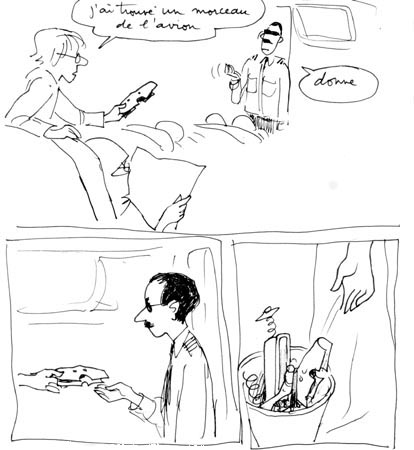
Inch Allah Airlines
Let's get back to the flight on that four-engine plane. It began with a ten-hour technical stopover in Glasgow. We did it again in Reijkiavik. It got worse over Canada. Two engines failed. In the plane there were many Jews, with side curls and kippas, who had taken out their "torah" and were chanting in Hebrew while swaying their bodies back and forth. At the time I must have been twenty. The plane crash-landed at Goose Bay, on a Strategic Air Command base. I remember we had flown over a line of Avro "V - bombers", British, painted khaki and bearing the white American star. As soon as we were on the ground, G.I.s took us to a windowless hangar where we were penned in for hours. Then the captain came to speak to us.
*- There... we have some trouble with the engines, as you may have seen. The American army has made buses available to us to cover the last stretch to New-York, across Labrador. We will bring the plane back to New-York. If any passengers want to stay in the plane, they can choose that option. *
I preferred the plane, because at that time Labrador was full of mosquitoes. A dozen passengers also chose to stay. The others got on the khaki buses. The takeoff was laborious. We had to rev the engines, all brakes on. But the crate finally got into the air, skimming the trees.
On the other hand I have another story to tell, a much more recent one. It was on an Air France San - Francisco - Paris flight, direct, on a 747. We were made to wait six or seven hours. It was no longer about air traffic congestion, but "a technical difficulty". They didn't see fit to give us explanations either, simply asking us "to be patient". Once we were in the air I learned a little more from the stewards. The 747 had had engine trouble. But Air-France's maintenance service was in Los Angelès. In San Francisco, if Air France had wanted to secure the services of American maintenance, no problem. But it would have had to pay. So the company had preferred, to save money, to bring us back to France with a makeshift repair carried out by the local French mechanics which, according to the cabin crew, was closer to tinkering than anything else.
I felt that the cabin crew was afraid. But we arrived safely.
Once in France I sent a letter to Air France's technical services, indicating the time, day and flight number, and asking them what kind of technical problem had arisen that kept us stuck in Frisco for seven hours. The reply was terse, in the purest "officialese" style:
- Sir,
The transport of passengers is ensured by the airline Air-France under the best safety conditions.
- Yours faithfully .....*
That's how it works. Air France gambled with the lives of 400 passengers to save money. In any case, if you ventured to ask questions seeking technical details about a flight incident, you would run into the same opacity.
*The plane ... Inch Allah. *
A reader asked me why airliner passengers weren't equipped with parachutes. The reason is simple (besides the extra weight and bulk it would cause). Airliners fly too fast. At more than 150-180 kilometers per hour, getting through the door of a plane in flight is problematic. You risk being knocked out. These parachutes, no one could use them. In the event of engine failure, landing is problematic. At sea, at 250 km/h, the water is like reinforced concrete. I have seen only one perfectly successful forced landing. It was at Marignane, at the end of the sixties. I was working in a branch of the Marseille Institute of Fluid Mechanics, which had its premises right near the airport. We ate at the restaurant with the technical services people and had a view of the runways. Suddenly a Caravelle that was taking off had an engine failure. The pilot pushed the stick forward. All the passengers must have appreciated those ten seconds of "weightlessness". Then the guy managed to land the plane on its belly, on the grass bordering the runway, without even having to turn.
The Caravelle has engines located high up and very low wings. The plane landed "in ground effect" without the slightest problem. We ran and we were there when the passengers, more dead than alive, emerged from the cabin. The stewardess, not knowing what to do, handed them scented paper towels. I would be delighted, by the way, to know who the pilot was who managed this feat at that time, before my eyes.
March 29, 2007: Thanks to the young Emmanuel Faure (who says he is a quarter of my age) we were able to recover period photos, taken by his grandfather, at the time in charge of airport security. First we have shots taken just after the belly landing of the aircraft. At the bottom and on the right you can see its trajectory. The pilot opportunely steered toward the grass runway, using a braking parachute, which can be seen spread out on the grass. Hats off for the reflexes. We would like to know his name. Not to have the exact date, nor press clippings from the time. If anyone has that..
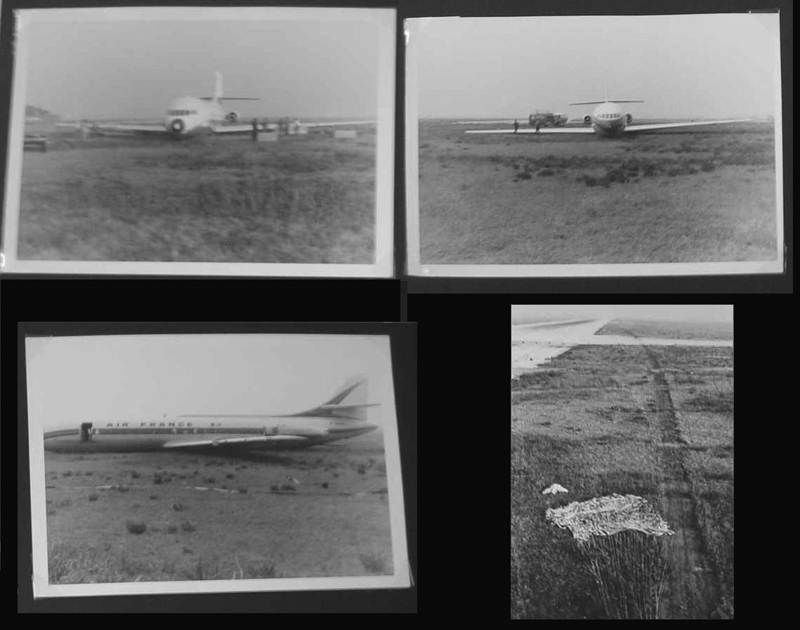
The Air France Caravelle, just after its belly landing, on the grass runway at Marignane
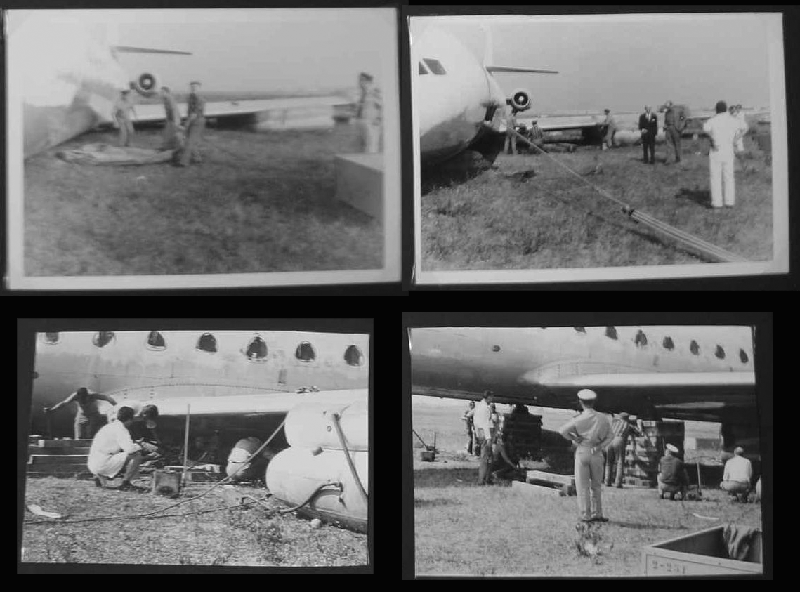
Second act: a recovery operation is undertaken. To do this, inflatable bags are slipped under the wings and the aircraft is lifted. Note, at the bottom and on the left, that the windows have all been broken, no doubt by the crew. The evacuation, according to my memories, must have been done through a side emergency door. Indeed, on these aircraft normal access was at the rear, under the tail, an exit that was unusable. During the minutes that followed the crash there must have been quite a disaster-movie atmosphere on board, given that the plane was full of kerosene.
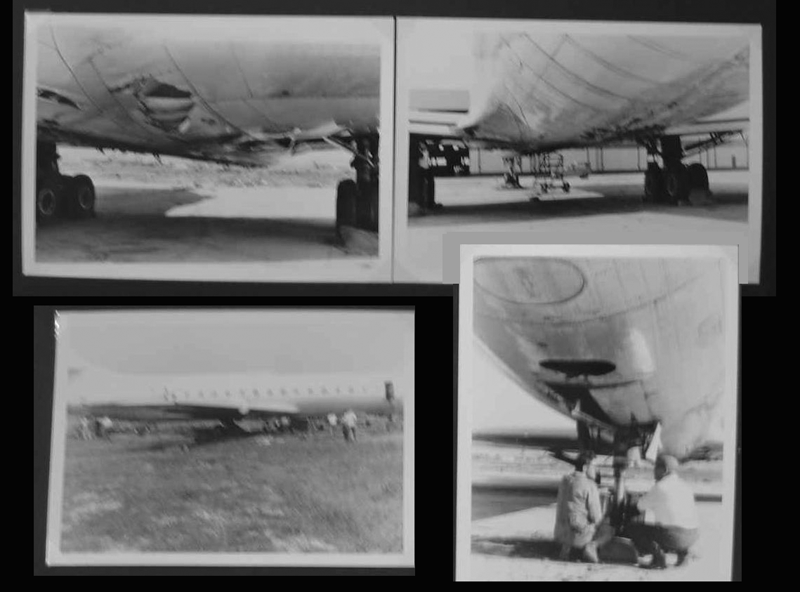
Third act: The bags did their job. The landing gear could be deployed. The plane could then be towed toward hangars
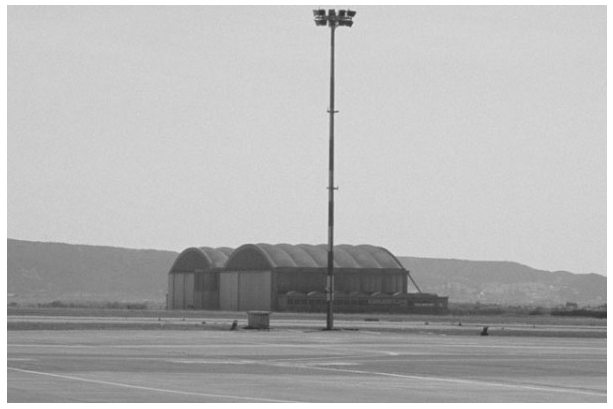
The Boussiron hangars located on the Étang de Berre side, where the plane is said to have been repaired and restored to flight and operating condition
The Caravelle was a hell of a sturdy plane. I had a friend, Josso, with whom I had attended Supaéro. He died diving, diving with the Roubaix family, in Corsica, trying to extract a grouper, at moderate depth. He pushed it and crack, blackout. He was found dead, lying on his fish. Shortly afterwards the Roubaixs' own son, great pioneers of free diving, killed himself, in the Azores, I believe. François was a brilliant music composer with whom I had been a schoolboy, at Lycée Carnot, in Paris. We were all very close. He got lost in an underwater maze. He composed a number of scores for hit films like La Scoumoune, les Aventuriers, etc...
Let's get back to Josso. He loved flying, in particular those little fabric-covered biplanes called Stampes. One day he was taking part in a ferry mission of two Stampes, with an instructor. Hearing that they were making the trip with two aircraft and were supposed to return together, aboard one of these two-seaters. Suddenly they inadvertently entered an air corridor where a Caravelle was on approach. The instructor was flying in front. The Caravelle pilot saw his tiny aircraft at the last moment and pushed the stick forward to try to pass underneath. But the collision happened anyway. The Stampe struck the cabin, opening in it a breach that was, if my memories are exact, four to six meters long and one meter wide. The plane broke apart. The pilot was killed. The engine penetrated the cabin and killed one of the passengers. But the aircraft was still able to land, with this huge hole in its fuselage. If anyone has photos or press articles, I'm interested.
When planes have their engines attached under the wings, in "pods", this kind of acrobatics, the belly landing, is no longer possible. When it comes to a crash landing, whether on land or at sea, the engines are torn off immediately, taking the wings with them.
When a plane has a problem in flight, nothing is easy. If the engines sputter, the pilot will tend to try to restart them until the last moment. But, in doing so, he will keep the tanks full, without activating his "dump valve". Speed is maneuverability. Lowering the flaps is a slow operation, as you may have seen. It is very rare that there is no damage and this incident on a Caravelle, with a happy ending, represents the exception that confirms the rule.
In the history of the Caravelle, everything must have happened so fast that the pilot surely did not have time to empty the tanks (wing tanks!). Landing on the belly with a full load, hello adrenaline! On a hard runway the friction would have immediately triggered a fire.
September 5, 2005:The bad streak continues
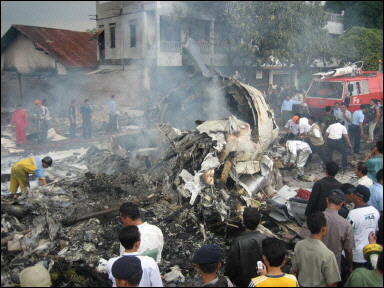
Boeing crash on the island of Sumatra, at least 100 dead
JAKARTA (Reuters) - The crash of an Indonesian Boeing 737-200 near the city of Medan, on the island of Sumatra, should have caused around a hundred deaths, official sources learned on Monday.
"The plane crashed onto houses and landed on the road. It is now in pieces. I expect a toll of around a hundred deaths. No survivors have been reported," explained a spokesperson for the provincial government of North Sumatra.
The plane was carrying more than a hundred passengers. The spokesperson did not specify whether there were any victims on the ground.
The plane crashed shortly after takeoff and landed in an urban area:
If the plane is the safest means of transport in the world, then what are the others?
My comment:
A reader passed me a document, unfortunately in pdf and not as a text file. It emerges from all this that many companies, around the world, maintain their planes by taking the problem lightly. Employees must keep quiet or are fired. One of them passed me photos of an Airbus used by a Chinese company that was a ... garbage can. Not being sure of the source, I did not publish them, but they are probably authentic.
Silence, or you're fired. We had an example recently. It's .... the law of profit with its corollary: the most complete contempt for human life. It's as simple as that. But plane passengers are not all people from the third world. There are also middle class tourists, the clients of charters, who represent a big market. Companies with little concern for the lives of their clients will perhaps lose some feathers in the movement that is taking shape. But even the so-called "serious" companies also take liberties with safety to save money. See my own testimony in this htm page, referring to that return from San Francisco on an Air France 747 with ... a makeshift repair.
For money you can take lots of risks .... For others.
*Come on, it'll hold until Roissy! *
There, it had held. But was that normal? Obviously, no.
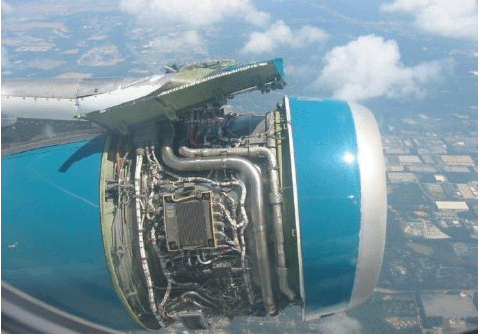
In-flight incident
Back to the beginning of this dossier
Back to New Back to Guide Back to Home page
Number of visits to this page since August 25, 2005: