Consolidated document. 14 original pages have been gathered here; the links below open each section.
Find again: Scientific documents.
Contents
- The Turning Inside Out of the Sphere and other stories of the same kind
- The Turning Inside Out of the Sphere and other stories of the same kind
- The Turning Inside Out of the Sphere
- The Turning Inside Out of the Sphere
- The Turning Inside Out of the Sphere
- The Turning Inside Out of the Sphere
- The Turning Inside Out of the Sphere
- The Turning Inside Out of the Sphere
- The Turning Inside Out of the Sphere
- The Turning Inside Out of the Sphere
- The Turning Inside Out of the Torus
- The Turning Inside Out of the Torus
- The Turning Inside Out of the Torus
- The Turning Inside Out of the Torus
The Turning Inside Out of the Sphere and other stories of the same kind
December 7, 2004
1-Immersions. Two-sheeted coverings. First approach to Boy's surface. Link
2-Interlude: The "father-mutation" of the cuspidal points of a Crosscap. Link.
3-Catastrophic modificationsLink
4-The turning inside out of the sphere according to BernardMorin**Link
5-The trivial turning inside out of the torus. Link
6-The non-trivial turning inside out of the torus(J.P.Petit, 1961). Link
Other subject: Transformation of a Cross Cap into a Boy surface(J.P.Petit 1990): Link
( bring aspirin, otherwise back to the Home page )
The Turning Inside Out of the Sphere
December 7, 2004
page 1
Introduction.
In what follows we will consider closed surfaces, such as the sphere, the torus and a few others. These are surfaces in the sense in which the man in the street understands it, that is to say that they are 2-dimensional objects that are represented in a three-dimensional Euclidean space, R3, which is our mental space of representation. These surfaces can be the object of several types of representation. If they do not intersect themselves, we will say that they are embedded (in R3). If they do intersect, we will then speak of immersions and this intersection will then be reflected by the presence of a self-intersection set.
In our embeddings we will assume that the tangent plane varies continuously and that the surface is free of singularities such as could be, for example, the apex of a cone. Our surfaces will be regular.
In the case of immersions we will then require that along the self-intersection lines the two tangent planes to the sheets that cross be distinct.
The world of geometry, as the mathematician conceives it, is quite different from the physical world. The fact that surfaces can pass through themselves does not bother him at all. The physical world does not allow this kind of thing. But it becomes possible in the metaphysical world. Thus in the Bible we read that when the dead rise again, it will be in the form of "glorious bodies". They will then be able to pass through anything and in principle will be capable of passing through themselves. Thus, when the time of the Last Judgment has come, if you are strolling in Rome in the form of a glorious body, if you are lost and looking for the piazza Navona, you might be tempted to ask your way from another resurrected mortal, having the same appearance as you. Suppose that the person you question is heading in the opposite direction from this square. In ordinary physical space, to point out the right way to you he would have to pivot on himself to point his finger in that direction. But if he is moving about in the form of a glorious body, this rotation will no longer be necessary. He will be able to point his index finger at his navel and pass through himself. When his hand reappears, emerging from his back, all he will have left to do is tell you "it's that way". By thrusting his arm through his belly he will have created in his bodily envelope a self-intersection set consisting of two circles, which will disappear when he returns to his normal configuration.
If a human being closes their mouth, puts a clothespin on their nostrils to plug them, and we disregard their other natural orifices, their bodily envelope then adopts the topology of the sphere S2. Let us imagine a being resurrected in the form of a glorious body whose natural orifices would thus be plugged. We know that it can pass through itself, that is to say that its bodily envelope can go from a situation of embedding to a situation of immersion. One of the metaphysical problems that then arose was to know whether a fellow resurrected in the form of a glorious body could turn itself inside out without making folds.
A small remark in passing. Conjurers know how to use "magic circles" that can interpenetrate "magically". One could imagine representing surfaces by means of a sort of "magic mesh" such that the two sheets, represented here one in black and the other in pink, could pass through each other without difficulty.
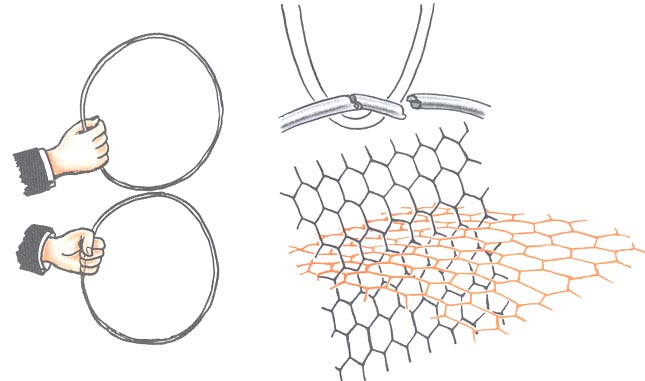
The magic mesh
In any case, it must be admitted that there is often not much difference between mathematics and magic. Twenty years ago I designed a comic strip: the Topologicon. It is now out of print and impossible to find, except as a collector's item. On one of the pages one could see this:
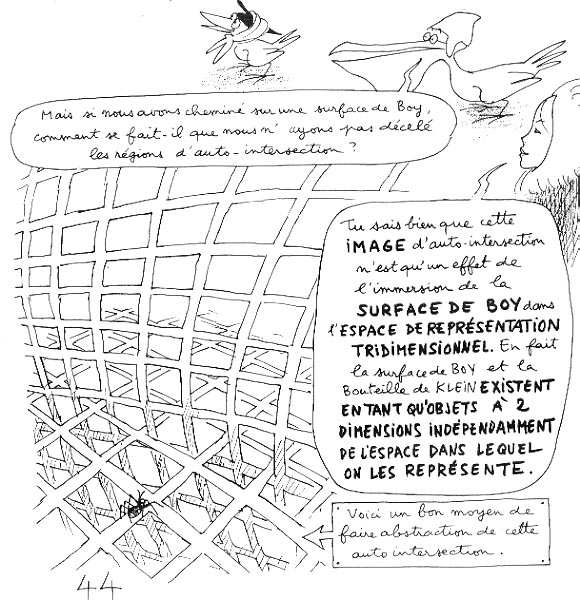
It is a great pity that the Belin editions decided to abandon this collection. It must be said that with a production cost of barely more than one euro, selling the albums for 13 euros (plus postage), by mail order, apart from the fact that this left a profit margin of 12 euros, that is to say with a profit exceeding 92 percent of the sale price, does not correspond to a very obvious commercial strategy, especially for black and white.
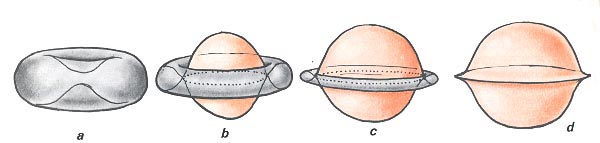
Let us consider a sphere S2 embedded in R3. We assume that its outer surface is gray and that its interior has an old pink color. We can press on two antipodal points, which we will arbitrarily call "north pole" and "south pole", until we bring them into contact at a point. One can do this for example with a doughnut. When it is a mathematical doughnut (one does not know whether doughnuts resurrect or not in the form of a glorious body) the two polar regions, after having been in contact at a point, can pass through each other along a self-intersection curve that takes the shape of a circle. Anticipating, we will say that this surface has undergone a catastrophe of type Do.
One can then be tempted to try to turn the doughnut, the sphere, inside out, by continuing the operation. But then a bulge will form, which will degenerate into an ugly fold, or more exactly a cusp surface (figure d). .
At the end of the fifties the grave question of knowing whether one could turn metaphysical doughnuts inside out without making folds remained unresolved. To tell the truth, everyone thought that this was strictly impossible. But in 1957 a mathematician, Stephen Smale (who received the Field medal but for a completely different work) demonstrated that the different immersions of the sphere S2 in R3 constituted a single set and that it was always possible to find a sequence of continuous deformations of immersions (also called regular homotopy) allowing one to pass from one situation to another. The corollary was that one should be able to pass, by means of a continuous sequence of immersions, from the standard embedding of the sphere S2 to the antipodal embedding. Put in simpler terms: one should be able to turn a sphere inside out without making folds, on condition of allowing it to turn itself inside out.
Smale's boss was called Raoul Bott. The latter asked his student how one should go about it and Smale answered that he did not have the slightest idea, but that his theorem was totally unassailable. Smale did not see at all in space but he did not care (as is the case with many geometers). And, to be quite frank, after having demonstrated his theorem he desperately did not care how one might go about concretizing the thing and had hastened to take an interest in another subject, leaving his mathematician colleagues in the greatest perplexity. I find that it is not very nice to create problems like that and then leave people to manage to find the solution, ten years later.
It must be said that it is rather difficult to imagine immersions, in one's head. Yet one knows surfaces that can only be represented in R3 in this way. The Klein bottle, for example.
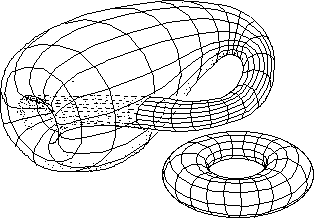
Klein bottle
Here it has been represented with a mesh-coordinate system consisting of two sets of closed curves, like the torus. One can thus mesh a Klein bottle without creating a mesh singularity. But as can be seen, this surface necessarily self-intersects along a closed curve, a circle. One therefore cannot embed a Klein bottle in R3. I tried, it doesn't work. One can only immerse it. Thanks to my drawing talents you can more or less picture this object to yourself. But when it came to turning a sphere inside out, much more complicated configurations had to be envisaged. The way of representing them was not the most convenient. Some used modeling clay. When one saw them arguing among themselves at colloquia, they would generally move aside, and open in front of their colleagues shoeboxes or hatboxes containing more or less monstrous objects. The drawing above evokes the most convenient way of constructing these objects and handling them: with what is called "coppered wire," an alloy that is flexible enough that one can bend it without difficulty, but which nevertheless retains its elasticity. The best way to proceed then consists in materializing the meeting points of the lines (we recommend rods 2 mm in diameter) by fixing them with wire ties. The advantage is that one can make them slide, at least until one considers that the object has acquired a definitive shape. One can then eliminate all sliding with a drop of glue.
In practice it is rather rare that one has to use Klein bottles. Below, a photograph of a Klein bottle that I use for my personal needs.
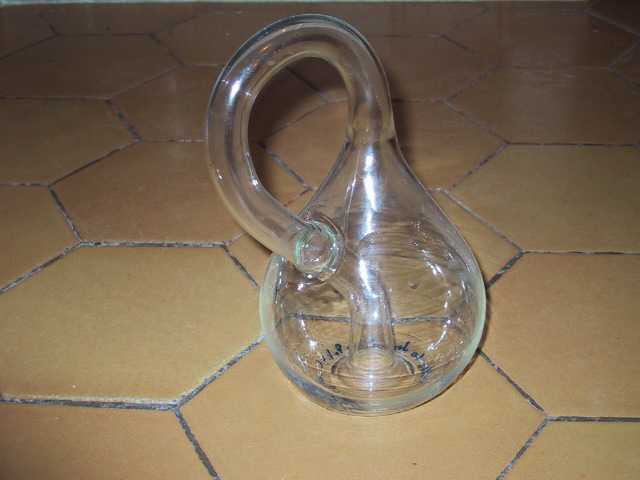
These objects, provided one has some sense of forms, are quite beautiful. I had a certain number of them built when I was a professor of sculpture at the Ecole des Beaux-Arts of Aix en Provence But before I moved on to this technique there was much fumbling in which we mixed soft wire and cardboard, which gave results of a wholly debatable aesthetic. I remember that one day I had had to take the train at Marseille to bring to Paris to my late friend the mathematician André Lichnérowicz several surfaces of which I had managed to construct sufficiently telling representations. There was in particular the Boy surface on which I had applied a cartography centered on a single pole. This ended up giving an absolutely superb object, which was exhibited for twenty years in the pi room of the Palais de la Découverte in Paris. But a year ago the management of the Museum decided that this surface had gone out of fashion and it now rests in an attic or a cellar. I hope it was not crushed in transport. All this to say that you will now not be able to see a Boy surface anywhere, except in books, or in a CD ROM on which I have recorded my 18 scientific comic strips in pdf format, including the Topologicon. How to obtain this CD-rom.
But let us return to this journey that I had undertaken, from Marseille to Paris. I was already encumbered by two suitcases and I had decided to take three models with me. The only solution had been to hang them around my neck. But when I crossed the station hall and saw how people were looking at me I understood that they imagined they were dealing with a madman who had obtained a leave permit from his asylum. It would have been totally futile to try to explain the opposite to them and I had to endure this ordeal with as much dignity as possible.
What is amusing is that the people who build things of this kind are rather rare. There was in America a mathematician named Charles Pugh, who worked in the mathematics department of the University of Berkeley. I will have occasion to speak of him again later. Pugh was absolutely brilliant with chicken wire, but personally I have always preferred the coppered wire technique.
Let us return to this story of turning a sphere inside out. The first who succeeded in overcoming this problem was the geometer Anthony Phillips He published his work, that is to say a series of drawings in an issue of Scientific Americain, in 1967. There are several ways of turning a sphere inside out. One consists in bringing each point of the sphere into coincidence with its antipode. It then takes the form of a Boy surface. I have always dreamed of finding a sponsor to build a magnificent sculpture that would represent a terrestrial globe folded into a Boy surface. Lacking the ability to build the object I made it the cover illustration of the Topologicon:
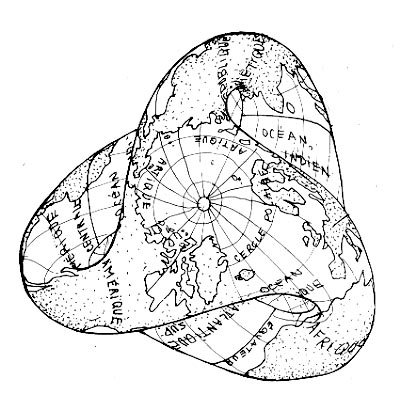
The terrestrial sphere reclosed on itself according to a Boy surface
In such a configuration, if one digs a hole at the north pole one immediately emerges on the other side, at the south pole, since these two points are antipodal. A Frenchman who dug a hole in his cellar would find himself in New Zealand, etc.
The version found by Anthony Phillips indeed consists in describing how the sphere configures itself into the form of a two-sheeted covering of Boy's surface, which is of course a one-sided surface. If one had a magic product, traversine, which would give surfaces the gift of being able to pass through themselves, it would suffice to join each point to its antipode by a thread, which one would make shrink until it became of zero length. If one cannot easily represent this transformation one can nevertheless take an interest in a part of the sphere, for example its equatorial neighborhood. This is what has been done in the animations that follow. This surface, endowed with two circular edges, resembles a bicycle wheel rim. Three spokes have been drawn, connected to diametrically opposite points. By making the length of these spokes tend toward zero this two-sided band will configure itself into a two-sheeted covering of a Moebius strip with three half-twists. Below, two rather crude animations. the one on the left is slow and the one on the right fast.
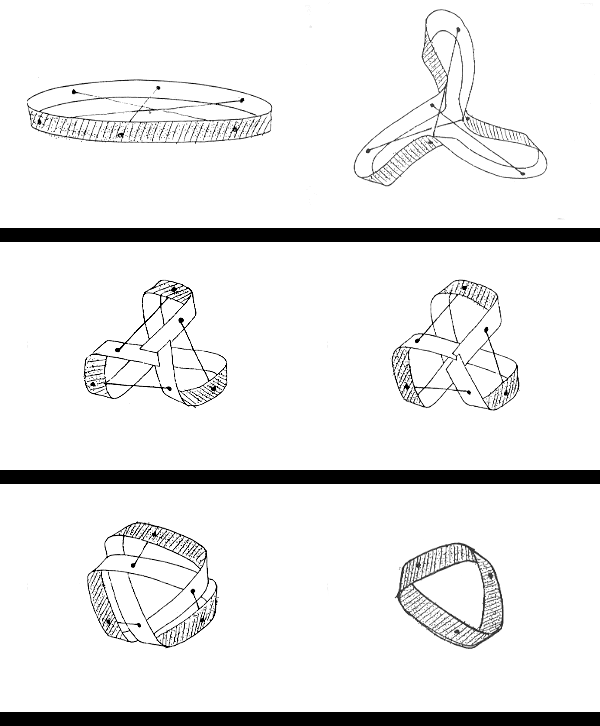
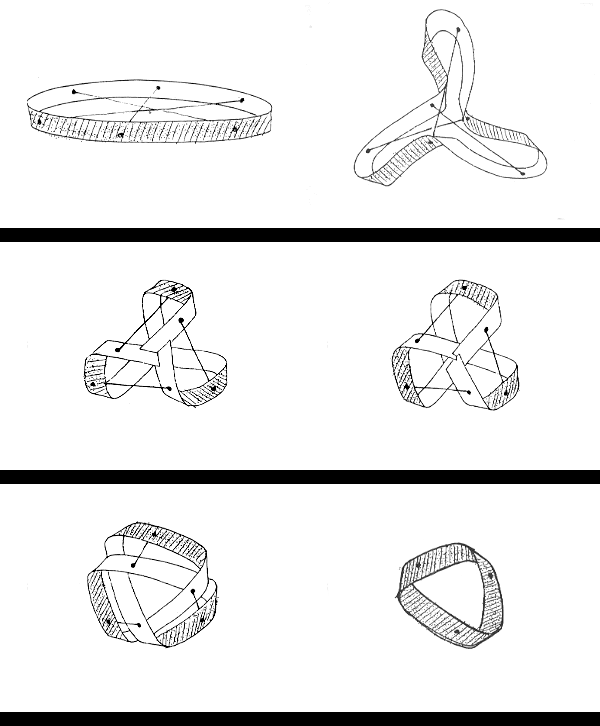
This Moebius strip with three half-twists is the "equatorial neighborhood" of Boy's surface. It is on this band that the equator of the sphere comes to wind.
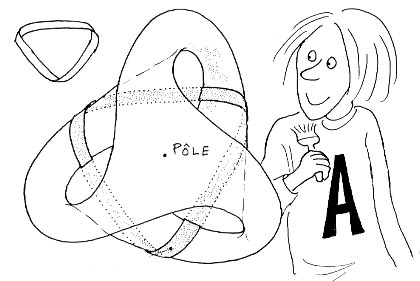
The "equator" of Boy's surface
As for the two poles of the sphere they come into coincidence on the single pole of the surface. This one, like the Klein bottle, cannot be immersed in R3. It can only be represented in the form of an immersion. It then possesses a set of self-intersection which has the form of a three-bladed propeller of which one glimpses the ends, which resemble the "tympana" of three "ears". In the following plates one will find some elements to better "read" this surface. In case of problem, procure yourself a Topologicon.
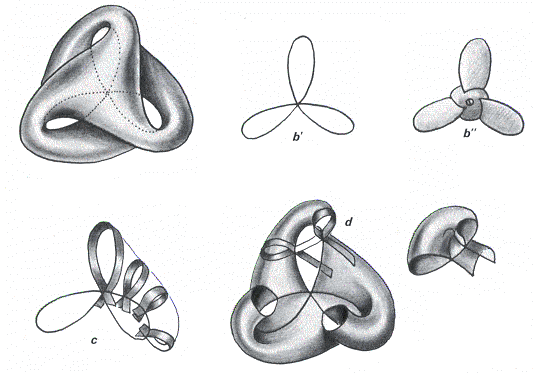
At the top and on the left a Boy's surface. As this surface is one-sided one could not use two colors. Inb' the set of self-intersection, trefoiled, evoking the blades of a propeller inb". The curve intersects itself again at a triple point T. The following drawings are there to help the reader find his way.
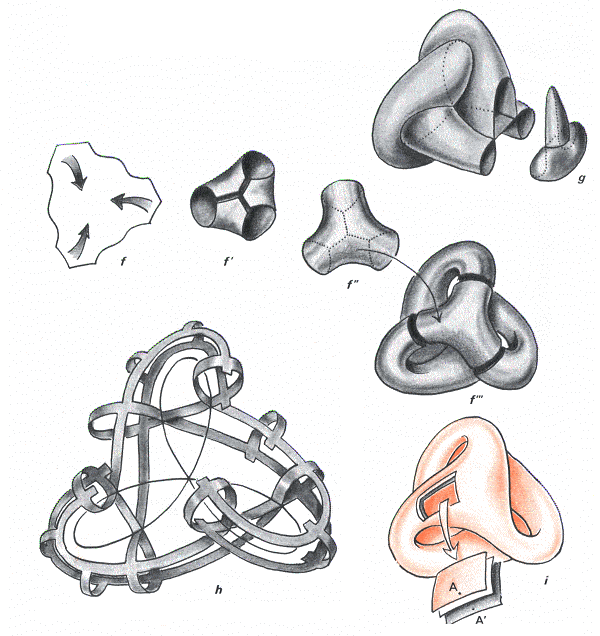
Anything is good for attempting to illustrate the structure of a surface: little bands, a montage with added pieces. One sees that a sculptor would find his happiness with this truly fascinating object. A word in passing on its history. In 1901 a student of the great German mathematician Hilbert, Werner Boy, evoked before him a surface of which no one had had the idea before. The holidays were very near. Hilbert said to his student:
*- This problem seems interesting to me. If you want, come back to see me at the start of term, we will discuss it. *
The holidays passed, but at the start of term Boy did not reappear. After two months, Hilbert tried to find him. Other students having given him his address, he went there. But the landlady declared to him that the young Werner Boy had returned his keys before the summer and that he had not reappeared. All the searches undertaken to find him proved vain, as did those to find members of his family. He literally vanished. If you go to Germany, do not hope to visit the grave of this illustrious inventor: it does not exist.
In the last figure, at the bottom and on the right, one has shown, in white, Boy's surface properly speaking and with grey and pink colors the two sides of the sphere which covers it. The points A and A' are, on this sphere, antipodal. One understands in any case how this two-sheeted covering of Boy's surface can be used to turn the sphere inside out. Suppose that we had the sequence of transformations, of the regular homotopy which allowed a sphere pink on the outside, grey on the inside to be transformed into this figure at the bottom and on the right. It would then suffice to exchange the two sheets (by making them self-pass through), among others the points A and A' and to perform the same transformations, carried out in reverse, to arrive at the antipodal embedding of this sphere, this time presenting its grey color on the outside.
In the same logic one can expect that a torus can configure itself into a two-sheeted covering of a ... Klein bottle. Here is what this covering looks like.
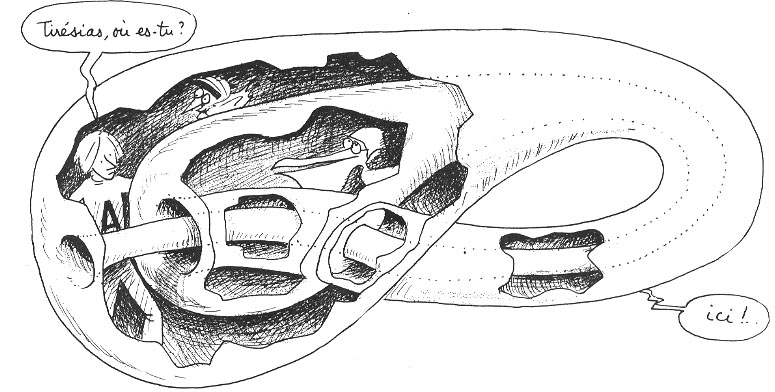
Two-sheeted covering of the Klein bottle
If one manages to configure a torus in this way it again suffices to exchange the adjacent sheets, situated on either side of the Klein bottle (not represented here), then to perform the operations in the opposite direction to arrive at the turned-inside-out torus. This work was presented in the January 1979 issue of Pour la Science in an article signed B. Morin and J.P.Petit. I took charge of the drawing part and Morin of the text. Although he cited many people in this paper, he forgot me along the way, as he forgot to mention that I was the inventor of this part of the work, presented on pages 46 and 47. But these are things that happen when one collaborates closely with a colleague. You know how it is: one is so accustomed to his presence over the years and one is so anxious not to forget anyone that one ends up forgetting him, as if he were part of the furniture. For more details this work was published under my name in the Comptes Rendus de l'Académie des Sciences de Paris on 20 November 1978, under the title "Retournement non-trivial du tore", the article having been presented by the Academician André Lichnérowicz.
Back to What's New Back to Guide Back to the Home page
Number of visits to this page since December 7, 2004:
The Turning Inside Out of the Sphere
December 7, 2004
page 1
Introduction.
In what follows we will consider closed surfaces, such as the sphere, the torus and a few others. These are surfaces in the sense in which the man in the street understands it, that is to say that they are 2-dimensional objects that one represents in a three-dimensional Euclidean space, R3, which is our mental space of representation. These surfaces can be the subject of several types of representation. If they do not intersect themselves, we will say that they are embedded (in R3). If they do intersect themselves we will then speak of immersions and this intersection will then translate into the presence of a self-intersection set.
In our embeddings we will assume that the tangent plane varies continuously and that the surface is free of singularities such as could be, for example, the vertex of a cone. Our surfaces will be regular.
In the case of immersions we will then require that along the self-intersection lines the two tangent planes to the sheets that cross be distinct.
The world of geometry, as the mathematician conceives it, is quite different from the physical world. The fact that surfaces can pass through themselves does not bother him at all. The physical world does not allow this kind of thing. But it becomes possible in the metaphysical world. Thus in the Bible we read that when the dead rise again, it will be in the form of "glorified bodies". They will then be able to pass through anything and in principle will be capable of passing through themselves. Thus, when the time of the Last Judgment has come, if you are strolling through Rome in the form of a glorified body, if you are lost and looking for the piazza Navona, you might be tempted to ask your way from another resurrected mortal, having the same appearance as you. Suppose that the person you question is heading in the opposite direction from that square. In ordinary physical space, to point you the right way he would have to pivot on himself to point his finger in that direction. But if he is moving about in the form of a glorified body, this rotation will no longer be necessary. He will be able to point his index finger at his navel and pass through himself. When his hand reappears, emerging from his back, all he will have left to do is tell you "it's that way". By thrusting his arm through his belly he will have created in his bodily envelope a self-intersection set consisting of two circles, which will disappear when he returns to his normal configuration.
If a human being closes his mouth, puts a clothespin on his nostrils to plug them and one disregards his other natural orifices, his bodily envelope then adopts the topology of the sphere S2. Let us imagine a being resurrected in the form of a glorified body whose natural orifices would thus be plugged. We know that he can pass through himself, that is to say that his bodily envelope can go from a situation of embedding to a situation of immersion. One of the metaphysical problems that then arose was to know whether a fellow resurrected in the form of a glorified body could turn himself inside out without making folds.
A small remark in passing. Conjurers know how to use "magic rings" that can interpenetrate "magically". One could imagine representing surfaces by means of a sort of "magic wire mesh" such that the two sheets, represented here one in black and the other in pink, could pass through each other without difficulty.
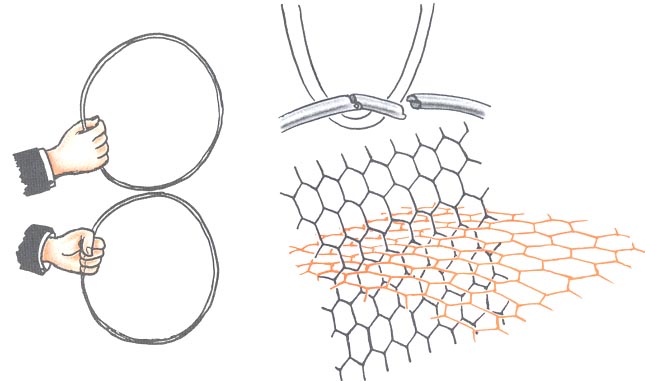
The magic wire mesh
In any case, it must be admitted that there is often not much difference between mathematics and magic. Twenty years ago I designed a comic strip: the Topologicon. It is now out of print and impossible to find, except as a collector's item. On one of the pages one could see this:
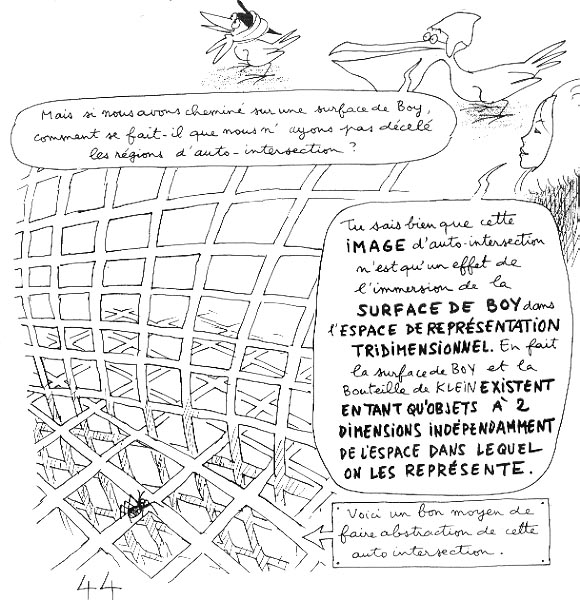
It is a great pity that the Belin editions decided to abandon this collection. It must be said that with a production cost of barely more than one euro, selling the albums at 13 euros (plus postage), by mail order, apart from the fact that this left a profit margin of 12 euros, that is to say with a profit exceeding 92 percent of the sale price, does not correspond to a very obvious commercial strategy, especially for black and white.
Let us consider a sphere S2 embedded in R3. We assume that its outer surface is grey and that its interior has an old pink color. We can press on two antipodal points, which we will arbitrarily call "north pole" and "south pole", until we bring them into contact at a point. One can do this for example with a doughnut. When it is a mathematical doughnut (one does not know whether doughnuts rise again or not in the form of glorified bodies) the two polar regions, after having been in contact at a point, can pass through each other along a self-intersection curve that takes the shape of a circle. Anticipating, we will say that this surface has undergone a catastrophe of type Do.
One can then be tempted to try to turn the doughnut, the sphere, inside out by continuing the operation. But then a bulge will form, which will degenerate into an ugly fold, or more exactly a cusp surface (figure d)..
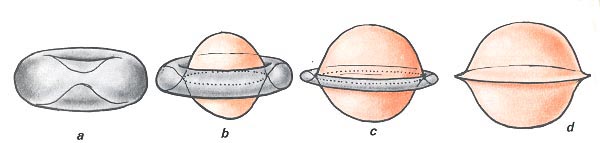
At the end of the fifties the serious question of whether one could turn metaphysical doughnuts inside out without making creases remained unresolved. To tell the truth, everyone thought that this was strictly impossible. But in 1957 a mathematician, Stephen Smale (who received the Fields Medal but for a completely different piece of work) demonstrated that the different immersions of the sphere S2 in R3 constituted a single set and that it was always possible to find a sequence of continuous deformations of immersions (also called regular homotopy) allowing one to pass from one situation to another. The corollary was that one had to be able to pass, with the help of a continuous sequence of immersions, from the standard embedding of the sphere S2 to the antipodal embedding. Put in simpler terms: one had to be able to turn a sphere inside out without making creases, on condition of allowing it to turn itself inside out.
Smale's boss was called Raoul Bott. The latter asked his student how one should go about it and Smale answered that he did not have the slightest idea, but that his theorem was totally unassailable. Smale did not see anything at all in space but he did not care (as is the case with many geometers). And, to be quite frank, after having demonstrated his theorem he desperately did not care how one might go about making the thing concrete and had hastened to take an interest in another subject, leaving his mathematician colleagues in the greatest perplexity. I find that it is not very nice to create problems like that and then leave people to manage on their own to find the solution, ten years later.
It must be said that it is rather difficult to imagine immersions, in one's head. Yet one knows of surfaces that can only be represented in R3 in this way. The Klein bottle, for example.
Klein bottle
It has been represented here with a mesh-coordinate system constituted by two sets of closed curves, like the torus. One can thus mesh a Klein bottle without creating a mesh singularity. But as one can see this surface necessarily self-intersects along a closed curve, a circle. One therefore cannot embed a Klein bottle in R3. I tried, it doesn't work. One can only immerse it. Thanks to my drawing talents you manage more or less to picture this object to yourself. But when it was a matter of turning a sphere inside out it was necessary to envisage much more complicated configurations. The way of representing them was not the most convenient. Some used modeling clay. When one saw them discussing among themselves at conferences, they generally moved aside, and opened in front of their colleagues shoeboxes or hatboxes, containing more or less monstrous objects. The drawing above evokes the most convenient way of constructing these objects and handling them: with what is called "coppered wire", an alloy that is flexible enough for one to be able to bend it without difficulty, but that nevertheless retains its elasticity. The best way to proceed then consists in materializing the meeting points of the lines (we recommend rods 2 mm in diameter) by fixing them with the help of wire ties. The advantage is that one can make them slide, at least until one considers that the object has acquired a definitive shape. One can then eliminate all sliding with a spot of glue.
In practice it is rather rare that one has to use Klein bottles. Below, a photograph of a Klein bottle that I use for my personal needs.
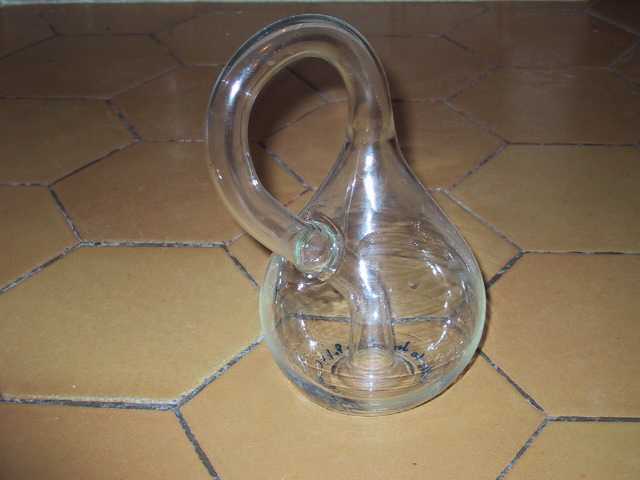
These objects, provided one has some sense of forms, are rather beautiful. I had a certain number of them built when I was a professor of sculpture at the Ecole des Beaux-Arts in Aix en Provence But before I moved on to this technique there were many fumblings where we mixed soft iron wire and cardboard, which gave results of a completely debatable aesthetic. I remember that one day I had had to take the train in Marseille to bring to Paris to my late friend the mathematician André Lichnérowicz several surfaces of which I had succeeded in constructing sufficiently telling representations. There was in particular the Boy surface where I had applied a cartography centered on a single pole. This ended up giving an absolutely superb object, which was exhibited for twenty years in the pi room of the Palais de la Découverte in Paris. But a year ago the management of the Museum decided that this surface had gone out of fashion and it now rests in an attic or in a cellar. I hope it was not crushed in transport. All this to say that you will now not be able to see a Boy surface anywhere, except in books, or in a CD ROM on which I have recorded my 18 scientific comic strips in pdf format, including the Topologicon. How to obtain this CD-rom.
But let us return to this journey that I had undertaken, from Marseille to Paris. I was already encumbered by two suitcases and I had decided to take three models with me. The only solution had been to hang them around my neck. But when I crossed the station hall and saw how people were looking at me I understood that they imagined they were dealing with a madman who had obtained from his asylum a permission to go out. It would have been totally vain to try to explain the contrary to them and I had to endure this ordeal with all possible dignity.
What's funny is that the people who build things of this kind are rather rare. In America there was a mathematician named Charles Pugh, who worked in the mathematics department at the University of Berkeley. I'll have occasion to speak of him again later on. Pugh was absolutely brilliant with chicken wire, but personally I've always preferred the copper wire technique.
Let's return to this story of turning a sphere inside out. The first who succeeded in coming to grips with this problem was the geometer Anthony Phillips. He published his work, that is to say a series of drawings, in an issue of Scientific American, in 1967. There are several ways to turn a sphere inside out. One consists in bringing each point of the sphere into coincidence with its antipode. It then takes the form of a Boy surface. I've always dreamed of finding a sponsor to build a magnificent sculpture that would represent a terrestrial globe folded into a Boy surface. Lacking the ability to build the object, I made it the cover illustration of the Topologicon:
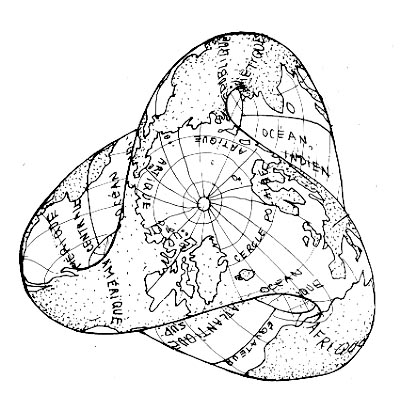
The terrestrial sphere glued back onto itself along a Boy surface
In such a configuration, if you dig a hole at the north pole you immediately emerge on the other side, at the south pole, since these two points are antipodal. A Frenchman who dug a hole in his cellar would find himself in New Zealand, etc.
The version found by Anthony Phillips consists effectively in describing the way in which the sphere configures itself into the form of a two-sheeted covering of the Boy surface, which is of course a one-sided surface. If one had a magic product, traversine, which would give surfaces the gift of being able to pass through themselves, it would suffice to join each point to its antipode by a thread, which one would make shrink until it became of zero length. If one cannot easily represent this transformation one can nevertheless take an interest in a part of the sphere, for example its equatorial neighborhood. This is what has been done in the animations that follow. This surface, endowed with two circular edges, resembles a bicycle wheel rim. Three spokes have been drawn, connected to diametrically opposite points. By making the length of these spokes tend toward zero this two-sided band will configure itself into a two-sheeted covering of a Moebius strip with three half-twists. Below, two rather crude animations. the one on the left is slow and the one on the right fast.
This Moebius strip with three half-twists is the "equatorial neighborhood" of the Boy surface. It is on this band that the equator of the sphere comes to wind.
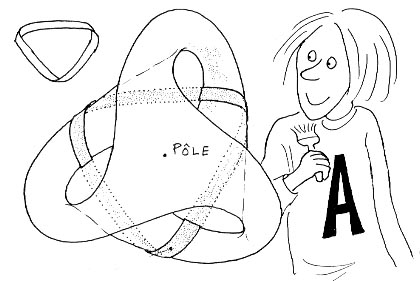
The "equator" of the Boy surface
As for the two poles of the sphere they come into coincidence on the single pole of the surface. This one, like the Klein bottle, cannot be embedded in R3. It can only be represented in the form of an immersion. It then possesses a set of self-intersection which has the form of a three-bladed propeller, of which one glimpses the ends, which resemble the "tympana" of three "ears". In the following plates one will find some elements to better "read" this surface. In case of a problem, get yourself a Topologicon.
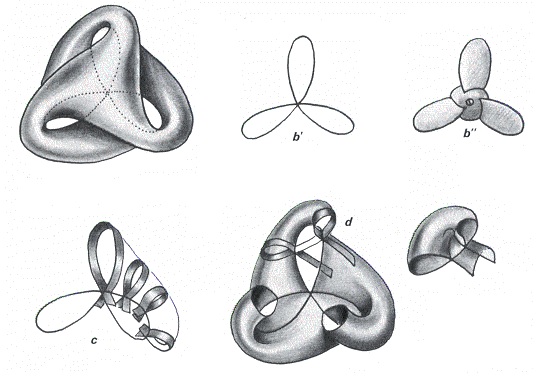
At the top and on the left a Boy surface. Since this surface is one-sided one could not use two colors. In b' the self-intersection set, trefoiled, evoking the blades of a propeller in b". The curve crosses itself again at a triple point T. The following drawings are there to help the reader find his way.
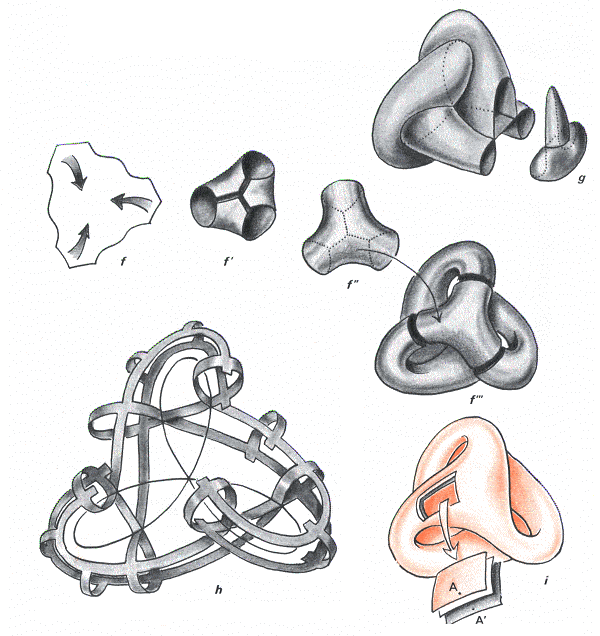
Anything goes in attempting to illustrate the structure of a surface: little bands, a montage with added pieces. One sees that a sculptor would find his happiness with this truly fascinating object. A word in passing on its history. In 1901 a student of the great German mathematician Hilbert, Werner Boy, evoked before him a surface of which no one had had the idea before. The holidays were very near. Hilbert said to his student:
*- This problem seems interesting to me. If you like, come back and see me at the start of term, we'll discuss it. *
The holidays passed, but at the start of term Boy did not reappear. After two months, Hilbert tried to find him. Other students having given him his address, he went there. But the landlady declared to him that the young Werner Boy had returned his keys before the summer and that he had not reappeared since. All the searches undertaken to find him proved vain, as did those to find members of his family. He literally vanished. If you go to Germany, do not hope to visit the grave of this illustrious inventor: it does not exist.
In the last figure, at the bottom and on the right, the Boy surface properly speaking has been shown in white and, with grey and pink colors, the two sides of the sphere that covers it. The points A and A' are, on this sphere, antipodal. One understands in any case how this two-sheeted covering of the Boy surface can be used to turn the sphere inside out. Suppose that we had at our disposal the sequence of transformations, of the regular homotopy that allowed a sphere pink on the outside, grey on the inside to be transformed into this figure at the bottom and on the right. It would then suffice to exchange the two sheets (by making them pass through themselves), among other things the points A and A', and to perform the same transformations, carried out in reverse, to arrive at the antipodal embedding of this sphere, presenting this time its grey color on the outside.
In the same logic one can expect that a torus can be configured as a two-sheeted covering of a ... Klein bottle. Here is what this covering looks like.
Two-sheeted covering of the Klein bottle
If one manages to configure a torus in this way it is enough, once again, to exchange the adjacent sheets, located on either side of the Klein bottle (not represented here), then to perform the operations in reverse order to arrive at the turned-inside-out torus. This work was presented in the January 1979 issue of Pour la Science in an article signed B. Morin and J.P.Petit. I took care of the drawing part and Morin of the text. Although he cited many people in this paper, he forgot me along the way, just as he forgot to mention that I was the inventor of this part of the work, presented on pages 46 and 47. But these are things that happen when one collaborates closely with a colleague. You know how it is: one is so used to his presence after years and one is so anxious not to forget anyone that one ends up forgetting him, as if he were part of the furniture. For more details this work was published under my name in the Comptes Rendus de l'Académie des Sciences de Paris on 20 November 1978, under the title "Retournement non-trivial du tore", the article having been presented by the Academician André Lichnérowicz.
Back to New Back to Guide Back to the Home page
Number of visits to this page since 7 December 2004:
The Turning Inside Out of the Sphere
8 December 2004
page 2
Permutation of the cuspidal points of a crosscap
This will constitute a small interlude, in the manner of "what can the turning inside out of the sphere be used for?". Here: to permute the two cuspidal points of a Crosscap, which could have seemed a priori impossible. I invented this little trick a good dozen years ago. It has never been published. But where can one publish this kind of thing? One doesn't really know. It is not "a major result in mathematics", but it is nonetheless a rather attractive exercise. In what follows we will make use of polyhedral representations. On the right the "round" Crosscap and on the left one of its many possible polyhedral representations.
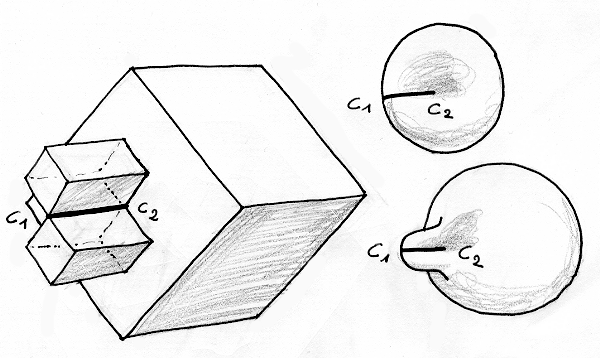
The Crosscap with one of its many polyhedral representations.
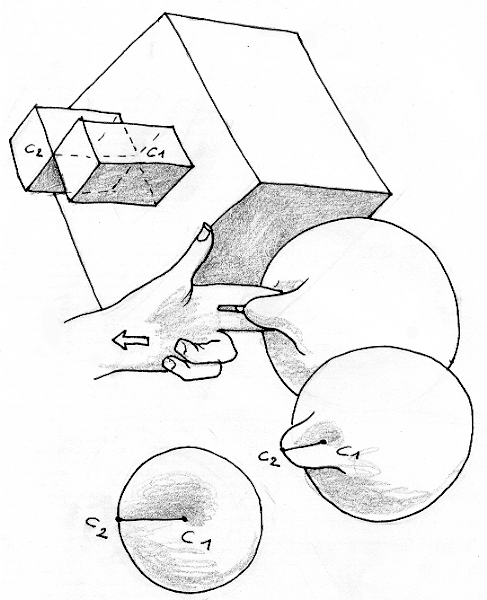
In the figure at the bottom and on the right we have arranged to lodge the two cuspidal points C1 and C2 located at the end of its self-intersection line in what can be considered a portion of a sphere. We know that we can turn a sphere inside out. So we can subject this object to the same treatment, without worrying about the different stages of this transformation. In polyhedral terms this will consist in turning the cube inside out.
All we know is that at the end of the operation we will have two kinds of invaginations that present themselves as what an observer would see who were situated "inside" the initial Crosscap (which is an improper expression since this surface is one-sided).
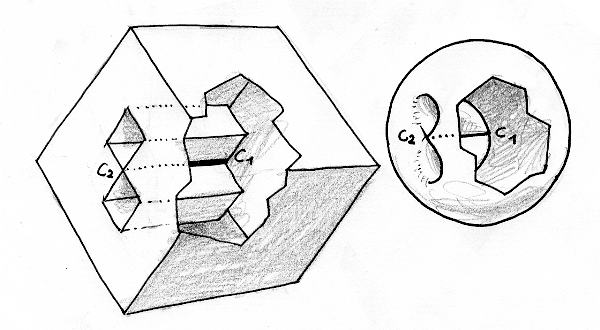
After turning inside out, from the cube on the left, to the sphere on the right
The polyhedral representation is nonetheless damn convenient for not losing the thread of these operations. All that remains is to slip two fingers into these invaginations and pull the whole thing outward:
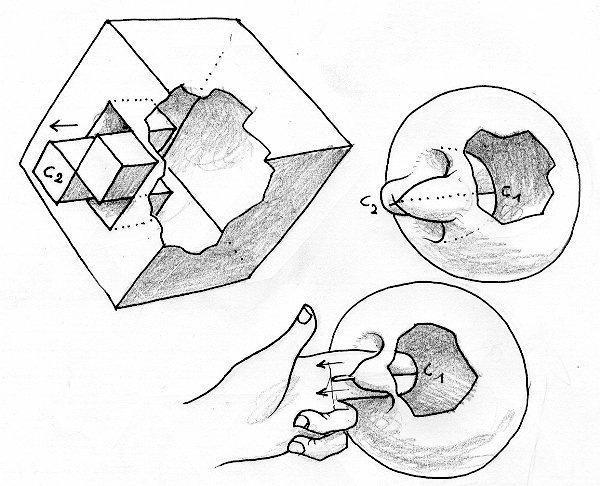
Pulling the cuspidal point C2 "outward"
If it amuses you, you will be able to build the polyhedral models out of cardboard. Unless a courageous person builds these models in vrml so that they can be manipulated.
All that remains is to finalize the operation.
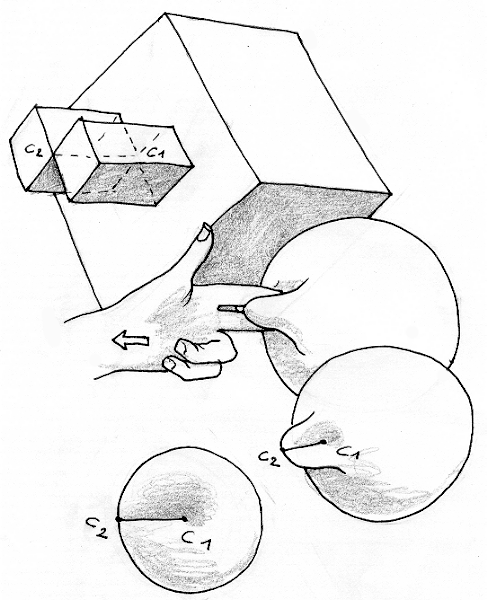
Passing to an immersion identical to that of the start, with the cuspidal points permuted.
I promised, one day, to make a dossier recounting my encounters with the psychoanalyst Jacques Lacan. The Crosscap had served him to model the "fundamental fantasy". He had focused on the "central cuspidal point" and simply neglected the second. In this central region Lacan had located the "linguistic phallus" or "objet petit a". I will tell you the rest another time. The fact remains that Lacan had not foreseen that these points could be "pere - mutated". In fact, when he had spoken to me of this linguisto - geometrico - psychoanalytic modeling I had frowned, imagining that in this Crosscap the two cuspidal points could play different roles and, in the second that followed, simply by having asked myself the question, I had found how to exchange them. Lacan was quite stunned, I remember. His fundamental fantasy had two linguistic phalluses instead of just one. His whole affair had been articulated around this object. But I immediately proposed an alternative solution to him by situating the linguistic phallus at the (unique) pole of a Boy surface. Thus, everything returned to order to his great satisfaction.
This episode took place fairly shortly before his death. From what I have been able to observe, this psychoanalytico-geometric redeployment has apparently not yet spread within the community of Lacanian psychoanalysts.
Back to New Back to Guide Back to the Home page
Number of visits to this page since 7 December 2004:
The Turning Inside Out of the Sphere
8 December 2004
page 2
Permutation of the cuspidal points of a crosscap
This will constitute a little interlude, in the mode "what can the turning inside out of the sphere be used for?". Here: to permute the two cuspidal points of a Crosscap, which could have seemed a priori impossible. I invented this little trick a good dozen years ago. It has never been published. But where can one publish this kind of thing? One doesn't really know. It is not "a major result in mathematics", but it is all the same a rather seductive exercise. In what follows we will make use of polyhedral representations. On the right the "round" Crosscap and on the left one of its multiple possible polyhedral representations.
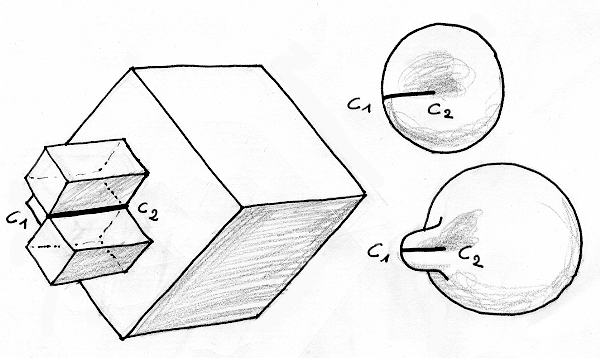
The Crosscap with one of its multiple polyhedral representations.
In the figure at the bottom and on the right we have arranged to lodge the two cuspidal points C1 and C2 situated at the end of its self-intersection line in what can be considered a portion of a sphere. We know that we can turn a sphere inside out. So we can subject this object to the same treatment, without worrying about the different stages of this transformation. In polyhedral terms this will consist in turning the cube inside out.
All we know is that at the end of the operation there will be two kinds of invaginations that present themselves as what an observer situated "inside" the initial Crosscap would see (which is an improper expression since this surface is one-sided).
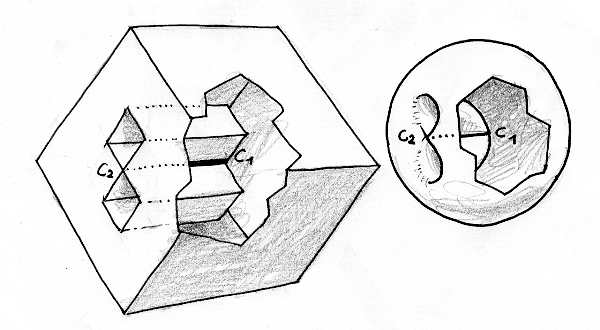
After turning inside out, of the cube on the left, of the sphere on the right
The polyhedral representation is all the same damn convenient for not losing the thread of these operations. There remains only to slip two fingers into these invaginations and to pull the whole thing outward:
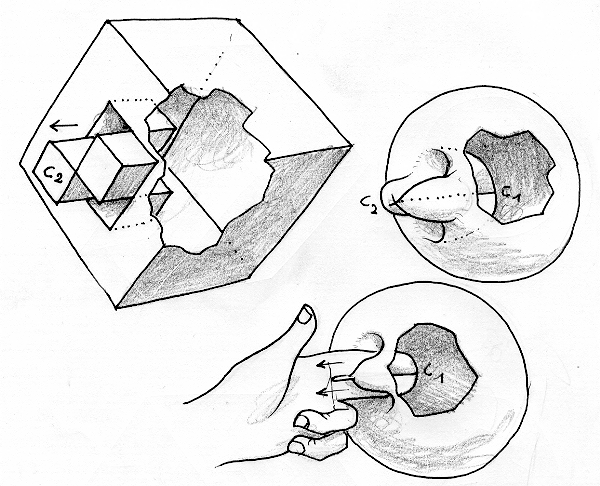
Pulling the cuspidal point C2 "outward"
If it amuses you, you will be able to build the polyhedral models out of cardboard. Unless a courageous person builds these models in vrml so that they can be manipulated.
There remains only to finalize the operation.
Passage to an immersion identical to that of the start, with the cuspidal points permuted.
I promised, one day, to make a file recounting my encounters with the psychoanalyst Jacques Lacan. The Crosscap had served him to model the "fundamental fantasy". He had polarized himself on the "central cuspidal point" and simply neglected the second. In this central region Lacan had localized the "linguistic phallus" or "objet petit a". I will tell you the rest another time. The fact remains that Lacan had not foreseen that these points could be "father - mutated". In fact, when he had spoken to me of this linguisto - geometrico - psychoanalytic modeling I had frowned while imagining that in this Crosscap the two cuspidal points could play different roles and, in the second that followed, simply by having asked myself the question, I had found how to exchange them. Lacan was quite stunned by it, I remember. His fundamental fantasy had two linguistic phalluses instead of a single one. His whole affair had been articulated around this object. But I immediately proposed to him an alternative solution by situating the linguistic phallus at the (unique) pole of a Boy surface. Thus, everything returned to order to his great satisfaction.
This episode takes place fairly shortly before his death. From what I have been able to observe, this psychoanalytico-geometric redeployment has apparently not yet spread within the community of Lacanian psychoanalysts.
Back to Novelties Back to Guide Back to the Home page
Number of consultations of this page since 7 December 2004:
The Turning Inside Out of the Sphere
7 December 2004
page 3
Elementary catastrophes.
We have already said above that the immersions that we were considering were such that the tangent planes along their self-intersection sets, when these were endowed with them, remained distinct. It is then possible to pass from one immersion to another with the help of four elementary catastrophes. Morin had given them names, which appear in the drawings below. The first leads to the creation of a closed curve (and its decreation, the inverse operation). This is what happens when one plunges one's elbow into the water of a basin to appreciate its temperature (on the left). Figure a4: the surfaces are in contact at a point. In a5 the self-intersection curve has been created. In the rest of the text we will call this operation "the elbow catastrophe".
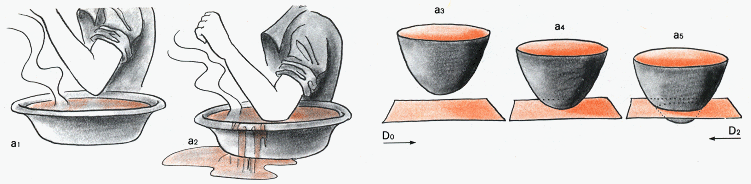
The "elbow catastrophe": creation - decreation of a closed curve
The second catastrophe is that of the "mandarin segment":
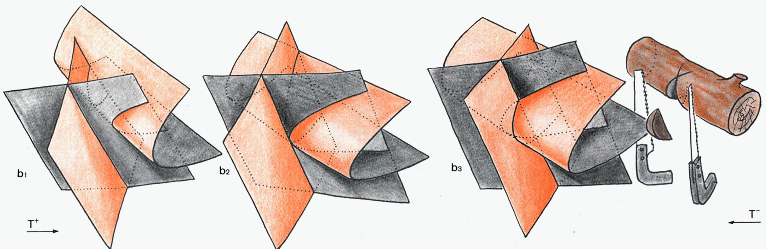
The catastrophe consisting in the creation-decreation of a "mandarin segment".
If we look carefully at these images, from left to right we will see that a parabolic cylinder approaches a dihedral. The self-intersection set consists of two disjoint curves of parabolic appearance, plus obviously the edge of the dihedral. In the center figure the edge of the dihedral is in contact with one of the generators of the cylinder. This edge is tangent to the cylinder at this point. The self-intersection set consists of two curves of parabolic appearance, tangent at a point, and to the edge of the dihedral. Right figure: the parabolic cylinder has continued its movement. The self-intersection curve has changed. It consists of the edge of the dihedral, plus the parabolic curves which intersect at two points, located on the edge of the dihedral. One can consider conversely that the parabolic cylinder is motionless and that it is the two "cutting planes" that are moving. The right figure would then evoke two axe blows, or two cuts made with a saw. The shaving is also depicted. Morin compared it to a "tangerine slice", a very telling image.
The third catastrophe is that "of the trousers".
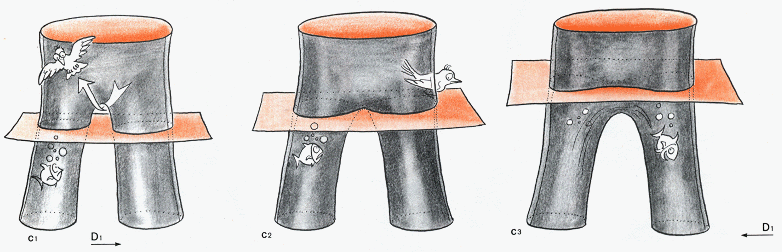
The "trousers" catastrophe
The images are telling enough. From left to right a pair of trousers is lowered into the water. On the left the bird passes under the crotch but the fish remains confined in one of the legs. On the right the fish passes, but the passage the bird used has disappeared. In the center the intermediate situation. What matters is the local modification of the intersection curve, which corresponds to what is called a "surgery", a change in the connection of arcs of the curve. Try to integrate this transformation well, as it will prove the most difficult to implement and to see clearly in the homotopy of the eversion of the sphere. Bear in mind that this catastrophe closes one passage at the same time as it opens another in the perpendicular direction.
The fourth and last catastrophe is that of "the inversion of a tetrahedron":
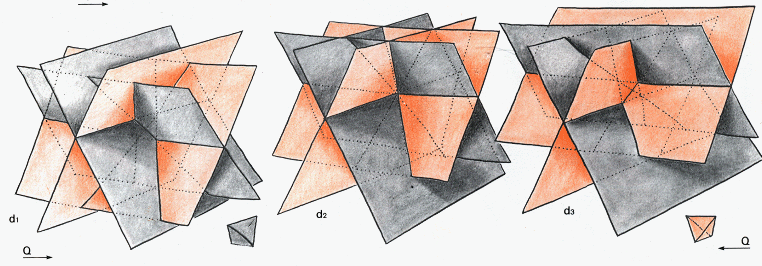
The catastrophe inverting a tetrahedron
The self-intersection curve consists of four "lines" which are the extensions of the four sides of a tetrahedron. In the left figure this tetrahedron has been isolated, showing its gray faces toward the outside. On the right, it is the opposite: the faces are pink. In the center, intermediate situation: the tetrahedron is reduced to a point Q (quadruple, since it is at the intersection of four sheets).
With the help of these four catastrophes we will undertake to turn a sphere inside out along a continuous sequence of transverse immersions. This variant is due to the (blind) mathematician Bernard Morin. Our meeting is worth recounting. One day a technician from the faculty of letters asked me to bring my drawing talents to a lecturer who was to speak about geometry. I came to this appointment without any mistrust. I had always been quite skilled at seeing objects in space, and when our advanced mathematics professor gave us a descriptive geometry problem to solve, I would trace the intersection and provide a perspective view at the same time as he produced his statement. But there, things were going to turn out differently.
I had no difficulty drawing the figures above. But when they had to be integrated into a diagram involving the eversion of the sphere, I ended up completely losing my bearings, confronted with a whole set of sheets located one behind another. Stung to the quick, I went back to see this strange character who, although deprived of sight, seemed more at ease than I was in this unfolding of forms. I then followed his courses for several months. The dialogue was rather complicated. On his side he had only speech to rely on. On mine I could either describe my drawings to him, or put into his hands models made when I got home, or later on the spot. These dialogues, absolutely surreal, should have been recorded, of the kind:
- Try to imagine two curves that would come together to form a sort of egg-beater.
Despite the difficult personality of the character, these meetings remained unforgettable for me. In the end I only got into the habit of swallowing two aspirins before our work sessions, as a preventive measure. His character can be summed up in the nickname his wife had given him: "Blessed Lightning", who is a character from Hergé's comic strip "Tintin in Tibet". Morin's grudges had a character as legendary as it was irreversible. He would sometimes evoke certain of his enemies, who had passed away, by launching about them:
- I sometimes throw a little curse at them in the afterlife, telling myself that if it doesn't do them any harm, at least it can't do them any good.
Back to New Back to Guide Back to Home page
Number of visits to this page since December 8, 2004:
The Eversion of the Sphere
December 7, 2004
page 3
The elementary catastrophes.
We have already said above that the immersions we were considering were such that the tangent planes along their self-intersection sets, when these had any, remained distinct. It is then possible to pass from one immersion to another with the help of four elementary catastrophes. Morin had given them names, which appear in the drawings below. The first leads to the creation of a closed curve (and its decreation, the inverse operation). This is what happens when you plunge your elbow into the water of a basin to appreciate its temperature (on the left). Figure a4: the surfaces are in contact at a point. In a5 the self-intersection curve has been created. In the rest of the text we will call this operation "the elbow catastrophe".
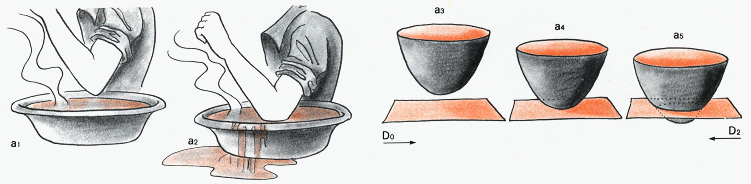
The "elbow catastrophe": creation - decreation of a closed curve
The second catastrophe is that of the "tangerine slice":
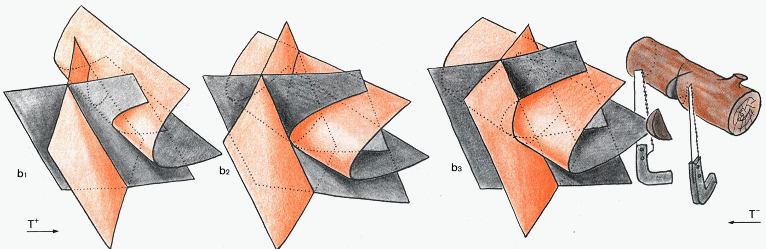
The catastrophe consisting of the creation-decreation of a "tangerine slice".
If you look carefully at these images, from left to right you will see that a parabolic cylinder approaches a dihedral angle. The self-intersection set consists of two curves of parabolic appearance, disjoint, plus obviously the edge of the dihedral angle. In the center figure the edge of the dihedral angle is in contact with one of the generatrices of the cylinder. This edge is tangent to the cylinder at this point. The self-intersection set consists of two curves of parabolic appearance, tangent at a point, and to the edge of the dihedral angle. Right figure: the parabolic cylinder has continued its movement. The self-intersection curve has changed. It consists of the edge of the dihedral angle, plus the parabolic curves which intersect at two points, located on the edge of the dihedral angle. One can conversely consider that the parabolic cylinder is motionless and that it is the two "cutting planes" that are moving. The right figure would then evoke two axe blows, or two cuts made with a saw. The shaving is also depicted. Morin compared it to a "tangerine slice", a very vivid image.
The third catastrophe is that "of the trousers".
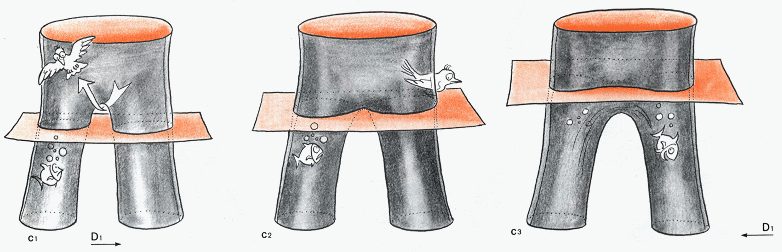
The "trousers" catastrophe
The images are sufficiently clear. From left to right a pair of trousers is lowered into the water. On the left the bird passes under the crotch but the fish remains confined in one of the legs. On the right the fish passes, but the passage that the bird used has disappeared. In the center the intermediate situation. What matters is the local modification of the intersection curve, which corresponds to what is called a "surgery", a change in the connection of arcs of the curve. Try to integrate this transformation well, which will prove to be the most difficult to implement and to see clearly in the homotopy of the eversion of the sphere. Remember well that this catastrophe closes one passage at the same time as it opens another in the perpendicular direction.
The fourth and last catastrophe is that of "the inversion of a tetrahedron":
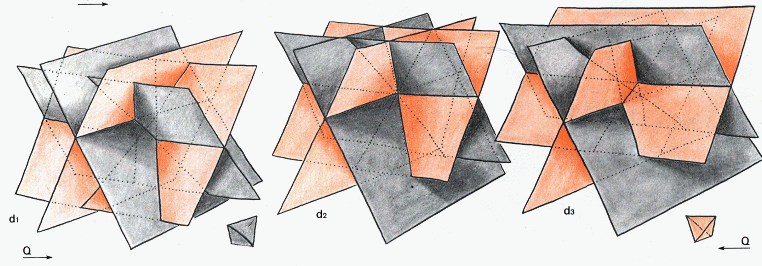
The catastrophe inverting a tetrahedron
The self-intersection curve is constituted by four "lines" which are the extensions of the four sides of a tetrahedron. In the left figure this tetrahedron has been isolated, showing its gray faces toward the outside. On the right, it is the opposite: the faces are pink. In the center, intermediate situation: the tetrahedron is reduced to a point Q (quadruple, since it is at the intersection of four sheets).
With the help of these four catastrophes we will consider everting a sphere according to a continuous sequence of transverse immersions. This variant is due to the (blind) mathematician Bernard Morin. Our meeting is worth recounting. One day a technician from the faculty of letters asked me to bring my drawing talents to a lecturer who was to speak about geometry. I came to this appointment without any mistrust. I had always been quite skillful at seeing objects in space and when our professor of higher mathematics gave us a descriptive geometry problem to solve I would trace the intersection and provide a perspective view at the same time as he produced his statement. But there, things were going to turn out differently.
I had no difficulty drawing the figures above. But when it came to integrating them into a diagram involving the eversion of the sphere I ended up completely losing my bearings, confronted with a whole set of sheets situated one behind another. Stung to the quick I went back to see this strange character who, although deprived of sight, seemed more at ease than I was in this unfolding of forms. I then followed his courses for several months. The dialogue was rather complicated. On his side he had recourse only to speech. On mine I could either describe my drawings to him, or put into his hands models made when I got home, or subsequently on the spot. These dialogues, absolutely surreal, should have been recorded, of the kind:
- Try to imagine two curves that would come together constituting a sort of egg whisk.
Despite the difficult personality of the character these meetings remained unforgettable for me. I only ended up getting into the habit of swallowing two aspirins before our work sessions, as a preventive measure. His character can be summed up in the nickname his wife had given him: "Blessed Lightning", who is a character from Hergé's comic strip "Tintin in Tibet". Morin's resentments had a character as legendary as it was irreversible. He would happen to evoke certain of his enemies, who had passed away, by launching about them:
- Sometimes I throw a little curse at them in the afterlife, telling myself that if it doesn't do them any harm, at least it can't do them any good.
Back to What's New Back to Guide Back to the Home page
Number of visits to this page since December 8, 2004:
The Turning Inside Out of the Sphere
December 8, 2004
page 4
Bernard Morin's version
To download the pdf version of the 1979 article by B. Morin and J.P. Petit, published in Pour la Science
The turning inside out of the sphere ( 2.8 MB )
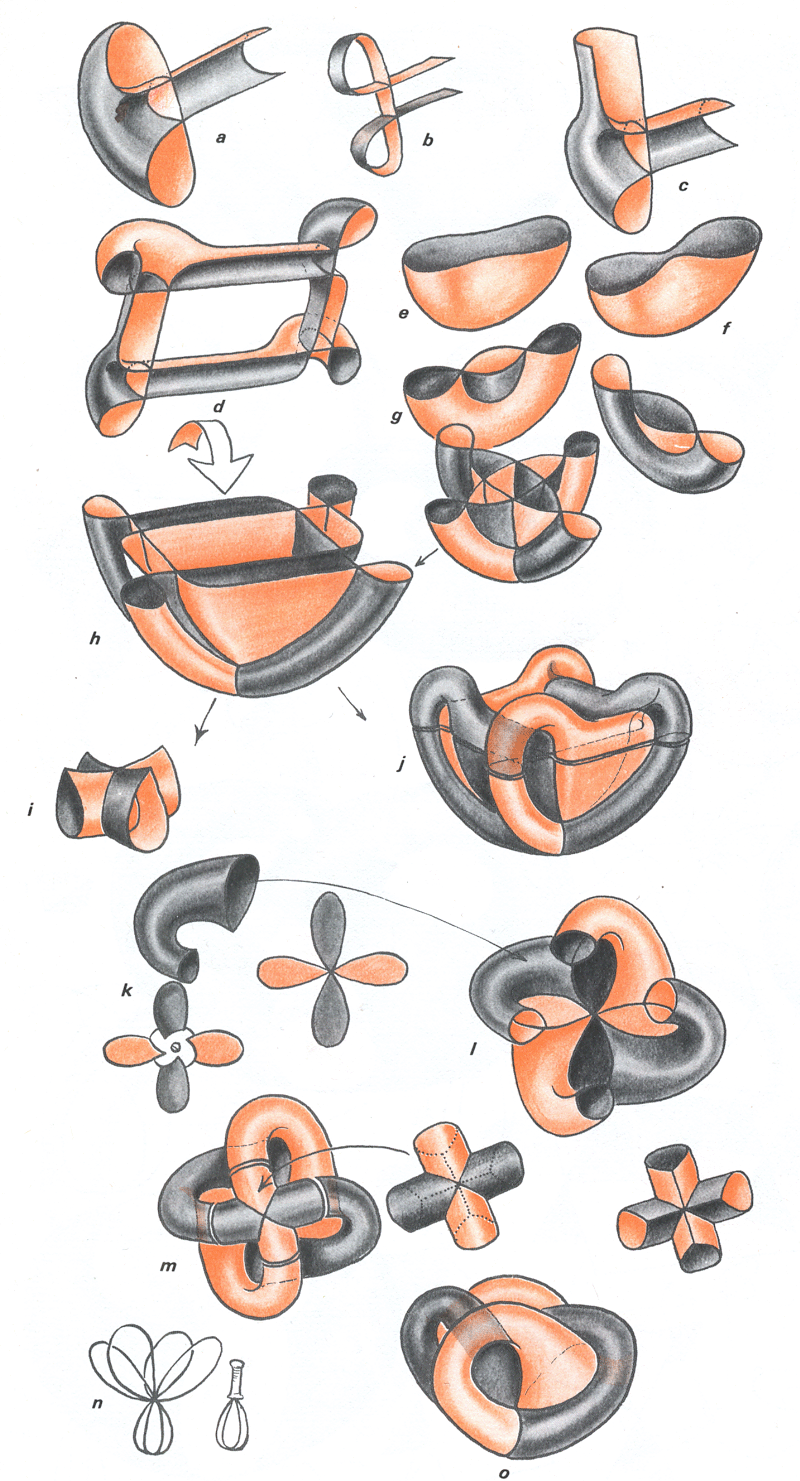
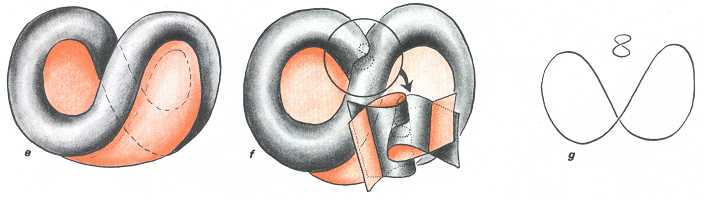
We will start from a sphere that presents its grey face toward the outside and its pink face on the inside. Inbandcits poles are brought into contact. Then the sheets interpenetrate according to an "elbow catastrophe". A closed curve of self-intersection is created. At the bottom and on the right three half-cuts allow a better grasp of the configuration obtained. At this stage the sphere resembles a sort of circular "rubber dinghy", with a "tube" and a "floor" with a double wall.
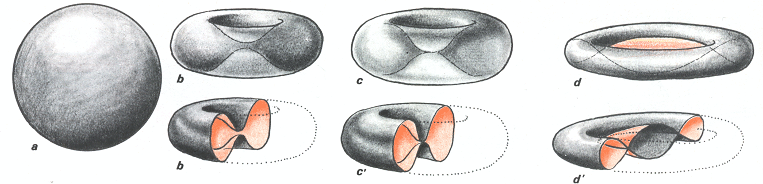
First step: an "elbow catastrophe". Creation of a closed curve of self-intersection
Second operation: a new elbow catastrophe, creation of a second closed curve.
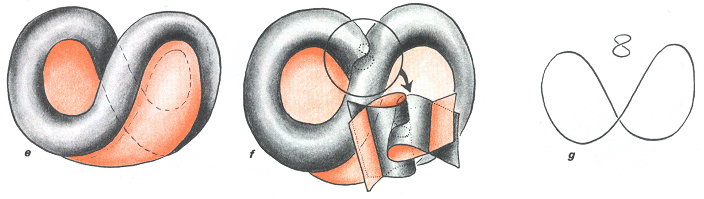
Second creation of a closed curve of self-intersection.
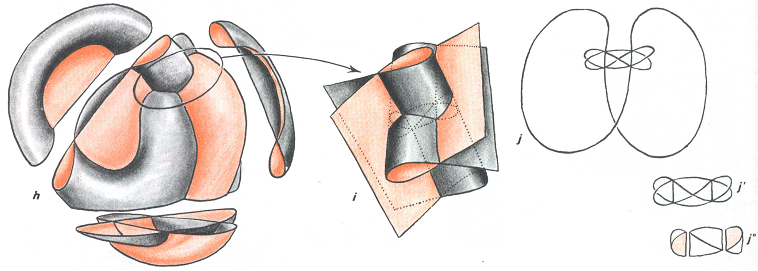
To do this the "rubber dinghy" has folded, with a twisting motion, which made it possible to bring two diametrically opposite parts of the "tube" into contact. The following image is the result of two catastrophes leading to the creation of "mandarin segments".
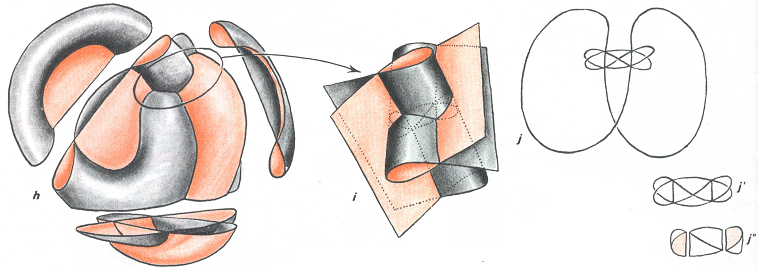
After creation of two "mandarin segments"
On the left cuts have been made in the model. In the center, the way in which the two cylinders whose section locally takes the shape of the Greek letter "gamma" have interpenetrated. It will be recalled that the catastrophe creating "mandarin segments" operated by cutting a "log" with two planes forming a dihedral angle. Each of the cylindrical structures whose section is in "gamma" comprises both the rounded section and the dihedral angle. Look carefully at figurei. Injthe self-intersection set has been drawn. The largest portion of closed curve comes from the first "elbow catastrophe" that had transformed the sphere into a "rubber dinghy". After creation of the two mandarin segments a more complex set is obtained, of whichj' is a subset. Inj" it can be seen that this structure can be compared to the assembly of two "mandarin segments" on two non-adjacent edges of a tetrahedron.
All this will one day be much simpler to grasp when I have been able to produce animations. This poses no technical problem for me a priori. It is a simple question of time. Rare are the people who can not only see in space, that is to say read this coding using lines, dotted lines, colors, shadows and reflections, but also chain transformations together in their heads by imagining the suggested movement. I hope one day to have the time to do all these things. Let us note in passing that polyhedral models could be used, as I did to show how a Crosscap can be transformed into a Boy Surface. There lies the future. But these models have to be invented. Further on will be found the optimized polyhedral version of the central model of this transformation imagined by Bernard Morin (let us recall that he is a blind man!), with the way to build it oneself from a cutting pattern.
Why have I not pushed these things further? I would say: for lack of "outlets". There are no mathematics journals that agree to publish such work. We were able to do so in 1975-78 through a few notes in the Comptes Rendus de l'Académie des Sciences de Paris, which undoubtedly cannot have been read by many people. But that was because the academician André Lichnérowicz was personally interested in this work. He is now deceased. As this work had been completely completed as early as 1975 it would have been desirable to produce an animated film from my drawings. Having worked in animation I was quite capable of coordinating such an undertaking. But it was impossible to find funding at the Cnrs and it was ultimately the American mathematician Nelson Max who, drawing inspiration from models built by his colleague Charles Pugh (of this same version of the turning inside out of the sphere), and using a powerful computer, managed to be the first to produce a film. But it is neither the first nor the last time that French people, receiving no echo to their efforts, are thus overtaken by foreign colleagues who are better organized and better supported.
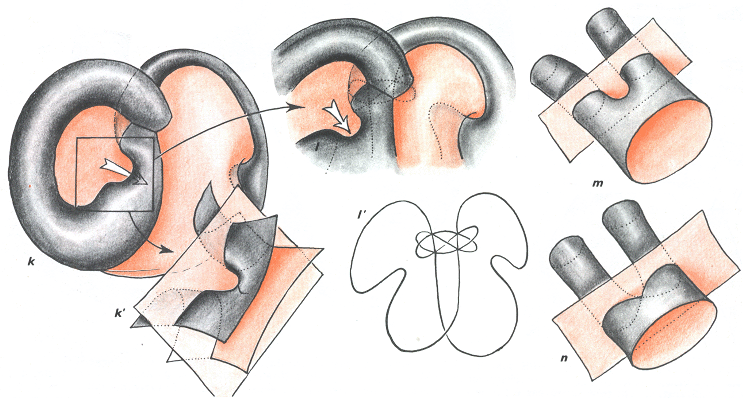
Let us move on to the third phase, the most difficult to grasp.
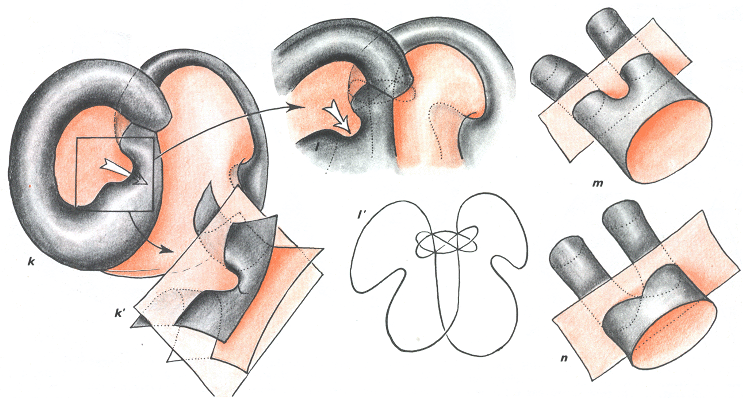
Preparation of two "trousers" catastrophes
In figurek the two ends of the "trouser legs" are clearly visible, the detail of which appears in a foregroundk'. The white arrow indicates the passage "through the crotch". This transformation is really difficult to grasp. I have added drawingmto try to be better understood. InlI have shown with dotted lines the self-intersection curve, which appears as a whole inl'. A passage (the one taken by the white arrow) is going to close up. This closing movement goes together with the rise of a part of the intersection curve, in two places. These pieces of curve will each come into contact with one of the lines belonging to "mandarin segments". When the contact occurs, the surgery will take place. The difficulty comes from the fact that, having seen the four elementary catastrophes on the previous page, one must be able to transpose them from every angle, by twisting one's neck vertebrae if need be. Innthe critical moment is shown at which the surgery takes place (the "median situation" of the transformation) and at which the mode of connection of the pieces of curve is going to be modified. It is known that this "trouser" catastrophe closes one passage and opens another. The initial passage is shown by the white arrow. But there exists another one which would be seen from the same angle by rotating the model 180° on itself about a vertical axis. These arrows form only one. Before these catastrophes take place it is still possible to circulate in this "folded rubber dinghy". Once these catastrophes have taken effect this passage will no longer be possible. On the other hand two other passages will have been created. But where, which parts of space are concerned? These passages will put the interior of the mandarin segments in communication with the outside. Inl', these mandarin segments, you can see them. Let us move on to the next step.
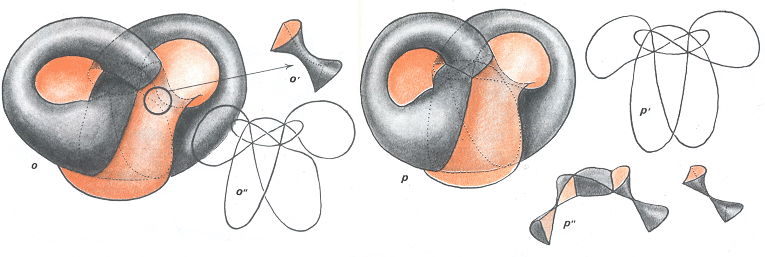
Closing of the passage. Towards a double critical situation
Inothe two "trouser" catastrophes are shown at two different stages. One of the passages is completely closed. We are in a critical situation, just before the arcs of the curve see their mode of connection change. On the right (detail in figureo' ) the passage is only in the process of closing. Thus the appearance of the self-intersection curveo" is different on the right and on the left. In figuresp,p' andp" the criticality (the "median" situation of the transformation) is reached on both sides. In the following plate the surgeries have taken effect. The tubes that were seen beginning in figurep", putting the "mandarin segments" in communication with the outside, are now formed:
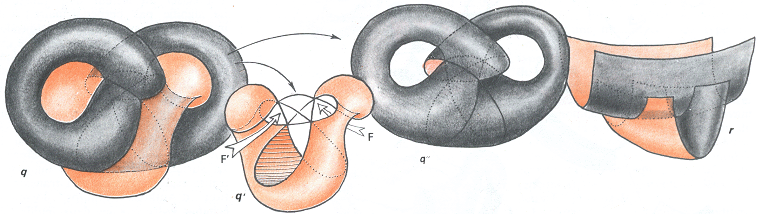
The two "trouser catastrophes" have taken effect. The passages ( white arrows ) are open.
Things will now continue by working on the lower part of the model, the detail of which is indicated inr. Let us look at this portion of surface carefully. We see two portions of parabolic cylinders that cross, being directed along two orthogonal directions. There exists a passage at the lower part ofrthat faces the reader. We are going to consider making these two cylinders slide one relative to the other. This would then have the effect of closing this passage and opening another running in the perpendicular direction ( "from right to left" ). We recognize here a new "trouser catastrophe". If this vertical sliding of these portions of parabolic cylinders takes place, we will again arrive at a critical situation, with a change in the mode of connection of the sheets. But in fact, simply for the sake of economy, we will stop the "process" at the criticality, in the "median situation", when the passage directed towards the reader closes and the passage situated in the perpendicular direction is not yet open. Let us do this.
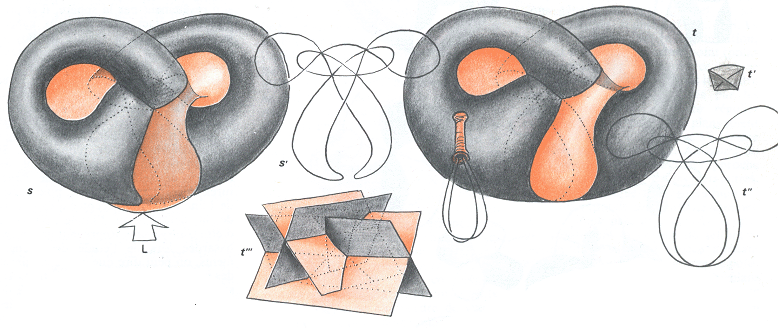
New trouser catastrophe, begun in L, stopped on the right, at the criticality.
We will apply in L a "pressure" on the cylinder that presents its pink colour towards the outside and make it rise. Inc' the impact that this movement has on the self-intersection set is seen: the arcs of the curve begin to come closer together. When the criticality is reached this part of the set will resemble "an egg whisk", shown in the figure. Figures on the right,t,t',t" : the criticality is reached, that is to say "the median instant of the catastrophe". Int" the appearance of the self-intersection set whose lower part is identical to that of our egg whisk. Figuret' represents the small tetrahedral volume. Int''' the crossing of the four sheets is shown.
*Go and swallow an aspirin. *
In this version of the sphere eversion all the transformations, the catastrophes, should be brought to their term. But we are going to block the one we have just evoked in its median, "critical" configuration. We will then begin a catastrophe that we have not yet used: the one that inverts a tetrahedron. But here again we will stop at the "median" situation, when this tetrahedron is reduced to a point. Let us go!
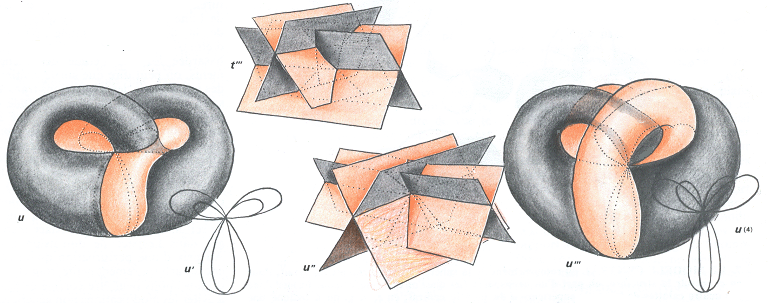
Last catastrophe, blocked at its median stage: when the tetrahedron is reduced to a quadruple point Q
Ent''' an evocation of the configuration of the four sheets whose self-intersection set contains a volume affecting the shape of a tetrahedron. Inu" this tetrahedron has been reduced to a point ( quadruple, since there are four sheets that cross ). On the left the "Morin model with four ears" is constituted. In the foreground the self-intersection set with, at the bottom, the "egg whisk" and at the top four loops evoking "rabbit ears". By deforming the surface a little, but without carrying out new catastrophes, we arrive on the right at the central Morin model with four ears. This one has a symmetry of order four. If we carried out a rotation of 90° around its vertical axis of symmetry, we would obtain the same drawing, but with the colors exchanged. The gray becomes pink and vice-versa. So we can say that the work is finished. Indeed, if we wanted to draw the complete homotopy it would suffice, with the help of an animation, to rotate this central model by 90°. Then we could take up all the drawings that we have made, in reverse, with exchanged colors. In the end we would obtain an embedding of the sphere where the latter presents its pink color on the outside. But mathematics is a school of laziness, or of economy, depending on the view one takes of the thing. Insofar as the work has brought us to an object presenting this symmetry of order four we can stop there by saying that the operation has been carried out successfully.
In the following plate I have endeavored to describe this central open Morin model with the maximum of details. There exists a model with "closed ears", which I described in another note to the Academy, but I will spare you that.
Detailed description of the central Morin model, with four ears
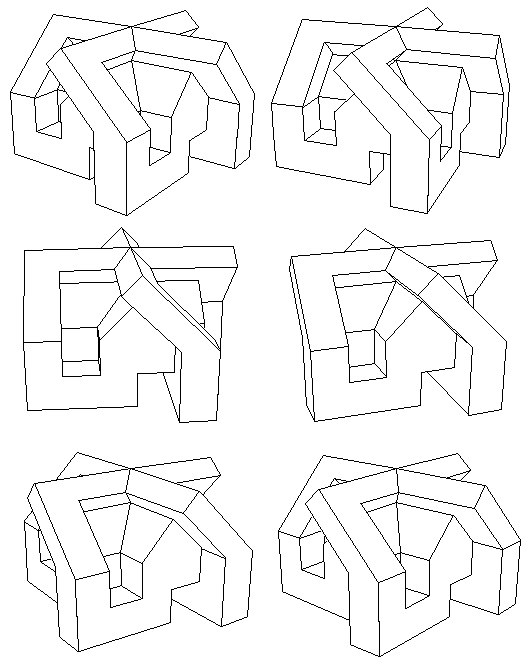
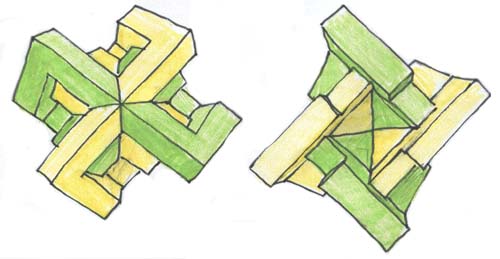
Subsequently I found a polyhedral representation of the central model with four ears. In fact such a model has neither "top" nor "bottom". For convenience of drawing and animation ( I obtained these images with a computer-aided design software that I had developed, without the beginning of the eighties ) the following animated gif shows this model by presenting the double point upwards. The quadruple point is also visible:
My polyhedral version of the model with four ears
How to build this model with the help of a cutout
The elements of the cutout (to print, then photocopy on four pages of strong paper, in two colors )
In the initial animation the object was "in mirror" with respect to the view above. Thus, "seen from above" it affected the shape of a swastika, the whole being able to evoke a sort of "house of culture for neo-Nazi party". I preferred to invert the object so as not to give far-right architects bad ideas. Click here to have all the explanations on how to mount this object yourself. To finish, a few views of this object.
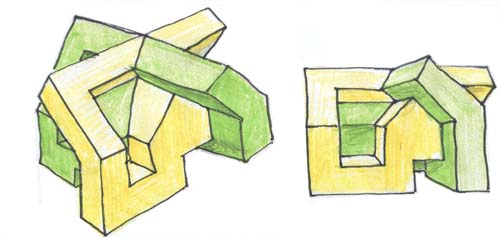
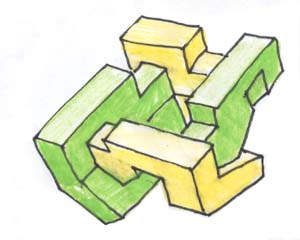
I will finish this evocation of the sphere eversion with an astonishing although perfectly authentic anecdote. At the time when these transformations were known only by a tiny number of initiates a patron offered a prize of a million dollars to the person who would manage to build sufficiently explicit models. At Berkeley, the mathematician Charles Pugh tackled this work and carried it out successfully. With the money he was able to acquire a house. These models, made with chicken wire and each measuring a good meter in diameter ( Pugh managed with an astonishing dexterity to cut and to reattach the meshes of his structures while allowing self-passage ) adorned for years the ceiling of the cafeteria of the mathematics department of Berkeley. Then, one night, they were stolen and they were never found again. It was never known who had done it. Commercially it would have been more difficult to sell than the Mona Lisa of the Louvre. Perhaps an amateur keeps them in a secret cellar rejoicing each evening in going down there saying to himself "I am the only one able to contemplate them".
There is another anecdote which refers this time to the Boy surface, of which I was the first to situate the meridian curves, by identifying them with a family of ellipses. This work was carried out in a totally empirical manner, from a metal model that I had made. One of the sons of the mathematician Jean-Marie Souriau, Jérôme, was then pursuing studies of physicist. By using his father's Apple II micro computer he managed to construct the first parametric representation of this object, of the type:
X = X ( alpha , mu )
Y = Y ( alpha , mu )
Z = Z ( alpha , mu )
I am incapable of including the Symbol font in Dreamweaver, which would allow me to include Greek letters in an htm page &&& If someone could explain to me how to proceed......
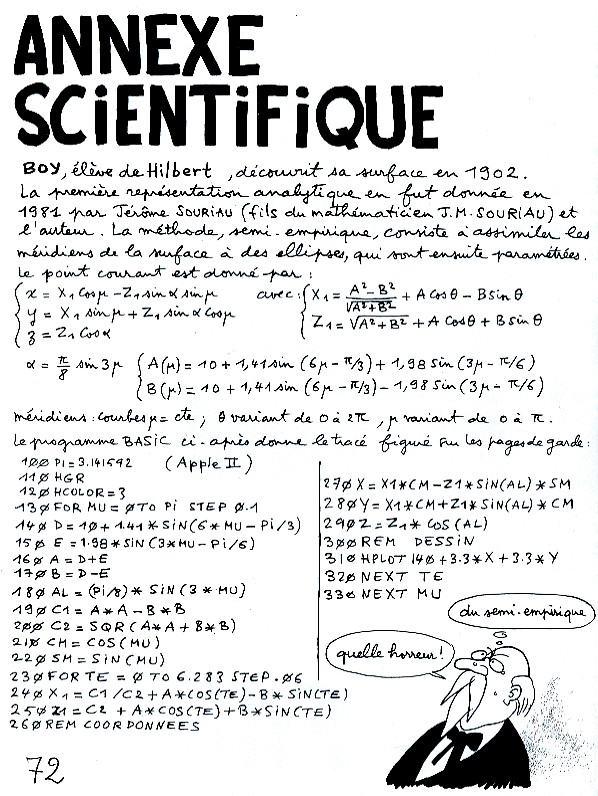
With ten lines of BASIC program we were able to make appear on the screen for the first time, in 1981, "wire-frame" images of the Boy surface. If you find, moreover, computer-generated images of this object on websites, they will always have been obtained from this work published at the Academy of Sciences (volume 293, session of October 5, 1981, series 1 pp. 269-272). As this work is signed J.P. Petit and J. Souriau, the (rare) readers think that J. Souriau is the well-known mathematician. In fact it is his son Jérôme, who never finished his physics degree and preferred to work as a computer scientist. It is easy to realize that the computer-generated images, many of which were created by the polytechnician Colonna at the École Polytechnique, are based on these equations that Jérôme and I had found. They would need to be improved and, for lack of this finishing work, the surface presents three rather unsightly creases near its pole. Here is the program allowing these "wire-frame" representations to be constructed.
The program, extracted from the Topologicon:
The last anecdote is more astonishing. About twenty years ago I was taking part in an underwater expedition south of the Bahamas, with the diver Jacques Mayol. The goal was to discover a "sunken pyramid" whose existence had been mentioned by Charles Berlitz in his famous book "The Bermuda Triangle", a planetary best seller. To be precise, this pyramid should have been located south of the Cay Sal Bank reef, halfway between Florida and Cuba, a region infested with high-sea sharks, rather dangerous. But in matters of research one must sometimes know how to take risks.
We found no more pyramid than a hole in the ground. We had been brought to the site by a very rich Italian financier, on a magnificent yacht, thirty meters long, equipped with very powerful engines. For lack of a pyramid, I began to talk to this billionaire about geometry, pointing out to him that by sponsoring the creation of mathematical surfaces he would find there a way to spend his money, even more uselessly than by inviting girls from the Lido de Paris to dinner. The man, whose name I will withhold, but whose real first name is Carlo, agreed to finance the production of a few models, which were "cleaned up" by a visual artist more skilled than I in handling copper wire. Eventually this financier wanted to have models made with gold wire, to put in his living room.
One day, suddenly, contact was broken. I ended up trying to reach him at his offices in Milan. But I learned that he had been imprisoned, having been identified as the number two in the "P2 Lodge" affair in Italy. He was able to get out of prison a few months later by buying his judges. To my great regret the Italian henceforth turned away from mathematics. Incidentally this allowed us to understand what had been the real purpose of the Bahamas expedition. In fact his magnificent yacht had served to transport dirty money, probably from drug trafficking, from Italy to Nassau, in the Bahamas. When we had made a stopover in that port the owner of the boat, our host, had disappeared into a hiding place he had fitted out in it, from which he emerged when the port police, having carried out their inspection and verified the identity of the persons present on board, had returned to shore. He then headed for his Nassau bank, carrying a briefcase with visibly very heavy contents, which must doubtless have contained a veritable fortune in cash. At that time, we were wondering how we were going to avoid being devoured by sharks at Cay Sal Bank; we had not at the moment attached any importance to this detail, which only came back to my memory later on.
On returning to France, however, I made the mistake of telling the head of the mathematics department of the Palais de la Découverte in Paris, located at the Grand Palais, that the model I proposed to exhibit to him, and which was indeed exhibited there for about twenty years, had been made with money from the drug trade. As a precaution, he refrained from affixing next to the object any mention whatsoever, not even the name of its inventor, or mine. It thus reigned at the center of the "pi room" for two decades, in a totally enigmatic manner.
There was once talk of a curse attached to the discovery of the tomb of Tutankhamun. I do not know whether there would exist a "Curse of the Boy Surface". The fact remains (and this is perfectly authentic) that its inventor vanished mysteriously and that this object, like the Maltese Falcon of the film with Humphrey Bogart, remained attached to stories linked to the Sicilian Mafia. I wonder whether its withdrawal and its placement in a basement of the building was not, on the part of the Museum's management, a simple precautionary measure.
The reserves of the Palais de la Découverte, not accessible to the public, are similar to an underground pharaonic tomb of the Egyptian Valley of the Kings. Perhaps an explorer, years after World War II has atomized Paris, will discover this object by chance, which will perhaps claim new victims, who knows?
Back to New Back to Guide Back to Home page
Number of visits to this page since December 8, 2004:
The Turning of the Sphere
December 8, 2004
page 4
The version by Bernard Morin
To download the pdf version of the 1979 article by B. Morin and J.P. Petit, published in Pour la Science
The turning of the sphere (2.8 MB)
We will start from a sphere that presents its gray side outward and its pink side inward. In b and c its poles are brought into contact. Then the sheets interpenetrate according to an "elbow catastrophe". A closed curve of self-intersection is created. At the bottom and on the right three half-cuts allow a better grasp of the configuration obtained. At this stage the sphere resembles a sort of circular "inflatable boat", with a "tube" and a "floor" with a double wall.
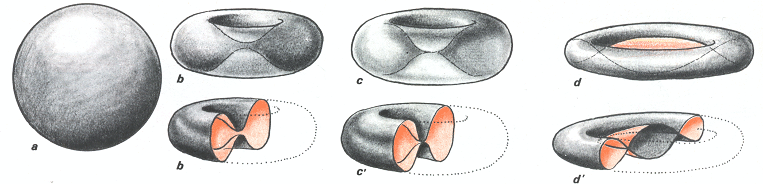
First step: an "elbow catastrophe". Creation of a closed curve of self-intersection
Second operation: new elbow catastrophe, creation of a second closed curve.
Second creation of a closed curve of self-intersection.
To do this the "inflatable boat" has folded, with a twisting motion, which made it possible to bring two diametrically opposite parts of the "tube" into contact. The following image is the result of two catastrophes leading to the creation of "mandarin segments".
After creation of two "mandarin segments"
On the left cuts have been made in the model. In the center the way in which the two cylinders whose section locally takes the shape of the Greek letter "gamma" have interpenetrated. It will be recalled that the catastrophe of creating "mandarin segments" operated by cutting a "log" with two planes forming a dihedral angle. Each of the cylindrical structures whose section is in "gamma" comprises both the rounded section and the dihedral angle. Look carefully at figure i. In j the self-intersection set has been drawn. The largest portion of closed curve comes from the first "elbow catastrophe" which had transformed the sphere into an "inflatable boat". After creation of the two mandarin segments a more complex set is obtained of which j' is a subset. In j" it can be seen that this structure can be compared to the assembly of two "mandarin segments" on two non-adjacent edges of a tetrahedron.
All this will one day be much simpler to grasp when I have been able to produce animations. This poses no technical problem for me a priori. It is a simple question of time. Rare are the people who can not only see in space, that is to say read this coding using lines, dotted lines, colors, shadows and reflections, but also chain together transformations in their heads by imagining the suggested movement. I hope one day to have the time to do all these things. Let us note in passing that one could use polyhedral models, as I did to show how one can transform a Crosscap into a Boy Surface. There lies the future. But these models have to be invented. Further on will be found the optimized polyhedral version of the central model of this transformation imagined by Bernard Morin (let us recall that he is blind!), with the way to build it oneself from a cutting pattern.
Why did I not push these things further? I would say: for lack of "outlets". There are no mathematics journals that agree to publish such work. We were able to do so in 1975-78 through a few notes in the Comptes Rendus de l'Académie des Sciences de Paris, which were doubtless not read by many people. But that was because the academician André Lichnérowicz was personally interested in this work. He is now deceased. As this work had been completely completed as early as 1975 it would have been desirable to produce an animated film from my drawings. Having worked in animation I was quite capable of coordinating such an undertaking. But it was impossible to find funding at the Cnrs and it was ultimately the American mathematician Nelson Max who, drawing inspiration from models built by his colleague Charles Pugh (of this same version of the turning of the sphere), and using a powerful computer, managed to be the first to produce a film. But it is neither the first nor the last time that French people, receiving no echo to their efforts, are thus overtaken by foreign colleagues who are better organized and better supported.
Let us move on to the third phase, the most difficult to grasp.
Preparation of two "trousers" catastrophes
In figurek the two ends of the "trouser legs" are clearly distinguishable, the detail of which appears in a foregroundk'. The white arrow indicates the passage "through the crotch". This transformation is really difficult to grasp. I have added drawingmin an attempt to be better understood. Inl I have represented with dotted lines the self-intersection curve, which appears as a whole inl'. A passage (the one taken by the white arrow) is going to close up. This closing movement goes together with the rise of a part of the intersection curve, in two places. These pieces of curve will each come into contact with one of the lines belonging to "tangerine segments". When the contact occurs, the surgery will take place. The difficulty comes from the fact that, having seen the four elementary catastrophes on the previous page, one must be able to transpose them from every angle, by twisting one's neck vertebrae if need be. Inn the critical moment is shown, when the surgery takes place (the "median situation" of the transformation) and when the mode of connection of the pieces of curve is going to be modified. It is known that this "trouser" catastrophe closes one passage and opens another. The initial passage is shown by the white arrow. But another one exists which would be perceived from the same angle by rotating the model 180° on itself about a vertical axis. These arrows form only one. Before these catastrophes take place it is still possible to circulate in this "folded rubber dinghy". Once these catastrophes have taken effect this passage will no longer be possible. On the other hand two other passages will have been created. But where, which parts of space are concerned? These passages will put the interior of the tangerine segments in communication with the outside. Inl', these tangerine segments, you can see them. Let us move on to the next step.
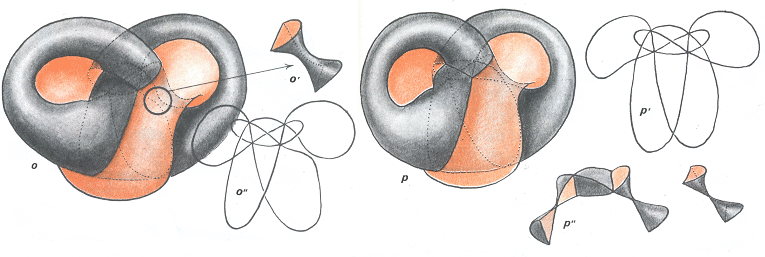
Closing of the passage. Towards a double critical situation
Ino the two "trouser" catastrophes are represented at two different stages. One of the passages is completely closed. We are in a critical situation, just before the arcs of the curve see their mode of connection change. On the right (detail in figureo') the passage is only in the process of closing. Thus the appearance of the self-intersection curveo" is different on the right and on the left. In figuresp,p' andp" the criticality (the "median" situation of the transformation) is reached on both sides. In the following plate the surgeries have taken effect. The tubes that could be seen beginning in figurep", putting the "tangerine segments" in communication with the outside, are now formed:
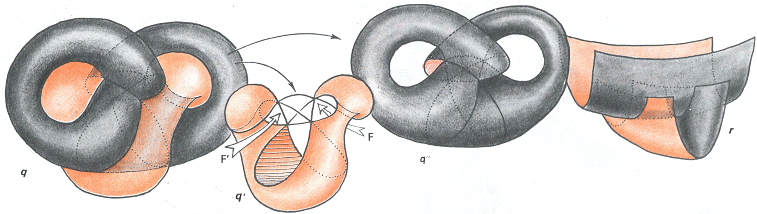
The two "trouser catastrophes" have taken effect. The passages (white arrows) are open.
Things will now continue by working on the lower part of the model, the detail of which is indicated inr. Let us look at this portion of surface carefully. We see two portions of parabolic cylinders that cross, being directed along two orthogonal directions. There is a passage at the lower part ofr that faces the reader. We are going to consider sliding these two cylinders one relative to the other. This would then have the effect of closing this passage and opening another running in the perpendicular direction ("from right to left"). We recognize here a new "trouser catastrophe". If this vertical sliding of these portions of parabolic cylinders takes place, we will again arrive at a critical situation, with a change in the mode of connection of the sheets. But in fact, simply for the sake of economy, we will stop the "process" at criticality, in the "median situation", when the passage directed towards the reader closes and the passage situated in the perpendicular direction is not yet open. Let us do this.
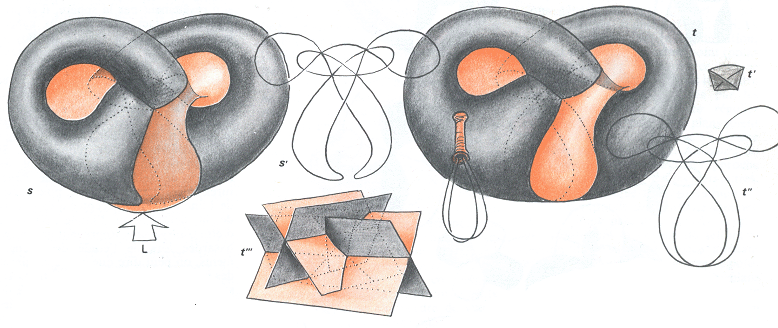
New trouser catastrophe, begun in L, stopped on the right, at criticality.
We will apply in L a "pressure" on the cylinder that presents its pink colour towards the outside and make it rise. Inc' the impact of this movement on the self-intersection set is seen: the arcs of the curve begin to come closer together. When criticality is reached this part of the set will resemble "an egg whisk", represented in the figure. Figures on the right,t,t',t": criticality is reached, that is to say "the median instant of the catastrophe". Int" the appearance of the self-intersection set, whose lower part is identical to that of our egg whisk. Figuret' represents the small tetrahedral volume. Int''' the crossing of the four sheets is shown.
*Go and swallow an aspirin. *
In this version of the sphere eversion all the transformations, the catastrophes, should be brought to their conclusion. But we are going to block the one we have just evoked in its median, "critical" configuration. We will then begin a catastrophe that we have not yet used: the one that inverts a tetrahedron. But here again we will stop at the "median" situation, when this tetrahedron is reduced to a point. Let us go!
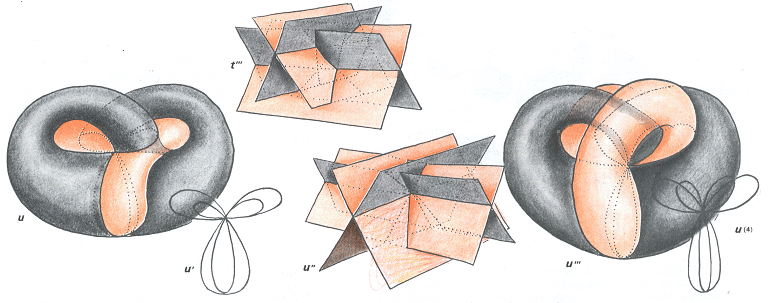
Last catastrophe, blocked at its median stage: when the tetrahedron is reduced to a quadruple point Q
Ent''' an evocation of the configuration of the four sheets whose self-intersection set contains a volume affecting the shape of a tetrahedron. Inu" this tetrahedron has been reduced to a point ( quadruple, since there are four sheets that cross ). On the left the "Morin model with four ears" is constituted. In the foreground the self-intersection set with, at the bottom, the "egg whisk" and at the top four loops evoking "rabbit ears". By deforming the surface a little, but without performing new catastrophes, we arrive on the right at the central Morin model with four ears. This one has a symmetry of order four. If we performed a rotation of 90° around its vertical axis of symmetry, we would obtain the same drawing, but with the colors exchanged. The gray becomes pink and vice-versa. So we can say that the work is finished. Indeed, if we wanted to draw the complete homotopy it would suffice, with the help of an animation, to rotate this central model by 90°. Then we could take up all the drawings that we have made, in reverse, with exchanged colors. In the end we would obtain an embedding of the sphere where the latter presents its pink color on the outside. But mathematics is a school of laziness, or of economy, depending on the view one takes of the thing. Insofar as the work has brought us to an object presenting this symmetry of order four we can stop there by saying that the operation has been carried out successfully.
In the following plate I have endeavored to describe this central open Morin model with the maximum of details. There exists a model with "closed ears", which I described in another note to the Academy, but I will spare you that.
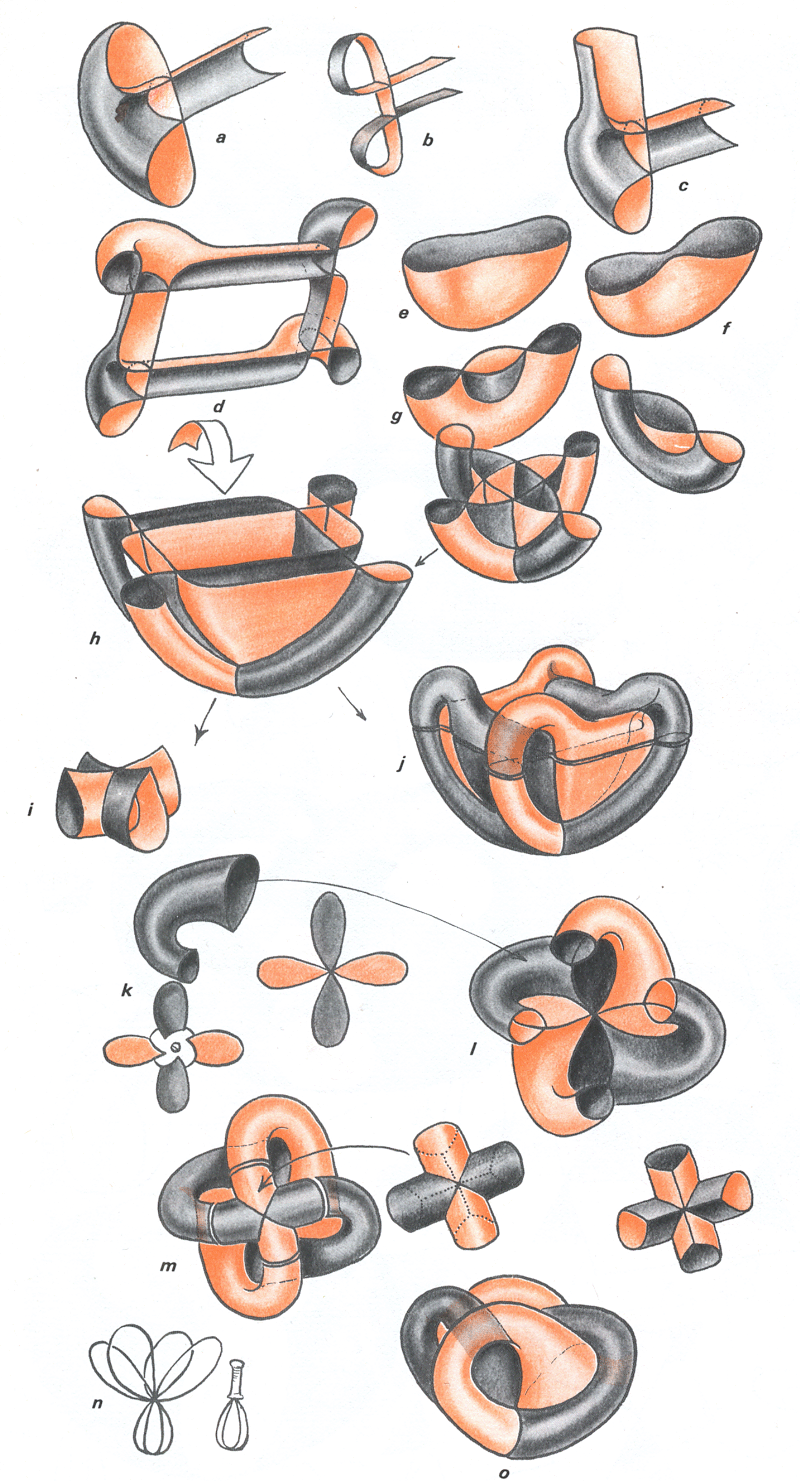
Detailed description of the central Morin model, with four ears
Subsequently I found a polyhedral representation of the central model with four ears. In fact such a model has neither "top" nor "bottom". For convenience of drawing and animation ( I obtained these images with a computer-aided design software that I had developed, at the beginning of the eighties ) the following animated gif shows this model while presenting the double point upwards. The quadruple point is also visible:
My polyhedral version of the model with four ears
How to build this model with the help of a cutout
In the initial animation the object was "in mirror" with respect to the view above. Thus, "seen from above" it affected the shape of a swastika, the whole being able to evoke a sort of "house of culture for the neo-Nazi party". I preferred to invert the object so as not to give far-right architects bad ideas. Click here to have all the explanations on how to assemble this object yourself. To finish, a few views of this object.
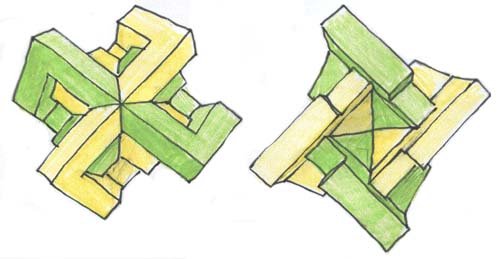
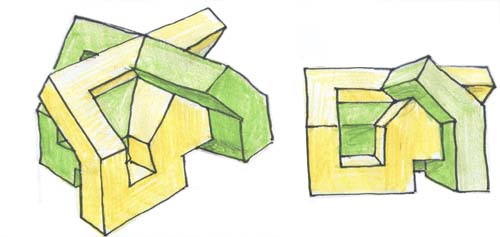
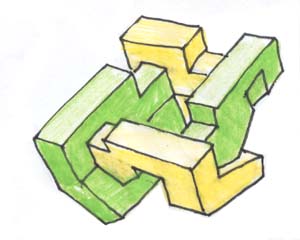
I will end this evocation of the sphere eversion with an astonishing although perfectly authentic anecdote. At the time when these transformations were known only to a tiny number of initiates a patron offered a prize of a million dollars to the person who would manage to build sufficiently explicit models. At Berkeley, the mathematician Charles Pugh set to work on this and carried it out successfully. With the money he was able to acquire a house. These models, made with chicken wire and each measuring a good meter in diameter ( Pugh managed with astonishing dexterity to cut and reattach the meshes of his structures while allowing self-passage ) adorned for years the ceiling of the cafeteria of the Berkeley mathematics department. Then, one night, they were stolen and they were never found again. It was never known who did it. Commercially it would have been more difficult to sell than the Mona Lisa of the Louvre. Perhaps an amateur keeps them in a secret cellar, rejoicing each evening in going down there and saying to himself "I am the only one able to contemplate them".
There is another anecdote which refers this time to the Boy surface, of which I was the first to situate the meridian curves, by identifying them with a family of ellipses. This work was carried out in a totally empirical manner, from a metal model that I had made. One of the sons of the mathematician Jean-Marie Souriau, Jérôme, was then pursuing studies as a physicist. Using his father's Apple II microcomputer he managed to construct the first parametric representation of this object, of the type:
X = X ( alpha , mu )
Y = Y ( alpha , mu )
Z = Z ( alpha , mu )
I am incapable of including the Symbol font in Dreamweaver, which would allow me to include Greek letters in an htm page &&& If someone could explain to me how to proceed......
With ten lines of BASIC program we were able to make appear on the screen for the first time, in 1981, "wire-frame" images of the Boy surface. If you find computer-generated images of this object on websites, by the way, they will always have been obtained from this work published at the Academy of Sciences (volume 293, session of October 5, 1981, series 1 pp. 269-272). As this work is signed J.P. Petit and J. Souriau, the (rare) readers think that J. Souriau is the well-known mathematician. In fact it is his son Jérôme, who never finished his physics degree and preferred to work as a computer scientist. It is easy to realize that the computer-generated images, many of which were created by the polytechnician Colonna at the Ecole Polytechnique, are based on these equations that Jérôme and I had found. They would need to be improved and, for lack of this finishing work, the surface has three rather unsightly creases near its pole. Here is the program allowing these "wire-frame" representations to be constructed.
The program, extracted from the Topologicon:
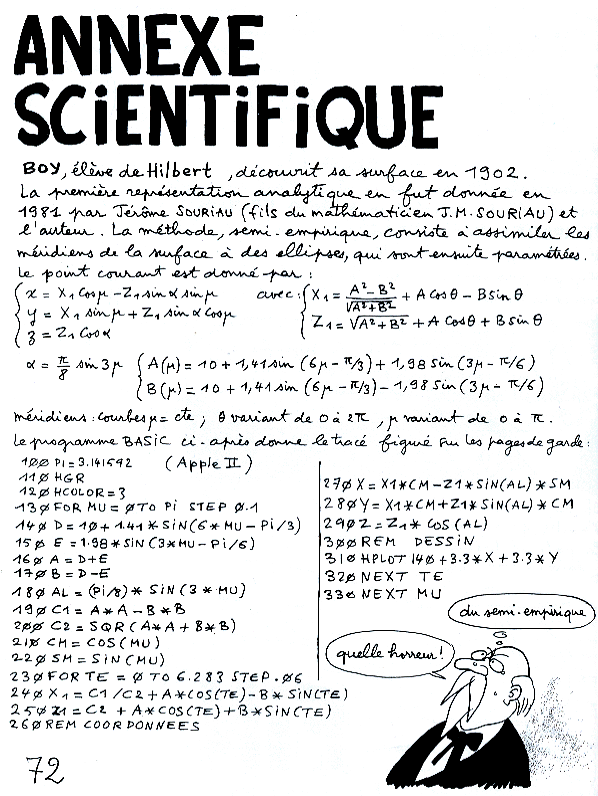
The last anecdote is more astonishing. Some twenty years ago I was taking part in an underwater expedition south of the Bahamas, with the diver Jacques Mayol. The goal was to discover a "sunken pyramid" whose existence had been mentioned by Charles Berlitz in his famous book "The Bermuda Triangle", a planetary best seller. To be precise, this pyramid should have been located south of the Cay Sal Bank reef, halfway between Florida and Cuba, a region infested with high-sea sharks, rather dangerous. But in matters of research one must sometimes know how to take risks.
We found no more pyramid than a hole in the ground. We had been brought to the site by a very rich Italian financier, on a magnificent yacht, thirty meters long, equipped with very powerful engines. For lack of a pyramid, I began to talk to this billionaire about geometry, pointing out to him that by sponsoring the creation of mathematical surfaces he would find there a way to spend his money, even more uselessly than by inviting girls from the Lido de Paris to dinner. The man, whose name I will keep to myself, but whose real first name is Carlo, agreed to finance the production of a few models, which were "cleaned up" by a visual artist more skilled than I in handling copper wire. Eventually this financier wanted to have models made with gold wire, to put in his living room.
One day, suddenly, contact was broken. I ended up trying to reach him at his offices in Milan. But I learned that he had been imprisoned, having been identified as the number two in the "P2 Lodge" affair in Italy. He was able to get out of prison a few months later by buying his judges. To my great regret the Italian henceforth turned away from mathematics. In passing this allowed us to understand what the real purpose of the Bahamas expedition had been. In fact his magnificent yacht had served to transport dirty money, probably from drug trafficking, from Italy to Nassau, in the Bahamas. When we had made a stopover in that port the owner of the boat, our host, had disappeared into a hiding place he had fitted out in it, from which he emerged when the port police, having carried out their inspection and checked the identity of the persons present on board, had returned to shore. He then headed for his Nassau bank, carrying an attaché case with visibly very heavy contents, which undoubtedly must have contained a veritable fortune in cash. At that time, we were wondering how we were going to avoid being devoured by the sharks at Cay Sal Bank; we had not at the time attached any importance to this detail, which only came back to my memory later.
On the return to France, however, I made the mistake of telling the head of the mathematics department of the Palais de la Découverte in Paris, located at the Grand Palais, that the model I proposed to him to exhibit, and which was indeed exhibited there for some twenty years, had been made with money from the drug trade. As a precaution, he refrained from affixing next to the object any mention whatsoever, not even the name of its inventor, or mine. It thus reigned at the center of the "pi room" for two decades, in a totally enigmatic manner.
There was once talk of a curse attached to the discovery of Tutankhamun's tomb. I do not know whether a "Curse of the Boy Surface" might exist. The fact remains (and this is perfectly authentic) that its inventor vanished mysteriously and that this object, like the Maltese Falcon of the film with Humphrey Bogart, remained tied to stories linked to the Sicilian Mafia. I wonder whether the removal of it and its placement in a basement of the building was not, on the part of the Museum's management, a simple precautionary measure.
The reserves of the Palais de la Découverte, not accessible to the public, are similar to an underground pharaonic tomb of the Egyptian Valley of the Kings. Perhaps an explorer, years after World War II has atomized Paris, will discover this object by chance, which will perhaps cause new victims, who knows?
Back to New Features Back to Guide Back to Home page
Number of visits to this page since December 8, 2004:
The Turning of the Torus
December 9, 2004
page 5
A spinoff of this work: the trivial turning inside out of the torus
If it had proved so complicated to turn a sphere inside out, on the other hand, starting from there, it is extremely easy to turn a torus inside out. One could even say that it is within the reach of a ten-year-old child. After all, this one is a sphere provided with a handle. One proceeds as was done to swap the two cuspidal points of a Crosscap, that is to say one turns the sphere inside out without asking questions. The handle then finds itself on the inside. Let us say that this "bridge" turns into an "underground passage". Now, all public works engineers know it, any underground passage, in a road network, can be transformed into a point by means of a regular homotopy.
When the sphere has been turned inside out it then suffices to slip a finger into this passage and to pull sharply. See the drawings below.
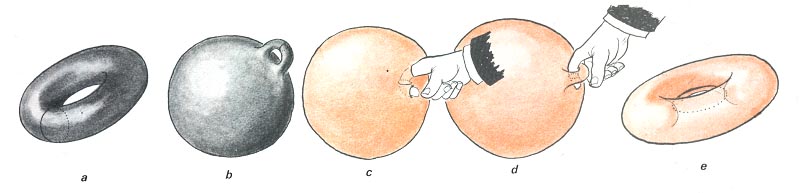
The trivial turning inside out of the torus
Although it is rather hard to see on this drawing, one of the generating circles of the torus has been shown ina, these constituting one of the two families of circles allowing it to be mapped without creating a mesh singularity ( see the Topologicon ). When the handle has been concentrated in a region of a handled spherebthe curve is still visible. When the handled sphere has been turned inside out, inc, and the operator slips his finger into the passage, this curve surrounds his finger. When he "extracts" the handle, ind, one sees ( final imagee, that of the torus turned inside out ) that this circle has become the .. gorge circle of the surface. Thus, when one starts from a torus mapped by means of a double network of meridian circles and parallel circles ( the gorge circle belonging to this second family ) one sees that the turning-inside-out operation swaps these two families. That has something magical about it and I admit that it surpasses my personal understanding. Everyone must learn to know their limits. I personally think that there are certain mental processes where the brain should be equipped with a fuse.
Back to New Features Back to Guide Back to the Home page
Number of visits to this page since 9 December 2004:
The Turning Inside Out of the Torus
9 December 2004
page 5
A spinoff of this work: the trivial turning inside out of the torus
If it had proved so complicated to turn a sphere inside out, on the other hand, starting from there, it is extremely easy to turn a torus inside out. One could even say that it is within the reach of a ten-year-old child. After all, this one is a sphere provided with a handle. One proceeds as was done to swap the two cuspidal points of a Crosscap, that is to say one turns the sphere inside out without asking questions. The handle then finds itself on the inside. Let us say that this "bridge" turns into an "underground passage". Now, all public works engineers know it, any underground passage, in a road network, can be transformed into a point by means of a regular homotopy.
When the sphere has been turned inside out it then suffices to slip a finger into this passage and to pull sharply. See the drawings below.
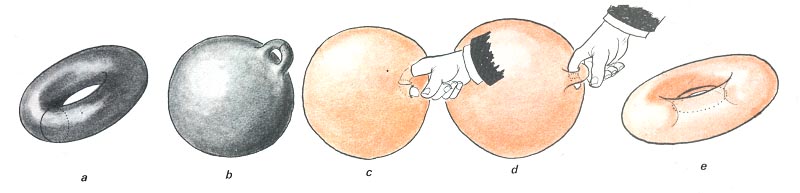
The trivial turning inside out of the torus
Although it is rather hard to see on this drawing, one of the generating circles of the torus has been shown ina, these constituting one of the two families of circles allowing it to be mapped without creating a mesh singularity ( see the Topologicon ). When the handle has been concentrated in a region of a handled spherebthe curve is still visible. When the handled sphere has been turned inside out, inc, and the operator slips his finger into the passage, this curve surrounds his finger. When he "extracts" the handle, ind, one sees ( final imagee, that of the torus turned inside out ) that this circle has become the .. gorge circle of the surface. Thus, when one starts from a torus mapped by means of a double network of meridian circles and parallel circles ( the gorge circle belonging to this second family ) one sees that the turning-inside-out operation swaps these two families. That has something magical about it and I admit that it surpasses my personal understanding. Everyone must learn to know their limits. I personally think that there are certain mental processes where the brain should be equipped with a fuse.
Back to New Features Back to Guide Back to the Home page
Number of visits to this page since 9 December 2004:
The Turning Inside Out of the Torus
9 December 2004
page 6
The non-trivial turning inside out of the torus
J.P.Petit :
Comptes Rendus Académie des Sciences. tome 293 , séance du 5octobre 1981, série 1 pp. 269-272
I will content myself with presenting the rest of the drawings, without commenting on them.
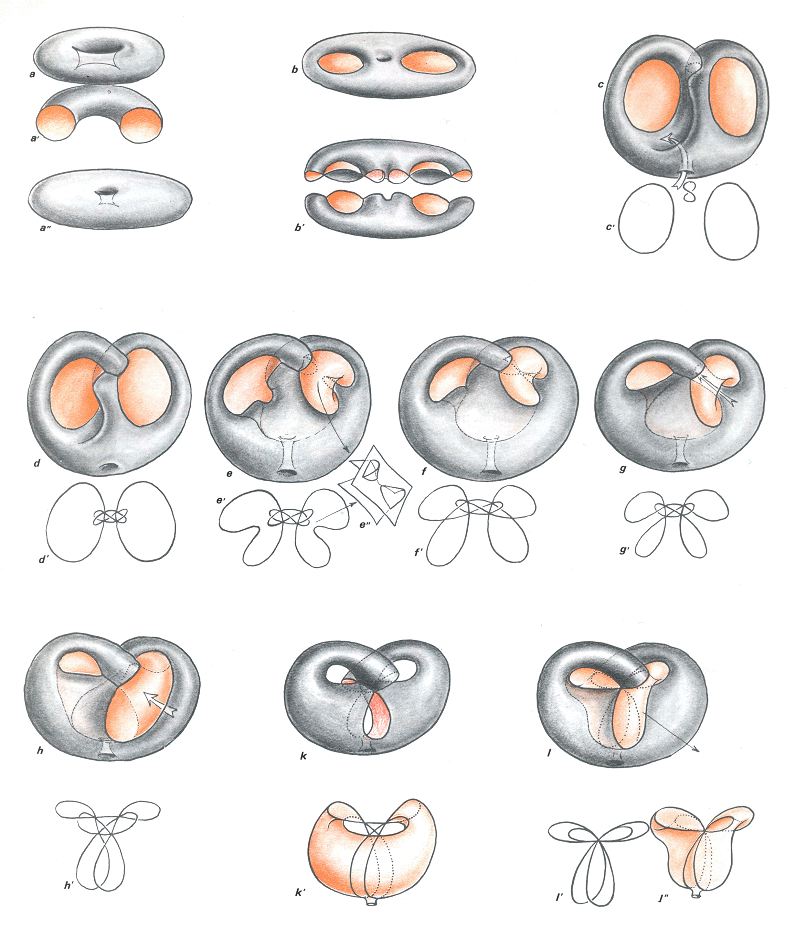
Non-trivial turning inside out of the torus. First part of the transformation
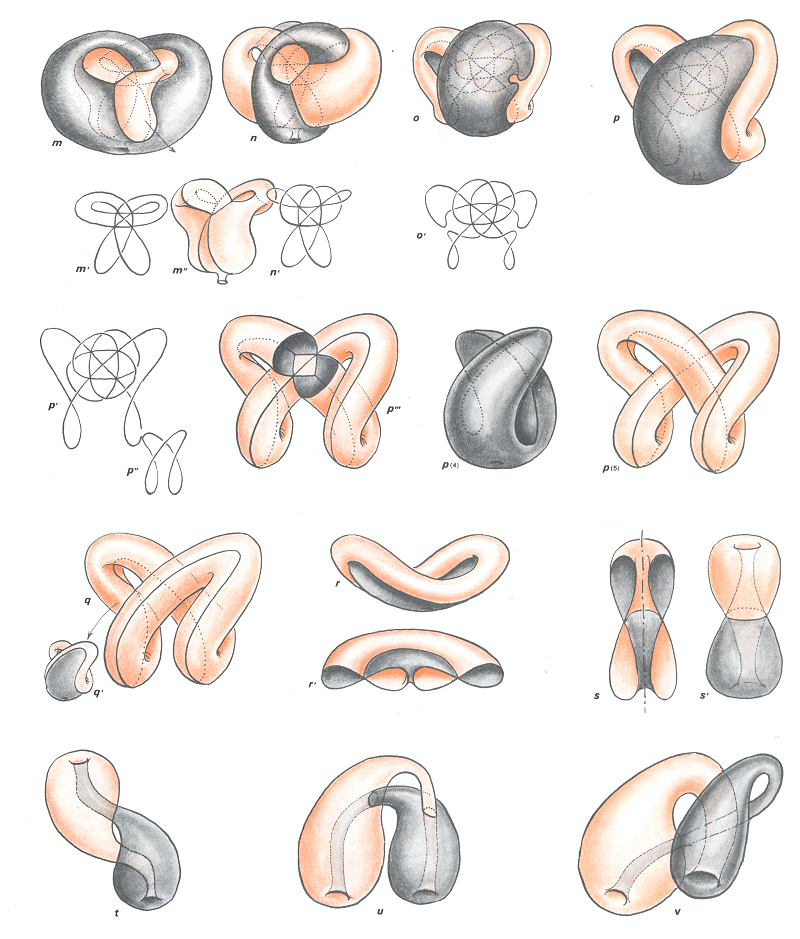
Non-trivial turning inside out of the torus. Second part of the transformation
When one arrives at figurevone sees that it is then easy to make the grey structure and the pink structure coincide in order to transform this object into a two-sheeted covering of the Klein bottle.
The inversion then takes place by exchanging the facing layers. Below, the same drawing with color coding.
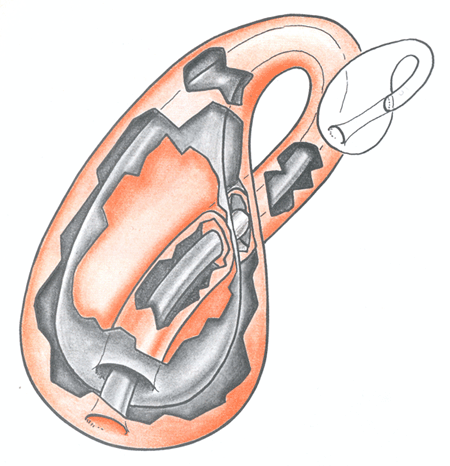
Two-sheeted covering of the Klein bottle, with color coding
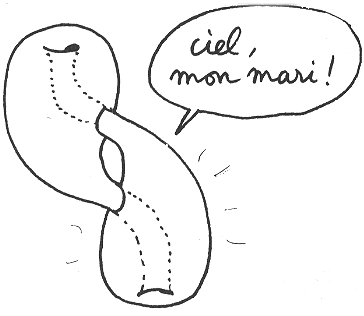
( this drawing not being part of my annual report to the Cnrs. It can be found in the Topologicon )
The different families of tori.
What Stephen Smale had demonstrated in 1957 was that there was only a single family of immersions of the sphere and that all of these could be connected to one another by a homotopy. These formed a group whose neutral element consisted in leaving the object as it was. The question was raised whether the same could be true for the torus. The mathematicians Ioan James and Emery Thomas showed that the immersions of the torus were divided into four continents between which it was impossible to pass by means of a regular homotopy.
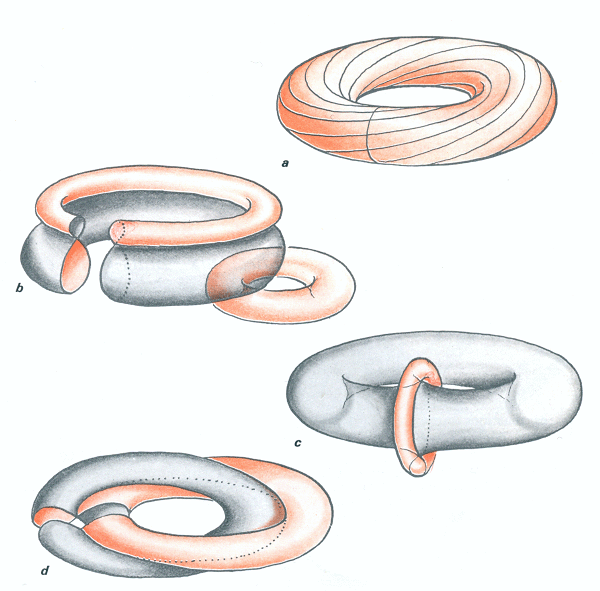
The four families of tori
The "standard torus", drawn at the center of the sheet, belongs to the same family as the object shown inb. This is what I incidentally showed in the version of the torus inversion that I invented in 1980. The family mentioned in a represents a torus that has undergone a 360° twist. It resembles the standard torus but the two are defined from their mapping system, using two families of curves. In the standard torus two sets of circles assimilated to meridians and parallels are used. On torus a one should complete the family of circles glued onto it by a second family, twisting in the opposite direction. What can then be shown is that it is impossible, by means of a regular homotopy, to bring the mesh of this torus a into coincidence with the mesh of the standard torus ( meridian circles plus parallel circles ). It is in this sense that they are different objects. All these objects can obviously be configured as a two-sheeted covering of the Klein bottle.
The power of the geometer's tools is to be able to predict what is possible and what is not. Transforming the standard torus into the torus of figureb: yes. Going fromctod: no.
It avoids wasting one's time foolishly and above all it encourages the search for things that are in no way obvious, such as turning a sphere inside out. The same is true in all sciences. It happens that people pass by fruitful approaches, for years or even centuries, simply because they believed them impossible to carry out. I devoted a few years of my life to building a theory of the suppression of shock waves around an object moving at supersonic speed in a gas, by means of a field of Laplace forces, of " MHD ". A student even did his thesis on this subject under my supervision and we published this work in various peer-reviewed journals and scientific conferences. It is a theme that is only just beginning to surface, thirty years later. It is surmised that the Americans would have hypersonic aircraft capable of traveling at Mach 10 without creating a shock wave (and in particular without undergoing the tremendous thermal stresses linked to the recompression of the air behind these "bangs". This is the famous myth of the Aurora, an aircraft cruising at the altitude where the northern lights occur, between 80 and 150 km of altitude. Aurora is also the prefiguration of future space launchers which, relying on the air, will be much more economical than the Cnes rockets. It was impossible, in France, to initiate such research (I had these ideas in 1975), because people, particularly at the Cnrs, found them totally unreasonable. The result represents thirty years of delay with respect to the United States, in my opinion totally impossible to make up.
The tobacco pouch
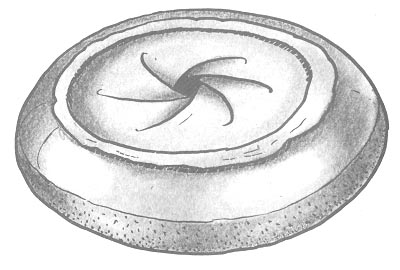
To be complete one must mention the versions of the sphere inversion whose central object is a tobacco pouch. It was an object that was common when I was young, but that one must hardly encounter any more today. The first who drew these sequences is Georges Francis. For a few years I have been working on a polyhedral version of these versions, which has already yielded a rather pretty central model. But, to show it to you, I will have to manage to lay my hands on it again. Fairly quickly, I hope, because it is one of the most fascinating objects I have ever created.
Previous page Next page
Back to New Features Back to Guide Back to the Home page
Number of visits to this page since December 8, 2004:
The Inversion of the Torus
December 9, 2004
page 6
The non-trivial inversion of the torus
J.P.Petit :
Comptes Rendus Académie des Sciences. volume 293 , session of October 5, 1981, series 1 pp. 269-272
I will content myself with presenting the rest of the drawings, without commenting on them.
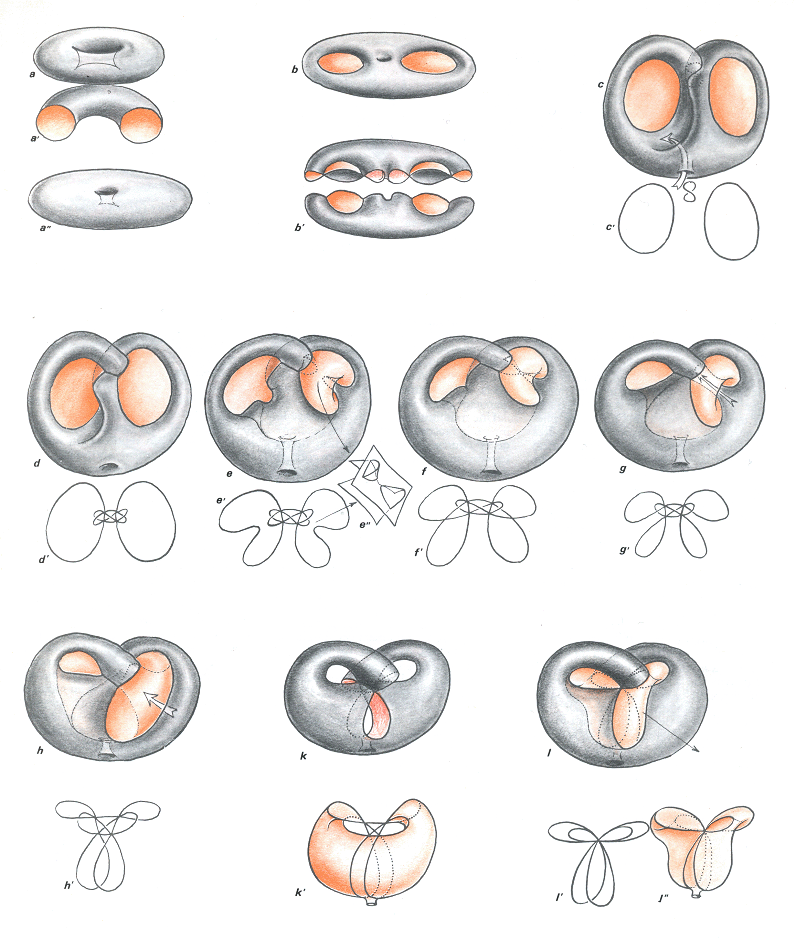
Non-trivial inversion of the torus. First part of the transformation
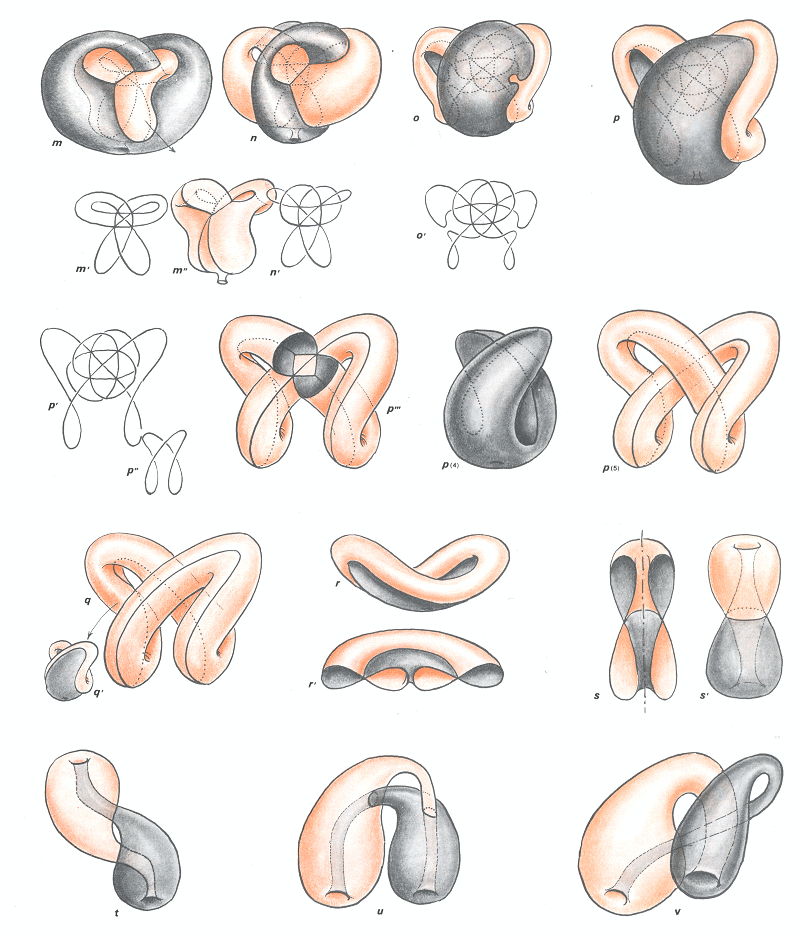
Non-trivial inversion of the torus. Second part of the transformation
When one reaches figurevone sees that it is then easy to make the gray structure and the pink structure coincide in order to transform this object into a two-sheeted covering of the Klein bottle.
The inversion then takes place by exchanging the facing layers. Below, the same drawing with color coding.
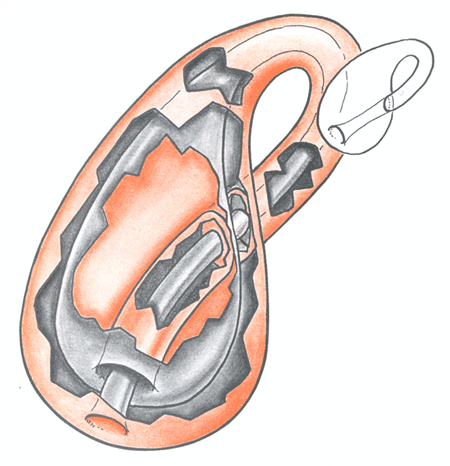
Two-sheeted covering of the Klein bottle, with color coding
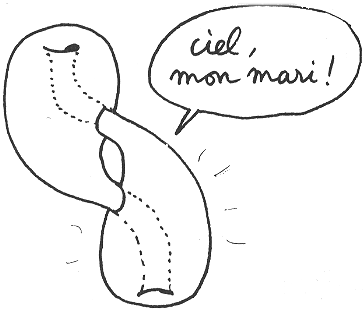
( this drawing not being part of my annual report to the Cnrs. It can be found in the Topologicon )
The different families of tori.
What Stephen Smale had demonstrated in 1957 was that there was only one family of immersions of the sphere and that all of these could be connected to one another by a homotopy. These formed a group whose neutral element consisted in leaving the object as it was. The question was asked whether the same could be true for the torus. The mathematicians Ioan James and Emery Thomas showed that the immersions of the torus were divided into four continents between which it was impossible to pass by means of a regular homotopy.
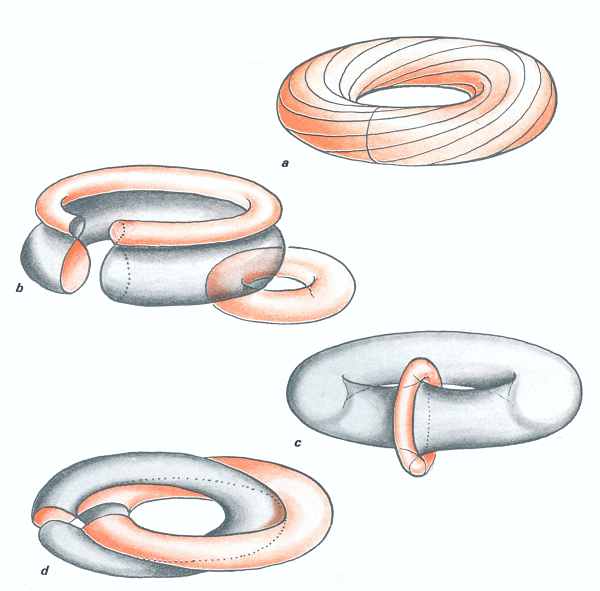
The four families of tori
The "standard torus", drawn at the center of the sheet, belongs to the same family as the object shown inb. That is what I incidentally showed in the version of the turning of the torus that I invented in 1980. The family evoked in a represents a torus that has undergone a twist of 360°. It resembles the standard torus but the two are defined from their mapping system, with the help of two families of curves. In the standard torus two sets of circles assimilated to meridians and to parallels are used. On the torus a one should complete the family of circles glued onto it by a second family, twisting in the opposite direction. What can then be shown is that it is impossible, by means of a regular homotopy, to bring the mesh of this torus a into coincidence with the mesh of the standard torus ( meridian circles plus parallel circles ). It is in this sense that they are different objects. All these objects can obviously be configured as a two-sheeted covering of the Klein bottle.
The power of the geometer's tools is to be able to predict what is possible and what is not. Transforming the standard torus into the torus of figureb: yes. Going fromctod: no.
It avoids wasting one's time stupidly and above all it encourages the search for things that are in no way obvious, such as turning a sphere inside out. The same is true in all sciences. It happens that people pass by fruitful approaches, for years or even centuries, simply because they believed them impossible to carry out. I devoted a few years of my life to building a theory of the suppression of shock waves around an object moving at supersonic speed in a gas, with the help of a field of Laplace forces, of " MHD ". A student even did his thesis on this subject under my supervision and we published this work in various peer-reviewed journals and scientific conferences. It is a theme that is only just beginning to surface, thirty years later. It is surmised that the Americans might have hypersonic aircraft capable of traveling at Mach 10 without creating a shock wave (and in particular without undergoing the tremendous thermal stresses linked to the recompression of the air behind these "bangs". It is the famous myth of the Aurora, an aircraft cruising at the altitude where the northern lights occur, between 80 and 150 km of altitude. Aurora is also the prefiguration of future space launchers which, relying on the air, will be much more economical than the rockets of the Cnes. It was impossible, in France, to initiate such research (I had these ideas in 1975), because people, in particular at the Cnrs, found them totally unreasonable. The result represents thirty years of delay with respect to the United States, in my opinion totally impossible to make up.
The tobacco pouch
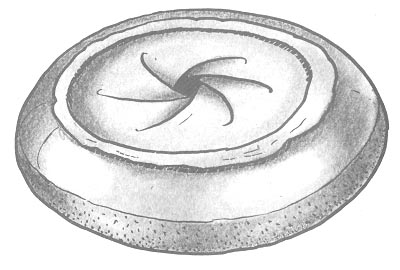
To be complete one must mention the versions of the turning of the sphere having a tobacco pouch as central object. It was an object that was common when I was young, but that one should hardly encounter anymore today. The first who drew these sequences is Georges Francis. For a few years I have been working on a polyhedral version of these versions, which has already yielded a rather pretty central model. But, to show it to you, I will have to manage to lay my hands on it again. Fairly quickly, I hope, because it is one of the most fascinating objects that I have ever created.
Previous page Next page
Back to New Back to Guide Back to the Home page
Number of visits to this page since December 8, 2004:
Original pages: retournement_sphere0.htm, retournement_sphere0.htm, retournement_sphere1.htm, retournement_sphere1.htm, retournement_sphere2.htm, retournement_sphere2.htm, retournement_sphere3.htm, retournement_sphere3.htm, retournement_sphere4.htm, retournement_sphere4.htm, retournement_sphere5.htm, retournement_sphere5.htm, retournement_sphere6.htm, retournement_sphere6.htm