Knowledge Without Borders
The statutes are published in the Official Gazette
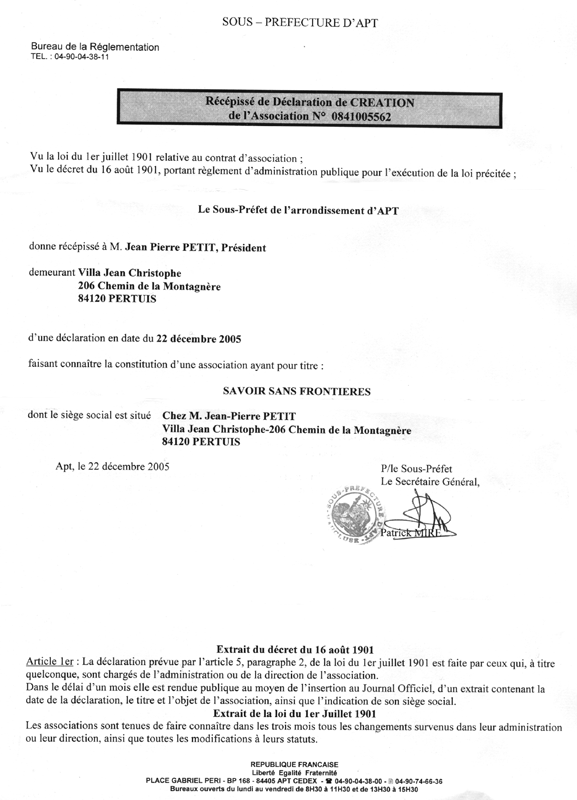
Publication of the statutes in the Official Gazette is expected around February 15th (administrative deadlines). Then a bank account will be opened, the 9,250 euros from received checks will be deposited, and payments to translators will begin.
As of December 15, 2005, there were already 174 checks issued to “Knowledge Without Borders” totaling 9,250 euros, which allows for payment of 61 translations.**
I hope that the remaining 112 donors will send their checks payable to the association.
List of existing and ongoing translations
I’ve increased the storage capacity of my website to 2 gigabytes so that translators can access the materials they need—namely copies of a thousand pages from my albums in TIFF-Bitmap format. Previously, I sent these materials via CD by mail. Six albums were missing; this gap was filled thanks to the help of Martine and Mathias Benlolo. These pages contain text that has been erased; translators—already hired or prospective ones—can then enter the translated text in the “target language”.
To access these files containing only images, translators simply need to go to:
http://www.jp-petit.com/without_text
Various folders containing sets of pages then appear. These pages can be downloaded by right-clicking and choosing “Save target as”. Some translators thought “the pages were blank.” But if they first save them to their hard drive and then open them with Photoshop, it works fine.
Caution: Keep pages in Bitmap-TIF format; don’t convert them to grayscale, as this increases file size. Don’t alter page dimensions either.
Have your spelling checked. Anyone can do that; corrections waste time.
The 275 extra checks have been returned to donors, with instructions to reissue them to:
Knowledge Without Borders
Address: Villa Jean-Christophe, Chemin de la Montagnère, 84120, Pertuis
Or: Jean-Pierre Petit, Villa Jean-Christophe, Chemin de la Montagnère, 84120 Pertuis
But please don’t write the checks as some have done—payable to “Knowledge Without Borders – Jean-Pierre Petit.”
As of January 24, 2006, 174 checks had arrived, totaling 9,150 euros, enough for 61 translations.
My friend Gilles d’Agostini and I finalized the statutes and submitted them to the subprefecture of Apt on December 11, 2005. Here they are. They’ll remain permanently accessible on the website without any time limits. It’s planned that both members and non-members can view the association’s accounts online in real time. Less than half of the 275 returned checks have been received so far. We hope donors will make the necessary changes. After submitting the statutes, we await receipt of the acknowledgment; publication in the Official Gazette is expected mid-February, considering administrative timelines for opening a bank account. Then we can start paying translators what we owe them and handle new translations. As of January 16, 2006, the association can pay for translating 61 albums. Thus, this association will function as a translation factory aiming at as many languages as possible. I’ve already started work on new “Scientific Comic Strips”; currently, I seem to be the only one capable of handling this genre.
This effort could be compared to “cultural, scientific, and technical humanitarianism,” except this organization prevents any misuse of funds, whether at the outset or later. People might, for instance, take medicines and resell them. But free knowledge cannot be monetized. That’s what makes this approach unique. We intend to limit membership to those with an email address. Hence, no stamp or shipping fees, no operational costs apart from site hosting (~450 euros/year). We’ll serve as volunteer webmasters. Everything will be managed via email. Donors will know their money will be entirely used for our stated purposes. The site ensures full traceability of funds. We’ll also accept memberships with zero fee from financially disadvantaged potential translators. This gesture will be seen as moral support for our mission.
Regarding translations, we’ve received many applications; we give preference to those planning to translate into their native language. Some applicants didn’t meet this criterion; even when their texts were correct in spelling, grammar, syntax, and semantics, “they wouldn’t have expressed themselves that way if they came from that country.” We pay 150 euros per translated album (175 USD at 2005 exchange rates), all-inclusive, and cover banking transfer fees.
But translations must be accurate and reliable, linguistically and scientifically. Some translators are scientists themselves and thus independent in this regard. For example, Andrea Sambusetti, Italian translator of Topologicon, couldn’t make errors since he’s a specialist in that field.
In other cases, translators collaborate with scientists, researchers, or university professors who speak the target language; these experts provide specialized vocabulary and verify that translations lack misunderstandings. For instance, Qin Jié, Chinese translator of “Around the World in Eighty Minutes” about space exploration, asked a friend—an engineer living in Nanjing working in that field—to check her translation. Another friend’s son, French, engineer, and huge fan of “Lanturlu” since childhood, lives in Japan and reads/writes Japanese; thanks to his scientific and technical expertise, he can verify the “final product.” His Japanese wife also helps him in this task. This shows how translation can involve teamwork in various forms.
Some prospective translators reach out to universities to find assistance in refining their translations, acquiring appropriate terminology, and eventually obtaining full review leading to approval. My friend John Murphy, living in France and quite comfortable translating my albums into English (he’s finishing Topologicon), had to ask contacts in England for equivalents in Shakespearean English for names of human muscles and bones when translating Spondylospcope.
Generally, translators should fully understand the subject matter of the works they intend to translate.
It’s also essential that translators don’t simultaneously work on the same works. All this raises issues of planning and management. To handle this, I’ve enlisted several colleagues and friends. For each language, you should contact them, sending me a copy of your message. If you’re a prospective translator, you can demonstrate your skills by sending a few translated pages to this manager-controller. When contacting them, specify your capabilities in specific fields. Then they can select an album for you to translate using TIF pages from the site. You’ll send your work to them via email. In France, sending five pages at a time as attachments works perfectly. If they deem your work acceptable, they’ll forward it to me. I’ll compile the pages into a PDF file, post it online, and pay the translator. Below are managers-controllers for various languages:
- English: John Murphy:

- Russian: Vladimir Golubev:

-
German: Frédéric (he preferred not to share his email; I’ll act as intermediary). Three new albums have also been secured.
-
Italian: My friend Elio Flesia agreed, as did André Sambusetti, mathematician at Rome University.

-
Spanish: I trust my two current translators; otherwise, I’d welcome any Spanish-speaking scientists willing to serve as volunteer verifiers for further translations.
-
Japanese: Ideally, a team of translators living in Japan should handle verification and validation.
-
Arabic: There are prospective translators; some may produce decent results in certain areas, but a “broad-spectrum” Arabic-speaking scientist would be very useful.
-
Indian: We seek an Indian scientist able to validate translations into Hindi as well as prospective translators.
-
Chinese: Same request; though Qin Jié managed to get her work verified independently.
-
Laotian: First translation delivered.
-
Romanian: Contact Delia Ionescu, mathematician at Bucharest University.

-
Polish: Same need, both for translators and verifiers.
-
Dutch, Swedish, Norwegian, Danish: Same requirement.
-
Turkish: We’ve received a Turkish translation by a fluid mechanics professor from Ankara.
-
Persian: We have a translator living in Tehran; contact with an Iranian scientist would be valuable. We’re still seeking the Iranian version of “Everything Is Relative”.
-
Portuguese: A Portuguese friend found three new albums, completing the series of five originally published in his country twenty years ago. Three translators are now working on them.
-
Hebrew: We seek Hebrew-speaking scientists as well as prospective translators.
Generally, I’ll connect translators with one another.
In every relevant country, it’s desirable to form groups around the theme “Knowledge Without Borders”, creating websites serving as platforms to make translated works available to locals. A biologist from Montélimar, of African origin, proposed translating into Rwanda’s language. I approved it, noting this would be more worthwhile once I publish albums aimed at broader audiences. She was surprised, however, when I told her this implied launching a website in that language too.
Such encouragement to create “echo websites” must, however, be preceded by prior authorization requests and content checks, given the unfortunate experience involving Jean-Sylvain Delroux. Delroux’s aim wasn’t to aid our association but to fraudulently present his own site:
http://www.rael.free.fr/ssf/index.htm
as the official site of Knowledge Without Borders. Note its undesirable proximity to the Raelian sect.
Once statutes are published and a bank account created, we’ll contract a paid hosting provider. The genuine Francophone site of the association will then be launched, denouncing fake sites like Delroux’s (which serve profit motives).
Knowledge Without Borders aims to be:
-
Non-political
-
Free of any ideology
-
Free of any religious or sectarian discourse
Works distributed via this channel, whose translations are funded by the association, must adhere to these principles. Satellite “Knowledge Without Borders” sites must avoid any propaganda or religious messaging, forming zones of ethnic neutrality. Works I wrote falling under this category will carry the “Knowledge Without Borders” label. My transcriptions of the Old and New Testaments (Bible), however, won’t qualify since they originate from religious texts (though personally I’m not a believer in the conventional sense). That won’t stop me from posting these works in French and other languages on my own site while seeking alternative funding for their translation.
When all this is settled—hopefully soon—I’ll finally be able to devote myself to writing new books and articles.
Access to comics translated into 15 languages, with ongoing projects
January 4, 2006
Brief note.
One of my readers informs me that the Raelians kindly posted a “Knowledge Without Borders” page on their site. To access it, go to:
http://www.rael.free.fr/ssf/index.htm
On the page it says:
| Admiring the brilliant idea of “Knowledge Without Borders”, we humbly decided to help, within our means, disseminate Jean-Pierre PETIT’s comic strips! |
|---|
| Admiring the brilliant idea of “Knowledge Without Borders”, we humbly decided to help, within our means, disseminate Jean-Pierre PETIT’s comic strips! |
Unfortunately, this runs contrary to our statutes, which state the association has no ties to any religion, sect, or political movement. No one can forbid communities from recommending their members visit the site currently hosting Knowledge Without Borders. Later, the Association will have its own site where featured works align with our ethics. My adaptations of the Old and New Testaments, referencing religious texts, won’t be included, for instance.
We’ve requested the Raelian webmaster http://www.rael.free.fr (archive dated June 5, 2012) to remove all elements borrowed from http://www.jp-petit.com. We hope this request is honored.
| To the webmaster of http://www.rael.free.fr Email: Sir, Our association’s statutes are quite clear on this point. We reject any amalgamation with any sect. Therefore, I ask you to immediately remove from the Raelian sect’s site any reference to our association—all images, filenames, translators’ emails—and delete any links pointing to files hosted on my site http://www.jp-petit.com and sites dedicated to my works “Les Aventures d’Anselme Lanturlu” within twenty-four hours; otherwise legal action will be taken against you. I also request that these same elements be removed from http://www.ssf.int.ms where they were placed without my permission. Jean-Pierre Petit, President of Knowledge Without Borders Association |
|---|
| To the webmaster of http://www.rael.free.fr Email: Sir, Our association’s statutes are quite clear on this point. We reject any amalgamation with any sect. Therefore, I ask you to immediately remove from the Raelian sect’s site any reference to our association—all images, filenames, translators’ emails—and delete any links pointing to files hosted on my site http://www.jp-petit.com and sites dedicated to my works “Les Aventures d’Anselme Lanturlu” within twenty-four hours; otherwise legal action will be taken against you. I also request that these same elements be removed from http://www.ssf.int.ms where they were placed without my permission. Jean-Pierre Petit, President of Knowledge Without Borders Association |
About twenty years ago, I faced Claude Vorillhon, aka “Raël”, on Dechavanne’s show “Ciel mon Mardi!”
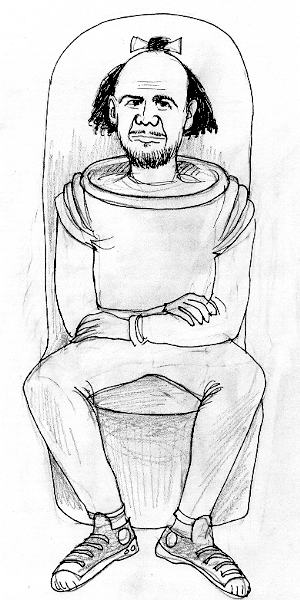
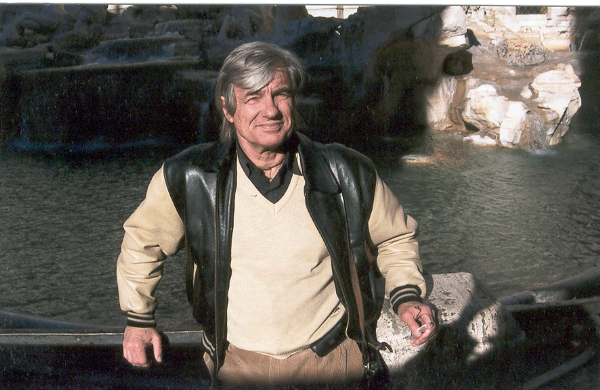
Raël, the backup guru, during “Ciel mon Mardi!”
(A reader tells me this dates from November 7, 1989; it’d be great to locate this clip in TV archives.)
This led to the following dialogue:
Dechavanne: Jean-Pierre Petit, are you familiar with works published by Raël? What do you think of them?
J.P. Petit: I’ve been sent his various books, including “Geniocracy”, wherein he advocates that geniuses should govern the planet and recounts his initial efforts to find geniuses in his environment.
Dechavanne: And?
J.P. Petit: Well, Raël writes that he and his group found an electronics technician. Not very convincing, but he concluded this was a small start.
Dechavanne: Hmm...
J.P. Petit: However, I admire his handsome suit, supposedly designed by a famous couturier. We have nothing like that at CNRS—only white lab coats. That said, if I may add a small remark: with such attire, I wouldn’t wear sneakers. White leather boots would be preferable.
The camera then zoomed in on Vorillhon’s shoes; he squirmed in his seat, completely flustered. Afterwards, he couldn’t utter a word. I believe he’d have given anything to avoid wearing those dreadful sneakers.

Monday I’ll rush to the bank to open the account. Then we’ll pay for first translations, hire a host, and launch the association’s official site.
Back to News Back to Guide Back to Home Page
Number of views of this page since November 30, 2005: