Cosmology of twin universes (p 10)
- Red shift and the Robertson-Walker metric with a variable speed of light.
...
The derivation of the distance from the red shift z, with "variable constants", has already been presented. See reference [13], sections 3 to 7. The index 1 refers to the emitter and the index 2 to the receiver. For example, c₂ is the current value of the speed of light, as measured in the observatory. It is assumed that the Rydberg constant (ionization energy of hydrogen) follows (94)
Then we obtain:
(95)

The value
g
= 1 is chosen in order to obtain the classical value.
Expanding the function 1/R(t) into a series with respect to
(96)
we obtain:
(97)
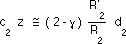
This is nothing but Hubble's red shift law, which still holds in this variable speed of light framework. From measurements of d₂, c₂ and z, we can derive the so-called Hubble constant, i.e. the age of the Universe.
(98)
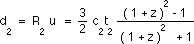
identical to the standard value. Then the distance to the object d₂ is evaluated:
(99)
...
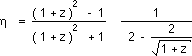
When z tends to infinity, we obtain the cosmological horizon 3/2 c₂ t₂, which is twice smaller than the standard value 3 c₂ t₂. If we compare the current model to the EdS model, we get, for the distances, the ratio:
(100)
...
They are similar for small z values, as shown in the following figure. For small z values, the distances, as derived from the current model, are slightly larger.
h
is close to unity for z = 1.5. Then
h
tends to 0.5 when z tends to infinity. For z < 2.5, the difference between the two distance evaluations is less than 5%.
Figure 20: The distances for the current model and for the Einstein-de Sitter model, and the ratio
h
of these distances, as a function of the red shift.
...
In reference [14], section 3, the evolution of the angular size of a distant object as a function of z was calculated. For the EdS model and constant size objects, the law is:
(101)
...
This function of z has a minimum for z = 1.25, and then f tends to increase linearly with z. Figure 21 explains why it leads to an overestimation of f for large z values.
Figure 21: Why the classical model overestimates the angular size of objects with large red shift. The measurement, at the time of reception, corresponds to a "fossil" angular size, when the object was closer.
In the current model, the situation is fundamentally different, as objects are assumed to expand with the Universe. See figure 22.
Figure 22: Current model: light propagates along geodesics. The angular size remains unchanged.
The corresponding formula is:
(102)
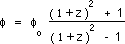
When z tends to infinity,
f
tends to a constant value.
Note that in our model:
...
In reference [14], this was used to compare the current model to the EdS model, applying to radio-QSO data (Barthel and Miley, 1988 [35]), giving a slight advantage to the first. Obviously, a single test, involving many assumptions about the nature of the observed objects, could not validate the model. See the discussion in reference [14].