Jacques Benveniste
May 10, 2010. A reader sent me an excerpt from a program in which Nobel laureate Luc Montagnier praises my late friend Jacques Benveniste.
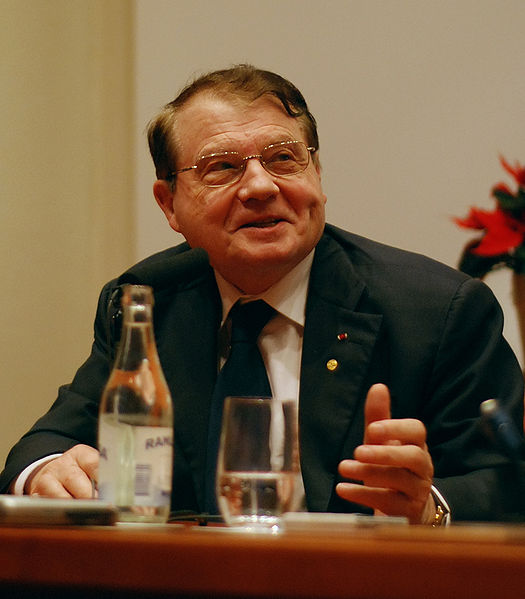
Professor Luc Montagnier, Nobel Prize winner in Medicine, in 2007, in Lugano
He doesn’t mince words and readily declares that Jacques was a brilliant pioneer, ahead of his time; he also expresses his conviction that one day people will recognize the validity of his ideas.
I recall the time when the Director-General of INSERM, Lazare, took away from Jacques his 200 square meters of laboratory space at INSERM 200 in Clamart, forcing him to set up shop in those Algeco prefabricated buildings in the courtyard! It was utterly disgraceful.
Many times I told Jacques, “Give up; you’re going to wear yourself out!” But he persisted, right up until his final breath—until his heart finally gave out.
My own career had similar features; I survived only because I kept abandoning one field after another. In 1972 I abandoned MHD (magnetohydrodynamics); in 1983 I quit computing; later I taught literature and mathematics; then I returned briefly to MHD (1975–1986); afterward I quit publishing comics; and in the 2000s I largely abandoned Egyptology. Nowadays I’ve practically abandoned astrophysics, cosmology, and mathematical physics due to lack of any positive feedback (1985–2008).
Currently I’m making a comeback via Savoir sans Frontières, republishing books and comics. My activities related to MHD and UFO research are now minimal. Below is a photo of the MHD lab currently being assembled in Rochefort (May 2010):
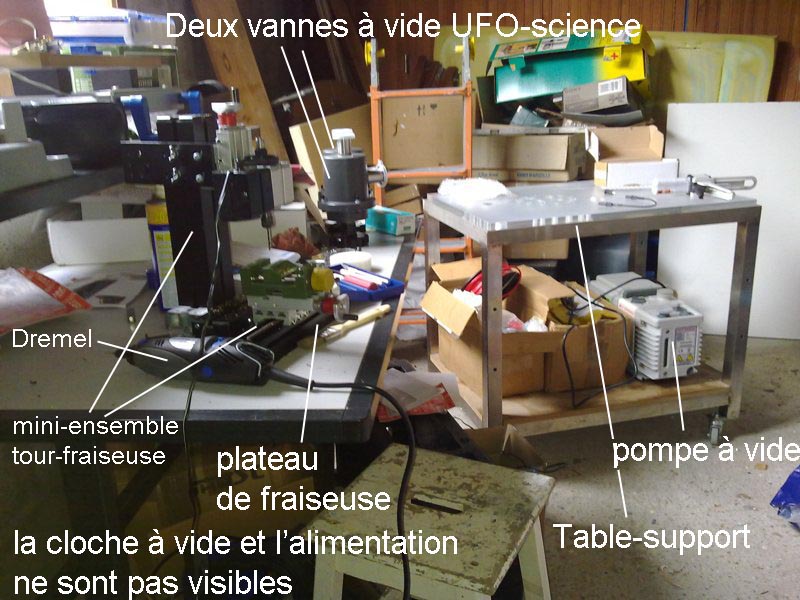
It resembles Jacques’s Algeco labs in the INSERM courtyard; however, it isn’t me handling this project—it’s a brave 40-year-old technician. Unlike Bernard Palissy, I won’t burn my furniture.
France’s cutting-edge MHD research—the “non-equilibrium” MHD involving “two-temperature plasmas”—has allowed us to rank among the world leaders in this field (Vilnius 2008, Bremen 2009). And here it is!
It would be amusing if it weren’t so tragic.
[Audio file of Montagnier’s interview, May 2010](https://www.jp-petit.org/AUDIOS/LE SEPT NEUF DU DIMANCHE 02.05.2010_benveniste.mp3)
There’s no deafer person than one who refuses to understand.
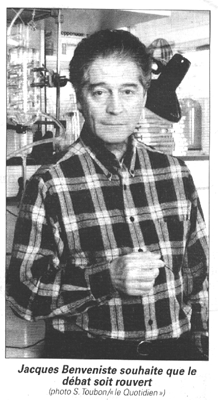
Jacques Benveniste.
...To be honest, I’d long wanted to write about my friend Jacques in these pages. But since I’m not a biologist, I couldn’t really comment on his work, even though I’ve known it for ages. Everything dates back about ten years. Back then Benveniste became fascinated by experiments involving “high dilutions.” He was a highly respected immunologist, internationally renowned. These experiments concerned human blood’s immunological reaction to bee venom. Though I’m no expert on this topic, I recall that this venom induces “degranulation” in lymphocytes within cells called “basophils,” which play a key role in immune responses; this phenomenon can be observed using a specific dye. The intensity of this degranulation could thus be measured by counting under a microscope. The procedure was straightforward: human blood samples were exposed to varying concentrations of bee venom. Degranulation occurred, and its intensity was assessed by lab technicians scrutinizing their microscopes. At first, the immune response diminished as the concentration of venom decreased.
...Yet beyond a certain dilution level, this phenomenon didn’t disappear, contrary to expectations. Even worse, this degranulation remained detectable and measurable even at dilutions where theoretically no venom molecules should remain. From a classical chemistry standpoint, this defied all logic. Normally, such effects should vanish alongside the “effector” substance. If the latter no longer exists, what causes this residual degranulation? The press coined the term “memory of water.” Note that this phrase originated in the media, not from Jacques Benveniste himself. An article on this subject was submitted to the world-famous British journal Nature. It was analyzed by an anonymous expert; since the experimental protocol seemed to follow standard biological procedures, the paper was accepted. Then Maddox, editor-in-chief, got wind of it and went ballistic. Believing it impossible that such results could arise without some “experimental error,” he demanded that Benveniste withdraw his paper immediately; otherwise, he threatened a massive media backlash. Benveniste refused, and the paper appeared, sparking a scandal. Various journals subsequently attacked his work (though Benveniste merely reported observed facts without proposing any interpretation). In France, the magazine Science et Vie led the campaign against this supposed “pseudoscience.” Its journalists wrote things like, “How can a molecule as simple as water possibly have memory?” etc. They also criticized Benveniste for entrusting the degranulation counts to his female collaborators, suggesting this could introduce “purely human” measurement errors. However—and this is why I bring this up—these experiments have recently been replicated by biologist Marthe Ennis from Queen’s University Belfast. Far from being a fan of “Ben,” she approached the problem with utmost skepticism. This time, though, she could use a counting system entirely devoid of human intervention—something Jacques never had access to. Surprisingly, her results fully corroborated those obtained twelve years earlier by the French researcher. The Guardian devoted an article to this matter in its March 15, 2001 issue; this research is slated for formal publication in Inflammation Research Journal next May (meaning it’s already been peer-reviewed and approved). In France, Le Quotidien du Médecin published a one-page article by Vincent Bargouin in its April 18, 2001 edition, No. 6900. Here’s a snippet:
“In the 1990s, not everyone accepted the ostracization of Jacques Benveniste and the whole notion of ‘water memory.’ Some stubborn individuals repeated his experiments; some did so covertly, but others openly declared it.”
...You read that correctly; it’s written in red. This is a... first.
...This article follows an earlier piece published in the Guardian on March 15, 2001.
...I won’t recount all of Benveniste’s tribulations over the past twelve years; as a friend, I’ve followed them almost daily. It was truly a path of suffering. Abandoning his research on blood reactions to bee venom, Jacques then conducted experiments wherein injections of yet another “effector” caused hamster hearts to accelerate—again at dilutions where such effects should logically be nonexistent. The accelerated heartbeat was visibly observable by anyone present; Benveniste even demonstrated it before Nobel laureate Georges Charpak, who was deeply impressed. Yet controlling this experiment proved extremely difficult. Nothing in it was straightforward; without knowing exactly what mechanisms were at play, how could one ensure all experimental parameters were properly managed? One needed total control over every aspect, even producing one’s own distilled water. Logically, such a lab should possess a completely isolated animal facility. Animal immune systems may react to countless factors, such as pollen. In the first year, Benveniste noticed that this phenomenon seemed to fade during colder seasons. The challenge lay in identifying the ideal experimental conditions. Apparently, rats’ responses weakened when their bodies entered a kind of “latency” state during winter. etc...
...Despite having access to sophisticated equipment, Jacques found himself, circa 1995, expelled from his own INSERM laboratory—which I’d visited previously through a longtime friend, Polytechnician Philippe Lazar, then Director-General of INSERM (this phrase appears in the obituary penned by Michel Alberganti and Jean-Yves Nau in Le Monde on October 6, discussing Benveniste’s death a few days prior). Being a stubborn man, Jacques settled for cramming into those Algeco prefabs in the courtyard. It was pitiful. Yet the French scientific community maintained (and still maintains) that he failed to provide irrefutable proof of his findings.
...Incidentally, there’s a simple observation made by Souriau. Is it conceivable to conduct experiments involving successive dilutions where the observed effect becomes independent of dilution rate, despite the “effector” molecule having physically vanished? Yes, replied Souriau: take square-meter containers filled with supercooled pure water; any impurity acts as a nucleation point causing ice formation. That impurity might be anything—even a single nose hair. The first ice block forms; using a spoon, extract a random square-centimeter slice. Probability of grabbing the impurity: one in 100,000. Drop this fragment into another container; it instantly serves as a nucleus for further freezing. Repeat this extraction process seven times; the probability of retaining any impurity drops to 10^-28. We surpass Avogadro’s number; chances of finding any impurity become virtually zero. Yet each new container freezes anyway.
...What relevance does this have to immunology or biology? Two Italian theoretical physicists, Preparata (deceased) and Del Giudicce, postulated a decade ago that we know virtually nothing about liquid water. Classical theory assumes hydrogen bonds suffice to create strong molecular linkages below a certain temperature threshold, enabling phase transition to liquid form at temperatures higher than those required for similarly complex molecules like ammonia or carbon dioxide.
...At a heated symposium held in a ski resort (Puy Saint Vincent) organized by France Inter journalist Jean-Yves Casgha (“Science-Frontière”), attended by representatives from the Pasteur Institute, these two physicists presented numerical simulations showing water molecules behaving erratically at temperatures slightly above freezing point—100°C. Their behavior defied conventional understanding; skeptics questioned whether such hydrogen bonds could actually exist in such chaotic environments. Without denying their existence, experts conceded that liquid water’s nature remains poorly understood. Most physical chemists agree that liquid water consists of clusters linked by hydrogen bonds, yet they cannot specify their exact composition or count the constituent H2O molecules. Having no background in chemistry or biochemistry, I merely relay these facts. I vividly recall hearing a CNRS chemist remark during this debate:
“Frankly, I have no idea why water stays liquid at room temperature; this doesn’t bother me at all!”
...That’s one perspective. Water isn’t some exotic substance; as Souriau noted upon my return: “It’s an extremely reactive chemical participating in countless hydration processes. Concrete setting is essentially hydration. Modern buildings contain huge amounts of water; if someone dropped a single drop onto a waterless planet, violent hydration would ensue.”
...At that same conference, Preparata and Del Giudicce speculated that collective phenomena might underlie water liquefaction: “quasi-molecules” formed from numerous H2O units. What stabilizes these structures? They suggested a mechanism akin to the “maser” effect seen in interstellar clouds.
“Where does the energy originate?” asked a chemist. “From thermal energy in the water itself,” answered Preparata. “But what happens if we eliminate that source?”
“Then it turns to ice, my friend...”
These researchers proposed that multiple types of “waters” exist, each possessing distinct “quasi-molecular” structures determined by impurities. These structures supposedly self-replicate, potentially explaining how information might be retained despite extreme dilutions. This was my understanding at the time. Also, at high dilutions, pure water samples lost their reactivity when heated to 70°C; this “quasi-molecule” framework thus seems compatible with hydrogen bonds.
...The indifference shown toward water by chemists and biologists shocked me. This wasn’t merely a problem of high-temperature liquefaction; water represents one of chemistry’s greatest mysteries. As Benveniste noted, biomolecules tend to hydrate, forming a protective shell of countless water molecules. He wondered how the ubiquitous “key-lock” model of biochemical interactions could function under such conditions. He imagined biomolecules communicating remotely via electromagnetic waves transmitted through their aqueous envelopes. Why not? Yet this ran counter to mainstream views.
...Things worsened when Jacques, a few years ago, hypothesized that signals emitted by such “encapsulated” biomolecules could be recorded. Biological information—the true “effector”—could thus be stored, encoded, and duplicated. Imagine the threat this posed to the global pharmaceutical industry! Experiments proceeded in cramped Algeco quarters, hardly befitting our research institutions. Presently, Jacques utilizes tiny robots to automate analyses—manipulating test tubes, adding reagents, etc. Such automation improves precision while eliminating human interference (Jacques was frequently accused of fraud!).
...Initially, critics claimed he worked for homeopathic firm Boiron. Time proved this false; Benveniste was simply a “research fanatic” sacrificing a potentially brilliant career. Charismatic, witty, and eloquent, he might have thrived in politics too. His sole flaw: unwavering faith in research; this devotion cost him dearly. Given his health issues, I marveled at his endurance (he died in October 2004, three years after I wrote this).
...Today, April 25, 2001, I spoke with him. I congratulated him on recent supportive articles.
“Yes, but does it matter? Many politicians read Le Quotidien du Médecin daily; none act.”
...Who’ll rescue this courageous man from his Algeco exile? I doubt it. My dear Jacques, I fear you’re deluding yourself. Politicians wield little real power; they merely manage routine affairs. Once I dined with one; he hosted microcomputing specialists in the early 1980s. At dessert he delivered a grand speech; I felt compelled to whisper:
“Stop. We’re not voters; you’re not on TV. Please say something meaningful...”
I showed him my CAD software—the first ever for microcomputers—hoping to promote technical education. He dismissed it as a mere game.
...What purpose serve such lone efforts? It’s easier to conform, to join the herd. Yet success demands isolation; one must risk everything. I’ve abandoned many pursuits likewise; that’s why I survive. Jacques refused to yield; he trusted rationality and honesty in science. A risky gamble.
Before burial, we reviewed press statements. Mostly they praised his early achievements—discovery of PAF-acether, an immune-active molecule—then condemned his later work as “deviant.” They mentioned magician Randi’s 1988 attempt to expose him at Nature’s request; Maddox demanded withdrawal of his paper, which Benveniste refused. Le Monde noted this “scandalous” episode but refrained from condemnation:
“Even if the trap failed, its goal was achieved: Benveniste’s credibility, results, and methodology were destroyed. His refusal to capitulate displayed arrogance; scientists saw no reason to forgive him.”
The newspaper neglected to mention that this “scientific institution” left him destitute for a decade, until exhaustion killed him—all while water remains poorly understood despite its vital biological and chemical roles.
Citing Philippe Lazar, Benveniste’s superior who closed his lab in 1995, Le Monde wrote:
“Lazar, a Polytechnician and INSERM Director from 1982–1996, calls Benveniste a ‘longtime friend’ and ‘honest top-tier researcher’ victimized by ‘shadowy’ circumstances. He faults him for lacking critical judgment; he believes his observed effects likely resulted from contamination rather than dilution.”
Larousse: Ténèbres: profound darkness, ignorance, uncertainty, demonic influence. Ténébreux: shrouded in secrecy, deceitful, speaking in cryptic terms.
Thus, without evidence, a label is slapped on ten years of grueling effort ending in death:
Abandonment or coffin.
What killed Jacques wasn’t disease; it was indifference and irrationality—the refusal to support seemingly marginal yet scientifically valid research threatening big pharma interests.
Hide this research; I dare not witness it.
Where was this “longtime friend” on the day of burial? Why didn’t he delegate a colleague to speak at the ceremony? Why did he only convey his sentiments via journalists?
I urge readers to perform a symbolic act: instead of merely clicking “like,” send a letter to
| Digital Biology Lab, 32 Rue des Carnets, 94140 Clamart |
|---|
Inside, write “Farewell, Jacques” and sign it.
As of October 11, 2004, 8,400 visitors had accessed this page; the lab received over eighty letters—roughly 1% of site visitors, a typical response rate. I anticipate this percentage persisting. Such is life...
I repeat: what killed Jacques Benveniste wasn’t illness; it was indifference.
Tribute by Professor Montagnier, three years after his death, at a virology symposium in Lugano, 2007
( November 6, 2008 ) Link