Consolidated document. 10 original pages have been gathered here; the links below open each section.
Find again: Scientific documents.
Contents
- Continued
- Continued
- 27 September - 25 October 2003
- 27 September - 25 October 2003
- 27 September - 25 October 2003
- 27 September - 25 October 2003
- 27 September - 25 October 2003
- 27 September - 25 October 2003
- 27 September - 25 October 2003
- 27 September - 25 October 2003
Continued {#section-1}
into a Boy surface (right or left, your choice)
passing through the Roman Steiner surface.
Jean-Pierre Petit
Italian: Andrea Sambusetti, University of Rome
Page 1 **Page 2 Page 3 Page 4 **
27 September - 25 October 2003
a
Continued {#section-2}
into a Boy surface (right or left, your choice)
passing through the Roman Steiner surface.
Jean-Pierre Petit
Italian: Andrea Sambusetti, University of Rome
Page 1 **Page 2 Page 3 Page 4 **
27 September - 25 October 2003
a
27 September - 25 October 2003 {#section-3}
How to transform a Cross Cap surface
into a Boy surface (right or left, your choice)
passing through the Roman Steiner surface.
Italian: Andrea Sambusetti, University of Rome
27 September - 25 October 2003
page 1
This, as Kipling would say, requires "great cunning and magical strength".
I am retired but, I feel I should say it, I still do a bit of research "in spite of myself", as others knit in their spare time. If you have patience and get yourself some 200 g squared Bristol board, you will be able to rebuild all these models yourself. My friend Christophe Tardy is building, from them, an animation that should not turn out badly.
The Cross Cap surface will appear in the drawings that follow, as will the Roman Steiner surface. But you can discover them by going to the Virtual Reality section, to see which you need to download the Cosmoplayer program onto your computer. Do it, it is really nice. Everything revolves around "cusp points". These points form naturally when you sit astride and squeeze your legs tightly. The horse's body will then be flattened along a segment. The right thigh will attach along that segment to its right shoulder, while the left thigh to the left shoulder. As for the cusp point, do not look for it: you are simply sitting on it.
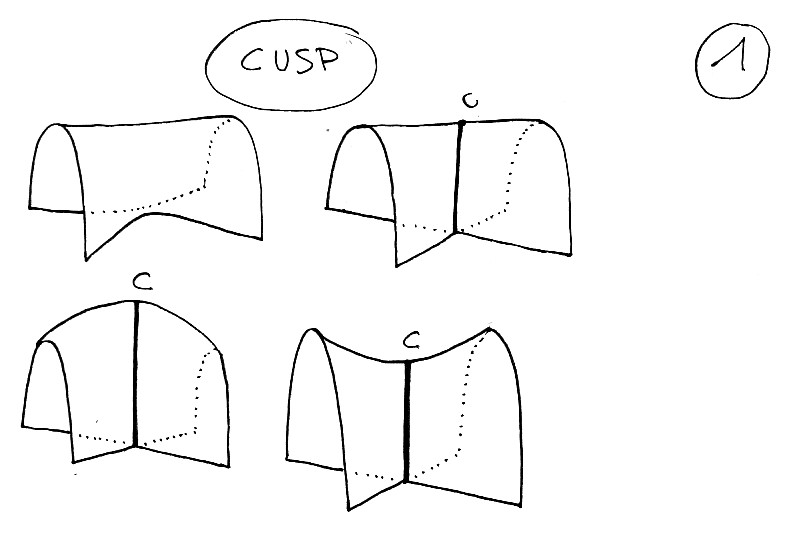
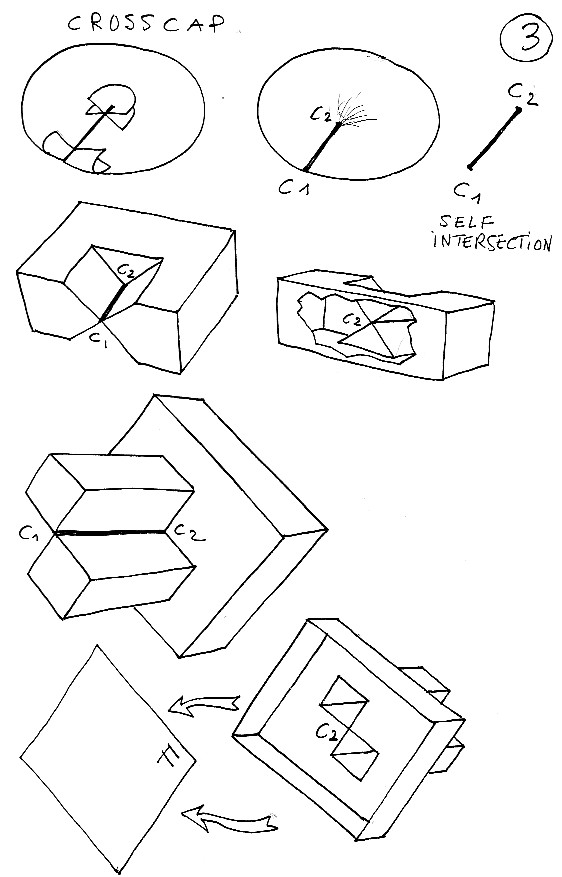
But all this is drawn... rather round. Let us move on to a "polyhedral representation" of the cusp point (just as a cube or a tetrahedron can be considered polyhedral representations of a simple sphere). The bold line represents the "self-intersection curve", which ends at the cusp pointC.
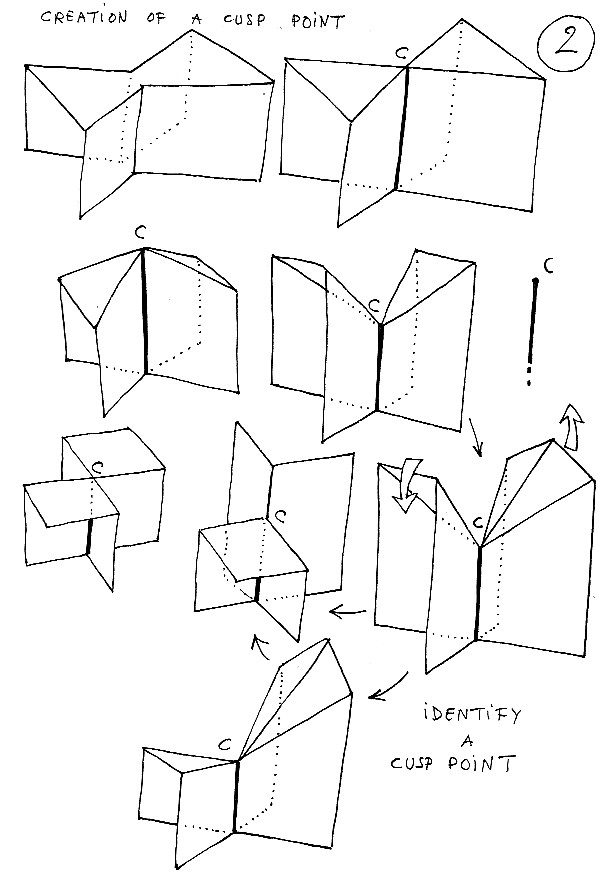
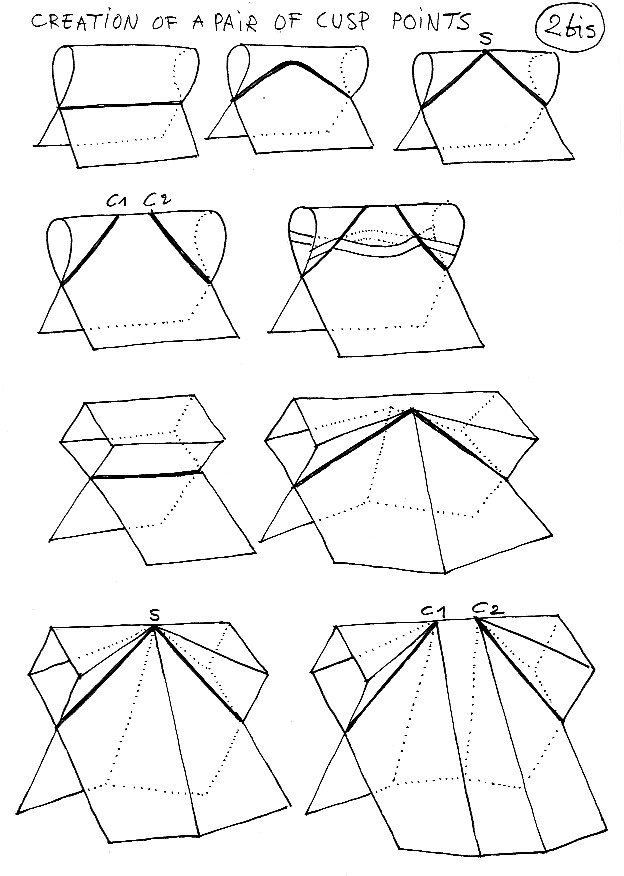
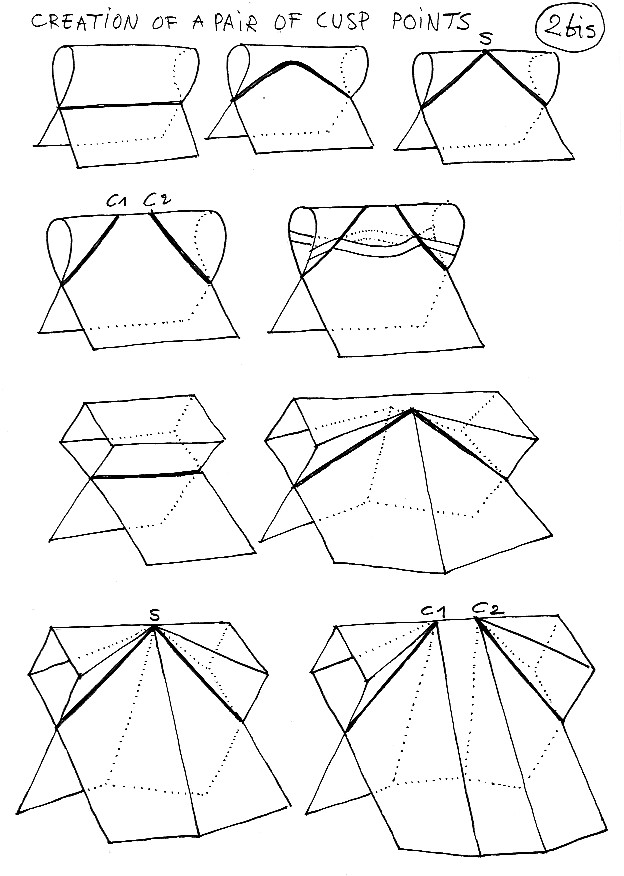
Print these plates, it is better. In what follows you will need to be able to recognize a cusp point in "different configurations" and not confuse it with a simple vertex of the polyhedron. Build, if you feel like it, these various objects with cardboard, you will understand better. Below we have an essential operation, called "creation-dissolution of a pair of cusp points". The first drawing represents a kind of cylinder that self-intersects along the segment drawn in bold, whose cross-section recalls the Greek letter gamma, inverted. We then deform this surface by "pinching" the tube whose cross-section resembles an "inverted teardrop". In doing so, we make this "teardrop" degenerate into a pointS. After that, this point splits, giving rise to two cusp points. This is the operation of creating a pair of cusp points. The opposite operation, on the other hand, destroys two cusp points. Just below you will find the polyhedral version of this operation.
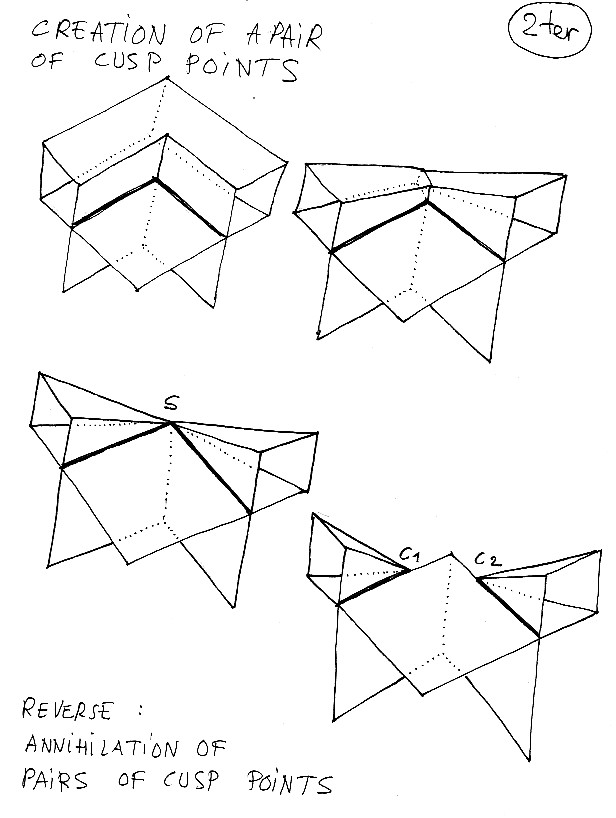
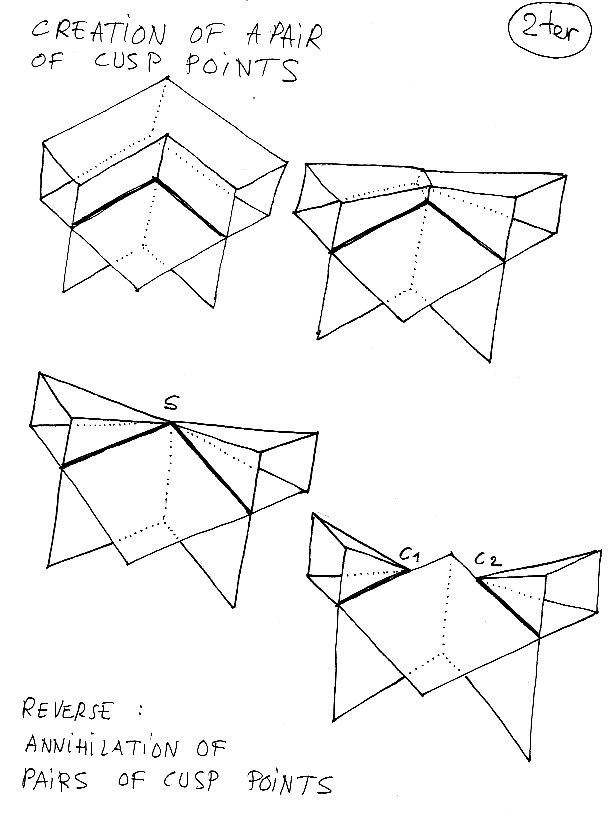
Here below is another polyhedral representation of the transformation, which resembles what you will soon see forming in the surface.
Back to the index "Transformation of a Cross Cap into Boy "
Back to the News section Back to the Guide section Back to the Main Page
Number of visits since 25 October 2003:
27 September - 25 October 2003 {#section-4}
How to transform a Cross Cap surface
into a Boy surface (right or left, your choice)
passing through the Roman Steiner surface.
Italian: Andrea Sambusetti, University of Rome
27 September - 25 October 2003
page 1
This, as Kipling would say, requires "great cunning and magical strength".
I am retired but, I feel I should say it, I still do a bit of research "in spite of myself", as others knit in their spare time. If you have patience and get yourself some 200 g squared Bristol board, you will be able to rebuild all these models yourself. My friend Christophe Tardy is building, from them, an animation that should not turn out badly.
The Cross Cap surface will appear in the drawings that follow, as well as the Roman Steiner surface. But you can discover them by going to the Virtual Reality section, to see which you need to download the Cosmoplayer program onto your computer. Do it, it's really nice. Everything revolves around "cusp points". These points form naturally when you sit astride and squeeze your legs tightly. The horse's body will then be flattened along a segment. The right thigh will attach along that segment to its right shoulder, while the left thigh to the left shoulder. As for the cusp point, don't look for it: you are simply sitting on it.
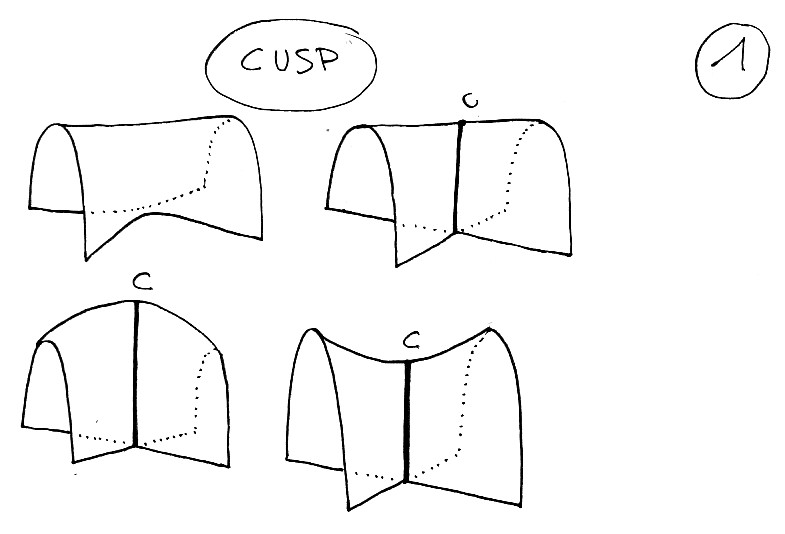
But all this is drawn... nice and round. Let's move on to a "polyhedral representation" of the cusp point (just as a cube or a tetrahedron can be considered polyhedral representations of a simple sphere). The bold line represents the "self-intersection curve", which ends at the cusp pointC.
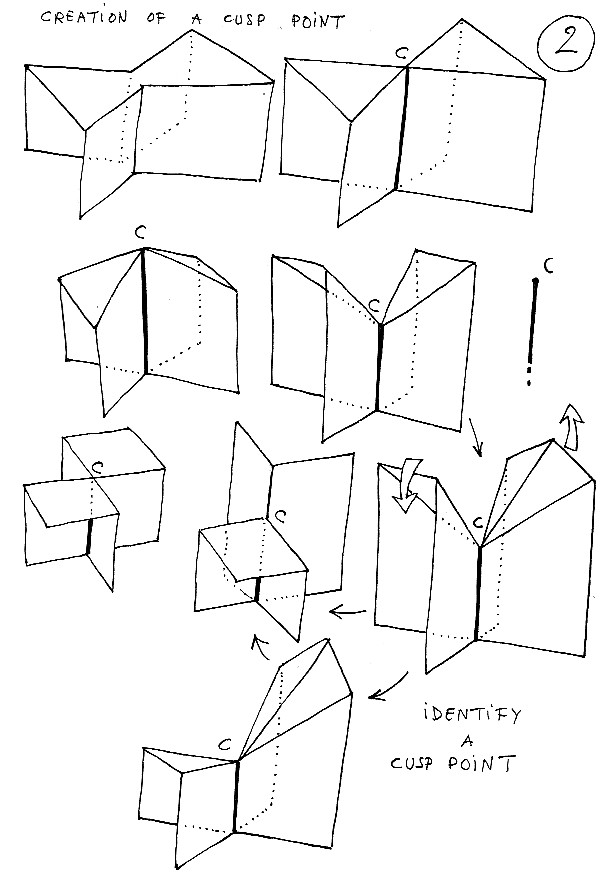
Print these plates, it's better. Later on you will need to be able to recognize a cusp point in "different configurations" and not confuse it with a simple vertex of the polyhedron. Build, if you feel up to it, these different objects with cardboard, you will understand better. Below we have an essential operation, called "creation-dissolution of a pair of cusp points". The first drawing represents a kind of cylinder that self-intersects along the segment drawn in bold, whose cross-section resembles the Greek letter gamma, upside down. We then deform this surface by "pinching" the tube whose cross-section resembles an "upside-down teardrop". In doing so, we make this "teardrop" degenerate into a pointS. After that, this point splits into two cusp points. This is the operation of creating a pair of cusp points. The opposite operation, on the other hand, destroys two cusp points. Just below you will find the polyhedral version of this operation.
Here below is another polyhedral representation of the transformation, which resembles what you will soon see forming in the surface.
Back to the index "Transformation of a Cross Cap into a Boy"
Back to the News section Back to the Guide section Back to the Main Page
Number of visits since October 25, 2003:
September 27 - October 25, 2003 {#section-5}
How to transform a Cross Cap surface
into a Boy surface (right or left, your choice)
passing through the Roman Steiner surface.
Italian: Andrea Sambusetti, University of Rome
September 27 - October 25, 2003
page 2
Here is a "Cross Cap surface" (as you would have discovered it in the virtual reality images). It has two cusp points that are vertices of a self-intersection line. It can be built by pinching a balloon with hair-roller clips. But you can also build polyhedral representations of it. The one below will interest us particularly.
In plate 4 is the most difficult thing to learn. It seems impossible to me that anyone could understand these objects well simply by looking at the figures. Build models. In short, you pull the cusp pointC2 toward "the inside of the surface" (which, by the way, makes no sense since, as you will surely have noticed right away, the Cross Cap surface is one-sided: it has no outer and inner face). By insisting, the surface "crosses itself", and the self-intersection set is completed, rounding things off a bit, with a figure-8 shaped curve. A triple pointT has been created, incidentally.
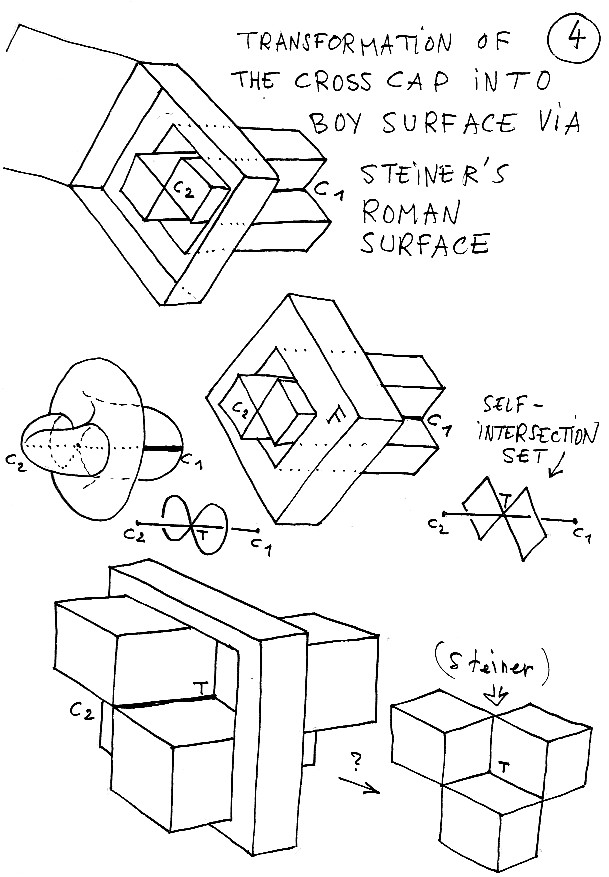
The surface becomes more comprehensible in its polyhedral form and, below, we have enlarged certain elements to show what leads us to transform this object into the Roman Steiner surface (see the virtual reality simulation), whose simplest polyhedral form consists in assembling four cubes (here only three are visible).
Plate 5: polyhedral version on the left, round on the right. The arrow passes through the point that we are going to "strangle". Further down, the beginning of the strangling operation.
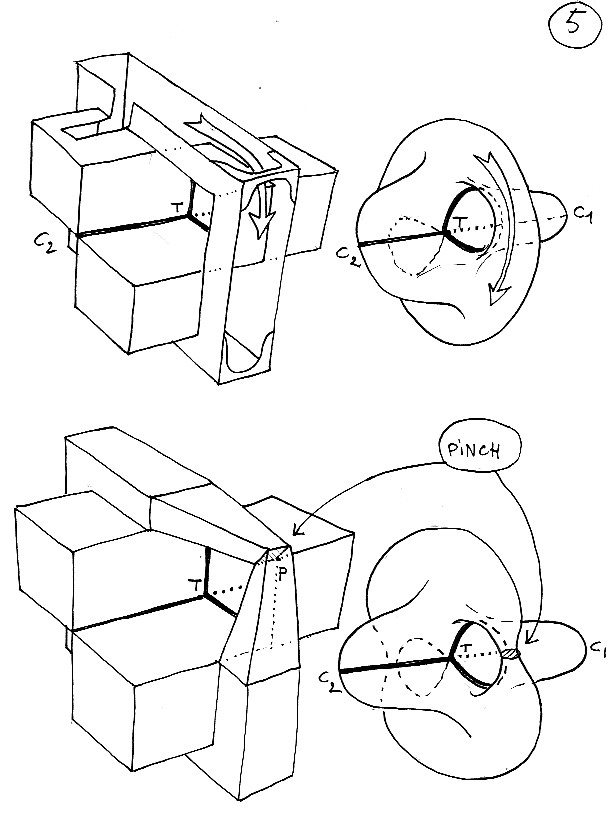
Plate 6: the strangling is carried out and creates a singular pointB. In fact, since we strangle it from both sides (to save time), two singular pointsS1 andS1 form, then two cusp points. At this point, without Bristol board, scissors and adhesive tape, you are in trouble.
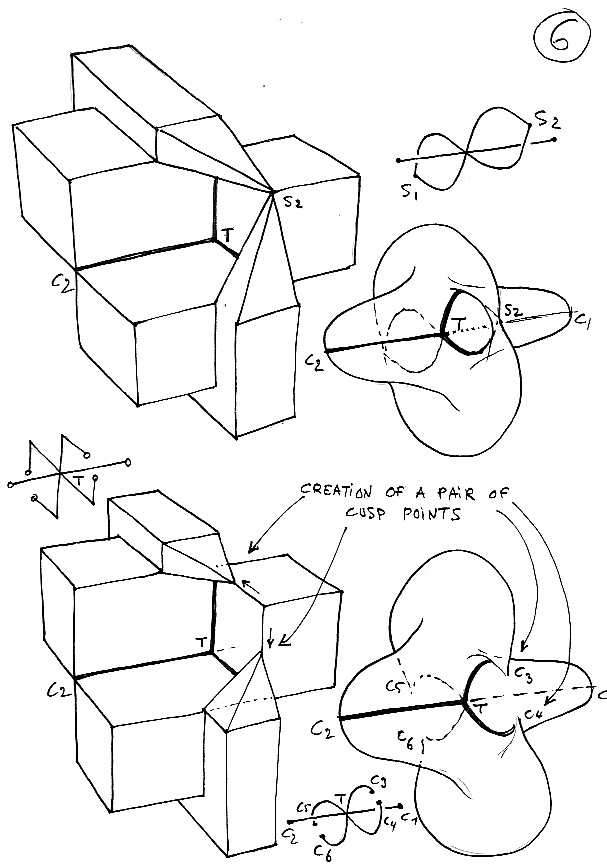
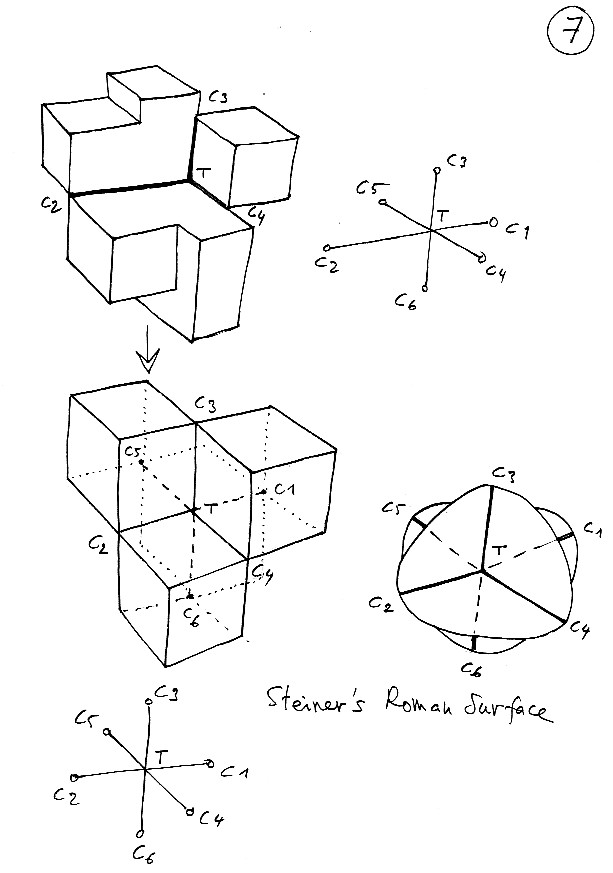
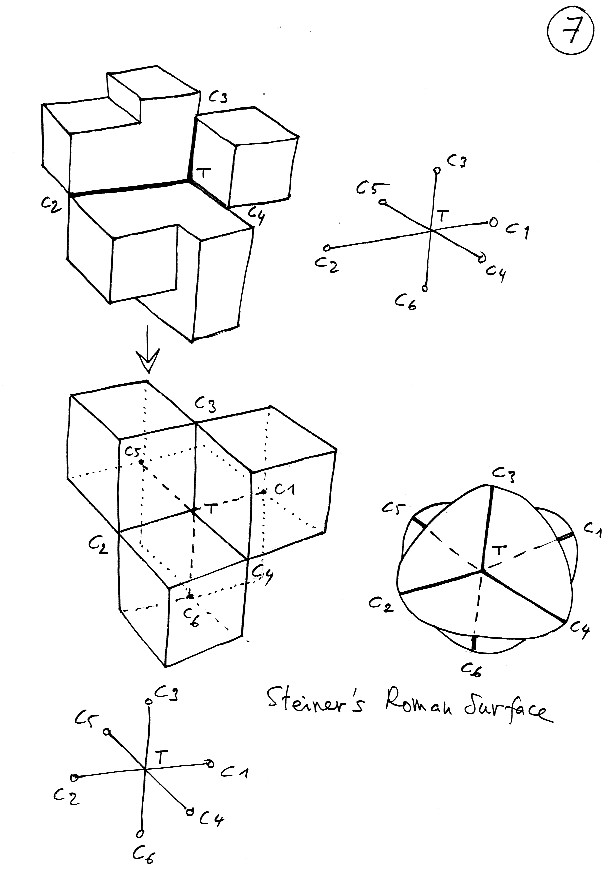
Plate 7: here we have simply made the different cusp points migrate. If pointC2 is "obvious", you will certainly have more difficulty instead identifying pointsC3 andC4 as cusp points. Yet they are there, at the ends of a self-intersection line. Above pointC3 there is simply what I have called a "posicone", that is, a point where positive curvature is concentrated (a point where negative curvature is concentrated I call a "negacone"). By deforming this object a little, one arrives at the polyhedral form of the Roman Steiner surface (invented by Steiner in Rome; see its illustration in virtual reality).
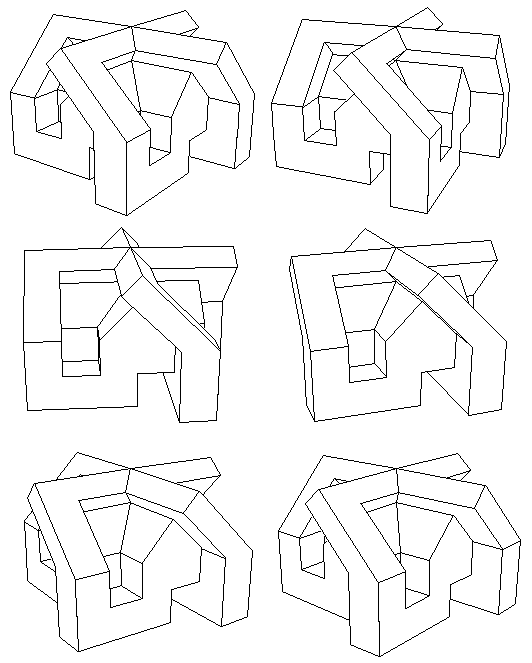
So the game is done. There are various types of surfaces, according to the rules that one imposes. Surfaces that do not self-intersect are called "embeddings" (of the sphere, or of the torus inR3). When instead they self-intersect but the tangent plane varies continuously without degenerating, they are called immersions. For example: the Klein bottle, in its classical representation. InR3 there is no representation of the Klein bottle in the form of an embedding: it necessarily self-intersects. Immersions possess sets of self-intersection without cuspidal points. These sets are continuous curves, but they can cross at double or triple points. Observation: the sphere can be realized in the form of an immersion (which is not an embedding) by making it self-intersect. This is in fact the way through which one manages to turn it inside out (cf. the method of A.Phillips, 1967, whose central step is the double covering of a Boy surface; and see also B.Morin and J.P.Petit, 1979, in which the central model taken is Morin's "four-eared" model, of which below you see a polyhedral representation that I invented about ten years ago).
Assembly instructions for this object with paper and scissors
If the rules of the game are extended by accepting that these objects also admit cuspidal points, one obtains summersions (the Cross Cap, the Roman surface of Steiner). I don't know whether summersione is the right term, but since I haven't found any mathematician who can clarify my ideas on the matter, I found it amusing to invent one, provisionally, at least until an expert geometer comes forward. Thus, the Cross Cap surface and the Roman surface of Steiner would be summersions of the "projective plane".
To tell you the whole story, after twenty-five years of activity and my disappointments in the field of Magneto-Hydrodynamics, I had started these works because they seemed to me as far as possible from any military application. But, as my old friend Mihn pointed out to me, the term summersione could lend itself to confusion and let the Navy infer that through these researches I was trying to hide progress in the field of submarine propulsion.
The rule of "creation-dissolution" of pairs of cuspidal points allows one to pass from one summersione of an object to another, and that is what we have just done, showing that the Cross Cap and the Roman surface of Steiner are two summersions of the same object, known as the *projective plane. *Do not try to picture a "projective plane". This object can be understood only through various different representations. As for the term "projective", it is just one among the thousand invented by mathematicians to mislead those who would like to penetrate their closed circle. Zanichelli will be of no use to you in mathematics.
It therefore remains for us to see how to pass to the Boy surface, which is an immersion of the projective plane
Back to the index "Transformation of a Cross Cap into Boy "
Back to the Novità section Back to the Guide section Back to the Main Page
Number of visits since 25 October 2003:
27 September - 25 October 2003 {#section-6}
How to transform a Cross Cap surface
into a Boy surface (right or left, as you choose)
passing through the Roman surface of Steiner.
Italian: Andrea Sambusetti, university of Rome
27 September - 25 October 2003
page 2
Here is a "Cross Cap surface" (as you would have discovered it in virtual reality images). It has two cuspidal points that are vertices of a line of self-intersection. One can build it by pinching a balloon with hair-curler clips. But you can also build polyhedral representations of it. The one below will interest us particularly.
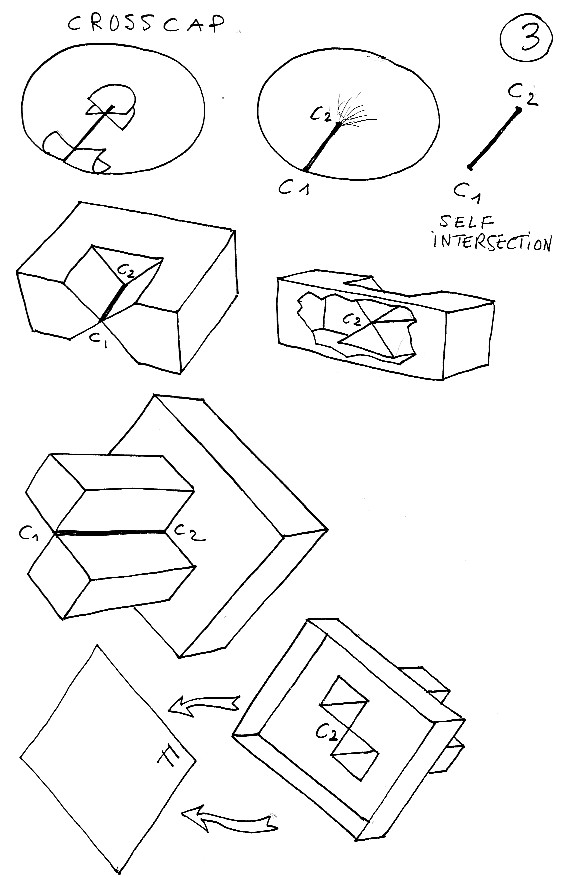
In plate 4 is the most difficult thing to learn. It seems impossible to me that anyone can understand these objects well simply by looking at the figures. Build models. In plain words, one pulls the cuspidal pointC2 toward "the inside of the surface" (which, by the way, makes no sense since, you will surely have noticed at once, the Cross Cap surface is one-sided: it has no outer and inner face). By insisting, the surface "self-crosses", and the set of self-intersection is completed, rounding things a little, with a figure-8 curve. A triple pointT has been created, incidentally.
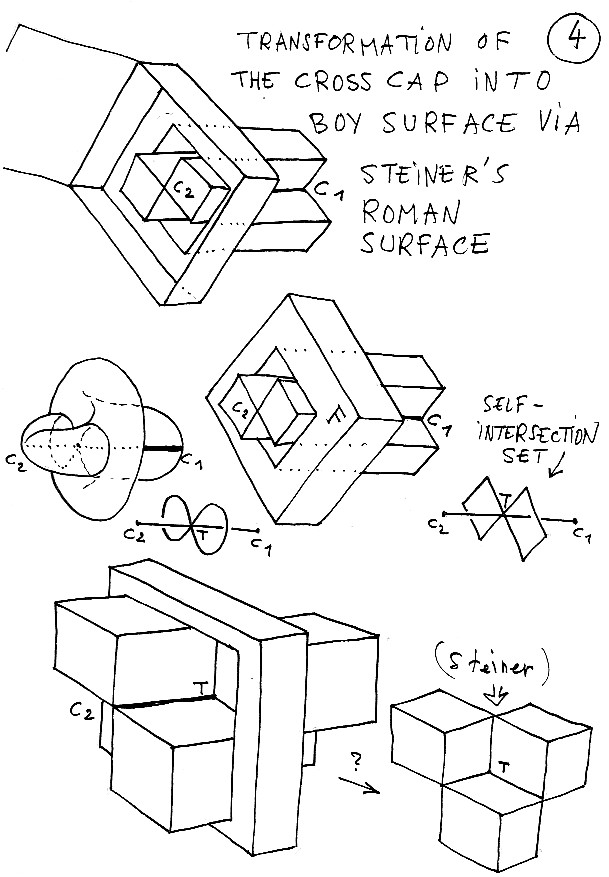
The surface is more comprehensible in its polyhedral form and, below, we have enlarged certain elements to show what induces us to transform this object into the Roman surface of Steiner (see the virtual reality simulation) whose simplest polyhedral form consists in assembling four cubes (here only three are seen).
Plate 5: polyhedral version on the left, round on the right. The arrow passes through the point that we are going to "strangle". Below, the beginning of the strangling operation.
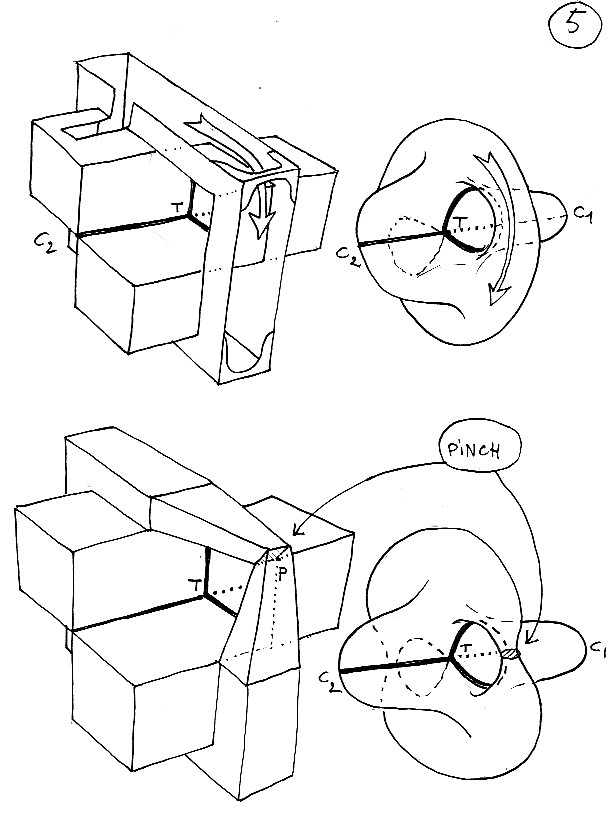
Plate 6: the strangling is carried out and creates a singular pointB. In fact, since we strangle it from both sides (just to save time), two singular pointsS1 andS1 are formed, then two cuspidal points. At this point, without Bristol board, scissors and adhesive tape, you are in trouble.
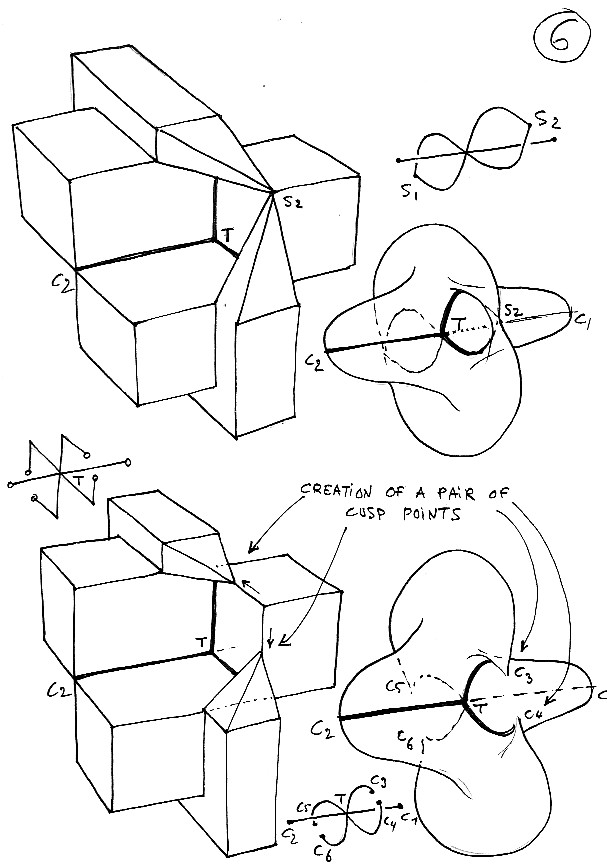
Plate 7: here we have simply made the different cuspidal points migrate. If pointC2 is "obvious", you will certainly have more difficulty instead identifying pointsC3 andC4 as cuspidal. And yet they are there, at the ends of a self-intersection line. Above pointC3 there is simply what I have called a "posicone", a point, that is, where positive curvature concentrates (a point where negative curvature concentrates I call a "negacone"). By deforming this object a little, one arrives at the polyhedral form of the Roman surface of Steiner (invented by Steiner in Rome; see his illustration in virtual reality).
So the game is up. There exist various types of surfaces, according to the rules that one imposes. Surfaces that do not self-intersect are called "embeddings" (of the sphere, or of the torus inR3). When instead they self-intersect but the tangent plane varies continuously without degenerating, they are called immersions. For example: the Klein bottle, in its classical representation. InR3 there exists no representation of the Klein bottle in the form of an embedding: it necessarily self-intersects. Immersions possess self-intersection sets without cuspidal points. These sets are continuous curves, but they can cross at double or triple points. Observation: the sphere can be realized in the form of an immersion (which is not an embedding) by making it self-intersect. It is in fact the way through which one manages to turn it inside out (cf. the method of A.Phillips, 1967, whose central step is the double covering of a Boy surface; and see also B.Morin and J.P.Petit, 1979, in which the "four-eared" model of Morin is taken as the central model, of which below you see a polyhedral representation that I invented about ten years ago).
Assembly plan for this object with paper and scissors
If one extends the rules of the game by accepting that these objects also admit cuspidal points, one obtains *summersions *(the Cross Cap, the Roman surface of Steiner). I do not know whether summersione is the right term, but since I have not found any mathematician who can clarify my ideas on the matter, I found it amusing to invent one, provisionally, at least until an expert geometer comes forward. Thus, the Cross Cap surface and the Roman surface of Steiner would be summersions of the "projective plane".
To tell you the whole truth, after twenty-five years of activity and my disappointments in the field of Magneto-Hydrodynamics, I had begun these works because they seemed to me as far as possible from any military application. But, as my old friend Mihn pointed out to me, the term summersione could lend itself to confusion and let the Navy infer that through these researches I was trying to hide progress in the field of submarine propulsion.
The rule of "creation-dissolution" of pairs of cuspidal points allows one to pass from one summersion of an object to another, and that is what we have just done, showing that the Cross Cap and the Roman surface of Steiner are two summersions of the same object, known as the *projective plane. *Do not try to picture a "projective plane". This object can be understood only through various different representations. As for the term "projective", it is but one among the thousand invented by mathematicians to mislead those who would like to penetrate their closed circle. Zanichelli will be of no use to you in mathematics.
It therefore remains for us to see how to pass to the Boy surface, which is an immersion of the projective plane
Return to the index "Transformation of a Cross Cap into Boy "
Return to the Novelties section Return to the Guide section Return to the Main Page
Number of visits since 25 October 2003:
27 September - 25 October 2003 {#section-7}
How to transform a Cross Cap surface
into a Boy surface (right or left, as you choose)
passing through the Roman surface of Steiner.
Italian: Andrea Sambusetti, university of Rome
27 September - 25 October 2003
page 3
Plate 8: We begin by making two cuspidal points migrate (C2 andC4) by bringing them a little closer to the triple pointT. To do this, we have highlighted with dots a part of the surface that we will "break through from the inside", with a "pyramidal awl" (come on, build some models, otherwise you are ready for the madhouse). As they develop, the tips of these pyramids are none other than the cuspidal pointsC2 andC4 that migrate and come together.
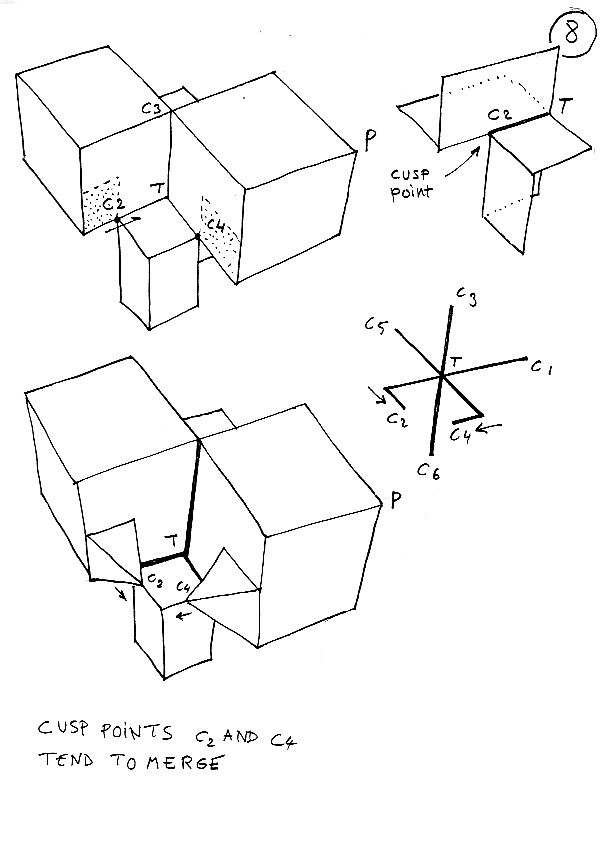
Plate 9: the cuspidal points join atSand "cancel each other out". The self-intersection curve therefore loses two cuspidal points and gains... a loop (in polyhedral form: a closed polygonal line).
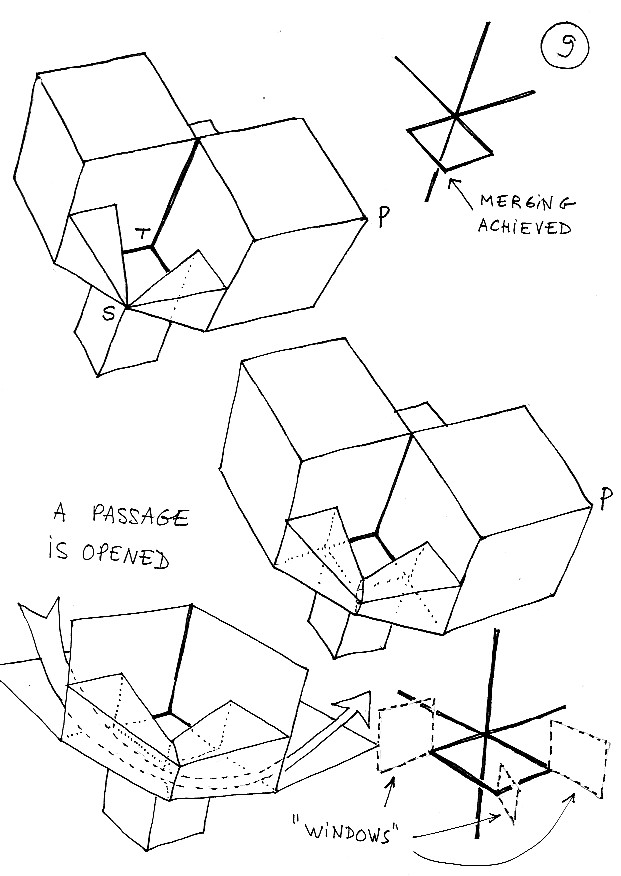
Plate 10: this "square-section tube" forms.
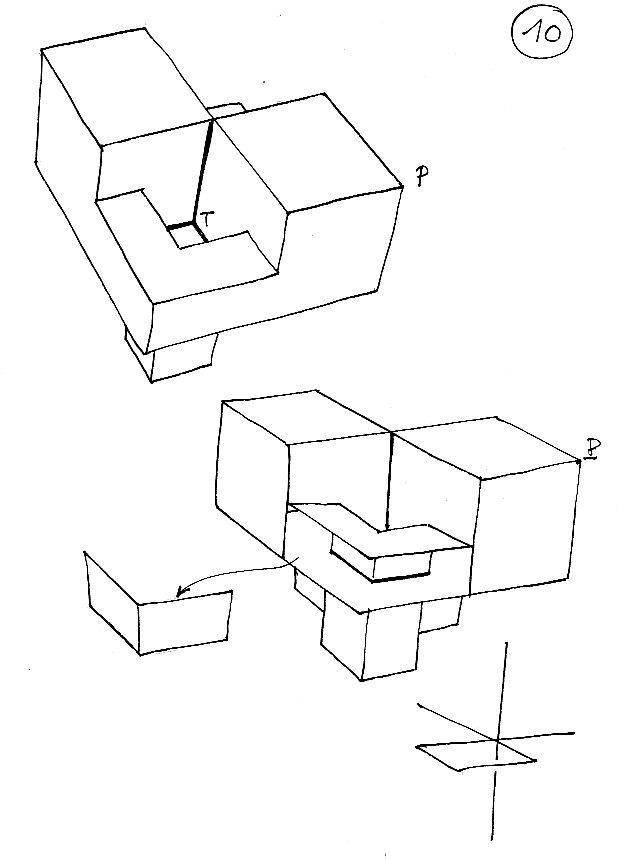
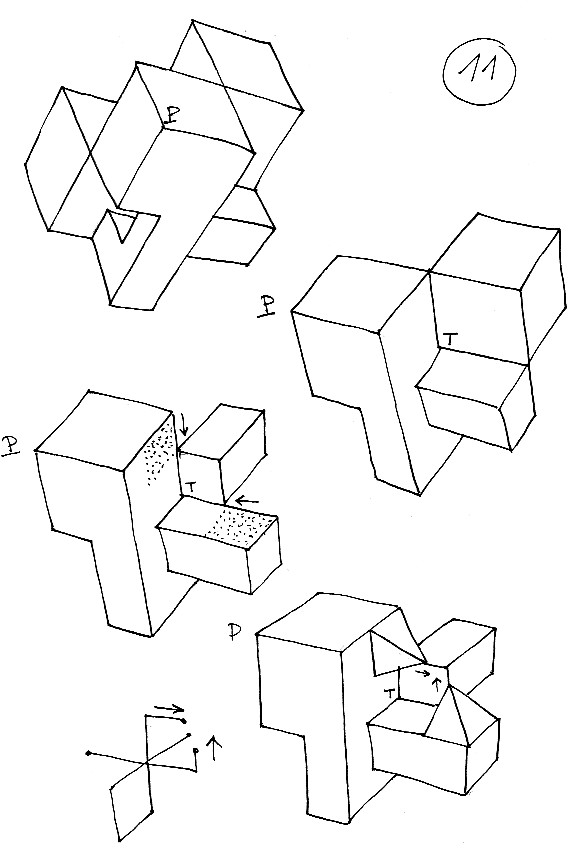
Plate 11: we turn this object to see it from another point of view, and we make two other cuspidal points migrate, after which we break through "from the inside" (which is absurd, since we have said that the Roman surface of Steiner is one-sided) as before the parts highlighted with dots. We continue with this operation of migration-confluence of this second pair of cuspidal points.
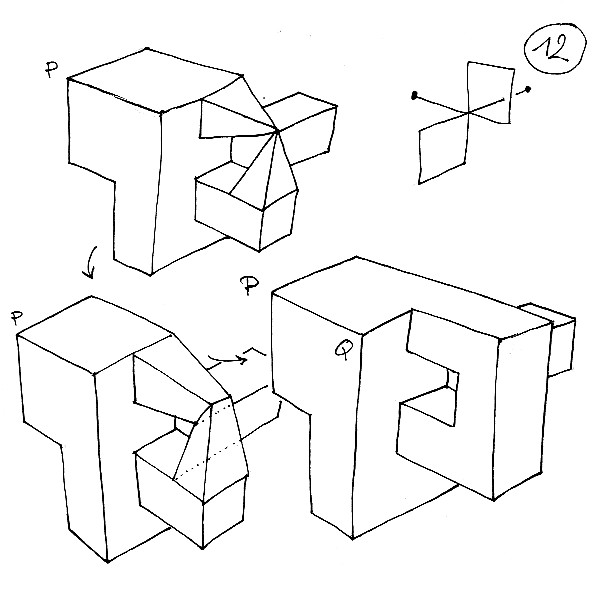
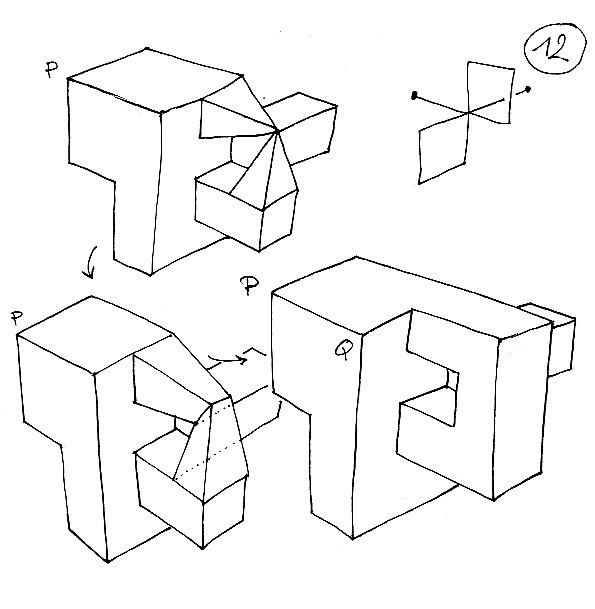
In this last image the points are about to touch. Plate 12: the passage between the two small pyramids has opened. Now only two cuspidal points remain.
Back to the index "Transformation of a Cross Cap into a Boy "
Back to the Novelties section Back to the Guide section Back to the Main Page
Number of visits since 25 October 2003:
27 September - 25 October 2003 {#section-8}
How to transform a Cross Cap surface
into a Boy surface (right or left, as you choose)
passing through the Roman Steiner surface.
Italian: Andrea Sambusetti, university of Rome
27 September - 25 October 2003
page 3
Plate 8: We begin by making two cuspidal points migrate (C2 andC4) bringing them a little closer to the triple pointT. To do this, we have highlighted with dots a part of the surface that we will "break through from the inside", with a "pyramidal awl" (come on, build some models, otherwise you are ready for the madhouse). As they develop, the tips of these pyramids are nothing other than the cuspidal pointsC2 andC4 which migrate and come together.
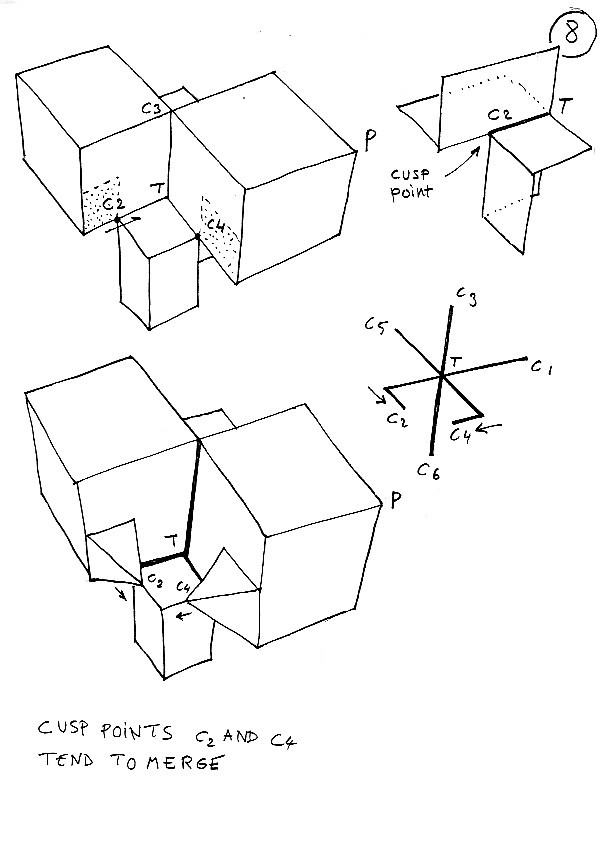
Plate 9: the cuspidal points join atSand "cancel each other out". The self-intersection curve therefore loses two cuspidal points and gains... a ring (in polyhedral form: a closed polygonal line).
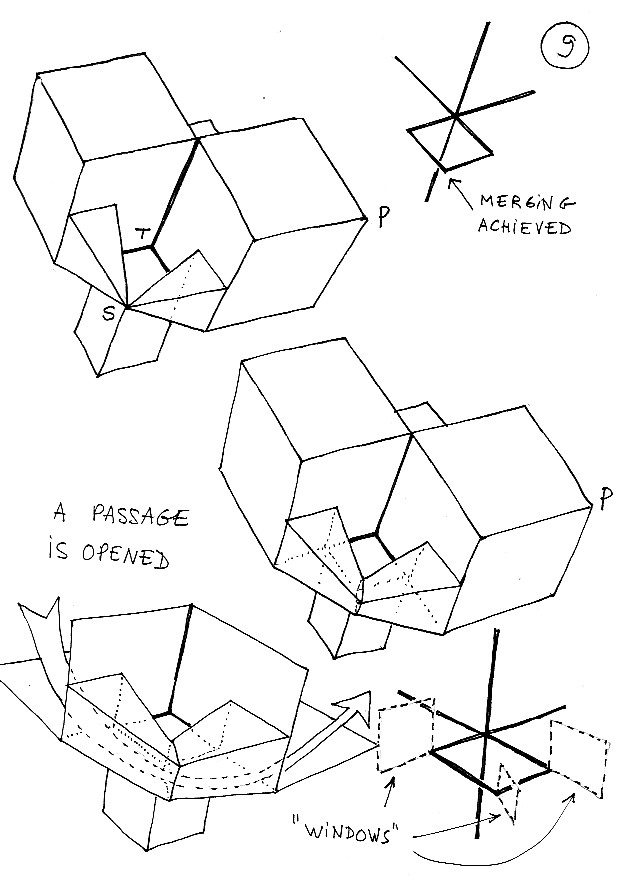
Plate 10: this "square-section tube" is formed.
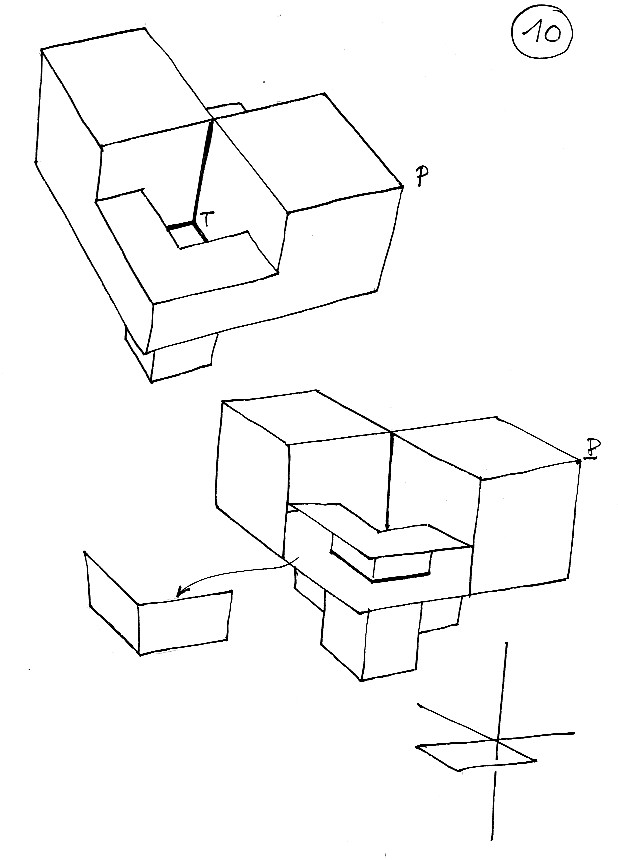
Plate 11: we turn this object to see it from another point of view, and we make two other cuspidal points migrate, after which we break through "from the inside" (which is absurd, since we have said that the Roman Steiner surface is one-sided) as before the parts highlighted with dots. We continue with this operation of migration-confluence of this second pair of cuspidal points.
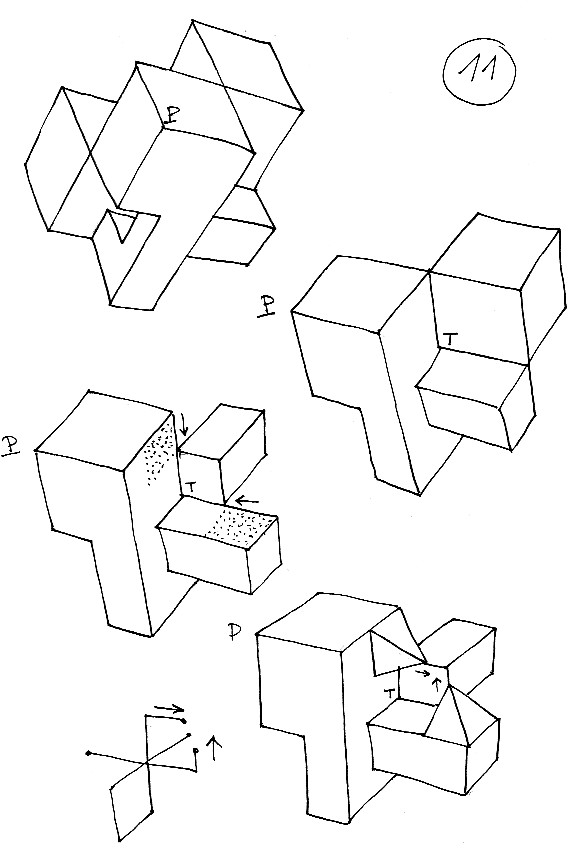
In this last image the points are about to touch. Plate 12: the passage between the two small pyramids has opened. Now only two cuspidal points remain.
Back to the index "Transformation of a Cross Cap into a Boy "
Back to the Novelties section Back to the Guide section Back to the Main Page
Number of visits since 25 October 2003:
27 September - 25 October 2003 {#section-9}
How to transform a Cross Cap surface
into a Boy surface (right or left, as you choose)
passing through the Roman Steiner surface.
Italian: Andrea Sambusetti, university of Rome
27 September - 25 October 2003
page 4
We present the model again from yet another point of view:
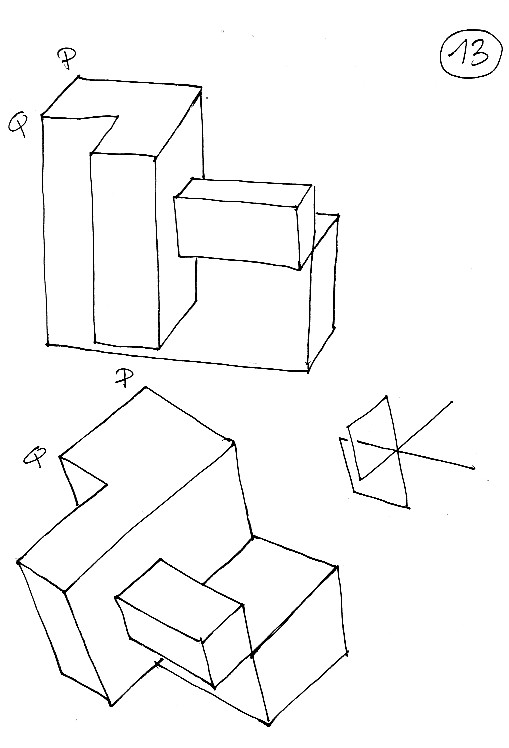
Plate 14: we always repeat the same operation, creating the third "ear" of the self-intersection curve. In the polyhedral model, the latter has the shape of three squares with a common vertex: the triple pointT.
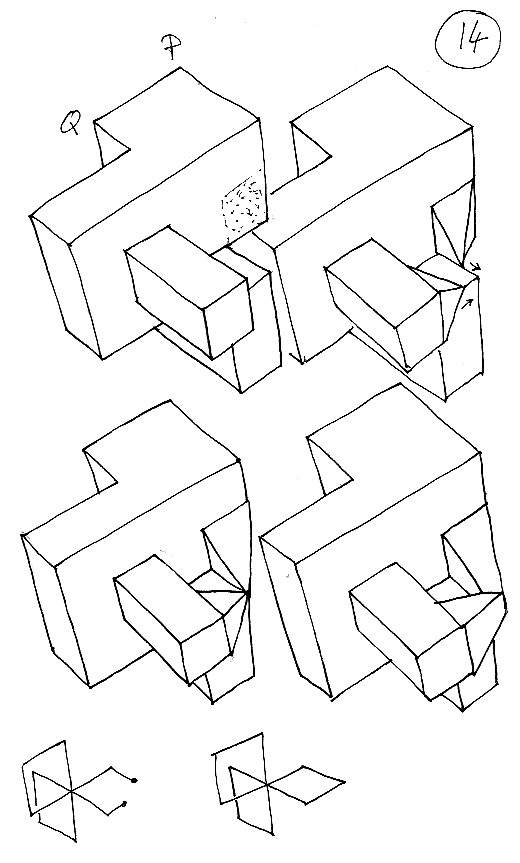
Plate 15: by rotating the object you will find again the polyhedral version of the Boy surface that I had presented in the Topologicon (where you can also find an assembly plan that allows you to build it).
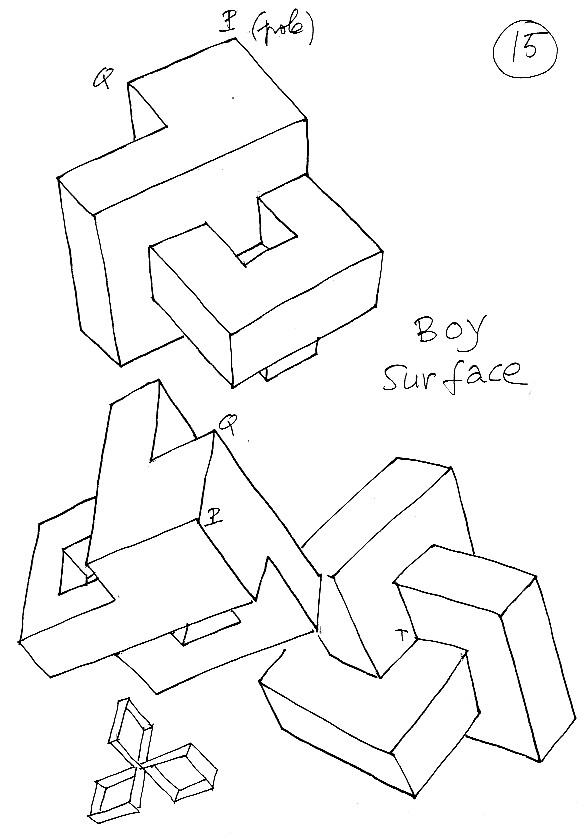
Last plate: I have tried to illustrate the Steiner surface as it twists and transforms into a Boy surface.
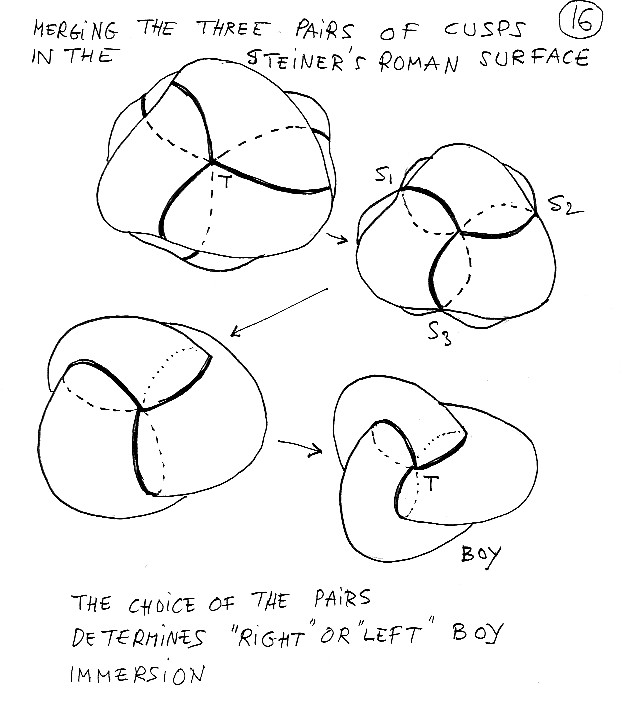
We see that, drawn in "rounded" form, it takes quite a bit of practice to understand it. Our eye is very uncomfortable when it comes to understanding an object for which, on one and the same line of sight, more than two sheets overlap. Hence the interest of the polyhedral model, which brings within everyone's reach, if only one tries to build the models oneself, transformations considered complicated in geometry. Let us note in passing that, depending on the pairs of cuspidal points chosen, one obtains a "right" or "left" Boy surface (completely arbitrary definitions). The projective plane immerses itself in space through two mirror "antiautomorphic" representations. We therefore also see that one can pass from a right Boy surface to a left Boy surface through a "central" model which is the Roman Steiner surface.
It would undoubtedly be nice if these drawings were published in magazines like Pour la Science or La Recherche. But for twenty years publication in these magazines has been "forbidden" to me because of ufological deviationism. Thank you, Messrs Hervé This and Philippe Boulanger. I have lost count of the articles of this kind that I have proposed to these magazines and that have been kindly refused. One ends up getting used to one's status as an excommunicate.
As an anecdote, there exists a "d'Alembert prize" intended to reward the authors of popular mathematics books. The story was told to me by a member of the commission responsible for deciding to whom the prize should be awarded (there are anyway questions of money behind it). Dialogue:
-
Well then, why don't we give the prize to Petit? He has written remarkable works such as the "Géométricon", the "Trou Noir" and the "Topologicon".
-
Yes, but he hasn't done only that.
-
What are you alluding to?
-
He also wrote the "Mur du Silence".
-
Ah, well, then....
Well yes, "Mur du Silence", published in 1983, is an album dedicated to the MHD. And, as each of us knows, this corrosive science has the merit, or the defect, of allowing flying saucers to move at supersonic speed without making a Bang.
« Cachez cette science, que je ne saurais voir »
I have in my boxes a magnificent version of the "cube reversal", which is not the polyhedral version of Morin's variant. All my own work. One of these days....
October 22, 2003: We don't rush too much on these pages, if I am to believe the counter. On Monday, October 13, 2003, I gave a seminar at the CMI (Center for Mathematics and Computer Science of Château-Gombert-Marseille) at the invitation of Trotman. On that occasion I was able to bring out a collection of about thirty cardboard models, of which one day you will be able to enjoy a preview, since they were photographed by Christophe Tardy.
When one gives a seminar, a certain atmosphere is created. In the photo below, here is a geometer expressing his perplexity.
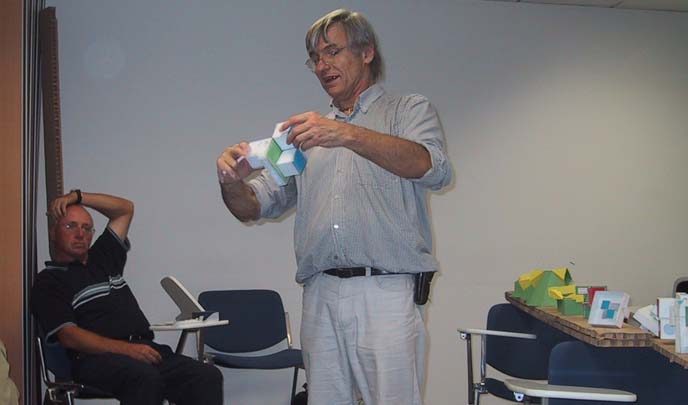
In the background, some of the models exhibited with the help of my long-time collaborator, Boris Kolev, a member of the department, also a geometer. At a certain moment I asked the question:
- How many of you have already seen a Roman Steiner surface? Raise your hand.
No one had ever seen it. It therefore seemed useful to me to present this object, with a virtual reality program, on the laptop I had with me, a program made with the help of Christophe Tardy, an engineer, and Frédéric Descamp, of the Laue Langevin Institute in Grenoble (ILL). Obviously this presentation disconcerts the audience, little accustomed to seeing mathematical surfaces twirl at will.
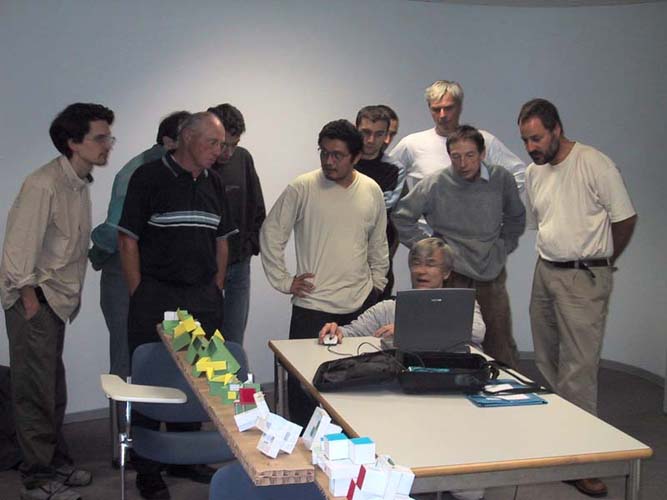
Two cardboard boards, visible in the foreground, made it possible to present the whole succession of models in their logical order. The green and yellow models illustrate, in polyhedral form, the essential tool for creating-dissolving a pair of cuspidal points. The most distant white object is a polyhedral version of the Cross Cap surface, which first transforms into a polyhedral version of the Roman Steiner surface, then, a meter further on, at will, into a "right" or "left" Boy surface.
The analysis of the models brings out various observations from the audience. One of the geometers asks:
- If it is true that, following the models in this order, one can pass from the Cross Cap surface to that of Boy, it seems that, following the opposite procedure, one can transform a Boy surface into a Cross Cap.
I answer in the affirmative. Emboldened, my interlocutor adds:
- Then, if upon reaching the Roman Steiner surface stage one stops, it should be possible to return to a Boy surface, but reflected with respect to the initial one.
I agree a second time. But, unfortunately, no one will volunteer to give some clarification on this strange world in which immersions of closed surfaces are allowed to have cuspidal points, created or dissolved in pairs, whose set constitutes a kind of extension of the world of immersions. The term "submersion" seems suitable to me. If a reader is capable of giving some clarification, he is welcome.
Curvature concentrated at a cuspidal point.
We will calculate it by summing the angles at the vertex and comparing this sum with the result obtained in the case of the Euclidean plane: 2 p .
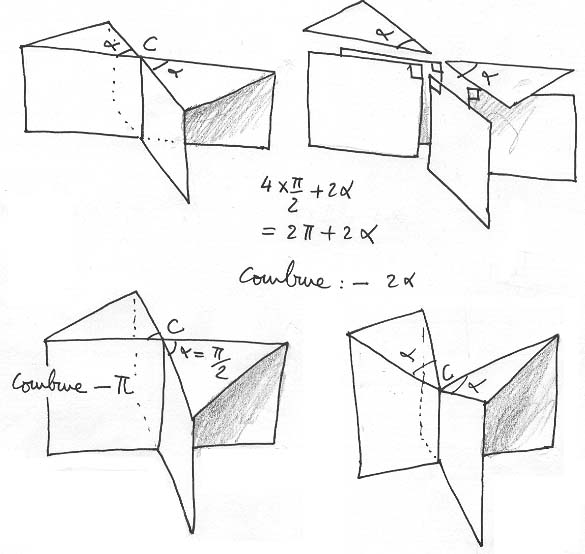
At the top left you can see one of the many possible polyhedral representations of a cuspidal point. By "dismantling" the surface one arrives at a sum of angles that exceeds the value 2p by 2a . From this one deduces that the angular curvature concentrated around this point C is - 2a. If the angle a is equal to p/2 then the negative curvature is worth -p (figure at the bottom left). In fact, the curvature of a cuspidal point can assume infinitely many values. At the bottom right we accentuate the angular sum and the curvature then becomes < -p (we have increased the negative curvature).
Operating in the opposite way, we can arrive at a rather surprising situation: we can arrange for the (angular) curvature concentrated at C to be ... zero:
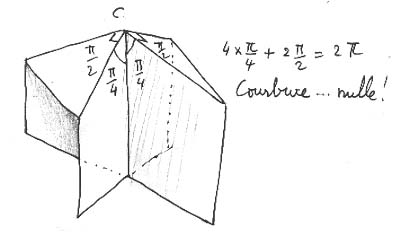
Let us now start from a polyhedral representation of the Cross Cap surface in which two cuspidal points appear, each of curvature equal to -p:
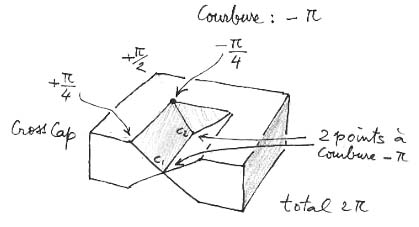
In this figure there are eight corresponding "posicones" of value + p/2. We add four other "posicones" of curvature + p/4 and four "negacones" of curvature - p/4.
Plus the two cuspidal points of curvature - p .
Total: 2 p
Dividing the value of this "total curvature" by 2p we find again the value of the Euler-Poincaré characteristic of any representation of the projective plane (or of the Boy surface).
During the conference I evoked the art and the manner of swapping the two cuspidal points of a Cross Cap surface by using the reversal of the sphere. I no longer know if I put this thing somewhere on my site. It is such a muddle. I will have to look, otherwise I will add it. It is amusing. The fact is that this operation did not please at all one of the people present at the seminar:
- I don't see why Petit makes use of so much paraphernalia to demonstrate the symmetry that links the two cuspidal points of a Cross Cap. It can be done much more simply.
And he drew on the blackboard the drawing of a sphere squeezed between two touching rulers which indeed gives a set of self-intersection in the form of a segment at whose ends two cuspidal points are found, like the Cross Cap surface. Unfortunately, and the gentleman in question noticed it, this is not the Cross Cap surface.
- Diavolo, what is it then? Someone asked.
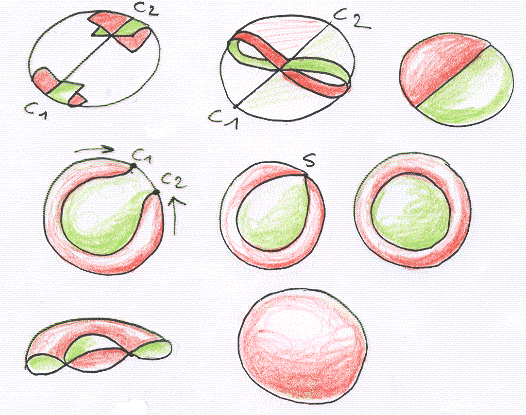
It is simply an immersion of a sphere, with two cuspidal points. If they are made to converge toward a single point, one obtains a self-intersection line that becomes a circle. And one obtains (at the bottom right) an immersion of the sphere that we only have left to transform into its standard embedding. We can also give a polyhedral representation of this surface:
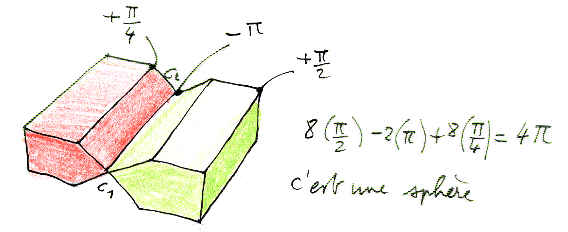
It is a two-sided surface whose total curvature is 2p.
In short, one can have a lot of fun with these "summersions". Let us consider an immersion of a torus obtained by rotating the "infinity" symbol around an axis:
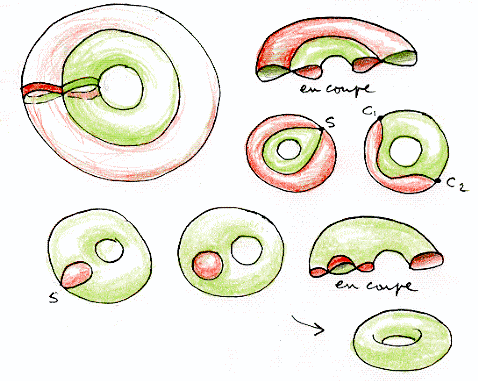
The technique of making cuspidal points converge into a single point allows us to arrive quickly at the standard embedding of the torus, as explained above in the successive drawings.
But things do not always turn out so easy and obvious. Take for example a sphere squeezed between two segments which, this time, are shorter than the diameter. We again obtain two cuspidal points.
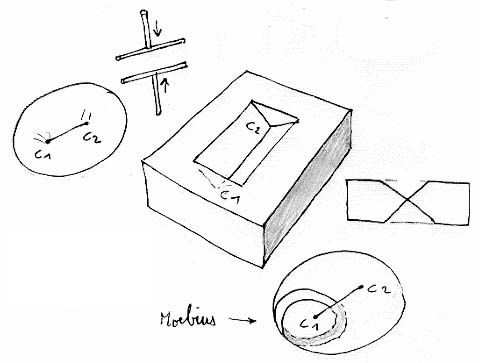
Since this surface contains a Moebius strip, it is one-sided. We have placed next to it a polyhedral representation that allows its total curvature to be calculated. We then find zero. If I am not mistaken, it should then be a Klein bottle. Generally only the classical immersion of it is known, in which the self-intersection line is a simple circle. But there are others, like this one here. I confess that I have not yet found a way to transform it into a usual Klein bottle. On the other hand, I do not even know whether this "immersion" and the classical one belong to the same homotopy class (for the sphere, for example, there is only one). A priori, it is not said: the torus can in fact be immersed in four different ways in three-dimensional space, which cannot be transformed into one another by a regular homotopy. While waiting to discover whether or not it is possible in this case, I had fun transforming it by creating two additional cuspidal points, thus obtaining two Cross Caps connected by a tube. By decomposing them, one finds that the Euler-Poincaré characteristic is zero.
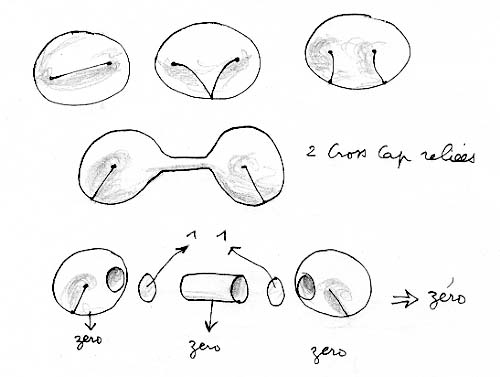
This strange surface should transform into one of the 4 possible immersions of the Klein bottle, but which one? In any case, here is one obtained by rotating an 8 around an axis, while it itself meanwhile performs a half-turn on itself:
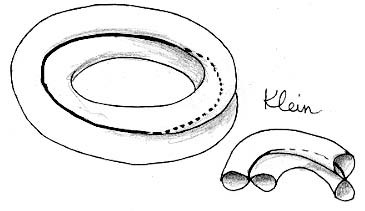
Back to the index "Transformation of a Cross Cap into Boy "
Back to the Novelties section Back to the Guide section Back to the Main Page
Number of visits since 25 Nov 2004:
27 September - 25 October 2003 {#section-10}
How to transform a Cross Cap surface
into a Boy surface (right or left, as you choose)
passing through the Roman Steiner surface.
Italian: Andrea Sambusetti, university of Rome
27 September - 25 October 2003
page 4
We present the model from yet another point of view:
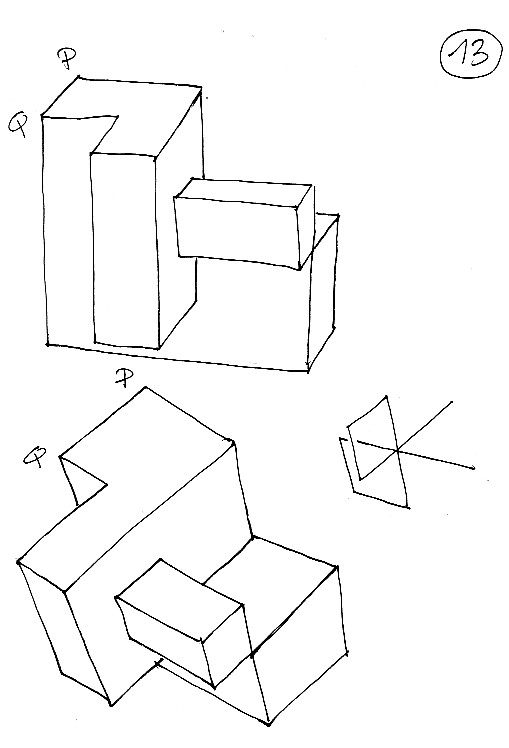
Plate 14: we always repeat the same operation, creating the third "ear" of the self-intersection curve. In the polyhedral model, the latter has the form of three squares with a common vertex: the triple pointT.
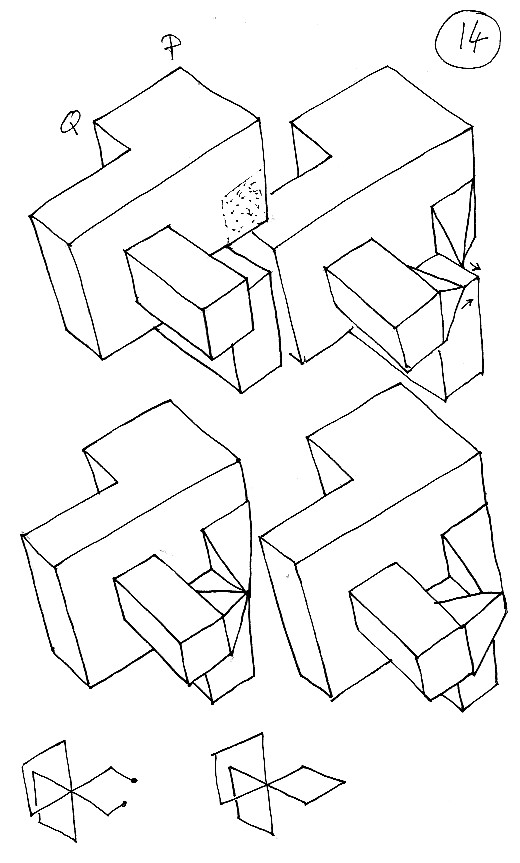
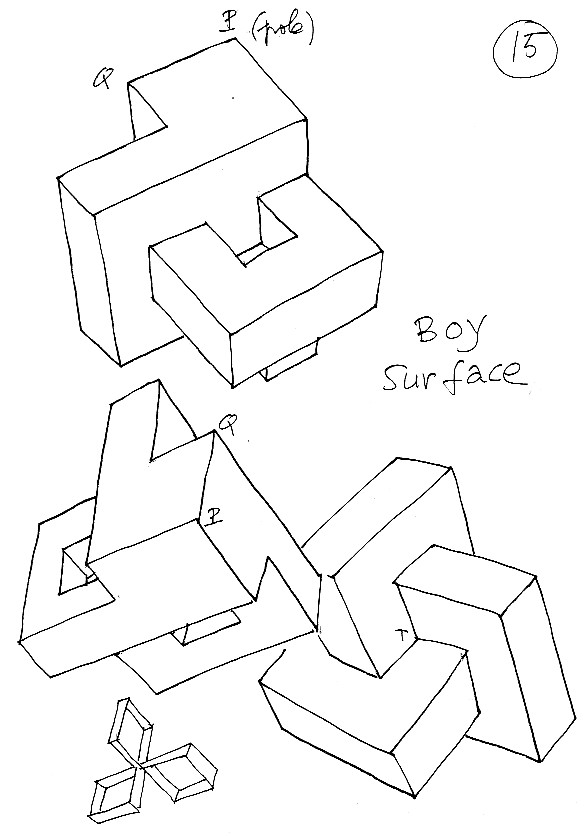
Plate 15: by rotating the object you will find again the polyhedral version of the Boy surface that I had presented in the Topologicon (where you can also find an assembly plan that allows you to build it).
Last plate: I tried to illustrate the Steiner surface as it twists and transforms into a Boy surface.
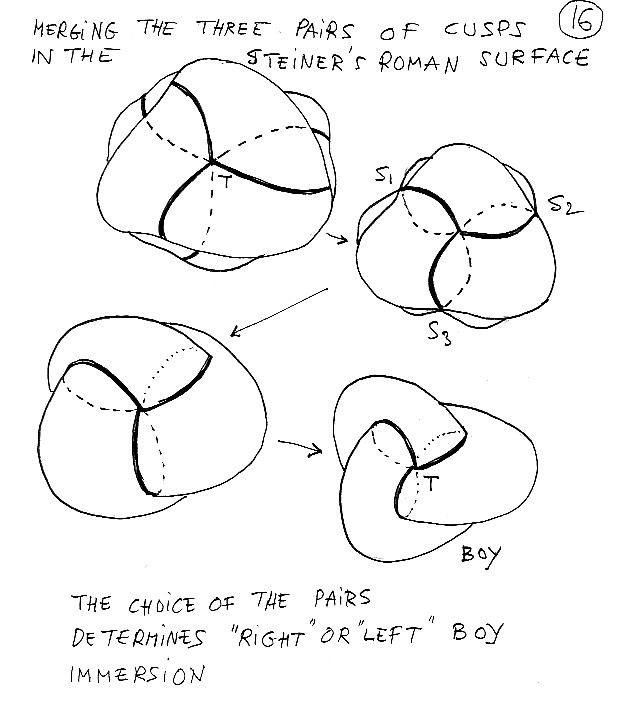
We see that, drawn in "rounded" form, it takes quite a bit of practice to understand it. Our eye is very uncomfortable when it comes to understanding an object for which, on one and the same line of sight, more than two sheets overlap. Hence the interest of the polyhedral model, which brings within anyone's reach, if only one tries to build the models oneself, transformations considered complicated in geometry. Let us note in passing that, depending on the pairs of cuspidal points chosen, one obtains a "right" or "left" Boy surface (completely arbitrary definitions). The projective plane immerses itself in space through two mirror "antiautomorphic" representations. We therefore also see that one can pass from a right Boy surface to a left Boy surface through a "central" model which is the Roman Steiner surface.
It would undoubtedly be nice if these drawings were published in magazines like Pour la Science or La Recherche. But for twenty years publication in these magazines has been "forbidden" to me because of ufological deviationism. Thank you, Messrs Hervé This and Philippe Boulanger. I have lost count of the articles of this kind that I have proposed to these magazines and that have been kindly rejected. One ends up getting used to one's status as an excommunicate.
As an anecdote, there exists a "d'Alembert prize" intended to reward the authors of popular mathematics books. The story was told to me by a member of the commission responsible for deciding to whom the prize should be awarded (there are anyway questions of money behind it). Dialogue:
-
In short, why don't we give the prize to Petit? He has written remarkable works such as the "Géométricon", the "Trou Noir" and the "Topologicon".
-
Yes, but he didn't just do that.
-
What are you alluding to?
-
He also wrote the "Mur du Silence".
-
Ah, well, then....
Well yes, the "Mur du Silence", published in 1983, is an album dedicated to MHD. And, as each of us knows, this corrosive science has the merit, or the defect, of allowing flying saucers to move at supersonic speed without making a Bang.
« Cachez cette science, que je ne saurais voir »
I have in my boxes a magnificent version of the "turning the cube inside out", which is not the polyhedral version of Morin's variant. All my own work. One of these days....
October 22, 2003: We don't rush too much on these pages, if I am to believe the counter. On Monday, October 13, 2003 I gave a seminar at the CMI (Center for Mathematics and Computer Science of Château-Gombert-Marseille) at the invitation of Trotman. On that occasion I was able to bring out a collection of about thirty cardboard models, of which one day you will be able to enjoy the first fruits, since they were photographed by Christophe Tardy.
When one gives a seminar, a certain atmosphere is created. In the photo below, here is a geometer expressing his perplexity.
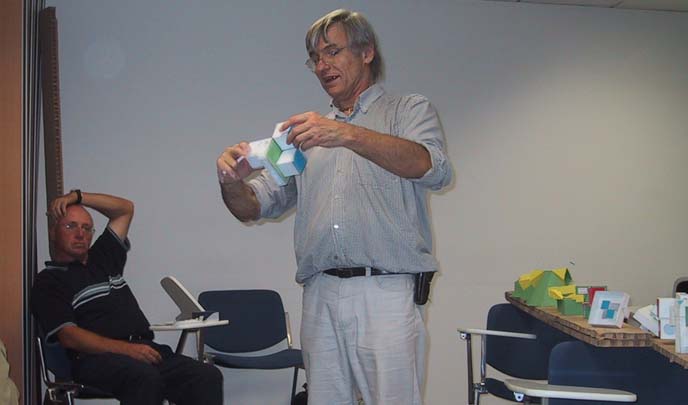
In the background, some of the models exhibited with the help of my long-time collaborator, Boris Kolev, a member of the department, also a geometer. At a certain moment I asked the question:
- How many of you have already seen a Roman Steiner surface? Raise your hand.
No one had ever seen it. It therefore seemed useful to me to present this object, with a virtual reality program, on the laptop I had with me, a program made with the help of Christophe Tardy, an engineer, and Frédéric Descamp, of the Laue Langevin Institute of Grenoble (ILL). Obviously this presentation disconcerts the audience, little accustomed to seeing mathematical surfaces twirl at will.
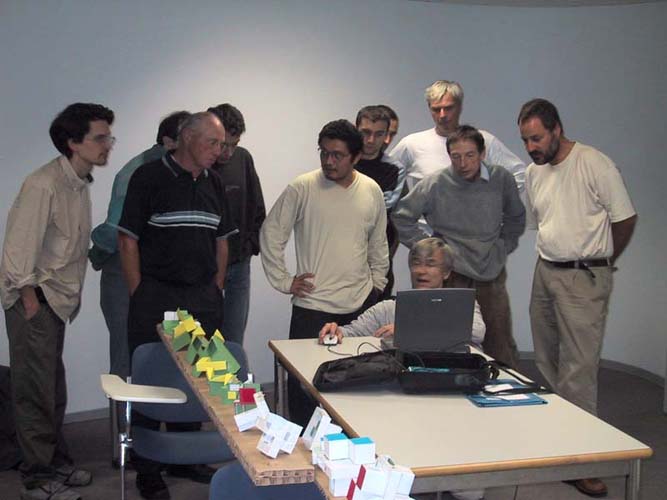
Two cardboard boards, visible in the foreground, made it possible to present the whole succession of models in their logical order. The green and yellow models illustrate, in polyhedral form, the essential tool for creating-dissolving a pair of cuspidal points. The most distant white object is a polyhedral version of the Cross Cap surface, which first transforms into a polyhedral version of the Roman Steiner surface, then, a meter further on, at will, into a "right" or "left" Boy surface.
The analysis of the models brings out various observations in the audience. One of the geometers asks:
- If it is true that, following the models in this order, one can pass from the Cross Cap surface to that of Boy, it seems that, following the opposite procedure, one can transform a Boy surface into a Cross Cap.
I answer in the affirmative. Emboldened, my interlocutor adds:
- Then, if having reached the stage of the Roman Steiner surface one stops, it should be possible to return to a Boy surface, but reflected with respect to the initial one.
I agree a second time. But, unfortunately, no one will volunteer to give some clarification on this strange world in which immersions of closed surfaces are allowed to have cuspidal points, created or dissolved in pairs, whose whole constitutes a kind of extension of the world of immersions. The term "submersion" seems suitable to me. If a reader is capable of giving some clarification, he is welcome.
Curvature concentrated at a cuspidal point.
We will calculate it by summing the angles at the vertex and comparing this sum to the result obtained in the case of the Euclidean plane: 2 p .
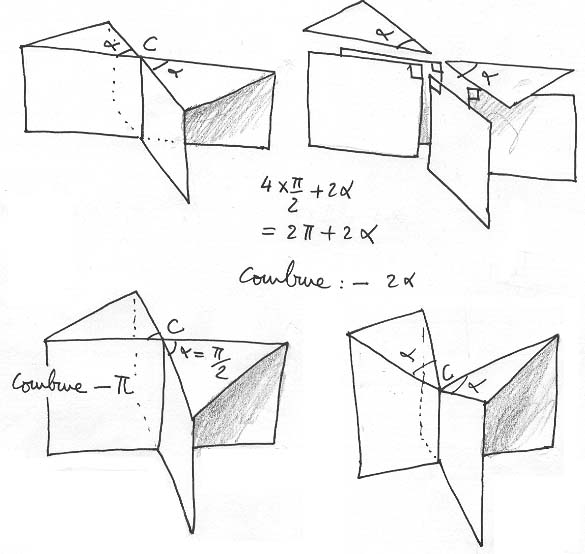
At the top left you can see one of the many possible polyhedral representations of a cuspidal point. By "dismantling" the surface one arrives at a sum of angles that exceeds the value 2p by 2a . One deduces that the angular curvature concentrated around this point C is - 2a. If the angle a is equal to p/2 then the negative curvature is worth -p (figure at the bottom left). In fact, the curvature of a cuspidal point can assume infinitely many values. At the bottom right we accentuate the angular sum and the curvature then becomes < -p (we have increased the negative curvature).
Operating in the opposite way, we can arrive at a rather surprising situation: we can arrange for the (angular) curvature concentrated at C to be ... zero:
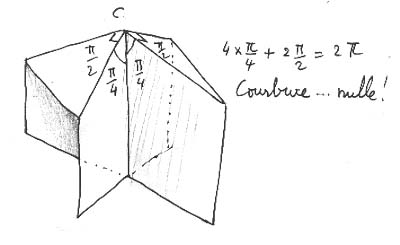
Let us now start from a polyhedral representation of the Cross Cap surface in which two cuspidal points appear, each of curvature equal to -p:
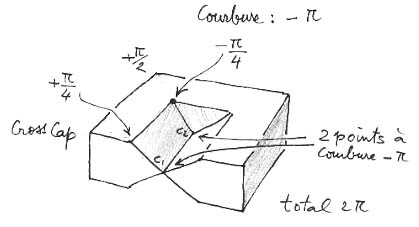
In this figure there are eight corresponding "posiconi" of value + p/2. We add four other "posiconi" of curvature + p/4 and four "negaconi" of curvature - p/4.
Plus the two cuspidal points of curvature - p .
Total: 2 p
Dividing the value of this "total curvature" by 2p we find again the value of the Euler-Poincaré characteristic of any representation of the projective plane (or of the Boy surface).
During the lecture I evoked the art and the manner of permuting the two cuspidal points of a Cross Cap surface by using the turning inside out of the sphere. I no longer know if I put this thing somewhere on my site. It is such a tangle. I will have to look, otherwise I will add it. It is fun. The fact is that this operation did not please at all one of the people present at the seminar:
- I don't see why Petit makes use of so much apparatus to demonstrate the symmetry that links the two cuspidal points of a Cross Cap. It can be done much more simply.
And he drew on the blackboard the picture of a sphere flattened between two rulers that touch each other and that effectively gives a set of self-intersection in the form of a segment at whose ends are two cuspidal points, like the Cross Cap surface. Unfortunately, and the gentleman in question noticed it, this is not the Cross Cap surface.
- Devil, but what is it then? Asked someone.
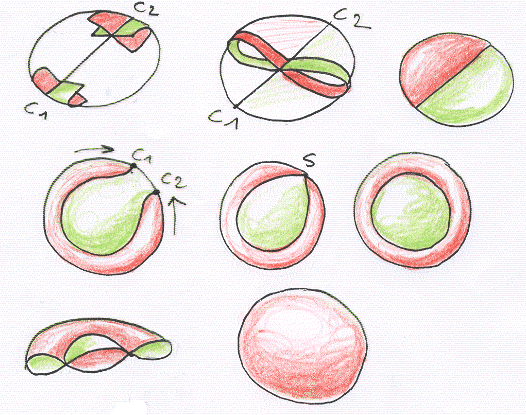
It is simply the immersion of a sphere, with two cuspidal points. If they are made to converge toward a single point, one obtains a line of self-intersection that becomes a circle. And one obtains (at the bottom right) an immersion of the sphere that we only have left to transform into its standard embedding. We can also give a polyhedral representation of this surface:
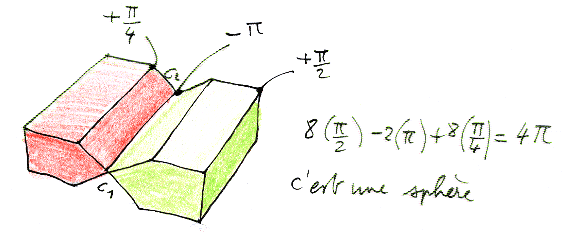
It is a two-sided surface whose total curvature is 2p.
In short, one can have quite a lot of fun with these "summersions". Let us consider an immersion of a torus obtained by making the "infinity" symbol rotate around an axis:
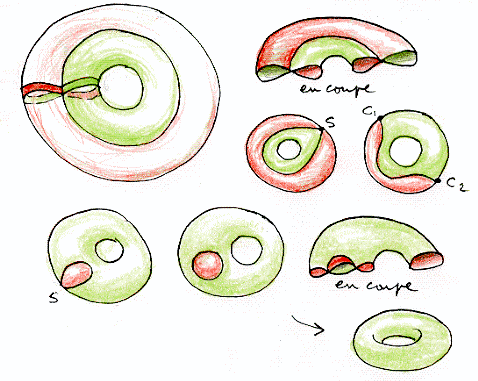
The technique of making cuspidal points converge into a single point allows us to arrive quickly at the standard embedding of the torus, as explained above in the successive drawings.
But things do not always turn out so easy and obvious. Let us take for example a sphere flattened between two segments that, this time, are shorter than the diameter. We again obtain two cuspidal points.
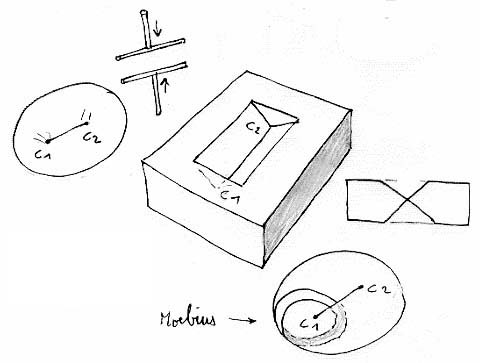
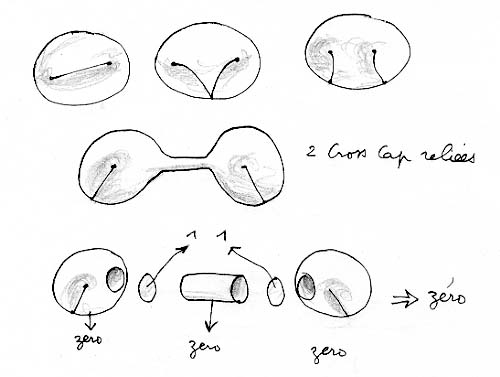
Since this surface contains a Moebius strip, it is one-sided. We have placed next to it a polyhedral representation of it that allows its total curvature to be calculated. We then find zero. If I am not mistaken, it should then be a Klein bottle. Generally only the classical immersion of it is known, in which the line of self-intersection is a simple circle. But there are others, like this one here. I confess that I have not yet found the way to transform it into a usual Klein bottle. On the other hand, I do not even know whether this "immersion" and the classical one are in the same homotopy class (for the sphere, for example, there is only one). A priori, it is not said: the torus in fact can be immersed in four different ways in three-dimensional space, which cannot be transformed into one another by means of a regular homotopy. While waiting to discover whether or not it is possible in this case, I had fun transforming it by creating two additional cuspidal points, thus obtaining two Cross Caps connected by a tube. Decomposing them, one finds again that the Euler-Poincaré characteristic makes zero.
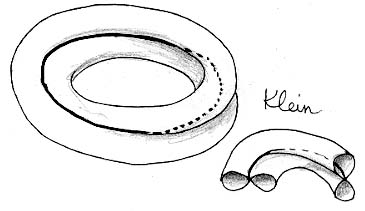
This strange surface should transform into one of the 4 possible immersions of the Klein bottle, but which one? In any case, here is one obtained by making an 8 rotate around an axis, while it itself meanwhile performs a half turn on itself:
Return to the index "Transformation of a Cross Cap into Boy "
Return to the Novelties section Return to the Guide section Return to the Main Page
Number of visits since 25 Nov 2004:
Original pages: crosscap_boy0_it.htm, crosscap_boy0_it.htm, crosscap_boy1_it.htm, crosscap_boy1_it.htm, crosscap_boy2_it.htm, crosscap_boy2_it.htm, crosscap_boy3_it.htm, crosscap_boy3_it.htm, crosscap_boy4_it.htm, crosscap_boy4_it.htm