J.P. Petit on a test rocket. Istres, 1964.
Why has a living species, mankind, developed sophisticated technology? To spread out, to one day enable interstellar travel. Why has it been endowed with consciousness? It’s a regulatory mechanism, meant to allow it to reflect on the long-term consequences of its actions, in order to control this technology. Thus, mankind’s purpose, its “sufficient reason” is to be the driver of a “carriage” destined to transport life to other star systems than our own. But is mankind the passenger of this cosmic vessel? Might this “passenger” actually be a member of a future species emerging from humanity, like a root species—just as humans themselves emerged from a simian species? Such an emergence seems imminent. Have extraterrestrial peoples already passed through this stage, becoming as different from us as we are from our distant cousins, the monkeys? Are we comparable to monkeys vis-à-vis visitors?
March 6, 2005
When one looks at Earth with “Sirius’s eye,” one sees ethnic groups fighting each other. In poor countries, the population grows rapidly, simply because the more children one has, the greater the chance that one’s old age will be cared for by offspring. In India, in Benares, there are two thousand widows who have found no family members or new husbands willing to care for them. They came to Benares not because the city offers better social services than elsewhere in India, but simply to die... of hunger and despair amidst general indifference, given local beliefs. Things will probably get better in their next incarnation.
The opposite phenomenon occurs in rich countries.
What’s interesting is comparing ideological-religious platforms. We won’t go into details, but what must be noted is that vast ethnic groups live with very different conceptions regarding the afterlife and, generally, the meaning of life. None seem capable of producing a rational, convincing vision. We live in a swamp of beliefs. At its center lies the epistemosphere, the island of science; this too, like all thought, is merely an organized system of beliefs. All we can say is that the scientific world doesn’t seem to fare any better than others. It gives rise to aberrations, such as enabling a sixty-year-old woman to become a mother by receiving a fertilized egg from another woman into her uterus. Logically, this should be record-breaking. One day this figure may increase. Science without conscience is merely ruin of the soul.
Has science become a “counter-natural” or “anti-nature” activity? It certainly seems so. This technoscience increasingly serves industrial wastefulness. If you think about it, the war industry is the quintessential example of a disposable product. Aren’t you impressed when you see a powerful bomber take off from an aircraft carrier carrying several “smart bombs”? It resembles an absolutely staggering waste of oil, raw materials, and labor hours.
Writing these lines, two memories return to me. The first dates back to 1961. I was a cadet officer at the airbase in Caen. Our training cycle required us to become familiar with handling a mortar. I wonder if you’ve ever seen a mortar. It’s a simple tube, fairly thick in diameter—say eight centimeters for the one we used at the time. The tube is aimed and rests on a plate driven into the ground using hooks. You insert the shell, which slides down the tube. At the end of its path, its propellant charge fires automatically. So, two hundred of us lined up, each holding a shell. No aiming needed. Each cadet officer (coming from a grandes écoles) slid his shell into the tube, and boom! We saw the impact a few hundred meters away, on a nearby hill—just a little cloud of dust, since these practice shells were inert, without explosive charge. I remember it was raining. I reflected, thinking that the price of one shell must equal the monthly salary of a beginning schoolteacher. There was a guy beside me, a young engineer from Centrale. I said to him, “Would you like to fire my shell?” He replied, “Yes, why not?” So I handed mine over. When we got near the mortar, the captain noticed I had empty hands.
“But, where’s your shell, Lieutenant?!!”
I pointed to my neighbor, the Centrale engineer.
“He’s got it, Captain.”
“And why so?”
“Well, it seemed he liked firing two shells, his and mine.”
The other nodded in agreement.
“Does that mean you refuse to fire your own mortar shell?”
“I never said that. I’m even ready to fire as many as you wish...”
The Centrale engineer returned my shell, and all was back to normal, under the captain’s suspicious gaze.
The other memory brings me back to that brief period when I was a rocket test engineer at Istres, for six months.
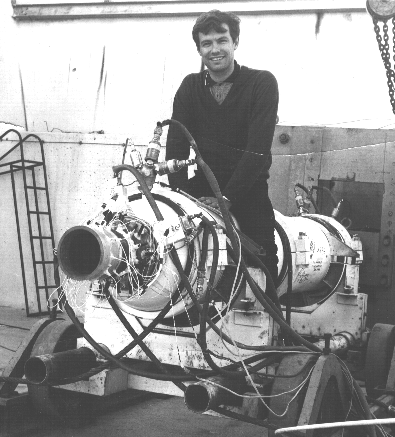
J.P. Petit on a test rocket. Istres, 1964.
That’s just a simple cannon. At Istres, we fired devices containing ten tons of powder, precursors to future MSBS—nuclear submarine missiles. I recall that when these devices fired, I calculated we’d have achieved the same result by filling them with banknotes and ejecting them with compressed air.
Nowadays, we’ve reached a stage where wars serve no purpose, because no one is right anymore. No act of warfare is convincing today. Unless war activity is considered an end in itself economically. That plane taking off drives numerous industries, involves countless subcontractors. It kills people, but saves jobs, in a way. In “The Nerve of War,” we hear American senators “blessing the country’s war industry.” God bless the military-industrial complex.
Apart from this last justification, everything happening on Earth has become utterly grotesque. The epic spirit has completely vanished. History turns in vain; it rehashes old patterns. In short, it lacks imagination entirely.
Personally, I feel it’s time for a historical pause: asking ourselves what we’re doing on this rock, beyond eating and mindlessly reproducing. There must be some sense to it all.
Let’s summarize broadly. On a planet in the solar system, probably similar to a million others in our galaxy, conditions allowed life to appear and develop. How? We really don’t know. Can we say anything about life that isn’t pathetic nonsense? I believe we can, at least analyze the phenomenon of life from a phenomenological angle.
“The biosphere becomes more complex. It tends to expand its relational field.”
We believe life first appeared in the oceans. Let’s accept that. It then produces atmospheric oxygen from CO2 emitted by volcanoes. Thus it shapes conditions for launching a new assault and conquering dry land. Afterward, everything develops. Nature invents sexual reproduction. Plants join in too. At first, spores are dispersed by wind. But at the same time, flowering plants and insects appear. Genetic crossbreeding can then occur over great distances, with insects acting as carriers. Not a bad idea. Later, migratory birds can carry seeds they can’t digest, which, expelled via feces, can grow thousands of kilometers away. Thanks to such a system, plants appeared rapidly on Surtsey Island—the topmost part of a volcanic eruption off Iceland’s coast in the early 1970s. Right after its formation, there was nothing. But it cooled quickly, and in no time at all, plants began to grow.
Plants, insects, dinosaurs, mammals—all appear on Earth. We stand at the top of this evolutionary pyramid. In fact, we’ve just completed a full informational short-circuit on a planetary scale. First we invented writing, then mail, then undersea cable telephone links, finally radio. Today, using a mobile phone, a person on Earth can communicate with another biped like himself.
Yes, but what next?
Other planets in the solar system? Hardly interesting, quite inhospitable. So, is this the end of history? We could decide to stop here, declare interstellar travel impossible for humans. I won’t bore you with the usual spiel about light-years, Special Relativity, etc. Clearly, neighboring systems are far, very far away. The Pioneer probes we painstakingly launched out of our solar system will need 30,000 years to reach the nearest star. And there’s no guarantee there’s anything worth reaching there.
This leads to the peculiar phenomenon of UFOs. Here, it’s either:
“It’s all nonsense”—or “We have neighbors who’ve figured out a way to make this journey.”
I lean toward the second option. I’ve written books on this. If the universe has a twin, then the speed of light might be much higher there—perhaps dozens of times higher than here. We could thus use this second spacetime as a sort of “express metro,” provided we find a way to perform a “hyperspatial transfer.” I won’t bore you with this. I’ve published and written enough on this topic; I’m inclined to believe this is not only possible but might happen within a few decades of our scientific and technological history. I’m convinced we’re on the verge of a new leap in scientific concepts, equivalent to that at the start of the previous century, whose technological fallout we’re now exploiting. A genuine paradigm shift.
Imagine yourself in 1900, trying to convince someone of that era that one day we’d create bombs capable of vitrifying an area the size of the Paris Basin, or that we’d drive from Paris to Marseille in three and a half hours, or fly from Paris to New York in the same time. Or that one day we’d set foot on the Moon. They’d laugh at you.
I rewind my story. I assume interstellar travel could become possible in a few decades. How? Thanks to technology.
I reverse the question:
“What can technology do that living beings cannot?”
“Answer: interstellar travel.”
Assuming that the desire to communicate over ever-increasing distances is a fixed idea in the world of life—if not its central project, at least one facet of the project called “Life.” If life “seeks to expand its communicative field” (here I reveal a resolutely teleonomic stance), then the development of technology, pushed to extremes, becomes a necessary step. Perhaps that’s all it’s for. At some point, a root species would give birth to a bipedal human, with unfused skull bones at birth (a neotenic being), etc., etc...
I don’t believe in gradualism. Too many missing links. What triggers this... emergence? God? Don’t make me say that. We’ll discuss it later, if you wish. Let’s stay speculative and phenomenological. Animals possess rudimentary technology. Without swallowing stones and storing them in their gizzards, a chicken couldn’t crush the grains it eats. There are crabs that camouflage themselves by sticking any inert object onto their shell with mucus. If they didn’t do that, they’d be spotted and eaten. Etc...
Thus chickens and crabs possess technology, living in symbiosis with the... non-living (the word “symbiosis” may be ill-chosen).
Technology extends life. Humans have simply pushed this limit to cosmic distances. But technology carries risks of self-destruction: pollution, nuclear weapons, playing at sorcery with genetics, etc. Thus, still from a teleonomic viewpoint, for the planet to have any chance of functioning, this intelligent animal must be endowed with a trait allowing it to counter these threats. Animals are intelligent, in that
“Intelligence is the ability to modify strategy for a given purpose, to ‘create code,’ as a computer scientist would say.”
We’re almost there now (adaptive robotics, used exclusively for military purposes). What allows us to control the process, as my friend Alain would say, isn’t intelligence but
“Consciousness, in that this attribute allows one to reflect on the long-term consequences of one’s actions.”
In us, it’s still in its infancy.
Am I right? I have no idea. But it makes sense. It’s an idea. It would explain today’s bustling activity on our biosphere. We believe technology serves to make Kalashnikovs, cars, and vacuum cleaners. In reality, its true purpose is interstellar travel. In my view, evolution is accelerating exponentially. It starts with nuclear energy, then mastery of antimatter synthesis and storage. I wrote a book where I discussed this. To achieve interstellar travel, you need plenty of energy—but not much more than we currently produce, albeit somewhat uncontrollably. To cross the Atlantic by plane, we first had to invent gasoline. The rest followed swiftly, admit it. It took decades—half a century, say.
We have neighbors watching us. Imagine you lived near a continent, separated from inhabited coasts by a few hundred kilometers. Suppose this continent is populated by various species, including “less developed” humanoid creatures unaware of your existence. Members of this species habitually kill each other nonstop. They have stone axes, know how to make fire. Recently, they’ve begun venturing onto the ocean using rafts. Would you teach them the basics of sailing? It’s quite possible to travel thousands of kilometers on a raft fitted with fins (the “guara” of ancient Peruvian pre-Columbian boats). But if you did so, this species would wreak havoc on nearby islands. Eventually, succeeding in visiting you, they might learn enough about your technology to one day be able to confront you. They’re thus potentially dangerous.
Of course, with a few well-placed bombs or a dose of smallpox bacteria (as the British did to Native Americans and New Zealand Maori), you could wipe out this violent, unruly population. But ultimately, you wait. There’s a strong probability that this species, upon discovering new technologies, will simply bring about its own destruction before any high-seas sailing vessel is built there. The problem resolves itself without your hands getting bloody.
That’s just an idea, mind you.
Imagine that Earth’s peoples understand in time the “plan”—what their activities over hundreds of thousands of years have amounted to. We can always dream. This requires a paradigm shift. One must conceive of a universe where two entities, a physical world and a meta-world, a physical and metaphysical realm, co-evolve, with life and consciousness situated at the interface between these two subsystems. A complex universe, in the mathematical sense, where objects possess “a real part and a purely imaginary part.” Objects with a strong real component and weak imaginary component constitute what we rightly call “the real”—the inert, lifeless. Stones on paths seem to have little feeling, presumably. Conversely, we have the world of ideas, feelings, imagination (it’s natural that imagination plays out in an ... imaginary world, populated by particles of imaginary mass, etc.). When something isn’t real or “realistic,” don’t we say “it’s just your imagination”?
“Sometimes the random choice of words isn’t random at all.”
This implies that various ethnic groups must realize their metaphysical conceptions are merely kaleidoscopic facets of a broader, less obvious reality where nobody is entirely right nor entirely wrong. In fact, the metaphysical views of different peoples are merely culturally shaped images of structures, aggregates of meta-matter in the metaphysical world. Transient aggregates, at that. In the afterlife, gods fight and eat each other, entity against entity, egrégor against egrégor. Hindus accept this. Monotheists confine theirs in psychological “fortresses,” practicing isolationism.
So, does God exist?
For a Buddhist, the question is meaningless. I see things differently:
“We create our gods and our gods create us.”
Suppose suddenly humans realize they appeared only to fulfill the next phase of the plan: making interstellar travel possible. Immediately a question arises:
“Is mankind the passenger of the forthcoming cosmic vessel or... its driver?”
Why should we be the ultimate endpoint of the evolutionary scheme? Why are Yves Coppens and Hubert Reeves the most elaborate products of life? And what if there are other beings “in gestation” within our human species, which became the root species after emerging from a less advanced simian group?
Quite a blow to our egos!
Have other beings already passed this stage? In other words, are we “their monkeys”? And if so, how can these decent folks communicate with us? What can you expect from communicating with chimpanzees? (See in The Year of Contact the chapters on communication with non-humans, upwards or downwards, via a “computerized protocol interface,” the theme of the book.) At best, you could manipulate them, immerse them in experimental protocols. But don’t hope to share your feelings or... share theirs.
We might be in such a situation vis-à-vis observers from distant systems, whose fearlessness baffles us. We’d be... sort of monkeys, believing ourselves human, the good drivers of vehicles they’ll someday build to allow another species—of which we’ll form the “nest”—to fully play its role as exchange agents, ambassadors between star systems. Good humanoids to whom they’d say:
“Alright, thanks guys. It nearly went wrong but you pulled it off at the last minute. Now it’s time for the next ones to act. Those are the ones we’ve been eagerly awaiting, and they’re appearing now. Naturally, flowering plants appeared at the same time as insects. You and your ships are the equivalent of insects, and these humanoid beings are the ‘pollen’ of your human society. They and you aren’t genetically compatible. Naturally: they’re compatible with their counterparts in other systems. They’re designed for that. Don’t expect to understand them, these sons of men. They’re designed to ensure development, to extend the communicative field on an interstellar scale, to let the Great Plan proceed, at the end of which the Universe will become a gigantic living, conscious being. For you, we’ve prepared a reserve, with lots of video games to amuse you. So you won’t feel deprived of space, we’ve crafted a nice artificial reality for you (see the movie Matrix).”
Here I suspend my tale. I’ve long wanted to tell this. Now I must advance the development of the mathematical physics model I envisioned, an extension of what we recently published, based on real group theory. The next model uses complex groups and introduces a “double reality” with a real facet and a purely imaginary facet—marking the beginning of formulation in a complex variety. We must move to “complex groups.” In my view, this opens a research field involving four types of matter (or energy), as calculations show:
- m , - m , + i m , - i m
Positive and negative matter obey physical laws; purely imaginary matter follows metaphysical laws. All this must be published, as there are already completed studies, though we must recognize this is only a first approach, a rough sketch.
Science cannot ignore the metaphysical aspect of being, of existence. When it neglects this “component,” it limps forward on one leg alone. Consciousness exists; it helps determine our actions. It can’t be reduced to a formalization within our current physics. It’s not the result of enzymatic reactions nor an expression of chaotic processes. An entire realm of knowledge eludes us; it’s absurd to write, as Edelman, Nobel laureate in neuroscience, once did:
“I’m convinced we’ll one day create thinking, conscious robots.”
The approach must be a difficult blend of modesty and audacity, but:
Fortune favors the bold.
Back to News Back to Guide Back to Home Page
Number of visits to this page since March 7, 2005: