The Japanese earthquake of March 2011
The lesson of Fukushima:
Nuclear, suicidal, manual
March 14, April 13, 2011
April 13, 2011: We have been able to read, see below interviewof Thierry Charles, Director of the French Institute for Radiological Protection and Nuclear Safety, to journalist Antoine Bouthier, on April 12, 2011, for the newspaper le Monde. Open your eyes, read and reread. Despite the spectacular degradation we could observe on the high-resolution photos taken from an unmanned aircraft (a small Japanese private company), everything can be recovered. The situation is under control. In a few weeks or months, it will just take a good washing and a good tune-up and the inhabitants will be able to return to their homes. I am not making this up. Read it for yourselves.
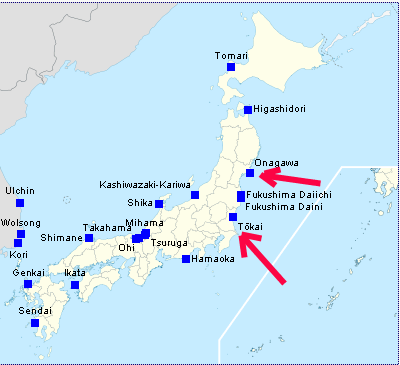
****http://www.independentwho.info/Presse_ecrite/11_03_26_LeMonde.fr_FR.pdf
****Documents on this subject, in English
****http://www.liberation.fr/economie/01012331339-a-iwaki-sous-la-menace-de-l-atome
********The MOX and the MOX money
| April 14, 2011: | An article by Christophe Perrais, in Agoravox (in French) |
|---|
April 13: The Japanese network NHK reports that the temperature in the pool of reactor number 4, which contains several tons of "used fuel", is increasing, and now reaches 90°C. These elements are under 2 meters of water (instead of the usual 5 meters). If this level were to drop, and if these elements were not cooled, it could be expected that radioactive waste would contaminate the atmosphere. This increase in temperature reveals that the assemblies are activated.
Source: http://www3.nhk.or.jp/daily/english/13_35.html
April 13: TEPCO tries to reassure the population by saying "that most of these assemblies (which were at high temperatures when the pools ran out of water), "have not been damaged"
Source *: *http://www3.nhk.or.jp/daily/english/13_37.html
The truth is that they have no idea of the extent of the damage. ****
http://fr.wikipedia.org/wiki/Liqu%C3%A9faction_du_sol
http://www.youtube.com/watch?v=Wi-ka8fhrhQ&feature=related.
| E | n
| some regions strongly affected by the earthquake and its aftershocks, there have been cases of deep soil alteration, even reaching the appearance of the groundwater on the surface. This curious phenomenon involves "soil liquefaction and fracturing". The population watches this with great emotion. | Video | : |
|---|
I have seen that Nicolas Hulot (French ecological journalist) had decided to run for the presidential elections and was seeking to be nominated by the Europe Ecological movement.
A leading figure of media journalism, Hulot could bring a change to French politics. However, ecologists would need to understand that it is impossible to "launch renewable energy projects that are profitable in terms of investment return".
The scale of such projects far exceeds the investment capacity of private companies and their short-term profit imperative.
These projects must take the form of LARGE WORKS with massive state funding, and ensuring immediate employment.
This does not mean replacing nuclear energy "progressively" over several decades, but rather considering the replacement of nuclear energy and fossil fuels within less than ten years. Perhaps even five. For all developed countries, energy needs amount to tens of thousands of megawatts. The solutions, mentioned in the article to be published in the May 2011 issue of the magazine Nexus (16 pages), would include, among others, the development of an immense offshore solar project, on boats that, once assembled, would constitute real cement islands of tens and later hundreds of square kilometers.
Obviously, and in the short term, it would not be possible to compare the price of a kilowatt-hour with current costs. In fact, if we reason in terms of budget, this operation on a planetary scale would represent a mobilization of capital, human resources, and raw materials equivalent to the cost of a third world war.
A "Green War", the first one, of man against his greed and his folly
The question we need to ask:
How much does a life cost?
(to be continued...)
In some regions strongly affected by the earthquake and its aftershocks, there have been cases of deep soil alteration, even reaching the appearance of the groundwater on the surface. This curious phenomenon involves "soil liquefaction and fracturing". The population watches this with great emotion.
Video
April 11, 2011:
Some readers may have been surprised to see that this page changes its title as the weeks go by. Initially, I had put the title "We need to get out of nuclear" because I still had the hope that cutting-edge technologies could bring solutions, such as neutron-free fusion
Boro +
Hydrogen. This technology represents a fantastic advancement made in 2006 by the team of Chris Deeney from the Sandia Laboratory, New Mexico. This work was later analyzed by the Englishman Malcolm Haines, a pioneer in Plasma Physics. The article, published in 2006 by the journal Physical Review Letters, had the title "Over two billion degrees" (more than two billion degrees). I immediately started working on this article and a few months later published a fairly detailed analysis of the article.
In September 2008 I attended a Colloquium in Vilnius (Lithuania) on high power pulsed where I had a long conversation with Keith Matzen, in charge of the Z machine, and where the result published in Physical Review Letters had been obtained. The Z machine was followed by the ZR (Z "refurbished") machine, which works with currents of the order of 18 million amperes. My surprise was great when I heard from Matzen and his assistant Mac Kee that the aforementioned publication was false and that Haines had made a mistake in analyzing the spectra.
Why didn't Matzen publish a correction? "To not discredit Haines further"
Who is going to believe this story?
I asked Gerold Yonas, scientific director of the Sandia Laboratories (whom I had met personally in 1976 when I visited the laboratory), who replied, "I am concerned about this situation. I will ask Matzen to publish a correction."
It has not been done to date.
In October 2008, Sytgar, who was supposed to present the results of the ZR machine at the Colloquium in Korea, where I was present, said he could not come. The excuse: "his father was very ill". However, after asking the organizers, I found out that he had not even registered for the Colloquium. Curious for someone who, among 18 signatories of the communication, was supposed to present the results at the most important international colloquium on Z machines.
After Oliver, from Sandia, had told the session president that Sytgar would not come and that this session was declared closed, Oliver quickly came to me and told me that I had to stop talking nonsense, that Haines had made a mistake and that was it. When I asked why and where he had made a mistake, Oliver told me that Sandia "would publish a correction in 2011".
I bet whatever you want that this correction will never appear. Haines has not made a mistake in the analysis of the experimental data or in his calculations. It is impossible to deny these two aspects, impossible to provide scientific arguments that can destroy this statement.
So what?
The Americans are misinforming, because this result should not have been published. If nuclear fusion that does not contaminate (producing helium atoms as "ash" from the combustion) represents a fantastic hope for humanity. But it is also the key to new "pure fusion" bombs. The fusion reaction can be initiated by an MHD (Magnetohydrodynamic) compressor and not by an A bomb (or fission bomb), which cannot be miniaturized due to the problem of critical mass, which imposes a lower limit on the fission process, and which is achieved through explosions of several hundred tons of TNT.
These compressors were invented by the Russians in the 1950s. I explain all this on my site (&&& I will put the links, since I burned a hard drive).
On the trip I made to Brighton in January 2001, I met some Americans working on "black programs". They totally amazed me because the only thing that interested them in the UFO file was the possibility of conceiving new weapons based on new concepts: hypervelocity MHD torpedoes, hypersonic airplanes equipped with "MHD controlled" air inlets.
At that time, the shock was violent. But after this event of aneutronic fusion and its immediate orientation towards military applications, I don't have any illusions. These bombs can be miniaturized. And therefore ... they can be used. Moreover, if one chooses a Boron-Hydrogen formula, one obtains a ... "green bomb".
This disgusts and depresses me.
I will go further. Current scientists have no awareness. They are bought for a piece of bread. I remember an issue of the CNRS Mail where Charpentier, then Director of the "Physical Sciences for Engineers" Department, wrote: "The army does not have enough research contracts to satisfy what the researchers ask for."
We discovered genetic manipulation techniques? After a short moratorium, here we have GMOs. Researchers develop medicines based on "new molecules", patented, of course. The World Health Organization launches a vaccination campaign that has resulted in vaccinated people contracting diseases. The agri-food industry mixes additives into our food that cause our health to deteriorate. Agricultural research turns a blind eye to the dirty motives of fertilizer and sterile seed sellers.
The mining engineers of the "Mining Corps" created an atomic empire in France. You can read the internal report
Soon we will have nuclear waste in construction materials, in containers, etc.
In the scientific field? Nothing, for decades. Theoretical physicists knit socks for winter with superstrings. In the CERN particle accelerator in Geneva (LHC), the Higgs boson hunters return with their tails between their legs. In Carache, the nuclear bosses promise us the "Sun in a test tube", after launching a 1.5 billion (10) euro project (ITER), in the middle of a technological fog, which guarantees them a scientific career in an absurd country, at the end of which they can say "oh, we were wrong".
Perhaps they will apologize, like the Japanese technocrats, to a society that pays the price of their ignorance and irresponsibility.
The press, the media? They are under control, or blind or deaf. They dedicate articles to "call girls", prostitutes elevated by the media to stardom. Why not make these girls ministers, since we have ministers who prostitute themselves every day?
Philosophy? Bernard Henry-Ley invented disposable thinking, like an empty bottle. In these times when metaphysics is in crisis, café philosophy is doing marvelously.
Along with some engineer and technical friends, we are writing an article on the exploitation of renewable energy. It is going well. In addition, it is evident that we must end the production of energy based on reactors, since it has become a murderous madness. We must demand that this decision be made now. Only the people, and not their corrupt representatives, can make this demand, provided we can offer a "Plan B", an exit strategy, that has nothing to do with the banking projects of our decadent ecologists.
We must demand an immediate halt to the "recycling of nuclear waste" at the La Hague facilities, which aims to recover uranium and residual plutonium present in the mixtures of "used fuel". We must immediately stop the production of MOX, fuel for nuclear power plants that contains 7% of the most dangerous substance ever invented by man: plutonium. The French use MOX in 20 of their 58 nuclear reactors. We must stop this mess that is the ITER project. We must stop playing with nuclear missiles, used as a deterrent force. We must finally bury these idiotic projects like the so-called fourth-generation reactors. The fast breeder reactors, based on molten sodium or lead, are suicidal projects.
We must dedicate money, energy, creativity to projects that improve the living conditions of human beings, instead of constantly degrading them. For all of this, we need to invest a lot of money, a lot of energy, and a lot of creativity. Interestingly, on this last point, it is not the ideas that are lacking.
We must denounce luxury, praise the sobriety of life, and not be enchanted by the richest, the most powerful, nor worship golden calves or be brutalized by their empty purposes. We must pursue these vain fools who ride in carriages, who build 800-meter-high Babel towers, or ski slopes in the middle of the desert, refrigerated with black gold.
How can one not be surprised that so many disadvantaged or confused people turn to old ideologies of several centuries when the only spectacle we offer them is our violence, our injustice, and our disorders.
April 4, 2011: Jonhatan Bellocine undertook the translation of this page into English
Update from March 20, 2011
Update from March 27, 2011. The IRSN reports from March 25 April 3, 2011: Death under contracto
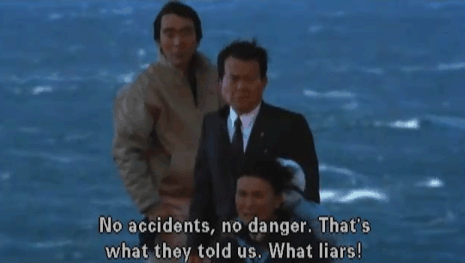
**Accidents could only be due to human errors. This is what we were told. Gang of liars! ** ****April 9: The prophetic film of Kurosawa
****April 9, 2011: The dizzying cynicism of AREVA
****I am setting up benevolent translation workshops for pages like this!

Since March 11, Japan has been bogged down in an unprecedented nuclear crisis.
The Institute for Radiological Protection and Nuclear Safety (IRSN) currently estimates that "the worst is over" but that it will still take "weeks, or even months" before the situation is stabilized at the plant.
When did you realize how serious this accident was?
We started to worry from the first explosion [24 hours after the earthquake]. Initially, we were considering a scenario similar to Three Mile Island.
The fuel had partially melted and there was a loss of cooling, easily manageable.
(...).
But when we saw the explosion, we knew there was hydrogen in the vessel and that the consequences could be very serious.
How do you assess the situation now?
For ten days, the situation has been roughly stabilized.
Engineers are able to continuously cool the reactors with fresh water.
We have found very radioactive puddles under the plant, which could be due to small leaks under the vessels
(?...).
But there is a layer of eight meters of concrete under the reactor, itself built on rock. There is now very little chance that the magma will start to sink into the ground. Moreover, the containment vessel is filled with nitrogen, which is good. This will prevent the formation of hydrogen and minimize the risk of explosion.
The worst is over,
but it is only the beginning of the conquest. The situation will be completely managed when the cooling system is back in operation.
Engineers are moving slowly and they are right to take their time. Especially since they are able to supply the reactors with water without any problem
(?...).
Before restarting the system
(???)
, it is necessary to check all the electrical circuits, the pumps and the water in the vessels, which may contain debris and salt crusts. This can take weeks, or even months.
Why was the exclusion zone expanded?
It was expanded to 30 km. This corresponds to the post-accident zone, where radioactive deposits are observed on the ground. We think it is a reasonable measure. Iodine 131 is a radioelement with a relatively short half-life, it decreases by a factor of 2 each week.
In three months, its level will be completely secondary and the inhabitants will theoretically be able to return.
(so the pollution is only related to short-lived radionuclides)
What do you think of Tepco's management?
You have to put yourself in their place. They had just suffered a huge natural disaster where they potentially lost family members when they had to face an unprecedented nuclear situation, with several damaged reactors at the same time.
Their main mistake was to bet everything on cooling the cores and neglecting the fuel pools at the beginning of the crisis.
With more hindsight, we can analyze how they should have ideally reacted
(...).
How will the authorities shut down the plant?
Once the cooling system is restored, when there is no longer a need to constantly add water to the vessels, the work will far from be over. They will have to clean the entire site, remove the fuel and protect the plant from the wind.
When you see the photos of the site, where several reactors are just tangles of iron and concrete, I would be happy if Mr. Thierry Charles explains to us how the Japanese will manage to "clean the site" and "remove the fuel from the cores and pools". How to access them? ??
They still have to think about the right strategy, which will be different from Chernobyl, where they had to build a sarcophagus.
So, does putting it in a sarcophagus not apply?
Here, the reactor is not open-air. Moreover, we are not safe from another earthquake. We do not rule out the possibility of shocks or new radioactive releases into the atmosphere.
Antoine Bouthier
Simple comment:
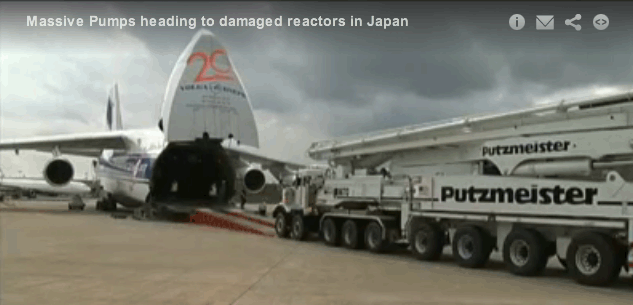
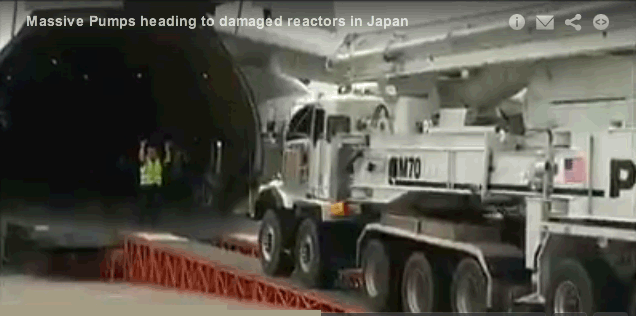
here are the photographs of the high-flow concrete cannon, rented by the Japanese to the Americans (Putzmeister Company), which is being loaded, on the west coast of the United States, in a large Antonov 22 cargo plane, so that this equipment can be transported to Japan.
The giant concrete cannon of the Putzmeister company, loaded in a Russian Antonov 22
Look, on the right, the rectangular opening where the concrete is poured, brought by a "spout"
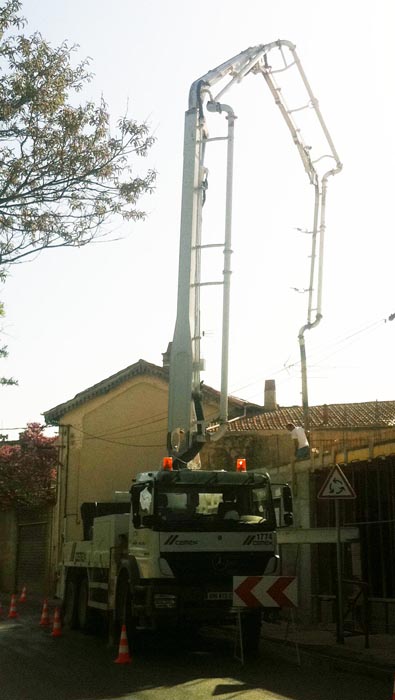
Concrete pumps have become extremely common objects around the world and allow workers to pour concrete in often difficult to access places. At the moment I write these lines, a pump of this kind is in operation a few hundred meters from my home (Pertuis).
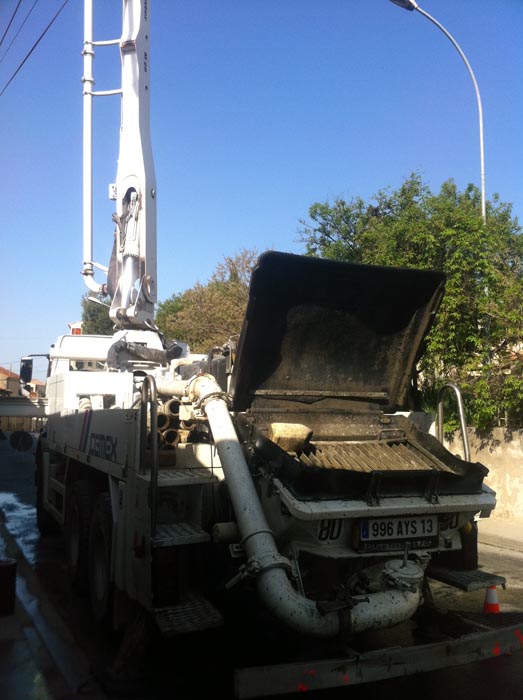
A concrete pump at work in Pertuis, April 11, 2011, Cemex Company
Diameter of the injection spout of this "mini-pump": 12 cm. The pouring is done by a 8 cubic meter spout.
The same, viewed from the back
Close-up on the opening where the spout pours its load
The giant machine, loaded on board the Russian cargo plane, does not seem to be suitable for water spraying at first glance. To do so, it would be necessary to completely modify the back of the vehicle, I think. I believe the diameter of its discharge spout is 25 cm, and its flow rate is 60 liters per second. To be verified.
From these images, a question emerges: Are the Japanese preparing to bury the reactors under tens of thousands of cubic meters of concrete?
The problem is not simple. At Chernobyl, the core, suddenly going critical (due to "xenon poisoning"), transformed a large amount of cooling water into hydrogen and oxygen. Above a thousand degrees, this mixture, from the dissociation of water molecules, cannot reconstitute into water vapor. When the temperature becomes lower, a very rapid recombination becomes possible and this "stoichiometric" mixture turns into a powerful explosive. The phenomenon consists of taking water, giving it energy for "a certain time" (minutes? dozens of minutes?), to make it a powerful explosive that will then return this energy in a thousandth of a second. At Chernobyl, the explosive power was sufficient to send the 12-ton reinforced concrete slab covering the reactor, dozens of meters above. It spun around and fell at 45°, pulverizing a large mass of solid graphite, used as a moderator.
The reactors of Fukushima were all covered by a similar slab. What about that of reactor number 3?
The core started to maintain the combustion of the graphite in the air, and the 25 firefighters who tried, without success, to stop this fire with their hoses were irradiated and all died within a few days that followed. They faced what they thought was just a simple fire without any protective equipment.
As it burned, the graphite carried radioactive elements into the air. It had become highly radioactive. The priority of the Russians was therefore to stop this fire at all costs. It was necessary to plug the 10-meter diameter hole, through which the reactor core could be seen, maintaining the combustion of the graphite. This could not be done with concrete pumps. The Russians sacrificed 600 helicopter crews, who poured, 200 meters above this gaping hole, thousands of tons of sand, boron and even lead (which in turn participated in the pollution of the air). All these pilots and mechanics died from the doses they received. But, in the urgency, there was no other solution.
When the core was covered, its temperature rose, and the Russians found themselves facing a new problem. This core was attacking the concrete and risked coming into contact with another large mass of water, accumulated in the basement, from the attempts made by the unfortunate firefighters, which could in turn become explosive and send the debris of the molten core not dozens of meters, but tens of kilometers, or more. Discussions continue to know what would have happened then. But all specialists agree that this second explosion could have made a large part of Europe uninhabitable!
The Russians sacrificed another hundred men, firefighters, to drain this water. But after approaching it through tunnels and making an opening with a torch, they found that the molten core, after having invaded this room, had a temperature high enough to attack the next layer of concrete, the last barrier against the groundwater, in communication with the Pripyat River, a tributary of the Dnieper, which flows into a closed sea, the Black Sea....
The miners, brought by plane, dug a 140-meter-long tunnel in a loose soil, at a rate of 13 meters per day and under a temperature of 50 degrees. Then, under the reactor, they arranged a 30-meter by 30-meter slab, which stopped the descent of the magma.
Finally, the engineers designed an immense and costly sarcophagus, a mix of strong steel beams, concrete and lead, with an estimated lifespan of 30 years. Currently, efforts are being made to gather the important funds to cover this sarcophagus with a metal vault structure, whose estimated lifespan could then be a century.
If the Japanese decide to "encase it", how would they proceed? It would be necessary to consider completely burying the reactors under a mass of concrete (50,000 cubic meters?). How to arm this concrete and prevent it from cracking due to thermal stresses? All I could find is a figure regarding the flow rate of these giant pumps: 200 cubic meters per hour.
I will continue this text by reproducing the report of the official Japanese commission, dated April 4, which admits that no one knows the height of the water in the pools; the temperature of the steel vessels and the state of these different containment barriers. Indicators (from the analysis of the salt water used for cooling and its isotopic abundances) suggest that corium has spread in the volumes under the pools of certain reactors. In what quantity? Where? No one knows.
The director of the French Institute for Radiological Protection and Nuclear Safety, Mr. Thierry Charles, displaying a calm and rational optimism and not being overwhelmed by emotion seems to have had access to information that the Japanese officials do not have. If this is the case, it would be urgent for him to pass it on to them.
Since March 11, Japan has been bogged down in an unprecedented nuclear crisis.
The Institute for Radiological Protection and Nuclear Safety (IRSN) currently estimates that "the worst is over" but that it will still take "weeks, or even months" before the situation is stabilized at the plant.
When did you realize how serious this accident was?
We started to worry from the first explosion [24 hours after the earthquake]. Initially, we were considering a scenario similar to Three Mile Island.
The fuel had partially melted and there was a loss of cooling, easily manageable
(...).
But when we saw the explosion, we knew there was hydrogen in the vessel and that the consequences could be very serious.
How do you assess the situation now?
For ten days, the situation has been roughly stabilized.
Engineers are able to continuously cool the reactors with fresh water.
We have found very radioactive puddles under the plant, which could be due to small leaks under the vessels
(?...).
But there is a layer of eight meters of concrete under the reactor, itself built on rock. There is now very little chance that the magma will start to sink into the ground. Moreover, the containment vessel is filled with nitrogen, which is good. This will prevent the formation of hydrogen and minimize the risk of explosion.
The worst is over,
but it is only the beginning of the conquest. The situation will be completely managed when the cooling system is back in operation.
Engineers are moving slowly and they are right to take their time. Especially since they are able to supply the reactors with water without any problem
(?...).
Before restarting the system
(???)
,
it is necessary to check all the electrical circuits, the pumps and the water in the vessels, which may contain debris and salt crusts. This can take weeks, or even months.
Why was the exclusion zone expanded?
It was expanded to 30 km. This corresponds to the post-accident zone, where radioactive deposits are observed on the ground. We think it is a reasonable measure. Iodine 131 is a radioelement with a relatively short half-life, it decreases by a factor of 2 each week.
In three months, its level will be completely secondary and the inhabitants will theoretically be able to return.
(so the pollution is only related to short-lived radionuclides)
What do you think of Tepco's management?
You have to put yourself in their place. They had just experienced a huge natural catastrophe where they had potentially lost family members when they had to face an unprecedented nuclear situation, with several reactors damaged at the same time.
Their main mistake was to bet everything on cooling the cores and neglecting the fuel pools at the beginning of the crisis.
With more distance, we will be able to analyze how they should have ideally reacted.
(...).
How will the authorities shut down the power plant?
Once the cooling system is restored, when there is no longer a need to constantly add water to the pools, the work will far from be over. They will have to clean the entire site, remove the fuel, and protect the power plant from the wind.
When you look at the photos of the site, where several reactors are just tangles of steel and concrete, I would be happy if Mr. Thierry Charles explained how the Japanese will manage to "clean the site" and "remove the fuel from the cores and pools." How will they access it??
They still need to think about the right strategy, which will be different from Chernobyl, where they had to build a sarcophagus.
So, does the sarcophagus not apply here?
Here, the reactor is not open-air. Furthermore, we are not safe from a new seismic shock. We do not rule out the possibility of shocks or new radioactive releases into the atmosphere.
Antoine Bouthier
Simple comment:
here are the photographs of the high-flow concrete pump, rented from the Americans (Putzmeister company) by the Japanese, which is currently being loaded, on the west coast of the United States, into a large Antonov 22 cargo plane, so that this equipment can be transported to Japan.
The Putzmeister super concrete pump, loaded into a Russian Antonov 22
Observe, on the right, the rectangular opening where the concrete is poured, brought by a "toupie"
C
ement pumps have become extremely common objects around the world and allow workers to pour concrete in often difficult to access places. At the moment I am writing these lines, a pump of this kind is at work a few hundred meters from my home (Pertuis).
A concrete pump at work in Pertuis, April 11, 2011, Cemex company
D
iameter of the injection pipe of this "mini-pump": 12 cm. The pouring is done by toupies of 8 cubic meters.
The same, viewed from the back
Close-up on the opening where the toupie pours its load
L
arge machine, loaded on board the Russian cargo plane, does not seem to be suitable for water spraying at first glance. To do so, it would have to completely modify the back of the vehicle, I think. I believe the diameter of its discharge pipe is 25 cm, and its flow rate is 60 liters per second. To be verified.
A
ccording to these images, a question emerges: Are the Japanese preparing to bury the reactors under tens of thousands of cubic meters of concrete?
L
he problem is not simple. At Chernobyl, the core, suddenly going critical (due to "xenon poisoning"), transformed a large amount of the cooling water into hydrogen and oxygen. Above a thousand degrees, this mixture, from the dissociation of water molecules, cannot reconstitute into water vapor molecules. When the temperature becomes lower, a very rapid recombination becomes possible and this "stoichiometric" mixture turns into a powerful explosive. The phenomenon consists of taking water, giving it energy for "a certain time" (minutes? tens of minutes?), to make it into a powerful explosive that then releases this energy in a thousandth of a second. At Chernobyl, the explosive power was sufficient to send the 12-ton reinforced concrete lid, covering the reactor, tens of meters above. It spun and fell at 45°, pulverizing a large amount of solid graphite, used as a moderator.
The reactors at Fukushima were all covered by a similar slab. What about that of reactor number 3?
T
he core started to maintain the combustion of the graphite in the air, and the 25 firefighters who tried, without success, to stop this fire with their hoses were irradiated and all died in the few days that followed. They faced what they thought was just a simple fire without any protective equipment.
C
onsuming, the graphite carried radioactive elements into the air. It had become highly radioactive itself. The priority of the Russians was therefore to stop this fire at all costs.
They had to plug the 10-meter diameter hole, through which the reactor core could be seen, maintaining the combustion of the graphite. This could not be done with concrete pumps. The Russians sacrificed 600 helicopter crews, who dumped thousands of tons of sand, boron, and even lead (which then contributed to air pollution) from 200 meters above this gaping hole. All these pilots and mechanics died from the doses they received. But, in the urgency, there was no other solution.
W
hen the core was covered, its temperature rose, and the Russians found themselves facing a new problem. This core was attacking the concrete and risked coming into contact with another large mass of water, accumulated in the basement, from the desperate attempts of the unfortunate firefighters, which could in turn become explosive and send the molten core debris not hundreds of meters, but tens of kilometers, or even more. Discussions continue about what could have happened then. But all specialists agree that this second explosion could have made a large part of Europe uninhabitable!
T
he Russians sacrificed another hundred men, firefighters, to drain this water. But after approaching it through tunnels and making an opening with a torch, they found that the molten core, after invading this room, had a temperature high enough to attack the next layer of concrete, the last barrier against the groundwater, connected to the Pripyat River, a tributary of the Dnieper, which flows into the Black Sea...
M
iners, brought by plane, dug a 140-meter-long tunnel in loose soil, at a rate of 13 meters per day and under a temperature of 50 degrees. Then, under the reactor, they installed a 30-meter by 30-meter slab, which stopped the flow of the magma.
F
inally, engineers designed an enormous and costly sarcophagus, a mix of strong steel beams, concrete, and lead, with an estimated lifespan of 30 years. Currently, efforts are being made to raise the important funds needed to cover this sarcophagus with a fully metal vault structure, whose estimated lifespan could then be a century.
I
f the Japanese decide on the "sarcophagus", how would they proceed? It would be necessary to consider completely burying the reactors under a mass of concrete (50,000 cubic meters?). How to arm this concrete and prevent it from cracking due to thermal stresses? All I could find is a figure regarding the flow rate of these giant pumps: 200 cubic meters per hour.
J
e will continue this text by reproducing the official Japanese commission report, dated April 4, which admits that no one knows the water level in the pools; the temperature of the steel vessels and the state of these different containment barriers. Indications (from the analysis of the salt water used for cooling and its isotopic abundance) suggest that corium has spread into the volumes under certain reactors. In what quantity? Where? No one knows.
T
he director of the French Institute for Radiological Protection and Nuclear Safety, Mr. Thierry Charles, displaying a calm and rational optimism and not letting himself be overwhelmed by emotion, seems to have had access to information that the Japanese officials do not have. If this is the case, it would be urgent for him to share it with them.
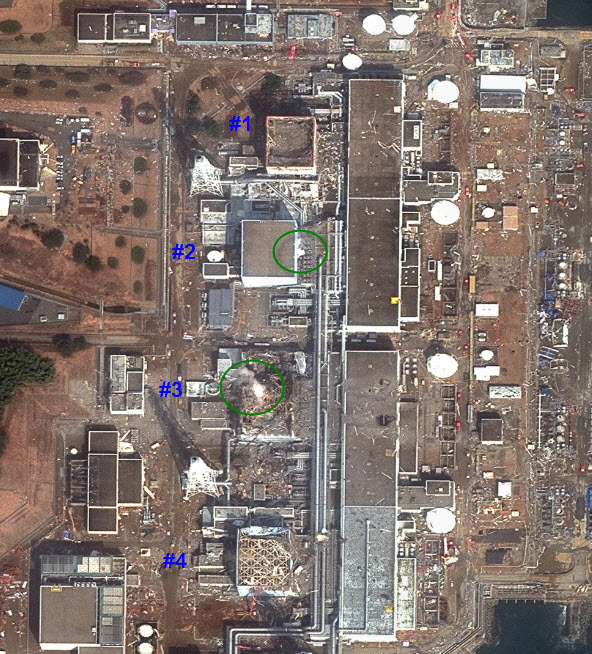
April 8, 2011-A:
A strange glow in the center of reactor number 3 of Fukushima:
This satellite photo of the reactors was taken on April 4, 2011.
In blue, the numbers of the different reactors. The size of the shadows indicates that the photo was taken at noon.
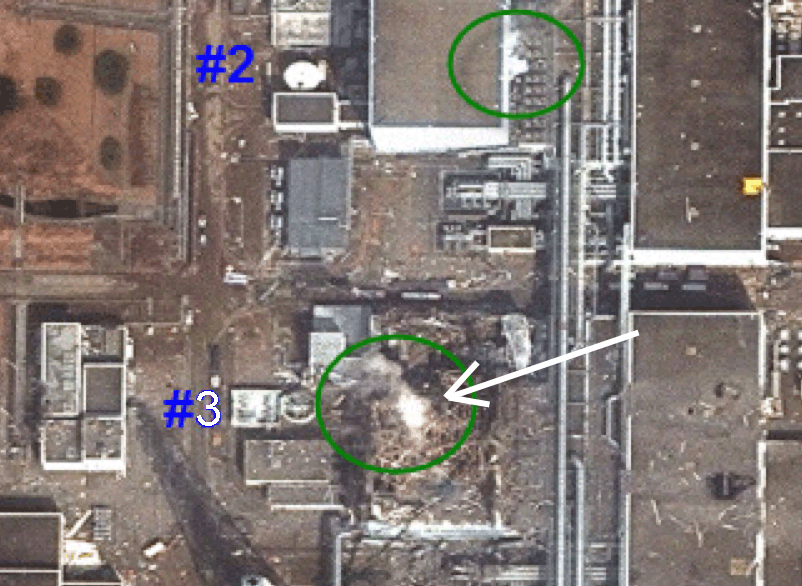
Detail of reactor number 3:
The strange glow indicated by the arrow. A second Chernobyl in the making ???
Subsidiary question
Can you see the armored vehicles, as well as the massive number of technicians and engineers who are gathered around the four reactors?
********source
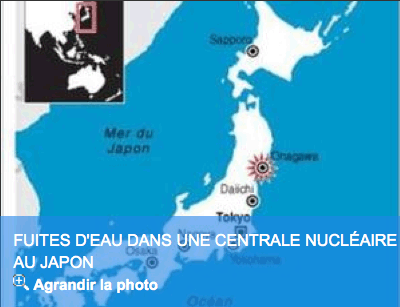
April 8, 2011-B:
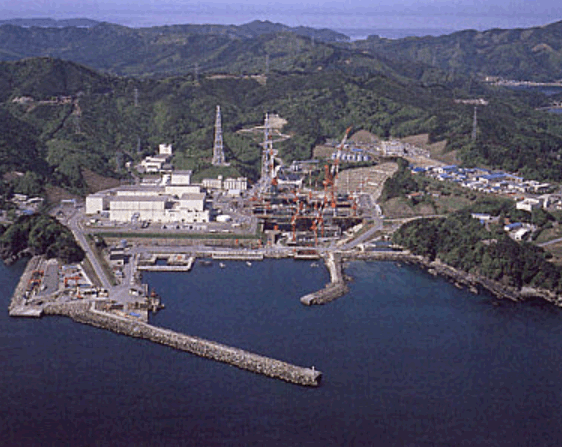
A few days ago we revealed that the neighboring nuclear power plants of Fukushima, Onagawa and Tokai, also located on the edge of the sea, with insufficient seismic devices, had also suffered the impact of the earthquake and tsunami of March 11. On March 13, the Tokai plant, after a failure in its cooling system, had to use the auxiliary system ( ). Less than a month after the magnitude 9 earthquake of March 11, 2011, a new earthquake of magnitude 7.4 has occurred in the fault located in northern Japan. The Onagawa plant has been damaged and the presence of leaks in the storage pools of nuclear fuel has been confirmed. Remember that these pools contain all the irradiated waste from the nuclear plant's activity, sometimes highly irradiated, as well as the used nuclear fuel. Although the auxiliary systems allow to maintain the water level in the pool and prevent a significant increase in the temperature of these waste materials, the spread of water outside the pool represents a source of nuclear contamination of the Pacific and its coasts.
There is a way to reduce the effects of an earthquake on a "compact" building that is not a tower. The key is to carry out significant land preparation work on the ground where the building will be constructed. Thus, a layered ground, in the manner of a "layer cake", with successive layers of different nature, produces a strong attenuation of the typical horizontal displacements of an earthquake.
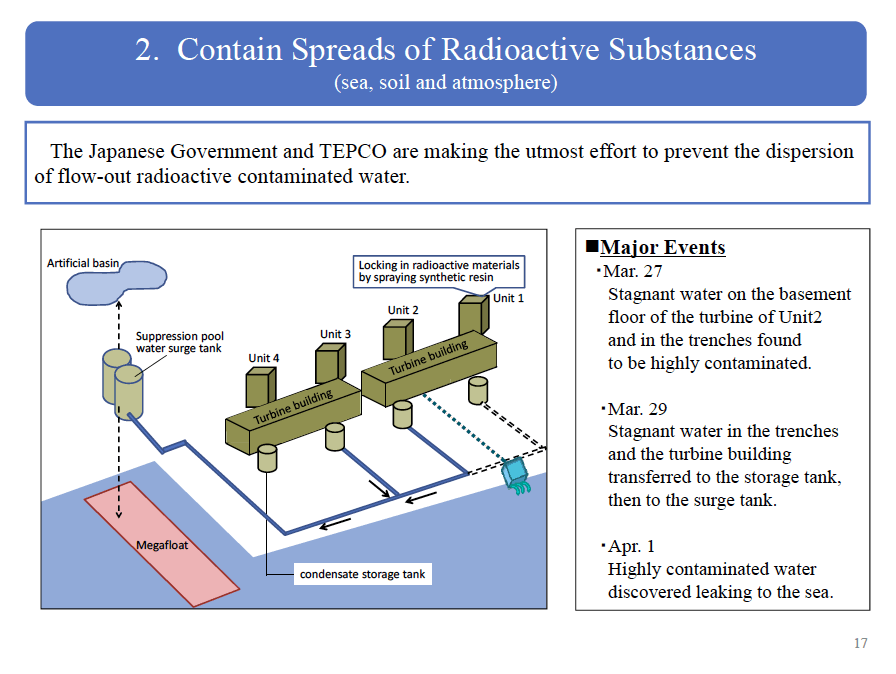
Official Japanese Government Report of April 6, 2011
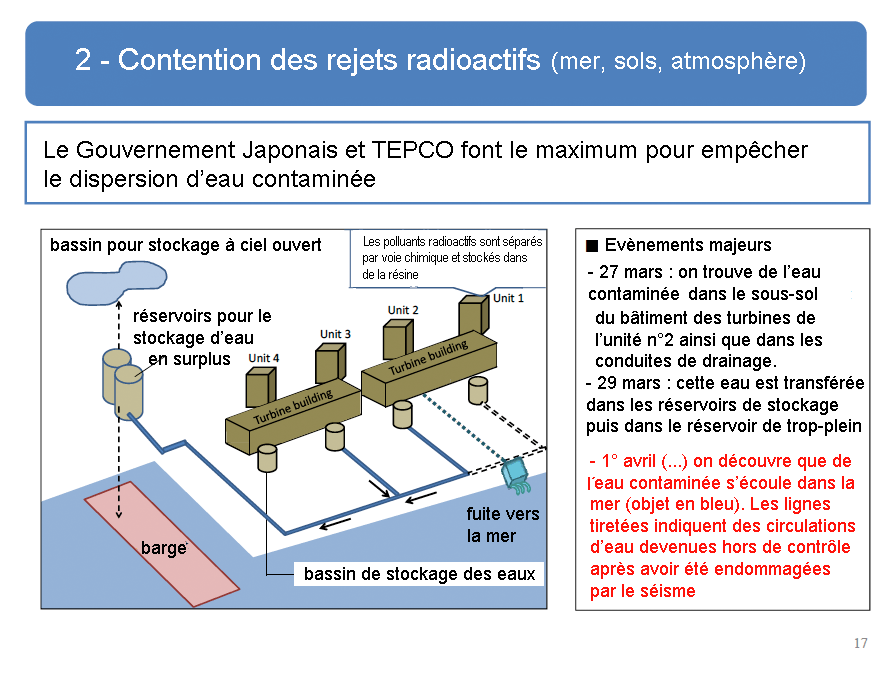
April 8, 2011-C:
Here
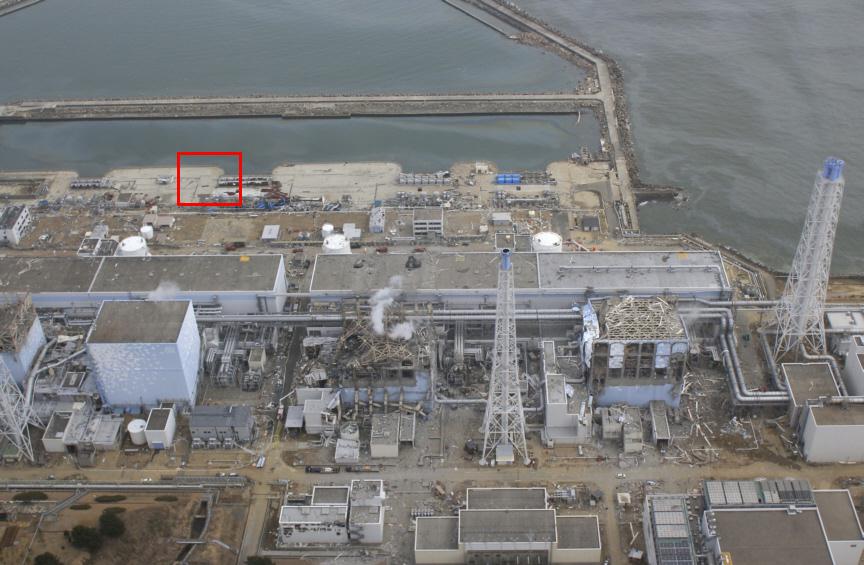
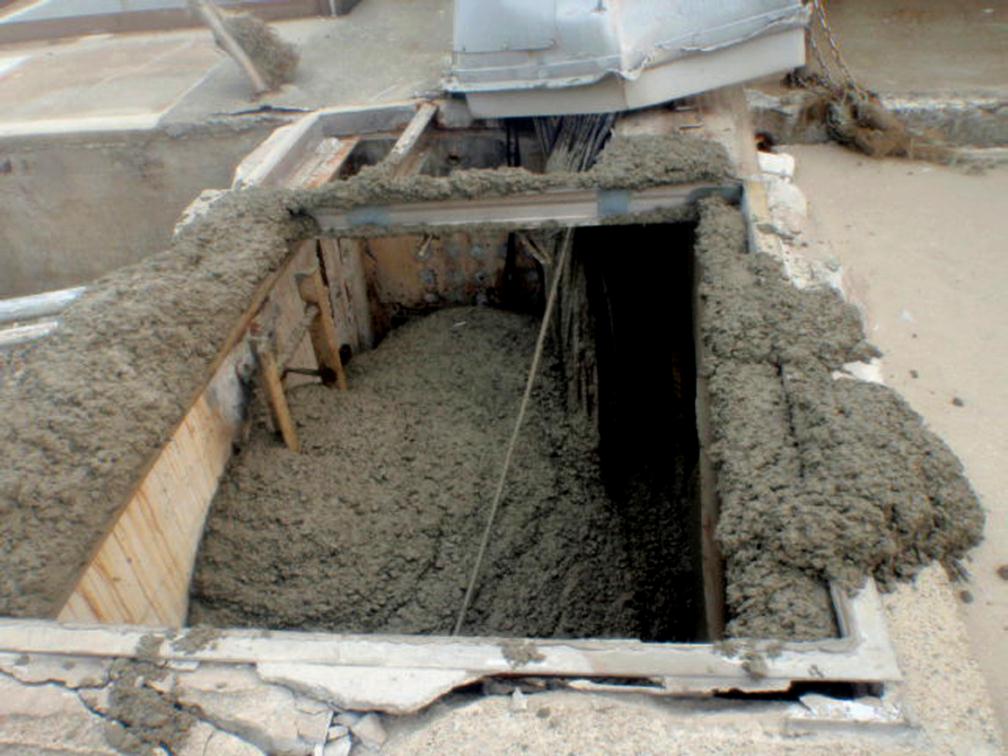
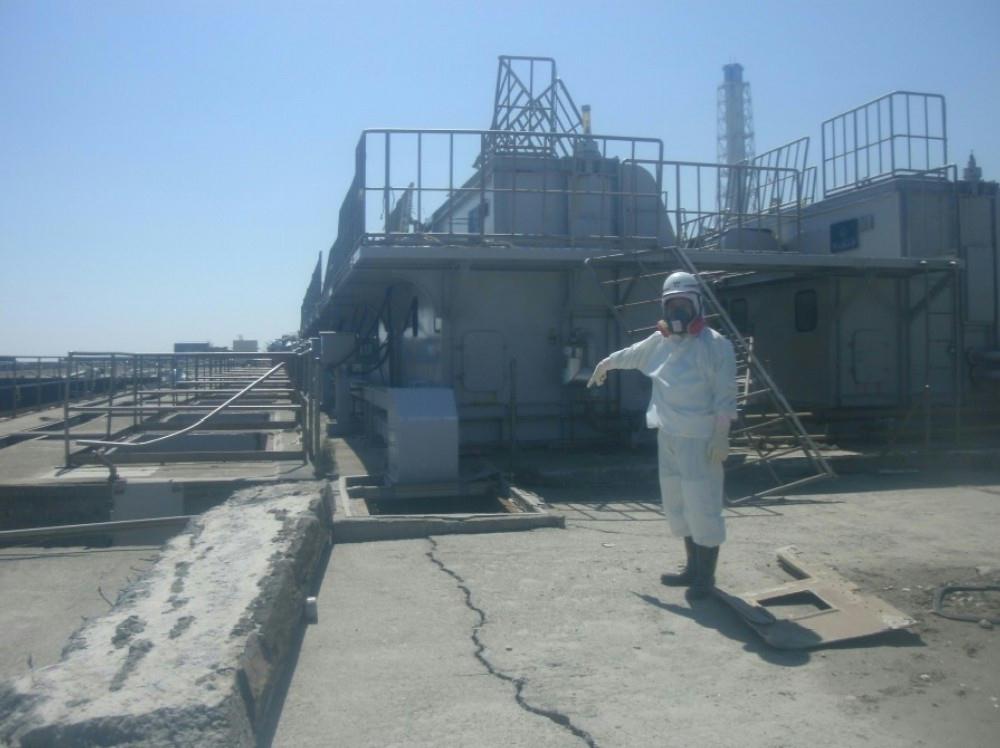
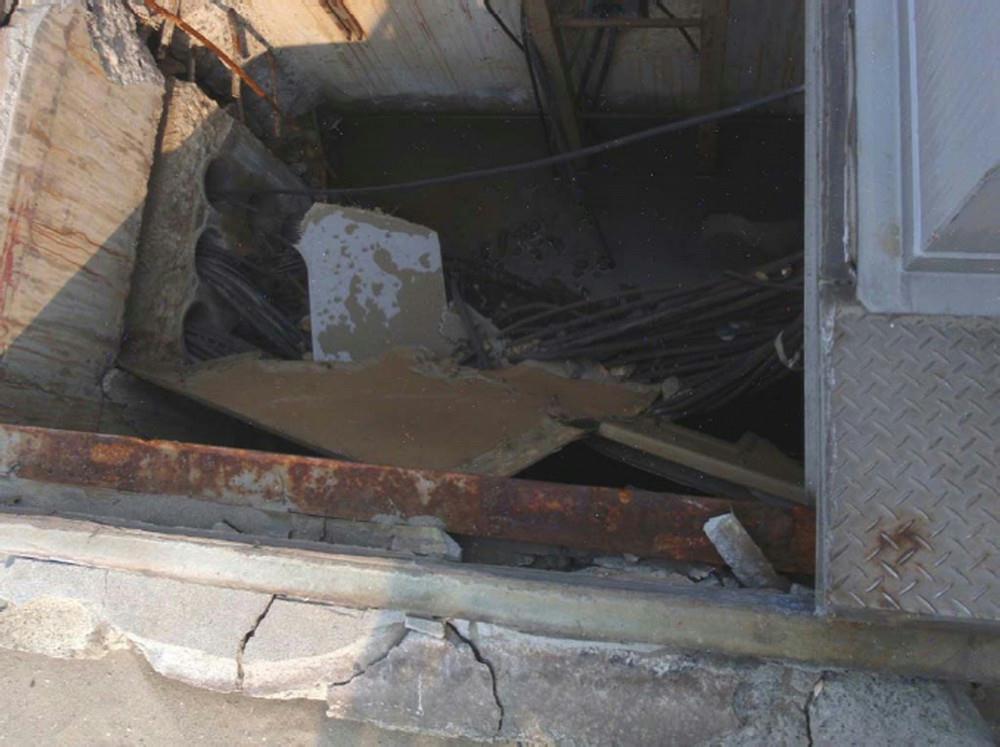
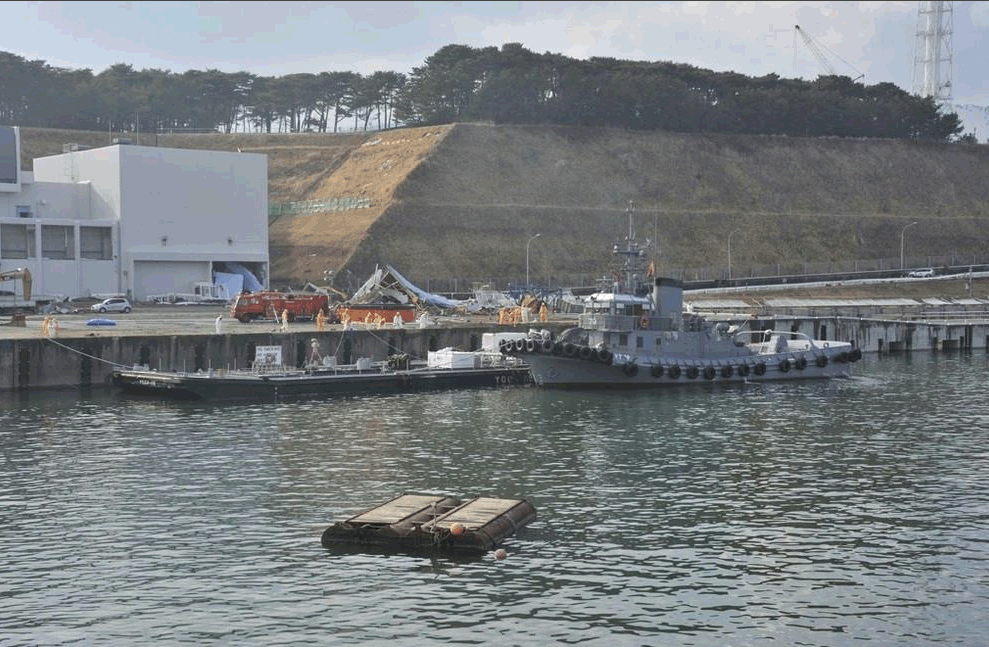
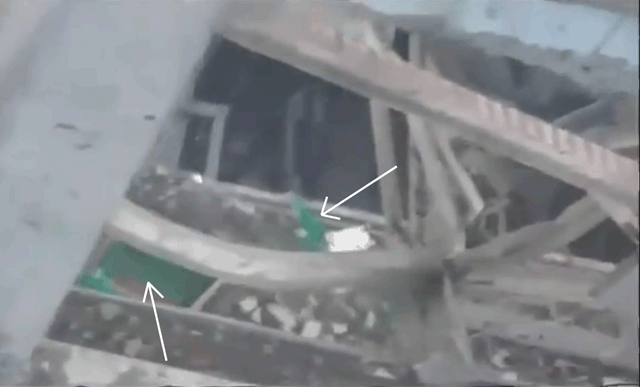
we have several images that allow us to know a bit more about what is happening in Fukushima. In the days following the earthquake, engineers have noted the appearance of an important crack in a tank located in immediate contact with the port water and connected to reactor number 2.
This is where a radioactive water leak to the sea has been located.
View of the crack caused by the earthquake. Behind, the wells.
View down into the cracked well. At the back, we see the electrical cables.
The well has been filled with cement, hoping it will seal the cracks in the well.
Click on this link and you can download the English version of the report published by the METI (Ministry of Economy, Trade and Industry) with a date of April 6, 2011 and titled "Nuclear Emergency in Japan".
Page 17
we can confirm that the water circuit that cools the steam that circulates in the turbines and passes through the core of the reactors of the different units continues parallel to the edge of the sea (see the drawing below) :
Apparently
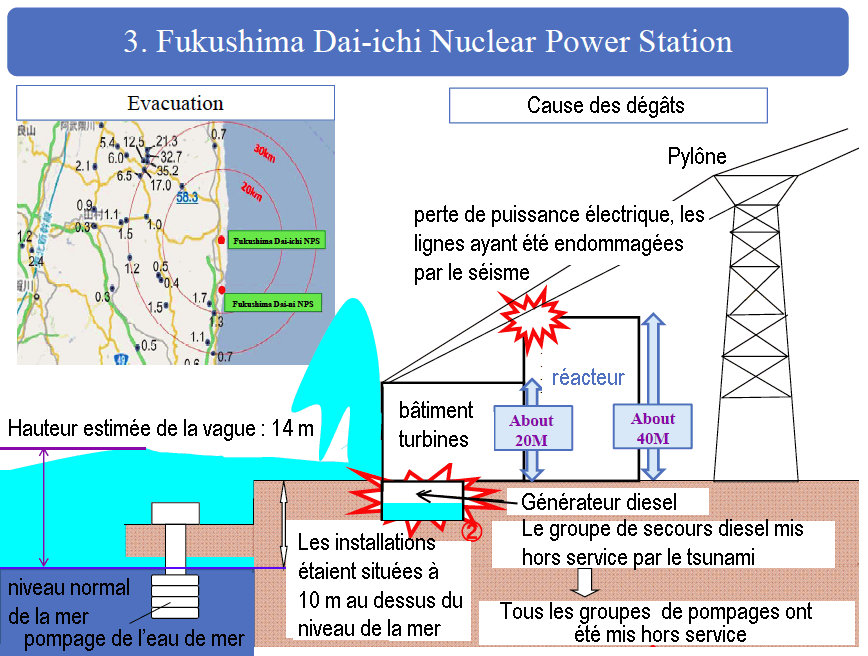
Official Japanese report of April 4, 2011: cause of damage
The Japanese had not taken into account in their forecasts that a wave could exceed 10 meters in height. It is very likely that the diesel engine installations were flooded after the wave passed.
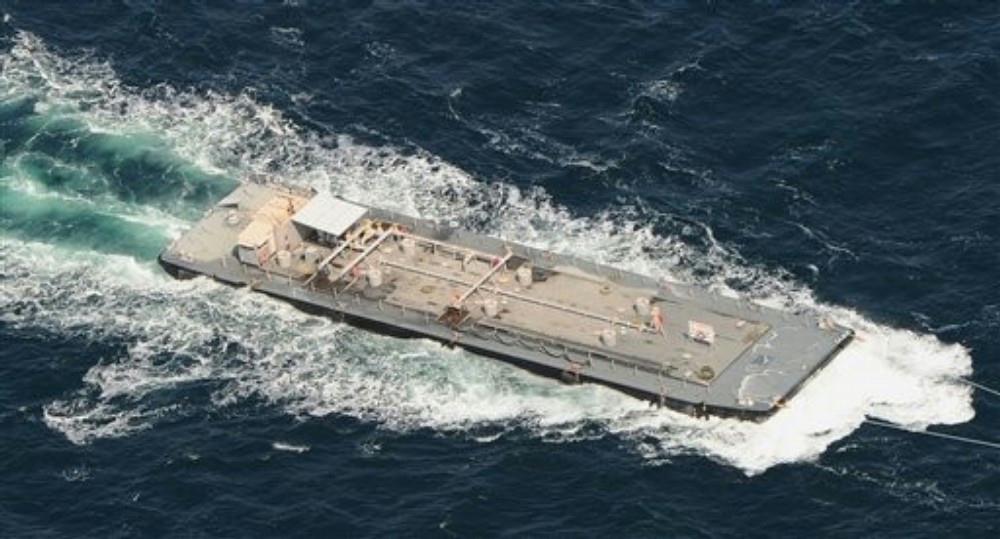
The Japanese ask for help from the Americans who lend them a boat that allows them to bring fresh water to the site :
The American boat filled with fresh water, being towed
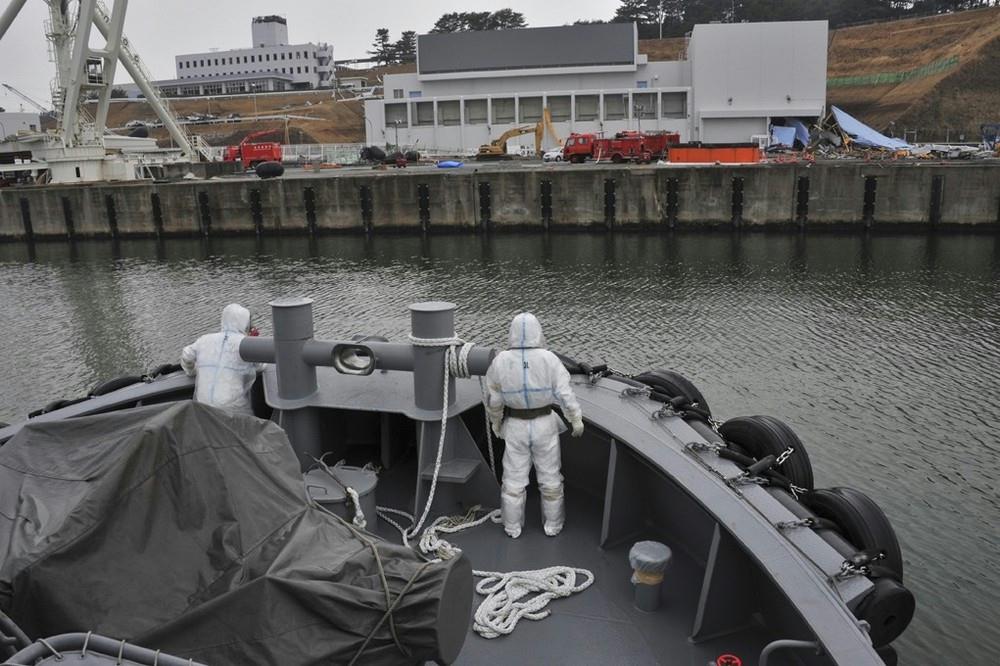
Arrival of the US tugboat, and the fresh water barge, to be able to supply the fire trucks: March 31, 2011
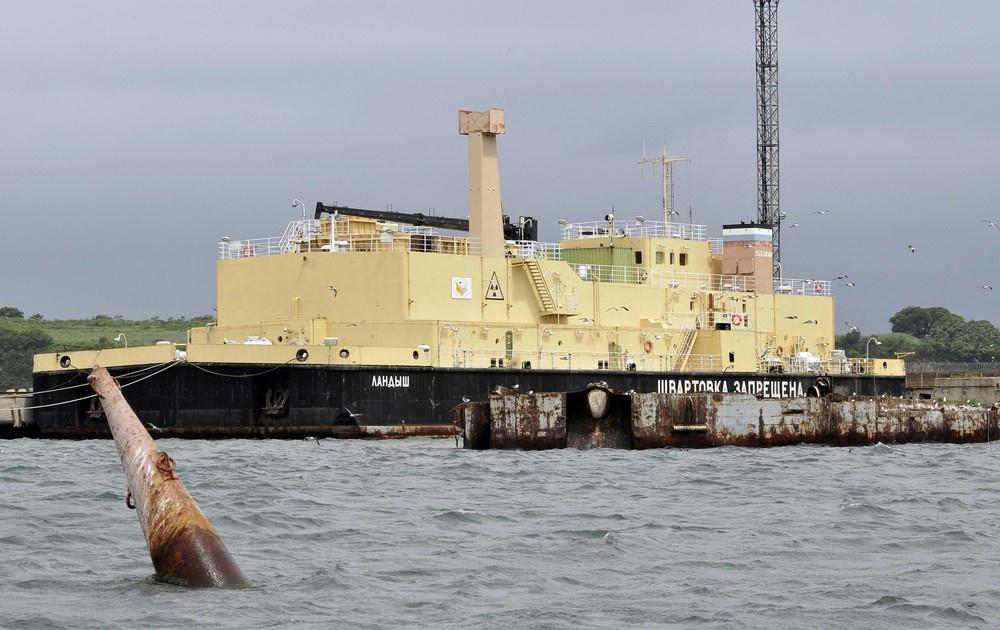
The Japanese request help from the Russians and ask them to send their specialized floating unit for the treatment of liquid effluents, which extracts radioactive components by chemical means. Treatment capacity: 35 cubic meters per day, 7000 per year.
********AREVA
publishes a pdf
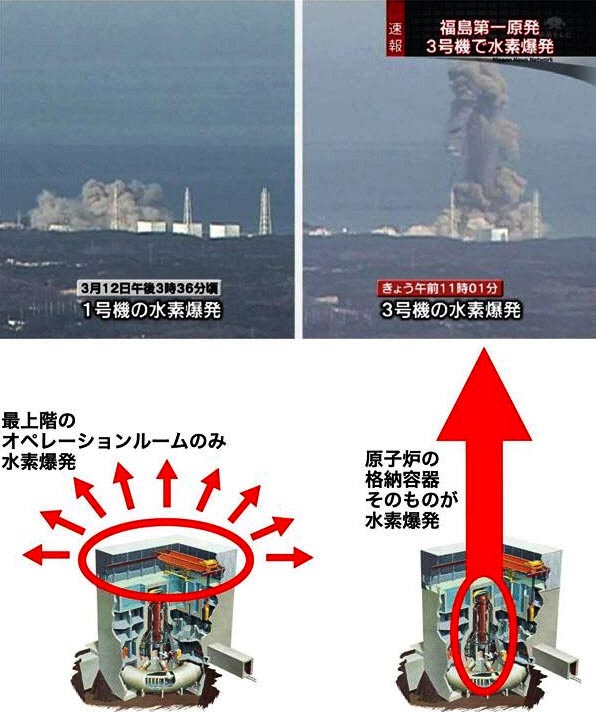
The explosion of reactor 3 contradicts the report published by AREVA
****http://fukushimaleaks.wordpress.com
April 7, 2011
: Things are beginning to become clearer. While
where it says that the only cause of the reactor explosions is the hydrogen explosion in the upper floor control room (which was the case for unit number 1, left image), even the Japanese, despite censorship and suspicious silences from their (ir)responsible, are beginning to say that the explosions of reactors 1 and 3 have been fundamentally different. The explosion of reactor number 3 (right image) could be attributed to the beginning of criticality or at least to an explosion coming from the lower floors.
Two explosions with completely different starting points
A reader living in Japan has indicated the existence of a website, unfortunately in English, that outlines the unthinkable negligence of Japanese nuclear authorities in the management of their reactor park over the last thirty years (to such an extent that TEMCO had not found an insurance company willing to insure the Fukushima facilities!).
Thirty years of cover-ups and lies!
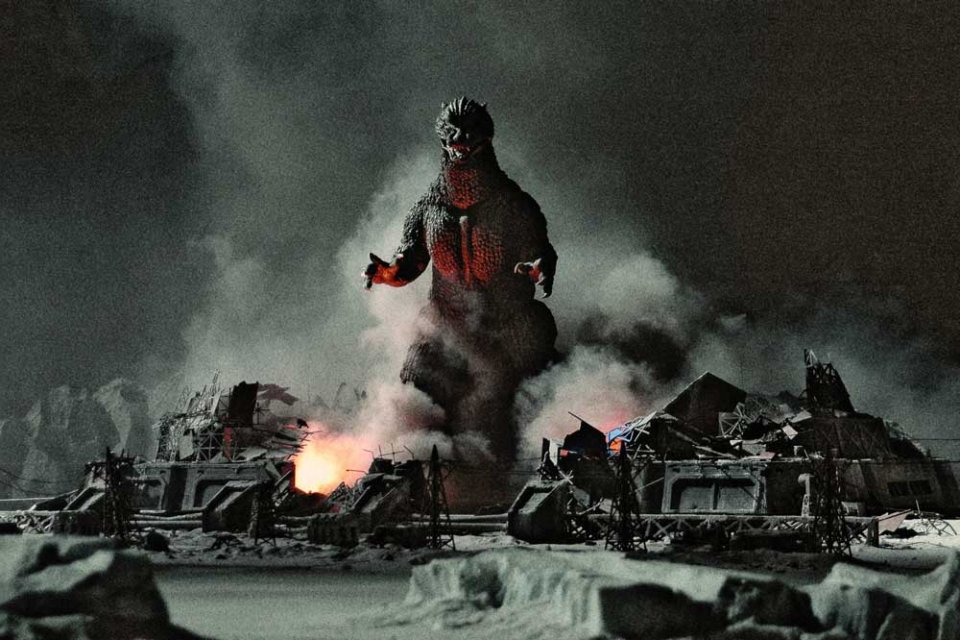
****Godzilla
April 5, 2011 :
Things are getting worse every day in Japan. There are important leaks of highly radioactive water into the Pacific, and attempts to seal these leaks have been futile. The radioactive water is coming out of unit number 2 and is inevitably pouring into the ocean. The Japanese government has asked for help from the Russians, who have had similar problems with liquid radioactive leaks in the reactors of the nuclear submarines sunk in the Baltic Sea. When the engineers from Toshiba contacted me (my file is read in Japan), I recommended that they contact their Russian counterparts, since it was obvious that the two accidents were similar.
Aerial photos are a testimony to the scale of the problem. In the "pools" are stored the nuclear fuels corresponding to decades of operation, at the rate of one annual reload (...). The earthquake has cracked some of these pools, which are losing water, and attempts to seal the cracks, with improvised and totally inadequate means, have not worked. In principle, these pools could be emptied and the cracks repaired, but in this case the temperature inside would increase in a critical way. I remember that in the underground river of Port-Miou (which flows into the Cala that has the same name, to the east of Marseille), where I did scuba diving, we had tried to block the rise of seawater with a special low-density cement that could set in water. They asked me to make plans for the retaining wall, on site, accompanied by Bernard Zappoli, then a young student in Marseille (see the scandal of Cnes-Toulouse, along with his accomplice from the École Polytechnique Alain Esterle). Zappoli, who had asked to descend with me, came back to the surface, terrified by this speleo-submarine excursion.
On Monday, April 4, the Japanese began to release about 11,500 tons of highly contaminated water (which was stored in a large pool filled to the brim
!!) directly into the sea, "apologizing to the neighbors of the villages adjacent to the nuclear plant". Knowing that sooner or later this contaminated water would have to be disposed of, it would have been better to plan its transport by barge, which would have had to be sunk afterwards because they would have also been contaminated. There is no need to tow them: a old, small-tonnage tanker would have been more than enough to carry the 11,500 tons of contaminated water. The tanker would have been piloted from the protected bridge room with lead bulkheads. Once the ship was in deep waters, the ship would have been sunk and the crew helicopter transported. The contaminated water would have been trapped in the ship's tanks and gradually mixed with the seawater as the hull and tanks deteriorated.
That the Japanese engineers managing this crisis have not thought of this alternative demonstrates their lack of vision, their incompetence, and their inability to cope with this situation. It could be said that all their actions are conditioned by the impact these could have on the public, both on their own population and on the eyes of the entire world. It is the image of Japan, a country of high technologies, that is in danger. Bringing a tanker close to the site, to pump the contaminated water, could have had a disastrous effect, especially if it was announced that the ship would then be sunk and that the crew would have to conduct its last trip protected by lead plates.
The situation is very bad. The Japanese meteorological service is under pressure not to provide information if the winds direct the radioactive cloud towards the large cities "to avoid causing panic in the population".
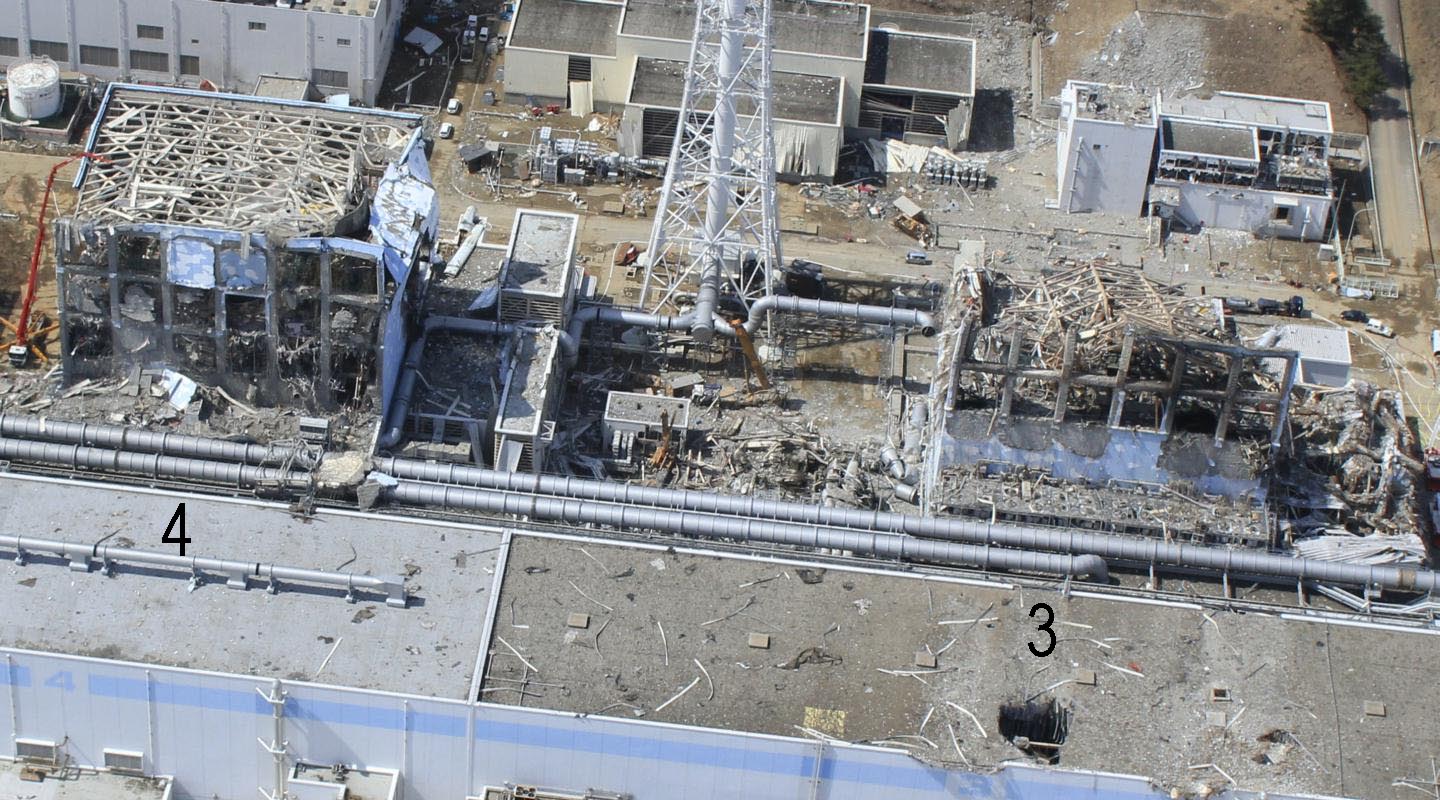
If the government has announced "that the reactors will be dismantled", a look at the photos taken by the remote-controlled plane (see below) is enough to realize that such a dismantling is not possible.
It is also not possible to remove the hundreds of elements that are in the storage pools.
To do so, the remnants of the upper structure of the reactors would have to be removed. If there were no radioactivity, the equipment could proceed to dismantle them on site with a torch. But it is impossible. There is no robot planned that is capable of operating remotely, and there is not enough time to design one.
The only solution is the sarcophagus. It is urgently necessary to pour solid materials over the three reactors to stop the radioactive emissions. These are distinguished "by light fumes", as was the case in the Chernobyl reactor, after the spectacular explosion of its core. But the appearance of these fumes should not mislead about what they contain.
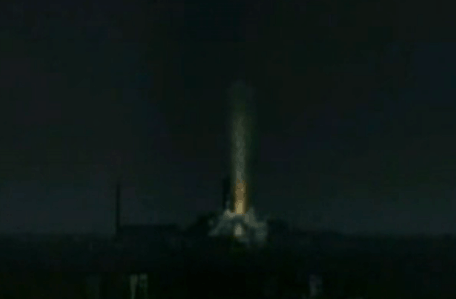
Several videos show light coming from parts of the destroyed buildings.
Light due to the emission of radioactivity by the reactor elements
It is not surprising that radioactive materials create luminous phenomena, visible to the naked eye. In the past, a radioactive substance was placed in the hands of wristwatches so that their owners could see the time in the dark. If the images had been taken at night by an unmanned aircraft or from a helicopter, they would have caused panic among the population. They would have reminded of the sinister glow of the Chernobyl reactor crater, rising into the clouds, visible during the night.
Appearance of reactor number 4 of Chernobyl, at night, before the crater was filled
Returning to the issue of the sarcophagus (which would not solve the problems related to the possible spread of the molten material in the reactor). At Chernobyl, the graphite was burning, and the hole through which the radioactive dust particles had a diameter of a dozen meters. So the Russians sent young helicopter pilots of the Hind type, with their crews, pouring thousands of cubic meters of sand, cement, lead, boron, into its throat. And it was only when that diabolical chimney was blocked that the nuclear contamination ceased. Performing the same operation in Fukushima would involve drowning the reactors with tens or hundreds of thousands of cubic meters of solid materials, before the gas and solid particles stop.
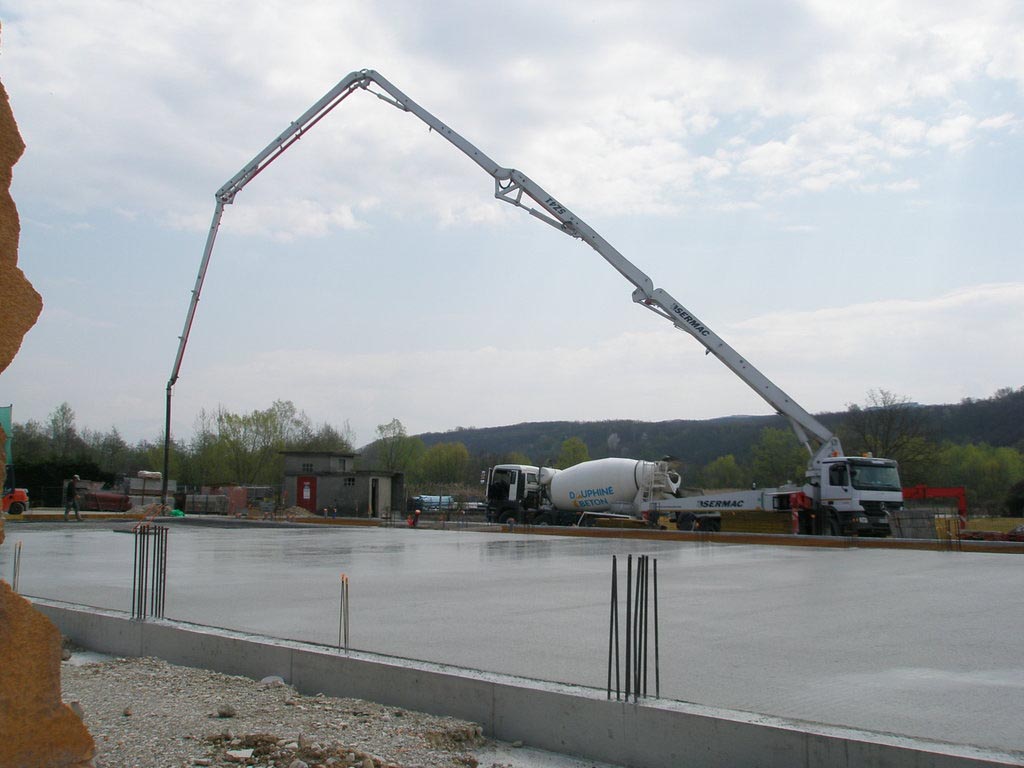
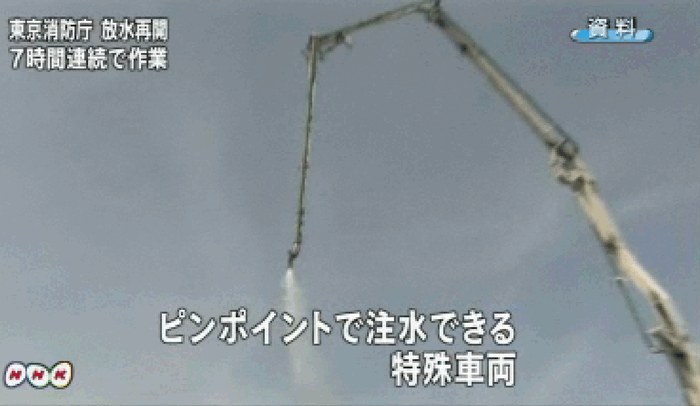
For this, the Japanese have brought to the site a cement dispenser:
Realization of a concrete slab of a building thanks to a concrete spreader
The spreader in action (with water)
But if we tried to make a sarcophagus with this device, the pouring of the cement would be too slow. The flow would be totally insufficient (the inability to assess the problem would be seen when the Japanese sent helicopters to pour water tanks over the reactors). The Americans would send by sea a similar device, ensuring a higher rate, and adding "that this would be a one-way trip because the device after its use, would become too radioactive to be repatriated to the US."
This information, transmitted by a contact of mine. A crisis meeting, bringing together the teams of AREVA and ITER, and representatives of foreign groups, including Germans, took place in Aix in Provence on April 4. One of the participants carried a dossier where a key name was mentioned:
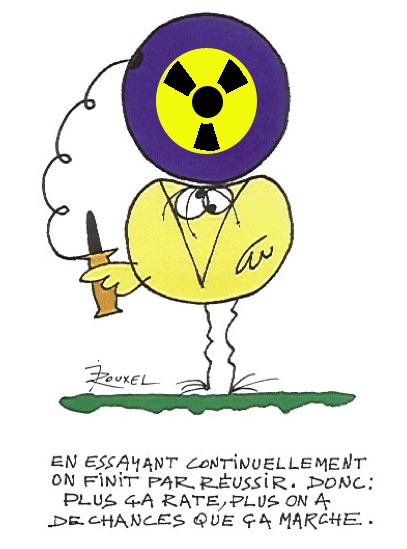
Nuclear-shadock ---
April 1, 2011** : **Although I am very busy with the writing, in the urgency and before closing, of a second article for the May issue of Nexus (the first, ten pages, is already in composition. This one will present truly global alternative solutions) I must continue to inform my readers about the development of the Fukushima disaster. This morning, at dawn, I can reproduce a minimal text, which I will expand later in the day, with personal contributions and images. Here is this text, which I fully adhere to and which overlaps with the information that comes to me from my contacts in Japan, the most worrying. If its author agrees to be cited (I always make the preliminary request, I will do so).
The Japanese authorities, expecting the worst and without informing the public, have been stockpiling a gel, dispersed by airplane, intended to stick to the ground radioactive releases, before cleaning by "liquidators", as was done once in Chernobyl. It is not impossible, in the case where a criticality would manifest itself, with a significant release, that they would have to use this product.
http://edition.cnn.com/2011/WORLD/asiapcf/03/30/japan.daini
Source
It is confirmed: the fuel rods are melting and the situation is really out of control.
The radioactive core in a reactor at the Fukushima plant seems to have melted into the bottom of its containment vessel according to a warning from an expert yesterday. Concerns have been raised about the radioactive gases that could be released into the atmosphere soon.
Richard Lahey, who was the head of reactor safety at General Electric, said that the workers have now lost their battle. The core has melted through the bottom of its vessel, in reactor number 2, and part of this substance is now on the floor.
The workers are paid very well to try to end this nightmare, exposed to a very high level of radiation, but it seems that their suicidal bravery could prove to be in vain and deadly!
The plant operator hopes to stop the ongoing contamination, otherwise 130,000 people will be forced to leave their homes.
Today, milk is contaminated, vegetables and drinking water. The seawater around the plant is also contaminated, not to mention the tides that will disperse the radioactive elements. Authorities have noted quantities of plutonium in the soil outside the plant. The tunnels connecting reactors 1, 2 and 3 are filled with contaminated water and to significant levels.
The Japanese Nuclear Safety Agency claims that the levels of plutonium are not dangerous for human health [really?], but confirms that the situation is extremely serious and that a partial meltdown is underway in at least one reactor.
Engineers continue to try to repair the cooling system, but they are forced to work surrounded by radiation and without electricity.
Florent B.
Friday, April 1, 2001, 2:47
Source
It is no longer a power plant, but two nuclear power plants in Fukushima that are smoking!
The smoke was spotted at another nuclear power plant in the north of
Japan on Wednesday according to Tokyo Electric Power.
The company stated that smoke was detected in the building of the
turbine number 2 of the reactor at the plant around 6 p.m.
This nuclear plant is located about 10 km from the Fukushima plant.
An evacuation order was given for the residents who live within a
10 km radius of this plant.
Since then, the authorities have not expressed any other comments on the situation.
Florent B.
April 1, 2011** :** Iodine 131 was detected in samples of French and American milk, report simultaneously the French Institute for Radiological Protection and Nuclear Safety (IRSN) and the Environmental Protection Agency. The analysis results confirm that this radioactive isotope comes from the releases of the Fukushima nuclear plant.
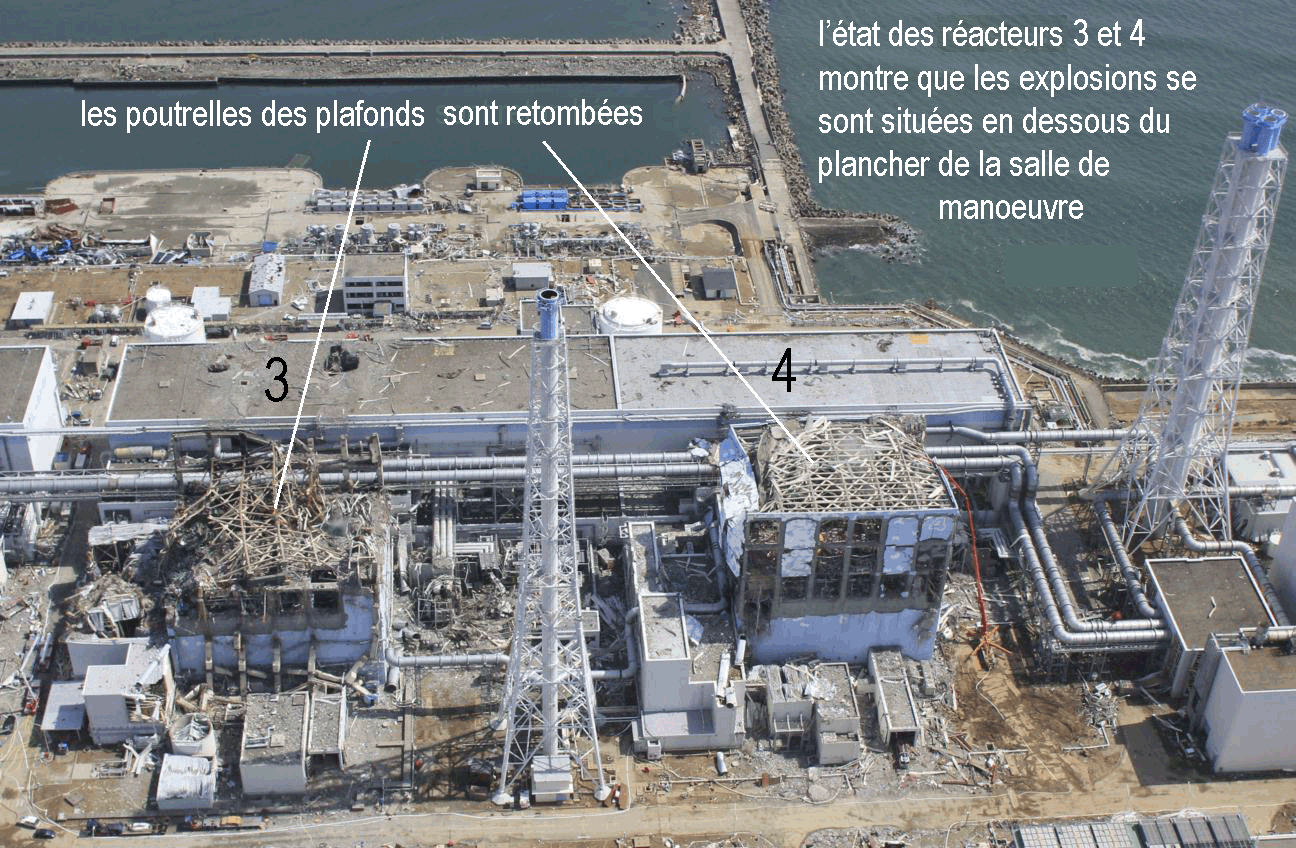
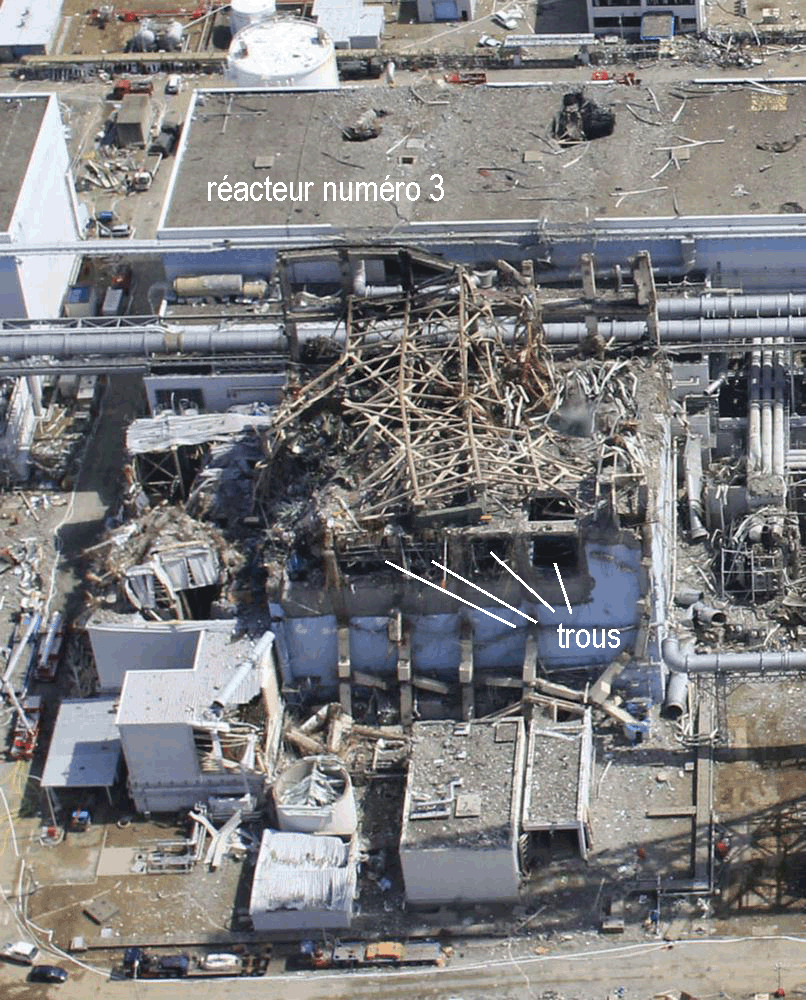
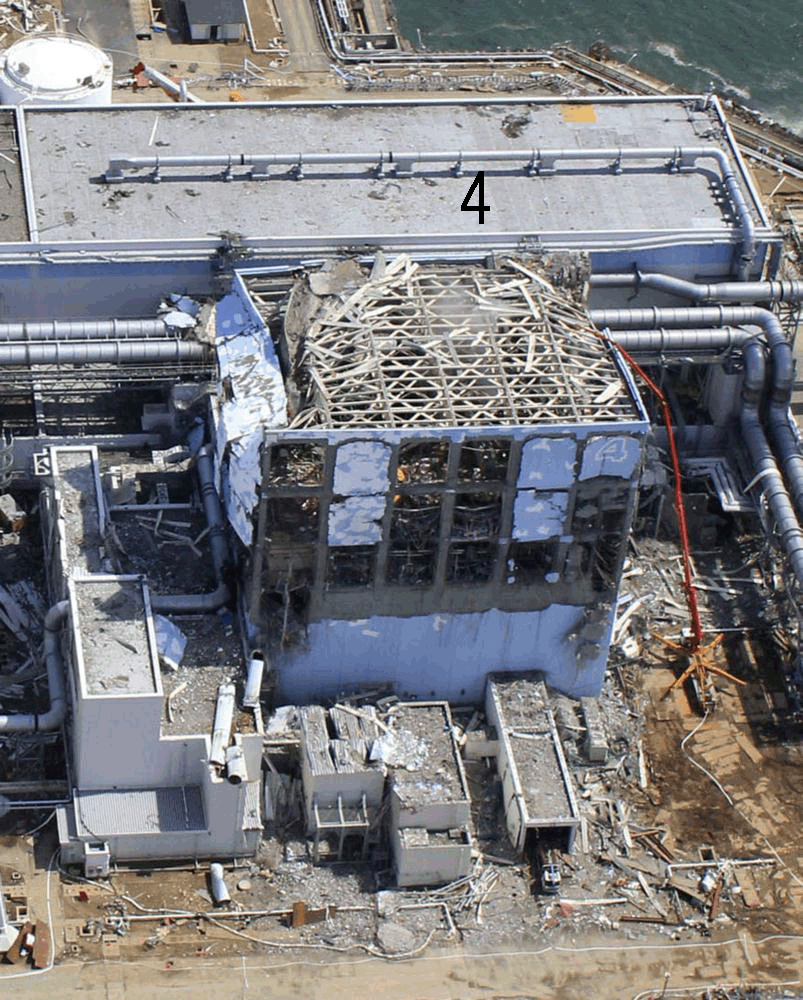
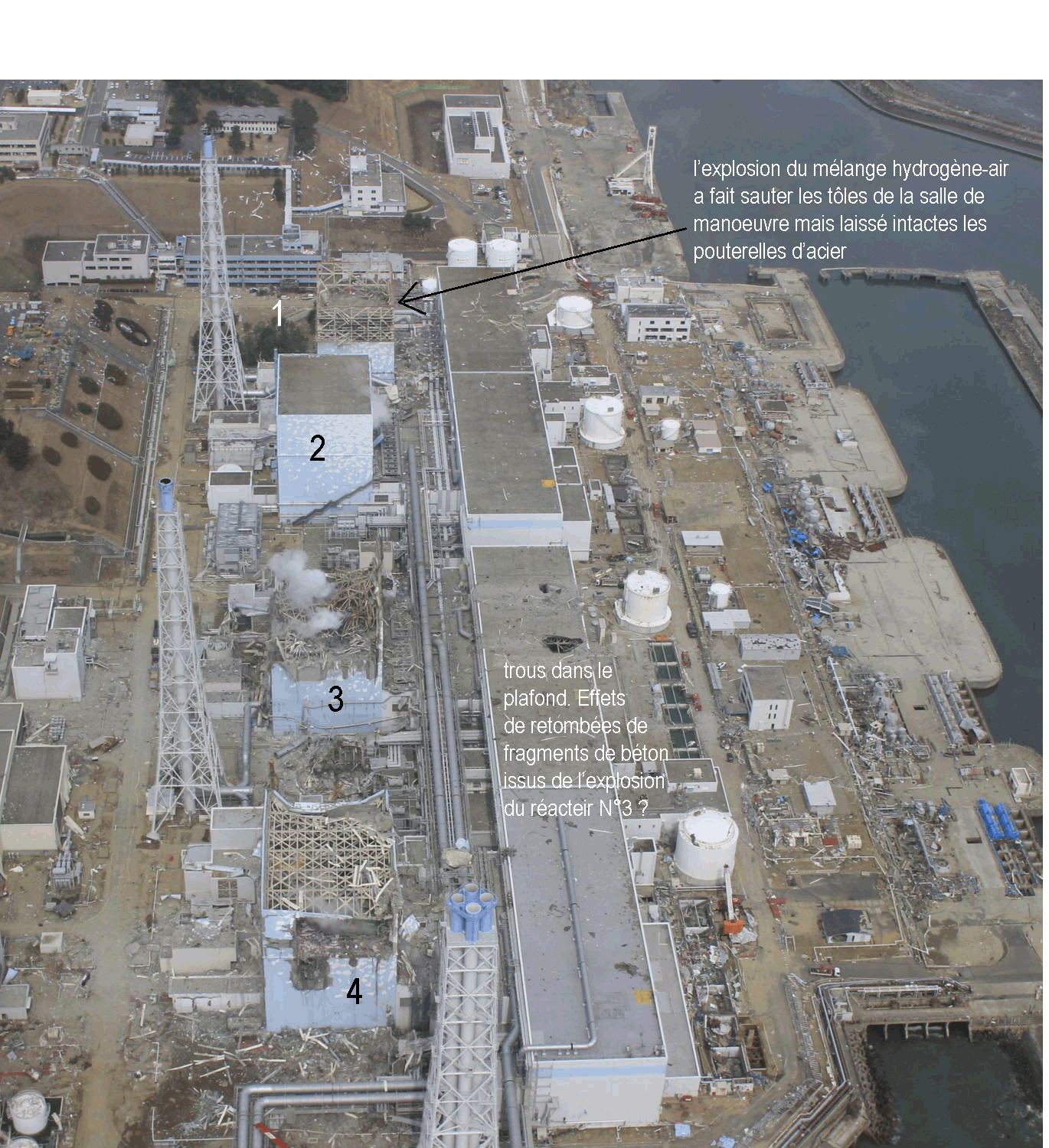
Finally, here are high-resolution photos, taken by a drone on March 20, 2011, belonging to a private company AIR PHOTO SERVICE. I have not adjusted the photos to the screen size, and you will probably, for some of them, have to maneuver your "scroll bars". They show the damage suffered by the reactors at the site and speak for themselves. Logically, these photos should have made double pages in our large "information magazines". Remember the Paris-Match motto "the weight of words, the shock of photos". But I am not sure that such photos will be found elsewhere than on the net. In that case, your opinion will be shaped.

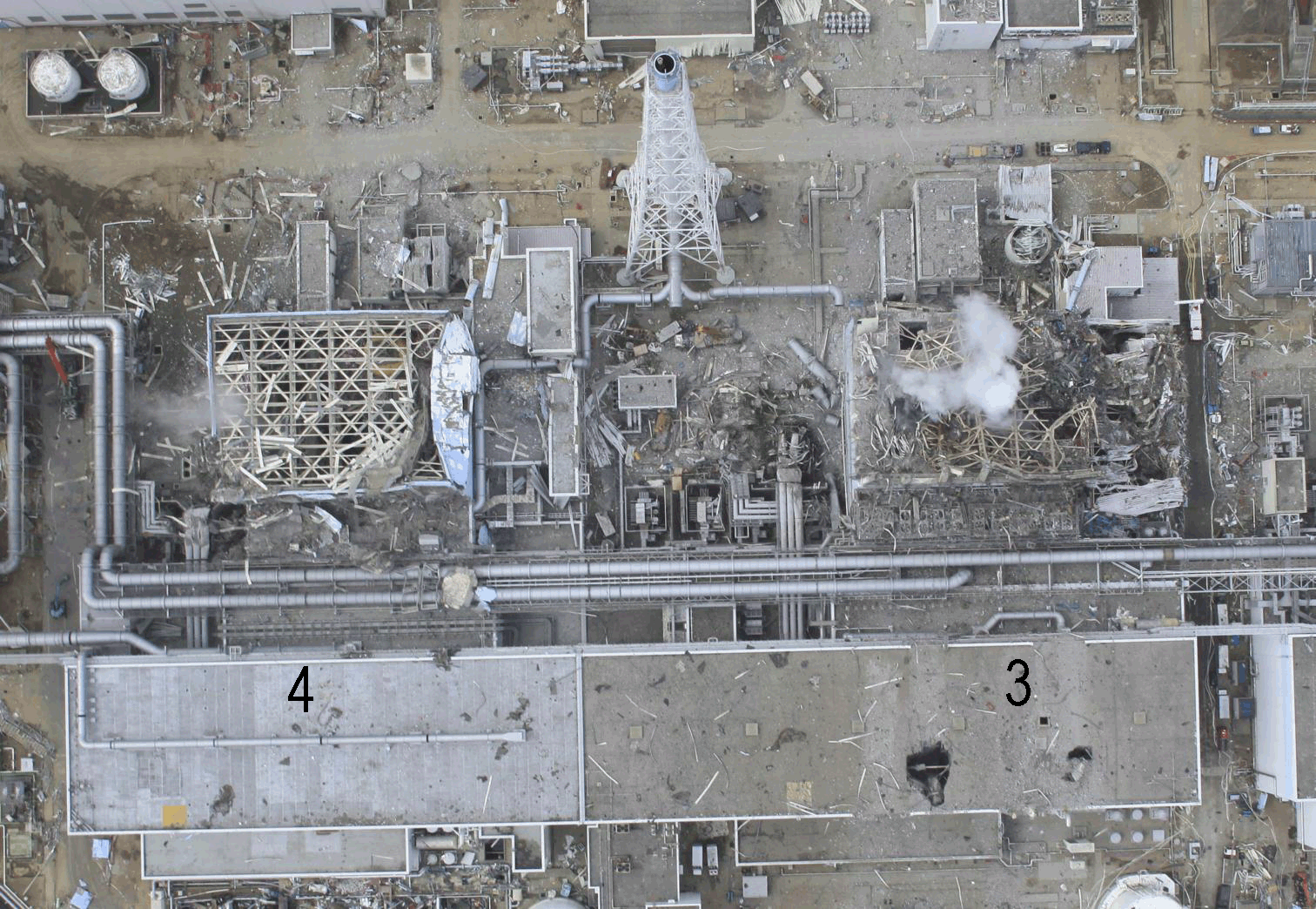
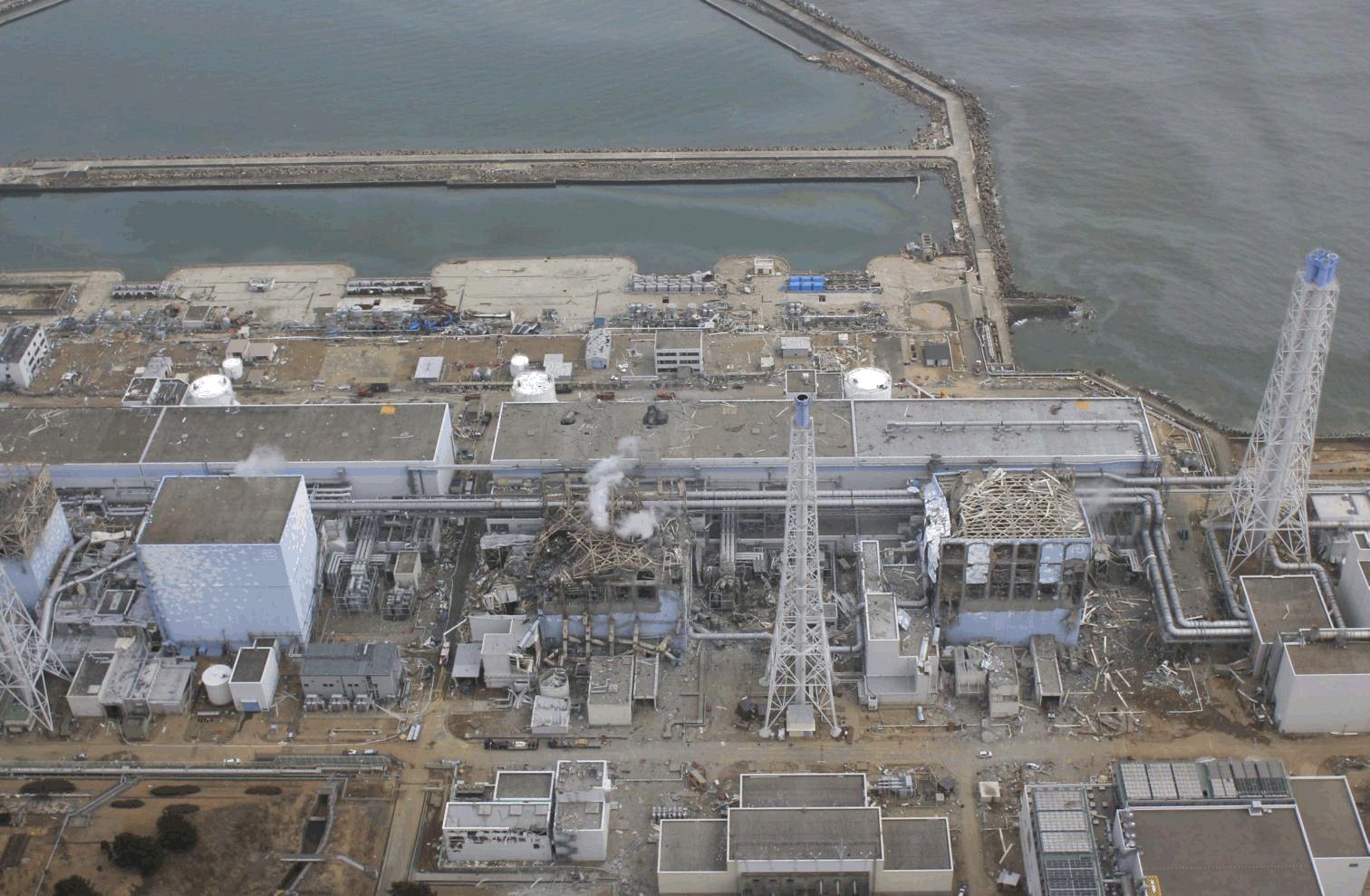
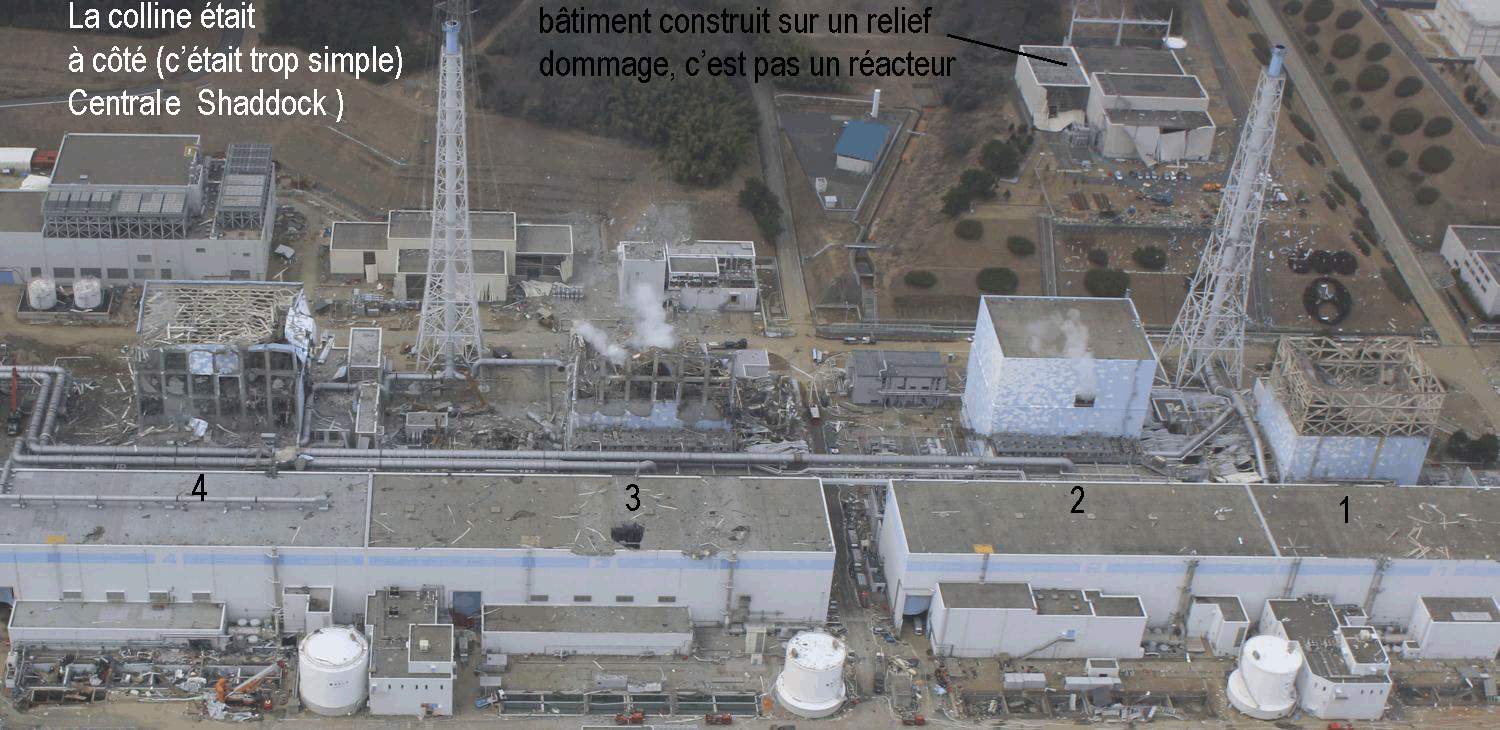
I am writing a second article for the May issue of Nexus, which has opened its columns to me. I will start with a series of articles illustrating the special issue of Le Point, devoted to nuclear energy.
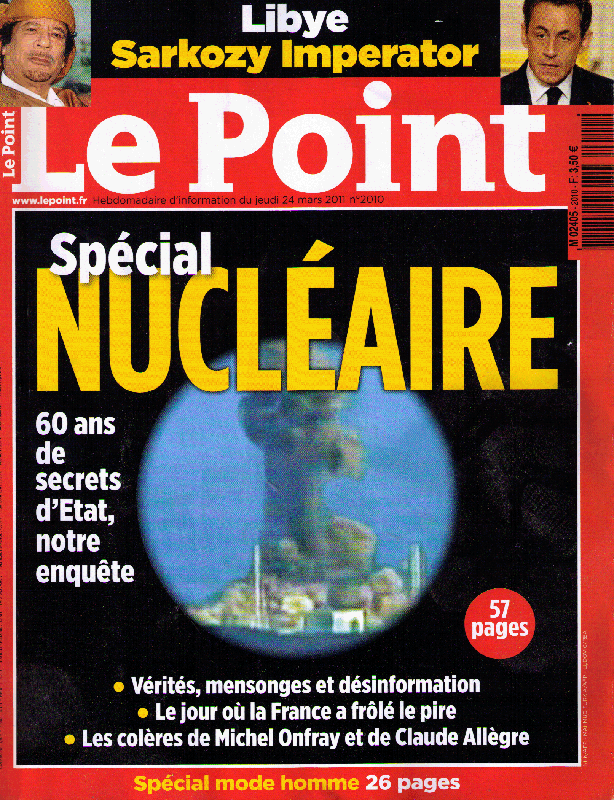
What you will read in this special issue will surprise you. Here is a summary:
Pages 58 to 95, generalities.
Pages 76 to 77, two pages by Claude Allègre, who claims that fearing the effects of seismicity in France is "walking on one's head".
Pages 96 to 103, a course on the different types of power plants, present and "future".
Page 106, an interview with Robert Klapish, former research director at CERN.
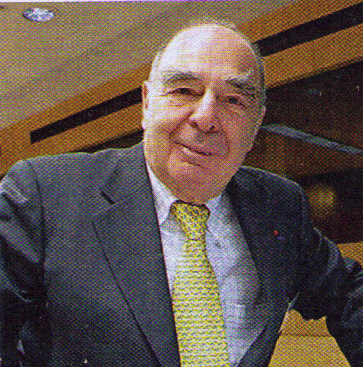
Robert Klapisch, former research director at CERN
Everything is going well in the best possible nuclear world
It is so crazy, irresponsible, and shows such a complete lack of imagination that I leave you to discover it by flipping through your local newsstand and going to this page.
Page 108, Pascal Colombani, former general administrator of the CEA, "demonstrates that we need nuclear energy, but the risks are high." He concludes by saying that the Fukushima disaster "will force us to be more imaginative."
Page 100: "France, addicted to nuclear energy." The only alternative is to... reopen our coal mines, and reorganize our ports to accommodate foreign coal.
Page 112: "Is there life after the atom?"
By reading this issue, you will, if you haven't already, realize that we are governed by fools and managed by dangerous madmen or irresponsible people.
There are solutions, and I will present them in the May issue of Nexus. It simply requires a bit more imagination than the classic environmentalists with their de-growth and solar panels on roofs, and to base ourselves on what works, on proven technologies, not on speculation or "what will work by 2030..."
We need a plan that matches the needs and urgency, and I will present it.
Additionally, news comes in that the two neighboring sites of Fukushima have also suffered damage. I will also publish photos of the three power plants, before the catastrophe, showing that all three, located at sea level, behind a port installation, were adjacent to large hills, all very close. And no one talks about it. It would have been sufficient for the private company in charge of the installation of these reactors to position them a few tens of meters above sea level to protect them from tsunamis, frequent and of high intensity in this region of Japan. Why wasn't this done?
To preserve the profits of shareholders and ensure a good return on investment.
April 1st, 2011: Refer to ****the pdf representing the analysis of the events, given by AREVA.
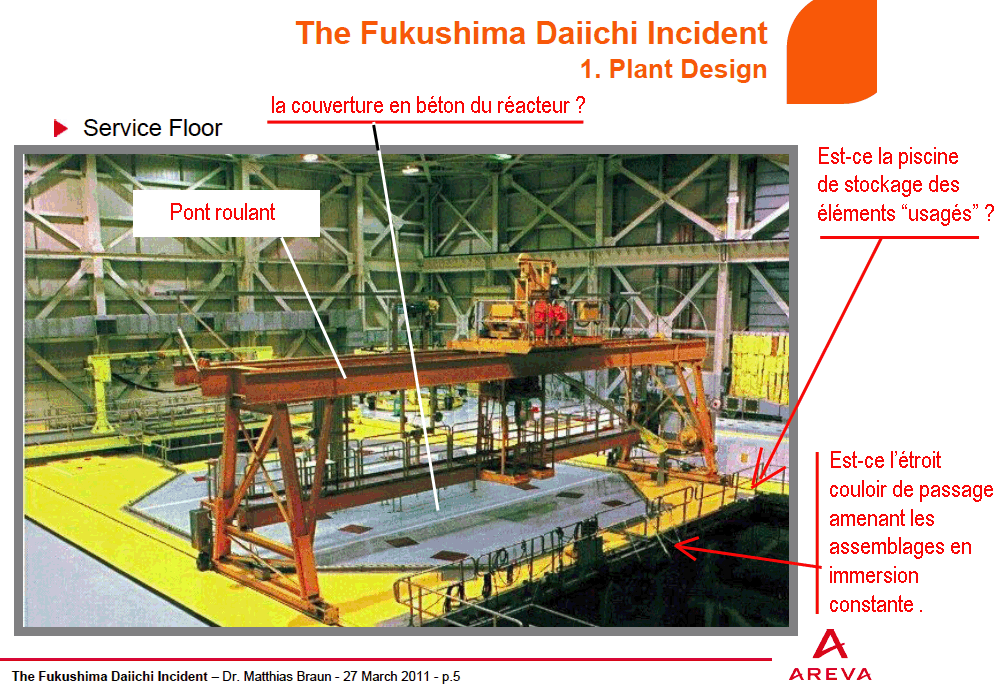
Let's take some of the illustrations to try to understand. This one represents "the maneuvering bridge" of the reactor. You can see the powerful overhead crane, capable of extracting the thick concrete slab covering the reactor, for a loading-unloading operation. The railings give the scale. After removing the slab, the two steel vessels of the reactor having been depressurized, everything is flooded, then the two steel hoods of the system are extracted, always using the overhead crane, and placed. Finally, through the narrow corridor connecting the room occupied by the reactor vessel and the pool, the extracted assembly elements from the core are moved, all these operations being carried out in immersion.
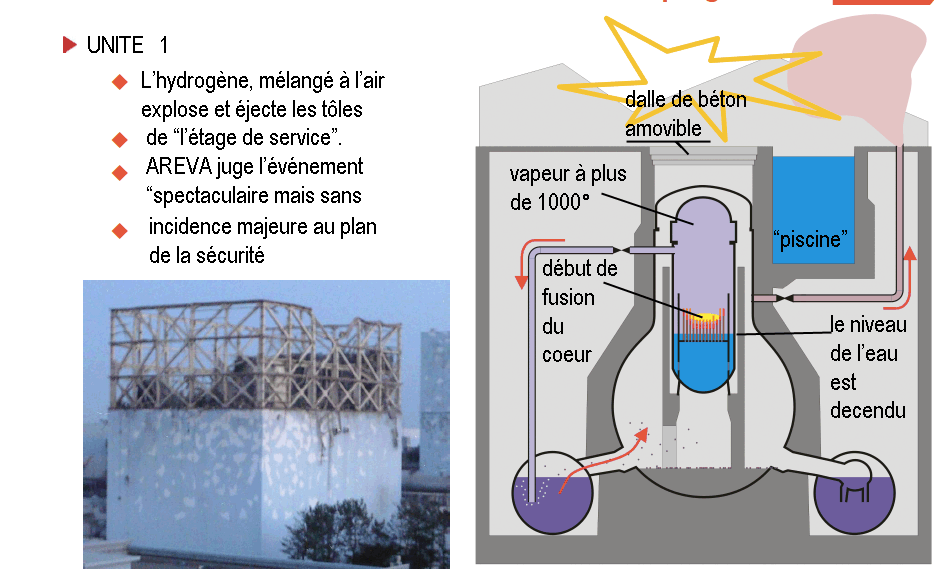
Apart from the overhead crane, this room is almost empty. In the background, you can see ventilation ducts. The structure is of relatively thin sheets, fixed to a light beam framework. In ****the Areva pdf, it is explained that when the temperature of the steam contained in the reactor vessel exceeded 1000° and the top of the reactor began to emerge from the water, it was decomposed by the zirconium of the "pencils" containing the fuel pellets, envelopes also called "cladding". By the way, why zirconium? Because this metal is transparent to neutrons and therefore does not hinder the fusion reactions.
The pressure in the 20 cm thick containment, which contains the core, began to rise. At the same time, hydrogen, from the decomposition of water molecules, was released. The technicians then sent it into this maneuvering room. The oxygen was fixed by oxidation by the zirconium bars. This released the fuel pellets, mixing with the water and the gas, and radioactive contaminants.
In this maneuvering room, a hydrogen-oxygen mixture was formed. Then, as you can clearly see in the explosion of reactor number 1, there was an explosion. The shock wave blew off the sheet metal plates, but the crossbeams remained in place.
This explanation is compatible with the images we have of reactor 1, but completely incompatible with those of other reactors, such as 3 and 4, where something of an entirely different level of severity occurred, which affected the levels below the maneuvering floor. Look at this image of the explosion of reactor 3. Something completely different happened there.
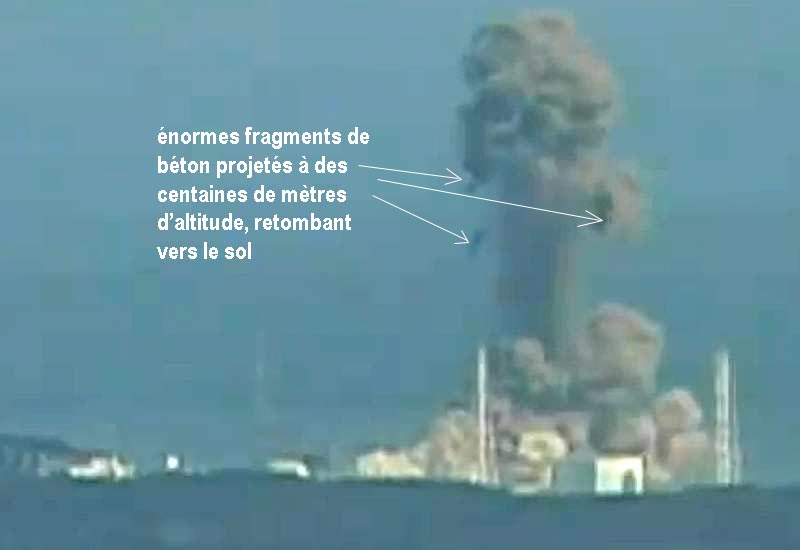
*A less that AREVA produces a new report, *****its report completely discredits its claims
The increase in radioactivity due to the releases from the Fukushima plant. Le Figaro :
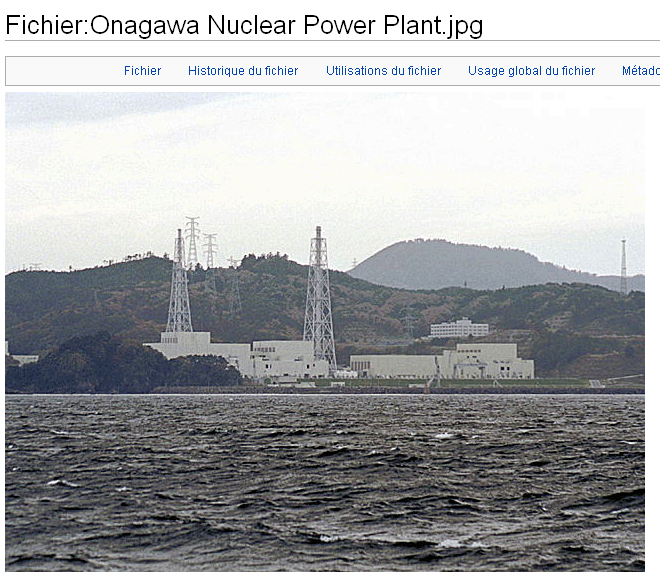
Not one plant has been affected, but three.
The southeast coast of Japan is particularly vulnerable to tsunamis, being bordered by a vast continental shelf sloping gently, which intensifies the wave. There have been two tsunamis of magnitude 7 in this region since 1960. This did not prevent the Japanese nuclear authorities from systematically installing their plants at sea level, simply building a port to bring in equipment, etc. Look at this map.
Two plants, surrounding the Fukushima one
Tokaï and Onagawa
Vulnerability
: maximum:
At 120 km northeast of Fukushima:
, feet in the water.
It was hit directly by the tsunami. Waves of 15 meters high.
A beginning of a fire was able to be controlled. Notice the hills, just behind.
Onagawa has three reactors, all boiling water reactors, the oldest dating from 1980. The village of Onagawa was completely destroyed. As all attention was focused on the Fukushima plant, the private company Tohoku Electric Power attributed the radioactivity around this plant to the releases from the Fukushima plant. But the population now hesitates to believe what they are told. And then, with all these deaths and homeless people, nuclear energy is just another misfortune.
Now let's go further south:
, also at sea level, backed by hills.
Third private operator: the Japanese company JAPC. A boiling water reactor of 1000 MW, put into service in ... 1978, 33 years ago....
The backup pump was able to be started.
Apparently, I am the only one (I have not read this in any press) to say that it would have been more prudent, in a region vulnerable to tsunamis, to install reactors a few tens of meters above sea level, not at sea level. I have not checked all the Japanese power plants, but regarding Fukushima, this plant also has very close heights.
What no one says: At Fukushima, it would have been sufficient, at least, to place the generators and fuel tanks on the surrounding hills
to protect them from the strongest tsunamis and allow them to power the electric pumps
The Japanese do not have a monopoly on stupidity. If ITER stumbles, I will tell you a good one. The reactor will release into the environment, through a chimney, its contents, including deuterium and
(radioactive, lifespan: 12 years).
Paris, the polytechnicians who designed Iter, or the Germans, or others, said "hydrogen, light or heavy, goes up."
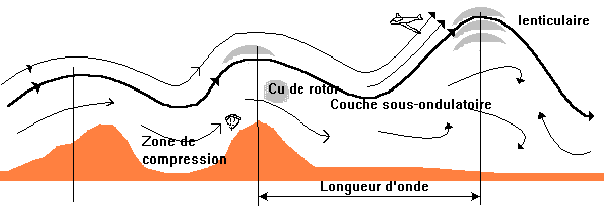
In fact, I have brushed past it dozens of times. This region, dear to gliders, is suitable for wave flying, an oscillatory phenomenon very frequent in this region, if the wind is strong enough. Like the Mistral, for example.
Wave regime (meteorology and gliding)
'wave is the delight of the glider. The drawing shows where the glider must be placed to take advantage of it. At the top of the gas surges: lens-shaped clouds. Below, a rotor, which presses the air to the ground. Air possibly charged, that day, with ... tritium.
What is there downstream of ITER, in a wave regime?
Lake Sainte Croix, a freshwater reserve of Marseille.
There is no meteorological service planned in the ITER teams. And if it were needed, it would require a representative from each participating nation.
One day, the people of the PACA region may hear in their media "that very small quantities of tritium were found in the lake's water, but at a rate that does not present a danger for the health of people who drink this water...."
To be continued ....
March 29, 2011: A situation of extreme gravity.
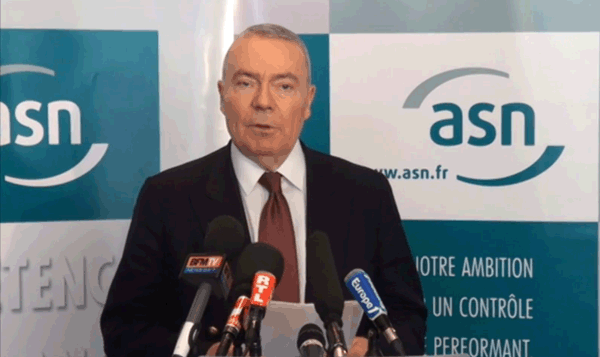
On March 28, 2011, André Claude Lacoste, president of the ASN: Nuclear Safety Authority, held a press conference.
André Claude Lacoste, president of the Nuclear Safety Authority
By consulting the ASN website (a government agency, which is difficult to suspect of an anti-nuclear militant attitude), you can read the report, formulated by this service. Below is a sound clip sent by a reader, reproducing excerpts from
As you can see, the situation at Fukushima is of the utmost gravity and is taking a very bad turn, including at the planetary level. The situation was initially managed in a surreal way. While such a nuclear accident requires rapid interventions, the Japanese prime minister asked that nothing be done before he could fly over the site to assess the situation. While he knows nothing about nuclear energy.
Moreover, the Japanese politely declined offers of assistance from various countries, out of pride, foolish vanity, "to not lose face in the eyes of the world". They refused the deployment of specialized robots. Today, the technicians who intervene on the site must act quickly, given the level of ambient radioactivity. Lacoste speaks of two minutes. Thus, we find a situation reminiscent of what happened at Chernobyl in 1986. Watch the film "The Battle of Chernobyl" to remind yourself of the extreme gravity of a nuclear accident...
****http://cequevousdevezsavoir.com/2011/03/19/la-bataille-de-tchernobyl
I watched a video showing the Fukushima site, filmed from a helicopter. It is impressive. You can see plumes of smoke rising from different locations. The Japanese have given no figures regarding the levels of radioactivity in these hotspots of the Fukushima site. It is worth remembering that shortly after the disaster they announced that it was level 4. But the ASN forced them to revise this number upwards, to level 6 (7 for Chernobyl). The probability that the vessels containing the reactor cores have been broken and released molten fuel is high. It seems that the Japanese do not control what is happening there. It is true that in addition to this nuclear disaster, they have to manage the large-scale consequences of an earthquake and a tsunami. But who had the foolish and criminal idea of installing the reactors by the water, in a region where tsunamis of magnitude 7 have occurred at very recent dates (1962 and 2008, I believe). Go to Google Earth and install the option that shows seismic events.
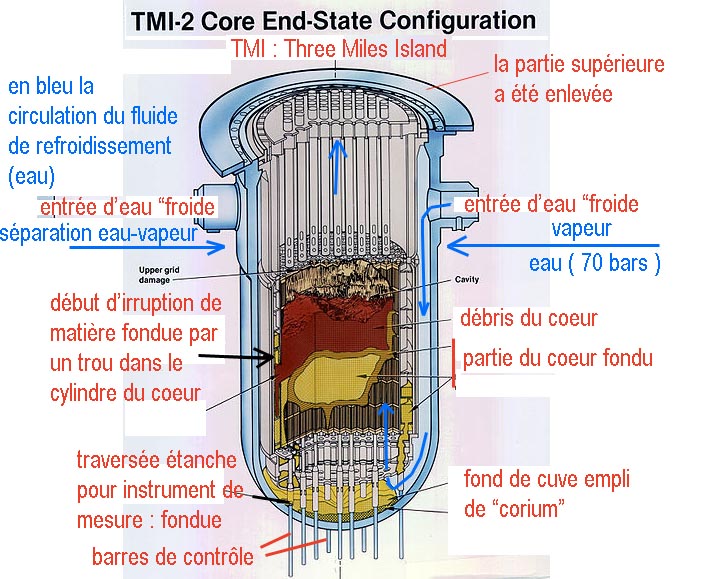
At Fukushima, there have been core meltdowns, possibly very significant. At Three Mile Island, in the USA, 45% of the core had melted and the "corium" had gathered at the bottom of the vessel, which, by miracle, held.
The Three Mile Island reactor, after dismantling, one year later
( it is of the same type as my Japanese reactors)
The shape of this containment is such that when the melted elements fall to the bottom of the vessel, the geometry of the vessel causes these elements to gather and the risk of criticality increases with the percentage of the core that has melted.
This is why the Japanese are desperately trying to cool these vessels. It is a plaster on a wooden leg, retreating to jump better. But if they do not do it, the entire fuel charge will melt and gather at the bottom of the vessel. Then the risk of criticality will be great. If this criticality is achieved, the entire corium will flow under the vessel, into a room full of water sent for cooling. This corium will be at a temperature sufficiently high to cause the dissociation of water molecules (from 1000°C), quickly. Then a gaseous explosive mass, a stoichiometric hydrogen-oxygen mixture, will form. The explosion will destroy the reactor, as was the case at Chernobyl, the force of the explosion having projected the 12-ton concrete cover of the reactor, dozens of meters away.
(What happened during the spectacular explosion of reactor number 3, with its gray smoke and fragments of concrete the size of a bunker, sent hundreds of meters into the air?).
This explosion, if it occurs, and the risk exists, would lead to a massive release of radioactive elements. You must understand the amount of fissile material in a reactor, which is always in tonnes, while a bomb contains only a few kilograms. The spectacular nature of a military nuclear explosion comes from its brevity. A certain amount of energy is released in a very short time, a thousandth of a second. The shock wave devastates everything in its path. The heat of the fireball causes fires and burns living beings. The radiation is also very intense. But the pollution, that is, the amount of radioactive debris falling to the ground, remains relatively low, because the enormous heat causes an ascent that carries the debris to altitude, where they are dispersed by the winds.
In the case of an explosion of a nuclear reactor, the release side is much more significant, because there is no ascent to carry them. If you watch the film "The Battle of Chernobyl" you will see that tens of thousands of men and women were irradiated by releases that materialized as a barely visible smoke plume. It was then the combustion of graphite, maintained by the powerful heating of the melting core.
I would be curious to know the content of radioactive materials in these small plumes of smoke or vapor rising from the breached power plants. There would be a thousand ways to know, not to mention dragging a sensor under a helicopter, or sending a remote-controlled drone.
All of this does not give me a good feeling.
At Chernobyl, the Russians quickly took energetic and dramatic measures to control the situation. After a few hours of lethargy and disbelief in Moscow, the engineers sent to the site took the measure of the situation and acted accordingly. Thirty hours after the start of the disaster, the 45,000 inhabitants of the city of Pripyat, located 3 km from the plant, were evacuated in an orderly manner in 3 hours 30 minutes in 1000 buses.
The Russians sacrificed 600 to 1000 helicopter pilots to drop sand and boron sacks into the mouth of the monster (a hole of ten meters in diameter, which required a low altitude approach, 100 meters above). The occupants of the helicopter then had to drop their load. They were all mortally irradiated.
It was only when a huge amount of sand, concrete, boron, and lead could be dumped that the emissions ceased. But not the radioactivity emitted by the many debris. The lead vapors also caused many ailments in the population (a simple remark: our polytechnicians, to replace the dangerous molten sodium (5000 tonnes), the coolant fluid of the fast breeder reactors, these "fourth generation reactors" suggest cooling the core, a ton of plutonium, with an equivalent amount of molten lead).
Where are the Japanese? It is unthinkable that they can recover their plant units. What will happen? If the vessels leak, the radioactive elements will spread in the very deteriorated buildings. The heat will cause a less spectacular emission, but carrying increasing amounts of radioelements over distance.
These various and varied radio-nuclides have already circled the Earth. In the end, it seems that the only solution will be to put them in a sarcophagus, given that the reactors are already inaccessible due to the high radioactivity. Taking this decision would be an admission of failure for the Japanese. Not a failure in this situation, but a failure of their technology, their energy policy, their way of life. The entire country coexists with 54 nuclear reactors, whose maintenance and design have already been the subject of many criticisms. Condemning the Fukushima reactors would lead to a crisis of confidence among the Japanese people, who have no energy resources to replace. The economic, social, and human stakes are considerable.
It is possible that the Japanese authorities, who have often shown incompetence and lack of determination, let things go to the point where:
- The situation risks becoming a nightmare locally.
- The nuclear pollution takes on a harmful scale on a planetary level.
Regardless, for me, the conclusion is obvious. We must abandon nuclear energy and develop, without delay and in urgency, alternative energies. It is feasible
It is a matter of the survival of the human species.
I will publish an article of 10 pages on this subject in the next issue of Nexus, which is already on its way (it will be in the newsstands in May). I finish writing a sequel, which will be published in the same issue and which points out real solutions. That is to say, the implementation of energy sources of replacement on a truly global scale. It is not, for example, about placing solar panels and wind turbines on the roofs of houses and using low-consumption bulbs, but about, for example, seeking energy where it is and transporting it over long distances, at high voltage, in ... direct current. It is not speculation, but the application of techniques already in place for a long time, in different countries. In Canada, the transmission of electricity produced by dams located in the north is done over 1400 km. The company Siemens is finishing building for the account of China a link that will connect the Three Gorges Dam to the coastal regions, via a direct current connection. Power: 5000 MW. A submarine cable link already sends 1000 megawatts from France to England. But the record refers to a Denmark-Norway link, with 450 km of submarine cable. You will read all this in my article. It is about quickly drawing on the mass of alternative energies that Nature provides us in abundance. The abandonment of nuclear energy is imperative. The sooner the better.
It is not too late, but it is time.
The CRIIRAD detected iodine 131 in Drôme-Ardèche, in rainwater. Here is the address of the video showing the animation of Météo-France, concerning the dispersion of the radioactive air mass.
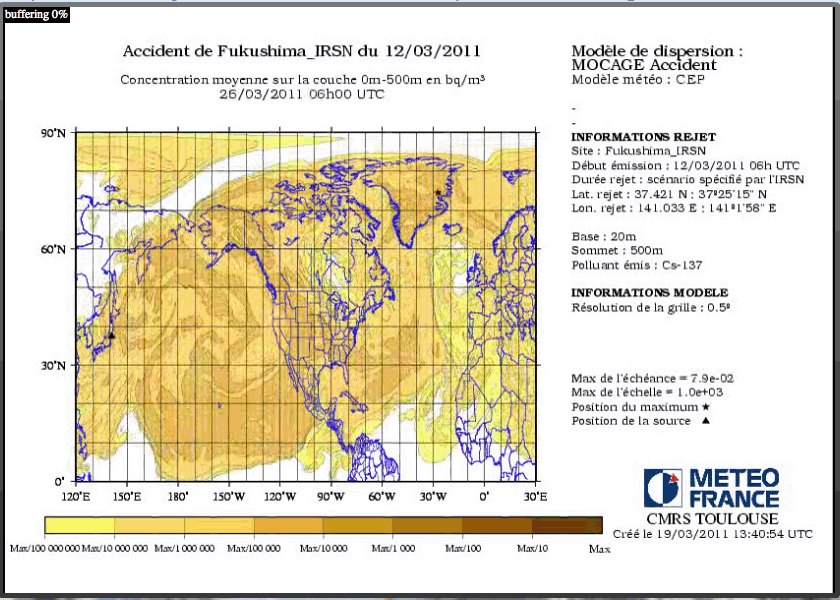
****http://www.irsn.fr/FR/popup/Pages/irsn-meteo-france_19mars.aspx
This sequence is eloquent and shows that it has spread throughout the northern hemisphere.
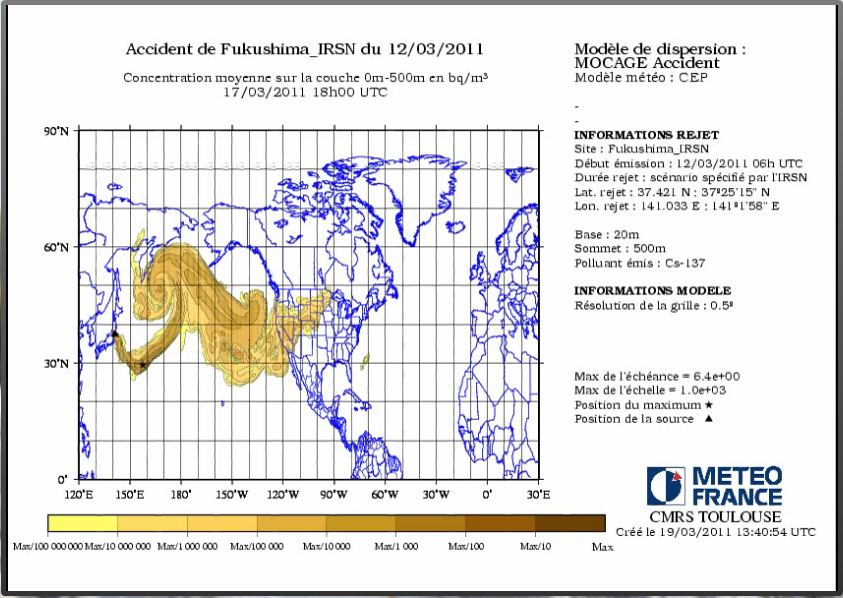
The air mass carrying radioactive dust has already covered the entire northern hemisphere
The analysis report and comments from CRIIRAD dated March 29, 2011
People receive reassuring words regarding pollution by radioactive elements. They are shown figures, which are qualified as very moderate, or even insignificant. But the main risk lies in the inhalation of dust, or its ingestion, followed by its fixation in the body of the person. This is the major risk: carrying this radioactive element inside one's body.
One can die living in a region where ambient radioactivity seems low, simply because one has absorbed a microscopic dusty fragment at the wrong time.
March 14, 2011
For some days now, the world has discovered, stunned, the extent of the damage caused to Japan by the earthquake, and especially the tsunami that formed in the middle of the Pacific Ocean, some 140 kilometers from the northeastern coast of Japan.
****An
impressive video showing the tsunami
If you want to have a panorama of these damages, go see this Chinese video.
****The
damage caused in Japan by the tsunami
These images are extremely impressive. Here are some samples:
The arrival of the tsunami
An enormous whirlpool formed at the retreat of the liquid mass. See a boat near the center, which seems tiny
Fire in a hydrocarbon storage park
Another fire ( gas storage )
Urban fire, city of Sandaï
Filmed from a helicopter, the tsunami crashes on the Sandaï airport
A part of the Sandaï airport, devastated by the tsunami
Without comment.....
It is said that "governing is foreseeing." In this matter, it is to foresee the consequences, which one could call "secondary" or "collateral" of such a natural disaster. Japan, overpopulated, has 58 nuclear reactors to meet its electricity needs. A nuclear reactor is a steel vessel, very resistant, in which there are bars of a fissile material. Technically, these are tubes called "pencils" in which are stacked fissile elements, mixtures of oxides, which have the appearance of aspirin tablets.
Compared to an atomic bomb, which behaves like an explosive, a reactor resembles a pile of embers. In these bars, the decomposition of uranium 235, or even a certain percentage of plutonium 239, releases heat and causes the emission of neutrons which, hitting other atoms of uranium 238, cause secondary reactions.
To better understand the functioning of a reactor, download my comic strip "Energétiquement vôtre" on the site of Savoir sans Frontières http://www.savoir-sans-frontieres.com (nearly 400 albums of the series of Anselme Lanturlu adventures, freely downloadable, in 36 languages, without media echo, all presses combined).
A "coolant fluid" must circulate permanently in this vessel, this core of the reactor, to evacuate the calories, the heat generated by the fission reactions, otherwise the worst can happen.
- I am not omniscient. *
Considering that I have the duty to clarify information, I try to disseminate it. I inform myself, often in a hurry, when it is not in a rush, when it is about current events. I do it in the midst of the numerous activities I must carry out (I have two new books to write and MHD research to conduct, complex calculations to make).
I take this opportunity to ask dozens of readers who, every day, ask me to accept to be on "their discussion list" to refrain from doing so. I don't have time to chat, like on a blog. High school students ask me for their TPE (same thing: I have absolutely no time to take care of them). Others expect me to answer questions like "could you explain in simple terms relativity?" or "what do you think of the hollow earth theory?" . Unless it is to tell me "I am personally very doubtful about .... could you provide arguments to convince the skeptic that I am?" . Some, having come across sites or videos that have caught their interest, just forward their addresses to me, without explanation. If these are not accompanied by a few lines of explanation, I don't have the time to go explore each of these contents.
Sometimes, readers ask me a question to which I answer briefly, this answer being simply "I don't know." It happens that the interlocutor insists, not understanding why "a scientist like me does not take the time to answer properly and with arguments." Sometimes the exchange ends with a mail accompanied by violent insults.
Certainly, what I receive continuously, daily, is an irreplaceable documentation, and it is thanks to these contributions and clarifications from specialists that I can be better equipped to try to inform you. Some, who have followed me for a long time, know how to provide me with these information, with a few lines of presentation, or even an image, saying "I think this is important," and I am grateful to them. Others know how to cut a video document to extract key elements.
When I build a new page, you will see that I do not just indicate an URL of an article or a video. I make many screenshots, I compose my own text and it is common that the assembly of a simple page, where elementary tasks are accumulated, represents 6 to 12 hours of work.
In what follows, I will correct what I posted yesterday, quickly, regarding the Japanese reactors, and that readers have immediately corrected. No, it is not pressurized water reactors, but boiling water reactors.
- I give these details in what follows.*
Let's look at the diagram of pressurized water reactors, an American solution, mainly implemented in France
At atmospheric pressure, water boils at 100°. At a lower temperature, 85°C, at the top of Mont Blanc. And conversely, at more than 100 degrees if this water is at a pressure higher than one bar.
If heat is not continuously removed, these metal bars can melt (this is called "core meltdown") and the result of this melting can accumulate at the bottom of the reactor vessel, forming what must be avoided at all costs: that this material is confined, which would drastically increase the energy release, due to "a criticality entry".
Indeed, a nuclear reactor is a place where chain reactions occur, which must be carefully controlled. These fissile material bars act like hams, in the reactor vessel. Around them circulates a fluid that collects the heat (water at 150 bars, in the case of pressurized water reactors, PWRs: pressurized water reactors). This water enters the vessel at a temperature of 295°C and exits at 330°C. The flow is considerable: 60,000 cubic meters per hour, or sixteen cubic meters per second. In this formula, the primary circuit is isolated from the secondary circuit, coupled to the first via a heat exchanger, and will be sent to the gas turbine, driving an electrical generator.
In purple: the primary circuit filled with pressurized water, circulating in the reactor core enclosure. In blue and red, the secondary circuit. In the heat exchanger, located in the reactor containment enclosure, this water (dark blue in liquid form) turns into vapor, in red. This vapor then drives a two-stage gas turbine: high and low pressure. The vapor, expanded and cooled, then passes through a condenser, where it liquefies.
A system producing energy has a hot source and a cold source. The hot source is the "fuel rods" of the reactor core, immersed in pressurized water, within which exo-energetic fission reactions occur. The cold source is the atmospheric air (for reactors that use this final cooling system). The first two systems, operating in closed loops, are coupled with a third one, in contact with the atmospheric air, thanks to large cooling towers that can be seen, flanking French power plants.
Water is made to flow along the inner wall of these towers, open at the bottom to allow air to circulate. This water thus transfers the heat collected in the condenser to the air rising in the tower. Along the way, part of the water is vaporized (500 liters per second). Therefore, it is necessary to have a water supply nearby (river or sea). It is this vaporized water that causes the towers to be topped with a plume of vapor when the reactor is operating.
70% of the heat produced is thus released into the atmosphere (or into the river, the sea, if the cold source is of this nature). The efficiency of a reactor does not exceed 30%.
There are 58 pressurized water reactors in France. List of French reactors.
Let's move on to the boiling water reactors, of the type that equip Japanese power plants.
Like you, I am discovering and trying to explain. The scheme is as follows:
Boiling Water Reactors (BWR) of Japanese power plants
Or "BWR": Boiling water reactors
See also: http://www.laradioactivite.com/fr/site/pages/Reacteurs_REB.htm
****Or
this interesting English pdf
The comparison with the previous diagram is immediate. There is now only one closed circuit. It is the water sent into the reactor core that is vaporized and then directly directed to the two-stage gas turbine. On the left (1), the core, in its steel enclosure. In (2) the fuel elements. In (3) the control rods which in this configuration must be raised and cannot, in case of emergency, fall by gravity.
Liquid water (blue) is a better heat conductor than water vapor (red, at the top of the core).
At the turbine exit, the water returning to liquid form, in the condenser, is shown in purple. There is no cooling tower. It is seawater, in gray, that is sent into the condenser.
How is the activity of a nuclear reactor controlled?
By using control rods (for example, made of cadmium) that absorb neutrons, without causing new exo-energetic nuclear reactions. When these rods are completely lowered (or raised, in the case of Japanese installations), the reactor's activity is reduced by a factor of ten, compared to its nominal power. In French reactors, the time for the rods to drop by gravity in an emergency is one second. Twenty seconds in the Chernobyl reactor. The control rods of Japanese reactors are raised and operated electrically by screw jacks (see the English pdf: I am not making this up).
Conversely, it is the raising (or lowering in the Japanese configuration) of these rods that will cause the reactor to start up, when it is put into operation. One would then say " the reactor diverges ".
If any failure is observed in the heat evacuation system in the reactor core, where the rods are located, it is necessary either to implement a backup pumping system, or to drastically reduce the power produced by lowering the control rods (or raising them, in the case of Japanese installations).
Electricity production is carried out using alternators, driven by gas turbines. The steam circulating in these turbines must be transformed into liquid water in a condenser. These condensers are the tall towers that can be seen, flanking the location of the nuclear reactor in France. The water vapor condenses there and is recovered in the lower part of the tower. Part of the water evaporates, with a loss of 500 liters per second.
Such structures are not found without Japanese reactors. Why? Because they use seawater for this cooling. For reasons of economy and profitability, the Japanese installed their reactors near the ocean, which is a great mistake, in a country whose coasts can be hit by tsunamis*.
The location of Japanese nuclear power plants, on the seashore (...)
I imagine that the engineers have studied these installations in relation to a certain number of risks. All Japanese nuclear reactors are built according to anti-seismic standards. These correspond to a value of 7 on the Richter scale and represent a possibility of horizontal acceleration of "1g". The technique consists of placing the building on the equivalent of "cylinder-blocks", but much larger.
***For information, the seismic shock felt by Japan reached the magnitude 8.9. ***
Click on the link. You will see, at the bottom of the page, that an earthquake of magnitude 8.9 can cause damage hundreds of kilometers away from the epicenter. This is what happened, the epicenter being located at the border between two plates, 140 km away.
In general, the magnitude is the logarithmic measure of the power of an earthquake (this must be corrected by taking into account the duration of the shocks and the type of waves involved).
***By designing their installations for a magnitude of 7, the Japanese have underestimated the power of future earthquakes by a factor of eighty (10^1.9). ***
Surprising fact: this road was fractured along its central line.
An explanation from a reader: it is common for roads to be "built" in two stages, half by half, their central line forming a fracture initiation
I briefly recall the "sufficient reason" for seismic shocks. On a board at the beginning of the page, the tectonic plates are represented, which can be compared to ice floes floating on the surface of a river. These can overlap. In the case of this Japanese earthquake, it is the meeting between the Okhotsk and Pacific plates. The epicenter is located at a depth of 10,000 meters. One of the two plates passes under the other (subduction phenomenon). These plates are not "lubricated" and this sliding can only occur in jerks. These jerks are the source of earthquakes. When this realignment occurs under water, the lifting of one of the plates lifts a large mass of liquid. This lifting, for someone sailing just above this event, would be imperceptible. It can be measured in tens of centimeters. But if hundreds of square kilometers of ocean are lifted by 10 cm, or more, this represents a considerable potential energy, which will dissipate with the departure of surface waves of long wavelength, propagating at very high speed (on the order of a hundred kilometers per hour). When this tsunami reaches the coast, if the uplift of the seabed occurs gradually, the wavelength decreases, while the amplitude of the level variation increases. Thus, a wave that represented a variation of 10 cm, barely perceptible, of a wave having a width (we talk about wavelength) of ten kilometers will become, near the coast, a wave of ten meters high, whose wavelength is then in hundreds of meters. Closest, the wave may break.
This earthquake would have caused the entire plate bearing Japan to move 2.4 meters. This figure should be multiplied by ten in the subduction zone, near the epicenter. Maps and GPS coordinates need to be reviewed. This movement had an impact on the entire Earth, causing a displacement of the entire Earth's crust by 25 cm, which leads to a shortening of the day. This earthquake is one of the five most powerful recorded on Earth since seismic measurements began.
What caused the malfunction in the entire Fukushima reactor site did not come from the earthquake, but from the fantastic tsunami, with its ten-meter-high wave (which had never happened in Japan for hundreds of years). There is no way to protect against such an impact. Those who know the sea know what storms can produce. They can burst dams, twist heavy sections of iron. About fifty years ago, a man wanted to build near Marseille an attraction he called "telecable". The principle was that of a submarine cable car. But instead of suspending baskets on a cable, they would have attached air-filled gondolas to a cable running on pylons anchored on the seabed. The goal was to bring our underwater tourists close to "the Farillon arch", at the end of the island Maïre, a superb underwater decor, which I know well. The starting base of the cable car was to be located to the east of the "Cap Croisette".
.
**The small harbor of Cap Croisette, in 1958, a few hundred meters from the planned starting point of the cable car. **
The sailors warned the engineer:
- You know, in our region, we have an east wind called the Labé. And when it gets out of hand, some winter days, the waves are really powerful.
The engineer ignored this. The first pylons were installed, and were swept away like straw the following winter, by the first Labé storm that came.
I cite this anecdote to evoke the fantastic power of the sea (water is 800 times denser than air). A reader informs me of effects of the tsunami that have not been mentioned in the media. The wave may have caused movements of sediments that could have blocked the "intakes" submerged, through which seawater for cooling would be drawn. The backup systems that would have been planned, such as water stored in large tanks, could have been disabled by the impact of the wave. The same goes for backup systems operating with generators.
On the powerpoint above you could see the damage the tsunami could have caused, impressive. If the Japanese engineers had designed their installations taking into account seismic risk, they obviously had not considered that the plant could be hit by a wave of this intensity. Even if the most visible buildings could have withstood it, what about the rest of the installation, the pump room, the control room, the power supply system for the pumps? It is enough that one of these elements is damaged for the act of shutting down the reactor, or cooling the core by a backup system, to be impossible to implement. Adding to this, a worsening fact, that in the Japanese system, the control rods cannot fall by gravity, but must be raised!
Japanese reactors are designed to react to seismicity. The ground shaking preceded the arrival of the tsunami. The epicenter being 140 km from the coast and the propagation time being 20 minutes, the wave traveled this distance at a speed of 300 km/h. The safety systems of the reactors, designed to withstand earthquakes of strength 7, have they functioned correctly, under the effect of a shock approaching strength 9? Has the containment enclosure, intended to ensure confinement, been damaged, cracked?
*The Japanese authorities tell us that these safety systems worked. *
Currently (March 14, 2011), we do not know the nature and extent of the damage suffered by the Japanese reactors. The situation seems to be worsening every hour. A failure in the cooling system can cause the fuel rods, instead of being immersed in hot water, to be surrounded by steam, whose temperature will increase. This will then combine with the metal forming the envelopes of the "fuel rods". This oxidation, taking oxygen, will release large amounts of hydrogen and spread radioactive elements in the steam. It was mentioned in previous days about sending hydrogen to cool the core. It seems that this is false. When this hydrogen began to invade the single circuit of the boiling water reactor, the engineers had to allow it to escape, to prevent the core itself from exploding (...), if this has not already happened. By combining with the oxygen in the air, this caused the explosion, which seems to have blown off the roof of one of the buildings, that of reactor number 1. I am talking about the first explosion, that of Saturday, the day after the tsunami.
Japanese engineers have resorted to trying to control the temperature rise of the core (the cores of the three reactors) by injecting ... seawater directly, which amounted to rendering these units unusable, due to corrosion.
What is still working in these installations? It is hard to say, and it is possible that the Japanese engineers do not know either. We saw that the control rods had to be raised. Can they still be raised now? If the answer is no, it will be impossible to reduce the reactor's activity level. Moreover, the seawater sent into the core comes out carrying radioactivity, which is returned to the Pacific waters...
The major mistake was:
- Building these reactors on the seashore
**- Underestimating the magnitude of future earthquakes (8.9 instead of 7), that is, underestimating the destructive power by a factor of 80. **
If the premises of the Japanese nuclear power plant were devastated like the districts of the city of Sandaï, or its airport, hello to the damages!
There is no way to protect against a tsunami of such power. One cannot imagine mounting a nuclear reactor and all its installations on ... pilings. The solution would have been to house these installations above sea level, at a sufficient altitude. Fifteen meters would have been enough: a simple hill. The country has no shortage of mountains: 71% of the country is mountainous. But in that case, using seawater as a coolant, one would have lost in efficiency by spending power to pump this water, with the high flow required (sixteen cubic meters per second).
Predicting ....
A Japanese seismologist had vainly, in 2006, emphasized the need to review the provisions related to the resistance of nuclear power plants to earthquakes.
Professor Ishibashi
Seismologist, Professor at the Urban Safety Research Center at Kobe University
Anyway, in a country sensitive to tsunamis, building all the power plants on the seashore was total irresponsibility.
*Satellite photos, comparative, showing the site, before and after: *
March 16, 2011: There were several explosions. The first blew off the upper part of the building housing reactor number 1. This seems to be due to the accumulation of hydrogen produced by the decomposition of the water bathing the core elements, the oxygen having oxidized the metal sheaths of the "fuel rods", in zirconium. The Japanese could not allow the pressure to rise in the closed internal circuit of the reactor, or even in the containment enclosure. They therefore allowed the hydrogen to rise and invade the area above the reactor. By mixing with the air, everything exploded, blowing off the roof of this area. This explosion triggered the departure of a shock wave, followed by the condensation of the water vapor produced, which is clearly visible on the video.
The explosion of number 3 seems more problematic:
The film shows that large concrete fragments were projected hundreds of meters high.
Reactor number 3 under construction, in 1970:
At the bottom, in the foreground, the steel dome closing the containment enclosure. The men give the ladder
**The core container, in its pear-shaped containment enclosure. ** ****
A reader's opinion
Here is the diagram of the Fukushima reactors, there is no containment enclosure in the sense that the term is understood in France. The Japanese General Electric BWRs, whether signed by GE, Hitachi or Toshiba, are built by KAJIMA (the Japanese Bouygues) in the same model, which evokes the Soviet VVR or even the Chernobyl RBMK: a big pile of concrete with a thin steel shed on top.
At the top of the concrete block, there are pools for storing the MOX fuel elements, the new and old, about 20 years of operation, which makes quite a few megacuries. One can also place in the pools the cover of the vessel, the bolts, and everything that emits radioactivity. A huge overhead crane is anchored on the concrete, and is used, for example, for handling the large concrete slabs that seal the vessel well.
Obviously, if the core is no longer cooled, the rods melt, react with the water and form hydrogen. If the vessel is pierced, the hydrogen leaks through the slab and accumulates in the shed. The voluntary releases should be done through the factory chimney, of course. If hydrogen has accumulated under the shed, it is obviously against the engineers' will, because the steam pipes were pierced, or even the vessel.
The first explosion, on Saturday, that of reactor number 1, is indeed a hydrogen explosion: few debris, a visible shock wave, little dust, some sheets flying: it is indeed an explosion under the shed.
On reactor 3, the accident was much worse: I think the core melted, pierced the steel vessel and accumulated at the bottom of the concrete vessel well.
By dripping to the bottom, the CORIUM formed a critical mass. (Corium is the material of the melted core, a mixture of uranium oxide, plutonium oxide, fission products and steel and zirconium) This is called a "criticality accident," or "nuclear excursion" (a small nuclear explosion, in fact)
I think the power of the explosion shattered the vessel well, and one can clearly see the huge pieces of concrete flying in the air on the videos. Note that the reactor building is nearly 100 meters high, which gives the scale of these pieces of concrete: the size of a small bunker of the Atlantic Wall!
Stop the video and measure with a ruler the maximum height of the dust and debris cloud: between 600 and 800 meters! Look at the pieces of concrete and estimate their size, again with a ruler. Do you still believe that the containment is intact?
Compared to Chernobyl, the problem is that the MOX fuel contains roughly TEN TIMES more plutonium. MOX is produced in France at the MELOX plant located in the commune of Chusclan. Its construction was decided by Mr. Jospin.
The Japanese have built their MOX plant, but if I remember correctly, it seems that it has been temporarily closed (to verify) since three workers accidentally mixed fissile products in a bucket of too large a size, which damaged their cells irreparably due to the neutrons produced. It is difficult to say whether the fuel in the Fukushima reactor 3 was produced in France or in Japan. We can trust Mr. Besson to
inform us on this point.
Let's not be smug: in the same situation, faced with such an explosion, the concrete of the containment of French power plants would not have resisted better.
On the other hand, in the French EPR, a "pancake tile" system in refractory concrete is supposed to spread the corium to avoid any criticality, and cool it in the form of a nice radioactive pancake.
Other images of this type of BWR (Boiling Water Reactor). American design. A quarter of the world's fleet. Power: from 570 to 1300 megawatts.
In blue, the "pool" where elements extracted from the reactor, "shut down", including a batch of "fuel rods", are stored, for their replacement.
According to a reader, shutting down a reactor is not immediate, even if the raising of the control rods stops the exo-energetic fission reactions. These fissions produce elements with a certain half-life, which continue, as they decay, to produce heat. This is why it is necessary to continue to cool the core of a "shut down" reactor. The reader estimates the thermal power released at 60 megawatts. Thus, even if one of these reactors was "shut down", the failure of the cooling system due to the tsunami impact created a risk of core meltdown. It was necessary to maintain the cooling of the core, at any cost. Yes, but how?.
Description at : ****http://www.laradioactivite.com/fr/site/pages/Reacteurs_REB.htm
****A
dossier, in English, on the safety measures associated with this type of reactor
The steam temperature is about 300°C and the pressure is 70 to 80 atmospheres. The control rods, introduced from below, are pushed by hydraulic jacks, and therefore cannot fall vertically by gravity. In these reactors, it is necessary to constantly monitor the level of liquid water. This is achieved by using a toroidal-shaped reservoir, located at the bottom of the device.
Between the first, cylindrical enclosure, surrounding the core and the second, bottle-shaped containment enclosure, there is (in yellow) an inert gas (argon). A precaution in case of temperature rise would lead to the production of hydrogen, after water dissociation, the oxygen released combining with the zirconium fuel rod envelopes. Thus, the hydrogen produced, diluting in a chemically inert gas, would not cause an explosion (...).
The days and months will pass. The time for the balance sheet will come. It is sad to say, but the fact that this catastrophe occurred in Japan could weigh on the development of nuclear energy in the world and its reorientation (see below). Chernobyl was 25 years ago. And Ukraine is far, it's big. It doesn't matter that a region as large as Provence had to be emptied of its inhabitants for decades and that thousands of people died, at the time, then from the effects of irradiation.
If the Japanese nuclear accident had occurred in India, or in China, or in an Eastern country, who would care, even if the deaths numbered in the hundreds of thousands, even if the poisoned regions were vast.
India, China, Eastern countries, it's far. And then, everyone knows that these people do ... anything, it's well known. For the world to finally realize the danger of civilian nuclear energy (let's not talk about military nuclear!), what would be needed? To wish that the Japanese experience a Chernobyl-bis, that a quarter of their territory, overpopulated, becomes uninhabitable for decades, that winds blowing westward require the immediate evacuation of Tokyo (250 kilometers away) and the inhabitants of the surrounding areas, which represents 30 million people? That fishing in Japanese waters becomes problematic, due to the fallout in the coastal area?
In six months, "everything will be back to normal". "Japan will heal its wounds," they will say.
Which media raised the key issue: the danger of locating nuclear power plants on the seashore, as they all are, making them vulnerable to tsunamis. But if these locations were mistakes, what about the cost of relocating them on a simple hill? What about the cost of modifying the buildings to withstand not earthquakes of strength 7, but those reaching 9!
There is no zero risk....
Behind this fact, there is the negligence of people who manage the fate of men, the irresponsibility of scientists, the incompetence of politicians, decision-makers, the greed of financial powers, the short-sightedness. In the face of this, the angelic impracticality of environmentalists who imagine that solar energy, or "economies", "de-growth" will solve everything. I will tell you one thing. Two months ago, the room adjacent to my house, containing the aquagym pool thanks to which I was able to get out of my wheelchair, burned down, due to a short circuit. On the walls: a plastic cladding, over thirty years old. The CES of Pailleron, located in the 19th arrondissement of Paris, where twenty children died in a few minutes, the night club 5 à 7, in Saint Laurent du Pont, in the Isère, 180 dead, it doesn't ring a bell?
This cladding is not fireproof at all. But its behavior in the face of a fire is alarming. Subjected to a simple radiation, this material decomposes into dark particles, forming a toxic mixture, quickly suffocating for anyone who finds themselves unable to escape the place quickly. But this dust, mixing with the air, can then ignite suddenly. I saw, in a dozen minutes, flames of 2 meters emerging from my room, located on the ground floor. I was able to extinguish this fire, which became immediately violent, using the garden hose and spraying fine droplets at the top of the flames, otherwise the house would have been destroyed. Their rapid vaporization cooled the fire, which disappeared in a minute. I left some strands of hair.
Advice: if your house or apartment contains insulation or soundproofing cladding of this kind, replace it without delay with modern, non-combustible elements.
The room was restored. In the process, I made a one and a half square meter solar panel, mounted vertically on the south wall, embedded, disguised as a false window. My pool, also insulated like a camping refrigerator, with an 8 cm thick polyurethane coating, lined with polyester resin and gel coat, and covered with plates of the same nature, its maintenance at a constant temperature of 32 degrees requires only 175 watts. I can therefore maintain this temperature with my solar collector (a wooden box, a one and a half millimeter thick sheet of metal, a copper coil, a double-glazed pane of 4 - 6 - 4 and a circulator). But would this mean that I could, thanks to this, heat my house, cook, etc.?
When our nice ecologists call for "new energies", the industrialists smile. How to power the industrial installations, run the TGVs, make aluminum, etc.?
See below
That being said, all countries that have strongly equipped themselves with nuclear power plants are beginning to ask questions. In France, three quarters of the electricity consumed is of nuclear origin. We are not lacking in imprudence. If the Japanese plants in question are 40 years old, the Fessenheim plant, 33 years old, does not have a double containment enclosure. It would not withstand an earthquake. When Super-Phoenix was built, the roof of the building housing the fluid pumping system collapsed on December 8, 1990 ... under the weight of snow! No one had considered this possibility. Yes, in the Isère, it sometimes snows....
In France, we have this absurdity called ITER, a simple "social plan" and a dream vacation for thousands of engineers and technicians, who are aware and complicit, and who will, before retiring, admit that "yes, it was a mistake ...".
But what is extraordinary is that two renowned scientists, Balibar and our late Nobel Prize winner Charpak, while condemning this costly project, reaching the pharaonic figure of 1,500 billion euros, were also advocating for the resumption of the most dangerous civil nuclear project that man has ever imagined to date: fast breeder reactors.
Georges
Charpak, Nobel Prize, died on September 29, 2010
He was advocating, just before his death, with Balibar, the installation of fast breeder reactors!
Superphénix, fast breeder reactor of Creys Malville
(Financial abyss, halted in 1998, currently being dismantled)
On December 8, 1990, the ceiling of the pumping hall of the reactor, poorly calculated, collapsed under the weight of snow. The designers of the installation had forgotten that in Isère, it sometimes snows.
To understand the general principle, refer to my comic strip where all of this is explained. The fission reactions produce neutrons. If this production occurs in an aqueous environment (pressurized water reactor), this water plays the role of a moderator, slows down these neutrons.
If we manage to prevent these neutrons from being slowed down, they will be able to cause the transmutation of uranium 238 (non-fissile) into plutonium 239 (fissile, not existing in nature). This is how in military reactors, the explosive of fission bombs is produced. A fertile cover, in U 238, is associated with a fast neutron reactor, which gradually transforms into Pu 239 over time.
This scheme can be transposed to civil reactors, with considerable danger of use. The coolant fluid can no longer be pressurized water, which slows down the neutrons. Therefore, we must opt for a setup where the heat produced by fission is extracted from the core by circulating molten sodium at 550°C (at 880°C, it boils). This does not slow down the neutrons. But, if released, it spontaneously ignites in the air.
In this type of reactor, called fast breeder reactors, plutonium is used. In a fast breeder reactor like Superphénix (which is supposed to rise from its ashes...), a functioning that represents an annual consumption of nearly one ton of plutonium (compared to 27 tons of uranium, at equivalent power). The neutrons emitted by these fission reactions could transform a U 238 cover into Pu 239.
Uranium 238 is the waste from nuclear reprocessing carried out at La Hague. It is in a way the "ash" of a uranium operation, where it is the isotope 235 that is consumed. It is no coincidence that France has positioned itself as the champion of "reprocessing", which consists of recovering this fraction of the "ash" that can be reused in fast neutron reactors. A long-term policy, aiming to "ensure our energy independence", unfortunately ... suicidal.
**The fast breeder reactor. **
In yellow, 5,000 tons of molten sodium, heated to 550°C. Spontaneously ignites upon contact with air and explodes upon contact with water (in case of a sodium fire, the last people to call are ... the firefighters!).
In the core, in red, the fuel elements, in plutonium. Around, in pink, the "fertile" elements, in Uranium 238, which the neutron bombardment transforms into plutonium 239. On the right, the heat exchanger system, gas turbine, and contact with the "cold source".
From this angle, one could say that the fast breeder reactor would function by "burning the ashes from uranium 235 reactors". Since France is very rich in "ashes", due to the operation of its uranium reactors, and the services it offers to neighboring countries in terms of reprocessing, it would thus achieve complete independence in terms of fissile fuel.
The problem is the extreme danger of operating such a reactor. Its core is at 550° instead of 300°. The use of molten sodium as a coolant represents a major risk of fire, in case of contact with air. Add to that the extreme radiotoxicity of plutonium. A tenth of a milligram of plutonium, inhaled and fixed in the lungs, is sufficient to cause a cancerous tumor with a 100% probability. Do the math. A fast breeder reactor loaded with a ton of plutonium contains enough of this poison to kill ten billion human beings.
The slightest notable incident on a fast breeder reactor could result in ten million victims.
Not ten million irradiated, but ten million dead
Recommending a development of the French nuclear industry towards the fast breeder reactor formula is complete irresponsibility. That this recommendation comes from an incompetent politician could be understood. It is astonishing that it was made by a Nobel Prize winner in physics, who was just about to pass away.
But, in France, a reactor of this type is once again under study.
Simple remark: France, like other countries, particularly Japan, uses as fissile material in 20 of its reactors a mixture called MOX. It is a mixture of two components. 6 to 7% plutonium, diluted in 93% non-fissile uranium 238. Wherever there is plutonium, the situation is not at all tranquil (for example in Japan ...).
The site of Savoir sans Frontières
****See
this dossier by Jean-Luc Piova
****See
this dossier made by Jean-Luc Piova
24/3/11 :
What is MOX?
Natural uranium is in the form of oxide. Two isotopes are present
- U238, at 99.3 %, non
fissile
but
fertile
- U235, with a content of 0.7 %,
fissile
to use this natural ore as fuel, it is necessary to have the most efficient neutron moderator: heavy water, a water molecule composed from an isotope of hydrogen, deuterium. Hence this famous "battle of heavy water", during which a commando went to destroy an isotope separation plant, located in Norway, possessing a stock of heavy water that the Nazis could have used. The same thing for the protection of the French heavy water by Joliot Curie, at the time of the French collapse, in 1940. Such reactors exist, in Canada. They are called CANDU, from CANada Deutérium Uranium. These reactors cannot use this heavy water as a coolant fluid. There are therefore automatically two sets. One circuit extracting the thermal energy and a set of pipes filled with the heavy water moderator.
'where the term "Light Water Reactors" (pressurized water or "boiling"), in contrast to these (rare) reactors containing heavy water.
Outside reactors using heavy water as a moderator, it will be necessary to carry out a prior enrichment of the uranium ore, which is first transformed from the oxide into uranium hexafluoride.
in gaseous form, which is enriched by centrifugation, to 3 to 6% U235. Then, by assembling a mass of about a hundred tons, this charge can "diverge", that is to say become the place of chain reactions producing energy.
if a low enrichment nuclear fuel is used, the reactor will have to be larger. Over the years, nuclear engineers have improved the design of the cores. Indeed, in a cylindrical core, the rate of fission reaction will be higher in the elements located near the center. They have played with the permutation of the assemblies located near the axis by those of the periphery. They have also played with a non-homogeneous distribution of moderator elements, reducing the reactivity rate in the center, in order to have a homogeneous depletion of the reactor charges. They also use neutron reflectors, all these techniques having allowed working with lower enrichment rates, hence at lower cost.
Military reactors, like those of submarines and aircraft carriers, require greater compactness and will use uranium with a higher enrichment rate
let's say that with enrichment rates of 3 to 20% of U235, we remain in civil uranium
from 20% to 90% is more, we enter the domain of military quality uranium. With high percentages, the production of uranium bombs is possible.
but in general, A bombs are made with plutonium, which requires a smaller critical mass. An uranium that is produced by allowing fast neutrons to escape and bombard a fertile cover of U 238, according to the reaction:
U238 + neutron gives PU239
therefore there is no clear boundary separating civil nuclear from military nuclear. If the moderation of a civil reactor is reduced, it can become plutonium-producing, eventually providing plutonium for making fission bombs. See my comic strip "Energétiquement vôtre", downloadable for free on
. Let us note in passing that in a normal operation of a civil reactor, there is a production of a little plutonium because the moderator substance, although it reduces the amount of fast neutrons produced, cannot completely eliminate them. This plutonium, mixed with uranium, is therefore part of the "wastes" resulting from a civil operation.
let's go to the fuel. The enrichment of this uranium is carried out in France in the Tricastin center. Consuming the electricity produced by three nuclear power plants located on the site (it is the largest "client" of Edf in France), this center carries out this enrichment operation starting from natural uranium ore, which contains only 0.7% of U
. The isotopic enrichment is mainly obtained by a cascade of centrifuges. At the end of the operation, we obtain
-
Enriched uranium, with 3 to 6% of U
-
The residue is "depleted" uranium, containing 0.2 to 0.3% of U
, which will be used to make penetrator heads for shells.
let's take the case of the most common reactors, those of the French park, the REP, the Pressurized Water Reactors. They are loaded with a fuel containing 3% of U
. During the operation of the reactor, which is about a year, the composition of the fuel evolves over time. There is production of plutonium Pu
, more different fission wastes, not exploitable. The percentage of U
decreases over time. When this rate falls to 1%, this fuel becomes unusable. The density of fissile material becomes too low. It is necessary to replace it. In passing, a certain amount of plutonium has been produced, by capturing a neutron. But this plutonium is not suitable for participation in the production of energy by fission in this operating regime with neutrons slowed down by water, which plays both the role of
coolant fluid
and of
moderator
, that is to say of neutron decelerator, which are emitted at 20 km/s and must fall to 2 km/s to trigger induced fissions in the U
at the end of this operation, two options. Either we store the contents of the reactor load "considered as burned", which, however, contains 1% of U
and 1% of Plutonium.
or we "reprocess" all this in a reprocessing plant (La Hague) where we separate the radioactive wastes, not usable, which we store in vitrified blocks, recovering the U
and the Pu
, otherwise pure, or at least diluted in U
at higher concentration, and we obtain something that can be fissioned again.
for decades, the French have decided to play the card of "fourth generation reactors", that is to say of fast breeder reactors, like Superphénix. You will read in texts from the CEA that the question is not whether we will pass to such a formula,
but when we will take the decision to replace the uranium reactor park with fast breeder reactors, which will then be "deployed" on the French territory.
but the fast breeder reactor Superphénix, which was a prototype of these "fourth generation reactors", gave us a big scare in 1990. The roof of the building where the turbines were housed collapsed under the weight of the snow!
luckily, on that day, the reactor was shut down
otherwise we would have had a nice catastrophe.
it caused a wave of protests and this reactor was shut down. In fact, as seen in the statements of Balibar and of the late Charpak, this idea was always present, and they simply wanted "the project to resume".
the "atom barons" (polytechnicians, from the "corps des mines", 100% of them, forming part of this sprawling French mafia) found "the solution": replace the dangerous sodium, as coolant fluid, with ... molten lead.
i have what it takes to make a dossier on Chernobyl, recalling everything that happened. The use of molten lead does not eliminate the inherent danger of the ton of plutonium contained in these fast breeder reactors. If that were all, a nuclear catastrophe would then spread molten lead, then condensed into particles, over a vast territory. Boiling temperature 1750°C, quickly reached in case of nuclear accident (as was the case at Chernobyl).
in addition to plutonium contamination (lifetime 24,000 years), you would have lead contamination (saturnism). Add that, very quickly, earthworms bury the surface soil up to 20 cm deep. Decontamination is then impossible.
to complete this apocalyptic picture, let's add that the "depleted" uranium (with 0.3% U235 instead of 0.7% in natural ore) is a waste that is reused to make shells combining high density and high penetration power. After impact, the uranium is vaporized, transformed into fine particles that can be inhaled by "the enemy", pollute their soil and create genetic mutations in their descendants, creating monsters (Iraq), this to "punish" them.
before the deployment of fast breeder reactors, our nuclear industry has found an intermediate solution by creating the
, using the production of the La Hague plant. We can therefore create (and sell) a new nuclear fuel, a mixture of U
, U
and 6 to 7% plutonium. All of this functioning in conventional reactors, pressurized or boiling water (like reactor number 3 of Fukushima). Minor detail:
the core now contains plutonium,
and if a nuclear accident occurs now, it is not iodine, cesium or the palette of radioactive contaminants with varying lifetimes that will be sent into the environment, but plutonium.
plutonium has a lifetime of 24,000 years, which can be considered as infinite.
If one day an accident pollutes a region with plutonium, this pollution will be irreversible.
March 25, 2011: Two remarks regarding reactors whose coolant fluid is water. There is always radiolysis, continuously, that is to say the dissociation of water molecules under the effect of radiation. This radiolysis can be added to the dissociation of the water molecule, around 1000°C. At Chernobyl, there was a blockage of the cooling circuits, at low power, by "xenon-135 poisoning". This gas, chemically inert, is a fission product. In normal operation, it is degraded by the neutron flux, into cesium, I believe. But if the reactor is at very low power, the neutron flux drops and this xenon transmutation can no longer be carried out. Bubbles form, blocking the water circulation, the coolant fluid, and the core ceases to be cooled. The temperature rise deforms the guide tubes of the control rods, whose descent speed was slow (20 seconds). This descent could not be carried out. Everything then happened very quickly. The water was dissociated into a stoichiometric gas mixture, explosive. When a certain amount of this mixture accumulated, it exploded, propelling the concrete cover of the reactor upwards. A mass of 1200 tons, which falling at 45°, fractured the reactor, that is to say the graphite moderator block and the assemblies. No cooling circulation was operating anymore, the temperature continued to rise. There was a fusion of the entire core, forming a mass of magma at the bottom of the reactor, without a containment vessel. This mass continued to release heat, maintaining the combustion of the graphite. The fumes left, taking with them all the radioactive pollutants. At the same time, the radiation emitted by the core was so intense that it ionized the air above the reactor, forming a bright beam, clearly visible at night.
I obtained the complete plans of the Japanese reactor and I am studying them. The bottom of the vessel, obviously concave, is very suitable for the possible gathering of molten material. Moreover, the control rods are pushed upwards by electrically driven screw jacks. Thus the lower part of the reactor is structured like a sieve. Readers insist on telling me "but why not put these rods on top, as in other reactors?". It is impossible in the boiling water reactor. The upper part is immersed in steam and the available space is occupied by systems for drying the said steam. I am currently translating the installation plan, the legends in English.
Has the "shutdown" system of the reactor functioned for reactor number 3? We are surprised by the violence of the explosion. Could there have been radiolysis of a large mass of water, then explosion, not in the steel room located above the reactor, as in the case of number 1, but in deep parts of the system, which would have resulted in the sending of large masses of concrete, fractured.
The manual emphasizes the self-stability of the installation, that is to say the fact that, in these water reactors, if an "unusual reactivity" manifests, if the core emits too many neutrons, this will cause heating of the water, and its expansion. This effect is then sufficient to attenuate the moderating action of this water (reducing the slowing down of neutrons). There is then a reduction in the number of slow neutrons, hence a decrease in activity in the core, since we know that uranium fissions occur more easily with slow neutrons than with fast neutrons.
Following pages of diagrams showing all the backup systems.
A chapter is missing titled:
What to do in case of earthquake and tsunami?
I find that it is missing.
The second remark concerns the aging of nuclear installations. Radiation weakens the steel of the vessel over time. When it is estimated that this vessel can no longer withstand the pressure, it is estimated that the reactor has reached the end of its life.
****The
IRSN report of March 25, 2011.
March 26, 2011:
A reader from the CEA sends me the daily report of the French Institute for Radiological Protection and Nuclear Safety (IRSN), specifying "here are the real information regarding the status of the Fukushima site".
The assessment seems less optimistic than that given by a French engineer living on site, commenting on the information provided by the Japanese official services.
Extracts
IRSN
Institute for Radiological Protection
and Nuclear Safety
Information Note
Status of nuclear installations in Japan following the major earthquake
that occurred on March 11, 2011
Situation report as of March 25 at 08:00
Status of reactors
The IRSN remains strongly concerned about the current situation of reactors 1, 2 and 3
(risk of failure of certain equipment due to the massive presence of salt in the vessels and containment buildings, absence of a permanent system capable of evacuating the residual power ...). This fragility should last for weeks or even months considering the difficulty
The IRSN is examining
possible scenarios of worsening of the situation,
notably the scenarios that could occur
in case of rupture of the vessel of reactor 3
. It will be difficult to demonstrate the reality of such a scenario, but the impact in terms of radioactive releases into the environment is
currently being examined.
Reactor 1
The seawater injection rate into the vessel has been adjusted (10 m3/h) to control the temperature above the core. This flow rate should allow the evacuation of the residual power. The pressure measured in the containment building has stabilized. There should be no need to depressurize this containment in the near future.
Reactor 2
Seawater injection into the vessel is maintained to ensure the cooling of the core, which remains partially drained. The containment building could be damaged. The situation has not changed and the depressurization of the containment building is no longer necessary at the moment. The control room should be reconnected to the electricity supply today.
Reactor 3
Seawater injection into the vessel would be maintained to ensure the cooling of the core, which remains partially drained.
The containment building does not seem to be airtight according to pressure indications; this loss of airtightness would be the cause of "continuous" unfiltered radioactive releases into the environment.
The smoke emissions observed on March 23 have stopped. The IRSN is analyzing the potential causes of failure of the containment of reactor 3.
One of the hypotheses examined by the IRSN concerns the possibility of a vessel rupture followed by an interaction between the corium (a mixture of melted fuel and metals) and the concrete at the bottom of the containment building.
The impact in terms of release into the environment is currently being examined.
Three operators were contaminated on March 24 in the turbine building of reactor 3.
The verification of the equipment has been suspended. These works aim to restore the reactor's water supply.
Reactor 4
The core of this reactor does not contain fuel.
Reactors 5 and 6
The reactors are properly cooled (core and assemblies in the shutdown pool).
You can read that the concern of the Japanese engineers is that the salt brought by the seawater cooling may block some valves, which can only be controlled remotely. A malfunction of this kind could have incalculable consequences, and their concern is to quickly switch back to fresh water cooling.
So, what is the solution? ....
I have "hot" information to share about the Z-machine, which is first-hand, since I collected them at two international conferences, Vilnius 2008 and Jeju, South Korea, October 2010) and from Malcom Haines himself. Nexus has agreed to publish the article, which will appear in its next issue. These information will multiply both the hopes and fears related to this new technology of ultra-high temperatures. Without revealing the subject (the article will be quickly written):
- *The Americans have indeed achieved 3.7 billion degrees in 2005 in the Sandia Z-machine. Opting for military applications first (pure fusion bombs), they spread disinformation. With ZR the intensity has increased from 17 to 26 million amperes and the performance of the device is now kept secret. * ---
[Go to the beginning of this page dedicated to the Japanese nuclear catastrophe](/legacy/find/hep-th/1/au_+Steer_D/0/1/0/all/0/file:///Macintosh HD/Users/jie/Downloads/Le s?©isme japonais de mars 2011_files/Le+sÈisme+japonais+de+mars+2011.html)
****the
recommendations of seismology specialists
http://allthingsnuclear.org/tagged/Japan_nuclear
http://www3.nhk.or.jp/news/genpatsu-fukushima
http://allthingsnuclear.org/tagged/Japan_nuclear
March 20, 2011
: Should we follow this Japanese accident as a serial? There are so many other catastrophic subjects on Earth that we don't know where to put our pen. What we can say is that this catastrophe is once again due to human stupidity: building nuclear reactors on the seashore (this is the case for all Japanese reactors) in a country periodically devastated by tsunamis. Furthermore, building cheap reactors, to put as many yen as possible in the pocket. Neglecting
, which asked to increase the safety measures against earthquakes.
Short-sightedness.
The Japanese surprise us with the spectacular progress of their robotics. In Japan, robots can ride bicycles, speak, smile. Humanoid robots are created, which may one day be sold, like artificial dogs or electronic escort girls, to city dwellers in need of company. This reminds us of a chapter from Ray Bradbury's "Martian Chronicles", which I strongly encourage you to read or reread.
But, in Japan, no one has invested in safety robots, capable of climbing over debris, but especially equipped with lead-shielded electronics, able to withstand the intense radiation flux. They had to be brought in from abroad.
We have seen one of the responsible for this criminal mess, "overwhelmed with emotion", shedding crocodile tears (but he wouldn't have gone as far as sitting next to the drivers of the vehicles, who, in an attempt to cool the reactors, approach them dangerously). In Japan, political or economic actors who have ruined hundreds of thousands of honest people periodically come on the media to make public apologies. The responsible for a nuclear catastrophe sheds a few tears. This replaces the classic Seppuku, the suicide with a blade.
This video animation shows the layout of the waste from the operation of a boiling water reactor, these being handled remotely and stored in a pool filled with water, which serves as a shield, absorbing the radiation.
You must understand one thing. In the nuclear industry, the products of the electricity production activities, highly radioactive and dangerous to handle, are simply stored
near the reactor
, in simple pools. Water is enough to shield the different radiations. It is only later that these wastes can be transported to "reprocessing centers" like that of La Hague, to extract the future fuel for the ... fast breeder reactors. These wastes
are not at all inert
and constitute a material as dangerous as the contents of the reactor itself.
The "pool" for storing used elements.
It is located near the reactor, for reasons of handling.
A close-up on these "assemblies" grouping "rods":
Each rectangular element, ending with a handling ring, is an "assembly"
A closer zoom shows the "rods", which make up the "assemblies". These are zirconium tubes (also called "gins"), filled with "fuel pellets": uranium oxide or, in the case of "MOX", a mixture of uranium oxide and plutonium oxide. If the water in which these assemblies are immersed evaporates, the residual heat released by these assemblies, in compact rows, is sufficient to quickly damage the zirconium tubes and allow the pellets to escape and gather at the bottom of the pool. Unless an explosive phenomenon disperses these products around the reactor.
60 "rods" per "assembly" in Japanese reactors
Here is the source of what follows:
The vessel (here, open) and the "pool" are connected by doors
serving as locks
Periodically "the reactor is shut down". The control rods are
raised
, which reduces its activity to a minimum, but not to zero, because the fission products continue to evolve, decompose, and release heat (60 megawatts, one tenth of the nominal power in operating mode). The lock isolating the top of the reactor with the storage pool is open. Water floods all available space. The handling of the assemblies is then carried out
in the water
, using the overhead crane and telescopic arm, whether it is the removal of "used" assemblies or their replacement with "new" assemblies. In any case, unless a reprocessing line like that of La Hague takes over, the "used assemblies" will be stored in the adjacent pool, where they will continue to heat the water of the "storage pool for spent and transit elements for the delivery of new elements".
Handling of assemblies under a water cover, providing a shield against radiation
Here is a photo showing such a manipulation, taken in a reactor located in the United States, at the Brown Ferry power plant, in Alabama.
Transfer of a used assembly to the storage pool (Alabama)
The word "cattle chute" was chosen because of the resemblance between these cranes and the passages that lead cattle to the place where they will be slaughtered.
The photo is taken by the overhead crane operator. Under his feet: the water that protects him from radiation.
A few meters below, one can clearly see the blue glow corresponding to the effect of radiation emitted by the "used" fuel elements on the water. It is clear that it is far from being inert !!!
Here is another photo of a storage pool for an American reactor (Alabama), empty, before use.
Many decades ago, I visited an experimental PEGASE pool reactor installed in Cadarache. Looking through this clear water, one could see "all the insides of the reactor", surrounded by a blue glow, located ten meters below. It was to see death face to face, the naked nuclear poison up close. The particles emitted were moving at a speed not exceeding the speed of light in a vacuum, but higher than this speed
in water
, which is only 200,000 km/s. The ratio 200,000/300,000 = 1.5 corresponds to
the refractive index
of water. Therefore, the particles were emitted "at supersonic speed" relative to the speed of light in the medium, and one could clearly see things that looked like "shock waves", which corresponds to what is called
the Cherenkov effect
. In a medium other than a vacuum, the propagation time of light is extended due to the absorption and re-emission time of photons by atoms or molecules. But between two atoms, photons travel at 300,000 km/s.
PEGASE (35 thermal megawatts), a research and testing reactor, was diverged at Cadarache in 1963, it is a pile where fuel tests are conducted for gas-cooled piles.
The PEGASE reactor pool was converted in 1980 for the storage of 2,703 containers enclosing 64 kg of plutonium.
Here are the sources of what follows:
Each assembly element (see above) weighs 170 kilograms and contains 60 "rods". The storage pool of reactor 3 contained as many "used but highly toxic" bars as ... its core.
After an image broadcast by the Japanese channel NHK, indicating that the watering (with seawater) must be done at 22 meters height.
The watering of Japanese reactors requires sending the water (from the sea) to 22 meters height (source: Japanese television NHK).
The watering pole, fixed on a mobile vehicle
Test of this watering pole
March 22, 2011
: As reported by a reader, this seems to be a remote concrete pouring pole, as indicated by this image he sent me (and I thank him for it):
One can indeed see on the left, the concrete truck, with its mixer rotating.
In front, an enormous slab on which the articulated pole allowed the concrete to be evenly placed.
Of course, one can use such a pole to deposit water at 22 meters height, where cooling can be most effective. If it were to flood the reactor with concrete, it would be much more serious. It would mean that the cooling systems of the reactors, or one of them, had been destroyed.
Wait...
We can only hope, for the Japanese, that the situation is not as critical as it appears on the nuclear front (modulo the fact that the victims of the tsunami so far amount to more than twenty thousand).
It remains that these events have suddenly brought us back into contact with the dangers of nuclear energy.

| For
| Spanish, | contact | Emilio Lorenzo | , researcher at CNRS | who will manage the different translations, possibly segmenting the pages |
|---|
For English,
different candidates have come forward, especially to translate . It is obviously the most important language, which has the best chance of reaching the most people.
I ask these readers to contact each other. If one of them could take charge of distributing the pages, possibly segmented.
So far, the following have come forward:
He has offered to translate part of this page, which I will divide into segments, each of approximately 5 pages of text:
Who is willing to be the coordinator for the English translations?
April 9
: Agree to translate into English:
| For Italian: |
|---|
| For Italian: |
|---|
[Go to the beginning of this page dedicated to the Japanese nuclear disaster](/legacy/find/hep-th/1/au_+Steer_D/0/1/0/all/0/file:///Macintosh HD/Users/jie/Downloads/Le s?©isme japonais de mars 2011_files/Le+sÈisme+japonais+de+mars+2011.html)
.