The Japanese earthquake of March 2011
The lesson of Fukushima:
Nuclear: suicide, user manual
 /nouv_f/seisme_au_japon_2011/A.htm
  /nouv_f/seisme_au_japon_2011/seisme_japon_2011_es.htm
  /nouv_f/seisme_au_japon_2011/seisme_japon_2011_it.htm
March 14, 2011 – May 31, 2011
April 25, 2013: The videos by Jesse Ventura, which I had directed my readers toward (9/11, FEMA internment camps, Bilderberg, HAARP project, etc.), became immediately inaccessible. Link.
****Reader's reaction dated April 26, 2013. Anti-suicide barriers in the Paris metro

April 21, 2012: The book by J.P. Biberian on cold fusion
Access to daily announcements from Asahi Shimbun, translated into French
As pointed out by a reader, there is a website, Next Up, which systematically translates into French the announcements broadcast by the major Japanese daily newspaper (8 million readers), Asahi Shimbun, which in principle offers guarantees of "maximum seriousness."
****The lesson has not been learned
**The inexorable descent of the corium**http://stefouxxx.wordpress.com/2011/07/26/on-a-retrouve-le-corium-de-fukushima/
****How Japanese reactors were built. A heart-wrenching testimony
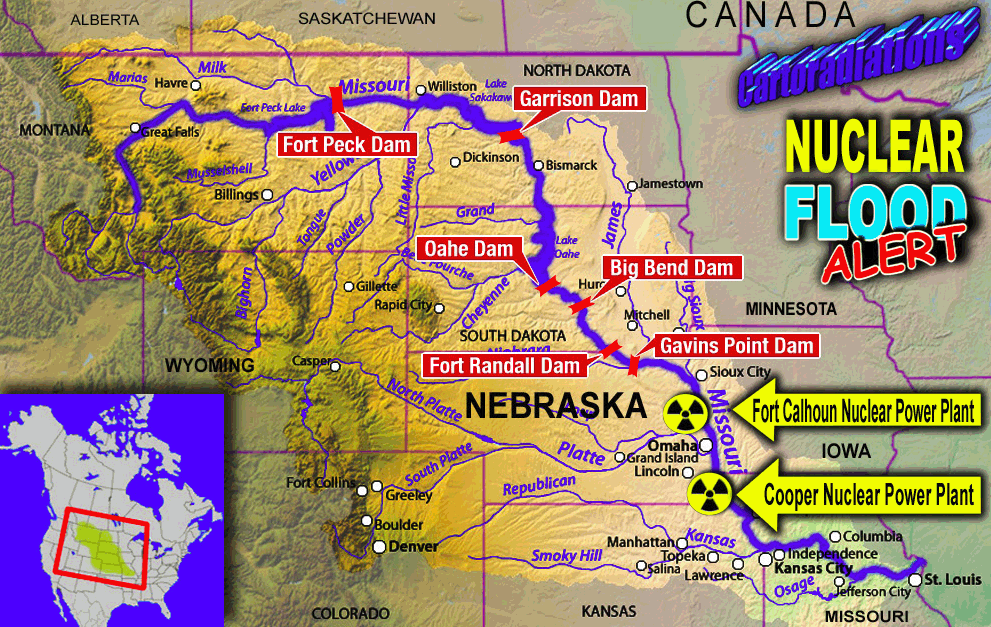
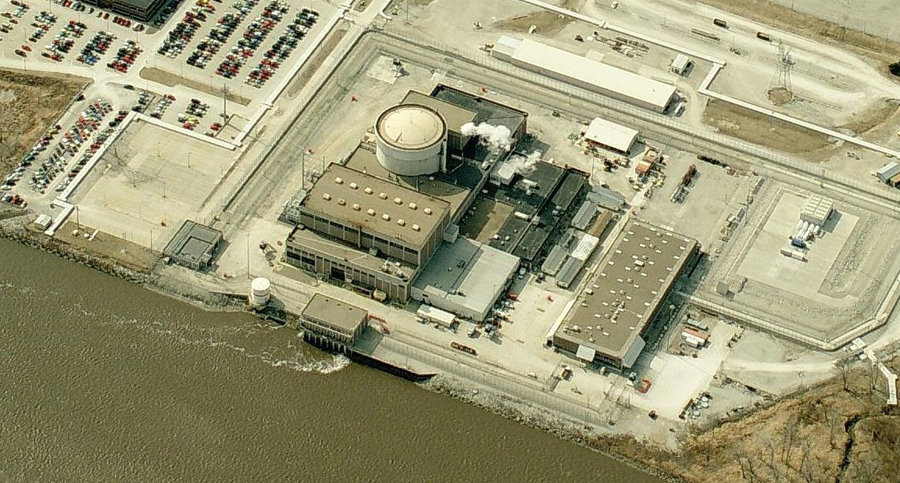
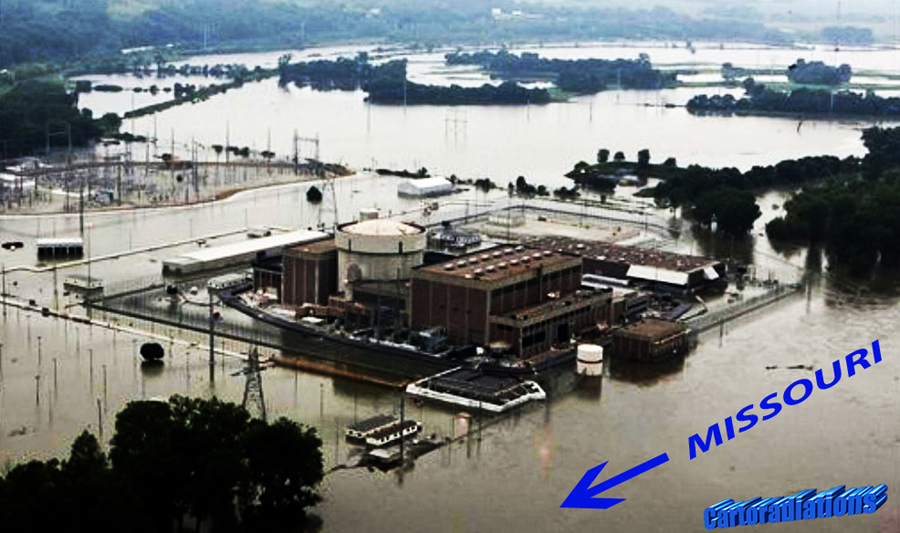
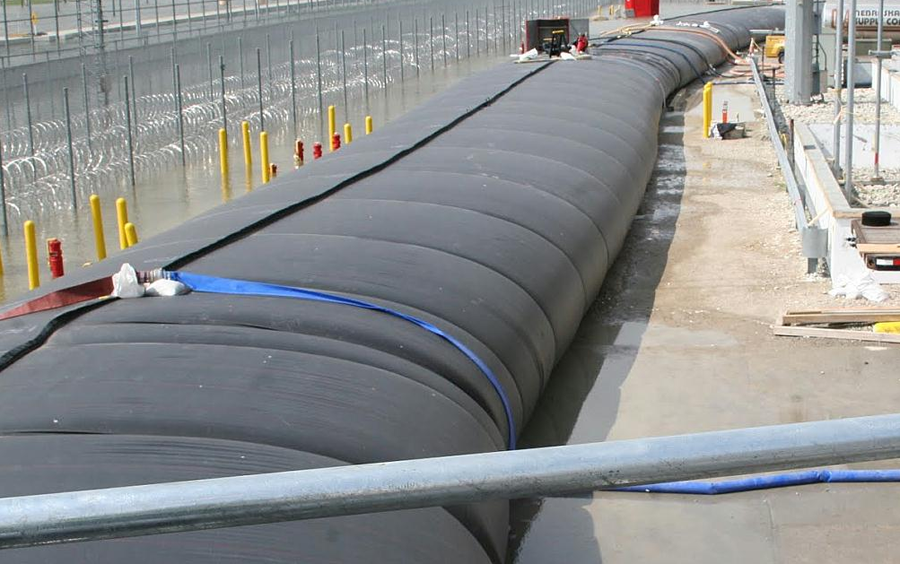
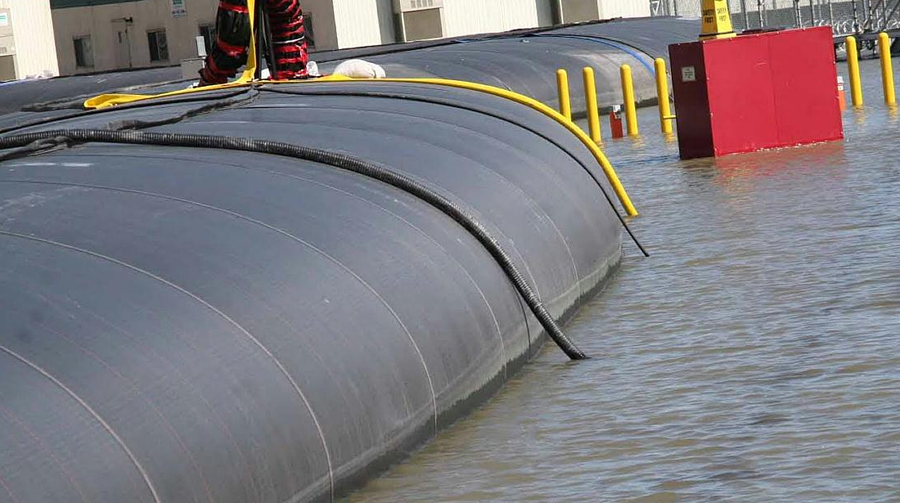
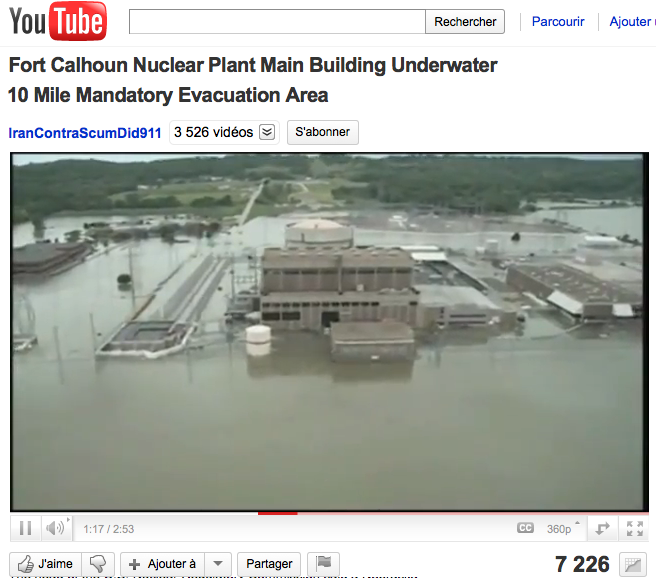
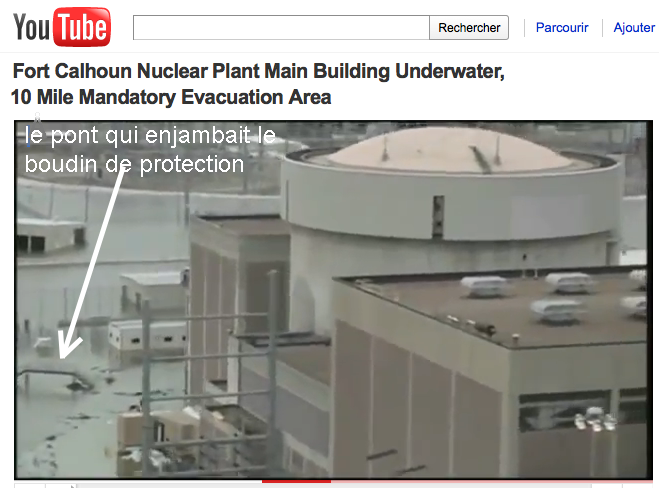
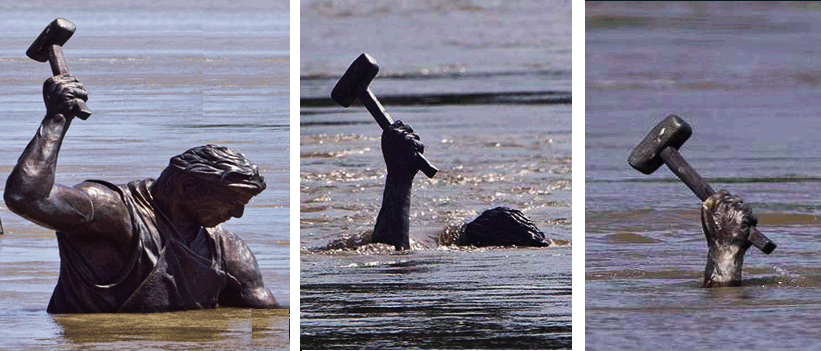
My interpretation of this affair
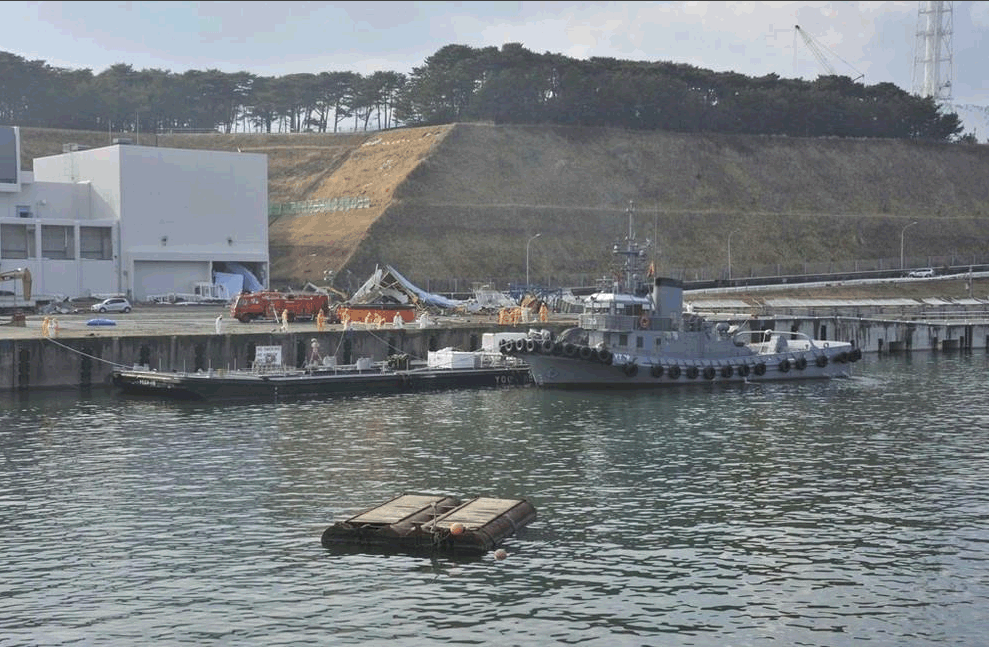
****http://search.japantimes.co.jp/cgi-bin/nb20110721a1.html
****http://mdn.mainichi.jp/mdnnews/news/20110722p2a00m0na001000c.html
****http://search.japantimes.co.jp/cgi-bin/nb20110722a1.html
From Japan:
The powerful company Hitachi, despite concerns raised within its own country regarding the construction of new nuclear power plants, continues its export policy and aims to place 38 new reactors by 2050 in Asian countries.
Source:
According to Mr. Hiroaki Koide from Kyoto University, the situation at the Fukushima plant is desperate:
"I believe the corium, a molten mixture based on uranium, has damaged the reactor vessel bottoms and is seeping through the concrete and spreading into the ground. The reactor core fuel does not melt below 2800 degrees (current temperature cannot be measured due to radiation).
There are approximately one hundred tons of corium. The pressure vessels and metals used in the building containment melt at 1500 degrees. Therefore, it is likely that the corium has fallen to the bottom of the vessels, part of it has attacked the ground, and another part has mixed with contaminated water, causing the walls to melt.
The fuel is leaking outside the reactors and releasing intense radioactivity into the environment. Mr. Koide describes this catastrophic situation as 'melt-out.'
If the corium reaches the groundwater, cooling will not prevent the spread of radioactivity. We must stop this underground infiltration to avoid contaminating the ocean. Shouldn't we consider building an underground containment structure around the plant? This would protect the groundwater and contaminated soil from the corium." As we mentioned earlier, no provisions were made for reactor meltdown, neither at the containment level nor at the vessel level. It was an assured failure from the start. That is why we must prepare measures for when we enter the 'melt-down' phase, as it is only a matter of time before the corium escapes the vessels, breaches the outer containment, and seeps into the plant's subsoil." I would add that no one knows the state of cracking in the 8-meter-thick concrete foundations on which the reactors are built. A magnitude 9 earthquake cracks... anything.
In contrast, the IAEA (International Atomic Energy Agency) praises the progress made by TEPCO in its "roadmap" to bring the situation under control by 2012.
Source:
TEPCO publicly admits the failure of ventilation in reactor number one, whose valves would have remained open.
Source:
The business leaders from the Kansai region presented an "urgent petition" urging the government on Thursday to call for restarting nuclear reactors, to ensure a stable energy supply.
Source:
etc....
Nothing new in the east...
We often wonder how the Japanese are reacting since May. There is a constant in Japanese behavior. It is not appropriate to expose one's misfortunes in front of others. Reserve is expected. These people have a great capacity to internalize their suffering. This has allowed them to survive numerous dramatic situations, whether due to the aftermath of World War II or natural disasters, which continue to strike them periodically. They endure, remain silent, rebuild like ants. But the Fukushima disaster is of an entirely different nature. It is a lasting poisoning, which is probably only beginning, and is the direct consequence of the negligence prevailing in the country regarding energy production.
Mazarin used to say "time is a great master." This is true on a scale of years, decades. But with this tragedy, the time scale far exceeds the human lifespan. The corium contains radionuclides with very long half-lives. At Chernobyl, the Russians feared above all that the corium, which had already melted through two concrete foundations, would reach the groundwater, contaminate the Pripyat River, and beyond the Dnieper and the Black Sea. They sacrificed hundreds of miners in a rush to dig a tunnel under the reactor and pour a 30-meter by 30-meter concrete slab beneath it. At Fukushima, nothing similar was done, nor even considered. We have merely kept about twenty employees in place, periodically replaced, whose task was to attempt to cool the reactors with water hoses. What will happen if the hundred tons of corium at Fukushima reach the groundwater and contaminate the nearby Pacific coast with long-lived elements?
How will the Japanese cope with this despair of life, with what fatalism and absence of revolt?
My readers must be thinking, "He's been very sparing with articles lately. Was he on vacation?" Well, no. Writing these articles takes me a lot of time. I need to take screenshots, edit them, add comments if possible, and scour the web for archives. Dozens of hours pass.
Meanwhile, I recall that on my homepage, in the lower right corner, I've placed an ad offering for sale the album Amber and Glass. Sixty-four pages in color. I believe the book is good, useful. It has been sold since August 2010, benefiting the association Science and Culture for All, at 8.50 euros including postage. It's moderate, democratic. If three copies were sold per day on average, the venture would be viable. What venture? Relaunching the publication of these comics from the Adventures of Anselme Lanturlu.
Well, no. One sale per day: it would take a year of sales to cover a new print run. As I write this, I don't even feel like adding a link to the album's ordering page.
I'm disappointed by the lack of response. It gives me the impression that among my readers, who constantly thank me with heartfelt messages—“thank you for existing!”—a significant number sit down each morning in front of their coffee, turn on their computer, and think, “So, what has this courageous, active man, despite his seventy-four years, come up with this time?”
In November 2010 I raised a loud protest, threatening to shut down my site until sales picked up. We reached ten sales per day. Then, very quickly, the momentum faded. I won't resort to this kind of editorial terrorism to sell books. I have a good dozen titles in various genres in my files, some fully completed, but I think if it means selling only one per day, I have no desire to print them.
Ah: Eurocopter has reprinted copies in French and English of Vertical Passion. In passing, these people were kind enough to give us a number of copies bearing the header of Science and Culture for All, which will be sold in its benefit. Initially, I had thought to have this special print run produced in a smaller format and sold, like the other album, at a very tight price. But ultimately, to bring money into the association's coffers, I gave up on that idea. The albums, superbly printed with hard covers, can be purchased for 30 euros including postage. I'll include an original, signed drawing with each shipment. Soon I'll post the announcement on my homepage. To those who find this price too high, I'll send them to the Savoir sans Frontières website, where they can download the black-and-white version for free.
As for my website: I'm going to slow down.
Does this mean I'll be pruning my roses and taking long naps? No, but I'll probably redirect the energy I have left elsewhere.
I've invested a lot following the Fukushima disaster. I've explained to my readers things I often discovered myself about this terrible event. The more I delved into the subject, the more I realized the gravity and depth of Japan's nuclear tragedy—and thus the danger posed by irresponsible nuclear "elites" (whom my friend Albert Souzan calls "nuclearopathies") to our planet. It became increasingly clear that we are governed and managed by incompetent fools.
Beyond criticism, which is always easy, we must consider another path of development. My investigation revealed an impressive range of solutions—little known, possibly hidden—simple, realistic, proven, not speculative. I'm sorry for all the fanatics obsessed with superfluous returns, but it seems to me that with many more prosaic formulas, yet opening up inexhaustible energy reserves, we already have plenty on our plate and solutions that can be implemented immediately.
At the same time, on June 6th, I attended the international conference in Biarritz dedicated to Z-machines, where the most representative figures in this new field were present. My friend, the Englishman Malcolm Haines, gave the first presentation at 8:30 a.m. on Monday. The day before, we had met and discussed at length. Malcolm had just published, two days earlier, a 64-page paper in the prestigious journal Plasma Physics and Controlled Fusion, practically a monograph on the subject.
The billions of degrees measured in 2006 at Sandia have been confirmed. No criticism, nothing. After this presentation, which we recorded—image and sound—despite the French organizers' refusal, and which will serve as evidence, I questioned Valentin Smirnov, Russia's top expert in this field and director of the fusion department at Moscow’s Institute of High Temperatures Kurtchatov. Naturally, I first asked him about what Haines had just confirmed. Another time I'll detail everything I learned at this conference. It's quite easy at such conferences, when you're not presenting a paper, to pass yourself off as a retired academic who haunts conferences "to keep in touch with the scientific community." An eccentric individual who, enjoying a comfortable retirement, prefers spending money on conferences rather than golf or senior cruises (while these conference participations are funded by my readers). Anonymity is achieved by pinning your badge inside your unbuttoned shirt, turned around. This gives the impression of a distracted retiree who put the badge around his neck before buttoning his shirt. Such a man goes unnoticed. So you chat, you chat...
I'll simply mention the end of my conversation with Smirnov, very courteous, during the coffee break. You know the Russians have always been absolute masters in MHD. In 1954, Andrei Sakharov produced 100 million amperes using the magneto-cumulative generator he invented.
Refer to the dossier I posted on my site.
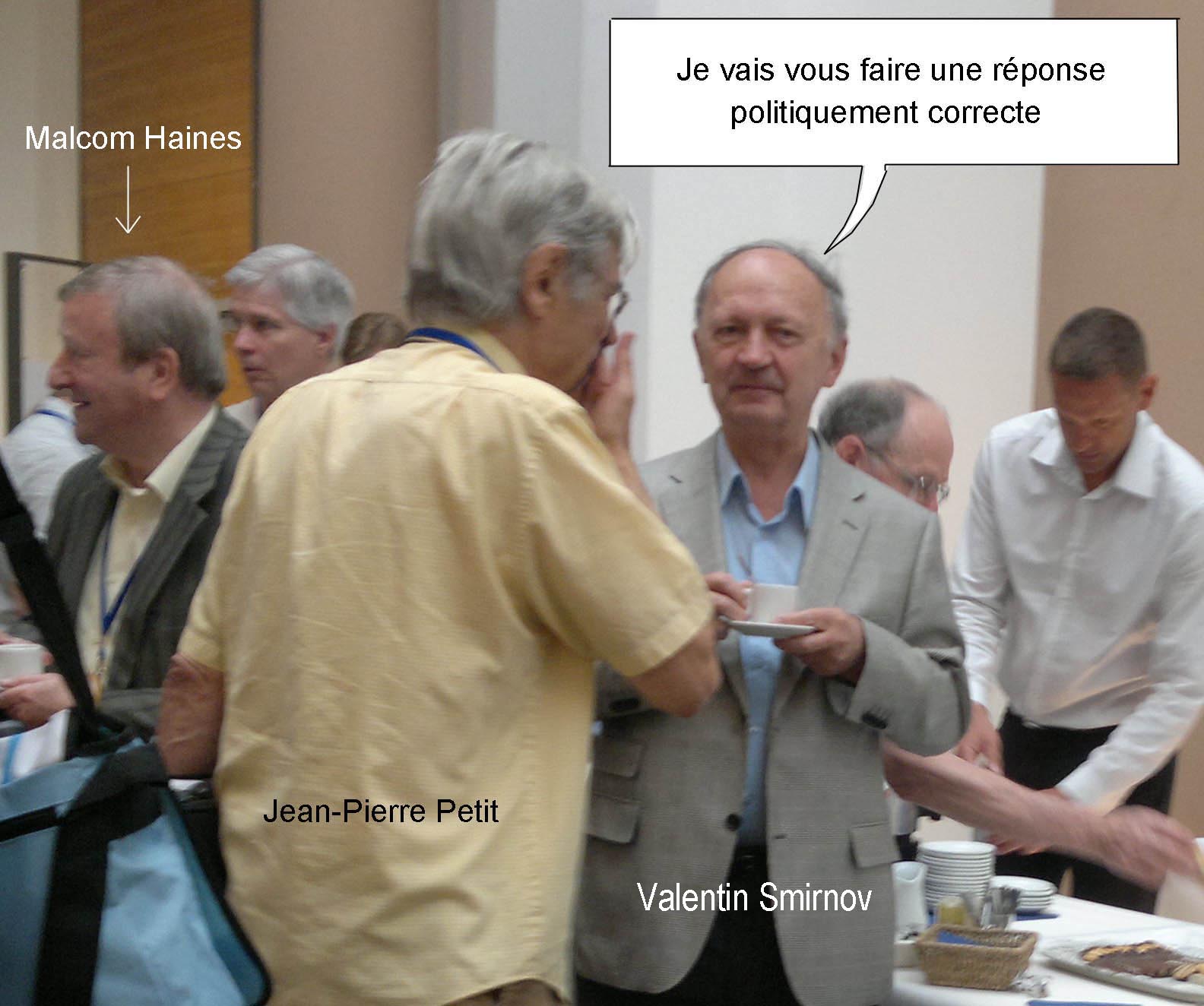
I provoked the Russian without hesitation.
- In Korea, in September 2010, I heard your colleague Grabowski present your results on your Angara V Z-machine. Honestly, with that pile of rust and its five million amperes, you look pitiful compared to the American machine ZR’s 26 million amperes!
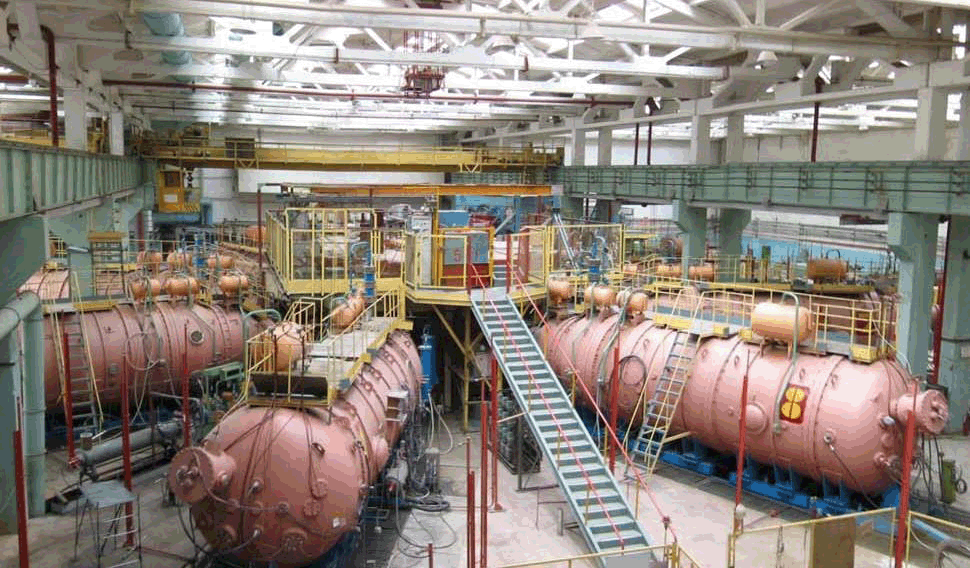
The Russian Z-machine Angara V
Smirnov immediately bristled (revealing something Haines didn't know):
- In Russia, we are completing the construction of a Z-machine whose intensity will reach 50 million amperes, with a rise time of 150 nanoseconds.
Shortly after, I questioned someone from Lawrence Livermore Laboratory (California). Rumors were circulating that the Russians were developing something where the primary energy source was explosive. This LLL researcher believed (as the Russians told him) that the formula was less expensive than using capacitor banks.
But how do the Russians manage to achieve such short rise times?
We must trust them. If they're putting so much effort into it, "there must be something." Anyway, at Biarritz, even much more modest experiments reported fusion neutrons.
I returned home by plane with Smirnov, who, if the flight attendant had offered him a parachute, would have jumped immediately. I learned that experiments based on liners made from two truncated cones (see my 2006 articles) had proven disappointing. It was impossible to make the two jets, created by the hollow charge effect, collide. The best target (it was Smirnov himself who invented the wire liner) is a spheroidal liner with a double wire cage, invented by his student Zakharov ("just like at Sandia," Smirnov said).
Among his remarks, note this one:
- It was hard to secure funding. Fortunately, the military helped us (...)
The race for pure fusion bombs, which will replace conventional thermonuclear bombs with plutonium triggers, has thus begun between Russians and Americans. Anyone below 5–10 million amperes is immediately out of the game. Indeed, heating by compression allows temperatures to rise as the square of the electric current. The Chinese, who are building a machine producing ten million amperes, have been spot-on.
The French (the Sphinx facility in Gramat, a military installation in Lot) failed to grasp that the brevity of the rise time was a key element (the Sphinx discharge, lacking an "adequate compression," occurs in 800 nanoseconds). A discharge with a rise time of 100 nanoseconds is equivalent to a 10 megahertz high-frequency current. Thus, the 70,000 amperes passing through wires the thickness of a hair do not flow through the core of the metal, but on the surface, due to the "skin effect." If the discharge is too slow, the wires sublime and plasma instabilities hinder focusing.
So the young researchers in Gramat use a truncated-cone liner to create jets. In short, they're doing astrophysics.
By betting from the start on a primary source consisting of 150 kilograms of explosive, the Russians may be on the verge of surpassing the Americans, just as Andrei Sakharov did with the thermonuclear device by opting immediately for the "dry bomb," using solid lithium hydride.
If you don't know, it was Sakharov who designed the Tsar Bomba (50 megatons). A FFF bomb, meaning fission-fusion-fission. At full power, it could have developed 100 megatons, but it was "restrained" by replacing its uranium-238 casing with lead. After this magnificent outdoor physics experiment, Sakharov (as he recounts in his memoirs) calculated the number of cancers it would cause. He then decided to abandon military nuclear weapons in 1967, dedicating himself henceforth to cosmology. It was there that he first proposed a cosmological model composed of two entities with anti-parallel time arrows. I only discovered this in 1983, reading the book dedicated to his scientific works (published in France by Éditions Anthropos, Paris).
Having a suspicion is one thing. Being confronted with statements that pass as proof is another. This conference, supposedly "civilian," had strong whiffs of defense secrecy. Malcolm, like me, believes the temperatures achieved with ZR could approach 8 billion degrees. With their 50 million amperes, the Russians could reach twenty billion degrees. The physics of ultra-dense, ultra-hot plasmas is emerging. But as we can see, the priority goal will be developing new weapons—pure fusion thermonuclear bombs, potentially miniaturizable through nanotechnologies. With mixtures like Boron-11 + Hydrogen-1, even "green bombs" without neutron emissions could be achieved.
It took me some time to recover from this Biarritz conference—I admit it, touching once again the unfathomable stupidity of humanity (as at Brighton in January 2001).
With retired friends, we will quickly compose a book, an 180-page monograph, in a format similar to the books I previously offered for sale on my site. We'll earn 10 euros per book, net. The books will be sold in favor of Science and Culture for All. The menu includes four parts:
- Nuclear: suicide, user manual
- A dead end called ITER
- Solutions based on renewable energies, at the scale of planetary needs.
- The physics of ultra-dense, ultra-hot plasmas: weapons first, energy later.
Policymakers can benefit from the information contained within to potentially include it in their electoral platforms. With the collected funds, we'll be able to travel and report on already operational installations worldwide—in Spain, the USA, Canada, China, etc. Image professionals will accompany us and produce video documentaries different from the incomprehensible nonsense that was Arte’s report on fusion.
From Japan:
The powerful company Hitachi, despite concerns raised within its own country regarding the construction of new nuclear power plants, continues its export policy and aims to place 38 new reactors by 2050 in Asian countries.
Source:
According to Mr. Hiroaki Koide from Kyoto University, the situation at the Fukushima plant is desperate:
"I believe the corium, a molten mixture based on uranium, has damaged the reactor vessel bottoms and is seeping through the concrete and spreading into the ground. The reactor core fuel does not melt below 2800 degrees (current temperature cannot be measured due to radiation).
There are approximately one hundred tons of corium. The pressure vessels and metals used in the building containment melt at 1500 degrees. Therefore, it is likely that the corium has fallen to the bottom of the vessels, part of it has attacked the ground, and another part has mixed with contaminated water, causing the walls to melt.
The fuel is leaking outside the reactors and releasing intense radioactivity into the environment. Mr. Koide describes this catastrophic situation as 'melt-out.'
If the corium reaches the groundwater, cooling will not prevent the spread of radioactivity. We must stop this underground infiltration to avoid contaminating the ocean. Shouldn't we consider building an underground containment structure around the plant? This would protect the groundwater and contaminated soil from the corium." As we mentioned earlier, no provisions were made for reactor meltdown, neither at the containment level nor at the vessel level. It was an assured failure from the start. That is why we must prepare measures for when we enter the 'melt-down' phase, as it is only a matter of time before the corium escapes the vessels, breaches the outer containment, and seeps into the plant's subsoil." I would add that no one knows the state of cracking in the 8-meter-thick concrete foundations on which the reactors are built. A magnitude 9 earthquake cracks... anything.
In contrast, the IAEA (International Atomic Energy Agency) praises the progress made by TEPCO in its "roadmap" to bring the situation under control by 2012.
Source:
TEPCO publicly admits the failure of ventilation in reactor number one, whose valves would have remained open.
Source:
The business leaders from the Kansai region presented an "urgent petition" urging the government on Thursday to call for restarting nuclear reactors, to ensure a stable energy supply.
Source:
etc....
Nothing new in the east...
We often wonder how the Japanese are reacting since May. There is a constant in Japanese behavior. It is not appropriate to expose one's misfortunes in front of others. Reserve is expected. These people have a great capacity to internalize their suffering. This has allowed them to survive numerous dramatic situations, whether due to the aftermath of World War II or natural disasters, which continue to strike them periodically. They endure, remain silent, rebuild like ants. But the Fukushima disaster is of an entirely different nature. It is a lasting poisoning, which is probably only beginning, and is the direct consequence of the negligence prevailing in the country regarding energy production.
Mazarin used to say "time is a great master." This is true on a scale of years, decades. But with this tragedy, the time scale far exceeds the human lifespan. The corium contains radionuclides with very long half-lives. At Chernobyl, the Russians feared above all that the corium, which had already melted through two concrete foundations, would reach the groundwater, contaminate the Pripyat River, and beyond the Dnieper and the Black Sea. They sacrificed hundreds of miners in a rush to dig a tunnel under the reactor and pour a 30-meter by 30-meter concrete slab beneath it. At Fukushima, nothing similar was done, nor even considered. We have merely kept about twenty employees in place, periodically replaced, whose task was to attempt to cool the reactors with water hoses. What will happen if the hundred tons of corium at Fukushima reach the groundwater and contaminate the nearby Pacific coast with long-lived elements?
How will the Japanese cope with this despair of life, with what fatalism and absence of revolt?
June 1, 2011: Surreal: The International Atomic Energy Agency praises how TEPCO managed the crisis
The decision is made!
May 31, 2011
. An interesting
regarding Nicolas Sarloky's claims on the Next Up site. But his solution is incomplete.
.
Germany debates its plan to exit nuclear energy.
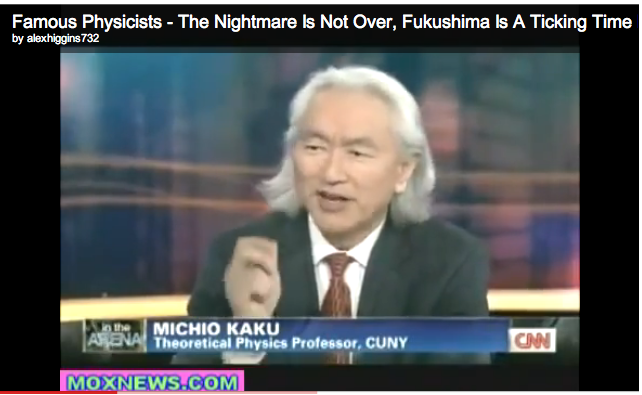
May 15, 2011:
Michio Kaku extremely pessimistic about the situation
Professor Michio Kaku believes the Fukushima site will remain extremely vulnerable to another earthquake. He says plant technicians continue to spray water on the reactors, but there are leaks and a mass of contaminated water is flooding the basements, must be pumped out, and when the storage tanks are full, the Japanese release it into the ocean. The containment measures proposed by TEPCO are only intended to prevent radioactive dust from escaping into the atmosphere and contaminating surrounding land. TEPCO leaders are incompetent and have only thought about one thing: saving their investment.
Kaku is extremely critical, saying public trust in the Japanese government is plummeting. He adds that the Japanese are deluding themselves when they ask, "When will we be able to return to our homes?" A "dead zone" will remain. He concludes by noting it took 14 years to open the containment vessel of the Three Mile Island reactor, where part of the core had melted but the corium had not escaped the reactor vessel—a situation not applicable in Japan. He estimates it will take at least thirty years for the Japanese to clean up the Fukushima site.
Things don't appear to be improving in the Land of the Rising Sun. The building housing one of the reactors, number 1, is tilting and seems to be sinking into the ground.
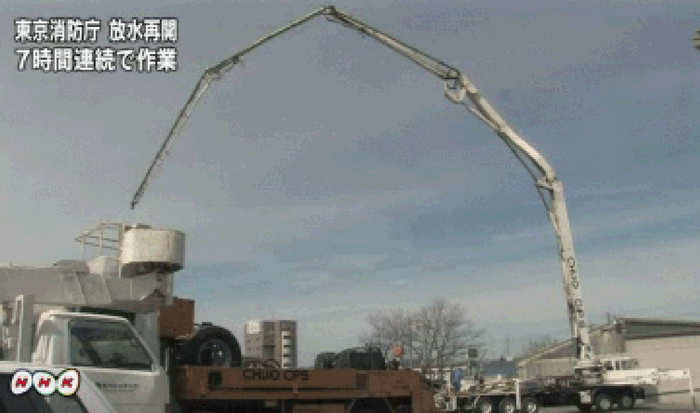
No bold, decisive measures—“Russian-style”—have been taken in the days or weeks following the disaster. Immediate access to the site should have been cleared (something TEPCO has only just begun to consider!), followed by clearing debris so that something could actually be done. The Japanese are no strangers to handling extremely heavy loads with overhead cranes, in their ports and steel industry. The deployment of such means to clean the site and remove debris covering the reactors has not been undertaken due to parsimony, incompetence, and indecision. As Kaku notes in his interview, in Japan no one knows who is managing this crisis. No one, in fact. Political authorities are incompetent. The prime minister is a puppet who “renounced his salary,” as if that were the only thing he could think of doing. Nuclear specialists, needed to go to the site and take charge, have shirked their responsibilities.
The Danaïdes’ barrel
To bring heavy equipment into action or build it, requisitions would be needed, billions of dollars would have to be spent, a real plan would be required, and someone would have to take charge. But at TEPCO, no one seems to have a plan. They observe and spray water...
As Kaku reminds us, what is stored at Fukushima is a real bomb, especially due to the combustible materials—spent or unused—contained in the pools. If one of the pools collapses, these materials, thrown against each other, could go critical.
Some reactor vessels, to say nothing of all of them, are behaving like...
This is probably the most accurate image.
On the ground, dozens of technicians are doing anything but effective work, while company executives resign or collapse in despair.
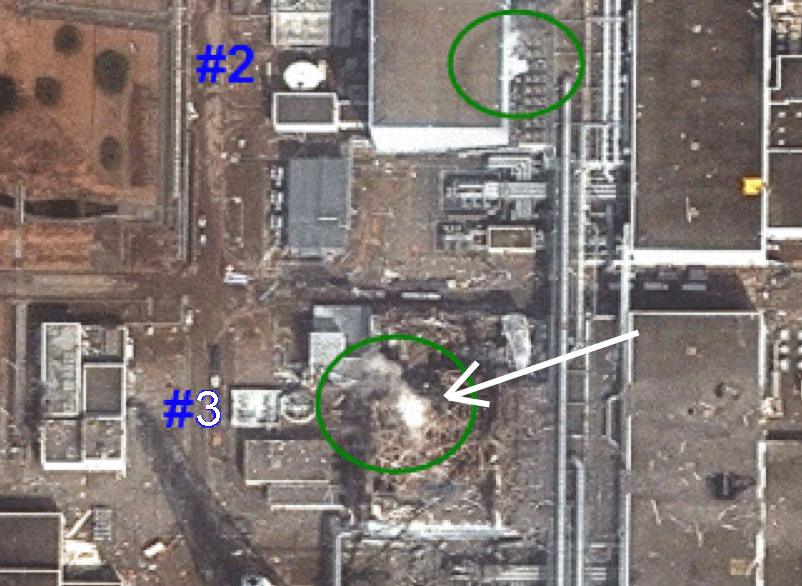
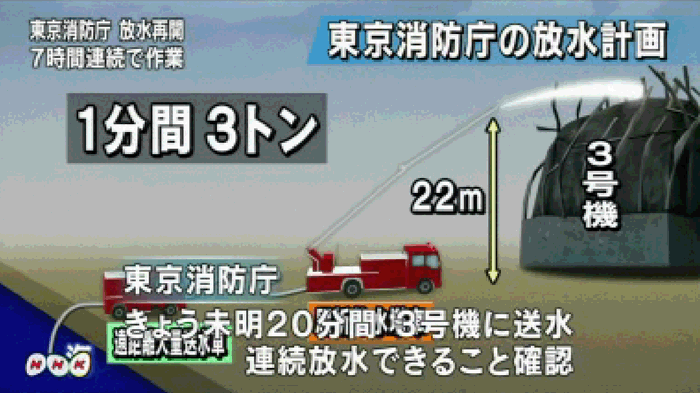
Since nothing has been done except spraying water, which is merely a band-aid on a broken leg, the situation is deteriorating in the various reactors. It is increasingly suspected that the explosion at reactor number 3 was not simply due to hydrogen, but possibly to a "prompt criticality," an early chain reaction in a cluster of fuel rods stored in the nearby pool. There are reports that fragments of fuel rods have been found far from the plant.
May 14, 2011
Latest information:
TEPCO disclosures: Reactor No. 1, the stainless steel 304L pressure vessel is cracked and pierced due to the collapse and melting of fuel rods; significant highly radioactive leaks; cooling impossible; water level below minus 5 meters; the reactor core is now exposed to air (...), the future is problematic and uncertain for reactors No. 2, 3, and 4.
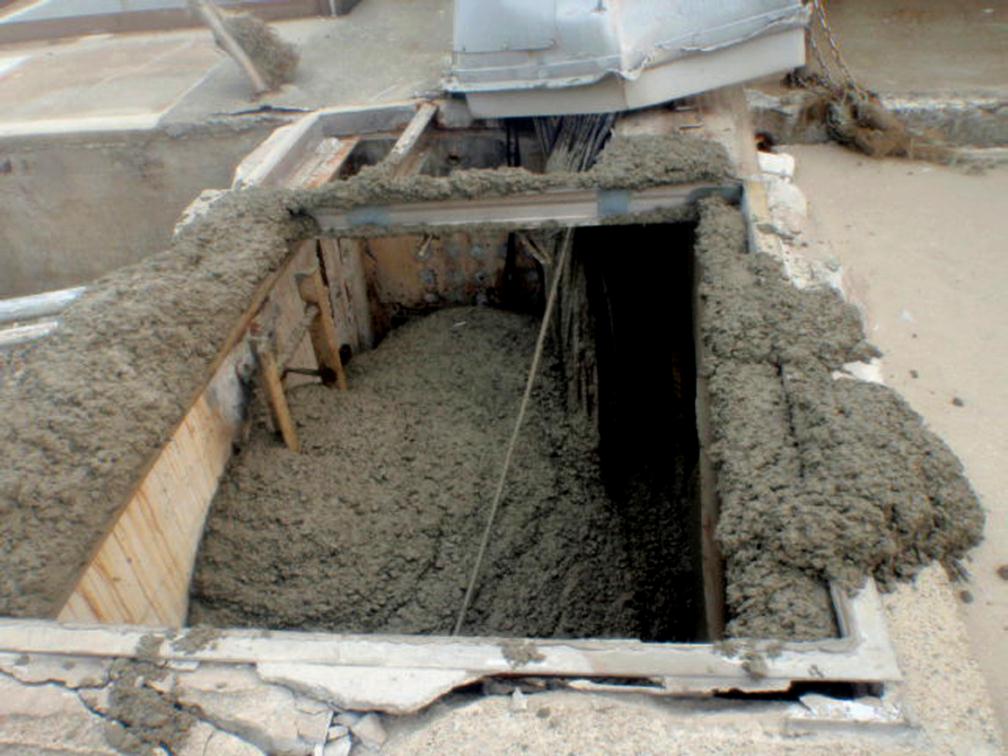
TEPCO’s stabilization plan is completely overturned; emergency studies are underway to build concrete sarcophagi around the reactor buildings, anchored to bedrock at minus 50 meters, using zeolite to absorb radioactive materials.
Latest information, pending confirmation: the building of reactor No. 4 appears to be tilting or sinking; emergency reinforcement work is underway (this U.S. report is also visually confirmed, not an optical illusion—if confirmed, it could signal serious developments).
Reminder: confirmation of this information is still pending.
****General Electric advertisement, at the time of selling its reactors to TEPCO!
****The Mainichi Daily News ****
May 13, 2011.
Source:
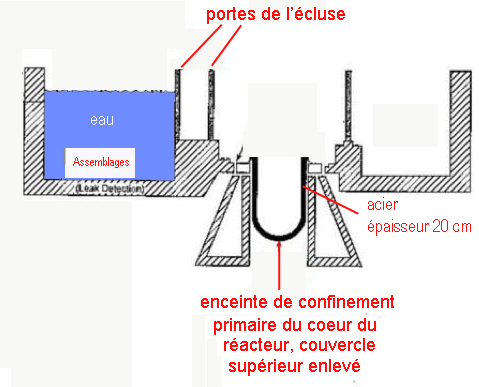
TOKYO (Kyodo) -- Tokyo Electric Power Co., the operator of the crippled Fukushima Daiichi nuclear power plant, revealed Thursday that holes had been created by melted nuclear fuel at the bottom of the No. 1 reactor's pressure vessel.
The company said it has found multiple holes adding up to several centimeters in welded piping. Earlier in the day, it said the amount of water inside the troubled reactor was unexpectedly low — not enough to cover the nuclear fuel — hinting that a large part of the fuel melted after being fully exposed.
TEPCO revealed Thursday (May 12, 2011) that holes had been discovered at the bottom of reactor No. 1 due to fuel melting inside.
The company said it found several holes at the welded joints of the pumping systems. Earlier that day, it was revealed that the water level inside the damaged reactor was unexpectedly low — so low that the fuel was no longer covered. This implies that a large portion of the fuel may have melted after being left exposed to air.
My comment:
This situation is a sign of great instability and hardly favors a quick return to normal. In the "shut-down" core, the decay of the fifty or so radionuclides produced generates heat. This heat production tends to subside over time. That is why, eventually, the containment vessel of the Three Mile Island reactor was opened and its contents examined several years after the event, revealing that 45% of the core had melted. Until this "calm" is achieved, cooling was required. The evolution of the situation depends on the effectiveness of cooling. At Fukushima, this is problematic.
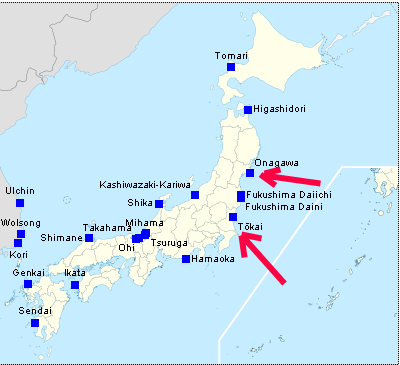
**
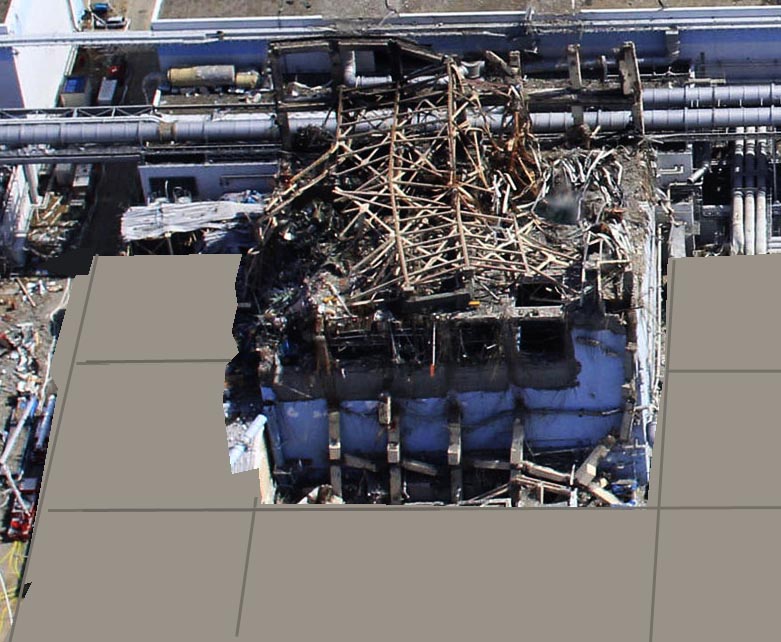
**
Kokopelli, who runs a blog about Fukushima events
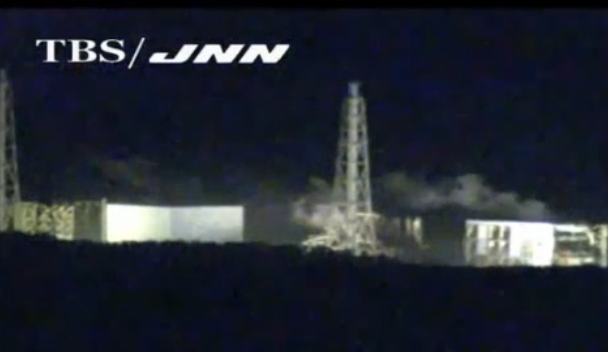
May 12, 2011:
It is no secret that the tragedy currently unfolding in Japan at Fukushima has been completely ignored by major French media, except for rare exceptions. We should note the special May 2011 issue of Science et Vie, well-illustrated and well-documented. Outside of that, when I check my "yahoo-news," I find football and gossip about some "celebrities of the moment." This is shameful. Why such silence? One might suspect a blackout "triggered" by the nuclear lobby. That's possible. But it's also underestimating the superficiality and emptiness of the "official media," where newsrooms live "in the event." This earthquake, this nuclear disaster, for these media, is just a passing event. They make the front page and move on. But it's obvious this affair is taking on a chronic character and risks dragging on for years.
In the Science et Vie issue, I read about the criminal dishonesty of TEPCO, which for decades covered cracks with paint and falsified inspection reports of its plants. Elsewhere, we discover collusion between Japanese nuclear elites and the underworld, the infamous Yakuza, who were tasked with recruiting unemployed "cleaners" to clean reactor pools. We might also think that for decades, these same Yakuza were responsible for silencing those who tried to expose such a situation, while plant operators, eager to line their pockets, bought the silence of others. In that case, what we should witness is not the prostration of executives, but a proper seppuku. Traditions are being lost.
Are our journalists really so incapable of understanding this? It's possible. They also reflect the deafness and avoidance of the average citizen, confronted with distressing situations, which they refuse to face.
I came across a clip from a video archive showing that fool Giscard d'Estaing declaring, at the time the Chernobyl cloud passed over, "this had no health implications." Indeed, he was the main architect of France's nuclearization, which he considered a source of pride and the highlight of his seven-year term. This statement shows that one can come from a so-called prestigious school and still be a complete fool. Let's remember that we owe "egghead" large parts of the European Constitution.
There is a constant phenomenon among men of power and money who, perhaps convincing themselves, confuse their own interest with the general good. It's rare that they end their lives in poverty.
People are increasingly realizing that their future is managed by two entities:
- Financial powers — Incompetent and completely disconnected politicians. In short, incompetent fools.
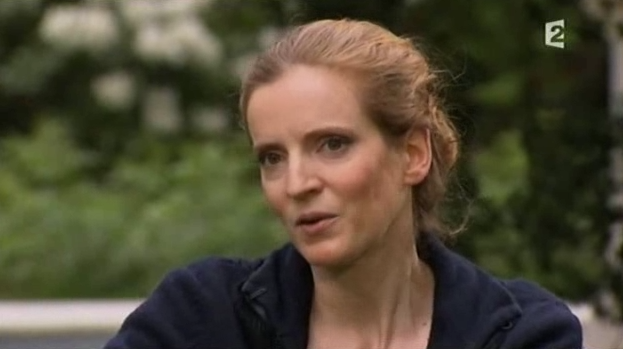
Revisit the moment when Nathalie Kusciusko-Morizet was interviewed on the April 2011 episode of "Complément d'enquête," where she said this astonishing phrase:
- Nothing was planned for dismantling solar farms.
I had to replay that passage to make sure I hadn't dreamed it. What did she mean by "dismantling solar farms"? This woman is utterly incompetent. One might expect her to mention "dismantling hydroelectric dams," while we're at it. She's a parrot minister, charged with... ecology, reciting a well-memorized speech, spouting empty phrases like "...better transparency in the nuclear sector." I've taken the trouble to detail this broadcast so you can spot the nonsense constantly poured down from the "highest echelons of power."
I did my part by informing my readers during these weeks when the Fukushima affair began, trying at the same time to provide some general information about the nuclear world. Then I spent a lot of time reviewing the excellent "Complément d'Enquête" broadcast by France 2. If you haven't read it, I recommend you do. Many were surprised to discover that, through MOX fuel, 20 of our country's reactors were operating not on uranium, but on plutonium. Along the way, they understood that the La Hague facility, described as a "reprocessing center for spent fuel," is not a dump, but a chemical plant recovering plutonium, the basis of MOX, which is nothing more than a mixture of 7% fissile plutonium diluted in 93% non-fissile uranium-238. 60 tons of this extremely dangerous substance, plutonium, are currently stored at [location]. If France were to go to war, this center, along with all its reactors and storage pools, would be prime targets, holding enough material to kill the entire European population. This MOX is also (and is) the fuel for fast breeder reactors, like the one at Creys Malville (shut down, and no one knows how to dismantle it).
In debates I see emerging on forums like Agoravox, some say we shouldn't descend into paranoia and imagine terrorists one day launching sophisticated attacks on our power plants—planes bypassing all defenses, launching ultra-sophisticated guided missiles capable of penetrating meters of concrete and thick steel vessels.
To say this is to confine oneself to "the hexagon." France, like many other countries—for example, South Korea—is ready to sell reactors to... anyone. To countries that will install them in seismically active zones. Or to others that could one day become targets of well-organized opponents. Meanwhile, we sell them the most modern weapons.
Nuclear targets present a fundamentally different aspect from conventional ones. Take, for example, a large munitions depot or hydrocarbon storage tanks. Suddenly, they are struck or bombed. There are explosions, destructions, a massive fire. Then, all of this "settles down." The dead are mourned, buried, and eventually forgotten. Fires eventually burn out. What was destroyed is rebuilt.
In the case of a nuclear target, the scenario is completely and fundamentally different.
The "fire" proves impossible to control because it is... inaccessible. Under its deteriorating sarcophagus, the nuclear fire at Chernobyl will continue smoldering for tens of thousands of years and threatens to contaminate the groundwater. Nuclear damage can spread over thousands of square kilometers and prove irreversible. Vast agricultural lands could become unproductive for thousands or tens of thousands of years. Areas of similar size could become uninhabitable for comparable durations. The health of millions of people could be affected, without distance limits.
But our nuclear barons couldn't care less. Profit blinds them.
Now I turn the remaining energy I have to arguing against ITER, whose immediate abandonment is imperative. In parallel, it is essential to urgently build a "Plan B." We can applaud ecologists and greens for their foresight and sometimes their courage. Conversely, we must note the cowardice of scientists, fearing, given the power of the nuclear lobby in France, that any protest or simple analysis could harm their most cherished asset: their bureaucratic careers.
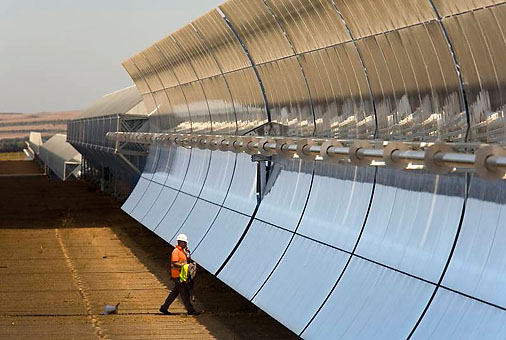
This Plan B simply involves a strong investment in renewable energy, using technologies worthy of the 19th century: drilling holes to harness geothermal energy, capturing solar energy with reflective steel mirrors to produce pressurized steam and generate tens, and one day thousands, of megawatts of electricity (see the Spanish Andasol project). A finalized, operational project producing 50 megawatts contradicts the other fool, Claude Allègre ("we don't know how to store energy!"—a refrain repeated by Areva's director).
Our science and technology have been misdirected for decades, chasing a "Theory of Everything" or filling the pockets of large corporations, serving the military-industrial complex, pharmaceutical companies, etc. Meanwhile, political power has colluded in the assassination or attempted assassination of worthy enterprises (such as [project]). All of this is lamentable, utterly contemptible.
To the east, nothing new. In the Land of the Rising Sun, nothing new. A camera captured steam and smoke emanating from reactor number 3. The media did not report it.
May 8, 2011: fire reignites at reactor number 3
Another ominous glow, filmed at night by the surveillance webcam above. Around the plant, a few dozen employees are busy. They're improvising, cooling with water hoses. The Emperor is comforting refugees in a stadium. It seems companies and the government are hiding the severity of the situation to avoid panic. Nearby residents naively ask, "When will we be able to return home?"
Pathetic. Energy crisis in Japan:
The main television network reported on May 11, 2011:
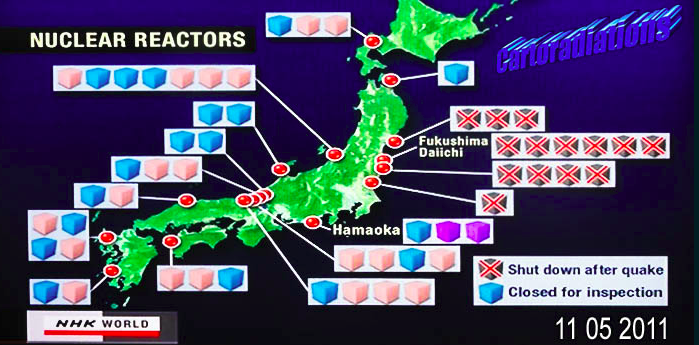
60% of Japan's nuclear power is offline.
Immediate impact on the Japanese economy
http://www.pluzz.fr/complement-d-enquete-2011-04-18-22h10.html
| Complément d'enquête | Nuclear, the disaster that changes everything: the Fukushima disaster reveals daily the lies of TEPCO, whose engineers struggle to regain control of the reactors. What real risks do the Japanese face? What about France and its 58 reactors? | Broadcast on Monday, April 18, 2011, at 10:10 PM on France 2 |
|---|
This broadcast is long. My exhausting work is to create a "digest" of such documents, highlighting key points to allow faster reading. I must pepper it with dozens of screen captures, retrieve them with Photoshop, assemble a webpage, and add text. This represents dozens of hours of work. I must do it, but I am thoroughly exhausted. I turned 74 recently and am beginning to feel the weight of the years.
A reader tells me it's downloadable (572 MB) at:
****http://depositfiles.com/files/onwpxsugv
It won't remain on the web forever, especially since it will disturb many.
Congratulations to the France 2 team that conducted this investigation and produced this document, of excellent quality
| Complément d'enquête | Nuclear, the disaster that changes everything: the Fukushima disaster reveals daily the lies of TEPCO, whose engineers struggle to regain control of the reactors. What real risks do the Japanese face? What about France and its 58 reactors? | Broadcast on Monday, April 18, 2011, at 10:10 PM on France 2 |
|---|
** --- **** **** **** **
http://www.world-nuclear-news.org/RS_Browns_Ferry_hit_by_major_storms_2804112.html
**Andasol
**

**
In the Complément d'Enquête broadcast
Posted online April 30, 2011:
The European Union authorizes the import of radioactive food products from Japan.
In her April 26 report, in English, Ami Gundersen, analyzing the (spectacular) footage of the explosion at reactor number 3, casts doubt on whether it could be solely attributed to the hydrogen-oxygen mixture released. She thinks the compression wave from this primary explosion could have compressed the fuel rods in the adjacent pool, triggering a criticality excursion and a mini-nuclear explosion.
Not impossible.
Nature issues another warning
On April 28, 2011, an exceptionally powerful tornado devastated Alabama, USA. A level F4 tornado, one kilometer wide, with winds swirling over 300 km/h. 220 dead, 1,700 injured. Half of Madison County was nearly erased from the map.
/ The electrical power supply for the pumping systems at the Browns Ferry nuclear plant was destroyed. The system had to switch to backup power, using diesel generators.
Near Fukushima, as Frédéric Requin points out, this event once again raises the question of the vulnerability of nuclear installations to natural phenomena of exceptional, catastrophic scale (hurricanes, earthquakes, tsunamis, and now tornadoes). What if the tornado's path had passed over the fuel storage pool? Its roof would have been ripped off, the water sucked away, the spent, radioactive fuel rods carried aloft and dispersed tens of kilometers away. And perhaps, if the tornado had reached the diesel fuel tanks, it might have emptied them, disabling the backup system. We would have had a Fukushima-bis...
The "disaster films" are... reality. Since "there is no zero risk," we must choose technological solutions that, in case of natural disasters, do not lead to catastrophic, irreversible human, health, and ecological consequences.
If we install thousands of hectares of parabolic solar collectors (see the Spanish Andasol installation, 100 hectares producing 50 megawatts), and a tornado passes through such an installation, we can quantify the damage, which would be financially significant, lament the material losses, and begin reconstruction.
But the debris from the metal mirrors won't poison the region for hundreds of thousands of years.
From this simple aspect alone, nuclear power is nonsense. The Spanish solar plant Andasol: 100 hectares producing 50 megawatts. The scale of the parabolic collectors at the plant.
This is what must be realized without delay in France.
We must move beyond "DIY tinkering."
This is solar power.
This ignorant man Allègre said on a TV show, "We don't know how to store energy." Completely false! The Andasol installation is fully equipped. These tubes produce gas at 400°C under pressure, driving a turbine and generator. Day/night storage is ensured by large masses of molten salts with high heat capacity, at 400°C (harmless, these). It's not an "experimental installation," but a fully operational system.
It's these installations that frighten the French nuclear lobby. When Madame Kosiusko-Morisset speaks of solar power, she only mentions photovoltaics, emphasizing the cost of importing cells made in Asia, and the cost "of dismantling such installations." Or she ignores the existence of installations like Andasol, or deliberately ignores them—worse still.
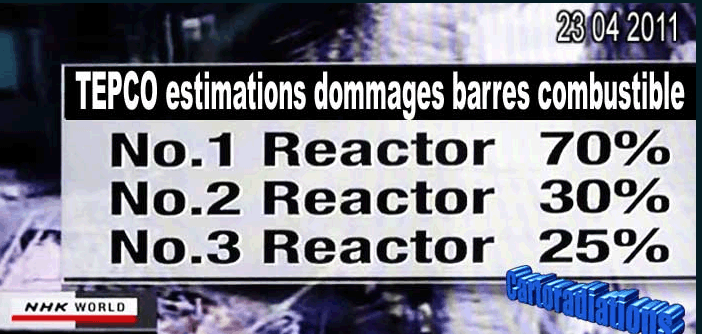
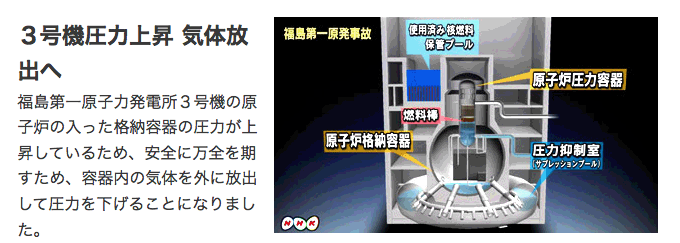
| On the Japanese network NHK, Sunday, April 23. | So there was | melting of these three cores |
|---|
http://en.wikipedia.org/wiki/Andasol_Solar_Power_Station

We need a political program. No candidate has one. It's simple: whether "on the right" or "on the left," these people are only concerned with perpetuating or adjusting (which is simply impossible) the existing system. Traditional environmentalists suffer from short-sightedness. They know what a megawatt (a thousand kilowatts) means, but are incapable of going further. They ride bicycles or canoes.
A nuclear reactor produces 400 - 600 - 900 - 1000 megawatts and beyond.
The needs of a country like France amount to tens of thousands of megawatts. A political program centered on solving the "energy crisis" offers multiple stabilizing facets.
It absorbs "floating capital," represents a fight against financial speculation (which has nothing to do with the economy).
It creates jobs by the tens of thousands—it develops an entire technico-scientific sector with an interesting aspect:
the army has no place here.
Unless one considers, as during the siege of Syracuse, burning enemy ships' sails from a distance using parabolic mirrors, as Archimedes did.
- It is a project that secures future generations, instead of preparing to leave them a country and planet that are unlivable. A project that takes care of your own health. Haven't you realized that since we've let apprentice sorcerers stick their noses everywhere, human health has deteriorated? The food industry puts anything into its products, selecting plant species "most resistant," "most profitable," but which end up devoid of the cancer-fighting substances nature originally placed within them.
It's as if we were in the movie "The Two of Us" with Louis de Funès—a mega-project requires a policy of Grand Works, which can only be managed by states, not private companies. These projects cannot fit within market-driven policies or profit-oriented logic.
Finally, all so-called "poor" countries can follow suit. All these technologies are within their reach. They can develop their own power plants to meet their own needs, rather than entering a new phase of helio-hydro-aero-neocolonialism.
It's easy for dictators or petty rulers to appropriate centralized national wealth like oil, gas, or mineral resources. It's far less easy to lock the sun, wind, or ocean currents into a Swiss bank.
By aiming high and thinking long-term, it is possible, over time, to replace not only nuclear energy but also oil-based energy, with a whole palette of renewable energies (think of artificial oil made from algae!). It's grand, it's vast. Solar thermal energy, perfectly operational in the U.S. and elsewhere, delivers one megawatt per hectare. But it is extendable infinitely.
There is no shortage of land, neither in Spain nor elsewhere.
A small note: Regarding the Andasol project in Spain, I sent you to a more documented page, which a friend recently tried to post on Wikipedia by simply translating the page into English.
But immediately (within less than 24 hours), Wikipedia France administrators—poor little bastards protected by their sacred "pseudonyms"—erased his page (check it out on ) and restored the previous version. Why? Because this friend was "on the blacklist of Wikipedia France." You know I've been personally banned for life for over five years for revealing the identity of a former student of the École Normale Supérieure, Yacine Dolivet, who was writing a thesis on superstrings and annoyed me by spouting nonsense about General Relativity, which he didn't understand at all. By the way, has anyone heard from this fool lately? Last I heard, he was working at a bank. Maybe he's a "trader"...
You want to do something useful: Make sure the simple translation of the English page becomes established on Wikipedia France, which is infested by legions of "administrators" who are idle, mediocre, and arrogant. There are no words strong enough to condemn such a stupid nuisance, rooted in a mixture of incompetence and vanity.
Wikipedia is a fantastically useful project, which fortunately functions despite this parasitism by mediocre, insecure, idle people who bother those who could effectively contribute to its development.
Back to this mega-ecology project:
The budget? At the planetary level: equivalent to that of a third world war... but peaceful. Renewable energies are poorly suited to speculation, capital flight, or blocking essential materials. How can you speculate on the sun, wind, or tides? How can you stop ocean currents, veil the sun, or halt the wind?
How can you create scarcity to speculate on such "products"?
Think about it: if we succeed in establishing, at the required cost, viable installations exploiting all these energies we swim in, the geopolitical landscape would be utterly transformed. Why fight over control of a product that would suddenly become devalued?
We are about to live through the first ecological war in history. It has already begun. The war of sensible people against profit-driven individuals, market fanatics, planet destroyers, with their latest absurd idea—the "shit gas," as Fillon so aptly put it, through yet another slip of the tongue. A war against liars, sellers of false promises (Sarkozy), people lacking imagination (Hulot), clowns (the Bodganoffs), philosophizing charlatans (Bernard-Henri Lévy, creator of disposable thought), political tightrope walkers (Strauss-Kahn), bought scientists (Allègre), servants of the military-industrial lobby (many physicists and nuclear specialists), former goat herders turned builders of Babel-like towers or air-conditioned ski slopes.
Yes, these solutions are expensive. We must inject money—lots of money—into them, without worrying about "return on investment." Let that nonsense be left to fools, selfish people of all kinds, those without soul, dreams, or imagination, all the image-conscious "bling-bling" types who want to take their bladder for a lantern.
For the presidential election, we would need to find a candidate who embraces this grand project (Eva Joly?). Hulot pretends to be an environmentalist, yet he was sponsored by all the polluters and planet destroyers (Total, EDF, etc.). He is backed by , a young polytechnician, who praises the merits of the "carbon tax" alongside him (but where would the money go? History doesn't say). A man who has never worked, never produced anything but wind, not even wind power. A "professional consultant" who recites the text written for him with all the conviction of an actor, avoiding questions that bother him. Jancovici is to economics what Bernard-Henri Lévy is to philosophy.
Moreover, it's not proven that greenhouse gas emissions are the planet's main problem, nor that they are the confirmed cause of a warming that needs to be analyzed. All this is unclear and hides sordid interests. Who is Jancovici really working for? For himself, as so many others. Look at the enormous profits Hulot has made selling his ideas, his "brand." I suspect he won't go through with his candidacy, at least not to the end, simply because he would be incapable of managing a country on all fronts. They'll withdraw at the last moment, selling their votes or getting assurances (promises that won't be kept) from another candidate. Then he'll return to collect his enormous salaries, cash in his dividends, and convince himself that, for the brief time of a campaign, he served the interests of the French people and effectively defended the ecological cause.
What's truly terrible is the slow evolution of the masses. In Japan, 38% of Japanese people still believe nuclear energy is the solution. Hulot proposes a referendum. He knows that if one were held, after a good media campaign, the French—like the usual sheep of Panurge—would overwhelmingly declare themselves in favor of continuing this dangerous program. All it would take is telling them:
- If you're against nuclear energy, you'll have to light candles, our economy will collapse, unemployment will spread.
And worse still:
- The sky will fall on our heads.
I'll have to take on small fools like Jean-Marc Jancovici, or big fools like Claudre Allègre, dismantling their arguments one by one, methodically. Jancovici predicts the development of a major crisis. Certainly, if we stay within his absurd system, instability is not caused by economic upheavals or shortages of this or that, but by financial turbulence orchestrated by these Ubu-like fathers who wield their crooks and money sticks.
You know what I reproach Jancovici and Hulot with? (Allègre isn't even worth mentioning.) Their lack of imagination and epic vision.
Sign the CRIIRAD petition calling for citizens to be informed about the radioactivity of their environment
http://petitions.criirad.org/?Petition-pour-une-transparence
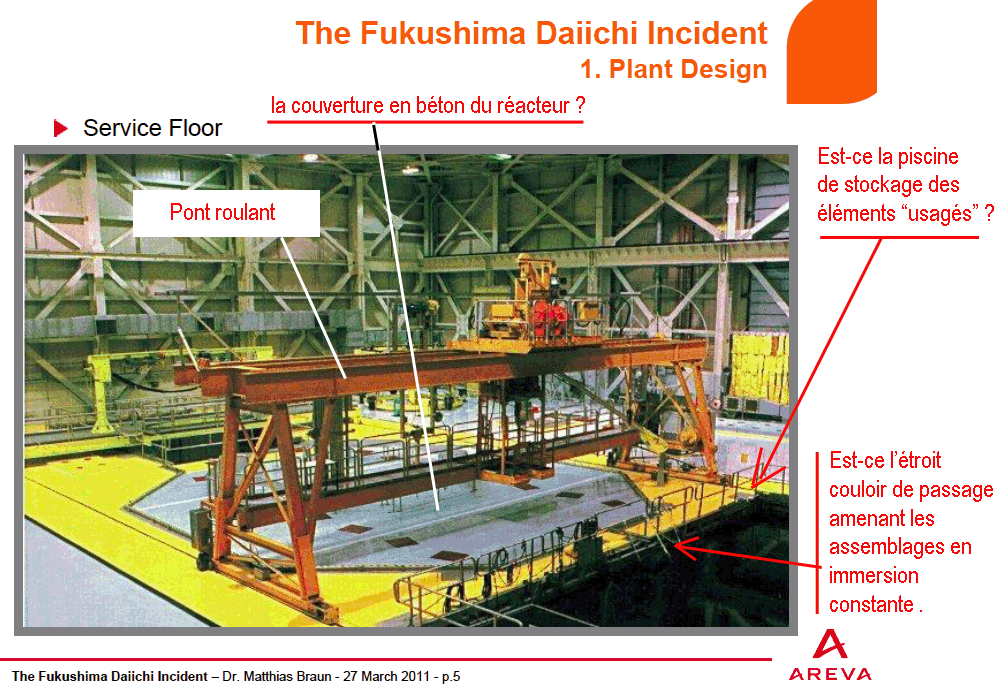
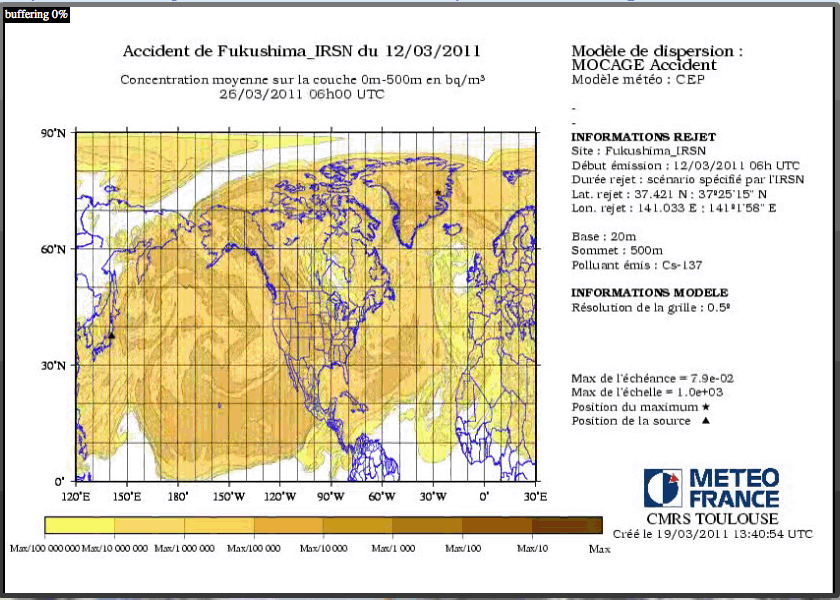
Source : http://www.cartoradiations.fr
The CIA analyzes French nuclear policy, regarding the spread of plutonium

****http://www.youtube.com/watch?v=G8rBBCKnboU
**http://www.youtube.com/watch?v=XJQAC4NswgA**http://www.youtube.com/watch?v=XJQAC4NswgA
The energy needs of countries like ours****** **
****http://fr.structurae.de/structures/data/index.cfm?id=s0004215
April 18, 2011: The former "left-wing" minister Claude Allègre flies to serve the power.
- We must stop walking on our heads. The fireman of the atom. What I heard from this man, supposedly knowledgeable, made me furious.
In this broadcast, either Allègre is lying, or he is completely ignorant, victim of two things:
- The influence of nuclear lobbying, which has done everything to present alternative energies as "viable solutions at the household level"—and the impression given by anti-nuclear activists, who, despite having carried out courageous actions for years while we watched them, are labeled as leftists.
There are solutions to quickly reposition alternative energies, alongside nuclear and fissile fuels. We simply need to invest the necessary funds. Allègre, who claims for instance that we don't know how to store energy, is simply ignorant.
, lacking even the minimum knowledge in engineering and physics. He simply imagines a country full of ugly wind turbines and solar panels. He rightly mocks champions of degrowth. If I had been on that panel, as a scientist and engineer, I would have silenced him quickly.
Indeed, it's enough to go to a steel mill and watch a Bessmer furnace in operation, where iron is melted using electric resistance, to realize we'll never produce such vast amounts of electricity, even by combining contributions from many individual homes.
Anti-nuclear activists showed great courage by confronting the nuclear monster under a deluge of tear gas, without any public support, as usual indifferent.
But the absence of a solid alternative project is a flaw in these groups, which lack engineers and physicists. Hulot surrounded himself with "environmental specialists," champions of the fight against greenhouse gas emissions, fervent supporters of the "carbon tax," like the polytechnician Jean-Marc Jancovici. Both remain highly questionable. Hulot has never hidden the support he received from major groups like EDF, OREAL, etc.
It remains perfectly true that household electricity consumption and our approach to transportation could be revised, leading to a substantial reduction in electricity bills. But:
- This degrowth is poorly perceived by the public ("we'll have to light candles!")—and there's a lack of a sufficiently ambitious substitute project to nuclear energy. Only countries like Spain and the U.S. have managed to implement real "solar power plants" of significant scale. You can easily find them online. The efforts made by countries like Germany make Sarkozy's electrically charged boasts ridiculous: "We are leaders in nuclear energy. We will invest and become leaders in renewable energies" (Sarkozy's election campaign).
The Spanish solar plant Andasol: 50 megawatts, with energy storage in molten salt. Capable of meeting the needs of a city of 200,000 inhabitants. Expandable, as can be seen.
What are we waiting for to fund such projects?
They amount to tens of thousands of megawatts—period. I'm talking about current needs. In France, we must reckon with 78,000 megawatts, of which 62,400 MW are currently covered by nuclear energy. If we consider a project to develop alternative energies, we must aim for production on this scale, not just savings through low-consumption bulbs and well-insulated homes. Although such savings are far from negligible, this is perfectly true. Great progress can be made in better management of household energy consumption.
But industrial needs and transportation needs are unavoidable. We won't run TGVs by placing photovoltaic cells on their roofs.
What this ignorant man, Allègre, who "poses as a scientist," fails to understand is that we can very well envision electricity production units capable of matching nuclear power plants and oil-fired plants. The U.S. is currently finalizing construction of solar plants of 320 megawatts.
Ah, but how, some might say?
By investing the necessary funds, with large-scale installations.
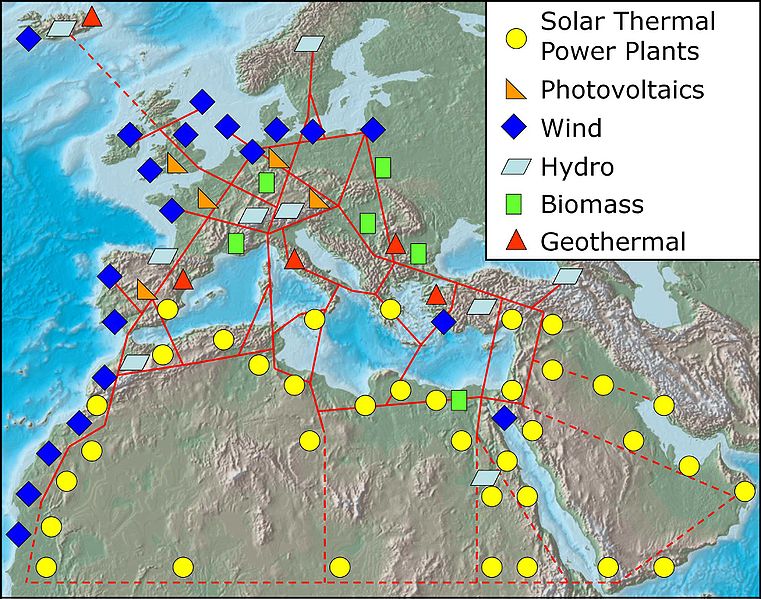
showed an image of what could be done by positioning such installations on land around the Mediterranean basin, for supplying that region and Europe. Because the key problem—the transport of electricity over very long distances, thousands of kilometers—is already solved. I'll explain this in detail in the May 2011 Nexus article. But you can also find this information online.
That said, the DESERTEC project immediately ran into problems regarding relations with "solar energy-producing countries," especially those in the Maghreb, countries that lack political stability "bulletproof."
I read that Angela Merkel announced Germany had decided to completely abandon nuclear energy to fully push toward renewable energies.
That is the way forward, regardless of cost.
Because we're playing with the health of future generations. I heard Allègre advocate spreading small nuclear power plants. That's sheer madness! No one talks about waste management! A journalist pointed out this increases risks. But our former "socialist" minister doesn't care.
Regarding renewable energies, we're living in a situation comparable to war. A war against greed, recklessness, irresponsibility, incompetence (the Fukushima disaster is a perfect example, whose people of Japan continue to pay the price for a long time). We must consider all solutions and implement them. We could equip southern-facing slopes of mountains. Floating renewable energy stations (solar + wind + hydro) are also viable solutions.
If we consider solar energy, the issue of land area arises. We can produce several megawatts per hectare under our latitudes. The needs of France (78,000 megawatts) thus correspond to a square with sides of about ten to a few dozen kilometers.
On a national scale, this is ultimately minuscule.
What we know for certain is that electricity can be transported over long distances. In France, the power grid is "meshed" so that the distance between production units and consumption centers does not exceed 200 kilometers. Beyond 500 km, losses due to inductive effects burden the transport of electricity via alternating current. The Canadians faced this problem. In the 1970s, two opposing trends emerged in developing the country's electricity infrastructure.
- Some advocated developing nuclear energy—others suggested exploiting the vast potential of hydroelectric resources in the north of the country, through massive dams on rivers with high flow rates, moderate elevation differences, but reliable supply.
These installations caused the flooding of vast areas initially considered hunting grounds for tribes. If we had prioritized the integrity of these hunting grounds by choosing nuclear energy, these entire populations, including Canadian tribes, would now live under the threat of nuclear disasters and face the problems of radioactive waste accumulation and the dismantling of nuclear plants with relatively short lifespans (30 years).
A brief aside. A pressurized water nuclear reactor (the currently "safest") is built around a steel vessel 20 cm thick. The pressure inside this vessel: 155 bars for French installations. This steel ages relatively quickly due to neutron bombardment, which disrupts its crystalline structure and reduces mechanical strength.
Its lifespan does not exceed thirty years.
As one of my retired neighbors, who spent his entire life at Cadarache working on nuclear submarine reactors, once told me:
- Submarine reactors also operate under pressurized water. Initially, they were run at 150 bars. But toward the end of their life, engineers found it safer to reduce the pressure to 40 bars...
A hydroelectric installation does not age. We don't periodically dismantle hydroelectric dams. They are built to last indefinitely.
In Canada, in this battle between nuclear supporters and advocates of hydroelectric power, the central issue was the considerable cost of production and transmission infrastructure. There was also the climatic challenge (one Canadian hydroelectric plant is entirely underground).
The most powerful production units had to be located 1,400 km north of electricity consumption centers.
Fortunately, the latter won, leading to the creation of Hydro-Québec, a state-owned company.
Check the internet. The figures are phenomenal. Quebec has become the world's largest producer of hydroelectric power (its hydrology allowed this). It has 59 hydroelectric installations producing 36,429 megawatts. The Churchill Falls dam produces 5,428 megawatts. The Saint James Bay complex alone produces 16,000 megawatts.
The issue of electricity transport remained, and this is where I want to emphasize. As I'll explain in the May 2011 Nexus article, beyond 500–1,000 km, transporting electricity as alternating current through overhead lines is no longer profitable due to "inductive losses." If transport is underwater (crossing the St. Lawrence), this constraint drops to 50–100 km.
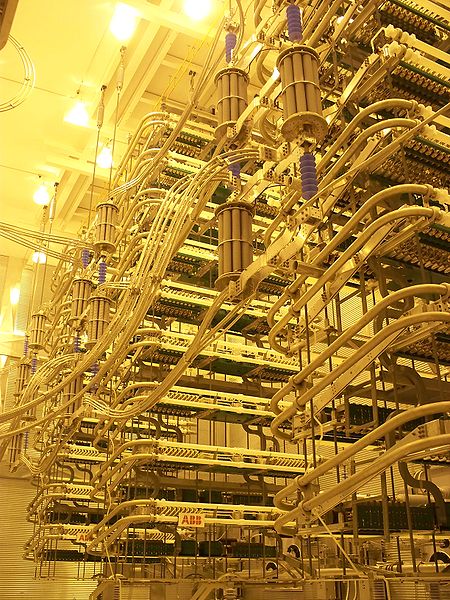
The Canadians therefore opted for transporting electricity as direct current, developing very high-power rectification installations operating at extremely high voltages. I provide two images.
Manitoba rectification unit operating at 150,000 volts. An image showing the scale of Canadian rectification units. This alternating current (up to 750,000 volts), once rectified, is then transported as high-voltage direct current, by thousands of megawatts.
Line losses then drop to just 3% per thousand kilometers!
At the destination, this direct current is converted back to alternating current using inverters, then voltage is reduced using transformers, etc.
Thanks to these facilities, Canada immediately became energy self-sufficient, avoiding the poisoned trap of nuclear energy. Of course, France does not have such abundant hydroelectric resources.
But what's crucial to remember is that it is perfectly possible to produce electricity in one place and transport it thousands of kilometers away.
Allègre, who is not an engineer, probably doesn't know this. We're stunned when we hear this man, who must have some knowledge in geology and hydrology, favorably consider exploiting shale gas resources!
This "shit gas," as Fillon so aptly named it. Currently, all of humanity could solve all its problems. For food and health, this is no secret. The same goes for energy. After careful reflection, I believe that choosing to exploit renewable energies—solar, geothermal, marine, wind, biochemical, etc.—would completely transform the social, political, and economic organization of the planet.
Knowledge equals power. The world of "high technologies" dominates and enslaves peoples. By wanting to implant small nuclear power plants everywhere, these great powers don't just run a very serious risk to the entire world. They would only intensify the dependence of poor nations on rich ones, which is precisely the goal—not to improve the well-being of populations.
The world of renewable energies is accessible to all countries. The vast majority of technologies needed are based on knowledge dating back fifty or even a hundred years. All countries could "play this game" and become independent.
We live in an era where people think only in terms of "return on investment," short-term profits. The scale of expectations is measured in years. These other projects do not allow for a return on investment on such short timescales. They cannot fit within the greed of the societies currently dominating the world, which draw their strength only from our weakness and our inability to set other goals. These projects can only be state-led, genuinely globalist in the true sense. They cannot be funded by predatory loans. This is precisely the kind of societal project completely missing from our presidential candidates.
If such Grand Works were initiated, they would provide massive employment, not just profits. Therefore, the world of profits rejects them, denies them, and people like Allègre become their advocates, their accomplices, wearing the robes of scientists and supposed men of knowledge.
They have every right to dismantle "classic anti-nuclear" activists, who don't shine in physics or engineering. That said, these people courageously fought against what was being set in motion, in complete public indifference. If they lacked competitive projects, they were the first to perceive the scale of the danger.
I cited French electricity consumption needs. But I'll go even further. By completely transforming our science and technology, turning it to our service instead of allowing others to use it as an instrument of power and enslavement, we could replace not only nuclear energy but also oil, ending all greed and spectacular waste, like the kind we've witnessed firsthand in Dubai, the "Tower of Babel" city.
All this using relatively simple, proven, accessible technologies for all peoples on Earth.
It's all a question of scale, investment amounts, and goals pursued.
There are historical moments when people willingly spend staggering sums to design and create products destined simply to be destroyed, "consumed violently." In such situations, we are also ready to sacrifice many human lives. These situations are called wars.
When you hate, you don't count. Imagine a discussion where engineers propose solutions for the Normandy landing. Imagine the reaction of financiers:
- Can you imagine how much this will cost? Building massive floating concrete structures to create your artificial ports. Have you calculated the cost of bridges, access roads, everything needed to handle, assemble these structures? No, the Normandy landing project is a ruinous madness!
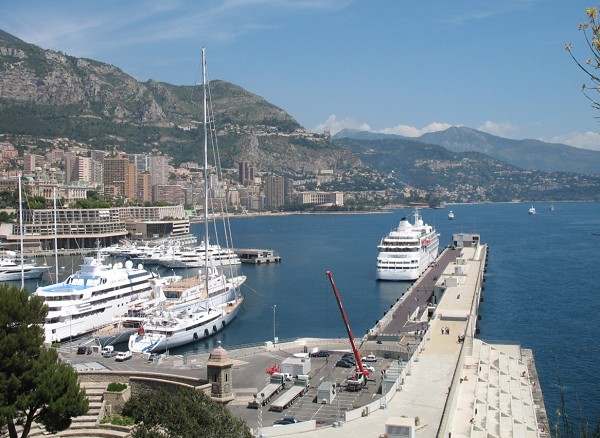
The Principality of Monaco has equipped itself with a floating pier... connected to the mainland only by a hinge. Here are the figures, provided by Xavier Lafont, who in our group was the first to propose floating solar, wind, and hydro installations on barges:
Cost:
150 million euros.
Height:
19 meters. Total length:
352 meters. Weight:
163,000 tons. Width at base: 44.0 meters. Width above water: 28.0 meters. Draft:
16 meters. Lifespan:
a century.
Source of the image:
The floating breakwater of Quai Rainier III in Monaco. These dimensions and the chosen design show that floating installations can withstand Mediterranean storms, known to be particularly violent.
What concrete specialist could provide us with more modest figures for floating structures—less luxurious, modular, mass-produced, and capable of being assembled into real concrete icebergs?
DCNS is developing with Areva, EDF, and the CEA an unprecedented project for a submarine nuclear reactor.
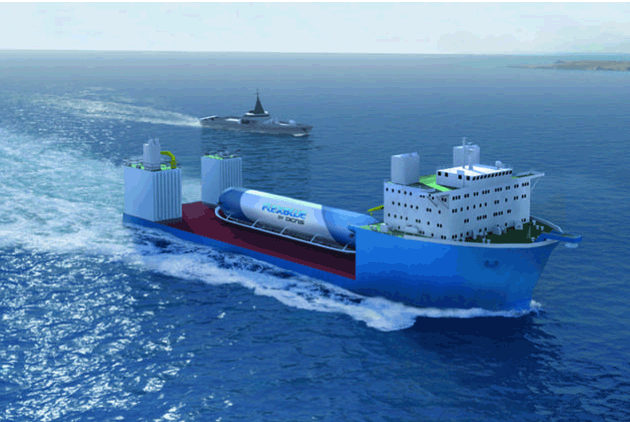
Will the future of French nuclear energy pass through the creation of mini-reactors placed on the ocean floor? That’s what DCNS believes, having unveiled on Wednesday the Flex Blue project. Its principle? A cylindrical reactor, 100 meters long and 15 meters wide, submerged at a depth of 100 meters and connected to the mainland by an electrical cable.
The result of two years of work, Flex Blue was developed by DCNS, which designs the French navy’s nuclear submarines, in partnership with Areva, EDF, and the CEA. For islands and coastal cities, the envisioned submarine reactor will have a power output of 50 to 250 megawatts and will be capable of supplying electricity to between 100,000 and one million people. It is intended to supply islands, remote regions, and certain developing countries.
For the French nuclear industry, Flex Blue would thus represent an alternative to the third-generation EPR nuclear reactor, which is more powerful but also more expensive and rejected by emerging nations.
Transportable by ship, the mini-reactor will be built at the shipyards in Cherbourg, where maintenance and uranium refueling operations will also be carried out. At a cost of a few hundred million euros, it offers several advantages over a conventional reactor: mass-produced, faster to build (in two years), it avoids the costly civil engineering work.
"The project holds water" "The project holds water on paper," says a researcher at the Foundation for Strategic Research, interviewed by Europe1.fr. For this nuclear specialist, "there is a market for small reactors for countries that cannot afford conventional power plants." A view shared by DCNS, which forecasts a potential market of 200 units for this type of reactor over the next 20 years.
Still, the question remains regarding the safety of a nuclear plant submerged in the ocean. On this subject, experts are reassuring. "The underwater location of mini-reactors makes sabotage or terrorist attacks impossible," states Bruno Tertrais. As for the risks of marine pollution, they are ruled out due precisely to the reactor’s submersion. "Water is the best barrier against radiation," argue DCNS officials.
This enthusiasm is not shared by Greenpeace. According to the environmental organization, the project presents nothing concrete, both technically and in terms of safety. Proof of their skepticism: during the project presentation, Greenpeace members thought it was an April Fool’s joke.
These systems will operate completely automatically. Do not fear misuse: these 100-meter-long, 15-meter-diameter units will be protected by a thick mesh.
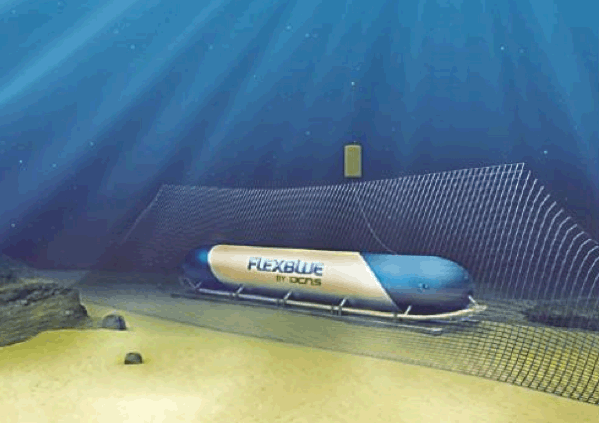
The underwater nuclear power plant Flexblue, protected from amorous assaults by sperm whales by a thick mesh
Question:
This nuclear reactor will be cooled by seawater. How has the circulation system been envisioned? How to prevent marine creatures from mistaking the inlets and filters for hotels?
If cooling is envisaged over the entire surface, how to prevent algae from attaching to the walls and reducing heat transfer?
Try to imagine a sudden drop in cooling, a core meltdown, criticality at 100 meters depth. James Bond-style...
Finally, how can one envision these numerous units, submerged at depths accessible to any scuba diver, not constituting unsustainable risks?
Captain Nemo must be turning in his grave.
How can anyone be so foolish as to imagine something like this, simply to make money, to "capture market share"? It baffles me...
DCNS is developing with Areva, EDF, and the CEA an unprecedented project for a submarine nuclear reactor.
Will the future of French nuclear energy pass through the creation of mini-reactors placed on the ocean floor? That’s what DCNS believes, having unveiled on Wednesday the Flex Blue project. Its principle? A cylindrical reactor, 100 meters long and 15 meters wide, submerged at a depth of 100 meters and connected to the mainland by an electrical cable.
The result of two years of work, Flex Blue was developed by DCNS, which designs the French navy’s nuclear submarines, in partnership with Areva, EDF, and the CEA. For islands and coastal cities, the envisioned submarine reactor will have a power output of 50 to 250 megawatts and will be capable of supplying electricity to between 100,000 and one million people. It is intended to supply islands, remote regions, and certain developing countries.
For the French nuclear industry, Flex Blue would thus represent an alternative to the third-generation EPR nuclear reactor, which is more powerful but also more expensive and rejected by emerging nations.
Transportable by ship, the mini-reactor will be built at the shipyards in Cherbourg, where maintenance and uranium refueling operations will also be carried out. At a cost of a few hundred million euros, it offers several advantages over a conventional reactor: mass-produced, faster to build (in two years), it avoids the costly civil engineering work.
"The project holds water" "The project holds water on paper," says a researcher at the Foundation for Strategic Research, interviewed by Europe1.fr. For this nuclear specialist, "there is a market for small reactors for countries that cannot afford conventional power plants." A view shared by DCNS, which forecasts a potential market of 200 units for this type of reactor over the next 20 years.
Still, the question remains regarding the safety of a nuclear plant submerged in the ocean. On this subject, experts are reassuring. "The underwater location of mini-reactors makes sabotage or terrorist attacks impossible," states Bruno Tertrais. As for the risks of marine pollution, they are ruled out due precisely to the reactor’s submersion. "Water is the best barrier against radiation," argue DCNS officials.
This enthusiasm is not shared by Greenpeace. According to the environmental organization, the project presents nothing concrete, both technically and in terms of safety. Proof of their skepticism: during the project presentation, Greenpeace members thought it was an April Fool’s joke.
****this dossier
the first offshore nuclear installation
**
April 17, 2011: Don’t believe the French are the only ones contemplating such madness. Projects are everywhere. In New Mexico, the Sandia laboratories are no exception. You can consult , in English. This movement has a name:
TerraPowerCompany Even craziness on the Russian side, who had already deployed in June 2011 "fully autonomous," described as "ecological," since when removed, it leaves no trace in the environment.
But what about the waste???
Let’s add that in case of war, such installations would be bombs installed at home, totally vulnerable. They would also be dream targets for terrorism. It feels like a bad James Bond movie.
In this festival of lunatics, you’ll find the inescapable Bill Gates, who advocates for the spread of . Normal. First came the big computers, then personal computers." Gates believes the concept must be extended to nuclear energy....
No, you’re not dreaming. We’re simply being prepared for a nightmare.
Bill & Melinda Gates Foundation lists as one of its "Guiding Principles" that "science and technology have great potential to improve lives around the world".
One of Bill and Melinda Gates’ guiding principles is that science and technology must improve human life everywhere in the world....
****the interview given by Thierry Charles
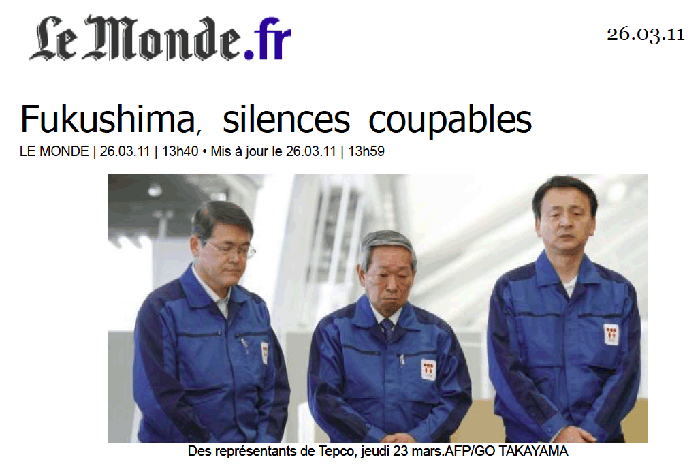
****http://www.independentwho.info/Presse_ecrite/11_03_26_LeMonde.fr_FR.pdf
Document on the subject, in English ** ******
http://www.liberation.fr/economie/01012331339-a-iwaki-sous-la-menace-de-l-atome ****
| April 14, 2011: | An article by Christophe Perrais, on Agoravox |
|---|
April 13, 2011: an infographic, released by Le Monde, which allows understanding what happened at Fukushima in three minutes.
It's not bad, with a caveat: in reactor 3, the explosion didn't just blow off the upper floor. It's likely much worse. In fact, we don’t know exactly what really happened at the site, nor the extent of the damage. We’ve heard, in official statements, EDF officials stressing that the damage in Japan was essentially due to the tsunami. They forget the incalculable effects of the earthquake, which can be seen along the coastline.
It wasn’t the tsunami that created this crack, which propagated all the way to a tank containing pipes and electrical connections!
The Japanese, unable to inspect the site, are incapable of assessing the damage, cracks (synonyms for leaks) that may have affected all structures at the plant.
April 13: The Japanese network reports that the temperature in the pool of reactor number 4, which contains tons of "used fuel," is rising and now reaches 90°C. These elements are still under two meters of water (instead of five, normally). If this level were to drop and these elements were no longer cooled, they would release massive amounts of radioactive debris into the atmosphere. This temperature rise indicates "activation" of the fuel assemblies."
Source: http://www3.nhk.or.jp/daily/english/13_35.html
April 13: TEPCO attempts to reassure the public by stating that "most of these assemblies (which were heated when they were no longer covered by water in their pools) have not been damaged."
Source: http://www3.nhk.or.jp/daily/english/13_37.html
The truth is, they have no idea what the extent of such damage truly is. ****
http://fr.wikipedia.org/wiki/Liqu%C3%A9faction_du_sol
http://www.youtube.com/watch?v=Wi-ka8fhrhQ&feature=related.
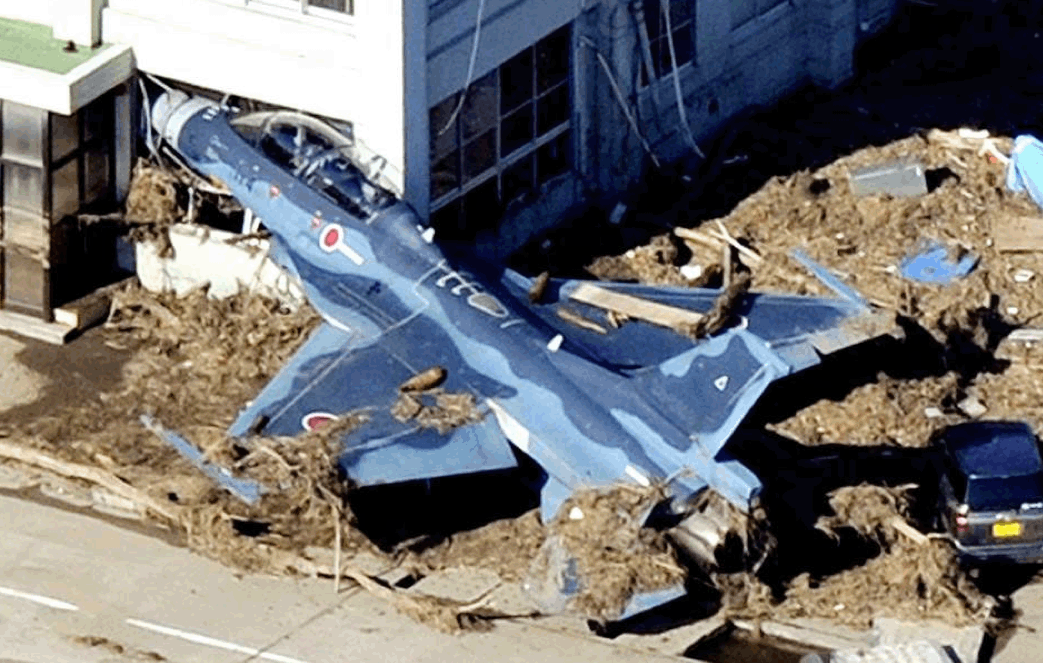
Outside of the numerous aftershocks, in certain regions of Japan severely affected by the earthquake and its aftershocks, deep soil rearrangements create pressure in the groundwater, which rises, triggering the phenomenon of soil liquefaction and fracturing, greatly alarming the population.
Video
I saw that Nicolas Hulot had decided to run for president and was seeking endorsement from Europe Ecologie.
A media figurehead, Hulot could change the game. But only if ecologists, in general, understand that it is impossible to "launch renewable energy projects that are profitable, in terms of return on investment."
The scale of such projects far exceeds private capacity and its imperative of short-term profit.
Such enterprises could only take the form of GRAND PROJECTS, with massive state funding, ensuring immediate full employment, given the tasks to be launched.
It’s not about gradually replacing nuclear power over a few decades, but about envisioning the replacement of nuclear power and fossil fuels in less than ten years. Five, perhaps. For all countries, needs are in the tens of thousands of megawatts. The solutions, mentioned in the Nexus article (16 pages), to be published, include among other things equipping mountain slopes and lakes, developing an immense offshore solar project on barges that, when assembled, would form vast concrete "icebergs" of tens to eventually hundreds of square kilometers.
Projects where it would be pointless, in the short term, to compare costs per kilowatt-hour. In fact, if we reason in terms of budget, this operation, not national but planetary, would represent a mobilization of capital, human resources, and raw materials equivalent to the cost of a ... Third World War.
An "Ecological War," the first in human history, against human greed and stupidity.
The right question is:
How much do we value a human life?
To be continued—I must now focus on finalizing the article to be published in the May issue of Nexus.
is | E | Outside of the numerous aftershocks, in certain regions of Japan severely affected by the earthquake and its aftershocks, deep soil rearrangements create pressure in the groundwater, which rises, triggering the phenomenon of soil liquefaction and fracturing, greatly alarming the population. | Video | : |
|---|---|---|---|
**
April 11, 2011:
Readers may have been surprised to see this page change its title over the weeks. Initially, I had titled it "We must get out of this nuclear." At that time, I still harbored the illusion that solutions could emerge from cutting-edge technologies, such as aneutronic fusion Bore 11 + Hydrogen 1. A fusion pathway that seemed possible thanks to the fantastic breakthrough of 2006, accidentally achieved at the Sandia laboratory in New Mexico by Chris Deeney’s team. A work analyzed by the Englishman Malcolm Haines, a pioneer in plasma physics. The paper was published in 2006 in Physical Review Letters, titled "Over two billion degrees" (more than two billion degrees). I immediately grasped the significance of this new development and published a meticulous analysis of the article a few months later.
In September 2008, I attended the Vilnius conference on High-Power Pulsed Systems and had long conversations with Keith Matzen, the head of the Z-machine where this result was achieved, using 18 million amperes, which became "ZR" (Z "refurbished") from the beginning of 2008. There, what was my surprise to hear Matzen, supported by his deputy Mac Kee, declare that this publication didn’t hold up, that Haines had made a mistake in analyzing the spectra, etc.
Why hadn’t Matzen published a correction? "To avoid hurting poor old Haines."
Who would believe such a fable?
Questioned, Gerold Yonas, scientific director of the Sandia laboratories (whom I had personally met since 1976 during a visit), replied, "This matter concerns me. I will ask Matzen to publish a correction."
It never came.
In October 2008, Sytgar, who was supposed to present the ZR results at the Jeju conference in Korea, where I was again present, suddenly disappeared. Excuse: "his father was very ill." But after checking with the secretariat, he hadn’t even registered for the conference. Strange, for someone who, among 18 signatories, was supposed to present the results at the most important international conference on Z-machines.
After Sytgar whispered to the chairman that he wasn’t present, and the chairman adjourned the session, Oliver from Sandia stormed toward me and declared that we must stop spreading nonsense, that Haines had been wrong, that was all. When questioned, Oliver told me that Sandia "would publish a correction in 2011."
I bet you anything that this correction will never come. Because Haines was not wrong in his interpretation of the experimental data and his calculations. It is impossible to deny these two aspects, impossible to provide scientific arguments that could refute this claim.
So?
So, the Americans are misinforming, because this result should never have been published. While it represents a fantastic hope for humanity—the possibility of non-polluting fusion, producing only helium as "ash"—it is also the key to new "pure fusion bombs," where fusion reactions can be initiated using an MHD compressor, not by an atomic bomb, which cannot be miniaturized due to the critical mass problem, imposing a lower limit of several hundred tons of TNT.
These compressors were invented by the Russians in the 1950s. I explain all this on my website (&&& I will add the links, but cannot do so right now, having burned a hard drive).
During my trip to Brighton in January 2001, having met Americans working on "black programs," I was shocked to see that the only thing that interested them in the UFO dossier was the possibility, based on new concepts, of designing new weapons: hypervelocity MHD torpedoes, hypersonic aircraft equipped with "MHD-controlled" air intakes.
At the time, the shock was already strong enough. But with this aneutronic fusion affair and its immediate turn toward military applications, the circle was complete. These bombs can be miniaturized. Therefore, they are... usable. Moreover, by choosing a Bore-Hydrogen formula, one obtains a... "green bomb."
This completely disgusted me with the subject. It’s done.
I’ll go further. Today’s scientists have no conscience whatsoever. They are bought for a handful of bread. I recall an issue of Courrier du CNRS where Charpentier, then head of the "Physical Sciences for Engineers" department, wrote, "The army does not have enough research contracts to satisfy researchers' demands."
We discover genetic manipulation techniques? After a short moratorium, we now have GMOs. Researchers develop medicines in the form of "new molecules," patented, of course. The World Health Organization launches a vaccination campaign to... make people sick. The agri-food industry mixes additives into our food, degrading our health. Agricultural research turns a blind eye to the vile motives of fertilizer and sterile seed sellers.
The French polytechnician engineers of the "Corps des Mines" created an atomic empire in France. You will soon read about nuclear waste in construction materials, in packaging.
And on the front of science? Nothing, for decades. Theoretical physicists knit socks for winter with superstrings. At CERN’s Large Hadron Collider, the Higgs boson hunters return empty-handed. At Cadarache, nuclear technocrats promise us "the Sun in a test tube," having launched a 1.5 trillion euro project, deep in technological fog, but guaranteeing them a career in a land of plenty, where they can later say, "well, we were wrong."
They might apologize, as Japanese technocrats did, to a population paying the price of their recklessness and irresponsibility.
The press? It is controlled or blind, deaf. It dedicates articles to "escort girls," prostitutes elevated by their media to stardom. Why not appoint these girls who sell their bodies as ministers, since we already have ministers who are, in fact, prostitutes.
Philosophy? Bernard-Henri Lévy invents disposable thinking. At a time when metaphysics is in crisis, bar philosophy thrives.
With a few engineer and technician friends, we are drafting a report on renewable energy exploitation. It’s progressing well. Meanwhile, it’s obvious we must stop this nuclear energy, which has become a murderous madness. Civil nuclear energy is the stepping stone to military nuclear energy, to the concentration of power in the hands of oligarchies completely disconnected from their people. France has always been ready to sell this know-how to anyone. There are other ways to produce energy, free from military applications, unless one wants to imitate Archimedes, burning enemy ships’ sails by focusing the Sun’s rays on them, as legend says. This decision to turn the page on nuclear energy must be demanded and taken. Only the people, not their corrupt and servile representatives, can make this demand, provided they are given a "Plan B," a way out, which has little to do with the feeble projects of our declining ecologists, none of whom can envision projects that Jules Verne himself would not have scorned.
We must demand an immediate halt to the "reprocessing of nuclear waste" at the La Hague plant, which in fact aims to recover unused uranium and plutonium present in spent fuel assemblies. We must immediately stop the production of MOX, this reactor fuel containing 7% of the most dangerous substance in the universe, invented by man: plutonium. The French already use it in twenty of their fifty-eight nuclear reactors. We must stop this equally costly and absurd project, ITER, the "cathedral for engineers" or "social plan," depending on which side of the coin you choose to focus on.
There are other ways to create mass employment. We must stop parading nuclear missiles as a strike force. We must definitively bury these idiotic projects like so-called fourth-generation reactors. Breeder reactors using sodium or molten lead are suicidal ventures.
We must dedicate money, energy, and creativity to things that improve human life conditions, instead of continually degrading them. We must invest heavily in money, energy, and creativity. But on the last point, after assessment, it's not ideas that are lacking.
We must denounce luxury, advocate sobriety and frugality in life, and not gawk at the richest and most powerful, worship the golden calf, or be numbed by empty talk. We must condemn these vain fools who drive luxury cars, build 800-meter Babel towers, ski resorts in the middle of deserts, refrigerated with black gold.
How can we be surprised that so many disadvantaged, disoriented people turn to ideologies centuries old, when all we offer them is the spectacle of our violence, our injustice, and our chaos.
 seisme_japon_2011_it.htm
April 4, 2011: Jonhatan Bellocine begins translating this page into English
****Updated on March 27, 2011. IRSN reports dated March 25
****April 3, 2011: Death by subcontracting
The accidents could only have been due to human error.
That’s what they told us. What liars!
April 9: Kurosawa’s prophetic film
April 9, 2011: AREVA’s vertiginous cynicism
April 9, 2011: Translation into French of the same report.
****I’m trying to organize volunteer translation workshops for pages like this
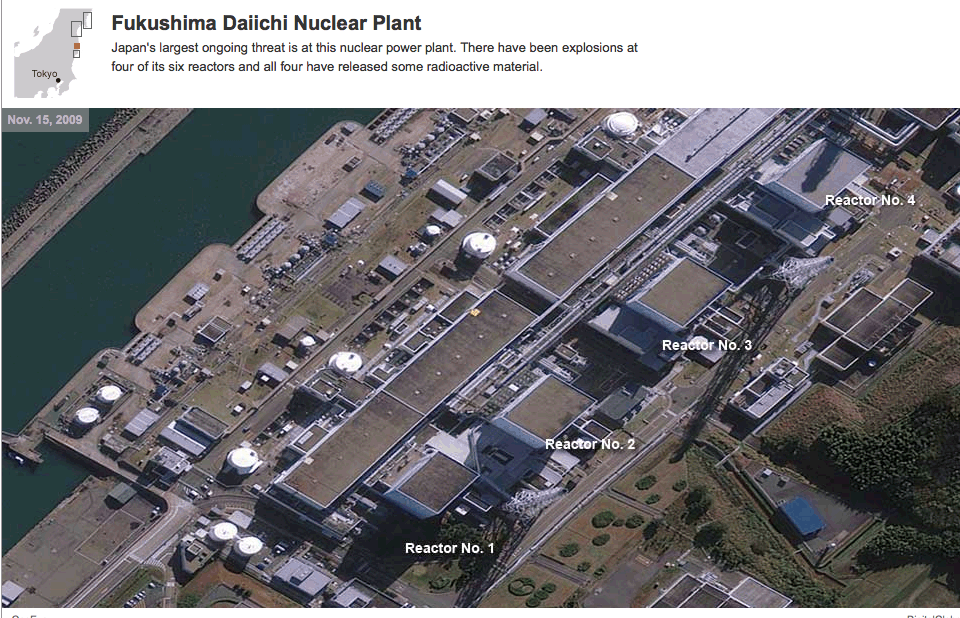
http://www.11alive.com/rss/article/186581/3/Massive-pumps-heading-to-damaged-reactors-in-Japan
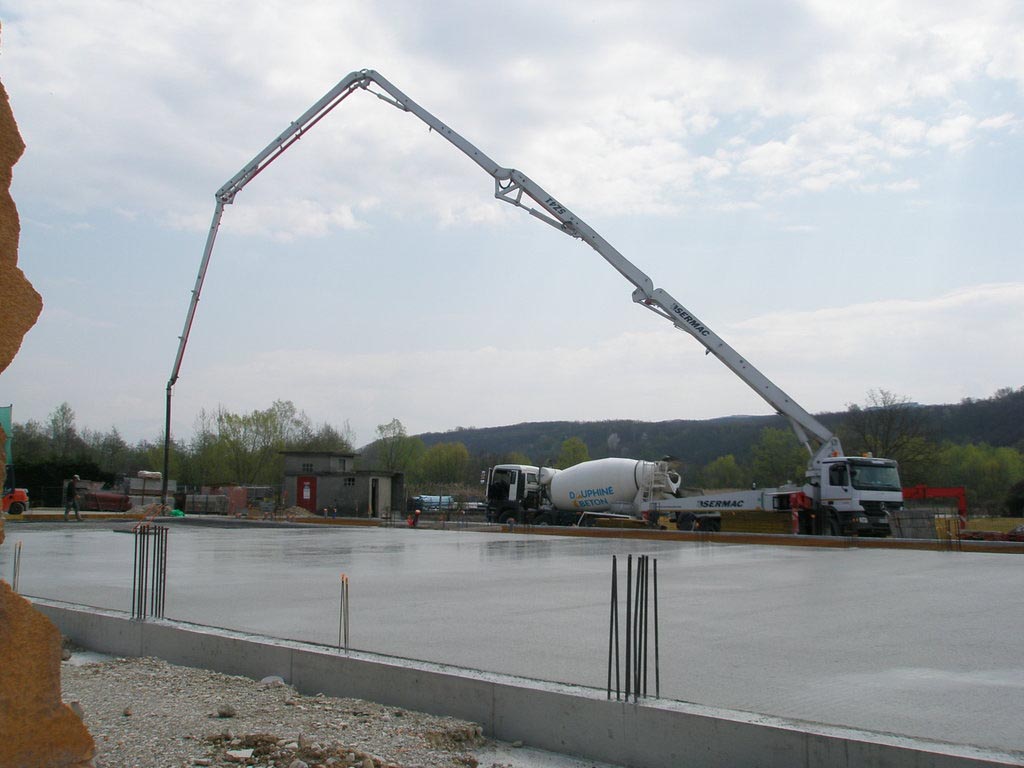
Translation:
ATLANTA (Associated Press) - A massive cargo plane landed in Atlanta on Friday to load one of the world’s largest concrete pumps, modified to spray water onto the damaged nuclear facilities at the Japanese site struck by the earthquake and tsunami.
Weighing 95 tons, this machine was designed in Wisconsin by the company Putzmeister and rests on 26 wheels. Its arm can reach a height of 60 meters, allowing operations in hard-to-reach areas of the Fukushima Dai-ichi site in Japan.
Eventually, this pump could also be used to create a concrete sarcophagus. After the 1986 Chernobyl disaster, the company Putzmeister sent 11 pumps to deliver concrete onto the damaged facility in Ukraine.
Regarding this shipment, Dave Adamas of Putzmeister stated that the entire company hopes this equipment could help resolve the problems there."
........
A representative of Putzmeister contacted the Japanese company TPCO after seeing that the Japanese were trying to cool the damaged facilities using helicopters and fire trucks.
The company redirected a smaller Putzmeister pump, originally destined for Vietnam. A dozen workers used this pump to spray 150 tons of seawater onto the storage pool of one of the reactors, completing the task in three hours and demonstrating the value of using this pole-based delivery system.
The transport of this large Putzmeister system prompted Japan to rent a Russian Antonov N-124 cargo plane, one of the largest in the world.
.... it is expected that this pump, along with another retrieved from Los Angeles International Airport, will depart the U.S. on Saturday. Putzmeister plans to send smaller installations from Germany, with costs covered by the Japanese (it should be noted that TEPCO had not deemed it necessary to secure the Fukushima site’s installations).
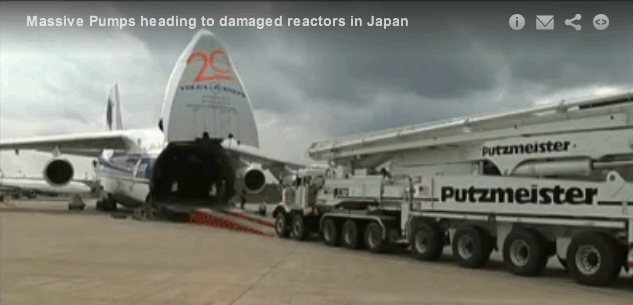
The super concrete pump from Putzmeister, loaded onto a Russian Antonov 22
These concrete pumps have become extremely common worldwide and allow workers to pour concrete in often inaccessible locations. At the moment I write these lines, a pump of this kind is at work a few hundred meters from my home (Pertuis).
A concrete pump at work in Pertuis, April 11, 2011, Cemex company
The injection hose diameter of this "mini-pump": 12 cm. Discharge occurs via buckets of 8 cubic meters.
Close-up on the outlet where the bucket discharges its load
The vehicle loaded onto the Antonov has a feed window similar to a hopper
The giant machine, loaded onto the Russian cargo plane, does not appear to be inherently suited for water spraying. To do so, the rear of the vehicle would need to be completely modified, it seems to me. I believe the discharge hose diameter is 25 cm, and the flow rate is 60 liters per second. To be verified.
Given these images, a question arises: Are the Japanese preparing to bury the reactors under tens of thousands of cubic meters of concrete?
The problem is not simple. At Chernobyl, the core, abruptly entering criticality (due to "xenon poisoning"), had transformed a large amount of cooling water into hydrogen and oxygen. Above a thousand degrees, this mixture, resulting from the dissociation of water molecules, could not recombine into water vapor. When the temperature dropped, ultra-rapid recombination became possible, turning this "stoichiometric" mixture into a powerful explosive. The phenomenon thus involves taking water, imparting energy to it for a "certain time" (minutes? tens of minutes?), to turn it into a potent explosive that would then release this energy in a thousandth of a second. At Chernobyl, the explosive power was sufficient to launch the 12-ton reinforced concrete slab covering the reactor tens of meters into the air. It spun around and fell at a 45-degree angle, shattering a large amount of solid graphite, used as a moderator, in the process.
All the reactors at Fukushima were similarly covered by a slab. What about the one covering reactor number 3?
The core began to sustain the combustion of graphite in the air, and the 25 firefighters who attempted, unsuccessfully, to extinguish the fire with their hoses were irradiated and all died within a few days. They faced what they believed was merely a simple fire, without any protective equipment.
As the graphite burned, it carried radioactive elements upward. The graphite itself had become highly radioactive. The Russians' priority was therefore to extinguish this fire at all costs. To do so, they had to seal the 10-meter-diameter hole through which the reactor core could be seen, sustaining the graphite combustion. This could not be achieved with concrete pumps. The Russians sacrificed 600 helicopter crews, who dumped thousands of tons of sand, boron, and even lead (which then contributed to air pollution) from 200 meters above this gaping hole. All these pilots and mechanics died from the radiation doses they received. But, in the urgency, there was no other solution.
When the core was finally covered, its temperature rose, and the Russians faced a new problem. The core was attacking the concrete and risked coming into contact with another large body of water, accumulated in the basement from the desperate firefighters' efforts, which could itself turn into an explosive and hurl the molten core debris not just hundreds of meters, but tens of kilometers, or even farther. Debates continue about what might have happened then. But all specialists agree that a second explosion could have rendered much of Europe uninhabitable!
The Russians sacrificed another hundred men, firefighters, to drain this water. But after approaching it through tunnels and creating an opening using a torch, they discovered that the corium magma, after filling this chamber, had sufficient temperature to attack the next layer of concrete—the final barrier against the groundwater, connected to the Pripyat River, a tributary of the Dnieper, which flows into the closed Black Sea.
Miners, flown in by plane, dug a 140-meter-long tunnel through soft soil at a rate of 13 meters per day, under a temperature of 50°C. Then, beneath the reactor, they installed a 30-by-30-meter slab, stopping the magma's descent.
Finally, engineers designed an enormous and costly sarcophagus, a mixture of strong steel beams, concrete, and lead, with an estimated lifespan of 30 years. Efforts are currently underway to raise the substantial funds needed to cap this sarcophagus with a fully metallic dome structure, whose lifespan is estimated to be a century.
If the Japanese decide on "encasement," how would they proceed? They would have to consider completely submerging the reactors under a massive concrete structure (50,000 cubic meters?). How would they reinforce this concrete and prevent it from cracking under thermal stress? All I could find was a figure regarding the flow rate of these giant pumps: 200 cubic meters per hour.
I will continue this text by reproducing the official Japanese commission report dated April 4, which admits that no one knows the water level in the reactor vessels; the temperature inside the steel containment vessels; or the condition of these various confinement barriers. Indicators (from the analysis of saltwater used for cooling and its isotopic abundances) suggest that corium has spread into the volumes beneath the reactor vessels in certain reactors. In what quantity? Where? No one knows.
The director of France's Institute for Radiation Protection and Nuclear Safety, Mr. Thierry Charles, displaying a calm and rational optimism, not overwhelmed by emotion, seems to have access to information that Japanese officials do not. If this is true, it would be urgent for him to share it with them.
Translation:
ATLANTA (Associated Press) - An enormous cargo plane landed in Atlanta on Friday to pick up one of the largest concrete pumps in the world, modified to project water onto the nuclear facilities at the Japanese site struck by the earthquake and tsunami.
This 95-ton aircraft was designed in Wisconsin by the company Putzmeister and rests on 26 wheels. Its arm can operate at a height of 60 meters, allowing work in hard-to-reach areas of the Fukushima Dai-ichi site in Japan.
Eventually, this pump could also be used to create a concrete sarcophagus. After the 1986 Chernobyl disaster, Putzmeister sent 11 pumps to deliver concrete to the damaged facility in Ukraine.
Regarding this shipment, Dave Adamas of Putzmeister said the entire company hoped this equipment could help resolve the problems there."
........
An official representative of Putzmeister contacted the Japanese company TPCO after seeing that the Japanese were trying to cool the damaged facilities using helicopters and fire trucks.
The company diverted a smaller Putzmeister pump, originally destined for Vietnam. A dozen workers used this pump to spray 150 tons of seawater into the storage pool of one of the reactors, which was accomplished in three hours and demonstrated the value of using this pole-based delivery system.
Transporting a large Putzmeister system led Japan to rent a Russian Antonov An-124 cargo plane, one of the largest in the world.
.... it is expected that this pump, along with another recovered from Los Angeles International Airport, will depart the U.S. on Saturday. Putzmeister plans to send smaller installations from Germany, with costs covered by the Japanese (we recall that TEPCO had not deemed it necessary to maintain the Fukushima site's facilities).
Translation:
ATLANTA (Associated Press) - An enormous cargo plane landed in Atlanta on Friday to pick up one of the largest concrete pumps in the world, modified to project water onto the nuclear facilities at the Japanese site struck by the earthquake and tsunami.
This 95-ton aircraft was designed in Wisconsin by the company Putzmeister and rests on 26 wheels. Its arm can operate at a height of 60 meters, allowing work in hard-to-reach areas of the Fukushima Dai-ichi site in Japan.
Eventually, this pump could also be used to create a concrete sarcophagus. After the 1986 Chernobyl disaster, Putzmeister sent 11 pumps to deliver concrete to the damaged facility in Ukraine.
Regarding this shipment, Dave Adamas of Putzmeister said the entire company hoped this equipment could help resolve the problems there."
........
An official representative of Putzmeister contacted the Japanese company TPCO after seeing that the Japanese were trying to cool the damaged facilities using helicopters and fire trucks.
The company diverted a smaller Putzmeister pump, originally destined for Vietnam. A dozen workers used this pump to spray 150 tons of seawater into the storage pool of one of the reactors, which was accomplished in three hours and demonstrated the value of using this pole-based delivery system.
Transporting a large Putzmeister system led Japan to rent a Russian Antonov An-124 cargo plane, one of the largest in the world.
.... it is expected that this pump, along with another recovered from Los Angeles International Airport, will depart the U.S. on Saturday. Putzmeister plans to send smaller installations from Germany, with costs covered by the Japanese (we recall that TEPCO had not deemed it necessary to maintain the Fukushima site's facilities).
April 8, 2011-A: An eerie glow at the heart of Fukushima's reactor No. 3:
This photo of the site was taken by satellite on April 4, 2011.
In blue, the numbers of the different reactors. The size of the shadows indicates the photo was taken around midday.
Close-up of reactor number 3:
Do you see the glow indicated by the arrow? A Chernobyl-like disaster in the making???
Subsidiary question:
Can you see the armored construction vehicles, as well as the crowd of technicians and engineers gathered around the four damaged reactors?
G __________________________________________________________________________________________________
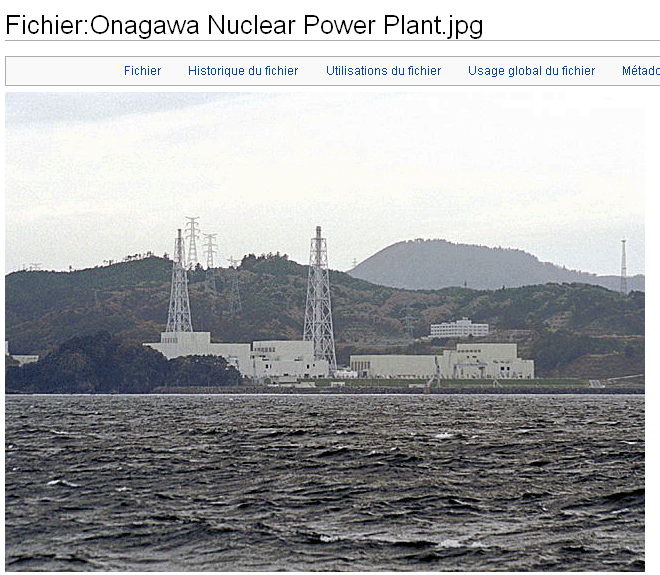
****source
April 8, 2011-B:
A few days ago, we had already noted that the neighboring nuclear plants to Fukushima—Onagawa and Tokai, both located right at sea level and with notably insufficient seismic protection systems—had been affected by the earthquake and tsunami on March 11. On March 13, the Tokai plant, after a failure in its cooling system, had to switch to its backup system.
Less than a month after the magnitude 9 earthquake on March 11, 2011, a new earthquake of magnitude 7.4 has just occurred, still along the fault line in northeastern Japan. The Onagawa plant was hit, and leaks were detected at the spent fuel storage pools. We recall that these pools contain all the residues and highly contaminated waste from previous reactor core loadings. Even though backup systems maintain the water level in these pools to prevent overheating, the release of water containing spent fuel represents a source of nuclear pollution for the Pacific Ocean and the coastlines.
There is a way to mitigate the effects of earthquakes for compact structures, not tall towers. This involves extensive land preparation work, layering the ground like a "mille-feuille" with alternating layers of different materials, which provides strong attenuation of horizontal movements.
[The official Japanese government report dated April 6](/legacy/find/hep-th/1/au_+Steer_D/0/1/0/all/0/2011-April-06 Japan-s Nuclear EmergencyMETI.pdf)
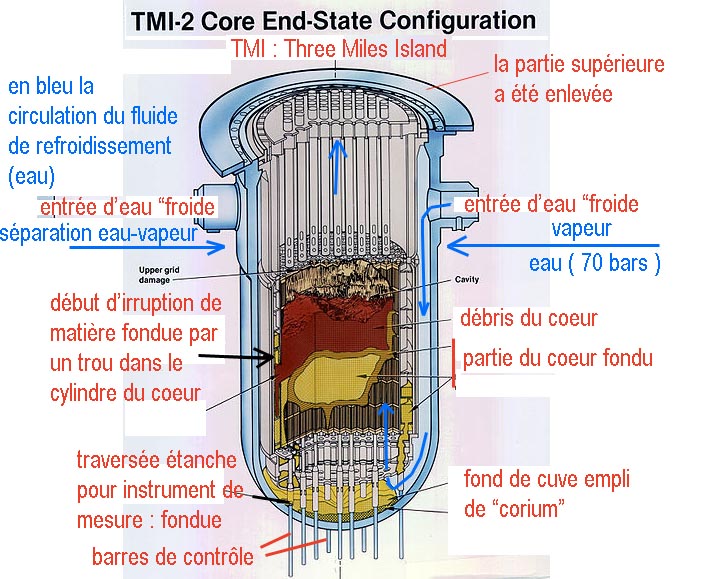
April 8, 2011-C:
Here are some images that provide a bit more insight into what is happening at Fukushima. In the days following the earthquake, engineers quickly noticed a significant crack appearing in a basin located directly adjacent to the harbor water, connected to reactor number 2. This is where radioactive water is leaking into the sea. View of the crack caused by the earthquake. Behind it, the well. A plunging view of the cracked well. Arrival of electrical conduits. The well, encased in concrete, hoping to seal the leaks.
Clicking on this link, you can download the English version of the report issued on April 6, 2011, by METI (Ministry of Economy, Trade and Industry: Ministry of Economy, Trade and Industry), titled "Nuclear Emergency in Japan." On page 17, we can see that the water circuit passing through the turbine halls of the various units, which constitutes the steam cooling circuit circulating through the turbines and then through the reactor cores after condensation, continues quietly along the seashore:
Apparently, .
Official Japanese report dated April 4, 2011: cause of damage. The Japanese had not anticipated that the wave could exceed ten meters. It is likely that the diesel generators were simply submerged during the inundation.
The Japanese have called upon the Americans, who have provided a barge to bring fresh water to the site:
The American barge filled with fresh water, being towed. The arrival of the U.S. tugboat, towing the fresh water barge, to supply fire trucks: March 31, 2011. The Japanese have called upon the Russians, requesting their specialized floating unit capable of treating liquid effluents by chemically extracting radioactive components. Treatment capacity: 35 cubic meters per day, 7,000 per year.
****[AREVA distributes a PDF](/legacy/find/hep-th/1/au_+Steer_D/0/1/0/all/0/Fukushima AREVA Matthias BRAUN.pdf) **** ** **
[The explosion of reactor 3 contradicts AREVA's published report](/legacy/find/hep-th/1/au_+Steer_D/0/1/0/all/0/Fukushima AREVA Matthias BRAUN.pdf)
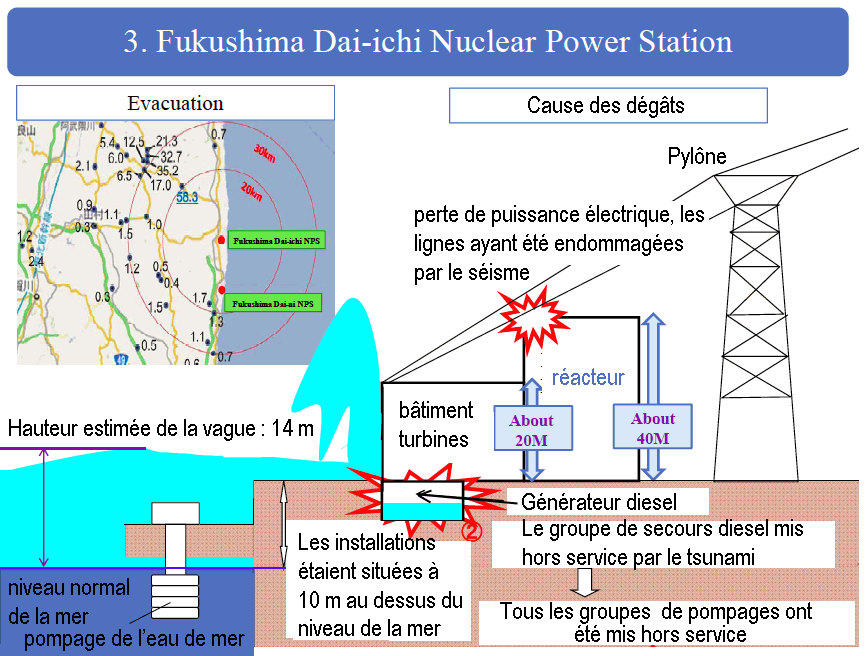
http://fukushimaleaks.wordpress.com
April 7, 2011: Things are becoming clearer. While the sole cause of reactor explosions was previously attributed to hydrogen explosions in the upper control room (as was the case for unit number 1), even the Japanese, despite censorship and the awkward silence of their irresponsible officials, are beginning to realize that the explosions in reactors 1 and 3 were fundamentally different—the second possibly due to the onset of criticality, or at least an explosion originating from the inner levels.
Two explosions with completely different origins. To grasp the scale, the diameter of the vessel containing the core is 5.5 meters. The yellow steel containment dome measures 10.5 meters in diameter. A reader living in Japan has informed me of a website (unfortunately in English) that documents the unimaginable negligence of Japanese nuclear authorities in managing the reactor fleet over the past three decades (to the point that TEPCO could not find an insurer willing to cover the Fukushima facilities!).
Thirty years of concealment and lies!
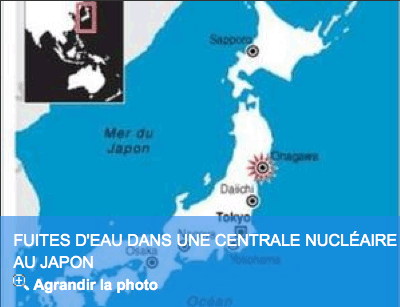
April 5, 2011:
The situation in Japan continues to deteriorate. There are significant leaks of highly radioactive water into the Pacific, and attempts to seal them have failed. Radioactive water is freely flowing into the sea from unit number 2. The Japanese have called upon the Russians, who have previously dealt with liquid leaks from sunken submarine reactors in the Baltic Sea. As soon as Toshiba engineers contacted me (my dossier is being read in Japan), I had recommended such a contact, which seemed obvious to me.
Aerial photographs make clear the scale of the problem. The "pools" contain the full load of the reactors, corresponding to decades of operation at an annual refueling rate (...). The earthquake cracked some of these pools, which are now leaking, and attempts to seal them using improvised and inadequate means have proven ineffective. We cannot drain these pools to seal them, as the temperature of the fuel assemblies would immediately spike. That said, I recall that in the underground river of Port-Miou (which empties into the calanque of the same name east of Marseille), where I had dived, they attempted to block the rise of seawater using special low-density concrete that could be poured underwater. I was asked to draw sketches of this dam in situ, accompanied by Bernard Zappoli, then a young student in Marseille (see the scandal involving CNES-Toulouse and its accomplice, polytechnician Alain Esterle). Zappoli, who had wished to dive with me, returned from the underwater spelunking trip terrified and died shortly after.
Starting Monday, April 4, the Japanese began releasing approximately 11,500 tons of highly contaminated water stored in a large tank, completely full, "apologizing to the local residents." In any case, knowing that this water would eventually have to be disposed of, it would have been better to transport it out to sea in barges, which would have been preferable to sink far from shore, as they themselves would have become radioactive. In fact, there was no need to tow barges. 11,500 tons is not even equivalent to the oil carried by a small tanker. It would have sufficed to pump this water into an old tanker, which would have been piloted to sea by a crew operating from a lead-shielded bridge. Then, after evacuating the crew by helicopter, the ship would have been sunk. The contaminated water would first have been retained within the ship's hull, gradually released as the vessel deteriorated.
The fact that Japanese engineers managing this crisis did not consider this solution demonstrates their lack of foresight, incompetence, and inability to handle the situation. It seems all their "actions" are conditioned by the public impact they might have, both on their own population and globally. It is Japan's image as a country of high technology that is at stake. Bringing a tanker close to the site to pump out the contaminated water would have made a very bad impression, especially if it were announced later that the ship would be sunk and its crew would have to sail it to its final journey protected by lead plates.
The situation is very dire. The Japanese meteorological service is under pressure not to release information if winds are blowing toward major cities, "to avoid triggering panic among the population."
If the government announced that "the reactors would be dismantled," a single glance at the photos taken by the small drone (see below) is enough to realize that such a "dismantling" is an impossible project.
It is also impossible to extract the hundreds of fuel assemblies from the storage pools. To do so, one would first have to clear the wreckage of the reactor structures covered by steel beams. If there were no radioactivity, teams could cut them on-site with torches. But this is impossible. No robot capable of operating remotely has been prepared, and there is not enough time to design such devices.
The only solution is the sarcophagus. In urgency, solid materials must be dumped over the three reactors to stop radioactive emissions. These emissions are signaled by "light fumes," as was the case with the Chernobyl reactor after the spectacular core explosion. But one must not be deceived by the appearance of these fumes.
In several videos, parts of buildings that have been ripped open are seen emitting glows.
Glows indicating radioactivity emitted by reactor components. One should not be surprised that materials emitting radioactivity produce visible light phenomena. In the past, radioactive substances were applied to watch hands so that their owners could read the time at night. If site photos were taken at night by drone or helicopter, the images obtained might well provoke panic among the population. They would recall the sinister glows rising from the crater of the ruptured Chernobyl reactor, reaching the clouds and visible at night.
The appearance of Chernobyl's reactor No. 4 at night, before the crater was filled. Returning to the question of encasement (which would not resolve problems related to possible corium spreading beneath the reactor). At Chernobyl, the graphite was burning, and the hole through which radioactive dust particles escaped was about ten meters in diameter. The Russians therefore sent young pilots of heavy Hind helicopters, with their crews, to dump thousands of cubic meters of sand, cement, lead, and boron into this maw. Only when this devil's chimney was blocked did the nuclear pollution cease. Performing the same operation at Fukushima would require burying the reactors under tens or hundreds of thousands of cubic meters of solid materials before the gaseous and solid particle emissions would stop.
For this purpose, the Japanese have brought a cement spreader into action:
Construction of a concrete slab for a building using a spreader. The spreader in action (with water). But if such a device were used for encasement, the initial cement flow would be far too slow. The flow rate would be completely insufficient (this inability to grasp the scale of the problem was evident when the Japanese sent helicopters to dump water-filled bladders onto the reactors). Therefore, the Americans sent, by sea, a similar device capable of a higher flow rate, adding that "this journey would be one-way because the apparatus, after use, would become far too radioactive to be returned to the U.S."
Another piece of news, relayed by a contact of mine. A crisis meeting was held on April 4, 2011, in Aix-en-Provence, bringing together teams from AREVA and ITER, as well as representatives from foreign groups, including Germans. One participant carried a dossier marked with a code name:
Nucléoshadock
In the "Complément d'enquête" program (see above), the head of nuclear power production at EDF:
- The older our reactors get, the safer they become...
April 1, 2011: Although I am extremely busy writing, urgently and before finalizing, a second paper for the May issue of Nexus (the first, ten pages, is already in layout. This one will present truly planetary-scale alternative solutions), I feel compelled to continue informing my readers about the unfolding Fukushima disaster. This morning, at dawn, I can reproduce a minimal text, which I will expand later in the day with personal insights and images. Here is the text, which I fully endorse and which aligns with the most alarming information I receive from my contacts in Japan. If the author agrees to be cited (I always ask first, I will do so).
Japanese authorities, anticipating the worst and without informing the public, have been stockpiling a gel, dispersed by aircraft, intended to adhere radioactive emissions to the ground before cleanup by "liquidators," as was done at Chernobyl. It is not impossible that, in case of a criticality event with significant release, they might have to use this product.
F__________________________________________________________________________________________________
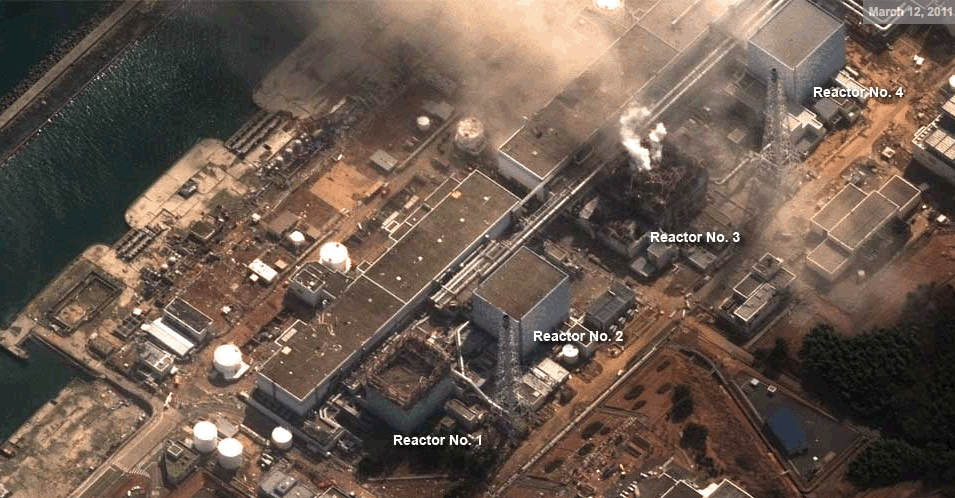
http://edition.cnn.com/2011/WORLD/asiapcf/03/30/japan.daini
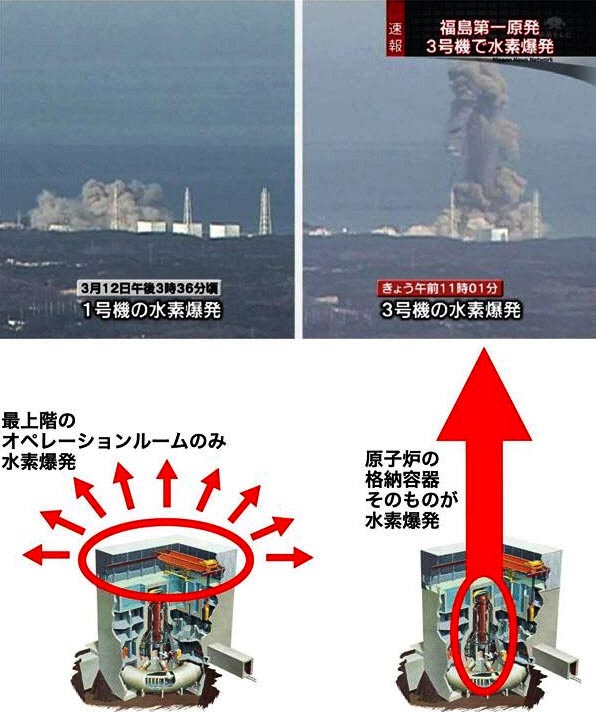
Source:
It is confirmed: fuel rod melting is underway, and the situation is truly out of control.
The radioactive core in a reactor at the Fukushima plant appears to have melted through the bottom of its containment vessel, according to an expert's warning yesterday. Concerns have been raised about radioactive gases that could soon be released into the atmosphere.
Richard Lahey, who was head of reactor safety at General Electric, said workers have now lost their battle. The core has melted through the bottom of its vessel in reactor No. 2, and part of this material is now on the floor.
Workers are being paid handsomely to try to end this nightmare, exposed to extremely high radiation levels, but it seems their suicidal bravery might prove futile and fatal!
The plant operator hopes to stop the ongoing contamination, otherwise 130,000 people will be forced to leave their homes.
As of today, milk is contaminated, vegetables and drinking water too. Seawater around the plant is contaminated as well, not to mention tides that will disperse radioactive elements. Authorities have detected plutonium levels in soil outside the plant. The tunnels connecting reactors 1, 2, and 3 are filled with contaminated water at significant levels.
The Japanese Nuclear Safety Agency claims plutonium levels are not dangerous to human health [really?], but confirms the situation is extremely grave and that partial melting is underway in at least one reactor.
Engineers continue trying to repair the cooling system, but they are forced to work surrounded by radiation and without electricity.
Florent B.
Friday, April 1, 2001, 2:47 a.m. Source:
/ It's no longer a power plant, but two nuclear plants at Fukushima that are smoking!
Smoke was detected at another nuclear plant in northern Japan on Wednesday, according to Tokyo Electric Power.
The company stated that smoke was detected in the turbine building No. 2 of the plant around 6 p.m.
This nuclear facility is located about 10 km from the Fukushima plant.
An evacuation order was issued for residents living within a 10 km radius of this plant.
Since then, authorities have not issued any further comments on the situation.
Florent B.
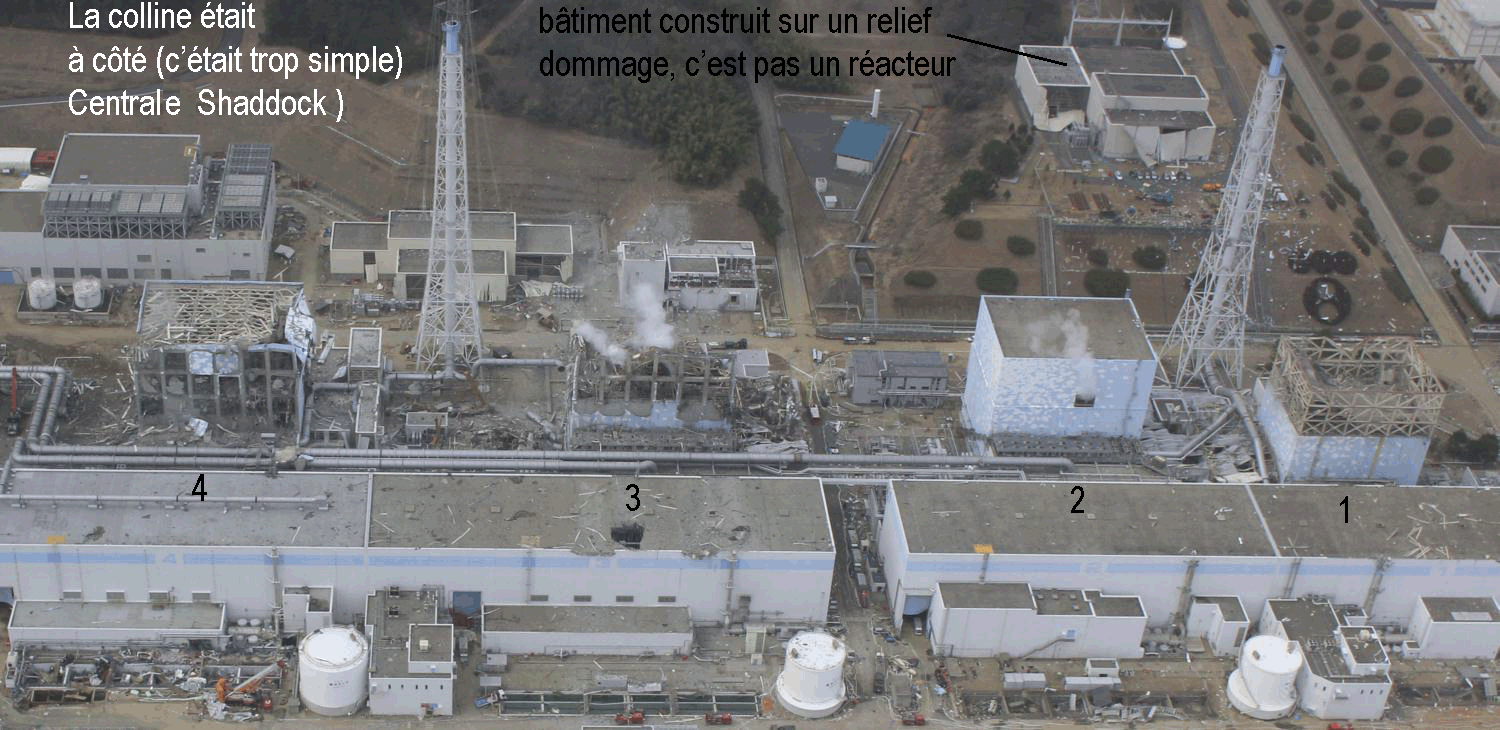
April 1, 2011: Iodine-131 has been detected in milk samples from France and the United States, according to simultaneous reports from the French Institute for Radiation Protection and Nuclear Safety (IRSN) and the U.S. Environmental Protection Agency. Analysis results confirm that this radioactive isotope originates from the releases at the Fukushima nuclear plant.
Finally, here are high-resolution photos taken by a private drone, belonging to AIR PHOTO SERVICE, on March 20, 2011. I have not resized the images to fit the screen, and you may need to use your "scroll bars" for some of them. They show the damage sustained by the reactors at the site and require no commentary. Logically, these photos should have filled double pages in our major "news magazines." Remember the motto of Paris-Match: "The weight of words, the shock of photos." But I'm not sure you'll find such images elsewhere except on the internet. In that case, your opinion will be shaped accordingly.
There is a high chance these holes were made during the fall of fragments from the concrete slab covering the reactor.
I am currently writing a second article for the May issue of Nexus, which has opened its columns to me. I will begin with a series of articles illustrating the special issue of Le Point dedicated to nuclear energy.
What you will read in this special issue will astonish you. I summarize:
Pages 58 to 95, generalities.
Pages 76 to 77, two pages by Claude Allègre, who assures us that fearing seismic effects in France is "walking on one's head."
Pages 96 to 103, a course on different types of reactors, present and "coming."
Page 106, an interview with Robert Klapish, former director of research at CERN.
Robert Klapish, former director of research at CERN
Everything is fine in the best possible nuclear world
It's so absurd, irresponsible, marked by a total lack of imagination that I leave it to you to discover by flipping through your local newsstand and going to this page.
Page 108, Pascal Colombani, former general administrator of the CEA, "demonstrates that we need nuclear energy, but that the risks are high." He concludes by saying that the Fukushima disaster "will force us to be more imaginative."
Page 100: "France, addicted to nuclear power." The only alternative is to... reopen our coal mines and reconfigure our port facilities to accommodate imported coal.
Page 112: "Is there life after the atom?"
As you read this issue, if you haven't already done so, you'll realize we are governed by fools and managed by dangerous madmen or unconscious irresponsible people.
Solutions exist, and I will present them in the upcoming May issue of Nexus. We simply need a bit more imagination than conventional ecologists, with their talk of degrowth and solar panels on rooftops, and instead base ourselves on what works, on proven technologies, not on speculation or "what might work by 2030..."
We need a plan commensurate with the needs and the urgency, and I will present it.
Meanwhile, we are hearing news that the two neighboring sites to Fukushima have also suffered damage. I will also publish photos of the three power plants, taken before the disaster, showing that all three—installed at sea level, behind a port facility—were backed by substantial hills, all very close by. And no one talks about this. It would have sufficed for the private company responsible for installing these reactors to place them a few tens of meters higher to protect them from tsunamis, frequent and intense in this region of Japan. Why wasn't this done?
To preserve shareholder profits and ensure a good return on investment.
April 1, 2011: Refer to [the PDF containing AREVA's analysis of the events.](/legacy/find/hep-th/1/au_+Steer_D/0/1/0/all/0/Fukushima AREVA Matthias BRAUN.pdf)
Let's go back to some diagrams, trying to understand. This one shows the "maneuvering bridge" of the reactor. We see the powerful overhead crane capable of removing the thick concrete lid covering the reactor, in preparation for refueling operations. The railings give us scale. After removing the lid, once the two steel reactor vessels have been depressurized, the entire area is flooded, and then, using the overhead crane, the two steel lids of the system are extracted and placed aside. Finally, via the narrow corridor connecting the reactor vessel room and the spent fuel pool, the fuel assemblies removed from the core are moved while submerged—this entire operation being conducted underwater.
Aside from the overhead crane, this room is almost empty. In the background, we can see ventilation ducts. The structure consists of relatively thin steel sheets fastened to a light truss framework. In [AREVA's PDF](/legacy/find/hep-th/1/au_+Steer_D/0/1/0/all/0/Fukushima AREVA Matthias BRAUN.pdf), it is explained that when the temperature of the steam inside the reactor vessel exceeded 1,000°C and the top of the reactor began emerging from the water, the zirconium in the "rods" containing the fuel pellets—also called "cladding"—began decomposing the water. Why zirconium? Because this metal is transparent to neutrons and therefore does not interfere with the fission reactions.
Pressure inside the 20 cm thick containment vessel, housing the core, began to rise. At the same time, hydrogen was released from the decomposition of water molecules. The technicians then directed this hydrogen into this maneuvering room. The oxygen was fixed through oxidation by the zirconium rods. This process released the fuel pellets, mixing them with water and gas, creating radioactive contaminants.
In this maneuvering room, a hydrogen-oxygen mixture formed. Then, as clearly visible in the explosion of reactor number 1, an explosion occurred. The shockwave blew out the steel panels, but the truss framework remained intact.
****[A](/legacy/find/hep-th/1/au_+Steer_D/0/1/0/all/0/Fukushima AREVA Matthias BRAUN.pdf)**['explanation from AREVA:](/legacy/find/hep-th/1/au_+Steer_D/0/1/0/all/0/Fukushima AREVA Matthias BRAUN.pdf)**Fukushima AREVA Matthias BRAUN.pdf
This explanation is compatible with the images we have of reactor 1, but totally incompatible with those of other reactors, such as reactors 3 and 4, where something of an entirely different, much graver nature occurred, affecting levels below the maneuvering floor. Re-examine this image of reactor 3's explosion. Something entirely different happened there.
Unless AREVA issues a new report, their report [Fukushima AREVA Matthias BRAUN.pdf] completely undermines their claims.
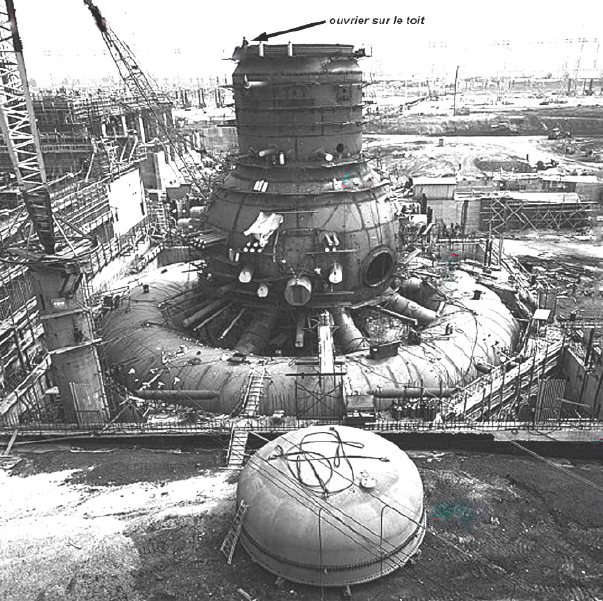
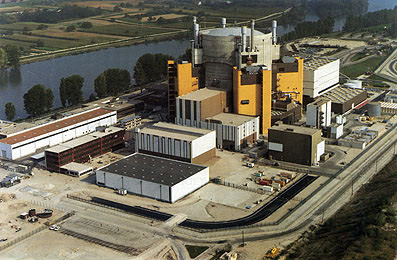
A photo of one of the Fukushima reactors. The worker standing at the top provides scale.
Diameter of the vessel: 5.5 meters. Diameter of the steel dome in the foreground: 10.5 meters
The increase in radioactivity due to releases from the Fukushima plant. Le Figaro:
The Tokai plant ** **
It's not just one plant affected, but three.
The southeast coast of Japan is particularly vulnerable to tsunamis, bordered by a vast continental shelf descending gently, which amplifies the waves. In this region, two tsunamis reaching magnitude 7 have occurred since 1960. This did not prevent Japanese nuclear operators from systematically installing their plants right at the water's edge, simply building a port to transport materials, etc. Look at this map:
Two plants, surrounding Fukushima. Vulnerability: maximum.
120 km northeast of Fukushima:
, feet in the water.
Was hit head-on by the tsunami. Waves 15 meters high.
A small fire was brought under control. Notice the hills just behind.
Onagawa has three boiling water reactors, the oldest dating back to 1980. The town of Onagawa was completely destroyed. As all attention was focused on the Fukushima plant, the private company Tohoku Electric Power attributed the radioactivity around the plant to discharges from Fukushima. But the population now hesitates to believe what they are told. After all, with so many dead and homeless, nuclear power is just another disaster.
Now let's move further south:
, also right at the water's edge, backed by hills.
Third private operator: the Japanese company JAPC. A 1,000 MW boiling water reactor, commissioned in... 1978, 33 years ago....
The backup pump could be activated.
Apparently, I am the only one (I haven't seen this reported in any press) to say that, in a region prone to tsunamis, it would have been more prudent to install reactors tens of meters above sea level, not right at the water's edge. I haven't surveyed all Japanese nuclear plants, but Fukushima itself also has nearby elevations.
What no one says: At Fukushima, it would have sufficed, at least, to place the generators and fuel tanks on the surrounding hills to protect them from the strongest tsunamis and allow them to power the electric pumps. The Japanese aren't the only ones capable of stupidity. If ITER ever stumbles, I'll tell you a good one. The reactor will release into nature, through a chimney, its contents, including deuterium and (radioactive, half-life: 12 years).
In Paris, the polytechnicians who designed ITER, or the Germans, or others, said to themselves, "Hydrogen, light or heavy, it rises."
Vignon is next to ITER, where I've passed dozens of times. This area, beloved by glider pilots, is ideal for wave soaring, an oscillatory phenomenon very common in this region when the wind is strong enough, like the mistral, for example.
Wave regime (meteorology and gliding): The wave is a glider pilot's delight. The diagram shows where the glider should position itself to take advantage. At the crest of the gas surges: lens-shaped clouds. Below, a rotor that presses the air down to the ground. Air that may, on this day, be charged with... tritium.
And what lies downstream of ITER, in a wave regime?
The Sainte-Croix Lake, Marseille's freshwater reserve.
There is no meteorological service planned within the ITER teams. And if one were needed, it would require a representative from each participating nation.
One day, residents of the PACA region might hear on their media, "Very low quantities of tritium have been found in the lake water, but at a level that does not pose a health risk for people drinking this water...." To be continued....
March 29, 2011: A situation of extreme gravity.
On March 28, 2011, André Claude Lacoste, President of the ASN: Nuclear Safety Authority, held a press conference.
André Claude Lacoste, President of the Nuclear Safety Authority
By visiting the ASN website (a government agency that is difficult to suspect of militant anti-nuclear bias), you can read the statement issued by this body. Below is an audio clip sent by a reader, reproducing excerpts from
As you will notice, the situation at Fukushima is of the utmost gravity and is taking a very dire turn, even on a planetary scale. The situation was initially managed in a surreal manner. While such a nuclear accident requires rapid intervention, the Japanese Prime Minister requested that nothing be done until he could personally survey the site to assess the situation. Yet he knows nothing about nuclear energy.
Moreover, the Japanese politely declined offers of assistance from various countries, out of pride, foolish vanity, "not wanting to lose face in the eyes of the world." They refused the deployment of specialized robots. Today, technicians working on-site must act quickly, given the high levels of ambient radioactivity. Lacoste speaks of two minutes. We thus find ourselves in a situation reminiscent of what occurred at Chernobyl in 1986. Re-watch the film "The Battle of Chernobyl" to recall the extreme gravity of a nuclear accident...
http://cequevousdevezsavoir.com/2011/03/19/la-bataille-de-tchernobyl
I watched a video showing the Fukushima site, filmed from a helicopter. It's impressive. We see plumes of smoke rising from various locations. The Japanese have provided no figures regarding radiation levels at these hotspots on the Fukushima site. We should recall that shortly after the disaster, they had announced it was a level 4 incident. But the ASN forced them to revise this upward to level 6 (7 for Chernobyl). The probability that the reactor vessels containing the cores have been breached and are releasing molten fuel is high. It seems the Japanese do not have control over what is happening there. True, they must also manage the extensive consequences of a major earthquake and tsunami. But who had the idiotic and criminal idea to install reactors right at the water's edge, in a region where tsunamis of magnitude 7 have occurred recently (1962 and 2008, I believe)? Go to Google Earth and enable the option showing seismic events.
E__________________________________________________________________________________________________
At Fukushima, there have been core meltdowns, possibly very significant ones. At Three Mile Island, USA, 45% of the core had melted, and the "corium" had collected at the bottom of the vessel, which miraculously held.
The Three Mile Island reactor, after dismantling, one year later
Diameter of the vessel: 5 meters
The shape of this vessel is such that when molten material falls to the bottom, the geometry causes the material to gather, increasing the risk of criticality with the percentage of core that has melted.
This is why the Japanese are desperately trying to cool these vessels. It's like putting a plaster on a wooden leg, retreating to jump further. But if they don't do it, the entire fuel load will melt and collect at the bottom of the vessel. Then the risk of criticality will be great. If criticality is reached, the entire corium will flow under the vessel, into a room filled with water sent for cooling. This corium will be at a temperature high enough to rapidly dissociate water molecules (from 1,000°C onward). A massive explosive gas cloud, a stoichiometric hydrogen-oxygen mixture, will form. The explosion will shatter the reactor, as happened at Chernobyl, the explosion's force projecting the 12-ton concrete lid of the reactor tens of meters away.
(What happened during the spectacular explosion of reactor number 3, with its gray smoke and concrete fragments the size of a bunker hurled hundreds of meters into the air?)
If such an explosion occurs—and the risk exists—it would result in a massive release of radioactive elements. We must grasp the quantity of fissile material in a reactor, which always amounts to several tons (of the same type as my Japanese reactors), whereas a bomb contains only a few kilograms. The spectacular nature of a military nuclear explosion comes from its brevity. A certain amount of energy is released in an extremely short time, a thousandth of a second. The shockwave devastates everything in its path. The heat from the fireball causes fires and burns living beings. Radiation is also extremely intense. But pollution, meaning the amount of radioactive debris falling to the ground, remains relatively low, because the immense heat causes the debris to rise into the air, where it is dispersed by the wind.
In the case of a nuclear reactor explosion, the release aspect is much more significant, because there is no upward current to carry the debris. If you watch the film "The Battle of Chernobyl," you'll see that tens of thousands of men and women were irradiated by releases that appeared as barely visible smoke plumes. This was due to the combustion of graphite, sustained by the intense heat of the molten core.
I would be curious to know the radioactive content of these small smoke or vapor plumes rising from the breached power plants. There are a thousand ways to find out, even just by dragging a sensor under a helicopter, or sending a remote-controlled drone.
None of this gives me a good feeling.
At Chernobyl, the Russians quickly took decisive and dramatic measures to control the situation. After a few hours of lethargy and disbelief in Moscow, the engineers dispatched to the site grasped the situation and acted accordingly. Thirty hours after the disaster began, the 45,000 residents of Pripyat, located 3 km from the plant, were evacuated in orderly fashion in 3.5 hours using a thousand buses.
The Russians sacrificed between 600 and 1,000 helicopter pilots to drop bags of sand and boron into the monster's mouth (a ten-meter-diameter hole requiring low-altitude approaches, 100 meters above ground). The helicopter crews then had to release their loads. All were fatally irradiated.
Only after a massive amount of sand, concrete, boron, and lead could be dumped did the emissions cease. But not the radioactivity emitted by the countless debris. Lead vapors also caused many health issues in the population. (A side note: our polytechnicians, to replace the dangerous molten sodium (5,000 tons) used as coolant in fast breeder reactors—these "fourth-generation reactors"—suggest cooling the core, one ton of plutonium, with an equivalent amount of molten lead.)
Where are the Japanese now? It is impossible for them to recover the units of their power plant. What will happen? If the vessels leak, radioactive elements will spread throughout the severely damaged buildings. Heat will cause a non-spectacular but increasingly distant emission of radioactive elements.
These diverse and varied radioisotopes have already circled the Earth. Ultimately, the only solution seems to be placing the reactors under a sarcophagus, given that the reactors are already inaccessible due to high radioactivity. Taking this decision would be an admission of failure for the Japanese—not failure in facing this situation, but failure of their technology, their energy policy, and their way of life. The entire country coexists with 54 nuclear reactors, whose maintenance and design have already drawn numerous criticisms. Condemning the Fukushima reactors would trigger a crisis of confidence among the Japanese people, who have no alternative energy resources. The economic, social, and human stakes are enormous.
It is possible that the Japanese authorities, who have often demonstrated incompetence and lack of determination, will allow things to deteriorate to the point where:
- The situation risks becoming a nightmare locally.
- Nuclear pollution takes on a damaging scale across the entire planet.
Regardless, for me, the conclusion is clear as daylight. We must abandon nuclear power and urgently develop viable alternative energy sources. It is feasible.
Our species' survival depends on it.
I will publish a 10-page article on this topic in the next Nexus issue, already in progress (available in newsstands in May). I am finishing a follow-up piece, also to be published in the same issue, which identifies genuine solutions. That is, implementing alternative energy sources on a truly global scale. This does not mean placing solar panels and wind turbines on rooftops and using low-consumption bulbs, but rather, for example, harnessing solar energy where it is abundant and transmitting it over long distances via high-voltage direct current lines. This is not speculation, but the application of techniques already in place for a long time in various countries. In Canada, electricity generated by dams in the north is transmitted over 1,400 km. Siemens is finishing construction for China of a link connecting the Three Gorges Dam to coastal regions via a direct current connection. Power: 5,000 MW. A submarine cable already transmits 1,000 megawatts from France to England. But the record belongs to the Denmark-Norway link, with 450 km of submarine cable. You'll read all this in my article. We must quickly tap into the vast reservoir of alternative energy that nature provides abundantly. Abandoning nuclear power is imperative. The sooner, the better.
It's not too late, but it's time.
The CRIIRAD detected iodine-131 in the Drôme-Ardèche region, in rainwater. Here is the address of the video showing Météo-France's animation regarding the dispersion of the radioactive air mass.
****http://www.irsn.fr/FR/popup/Pages/irsn-meteo-france_19mars.aspx
This sequence is eloquent and shows that the radioactive air mass has spread across the entire Northern Hemisphere.
The air mass carrying radioactive dust has already covered the entire Northern Hemisphere
The CRIIRAD's analysis report and commentary dated March 29, 2011
People are given reassuring words about pollution from radioactive elements. Numbers are brandished, described as very moderate, even insignificant. But the main risk lies in inhaling or ingesting dust, followed by its fixation in the body. This is the major risk: carrying this radioactive element inside one's body.
One can die living in a region where ambient radioactivity seems low, simply because one inhaled a microscopic radioactive dust particle at the wrong moment.
March 14, 2011
For several days now, the world has been stunned, discovering the extent of the damage caused in Japan by the earthquake, and especially the tsunami generated in the Pacific Ocean, some 140 kilometers off Japan's northeast coast.
****[An impressive video showing the tsunami](An impressive video showing the tsunami)
If you want a panoramic view of the damage, watch this Chinese video.
The damage caused in Japan by the tsunami
These images are extremely impressive. Here are a few samples:
The arrival of the tsunami
An enormous whirlpool formed during the retreat of the liquid mass. Notice a boat near the center, appearing tiny
Fire in a hydrocarbon storage park
Another fire ( gas storage )
Urban fire, city of Sandaï
Filmed from a helicopter, the tsunami surges over Sandaï airport
A portion of Sandaï airport, devastated by the tsunami
No comment.....
They say "governing is foreseeing." In this case, foreseeing the consequences—what we might call "secondary" or "collateral"—of such a natural disaster. Japan, overpopulated, has 58 nuclear reactors to meet its electricity needs. A nuclear reactor is a very strong steel vessel containing rods of fissile material. Technically, these are tubes called "rods," in which fissile elements—mixtures of oxides resembling aspirin tablets—are stacked.
Compared to an atomic bomb, which behaves like an explosive, a reactor resembles a pile of embers. Inside these rods, the decay of uranium-235, or even a certain percentage of plutonium-239, releases heat and causes the emission of neutrons, which, striking other uranium-238 atoms, trigger secondary reactions.
To understand how a reactor works, download my comic strip "Yours in Energy" from the Savoir sans Frontières website http://www.savoir-sans-frontieres.com (nearly 400 albums from the Anselme Lanturlu adventures, freely downloadable in 36 languages, without media echo, all publishers combined).
A "heat transfer fluid" must continuously circulate through this vessel, the reactor core, to evacuate the heat generated by fission reactions; otherwise, the worst could happen.
I am not omniscient.
Considering that I have a duty to clarify information and strive to disseminate it, I inform myself, often urgently, when not in a panic, when dealing with current events. I do this alongside numerous other activities I must manage simultaneously (I have two new books to write and MHD research to conduct, complex calculations to perform).
I take this opportunity to ask dozens of readers who daily solicit me to add me to their discussion lists to refrain from doing so. I don't have time for casual exchanges, like on a blog. High school students contact me for their TPEs (same thing: I absolutely don't have time to deal with them). Others expect me to answer questions like "Could you explain relativity simply?" or "What do you think of the hollow Earth theory?" Or perhaps they say, "I'm personally very skeptical about... Could you provide arguments to convince a skeptic like me?" Some, having stumbled upon websites or videos that caught their interest, simply forward their addresses to me without explanation. If these aren't accompanied by a few lines of explanation, I don't have the time to explore each of these contents.
Sometimes, readers ask me a question, and I answer briefly, sometimes just "I don't know." Occasionally, the interlocutor persists, not understanding why "a scientist like me doesn't take the time to respond properly and argue." Sometimes the exchange ends with an insulting email.
That said, what I receive continuously, daily, constitutes irreplaceable documentation, and it is thanks to these contributions and clarifications from specialists that I can better equip myself to inform you. Some, who have followed me for a long time, provide me with these insights, sometimes with a few lines of introduction, or even an image, saying "It seems this is important," and I am grateful. Others know how to extract key elements from a video document.
When I build a new page, you'll notice I don't just list a URL for an article or video. I take numerous screenshots, compose my own text, and it's common for assembling a simple page, where basic tasks accumulate, to take between 6 to 12 hours of work.
In what follows, I will correct what I posted yesterday, hastily, about the Japanese reactors, which readers immediately corrected. No, these are not pressurized water reactors, but boiling water reactors.
I provide these clarifications in what follows.
D__________________________________________________________________________________________________
Let's examine the design of pressurized water reactors, an American-origin solution, predominantly used in France.
At atmospheric pressure, water boils at 100°C. At a lower temperature, 85°C, at the top of Mont Blanc. Conversely, at over 100°C, if this water is under pressure greater than one bar.
If heat is not continuously removed, these metal rods can melt (this is "core meltdown"), and the result of this melting can collect at the bottom of the vessel, forming what must be avoided above all: confinement of this material, which would drastically increase energy release due to "criticality."
Indeed, a nuclear reactor is a place where chain reactions occur, which must be carefully controlled. These rods of fissile material hang like hams in the reactor vessel. Around them circulates a fluid that collects the heat (water under 150 bars, in the case of pressurized water reactors, PWRs: pressurized water reactors)). This water enters the vessel at 295°C and exits at 330°C. The flow rate is considerable: 60,000 cubic meters per hour, or sixteen cubic meters per second. In this setup, we decide to isolate the primary circuit from the secondary circuit, coupled to the first via a heat exchanger, which will then be sent to the gas turbine, driving an electric generator.
In purple: the primary circuit filled with pressurized water, circulating within the reactor core containment. In blue and red: the secondary circuit. In the heat exchanger, located within the reactor containment, this water (dark blue in liquid state) turns into steam (red). This steam then drives a two-stage gas turbine: high and low pressure. The expanded and cooled steam then passes through a condenser, where it liquefies.
A system producing energy has a hot source and a cold source. The hot source is the "rods" of the reactor core, submerged in pressurized water, where exo-energetic fission reactions occur. The cold source is the atmospheric air (for reactors using this terminal cooling system). The first two systems, operating in closed loops, are coupled with a third system in contact with the atmospheric air, via enormous cooling towers visible flanking French power plants.
Water is made to flow down the inner wall of these towers, open at the bottom to allow air to circulate. This water thus transfers the heat collected in the condenser to the air rising through the tower. Along the way, part of the water evaporates (500 liters per second). Therefore, a water supply must be nearby (a river or the sea). It is this evaporated water that causes the towers to be crowned with a plume of steam when the reactor is operating.
70% of the heat produced is thus released into the atmosphere (or into a river or sea, if the cold source is of this nature). The efficiency of a reactor does not exceed 30%.
There are 58 pressurized water reactors in France. List of French reactors.
Let's move on to boiling water reactors, of the type used in Japanese power plants.
As you, I am discovering and attempting to explain. The diagram is as follows:
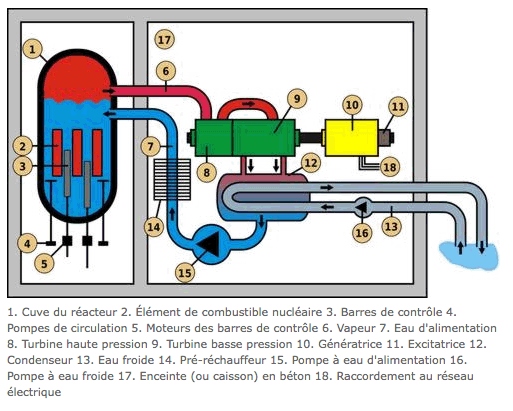
Boiling Water Reactors (BWRs) in Japanese power plants
Or "BWR": Boiling Water Reactors
See also: http://www.laradioactivite.com/fr/site/pages/Reacteurs_REB.htm
Or this English PDF, very interesting
The comparison with the previous diagram is immediate. There is now only one closed circuit. It is the water sent into the reactor core that becomes vaporized and is then directed straight to a two-stage gas turbine. On the left (1), the core, enclosed in steel. At (2), the fuel rods. At (3), the control rods, which in this setup must be raised and cannot, in an emergency, fall by gravity.
Liquid water (blue) is a better heat conductor than steam (red, at the top of the core).
At the turbine exit, as the water returns to its liquid state in the condenser, it is shown in purple. There is no cooling tower. Instead, seawater, in gray, is sent into the condenser.
How is the activity of a nuclear reactor controlled?
By using control rods (for example, made of cadmium) that absorb neutrons, without triggering new exo-energetic nuclear reactions. When these rods are fully lowered (or raised, in the case of Japanese setups), the reactor's activity is reduced by a factor of ten compared to its nominal power. In French reactors, the emergency descent time of the rods by gravity is one second. Twenty seconds in the Chernobyl reactor. The control rods in Japanese reactors are raised and operated electrically via screw jacks (see the English PDF: I am not making this up).
Conversely, it is the raising (or lowering in the Japanese setup) of these rods that initiates reactor startup during operation. We would then say the reactor is "diverging."
If any failure is detected in the system for evacuating heat produced in the reactor core, where the rods are located, either a backup pumping system must be activated, or the power output must be drastically reduced by lowering the control rods (or raising them, in the case of Japanese setups).
Electrical power generation is achieved using alternators driven by gas turbines. The steam circulating through these turbines must be converted back into liquid water in a condenser. These condensers are the tall towers seen flanking the reactor building in France. The steam condenses there and is recovered in the lower part of the tower. Part of the water evaporates, resulting in a loss of 500 liters per second.
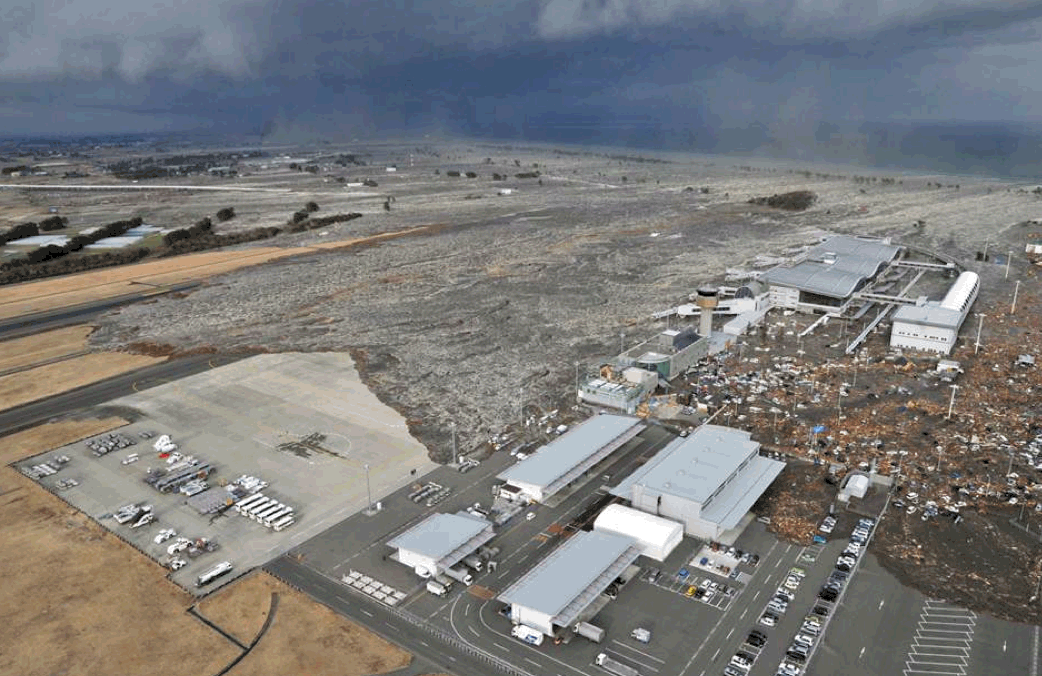
Such structures are not found with Japanese reactors. Why? Because seawater is used for cooling. For reasons of economy and profitability, the Japanese have installed their reactors near the ocean, which is a serious mistake in a country whose coasts can be hit by tsunamis.
The location of Japanese nuclear power plants, along the coast (...)
I imagine engineers studied these installations in light of various risks. All Japanese nuclear reactors are built according to seismic safety standards. These correspond to a Richter scale value of 7 and represent a possible horizontal acceleration of one "g." The technique involves placing the building on what are equivalent to "cylinder-blocks," but much larger.
For information, the seismic shock felt by Japan reached a magnitude of 8.9.
Click on the link. You will see, at the bottom of the page, that a magnitude 8.9 earthquake can cause damage hundreds of kilometers from the epicenter. This is exactly what happened, the epicenter being located at the boundary between two tectonic plates, 140 km away.
Roughly speaking, magnitude is a logarithmic measure of an earthquake's power (which must be corrected to account for the duration of tremors and the type of waves involved).
By designing their installations for a magnitude of 7, the Japanese underestimated the power of future earthquakes by a factor of eighty (10^1.9).
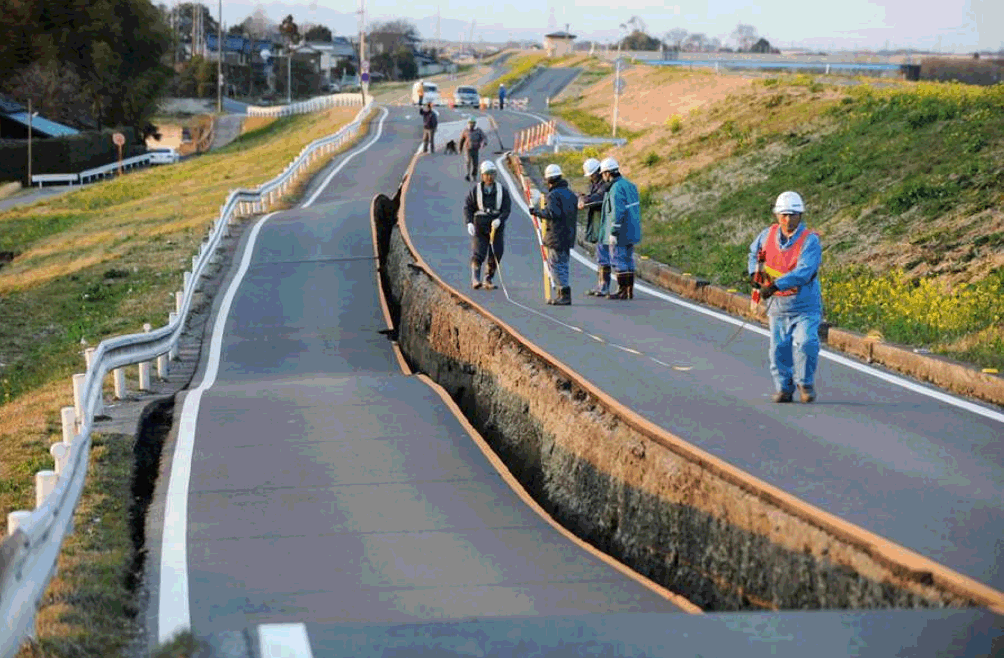
An astonishing fact: this road fractured along its central line.
An explanation from a reader: it is common for roads to be "constructed" in two stages, half by half, with their central line serving as a fracture initiation point.
I briefly recall the "sufficient reason" for seismic tremors. On the diagram at the beginning of the page, tectonic plates are shown, comparable to ice floes floating on the surface of a river. These plates can overlap. In the case of this Japanese earthquake, it involved the meeting of the Okhotsk plate and the Pacific plate. The epicenter was located at a depth of 10,000 meters. One of the plates slides beneath the other (a process known as subduction). These plates are not "lubricated," so the sliding can only occur in jerks. These jerks are the source of earthquakes. When this readjustment occurs underwater, the uplift of one plate raises a vast mass of liquid. For someone navigating just above this event, the uplift would be imperceptible. It may amount to tens of centimeters. But if hundreds of square kilometers of ocean are lifted by 10 cm or more, this represents considerable potential energy, which dissipates as long-wavelength surface waves propagating at very high speed (on the order of a hundred kilometers per hour). When this tsunami approaches a coastline, if the seafloor uplift occurs gradually, the wavelength decreases while the amplitude of the water level variation increases. Thus, a wave that represented a 10 cm variation—barely perceptible—on a wave with a width (wavelength) of ten kilometers transforms near the coast into a ten-meter-high wave with a wavelength now measured in hundreds of meters. At its closest point, the wave may break.
This earthquake caused the entire plate carrying Japan to shift by 2.4 meters. This figure should be multiplied by ten at the subduction zone, near the epicenter. Maps and GPS coordinates need to be revised. This movement affected the entire Earth, causing a 25 cm displacement of the entire crust, resulting in a shortening of the day. This earthquake ranks among the five most powerful ever recorded on Earth since seismographic monitoring began.
What caused the failure in the entire Fukushima reactor complex was not the earthquake itself, but the colossal tsunami, with its ten-meter-high wave (something that had never occurred in Japan for hundreds of years). There is no way to protect against such an impact. Those who know the sea understand what storm waves can do. They can burst through sea walls, twist heavy steel reinforcements. About fifty years ago, a man wanted to build near Marseille an attraction he called the "telecable." The principle was a submerged cable car. Instead of suspending buckets from a cable, air-filled cabins would be attached to a cable running over pylons anchored to the seabed. The goal was to bring our underwater tourists close to the "Farillons Arch," at the end of the nearby island of Maïre, a superb underwater landscape I know well. The starting base for the telecable was to be located east of "Cap Croisette."
 .
.
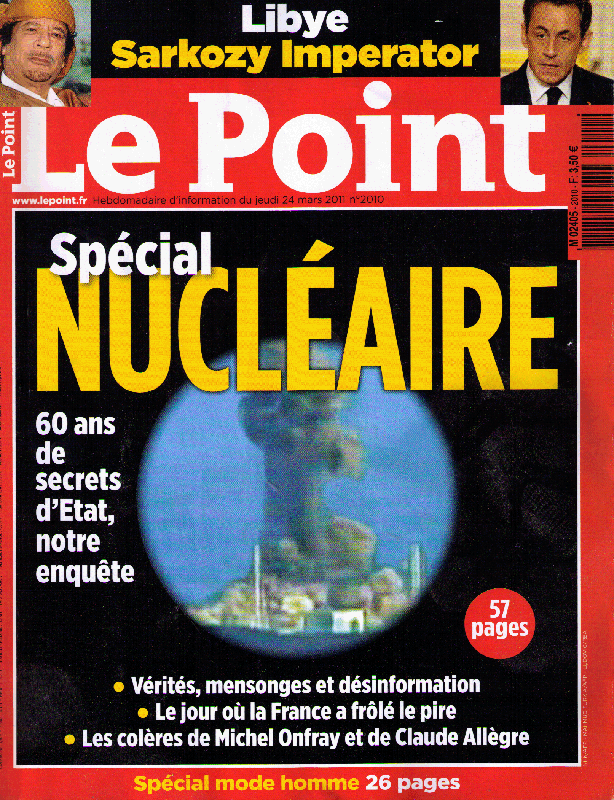
The small port of Cap Croisette, in 1958, a few hundred meters from the planned starting point for the telecable.
The sailors warned the engineer:
- You know, in our region, we have an east wind called the Labé. And when it runs wild, on certain winter days, the waves are incredibly powerful.
The engineer ignored the warning. The first pylons were installed and were swept away like straw by the first Labé storm the following winter.
I cite this anecdote to highlight the fantastic power of the sea (water is 800 times denser than air). A reader has pointed out tsunami effects not mentioned in the media. The wave may have caused sediment movements that could have blocked the submerged "intakes" through which seawater for cooling is drawn. Backup systems, such as water stored in large tanks, may have been rendered inoperable by the wave impact. The same applies to backup installations running on diesel generators.
On the PowerPoint above, you could see the impressive damage caused by the tsunami. If Japanese engineers had designed their installations with seismic risk in mind, they clearly did not anticipate that the plant could be struck by a wave of such intensity. Even if the most visible buildings held up, what about the rest of the installation—the pump room, the control room, the power supply system for the pumps? It only takes one of these elements being damaged to prevent the reactor shutdown or the emergency cooling of the core. Adding to this aggravating factor, in the Japanese system, the control rods cannot fall by gravity but must be raised!
Japanese reactors are designed to withstand seismic activity. The ground tremor preceded the arrival of the tsunami. The epicenter was 140 km from the coast, and the propagation time was 20 minutes, so the wave traveled this distance at a speed of 300 km/h. Did the reactor safety systems, designed to withstand seismic shocks of magnitude 7, function correctly under a shock approaching magnitude 9? Was the containment structure damaged or cracked?
The Japanese authorities tell us these safety systems worked.
We currently do not know (as of March 14, 2011) the nature and extent of the damage sustained by the Japanese reactors. The situation appears to be worsening hour by hour. A failure in the cooling system could mean that the fuel rods, instead of being bathed in hot water, are surrounded by steam, whose temperature continues to rise. This steam will then react with the metal of the fuel rod cladding. This oxidation, by consuming oxygen, releases large amounts of hydrogen and disperses radioactive elements into the steam. Previously, there was talk of injecting hydrogen to cool the core. It seems this was false. When this hydrogen began to fill the single circuit of the boiling water reactor, engineers had to allow it to escape to prevent the core itself from exploding (...), if that hasn't already happened. When this hydrogen mixed with air, it caused the explosion, which appears to have blown off the roof of one of the buildings—the No. 1 reactor building. I'm referring to the first explosion, that of Saturday, March 12, the day after the tsunami.
Japanese engineers eventually resorted to controlling the core temperature (of the three reactors) by injecting ... seawater directly, which effectively rendered these units unusable due to corrosion.
What still works in these installations? Who knows? It's possible even Japanese engineers don't know. We saw that the control rods must be raised. Can they still be raised now? If the answer is no, it will be impossible to reduce the reactor's activity level. Furthermore, the seawater injected into the core exits carrying radioactivity, which is then returned to the Pacific Ocean...
The major error was:
- Building these reactors on the seashore
- Underestimating the magnitude of future earthquakes (9 instead of 7), meaning underestimating destructive power by a factor of 100.
If the nuclear plant facilities were devastated like the districts of the city of Sandaï or its airport, hello to the damage!
There is no way to protect against a tsunami of such power. One cannot imagine mounting a nuclear reactor and all its installations on stilts. The solution would have been to locate these installations above sea level, at a sufficient altitude. Fifteen meters would have sufficed: a simple hill. Yet Japan is not lacking in hills—71% of the country is mountainous. But in that case, using seawater as a coolant would have reduced efficiency, requiring significant power to pump the water, given the high flow rate required (sixteen cubic meters per second).
Anticipate...
****Chronicle of an anticipated disaster
A Japanese seismology specialist had vainly, in 2006, emphasized the need to revise safety measures for nuclear power plants against earthquakes.
Professor Ishibashi Katsuhiko
Seismologist, Professor at the Center for Urban Safety Research, Kobe University
D
Anyway, in a country sensitive to tsunamis, building all nuclear power plants on the coast was total irresponsibility.
Resumption of segment C
End of segment C+, added April 12, 20100
Japanese standards regarding seismic magnitudes
http://www.japanfocus.org/-Ishibashi-Katsuhiko/2495
The article by Professor Ishibashi[Katsuhiko](/legacy/find/hep-th/1/au_+Steer_D/0/1/0/all/0//nouv_f/seisme_au_japon_2011/article_sismologue_jap_2007 .doc)
In your dossier, you write:
« The reactor safety systems, designed to withstand seismic shocks of magnitude 7, did they function correctly under a shock approaching magnitude 9? The containment... » But in Ishibashi Katsuhiko’s 2007 article, he states that nuclear power plants are designed to withstand earthquakes of lower magnitude (he says the new regulations require only 450 [units], which must correspond to a magnitude of about 4 ± ?), and that these standards should be significantly increased:
« So the guidelines should require that a nuclear power plant, no matter where it is located, should be designed to withstand at least the ground acceleration caused by an earthquake of about a 7.3 magnitude, roughly 1000 gal.
In fact, however, the new guidelines require only about 450 gal. This figure should be raised substantially, and all existing nuclear power plants should be examined rigorously according to the revised criteria. » So, ultimately, what magnitude should Japanese power plants be able to withstand?
My answer (April 12, 2011):
I honestly don't know! A French engineer told me that French power plants are designed to withstand earthquakes of magnitude 7 (which would need verification), and added, "this corresponds to a horizontal acceleration of one g, and this is the standard in general" (which would also need verification).
I therefore deduced, entirely arbitrarily, that Japanese plants must be the same! A reader might be able to clarify this point &&& You also write: « Anyway, in a country sensitive to tsunamis, building all power plants on the coast was total irresponsibility. » In my opinion, and always, building nuclear power plants in the first place is total irresponsibility.) Turiya, at my request, directed me to the content of the 2007 article by Professor Ishibashi, a seismology professor at Kobe University.
I am therefore able to provide a link to this document.
Source:
(in PDF and in English) If this reader, or another reader, could translate the entire text into French, that would be welcome.
In your dossier, you write:
« The reactor safety systems, designed to withstand seismic shocks of magnitude 7, did they function correctly under a shock approaching magnitude 9? The containment... » But in Ishibashi Katsuhiko’s 2007 article, he states that nuclear power plants are designed to withstand earthquakes of lower magnitude (he says the new regulations require only 450 [units], which must correspond to a magnitude of about 4 ± ?), and that these standards should be significantly increased:
« So the guidelines should require that a nuclear power plant, no matter where it is located, should be designed to withstand at least the ground acceleration caused by an earthquake of about a 7.3 magnitude, roughly 1000 gal.
In fact, however, the new guidelines require only about 450 gal. This figure should be raised substantially, and all existing nuclear power plants should be examined rigorously according to the revised criteria. » So, ultimately, what magnitude should Japanese power plants be able to withstand?
My answer (April 12, 2011):
I honestly don't know! A French engineer told me that French power plants are designed to withstand earthquakes of magnitude 7 (which would need verification), and added, "this corresponds to a horizontal acceleration of one g, and this is the standard in general" (which would also need verification).
I therefore deduced, entirely arbitrarily, that Japanese plants must be the same! A reader might be able to clarify this point &&& You also write: « Anyway, in a country sensitive to tsunamis, building all power plants on the coast was total irresponsibility. » In my opinion, and always, building nuclear power plants in the first place is total irresponsibility.) Turiya, at my request, directed me to the content of the 2007 article by Professor Ishibashi, a seismology professor at Kobe University.
I am therefore able to provide a link to this document.
Source:
(in PDF and in English) If this reader, or another reader, could translate the entire text into French, that would be welcome.
Start of segment C+, added April 12, 2011
Satellite photos, comparative, showing the site before and after:
March 16, 2011: There were several explosions. The first blew off the upper part of the building housing reactor No. 1. This appears to have been due to the accumulation of hydrogen produced by the decomposition of water bathing the core elements, with oxygen oxidizing the metal cladding of the "rods," made of zirconium. The Japanese could not allow pressure to build up in the closed internal circuit of the reactor, or even in the containment structure. So they allowed the hydrogen to rise and fill the space above the reactor. When mixed with air, it exploded, blowing off the roof of that space. This explosion triggered a shockwave, followed by the condensation of the produced steam, clearly visible in the video.
The explosion at reactor No. 3 appears more problematic:
The video shows large fragments of concrete being thrown hundreds of meters into the air.
Reactor No. 3 under construction, 1970:
At the bottom, in the foreground, the steel dome sealing the containment structure. The men are giving the scale.
The core container, inside its pear-shaped containment structure.
C__________________________________________________________________________________________________
A reader's opinion:
Here is the diagram of the Fukushima reactors. There is no containment structure in the sense understood in France. The Japanese General Electric BWRs, whether signed GE, Hitachi, or Toshiba, are built by KAJIMA (the Japanese Bouygues) on the same model, reminiscent of Soviet VVR reactors or even Chernobyl's RBMK: a large concrete mass with a thin steel shed on top.
At the top of the concrete block, there are pools for storing spent fuel rods, both new and old, representing about 20 years of operation, which amounts to many megacuries. One can also place in the pools the reactor vessel lid, bolts, and anything else emitting radioactivity. A massive overhead crane is anchored to the concrete and is used, among other things, to handle the large concrete slabs sealing the reactor well.
Of course, if the core is no longer cooled, the rods melt, react with water, and produce hydrogen. If the vessel is breached, the hydrogen escapes underneath the slab and accumulates in the shed. Voluntary releases should go through the plant's chimney, of course. If hydrogen has accumulated under the shed, it is clearly against the engineers' intentions, because the steam pipes were ruptured, or even the vessel itself.
The first explosion, on Saturday, at reactor No. 1, was clearly a hydrogen detonation: few debris, a visible shockwave, little dust, a few sheets of metal flying: clearly an explosion under the shed.
At reactor No. 3, the accident was much worse: I believe the core melted, pierced the steel vessel bottom, and accumulated at the bottom of the concrete reactor well.
Over time, dripping at the bottom, the corium formed a critical mass. (We call "corium" the molten core material, a mixture of uranium oxide, plutonium oxide, fission products, steel, and zirconium.) This is known as a "criticality accident" or "nuclear excursion" (a small nuclear explosion, in fact). I believe the explosion's power shattered the reactor well, and we clearly see large pieces of concrete flying in the air in the videos. Note that the reactor building is 46 meters high, giving the scale of these concrete fragments: the size of a small bunker from the Atlantic Wall!
Pause the video and measure with a ruler the maximum height of the dust and debris cloud: 300 meters! Look at the concrete fragments and estimate their size, again using a ruler. Do you still believe the containment structure is intact?
Compared to Chernobyl, the problem is that MOX fuel contains roughly TEN TIMES more plutonium. MOX is produced in France at the MELOX plant in Chusclan. Its construction was decided by Mr. Jospin.
The Japanese built their own MOX plant, but if I recall correctly, it seems to have been temporarily closed (to verify) since three workers accidentally mixed fissile materials in a bucket too large, irreversibly damaging their cells due to neutron exposure. It's difficult to say whether the fuel in Fukushima's reactor No. 3 was produced in France or Japan. We can trust Mr. Besson to clarify this point.
Let's not boast: in the same situation, confronted with such an explosion, the containment structure concrete of French power plants would not have fared better.
On the other hand, in French EPR reactors, a "pancake tile" system made of refractory concrete is supposed to spread the corium to prevent any criticality and cool it into a nice radioactive pancake.
Other images of this type of BWR (Boiling Water Reactor). American-designed. One-quarter of the global reactor fleet. Power: from 570 to 1300 megawatts.
In blue, the "pool" where fuel elements removed from the reactor, "shut down," were stored, including a batch of "rods" awaiting replacement.
According to a reader, shutting down a reactor is not immediate, even if raising the control rods stops exo-energetic fission reactions. These fissions produce elements with a certain half-life, which continue to generate heat as they decay. This is why the core of a "shut down" reactor must still be cooled. The reader estimates the resulting thermal power at 60 megawatts. Thus, even if one of these reactors were "shut down," the failure of the cooling system due to the tsunami's impact created a risk of core meltdown. The core cooling had to be maintained at all costs. Yes, but how?
Description at: ****http://www.laradioactivite.com/fr/site/pages/Reacteurs_REB.htm
****A dossier in English on safety measures associated with this type of reactor
The steam temperature is about 300°C and the pressure is 70 to 80 atmospheres. The control rods, inserted from below, are pushed by hydraulic jacks and therefore cannot fall vertically by gravity. In these reactors, the level of liquid water must be continuously monitored. This is achieved using a toroidal-shaped reservoir located at the base of the system.
Between the first cylindrical containment structure surrounding the core and the second bottle-shaped containment structure, there is (in yellow) an inert gas (argon). A precaution in case a temperature rise leads to hydrogen production after water dissociation, with the released oxygen combining with the zirconium fuel rod cladding. Thus, the produced hydrogen, diluted in a chemically inert gas, could not trigger an explosion (...).
The days and months will pass. The time for assessment will come. It's sad to say, but the fact that this disaster occurred in Japan might affect the global development and reorientation of nuclear energy (see below). Chernobyl was 25 years ago. And Ukraine is far away, vast. It doesn't matter that a region the size of Provence had to be evacuated for decades and thousands of people died then, or suffered the consequences of radiation.
If the Japanese nuclear accident had occurred in India, China, or an Eastern country, would anyone care, even if the death toll reached hundreds of thousands and the poisoned regions were enormous?
India, China, Eastern countries—far away. And everyone knows these people just... do anything. It's well known. For the world to finally grasp the danger of civilian nuclear energy (let's not even talk about military nuclear energy!), what would it take? Wish for the Japanese to experience a Chernobyl-bis, with a quarter of their densely populated territory becoming uninhabitable for decades, with westward winds requiring the immediate evacuation of Tokyo (250 km away) and its surrounding inhabitants, amounting to 30 million people? That fishing in Japanese waters would become problematic due to marine fallout in a coastal zone?
In six months, "everything will be back to normal." "Japan will heal its wounds," people will say.
Which media raised the key issue: the danger of locating nuclear power plants along the coast, as they all are, making them vulnerable to tsunamis? But if these locations were mistakes, what about the cost of relocating them onto a simple hill? What about the cost of modifying buildings to withstand not just magnitude 7 earthquakes, but those reaching magnitude 9?!
There is no such thing as zero risk...
Behind this reality lies the negligence of those managing human destinies, the irresponsibility of scientists, the incompetence of politicians and decision-makers, the greed of financial powers, and short-sightedness. In the face of this, the angelic impracticality of ecologists who imagine that solar energy, or "economies," or "de-growth" will solve everything. Let me tell you something. Two months ago, the room adjacent to my house, containing the aquagym pool that enabled me to get out of my wheelchair and help myself, burned down due to a short circuit. On the walls: plastic paneling over thirty years old. The CES of Pailleron, located in the 19th arrondissement of Paris, where twenty children died in minutes, the 5 to 7 nightclub in Saint-Laurent-du-Pont, Isère, 180 dead—does that ring a bell?
This cladding is not fireproof in any way. Yet its behavior in the event of a fire is terrifying. When exposed to simple radiation, this material decomposes into dark particles, forming a toxic mixture that rapidly becomes asphyxiating for anyone unable to escape the area quickly. But when this dust mixes with air, it can suddenly ignite. In just ten minutes, flames two meters high emerged from my ground-floor room. I managed to extinguish this fire, which had become immediately violent, by using the garden hose and spraying fine droplets at the top of the flames; otherwise, the house would have been destroyed. The rapid vaporization cooled the blaze, which disappeared within a minute. I left behind a few strands of hair.
Advice: If your home or apartment contains insulation claddings of this type, replace them immediately with modern, non-combustible materials.
The room has been restored. Along the way, I built a one-and-a-half-square-meter solar panel, mounted vertically on the south wall, embedded and disguised as a false window. Since my pond is insulated like a camping cooler—using an 8-centimeter-thick polyurethane coating, doubled with polyester resin and gel coat, and covered with similar panels—maintaining a constant temperature of 32°C requires only 175 watts. I could thus maintain this temperature using my solar collector (a wooden box, a 1.5-millimeter steel plate, a copper spiral, a double-glazed pane of 4-6-4 glass, and a circulator). But does this mean I could, thanks to this, heat my house, cook meals, etc.?
When our well-meaning environmentalists call for "new energies," industrialists smile. How would one power industrial installations, run high-speed trains, produce aluminum, etc.?
See further down
That said, all countries that have heavily invested in nuclear power plants are now beginning to question their choices. In France, three-quarters of consumed electricity comes from nuclear sources. We are no less negligent in this regard. If the Japanese reactors in question are 40 years old, the Fessenheim reactor, at 33 years, lacks a double containment structure. It would not withstand an earthquake. When Super-Phoenix was built, the roof of the building housing the coolant pump system collapsed on December 8, 1990—under the weight of snow! No one had considered this possibility. Yes, in Isère, it sometimes snows...
In France, we have the absurdity known as ITER, a mere "social plan" and dream vacation for thousands of engineers and technicians, fully aware and complicit, who, before retiring, might admit: "Yes, this was a mistake..."
But what is truly extraordinary is that two renowned scientists—Balibar and our late Nobel laureate Charpak—while denouncing this ruinous project, estimated at a pharaonic 1.5 trillion euros, simultaneously advocated for the revival of the most dangerous civilian nuclear project humanity has ever imagined: the fast breeder reactor.
Georges Charpak, Nobel laureate, deceased September 29, 2010
Just before his death, Charpak, alongside Balibar, advocated for the deployment of fast breeder reactors!
Superphénix, Fast Breeder Reactor at Creys Malville
(Financial black hole, shut down in 1998, currently being dismantled)
On December 8, 1990, the roof of the reactor pump hall collapsed under the weight of snow. The designers had forgotten that in Isère, it sometimes snows.
To understand the general principle, refer to my comic strip, where everything is explained. Fission reactions produce neutrons. If this occurs in an aqueous environment (pressurized water reactor), the water acts as a moderator, slowing down these neutrons.
If we arrange for these neutrons not to be slowed down, they can trigger the transmutation of uranium-238 (non-fissile) into plutonium-239 (fissile, not naturally occurring). This is how military reactors produce the explosive material for fission bombs. A fast breeder reactor incorporates a fertile blanket of U-238, which gradually transforms into Pu-239 over time.
This scheme can be adapted to civilian reactors, but with considerable risks. The coolant fluid can no longer be pressurized water, which slows neutrons. Instead, one must opt for a design where heat from fission is extracted by circulating molten sodium at 550°C (boiling at 880°C). This sodium does not slow down neutrons. However, if released, it spontaneously ignites in air.
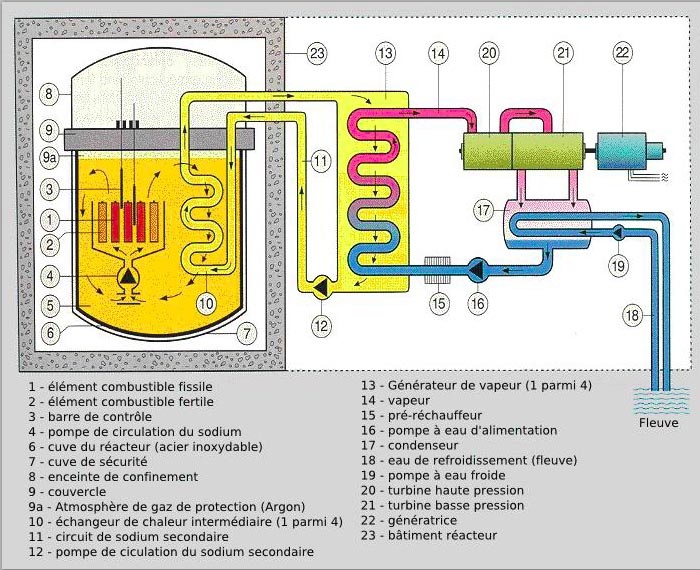
In such reactors, known as fast breeders, plutonium fission is used. In a fast breeder like Superphénix (which is supposedly rising from its ashes), the annual consumption is nearly one ton of plutonium (compared to 27 tons of uranium at equivalent power). The neutrons emitted by these fission reactions could transform a blanket of U-238 into Pu-239.
Uranium-238 is the waste product from nuclear reprocessing carried out at La Hague. It's essentially the "ash" from uranium-based operation, where isotope U-235 is consumed. It's no coincidence that France has become the world leader in "reprocessing," which involves recovering this fraction of "ash" that can be reused in fast breeder reactors. A long-term policy aimed at "ensuring our energy independence"—unfortunately... suicidal.
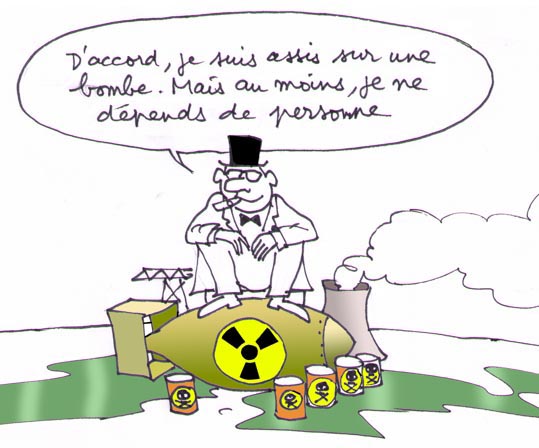
The Fast Breeder Reactor
In yellow, 5,000 tons of molten sodium heated to 550°C. Spontaneously ignites upon contact with air and explodes when contacting water (in the event of a sodium fire, the last people to call are... firefighters!).
In the core, in red, the fuel elements made of plutonium. Surrounding them, in pink, the "fertile" elements—uranium-238—which neutron bombardment transforms into plutonium-239. On the right, the heat exchanger system, gas turbine, and contact with the "cold source."
From this perspective, one might say the fast breeder operates by "burning the ashes from uranium-235 reactors." Since France is extremely rich in such "ashes" due to its uranium-powered reactors and its reprocessing services for neighboring countries, it could thus achieve complete independence in fissile fuel.
The catch is the extreme danger of operating such a reactor. The core operates at 550°C instead of 300°C. Using molten sodium as the coolant poses a major fire risk if it contacts air. Add to this the extreme radiotoxicity of plutonium. A tenth of a milligram of inhaled plutonium, lodging in the lungs, is enough to cause cancer with 100% probability. Do the math. A fast breeder loaded with one ton of plutonium contains enough poison to kill ten billion human beings.
The slightest significant incident at a fast breeder could result in ten million victims.
Not ten million irradiated people—but ten million dead
Recommending a shift in French nuclear policy toward fast breeder reactors is equivalent to total irresponsibility. That such a recommendation comes from an incompetent politician might be understandable. It is astonishing that it came from a Nobel laureate in physics, who was just days away from death.
Yet in France, a reactor of this type is once again under study.
A brief note: France, like other countries—including especially Japan—uses a mixture called MOX as fissile material in 20 of its reactors. This mixture consists of two components: 6 to 7% plutonium diluted in 93% non-fissile uranium-238. Wherever there is plutonium, the situation is never calm (for example, in Japan...).
The website of Savoir sans Frontières
****See Jean-Luc Piova's dossier on this subject
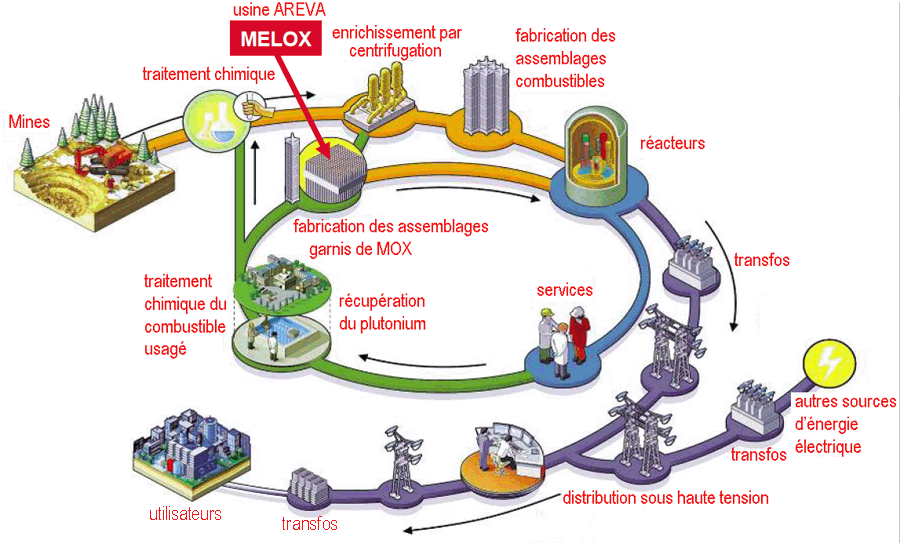
See Jean-Luc Piova's dossier ****** **
March 24, 2011:
What is MOX?
Natural uranium exists in the form of oxide. Two isotopes are present: U-238, making up 99.3%, non-fissile but fertile; and U-235, at 0.7%, fissile. To use this natural ore directly as fuel, one needs the most effective neutron moderator: heavy water, a molecule composed of deuterium (an isotope of hydrogen). Hence the famous "battle for heavy water," during which a commando destroyed an isotope separation plant in Norway, which held a stock of heavy water that could have been used by the Nazis. Similarly, Joliot-Curie safeguarded French heavy water during the 1940 French collapse. Such reactors exist in Canada, known as CANDU (Canada Deuterium Uranium). These reactors cannot use heavy water as a coolant. Thus, there are automatically two separate systems: one circuit extracting thermal energy, and another containing the heavy water moderator.
Hence the term "Light Water Reactors" (pressurized or boiling water), in contrast to these (rare) reactors using heavy water.
Outside reactors using heavy water as a moderator, uranium ore must undergo prior enrichment, starting by transforming the oxide into gaseous uranium hexafluoride.
UF6 in gaseous form is enriched via centrifugation to 3–6% U-235. Then, by assembling masses of around a hundred tons, this charge can "diverge," meaning it becomes a site for chain reactions producing energy.
If a nuclear fuel with low enrichment is used, the reactor must be larger. Over the years, nuclear engineers have improved core design. In a cylindrical core, fission reaction rates are higher in elements near the center. Engineers have adjusted the placement of central assemblies with peripheral ones. They've also used non-uniform distributions of moderator elements, reducing reactivity at the center to achieve more uniform fuel depletion. Neutron reflectors are also used—these techniques allow working with lower enrichment levels, thus reducing costs.
Military reactors, such as those in submarines and aircraft carriers, require greater compactness and use uranium enriched to higher levels.
Let’s say that with 3–20% U-235, we remain in the realm of civilian uranium. From 20% to 90%, we enter the domain of military-grade uranium. With high percentages, uranium-based atomic bombs become possible.
However, in general, atomic bombs are made from plutonium, which requires a smaller critical mass. Plutonium is produced by allowing fast neutrons to escape and bombard a fertile blanket of U-238 via the reaction:
U-238 + neutron → Pu-239
Thus, there is no clear boundary separating civilian from military nuclear programs. Reducing moderation in a civilian reactor can make it plutonium-producing, eventually yielding plutonium for fission bombs. See my comic strip "Energétiquement vôtre," available for free download at . Note that during normal operation of a civilian reactor, a small amount of plutonium is produced because the moderator, while reducing the number of fast neutrons, cannot eliminate them entirely. This plutonium, mixed with uranium, thus becomes part of the "waste" from civil nuclear operations.
Returning to fuel: enrichment in France occurs at the Tricastin facility. Consuming electricity generated by three nuclear power plants on-site (the largest client of EDF in France), this center enriches natural uranium ore, which contains only 0.7% U-235. Isotopic enrichment is achieved primarily through cascades of centrifuges. At the end of the process, one obtains:
- Enriched uranium with 3–6% U-235
- The residue being "depleted" uranium, containing 0.2–0.3% U-235, which is used to make penetrator warheads.
Consider the most common reactors in France—the PWRs (Pressurized Water Reactors). They are loaded with fuel containing 3% U-235. During reactor operation, lasting about a year, the fuel composition evolves over time. Plutonium-239 and various fission waste products, unusable for energy, are produced. The U-235 percentage decreases. When it drops to 1%, the fuel becomes unusable—the fissile material density is too low. Replacement is necessary. Meanwhile, some plutonium has been produced through neutron capture. But this plutonium isn't suitable for contributing to energy production via fission in this regime of slow neutrons moderated by water, which serves both as coolant and moderator—slowing neutrons from 20 km/s down to 2 km/s to induce fission in U-235.
At the end of operation, two options exist. Either store the reactor's spent fuel "as is," despite containing 1% U-235 and 1% plutonium.
Or reprocess it at a reprocessing plant (La Hague), where radioactive waste is separated and stored in vitrified blocks, while Pu-239 is chemically recovered and used to produce MOX fuel:
93% uranium-238
7% plutonium
This allows future reactor operation via plutonium fission, derived from waste.
Below: the wonderful world of electricity, AREVA document:
For decades, the French have chosen the "fourth-generation reactor" path—i.e., fast breeder reactors like Superphénix. As stated in CEA texts, the question is not whether we will adopt this model, but when we will decide to replace the uranium reactor fleet with fast breeders, which will then be "deployed" across French territory.
But the Superphénix fast breeder, a prototype of these "fourth-generation reactors," gave us a scare in 1990. The roof of the turbine hall collapsed under the weight of snow!
By luck, on that day, the reactor was shut down. Otherwise, we would have had a major catastrophe.
This sparked widespread protests, and the reactor was shut down. As Balibar and the late Charpak noted, this idea remained alive, and they simply wanted "the project to resume."
The "atom barons" (polytechnicians, from the "Corps des Mines," 100% of them, forming part of this vast French mafia) found "the solution": Replace dangerous sodium as coolant with molten lead.
I have enough material to produce a dossier on Chernobyl, recalling everything that happened. Using molten lead does not eliminate the inherent danger posed by the ton of plutonium contained in these fast breeder reactors. If that were all, a nuclear disaster would then scatter vaporized lead, which condenses into particles across a vast area. Lead's vaporization temperature is 1750°C—easily reached during a nuclear accident (as happened at Chernobyl).
In addition to plutonium contamination (lifetime of 24,000 years), you'd have lead contamination (plumbism). Add that earthworms quickly bury surface soil down to 20 cm depth. Decontamination would then be impossible.
To complete this apocalyptic picture, note that depleted uranium (0.3% U-235 instead of 0.7% in natural ore) is a waste product reused to make high-density, highly penetrating bullets. After impact, uranium vaporizes into fine particles that can be inhaled by "the enemy," polluting the soil and causing genetic mutations in their descendants—creating monsters (Iraq), all in "punishment."
Until fast breeders are deployed, our nuclear industry has found an intermediate solution by creating MOX fuel using output from La Hague. We can thus produce (and sell) a new nuclear fuel: a mixture of U-238, U-235, and 6–7% plutonium. All functioning in conventional reactors—pressurized or boiling water (like Fukushima Unit 3). A minor detail:
The core now contains plutonium, so if a nuclear accident occurs, it won't be iodine, cesium, or a range of radioactive contaminants with varying lifetimes being released into the environment—but plutonium.
Plutonium has a lifetime of 24,000 years, which can be considered infinite.
If a disaster ever pollutes an area with plutonium, that pollution will be irreversible.
March 25, 2011: Two remarks regarding reactors using water as coolant. There is always radiolysis, continuous dissociation of water molecules under radiation. This radiolysis can add to the dissociation of water molecules at around 1,000°C. At Chernobyl, cooling circuits were blocked at low power due to "xenon-135 poisoning." This chemically inert gas is a fission product. Under normal conditions, it is degraded by neutron flux into cesium, I believe. But if the reactor operates at very low power, the neutron flux drops, and xenon transmutation can no longer occur. Bubbles form, blocking water circulation—the coolant—and the core stops being cooled. Temperature rises, deforming the guide tubes for control rods, whose descent speed is slow (20 seconds). This descent could not be completed. Everything then unfolded very quickly. Water dissociated into a stoichiometrically explosive gas mixture. When enough of this mixture accumulated, it exploded, propelling the 1,200-ton concrete lid upward. Falling at a 45° angle, it fractured the reactor—i.e., the graphite moderator block and fuel assemblies. With no cooling circulation, temperature continued to rise. The entire core melted, forming a magma mass at the reactor's base, without any containment structure. This mass continued releasing heat, sustaining graphite combustion. Smoke carried all radioactive pollutants away. At the same time, radiation from the core was so intense it ionized the air above the reactor, creating a visible luminous beam at night.
I obtained complete plans of the Japanese reactor and am studying them. The bottom of the vessel, obviously concave, is ideal for gathering molten material. Moreover, control rods are pushed upward by electrically driven screw jacks. Thus, the lower part of the reactor is structured like a sieve. Readers insist: "But why weren't the rods placed on top, as in other reactors?" It's impossible in boiling water reactors—the upper section is submerged in steam, and space is occupied by systems for drying the said steam. I am currently translating the installation plan, with legends in English.
Did the "shutdown" system work for Unit 3? We are surprised by the explosion's violence. Could there have been radiolysis of a large water mass, followed by an explosion not in the steel structure above the reactor—as in Unit 1—but deep within the system, causing massive chunks of fractured concrete to be ejected?
The manual emphasizes the inherent stability of the installation: in these water reactors, if abnormal reactivity occurs—too many neutrons emitted—the water heats up and expands. This effect is sufficient to reduce the moderating action of the water (reducing neutron slowing). Thus, fewer slow neutrons exist, leading to reduced core activity, since we know uranium fission occurs more easily with slow neutrons than fast ones.
The manual includes pages of diagrams showing all safety systems.
One chapter is missing:
What to do in case of earthquake and tsunami?
I find this omission troubling.
The second remark concerns aging nuclear installations. Radiation weakens the reactor vessel's steel over time. When engineers estimate the vessel can no longer withstand pressure, they consider the reactor at the end of its life.
B__________________________________________________________________________________________________
****IRSN Report from March 25, 2011.
March 26, 2011:
A reader from the CEA sent me the daily report from France’s Institute for Radiation Protection and Nuclear Safety (IRSN), stating: "Here are the real facts about the status of the Fukushima site."
This assessment appears less optimistic than that provided by a French engineer on-site, commenting on information from Japanese official sources.
Excerpts:
IRSN Institute for Radiation Protection and Nuclear Safety Information Note Status of Nuclear Installations in Japan Following the Major Earthquake of March 11, 2011 Situation Update as of March 25 at 08:00 Status of Reactors The IRSN remains highly concerned about the current state of reactors 1, 2, and 3 (risk of equipment failure due to massive salt presence in vessels and containment structures, lack of a durable system capable of removing residual heat...). This precarious situation is expected to last weeks or even months given the difficulty. The IRSN is examining possible worsening scenarios, especially those involving potential rupture of reactor 3’s vessel. It will be difficult to confirm such a scenario, but the environmental impact in terms of radioactive releases is currently under assessment.
Reactor 1: The rate of seawater injection into the vessel has been adjusted (10 m³/h) to control temperature above the core. This flow should allow residual heat removal. Pressure measured inside the containment structure has stabilized. There should be no immediate need to depressurize this structure.
Reactor 2: Seawater injection into the vessel is maintained to ensure core cooling, although the core remains partially uncovered. The containment structure may be damaged. The situation has not changed, and depressurization of the containment structure is no longer necessary at present. The control room should be reconnected to power today.
Reactor 3: Seawater injection into the vessel is maintained to ensure core cooling, although the core remains partially uncovered.
The containment structure appears no longer airtight according to pressure readings; this loss of tightness is likely responsible for continuous, unfiltered radioactive releases into the environment.
Smoke emissions observed on March 23 have ceased. The IRSN is analyzing potential causes of containment failure in reactor 3.
One hypothesis examined by the IRSN involves the possibility of a vessel rupture followed by interaction between the corium (mixture of molten fuel and metals) and the concrete at the bottom of the containment structure.
The environmental impact of such an event is currently under assessment.
Three workers were contaminated on March 24 in the turbine building of reactor 3.
Work to verify equipment has been suspended. These efforts aim to restore freshwater supply to the reactor.
Reactor 4: This reactor's core contains no fuel.
Reactors 5 and 6: The reactors are properly cooled (core and assemblies in spent fuel pools).
One can read that Japanese engineers are concerned that salt brought by seawater cooling might block solenoid valves, which can only be operated remotely. A malfunction of this kind could have incalculable consequences, and their priority is to switch back to freshwater cooling as soon as possible.
So what is the solution?
...
I have "hot" information to share about the Z-machine, directly from two international conferences (Vilnius 2008 and Jeju, Korea, October 2010) and from Malcolm Haines himself. Nexus has agreed to publish the article, which will appear in its next issue. These revelations will simultaneously amplify hopes and fears surrounding this new technology of ultra-high temperatures. Without spoiling the topic (the article will be written quickly):
- Americans achieved 3.7 billion degrees in 2005 at Sandia's Z-machine. Prioritizing military applications (pure fusion bombs), they are now keeping everything secret. With ZR, current intensity increased from 17 to 26 million amperes, and the device's performance is now classified.
Go back to the beginning of this page dedicated to the Japanese nuclear disaster
****Recommendations from seismology specialists
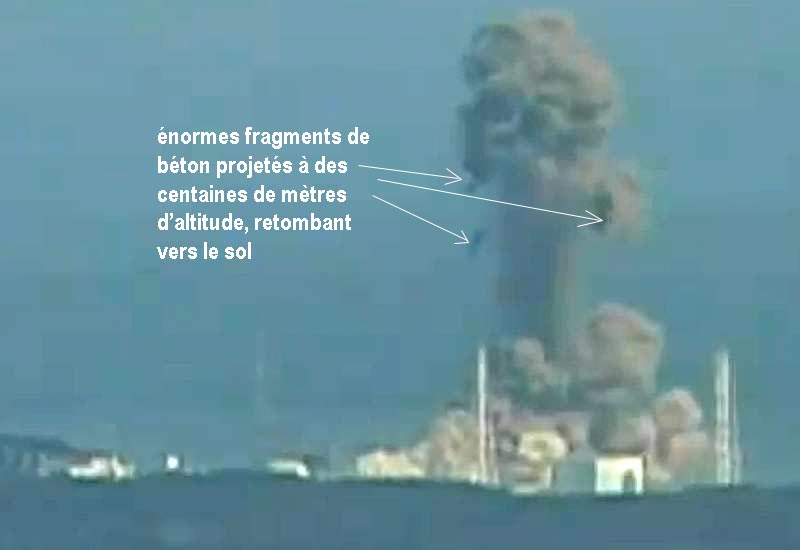
http://allthingsnuclear.org/tagged/Japan_nuclear
http://www3.nhk.or.jp/news/genpatsu-fukushima
http://allthingsnuclear.org/tagged/Japan_nuclear
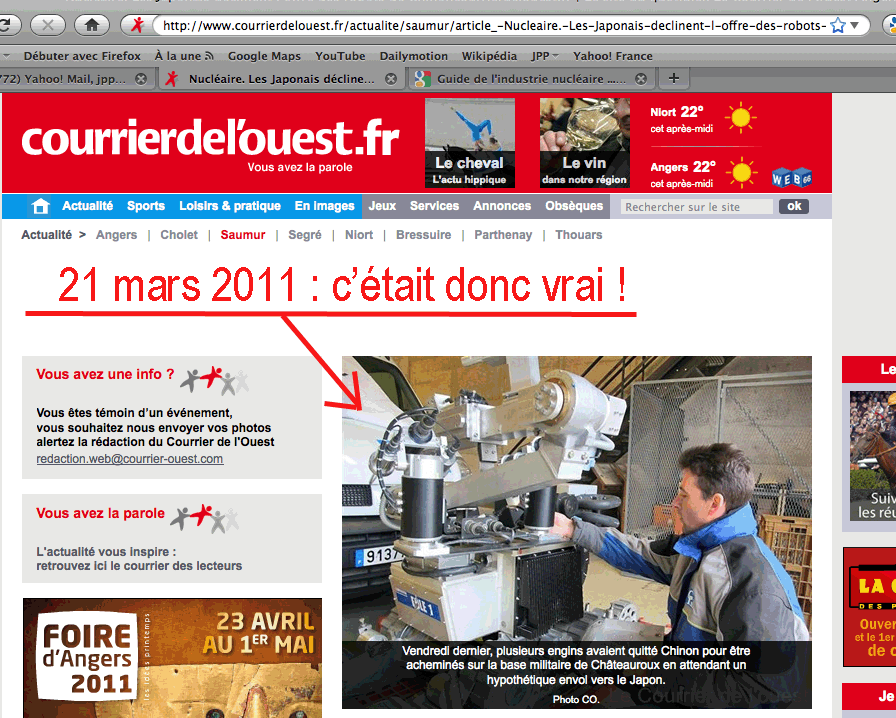
March 20, 2011: Should we turn this Japanese disaster into a serial drama? There are so many other catastrophic events happening on Earth that we don't know where to begin. What we can say is that this catastrophe is once again due to human stupidity: building nuclear reactors right on the seashore (which is the case for all Japanese reactors) in a country periodically devastated by tsunamis. Furthermore, building cheap reactors, just to line one's pockets with as many yen as possible. Neglecting safety measures against earthquakes, which were clearly needed.
Shortsightedness.
The Japanese continue to amaze us with the spectacular advances in their robotics. In Japan, robots can ride bicycles, speak, and smile. We are creating humanoid robots that look impressive and may one day be sold like artificial pets or electronic hostesses to lonely city dwellers. This reminds me of a chapter from Ray Bradbury's "The Martian Chronicles," which I strongly encourage you to read or reread.
But in Japan, no one had invested in safety robots capable of climbing through rubble, especially those equipped with lead-shielded electronics able to withstand intense radiation. They had to be brought in from abroad.
We saw one of the responsible parties for this criminal negligence, "overwhelmed with emotion," shedding crocodile tears (though he wouldn't go so far as to sit beside the operators of the vehicles who, in an attempt to cool down the reactors, approach them dangerously). In Japan, political or economic figures responsible for ruining hundreds of thousands of ordinary people periodically appear on media to offer public apologies. The head of a nuclear disaster sheds a few tears. This replaces the traditional ritual of seppuku, suicide by sword.
This video animation shows the layout of waste materials from a boiling water reactor, handled remotely and stored in a pool filled with water, which acts as a shield, absorbing radiation.
You need to understand one thing: In the nuclear industry, the highly radioactive and dangerous byproducts of electricity generation are simply stored near the reactor itself, in basic pools. Water alone is sufficient to block radiation. Only later will these wastes be transported to reprocessing centers like La Hague, to extract fuel for future fast breeder reactors. These wastes are by no means inert and are as dangerous as the reactor's core contents.
The spent fuel storage pool.
This pool is located immediately adjacent to the reactor for ease of handling.
A close-up of these "assemblies" grouping "pencils":
Each rectangular element, ending in a handling ring, is an "assembly." Zooming in further, we see the "pencils" that make up the "assemblies." These are zirconium tubes (also called "gins"), filled with "fuel pellets": uranium oxides, or in the case of MOX, a mixture of uranium and plutonium oxides. If the water surrounding these assemblies evaporates, the residual heat from these densely packed assemblies is enough to quickly damage the zirconium tubes and allow the pellets to escape and accumulate at the bottom of the pool. Or worse, an explosive event could scatter these materials around the reactor.
60 "pencils" per assembly in Japanese reactors. Here is the source of what follows:
The reactor vessel (here open) and the pool are connected by doors, functioning as locks. Periodically, "the reactor is shut down." The control rods are raised, reducing activity to a minimum, but not to zero, since fission products continue to decay and generate heat (60 megawatts, one-tenth of nominal operating power). The lock separating the reactor's top from the storage pool is opened. Water floods the entire available space. Handling of the assemblies then takes place underwater, using a crane and telescopic arm, whether removing "spent" assemblies or replacing them with "new" ones. In any case, unless a reprocessing line like La Hague takes over, the "spent assemblies" will remain stored in the adjacent pool, continuing to heat the water in the "spent and transit pool for new elements."
Handling of assemblies under a water shield, blocking radiation.
Here is a photo showing such a maneuver, taken at a reactor in the United States, at the Brown Ferry plant in Alabama.
Transfer of a spent assembly to the storage pool (Alabama).
The term "cattle chute" was chosen due to the resemblance between these cranes and the passages used to lead cattle to slaughter.
The photo was taken by the crane operator. Under his feet: water protecting him from radiation.
A few meters below, the blue glow caused by radiation emitted by the spent fuel elements is clearly visible. It's far from inert!
Here is another photo of a U.S. reactor storage pool (Alabama), empty, before use.
Decades ago, I visited the experimental Pégase reactor at Cadarache. Looking through the clear water, I could see "the entire interior of the reactor," surrounded by a blue glow, located ten meters below. It was like staring death in the face, the naked nuclear poison up close. The emitted particles traveled at a speed not exceeding that of light in a vacuum, but faster than light in water, which slows light to about 200,000 km/s. The ratio 200,000/300,000 = 1.5 corresponds to water's refractive index. Thus, the particles were emitted at "supersonic speed" relative to light in the medium, and we could clearly see phenomena resembling "shock waves," known as the Cherenkov effect. In any medium other than vacuum, light propagation time is extended due to the absorption and re-emission of photons by atoms or molecules. But between atoms, photons travel at 300,000 km/s.
PEGASE (35 thermal megawatts), a research and testing reactor, went critical at Cadarache in 1963. It was a reactor used to test fuels for gas-cooled reactors.
The Pégase reactor pool was converted in 1980 to store 2,703 containers holding 64 kg of plutonium.
Here are the sources for what follows:
Each assembly element (see above) weighs 170 kilograms and contains 60 "pencils." The storage pool of reactor 3 held as many "spent but highly toxic" rods as the reactor's core itself.
Here is an image broadcast by the Japanese network NHK, indicating that water spraying must be done from 22 meters high.
Spraying the Japanese reactors requires sending seawater up to 22 meters high (source: Japanese television NHK).
.
The water-spraying pole, mounted on a mobile vehicle.
Test of this water-spraying pole.
March 22, 2011: As noted by a reader, this appears to be a remote concrete-dispensing pole, as shown in the image he sent me (and I thank him for it):
Indeed, on the left, we see the concrete transport truck with its rotating mixer.
In front, a large slab on which the articulated pole enabled even distribution of the concrete.
Of course, such a pole could also be used to deliver water at 22 meters, where cooling would be most effective. But if it were meant to bury the reactor in concrete, that would be far worse. It would mean the reactor's cooling systems—or at least one of them—had been destroyed.
Let's wait and see...
We can only hope, for the Japanese, that the situation is not as critical as it appears on the nuclear front (setting aside the fact that tsunami victims already number over twenty thousand).
Still, these events abruptly bring us face to face with the dangers of nuclear energy.
March 21, 2011: I posted this information on the date it appeared on the Ouest-France website. But I only learned about it from a reader on April 26, more than a month later.
Source:
One could headline it:
THE JAPANESE PRIDE
Indeed, the fools and irresponsible individuals at TEPCO flatly refused an offer from the French to send robots capable of operating in a site with high radiation levels.
Japanese authorities declined the French offer to send specialized robots to intervene at the damaged Fukushima nuclear plant, judging the equipment "unsuitable" for the situation, the French Nuclear Safety Authority (ASN) said Monday.
EDF had announced Friday the dispatch of remotely operated robots capable of replacing humans in the event of a nuclear accident. This equipment from the Intra group is based just next to the Chinon nuclear power plant (Indre-et-Loire).

| For Spanish, | contact | Emilio Lorenzo | who will manage the various translations, possibly segmenting the pages |
|---|

For English, several candidates have stepped forward, particularly to translate. It is clearly the most important language, with the greatest potential to reach the widest audience.
I ask these readers to contact one another. If one of them could take charge of distributing the pages, possibly segmented.
So far, the following have volunteered:
François Brault has agreed to coordinate all translations of my website pages into English:
I will therefore segment the pages of my website, which are somewhat long, like this one, by introducing colored (green) separator lines ________________________________________________________________________ as well as alphabetical markers. I will begin, for these pages that serve as chronicles, from the bottom: A, B, C, D, etc...
This will allow me to make additions later, marked as D+, D++, D+++. These additional sections will also be bordered by separator lines. This will help keep the translation up to date.
| For Italian, the coordinator is: |
|---|
| For Italian, the coordinator is: |
|---|
Go to the beginning of this page dedicated to the Japanese nuclear disaster
http://www.agoravox.fr/actualites/societe/article/nucleaire-la-cible-terroriste-93801
| May 13, 2011: | On Agoravox, how nuclear power plants are like real swords of Damocles |
|---|
To the East, Nothing New
April 8, 2013
I'm adding this note at the bottom of this long page dedicated to the Fukushima disaster. It's true I worked extensively on this topic at the time the events unfolded. Further down, you'll find a link to a lecture by Professor Hinoaki Koide, who previously headed the Nuclear Energy master's program at Kyoto University. He explains things clearly.
It feels like a reminder. These events seem so distant now. Japan is in the Southern Hemisphere, as we were told at the time by Cécile Duflot.
I've just turned 76, and I ask myself, "And now what do I do?" When I saw the immediate decisions made by the Hollande government, I admit I was a bit shaken. But should we expect anything different from "socialists" than what was done during the previous presidential exercise? Hollande is simply an idiot. Oh, he's just confirmed the decision to build the EPR. I should have added a section to the linked page. But I admit I lacked the courage.
There's another one I'm presenting as a scoop. It's brand new, just released. DCNS has just secured a contract to supply an underwater nuclear power plant, Flexblue, to a foreign country. It must be delivered within four years.
Underwater nuclear power plant Flexblue, a civilian reuse of submarine reactor technology
Specialty of Cadarache
I'll try to contact Hinoaki Koide. I help as best I can Michel Guéritte, who fights against the permanent burial of long-lived waste at the Bure site in Champagne. The government is pushing hard, with its idiot minister "of ecology." Meanwhile, Fioraso, another idiot, gushes over ITER ("which will take us to the stars"). What fools there are in this cabinet! It's true that an idiot has a good chance of surrounding himself with similar people.
A major publication is preparing to release a well-documented article on the issue of burial, which deeply worries supporters of the CIGEO project and all nuclear establishment figures. Because burial is the key to France's completely insane plan for "deploying fourth-generation reactors," alias fast breeder reactors running on plutonium (the EPR, operating 100% on MOX, representing the transition between pressurized water reactors and sodium-cooled fast breeder reactors).
Burial at Bure will involve 100,000 Castor wagons (invented and perfected by my neighbor Klaus Janberg), packed with radioactive materials. A robotic burial operation expected to last... a century. Among these waste materials of all kinds, including plastics that, as they decompose, will release hydrogen. This is... unavoidable. When air contains more than 5% hydrogen, there's a risk of explosion. Furthermore, many "packages" are sealed with bitumen, which is flammable at relatively low temperatures. And all of this "sealed for hundreds of thousands of years."
Our descendants will curse us. But the disaster might happen much sooner.
As Jesse Ventura reminds us in his videos:
*- If you want to understand, follow the money trail. *
Guéritte and his team might have the financial means to bring Koide to France. Koide is a "repentant" of nuclear energy (see below). He only realized, too late after Fukushima, that it was "suicide by instruction manual."
I also have another project among many others: to complete my album Energyfully Yours, already available in Japanese version on the Savoir sans Frontières website, where Gilles d'Agostini, its treasurer, has just paid for his 400th translation and added a 37th language to his list: Finnish. I've been waiting a long time for this language, thanks to a gag from the film Hellzapoppin. A film absolutely without logic or coherence by Harry Codman Potter. One character, Peppi, is played by Mischa Auer. In this film, Mischa plays a Finn, and we find the following dialogue:
- You have a strange accent. You are not British?
(You have a strange accent. You're not British?) - No. (No) - What country are you from?
(What country are you from?) - I am Finnish. (I am Finnish) - But you don't speak Finnish....
(But you don't speak Finnish?) - No. (No) - Why? (Why?) - Finnish is too difficult. (Finnish is too difficult)
My friend Gilles d'Agostini, who has co-managed the Savoir sans Frontières website since its creation in 2005, has done a wonderful job. Now, if you go to the homepage and hover your mouse over the flags, a pop-up message will tell you the language in question.
No media echo in five years, except for a brief appearance on "La Tête au Carré" on France-Inter a few years ago. But that hasn't stopped the machine from moving forward. Fans of Savoir sans Frontières periodically replenish the fund. It works without subsidies, without help from the Ministry of National Education or UNESCO. It works thanks to small donations from kind-hearted people. You'll find their list on the site. Twenty euros here, fifty there. Thank you, friends—you're doing a great job!
I am only the messenger.
This is a change from stories like Cahuzac's. I admit I hadn't seen the video clip where this financial and tax evasion acrobat unfolds his lies in full view of the National Assembly, while serving as... Minister of the Budget, and supposedly committed to fighting such practices.
The character, a loudmouth: https://www.youtube.com/watch?v=6OjYNB6ogdU
Now take a look at the following video—it's worth it.
- Mr. Cahuzac, did you or did you not have an undeclared Swiss bank account?
****http://www.youtube.com/watch?v=BxemczLqgsk
When this question is asked clearly and loudly by an UMP parliamentarian, Danielle Fasquelle, referencing revelations from Mediapart, a news and current affairs website, loud boos erupt in the chamber (probably to stigmatize "low political attacks"), emanating from deputies who cannot ignore that suspicions have hung over their "colleague" for three months. Since the question comes from an opposition UMP deputy, it's highly likely these protests come from Socialist deputies. Acts of solidarity among members of the same "family," from people who, if their accounts were investigated, would probably have plenty of similar issues to explain.
The chamber would have erupted in protests from the right if the question had come from a left-wing representative.
In any case, someone would be blamed for the other. Paraphrasing a famous character, someone might have said:
*- Let him who has no undeclared account throw the first stone! *
During the previous presidential exercise, we had a Minister of Justice who confused, in a Freudian slip, inflation and fellatio, allowing all sorts of speculation about her political rise. A woman who got pregnant while trying to extract a pension from a very wealthy man.
Today, Taubira, whenever she gets angry, speaks at the National Assembly like a fishmonger from the old port.
A friend reminded me yesterday that in one year, 45 police officers have committed suicide. I recall once having a phone conversation with a woman, head of a gendarmerie unit, who spoke about working conditions, lack of equipment, and the gendarmes being diverted from their mission to become tax collectors, pressured to "produce results." She added, "I sometimes receive young gendarmes who completely break down in my office."
The number of desperate, unemployed people at the end of their benefits, who use the SNCF to end their lives, reaches 450 annually—about one every twenty hours. Recently, I took a TGV that was stopped so they could remove another body. SNCF apologized for the delay. In this context, fraudulent enrichment by those who exploit the "system" without the slightest scruple is truly revolting.
Back to the Cahuzac affair. This creature told the press that this matter "devastated" him, then claimed he had been treated "inhumanely." Finally, regarding his lies, "but everyone lies in the National Assembly! If we were to expose all the liars, the room would be full."
This man reminds me of Cardignac, a character from the Largo Winch series (album number 2).
This type has the same cold-bloodedness as the character in the series. Because to lie like that, in front of the French People's Assembly, you must have stainless steel genitalia. But it's the same everywhere. I have many books in the pipeline, and among them, I'll write one about the scientific community. You'll see that in this world, there are some fine examples of sellouts. When they're not sellouts, they're cowards and liars beyond imagination.

April 12: I'm returning to this page. Definitely....
Gilles Bernheim, Grand Rabbi of Paris, has been denounced as a plagiarist. Indeed, in his book Forty Jewish Meditations, several passages were found to be verbatim borrowings from other authors. Faced with the evidence, the man gets tangled up:
- I had asked a student to write certain passages, and he betrayed my trust by doing cut-and-paste.
The plagiarizing Grand Rabbi. Of course, it's... the student's fault!
Nonsense...
The newspaper Le Monde clarifies that the investigation revealed he does not possess the title of philosophy agrégé, which appeared in his biographies and, more recently, in Who's Who.
In the world we live in, which is completely collapsing, the only thing left is to laugh at these revelations. Another one who must be "devastated."
I remember a Sunday morning show where a believing Jew tried to dialogue with the then Grand Rabbi of France. I believe it was Sitruck. This notable, a physician, defended his position:
My wife and I are deeply religious and practicing. Our son married a non-Jew (a "goy"). They had two sons. We gave them a religious education. But when they reached 13, the age of their Bar Mitzvah (the equivalent of Catholic First Communion in the Jewish world), they were rejected.
That's normal. Their mother isn't Jewish. You know very well that Jewish identity is passed through women. If their father were a non-Jew, they could be welcomed into the synagogue. But for your two grandsons, it's impossible....
Can't we consider changing this?
The rabbi smiled, and the honest man wasted his time. Many social behaviors around the world are thus constrained by outdated customs. In fact, this rule isn't even in the Pentateuch, the part of the Bible corresponding to the Old Testament. It's a later rabbinic addition, like so many customs in the Jewish world.
Rabbi Bernheim is Ashkenazi, with ancestors from Central Europe (in contrast to Sephardim, from the Eastern world). His wife strictly follows Ashkenazi rules. I read she wears a... wig. Why? Because, a Jewish friend told me, the strictest Ashkenazi rule requires women to shave their heads. As for Rabbi Bernheim, he doesn't shake hands with women.
Between these people and hardcore Muslims, we'd really be hard-pressed to pick one to blame over the other.
I suggest, to change the mood, listening to the words of an honest man, Hiroaki Koide. It will refresh us, even if we have to go all the way to Japan to find a bit of clean air.
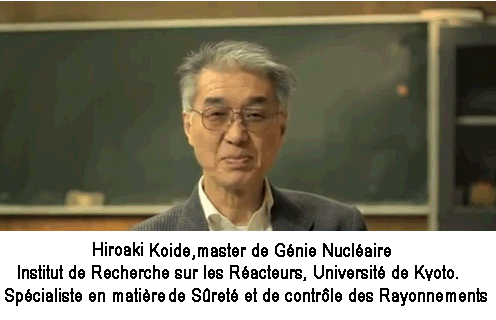
****http://www.youtube.com/watch?v=VUbWz9ydm0I&NR=1&feature=endscreen
In our country, people like this simply don't exist.
See also: http://fukushima.over-blog.fr/
I hadn't understood why, on certain Paris metro lines, a system of double automatic doors prevents access to the tracks.
It's to... prevent people from committing suicide!
April 26, 2013.
Reader's reaction.
Good evening Jean-Pierre, I've just read your article from April 8, 2013. What disturbs me about the minister's scandalous revelations is the "tree hiding the forest." Hypocritical Right-wingers scream "Wolf!" while the Left plays pretend. Mr. Benkasem pretends to cry crocodile tears when their minister admits his sins (sins practiced by everyone)...
But I remember a phrase that struck me when the former head of ELF, hiding in Thailand, was brought back to France with handcuffs on his wrists. The first thing he said at Roissy CDG in front of journalists was, quote:
"I have enough to blow up the Republic more than 200 times." He also claimed that 70% of deputies have Swiss bank accounts or offshore holdings (the soup is good—everyone has understood that for a long time). But as soon as he returned from Thailand, sharp-tongued and ready to spill the beans, they managed to make him choke to death during his sleep in a prison cell...
These revelations will never see the light of day, thanks to the non-aggression pact between the two major corrupted parties. But I would have loved to see the UMP publish in bold print the details of Ziad Takhiedine's retro-commissions in the arms sales scandal to Pakistan, among other things... and the envelopes from the head of OREAL, and so many others we'll never know about, amnesty now being five years and politicians automatically amnestied...
All this gives the impression of a grand-scale farce, where the nobility and court pretend, à la style of the "Précieuses Ridicules," to make the people believe they are without reproach...
As you so rightly say, suicides of desperate people happen daily, and far more than 450 per year.
In June 2006, I witnessed four to five suicides per week on Line 1 of the metro between Défense and Étoile.
It started on Thursday afternoons, sometimes even Wednesdays. They finally installed plexiglass windows on automatic doors that only open when the train is at the platform, in all stations of Line 1, about two years ago. But what does it matter? Suicides are still happening, and now they're increasingly shifting to the RER B line, where RER omnibus and express trains alternately pass through stations at high speed.
Moreover, what shocked me deeply is that for several years now, I've seen and continue to see elderly homeless people in Paris at night, unable to afford rent, sleeping in large numbers in RER stations like AUBER. The RATP even provides them with "reserved spots," where they sleep on cardboard and worn-out blankets—a real deathbed for people who once contributed to the country's economy.
Even worse: about a year and a half ago, under Sarkozy's rule, I saw a significant number of elderly homeless people outside, in the cold, at the Saint-Michel metro station, near the Boulevard Saint-Germain and just steps from Gibert. One man, one winter evening, seemed utterly hopeless, wanting nothing but to die. Sitting along a building, he let himself freeze to death. Despite intervention by two passersby, he refused help. The firefighters arrived.
But we've never seen anything like this before.
I think of the puppet show of the time, Sarkozy, spokesperson for banking mafias, who was treating himself to a megalomaniac plane.
I can't take it anymore—I'm exploding. This drift is happening at every level... there's nothing left but castes.
How can people coming from the Énarque factories, where ranking trumps intellectual reflection, serve a country honestly? They're already pre-programmed to serve only their interests and careerism, as we see clearly later on.
Even small humanitarian associations in Paris were dismantled a year ago on Delanoé's orders, their offices razed to the ground under the pretext that any social intervention with vulnerable people must first receive PS approval and go through them. Delanoé is pure political careerist marketing, and he couldn't care less about the fate of suffering people.
We're walking on our heads.
I fear a surge of pure, hard-core fascism in Greece and Spain, where Francoists still lurk in the shadows. The only thing this absurd political incompetence from all sides—serving the financial establishment—will succeed in achieving is establishing fascist states across Europe.
All it would take is Italy collapsing, and then a chain reaction follows. Then Hollande will implement the reforms Sarkozy wanted, but with a little oil to make them go down more smoothly. He'll soon fully deregulate gas prices. Margaret Thatcher would have applauded, and he'll allow shale gas extraction. Standard & Poor's, whose job is to be mafia bankers, "bangsters," has just created a subsidiary for shale gas exploitation, and we'll be told this is all for our own good...
Hollande is under the same orders as the previous government.
The tone was set when Mr. Benkasem announced, and it struck me deeply—I jumped up immediately, quote:
"For solidarity with people suffering, ministers have decided to reduce their salaries from 17,900 Euros per month to 13,900 Euros per month."
(Of course, all expenses are paid separately, not included in this "salary" of course...) Within just four days after Hollande's election, I already knew exactly where I stood. I thought to myself:
"Farce. The soup is too good. They'll do and continue doing exactly as the others."
The "change" had already sunk into the abyss after only four days...
And given that there are very few honest people, across all political lines, there's almost no future or hope that things will change. They all went through the same molds, graduated from the same schools, and defend the same interests and lobbies. We probably need a pseudo-Roosevelt who would bring banking systems under control with veto rights—but I fear, in the long run, an economic situation drifting toward the Argentine scenario, and the rise of fascist governments in a quarter or third of Europe.
We're watching a world collapse, having sawed off the branch it was sitting on, driven by greed and the insatiable appetite for money for money's sake. And I can't really see what will come after...
Warm regards,
Philippe M.
I fully agree with this reader.
A few updates in passing. In the summer of 2012, with the help of a friend, I recorded six hours of videos, three of which were on nuclear fusion. But to post them online, they needed illustrations. I couldn't take on that work at age 76, on top of everything else I manage. Now, in principle, a man from Marseille is handling it. These videos will thus compete with those I recorded and that Jean Robin sells as DVDs, keeping all profits for himself, even though it was agreed he'd give 3 euros to Savoir sans Frontières for each DVD sold. A clear case of abuse of trust. But what else could you expect from such a character, a true "ideological chameleon," who presents himself as a "liberal Gaullist"?
If this young man, who is illustrating these videos—lying dormant since August 2012 on my hard drive—actually does the work, they'll be immediately uploaded to YouTube, and you'll be notified right away.
An internet user from Aix is coming tomorrow morning to help me repair my aquagym pool, which my health depends on and which has been broken for three months.
I'm illustrating a new book, which won't be entrusted to a publisher (incompetent and unscrupulous).
Friends are helping me convert my website (7 gigabytes!) to WordPress, a task I could only entrust to people I fully trust.
I'd like to hear readers' opinions on Jesse Ventura's productions. Here are some of his videos, which have been dubbed.
http://www.dailymotion.com/video/xfakhq_ovni-conference-de-presse-27-septem_news#.UXmqcoX83bk
http://www.dailymotion.com/video/xdajjp_ovni-revelations-ex-ministre-canadi_news#.UXmpi4X83bk
the destruction of pilot Mantell's aircraft

25 April 2013:
Before you go further. It didn’t take long, and I had the answer to the question I was asking, within a few days. See the box below, where I listed the addresses of Jesse Ventura's videos, dubbed in French.
They were promptly removed. A singular coincidence: I draw attention to these videos, and immediately they disappear! Who dubbed them into French (Canadians? The accent doesn't match). Did they appear on a French or merely francophone channel?...
One thing seems clear from this massive removal: these videos are disturbing. Personally, knowing these topics, I found the ones I shared reasonably well-made. But many rushed to denounce "Ventura's sensationalism." That said, no matter how he addresses these highly sensitive subjects, I find him bold—something quite rare in France, especially in journalism circles.
Did anyone save these files? Can they be viewed elsewhere?
Ventura does sensationalize, certainly. But by doing so, he reaches the American heartland, and hits the mark. A million six hundred thousand viewers tuned in to his first show—something unprecedented. And it continued at that pace.
But how do you speak to the deaf, to people who don’t want to question anything, unless you hammer your words?
I received messages from people saying, "These conspiracy theories have long been debunked. See these analyses..." Robert Salas, the American officer who was in his bunker at the Minuteman missile launch site in Malstrom in 1967, saw ten missiles he controlled with a colleague, 25 meters underground, suddenly deactivated by a UFO hovering above the silos, terrifying the soldiers on the surface. See the press conference he held in Washington on this matter.
Salas wrote a book, The Faded Giant, self-published. In his conclusion, page 53, he writes:
No one wants a government that seems to be serving an elitist few. No people want a government that is focused on controlling their lives. History tells us this is the way it is with people. If it is true that our government has been withholding information about extraterrestrial visitors, and has extracted some technology from these visitors without public knowledge, then we have a secret government that has lost contact with its people.
Translation:
No one wants a government that seems to serve only a privileged few. No people want to be governed by those whose main concern is controlling them. History shows us that this is how it is with people. If it is true that our government has been withholding information about extraterrestrial visitors and has secretly acquired some technology from these encounters, then we have a secret government that has lost contact with its people.
These phrases seemed powerful. I contacted Salas, and he visited me in the summer of 2012. He brought me a dossier on "scientific work related to the UFO case" he had collected. What could I say? That it was fascinating? I would have lied. That these documents were worthless? I would have hurt him. I stayed silent and put on a good face. I suggested we write a book together, to be published in the U.S. It was up to him to find a publisher. Even more, I later proposed that he try to contact the former Canadian Minister of Defense, Paul Hellyer, suggesting he propose co-authoring a three-person book. Hellyer would have received excellent media coverage.
There are elements in such claims that I believe can be scientifically explained. I think that when a UFO "inverts its mass," that mass ceases to interact with surrounding air molecules. This volume is then perceived by those molecules as empty space. Air rushes into this vacuum, which can create a strong aerodynamic disturbance nearby, potentially disintegrating an aircraft. Thus, the aircraft's destruction doesn't result from an aggressive maneuver, but from a fleeing one.
That’s how I imagine it, in 1948.
Salas did nothing and is currently finishing writing a second book. A move that doesn’t show much initiative. Years have passed, and Salas has become just another ufologist.
Faced with this silence, this inertia, I had the idea of writing to him, asking what he thought of Ventura’s video on 9/11 (which I personally find excellent, courageous, and well-documented). He immediately mocked the man, denouncing his taste for sensationalism. Worse: he rejected the content, telling me, "You, a scientist, surely aren't going to believe such irrational nonsense!" Quickly, it became clear that Salas had never seriously engaged with such topics. He’s "single-task," concluded my friend Alix, responsible for reopen 9/11.
I insisted, asking:
- In this 9/11 video, do you find Ventura irrational?
No reply.
Salas experienced undeniable, transcendent events, which forged in him an unshakable conviction—expressed in his book—that the Malstrom incidents, being caused by extraterrestrial visitors, meant "Attention, nuclear, danger!"
But his "awakening" stops there. For everything else, his intelligence remains stuck at the level of the average American. Unless he's under pressure, or if telling his story is being used to draw out other people involved in similar incidents, whom the "secret government," having identified them, could then neutralize.
But perhaps it's not even that. Look at Hastings, the instigator of that Washington press conference. He's cut from the same cloth. Behind him is just a simple ego, a desire for fame.
I'm not done with this subject, far from it.
http://www.youtube.com/watch?v=PwN36UTzqxQ
http://www.youtube.com/watch?v=F7ZLK6xchMY
http://www.youtube.com/watch?v=sm3FZJ94t1M
http://www.youtube.com/watch?v=y3SNIdHMYuk
http://www.youtube.com/watch?v=HLOturMN5Wo
http://www.youtube.com/watch?v=f9tvrYg85qU
http://www.youtube.com/watch?v=yYpMBJNL0TU
Videos by Jesse Ventura:
Inaccessible since April 25, 2013 (a few days later). FEMA camps Inaccessible since April 25, 2013 (a few days later). 9/11 Inaccessible since April 25, 2013 (a few days later). Bilderberg Group Inaccessible since April 25, 2013 (a few days later). HAARP Project Inaccessible since April 25, 2013 (a few days later). JFK Assassination In English: The Pentagon The journalist who leaves (2009) from reopen 9/11 (subtitled). Ventura takes on this disinformation expert: David Icke, with his theory of reptilian invasion (in English. Too bad. Could someone subtitle it?)
Immediate reaction from many people:
- This guy specializes in sensationalism!
Certainly, but let's admit he still has real courage. His 9/11 show is well-structured.
You know the Latin maxim:
IS FECIT CUI PRODEST
Refer to the Larousse pages giving translations of Latin maxims. I think this maxim fits this situation quite well.
In Ventura's investigations, especially the one on Bilderberg, which is top-notch. How can 120 of the world's most powerful individuals meet annually at a "private gathering," when they're public figures? There's something going on. What? That remains to be determined.
Meanwhile, I note the actions of figures like David Icke. For 20 years, in 55 countries, he's claimed the Earth is under the control of "reptilians." These beings can take over prominent political figures and even media personalities. Ventura discovers (it's in the video referencing this affair) that Time Magazine listed various "conspiracy theories." It casually mentions everything Ventura has investigated, adding "the reptilian conspiracy." According to Icke, these reptilians are preparing total domination over humanity, followed by its elimination. I leave it to you to discover which politicians are actually reptilians. Clinton and his wife are among them.

Bill Clinton in the showers of his tennis club
Monica Lewinsky
Ventura explodes and decides to conduct his own investigation. If you don't understand English fluently, here's a summary. He starts by following men and women who claim to know something about the presence of reptilians on U.S. soil. He follows a man who takes him to a desolate area, where a base full of reptilians is supposedly hidden deep underground. They're accompanied by a hysterical woman who claims she "feels them, very close," and is terrified.
No more reptilians than butter on a stick.
Conscientious, Ventura meets a woman who claims to be a hybrid between human and reptilian. Another display of hysteria, with communication via a medium.
After a quest that turns into a farce, Ventura decides to meet David Icke. A filmed encounter.
As with all good gurus, we must admit Icke handles women quite well, even if the photo might be old:

David Icke, visibly uncomfortable, arrives at the agreed meeting to face the boogeyman Jesse Ventura (former wrestler, former combat swimmer, and former governor of Minnesota).
David Icke, visibly uneasy, facing Jesse Ventura
If someone could at least subtitle this dialogue, it would enlighten many. Look at Icke's expression, facing Ventura. It's clear he's outmatched and looks terrible from the start.
David Icke no longer smiles
Jesse Ventura immediately corners him. David Icke:
-
The answers to your questions are in a 700-page book I wrote.
-
You can't expect me to read a 700-page book just to get a simple answer: how can I face a reptilian?
Icke loses his composure, explaining that to see someone is a reptilian, you must be able to perceive, even briefly, an "invisible light." Ventura laughs in his face.
Perceive an... invisible light! You're joking?
He's near knockout. Icke says he's given conferences for 21 years in 58 countries. Ventura applies the principle of his investigations:
- Follow the money trail.
Icke denies doing it for money, but Ventura shows him his accounts. With all he earns from his 19 books, conferences, and broadcast rights, the total comes to $1.9 million per year.
- I think you're mostly in it for the money. Let me give you some numbers.
David Icke stands up and leaves the set saying:
- I thought we were supposed to talk about what's happening in the world...
.
David Icke flees
And now you understand what we're up against. Men like David Icke spread amplified disinformation (while lining their pockets), just like that good "Dr. Greer," who freely mixes UFO phenomena with "zero-point energy." Like Nassim Haramein, pillar of the Thrive group.
The "Thrive movement" (meaning "well-being" in English) casts a wide net, draws attention to world hunger, denounces conspiracies and the Fed, while mixing in nonsense. In passing, the backup guru presents the sect's central object, the "zero-gorge torus" (so abundant in nature). Imagine a video by Jean-Pierre Petit where I produce countless images of the Boy surface. The zero-gorge torus (obtained by rotating a circle tangent to a line around that line), which causes the man to experience complete enlightenment.
Think of honorable Mr. Keshe, his nonsense like the Camelot project, the moldy videos presented by Bill Ryan, etc., etc...
The Camelot project by Bill Ryan, and for a time by Kerry Cassidy, other oddballs of alternative media.
Revisit this page on all sorts of oddballs. The list is long, from Jean-Marc Roeder and Claude Poher with their "Universons" nonsense.
All of this is pitiful and drives me to fury.
Yes, you're being thoroughly misled. Misled by real agents, sponsored, paid. Or by delusional manipulators, which amounts to the same thing. Or by dangerous money-makers like David Icke and Dr. Steven Greer, who has just released his film-conference "Sirius," which I watched this afternoon. He's polished, and you'll need to provide proof that he's spreading disinformation everywhere.
But real information, like the obvious failure of the NIF (National Ignition Facility, the U.S. laser fusion project fiasco), which I discussed in the January-February issue of NEXUS magazine—nowhere else can you find mention of it (except in alternative media like Gizmodo and "20 minutes"). Elsewhere, in journals like Pour la Science, La Recherche, Science et Vie, etc.: a deafening silence that never fails to astonish specialists.
If the young man in Marseille carries out the work of inserting images and short videos into the files I gave him, recorded with my friend Alix (reopen 9/11) in August 2012, I'll make more. The tedious, time-consuming part is illustration. I'll also provide audio interviews on nuclear energy to Info-Libre (link on my homepage). I bought a headset-microphone set to get better sound. Know that the guy handling this, David, works alone. He finishes his weekly audio editorial, dedicating many hours, without any profit.
I'll return in these interviews to genuinely interesting ideas, like the MagLif pulsed fusion project, derived from the "Z" projects. Now that my friend Malcolm Haines passed away two months ago, I'm the only one in Europe who can speak meaningfully about this topic. Beyond that, there's potential for aneutronic fusion. And that's truly worth holding on to—because otherwise, nuclear energy leads us straight to ruin.
This is far different from these gentle distractions about cold fusion, a real phantom of physics and chemistry.
On Jean-Paul Biberian's book:
LA FUSION
IN ALL ITS STATES
Cold Fusion, ITER, Alchemy, Biological Transmutations...
Editions Trédaniel, 2012
Jean-Paul Biberian
I'm convinced that conditions must exist to ensure catalyzed fusion reactions. Since nuclear energy is nothing but nuclear chemistry, fission is an auto-catalyzed dissociation. Fusion reactions are analogous to chemical reactions. Therefore, it's logical to think that exo-energetic reactions with catalysis, possibly at low temperature, are not impossible. Every high school student has seen a platinum foam glow red from the heat released by hydrogen burning in oxygen. But the platinum foam doesn't just allow this reaction to start at low temperature. If we coated this foam on a metal tube carrying a coolant, the reaction would continue at normal or even subnormal temperatures.
Freshly retired from Aix-Marseille University, Jean-Paul Biberian has just published a book, "Cold Fusion in All Its States," with the subtitle "Cold Fusion, ITER, Alchemy, Biological Transmutations..."
No, I don't "have it in for the guy"—I've met him and find him very pleasant. But the more I read his book, the more I find things that discredit him.
He covers a wide range. I bought his book. What's in it doesn't differ from what he says in conferences or in his videos. It's... empty. Lots of rambling, anecdotes, speeches that don't relate much to the topic (like his very incomplete, poorly informed analysis of ITER, which he devotes a chapter to).
On the cover, he lists:
Cold Fusion, ITER, Alchemy, Biological Transmutations...
Those who know Biberian and have followed him for years agree:
The book is "loaded" with "scientific publications, or presented as such."
But refer to page 192. I quote:
In 2003, at the ICCF10 (Tenth International Conference on Cold Fusion) held in the U.S., it was decided to create a scholarly society on cold fusion... Due to difficulties publishing our results in scientific journals, we felt it necessary to create our own journal, of which I've been editor-in-chief since 2006, with a team of six other regional editors... At the start, Peter Hagelstein from MIT (the prestigious Massachusetts Institute of Technology) was the editor-in-chief.
He wanted a high-level journal. Unfortunately, there were very few submissions of that caliber... After two fruitless years, Hagelstein handed me the reins. It seemed to me the journal should be less ambitious and simply serve as a communication tool for the community...
We were thus open to less solidly established data ( ... ). We no longer tried to prove the reality of cold fusion in every article, since the entire readership was already convinced (...); this allowed us to produce articles that weren't necessarily absolutely credible (...), but always contributed to the field.
Regarding theoretical articles, I thought judging a theory's validity was very difficult, so as editor-in-chief, not knowing what the future holds, I took the risk of being open to new ideas.
It's better to be slightly lax ( ... ) with the chance of finding a correct theory, rather than being too strict and missing it, because it might lie outside established paths.
This laxity is the end of all credibility. This admission opens the door to self-discrediting.
Biberian devotes five pages to alchemy
and mentions his meeting with alchemist Albert Cau in 1998. Under his guidance, he attempted an experiment, and on page 161:
| A possible solution might be to drop molten silver into lime. The thermal shock should produce transmutation. I conducted several experiments of this type, but again without success. |
|---|
A little later, in this brief five-page chapter, Biberian discusses his analysis of "alchemically alleged silver coins" held in a German museum. He tested the isotope abundance ratios, hoping to find a difference from natural silver. The result was negative.
In short, this chapter could be summed up by the phrase:
- When I have nothing to say, I say it...
Does this mean alchemy is nonsense? I wouldn't go that far. I'll mention a personal experiment (I have so much to tell and... to do).
Around the same time, Cau contacted me. He was living in miserable conditions in a small room in Paris and was seeking a sponsor to fund his research. To perform alchemy, the first thing one needs is a proper furnace. Cau couldn't experiment in his attic. So he conducted his experiments in his sister's small garden on the outskirts of Paris.
He knew I was friends with Alain D., a wealthy industrialist from southern France who owned a private jet used for his numerous professional travels. It was in front of Alain that Cau proposed to demonstrate the transmutation of a material into gold. We offered him the following deal: We would purchase the materials ourselves and carry out the experiment with our own hands, under his supervision. He would touch nothing. If the result was positive, Alain would pay for an electric induction furnace capable of heating samples of a few cubic centimeters to high temperatures, placed within a crucible. Alain would also cover travel and accommodation expenses.
Cau accepted. These were so-called spagyric manipulations, where silver would be transmuted into gold. Alain bought silver and the second ingredient: lime. His wife made pottery in a kiln, which we would use. Cautious, Alain had purchased plexiglass masks and protective gloves. Cau stayed at a distance and touched nothing at all. From ten meters away, he gave his instructions. We followed his orders:
- We melt, in the kiln and in a refractory clay crucible, a mixture of silver and lime.
- I am in charge of opening and closing the kiln door.
- When we judge the mixture to be molten, I open the door. Alain grabs the crucible with tongs and quickly pours the molten silver and lime mixture into a cylindrical basin, 30 cm in diameter and 40 cm high, filled with tap water.
- The water boils violently. But very quickly, once the boiling stops, we can retrieve an object. In fact, the molten mixture has transformed into something that looks exactly like popcorn, including in its dimensions.
Cau warned us: it doesn't work every time. But still relatively often. Let's say, "once in two." Then we hear what sounds like a loud hammer blow, evoking a shockwave. And then, oh surprise, this popcorn is "gold-plated." It's not just a slight iridescence. No, all these hollow, small-diameter metallic bubbles are then completely "gold-edged." Unfortunately, I didn't keep any. Alain might have one at home.
Is it gold? Cau intervenes, dissolves one of these small golden spheres, extracted with tweezers from the object, about 4 or 5 cm in size, and drops it into nitric acid (we follow his every move). The silver turns into liquid silver nitrate. At the bottom of the test tube, fine specks remain. The quantity is infinitesimal, perhaps measured in fractions of a milligram. But the deposit is clearly visible.
Cau continues the analysis. The specks are dissolved in aqua regia. And he concludes: "It is indeed gold."
It would have been necessary to continue with a mass spectrometer. But regardless, the golden, shiny appearance of the "bubbles" was undeniable. The raw silver was dull gray.
Alain took out his checkbook and paid for the induction furnace: 3,000 euros. Cau left for Paris that same evening. As I drove him to the train station, I said to him:
"Of course, if this is truly alchemical gold, we can't say the process is industrially profitable, given the quantities produced and the energy expended. But I see a way for you to make some money. Why not, with the furnace Alain gave you, produce these specks? You could embed them in clear resin and sell these objects as pendants, necklaces, rings, at a reasonable price, as samples of alchemical gold, with a certificate signed by you and explanatory notes."
Cau stared at me with a furious glare. I don't know what became of that man.
We left it at that. Alain and I had many other pressing concerns at the time. We never had the chance to clarify this matter further. Moreover, by repeatedly opening and closing the kiln door, we had damaged it due to thermal stress. The door no longer closed properly, and Alain's wife complained because we had ruined her equipment. Alchemy meant nothing to her. Only men dream of such things.
Did the silver we used contain traces of gold? It would have been easy to verify. All we would have needed was a small amount of this silver, "untreated," of the same mass as the sample analyzed by Cau, then dissolve it in nitric acid. If it contained gold, a deposit would have formed at the bottom of the test tube.
If no deposit appeared, that would have been remarkably interesting.
But life is a torrent. We never returned to this topic. If anyone wants to repeat this experiment, it is completely transparent, with no ambiguity at any point, and I believe it is very likely reproducible. Alain had obtained "industrial silver," and Cau couldn't have faked it.
In any case, the effect remains incredibly spectacular. Even if the silver contained gold, what phenomenon could have projected this metal, coating the outer surface of the "silver popcorn" to perhaps just a few microns thick?
Biberian devotes a 7-page chapter to biological transmutations,
announced with sensationalist flair on the cover page.
On page 151, he writes:
Not being a chemist and not knowing how to perform quantitative chemical measurements... I've never liked chemistry, with its test tubes and precise dosages...
He immediately mentions experiments conducted by a certain Kervran. On page 207, Corentin Louis Kervran is cited on page 212. He appears to be deceased (1901–1983). I translate:
Kervran is certainly the most well-known scientist who has worked in the field of biological transmutations. He possessed extensive knowledge regarding installations, geology, and nuclear physics. He published his discoveries in French in ten books. Some were translated into English. He was also nominated for the Nobel Prize.
On Wikipedia we read:
In 1993, he received (posthumously) the Ig Nobel Prize in Physics for concluding that the calcium in chicken eggshells is created by a cold fusion process. The Ig Nobel Prize (a pun on "Nobel" and "ignoble") is a parody prize awarded to individuals whose "discoveries" or "achievements" may seem bizarre, funny, or absurd. Sometimes derogatory and critical, the awards aim to celebrate the unusual, honor imagination, and stimulate interest in science, medicine, and technology.
There seems to be a clear difference between "receiving the Ig Nobel parody prize" and "being nominated for the Nobel Prize." It gives the impression that Jean-Paul Biberian's book is a hodgepodge where he verifies nothing, merely compiling facts he considers proven. Indeed, every time I reread his book—whose discourse is the most complete artistic ambiguity—I discover new... errors.
On page 152, Biberian writes:
I successfully reproduced part of Kervran's experiments.
Where, when, how? Where was this published?
I don't know whether these biological transmutations are real or not. I've seen enough in my life to know that hasty conclusions, in either direction, are always risky. I remember discussions about calcium in chicken eggs—how the hens couldn't have absorbed it from their feed. One commentator on Kervran suggested the birds might have drawn calcium from their skeletons, or more generally, from calcium already present in their bodies, in their cells.
On page 205 of his book, you will read:
ANNEXES
Selection of scientific articles published in peer-reviewed journals in English
It begins with a paper by Jean-Paul Biberian. Look at the top, in small print:
- Condensed Matter Nucl. Sc. 7 (2012) 11–25
This is... the journal of which Biberian is the editor-in-chief and the sole French-language referee since 2006. The list of other editorial board members is given in a footnote on page 192.
Indeed, not everything that shines is gold.
I have published books on a subject that is extremely controversial: UFOs. Some of my books included reproductions of scientific articles and communications. But each time, they were high-level publications with genuine peer review and presentations at international conferences, at the highest level of the specialty. In Korea in 2009 and Prague in 2012, Doré and I presented undeniable, high-level experimental results from experiments conducted in... his garage. At any moment, I would be ready to immediately respond to any challenge to these works. The courageous Doré is still finalizing, in that same garage, the work that will be the subject of our next presentation at a conference where we will... thank the donations made to our association UFO-science.
Personally, I have been banned from seminars for years—over twenty, at the very least. The door of the Institute of Higher Studies in Bure-sur-Yvette has been closed to me by Academician Thibaud Damour, who wouldn't want to face me publicly, eye to eye. The same goes for Carlo Rovelli's seminar in Marseille. The same at the Paris Institute of Astrophysics (Alain Riazuelo affair), or Joa Magueijo at Imperial College, London (on variable speed of light). All have fled in disgrace. They all know that in forty years of seminars, I have never lost a battle. Riazuelo wouldn't last a round against me in his own territory, and he knows it very well.
Alain Blanchard had also previously fled publicly, when I made a request in front of my colleagues during a seminar he gave at the Marseille Observatory, when I was still working there. I had read aloud the foolish criticism he had made about my cosmology work, within the CNRS committee I belonged to. In response, Blanchard gathered his slides and ran out through the back door. One of my colleagues present stood up and said:
You saw! He's fleeing, he's running away!
It seems he now heads the Institute of Astrophysics in Toulouse. There, I was told: "If you asked to give a seminar there, it would be perceived as a provocation" (...).
Cowards, cowards, cowards—without courage, without honor!
On December 5th and 6th, I gave three two-hour seminars at the mathematics department of Toulouse-Mirail University. Attendees: six people at the first seminar, three at the two subsequent ones, including the mathematician who invited me (at my own expense), and... who hasn't contacted me since. At 71 years old, he is a seasoned expert in Clifford algebras. His plan was that we write a book together, published by a major German scientific publisher, where he had connections. He was supposed to contact me again.
I doubt he will.
Were there any criticisms during these seminars? None—on the contrary. The mathematician who invited me was delighted, saying "the connection was strong." This first visit was supposed to be followed by others. But upon my arrival in Toulouse, the hostility from astrophysicists was evident.
After this Toulouse trip:
I heard feedback about your presentation. What's curious is that, broadly speaking, astrophysicists agree with your work, but paradoxically, they don't want to engage with it.
Of course, "because of the UFO context," all that these works imply—the non-impossibility of interstellar travel (a second matter, within which the speed of light is 50 times higher than ours).
I found myself facing high-level geometers, with whom, indeed, "the connection was strong." During the first seminar, the deputy director of the astrophysics institute was present. A nice guy, but he looked like a ping-pong player lost on the Centre Court at Roland Garros on the day of a final.
I believe it was truly there, after 38 years of work, that I realized my work was truly comprehensible only to mathematician-geometers. But at least with these people, dialogue is possible. With astrophysicists, no.
Back to Jean-Paul Biberian's book. Colleagues who have known him for a long time say:
Jean-Claude, he's an Oriental...
Yes, his videos, like his book, resemble the tales of One Thousand and One Nights. This cold fusion, said to have occasionally produced up to 24 watts of abnormal heat, often plateauing at just a watt or even a... milliwatt, remains stagnant. In this book, which reads like a visit to a souk, you'll find an exhaustive list of all the cold fusion experimenters. These experiments are in the hands of hobbyists. None offers a theoretical model, nothing. You bring "this and that" together, immerse them in "this," and watch what happens. What resembles cold fusion most is cooking.
Biberian repeatedly mentions Rossi's cold fusion machine.
If this concept holds up...
If, as the Spartans say.
If you enjoy oriental tales, go ahead and spend your 18 euros. I hope this empty book won't "go viral" online or spark passionate debates in major media, because as it stands, the mountain gives birth to a mouse. I think there are more urgent paths to pursue than chasing dreams with no real substance, marked by numerous failures.
It didn't work. No energy release could be observed...
We would be delighted to report significant advances, ideas with real coherence. But years pass, and cold fusion remains "a topic you can discuss among friends."
What frustrates me is that for 40 years I have strictly followed the scientific game, placing my "goals" (at the cost of so much sweat!) in genuine arenas—high-level journals and conferences—while Biberian's approach is riddled with lack of rigor at every turn. I have nothing against the man, absolutely nothing. Personally, I believe research into catalyzed fusion should be supported.
Before discussing what might be attempted toward sonofusion, let's conclude by quoting further excerpts from Biberian's book.
In his book, he says one thing, then its opposite, a few pages apart. The reader will judge. Skipping over the numerous phrases where it says "he demonstrated," "he proved," we find many accounts of failures.
Page 73:
Unfortunately, after several years of work, dozens of letters, and experiments as varied as they were, we still haven't reached a conclusive result (...).
Page 79:
We tried these French balls, but the results weren't convincing enough to publish. At best, we obtained only a few percent more energy. It wasn't enough to convince ourselves, let alone others (...).
Page 104:
In the field of cold fusion, the situation is difficult because, at present, there is no theory to verify (...).
This observation doesn't prevent Biberian, on page 133, from dedicating
Chapter 6 of his book to "Theories of Cold Fusion."
At the end of the book, he signs his conclusion on page 194. I reproduce this passage in full:
Page 194
WHAT FUTURE FOR COLD FUSION?
Since 1989, enormous progress has been made in the field of cold fusion (...). We are beginning to better understand which ingredients are important, what conditions are necessary for the system to work (...). Not only has the original experiment by the two discoverers been reproduced, but new experiments have shown other ways to achieve similar results. We have also seen that the phenomenon is far more general than initially thought, and that couples other than palladium-deuterium are possible. Perhaps one of the key points is that the nickel-hydrogen couple may be a future solution. The results obtained by Andrea Rossi's team in Italy and by the Greek company Defkalion are extremely encouraging and show that research could soon lead to practical applications.
Thus, the epilogue. After a quarter-century of struggle, chasing often non-reproducible experiments and highly problematic measurements, Andrea Rossi will save the situation by scaling up from fractions of a watt to... megawatts. May heaven help this story not deflate like a balloon, sincerely! To be continued.
Regarding Jean-Paul Biberian's book, I apologize for being frankly negative about its construction. I repeat, I have nothing against the man. But there is, in this entire approach, a systematic marginalization of these teams, with the organization of conferences and the creation of a journal where the editorial board identifies with the authors of the papers, and where laxity is presented with utter sincerity, but also naïveté, as a common practice. How can one trust publications established with such carelessness?
If there is someone who is paid to know that the scientific community is violently hostile to anything that strays from the beaten path, it is me. The publications I've managed to secure in high-level journals were achieved only after unimaginable, exhausting battles.
Even worse: not only is this community hostile, but it is also frankly dishonest, cowardly avoiding confrontation, face-to-face debates, the necessary clash of ideas in seminars. That said, fleeing to a deserted island and publishing in one's own journal is not the solution, especially when one openly admits these same publications will be tainted by laxity.
J.P. Petit, April 20, 2013
http://www.youtube.com/watch?v=agoshqLW59Y
http://www.youtube.com/watch?v=5osJcNalags
http://nickelpower.org/2013/04/10/my-visit-to-defkalion-canada/
http://defkalion-energy.com/technology/
http://nickelpower.org/2013/04/10/my-visit-to-defkalion-canada/
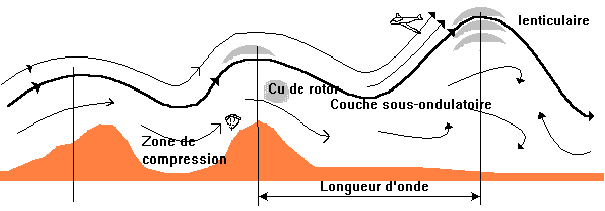
22 April 2013.
Shortly after posting my analysis of Jean-Paul Biberian's book, a researcher colleague, Frédéric Heny Couannier, assistant professor at Aix-Marseille University, also cited in the book on pages 95 and 96, responded with the message below, which I reproduce with his permission.
It is true that the results claimed by Italian Andrea Rossi would represent a thousandfold leap forward in thermal energy production via cold fusion using a nickel-hydrogen pathway, a technology that has reportedly undergone demonstrations and patent applications.
It is also true that if this advancement were real, it would provoke extremely violent reactions given the sums involved, as well as the geopolitical upheavals resulting from the emergence of this new technology—reactions that could even include threats of death directed at the individual.
But let us remember that we have known, even in France alone, impostures of unimaginable scale, such as the "sniffing aircraft." Watch this incredible investigation:
To be continued. J.P. Petit
From: Frédéric Henry-Couannier fhenryco@yahoo.fr
To: Jean-Pierre Petit jppetit1937@yahoo.fr
Sent: Monday, April 22, 2013, 12:09 AM
Subject: Re: Biberian's book on cold fusion.Jean-Pierre, I fear you may have missed the most important message in JP Biberian's book, found in the preface by Stanley Pons, co-discoverer of cold fusion. I quote this excerpt from page 11:
Very quickly, I realized the subject had been declared dead in America, embalmed in America, and buried in America; and as for me, I was unofficially exiled forever by "the men of the president."
It seems evident to me that the military labs of the DoD (Department of Defense) seized control of this cold fusion, deliberately discrediting it in the media. Such a discovery obviously had strategic implications. How could it be otherwise?
Hence, in my view, the systematic blocking of patents (Rossi), the taboo maintained in the media (like with water memory), the blocking of publications in prestigious journals—with the corollary that researchers working on the topic are forced to create their own journals (a trend observed in all fields outside mainstream science).
Such a subject is also abandoned by serious theoretical physicists, who are often far more loyal to the dominant paradigm than experimentalists.
Don't forget that Biberian is exclusively an experimentalist. What else could he do but try to recount all the experiments he attempted, mostly unsuccessful, but sometimes yielding positive results confirming those of colleagues and reinforcing his belief in the phenomenon—entirely in the most total groping, given the absence of a consensus theoretical framework?
Regarding Rossi, the possibility of a methodological error can be ruled out because this man:
- Claims to run his own factories (he's an industrialist) using energy produced by his reactors.
- Has emphasized that the steam exiting his e-cat was tested to confirm it was truly dry—answering the main methodological criticism often leveled against him.
- Claims his reactor can operate in a closed loop once in steady state (using part of the produced energy to reinject it as input to sustain the reaction), thus avoiding any external energy consumption in this mode.
So either he's telling the truth, or he's a complete fraud. But:
When you consider the scale of the fraud, it's still astonishing:
Rossi cooperated (signed agreements) with the Greek company Defkalion for a short period, after which there was a rather conflictual split. Shortly afterward, Defkalion announced it could soon offer a domestic reactor with performance similar to Rossi's and published its independent results at the summer 2012 conference. Plenty of details here:
Defkalion and Rossi are now competitors. So if there is fraud, it's not only monumental (given the substantial resources involved), but also contagious, since it now involves a company (Defkalion) with dozens of engineers and scientists who have published results independently of Rossi, exactly on the same technology (nickel-hydrogen)!
What I believe:
Rossi, blocked and threatened with death, may have leaked information to Defkalion—the only way out for him—to ensure the future of his discoveries... otherwise, what are the odds that both would independently develop the famous device capable of multiplying cold fusion performance a thousandfold, while hundreds of independent researchers worldwide trying to guess Rossi's secret have failed?
When I posted this on the Defkalion forum, all my posts were deleted. I asked for explanations, and they apologized, citing a "mistake," but couldn't restore my posts (with links to my site and forum exchanges). I was about to repost when the Defkalion website simply disappeared for several months! Then it reappeared recently, but without the forum.
Defkalion had invited dozens of "experts" for a demonstration last spring. JP Biberian was one of them... the day before, everything was canceled!
Rossi's latest message seems quite clear: the domestic e-cat is blocked (patents), while the e-cat MegaWatt is currently acquired by a secret military organization! Yet, we can read here that initially:
Defkalion was created to commercialize the black box technology Rossi claimed he had on a global scale, excluding the United States of America and all military applications.
This gives an impression of a blackout.
I've been trying for years to enlighten JP Biberian about what truly hinders cold fusion, but I think he only recently truly grasped it. Now retired, he can more easily consider that this research obstacle stems from a real conspiracy, whereas when he was active, it was harder to believe.
Fred
Returning to what we might consider a complement to this analysis of the book—a digression on the hope of achieving sonofusion.
It all begins with the phenomenon of cavitation, identified in 1917 by Lord Raleigh (co-inventor, among others, of the Rayleigh-Taylor instability, a phenomenon that dooms laser fusion attempts at the U.S. NIF and, in the future, on the French Megajoule facility). At the beginning of the century, it was discovered that the bronze propellers of His Majesty's warships seemed eaten away by moths. The explanation is as follows. When the propeller rotates, a region on the outer edge of the blade experiences a depression. The pressure drops below the saturation vapor pressure of water. A hemispherical vapor bubble forms and grows. But carried by the liquid flow, this vapor bubble then moves downstream into a region of the blade where pressure rises again. The vapor hemisphere is then recompressed. That is, along this liquid-vapor boundary, pressure suddenly increases. This triggers a centripetal hemispherical shockwave that converges toward the geometric center of this small volume, located at the blade's surface. This self-focusing shockwave concentrates energy into a tiny zone, which then experiences an impact corresponding to extremely high pressure (several thousand atmospheres). In a very localized area, the temperature exceeds that of bronze fusion. By combining the mechanical shock and thermal shock, rapid metal abrasion occurs.
Cavitation can also be achieved by subjecting water to pressure oscillations created by a piezoelectric crystal, generating ultrasound. When in the rarefaction phase, cavitation manifests within the liquid, with the appearance of spherical vapor microbubbles. In the compression phase, the same scenario occurs, with a centripetal spherical shockwave. Once again, the pressures and temperatures reached are considerable (5,000 bars, 5,000 to 10,000 degrees). The high temperature excites water molecules, causing their dissociation and the emission of a bluish light (phenomenon of sonoluminescence).
There is no doubt that, locally, extremely high temperatures are reached in a liquid medium by creating a micro-cavitation phenomenon via ultrasound. Indeed, one can buy online a fairly inexpensive kit—a probe that produces ultrasound, which can be submerged in water. Then, if you submerge everything in darkness, the water emits a beautiful bluish glow.
Biberian, in his book, page 73-64, mentions an attempt by Californians Roger Stringham and Russ George to achieve fusion reactions using ultrasound, acting on heavy water—where hydrogen in water molecules is replaced by its second isotope, deuterium. They placed a sheet of this material, the magical substance used by Pons and Fleischmann in 1988, inside a volume of D₂O—a metal capable of absorbing 900 times its own volume of hydrogen, to the point of... expanding.
Of course, researchers are looking for abnormal heat release, which is problematic since ultrasound supplies energy to the water. Moreover, in the hangar where the experiments were conducted, frequent temperature fluctuations made calorimetric measurements unreliable. But Biberian, who collaborated on these experiments, after raising these concerns, writes: "Nevertheless, I was able to make my small contribution and clearly demonstrate an unusual heat release." How? Mystery. On the next line, he adds an important clarification: Stringham and he were vegetarians (I’m not making this up—you’ll read it yourself).
Stringham was convinced that the bubbles forming on the palladium surface triggered nuclear reactions. And Biberian comments, on page 74:
- Indeed, on the palladium sheet, one could see under the electron microscope melted spots and craters, indicating violent reactions.
In the book, he confesses his lack of expertise in chemistry. If Biberian were examining ship propeller helices, he would also observe traces of "violent reactions."
No, these are not "reactions," but rather the effect of mini-shockwave focusing— a phenomenon well known to physicists for a long time.
http://www.youtube.com/watch?v=agoshqLW59Y
Superconductivity******
April 25, 2013:
Email from Jean-Paul Biberian, reproduced with his permission.
My comments are in red.
From: Jean-Paul Biberian To: Jean-Pierre Petit jppetit1937@yahoo.fr Sent: Wednesday, April 24, 2013, 9:47 AM Subject: Regarding your comments on my book Hello Jean-Pierre, I just read with astonishment your critique of my book: Fusion in All Its Forms: Cold Fusion, ITER, Alchemy, Biological Transmutations, published by Trédaniel.
First of all, my first name is Jean-Paul, and I am retired from Aix-Marseille University, not from CNRS, and thank you for not holding a grudge against me!
My apologies. I corrected it immediately. If you tell me your academic title at the university before retirement, I could mention it.
This book is intended for the general public, not a scientific work. It’s not “nonsense”—I’m actually telling a story, my own, through my scientific journey. I describe what I did, the people I met, what worked, and what failed. In short, the life of a scientist that the general public may not know. I’m not a role model, but simply recounting my path. Much of what I wrote, I actually said in my lectures—this is normal, I only have one life to tell.
If you're telling your life story, then the title should have been different. You chose Fusion in All Its Forms: Cold Fusion, ITER, Alchemy, Biological Transmutations...
You should have instead chosen something like:
Memories of a Researcher Straying Off the Beaten Path, for example.
Regarding ITER, I gave a brief overview of the situation and shared my opinion. I couldn’t expand much on the topic, as I never truly worked on tokamaks, but I know enough to form and share an opinion.
No, you don’t know enough. This is a very complex issue requiring cutting-edge knowledge in plasma physics and MHD, which you lack. It’s just a weak digression. ITER is a serious international problem. It represents a massive misallocation of public funds, unprecedented in scale. If you had wanted to discuss this topic and consulted me beforehand, I would have provided more precise data. The true experts in fusion (and I’ve become one of them) know this machine will never deliver what’s expected—it will always be nothing but a colossal waste. It’s too unstable, and these chronic, harmful instabilities appear incurable. Look at Wurden’s presentation at Princeton in 2011, available on my website.
Cold fusion is an entirely new scientific field, and to date, there is no fully satisfactory theory to explain it.
Then how can you claim to be a science popularizer in a domain that no one fully masters?!
It’s possible that with current knowledge in quantum mechanics and solid-state physics, we might eventually explain the phenomenon—but it’s uncertain. It’s also possible that this is a new phenomenon requiring entirely new ideas beyond what is currently known.
That’s why a scientific journal like the one I edit: Journal of Condensed Matter Nuclear Science, must maintain an open-minded approach in selecting published articles. I remind you that this is a peer-reviewed journal, and all articles published have undergone peer review.
The journal publishes articles on cold fusion. If these articles are validated by referees, then those referees must automatically be experts in the field. But how can people claim to be experts in a domain that no one masters? That makes no sense. It might be acceptable as a newsletter for members of a community, but not as a peer-reviewed journal. Someone needed to say it.
A too-strict control might let a promising idea slip through. This editorial approach isn’t about discrediting, but about openness to new ideas. It’s up to the reader to judge for themselves.
This sentence shocks me. How could the average person be capable of judging a scientific approach described in articles? A method that can only be validated by concrete facts. Yet, for a quarter of a century, cold fusion has made no notable progress in terms of verifiable facts. Apart from the alleged breakthrough by Andrea Rossi. That’s something very significant. At this point, there are only three possible scenarios:
Either it’s a major discovery. Then it must be rapidly integrated into the international energy landscape. Resources must be made available to develop this new field.
Second possibility: the discovery is real but suppressed by military or financial powers, as suggested by Frédéric Henry Couannier. Then an investigation is needed, and if confirmed, it must be revealed and every effort made to bring it to light.
Third possibility: it’s a hoax whose echo has reached the entire planet. Then we must acknowledge it and denounce such practices. The scale of resources involved is unprecedented. See the case of the sniffing aircraft:
Alchemy is an interesting topic, since it implies transmutation. By recounting my experimental adventure in alchemy, I simply wanted to show that a researcher must remain open to new ideas. As an experimenter, I tried to reproduce alchemical experiments. I didn’t “have nothing to say”—I simply found nothing. I believe this is important. A negative result is still an interesting result.
I find your chapter adds nothing. It’s merely anecdotal. If it’s an episode from your professional life, the chapter title should be changed. You titled it “Chapter 9, ALCHEMY,” and on the cover you used the enticing word: “Alchemy.”
It should have been:
“Chapter 9: ‘Cabbage White in Alchemy,’ or ‘My Misadventure in Alchemy.’”
You saw in my comment that I cited the experiment I conducted under Cau’s direction. Even if no transmutation occurred (which needs clarification), the gold deposition on the sample’s surface remains an undeniable and perfectly reproducible phenomenon that deserves study.
Regarding biological transmutations, I believe this topic is important—very few people know it exists. It was important to discuss it, especially since I personally conducted successful experiments in this area. In science, not everything is published. My results reproducing Kervran’s work will be published once I’ve completed ongoing experiments.
So here are experiments that aren’t published or even finished, yet you write on page 152: “From there, I successfully reproduced part of Kervran’s experiments.”
The first review article in the appendix of my book concerns biological transmutations. It’s the first article of its kind. It was published in the Journal of Condensed Matter Nuclear Science, which I edit, but like all other journal articles, it went through peer review. I am not the referee for French language—articles are all in English, and I am the only French member of the editorial team.
Same remark as above. Your publication should be titled: Newsletter for Researchers Working on Low-Temperature Fusion in Condensed Matter.
That’s just a newsletter, not a peer-reviewed journal, since there are no experts in this field, which remains unmastered.
Indeed, being of Armenian origin, I have an Eastern flair, and I love stories. After all, the science we love is the one that tells us a story—whether it’s the origin of the universe, the extinction of dinosaurs, the discovery of radioactivity, X-rays, or superconductivity.
This book isn’t a “soukh” (a collection of anecdotes). It’s a journey through the life of a researcher. Cold fusion might be similar to Edison’s search for the right filament for his incandescent lamp—trying many materials before finding the right one. When we lack a theory to guide us, we experiment in various directions until we find the right one. The experimenter is indeed a bit like a “cook” who tries adding a little of this, a little of that.
I don’t see things the way you do, even though I also love stories and have written many. I have forty years of research behind me, and at 76, I continue. In September 2013, Doré and I will present a 100% original, completely unambiguous experimental work on MHD at an international plasma physics conference of the highest level in Warsaw, following international conferences in Vilnius (MHD), Bremen (supersonic aerodynamics), and Korea (plasma physics). At Warsaw, we will present experiments focused on “disk-shaped MHD aerodynes.” We’ve already published three articles in Acta Physica Polonica, a genuine peer-reviewed journal, and we’ll continue along this path.
My professional life isn’t a “soukh.” I’ve worked in many directions, rationally, methodically, and systematically, supported by solid foundations. I’ve had to fight hard, and I’m still forced to do so. The publications in question are always in top-tier peer-reviewed journals. Some experimenters are cooks, not me. In my research, theoretical work, construction, and experimental validation of predictions have always gone hand in hand.
Jean-Pierre, don’t worry—the major media aren’t interested in this topic. The blackout is total. Yet at the highest levels, everyone knows. Stanley Pons clearly states this in the preface he kindly wrote. My encounter with the police, which I recount in the book, is also significant.
It’s especially regrettable that cold fusion researchers haven’t produced any verifiable, reproducible experimental results. Far from blaming them, it’s quite normal when exploring an unmastered subject. My friend Benveniste faced similar difficulties, likely because he didn’t realize that distilled water bottles purchased by his lab could differ in their “nano-structure,” despite their purity, meaning there isn’t just one kind of water, but many. But this doesn’t simplify things when dealing with the media.
Cold fusion is already 24 years old, and since its beginning, progress has been significant—we understand much better what’s happening, what needs to be done to succeed, and especially what must be avoided.
How can you “understand better what’s happening” without a model to interpret what’s observed?
I appreciate that you “think research into catalyzed fusion should be supported,” since it’s not currently the case.
My support on this point is total. It always has been.
Once again, the Journal of Condensed Matter Nuclear Science publishes articles from many authors not on the editorial board. It’s not “laxity,” but openness to new, non-orthodox ideas.
I didn’t mention “laxity.” You did, on page 192 of your book, where you quote:
"It’s better to be a bit lax..."
Regarding the sonofusion experiments with Roger Stringham, it’s clear that if I mention palladium fusion, it’s because we observed excess heat. Of course, it could simply be due to cavitation effects. It’s the correlation between fusion and abnormal heat that I noted. Moreover, it’s evident that we subtracted the heat directly supplied by the ultrasound from our measurements!
I didn’t contest that measurement, but rather your interpretation of the melted spots on the electrode surface, which you link to “violent reactions.” I quote:
Page 74:
- Indeed, on the palladium sheet, one could see under the electron microscope melted spots and craters, indicating violent reactions.
Yet the impact of shockwaves from cavitation can perfectly melt this metal—a phenomenon known for... a century.
I wish for a day when energy production via low-temperature nuclear reactions, and ideally without waste, could become established in the international energy landscape.
Jean-Pierre._______________ After accepting the email for online publication, in reply: Good evening, I was a Maître de Conférences.
I fully agree with you regarding ITER. I haven’t studied the subject as deeply as you have, but I know it’s a dead-end project. Unfortunately, it’s an international project very hard to stop, and it will continue spending vast sums of money for a long time...
I’ve certainly heard a lot about over-unity magnetic machines, but I’ve never yet seen one that actually works.
However, it’s not because we lack a theory that we can’t study a scientific subject. It took 50 years to understand low-temperature superconductivity, and we still don’t know why high-temperature superconductivity works. Catalysis works, even without a complete theory, and researchers continue developing catalysts through much trial and error.
Entirely agree.
Was discovered in 1911 by the Dutchman Kamerlingh Onnes using mercury cooled to the temperature of liquid helium. This discovery was part of a logical program: studying the properties of materials at extremely low temperatures. Immediately, the experimental fact could be sustained over time and proved perfectly reproducible. Experimental parameters could be precisely defined. This allowed the work to immediately become a new branch of physics, without any possible controversy. No one could stand up and say, “I don’t believe in superconductivity.” In such conditions, it doesn’t matter that theoretical modeling wasn’t ready. Astronomers didn’t wait for a full explanation of how stars work (fusion) before studying them through spectroscopic analysis and classifying stars based on their spectral signatures. And all astronomers aiming at the same star found the same spectrum. It’s different when research faces major reproducibility difficulties. I followed day by day the (dramatic) efforts of my late friend Jacques Benveniste (we were very close). He didn’t master the parameters, and we still don’t measure them. And you know that when you organized a cold fusion conference in Marseille, you tried to set up a demonstration experiment that could have been shown to the press and skeptics—but unfortunately, it failed that day.
You can leave my email; anyway, it’s easy to find on my website.
Sincerely
It would be interesting to create cavitation not with ultrasound, but using a convergent-divergent nozzle, a disk-shaped nozzle, producing a very high expansion ratio. And this with upstream pressure reaching thousands of bars.
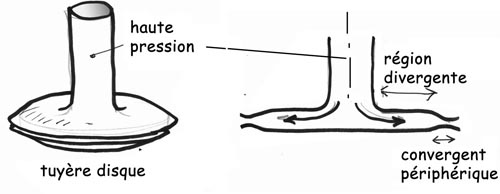
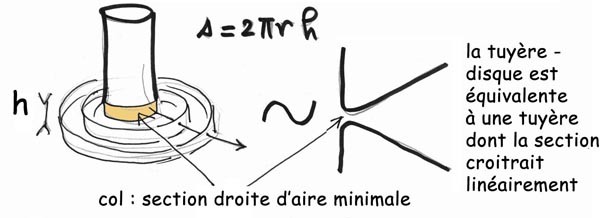
When the liquid is pushed into the divergent section, unable to expand like a gas, it would become populated by vapor bubbles through cavitation. A subsequent change in cross-section, with a peripheral convergent part, would trigger implosion of these bubbles, generating a new spherical, inward-moving shockwave.
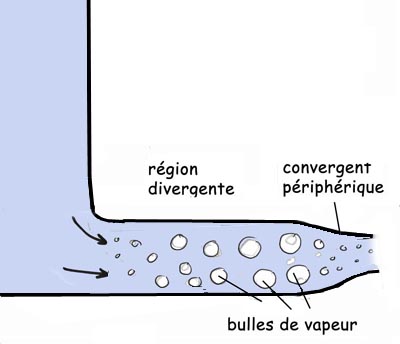
Cavitation in the Disk Nozzle
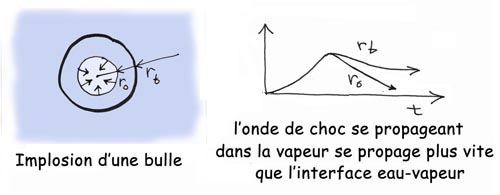
The Mechanism of Bubble Implosion in Cavitation
We could enhance the expansion by placing not disks, but two truncated cones face to face.
I think the energy associated with this implosion could be greater than that delivered to microbubbles by an ultrasonic actuator. I don’t exclude that temperatures at the center of these bubbles could reach values exceeding hundreds of millions of degrees, making fusion reactions conceivable.
Why not a brutal compression-expansion-recompression cycle of a liquid deuterium-tritium mixture? Why not a compression-expansion-recompression of liquid lithium hydride (the explosive in hydrogen bombs), or liquid boron hydride (aiming for neutronless fusion)?
To conclude this page, before the file disappears from the internet, if you’d like to relax, watch or rewatch this masterpiece by Jules Romains, the film Knock, starring Jouvet. A film that hasn’t aged a day—unlike many old films now accessible online:
Knock with Jouvet
http://www.youtube.com/watch?v=QXNDOtd0vYw
In passing, I also suggest:
The Construction of Pyramids in Ancient Egypt with Closets.
http://www.youtube.com/watch?v=OU1IiPr_1uI
A somewhat old film with beautiful visuals and occasional humor (I love the pre-title sequence), where Closets repeatedly says, “No, these pyramids are not tombs.” I agree with him. If tomb robbers emptied tombs, it would be logical to find fragments of cloth, bandages, wood—something to analyze. But nothing. Did they vacuum the site before leaving? If elements were removed from burial chambers, reinforcing the theory that they were tombs, where are they now, and what did we learn from their examination?
Could Egyptologists, over the years, have carefully cleaned the burial chambers of all debris “to make them more presentable”? It’s not impossible. Years ago, I examined the Entremont site, west of Aix-en-Provence, just after the city’s exit. A Gallic oppidum discovered during WWII when the Germans wanted to install a radar there. They dug in hopes of finding water, and it was then that the rich archaeological site beneath the hill became apparent.
After the war, Fernand Benoit, who became head of archaeological excavations for the Provence-Côte d’Azur region, conducted digs. They found piles of “pottery fragments.” Benoit gave his orders:
- Clear all this out so we can see clearly!
It was done. And thus vanished all the puzzle pieces—fragments of Gallic hearths, which were broken after use to extract the cast iron cake. Precious information sent to the dump—whole tons.
If you visit the site, you’ll easily find a wall with three small openings. The ground in front has been... concreted. If you examine these three openings carefully, you’ll notice they aren’t the same height. The lower part of the left small door is lower than the upper part of the right small door.
I believe this was a long, tunnel-like furnace, where the left door served as the air inlet and the right door as the exhaust. The central door was for filling and cleaning the duct. The longer air residence time allowed higher temperatures, thus refining the iron cake. The cakes to be refined were stored in a tunnel above, made of clay, destroyed when the enriched cakes were retrieved.
No archaeologist has ever paid attention to this.
Returning to the pyramids, I incline to think they were primarily initiatory sites. At least some of them, like those at Dashour—the “Red Pyramid,” for example. They imprisoned neophytes. To be initiated, candidates had to enter a vegetative state similar to what Yogis can achieve—reduced heart rate, lowered body temperature, etc. It was as if one said to the candidate:
- If you want to live, you must first die, then be reborn.
If their spiritual preparation was sufficient, the candidate passed the test. Otherwise, they were found dead in the chamber.
To return to the top of this extensive page on Fukushima ---
Nouveautés Guide Page d'Accueil
http://fr.wikipedia.org/wiki/Catastrophe_de_Tchernobyl
.