Lee Smolin and Peter Woit's books on Superstrings
Nothing is going well in physics!
June 22, 2007 - updated on March 6, 2008: the book "Not Even Wrong" by Peter Woit
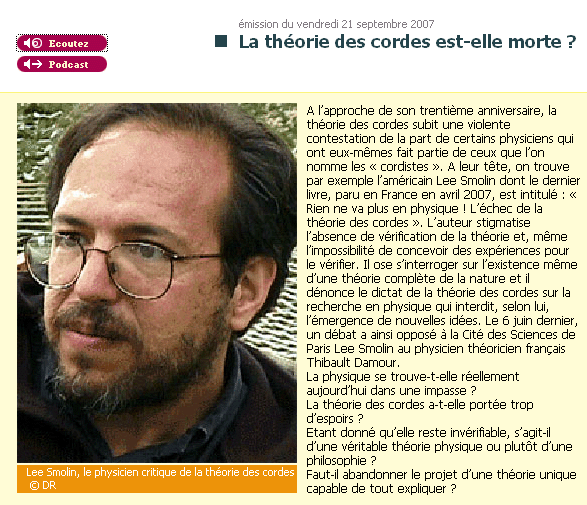
| Added on September 22, 2007 | : "Debate" on France Culture, between | (member of the Academy of Sciences, Institute of Advanced Studies in Bures-sur-Yvette), | (professor at the Collège de France) and Costa Bachas (research director at CNRS at the physics department of the École Normale Supérieure in Paris) on September 21, 2007 |
|---|
Added on September 22, 2007
: "Debate" on France Culture, between
( member of the Academy of Sciences, Institute of Advanced Studies in Bures-sur-Yvette ),
( professor at the Collège de France ) and Costa Bachas ( research director at CNRS at the physics department of the École Normale Supérieure in Paris ) on September 21, 2007
This article announced a ... debate. I listened to this long and boring performance. Detail: the three "protagonists" are all three involved in this same theory! I'm stunned...
Smolin's statements are distorted, particularly by Damour, who contrasts the projects proposed by "loop gravity" by Smolin and Rovelli and those of string theory by saying "loop gravity has not also proposed elements that can be confronted with observations". He ignores the central axis of his book, which is:
- We need completely new ideas. For this, researchers must be able to venture into other paths. What is shocking is that string theory has monopolized, for thirty years, grants, credits, positions, and discouraged any approach that could go beyond this framework.
The scandalous fraud of string theory, the only "global" theory of physics, finally revealed
**nonsense ..... **
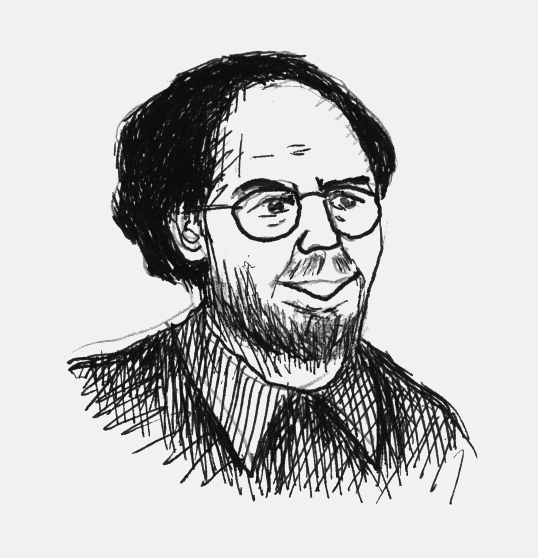
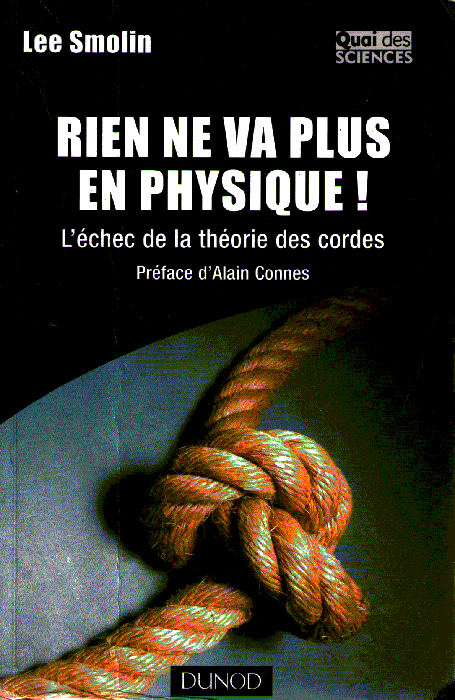
The theoretical physicist Lee Smolin has just published a book titled "Nothing is going well in physics!", published by Dunod.
**Lee Smolin **
Curriculum vitae and scientific publications of Lee Smolin
A thick book of 485 pages. But I recommend reading it. I think this book will be a milestone in the history of science.
the opinion of the mathematician Michel Mizony
| July 20, 2007 | : A bit specialized: | , director of the IREM of Lyon |
|---|
| July 20, 2007 | : A bit specialized: | , director of the IREM of Lyon |
|---|
I don't know if there is a precedent of this kind. Smolin is "at the peak of his career", as he concludes at the Perimeter Institute, in Canada. This book traces his career, where he has participated for three decades in what could be called a frenzied research carried out by thousands of researchers to try to give a new breath to theoretical physics. For example, he points out that in thirty years, thousands of researchers have published some ... one hundred thousand articles on string theory, without any concrete results. He himself has produced eighteen articles on this subject.
Before commenting on this book, I encourage you to follow the dialogue between Lee Smolin and Thibaud Damour, at the Cité des Sciences, organized under the auspices of Dunod editions and the magazine Ciel et Espace, this "debate" being hosted by journalist David Fosset, who works for this magazine. The address to access this video:
According to a reader, this video can be viewed with Real Player. He suggests installing a "light" version, without ads and without this version being automatically installed as the preferred one.
Click on the blue camera, the one on the left
Someone who has not read Smolin's book cannot really appreciate the replies that punctuate this debate. I just want to make a few remarks. At one point, Smolin says that when a progress is recorded in science, things simplify, become clearer, more harmonious. Damour cites an example to prove the opposite, referring to a change in vision for the solar system, by moving from the Kepler model to the Newtonian one.
The Kepler model was purely phenomenological. It started from very precise observations made by the Danish astronomer Tycho Brahé. From these data, it was no longer possible, considering the heliocentric model of Copernicus, to consider that the trajectories of the planets occurred along circles. You probably remember Kepler's laws.
- The trajectories of the planets are ellipses, with the Sun located at one of the foci.
- The squares of the orbital periods are proportional to the cubes of the major axes.
Kepler observed this, but did not "explain" it, he had no theoretical model to justify it. It was Newton who allowed the construction of these same trajectories mathematically, simply considering that the planets were "point masses", attracted by the Sun, another point mass, according to the law that he left his name. There is therefore a simplification. Kepler's observation can then be translated as:
*- The trajectories of the planets follow the laws of Newtonian mechanics, according to which two objects attract each other proportionally to their masses and inversely proportionally to the distance between them. *
A mathematician can then demonstrate that these trajectories are planar, and are more precisely conic sections (circles, ellipses, parabolas or hyperbolas in the case of asteroids or comets).
This aspect therefore gives Smolin the right. But Kepler also tried to explain why the planets had settled on certain orbits, and not others. An empirical approach led to the "Titius-Bode law", which has not known an explanation to date. Kepler failed in an attempt to describe a "geometric nature", according to which planetary trajectories corresponded to "nested polyhedra" ( see my comic strip Cosmi Story, freely downloadable on the site http://www.savoir-sans-frontieres.com. more precisely at this link. It turned out that Kepler's model did not match the observations.
In Newton's vision, planets can settle on any orbits, the only constraint being that their movements obey the laws of mechanics. Damour uses this to mention that the planetary model of Newton is "with free parameters", these parameters being the radii of the orbits. He does not attach himself to the Titius-Bode law, because he does not see its ontological origin. Kepler's attempt seems to him to be an attempt to determine, at least the ratios of the orbits, if not their values. This speech evokes the effort made in theoretical physics ( without success so far ) to try to understand what these "provisionally free parameters" are, which are the masses of the particles, and the relations between them.
As will be seen in Smolin's book, contemporary theoretical physics represents a caricatural explosion of the number of these free parameters, which are frequently counted in ... several hundreds. What has so far been quite hidden from the public is the fact that, in the most advanced approaches of string theory, the adherents of this strange discipline admit that their choice must be made between 10500 possible theories ( ... ), each theory representing a particular choice of parameters and physical laws. Of course, one could say that it is sufficient to select in this "theoretical landscape" the correct law, which will account for the observations based on the incontestable achievements of elementary particle physics. Unfortunately, the proponents of this string theory admit they have no idea of how to proceed.
But let's go back to this evocation of the passage from a pseudo-model, that of Kepler, regarding the arrangement of the orbits, to a return to greater freedom, these orbits becoming free parameters. Is it really so?
There is a work, due to the mathematician Jean-Marie Souriau, which shows that a system of masses orbiting around a central star, a sun, distributes its orbits according to a "golden law", which is also very close to the empirical Titius-Bode law.
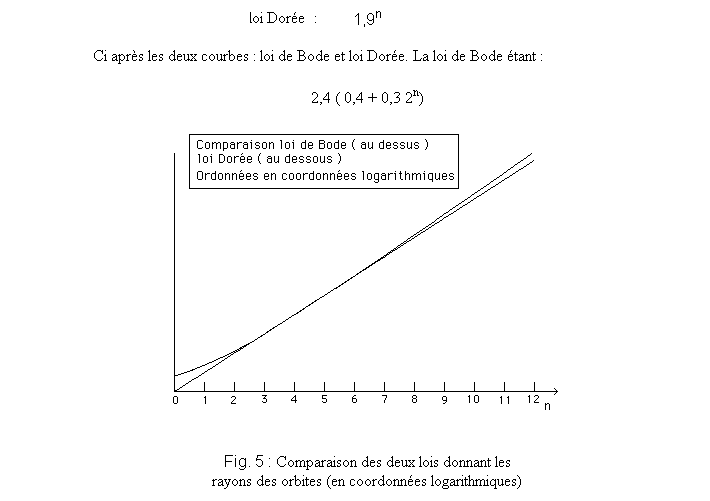
I refer the reader to the file on my site. In a few words, the planets, as they circulate around the sun create a tidal effect on it. Take the example of the Earth-Moon pair. Assume the Earth is a perfect, homogeneous sphere. The moon will deform the Earth, transforming it into an ellipsoid whose major axis points towards the satellite. This is terrestrial tides ( half a meter ) and not marine tides. Every day "when the Moon passes over the Earth" the Earth's surface ( the Earth's crust ) rises by half a meter.
Same phenomenon when a planet orbits the Sun. It transforms the "solar sphere" ( or "quasi-sphere" ) into an ellipsoid, whose major axis points towards the planet in question. The effect is in one over r cube. Thus a planet like Mercury is able to create, on the surface of the Sun, the same effect as its giant cousin Saturn, this effect being represented by a lift of a few centimeters.
The planets "use the Sun" to inform themselves of their respective positions. The Sun serves them as a "resonator", "antenna". These tidal effects combined mean that the gravitational field due to the Sun no longer has a beautiful spherical symmetry. This is translated into alterations that modify the trajectories of the planets. The first effect is to bring them all to circulate in the same plane. Is this the plane perpendicular to the axis of rotation ( initial ) of the young Sun?
No. The star that leads the game, on this plane, is the one that has the "greatest angular momentum", that is to say the greatest MRV, where M is the mass of the planet, R the radius of the orbit and V the orbital speed. The Sun also has an angular momentum, which is calculated by integration. It is the sum of all the elementary MRVs. Nevertheless, from this point of view, the dominant star is not the Sun, but ... Jupiter, the "king of the gods".
A parenthesis. Where do these angular momenta come from? When the solar system forms, the Sun still belongs to a star cluster, collisional. It is only later that this cluster will completely disperse, something astronomers only really became aware of a little over ten years ago.
Before this "cluster lets go", dynamically unstable, disintegrates, the proto-stars are relatively close to each other. Around them, planetary systems are formed. One could rather speak of proto-planetary systems.
These systems brush against each other, interact. In books I have compared these systems to fried eggs wandering on the surface of a large, well-oiled pan. The "whites" rub against each other, not the "yolks". If after the "fried eggs" disperse, we will have "whites" with a rotational movement, endowed with an "angular momentum", while the yolks will have benefited little from these energy exchanges. All this to justify the fact that a planet located at the periphery of the solar system contains the bulk of the angular momentum of the system.
The planets will therefore modify each other's trajectories by tidal effects, as well as modify the axis of rotation of the Sun. In fact, the planet Jupiter will constrain all this to orbit in its plane of rotation, which will become the plane of the ecliptic. We cannot know how the axis of rotation of the Sun was initially oriented. But since Jupiter has a greater angular momentum than the Sun, it is he who will have constrained this axis of rotation to straighten up and be located in a direction practically perpendicular to the plane of the ecliptic, the plane where Jupiter initially orbited, becoming the plane of the ecliptic. But as Jupiter has a greater angular momentum than the Sun, it is he who will have constrained the axis of rotation of the Sun to straighten up and be located perpendicular to the plane of its orbit.
Tidal effects result in modifications of the orbits. One of these effects is their circularization. Souriau has highlighted the result of these tidal effects on the ratios of the orbits.
Two systems can exchange energy by resonance. Take, for example, a musical instrument with two strings. The first has a vibration frequency N1 and the second a frequency N2. If you pluck the first string, the second will not remain indifferent to the sound waves it produces. If the two frequencies are equal, the effect will be maximal. It will still exist if the ratio of these frequencies is equal to a rational number, equal to the ratio of two integers. But the effect will begin to deteriorate when this ratio tends towards an ... irrational number, like the square root of 2.
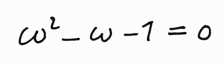
A mathematician, Kantor, then constructed a measure of the degree of irrationality of a given number. At the end of this study, one comes across an equation that provides "the most irrational of all numbers" and it is ... the golden number:
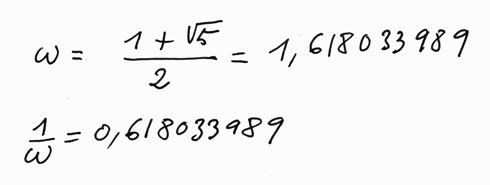
At the end of his study on the degree of irrationality, Kantor finds that the most irrational of all numbers is the solution of the equation:
Back to a planetary system with a sun and two planets. Initially the orbits are arbitrary. The trajectories will then be modified by tidal effects, the central star playing the role of an antenna. The system will evolve until the ratio of the orbital periods of the two planets is equal to the golden number. The system will then have converged to a state of minimal resonance.
If there are more than two planets, the system is a bit more complicated, but converges towards Souriau's "golden law". There would be a nice doctoral thesis to be done with all this, now that the computing power of computers allows handling such systems. It would not be so complicated, in the sense that the planets could be assimilated to material points. Only the Sun would need to be "meshed" with sufficient precision.
Therefore, Damour is wrong when he says that the passage from Kepler to Newton has shifted astronomy towards a system with many free parameters. These trajectories are constrained and all this can be derived from a mix between Newton's law and the Navier-Stokes equations ( fluid mechanics ), describing the behavior of the Sun;
Few people know this work of Souriau, presented at an obscure astronomy congress in Geneva in 1989, moreover in French ( Souriau does not write, read or speak the language of Shakespeare, and at 85 years old, it is unlikely that this will change ). I don't think André Brahic knows this work. Add that the golden number has a bad reputation, giving off a smell of sulfur. Would Souriau be into alchemy? Not exactly, but let's say he has read a lot....
The golden number is found in many ancient constructions. Even a search for "non-resonance", but this time regarding resistance to seismicity. But this, as Kipling would say, is another story. Back to the Smolin-Damour debate. The first invokes Leibniz, in search of "first causes". Immediately, Damour makes an astonishing reply:
-
- Smolin is too smart to fall into this kind of naive popperism* ( the exact phrase is very close ).
Karl Popper is a philosopher who highlighted the concept of "falsifiability" of a theory. The translation of this word is misleading. Falsify, in French, means "to make a fake". A more correct translation would be "to check if a theory can be refuted, for example, to predict effects that will not be observed". For Smolin, this approach is inescapable. For Damour, regarding string theory, it is simply outdated. He even invokes a bit later the famous Italian expression " si non e vero, esta bella " ( "if it is not true, at least it is beautiful" ).
In short, scientists can easily justify three decades of a physicist's career, even if this approach leads to a void, provided that "it is beautiful". Remember, in this regard, the title of the book by Michael Green "The Elegant Universe" ( "the smart universe" ). In string theory, the emphasis is on "elegance". But how is it measured, according to what criteria should it be appreciated?
I recall the balance of the work on strings: one hundred thousand papers in thirty years.
Here, I leave the word to the mathematician Souriau. According to him, these mathematics are not very elegant. The calculations are, in fact, abominably tedious. Smolin talks about thousands of lines of calculation, containing dozens of terms, that the theorists have to arrange on large notebooks, bought in art supplies stores (...).
It seems that his personal definition of theoretical physics is confirmed:
A physics without experience and a mathematics without rigor
All this is a first comment on this book by Smolin. I will have to come back to it. A few flashes in passing. Smolin locates the origin of this string theory, which is also before the appearance of the "standard model" ( the leptons, plus the hadrons, made of quarks ). The underlying idea is unification and it is immediately very attractive. Nevertheless, I am a bit like everyone else. I try to get a (vague) idea of what this famous string theory might be. There are no popularization or awareness books on this approach. Smolin gives some clues.
Physicists know the concept of Lagrangian and the principle of least action. One can find an introduction to this concept in " The Adventures of Nicolas Boubakov " ( page 17 of the pdf ), the result of a collaboration with the mathematician Boris Kolev, from Marseille. Boris had an excellent idea to highlight the concept of Lagrangian, starting from the calculation ( exact ) of the shape of a soap film that rests on two coaxial circles. The soap film then establishes itself in such a way that its area is minimal. The area of the soap film is calculated using an integral. One can calculate the shape of this surface ( the equation of the meridian of this surface of revolution ).
Boris uses this starting point to extend it much more generally. The area of the soap film is then just a "particular action", calculated through an "integral", from a function, which appears in this integral and which is only a "particular Lagrangian". For a non-scientist, what does this mean? An "action" is a quantity that is calculated according to an "integral", on a "path". This path, let's assimilate it to the behavior of a physical system in a sort of configuration space. It turns out that many solutions to physics problems can be translated in terms of the search for a "minimal action". The act of "minimizing this action" will provide the "path", the way the system will evolve or behave.
A Lagrangian can simply be a function that, intervening in an action integral, allows to calculate the distance traveled to go, on a surface, from a point A to a point B. If one minimizes this distance, the path will correspond to what is called a geodesic. It is a static image. But this idea of geodesic, of "shortest path", also applies in space-time.
Why "strings"? According to what I understood (...) a "string" is supposed, when it is open, to carry two charges, one at each end. Smolin then evokes the idea of electric field, materialized by "field lines":
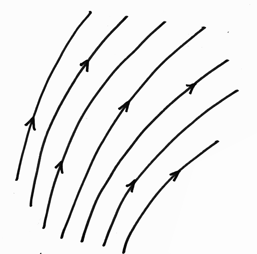
**Electric field lines **
One could "recreate" this field by assuming that it spreads in the vacuum by placing in space objects that are small "strings" at the ends of which there would be electric charges, positive and negative, similar to electron-positron pairs.
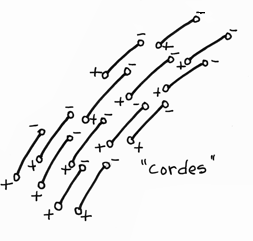
An image that suggests, very vaguely, that strings could represent both the "objects" and "fields", the forces. The underlying idea is unification. Quantum electrodynamics represents this kind of "unification" approach where conceptual elements of nature are included in a single "family", where they are found to have "a family resemblance". Thus a charged particle is an object. An electromagnetic force is ... a force. At first, force and objects subject to these forces, or (and) creating them, seem to be conceptual elements of different natures. In quantum electrodynamics, when two charged particles interact ( "act on each other" ), this force proceeds by exchange of particles that carry the force, the "transport" ( hence this generic denomination of "carriers" ). The charged particles interact by exchange of virtual photons. Thus the force and the object creating and suffering the force acquire similar natures. A unification is achieved. As noted by Smolin in his book in his chapter 4: "Unification becomes science", this theme of unification is at the center of the concerns of contemporary physicists.
It will be seen later that the idea ( strong ) of the people of "loop gravity, one of their ideas, consists in seeking a description of the world where the container and the content are "of the same nature", where "space" and "matter" would be "emergent properties" of a same "pre-geometric" structure.
The string can be, in principle, ... anything. It moves in space, it vibrates, can break, close on itself. All these contortions are supposed to represent phenomena. Consider a string moving in space. It will follow a surface element:
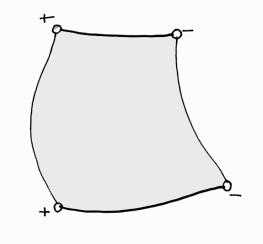
Surface envelope generated by the movement of a charged string
On page 162 of his book, Smolin then lists what the string theory, the new "lego" of theoretical physics, is supposed to bring. He specifies that "the list is impressive":
*- String theory provides us with an automatic and "free" unification of all elementary particles; it has also unified the forces with each other. These come from the vibration of a fundamental object, the string. *
*- String theory automatically provides the gauge fields, which are responsible for electromagnetism and nuclear forces. These emerge naturally from open strings. *
Electromagnetism is linked to charged particles: proton, electron. Nuclear forces are at work in atoms, binding quarks, the constituents of nucleons ( protons, neutrons ). The phenomena are assimilated to the behavior of strings, their vibration indicating a unification.
*- String theory automatically provides the gravitons, which come from the vibrations of closed strings. Consequently, we have obtained an automatic unification of gravity with the other forces for free. *
Indeed. The electromagnetic force and the nuclear forces, strong and weak, and the force of gravity derive from the behavior of a single object: the string.
This is what string theory makes possible, concludes Smolin. One can understand why the approach has attracted theoretical physicists like a lamp attracts moths. Imagine that at the beginning of the century someone had said:
*- We will replace what we have so far called particles with waves. Even more: we will unify waves and particles. Thus the objects that we thought were particles are also waves. Conversely, the forces, linked to waves, will be identified as ... particles, which we will call "carriers" (transporters). Each force, each field will have its own. The particle "carrying" the electromagnetic force will be the photon. To the strong nuclear force we will associate particles that we will call gluons. We will decide to call these force-carrying particles bosons. The force called weak interaction will be linked to other types of bosons. *
The temptation of strings has derived from the same "unification" approach. Quantum mechanics represented a unification of waves-particles. There, it worked very well. In the end, it led to what was called the standard model, managing the nuclear forces, strong and weak, and the electromagnetic forces. The nucleons, proton and neutron, were "disassembled" into quarks, linked by the strong interaction force, by "exchanges of gluons". All this turned out to be complicated but predictive. We were able to "break protons and neutrons". But it turned out that the forces binding the quarks increased with distance ( or at least this is how the impossibility of observing the behavior of quarks in free state was interpreted, which would have been identifiable, due to their fractional electric charges ). These could not travel freely and immediately recombined to give other particles, unstable, etc.
A nice construction game, giving these "jets" that you have all seen and that represent the result of an "event", a collision that occurs, at high energy, in a particle accelerator. Very quickly, theorists said "the force of gravity must be able to 'be part of the family': for this it is sufficient to consider the existence of a new particle 'carrying this force': the graviton. But for half a century, it has been impossible to make a decent graviton, to "quantify gravity". And here comes this new approach based on a model that seems very simple, with a single object, the string, open or closed, which seems to promise the desired unification. The force of gravity ceases to be "exotic". It is simply linked to the vibration of closed strings, as the academician Thibaud Damour rightly reminded during the meeting organized at the Cité des Sciences de la Vilette, face to face with Lee Smolin.
Smolin adds a quick lamp, which we can catch on the way. When the string moves in space-time, it follows a surface-envelope, creating a two-dimensional object, a surface. The following drawing represents an interaction between two closed strings, which merge.
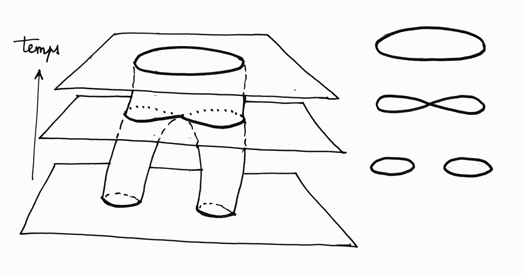
The strings envelope a surface of minimal area
Smolin writes, page 163:
*- This is therefore the dream that string theory makes possible. All the standard model with its twelve types of quarks and leptons and its three forces, plus gravity, could be unified, all these phenomena emerging from vibrations of strings that stretch in space-time according to the simplest possible law: that their area be minimal. .... String theory was so promising that it is hardly surprising that Schwarz and his collaborators, few at the time, were convinced of its truth. As for unification, no theory has offered so much from such a simple idea. *
The fact that the surface is minimal reminds us that in theoretical physics, many things happen by searching for these "extreme" situations.
I will not rewrite Smolin's book here. Nevertheless, this game could not be played in a simple space-time with three dimensions of space and one dimension of time. "Anomalies" appeared, aspects that could not be framed with physics. It was then necessary to introduce additional dimensions, to consider that the game of natural phenomena must be played in a richer geometric context, with ten dimensions, which Smolin describes as "nine dimensions of space and one of time". Thus the strings "move in a nine-dimensional space".
And this is where things began to get dramatically complicated. These additional dimensions must be managed. When you increase the number of space dimensions, things become complicated in a ... "exponential" way. Start from a one-dimensional space. You can only consider two objects: a closed curve and a segment ending in two points. Add another dimension. The family of surfaces, two-dimensional objects, becomes much richer. Closed surfaces contain the sphere, the ... Boy surface ( see "Le Topologicon" freely downloadable ), the torus, the Klein bottle, and an infinite number of "dented" surfaces. Add the "surfaces with boundary": you can't get out. The more dimensions there are, the more complicated it becomes.
Go to page 175.
- An interesting problem was posed. Can we choose the geometry of the six extra dimensions in such a way that it results exactly in "the right type of supersymmetry"? Can we arrange it so that our three-dimensional world has a version of particle physics as described by the supersymmetric versions of the standard model? Philip Candelas, Gary Horowitz, Andrew Strominger and Edward Witten showed that the necessary conditions for string theory to reproduce a supersymmetric version of the standard model were that the six extra dimensions form a geometric structure first explored by the mathematicians Eugenio Calabi and Shing-Tung Yau. This reduced the abundance of possibilities.
What was omitted from the information given by people like Michael Greene in his book The Elegant Universe is that there are at least one hundred thousand different Calabi-Yau structures.
Michael Greene, at the time of the publication of his book "The Elegant Universe"
Popular science magazines have often reproduced the appearance of one of these objects, or of a "parent" object, since it is impossible to draw a six-dimensional hypersurface. You can find this drawing in Greene's book, which I have already commented on in my site.
And Smolin adds:
- Each of these spaces produced a different version of particle physics. Each came with its list of constants governing its size and shape.
Smolin writes in his book, page 359: "I will add to my indictment...". This sentence appears in a passage where he talks about how string theorists question "in a particularly unpleasant way" the professional skills of people who have chosen a different path. And it is indeed an indictment. When you witness the confrontation between Smolin and Damour, the former speaks much more moderately than in his book. Damour presents himself with a kind of very worldly confidence. He talks about "advances" which Smolin demonstrates in his book are simply lies. Conversely, Damour calls the attempts of "loop gravity", which now attract Smolin's attention, "toy models" ("model - toy"). However, Smolin is perfectly clear in his pages. It is not about claiming "the fantastic successes and advances of loop gravity". He presents it as another approach and insists by saying "In physics, we have generally failed. Something is missing, something new", an idea that does not seem to even cross Damour's mind, who is very satisfied with himself. He perfectly illustrates this arrogance of string theorists that Smolin denounces throughout the pages;
The Frenchman Alain Connes, a Fields medalist, has agreed to write the preface to the book. Let us quote an excerpt from page VI of his preface:
- So, where is the trouble? (Then, where is the problem?) The problem, remarkably analyzed in his book by Lee Smolin, comes from the increasingly perceptible discrepancy between the perhaps exaggerated hopes raised by the initial successes of the theory (of strings) on the mathematical level and their real scope, a discomfort amplified (probably unintentionally) by unrestrained media coverage, newspaper articles, books and television programs, presenting as truths what are still only ideas that have not yet received any approval from nature.
By "television programs", Connes refers to the two television programs produced by Brian Greene on superstrings, perfectly grotesque, of the kind:
- If my aunt had, it would be my uncle
Those who have seen them must have had the impression of facing a clone of the Bogdanoff brothers, in their worst performances. Nevertheless, this young Greene has become world-famous. His book has been translated into all languages and his programs in many countries. However, Smolin shows throughout the pages that this is just wind, froth. It is enough to be completely exasperated.
Continuing with this preface by Connes:
- What do popular science books and newspaper articles say? That string theory accounts not only for the standard model, but also for its interactions with gravity. Having worked long on this model, I wanted to get to the bottom of it and I went in June 2006 to a string theory conference in Cargèse. I attended the speeches of the leading specialists on the subject and what was my surprise to see that even after having cooked dozens of recipes to make the appropriate Calabi-Yau variety, the result looked very little like the standard model (technically, for example, a Higgs doublet per generation). There is a real problem here, because science does not advance without confrontation with reality. It is perfectly normal to allow a theory in the making time to develop without external pressure. It is not normal that a theory has acquired a monopoly on theoretical physics without ever having faced nature and experimental results (...). It is not healthy that this monopoly deprives young researchers of the possibility of choosing other paths, and that some leaders of string theory are so sure of their sociological dominance that they can say: if another theory succeeds where we have failed, we will call it string theory.
I can only urge my readers to read Smolin's book carefully. It is enlightening. You can find, if you want, the key to his approach on page 363 of his book, where he writes:
- In 2002, I was asked to present an overview of the entire field of quantum gravity at a conference held in honor of Professor John Wheeler, one of its founders. I decided that the best way to give such an overview would be to list all the important results obtained by the different approaches. I wrote a draft of my list, and naturally one of the results on this list was the finiteness of the superstring theory.
Smolin does not specify exactly what he means by this "finiteness of the theory". I can only hazard an interpretation. If one of my readers thinks I am saying nonsense, he will let me know. In physics, solutions to equations are often expressed in the form of series. For the non-scientific reader, what is a series? Take, for example, the function:
Y = sin (X)
It can be constructed using a series containing an infinite number of terms, and which is:
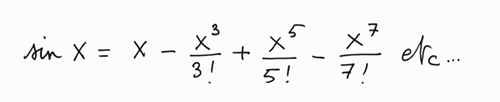
In mathematics, we denote by an exclamation mark what is called a "factorial".
Thus "factorial five" which is 5! is equal to 5 x 4 x 3 x 2 x 1
It is easy to see how this infinite series of terms is constructed. The sign alternates from one term to the next. The exponents are odd. But now imagine yourself in the skin of a theoretical physicist who is looking for the solution of a certain equation, for example, and who comes across the function, defined in the form of a series:

He will have to ask himself the question:
- When I give myself a value of X, is this sum of terms corresponding to a finite or infinite value?
In mathematics, one would say "does this series converge?"
I don't know what finiteness Smolin refers to. It is probably much more complicated. In theoretical physics, a lot of things are presented in the form of series and it is then recommended to know whether these sums of an infinite number of terms give finite or infinite quantities. In the case of the series that gives the sine function, if one only takes the first few terms, one gets a very good approximate value of the exact value, which obviously has an infinite number of decimals. This is called an approximate value. When adding more terms, one only touches more and more distant decimals. In physics, it is common to construct a solution with two terms. A "zeroth order term" and a second term representing "a perturbation". I myself built part of my doctoral thesis by constructing a function according to a two-term series, which gave me the electrical conductivity of a plasma. Did I worry about whether this way of constructing this solution using a series was valid? Did this series converge?
I confess that I did not. Simply because calculating the next term would have been extremely complicated. I was doing "theoretical physics", not "mathematical physics", a nuance. In this specific case, I was trying to assess the validity of my calculation by comparing the numerical values I found with those measured in experiments, and it worked quite well. But this kind of field called "kinetic theory of plasmas" is generally not taken further. This is what Smolin calls "artisanal work". You are faced with a problem. In the case I was dealing with, it was to calculate the electrical conductivity of an ionized gas with two temperatures, where the electronic temperature was significantly higher than the ionic temperature. Despite what the polytechnician named Alain Riazuelo might say, I was the first to produce a theoretical model that gave this, which allowed the calculation of these values. I published this in several journals. I take this opportunity to mention an episode that illustrates the flaws of the peer review system, the system where articles are submitted to the criticism of a "referee", an "expert". In this case, I had sent this work to the "Journal de Mécanique" (which later became "The European Journal of Mechanics"). The reception was dramatic. I almost missed my entry into the CNRS because of this. René Germain, who later became secretary of the Academy of Sciences of Paris, was the editor of this journal. He had entrusted my work to a professor named Cabannes (probably deceased, peace be with his soul). The article, rejected, came back with the note:
- This work reveals deep ignorance in the kinetic theory of gases
I was very upset, very upset. The president of the commission that had to decide whether I would be or not permanently integrated into the CNRS was ... Germain.
During the months preceding the meeting, where the applications (for the position of research associate) were to be examined, I was in a very bad mood. One day, I was prostrate in my office when a group of Russians knocked on my door. An interpreter, built like a coast guard captain, translated their words like a machine gun.
- Mr. Petit? - Yes - I present to you Professor Luikov. - Pleased to meet you. - Professor Luikov wanted to make a detour through Marseille to meet you, because his colleague Vélikhov had spoken a lot about you. - I am pleased. - Professor Luikov asks what your latest work is.
I then explained my theory of the electrical conductivity of bitemperature plasmas, where the electronic and gas temperatures differ significantly. After my speech, the interpreter:
- Professor Luikov congratulates you. You have solved a problem where he and his team have failed for years. He asks where this work is published.
A bit taken aback, I stammered:
- Uh, I hadn't yet considered where to submit this article.....
and the interpreter continued:
- We would be very honored to publish it in the Soviet Union.
I didn't hesitate and immediately handed him the paper. Two months later the article was published in the Russian journal, translated. As soon as I get my hands on a reprint, I will scan the first page and put this image in this text &&&. A month later, the American publishers Pergamon Press sent me a letter:
- Our correspondent in Moscow read your article. We ask if it would be possible for us to publish it in English in a US journal.
I accepted immediately (but there, I admit I forgot the name of the said journal). In the spring, the CNRS commission session arrived, which would decide whether I would be kept in the house or sent elsewhere. I had already failed several times at this entrance exam and, according to the shop's statutes, it was my last chance. I had a union representative as support, who saw my case very badly off, until I gave him copies of the two articles
- Oh, great! There, I think I'm going to have a lot of fun.
The date of the session arrived. Paul Germain, president, opened my file with emphasis:
- We will now examine the case of a researcher that most of you already know too well. It is Jean-Pierre Petit.
Some nodded. Others looked up to the sky. Germain scanned my file:
- This researcher did not get along with his supervisor, Professor Valensi, director of the Institute of Fluid Mechanics in Marseille. He was therefore assigned to another laboratory. He has changed research topics many times. He seems scattered, messy. Some doubt his skills.
He took a paper out of the file.
- And here we have an opinion from the referee of the Journal de Mécanique, which I direct, telling us that the work he submitted, on the calculation of the electrical conductivity of a plasma, reveals deep ignorance in the kinetic theory of gases. I therefore propose that we proceed to the vote. Who is in favor of the permanent appointment of this researcher? Who is against?
In such moments one could imagine the grinding of a guillotine.
The union representative then intervened by distributing copies of my paper, in Russian and English, like cards on a table. Germain examined the English version. His face immediately changed. The "politics" excel at rapid course changes.
- Ah... well, I think this is new information! Let's proceed to the vote.
And that's how I became a research associate, in the last minute. In passing, the French referee, Cabanne, who presented himself as the French expert in the kinetic theory of gases, took a hit. It must be said that I had introduced a new "bi-parametric" calculation technique, which he simply did not understand. The paper was also published in the French journal where it had been rejected (Journal de Mécanique). I wanted to finalize this matter this way.
End of the anecdote (there were many others of the same kind. Most of the papers I was able to publish in my career are ... stained with blood, torn after long and painful struggles, with referee changes). Yes, I have never been able to do things like everyone else. Still, this calculation was based on a series expansion limited to two terms. As I said, it never occurred to me to show that this series converged. It would have been very complicated. You thus discover an aspect of theoretical physics where the theory is validated ... because it works roughly, that it is useful. It is artisanal, not mathematical rigor, even if the tools used (here, tensors) are sometimes quite sophisticated.
In the matter of string theory, people were forced to base their approach on mathematical criteria, simply because they did not know ... what they were calculating exactly. But, if they presented results in the form of a series of terms, the least thing was to determine whether or not what they calculated was finite. It seems that there was therefore a problem of finiteness, considered crucial, central by Smolin. As he is in charge of drawing a panorama of string theory and its achievements, he looks for the papers (among the one hundred thousand published in thirty years) that deal with this subject. He then comes across the work of a man named Mandelstam, whom "everyone" considers "to demonstrate the finiteness of the string approach". He has it read by mathematicians, who are not convinced and reply that this work is incomplete. On page 364 he writes:
- I started asking string theorists I knew, in person, or by email, what was the status of finiteness and if they had the reference of the paper containing the proof. I asked this to a good dozen people, young and old. Practically all those who answered affirmed that this result was true. Most did not have a reference to the proof, and those who did directed me to Mandelstam's paper. I therefore turned to review articles. Most explicitly stated that the theory was finite. Either these articles cited each other, or they mentioned the initial paper of Mandelstam. But I found an article by a Russian physicist who said that the result had not been proven. I had difficulty believing that he could be right, while those who were of the opposite opinion were all eminent specialists, whom I sometimes knew personally and for whom I had the greatest admiration.
Smolin, intrigued, then begins a meticulous investigation to try to clarify this. He concludes that it is far from having been established and reports his approach, writing, page 365:
- When I described this situation in my presentation at the conference in honor of Wheeler, it was received with skepticism. I received messages, not all friendly, saying that I was wrong, that the theory was finite and that Mandelstam had proved it. Most string theorists were shocked when I told them that the proof of finiteness had never been completed. No one remembered having heard string theorists present this problem as an open question. I had accepted to do this work because of my interest in string theory, which I devoted all my time to at the time (he published 18 articles on the subject). Nevertheless, some string theorists took my presentation as an act of hostility.
On page 366, Smolin talks about this question with his good friend Carlo Rovelli (from the Centre de Physique théorique in Marseille). He replies that, having also received many messages affirming that Mandelstam had proven the finiteness of the theory, he had eventually contacted him. Smolin continues:
- Mandelstam is now retired, but he replied quickly. He explained that what he had actually proven was that a particular type of infinite term did not appear anywhere in the theory. But he also said that he had not actually proven that the theory was finite, because other types of infinite terms could arise. None of the string theorists with whom I had discussed this problem, at the time when the finiteness proof of the string theory did not exist, had decided to stop their work on string theory. When the question of finiteness is resolved (if it ever is), we will have to ask how it is possible that so many researchers were not aware of the true status of one of the central results of their field of research, why many string theorists spoke so easily about their field to outsiders and newcomers using a language implying that the theory was perfectly finite and consistent. And finiteness is not the only example of a conjecture that everyone believes without it being proven.
At the occasion of this 2002 conference, Lee Smolin, having worked on string theory for more than twenty years, is led to examine the foundations of an already extremely complicated structure. As soon as he inspects one of the foundations of this theory, finiteness, he discovers that thousands of researchers work as if this aspect had been perfectly clarified and proven, when it is not the case. But he was far from being at the end of his surprises. He starts reading the writings of the greatest specialists on the subject and discovers statements that shock him. A conjecture is a "proposition" put forward by a mathematician, and which has not been the subject of a proof. These are common things in the field of mathematics. A conjecture is a property that is observed "in many cases" and for which no counterexample has been found. When it has been shown that the property is true in all cases, then the conjecture becomes a theorem (a proposition "true in all cases"). But it is not because it works "in the many cases considered" that this property is automatically true in its entirety.
Example of a conjecture. A few years ago (in &&& ?) the conjecture was put forward that four colors were sufficient to color countries on a map, without the same color appearing on both sides of a border. This was called "the four-color theorem". In fact, until the proof was established (in &&&), it should have been called "the four-color conjecture". Then this proof appeared, very long, after a laborious quest, and the conjecture became a theorem.
Conjectures are found in many fields. In the field of strings, Smolin cites one, stated by Maldacena. In 2002 he comes across a text, among others, written by one of the leading figures of string theory, Gary Horowitz, and he reads:
- In summary, we see convincing reasons to put Maldacena's conjecture in the category of true, but not proven.
On page 367 Smolin writes:
- I have never heard a mathematician refer to a result as "true and not proven". Above all, what is astonishing is that the authors, two very intelligent people, ignore the obvious difference between the two cases they are talking about. Beyond that, we do not know if string theory, or the gauge supersymmetric theories, actually exist as mathematical structures. Indeed, their very existence is part of the problem. This situation clearly shows that the authors reason as if string theory were a well-defined mathematical structure - despite the wide consensus stating that, even if this were the case, we would have no idea what this structure would be. Regarding the defense of their belief in unproven conjectures, string theorists often note that something is "a matter of general belief" within the string theory community or "no reasonable person would doubt its truth". They seem to believe that calling for consensus within their community is equivalent to a rational argument. ... (page 371) I understand the difficulty of thinking clearly and independently when recognition by the community requires blind faith in a set of complex ideas of which you yourself do not know the proofs. It is a trap that took me years to escape from.
Any "reasonable" reader will be speechless after reading these lines. They confirm what Souriau has been saying for 30 years about string theory, and theoretical physics in general:
- It has become a physics without experience and a mathematics without rigor
What is new is that a defector from the string theory community, who knows exactly what he is talking about, reveals these facts. The journalist from Ciel et Espace, David Fosset, apparently did not perceive the gravity of this situation, presenting Smolin at the beginning of the program as some kind of agitator, a marginal challenger. The debate necessarily has a limited duration. Smolin appears very moderate, and even intimidated. It is true that to raise such a question, that of the non-proof of finiteness, the protagonists risk "losing their audience". But scientific debates are not conversations in a corner or salon talk.
I remember what a journalist from the magazine Actuel once told me:
- In the media, it's not what you say that matters, it's what you convey.
I had read Smolin's book before seeing this debate on my screen. I don't know what the impression of the television viewer was when seeing these images and hearing these words. I tend to say that this face-to-face will leave few traces in the public's mind. And perhaps it will be the same for Smolin's book. The traces depend on media echoes. It is clear that David Fosset, from Ciel et Espace, will not report this face-to-face, organized at the Cité des Sciences, in the columns of the magazine, in the same terms as I do here. No scientific journalist will denounce the fraud of the "global theory", which is made ... exists only in the imagination of its creators. It is the first example of completely imaginary science.
On the other hand, this expression of "global theory" has benefited from very positive echoes in science media. I remember, a few years ago, a clarification made by the (young) journalist of Science et Avenir, a certain Larousserie, in response to criticisms that had been addressed to him by readers he called "Fans of JP Petit". He immediately wanted to make a distinction between my work and others, "vaguely similar", but coming from a new matrix, the string theory, which gave them the qualification of "global theory".
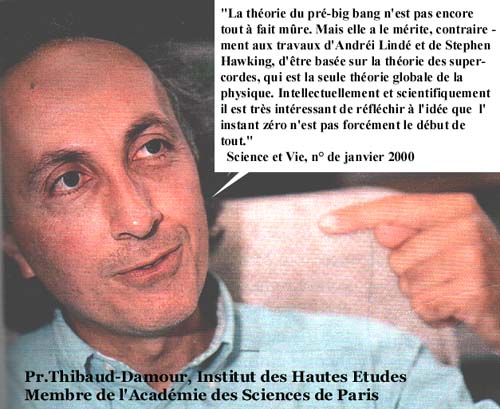
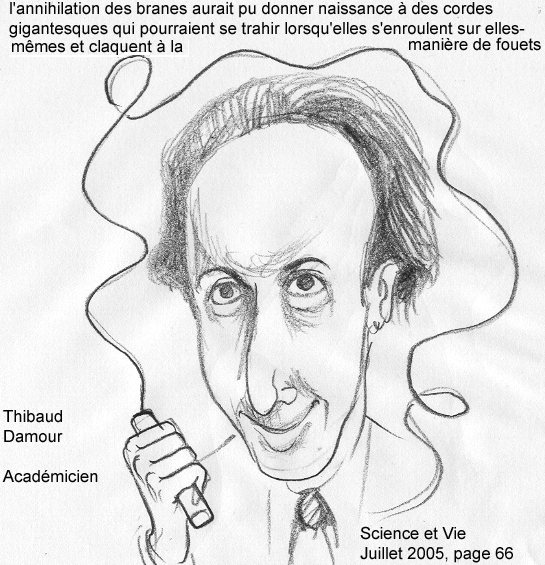
At the top of this page you find the words of the Academician Thibaud Damour, presenting string theory as "the only global theory of physics". At this stage, one can formulate the question
- Does he really believe what he says, or is he taking us for fools?
The most worrying would be that he believes his own words, and I think that is the case. Indeed, considering that there are 10 500 possible variants of string theory, as this number exceeds that of the ... elementary particles populating the known universe, one can say that if there is a global theory, it must be part of this set, in application of the principle stated by the late Pierre Dac:
- Everything is in everything, and vice versa
It is this impressive potential richness that gave rise to the TOE (theory of everything), immediately promoted by people like Hawking, author of phrases of rare depth (in "A Brief History of Time") like:
- If the universe contains itself and has neither beginning nor end, then what is the use of God?
If there are indeed 10 500 possible string theories, one can indeed wonder if God would not be part of the "package", to use Smolin's word. It is an interesting perspective. Within possible theories, there might be room, besides modeling the "real" for a modeling of consciousness, God, all his saints, metaphysics and beyond...
It is likely that "everything will fall into place", that the commotion created by Smolin's book will gradually subside. One cannot expect much from a "public debate" held at the Cité des Sciences, for a limited time. Obviously, there were no scientists in the room, only people who came out of curiosity. No offensive, embarrassing questions.
No television channel would think of broadcasting this at a time of high audience. But why not a debate between Smolin and Damour, plus Alain Connes in a place like ... the Academy of Sciences? It is indeed the role of this learned house to try to clarify things. Why not a debate at the Institute of Advanced Studies in Bures-sur-Yvette, the Mecca of physics in France?
Quousque tandem abutere Catilina patientiam nostram?
said Cicero.
What about a conference on the foundations of string theory?
This reminds me of the opening speech of a session president, which Souriau gave me fifteen years ago:
- Although string theory has not predicted any phenomenon, provided any model or explained anything so far, given the volume of articles published, one can only note the extreme vitality of this new discipline.
It was ... fifteen years ago.
Smolin's book, which he himself calls in the body of his text a "indictment", resembles a long Catilinarian, a long speech pronounced by Cicero against Catilina, the above sentence (my Latin, worn, was corrected by Nicolas Montessuy) meaning "how long, Catilina, will you abuse our patience?"
Yes, how long will this incredible fraud, whose leader, Thibaud Damour, is a ... member of the Academy of Sciences of Paris, continue? A harmful fraud, which stifles any competing idea, discourages young researchers from exploring other paths.
Damour published in 2002 with Editions Odile Jacob and Jean-Claude Carrière a book entitled:
Conversations on the Multiplicity of the World and the Uniqueness of Ideas
I had made a reading note at the time, which can be accessed by clicking on the link. For me, this book is ... empty. The reader will judge by discovering the countless speeches of Damour, with Carrière, playing the role of a lackey. But well. If someone like me says it, it doesn't count. It took a man like Lee Smolin to speak for it to take on a whole different weight.
I have made many annotations in Smolin's book, as usual. What I can do is extract sentences from his book, citing the pages. I dare to hope that this will illuminate the reader a bit.
Page 10, in the introduction:
Despite many efforts, string theory has made no new predictions that could be verified by an experiment that could be performed today, or by an experiment that could be performed in the future.
One of the reasons why string theory does not produce new predictions is that it branches into an infinite number of versions. Even if we impose the constraint of considering only theories that agree with fundamental experimental facts about our universe, such as its size or the existence of dark energy, we still have 10
500
(...) different string theories.
Page 10, in the introduction:
Despite many efforts, string theory has made no new predictions that could be verified by an experiment that could be performed today, or by an experiment that could be performed in the future.
One of the reasons why string theory does not produce new predictions is that it branches into an infinite number of versions. Even if we impose the constraint of considering only theories that agree with fundamental experimental facts about our universe, such as its size or the existence of dark energy, we still have 10
500
(...) different string theories.
**
Page 11, in the introduction:
After all the work devoted to string theory, we cannot say whether there exists a complete and consistent theory, which could be called "string theory". What we actually have is not a theory, but a large collection of approximate calculations that come with an entire network of conjectures which, if true, tend to suggest the existence of a theory. But this theory has never been written down. We do not know its fundamental principles. We do not know in which mathematical language it will be expressed. It may be a language we will have to invent. Given this absence of fundamental principles and mathematical formulation, we cannot even say that we know what string theory claims.
Page 11, in the introduction:
After all the work devoted to string theory, we cannot say whether there exists a complete and consistent theory, which could be called "string theory". What we actually have is not a theory, but a large collection of approximate calculations that come with an entire network of conjectures which, if true, tend to suggest the existence of a theory. But this theory has never been written down. We do not know its fundamental principles. We do not know in which mathematical language it will be expressed. It may be a language we will have to invent. Given this absence of fundamental principles and mathematical formulation, we cannot even say that we know what string theory claims.
Page 12, in the introduction:
Some time ago, an eminent string theory theorist, >Joseph Polchinski, who works at the Kavli Institute at the University of Santa Barbara, was invited to give a lecture titled "Alternatives to String Theory". When he received this invitation, his first reaction was to say "It's silly. There are no alternatives to string theory (....), all the good ideas are part of it (...)
Lubos Motl, assistant professor at Harvard, recently wrote on his blog: "The most likely reason why no one has convinced others of the possibility of an alternative to string theory is that there is no alternative (...) "
Page 12, in the introduction:
Some time ago, an eminent string theory theorist, >Joseph Polchinski, who works at the Kavli Institute at the University of Santa Barbara, was invited to give a lecture titled "Alternatives to String Theory". When he received this invitation, his first reaction was to say "It's silly. There are no alternatives to string theory (....), all the good ideas are part of it (...)
Lubos Motl, assistant professor at Harvard, recently wrote on his blog: "The most likely reason why no one has convinced others of the possibility of an alternative to string theory is that there is no alternative (...) "
**
Page 209:
String theory has not predicted dark energy; worse: the detected value was very difficult to fit into string theory. Therefore, this discovery created a real crisis within the field.
Page 209:
String theory has not predicted dark energy; worse: the detected value was very difficult to fit into string theory. Therefore, this discovery created a real crisis within the field.
**
Page 217:
If one wants to adapt the theory to a positive value of the cosmological constant, corresponding to observations, then there is only a finite number of variants of the theory; to date we have indications of the existence of about theories of this type. This is an enormous number of string theories. Moreover, each is different from the others. Each gives different predictions for elementary particle physics and also for the values of the parameters of the standard model.
Page 217:
If one wants to adapt the theory to a positive value of the cosmological constant, corresponding to observations, then there is only a finite number of variants of the theory; to date we have indications of the existence of about theories of this type. This is an enormous number of string theories. Moreover, each is different from the others. Each gives different predictions for elementary particle physics and also for the values of the parameters of the standard model.
- Theoretical physics has become a vast psychiatric hospital, where the mad have taken power * Jean-Marie Souriau * **
Page 345:
In hiring procedures, the judgments of senior professors are given less importance than statistical measures of success, such as funding or university citation levels.
Page 345:
In hiring procedures, the judgments of senior professors are given less importance than statistical measures of success, such as funding or university citation levels.
Page 349:
The question is not whether string theory is worth studying or supporting, but why it, despite the lack of experimental predictions, has monopolized the available resources for fundamental physics research, and therefore hindered any exploration of other approaches that show comparable promise.
Page 349:
The question is not whether string theory is worth studying or supporting, but why it, despite the lack of experimental predictions, has monopolized the available resources for fundamental physics research, and therefore hindered any exploration of other approaches that show comparable promise.
**
Page 351:
Some string theorists prefer to believe that the secrets of the theory are too complex to be understood by human beings ( !!!)
Page 351:
Some string theorists prefer to believe that the secrets of the theory are too complex to be understood by human beings ( !!!)
**
Page 352:
Nathan Seiberg, famous theorist at the Institute for Advanced Study in Princeton, recently said with a smile, "if there is something beyond string theory, then it will be called string theory"
Page 352:
Nathan Seiberg, famous theorist at the Institute for Advanced Study in Princeton, recently said with a smile, "if there is something beyond string theory, then it will be called string theory"
A little higher, in the bubble accompanying the photo of Thibaud Damour accompanying an interview from 2002, we see that he refers to string theory "as a global theory". This word covers a fantastic intellectual fraud and refers to the "M-theory" whose existence was suggested by Edward Witten. He would have shown that string theories would be grouped into five major families, all emerging from a "M-theory" of which he mentioned the existence without giving more details. Why the letter M? Is it for "mother theory" or for "mysterious theory". No one knows. It is amazing to see people repeating this shocking intellectual fraud, talking about the richness of the king's clothes, while
The king is naked
I finish reading this book a bit stunned and puzzled. Access to the seminar at the Institute of Advanced Studies in Bures-sur-Yvette was denied to me twice by Thibaud Damour, head of the "cosmology sector". And without any formulated or reasoned criticism. Let's not even speak of the lamentable behavior of the people at the Paris Institute of Astrophysics, Alain Riazuelo in the lead. Yet I would be ready, at any time, to go into the arena to defend my ideas and work. Reading the book by the Canadian, who knows what he is talking about, since he has worked in this field for three decades, I realize how much my own work is more solid and constructed than the ramblings of these people, sprinkled with "conjectures". But what can I do? In 1997, ten years ago, I published a popularization book, "We have lost half the universe", at Albin Michel. God knows how full this book was with observational confirmations, fertile openings, based on numerical simulations. No media echo. It is still distributed by Hachette in its "Le Point Science" collection, I believe. You can find a variant in the downloadable texts I offer on my site, by clicking on "the dark side of the universe". Would David Fosset from Ciel et Espace dare to read it and ask me some questions, or would he just stick to the phrases of people in power, like Damour, or like Hubert Reeves who, regarding my work, had answered a young student:
- I would avoid wasting my time with all that
That's an opinion. In fact, this approach is disconcerting for a non-geometer. I am not a top in differential geometry. I have simply learned a few things in this field, and that is enough to make my statements obscure to today's astrophysicists and cosmologists. I think that Damour does not understand my approach (what to say about Riazuelo!). I tried to understand why. A few months ago I had the opportunity to give a seminar in a research center in India where I had been invited. I had said "No one is a prophet in his own country". It was simply catastrophic. Daddish, director of this institute, founded by Narlikar, immediately attacked me, saying that my model was absurd "because a space cannot have two distinct systems of geodesics".
It was not "I would like you to explain it better..." but "it is absurd because..."
I replied:
- Completely agree. There is not one space, but two, and each has its own system of geodesics.
Daddish confused space and "manifold". I tried in vain to enlighten him.
But "the current did not pass". At the end of my talk, a researcher made this comment:
- Daddish tried several times to put Petit in difficulty, but it turned against him.
All of this lasted an hour and a half and I finally could not get to the heart of my real presentation, based on groups. But Daddish, a sort of Indian Damour, didn't care. Another one for whom theoretical physics is above all a way to amuse oneself among friends (carefully selected for their community of thought and ideas).
This exchange, which evokes a duel between two duelists with a rapier, is exactly what would have happened if I had been able to give a talk at the IHES. Damour would have charged headlong and would have been defeated, like the Indian (or like Riazuelo, if I had given a seminar at the Paris Institute of Astrophysics). In this kind of exchange I have never lost a battle, in thirty years, and they all know it. After showing Daddish what his mistake was, and how he was confused, I said:
- Honestly. Do you think I would have taken the risk of appearing before you without having previously thoroughly clarified these questions?
Having already been turned away by Damour, I had tried to approach Jean-Pierre Bourguignon, a geometer and director of the Institute of Advanced Studies in Bures. He perfectly understood the essentials of my talk, which can be summarized in very "compact" technical terms:
-
The Poincaré group, as a dynamic group managing the dynamics of the relativistic point particle, inheriting a property of the Lorentz group, around which it is built, is endowed with a space of movements composed of two subsets: movements with positive energy and movements with negative energy.
-
I suggest using a group whose space of movements is not connected.
Bourguignon said to me, "The fact that the space of movements is not connected does not bother me at all."
Behind this phrase "non-connected space of movements" lies the whole issue of the universe - twin universes, which astrophysicists and cosmologists do not want to hear about. The string theorists as well. Unless it is them who, one day, will propose this concept.
What to do? Contact Smolin? Contact Alain Connes, who is a geometer?
I will end this page by mentioning the last part of the Canadian's book, where he mentions some possible directions, which could lead to a revolution in physics, among others the non-constancy of the speed of light. He cites the work of a researcher, Magueijo, author of a book translated into a language and published by Dunod, titled "Faster than Light". I could also propose my own and submit it to this publisher. But if no scientific media gives it a follow-up, as was the case in 1997 with "We have lost half the universe" (Albin Michel), it will be another futile effort. Does Smolin know that the precursor of this idea is a certain ... Jean-Pierre Petit? The first, published in Modern Physics Letters A, dates from .. 1O988.
What would happen if I sent him my papers on this? What expression would his colleague and friend Magueijo have? I had sent papers to Magueijo and Moffat, Canadian like Smolin, years ago. None of them replied.
Smolin then mentions his collaboration with Carlo Rovelli, from the Centre de Physique Théorique in Marseille, who, like him, works on the loop gravity (Quantum Loop Gravity). You need to go to chapter 15, page 315, titled "Physics after String Theory". I find the ideas quite fascinating. Smolin writes, page 315:
- *The main unifying idea is easy to formulate: don't start with a given space, nor with something that moves in space. On the contrary, start with something that has no spatial structure, but a purely quantum structure. If the theory is good, then space will emerge as a representation of some average properties of the structure - just as temperature emerges as a representation of the motion of atoms. **Thus, many quantum gravity theorists believe that there is a deeper reality where space does not exist. * *
On the next page, another very interesting sentence:
- *What we, who work in quantum gravity, want to make clear when saying that space is emergent, is that the continuum of space is an illusion. Just as the smooth, apparent aspect of water or silk hides a matter composed of discrete atoms, we suspect that the smooth aspect of space is not real, but emerges from the approximation of something fundamentally different, and is actually composed of countable building blocks. * *
There, an old idea resurfaces, already explored by Heinsenberg himself. That it is not "reality" that is quantized, but ... that it is the universe itself that is. I have often raised this idea in books or comics. The image of a quantized structure is the game of chess. The pieces do not exist. Matter does not exist. There are only behaviors. If C represents the line coordinate and L the column coordinate, a piece that moves in such a way that
D C = plus or minus 1; D L = plus or minus 1
is ... a king (modulo this constraint of not being able to leave the chessboard).
A piece such that the product
D C x D L = 0
is ... a rook
( it can only move along a line or a column )
A piece such that the absolute values of D C and D L are equal is ... a bishop
etc....
The game of chess is a game that can be entirely managed by a computer, which only manipulates bits, "ignores that space and time exist". The chessboard, the pieces, the moves, are convenient geometric representations, what Smolin calls "emergent objects". When two computers face each other, they don't need ... a chessboard.
Page 326:
- *A quantum geometry is a certain type of graph. A quantum spacetime is a sequence of events where the graph evolves through local changes in its structure. * *
Oh how much I like and understand this. Could I understand how these people go about it? What are their tools? In the Topologicon (1985), page 39, there is a diagram of a "dislocation in a crystal" creating a set of conjugated singularities.
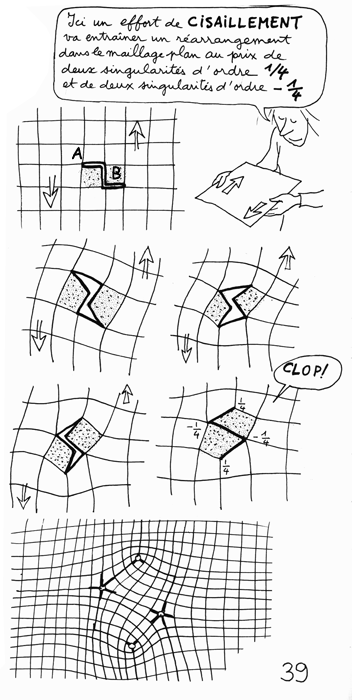
The polyhedron, there is nothing better to understand things. Take some graph paper. You can then realize the dislocation in "3d". It would certainly be a very fun thing to do in computer graphics, with a small film.
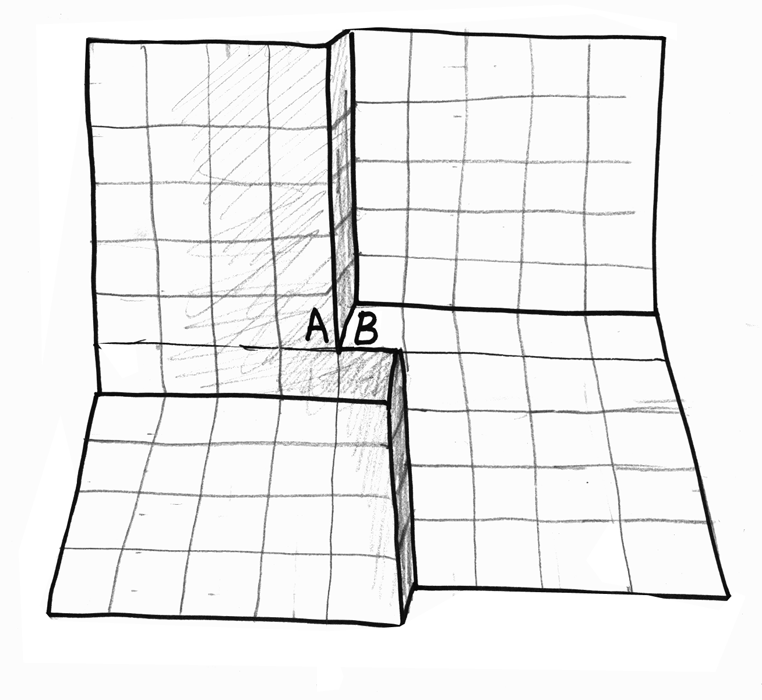
And, on page 40 of the Topologicon, you can read:
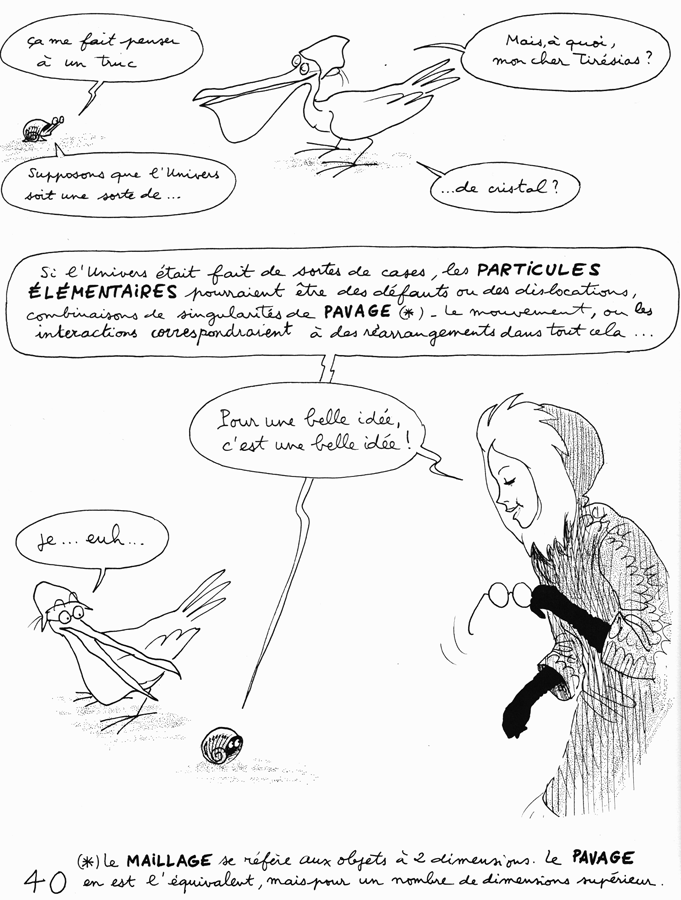
Of course, one can conceive of dislocations in spaces with more than three dimensions, dislocations that propagate.
- Puh... would say Damour, waving his academic hair, bald on the front, it's just toy models!
**It's better to hear it than to be deaf **
Still, all this is very interesting. Personally, I would recommend a mix of loop gravity and gemellarity. I hope that Rovelli and Smolin will come up with something. Because, from the string theory side, people are beginning to believe less and less in it.

Physicist and Nobel laureate, Princeton University
Is string theory a futile exercise as physics, as I believe it to be? It is an interesting mathematical specialty and has produced and will produce mathematics useful in other contexts, but it seems no more vital as mathematics than other areas of very abstract or specialized math, and doesn't on that basis justify the incredible amount of effort expended on it.
My belief is based on the fact that string theory is the first science in hundreds of years to be pursued in pre-Baconian fashion, without any adequate experimental guidance. It proposes that Nature is the way we would like it to be rather than the way we see it to be; and it is improbable that Nature thinks the same way we do.
The sad thing is that, as several young would-be theorists have explained to me, it is so highly developed that it is a full-time job just to keep up with it. That means that other avenues are not being explored by the bright, imaginative young people, and that alternative career paths are blocked.
Princeton University. Nobel Prize in Physics
Is string theory a futile exercise as physics, as I believe it to be? It is an interesting mathematical specialty and has produced and will produce mathematics useful in other contexts, but it seems no more vital as mathematics than other areas of very abstract or specialized math, and doesn't on that basis justify the incredible amount of effort expended on it.
My belief is based on the fact that string theory is the first science in hundreds of years to be pursued in pre-Baconian fashion, without any adequate experimental guidance. It proposes that Nature is the way we would like it to be rather than the way we see it to be; and it is improbable that Nature thinks the same way we do.
The sad thing is that, as several young would-be theorists have explained to me, it is so highly developed that it is a full-time job just to keep up with it. That means that other avenues are not being explored by the bright, imaginative young people, and that alternative career paths are blocked.
Princeton University. Nobel Prize in Physics
Is string theory a futile exercise as physics, as I believe it to be? It is an interesting mathematical specialty and has produced and will produce mathematics useful in other contexts, but it seems no more vital as mathematics than other areas of very abstract or specialized math, and doesn't on that basis justify the incredible amount of effort expended on it.
My belief is based on the fact that string theory is the first science in hundreds of years to be pursued in pre-Baconian fashion, without any adequate experimental guidance. It proposes that Nature is the way we would like it to be rather than the way we see it to be; and it is improbable that Nature thinks the same way we do.
The sad thing is that, as several young would-be theorists have explained to me, it is so highly developed that it is a full-time job just to keep up with it. That means that other avenues are not being explored by the bright, imaginative young people, and that alternative career paths are blocked.
Before concluding, I would like to return to a theme dear to Smolin, that a theory must be falsifiable (refutable), that is, it must be able to propose future observations that have not yet been made. If this is confirmed, then it is a good point for the theory. Otherwise, the opposite. This idea of falsifiability was proposed by the epistemologist Karl Popper. Smolin adheres to it, not Damour, who, in their face-to-face, doubted "that a man as refined as Smolin could be inhabited by such naive Popperism".
I will therefore make a falsifiable prediction, and I will explain in another article why I say this. You have probably seen a "pseudo photo" of the sky, taken by the Hubble telescope.
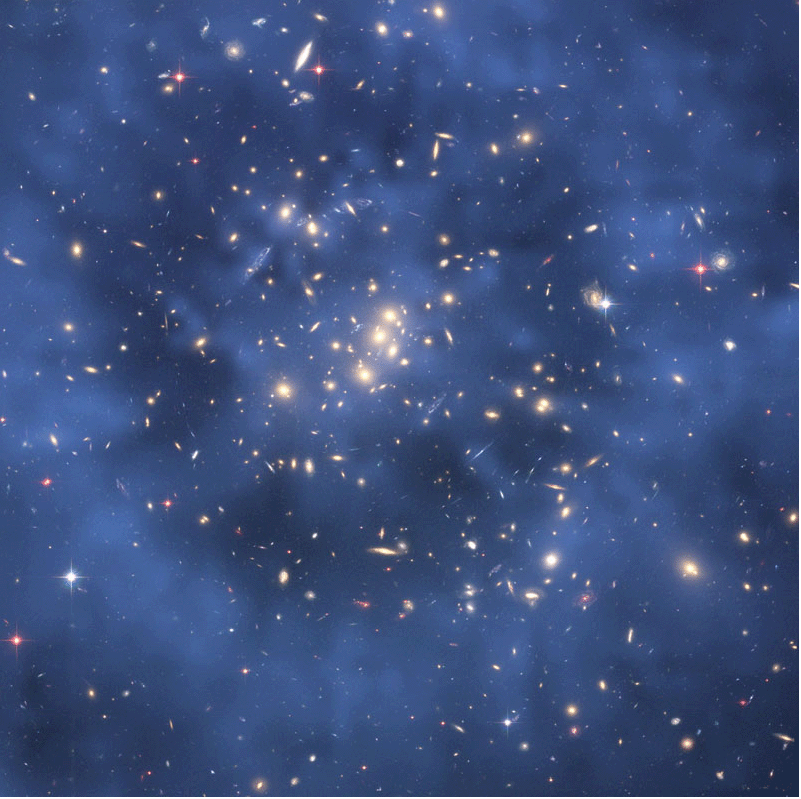
**"Dark matter ring" reconstructed by analysis of the weak lensing effect, around the galaxy cluster ZwCl0024 + 1652, located 5 billion light-years away.
Image: Hubble telescope. In fact, the ring is not optically visible. I had painstakingly erased it, but I don't know where I put this damned image. **
Article http://www.techno-science.net/?onglet=news&news=4076 from May 17, 2007, from the site http://www.techno-science.net
The image shows this "dark matter halo", practically centered on a galaxy cluster. Interpretation: it would be a structure similar to a "smoke ring", which has been reproduced during the collision of two large structures, which pass through each other, leaving this object as a trace of this collision. A collision between what and what? The story does not say. But statistically, it is quite extraordinary that the "smoke ring" has its axis directed towards us. There is roughly a 1 in 500 chance of this happening.
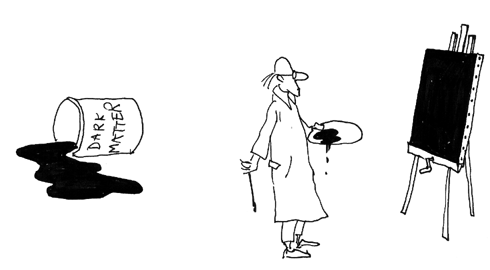
Voici ma prédiction :
We will find new dark matter halos ( "detected" by gravitational lensing effect, decoding of the "weak lensing" ) around galaxy clusters and all will be centered on the cluster. As soon as we find a second one with this appearance, the chance that it is due to chance will drop to 1 in 250,000. Etc... The conclusion of astronomers will then be that it is not halos but hollow shells, of dark matter. It will become very difficult to explain how these things can hold. Perhaps someone will write that they are "tethered by cosmic strings". In a future paper ( where the hell did I put it? ) I will give my own interpretation. It is a "dark matter halo effect". I think these halos simply do not exist, but reveal the presence of the environment of twin matter. Ten years ago I did calculations, also published in a journal, which predicted this phenomenon.
Not even false! Physics sent back to its strings
March 6, 2008
Comments on Peter Woit's book
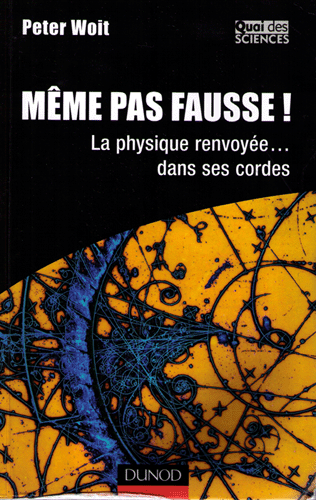
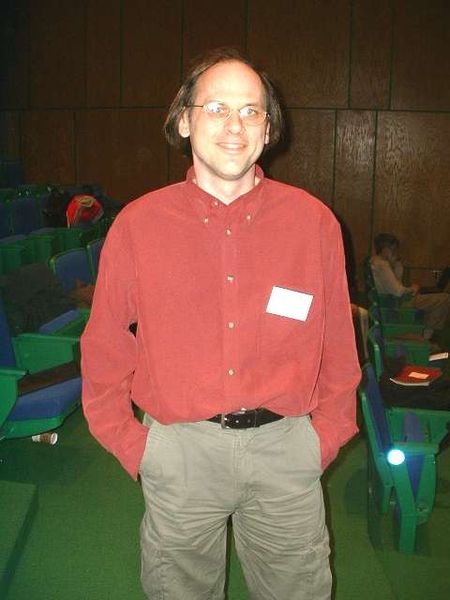
I read Peter Woit's book, a mathematics teacher in the mathematics department of Columbia University, United States.
When looking at the publication dates, we see that this book, like that of Lee Smolin, was published in its original form in 2006. This therefore reflects the beginning of an anti-string theory rebellion. Woit's conclusions are the same as Smolin's. Should we call science what Souriau called twenty years ago as:
A physics without experience and a mathematics without rigor
For the physics without experience, anyone could see it, since this "theory" explains nothing and predicts nothing. However, its proponents were not short of grand phrases. Woit repeats some of them:
- String theory is a 21st century physics accidentally fallen into the 20th
Woit cites a "great popularizer":
I didn't know that one day, in a great outburst, he had said that it was not surprising "that one does not understand the meaning of this string theory since it is the very words of God". Thus, the jargon of string theory would constitute a kind of "scientific Koran".
Woit recalls a phrase from the Nobel Prize winner Richard Feynman, which I also did not know and which is delicious:
- *String theorists do not make predictions, they make excuses. *
That being said, Woit's book is very heterogeneous. It starts with a clear introduction to the experiments conducted in high energy physics. It explains very well, for example, that super particle accelerators are fantastic electricity consumers and that it is particularly this that limits the construction of new machines. In the rest of the book, Woit traces the genesis of the "standard model", then of theories such as supersymmetry. But since he decides not to include any equations, any didactic image, or any visual diagram, the uninitiated reader quickly loses track. He regains his senses two hundred pages later, when it comes to conclude.
The form of the book comes from the fact that Woit's strategy was initially different from that of Smolin, a physicist. He aimed for a publication with an academic publisher such as Cambridge University Press, Pergamon Press, Mac Graw Hill Books Co., etc. It is there that solidly structured books are published, where "nothing is missing." Therefore, Woit designed his book as a defense, which he wanted to be unassailable, and thus necessarily filled with numerous technical details that would completely escape the reader, whether he was a science enthusiast or even a non-specialist scientist. Through this book, he tried to express the opinion of a mathematician on the world of strings. Therefore, the book was addressed to an academic publisher, and thus submitted "to experts in the field" with whom Woit expected to have to confront, based on concrete criticisms. He was left with nothing. The reader's notes that the publisher received contained no specific, targeted criticism, where the "referee" could have said, "there, Woit says something foolish." In fact, these notes contained ... no argumented criticism, but concluded simply by advising against the publication of the book, judged inappropriate. One expert even expressed the opinion that "these disputes within the scientific community should be resolved within the family and not exposed to the public."
Understanding that he would not be able to publish this book with these major publishers, Woit addressed an "ordinary" publisher who did not subject his manuscript to expert review and published it as is. Smolin did the same.
These books have been translated into many languages. Let's say that through the writings of Smolin and Woit, the public discovered what this string theory was hiding.
The reader will find, as a conclusion, what has already been explained by Lee Smolin, namely that this strange model would have 100500 possible variations, more than there are atoms in the universe. Etc.
Woit, a mathematician, highly values the talent of Edward Witten, a Fields Medalist, a true "hero of the superstring saga." He describes him as an imaginative, talented, precocious, and prolific researcher.
The mathematician Edward Witten
He adds that at a time when the great crisis in our theoretical physics was beginning, which has now spread, the enthusiasm of thousands of researchers (...) was greatly due to the fact that such a brilliant man had identified this path as promising more than twenty years ago. Witten thus became "the man in the spot." He multiplied announcements over the years, the latest being the prediction of the emergence of a "M-theory" which we don't even know in what language it could be formulated, which would have terminal unifying virtues.
This M-theory gives the impression that contemporary theoretical physics could have been written by ... Molière
But it benefits some, like the very famous Michael Greene, who has become a real businessman, whom Woit spares from his criticisms, but who was able to present the main features of these advances in a series of programs commissioned and funded by an American production company for a hefty sum of three and a half million dollars, which were broadcast in many countries, especially in France.
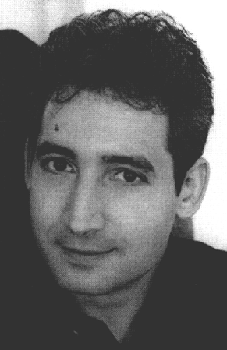
**The mathematician Michael Greene
become "the Hubert Reeves of superstrings" **
That's where we are.
I have placed a number of my cosmology works on arXiv and I will continue. It is formatting work, as some of these results date back to the early 1990s. Let's say that thanks to the meetings last summer with mathematicians, all of this has been reformulated in a more "classy" way, but it's not much different from what I published 11 years ago in "On a Perceived Half of the Universe" (Albin Michel, then Hachette). When I put the next paper I need to finalize soon on arXiv, I will try to approach Smolin and Woit. I tried to contact Alain Connes, a geometer mathematician, without success. I sent him my papers by e-mail and by post: no response. My mathematician colleagues told me, "Connes is a star. He won't answer you." It turned out to be true.
I think this "bimetric" perspective (new name for what I used to call "gémellaire") offers very interesting prospects in many fields and probably not only in astrophysics and cosmology. At a time when astronomers use simple words like "dark matter" and "dark energy" to describe data, what I have built has the advantage of being clear and fruitful. Now, if no one decides to take an interest in it, I won't fall into despair like Ludwig Boltzmann, who eventually ... committed suicide because no one was interested in his work. I will translate that into ... comic strips.
In his book, Woit briefly settles accounts with the Bogdanoff brothers, dedicating an entire chapter to them. At least, they have a chance: they are attacked. Not me. Facing a wall of silence, to non-answers to seminar proposals, there's nothing more to do. The loop is closed.
What's amusing is that at the same time scientific work is being done, elements of future comic strips are emerging. Very subtle concepts can be illustrated in an extremely simple way. The classical cosmological model is based on what was long considered a "fundamental hypothesis," namely that the cosmos had to be isotropic and homogeneous. It was conceived as a kind of gas whose "molecules" would be ... galaxies. Since the relative velocities of these galaxies are small compared to the speed of light (1000 km/s versus 300,000 km/s), the image of "the universe of dust" was born: very small objects, very little agitated compared to each other. Regarding this low value of the "agitation velocities" that astronomers call "residual velocities," the thing is confirmed. However, the constant improvement of measurements concerning the large-scale structure of the universe shows that it is anything but homogeneous. By homogeneity, it is meant that this "object" would be identical to itself if a translation were performed. But this is completely false: refer to this "lacy" structure where matter is distributed around immense voids of a hundred million light-years in diameter.
Moreover, what is expanding and where? The question is amusing. Have you ever asked yourself this? Have you questioned an astronomer about this?
Do planetary systems follow cosmic expansion: no. They would be unstable. Same for galaxies. Yet, to explain the redshift, it must be able to expand somewhere. For example, in the large voids separating the galaxies. It reminds me of an idea found in one of my comic strips. But right now I can't remember which one. The idea that matter is a sort of "frozen space." The image is that of a character overturning a glass filled with ice cubes. The water is the "vacuum," filled with "cosmic photons." These have a wavelength that increases at the same time as the "size" R of the universe. On the other hand, the ice cubes represent matter, with a wavelength that is the Compton distance, which does not vary. In other words, the universe is a juxtaposition of "things that relax" (the photons) and "things that do not relax" (the material elements). I modeled this in my next paper in the form of a series of drawings, which I reproduce here:
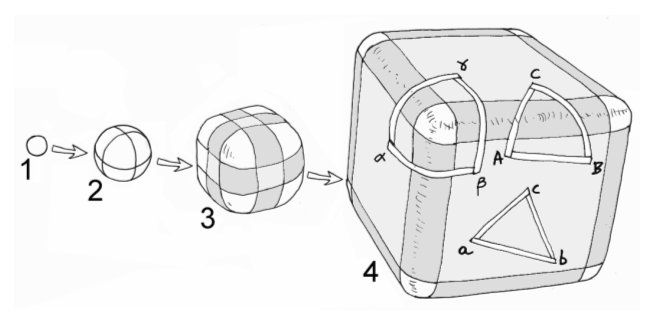
**The image of the "fundamental symmetry breaking" **
On the right, the image of our universe in its current state, represented by a cube, whose topology is that of a sphere, equipped with eight "masses" (the rounded corners) connected by Euclidean elements, quarter-cylinders, and ends of planes. According to this scheme, the Euclidean elements "grow" but the rounded corners do not move. These corners are where we live.
Going back in the past, these "masses" eventually meet (here these eight-eighths of a sphere). The second drawing corresponds to a "symmetry breaking." Before, the object had the symmetries of the sphere, after, it does not. If you extend this to an object with one more dimension, you will obtain the kind of three-dimensional polyhedron where we are supposed to live, with curved areas (where there are matter concentrations) and vast Euclidean regions.
These curved regions do not expand. For example, you, me, the house, the Earth, the Milky Way.
Outside of matter concentrations, it expands. However, when you go back in the past, there will necessarily be an instant when these concentrations meet and there will be a "phase transition." The space will then have the symmetries of a sphere S3. It will be homogeneous and isotropic. What is amusing to note is that this vision is then incompatible with considering the speed of light (and other constants of "physics") as invariable. We then plunge into the "variable constants" model that Moffat and Magueijo believe they have invented, the former in 1999, the latter in 2001, whereas I published more elaborate things in 1988-1989, in Modern Physics Letters A. I will write to Moffat and Magueijo. But I had already done so seven or eight years ago without getting a response. I don't think they will respond this time either.
Why?
Why respond to a French troublemaker completely unknown to the battalion? But Dunod published Magueijo's book "Faster than Light." A big sales success. Nothing to do with the failure of "On a Perceived Half of the Universe," 1997.
I will put my work on arXiv, then write to all these people (Smolin says he is open to new ideas). And when all this proves to be in vain, I will go back to my comic strips.
**May 10, 2008: Attempt to contact Woit. Result: **
Woit has a blog, which is supposedly quite followed. My mathematician friends told me, "why don't you try to start a dialogue with Woit via his blog? It would be enough for you to get involved in a subject he is addressing and that would allow you to intervene." This was the case on May 7, 2008, as reported by these colleagues. Woit was addressing the issue of dark energy and commenting on recent statements by Witten on this subject, following a symposium.
http://www.math.columbia.edu/~woit/wordpress/
Here is the page of his blog.
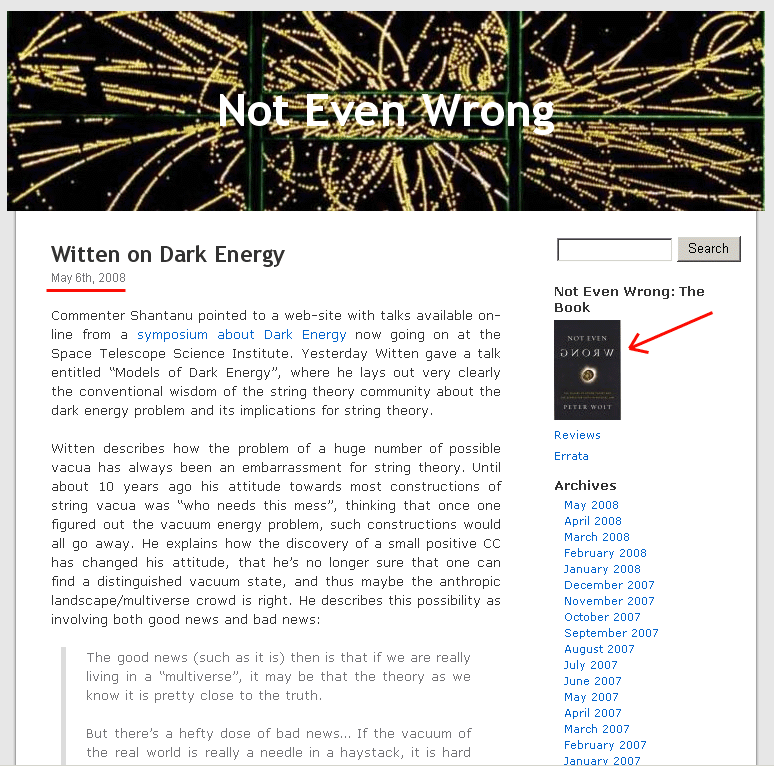
You immediately notice several things. This blog refers to the name of the publishing house Word Press, which publishes the book, which is omnipresent on all pages.
But, well, I left a comment, reminding that the complete Poincaré group generated particles with negative energy, including photons with negative energy, and that this would represent a good candidate for this "dark energy" that is less and less identified.
The message remained in place for an hour and was deleted. I then sent another message in the form of a protest and received this email response from Woit:
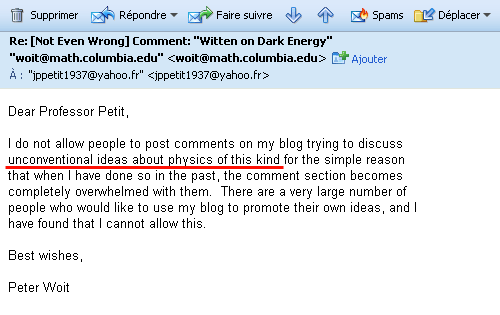
I then tried simply to draw his attention to the fact that group theory, symplectic geometry, and the coadjoint action of a group on its moment space constitute the very basis of mathematical physics and not "non-conventional ideas in physics." No response, the story ends.
It seems that people like Woit form a kind of club where they chat more than anything else and where no shadow of a somewhat new idea is seen. These people were the first to say "the emperor is naked!" Indeed. But then, many want to put on a new crown. Unconventional can also be translated as "non-conformist." Today it is very difficult to distinguish between ideas. As Woit mentions, he was immediately overwhelmed by messages from people "trying, on his blog, to promote their own ideas." In practice, it turns out that you cannot even, on this blog, ask questions, make remarks, make people think, and this using the most classical language of mathematical physics.
So it's hopeless. Woit wants us to move away from conformity, but he has his own.
This is my idea and I share it
I just sent a new cosmology work to arXiv. But I am pessimistic about the possibility of engaging in a dialogue with people like Woit, Smolin. For someone like Woit, a new idea could only emerge "from the inside," from Columbia University or Princeton. How could I, a Frenchman, catch the attention of these people for even a second?
It should be added that the scientific world is like other spheres. Ambition and the search for fame are not absent.