Untitled Document
Concentrated Solar Thermal
May 31, 2011 - June 14, 2011
In many parts of the world, men and women are gathering and protesting. They lament about unemployment, the collapse of pensions, and their miserable wages.
It brings to mind May '68, except that back then the economy was doing fairly well, compared to today. Now things are different. It's really bad. So these men and women wonder what to do. They have no program—or programs. And we understand. It's the global society that needs to be completely transformed.
We've let everything develop unchecked: the pursuit of profit, corruption, neo-colonialism, liberalism, the "Bretagne to the Urals" alliance. The beautiful Europe, Giscard d'Estaing's Euro-Africa, which gave us a fine European constitution where "law enforcement is authorized to shoot if a demonstration turns into an insurrection."
It all depends on how you see it.
I'll reproduce a text read by a journalist on France Inter. Quite interesting.
The Indignant Spaniards, by Cécile de Kervasdoué
Excerpt from her daily 7:20 AM commentary on France-Culture
Here is the transcript of the text, from May 24, 2011:
The end of the European dream, or an accident experienced in slow motion. It's a bit like watching in slow motion on a screen... your own car hurtling toward your own accident. The spectator sees it perfectly, ten out of ten in each eye... he sees exactly what's about to happen, but that doesn't prevent the accident from occurring... it doesn't lessen the pain. This is the image the British Guardian chooses this morning to open its editorial. An image meant to illustrate what international press finally grasps this morning, after more than eight days of something very important happening in Spain...
It's not just a series of demonstrations... not just a simple social outburst against austerity measures... writes the Guardian... it's much broader than that... what's happening in Spain must not be ignored: the May 15 movement, the "indignant" or "real democracy" movement, reflects a lasting disillusionment, a deep disappointment, as well as a rejection of how politics is conducted in our Western democracies...
Because today, politics is no longer made in parliaments, warns the Guardian... it's now made elsewhere... online or in public squares... to ignore this is to head toward catastrophe... toward the accident. Thus, Spain would be a kaleidoscope of what Western democracies are experiencing, implies the Guardian... and this view is echoed this morning by numerous European newspapers.
Criticatac, for example, in Romania, considers that it's not discontent toward a particular party or anger against austerity measures that is driving Spaniards of all ages into the streets... and ultimately, it has nothing to do with this weekend's elections... or the economic situation... the Romanian newspaper says this election is merely the trigger... because the true demand of the indignant is for an entirely different societal model... and a different political model too... far from the traditional two-party system... and against a model that treats its citizens cynically. Change, says Italy's Stampa... all citizens with even a little common sense are demanding it this year... it was true in Italy this winter before this Spanish spring... and it's incredible that European politicians pretend not to see or feel it!
Because this movement exists everywhere in Europe, continues Tijd in Belgium... in Spain, Italy, Greece, Ireland, soon Portugal... it's a movement against social injustice, with demands exactly like those of the rebels in Egypt or Tunisia... a movement from the south, therefore, while in the wealthy northern half of Europe... a selfish movement has already developed, undermining cohesion and solidarity... but the rich north must not delude itself, writes the Belgian newspaper... the population will flood our squares too, here and there, when inequalities grow and social cohesion vanishes. Hence Chapatte's cartoon today in the columns of Le Temps in Switzerland... there we see a medieval tower, armed with a full security arsenal, surrounded by revolutionaries trying to get in... inside the tower, flying the EU flag... hidden from everyone's eyes... while demonstrations brandish the same banners: revolution!
And the comment from one of the police officers: "Not where it went in?" So are we facing an Arab Spring in Spain?
Undoubtedly yes, writes the Al Jazeera website... this wave of protest, originating in Arab countries, is globalizing via the internet, catching European experts completely off guard... it's an Arab Spring in Europe, also considers the Independent in the UK. And the situation is no longer just about youth demonstrations, writes Germany's Spiegel... the government of José Luis Zapatero refuses to call for early national elections, despite pressure from the right-wing opposition, which won the local elections this Sunday... and meanwhile, the anger and determination of the streets do not wane. But what do they want? This question keeps recurring among European editorialists, who seem to be waking up this morning and discovering what's happening in Spain—and it's Le Temps in Switzerland that answers, via an interview with historian Benoît Pellistrandi, an expert on contemporary Spain.
There's a fundamental demand from a generation of highly educated youth who no longer earn even a thousand euros a month, as they did a few years ago... now they earn less than 300 euros a month for full-time work, and this for over thirty years... there are criticisms of economic austerity measures.
But above all, believes the historian... the problem is that Spanish left-wing politics is orphaned... it no longer recognizes itself in the PSOE, the ruling party, which blindly followed EU and IMF directives and has now fallen victim to the crisis... and Le Temps concludes... this is therefore a vote of indignation and despair. No, it's much simpler than that, reacts a Spanish columnist in the Guardian's pages. In Madrid's Puerta del Sol square, absolutely everything is being debated... everything... what's happening in Spain is that the population is inventing something new... people are discussing the end of nuclear power, the abolition of bullfighting, the establishment of a secular state... these are highly informed, very realistic people leading a genuine fundamental revolution. And one really must read El País these days to understand it. More than mere complaints about the economic crisis... it's an ethical, moral, political movement, considers El País... a deep movement, an anti-system movement in the Icelandic style, since it draws inspiration from the one that brought down Reykjavik's government in 2009. The anger of the Icelandic population, which refused to bail out banks caught in the financial storm... is reflected in the anger of the Icelandic earth, which has spread its volcanic ash across all of Europe. And El País delights in publishing this drawing: a giant middle finger made of smoke from the Icelandic volcano, accompanied by a slogan from a Spanish indignant: "When we grow up, we'll be Icelandic!" Because only democracy can save democracy, adds the blog of Lluís Basset, also in El País's pages, who asserts that if this revolution currently lacks a precise objective... it has a meaning... it's politics in its purest form... even if it's labeled anti-politics. Now, we must find representatives for it—here in Spain, but also in many other European countries where this cloud of anger will spread... as we all know... simply because the Spanish revolution is a kaleidoscope, repeats El País. And there's the same kaleidoscope image in the American columns of the International Herald Tribune... but concerning the Strauss-Kahn affair—a complex kaleidoscope, writes the American daily, which ultimately reveals more than any other image: the deep crisis of the European dream... because the Strauss-Kahn affair is the story of the monumental fall of a globalized elite, synthesizing the traditional left-right divide, and perceived precisely for that reason as the sole solution to the rise of far-right populism...
Yet this synthesis, with its arrogance, its unashamed wealth, and its opportunistic proposals, no longer convinces in Europe... because these eurocrats are the caricature of a European aristocracy exercising its privilege at every turn, never caring about the fate of the weakest... let alone that of the most vulnerable women...
Not realizing this is, once again, undoubtedly heading slowly toward the accident.
Every day, people see in their favorite newspapers the description of lives of the wealthy, football players, or overpaid showbiz stars. How many times have you read "the ten best-paid people in the world"? You could replace the "ten" with almost anything: footballers, politicians, CEOs, prostitutes.
Fascinating. But what does this have to do with concentrated solar thermal?
Patience.
It's like Jacques Prévert's poem "Inventory." This world is terribly boring, desperately lacking epic breath, the march toward the stars. For the nth time, we're going shopping at the nearby supermarket. A glance at our favorite intellectual magazines: L'Express, Le Point, and so on. The circus continues. Everywhere, the dejected face of DSK, "caught red-handed in his underpants." It's so boring that one day I joked about it in this article. What else can you do, in a world that's spinning out of control day by day?
I don't understand how such a vulgar story can get so much attention. You'll notice that while our journalists from the Great Press delight in digging into the murky past of this other little man, none of them draw attention to a video worth its weight in Turkish delight:
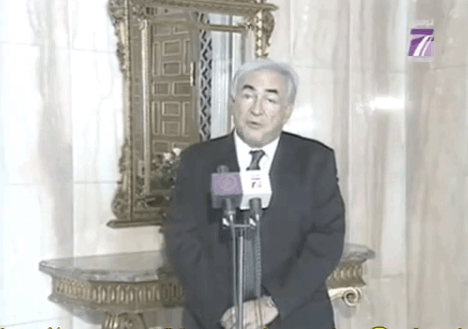
Strauss Kahn in autumn 2010, in Tunis - As President of the IMF, I wish to congratulate Tunisian President Ben Ali on the rigor of his management
&&&
Shortly after this "Tunisian Spring," my wife and I were in Egypt, in a tiny village near Luxor, staying with a friend working on a nearby archaeological site. Not far from the tomb of Queen Hatshepsut, where a group of religious fanatics had, a few years earlier, murdered around forty tourists—French and Swiss—first with AK-47s, then with knives when they ran out of ammunition.
Suddenly, the Egyptian Spring begins.
- Mubarak, get out!
The crowd gathers in Tahrir Square, waiting for a miracle, a sign from heaven.
We bond. A vision of a police vehicle speeding off at high speed, killing a few passersby in the process.
The calm of this small village, where time seems to have stopped. I draw everything around me, sketch portraits of my neighbors. In the evenings, I play guitar among the young people, who are delighted.
Our host has left, on orders, to join the French embassy. Fear settles in, comfortably. Anything could happen.
One night, gunfire. The farmers have rifles. They stand guard, protecting their meager possessions. Those who receive a salary often wait months for it to arrive. One man sleeps with his animals—goats, donkey, chickens—afraid that a jackal, just a hundred meters from his home, might come and attack them.
I said gunfire. The region is full of police officers, in worn uniforms, casually grouped at checkpoints along a road leading to an archaeological site. They "check" people, and more often than not, they extort money to supplement their miserable salaries. The locals are used to them and ignore them more than they interact with them. I imagine a France where, if you're stopped by a gendarme by the roadside, a few bills slipped into their hand would solve any problem.
Our bakchish-men drive with bald tires, broken headlights. In front of their police station, a corrugated metal shelter has a thick glass bullet hole, never repaired. Last night, the villagers suddenly spotted a 4x4 trying to flee, lights off. They fired shots in the air, stopping the vehicle.
Inside were four police officers in civilian clothes, leaving their post—perhaps to reinforce Mubarak's thugs in Tahrir Square. We'll never know. That night, the region emptied completely of its dozens of police officers. Was there fear of something? No. They could have easily barricaded themselves in their quarters. They were fleeing, deserting their posts.
Calm returns to the village. I continue drawing. We eat with the farmers, sitting on the ground. During the day, my wife joins the other women to make flatbreads, drying them in the sun before turning them into pancakes on a heated griddle.
The TV runs continuously. Our neighbors don't speak a word of French, and we don't speak a word of Arabic. Drawing and guitar serve as a bridge, just as in the past, when I took clients on safari to Kenya and Tanzania and met the Maasai.
On screen, Tahrir Square, always. The crowd, stones thrown, some gunfire. At prayer time, thousands of backs face the sky. Allah is great, it's written. With the internet cut off, there's nothing left but to question the stars.
Allah has an answer for everything. I learn on the spot that the Quran is completed by the Hadith—the sayings of the Prophet, collected in thick volumes. He must have been quite talkative, that one. We're told there are no fewer than 400,000 statements attributed to him. Over time, scholars have selected what they consider authentic. A few tens of thousands of key statements remain. With that, you can answer any question, bringing forth both sides of any argument. In Cairo, twice, I found copies of Mein Kampf sold on a sidewalk, in Arabic.
Fortunately, we have "our Western civilization," with its sacred books. Magazines with beautiful colors, capable of giving meaning to our lives. Take this one, for example:
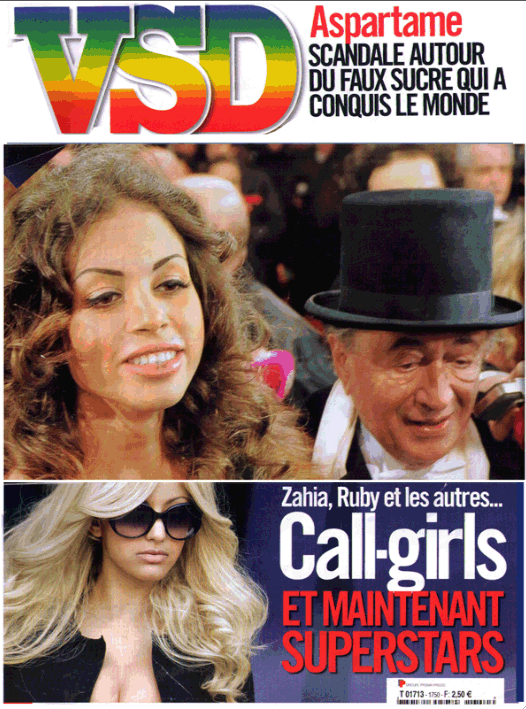
Excerpt from the March 2011 issue of VSD
At the top, the sultry Ruby takes her first steps into Viennese high society, arm in arm with billionaire Richard Lugner
On the spine, I read:
Bel: €2.90, CH: $8, A: €3.60, D: €3.70, ESP: €3.20, ITA: €3.20, LUX: €2.90, NL: €3.20, Morocco: 30 DH, Tunisia: 4.20 TND, CFA zone: 3200 CFA, etc.
This rag sells clearly. There are others. Nonsense is globalizing. But don't go telling these women they're just prostitutes. They're "escort girls"—a crucial distinction. You could just as easily replace the head of this Viennese billionaire with that of Strauss Kahn, who's currently being sucked off by the woman he's parading on his arm.
Quickly, find me the way to the nearest synagogue or mosque. A rabbi or an imam will tell me how to live, minute by minute. What other solution is there in an age when we discover a political figure who, through repeated slips of the tongue, reveals elements that may not have been unrelated to the course of his career?
And what about Jean-François Kahn, who describes DSK's indiscretions as "ancillary romps"? He was right to retire from journalism. When you utter such nonsense, it's truly because you have nothing left to say.
What does this have to do with concentrated solar thermal?
There must be a connection. I'll find it. But everything often mingles in our heads at dawn, you know well, in a world where we feel like waking up each morning with a hangover.
Images pass by. Tahrir Square, on the TV screen. I think, "Poor people. They have no direction to turn toward, no program to debate. We discover that Ben Ali's closets were full of gold bars. Mubarak isn't much better. These are just the pyramidions of pyramids of corruption nested within one another. How to get these countries out of the rut, with whom, how?
Others aren't much better. Education? Well, first you'd need to know how to read? My neighbor in this village has worked with French people for thirty years and doesn't know three words of my language. And reading—what? VSD?
In the village, children receive traditional education in the morning and attend Quranic school in the evening. As a result, they learn theorems like they do surahs.
- Any body submerged in water receives, if God wills, an upward thrust...
A ticket home, finally. The airport deserted. No police, just airline employees extorting small bribes. A ticket here, a ticket there. Everything always ends up being sorted out in Bakchish-city.
Next week I'll be in Biarritz, from June 6 to 9, attending a conference on Z-machines. The DZP (dense Z-pinches) colloquium. At 8:30 AM Monday, my old friend Malcolm Haines will speak, and we'll see if any Americans rise to challenge him. It's easier to criticize someone in the corridors of conferences. Harder face to face. I won't miss that session. Scientific journalists should come. It'll be worth the trip.
But it's the swan song. In Brighton, I discovered the childish joy of Americans involved in black programs (UFOs and secret American weapons, now become... collector's items. Search for it on eBay). In Vilnius and Korea, I discovered that new scientific breakthroughs were already being redirected toward new weapons.
Tiring...
Aside from our MHD research, civilian in nature, deliberately violating God's eleventh commandment—"you shall not study what is round!"—I will now turn toward energy production fields using methods worthy of the 19th century.
Concentrated solar thermal—here we are. You see how everything comes full circle, and there was no real reason to worry. Even Areva is getting involved. They're anticipating a potential collapse. Who knows? Caradarche would make a superb solar power plant, with its 1680 hectares. We install mirrors, turbines, alternators, systems for storing heat in molten salts. We could produce 1689 megawatts. At least that would serve a purpose. And we'd have everything on hand: offices, workshops. My friend Jacques Juan suggests renaming ITER:
Institute for Thermal Energy Research
That way, we keep the signs.
It seems a high-ranking official at DGA, the French Defense Procurement Agency, recently burst into a study office.
- Tell me, could solar energy have military applications?
- Indeed it could!
- Ah, you reassure me. Tell me...
- Well, it's under study. Imagine, with powerful mirrors, we could set fire to enemy ships' sails from a distance.
- But our navy no longer sails under sail!
- You're behind the times, General. The French Navy and DCNS are studying stealthy wooden cruisers, completely undetectable. At a distance, their radar cross-section is no larger than a football.
- Good, but what about weapons?
- Thanks to stealth, we can approach the enemy at close range and shoot them at point-blank range with crossbows.
- And cannons?
- No, with cannonballs and carriages, we'd lose stealth.
- Well, keep me posted...
I've built large files on ITER, especially as a commentary on the excellent "Complément d'Enquête" broadcast. It took a serious effort, I tell you. But it was worth it. These people did their job well. This leads us to revisit the segment where NKM (she sounds like a ball bearing brand, but nowadays, lacking a real name, we make an acronym), alias Nathalie Kosciusko-Morizet, responded to journalist Benoît Duquesne about how her government mistreated the poor souls who, believing the lies of that liar Sarkozy, invested in photovoltaics.
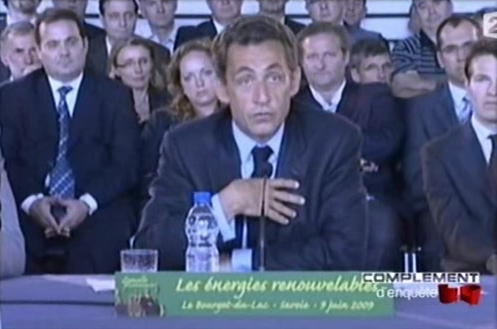
- France decides to invest in photovoltaics, long-term, for the long haul.
[Video clip](/VIDEOS/sarko .avi)
(Would you buy a used car from a guy like that?)
Benoît Duquesne questions NKM. Her response:
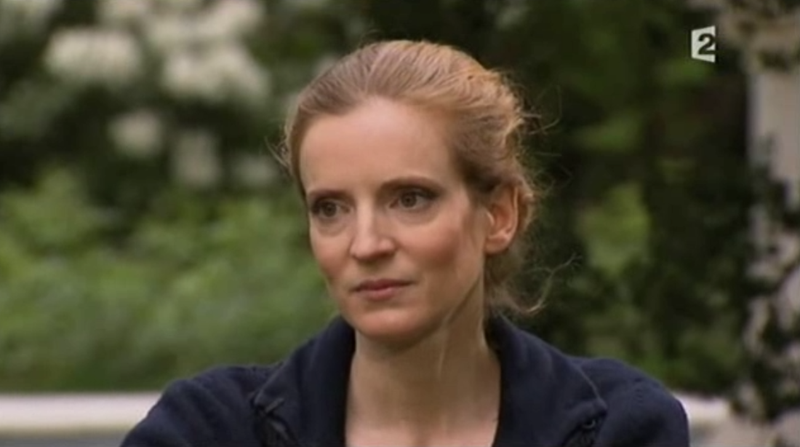
Duquesne and Madame Kosciusko-Morizet, clearly not at ease with butter.
Minister of Ecology, Sustainable Development, Transport, and Housing
http://www.batiactu.com/edito/un-tunnel-solaire-alimente-les-trains-en-belgique--29298.php
June 14, 2011:
A text by A. Dutreix: "Let's put an end to such lies!
______________________________________________________________________________ The US White Paper on Solar Energy (2006) ______________________________________________________________________________ A Belgian story:
A solar tunnel powers trains in Belgium. A first "green train" left the city of Antwerp heading north toward the Dutch border on Monday morning, running on electricity produced locally by the 16,000 photovoltaic panels of the "Sun Tunnel." A world first in the railway world.
These are photovoltaic sensors, without energy storage. But the same concept could be applied with well-designed concentrated solar thermal, storing heat in molten salts for night and cloudy-day operations. So do the math. Imagine covering France's railway lines and highways. Take an 800 km high-speed rail line, assuming a 30-meter-wide roof. That's 2,400 hectares. Assume 0.1 MW per hectare of concentrated solar thermal. That gives us 240 MW. Enough to power the TGVs abundantly.
The sensors shouldn't have been on the roofs of the trains, but on top of the tracks.
Of course!
Imagine equipping all French and Navarre highways with "solar roofs," well oriented. With power stations every few kilometers, using concentrated solar thermal with heat storage in molten salts.
All vehicles could run on electricity.
And as a bonus, nearby towns would be supplied with power. It wasn't in car batteries that we should have put batteries charged by nuclear electricity, but on the roofs of solar tunnels...
It took Belgians to point this out. These are "Great Works," to be sure, but it would be worth leaving our descendants a livable country. You can easily imagine the "hybrid" formula. Under this roof capturing solar energy, a meshed roof identical to those on bumper car rides.
You enter these circuits with a car equipped with a conventional internal combustion engine, plus electric motors built into the wheels. At the toll booth, you extend your "pole" to connect. And off we go, at constant, regulated speed, in safe mode. No more car accidents, no more paraplegics, no more death tolls. The system even pilots your car. You can read your newspaper, work, or sleep. You program your route, and fifteen minutes before your exit, you receive the message: "Restart your internal combustion engine. You'll be diverted to exit number 15, which you selected, in fifteen minutes. Press the reception button to confirm you've received this message."
Why not put people with imagination, visionaries, at the head of the country—or countries—instead of soulless schemers with no dreams of any kind?
| - | | | | | | | | | | | | | | | | | | | | | | | | | | | | | |
Hearing her, one gets the impression that solar energy is limited to photovoltaics, and that the government had to put a stop to massive imports of Asian-made cells, disrupting our balance of payments.
Benoît Duquesne didn't respond to her with, "But there's more than one way to manage solar energy?"
He doesn't, because he doesn't know. And neither does Madame Kosciusko-Morizet. She should consult... AREVA. Yes, there exists a "very clear-cut" sector, to use the phrase of this "fourth-ranking official in the Sarkozy government," which requires no import of rare or expensive materials. All you need is to install mirrors made of silvered sheet metal, like at Andasol and other sites in Spain.
Ah, quite a few interesting things in this month's (May 2011) issue of Science and Vie.
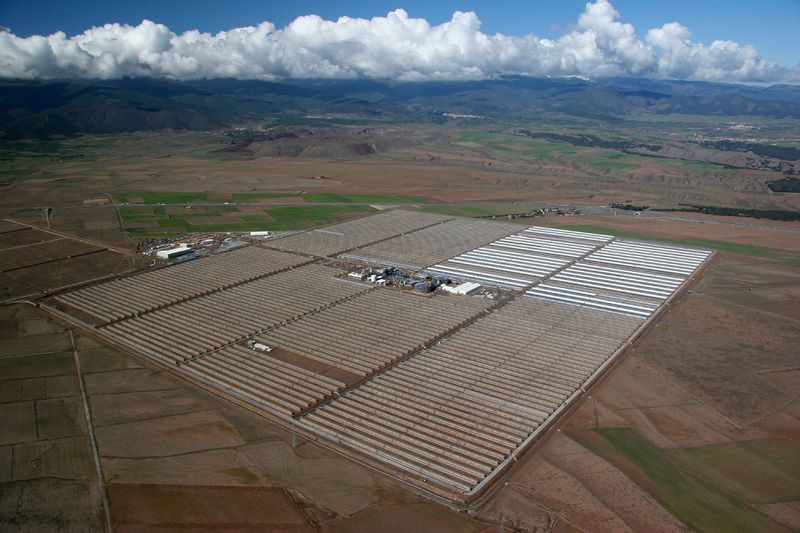
The Andasol site in Andalusia: 50 megawatts (more than double with Andasol II)
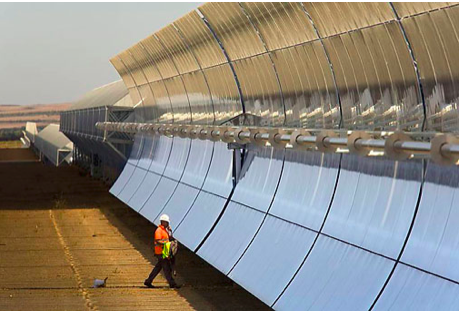
The mirrors at Andasol
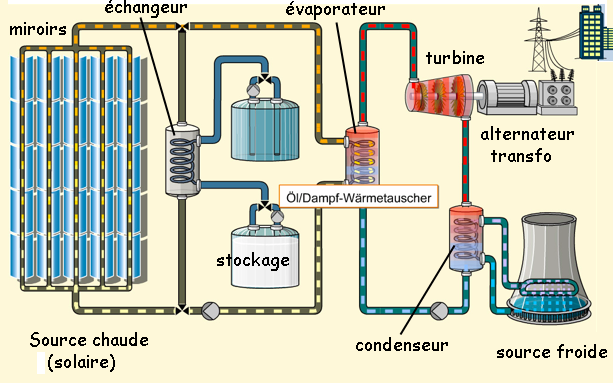
This kind of installation is not "experimental" but fully operational, feeding the nearby grid. Its mirrors produce fluid at 400°C, powering a turbine-alternator system, identical in every way to those powering a nuclear reactor's core.
Go online. Explore. Try:
****http://en.wikipedia.org/wiki/Concentrated_solar_power
**The French version, more concise.**http://fr.wikipedia.org/wiki/Centrale_solaire_thermodynamique
You'll find "linear parabolic" systems:
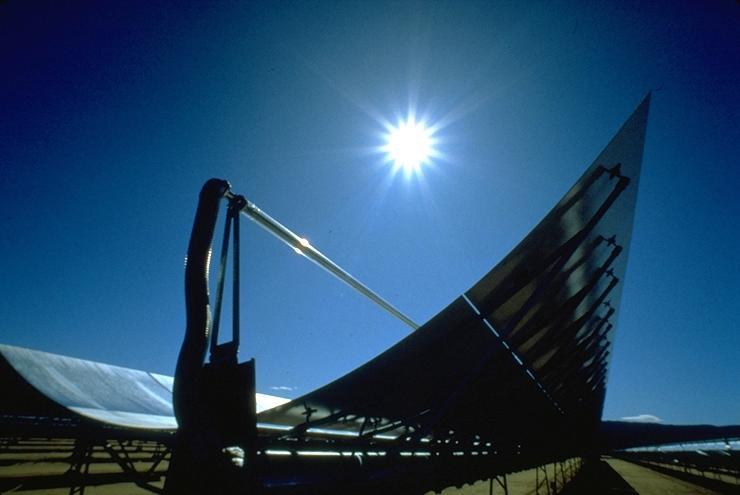
Even in countries with moderate sunshine, you can produce high-pressure steam at 400°C.
You just need to extend the length of the mirrors...
AREVA, "at the forefront of progress," opts for rotating Fresnel mirrors.
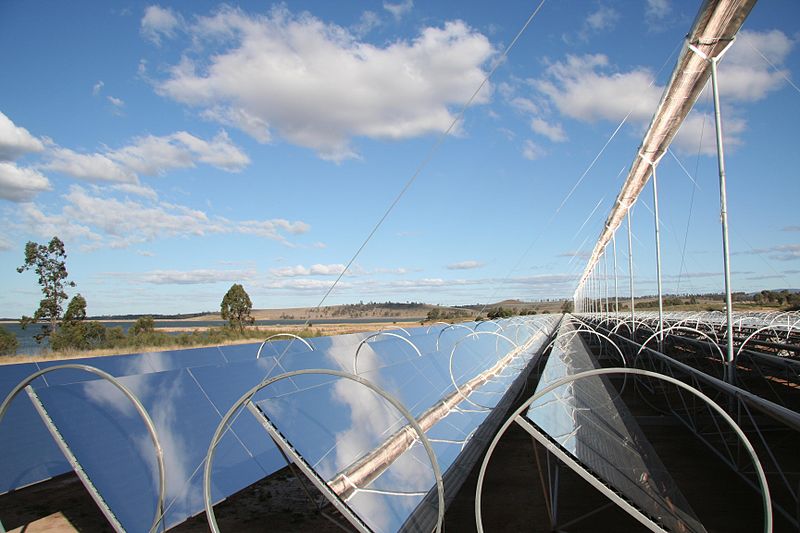
At the top, at the focus, the solar energy concentrator.
For a domestic version of the Fresnel mirror system, see my article in the May-June issue of Nexus.
Another variant: parabolic dishes focusing energy onto Stirling generators
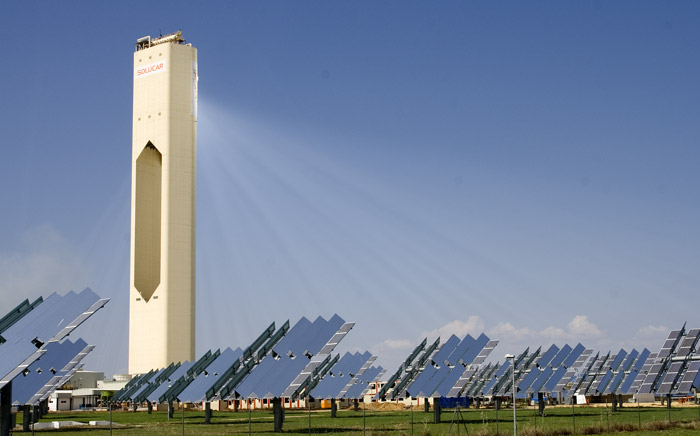
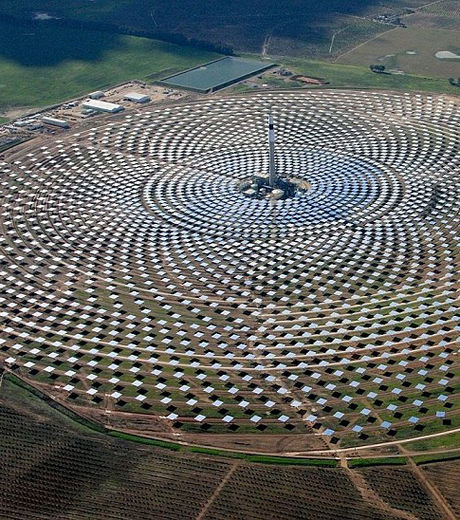
Elsewhere, a "solar tower" toward which mirrors automatically concentrate energy.
****Endless images
I must hurry. The hour is advancing. I leave you to discover this already vast field, where we are practically absent. But you get the idea. We abandon nuclear boilers, but recover everything downstream—the heat exchangers, turbines, alternators, all the know-how surrounding them—and couple it with large-scale, high-power "solar boilers." We store energy in molten salts at 400°C. It's already operational.
When space is lacking (Japan), we install it on barges, combining it with wind and hydro power (my article in Nexus, May-June 2011). We transport the electricity as high-voltage direct current (already operational for ages). In Japan or elsewhere, we equip the slopes of mountains, exposed to sunlight. Work, jobs for tens of millions of people. Technologies accessible to all countries. A global economy revived by "Great Works."
It's this—or a third world war. You choose what you prefer.
Ah, I forgot the best one. Iceland, financially in ruins, strangled by its "debt," is the Saudi Arabia of geothermal energy, the paradise of hydropower (Icelanders don't even know drought). All it lacks is a continuous high-voltage undersea power line to supply Europe. And Iceland might be less unstable than Libya (ah, that image of Bernard-Henri Lévy playing Malraux there, and addressing Sarkozy by his first name. BHL, the inventor of disposable thought).
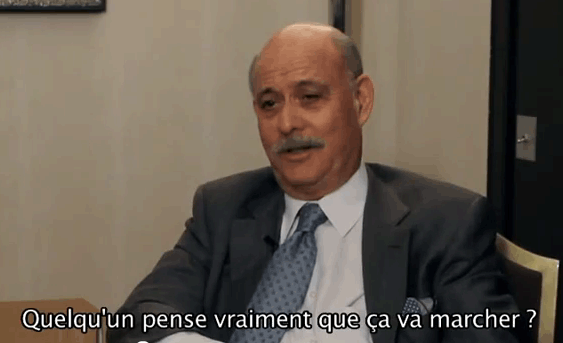
Jeremy Rifkin responds to Sarkozy
Rifkin is right: nuclear power is an outdated, dangerous technology that produces only 6% of the world's energy consumption. For this deadly technology to play a role in "reducing greenhouse gas emissions," we would need to build 1,500 additional reactors over the next 24 years, on top of the 450 already in existence.
That’s equivalent to having a Chernobyl disaster every month, statistically.
It’s impressive what Rifkin says. But when it comes to energy, he envisions a network resembling the Internet. It reminds me of Mao’s village foundries. Yet I doubt we’ll ever be able to power a foundry using solar panels from neighboring communities.
Every time, each person holds up one piece of the puzzle, ignoring the existence of the others. Rifkin lacks the concept of long-distance electric energy transmission (only 3% loss per thousand kilometers) via high-voltage direct current. But he has an excuse. A few months ago, I too was unaware of such a technology...
A minister is supposed to know more than the average person, in principle. Re-listen to Koziusko-Morizet—synthesis of ignorance and incompetence, advocating for the "transparency of the nuclear supply chain."
Pathetic...
I can't find online a summary table with flags showing the major achievements of solar thermal energy across different countries. Spain is well positioned. The U.S. is somewhat so. There are installations with hundreds of megawatts.
France, absent...
http://www.total.com/fr/groupe/actualites/actualites-820005.html&idActu=2394&textsize=1
June 2, 2011:
France cautiously re-engages with solar thermal energy:
/ AREVA installs solar thermal plants in Australia. Why not in France?
The United Arab Emirates are also getting involved (2010), with Total's collaboration:
But... in France???
June 3, 2011:
I know the village of Mées, near Sisteron, quite well. It has a rather astonishing history, which I’ll tell you one day. It features an 117-meter cliff made of "poudingue," a remnant of one of the Durance River’s moraines when it was a massive glacier. A moraine is a mixture of soil and pebbles (from "pudding," hence the French term). Nearly impossible to climb.
Go see it—it’s worth the trip. At 80 meters above ground, a Saint Andrew’s cross is embedded in a cave, made of two 4-meter wooden beams. It’s been there since the 15th century. Who put it there? Mystery. When I rappelled down, I got close enough to touch it. A complicated, adventurous story. Perhaps, up there, there’s a tomb accessible through a hidden tunnel.
Indiana Jones near your doorstep. Up above, a vast plateau. The people of Mées have installed 36 hectares of photovoltaic panels, planning to expand to... 200 hectares. No one is bothered. It’s invisible unless you fly over the area in a glider.
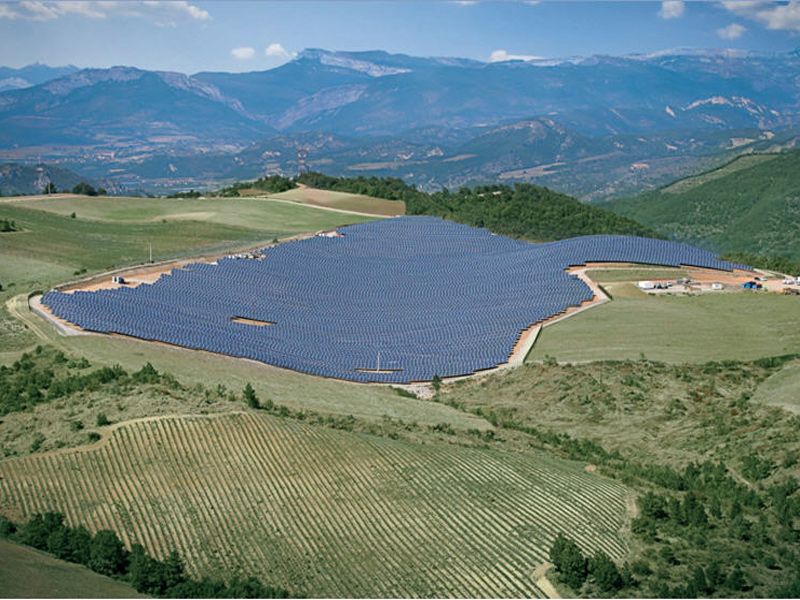
36 hectares of photovoltaics on the Mées plateau. Total project: 200 hectares. One hectare equals 10,000 square meters. There, each square meter receives one kilowatt of solar energy. That’s ten megawatts of solar power per hectare. Assuming a 10% efficiency (in reality, higher), that yields one megawatt of solar energy per hectare. With the full project, a minimum of 200 megawatts. That starts to add up. And all of this in a remote, unattractive area with no tourism value. France isn’t short of plateaus.
What a bore with this nuclear crowd!
.
http://www.maxisciences.com/gemasolar/gemasolar-une-centrale-solaire-capable-de-produire-de-l-039-energie-la-nuit_art15117.html
| June 15, 2011: | A solar tower near Seville. Its boiler reaches 900°C. Thermal storage in molten salts enables nighttime operation. Powers 25,000 homes. | And in France?
 |
|---|
Solar development projects in Morocco
To be continued...
An answer to the questions raised by various movements of protest emerging here and there like bubbles:
We are governed by self-proclaimed "elites" combining incompetence with stupidity.
Novelties Guide (Index) Home Page/index.html
.
.