Is paragliding a dangerous sport?
**Text updated on July 12, 2007 **
This system had been implemented by a friend on a training slope located in the central massif. But this site, lent by a farmer, is no longer used. A pity. The system was very clever:
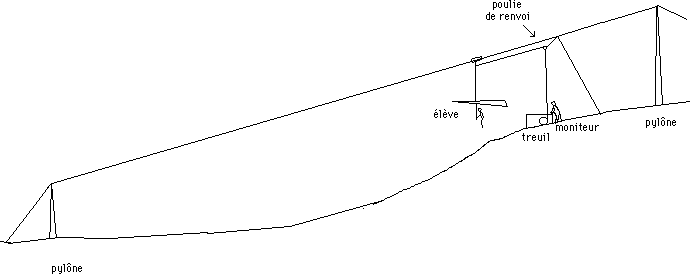
The "bana-bana"
...The principle is simple. The wing is suspended from a mobile rig running on a suspension cable, connected to a thinner retention cable by an electric winch. The suspension cable is fixed between two pylons and its average slope corresponds to the normal descent slope of a wing. The instructor completely controls the descent speed, thanks to the retention cable, using an electric control.
...Gradually, the speed is increased until the wing becomes airborne. The student then actually flies, except that he is not free to turn left or right. He tests his ability to control the pitch, learns the movement of running for takeoff and the final push at landing, which brakes the machine.
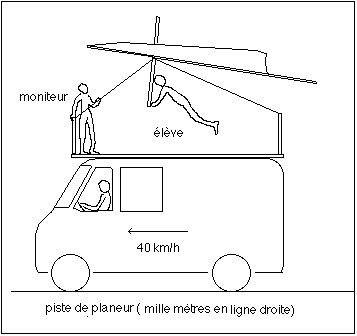
...Here is a second type of simulator (Hervé Duplan was one of those who introduced it into the teaching of paragliding). It is mounted on the roof of a truck.
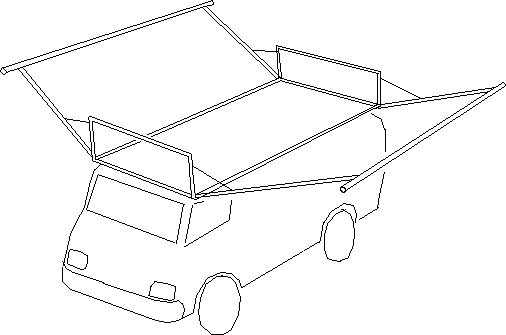
Truck equipped with a runway.
...A very open site, practically a glider field, with a good rollout length is required. Learning is done at dawn, the truck moving at 40 km/h. Below is the position of the wing relative to the cradle, and that of the instructor.
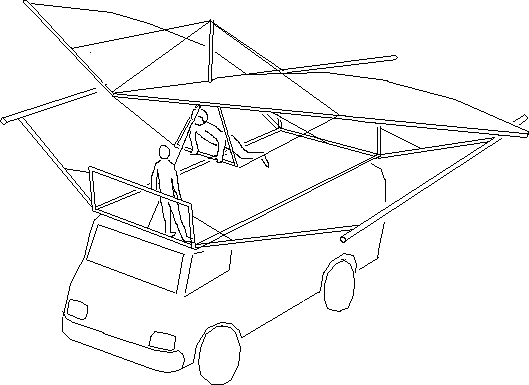
...With this system, the student learns how to control his wing laterally.
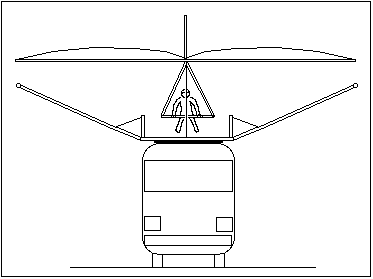
...Below, the lateral wind has moved the wing, still semi-captive, relative to the truck. The student learns to counteract immediately by shifting his weight laterally. Very quickly, he learns to bring his machine back into alignment with the truck and, by "anticipating," to keep it there.
...This exercise teaches the student to control any lateral deviation of his machine during takeoff, in flight, and during landing, safely.
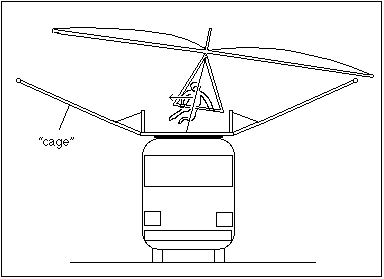
...He is not free to perform pitch movements:
...The two previous simulators allow one to detect without risk the clumsy ones, those who act before thinking, who will then only be put on training slopes when they have completely mastered the first two exercises.
...The quality of the next step is very much linked to the geometry and location of the training slope (which is the same for delta and paragliding). Some centers only have rocky slopes with obstacles. Ideally, one needs:
-
A small hill at the top to facilitate takeoff.
-
A grassy slope with an optimal slope profile.
-
A good landing area.
...The slope is oriented facing the sun, which gives a slight thermodynamic ascent in the morning, and facilitates takeoff.
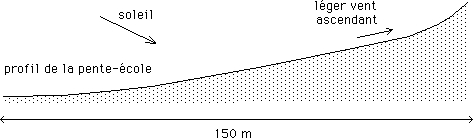
The ideal training slope.
**
...We will not develop here a whole theoretical course on delta and paragliding. See the aforementioned book. When the student has fully assimilated the takeoff and landing maneuvers, when he knows how to position himself in "3D" relative to a field, negotiate his field takeoff, he is ready for his first "big flight," generally involving several hundred meters of altitude difference, an easy takeoff and a large landing area equipped with a windsock to indicate to the person in the air the direction of the wind.
...Regarding this, I have a friend who seriously injured his face by approaching the field from the rear in a delta. There was no windsock.
- How could I, in these conditions, guess the direction of the wind at ground level? He said.
(The direction of the wind at ground level can be different from that at a few hundred meters altitude).
...Method: take a ground reference: a farm, any visible object, when you are still high enough. Then make a 360-degree turn, perfectly circular. If you return to your starting point: no wind. Otherwise, the drift indicates the direction of the wind. My friend was unaware of this detail.
**The first French ULM championship, in Millau. **
...One might think that in the different sectors of the ultra-light aircraft, progress has been made, of course in all areas, including in the teaching sector. But no standard had been established from the start. I remember very well "the first French ULM championship" held in Millau, about fifteen years ago. The carrying of a parachute was considered optional "otherwise there would not have been enough competitors". Everything was broadcast on television. As the machines were very different, the organizers (the recently created ULM federation) did not know which events to propose. The least absurd consisted of asking competitors to make a circuit by taking photographs of different key points. But this was more like a rally than a French championship. Then an irresponsible person suggested an accuracy landing event. On a large field, a rectangle was marked with yellow plastic bands. The event consisted of landing inside this rectangle, like on an aircraft carrier deck.
...ULMs did not have air brakes. The competitors were therefore encouraged to approach the runway by doing exactly the opposite of what is taught for any aircraft: flying just above the stall. There was a first accident. An ULM stalled at low altitude and the pilot suffered broken vertebrae. But the second accident was terrible. The aircraft was apparently one of the best available at the time (a "Sirocco," if my memory serves me right). It was reasonably built and powered and offered good flight qualities. I remember that the tail was of the "butterfly" type, with two planes inclined at 45 degrees. The pilot stalled during his approach to the field. A asymmetric stall immediately caused a spin. At the altitude he was at, the pilot had a hundred times the time to recover. He would have only needed to "let go," push the stick forward while adding a bit of power. The aircraft would have immediately regained full maneuverability, in one second. But, horrified, I saw the rear controls tilt in the wrong direction, in a fully pitched-up position: the pilot was doing the worst possible thing: pulling back on the stick all the way! He did four spins and crashed in front of the public and millions of television viewers. The championship was interrupted. Shocked, I contacted the journalists who had covered the event, asking to intervene, in vain. Filming an ULM competition could give "good images," but interviewing an unknown person about an accident that had only resulted in one death, what interest? Safety does not go well with ratings.
(Anyway, and this is verified over the years, journalists are not really interested in anything related to safety. Recently (July 2007), a television channel presented a report on "the saga of freediving." A viewer wrote to protest and demand a debate on this so-called sport. Vox cl...