Transforming a right-handed Boy surface into a left-handed Boy surface
A reader's reaction, after reading "Tender and Delicate"
June 27, 2010
It always takes me considerable effort to compile folders for my website. The feedback I receive has prompted me to draw this illustration, which fairly captures the situation.
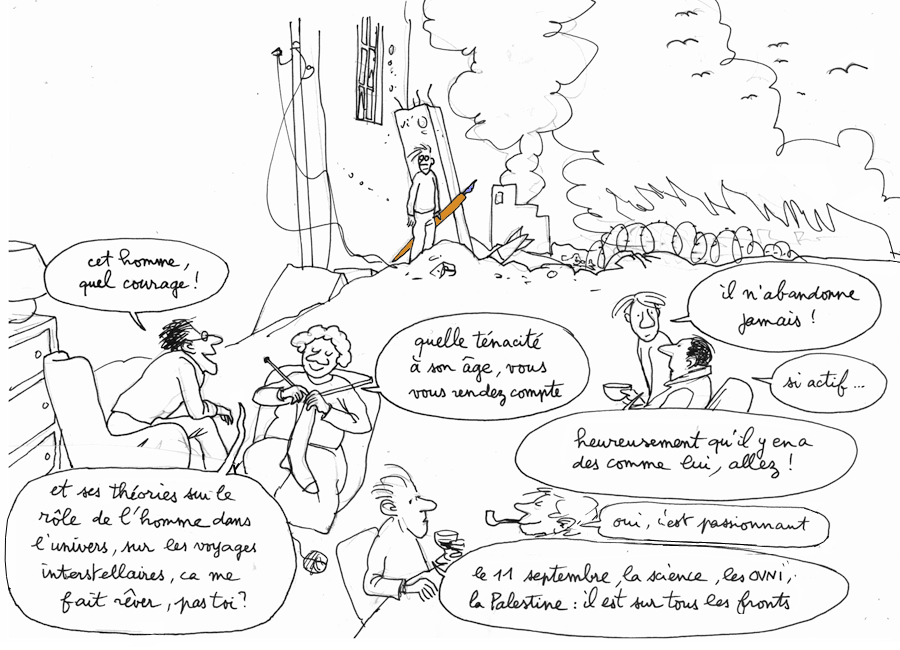
I can no longer count the emails from people who end with "thank you for not citing me," even though most of them share utterly insignificant things. Our world is rushing headlong into fear. One must admit, some are job-seeking. In this matter, there's no point in taking unnecessary risks.
Still, the crown goes to a 43-year-old CNRS researcher, a mathematician by profession, hence a civil servant, secure in his job stability. Deeply concerned about all the world's misfortunes, he courageously signs petitions by the dozen. Fifteen days ago, he told me:
- A colleague informed me that my name appeared on your website, using your internal search engine. They said it could harm me.
I checked. Indeed, my name appeared as a spectator at a seminar I gave in his math lab back in 2003. Originally, I had called the head of that geometry lab, a specialist in singularities. I mentioned something I had discovered: "how to transform a right-handed Boy surface into a left-handed Boy surface, passing through the Roman surface of Steiner." For those curious about this topic, here is the link. The man found it interesting and said:
- Why don't you come and present this at our seminar? Let's set a date. And on that day, come in the late morning. We'll go eat with the lab members, so we can get acquainted.
In the following days, he told his lab mates he had invited someone who had done something interesting in geometry.
- What's his name?
- Petit.
- Jean-Pierre Petit, the "the" Jean-Pierre Petit?
- Yes.
- You're crazy. We'll get into trouble!
When I arrived on the day of the seminar, the lab was deserted. All doors were locked. Since I came with my old friends Tardy and Flesia, we went to eat in the cafeteria, all three of us.
I set up the models for the week. I had built, from cardboard, all the models illustrated in the link (by the way, if someone wants to animate this, they’re welcome to—it’s just flat faces). The lab members arrived, their faces grim. No director in sight. I waited twenty minutes and eventually started the seminar without being introduced. It vanished immediately after my talk. In the back of the room, my mathematician-who-doesn't-want-trouble.
I gave my seminar. But a geometry seminar by JPP, even if it's high-level, resembles Lanturlu. It's very visual. Two visiting mathematicians—both German and Italian—were absolutely delighted by what I presented. (In fact, I had great success later at the geometry department in Rome, when I repeated this show.) The French, as usual, looked glum.
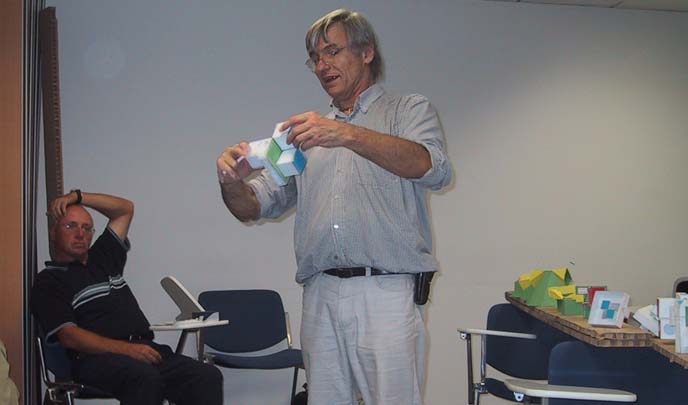
Along the way, I explained how to swap the two cusp points of a cross-cap. The man in the background misunderstood, mistaking me for an amateur, a mathematical clown, someone to be quickly silenced. At the end of my talk, he stood up, went to the board, and declared:
- I don't understand why Petit seeks such complicated methods to swap the two cusp points of a cross-cap. There's a much simpler way.
And he drew on the board a sphere that had been squashed between two rulers:
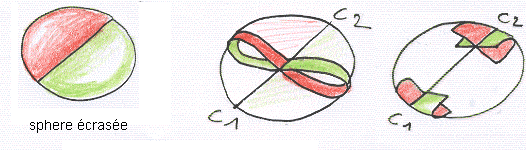
The following drawings show what happens to this poor sphere. Colors are used to encode the two sides of the surface. Indeed, during this squashing, two singular points are created, called cusp points. And the man added:
- Here is my cross-cap. To swap these two points C1 and C2, just rotate the object (I won't describe my much more complicated method).
Unfortunately, our man had messed up. The cross-cap, like the Klein bottle, is unilateral—it has only one side. A member of the audience pointed this out:
- But your cross-cap is... bilateral.
The man realized his mistake and collapsed. Tardy, never missing a chance to pour oil on the fire, added:
- Maybe there are bilateral cross-caps...
The atmosphere grew heavy. My man turned to me, defeated.
- But then, what is this surface?
I went to the board and, in three drawings, merged the two cusp points and gave the answer, in a neutral tone, without a mocking smile.
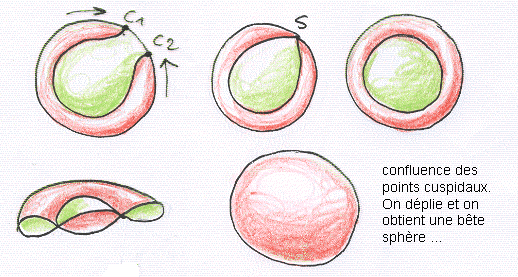
- This surface is simply a sphere...
The man, already somewhat red-faced by nature, turned crimson and sat down. I had just made a mortal enemy—one more. The seminar ended.
- Any questions?
No, the room emptied quickly. Only the German and Italian mathematicians remained, laughing heartily. The French had fled this man practicing a kind of geometric sorcery, who had just ridiculed one of their lab's leading minds. Throughout the scene, the director had courageously disappeared. Later, he told my little mathematician, who had watched from the back and only confessed seven years later:
- You know... uh... for the sake of your career, you'd better not associate with this... Jean-Pierre Petit. Well, it's just a friendly suggestion...
This anecdote, from seven years ago, explains why my dear colleagues are so reluctant to face me in seminars, like the young polytechnician Riazuelo. Such an incident, even if conducted with neutral words, is equivalent for someone claiming to be an expert in a discipline to being hit in the face with a theorem. Many know that in this game, I have never lost a battle.
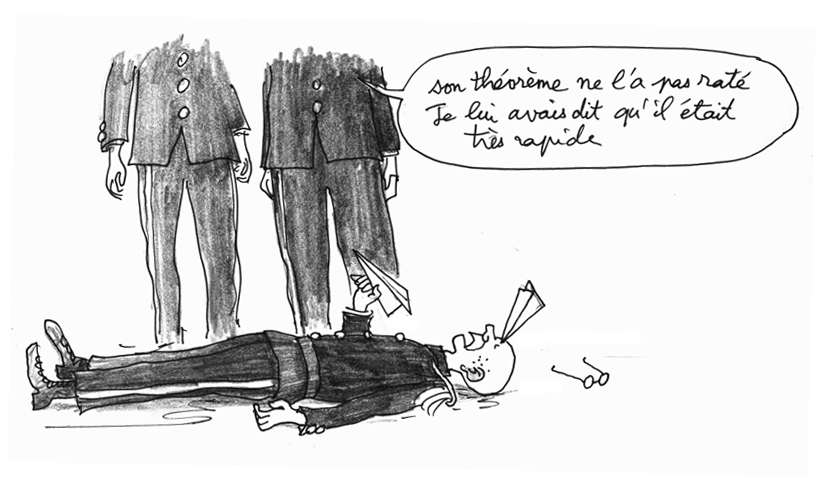
These aren't even battles. People simply underestimate me, decide to steal my thunder, and end up spectacularly embarrassed. I could write a book about the dozens of scenes like this I've experienced, where the same scenario repeats endlessly across different disciplines. And maybe I will. Yes, I don’t look like Hubert Reeves, and I create comics. People don’t suspect...
It reminds me of a seminar I gave twenty years ago at the Centre de Physique Théorique in Marseille. In front of the audience, I "varied the constants," including the sacred speed of light. Unprecedented. At the end of the talk, the audience turned to Souriau, seated at the back. He had a reputation as a "killer." How many times had he mercilessly dismantled speakers? All theoretical physicists presenting before him were always nervous.
But this time, it was someone outside the brotherhood who had just given a talk, doing things quite inappropriate—like varying the speed of light. It was a first. See my comic "Faster than Light."
Yet "Grandpa Souriau" strangely didn’t react. He made a gesture indicating he had nothing to say. The audience was perplexed. In the front row, a man fidgeted, seemingly about to draw his weapon. It reminded me of a scene from a Sergio Leone film, where Clint Eastwood has just struck a match on the bump of a bandit, played by Klaus Kinsky. The man’s hand rose toward his revolver’s grip, but his neighbor warned him. It was as if to say:
- This guy is really fast. If I were you, I wouldn’t do that.
In this theoretical physics seminar, the gesture was the same:
- If Souriau didn’t shoot this guy, there must be something we don’t understand. There must be something solid in this story.
I finished my seminar. Someone said:
- Any questions?
No, none. The herd shook itself and left. If I had to do it again, I think I would have said and done the following:
- Listen, dear colleagues. In just one hour, I’ve varied all the constants of physics, including the speed of light. And you’ve shown no reaction. So I’ll do this: turn around, unbutton my pants, and show you my buttocks. Maybe I’d have more success...
I never managed to present my cosmology work at the Institut des Hautes Études in Bures-sur-Yvette, despite several attempts. Astrophysicist and academician Thibaud Damour opposed it. But he didn’t understand my work. The director, a mathematician named Bourguignon, did. But he lacked the courage to extend the invitation himself. There would have been a Damour-Petit showdown. Damour would have attacked, and one of them would have fallen. Bourguignon didn’t want to take that risk.
I wrote three times to Rovelli (loop gravity), who is in Marseille. No reply. At Imperial College, Magueijo, chair of Theoretical Physics, who sees himself as the discoverer of the concept of a variable-speed-of-light cosmological model, and who edited a book later published in France by Dunod under the title "Faster than Light," also evaded the seminar proposal.
I no longer insist. I’m tired. Ah, I’ve removed the name of the little mathematician who worried about his career from my website. That way, he won’t have any more career worries.
Poor fellow, something terrible happened to him a few months ago—probably the worst thing that can happen to an academic. While walking with his mother through Paris, he saw a UFO in broad daylight. A large dark mass, like a thumbnail at arm’s length, around which small glowing objects whirled. The object, nearly at zenith, must have been high in the sky and large, as it passed behind an airplane’s contrail. The sighting lasted several minutes. They even stopped a passerby to point it out. Then the object turned white and quickly vanished.
I tried for years to work with this young man. I thought this observation would finally motivate him to reconsider the geometry of the universe. No such thing. When he returned, he simply said:
- I’m not making any assumptions about what I witnessed.
I suppose if extraterrestrials abducted him and took him on a tour of the solar system, he’d say, after saying goodbye:
- I’m not making any assumptions about what I experienced.
Back to the title of this page. Here is the reader’s interesting reaction:
Email received on June 26, 2010:
Dear Mr. Petit, I often read your writings, which I greatly appreciate. I’m not the type to speak up easily, and I only do so on this occasion due to a few fortuitous circumstances and a fair amount of idleness.
I read your text titled "Voices of Israel," and when I reached the excerpt from Amos Oz’s book "Tender and Delicate," I was genuinely horrified.
Afterwards, I reflected on the person herself.
Here is someone who, throughout her speech, speaks, as Oz repeatedly notes, in a calm and composed voice, never getting angry, even when contradicted. She describes how to achieve her goals, no matter the means, without feeling the slightest regret. She talks about acting for her children without the slightest trace of love—even for them—rather, a purely animalistic need to protect her offspring.
In fact, I think this man is simply a textbook example of a psychopath.
I’m certain a real psychologist could dissect her personality far better than I can. But even for a layperson who’s only seen a few films or police dramas, read some novels, and perhaps encountered a few killers—literally or figuratively—in the workplace—this would be obvious. Her hatred of tenderness and delicacy probably stems from her inability to feel these emotions. And yet, it’s precisely these feelings that distinguish us from animals and prove that humanity has evolved. Not all, clearly.
Everywhere in the world, when life becomes harsh and cynical, conditions favorable to the emergence of such individuals arise. They aren’t that numerous (at least, I hope not), and in a normal world, they are fought and driven out. But in an imbalanced world, we even use them, and they then assert themselves until they sometimes seize power. To justify their actions, they find all kinds of plausible excuses—political, religious, or any delusional rationale, like serial killers do. We’ve seen such people all over the world, from Nazi Germany to Serbia, and their names appear in newspapers worldwide.
In any case, they never question themselves, and the one who is always wrong is the other. They are absolute proponents of a binary worldview: "You’re with me or against me." Even if their speech appears coherent, it serves only to justify that the goal alone matters, regardless of the means or sacrifices—especially if it’s others who are sacrificed.
When Oz says people have written to him saying they share the monster’s views, one should remember the fan letters that serial killers receive in prison—so fascinating that we can no longer count the TV series and books dedicated to them. The real question is: why do we admire killers so much? Perhaps by answering that, we could fix things. I have a small idea, but again, I’m not a psychologist, and I fear it might be too simplistic.
Thank you once more for your writings and your presence.
Sincerely, Jean-Pierre V.
I find all of this quite insightful. The situation in the Middle East is nightmare-like. I’ve already presented the causes, background, and consequences in my dossier "The Land of Suffering and Hate." Wars foster the emergence of pathologies. The text "Tender and Delicate" represents one of them. The use of torture (Abu Ghraib and Guantánamo) allows all kinds of sadists to indulge freely. The film (which won six Oscars—I wonder why) portrays a deminer who grows fond of a game of Russian roulette.
My wife says every politician or high-ranking official is, in his own way, a psychopath—"otherwise he wouldn’t have risen so high." It’s true that power intoxicates. Then there’s this way of getting trapped in some dynamic or another. It can take any form. Recently, I met a colleague, a researcher-teacher who heads a thermodynamics lab.
- You know I’m working on ITER?
- Oh really? But you know it’s nonsense, right?
- Of course. Everyone knows that. But I had no choice. I had to accept the contract. Otherwise, I’d never have become a university professor.
Returning to the reader’s message, I suddenly thought of lines from the Partisan Song, composed during the French Resistance:
... and you, saboteur, beware your burden, dynamite.
- And you, killers, to your weapons and knives, kill quickly.
In our national anthem, the Marseillaise:
- Let impure blood water our furrows!
If our reader has a personal idea about how violence fascinates men, we await his comments.