Voices of Israel
Page modified on June 25 at 3:30 PM
Voices of Israel
Page created on June 20, 2010
****July 7, 2010: Content of Chapter 2
I believe the best way to produce a discourse on Israel is to let Jews speak for themselves, so they cannot be accused of antisemitism. The Old Testament forms the religious foundation of the Jewish faith, just as the New Testament does for Christianity. I am continually amazed to see people fighting bitterly while invoking books they generally don’t know. Unless they chant them, to the point of ecstasy, like endless mantras.
These "Holy Books" serve as a "manual of instruction" on both sides.
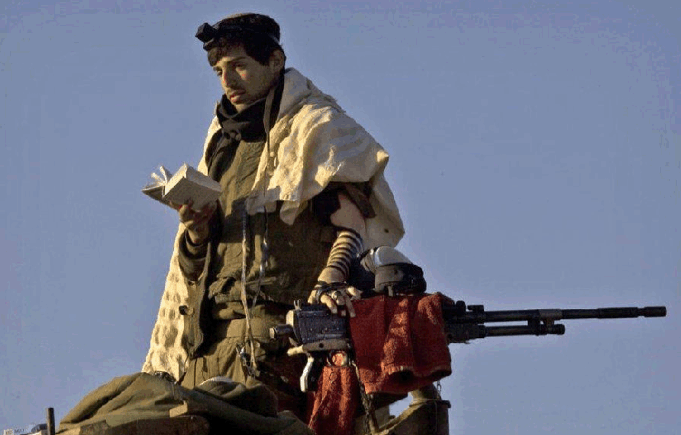
Young Israeli reading the Torah during Operation Lead Curtain
Deuteronomy is part of the Torah, the "canonical Hebrew texts." Excerpts:
Deuteronomy 6:10–11: Then the Lord, your God, will bring you into the land which He promised to your ancestors Abraham, Isaac, and Jacob that He would give it to you—a land with great, magnificent cities you did not build, houses full of treasures you did not accumulate, cisterns you did not dig, vineyards and olive groves you did not plant—and you will eat to your heart’s content.
Deuteronomy 7:1–2: When the Lord, your God, brings you into the land you are entering to possess, driving out before you countless nations… you must utterly destroy them. Make no covenant with them, and show them no mercy.
I am not inventing anything—I am quoting. How can people who draw their inspiration from these "foundational texts" possibly respect resolutions of the Security Council? When Zionists speak of the State of Israel, they say "the land," because to them, other lands simply do not exist—all others. Including, if necessary, the United States (see the attack on the American ship USS Liberty during the Six-Day War, outside territorial waters, to neutralize this vessel equipped with sophisticated listening systems. Survivors of the attack, which killed 34 and wounded 171, repeatedly stated they had raised a large American flag, fully visible under clear skies, without a cloud).
When Israelis speak of themselves, they say "the people," because other peoples are simply "non-Jews," "goyim."
The Bible is nearly unreadable, given the chaos that surrounds it and the expressions that often remain cryptic (such as "you to the forbidden," meaning "to systematically dedicate to genocide"). I envy the man who once told me, "When I feel down, I open the Bible at random, read a page, and it calms me." I find he has great luck. Or else, like Protestants during Sunday readings, they simply skip entire passages. I grew tired of extracting what I consider essential, creating a 540-page comic book that received little attention over ten years. I am astonished that journalists, when challenged—for example by Elisabeth Lévy—do not quote passages from the Bible, or remind her that figures like Yitzhak Shamir (assassin of Count Bernadotte, the UN mediator), Menachem Begin (bombing of the King David Hotel in Jerusalem, killing 80 people), and many others were proven terrorists. Returning to my dossier The Land of Suffering and Hatred.
Still on the subject of the Bible, take a look at these excerpts from my comic book, devoted in part to the conquest and division of Palestine. I quote a phrase from the warrior leader Jephthah and what happened to the non-Jewish city of Laish:
Jephthah:
And what the Lord has put into our hands—why should we not possess it? (Judges 11:24)
Laish:
Then the Hebrews of the tribe of Dan arrived at Laish, upon its peaceful and trusting population, whom they slaughtered with the sword, and no one came to their aid, for they depended on no one (Judges 18:27)
Noam Chomsky, a Jew born in the USA, was interviewed during his recent visit to France, shortly after the interception of the Turkish ship in international waters.
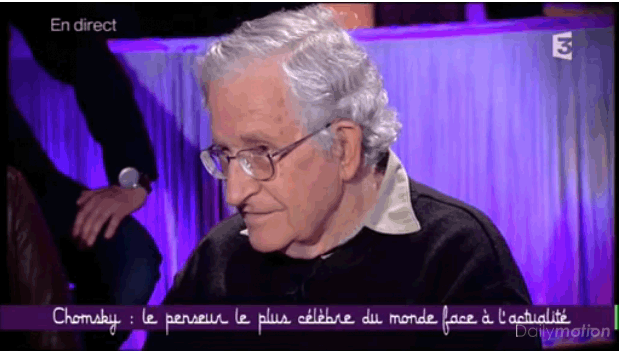
Noam Chomsky, interviewed by FR3, journalist Taddei, June 2010
http://www.dailymotion.com/video/xdij9p_noam-chomsky-chez-taddei-1-2_news#from=embed
The reader will note how Israelis commented on this assault carried out by Israeli commandos against the Turkish ship:
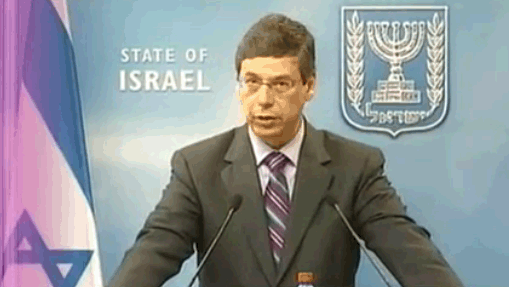
- The organizers’ intentions were violent, and their methods were violent
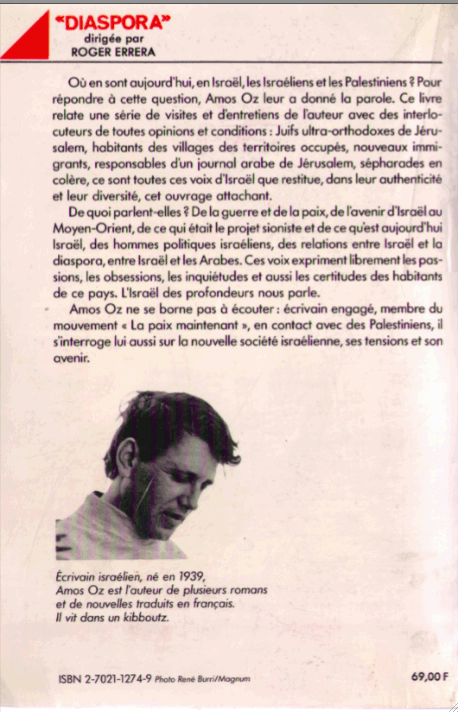
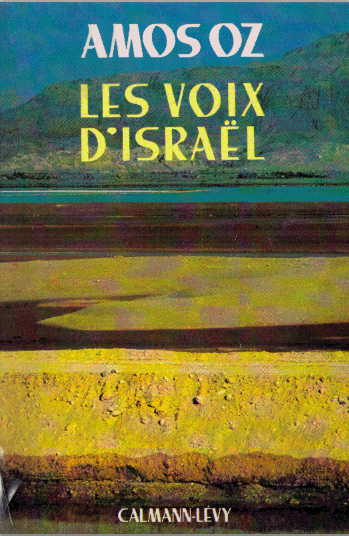
But Chomsky is not Israeli. I found a book published in 1983 by the Israeli writer and journalist Amos Oz, co-founder of the "Peace Now" movement. This work was translated into French and published by Calmann-Lévy.
Why did I go back to this book and seek to obtain it (used)? This book is a series of interviews conducted by Amos Oz in Israel. One of them reproduces the words of a man who hides behind the pseudonym T. This extremely violent text has already been reproduced on various websites, where people have claimed to identify this T. In the next edition, Amos Oz stated that his fellow Israeli writers had questioned whether such words could have come from an Israeli citizen. He confirmed that the author of these words insisted on remaining protected by anonymity, and had received numerous letters from Israelis expressing solidarity with these statements.
Twenty-seven years have passed. After acquiring this book a little over a year ago, I wrote to Calmann-Lévy, asking whether they planned to reissue it. At the same time, composing my letter both in French and English, I drafted a message addressed to the author, asking the publisher to forward it to him, posing the same question, and asking whether he considered it ethically justifiable to continue shielding the extremely shocking statements of this T, maintaining his anonymity for nearly three decades.
(Posted online on July 18, 2010)
I received no response from either the publisher or Amos Oz, and what I write now amounts to an open letter of inquiry. If I receive any response from either party, I will immediately report it.
There are ten chapters, and the text I referred to is the fifth:
1 - Praise be to God (6/27/2010) 2 - Humiliation and Anger (7/7/2010) 3 - The Finger of God 4 - A Glimmer of Peace 5 - 6 - Question of Life and Death 7 - Dawn 8 - Shadow, Light, and Love 9 - The Telescopic Jew 10 - Askhod
1 - Praise be to God (6/27/2010) 2 - Humiliation and Anger (7/7/2010) 3 - The Finger of God 4 - A Glimmer of Peace 5 - 6 - Question of Life and Death 7 - Dawn 8 - Shadow, Light, and Love 9 - The Telescopic Jew 10 - Askhod
Below is the book’s cover and its back cover, introducing the author.
The Ten Commandments (Hebrew) I - • 3 You shall have no other gods before Me.
II - • 4 You shall not make for yourself a carved image, or any likeness of anything that is in heaven above, or that is in the earth beneath, or that is in the water under the earth. 5 You shall not bow down to them or serve them; for I, the Lord your God, am a jealous God, visiting the iniquity of the fathers on the children to the third and fourth generation of those who hate Me, 6 and showing mercy to thousands of those who love Me and keep My commandments.
III - • 7 You shall not take the name of the Lord your God in vain; for the Lord will not hold him guiltless who takes His name in vain.
IV - • 8 Remember the Sabbath day, to keep it holy. 9 You shall labor six days, and do all your work. 10 But the seventh day is the Sabbath of the Lord your God: you shall not do any work, neither you, nor your son, nor your daughter, nor your male servant, nor your female servant, nor your livestock, nor the stranger who is within your gates. 11 For in six days the Lord made the heavens, the earth, and the sea, and all that is in them, and rested on the seventh day: therefore the Lord blessed the Sabbath day and sanctified it.
V - • 12 Honor your father and your mother, so that your days may be long in the land which the Lord your God is giving you.
VI - • 13 You shall not murder.
VII - • 14 You shall not commit adultery.
VIII - • 15 You shall not steal.
IX - • You shall not bear false witness against your neighbor.
X - • You shall not covet your neighbor’s house; you shall not covet your neighbor’s wife, nor his male servant, nor his female servant, nor his ox, nor his donkey, nor anything that is your neighbor’s. (Exodus 20:3–17)