univers gemelos contra materia oscura materia negra y constante cosmológica
- **Los agujeros negros no existen. **
¿De dónde proviene el modelo de los agujeros negros? De la ecuación del campo con segundo miembro nulo. Paradójicamente, un objeto tan denso proviene de una ecuación inicialmente concebida para describir regiones vacías del Universo. El tensor de Kerr no aporta mucho más: el objeto se vuelve simplemente más complejo. La rotación conlleva un fenómeno de arrastre de marco azimutal, lo que significa que la velocidad de la luz es diferente según se mire hacia adelante o hacia atrás con respecto al movimiento de rotación. Sin importar la técnica elegida, las cosas se vuelven francamente patológicas una vez cruzado el horizonte y entrado dentro. En el centro se encuentra "la singularidad". Comencemos con un ejercicio. Consideremos la métrica 2D (a). Si consideramos r como una distancia radial y j como un ángulo polar, nos encontramos con problemas para r < Rs. Pero si introducimos el cambio (b), la expresión de la métrica se convierte en (c). Todas las patologías desaparecen. Además, esta superficie puede ser incrustada en R3: la ecuación del meridiano es (d). Véase la figura 25 donde hemos representado una geodésica. Esto ilustra el hecho de que una patología puede depender de una elección incorrecta de coordenadas y de una elección incorrecta de topología.
En el ejemplo 3D, hemos calculado geodésicas planas (véase la figura 26) que se proyectan en el espacio de representación inicial (r, q, j). Obtenemos una "esfera de garganta" que conecta dos espacios euclidianos 3D. No hay nada dentro. El espacio para r < Rs no tiene significado físico. Si intentáramos calcular geodésicas en ese lugar, obtendríamos una solución imaginaria.

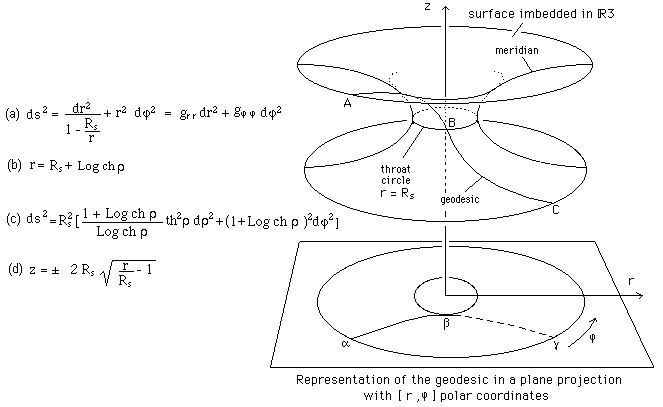
Fig. 25 : métrica 2D de una superficie con un "puente" que conecta dos pliegues.
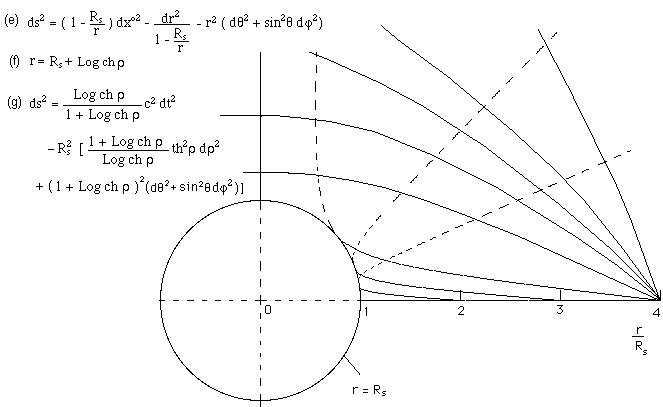
Fig. 26 : hipersuperficie métrica 3D con un "puente espacial". Geodésicas.

Clásicamente, se introduce un tiempo propio s (j) y una "coordenada de tiempo" t (i). El estudio de las geodésicas radiales da dos ecuaciones diferenciales (k) y (l), cuyas soluciones corresponden a las curvas (m), figura 6.2, referencia [52].
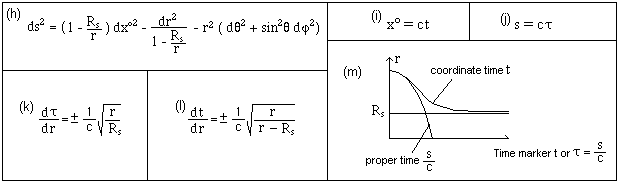
Las curvas representadas en la figura (m) son la base del modelo de los agujeros negros. Se identifica la coordenada t con el tiempo propio de un "observador lejano", de modo que el tiempo de caída libre de una partícula de prueba hacia la esfera de Schwarzschild se vuelve infinito para él. Mostremos que esto se debe completamente a esta elección particular de coordenada de tiempo. En 1925, Eddington sugirió un nuevo marcador de tiempo (p).

Luego, el estudio de las geodésicas radiales correspondientes.
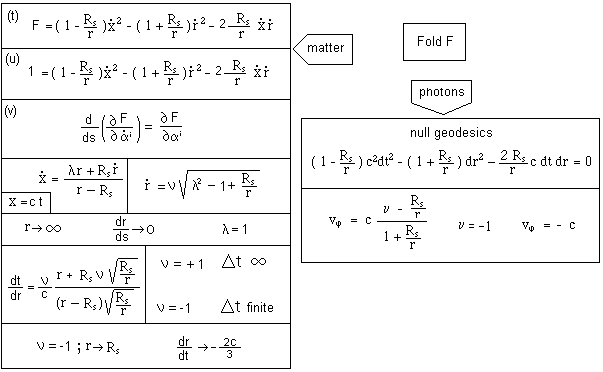
Utilizamos las ecuaciones de Lagrange. A la derecha, vemos que la velocidad de la luz siguiendo caminos radiales tiene dos valores. (nu = -1) corresponde a caminos centrípetos: la velocidad tiene un valor constante - c. De manera similar (a la izquierda), el tiempo de transito desde un punto lejano hasta la esfera de Schwarzschild depende de la orientación de los caminos. El tiempo de caída libre centrípeta (nu = -1) se completa en un intervalo de tiempo finito Dt. Por el contrario, un camino centrífugo (nu = +1), que comienza desde la esfera de Schwarzschild, da un intervalo de tiempo infinito, de modo que la esfera de Schwarzschild actúa como una membrana de un solo sentido. Esto corresponde a un efecto de arrastre radial. No es una razón para rechazar esta interpretación de la geometría de Schwarzschild. De hecho, encontramos un fenómeno similar en el tensor de Kerr (arrastre azimutal). Luego, la expresión clásica del tensor de Kerr. Vemos que obtenemos dos valores distintos para la velocidad azimutal de la luz. Según que consideremos la luz siguiendo la rotación o yendo en sentido contrario.
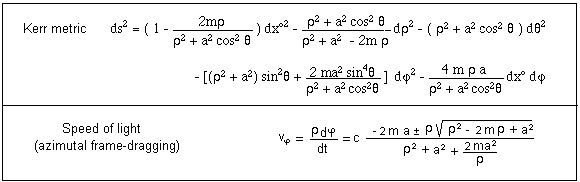
Podemos dar una nueva interpretación de la geometría de Schwarzschild, a través de un puente espacial que conecta dos pliegues F y F. Si el pliegue F corresponde al pliegue gemelo, la coordenada de tiempo t = - t (simetría T). Según la sección 19, sabemos que esta simetría T va acompañada de una inversión de masa, de modo que al atravesar la esfera de Schwarzschild, considerada como una superficie de garganta, la masa positiva se convierte en negativa. La geometría conjugada, tal como se presenta en la sección 13, corresponde a reemplazar Rs por - Rs. Luego, introducimos el siguiente cambio de marcador de tiempo, análogo al de Eddington:

Siempre utilizando las ecuaciones de Lagrange, estudiamos el sistema de geodésicas radiales y establecemos un vínculo entre los dos pliegues.

Pero los caminos inversos requieren un tiempo infinito, por lo que se trata de un paso único de un universo a otro. Aquí también encontramos un efecto de arrastre, pero en dirección opuesta.
Durante el tránsito, el flujo del tiempo propio permanece inalterado: ds > O. Esto hace que el modelo de los agujeros negros sea problemático. De hecho, según esta nueva interpretación de la geometría de Schwarzschild, un tal puente espacial puede engullir grandes cantidades de materia en muy poco tiempo (» 10-4 s). Para comparar, un análisis basado en el tensor de Kerr, aunque ligeramente más complejo, da resultados similares.
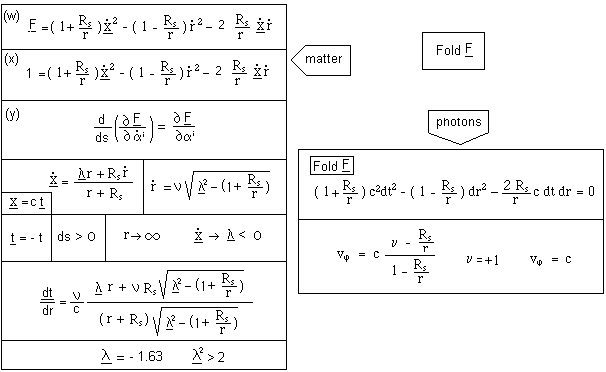
Luego, la solución de los sistemas de geodésicas.
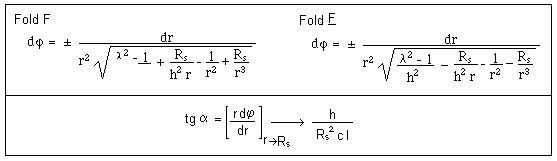
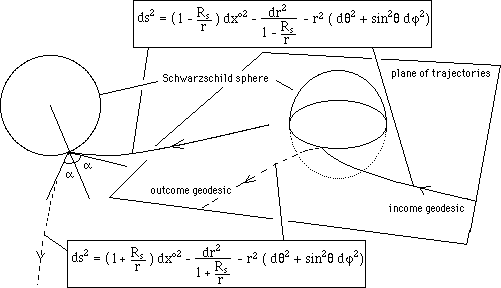
¿Cómo representar tales caminos? Podemos utilizar el espacio de representación inicial (r, q, j). Obtenemos así el sistema de ecuaciones diferenciales anterior y el esquema de la figura 27.
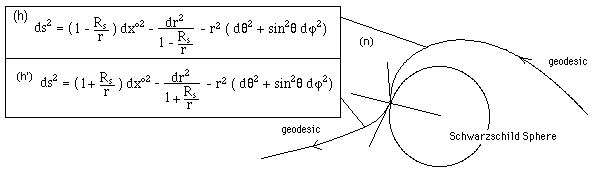
Fig. 27 : Geodésicas de entrada y salida.
La geodésica parece "rebotar" en la esfera de Schwarzschild, como se muestra también en la figura 28.
**  **
**
Pero todo esto proviene de una representación euclidiana ingenua del camino. Usando el siguiente cambio de marcador de espacio:
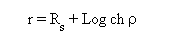
La expresión de la métrica conjunta se convierte en:
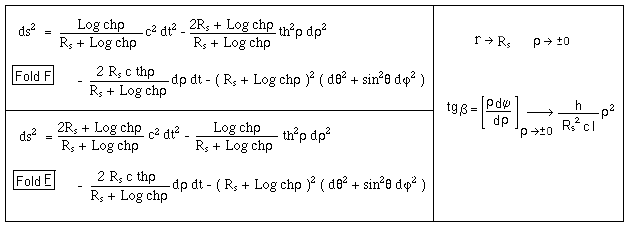
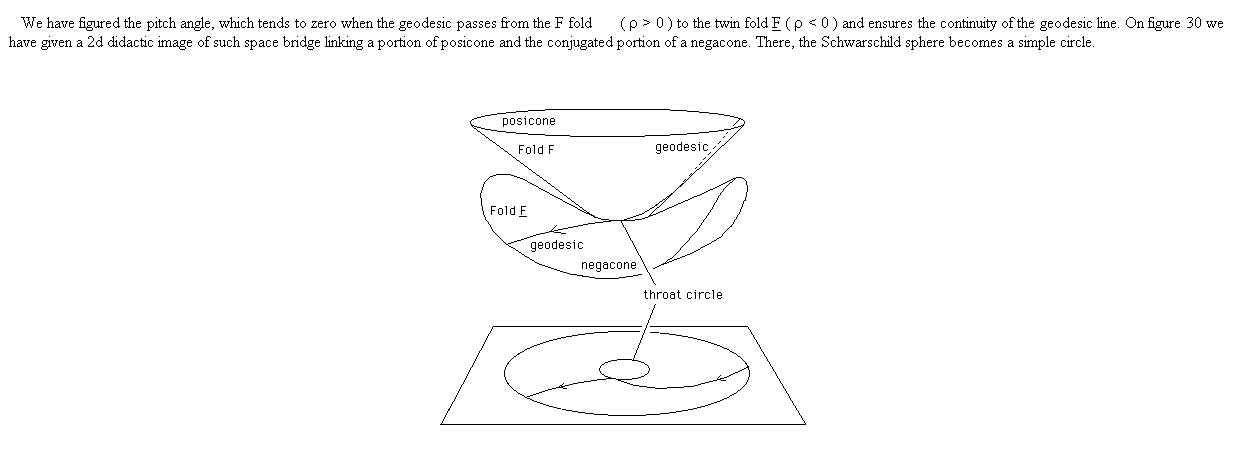
Fig. 29 : Imagen didáctica de un puente espacial con flujo rápido.
Referencias.
[1] J.F.Augereau : « Si la materia oscura desvía los rayos luminosos, es porque existe » (If dark matter bends light rays it shows it does exist). Le Monde, 17 de marzo de 2000.
[2] Entrevista de B.Fort en Ciel et Espace, junio de 2000.
[3] J.P.Petit : El efecto de masa faltante. Il Nuovo Cimento, B, vol. 109, julio de 1994, pp. 697-710
[4] J.P.Petit, Cosmología de los universos gemelos. Astrophysics and Space Science. Astr. And Sp. Sc. 226 : 273-307, 1995
[5] Zel'dovich Ya.B., Astrophysica 6. 319 MNRAS 192, 192 (1970)
[6] Doroskhevich A.G. MNRAS 192, 32 (1980)
[7] Klypin A.A & Shandarin S.F. MNRAS 204, 891 (1983)
[8] Centrella J.M. & Mellot A.L. Nature 305, 196 (1983)
[9] Mellot J.M. & Shandarin S.F. Nature 346, 633 (1990)
[10] Shandarin S.F. En Grandes Estructuras del Universo, ed. J.Audouze, M.C. Peleton y A.Szalay, 273. Dordrecht : Kulwer (1988).
[11] Kofman.L.A., Pogosyan D. y Shandarin S. MNRAS 242, 200 (1990)
[12] Peebles P.J.E. Principios de cosmología física, Princeton University Press (1993).
[13] M.Myamoto y R.Nagai Publ. Astrom. Soc. Japan 27, 583, 1975
[14] J.Binney y S.Tremaine, "Dinámica galáctica", Princeton University Press, Princeton, 1987. [16] Bahcall J.N & Soneira R.M. APJ. S** 44** p. 73 1980
[17] Bahcall J.N., Flynn A y Gould A. APJ 389 p.234 1992
[18] B.Lindblad, Handbuch der Physik 53, (1959) 21
[19] C.C. Lin y F.H.Shu : Astrophysics and Gen. Relat. Vol.2 Gordon and Breach Sc. Publ. 1971, p. 235
[20] Toomree A. (1981) La estructura y dinámica de galaxias normales. Cambridge University Press, p.111
[21] Toomree A. y Toomree J. (1972) Astrophys. J. 178, 623
[22] A.Toomree, Ann. Rev. Astronom. Astrophys. 15 (1977) 437
[23] E.Athanassoula : Espirales y barras impulsadas por compañeros. International Astronomic Union. Symposium n° 146 (1991)
[24] A.Toomree Astrophys. J. 158 (1969) 89
[25] R.H.Miller y B.F. Smith, Astrophys. J. 277 (1979) 785
[26] F. Hohl, Astrophys. Sp. Sc. 14 (1971) 91
[27] Holmberg E. (1941) Astrophys. J. 94, 385
[28] B. Sundelius y K.J. Donner : Galaxias en interacción, Dinámica de galaxias en disco (1991) Sundelius ed. p. 195
[29] S. Engström : Velocidades características en simulaciones numéricas. , Dinámica de galaxias en disco (1991) Sundelius ed. p. 332
[30] A.Toomree Ann. Rev. Astron. Astrophys. 15 (1977) 437.
[31] F.Bouchet y L.Hernquist : Simulaciones cosmológicas utilizando métodos teóricos arborescentes. Astr. Jr Suppl. Series 68 , pp. 521, 538, 1988.
[32] F.Bouchet, L.Hernquist y Y.Suto : Aplicación del método de Ewald a simulaciones N-cuerpos cosmológicas. Apj. Suppl. Series 75 , pp. 231-240, 1991
[33] A.Sakharov : "Violación de CP y asimetría bariónica del Universo". ZhETF Pis'ma 5 : 32-35 (1967) : Traducción JETP Lett. 5 : 24-27 (1967)
[34] A.Sakharov : "Un modelo cosmológico de múltiples capas". Preimpreso Instituto de Matemáticas Aplicadas, Moscú 1970
[35] A.Sakharov : "Modelo cosmológico del Universo con inversión del vector tiempo". ZhETF 79 : 689-693 (1980) : Traducción en Sov. Phys. JETP 52 : 349-351 (1980)
[36] A.Sakharov : "Estructura topológica de las partículas elementales y asimetría CPT" en "Problemas de física teórica", dedicado a la memoria de I.E.Tamm, Nauka, Moscú 1972 pp. 243-247
[37] Green M.B. & Schwarz J.H. Nucl. Phys. B181 , 502-530 (1981) ; B198 , 225-268 (1982) ; Phys. Lett. B , 444-448 (1982)
[38] Green M.B. Surv. High Energy Phys. 3 , 127 (1982)
[39] Gross D.J. , Harvey J.A. , Martinec E. & Rohm R. , Phys. Rev. Lett. 54, pp 503-505 (1985)
[40] Kolb E.W. , Seckel D , Turner M.S. : El mundo invisible de las teorías de cuerdas, Nature Vol. 314, abril 1984 pp. 415-419
[41] P.C.W.Davies & J.B.Brown : Cuerdas super, Cambridge University Press 1988
[42] Abdus Salam, Nuovo Cimento 5 , 299 (1957)
[43] Nima-Arkani Ahmed, Savas Dimopoulos y Georgi Dvali : "Las dimensiones ocultas del universo", PLS oct 2000 n° 276 pp. 56-64
[44] J.P.Petit : Una interpretación del modelo cosmológico con velocidad de la luz variable. Modern Physics Letters A, Vol. 3, n°16, nov 1988, p.1527
[45] ** **J.P.Petit : Modelo cosmológico con velocidad de la luz variable: la interpretación de los desplazamientos al rojo. Modern Physics Letters A, Vol.3 , n° 18, dic. 1988, p.1733
[46] J.P.Petit y Maurice Viton : Modelo cosmológico con velocidad de la luz variable. Comparación con los datos observacionales de QSO. Modern Physics Letters A Vol.4 , n°23 (1989) pp. 2201-2210
[47] P.Midy y J.P.Petit : Cosmología invariante a escala. The international Journal of Modern Physics D, Vol.8 junio 1999 pp.271-280
[48] E.A.Milne : Relatividad cinemática Oxford 1948.
[49] J.D.Anderson, P.A.Laing, E.L.Lau, A.S.Liu, M.M. Nieto y S. Turchev : Indicación para los datos Pioneer 10/11, Galileo y Ulysse, una aceleración anormal, débil, a largo alcance. Phys. Rev. Letters : 81 31 agosto 1998.
[50] G.J.Stephenson Jr. , T.Goldman, Phys. Rep. 205, 211 (1992) ; 216, 343 (1992).
[51] M.N. Nieto y T.Goldman, Phys. Re. 205, 221, 1991; 216, 343.
[52] R.Adler, M.Bazin & M.Schiffer : Introducción a la relatividad general, Mac Graw Hill book, 1975, capítulo 10, sección 10.5 : Límite clásico de las ecuaciones gravitacionales, p. 345.
[53] J.M.Souriau, Estructura de los Sistemas Dinámicos, Ed. Dunod 1970, Francia & Estructura de los Sistemas Dinámicos. Birkhauser Ed. Boston-Zurich 1997.
[53] J.P.Petit : Universos enantiomorfos con flechas del tiempo opuestas (Enantiomorphic universes with opposite time arrows). Comptes rendus de l'Académie des Sciences de Paris, t. pp. 1977
[54] Eddington S.A : : Una comparación de las fórmulas de Withead y de Einstein. Nature 113 : 192 (1924).
Versión original (inglés)
univers jumeaux contre matiere sombre matiere noire et constante cosmologique
- **Black holes do not exist. **
Where the black hole model does come from ? From the null second member field equation. Paradoxically such very dense object rises from an equation which was initially built to describe empty regions of the Universe. The Kerr metric does not bring so much : the object becomes more complex, thats all. Rotation brings an azimutal frame-dragging phenomenon, which means that the speed of light is different if one looks forward or backward with respect to the spinning movement. Whatever is the technique you choose, the things become frankly pathological when you pass the horizon and get in. At the centre lies the singularity. Let us start with an exercise. Consider the 2d metric (a). If we consider r as a radial distance and j as a polar angle, we get problems for r < Rs. But if we introduce the change (b) the expression of the metric becomes (c). All pathologies disappear. Moreover this surface can be imbedded in R3 : the meridian equation is (d). See figure 25 where we have figured a geodesic. This illustrates the fact that a pathology can depend on a wrong choice of coordinates and on a wrong choice of topology.
In the 3d example we have computed (plane) geodesics ( see figure 26 ) which are projected on the initial (r,q,j) representation space. We get a throat sphere linking two Euclidean 3d spaces. There is nothing inside. Space for r < Rs has no physical meaning. If we would try to compute geodesics in that place, we would find an imaginary solution.
Fig. 25 : 2d metric of a surface with a bridge linking two folds.
Fig. 26 : 3d metric hypersurface with a space bridge. Geodesics.
Classically, one introduce a proper time s (j) and a time-coordinate t (i). Then the study of radial geodesics gives two differential equations (k) and (l), whose solutions correspond to curves (m), fig. 6.2, reference [52].
The curves shown on figure (m) are the basis of the black hole model. One identifies the coordinate t to the proper time of a distant observer so that the free fall time of a test particle, towards the Schwarzshild Sphere become infinite for him. Let us show that this is completely due to this peculiar choice of time coordinate. In [54] 1925 Eddington suggested a new time-marker (p).
Following, the study of corresponding radial geodesics.
We use Lagrange equations. On the right we see that the speed of light, following radial paths has two values. ( nu = - 1 ) corresponds to centripetal paths : the speed has a constant value c. Similarly (left) the transit time from a distant point to the Schwarzschild sphere depends on the orientation of the paths. Centripetal ( nu = - 1 ) free fall time is achieved in finite time interval Dt . Oppositely a centrifugal path ( nu = + 1 ), starting from the Schwarzschild sphere gives an infinite time interval, so that the Schwarzschild sphere works like a one-way membrane. This corresponds to a radial frame-dragging effect. This is not a reason to reject this interpretation of the Schwarzschild geometry. In effect we find a similar phenomenon in the Kerr metric ( azimutal frame-dragging). Next, the classical expression of the Kerr metric. We see that we get two distinct values for azimutal speed of light. Depends if we consider light following the rotation or going backwards.
We can give a new interpretation of the Schwarzschild geometry, through a space-bridge linking two folds F and F. If the fold F corresponds to the twin fold, the time coordinate t = - t ( T-symmetry). From section 19 we know that this T-symmetry goes with a mass-inversion, so that when a positive mass passes through the Schwarzschild sphere, considered as a throat surface, the sign of it becomes negative. The conjugated geometry, as presented in section 13 corresponds to change Rs into Rs. Then we introduce the following Eddington-like time marker change :
Still using Lagranges equation we study the radial geodesics system and build a link between the two folds.
But the inverse paths requires an infinite time, so that it is a one-way passage from a Universe to the other. Here again we find a frame-dragging effect, in the opposite direction.
During the transit the proper time flow is unchanged : ds > O . This makes the black hole model questionable. In effect, according to this new interpretation of the Schwarzschild geometry such space bridge can swallow in a very short time ( » 10-4 sec) unlimited amounts of matter. By the way, an analysis based on the Kerr metric, although a little bit more complicated gives similar results.
Following, the solution of the geodesic systems.
How to figure such paths ? We can use the initial ( r , q , j ) representation space. Then we get the above system of differential equations and the schema of figure 27 .
Fig.27 : Income and outcome geodesics.
The geodesic seems to bounce on the Schwarzschild sphere, as shown of figure 28 too.
** **
But all that comes from such naïve Euclidean representation of the path. Using the following change of space marker :
The expression of joint metrics become :
Fig. 29 : Didactic image of a fast flow space bridge.
References.
[1] J.F.Augereau : « Si la matière sombre dévie les rayons lumineux, cest donc quelle existe (If dark matter bends light rays it shows it does exist). Le Monde, March 17 th 2000.
[2] Interview of B.Fort in Ciel et Espace, june 2000.
[3] J.P.Petit : The missing mass effect. Il Nuovo Cimento, B , vol. 109, july 1994, pp. 697-710
[4] J.P.Petit, Twin Universe Cosmology. Astrophysics and Space Science. Astr. And Sp. Sc. 226 : 273-307, 1995
[5] Zel'dovich Ya.B., Astrophysica 6. 319 MNRAS 192, 192(1970)
[6] Doroskhevich A.G. MNRAS 192, 32 (1980)
[7] Klypin A.A & Shandarin S.F. MNRAS 204, 891 (1983)
[8] Centrella J.M. & Mellot A.L. Nature 305, 196 (1983)
[9] Mellot J.M. & Shandarin S.F. Nature 346 , 633 (1990)
[10] Shandarin S.F. In Large Structures of the Universe, ed. J.Audouze, M.C. Peleton and A.Szalay, 273. Dordrecht : Kulwer (1988).
[11] Kofman.L.A., Pogosyan D. and Shandarin S. MNRAS 242, 200 (1990)
[12] Peebles P.J.E. Principles of Physical Cosmology, Princeton University Press (1993).
[13] M.Myamoto and R.Nagai Publ. Astrom. Soc. Japan 27, 583, 1975
[14] J.Binney and S.Tremaine, "Galactic Dynamics", Princeton University Press, Princeton, 1987. [16] Bahcall J.N & Soneira R.M. APJ. S** 44** p. 73 1980
[17] Bahcall J.N. , Flynn A and Gould A. APJ 389 p.234 1992
[18] B.Lindblad, Handbuch der Physik 53, (1959) 21
[19] C.C. Lin and F.H.Shu : Astrophysics and Gen. Relat. Vol.2 Gordon and Breach Sc. Publ. 1971, p. 235
[20] Toomree A. (1981) The structure and dynamics of normal galaxies. Cambridge University Press, p.111
[21] Toomree A. and Toomree J. (1972) Astrophys. J. 178, 623
[22] A.Toomree, Ann. Rev. Astronom. Astrophys. 15 (1977) 437
[23] E.Athanassoula : Companion driven spirals and bars. International Astronomic Union. Symposium n° 146 (1991)
[24] A.Toomree Astrophys. J. 158 (1969) 89
[25] R.H.Miller and B.F. Smith, Astrophys. J. 277 (1979) 785
[26] F. Hohl, Astrophys. Sp. Sc. 14 (1971) 91
[27] Holmberg E. (1941) Astrophys. J. 94, 385
[28] B. Sundelius and K.J. Donner : Interaction galaxies, Dynamics of Disk Galaxies (1991) Sundelius ed. p. 195
[29] S. Engström : Feature velocitys in numerical simulations. , Dynamics of Disk Galaxies (1991) Sundelius ed.p. 332
[30] A.Toomree Ann. Rev. Astron. Astrophys. 15 (1977) 437.
[31] F.Bouchet and L.Hernquist : Cosmological simulations using theoretical tree methods. Astr. Jr Suppl. Series 68 , pp. 521, 538, 1988.
[32] F.Bouchet, L.Hernquist and Y.Suto : Application of the Ewald method to cosmological N-body simulation. Apj. Suppl. Series 75 , pp. 231-240, 1991
[33] A.Sakharov : "CP violation and baryonic asymmetry of the Universe". ZhETF Pis'ma 5 : 32-35 (1967) : Traduction JETP Lett. 5 : 24-27 (1967)
[34] A.Sakharov : "A multisheet Cosmological Model" Preprint Institute of Applied Mathematics, Moscow 1970
[35] A.Sakharov : "Cosmological Model of the Universe with a time-vector inversion". ZhETF 79 : 689-693 (1980) : Traduction in Sov. Phys. JETP 52 : 349-351 (1980)
[36] A.Sakharov : "Topological structure of elementary particles and CPT asymmetry" in "problems in theoretical physics", dedicated to the memory of I.E.Tamm, Nauka, Moscxow 1972 pp. 243-247
[37] Green M.B. & Schwarz J.H. Nucl. Phys. B181 , 502-530 (1981) ; B198 , 225-268 (1982) ; Phys. Lett. B , 444-448 (1982)
[38] Green M.B. Surv. High Energy Phys. 3 , 127 (1982)
[39] Gross D.J. , Harvey J.A. , Martinec E. & Rohm R. , Phys. Rev. Lett. 54, pp 503-505 (1985)
[40] Kolb E.W. , Seckel D , Turner M.S. : The shadow world of superstring theories, Nature Vol. 314, april 1984 pp. 415-419
[41] P.C.W.Davies & J.B.Brown : Superstrings, Cambridge University Press 1988
[42] Abdus Salam, Nuovo Cimento 5 , 299 (1957)
[43] Nima-Arkani Ahmed, Savas Dimopoulos and Georgi Dvali : "Les dimensions cachées de l'univers", PLS oct 2000 n° 276 pp. 56-64
[44] J.P.Petit : An interpretation of cosmological model with variable light velocity. Modern Physics Letters A, Vol. 3, n°16, nov 1988, p.1527
[45] ** **J.P.Petit : Cosmological model with variable light velocity: the interpretation of red shifts. Modern Physics Letters A, Vol.3 , n° 18, dec. 1988, p.1733
[46] J.P.Petit & Maurice Viton : Gauge cosmological model with variable light velocity. Comparizon with QSO observational data. Modern Physics Letters A Vol.4 , n°23 (1989) pp. 2201-2210
[47] P.Midy & J.P.Petit : Scale Invariant Cosmology. The international Journal of Modern Physics D, Vol.8 June 1999 pp.271-280
[48] E.A.Milne : Kinematic Relativity Oxford 1948.
[49] J.D.Anderson, P.A.Laing, E.L.Lau, A.S.Liu, M.M. Nieto and S. Turchev : Indication for Pioneer 10/11, Galileo and Ulysse Data, an an Apparent Anomalous, Weak, Long-Range Acceleration. Phys. Rev. Letters : 81 31 August 1998.
[50] G.J.Stephenson Jr. , T.Goldman, Phys. Rep. 205, 211 (1992) ; 216, 343 (1992).
[51] M.N. Nieto and T.Goldman, Phys. Re. 205, 221, 1991; 216, 343.
[52] R.Adler, M.Bazin & M.Schiffer : Introduction to general relativity, Mac Graw Hill book, 1975, chapter 10, section 10.5 : Classical limit of gravitational equations, p. 345.
[53] J.M.Souriau, Structure des Systèmes Dynamiques, Ed. Dunod 1970, France & Structure of Dynamical Systems. Birkhauser Ed. Boston-Zurich 1997.
[53] J.P.Petit : Univers énantiomorphes à flèches du temps opposeés (Enantiomorphic universes with opposite time arrows). Comptes rendus de lAcadémie des Sciences de Paris, t. pp. 1977
[54] Eddington S.A : : A comparizon of Witheads and Einsteins formulæ. Nature 113 : 192 (1924).
****Paper's Summary