modelo cosmológico con velocidad de la luz variable
Modelo cosmológico de gauge con velocidad de la luz variable. Comparación con datos observacionales de QSO.
Jean-Pierre Petit y Maurice Viton (Laboratoire d'Astronomie Spatiale. Traverse du Siphon. 13012. Marsella)
Physics Letters A Vol. 4, n° 23 (1989) pp. 2201-2210
RESUMEN:
...Después de un complemento a artículos anteriores sobre la invariancia de gauge del operador de colisión de Boltzmann, comparamos un conjunto reciente y homogéneo de datos sobre QSOs radio, incluyendo los tamaños angulares y las curvaturas de los lóbulos, con lo que se espera a partir de nuestro nuevo modelo cosmológico de gauge, o del modelo de Friedmann más comúnmente aceptado con q₀ = 1/2. Se muestra que el nuevo modelo de gauge proporciona un mejor ajuste a la distribución de los tamaños angulares en función del corrimiento al rojo, así como a la curvatura, gracias a suposiciones simples sobre los mecanismos involucrados en la formación de los chorros.
- INTRODUCCIÓN
...En las referencias [1] y [2], a continuación artículo I y artículo II respectivamente, previamente desarrollamos un modelo cosmológico en el cual todas las constantes llamadas de la física se convirtieron en libres, de modo que tuvimos que introducir nuevas leyes físicas, leyes de gauge, para relacionar convenientemente estas constantes:
c (velocidad de la luz), G (gravedad), h (constante de Planck), mₑ (masa del electrón), mₚ, mₙ (masa del protón y del neutrón). Se mostró primero que la teoría de la relatividad general no exige la constancia absoluta de G y c, sino solamente la constancia absoluta del cociente G/c² (constante de Einstein de la ecuación del campo). Esto dio la primera relación de enlace. La otra vino de consideraciones geométricas: supusimos que las longitudes características como la longitud de Jeans, la longitud de Schwarzschild y la longitud de Compton seguían la variación del parámetro de escala R(t).
Combinando estas nuevas leyes físicas, obtuvimos las siguientes relaciones: (1)
(2)
mₚ = mₙ (masa del nucleón) » R
(3)
h » R³/²
(4)
G » 1/R
(5)
V (velocidad) » R⁻¹/²
(6)
ρ » 1/R²
Además, encontramos un único modelo cosmológico con curvatura negativa, lleno indistintamente de fotones o de materia o de una mezcla de ambos, con presión no nula, y que obedece a la única ley: (7a)
...En el artículo II, recuperamos la ley de Hubble, debido a la variación secular de la constante de Planck (que resultó variar como t) y no al proceso de expansión. En este modelo de energía constante, consideraciones geométricas hicieron variar ciertas energías características como la energía de ionización como R(t), y esto resultó coherente con relaciones de gauge adicionales aplicadas al electromagnetismo. Luego, resultó posible deducir las distancias de las fuentes luminosas a partir de los datos de corrimiento al rojo. Se revelaron bastante cercanas, para valores moderados de z, a los valores clásicos deducidos de un modelo de Friedmann con q₀ = 1/2, ya que el cociente:
(7b)
permanece cercano a la unidad dentro del 5 por ciento para z ≤ 2.
- UN BREVE COMPLEMENTO SOBRE LA INVARIANCIA DE GAUGE
...En el artículo I, sección 5, mostramos que ciertas ecuaciones fundamentales (Vlasov, Schrödinger, Maxwell) eran invariantes bajo las relaciones de gauge propuestas. Mostremos que el operador de colisión de Boltzmann también lo es.
Escribamos esta ecuación. (8)
...f es la función de distribución de velocidades, g es la velocidad relativa de dos partículas durante un encuentro, b es una longitud (parámetro de impacto), e un ángulo. Introduzcamos variables sin dimensiones, mediante: (9)
t = t* t ; f = f* x ; V = V* w ; g = V* g ; r = R* z
Y = (Gm/R*) j ; b = R* b
La función de distribución de velocidades característica es: (10)
...Según las relaciones de gauge tal como están definidas en el artículo I, Gm/R* varía como 1/R*. V* varía como 1/R¹/². m varía como R* (mV² es constante). La energía kT es constante. En resumen f * » R*⁻³/², y por lo tanto: (11)
...Un análisis dimensional da términos que varían respectivamente como 1/t*, V*/R* = 1/R³/², 1/R³/², lo que implica nuevamente: (12)
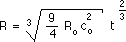
R* » t*²/³
y por lo tanto la invariancia del operador de Boltzmann.
- PRUEBAS OBSERVACIONALES.
...Después de esta breve pausa, pasemos a una comparación entre diversos modelos y los datos radio sobre 134 QSOs recientemente publicados por Barthel y Miley [3, a continuación BM], en los cuales muestran que los DSO lejos tienen tamaños angulares más pequeños, curvaturas más importantes y luminosidades más altas que los objetos cercanos. Sin embargo, notemos que no tenemos la intención de discutir aquí las potencias intrínsecas dadas, ya que los mecanismos físicos involucrados en la generación de los chorros relativistas no están aún claramente comprendidos.
...La situación parece aparentemente más simple en cuanto al tamaño angular y la curvatura de las fuentes radio, ya que las propiedades geométricas están principalmente en juego a priori en ambos casos, aunque no podamos ignorar que puedan haber efectos sistemáticos importantes en juego, y remitimos al lector a la discusión exhaustiva de BM sobre los mecanismos detallados involucrados. En resumen:
-
la interacción con el medio interestelar (MIG) puede perturbar muy eficientemente los chorros inicialmente colimados, causando la formación de lóbulos grandes, turbios, de menor alcance: si aceptamos que tales efectos pueden modificar significativamente la distribución de los tamaños angulares a un corrimiento al rojo dado, se han invocado mecanismos más complejos por BM para explicar la curvatura más fuerte de los lóbulos observados a gran corrimiento al rojo.
-
efectos evolutivos posibles en todos los mecanismos elementales involucrados, incluyendo procesos de gauge aún no identificados.
-
un sesgo observacional como el bien conocido de Malmquist, introduciendo una subestimación de los tamaños angulares para los QSOs lejos.
...Ahora, supongamos en este artículo que estos efectos potenciales no son dominantes en los datos, es decir, que la distribución del tamaño angular y la curvatura en función del corrimiento al rojo puede ser considerada como una buena prueba para distinguir entre diferentes modelos cosmológicos, y mostremos que el nuevo modelo de gauge proporciona un mejor ajuste a estas distribuciones que los modelos clásicos.
3a El tamaño angular.
...El tamaño angular de objetos extragalácticos ha sido a menudo considerado como una prueba poderosa para los modelos cosmológicos. Sea el subíndice 1 asociado a la época de emisión y el subíndice 2 a la época de recepción: ya que la luz emitida por los bordes de una fuente en el instante t₁ sigue trayectorias radiales, el tamaño angular f se conserva para un observador actual, de modo que podemos escribir clásicamente, cualquiera que sea el modelo:
(13)
donde D(t₁) es el diámetro lineal de la fuente y d(t₁) su distancia métrica.
En el modelo clásico de Friedmann con q₀ = 1/2 (el famoso modelo de Einstein-de-Sitter)
D(t₁) = D constante
R(t₁) = R(t₂) / (1 + z)
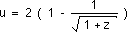
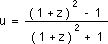
y d(t₁) = R(t₁) u donde :
(14)
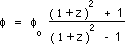
y por lo tanto aparece un cierto paradoja ya que el tamaño angular obedece a:
(15)
Esta función presenta un mínimo para z = 1,25, y luego tiende a crecer linealmente con z.
Ahora, con el nuevo modelo de gauge, tenemos
D(t₁) = D(t₂)/(1+z),
R(t₁) = R(t₂)/(1+z)
y d(t₁) = R(t₁) u también
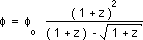
pero con :
(16)
y el tamaño angular obedece a :
(17)
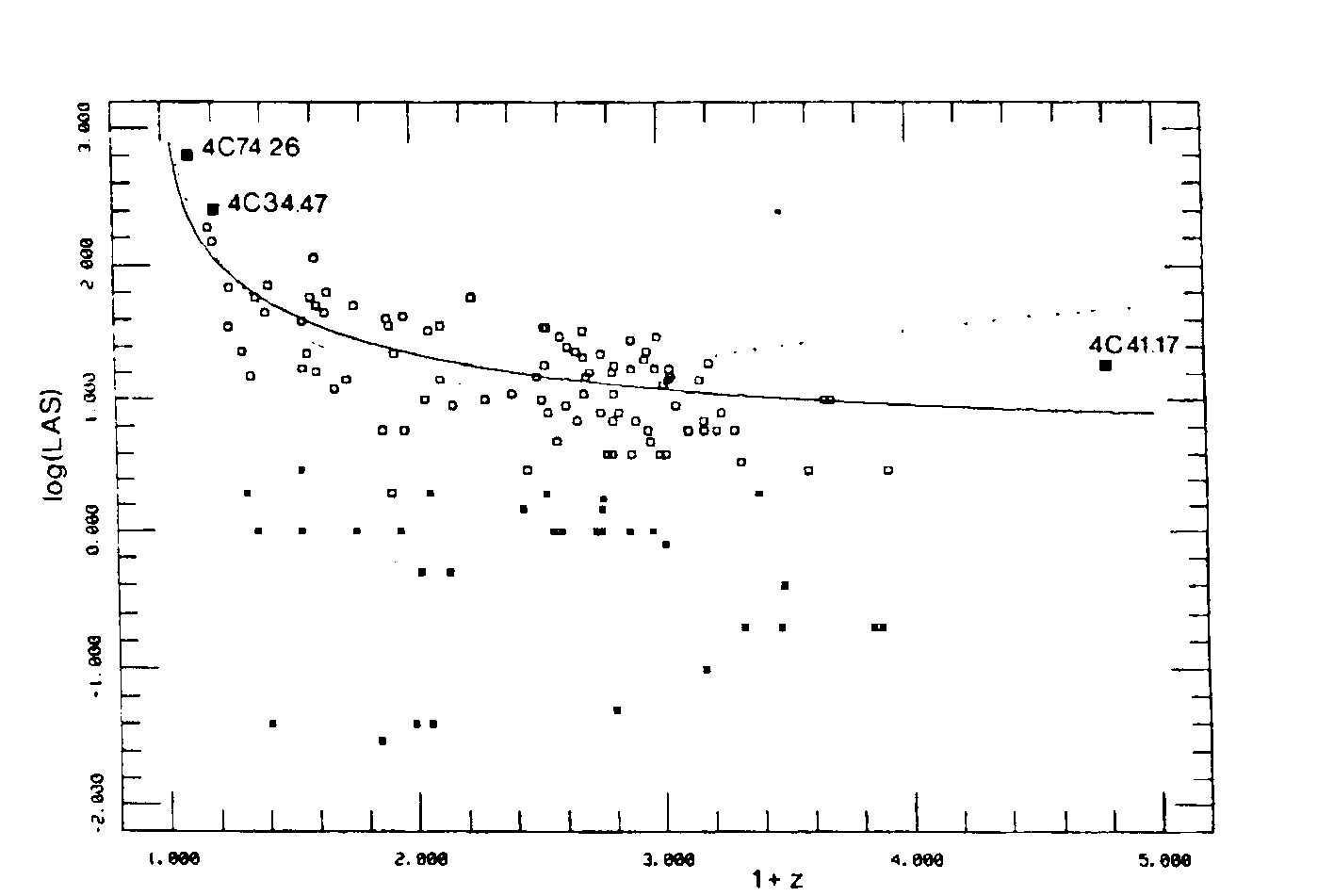
Cuando z tiende al infinito, f tiende a una constante, un comportamiento claramente diferente y en acuerdo cualitativo con los datos.
(18)
Fig 18: El mayor tamaño angular (LAS, en segundos de arco), en una escala logarítmica en función del corrimiento al rojo para las 95 fuentes extendidas con morfologías "T", "D1" y "D2" (cuadrados) y las 33 fuentes compactas con morfologías "SSC" (asteriscos). Las dos curvas representan los ajustes del modelo de gauge (línea continua) y del modelo de Einstein-de-Sitter (línea punteada) obtenidos para las fuentes extendidas en este artículo. Tres otras fuentes radio de gran extensión se muestran como comparación. 4C41.17 siendo la galaxia más lejana conocida actualmente, 4C74.26 la mayor fuente radio asociada a un quásar.
...Para comparar cuantitativamente la calidad del ajuste de los dos modelos a los datos, escribamos f = f₀f(z) donde f(z) es una función característica predicha anteriormente por cada modelo. Se realizaron regresiones lineales entre f(z) y los datos de "mayor tamaño angular" [LAS después de BM], ya sea para la muestra completa de 134 QSO, ya para una muestra reducida de 83 QSO en la cual solo se seleccionaron los objetos con lóbulos bilaterales, es decir, aquellos con morfologías "T" o "D1" definidas por BM, excluyendo así los núcleos con espectro abrupto o "SSC" y las fuentes con lóbulos unilaterales o "D2", con el fin de probar posiblemente propiedades diferentes entre fuentes compactas y extendidas. Los resultados de las regresiones son los siguientes, todos los coeficientes lineales dados y sus barras de error RMS expresados en segundos de arco:
- con el modelo de Einstein-de-Sitter :
F = (28,8 ± 2,9) f(z) - (89,3 ± 20,1)
para la muestra completa, y
F = (31,3 ± 3,3) f(z) - (90,5 ± 20,8)
para la muestra reducida.
- con el modelo de gauge :
F = (21,5 ± 2,11) f(z) - (19,1 ± 19,6)
para la muestra completa, y :
F = (24,3 ± 2,3) f(z) - (17,3 ± 19,8)
para la muestra reducida.
...Es claro que el nuevo modelo de gauge proporciona un ajuste claramente mejor a los datos, ya que cualquiera que sea la muestra, el término constante moderado que implica es marginalmente significativo desde el punto de vista estadístico, y por lo tanto el valor (esperado) cero es muy probable. La situación es completamente opuesta con el modelo clásico, ya sea cual sea la muestra, ya que el término constante es fuertemente significativo desde el punto de vista estadístico y su valor grande y negativo es inaceptable desde el punto de vista teórico, a menos que se suponga que efectos sistemáticos muy fuertes, como los sospechados anteriormente, estén en juego en los datos.
3b. La curvatura.
...Mostremos también que la apariencia más curvada, más deformada de los QSOs lejos señalada por BM puede ser curiosamente explicada por el nuevo modelo de gauge, siempre que no se trate de un artefacto resultante de diversos efectos sistemáticos. Puesto que en el nuevo modelo se supone que todas las energías se conservan durante el proceso de gauge cósmico, podemos incluir la conservación de la energía de rotación del núcleo del QSO emitiendo los chorros: (19)
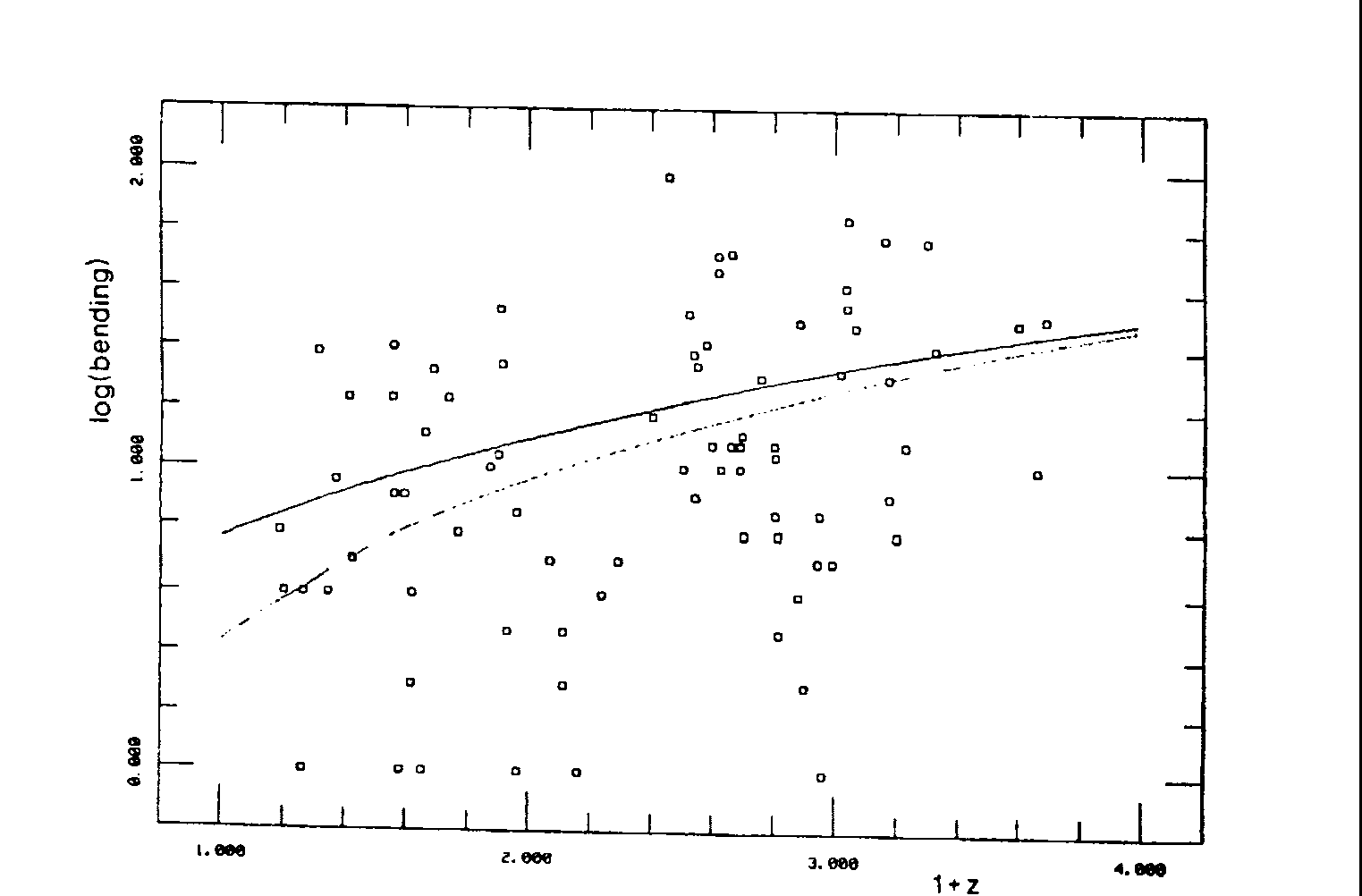
Como m » R, I » R³ y W » R⁻³/² W » 1/t » (1 + z)³/², en curiosa concordancia con el ajuste a ley unidimensional inferior efectuado por BM sobre la muestra reducida (ya que la curvatura solo se define en este último caso), es decir:
(20)
Fig 21: La curvatura (en grados) en una escala logarítmica en función del corrimiento al rojo para las 83 fuentes extendidas con morfologías "T" y "D1" solamente, para las cuales está definida. La curva continua corresponde al ajuste del modelo de gauge, indicando que las velocidades angulares eran más altas en el pasado, mientras que la línea punteada representa el ajuste en ley potencia de Barthel y Miley (BM).
...Ahora, propongamos una explicación somera, refiriéndonos al análisis reciente de Greyber [5] sobre la naturaleza de los motores centrales en los QSOs responsables de sus tasas de producción de energía enormes: si aceptamos el hecho (i) de que los paquetes de plasma son eyectados a gran velocidad del motor central, de forma continua o no, a lo largo del eje del dipolo magnético de los QSOs, y (ii) que este último no es generalmente coincidente con el eje de momento cinético, entonces nos enfrentamos a un modelo similar a un aspersor rotativo, en el cual los chorros se curvarán en una especie de espiral de Arquímedes, siempre que la interacción con el MIG permanezca despreciable. Y aunque esta interacción se vuelva significativa a cierta distancia del núcleo, los chorros dejarán de expandirse allí, causando un aumento en la curvatura. Puesto que no hay razón para que la densidad del MIG esté distribuida esféricamente alrededor de los QSOs, tales interacciones podrían explicar las asimetrías frecuentes observadas en sus chorros, así como efectos aleatorios en la curvatura global, como se discutió por BM.
...Como consecuencia, cuanto mayor sea el corrimiento al rojo del QSO, mayor será su velocidad angular debido al proceso de gauge cósmico, y por lo tanto mayor será la curvatura de sus chorros.
- CONCLUSIÓN.
...Nos hemos concentrado en características específicas recientemente destacadas en la distribución de los tamaños angulares y la curvatura en función del corrimiento al rojo para un conjunto homogéneo de 134 QSOs radio. Encontramos interesantemente que nuestro modelo de gauge con "constantes variables" proporciona un mejor ajuste a estas distribuciones que el modelo clásico de Einstein-de-Sitter, siempre que (i) las tendencias observadas (tamaños angulares más pequeños y curvaturas más grandes para los QSOs lejos) sean confirmadas por observaciones futuras, (ii) que estas tendencias no estén dominadas por diversos efectos o artefactos, y (iii) que las suposiciones simples hechas sobre ciertos mecanismos involucrados sean reales. Además, se necesitan investigaciones adicionales sobre la potencia intrínseca de estas fuentes para comprender si el modelo de gauge permite una mejor comprensión de las tendencias observadas, es decir, que la luminosidad de los QSOs lejos sea mucho mayor que la de los QSOs cercanos.
- REFERENCIAS.
[1] J.P. PETIT : Interpretación del modelo cosmológico con velocidad de la luz variable. Modern Physics Letters A, Vol. 3, n° 16, noviembre 1988
[2] J.P. PETIT : Modelo cosmológico con velocidad de la luz variable. La interpretación de los corrimientos al rojo. Modern Physics Letters A, Vol. 3, n° 18, diciembre 1988.
[3] P.D. BARTHEL & G. K. MILEY. Evolución de la estructura radio en los cuásares: una nueva sonda de las proto-galaxias? - Nature Vol 333, 26 mayo 1988.
[4] M.L. NORMAN, J.O. BURNS y M.E. SULKANEN : Perturbación de los chorros radio galácticos por los choques en el medio ambiente, Nature 335 (1988) 146.
[5] H.D. GREYBER : La importancia de los campos magnéticos intensos en el Universo, Comments Astrophys. 13 (1989) 201.








Versión original (inglés)
cosmological model with variable light velocity
**Gauge cosmological model with variable light velocity. Comparizon with QSO observational data. **
Jean-Pierre Petit and Maurice Viton (Laboratoire d'Astronomie Spatiale. Traverse du Siphon.13012. Marseille)
Modern Physics Letters A Vol.4 , n°23 (1989) pp. 2201-2210
ABSTRACT :
...After a complement to previous papers on the gauge invariance of the Boltzmann collisional operator, we compare a recent homogeneous set of data on radio-QSOs, including angular sizes and bending of lobes, with what is expected from either our new cosmological gauge model or the most commonly accepted Friedman model with qo = 1/2 . It is shown that the new gauge model provides a much better fit to the angular size distribution vs. redshift and similarly to the bending, thanks to crude hypothesis on the mechanisms involved with the formation of jets.
- INTRODUCTION
...In references [1] and [2] , hereafter paper I and paper II respectively, we have previously developped a cosmological model in which all the so called constants of physics were made free, so that we had to introduce new physical laws, gauge laws, in order to link conveniently these constants :
c (velocity of light), G (gravitation), h (Planck's constant), me (electron mass), mp, mn (proton and neutron mass ). It was shown at first that the general relativity theory does not require the absolute constancy of G and c, but only the absolute constancy of the ratio G/c2 (Einstein's constant of the field equation). This brought the first linking relation. The other came from geometric considerations : we assumed that the characteristic lengths like Jeans length, Schwarzschild length and Compton length followed the variation of the scale parameter R(t).
Combining these new physical laws we got the following relations : (1)
(2)
mp = mn ( nucleon's mass ) » R
(3)
h » R3/2
(4)
G » 1/R
(5)
V ( velocity ) » R-1/2
(6)
r » 1/R2
In addition we found a single cosmic model, with negative curvature, indifferently filled by photons or matter or a mixture of the two, with non zero pressure, and obeying the single law : (7a)
...In the paper II we refound the Hubble's law, due to the secular variation of the Planck constant (which was found to vary like t) and not to the expansion process. In this constant energy model, geometrical considerations made some characteristic energies like the ionization energy to vary like R(t), and it was found to be consistent with additional gauge relations applying to electromagnetism. Then it appeared possible to derive the distances of light sources from the red shift data. They were found to be quite close, for moderate z values, to the classical values derived from a Friedman model with qo = 1/2 , since the ratio :
(7b)
remains close to unity within 5 percent for z £ 2 .
- A SHORT COMPLEMENT ABOUT THE GAUGE INVARIANCE
...In the paper I, section 5, we had shown that some fundamental equations (Vlasov, Schrödinger, Maxwell) were invariant under the suggested gauge relations. Let us show that the Boltzmann collision operator is invariant to.
Writing this equation. (8)
...f is the velocity distribution function, g is the relative velocity of two particles in an encounter, b is a length (impact parameter), e an angle. Introduce adimensional variables, through : (9)
t = t* t ; f = f* x ; V = V* w ; g = V* g ; r = R* z
Y = (Gm/R*) j ; b = R* b
The characteristic velocity distribution function is : (10)
...Following the gauge relations as defined in paper I , Gm/R* varies like 1/R*. V* varies like 1/R1/2. m varies like R* (mV2 is constant). The energy k T is constant. To sum up f * » R*-3/2, and hence : (11)
...Such a dimensional analysis gives terms varying respectively like 1/t*, V*/R* = 1/R3/2 , 1/R3/2 , which implies again : (12)
R* » t* 2/3
and hence the invariance of the Boltzmann operator.
- OBSERVATIONAL TESTS.
...After this short parenthesis, let us turn to a comparison of various models with the radio data on 134 QSOs recently published by Barthel and Miley [ 3, hereafter BM] , in which they show that distant DSOs have smaller angular sizes, larger bendings and higher luminosities than those nearby. Note however that we do not intend to discuss the given intrinsic powers here, since the physical mechanisms involved in the generation of relativistic jets are not yet clearly understood.
...The situation is appearently simpler concerning the angular size and bending of radiosources, since geometric properties are mainly concerned a priori in both cases, though we cannot ignore that important systematic effects might be at work and we adress the reader to the related comprehensive discussion of BM on the detailed mechanisms involved. In short :
-
interaction with the intergalactic medium (IGM) can disrupt very efficiently the initially collimated jets, resulting into the formation of large, turbulent lobes (4) of lesser extension : if it is clear that such effects can modify significantly the angular size distribution at a given redshift, more complicated mechanisms have been invoked by BM to explain the stronger bending of lobes observed at large redshifts.
-
possible evolutionary effects in all the elementary mechanisms implicated above, including gauge processes not yet identified.
-
observational bias such as the well-known Malmquist's, introducing an underestimate of angular sizes for distant QSOs.
...Now, let us suppose in this paper that such potential effects are not dominant in the data, i.e. that the distribution of angular size and bending vs. redshifts may be considered as good tests for discriminating between different cosmological models and show that the new gauge model provides better fits to these distributions than do the conventional models.
3a The angular size.
...The angular size of extragalactic objects has often be considered as a powerfull test for cosmological models. So, let the subscript 1 refer to the emission epoch and subscript 2 to the reception epoch : since the light emited by the edges of a source at time t1 follows radial pathes, the angular size f is conserved for a present observer, so that we can write classically, whatever the model :
(13)
where D(t1) is the linear diameter of the source and d(t1) its metric distance.
In the classical Friedman model with qO = 1/2 ( the so called Einstein-de-Sitter's )
D(t1) = D constant
R (t1) = R (t2) / ( 1 + z )
and d(t1) = R (t1) u where :
(14)
and hence some kind of a paradox arises since the angular size obeys :
(15)
This function has a minimum for z = 1.25 , and then it tends to grow linearly with z .
Now, with the new gauge model we have
D(t1) = D(t2)/(1+z) ,
R(t1) = R(t2) / ( 1 + z )
and d(t1) = R (t1) u also
but with :
(16)
and the angular size obeys :
(17)
When z tends to infinity, f tends to a constant, a readily different behaviour and in qualitative agreement with the data.
(18)
Fig 18 : The largest angular size (LAS, in arcsecond), on a logarithmic scale versus redshift for the 95 extended sources with "T", "D1" and "D2" morphologies (squares) and the 33 compact sources with "SSC" morphologiy (asterisks). The two curves represent the fits of the gauge model (continuous line) and the Einstein-De Sitter model (dotted line) derived for extended sources in this paper. Three additional radio-sources of very large extent are shown for comparison. 4C41.17 being the farthest galaxy presently known, 4C74.26 the largest radio-source associated with a quasar.
...In order to compare quantitatively how both models fit the data, let us write f = fof(z) where f(z) is a characteristic function as predicted above by each model. Linear regressions have been performed between f(z) and the "largest angular size" [ LAS after BM ) data, either for their complete sample of 134 QSOs, or for a reduced sample of 83 QSOs in which only two-sided lobes sources were selected, i.e. those with the "T" or "D1" morphologies defined by BM, thus excluding the steep spectrum core or "SSC" and the one-sided lobe or "D2" sources, so as to test for possibly different properties of compact and extended sources. The results of the regressions were as follows, all the given linear coefficients and their rms errors bars being in arc second units :
- with the Einstein-de-Sitter model :
F = ( 28.8 ± 2.9 ) f(z) - ( 89.3 ± 20.1 )
for the complete sample, and
F = ( 31.3 ± 3.3 ) f(z) - ( 90.5 ± 20.8 )
For the reduced sample.
- with the gauge model :
F = ( 21.5 ± 2.11 ) f(z) - ( 19.1 ± 19.6 )
for the complete sample, and :
F = ( 24.3 ± 2.3 ) f(z) - ( 17.3 ± 19.8 )
for the reduced sample.
...It is clear that the new gauge model provides a fairly better fit to the data since whatever the sample, the moderate constant term it implies is marginally significant from a statistical point of view and hence the (expected) zero value is highly probable. The situation is quite opposite with the conventional model, here also whatever the sample, since the constant term is highly significant from a statistical point of view and its large, negative value is unacceptable on theoretical grounds, unless one supposes that very strong systematic effects as those suspected above are at work in the data.
3b. The bending.
...Let us show also that the more bent, distorted appearence of distant QSOs pointed out by BM may be curiously explained by the new gauge model, providing here again that is not an artefact resulting from various systematic effects. Since in the new model it is assumed that all the energies are conserved during the cosmic gauge process, we can include the conservation of the rotational energy of the QSO core emitting the jets : (19)
As m » R , I » R3 and W» R-3/2 W » 1/t » ( 1 + z )3/2, in curious agreement with the one-dimensional lower law fit performed by BM on the reduced sample ( since the bending is only defined in this latter case ), that is :
(20)
Fig 21: The bending (in degree) on a logarithmic scale versus redshift for the 83 extended sources with "T" and "D1" morphologies only, for which it is defined. The continuous curve corresponds to the fit of the gauge model, indicating that angular speeds where higter in the past, while the dotted line represents the power law fit of Barthel and Miley (BM)
...Now let us suggest a crude explanation, refering to the recent analysis of Greyber [5) on the nature of the central engines in QSOs responsible for their tremendous energy production rates : if we accept the figure (i) that the plasma blobs are ejected at high velocities from the central engine, continuously or not, along the magnetic dipole axis of the QSOs and (ii) that this latter is not generally coincident with their angular momentum axis, then we are faced with a model similar to a rotating "garden sprinkler", in which the jets will bend into some kind of a spiral of Archimedes, as long as the interaction with the IGM remains neglectible. And even if this interaction becomes significant at some distance from the nucleus, the jets will stop to expand there, resulting into an increased bending. Since there is no reason why the IGM density would be spherically distributed around QSOs, such interactions could account for the frequently assymetries in their jets together with random effects on the overall bending, as it has been discussed by BM.
...As a consequence, the higher the redshift of the QSO, the higher its angular velocity because of the cosmic gauge process and hence the larger the bending of its jets.
- CONCLUSION.
...We have focussed on specific features recently evidenced in the distribution of angular sizes and bending vs. redshift for an homogeneous set of 134 radio-QSOs. We found interestingly that our gauge model with "variable constants" provides better fits to these distributions than the conventional Einstein-de-Sitter model, providing (i) that the observed trends (smaller angular size and larger bending of distant QSOs) will be confirmed by future observations, (ii) that these trends are not dominated by various effects or artefacts, and (iii) that the crude assumptions wa made on some of the mechanisms involved are real. Also, further investigations on the intrinsic power of these sources are needed to understand if the gauge model provides a better understanding of the observed trends, i.e. that the luminosity of distant QSOs is much greater than for those nearby.
- REFERENCES.
[ 1] J.P.PETIT : Interpretation of cosmological model with variable light velocity. Modern Physics Letters A, Vol.3 n° 16 November 1988
[ 2] J.P.PETIT : Cosmological model with variable light velocity. The interpretation of red shifts. Modern Physics Letters A, Vol.3 , n° 18, December 1988.
[ 3] P.D.BARTHEL & G.KMILEY. Evolution of radio structure in quasars : a new probe of protogalaxies? - Nature Vol 333, 26 may 1988.
[ 4] M.L.NORMAN, J.O. BURNS and M.E. SULKANEN : Disruption of the galactic radio jets by the shocks in the ambient medium, Nature 335 (1988) 146.
[ 5] H.D.GREYBER : The importance of strong magnetic fields in the Universe, Comments Astrophys. 13 ( 1989 ) 201.