L'Irak : une mauvaise affaire
L'Irak : une mauvaise affaire
12 août 2005
Depuis longtemps, personne ne croit plus que l'équipe de Bush ait envahi l'Irak pour mettre la main "sur des armes de destructions massives" ou "pour mettre fin au terrorisme", ou pour "y instaurer la démocratie". En réalité, l'Irak était le seul pays capable de produire assez de pétrole pour exercer une pression sur les cours du brut. Cette pression aurait pu mettre l'Arabie Saoudite en difficulté. Un contrôle des cours du pétrole aurait donné aux Américains un levier de pression sur l'ensemble des pays producteurs.
De nombreuses théories circulent concernant les raisons de cette opération militaire. On a dit que l'Irak de Saddam Hussein projetait de facturer ses livraisons en euro plutôt qu'en dollars. Une telle mesure aurait affaibli le dollar, déjà en mauvaise posture. Enfin, le contrôle du pétrole irakien aurait permis de limiter les ambitions de la Chine.
Le Monde d'aujourd'hui fait écho aux difficultés actuelles que rencontre G.W. Bush face à l'opinion publique. Dans de nombreuses couches populaires et communautés où la guerre a fait ses plus lourdes pertes, le seul argument invoqué pour poursuivre les opérations et s'opposer à un retrait est que "si on se retirait d'Irak maintenant, alors nos soldats seraient morts pour rien".
Sur cette page, il est possible de consulter des informations concernant les attaques contre le système d'acheminement des hydrocarbures. Les pipelines sont indiqués en vert.
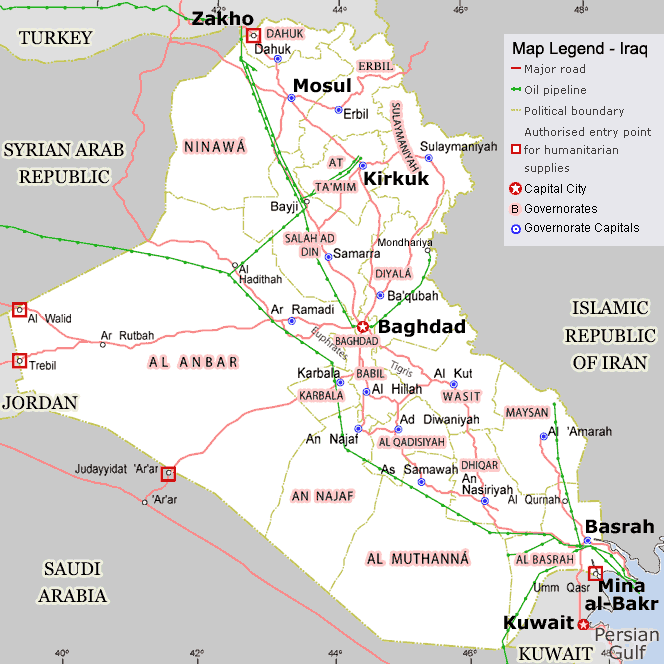
****http://www.iags.org/iraqpipelinewatch.htm
Source
Surveillance du système d'acheminement pétrolier en Irak.
Attaques contre les pipelines, les installations pétrolières et le personnel :
2003
-
12 juin — Attaque le long du pipeline de 960 km qui achemine le pétrole du nord de l'Irak vers le port turc de Ceyhan, sur la côte méditerranéenne
-
19 juin — Explosion dans le complexe de raffinage de Bayji, à 200 km au nord de Bagdad
-
22 juin — Sabotage d'une conduite de gaz naturel près de Hit, à 152 km au nord-ouest de Bagdad
-
23 juin — Explosion d'un pipeline au voisinage de la ville d'Abidiyah Gaarbiga, près de la frontière syrienne
-
24 juin — Explosion près du pipeline de Barwanah, qui achemine le brut à la raffinerie d'al-Dawrah à Bagdad
-
26 juin — Explosion près d'Al-Fatha, près du Tigre, sur un pipeline acheminant le pétrole à la raffinerie de Bayji
-
29 juin — Attaque d'un pipeline près de Bassora
-
31 juillet — Des saboteurs détruisent une partie du pipeline près de Bayji
-
1er août — Deux roquettes touchent un robinet de pétrole près de Karbala, provoquant un incendie
-
1er août — Explosion sur le pipeline allant de Kirkouk à Bayji
-
12 août — Attaque sur al-Taji, près de Bagdad
-
15 août — Explosion près de Bayji
-
16 août — Le lendemain, nouvelle explosion près de Bayji
-
8 septembre — Attaque du pipeline du champ de Jabour, à 32 km au sud de Kirkouk, sur le pipeline qui part de là
-
18 septembre — Attaque visant le pipeline allant de Kirkouk à Ceyhan
-
11 octobre — Attaque du pipeline allant de Zab à Kirkouk
-
16 octobre — Explosion du pipeline près de la cité de Hadeetha, à 200 km au nord-ouest de Bagdad
-
23 octobre — Explosion près de la conduite de gaz naturel à 48 km au sud de Mossoul
-
23 octobre — Attaque à la bombe sur un pipeline à 240 km au nord de Bagdad
-
1er novembre — Explosion d'un pipeline à 15 km au nord de Tikrit
-
4 novembre — Attaque du pipeline de Zumar, à 60 km au nord-ouest de Mossoul
-
10 novembre — Mohammed al-Zibari, responsable de la compagnie de distribution du pétrole irakien, blessé par balles dans ce qui peut être considéré comme la première tentative d'assassinat visant un responsable d'une firme irakienne. Zibari meurt de ses blessures. Selon l'agence Reuters, avant de mourir, Zibari a déclaré : "Trois hommes ont ouvert le feu avec des armes AK-47. Mon chauffeur et mon garde du corps les ont vus. Des gens inféodés à des régimes étrangers sont les auteurs de cet attentat. Je n'ai ici aucun ennemi personnel, aucun problème tribal ou familial. Je ne suis membre d'aucun parti politique."
-
17 novembre — Une explosion souffle une conduite acheminant le fuel de la raffinerie de Daura, à 250 km au nord de Bagdad, entraînant une coupure d'électricité de deux jours
-
18 novembre — Explosion d'un pipeline dans la région de Mashruh al-Therthar, au sud-ouest de la ville de Samarra, conduite qui alimente la raffinerie de Daura, à Bagdad
-
22 novembre — Abdel Salam Qanbar, un policier irakien, chargé de la sécurité des installations pétrolières au nord de la ville de Mossoul, attaqué et tué par des inconnus opérant à partir d'un véhicule
-
22 novembre — Un club situé à l'intérieur du complexe de la Northern Oil Company, à Kirkouk, à 240 km au nord de Bagdad, touché pendant la nuit par des tirs de mortier, blessant trois Irakiens
-
23 novembre — Une explosion touchant une conduite acheminant le gaz du champ de Jambur à la raffinerie de Bayji provoque une lueur si vive qu'elle a pu être aperçue de Kirkouk, à 30 km de là
-
26 novembre — Une conduite reliant deux champs pétrolifères en Irak du Nord à la raffinerie de Bayji en feu, près du village de Sarkhat, à 38 km au nord de Bayji
-
9 décembre — Explosion d'une conduite reliant Kirkouk à une usine produisant des bouteilles de gaz, au nord de Bagdad
-
10 décembre — Explosion à 135 km à l'ouest de Kirkouk, sur un pipeline reliant les raffineries de Nayji et de Daura. Enregistrement vidéo
-
19 décembre — Un pipeline soufflé au sud de Bagdad
-
20 décembre — Des roquettes touchent des réservoirs au sud de Bagdad, entraînant la perte de deux millions et demi de gallons d'essence
-
20 décembre — Un pipeline touché par des roquettes dans la région de al-Mashahda à 24 km au nord de Bagdad
-
21 décembre — Un pipeline touché dans la région de al-Mashahda, à 50 km de Bagdad cette fois
-
22 décembre — La station de pompage située près de la raffinerie de Bayji, attaquée au mortier
-
22 décembre — Explosion à 12 h 30 GMT (15 h 30 de l'après-midi) à Riad, à 45 km à l'ouest de Kirkouk, frappant la conduite reliant les champs pétrolifères de Kirkuk et la principale raffinerie irakienne, située à Bayji, disposée parallèlement à celle reliant Kirkuk et le port turc de Ceyhan, ouvrant sur la Méditerranée
-
22 décembre — Les pipelines alimentant Bayji en brut à partir des champs de Kirkuf, en feu à 50 km au nord-est de la raffinerie
2004
-
7 janvier — explosion sur le pipeline reliant les champs pétroliers à une station de pompage dans la région de Hassiba, à 135 km à l'ouest de Kirkouk. Le directeur général de la Northern Oil Company, Adel Kazzaz, a déclaré : "La conduite était utilisée pour les besoins du marché intérieur et pour remplir les citernes destinées à l'exportation du brut."
-
30 janvier — explosion sur le pipeline transportant le brut de Kirkouk vers la raffinerie de Bayji
-
22 février — explosion et incendie sur le pipeline Kirkuk-Baghdad-Basra près d'Al-Hare, une petite ville à l'ouest de Karbala, à environ 110 km au sud de Bagdad. C'est la première attaque contre un pipeline dans le sud de l'Irak depuis le renversement de Saddam Hussein, selon les rapports
-
26 février — explosion probablement causée par une bombe artisanale lancée sous les conduites pétrolières et gazeuses, endommageant une partie du pipeline à environ 96 km au nord de Bagdad
-
2 mars — grande explosion sur un pipeline pétrolier près de la ville du nord de Kirkouk, provoquant un incendie important mais sans victimes. L'explosion a touché la principale ligne pétrolière menant à la raffinerie de Bayji, à 200 km au nord de Bagdad, provoquant un incendie considérable, a déclaré le chef de la police, Turhan Yussef. "L'explosion s'est produite à 11h15 (06h15 AEDT). Un dispositif explosif a été placé sous le pipeline à Al-Riad, à 35 km à l'ouest de Kirkouk", a-t-il précisé
-
10 mars — incendie sur un pipeline pétrolier au sud de Bagdad, reliant les champs du sud à la raffinerie de Daura à l'extérieur de Bagdad. Le pompier Saleh Jabbar a déclaré que cela semblait être le résultat d'un sabotage
-
12 mars — pipeline pétrolier détruit à l'ouest de Tikrit, vendredi, entraînant un incendie sur la ligne. Le pipeline relie les champs pétroliers du nord à la raffinerie de Daura à la périphérie de Bagdad
-
24 mars — forage pétrolier de la Northern Oil Company dans la région de Khabaz, à environ 88 km à l'ouest de Kirkouk, a été bombardé la nuit. Le feu a été éteint tard le lendemain. Le général Mohammed Amin, chef du Corps de défense civile irakienne à Kirkouk, a déclaré que le puits n'était pas exploité au moment de l'explosion ni étroitement surveillé. "C'est un acte terroriste. C'est la première fois qu'un puits pétrolier est attaqué à Kirkouk", a-t-il dit
-
25 mars — explosion sur un puits pétrolier principal dans le nord de l'Irak qui alimente les exportations via la Turquie. Adel Qazzaz, directeur général de la Northern Iraqi Company (NOC), a déclaré : "L'explosion s'est produite à 15h30 (12h30 GMT) à cause d'une charge explosive placée par des individus inconnus à l'intérieur du puits, situé à 75 km à l'ouest de Kirkouk." Il a ajouté : "Elle a causé des dégâts massifs au puits, et les pompiers ont du mal à l'éteindre car l'explosion s'est produite à l'intérieur du puits et non dans les conduites." Qazzaz a précisé que les pompiers auraient besoin de deux jours pour éteindre le feu, et a noté : "Le puits est un producteur principal pour les exportations pétrolières via le pipeline irako-turc et pour couvrir les besoins du marché local."
-
26 mars — pipeline des installations pétrolières du sud de Bassora en feu, a déclaré un responsable de l'Organisation nationale irakienne de commercialisation du pétrole. Des gardes irakiens en service à Shuaiba, près de la ville du sud de Bassora, ont affirmé que les saboteurs avaient allumé le pétrole brut qui s'était échappé du pipeline. Un porte-parole militaire britannique a contesté ce rapport, disant : "Ce n'était pas le résultat d'une explosion. Nous comprenons qu'une vanne du pipeline a échoué et que l'incendie a été provoqué par le déversement résultant."
-
4 avril — attaque sur un pipeline pétrolier dans le sud de l'Irak reliant Bassora au port de Faw sur le golfe Persique. Il a été rompu et le pétrole a pris feu
-
8 avril — un obus de mortier a touché un réservoir de gaz naturel et un autre a touché un pipeline dans une usine au nord de Kirkouk exploitée par la Northern Iraqi Company (NOC), a déclaré Jumaa Ahmad, chef de la brigade de lutte contre les incendies
-
21 avril — bombardement sur un pipeline au nord de Bagdad
-
24 avril — des terroristes suicidaires ont fait exploser trois embarcations dans et autour de la zone du terminal de Bassora, l'un des sites les mieux protégés du monde
-
8 mai — bombe à 56 km au sud de Bassora a endommagé une section de 18 pieds d'un des deux pipelines reliant Bassora à la péninsule de Faw sur le golfe. Le porte-parole de l'Armée américaine, Steve Wright, a déclaré que les exportations pétrolières depuis les terminaux offshore du sud de Bassora et de Khor al-Amaya, par lesquels passent environ 90 % des exportations pétrolières irakiennes, avaient été arrêtées : "La pompe a été arrêtée. Ils ont attaqué à proximité du point où le collecteur entre dans la mer." Selon les autorités irakiennes, les exportations continuaient depuis Bassora, mais à un taux réduit de 1,2 million de barils par jour (bpd) contre 1,6 million de bpd avant l'attaque, car le pétrole provenant du pipeline endommagé s'écoulait à travers le pipeline parallèle. Ali Nasr al-Rubaie, directeur du principal terminal portuaire, a déclaré que les exportations avaient été réduites de moitié après l'attaque : "Nous sommes passés d'une moyenne de 80 000 barils par heure à 40 000 barils par heure."
-
8 mai — attaque sur un pipeline pétrolier qui achemine le brut vers le nord depuis les champs pétroliers du sud du pays, à 40 km au sud de Bagdad, a déclaré samedi le porte-parole du ministère du Pétrole, Assem Jihad, notant qu'il faudrait plusieurs jours pour reprendre le pompage
-
9 mai — explosion près d'un réseau stratégique de pipelines reliant le nord et le sud de l'Irak, près de la ville de Musayyib, à environ 90 km au sud de Bagdad. Il n'est pas clair ce qui a provoqué l'explosion ou si le pipeline lui-même a été endommagé
-
13 mai — une roquette est tombée dans une usine de gaz à la raffinerie pétrolière de Daura à Bagdad, blessant un ouvrier et provoquant un incendie
-
24 mai — explosion a gravement endommagé le pipeline du nord vers 19h heure locale sur une section entre les champs pétroliers de Kirkouk et les installations de pompage de Dibis. Un responsable de sécurité de la Northern Oil Company d'Irak, Juma Ahmad, a déclaré que la pompe devait être arrêtée pour combattre l'incendie. Un autre responsable de sécurité de la Northern Oil, Issam Muhammad, a déclaré que bien que l'incendie ait été maîtrisé, il faudrait 12 jours pour réparer les dégâts
-
26 mai — explosion sur le pipeline Kirkuk-Ceyhan près de Kirkouk
-
26 mai — explosion sur le pipeline du sud par lequel le pétrole s'écoule vers le golfe Persique
-
6 juin — attaque sur le pipeline Kirkuk-Ceyhan. Le chef de la Northern Oil Company d'Irak (NOC), Ghazi Talabani, a déclaré : "Les assaillants ont fait exploser des grenades sonores sur le pipeline dimanche au petit matin (heure locale), à 120 km (75 miles) à l'est de Kirkouk, causant des dégâts et une perte énorme de pétrole." Il a ajouté : "La perte de pétrole a été arrêtée et un groupe d'experts techniques répare le pipeline et les dégâts pourraient être réparés d'ici la nuit de mardi. La reprise de la production dépend de la décision de la coalition et du ministère du pétrole." Le directeur du projet de la NOC, Abdullah al-Rubai, avait précédemment nié l'attaque
-
6 juin — explosion sur le pipeline pétrolier alimentant le terminal de Bassora près de la péninsule de Faw au sud. L'explosion a ralenti le flux pétrolier de 80 000 barils par heure à 40 000
-
9 juin — explosion sur le pipeline pétrolier près de Bayji, à 250 km au nord de Bagdad, a interrompu l'approvisionnement de la centrale électrique de Bayji, et selon le porte-parole du ministère irakien du pétrole, Assem Jihad, a forcé une réduction de 400 mégawatts, soit une baisse de 10 % de la production du réseau électrique national
-
9 juin — explosion sur le pipeline pétrolier Kirkuk-Ceyhan. Anwar Hamed Amin, chef du Corps de défense civile irakien, a déclaré : "Une bombe placée à 80 km (50 miles) à l'ouest de Kirkouk a explosé à 8h20 (heure locale) sur la principale ligne menant au terminal de Ceyhan."
-
15 juin — explosion en début de matinée sur un pipeline par lequel le pétrole s'écoule de la station de pompage de Zubeir 1 vers un dépôt à Faw, à 40 miles (64 km) au sud-est de Bassora
-
15 juin — une autre explosion, en soirée, sur un pipeline du sud. Ensemble avec l'attaque sur le pipeline vers Bassora, l'attaque sur ce pipeline de 48 pouces par lequel le pétrole s'écoule vers le port de Khor al-Amaya a réduit les exportations pétrolières du sud de plus de la moitié, selon la Southern Iraqi Oil Company
-
15 juin — "Un pipeline reliant les champs de Kirkouk à une station de traitement à Bajwan, à 20 km (12 miles) au nord de la ville, a été saboté et un incendie s'est déclenché", a déclaré Adel Kazaz, directeur de la North Oil Company. Le pipeline alimentait les raffineries domestiques
-
16 juin — le pipeline de 42 pouces vers le terminal de Bassora, le terminal principal par lequel la majeure partie des 1,6 million de barils par jour de pétrole Basra Light étaient exportés, a été attaqué à nouveau. Le porte-parole de la Southern Iraqi Oil Company a déclaré : "En raison des dégâts infligés aux deux pipelines, la pompe du pétrole vers le terminal pétrolier de Bassora a complètement cessé." Il a ajouté que les export
-
29 août – explosion sur une conduite pétrolière reliant les champs pétroliers de Rumaila aux réservoirs d'exportation situés sur la péninsule de Faw, à al-Radgha, à 30 miles (48 km) au sud-ouest de Bassora.
-
30 août – explosion sur une conduite intérieure pétrolière dans le district sud-est de Bagdad nouvelle.
-
1er septembre – explosion sur la conduite pétrolière Kirkuk-Ceyhan, section entre Kirkuk et Bayji à 18h30, près de Riyadah, à 30 miles (50 km) au sud de Kirkuk, a provoqué un incendie important, interrompant les exportations sur la ligne.
-
4 septembre – explosion sur une conduite de 14 pouces transportant le brut provenant du champ Al-Khabaz vers la raffinerie de Bayji.
111-112. 4 septembre – attaque à 8h30 à Hartha, à 19 miles (33 km) au nord de Bassora, sur la conduite sud qui alimente la centrale électrique de Hartha. Attaque simultanée sur une conduite parallèle qui pompe 15 000 barils de pétrole brut par jour depuis les champs pétroliers près de Nahr Omar vers les réservoirs de Zubayr.
-
6 septembre – attaque à 12 miles (20 km) au sud de Kirkuk sur une conduite de gaz naturel reliant les champs de Janbur à la centrale électrique de Bayji, produisant 400 mégawatts par jour et fournissant de l'électricité au nord de l'Irak, a provoqué un incendie.
-
6 septembre – à 9h30, un jour après que l'incendie sur la conduite Kirkuk-Ceyhan a été éteint, les attaquants ont mis le feu au pétrole qui fuyait et l'ont rallumé.
-
11 septembre – à 15h15, des attaquants ont endommagé la conduite pétrolière de 14 pouces reliant un champ pétrolier de Kirkuk à la raffinerie de Havana située à 37 miles (60 km) de Kirkuk, par des tirs d'armes automatiques.
-
11 septembre – attaque par feu de mitraillette à 3h30 du matin près de Hatin, à 18 miles (30 km) au nord de Kirkuk, a blessé trois gardes de sécurité de la Northern Oil Company, dont un grièvement.
-
12 septembre – attaque par feu de mitraillette à 1h00 du matin, à 25 miles (40 km) au nord-est de Kirkuk, sur les forces de sécurité gardant les champs pétroliers de Dibis, blessant trois d'entre elles.
-
12 septembre – attaque par feu de mitraillette a blessé deux agents de sécurité en patrouille près des champs pétroliers de Jambouz, à 30 miles (42 km) à l'ouest de Kirkuk.
-
13 septembre – attaque sur une conduite pétrolière dans le champ pétrolier de Rumaila.
-
14 septembre – explosion à 2h00 au point de croisement des conduites traversant le fleuve Tigre, près de la centrale électrique de Beiji de 676 MW, a mis le feu à trois conduites pétrolières, interrompant le flux de pétrole des champs de Kirkuk vers la raffinerie de Beiji et vers Ceyhan. La chaleur a fondu un câble de transmission de 400 kV qui passait à presque 300 pieds au-dessus de la zone, provoquant une perte de puissance de 750 MW en une seconde, ce qui a provoqué une surcharge du réseau national de 5 000 MW, interrompant l’approvisionnement électrique dans tout l’Irak. Deux jours auparavant, les ingénieurs de la Northern Oil Company avaient terminé le remplacement de vannes critiques détruites par une attaque antérieure.
-
16 septembre – attaque sur une conduite pétrolière près de Baqouba, qui relie les champs pétroliers de Khanaqin à la raffinerie d’Al Daura.
-
18 septembre – tentative d’assassinat du directeur des produits pétroliers de la Northern Oil Company, Muhammad Zibari, par des attaquants armés de mitrailleuses et de grenades qui ont embusqué sa convoi à Mossoul. L’attaque a manqué sa cible mais a entraîné la mort de huit personnes et la blessure de quatre.
-
23 septembre – des assassins ont abattu le directeur adjoint du département des produits pétroliers de la Northern Oil Company, Sana Toma Sulaiman, alors qu’il se rendait au travail en taxi à Mossoul.
-
23 septembre – explosion sur une conduite pétrolière près du village d’al-Fahhama, à 15 miles (25 km) au nord de Bagdad, causant des dégâts importants.
-
23 septembre – des saboteurs ont fait sauter une partie du champ pétrolier d’East Baghdad. Le puits, d’une capacité de 5 000 barils par jour, alimente les raffineries de Taji voisines et la raffinerie d’Al Daura à Bagdad.
-
23 septembre – explosion sur une conduite pétrolière à Angour, à 50 miles (80 km) à l’est de Falloujah.
-
23 septembre – explosion sur une conduite pétrolière à Najaf a interrompu le flux provenant des champs pétroliers près de la ville vers une raffinerie à Bassora.
-
24 septembre – une société privée de sécurité des pipelines a découvert un dispositif explosif le long d’une importante conduite pétrolière à l’ouest de Balad. Le flux de pétrole est resté ininterrompu.
-
3 octobre – des saboteurs ont fait sauter une section de la conduite près de la ville de Karbala, au centre de l’Irak.
-
5 octobre – fusée tirée sur le ministère pétrolier à Bagdad.
-
5 octobre – explosion sur une conduite pétrolière à l’ouest de Bagdad.
-
18 octobre – explosion sur une conduite pétrolière à 8 miles (12 km) de Bayji.
-
19 octobre – explosion sur une conduite pétrolière à 6 miles (10 km) au nord de la raffinerie de Bayji.
-
19 octobre – explosion à 14h10 sur une conduite pétrolière à 87 miles (140 km) au sud de Kirkuk.
-
21 octobre – des saboteurs ont attaqué une section du réseau d’exportation pétrolière du nord.
-
22 octobre – explosion dans la région de Mashahdeh, à environ 30 miles (48 km) au nord de Bagdad, sur une conduite pétrolière alimentant la raffinerie d’Al Daura.
-
23 octobre – explosion sur la conduite pétrolière Khana au nord-est de Bagdad a provoqué un incendie endommageant 150 mètres de la conduite. Une autre bombe a été trouvée sur la même ligne et a été désamorcée en toute sécurité.
-
25 octobre – des saboteurs ont fait sauter une section de conduite à environ 15 miles (25 km) au sud-ouest de Kirkuk, alimentant la raffinerie de Bayji. Un incendie s’est ensuite déclenché sur une autre conduite, et des témoins affirment qu’il a été causé par une explosion.
-
29 octobre – explosion vers 6h00 sur une conduite pétrolière près du quartier de Havice à Kirkuk.
-
1er novembre – explosion sur la conduite pétrolière Kirkuk-Ceyhan à Riyad, au sud-ouest de Kirkuk.
-
1er novembre – attaque sur une conduite pétrolière alimentant la conduite Kirkuk-Ceyhan et reliée au champ pétrolier de Bai Hassan à Qoshqaya.
141-142. 2 novembre – deux bombes ont explosé contre une conduite reliant les champs pétroliers de Kirkuk à la raffinerie de Bayji, une à 10h00, à 44 miles (70 km) au sud-ouest de Kirkuk.
-
2 novembre – explosion sur une conduite de produits raffinés à Hatin, au nord de Kirkuk.
-
2 novembre – attaque à 19h20 près de Sheikh Mizher al-As sur un réseau de conduites reliant les puits pétroliers de Khubbaz, à 24 miles (40 km) à l’ouest de Kirkuk, aux raffineries de Bayji et de Bagdad.
-
3 novembre – des assassins ont abattu le directeur général de la société de distribution des sous-produits pétroliers du ministère irakien du pétrole, Hussein Ali al-Fattal, alors qu’il quittait sa maison dans le quartier de Yarmouk à Bagdad pour aller au travail.
-
5 novembre – explosion a endommagé une conduite de gaz reliant les champs de Baba Gurgur près de Kirkuk à la Northern Gas Company.
-
9 novembre – explosion sur une conduite pétrolière près de Safa, à 44 miles (70 km) au sud-ouest de Kirkuk.
-
10 novembre – attaque sur une conduite de gaz reliant les champs de Khubbaz à la Northern Gas Company.
-
13 novembre – attaque à Taji, à 12 miles (19 km) au nord de Bagdad, sur une conduite pétrolière qui alimente la raffinerie d’Al Daura à Bagdad.
150-153. 14 novembre – quatre puits pétroliers ont été mis à feu dans le champ pétrolier de Khubbaz à l’ouest de Kirkuk. Ces puits produisaient chacun entre 10 000 et 15 000 barils par jour.
-
15 novembre – explosion sur une conduite pétrolière de Kirkuk à Ceyhan à Safra, à 37 miles (50 km) à l’ouest de Kirkuk.
-
15 novembre – des hommes armés ont mis le feu à un dépôt de stockage et une station de pompage le long de la conduite pétrolière vers Ceyhan près d’Ain al Jahish, à 60 miles (96 km) au sud de Mossoul.
-
15 novembre – explosion à 23h00 près de Sarai, à 47 miles (75 km) à l’ouest de Kirkuk, sur une conduite pétrolière alimentant la raffinerie de Bayji.
-
15 novembre – explosion à 23h00 près de Riyadh, à 25 miles (40 km) à l’ouest de Kirkuk, sur une conduite de gaz alimentant la centrale électrique de Bayji.
-
17 novembre – explosion à 1h00 sur une conduite pétrolière provenant du champ Bai Hassan, à 30 miles (42 km) à l’ouest de Kirkuk, vers les installations de stockage de Dibis, à 20 miles (32 km) à l’ouest de Kirkuk.
-
17 novembre – bombe sur un puits pétrolier à Barajwan, à 20 miles (32 km) au nord-ouest de Kirkuk.
-
17 novembre – explosion à 8h00 à 2,5 miles (4 km) à l’ouest de Samarra sur une conduite reliant Bayji à la raffinerie d’Al Daura à Bagdad.
-
21 novembre – un puits pétrolier a été mis à feu dans le champ pétrolier de Khubbaz.
-
21 novembre – tentative de sabotage sur un puits dans le champ pétrolier de Khubbaz a été repoussée par les gardes de sécurité irakiens. Un saboteur potentiel a été tué et un autre blessé.
-
22 novembre – explosion à 9h00 sur la conduite de 42 pouces vers le terminal de Bassora a interrompu le flux de pétrole à travers la conduite.
-
25 novembre – attaque sur deux puits pétroliers près des monts Himreen, à 75 miles (120 km) au sud de Kirkuk.
-
25 novembre – explosion matinale dans la zone de Fatha, à 9 miles (15 km) au nord de Bayji, sur la conduite pétrolière reliant Kirkuk à Bayji. Une force de sécurité irakienne de 2 000 personnes avait été affectée à la protection des infrastructures pétrolières deux jours auparavant.
166-167. 29 novembre – deux explosions, l’une à 8h40 et l’autre à 8h50, sur la conduite pétrolière reliant Bayji à la raffinerie d’Al Daura.
-
30 novembre – explosion sur la conduite pétrolière reliant la raffinerie d’Al Daura à la centrale électrique de Musayyib au sud de Bagdad, coupant l’alimentation électrique dans la région de Babil.
-
1er décembre – des hommes armés ont ouvert le feu sur une équipe de réparation de conduite travaillant dans la zone de Safrah, à 50 miles (80 km) au sud-ouest de Kirkuk. Un homme a été blessé.
-
6 décembre – attaque à 10 miles (16 km) au sud de Samarra sur une conduite pétrolière reliant Bayji à la raffinerie d’Al Daura.
-
6 décembre – attaque sur une conduite qui traverse un réservoir souterrain de stockage pétrolier à 50 miles (80 km) au sud-ouest de Kirkuk.
-
7 décembre – attaque sur une conduite alimentant le pétrole du nord de l’Irak vers Bagdad.
-
10 décembre – attaque nocturne tardive sur la conduite d’exportation pétrolière de 48 pouces dans la région de Riyad, au sud-ouest de Kirkuk.
-
11 décembre – dix hommes armés ont enlevé le responsable de la sécurité de la Northern Oil Company pour la région de Bayji alors qu’il se trouvait dans la zone de Samarra pour inspecter les dégâts causés par une attaque antérieure sur une conduite.
-
13 décembre – des incendiaires ont mis le feu à du pétrole qui s’était écoulé et accumulé en raison d’attaques antérieures sur les conduites, à 43 miles (27 km) au sud-ouest de Kirkuk, suscitant des inquiétudes que l’incendie puisse endommager les conduites voisines.
-
17 décembre – attaque sur une conduite alimentant le pétrole de Bassora vers la raffinerie d’Al Daura à Bagdad, interrompant le flux de produits raffinés, que le porte-parole du ministère du pétrole Jihad Assem a déclaré avoir été rétabli juste après une interruption de 17 jours consécutifs à un sabotage précédent.
-
17 décembre – attaque sur une conduite alimentant les produits raffinés de la raffinerie de Bayji vers Bagdad. Un communiqué diffusé à Bayji a affirmé que Abu Musab al-Zarqawi avait fait sauter une conduite, suivant les ordres du « commandant suprême Oussama ben Laden ».
-
17 décembre – attaque sur la conduite du nord près de Fatha, à 53 miles (85 km) à l’ouest de Kirkuk.
-
18 décembre – attaque à 7h30 sur une conduite alimentant le pétrole de Kirkuk vers les réservoirs de stockage IT-1A près de Bayji.
-
18 décembre – explosion à 8h30 sur une conduite pétrolière entre Bayji et la raffinerie d’Al Daura à Dilja, à 12 miles (20 km) au nord de Samarra.
-
21 décembre – attaque à 22h25 sur une station de répartition de conduite à Fatha.
-
23 décembre – attaque sur une conduite reliant Bayji à une installation de stockage à Bagdad.
-
26 décembre – attaque sur la conduite du nord près de Fatha.
-
28 décembre – attaque à 0h30 sur une conduite de gaz à Barjisiyah, au sud-ouest de Bassora. La conduite, qui relie la deuxième plus grande raffinerie d’Irak à Shueiba aux unités de stockage de la South Oil Company, a été détruite par un seul attaquant utilisant un cylindre à gaz.
-
30 décembre – attaque par obus de mortier a mis le feu à la raffinerie d’Al Daura, qui fournit du carburant à la centrale électrique principale de Bagdad.
2005
-
1er janvier – attaque sur une conduite reliant Kirkuk à Bayji.
-
1er janvier – attaque sur une conduite reliant les villes du sud, Karbala et Hillah, à 46 miles au sud de Bagdad, près de la centrale électrique de Musabayb.
-
7 janvier – attaque sur une conduite de gaz à 9 miles au nord de Tikrit.
-
8 janvier – attaque sur une conduite pétrolière reliant les champs du nord à Bayji dans la zone de Safra, à 43 miles au sud-ouest de Kirkuk. Deux postes de garde pour une force de protection pétrolière ont également été détruits dans la région, un garde a été blessé.
-
8 janvier – attaque sur une conduite de gaz dans la zone de Fatha près de Bayji.
-
11 janvier – attaque par roquette à 2h00 du matin sur une conduite de gaz reliant Kirkuk à Bayji près de la station de production de Fatha.
-
11 janvier – attaque à 6h30 du matin sur une conduite pétrolière reliant Kirkuk à Bayji dans la zone de Zegheitoun, à 35 miles au sud-ouest de Kirkuk. La conduite venait d’être mise en service le 9 janvier.
-
13 janvier – attaque à 22h30 sur une conduite pétrolière près de Fatha.
-
14 janvier – dispositif explosif improvisé a été détoné après minuit, endommageant une conduite pétrolière près de Bayji et provoquant un grand incendie.
-
14 janvier – attaque sur une conduite reliant Kirkuk à la raffinerie d’Al Daura, près de Samarra.
-
14 janvier – attaque par roquette sur un complexe de conduites près de Fatha a provoqué un grand incendie.
-
17 janvier – une bombe a fait sauter une section d’une conduite à Fatha.
-
21 janvier – attaque à 7h00 sur une conduite dans la région d’al-Tharthar, à 12 miles au sud de Samarra, a interrompu le flux de pétrole vers la raffinerie de Bayji.
-
2 février – attaque sur une conduite reliant la raffinerie de Bayji à la raffinerie d’Al Daura. L’attaque a eu lieu près de Samarra.
-
5 février – attaque sur un groupe de huit conduites à l’ouest de Sam
-
22 février - explosion et incendie sur le pipeline Kirkuk-Baghdad-Basra près d'Al-Hare, petite ville à l'ouest de Karbala, à environ 70 miles (110 km) au sud de Bagdad. Selon les informations, il s'agirait du premier attaque contre un pipeline dans le sud de l'Irak depuis le renversement de Saddam Hussein.
-
26 février - explosion apparemment causée par une bombe artisanale lancée sous des conduites de pétrole et de gaz a endommagé une partie d'un pipeline pétrolier à environ 60 miles (96 km) au nord de Bagdad.
-
2 mars - grande explosion sur un pipeline pétrolier près de la ville du nord Kirkuk, provoquant un incendie important mais sans victimes. L'explosion a touché la principale ligne pétrolière menant à la raffinerie de Bayji, à 125 miles (200 km) au nord de Bagdad, enflammant un grand feu, a déclaré le chef de la police Turhan Yussef. « L'explosion s'est produite à 11h15 (0615 HAE). Un dispositif explosif a été placé sous le pipeline à Al-Riad, à 21 miles (35 km) à l'ouest de Kirkuk », a-t-il précisé.
-
10 mars - incendie sur un pipeline pétrolier au sud de Bagdad, reliant les champs du sud à la raffinerie de Daura à l'extérieur de Bagdad. Le pompier Saleh Jabbar a déclaré qu'il semblait s'agir d'une sabotage.
-
12 mars - pipeline pétrolier détruit à l'ouest de Tikrit vendredi, entraînant un incendie sur la ligne. Le pipeline relie les champs pétroliers du nord à Kirkuk à la raffinerie de Daura à la périphérie de Bagdad.
-
24 mars - forage pétrolier de la Northern Oil Company dans la région de Khabaz, à environ 55 miles (88 km) à l'ouest de Kirkuk, a été bombardé la nuit. Le feu résultant a été éteint en fin de journée suivante. Le général Mohammed Amin, chef des forces de défense civile irakiennes à Kirkuk, a déclaré que le puits n'était pas exploité au moment de l'explosion ni étroitement gardé. « C'est une action terroriste. C'est la première fois qu'un puits pétrolier est attaqué à Kirkuk », a déclaré Amin.
-
25 mars - explosion sur un puits pétrolier principal dans le nord de l'Irak alimentant les exportations par la Turquie. Adel Qazzaz, directeur général de la Northern Iraqi Company (NOC), a déclaré : « L'explosion s'est produite à 15h30 (1230 GMT) en raison d'une charge explosive placée par des individus inconnus à l'intérieur du puits, situé à 47 miles (75 km) à l'ouest de Kirkuk. » Il a ajouté : « Elle a causé des dégâts massifs au puits, et les pompiers ont du mal à l'éteindre car l'explosion s'est produite à l'intérieur du puits et non dans les pipelines. » Qazzaz a déclaré que les pompiers auraient besoin de deux jours pour éteindre le feu, et a souligné que « le puits est un producteur principal pour les exportations pétrolières par le pipeline irako-turc et pour couvrir les besoins du marché local ».
-
26 mars - pipeline des installations pétrolières du sud de Basra en feu, a déclaré un responsable de l'Organisation nationale irakienne de commercialisation du pétrole. Des gardes irakiens en service à Shuaiba, près de la ville du sud de Basra, ont déclaré que des saboteurs avaient allumé du pétrole brut qui s'était échappé du pipeline. Un porte-parole militaire britannique a contesté ce rapport, affirmant : « Ce n'était pas le résultat d'une explosion. Nous pensons qu'une vanne de pipeline a échoué et que l'incendie a été provoqué par le déversement résultant. »
-
4 avril - attaque sur un pipeline pétrolier dans le sud de l'Irak reliant Basra au port de Faw sur le golfe Persique. Il a été rompu et le pétrole a pris feu.
-
8 avril - un obus de mortier a touché un réservoir de gaz naturel et un autre a frappé un pipeline dans une usine au nord de Kirkuk exploitée par la Northern Iraqi Company (NOC), a déclaré Jumaa Ahmad, chef de la brigade de lutte contre les incendies.
-
21 avril - bombe sur un pipeline au nord de Bagdad.
-
24 avril - des attentats-suicides en trois embarcations ont fait exploser les bombes à proximité de la zone du terminal de Basra, l'une des installations les mieux gardées au monde.
-
8 mai - bombe à 35 miles (56 km) au sud de Basra a endommagé une section de 18 pieds d'un des deux pipelines reliant Basra à la péninsule de Faw sur le golfe. Le porte-parole du Corps des ingénieurs de l'armée américaine, Steve Wright, a déclaré que les exportations de pétrole depuis les terminaux offshore du sud de Basra et de Khor al-Amaya, par lesquels passent environ 90 % des exportations pétrolières irakiennes, avaient été arrêtées : « La pompe a été arrêtée. Ils ont attaqué à proximité du point où le collecteur entre dans la mer. » Selon les responsables irakiens, les exportations continuaient à partir de Basra, mais à un rythme réduit de 1,2 million de barils par jour (bpd) contre 1,6 million de bpd avant l'attaque, car le pétrole provenant du pipeline endommagé s'écoulait par le pipeline parallèle. Ali Nasr al-Rubaie, directeur du terminal principal du port, a déclaré que les exportations avaient été réduites de moitié après l'attaque : « Nous sommes passés d'une moyenne de 80 000 barils par heure à 40 000 barils par heure. »
-
8 mai - attaque sur un pipeline pétrolier qui transporte du brut vers le nord à partir des champs pétroliers du sud du pays, à 25 miles (40 km) au sud de Bagdad, a déclaré samedi le porte-parole du ministère du pétrole, Assem Jihad, notant qu'il faudrait plusieurs jours pour reprendre la pompe.
-
9 mai - explosion près d'un réseau stratégique de pipelines reliant le nord et le sud de l'Irak, près de la ville de Musayyib, à environ 56 miles (90 km) au sud de Bagdad. Il n'est pas clair ce qui a causé l'explosion ou si le pipeline lui-même a été endommagé.
-
13 mai - une fusée est tombée dans une usine de gaz à la raffinerie pétrolière de Daura à Bagdad, blessant un ouvrier et provoquant un incendie.
-
24 mai - explosion a gravement endommagé le pipeline du nord vers 19 heures heure locale sur une section entre les champs pétroliers de Kirkuk et les installations de pompage de Dibis. Un responsable de sécurité de la Northern Oil Company d'Irak, Juma Ahmad, a déclaré que la pompe devait être arrêtée pour combattre l'incendie. Un autre responsable de sécurité de la Northern Oil, Issam Muhammad, a déclaré que bien que l'incendie ait été éteint, il faudrait 12 jours pour réparer les dégâts.
-
26 mai - explosion sur le pipeline Kirkuk-Ceyhan près de Kirkuk.
-
26 mai - explosion sur le pipeline du sud par lequel le pétrole s'écoule vers le golfe Persique.
-
6 juin - attaque sur le pipeline Kirkuk-Ceyhan. Le chef de la Northern Oil Company d'Irak, Ghazi Talabani, a déclaré : « Les assaillants ont fait exploser des grenades sonores sur le pipeline dimanche au petit matin (heure locale), à 120 km (75 miles) à l'est de Kirkuk, causant des dégâts et une perte importante de pétrole. » Il a ajouté : « La perte de pétrole a été arrêtée et un groupe d'experts techniques répare le pipeline, les dégâts pouvant être réparés d'ici la nuit de mardi. La reprise de la production dépend de la décision de la coalition et du ministère du pétrole. » Le directeur du projet de la NOC, Abdullah al-Rubai, avait précédemment nié l'attaque.
-
6 juin - explosion sur un pipeline alimentant le terminal de Basra près de Basra, au sud de la péninsule de Faw. L'explosion a ralenti le flux pétrolier de 80 000 barils par heure à 40 000.
-
9 juin - explosion sur un pipeline près de Bayji, à 155 miles (250 km) au nord de Bagdad, a interrompu les approvisionnements de la centrale électrique de Bayji et, selon le porte-parole du ministère irakien du pétrole, Assem Jihad, a forcé une réduction de 400 mégawatts, soit une baisse de 10 % de la production du réseau électrique national.
-
9 juin - explosion sur le pipeline pétrolier Kirkuk-Ceyhan. Anwar Hamed Amin, chef de la Brigade de la Défense civile irakienne, a déclaré : « Une bombe placée à 80 km (50 miles) à l'ouest de Kirkuk a explosé à 8h20 (heure locale) sur la principale ligne vers le terminal de Ceyhan. »
-
15 juin - explosion au matin sur un pipeline par lequel le pétrole circule de la station de pompage de Zubeir à un dépôt à Faw, à 40 miles au sud-est de Basra.
-
15 juin - une autre explosion, en soirée, sur un pipeline du sud. Ensemble avec l'attaque sur le pipeline menant à Basra, l'attaque sur ce pipeline de 48 pouces par lequel le pétrole s'écoule vers le port de Khor al-Amaya a réduit les exportations pétrolières du sud de plus de la moitié, selon la Southern Iraqi Oil Company.
-
15 juin - « Un pipeline reliant les champs de Kirkuk à une station de traitement à Bajwan, à 20 km (12 miles) au nord de la ville, a été saboté et un incendie s'est déclenché », a déclaré Adel Kazaz, directeur de la North Oil Company. Le pipeline alimentait les raffineries nationales.
-
16 juin - le pipeline de 42 pouces vers le terminal de Basra, le terminal clé par lequel la majeure partie des 1,6 million de barils par jour de pétrole Basra Light sont exportés, a été attaqué à nouveau. Le porte-parole de la Southern Iraqi Oil Company a déclaré : « En raison des dégâts causés aux deux pipelines, la pompe de pétrole vers le terminal pétrolier de Basra a complètement cessé », ajoutant que les exportations du sud « ont été arrêtées ». Un responsable pétrolier irakien a déclaré : « Il n'y a plus d'exportations depuis le terminal de pétrole de Basra ou de Khor al-Amaya, et il est incertain quand elles reprendront », ajoutant : « Les deux pipelines alimentant les terminaux ont été détruits. »
-
16 juin - Ghazi Talabani, 70 ans, chef de la sécurité de la Northern Oil Company d'Irak, a été abattu à Kirkuk alors qu'il se rendait au travail. Son chauffeur a été gravement blessé. Les assassins se sont échappés.
-
21 juin - explosion sur un pipeline transportant du pétrole brut de la ville du nord de Bayji à la raffinerie de Daura, à un point près d'al-Mashahidah, à 20 miles (32 km) au nord de Bagdad. L'explosion a interrompu les approvisionnements à la raffinerie, qui fournit le marché intérieur irakien en essence, kérosène et gaz butane.
-
26 juin - explosion près de Latifiyah, à environ 30 miles (48 km) au sud de Bagdad, sur un petit pipeline alimentant des réservoirs de stockage à Latifiyah.
-
29 juin - une autre explosion sur un pipeline près de Latifiyah.
-
3 juillet - incendie à Al-Maqalai, au sud-est des champs pétroliers d'Az-Zubayr, sur l'un des deux pipelines alimentant les terminaux du sud, a entraîné une baisse de moitié des exportations pétrolières irakiennes à 960 000 barils par jour. Les exportations du sud sont passées de 84 000 barils par heure à 40 000. Alors qu'un responsable pétrolier irakien a déclaré : « Le feu ravage le pipeline de 42 pouces sur la péninsule de Faw. C'était un sabotage », un responsable de la Southern Iraqi Oil Company a déclaré : « Les informations selon lesquelles l'un des principaux pipelines d'exportation pétrolière de la péninsule de Faw aurait été attaqué par des saboteurs sont infondées. »
-
3 juillet - explosion lors du changement de garde dans une installation de stockage pétrolier au sud de Bagdad, à Al Latifiyah, a tué six soldats de la Garde nationale irakienne et en a blessé cinq autres.
-
4 juillet - attaque sur un pipeline transportant du pétrole des champs du nord vers le sud près de Musayyib, à environ 50 miles (80 km) au sud-ouest de Bagdad.
-
6 juillet - explosion sur un pipeline de gaz alimentant plusieurs centrales électriques au centre et au nord de l'Irak et une usine de conteneurs de gaz à Taji, au nord de Bagdad, qui fournit du gaz à de nombreuses maisons. Le directeur de la Northern Gas Company, Huner Hassan, a déclaré : « Un dispositif a explosé le long du pipeline à environ 90 km (56 miles) au sud de Kirkuk, provoquant un incendie. » Il a ajouté : « Cela va affecter la production d'électricité dans le pays et la production de gaz pour usage domestique. »
-
10 juillet - explosion vers 6h30 heure locale, à environ 55 miles (88 km) à l'ouest de Kirkuk, dans la région de Safra, sur un pipeline de gaz qui relie les champs de gaz de Kirkuk à une centrale électrique à Bayji, a provoqué un incendie, selon le responsable de sécurité de la Northern Gas Co., Ahmed al-Hassan, à moins d'un mètre du pipeline.
-
14 juillet - un agent de police de la Northern Oil Company a été abattu alors qu'il gardait un poste de contrôle près d'un pipeline à Riyad, à environ 80 km au sud-ouest de Kirkuk.
-
15 juillet - explosion sur un pipeline reliant les champs pétroliers du nord à la raffinerie de Beiji.
-
15 juillet - des trous ont été percés sur un grand pipeline du sud qui mène aux terminaux d'exportation en mer. Les dégâts se sont produits dans le district d'al-Askari, à 20 km au sud-ouest de Basra, selon le chef de la police frontalière irakienne, le général de brigade Ali al-Mousawi. Il semble que cela puisse être l'œuvre de pillards.
-
15 juillet - explosion près de Fatha, à environ 55 miles (90 km) à l'ouest de Kirkuk, vers 8h40 (0440 GMT) sur un pipeline pétrolier qui relie les principaux champs pétroliers de Kirkuk au port turc de Ceyhan. Le feu résultant a été éteint et les réparations sur le pipeline devraient commencer le 17 juillet.
-
16 juillet - tentative d'attaque au mortier sur un pipeline pétrolier du nord reliant Kirkuk à Ceyhan a échoué. Selon un responsable de sécurité de la Northern Oil Company, Ahmad Hassan Afif, « Un obus de mortier a été lancé vers 8h10 (0410 GMT) sur le pipeline près de Riad, à 35 kilomètres à l'ouest de Kirkuk, provoquant un incendie dans un bassin d'huile formé par des fuites, mais n'ayant causé aucun autre dommage. »
-
17 juillet - tentative d'explosion d'un pipeline de gaz naturel a échoué car la bombe du saboteur a explosé prématurément, tuant l'assaillant mais sans endommager le pipeline.
-
19 juillet - explosion sur un pipeline pétrolier qui traverse la région d'al-Debis au nord-ouest de Kirkuk, alimentant les raffineries et centrales électriques pour usage domestique.
83-84. 23 juillet - deux explosions sur un pipeline pétrolier de 125 miles (200 km) de long qui relie la raffinerie d'al-Daura à Bagdad à la raffinerie de Beiji, à un point à environ 12 miles (20 km) au sud de Samarra.
-
24 juillet - explosion au sud-ouest de la ville de Samarra, à 60 miles (100 km) au nord de Bagdad, a provoqué un incendie sur un pipeline transportant du pétrole de la raffinerie de Beiji à Bagdad.
-
24 juillet - explosion dans les environs du lac de Tharthar, à 100 miles (160 km) au sud-est de Kirkuk, sur un pipeline pétrolier qui relie les champs pétroliers autour de Kirkuk à la centrale électrique d'Al-Dura, au sud de Bagdad.
-
28 juillet - explosion prématurée a tué deux saboteurs qui tentaient de placer une bombe sur un pipeline pétrolier près de Kirkuk. Le pipeline n'a pas été endommagé.
-
3 août - explosion à environ 75 miles (120 km) à l'ouest de Kirkuk, à Al-Fateha, sur un nœud critique de pipeline a provoqué un grand incendie et la fermeture de la route entre les raffineries de Beiji et Kirkuk, mettant fin aux exportations par le pipeline du nord vers Ceyhan.
-
5 août - une bombe trouvée sur un pipeline pétrolier dans la région de Kirkuk par le personnel de sécurité de la Northern Oil Company a explosé pendant l'investigation par les troupes de la Task Force Danger. Aucune blessure.
-
5 août - explosion sur le pipeline pétrolier Kirkuk-Ceyhan a provoqué un incendie qui a été rapidement maîtrisé car le flux de pétrole a été arrêté sur le pipeline suite à l'attaque du 3 août.
-
5 août - l'attaque a provoqué un incendie sur un pipeline de gaz alimentant à la fois la centrale électrique de Bayji et une usine de propane à Taji, à 12 miles (20 km) au nord de Bagdad. Le directeur de la division gaz de la Northern Oil Company, Honer Najib, a déclaré : « Les pompiers tentent de maîtriser le feu, mais le sabotage va affecter la production d'électricité en Irak. »
-
9 août - l'attaque a interrompu le flux pétrolier sur le grand pipeline alimentant les terminaux du sud, réduisant les exportations de 1,9 mbd à environ 1 mbd, alimentées par le petit pipeline de 42 pouces.
-
14 août - attaque sur un pipeline pétrolier intérieur près de la ville de Mussayyib,
-
17 novembre - bombe posée sur un puits pétrolier à Barajwan, à 20 miles (32 km) au nord-ouest de Kirkouk.
-
17 novembre - explosion à 8h du matin à 2,5 miles (4 km) à l'ouest de Samarra sur une canalisation provenant de Bayji vers la raffinerie de Daura à Bagdad.
-
21 novembre - un puits pétrolier a été mis à feu dans le champ pétrolifère de Khubbaz.
-
21 novembre - tentative de sabotage sur un puits dans le champ pétrolifère de Khubbaz, repoussée par les gardes de sécurité irakiens. Un tentative de sabotage a été tué et un autre blessé.
-
22 novembre - explosion à 9h sur la canalisation de 42 pouces menant au terminal de Bassora, interrompant le flux de pétrole à travers la canalisation.
-
25 novembre - attaque contre deux puits pétroliers près des montagnes de Himreen, à 75 miles (120 km) au sud de Kirkouk.
-
25 novembre - explosion au petit matin dans la région de Fatha, à 9 miles (15 km) au nord de Bayji, sur la canalisation pétrolière reliant Kirkouk à Bayji. Une force de sécurité irakienne de 2 000 personnes avait été affectée à la protection des infrastructures pétrolières deux jours auparavant.
166-167. 29 novembre - deux explosions, l'une à 8h40 et l'autre à 8h50, sur la canalisation pétrolière reliant Bayji à la raffinerie de Daura.
-
30 novembre - explosion sur la canalisation pétrolière reliant la raffinerie de Daura à la centrale électrique de Musayyib au sud de Bagdad, coupant l'alimentation électrique dans la région de Babil.
-
1er décembre - des hommes armés ont ouvert le feu sur une équipe de réparation de canalisation travaillant dans la région de Safrah, à 50 miles (80 km) au sud-ouest de Kirkouk. Un homme a été blessé.
-
6 décembre - attaque à 10 miles (16 km) au sud de Samarra sur la canalisation pétrolière reliant Bayji à la raffinerie de Daura.
-
6 décembre - attaque contre une canalisation située à l'intérieur d'un réservoir souterrain de pétrole à 50 miles (80 km) au sud-ouest de Kirkouk.
-
7 décembre - attaque contre une canalisation fournissant du pétrole du nord de l'Irak à Bagdad.
-
10 décembre - attaque nocturne tardive sur la canalisation d'exportation pétrolière de 48 pouces dans la région de Riyad au sud-ouest de Kirkouk.
-
11 décembre - dix hommes armés ont enlevé le responsable de la sécurité de la Northern Oil Company pour la région de Bayji alors qu'il se trouvait dans la région de Samarra pour inspecter les dégâts causés par une attaque sur une canalisation.
-
13 décembre - des incendiaires ont mis le feu à du pétrole qui s'était échappé et accumulé à cause d'attaques antérieures sur une canalisation, à 43 miles (27 km) au sud-ouest de Kirkouk, suscitant des inquiétudes quant à la possibilité que le feu endommage les canalisation voisines.
-
17 décembre - attaque contre la canalisation fournissant du pétrole de Bassora à la raffinerie de Daura à Bagdad, interrompant le flux de produits raffinés, qui, selon le porte-parole du ministère du pétrole Jihad Assem, venait tout juste de reprendre après une interruption de 17 jours suite à un sabotage précédent.
-
17 décembre - attaque contre la canalisation fournissant des produits raffinés de la raffinerie de Bayji à Bagdad. Un communiqué circulé à Bayji affirmait qu'Abou Moussab al-Zarqawi avait fait sauter une canalisation, suivant les ordres du « commandant suprême Oussama ben Laden ».
-
17 décembre - attaque contre la canalisation du nord près de Fatha, à 53 miles (85 km) à l'ouest de Kirkouk.
-
18 décembre - attaque à 7h30 sur la canalisation fournissant du pétrole de Kirkouk aux réservoirs IT-1A près de Bayji.
-
18 décembre - explosion à 8h30 sur la canalisation pétrolière entre Bayji et la raffinerie de Daura à Dilja, à 12 miles (20 km) au nord de Samarra.
-
21 décembre - attaque à 22h25 sur une station de jonction de canalisation à Fatha.
-
23 décembre - attaque contre la canalisation reliant Bayji à une installation de stockage à Bagdad.
-
26 décembre - attaque contre la canalisation du nord près de Fatha.
-
28 décembre - attaque à 0h30 sur une canalisation de gaz à Barjisiyah, au sud-ouest de Bassora. La canalisation, qui relie la deuxième plus grande raffinerie d'Irak à Shueiba aux unités de stockage de la South Oil Company, a été détruite par un seul attaquant utilisant un cylindre à gaz.
-
30 décembre - attaque par obus de mortier qui a mis le feu à la raffinerie de Daura, fournissant du carburant à la centrale électrique principale de Bagdad.
2005
-
1er janvier - attaque contre une canalisation reliant Kirkouk à Bayji.
-
1er janvier - attaque contre une canalisation reliant les villes du sud de Karbala et Hillah, à 46 miles au sud de Bagdad près de la centrale électrique de Musabayb.
-
7 janvier - attaque contre une canalisation de gaz à 9 miles au nord de Tikrit.
-
8 janvier - attaque contre une canalisation pétrolière reliant les champs du nord à Bayji dans la région de Safra, à 43 miles au sud-ouest de Kirkouk. Deux postes de garde pour une force de protection pétrolière ont également été détruits dans la région, un garde a été blessé.
-
8 janvier - attaque contre une canalisation de gaz dans la région de Fatha près de Bayji.
-
11 janvier - attaque par roquette à 2h00 du matin sur une canalisation de gaz reliant Kirkouk à Bayji près de la station de production de Fatha.
-
11 janvier - attaque à 6h30 du matin contre une canalisation pétrolière reliant Kirkouk à Bayji dans la région de Zegheitoun, à 35 miles au sud-ouest de Kirkouk. La canalisation venait juste d'être mise en service le 9 janvier.
-
13 janvier - attaque à 22h30 contre une canalisation pétrolière près de Fatha.
-
14 janvier - engin explosif improvisé a été fait exploser après minuit, endommageant une canalisation pétrolière près de Bayji et provoquant un grand incendie.
-
14 janvier - attaque contre une canalisation reliant Kirkouk à la raffinerie de Daura, près de Samarra.
-
14 janvier - attaque par roquette contre un complexe de canalisation près de Fatha, provoquant un grand incendie.
-
17 janvier - une bombe a fait sauter une section d'une canalisation à Fatha.
-
21 janvier - attaque à 7h00 sur une canalisation dans la région d'al-Tharthar, à 12 miles au sud de Samarra, interrompant le flux de pétrole vers la raffinerie de Bayji.
-
2 février - attaque contre une canalisation reliant la raffinerie de Bayji à celle de Daura. L'attaque s'est produite près de Samarra.
-
5 février - attaque contre un groupe de huit canalisation à l'ouest de Samarra reliant les raffineries de Bayji et Daura.
-
6 février - attaque contre une canalisation transportant du pétrole brut de Kirkouk à Bayji.
-
9 février - attaque contre une canalisation de gaz avant l'aube dans la région de Fatha, à environ 15 miles au nord de Bayji.
-
9 février - attaque par roquette contre une canalisation reliant Kirkouk à Bayji.
-
13 février - attaque à 22h00 contre une canalisation pétrolière au champ pétrolier d'al-Dibbis, à 31 miles au nord de Kirkouk.
-
14 février - nouvelle attaque contre une canalisation pétrolière au champ d'al-Dibbis.
-
16 février - attaque contre une canalisation transportant du pétrole brut de Kirkouk à Bayji près de Fatha.
-
16 février - attaque contre une canalisation transportant du pétrole brut de Kirkouk à la raffinerie de Daura.
-
16 février - nouvelle attaque contre une canalisation près de Fatha.
-
16 février - attaque contre une canalisation dans la région de Bajwan, au nord-ouest de Kirkouk.
-
16 février - des hommes armés ont tué le colonel Ibrahim Ahmed, chargé de la sécurité des canalisation. Le meurtre s'est produit à Ajeel, à l'ouest de Kirkouk.
-
25 février - attaque nocturne tardive contre une canalisation reliant les champs pétroliers de Dibbis à Kirkouk.
-
2 mars - attaque à 22h contre une canalisation de gaz vers Bayji près d'Al-Safra, à 30 miles à l'ouest de Kirkouk, entraînant l'arrêt de deux des quatre turbines de la centrale électrique de Bayji.
-
3 mars - attaque contre une canalisation de gaz reliant Kirkouk à Dibbis.
-
7 mars - attaque contre une canalisation près de Samarra, à 60 miles au nord-ouest de Bagdad.
-
8 mars - attaque à 13h contre une canalisation pétrolière alimentant la raffinerie d'Al-Daura près de Jorf al-Sakhr, à 35 miles au sud de Bagdad.
-
9 mars - attaque contre une canalisation pétrolière alimentant la raffinerie de Daura à Jorf al-Sakhr, à 46 miles au sud de Bagdad.
-
12 mars - attaque contre une canalisation pétrolière reliant Bayji et Daura à Al-Tharthar, près de Samarra.
-
12 mars - des grenades propulsées par fusée ont été lancées contre une canalisation reliant Kirkouk à Daura.
-
15 mars - attaque contre une canalisation pétrolière à Fatha qui transporte du brut de Kirkouk à Bayji.
-
25 mars - attaque contre une canalisation pétrolière reliant les champs pétroliers du nord de l'Irak à la raffinerie de Daura.
-
27 mars - attaque à 9h00 contre une canalisation pétrolière transportant du brut de Kirkouk à Bayji. Les réparations sur la ligne avaient été achevées la veille.
-
4 avril - attaque contre une canalisation traversant la région de Riyad près de Bayji.
-
13 avril - une bombe a explosé sur une canalisation pétrolière près de Kirkouk, tuant un chef de sécurité pétrolière irakien et huit de ses hommes, qui étaient en train de désamorcer un autre engin explosif, et a provoqué un incendie sur la canalisation.
-
17 avril - attaque près de Fatha contre une canalisation pétrolière reliant Kirkouk à la raffinerie de Bayji.
-
18 avril - deux explosions simultanées sur une canalisation intérieure près de Kirkouk.
-
25 avril - des insurgés ont fait exploser des pompes utilisées pour les approvisionnements domestiques près de Bay Hassam, à 19 miles à l'ouest de Kirkouk.
-
4 mai - attaque contre une canalisation pétrolière reliant les champs pétroliers du nord de Kirkouk à Bagdad. L'attaque s'est produite près de Balad.
-
10 mai - attaque contre un complexe de canalisation près de Kirkouk.
-
11 mai - un obus de mortier a frappé le complexe du ministère irakien du pétrole à Bagdad.
-
11 mai - trois bombes ont été placées sur différentes parties de la canalisation pétrolière dans le district de Dibiz à Kirkouk. Deux des trois ont explosé, endommageant gravement la canalisation.
-
11 mai - attaque contre une canalisation pétrolière près de Bayji.
-
11 mai - une bombe a explosé dans la plus grande usine d'engrais d'Irak à Bassora, tuant une personne et blessant 23. L'explosion a mis le feu à une canalisation de gaz.
-
11 mai - une bombe a été placée près du ministère du pétrole dans le centre de Bagdad.
-
12 mai - un insurgé s'est fait exploser lorsqu'il a tenté de saboter une canalisation pétrolière près de Kirkouk.
-
13 mai - attaque contre la station de pompage d'Athana qui alimente la canalisation du nord.
-
27 mai - attaque contre une canalisation aux limites ouest de Bagdad.
-
3 juin - attaque à 8h du matin contre la canalisation entre Kirkouk et la raffinerie de Dibis, à environ 30 miles à l'ouest.
-
8 juin - des saboteurs ont fait exploser une grande canalisation pétrolière près de Kirkouk.
-
8 juin - des saboteurs ont ouvert les connexions entre deux canalisation près de la raffinerie de Bayji, provoquant une fuite de pétrole.
-
9 juin - à 20h00, des saboteurs ont fait exploser une grande canalisation pétrolière à cinq miles à l'est de la raffinerie de Bayji.
-
15 juin - des insurgés ont fait exploser une canalisation près de Bagdad qui transporte du pétrole brut entre Bayji et Daura.
-
23 juin - attaque contre une canalisation transportant du brut de Kirkouk à Bayji, près d'al-Fathah.
-
25 juin - attaque contre une canalisation pétrolière menant de Kirkouk à Ceyhan.
-
24 juin - canalisation reliant les champs du sud autour de Bassora à Daura. L'attaque s'est produite près de Yusifiyah.
-
28 juin - attaque contre une canalisation dans le sud-ouest de Bagdad.
-
29 juin - attaque contre une canalisation de gaz naturel reliant les installations de stockage de Yousfiyah, au sud de Bagdad, à une usine à Bagdad.
-
3 juillet - attaque contre une canalisation principale alimentant la raffinerie de Daura.
-
8 juillet - attaque par obus de mortier contre la raffinerie pétrolière de Daura, touchant une canalisation reliée à l'un des réservoirs.
-
20 juillet - attaque contre une canalisation pétrolière reliant Bayji et Bagdad.
-
20 juillet - à 6h00 du matin, une bombe posée au bord de la route a explosé sous la canalisation reliant Kirkouk à la raffinerie de Daura.
-
20 juillet - attaque nocturne tardive contre une canalisation pétrolière entre Mahmoudiyeh et Latifiyeh, dans le sud de l'Irak.
-
21 juillet - des insurgés ont incendié une canalisation pétrolière à l'ouest de Samarra.
-
26 juillet - deux agents de sécurité irakiens ont été tués et trois blessés par des tirs de mortier près de Bayji pendant qu'ils gardaient une canalisation pétrolière.
-
28 juillet - une bombe a touché une canalisation reliant Bayji et Kirkouk. Une canalisation de gaz alimentant la centrale électrique de Bayji a également été endommagée lors de l'attaque.
-
28 juillet - une bombe a frappé une voie ferrée transportant des produits pétroliers près de Bagdad, provoquant un grand incendie.
-
3 août - une explosion a endommagé une canalisation utilisée pour acheminer du carburant vers une centrale électrique de Bagdad au nord de la capitale.
-
4 août - à 5h00 du matin, trois explosions ont mis le feu à une canalisation près de Kirkouk.
Source : Nations Unies
**Nombre de consultations de cette page depuis le 13 août 2005 ** :
Retour vers Guide Retour vers page d'Accueil
Version originale (anglais)
L'Irak : une mauvaise affaire
L'Irak : une mauvaise affaire
12 août 2005
Cela fait longtemps que personne ne croit plus que l'équipe de Bush ait envahi l'Irak pour mettre la main "sur des armes de destructions massives" ou "pour mettre fin au terrorisme", ou pour "y instaurer la démocratie". Dans les faits l'Irak était le seul pays à pouvoir produire assez de pétrole pour pouvoir exercer une pression sur les cours du brut. Celle-ci aurait pu mettre l'Arabie Saoudite en difficulté. Un contrôle des cours du pétrole aurait donné aux Américains un moyen de pression sur l'ensemble des pays producteurs.
Il existe de nombreuses thèses concernant les raison de cette opération militaire. On a dit que l'Irak de Saddam Hussein projetait de libeller ses factures en euro et non en dollars. Une telle opération aurait fragilisé le billet vert, déjà assez mal en point. Enfin le contrôle du pétrole Irakien aurait permis de limiter les appêtits de la Chine.
Le Monde d'aujourd'hui se faisait l'écho de difficultés que connaîtrait actuellement G.W.Bush vis à vis de son opinion publique. Dans beaucoup de couches populaires et communautés au sein desquelles la guerre a effectué ses coupes les plus sombres le seul argument invoqué pour poursuivre les opérations et s'opposer à un retrait est que "si on se retirait d'Irak maintenant, alors nos boys seraient morts pour rien".
Dans cette page il est possible de donner une information concernant les coups de main opérés contre le système d'acheminement des hydrocarbures. Les pipelines sont en vert.
****http://www.iags.org/iraqpipelinewatch.htm
Source
Surveillance du système d'acheminement pétrolier en Irak.
Attaques contre les pipelines, les installations pétrolières et le personnel :
2003
-
12 Juin — Attaque le long du pipeline de 960 km qui achemine le pétrole du nord de l'Irak vers le port turc de Ceyhan, sur la côte méditerrannéenne
-
19 Juin — Explosion dans le complexe de raffinage de Bayji, à 200 km au nord de Bagdad
-
22 Juin — Sabotage d'une conduite de gaz naturel près de Hit, à 152 km au nord ouest de Bagdad
-
23 Juin - Explosion d'un pipeline au voisinage de la ville de Abidiyah Gaarbiga, près de la frontière Syrienne.
-
24 Juin — Explosion près du pipeline de Barwanah, qui achemine le brut à la raffinerie de al-Dawrah à Bagdad
-
26 Juin— Explosion près Al-Fatha, près du Tigre, sur un pipeline acheminant le pétrole à la raffinerie de Bayji
-
29 juin— Attaque d'un pipeline près de Basra
-
July 31 - Des saboteurs détruisent une partie du pipeline près de Bayji
-
1° Août- Deux roquettes touchent un robinet de pétrole près de Karbala et provoquent un incendie.
-
1° Août- Explosion sur le pipeline allant de Kirkouk à Bayji.
-
12 Août — Attaque sur al-Taji, près de Bagdad
-
15 Août - Explosion près de Bayji
-
16 Août - Le lendemain, nouvelle explosion près de Bayji
-
8 Septembre — Attaque du pipeline du champ de Jabour, à 32 km au sud de Kirkuk, sur le pipeline qui part de là.
-
18 Septembre - Attaque visant le pipeline allant de Kirkuk à Ceyhan
-
11 Octobre - Attaque du pipeline allant de Zab à Kirkuk.
-
16 Octobre - Explosion du pipeline près de la cité de Hadeetha, à 200 km au Nord Ouest de Bagdad
-
23 Octobre - Explosion près de la conduite de gaz naturel à 48 km au sud de Mosoul.
-
23 Octobre - Attaque à la bombe sur un pipeline à 240 km au nord de Bagdad
-
1° Novembre - Explosion d'un pipeline à 15 km au nord de Tikrtit
-
4 Novembre - Attaque du pipeline de Zumar, à 60 km au nord ouest de Mosoul.
-
10 Novembre - Mohammed al-Zibari, responsable de la compagnie de distribution du pétrole irakien, blessé par balles dans ce qui peut être considéré comme la première tentative d'assassinat visant un responsable d'une firme irakienne. Zibari meurt de ses blessures. Selon l'agence Reuters, avant de mourir, Zibari a déclaré : " Trois hommes ont ouvert le feu avec des armes AK-47. Mon chauffeur et mon garde du corps les ont vus. Des gens inféodés à des régimes étrangers sont les auteurs de cet attentat. Je n'ai ici aucun ennemi personnel, aucun problème tribal ou familial. Je ne suis membre d'aucun parti politique".
-
17 Novembre - Une explosion souffle une conduite acheminant le fuel de la raffinerie de Daura, à 250 km au nord de Bagdad, entraînant une coupure d'électricité de deux jours.
-
18 Novembre - Explosion d'un pipeline dans la région de Mashruh al-Therthar, au sud ouest de la ville de Samarra, conduite qui alimente la raffinerie de Daura, à Bagdad.
-
22 Novembre - Abdel Salam Qanbar, un policier irakien, chargé de la sécurité des installations pétrolières au nord de la ville de Mosoul, attaqué et tué par des inconnus opérant à partir d'un véhicule.
-
22 Novembre - Un club situé à l'intérieur du complexe de la Northern Oil Company, à Kirkuk, à 240 km au nord de Baghdad, touché pendant la nuit par des tirs de mortier, blessant trois irakiens.
-
23 Novembre - Une explosion touchant une conduite acheminant du gaz du champ de Jambur à la Raffinerie de Bayji provoque une lueur si vive qu'elle a pu être aperçue de Kirkuk, à 30 km de là.
-
26 Novembre - Une conduite reliant deux champs pétrolifères en Irak du Nord à la raffinerie de Bayji en feu, près du village de Sarkhat, à 38 km au nord de Bayji.
-
9 Décembre- Explosion d'une conduite reliant Kirkuk à une usine produisant des bouteilles de gas, au nord de Bagdad.
-
10 Décembre - Explosion à 135 km à l'ouest de Kirkuk, sur un pipeline reliant les raffineries de Nayji et de Daura. Enregistrement vidéo.
-
December 19 - Un pipeline soufflé au sud de Bagdad.
-
20 Décembre - Des roquettes touchent des réservoirs au sud de bagdad, entraînant la perte de deux million et demi de gallons d'essence.
-
20 Décembre - Un pipeline touché par des roquettes dans la région de al-Mashahda à 24 km au nord de Bagdad.
-
21 Décembre - Un pipeline touché dans la région de al-Mashahda region, à 50 km de Bagdad cette fois.
-
22 Décembre- La station de pompage située près de la raffinerie de Bayji, attaquée au mortier.
-
22 Décembre - Explosion à 12 h 30 GMT ( 3 h 30 de l'après-midi ) à Riad, à 45 km à l'ouest de Kirkouk, frappant la conduite reliant les champs pétrolifères de Kirkuk et la principale raffinerie irakienne, située à Bayji, disposée parallèlement à celle reliant Kirkuk et le port turc de Ceyhan, ouvrant sur la Méditerrannée.
-
22 Décembre - Les pipeline alimentant Bayji en brut à partir des champs de Kirkuf, en feu à 50 km au nord est de la raffinerie.
2004
-
January 7 - explosion holes pipeline connecting oil fields to a pumping station in the area around Hassiba, 85 miles (135 km) west of Kirkuk, Northern Oil Company director general Adel Kazzaz said "The fuel line was used for domestic market needs and filling up tankers that export crude."
-
January 30 - explosion on pipeline carrying crude oil from Kirkuk to Bayji refinery.
-
February 22 - explosion and fire on the Kirkuk-Baghdad-Basra pipeline near Al-Hare, a small town west of Karbala, about 70 miles (110 km) south of Baghdad. This is reported to be the first attack against a pipeline in southern Iraq since the ousting of Saddam Hussein.
-
February 26 - explosion apparently caused by homemade bomb thrown under oil and gas pipes damaged part of an oil pipeline about 60 miles (96 km) north of Baghdad.
-
March 2 - large explosion on oil pipeline near the northern city of Kirkuk causing a huge fire but no casualties. The blast hit the main oil line leading to the Bayji refinery 125 miles (200 km) north of Baghdad igniting a huge fire police chief Turhan Yussef said. "The explosion happened at 11.15am (0615 AEDT). An explosive device was placed under the pipeline at Al-Riad, 21 miles (35 km) west of Kirkuk," he said.
-
March 10 - fire on an oil pipeline south of Baghdad, leading from southern fields to the Daura refinery outside Baghdad. Firefighter Saleh Jabbar said it appeared to be the result of sabotage.
-
March 12 - oil pipeline blown up west of Tikrit on Friday, resulting in a fire on the line. The pipeline links northern oil fields in Kirkuk with the Daura refinery on the edge of Baghdad.
-
March 24 - Northern Oil Company oil well in the Khabaz area, about 55 miles (88 km) west of Kirkuk, was bombed at night. The resulting fire was extinguished late the following day. Gen. Mohammed Amin, the Iraqi Civil Defense Corps chief in Kirkuk said the well was not being tapped at the time of the blast nor was it closely guarded. "This is a terrorist act. This is the first time an oil well has come under attack in Kirkuk." Amin said.
-
March 25 - blast on a main oil well in northern Iraq that feeds exports through Turkey. Adel Qazzaz, director-general of the Northern Iraqi Company (NOC) said, "The explosion occurred at 3:30 pm (1230 GMT) because of an explosive charge planted by unknown individuals inside the well, located 47 miles (75 km) west of Kirkuk." He added, "It inflicted massive damage in the well, and firefighters are having a hard time extinguishing it because the explosion occurred inside the well and not in the pipelines." Qazzaz said firemen would need two days to put out the fire, and noted "the well is a principal producer for oil exports through the Iraqi-Turkish pipeline and for covering local market demands."
-
March 26 - pipeline in the southern Basra oil facilities on fire, said an official from Iraq's State Oil Marketing Organization. Iraqi guards on duty at Shuaiba, near the southern city of Basra, said saboteurs ignited crude oil that leaked from the pipeline. A British military spokesman disagreed with the report, saying "It was not the result of an explosion. We understand that a pipeline valve failed and fire broke out from the resultant spillage."
-
April 4 - attack on oil pipeline in southern Iraq which links Basra with Faw port on the Persian Gulf. ruptured it and set the oil ablaze.
-
April 8 - mortar round hit natural gas tank and another hit a pipeline at a plant north of Kirkuk operated by the Northern Iraqi Company (NOC) Jumaa Ahmad, head of the fire fighting brigade, said.
-
April 21 - bombing on pipeline north of Baghdad.
-
April 24 - suicide bombers in three boats blew themselves up in and around the Basra terminal zone, one of the most heavily guarded facilities of its kind in the world.
-
May 8 - bomb 35 miles (56 km) south of Basra damaged an 18-foot section of one of two pipelines running from Basra to the Faw peninsula on the Gulf. U.S. Army Corps of Engineers Spokesman Steve Wright said oil exports from the Basra and Khor al-Amaya offshore southern terminals, through which about 90% of Iraq's oil exports flow, were stopped as a result: "Pumping has stopped. They attacked in the vicinity where the manifold goes into the sea." According to Iraqi officials exports were still flowing from Basra albeit at a reduced rate of 1.2 million barrels per day (bpd) compared with 1.6 million bpd prior to the attack as oil from the damaged pipeline is flowing through the parallel pipeline. Ali Nasr al-Rubaie, director of the main port terminal said exports had been halved following the attack: "We have dropped from an average of 80,000 barrels per hour to 40,000 barrels per hour."
-
May 8 - attack on oil pipeline taking crude northwards from the country’s southern oilfields at point 25 miles (40 km) south of Baghdad, oil ministry spokesman Assem Jihad said on Saturday, noting it would take several days to start pumping oil again.
-
May 9 - blast near a strategic oil pipeline network linking north and south Iraq, by the town of Musayyib, about 56 miles (90 km) south of Baghdad. Unclear what caused the explosion or whether the pipeline itself was damaged.
-
May 13 - rocket landed in a gas plant at the Daura oil refinery in Baghdad, injured a worker and caused a fire.
-
May 24 - explosion badly damaged the Northern pipeline at around 7pm local time on a section between the Kirkuk oilfields and the Dibis pumping installations. A security official of Iraq's Northern Oil Company, Juma Ahmad, said pumping had to be stopped to fight the fire. Another security official for Northern Oil, Issam Muhammad, said while the fire had been put out it would take 12 days to repair the damage.
-
May 26 - explosion on Kirkuk-Ceyhan pipeline near Kirkuk.
-
May 26 - explosion on southern pipeline through which oil flows to the Persian Gulf.
-
June 6 - attack on Kirkuk-Ceyhan pipeline. Iraq's Northern Oil Company (NOC) chief Ghazi Talabani said "Assailants detonated sound grenades on the pipeline Sunday at dawn (local time), 120 km (75 miles) east of Kirkuk, causing damage, and a loss of a huge quantity of oil." He said "The oil loss has been stopped and a group of technical experts are repairing the pipeline and the damage could be repaired by Tuesday night. Restarting production depends on the decision of the coalition and the oil ministry." NOC project manager Abdullah al-Rubai had earlier denied the attack.
-
June 6 - explosion on oil pipeline that feeds the Basra terminal near Basra on the Faw Peninsula's southern end. The blast slowed oil flow from 80,000 barrels per hour to 40,000.
-
June 9 - blast on oil pipeline near Bayji 155 miles (250 km) north of Baghdad cut supplies to the Bayji electric power station and according to Iraq Oil Ministry spokesman Assem Jihad forced a reduction of 400 megawatts, amounting to a 10% output cut on the national power grid.
-
June 9 - blast on Kirkuk-Ceyhan oil pipeline. Anwar Hamed Amin, chief of Iraqi Civil Defence Corps, said "A bomb placed 80 km (50 miles) west of Kirkuk exploded at 8:20am [local time] on the main pipeline to the Ceyhan terminal."
-
June 15 - Explosion in the morning on a pipeline through which oil flows from the Zubeir 1 pumping station to a depot in Faw, 40 miles southeast of Basra.
-
June 15 - Another explosion, during the evening, on a southern pipeline. Together with the attack on the pipeline to Basra, the attack on this 48-inch pipeline through which oil flows to Khor al-Amaya port cut oil exports from the south by over half according to the Iraqi Southern Oil Company.
-
June 15 - ``An oil pipeline connecting the fields in Kirkuk and a processing station in Bajwan, 20 km (12 miles) north of the city, was sabotaged and a fire broke out,'' said Adel Kazaz, a North Oil Company director. The pipeline supplied oil to domestic refineries.
-
June 16 - 42-inch Pipeline to Basra terminal, the key terminal from which most of Iraq's 1.6 million bpd of Basra Light were exported, attacked again. Iraqi Southern Oil Company's spokesman said: "Due to the damage inflicted on the two pipelines, the pumping of oil to the Basra oil terminal has completely stopped," adding that southern exports have "come to halt." A Iraqi oil official reported "There are no exports from Basra oil terminal or Khor al-Amaya and it is unclear when they will restart," adding, "Both pipelines feeding the terminals have been destroyed."
-
June 16 - Chief of security for Iraq's Northern Oil Company, Ghazi Talabani, 70, was shot and killed in Kirkuk as he was being driven to work. His driver was badly wounded. The assassins escaped.
-
June 21 - blast on pipeline transporting crude oil from the northern town of Bayji to Daura refinery at point near al-Mashahidah, 20 miles (32 km) north of Baghdad. The explosion interrupted supplies to the refinery, that provides the domestic Iraqi market with gasoline, kerosene and liquefied petroleum gas.
-
June 26 - explosion near Latifiyah, about 30 miles (48 km) south of Baghdad, on small pipeline that feeds crude oil to storage tanks in Latifiyah.
-
June 29 - another blast on pipeline near Latifiyah.
-
July 3 - Fire in Al-Maqalai, southeast of the Az-Zubayr oil fields, on one of the two pipelines that feed the southern terminals resulted in a drop by half of Iraqi oil exports to 960,000 barrels per day. Exports in the South fell from 84,000 barrels per hour to 40,000. While one Iraqi oil official said, "Fire is raging in the 42-inch pipeline on the Faw Peninsula. It was sabotage," an official from the Southern Iraqi Oil Company said "News that one of the key oil export pipeline in the Faw peninsula was attacked by saboteurs are baseless."
-
July 3 - bomb blast during changing of the guard at an oil storage facility south of Baghdad in Al Latifiyah killed six Iraqi National Guard soldiers and wounded five more.
-
July 4 - attack on pipeline that carries oil from the northern oil fields to the south at point near Musayyib, about 50 miles (80 km) southwest of Baghdad.
-
July 6 - blast on gas pipeline that feeds multiple power plants in the center and north of Iraq and a gas canister factory in Taji, north of Baghdad, that provides gas for many homes. Head of the Northern Gas Company, Huner Hassan, said "A device exploded along the pipeline about 90 km (56 miles) south of Kirkuk, sparking a fire." He noted "This is going to affect electricity production for the country and the production of gas for domestic use."
-
July 10 - explosion at approximately 6:30am local time about 55 miles (88 km) west of Kirkuk in the Safra area on a gas pipeline that runs from the gas fields in Kirkuk to a power station in Bayji sparked a fire on, according to the Northern Gas Co. head of security, Ahmed al-Hassan, less than a meter of the pipeline.
-
July 14 - Northern Oil Company police officer was shot to death while manning a checkpoint near a pipeline in Riyad, approximately 80 km southwest of Kirkuk.
-
July 15 - explosion on pipeline running from the northern oil fields to the Beiji refinery.
-
July 15 - holes were drilled on a major southern pipeline that runs to offshore export terminals. The damage occured in the al-Askari district, 20 km south-west of Basra, according to head of the Iraqi Border Police, Staff Brigadier General Ali al-Mousawi. It appears this may be the work of looters.
-
July 15 - explosion near Fatha, some 55 miles (90 km) west Kirkuk, at about 8:40 a.m. (0440 GMT) on oil pipeline that runs from the major oil fields in Kirkuk and the Turkish port Ceyhan. The resulting fire has been extinguished and repairs on the pipeline are expected to begin July 17.
-
July 16 - attempted mortar attack on northern oil pipeline that runs from Kirkuk to Ceyhan failed. According to a security official at the Northern Oil Company, Ahmad Hassan Afif, "A mortar round was thrown at about 8:10 am (0410 GMT) on the pipeline near to Riad, 35 kilometres west of Kirkuk, causing a fire in a pool of oil created by leaks, but failing to cause any other damage."
-
July 17 - attempt to blow up natural gas pipeline failed as saboteur's bomb exploded prematurely, killing him but not damaging the pipeline.
-
July 19 - explosion on oil pipeline that runs through al-Debis region northwest of Kirkuk, supplying oil for domestic use in refineries and power plants.
83-84. July 23 - two blasts on 125 mile (200 km) long oil pipeline that runs from al-Daura refinery in Baghdad to Beiji, at point about 12 miles (20 km) south of Samarra.
-
July 24 - explosion southwest of the town of Samarra, 60 miles (100 km) north of Baghdad, sparked a fire on pipeline that carries oil from Beiji refinery to Baghdad.
-
July 24 - blast in the vicinity of Tharthar Lake, 100 miles (160 km) southeast of Kirkuk, on oil pipeline that runs from the oil fields around Kirkuk to Al-Dura power station, south of Baghdad.
-
July 28 - premature explodulation killed two saboteurs who tried to place a bomb on an oil pipeline near Kirkuk. The pipeline was not damaged.
-
August 3 - explosion about 75 miles (120 km) west of Kirkuk at Al-Fateha on critical pipeline juncture caused a huge fire and road closure between the Beiji refineries and Kirkuk and halted exports through the northern pipeline to Ceyhan.
-
August 5 - bomb on oil pipeline in Kirkuk area found by Northern Oil Company security personnel exploded as Task Force Danger troops were investigating it. No injuries.
-
August 5 - blast on the Kirkuk to Ceyhan oil pipeline sparked a fire that was swiftly contained since oil flow was halted on the pipeline as a result of the Aug. 3 attack.
-
August 5 - attack sparked fire on gas pipeline that feeds both the Bayji power station and a propane factory in Taji 12 miles (20 km) north of Baghdad. Northern Oil Company's gas division director, Honer Najib, said "Firefighters are trying to contain the blaze but the sabotage is going to effect the production of electricity in Iraq."
-
August 9 - attack halted oil flow on the major pipeline that feeds the southern terminals, reducing exports from 1.9 mbd to the about 1 mbd, fed through the smaller 42-inch pipeline.
-
August 14 - attack on domestic oil pipeline near the town of Mussayyib south of Baghdad sparked fire, and has caused shortages in the domestic supply of gasoline.
-
August 15 - rocket-propelled grenades were fired on an oil well 25 miles (40 km) east of the southern town of Amarah setting it ablaze.
-
August 18 - Northern Iraqi oil company security officer was killed and 2 others wounded 6 miles (10 km) from Kirkuk.
-
August 19 - attackers inflitrated the Basra headquarters of the Iraqi Southern Oil Company setting a fire that obliterated warehouses containing drilling equipment, among other items, spread to the firm's offices, and cut electricity. "They came in droves, surrounded the building and looted it before setting it on fire," said a company official. Firefighters arriving at the compound were shot at and fled.
-
August 20 - attack apparently perpetuated by al-Sadr loyalists sparked fire on pipeline through which oil flows from the Bezergan oil field in the south to a refinery in Amarah, 180 miles (290 km) southeast of Baghdad.
-
August 20 - explosion at 8:30am on domestic pipeline through which oil flows from Kirkuk to Baiji refinery at point 19 miles (30 km) west of Kirkuk.
-
August 21 - blast near pipeline valve at Berjisiya, 20 miles (32 km) southwest of Basra, sparks fire on oil pipeline connecting the Rumeila oilfields with export storage tanks in the Faw peninsula. Another bomb was found nearby and defused. The pipeline was shut for a week due to sabotage threats. Lt. Mohammed al-Mousawi of the Iraqi National Guard explained "The aim behind attack is to damage the pipeline in case it is turned on again."
-
August 25 - attack on the reversible Strategic Pipeline linking oil fields in the north and south of Iraq sparked fire 19 miles (30 km) west of Babylon.
-
August 25 - explosion at 7:00 am near Al Madhatiya in Aawazel area, about 18 miles (30 km) south of Hilla, on gas pipeline which transports gas from Basra to other southern towns set the pipeline ablaze.
-
August 25 - eight parallel pipelines that link the Rumaila oilfields to the Zubayr 1 pumping station were hit in Berjasiya, 20 miles (32 km) southwest of Basra, when a bomb exploded under a bridge at 9:00pm and caused it to collapse, reducing exports from the south.
-
August 27 - attack on the 36 inch in diameter oil pipeline that connects the South Rumaila oilfield to storage tanks at the Zubayr 1 station near Basra.
-
August 27 - attack on the 48 inch oil pipeline that connects the North Rumaila field to storage tanks in the West Qorna oilfield.
-
August 27 - blast on oil pipeline that feeds the Daura refinery; section on fire 19 miles (30 km) north of Baghdad.
-
August 27 - attack on oil pipeline in the West Qurna oilfield, 90 miles (144 km) north of Basra.
-
August 29 - blast on oil pipeline that links the Rumaila oilfields with export storage tanks in the Faw peninsula in al-Radgha, 30 miles (48 km) southwest of Basra.
-
August 30 - blast on internal oil pipeline in the southeast New Baghdad district.
-
September 1 - explosion on Kirkuk-Ceyhan oil pipeline on section between Kirkuk and Bayji at 6:30 pm near Riyadah 30 miles (50 km) south of Kirkuk sparked a huge fire halting exports on the line.
-
September 4 - blast on 14-inch line carrying crude from the Al-Khabaz field to the Bayji refinery.
111-112. September 4 - attack at 8:30am at Hartha, 19 miles (33 km) north of Basra, on southern pipeline that supplies oil to the Hartha electrical plant. Simultaneous attack on parallel pipeline that pumps 15,000 barrels of crude oil a day from oil fields near Nahr Omar to the storage tanks at Zubayr 1.
-
September 6 - attack at point 12 miles (20 km) south of Kirkuk on natural gas pipeline connecting the Janbur fields to the Bayji power plant, which produces 400 megawatts a day and provides electricity to northern Iraq, sparked fire.
-
September 6 - at 9:30am, a day after the fire on the Kirkuk-Ceyhan pipeline was extinguished, attackers set fire to the leaking oil and re-ignited it.
-
September 11 - at 3:15pm attackers damaged the 14 inch oil pipeline that links a Kirkuk oilfield to the Havana refinery located 37 miles (60 km) from Kirkuk with fire from automatic weapons.
-
September 11 - gunfire attack at 3:30am near Hatin, 18 miles (30 km) north of Kirkuk, injured three Northern Oil Company security guards, one of them seriously.
-
September 12 - gunfire attack at 1am 25 miles (40 km) northeast of Kirkuk on security forces guarding the Dibis oil fields wounded three of them.
-
September 12 - driveby gunfire injured two security officers on patrol near the Jambouz oilfields 30 miles (42 km) west of Kirkuk.
-
September 13 - attack on oil pipeline in the Rumaila oilfield.
-
September 14 - 2am blast on junction where pipelines cross the Tigris River, at point near the 676-MW Beiji power plant set ablaze three oil pipelines, stopping the flow of oil from the Kirkuk oilfields to Beiji refinery and to Ceyhan. The heat melted a 400-KV transmission line that ran almost 300 ft above the area, causing a power loss of 750 MW within a second, which caused the country's 5,000 MW grid to short circuit stopping electricity supply to all of Iraq. Just two days prior Northern Oil Company engineers finished replacing critical valves destroyed by an earlier attack.
-
September 16 - attack on oil pipeline near Baqouba that runs from the Khanaqin oilfields to the Al Daura refinery.
-
September 18 - attempt to assassinate director of oil products for the Northern Oil Company, Muhammad Zibari, by attackers with machine guns and grenades who ambushed his convoy in Mosul missed him but resulted in the death of eight people and injury of four.
-
September 23 - assassins shot and killed the deputy director of the Northern Oil Company's oil product department, Sana Toma Sulaiman, riding in a taxi in Mosul on his way to work.
-
September 23 - explosion on oil pipeline near al-Fahhama village, 15 miles (25 km) north of Baghdad, causing extensive damage.
-
September 23 - saboteurs blew up part of the East Baghdad oil field. The well, capacity 5,000 barrels a day, supplies refineries in nearby Taji and Baghdad's Daura refinery.
-
September 23 - blast on oil pipeline at Angour, 50 miles (80 km) east of Fallujah.
-
September 23 - explosion on oil pipeline in Najaf stopped flow from oil fields near the city to a refinery in Basra.
-
September 24 - private pipeline security company found explosive device along a major oil pipeline west of Balad. Oil flow remained uninterrupted.
-
October 3 - saboteurs blew up a section of the pipeline near the city of Karbala in central Iraq.
-
October 5 - rocket fired at the Oil Ministry in Baghdad.
-
October 5 - blast on oil pipeline west of Baghdad.
-
October 18 - blast on oil pipeline 8 miles (12 km) from Bayji.
-
October 19 - blast on oil pipeline 6 miles (10 km) north of the Bayji refinery.
-
October 19 - explosion at 2:10pm on oil pipeline 87 miles (140 km) south of Kirkuk.
-
October 21 - saboteurs hit a section of the northern oil export network.
-
October 22 - blast in the Mashahdeh area, some 30 miles (48 km) north of Baghdad, on an oil pipeline that feeds the Daura refinery.
-
October 23 - blast on the Khana oil pipeline northeast of Baghdad sparked fire which damaged 150 meters of the pipeline. Another bomb was found along the same line and safely defused.
-
October 25 - saboteurs blew up a section of a pipeline about 15 miles (25 km) southwest of Kirkuk feeding the Bayji refinery. A fire later broke out in another pipeline and witnesses said it was caused by a blast.
-
October 29 - explosion at about 6:00am on oil pipeline near the Havice district of Kirkuk.
-
November 1 - explosion on Kirkuk-Ceyhan oil pipeline in Riyad, southwest of Kirkuk.
-
November 1 - attack on a oil pipeline that feeds the Kirkuk-Ceyhan pipeline and is connected to the Bai Hassan oilfield in Qoshqaya.
141-142. November 2 - two bombs exploded against oil pipeline connecting oil fields in Kirkuk to the refinery in Bayji, one at 10am, 44 miles (70 km) southwest of Kirkuk.
-
November 2 - blast on refined products pipeline in Hatin north of Kirkuk.
-
November 2 - attack at 7:20pm near Sheikh Mizher al-As on a pipeline network connecting the Khubbaz oil wells, 24 miles (40 km) west of Kirkuk with refineries in Bayji and Baghdad.
-
November 3 - assassins shot to death the director general of the Iraqi oil ministry's oil byproducts distribution company, Hussein Ali al-Fattal, as he left his home in the Yarmouk area of Baghdad to go to work.
-
November 5 - explosion damaged a gas pipeline which connects the Baba Gurgur fields near Kirkuk with the Northern Gas Company.
-
November 9 - explosion on oil pipeline near the Safa, 44 miles (70 km) southwest of Kirkuk.
-
November 10 - attack on gas pipeline connecting the Khubbaz fields to the Northern Gas Company.
-
November 13 - attack at Taji, 12 miles (19km) north of Baghdad on oil pipeline that runs to the Daura refinery in Baghdad.
150-153. November 14 - four oil wells set afire in the Khubbaz oilfield west of Kirkuk. The wells had been pumping 10-15,000 bpd of oil a piece.
-
November 15 - blast on oil pipeline from Kirkuk to Ceyhan in Safra 37 miles (50 km) west of Kirkuk.
-
November 15 - gunmen set ablaze a storage depot and pumping station along the oil pipeline to Ceyhan near Ain al Jahish, 60 miles (96 km) south of Mosul.
-
November 15 - explosion at 11pm near Sarai, 47 miles (75 km) west of Kirkuk, on oil pipeline that feeds the Bayji refinery.
-
November 15 - explosion at 11pm near Riyadh, 25 miles (40 km) west of Kirkuk, on gas pipeline that feeds the power station in Bayji.
-
November 17 - blast at 1am on oil pipeline from the Bai Hassan field, 30 miles (42 km) west of Kirkuk, to storage facilities in Dibis, 20 miles (32 km) west of Kirkuk.
-
November 17 - bomb on oil well in Barajwan, 20 miles (32 km) northwest of Kirkuk.
-
November 17 - blast at 8am 2.5 miles (4 km) west of Samarrah on pipeline from Bayji to the Daura refinery in Baghdad.
-
November 21 - an oil well was set afire in the Khubbaz oilfield.
-
November 21 - sabotage attempt on a well in the Khubbaz oilfield thwarted by Iraqi security guards. One would-be saboteur was killed and another wounded.
-
November 22 - blast at 9am on the 42 inch pipeline to Basra terminal stopped flow of oil through the pipeline.
-
November 25 - attack on two oil wells near the Himreen Mountains, 75 miles (120 km) south of Kirkuk.
-
November 25 - an early morning explosion in the Fatha area, 9 miles (15 km) north of Bayji, on the oil pipeline that runs from Kirkuk to Bayji. A 2,000 person Iraqi security force was assigned to guard oil infrastructure two days prior.
166-167. November 29 - two blasts, one at 8:40 am and the other at 8:50am, on the oil pipeline that runs from Bayji to Daura refinery.
-
November 30 - blast on the oil pipeline that connects Daura refinery and the Musayyib power station south of Baghdad, cutting power to the Babil area.
-
December 1 - gunmen opened fire on a pipeline repair team working in the Safrah area, 50 miles (80km) southwest of Kirkuk. One man was injured.
-
December 6 - attack 10 miles (16 km) south of Samarra on oil pipeline that runs from Bayji to Daura refinery.
-
December 6 - attack on a pipeline that runs inside an underground oil storage tank 50 miles (80 km) southwest of Kirkuk.
-
December 7 - attack on pipeline supplying oil from northern Iraq to Baghdad.
-
December 10 - late night attack on the 48 inch oil export pipeline in the Riyad area southwest of Kirkuk.
-
December 11 - ten armed men kidnapped the Northern Oil Company's head of security for the Bayji region while he was in the Samarra area examining damage to a pipeline that had been attacked.
-
December 13 - arsonists set on fire oil, which had leaked and pooled due to prior pipeline attacks, 43 miles (27 km) southwest of Kirkuk, raising concern that the blaze could damage nearby pipelines.
-
December 17 - attack on pipeline supplying oil from Basra to Baghdad's Daura refinery, halted the flow of refined products which, oil ministry spokesman Jihad Assem said, had just resumed following a 17 day stoppage after the previous sabotage.
-
December 17 - attack on pipeline supplying refined products from Bayji refinery to Baghdad. A statement circulated in Bayji said that Abu Musab al-Zarqawi had blown up a pipeline, following orders from ''supreme commander Osama bin Laden''.
-
December 17 - attack on the northern pipeline near Fatha, 53 miles (85 km) west of Kirkuk.
-
December 18 - 7:30am attack on pipeline supplying oil from Kirkuk to the IT-1A storage tanks near Bayji.
-
December 18 - 8:30am blast on oil pipeline between Bayji and Daura refinery at Dilja, 12 miles (20 km) north of Samarra.
-
December 21 - 10:25 pm attack on a pipeline hub in Fatha.
-
December 23 - attack on pipeline from Bayji to a storage facility in Baghdad.
-
December 26 - attack on the northern pipeline near Fatha.
-
December 28 - 0:30am attack on a gas pipeline in Barjisiyah, southwest of Basra. The pipeline, which links Iraq's second largest refinery in Shueiba to the storage units of South Oil Company, was blown up by a single attacker using a gas cylinder.
-
December 30 - mortar attack set fire in the Daura refinery, which provides fuel for Baghdad's main power plant.
2005
-
January 1 - attack on a pipeline from Kirkuk to Bayji.
-
January 1 - attack on a pipeline linking the southern cities of Karbala and Hillah, 46 miles south of Baghdad near the Musabayb power station.
-
January 7 - attack on gas pipeline 9 miles north of Tikrit.
-
January 8 - attack on an oil pipeline running from northern fields to Bayji in the Safra area, 43 miles southwest of Kirkuk. Two guard posts for an oil protection force were also blown up around the area and one guard was wounded.
-
January 8 - attack on a gas pipeline in the Fatha area near Bayji.
-
January 11 - 2:00am rocket attack on a gas pipeline that runs to Bayji near the Fatha production station.
-
January 11 - 6:30am attack on an oil pipeline that runs to Bayji in the Zegheitoun area, 35 miles southwest of Kirkuk. The pipeline had just been brought online on January 9th.
-
January 13 - 10:30pm attack on oil pipeline near Fatha.
-
January 14 - improvised explosive device detonated after midnight damaging an oil pipeline near Bayji and sparking a large fire.
-
January 14 - attack on a pipeline linking Kirkuk and the Daura refinery, near Samarra.
-
January 14 - rocket attack on pipeline complex near Fatha sparked large blaze.
-
January 17 - a bomb blew off a section of a pipeline in Fatha.
-
January 21 - 07:00am attack on pipeline in the al-Tharthar region 12 miles south of Samarra interrupted the flow of oil to the Bayji refinery.
-
February 2 - attack on oil pipeline connecting Bayji refinery to Daura refinery. The attack took place near Samarra.
-
Fabruary 5 - attack on a cluster of eight pipelines west of Samarra connecting the Bayji and Daura refineries.
-
February 6 - attack on pipeline carrying crude oil from Kirkuk to Bayji.
-
February 9 - attack on a gas pipeline before dawn in Fatha, about 15 miles north of Bayji.
-
February 9 - rocket attack on a pipeline linking Kirkuk to Bayji.
-
February 13 - 10:00pm attack on oil pipeline at the al-Dibbis oil field 31 miles north of Kirkuk.
-
February 14 - another attack on oil pipeline at al-Dibbis.
-
February 16 - attack on pipeline carrying crude from Kirkuk to Bayji near Fatha.
-
February 16 - attack on pipeline carrying crude from Kirkuk to Daura refinery.
-
February 16 - another attack on pipeline near Fatha.
-
February 16 - attack on pipeline in the Bajwan area, northwest of Kirkuk.
-
February 16 - gunmen killed Colonel Ibrahim Ahmed in charge of pipeline security. The killing took place at Ajeel west of Kirkuk.
-
February 25 - late night attack on a pipeline connecting the Dibbis oil fields with Kirkuk.
-
March 2 - 10pm attack on gas pipeline to Bayji near Al-Safra 30 miles west of Kirkuk caused the shutdown of two of the Bayji power station's four turbines.
-
March 3 - attack on a gas pipeline that links Kirkuk to Dibbis.
-
March 7 - attack on pipeline near Samarra, 60 miles northwest of Baghdad.
-
March 8 - 1pm attack on oil pipeline feeding Al-Daura refinery near Jorf al-Sakhr, 35 miles south of Baghdad.
-
March 9 - attack on oil pipeline feeding the Daura refinery in Jorf al-Sakhr, 46 miles south of Baghdad.
-
March 12 - attack on oil pipeline connecting Bayji and Daura in Al-Tharthar, near Samarra.
-
March 12 - Rocket-propelled grenades were launched at a pipeline running from Kirkuk to Daura.
-
March 15 - attack on oil pipeline in Fatha which carries crude from Kirkuk to Bayji.
-
March 25 - attack on oil pipeline which connects Iraq northern oilfields with the Daura refinery.
-
March 27 - 9:00am attack on oil pipeline which carries crude from Kirkuk to Bayji. Repairs on the line had just been completed the day before.
-
April 4 - attack on pipeline running through the Riyad area near Bayji.
-
April 13 - bomb on oil pipeline near Kirkuk killed an Iraqi oil security chief and eight of his men, who were in the process of defusing another explosive device, and sparked a fire on the pipeline.
-
April 17 - attack near Fatha on oil pipeline from Kirkuk to the Bayji refinery.
-
April 18 - twin blasts at an internal oil pipeline near Kirkuk.
-
April 25 - insurgents blew up pumps used for domestic supplies near Bay Hassam, 19 miles west of Kirkuk.
-
May 4 - attack on an oil pipeline that links northern Kirkuk oil fields to Baghdad. The attack took place near Balad.
-
May 10 - attack on an oil pipeline complex near Kirkuk.
-
May 11 - a mortar round struck the Iraqi Oil Ministry complex in Baghdad.
-
May 11 - three bombs were planted on different parts of the oil pipeline in Kirkuk's Dibiz district. Two of the three exploded, heavily damaging the pipeline.
-
May 11 - attack on an oil pipeline near Bayji.
-
May 11 - a bomb exploded at Iraq’s largest fertilizer plant in Basra, killing one person and wounding 23. The blast set fire to a gas pipeline.
-
May 11 - a bomb was planted near the oil ministry in central Baghdad.
-
May 12 - an insurgent blew himself up as he tried to sabotage an oil pipeline near Kirkuk.
-
May 13 - attack on the Athana pumping station that feeds the northern pipeline.
-
May 27 - attack on pipeline in the western outskirts of Baghdad.
-
June 3 - 8 a.m. attack on pipeline between Kirkuk and the Dibis refinery, about 30 miles west.
-
June 8 - saboteurs blew up a main oil pipeline near Kirkuk.
-
June 8 - saboteurs opened connections between two pipelines near the Bayji refinery causing oil spill.
-
June 9 - 8:00 p.m. saboteurs blew up a major oil pipeline five miles east of the Bayji refinery.
-
June 15 - insurgents blew up a pipeline near Baghdad that transports crude oil between Bayji and Daura.
-
June 23 - attack on pipeline carrying crude from Kirkuk to Bayji, near al-Fathah.
-
June 25 - attack on oil pipleline leading from Kirkuk to Ceyhan.
-
June 24 - pipeline linking the southern fields around Basra to Daura. The attack took place near Yusifiyah.
-
June 28 - attack on pipeline in southwestern Baghdad.
-
June 29 - attack on a natural gas pipeline linking storage facilities in Yousfiyah, south of Baghdad, to a plant in Baghdad.
-
July 3 - attack on a key feeder pipeline that leads to the Daura refinery.
-
July 8 - mortar attack on the Daura oil refinery hit a pipeline attached to one of the reservoirs.
-
July 20 - attack on an oil pipeline that connects Bayji and Baghdad.
-
July 20 - 6:00 a.m. a roadside bomb exploded under the pipeline that goes from Kirkuk to the Daura refinery.
-
July 20 - late night attack on oil pipeline between Mahmoudiyeh and Latifiyehin in southern Iraq.
-
July 21 - insurgents incinerated an oil pipeline west of Samarra.
-
July 26 - two Iraqi security personnel were killed and three wounded by mortar fire near Bayji while guarding an oil pipeline.
-
July 28 - a bomb hit an oil pipeline conecting Bayji and Kirkuk. A gas pipeline that supplies Bayji power station was also damaged during the attack.
-
July 28 - a bomb on a railway line hit a train carrying oil products near Baghdad, causing a huge fire.
-
August 3 - an explosion damaged a pipeline used for shipping fuel to a Baghdad power plant north of the capital.
-
August 4 - 5:00a.m. three explosions set ablaze a pipeline near Kirkuk.
Source: United Nations
Source
:
Surveillance du système d'acheminement pétrolier en Irak.
Attaques contre les pipelines, les installations pétrolières et le personnel :
2003
-
12 Juin — Attaque le long du pipeline de 960 km qui achemine le pétrole du nord de l'Irak vers le port turc de Ceyhan, sur la côte méditerrannéenne
-
19 Juin — Explosion dans le complexe de raffinage de Bayji, à 200 km au nord de Bagdad
-
22 Juin — Sabotage d'une conduite de gaz naturel près de Hit, à 152 km au nord ouest de Bagdad
-
23 Juin - Explosion d'un pipeline au voisinage de la ville de Abidiyah Gaarbiga, près de la frontière Syrienne.
-
24 Juin — Explosion près du pipeline de Barwanah, qui achemine le brut à la raffinerie de al-Dawrah à Bagdad
-
26 Juin— Explosion près Al-Fatha, près du Tigre, sur un pipeline acheminant le pétrole à la raffinerie de Bayji
-
29 juin— Attaque d'un pipeline près de Basra
-
July 31 - Des saboteurs détruisent une partie du pipeline près de Bayji
-
1° Août- Deux roquettes touchent un robinet de pétrole près de Karbala et provoquent un incendie.
-
1° Août- Explosion sur le pipeline allant de Kirkouk à Bayji.
-
12 Août — Attaque sur al-Taji, près de Bagdad
-
15 Août - Explosion près de Bayji
-
16 Août - Le lendemain, nouvelle explosion près de Bayji
-
8 Septembre — Attaque du pipeline du champ de Jabour, à 32 km au sud de Kirkuk, sur le pipeline qui part de là.
-
18 Septembre - Attaque visant le pipeline allant de Kirkuk à Ceyhan
-
11 Octobre - Attaque du pipeline allant de Zab à Kirkuk.
-
16 Octobre - Explosion du pipeline près de la cité de Hadeetha, à 200 km au Nord Ouest de Bagdad
-
23 Octobre - Explosion près de la conduite de gaz naturel à 48 km au sud de Mosoul.
-
23 Octobre - Attaque à la bombe sur un pipeline à 240 km au nord de Bagdad
-
1° Novembre - Explosion d'un pipeline à 15 km au nord de Tikrtit
-
4 Novembre - Attaque du pipeline de Zumar, à 60 km au nord ouest de Mosoul.
-
10 Novembre - Mohammed al-Zibari, responsable de la compagnie de distribution du pétrole irakien, blessé par balles dans ce qui peut être considéré comme la première tentative d'assassinat visant un responsable d'une firme irakienne. Zibari meurt de ses blessures. Selon l'agence Reuters, avant de mourir, Zibari a déclaré : " Trois hommes ont ouvert le feu avec des armes AK-47. Mon chauffeur et mon garde du corps les ont vus. Des gens inféodés à des régimes étrangers sont les auteurs de cet attentat. Je n'ai ici aucun ennemi personnel, aucun problème tribal ou familial. Je ne suis membre d'aucun parti politique".
-
17 Novembre - Une explosion souffle une conduite acheminant le fuel de la raffinerie de Daura, à 250 km au nord de Bagdad, entraînant une coupure d'électricité de deux jours.
-
18 Novembre - Explosion d'un pipeline dans la région de Mashruh al-Therthar, au sud ouest de la ville de Samarra, conduite qui alimente la raffinerie de Daura, à Bagdad.
-
22 Novembre - Abdel Salam Qanbar, un policier irakien, chargé de la sécurité des installations pétrolières au nord de la ville de Mosoul, attaqué et tué par des inconnus opérant à partir d'un véhicule.
-
22 Novembre - Un club situé à l'intérieur du complexe de la Northern Oil Company, à Kirkuk, à 240 km au nord de Baghdad, touché pendant la nuit par des tirs de mortier, blessant trois irakiens.
-
23 Novembre - Une explosion touchant une conduite acheminant du gaz du champ de Jambur à la Raffinerie de Bayji provoque une lueur si vive qu'elle a pu être aperçue de Kirkuk, à 30 km de là.
-
26 Novembre - Une conduite reliant deux champs pétrolifères en Irak du Nord à la raffinerie de Bayji en feu, près du village de Sarkhat, à 38 km au nord de Bayji.
-
9 Décembre- Explosion d'une conduite reliant Kirkuk à une usine produisant des bouteilles de gas, au nord de Bagdad.
-
10 Décembre - Explosion à 135 km à l'ouest de Kirkuk, sur un pipeline reliant les raffineries de Nayji et de Daura. Enregistrement vidéo.
-
December 19 - Un pipeline soufflé au sud de Bagdad.
-
20 Décembre - Des roquettes touchent des réservoirs au sud de bagdad, entraînant la perte de deux million et demi de gallons d'essence.
-
20 Décembre - Un pipeline touché par des roquettes dans la région de al-Mashahda à 24 km au nord de Bagdad.
-
21 Décembre - Un pipeline touché dans la région de al-Mashahda region, à 50 km de Bagdad cette fois.
-
22 Décembre- La station de pompage située près de la raffinerie de Bayji, attaquée au mortier.
-
22 Décembre - Explosion à 12 h 30 GMT ( 3 h 30 de l'après-midi ) à Riad, à 45 km à l'ouest de Kirkouk, frappant la conduite reliant les champs pétrolifères de Kirkuk et la principale raffinerie irakienne, située à Bayji, disposée parallèlement à celle reliant Kirkuk et le port turc de Ceyhan, ouvrant sur la Méditerrannée.
-
22 Décembre - Les pipeline alimentant Bayji en brut à partir des champs de Kirkuf, en feu à 50 km au nord est de la raffinerie.
2004
-
January 7 - explosion holes pipeline connecting oil fields to a pumping station in the area around Hassiba, 85 miles (135 km) west of Kirkuk, Northern Oil Company director general Adel Kazzaz said "The fuel line was used for domestic market needs and filling up tankers that export crude."
-
January 30 - explosion on pipeline carrying crude oil from Kirkuk to Bayji refinery.
-
February 22 - explosion and fire on the Kirkuk-Baghdad-Basra pipeline near Al-Hare, a small town west of Karbala, about 70 miles (110 km) south of Baghdad. This is reported to be the first attack against a pipeline in southern Iraq since the ousting of Saddam Hussein.
-
February 26 - explosion apparently caused by homemade bomb thrown under oil and gas pipes damaged part of an oil pipeline about 60 miles (96 km) north of Baghdad.
-
March 2 - large explosion on oil pipeline near the northern city of Kirkuk causing a huge fire but no casualties. The blast hit the main oil line leading to the Bayji refinery 125 miles (200 km) north of Baghdad igniting a huge fire police chief Turhan Yussef said. "The explosion happened at 11.15am (0615 AEDT). An explosive device was placed under the pipeline at Al-Riad, 21 miles (35 km) west of Kirkuk," he said.
-
March 10 - fire on an oil pipeline south of Baghdad, leading from southern fields to the Daura refinery outside Baghdad. Firefighter Saleh Jabbar said it appeared to be the result of sabotage.
-
March 12 - oil pipeline blown up west of Tikrit on Friday, resulting in a fire on the line. The pipeline links northern oil fields in Kirkuk with the Daura refinery on the edge of Baghdad.
-
March 24 - Northern Oil Company oil well in the Khabaz area, about 55 miles (88 km) west of Kirkuk, was bombed at night. The resulting fire was extinguished late the following day. Gen. Mohammed Amin, the Iraqi Civil Defense Corps chief in Kirkuk said the well was not being tapped at the time of the blast nor was it closely guarded. "This is a terrorist act. This is the first time an oil well has come under attack in Kirkuk." Amin said.
-
March 25 - blast on a main oil well in northern Iraq that feeds exports through Turkey. Adel Qazzaz, director-general of the Northern Iraqi Company (NOC) said, "The explosion occurred at 3:30 pm (1230 GMT) because of an explosive charge planted by unknown individuals inside the well, located 47 miles (75 km) west of Kirkuk." He added, "It inflicted massive damage in the well, and firefighters are having a hard time extinguishing it because the explosion occurred inside the well and not in the pipelines." Qazzaz said firemen would need two days to put out the fire, and noted "the well is a principal producer for oil exports through the Iraqi-Turkish pipeline and for covering local market demands."
-
March 26 - pipeline in the southern Basra oil facilities on fire, said an official from Iraq's State Oil Marketing Organization. Iraqi guards on duty at Shuaiba, near the southern city of Basra, said saboteurs ignited crude oil that leaked from the pipeline. A British military spokesman disagreed with the report, saying "It was not the result of an explosion. We understand that a pipeline valve failed and fire broke out from the resultant spillage."
-
April 4 - attack on oil pipeline in southern Iraq which links Basra with Faw port on the Persian Gulf. ruptured it and set the oil ablaze.
-
April 8 - mortar round hit natural gas tank and another hit a pipeline at a plant north of Kirkuk operated by the Northern Iraqi Company (NOC) Jumaa Ahmad, head of the fire fighting brigade, said.
-
April 21 - bombing on pipeline north of Baghdad.
-
April 24 - suicide bombers in three boats blew themselves up in and around the Basra terminal zone, one of the most heavily guarded facilities of its kind in the world.
-
May 8 - bomb 35 miles (56 km) south of Basra damaged an 18-foot section of one of two pipelines running from Basra to the Faw peninsula on the Gulf. U.S. Army Corps of Engineers Spokesman Steve Wright said oil exports from the Basra and Khor al-Amaya offshore southern terminals, through which about 90% of Iraq's oil exports flow, were stopped as a result: "Pumping has stopped. They attacked in the vicinity where the manifold goes into the sea." According to Iraqi officials exports were still flowing from Basra albeit at a reduced rate of 1.2 million barrels per day (bpd) compared with 1.6 million bpd prior to the attack as oil from the damaged pipeline is flowing through the parallel pipeline. Ali Nasr al-Rubaie, director of the main port terminal said exports had been halved following the attack: "We have dropped from an average of 80,000 barrels per hour to 40,000 barrels per hour."
-
May 8 - attack on oil pipeline taking crude northwards from the country’s southern oilfields at point 25 miles (40 km) south of Baghdad, oil ministry spokesman Assem Jihad said on Saturday, noting it would take several days to start pumping oil again.
-
May 9 - blast near a strategic oil pipeline network linking north and south Iraq, by the town of Musayyib, about 56 miles (90 km) south of Baghdad. Unclear what caused the explosion or whether the pipeline itself was damaged.
-
May 13 - rocket landed in a gas plant at the Daura oil refinery in Baghdad, injured a worker and caused a fire.
-
May 24 - explosion badly damaged the Northern pipeline at around 7pm local time on a section between the Kirkuk oilfields and the Dibis pumping installations. A security official of Iraq's Northern Oil Company, Juma Ahmad, said pumping had to be stopped to fight the fire. Another security official for Northern Oil, Issam Muhammad, said while the fire had been put out it would take 12 days to repair the damage.
-
May 26 - explosion on Kirkuk-Ceyhan pipeline near Kirkuk.
-
May 26 - explosion on southern pipeline through which oil flows to the Persian Gulf.
-
June 6 - attack on Kirkuk-Ceyhan pipeline. Iraq's Northern Oil Company (NOC) chief Ghazi Talabani said "Assailants detonated sound grenades on the pipeline Sunday at dawn (local time), 120 km (75 miles) east of Kirkuk, causing damage, and a loss of a huge quantity of oil." He said "The oil loss has been stopped and a group of technical experts are repairing the pipeline and the damage could be repaired by Tuesday night. Restarting production depends on the decision of the coalition and the oil ministry." NOC project manager Abdullah al-Rubai had earlier denied the attack.
-
June 6 - explosion on oil pipeline that feeds the Basra terminal near Basra on the Faw Peninsula's southern end. The blast slowed oil flow from 80,000 barrels per hour to 40,000.
-
June 9 - blast on oil pipeline near Bayji 155 miles (250 km) north of Baghdad cut supplies to the Bayji electric power station and according to Iraq Oil Ministry spokesman Assem Jihad forced a reduction of 400 megawatts, amounting to a 10% output cut on the national power grid.
-
June 9 - blast on Kirkuk-Ceyhan oil pipeline. Anwar Hamed Amin, chief of Iraqi Civil Defence Corps, said "A bomb placed 80 km (50 miles) west of Kirkuk exploded at 8:20am [local time] on the main pipeline to the Ceyhan terminal."
-
June 15 - Explosion in the morning on a pipeline through which oil flows from the Zubeir 1 pumping station to a depot in Faw, 40 miles southeast of Basra.
-
June 15 - Another explosion, during the evening, on a southern pipeline. Together with the attack on the pipeline to Basra, the attack on this 48-inch pipeline through which oil flows to Khor al-Amaya port cut oil exports from the south by over half according to the Iraqi Southern Oil Company.
-
June 15 - ``An oil pipeline connecting the fields in Kirkuk and a processing station in Bajwan, 20 km (12 miles) north of the city, was sabotaged and a fire broke out,'' said Adel Kazaz, a North Oil Company director. The pipeline supplied oil to domestic refineries.
-
June 16 - 42-inch Pipeline to Basra terminal, the key terminal from which most of Iraq's 1.6 million bpd of Basra Light were exported, attacked again. Iraqi Southern Oil Company's spokesman said: "Due to the damage inflicted on the two pipelines, the pumping of oil to the Basra oil terminal has completely stopped," adding that southern exports have "come to halt." A Iraqi oil official reported "There are no exports from Basra oil terminal or Khor al-Amaya and it is unclear when they will restart," adding, "Both pipelines feeding the terminals have been destroyed."
-
June 16 - Chief of security for Iraq's Northern Oil Company, Ghazi Talabani, 70, was shot and killed in Kirkuk as he was being driven to work. His driver was badly wounded. The assassins escaped.
-
June 21 - blast on pipeline transporting crude oil from the northern town of Bayji to Daura refinery at point near al-Mashahidah, 20 miles (32 km) north of Baghdad. The explosion interrupted supplies to the refinery, that provides the domestic Iraqi market with gasoline, kerosene and liquefied petroleum gas.
-
June 26 - explosion near Latifiyah, about 30 miles (48 km) south of Baghdad, on small pipeline that feeds crude oil to storage tanks in Latifiyah.
-
June 29 - another blast on pipeline near Latifiyah.
-
July 3 - Fire in Al-Maqalai, southeast of the Az-Zubayr oil fields, on one of the two pipelines that feed the southern terminals resulted in a drop by half of Iraqi oil exports to 960,000 barrels per day. Exports in the South fell from 84,000 barrels per hour to 40,000. While one Iraqi oil official said, "Fire is raging in the 42-inch pipeline on the Faw Peninsula. It was sabotage," an official from the Southern Iraqi Oil Company said "News that one of the key oil export pipeline in the Faw peninsula was attacked by saboteurs are baseless."
-
July 3 - bomb blast during changing of the guard at an oil storage facility south of Baghdad in Al Latifiyah killed six Iraqi National Guard soldiers and wounded five more.
-
July 4 - attack on pipeline that carries oil from the northern oil fields to the south at point near Musayyib, about 50 miles (80 km) southwest of Baghdad.
-
July 6 - blast on gas pipeline that feeds multiple power plants in the center and north of Iraq and a gas canister factory in Taji, north of Baghdad, that provides gas for many homes. Head of the Northern Gas Company, Huner Hassan, said "A device exploded along the pipeline about 90 km (56 miles) south of Kirkuk, sparking a fire." He noted "This is going to affect electricity production for the country and the production of gas for domestic use."
-
July 10 - explosion at approximately 6:30am local time about 55 miles (88 km) west of Kirkuk in the Safra area on a gas pipeline that runs from the gas fields in Kirkuk to a power station in Bayji sparked a fire on, according to the Northern Gas Co. head of security, Ahmed al-Hassan, less than a meter of the pipeline.
-
July 14 - Northern Oil Company police officer was shot to death while manning a checkpoint near a pipeline in Riyad, approximately 80 km southwest of Kirkuk.
-
July 15 - explosion on pipeline running from the northern oil fields to the Beiji refinery.
-
July 15 - holes were drilled on a major southern pipeline that runs to offshore export terminals. The damage occured in the al-Askari district, 20 km south-west of Basra, according to head of the Iraqi Border Police, Staff Brigadier General Ali al-Mousawi. It appears this may be the work of looters.
-
July 15 - explosion near Fatha, some 55 miles (90 km) west Kirkuk, at about 8:40 a.m. (0440 GMT) on oil pipeline that runs from the major oil fields in Kirkuk and the Turkish port Ceyhan. The resulting fire has been extinguished and repairs on the pipeline are expected to begin July 17.
-
July 16 - attempted mortar attack on northern oil pipeline that runs from Kirkuk to Ceyhan failed. According to a security official at the Northern Oil Company, Ahmad Hassan Afif, "A mortar round was thrown at about 8:10 am (0410 GMT) on the pipeline near to Riad, 35 kilometres west of Kirkuk, causing a fire in a pool of oil created by leaks, but failing to cause any other damage."
-
July 17 - attempt to blow up natural gas pipeline failed as saboteur's bomb exploded prematurely, killing him but not damaging the pipeline.
-
July 19 - explosion on oil pipeline that runs through al-Debis region northwest of Kirkuk, supplying oil for domestic use in refineries and power plants.
83-84. July 23 - two blasts on 125 mile (200 km) long oil pipeline that runs from al-Daura refinery in Baghdad to Beiji, at point about 12 miles (20 km) south of Samarra.
-
July 24 - explosion southwest of the town of Samarra, 60 miles (100 km) north of Baghdad, sparked a fire on pipeline that carries oil from Beiji refinery to Baghdad.
-
July 24 - blast in the vicinity of Tharthar Lake, 100 miles (160 km) southeast of Kirkuk, on oil pipeline that runs from the oil fields around Kirkuk to Al-Dura power station, south of Baghdad.
-
July 28 - premature explodulation killed two saboteurs who tried to place a bomb on an oil pipeline near Kirkuk. The pipeline was not damaged.
-
August 3 - explosion about 75 miles (120 km) west of Kirkuk at Al-Fateha on critical pipeline juncture caused a huge fire and road closure between the Beiji refineries and Kirkuk and halted exports through the northern pipeline to Ceyhan.
-
August 5 - bomb on oil pipeline in Kirkuk area found by Northern Oil Company security personnel exploded as Task Force Danger troops were investigating it. No injuries.
-
August 5 - blast on the Kirkuk to Ceyhan oil pipeline sparked a fire that was swiftly contained since oil flow was halted on the pipeline as a result of the Aug. 3 attack.
-
August 5 - attack sparked fire on gas pipeline that feeds both the Bayji power station and a propane factory in Taji 12 miles (20 km) north of Baghdad. Northern Oil Company's gas division director, Honer Najib, said "Firefighters are trying to contain the blaze but the sabotage is going to effect the production of electricity in Iraq."
-
August 9 - attack halted oil flow on the major pipeline that feeds the southern terminals, reducing exports from 1.9 mbd to the about 1 mbd, fed through the smaller 42-inch pipeline.
-
August 14 - attack on domestic oil pipeline near the town of Mussayyib south of Baghdad sparked fire, and has caused shortages in the domestic supply of gasoline.
-
August 15 - rocket-propelled grenades were fired on an oil well 25 miles (40 km) east of the southern town of Amarah setting it ablaze.
-
August 18 - Northern Iraqi oil company security officer was killed and 2 others wounded 6 miles (10 km) from Kirkuk.
-
August 19 - attackers inflitrated the Basra headquarters of the Iraqi Southern Oil Company setting a fire that obliterated warehouses containing drilling equipment, among other items, spread to the firm's offices, and cut electricity. "They came in droves, surrounded the building and looted it before setting it on fire," said a company official. Firefighters arriving at the compound were shot at and fled.
-
August 20 - attack apparently perpetuated by al-Sadr loyalists sparked fire on pipeline through which oil flows from the Bezergan oil field in the south to a refinery in Amarah, 180 miles (290 km) southeast of Baghdad.
-
August 20 - explosion at 8:30am on domestic pipeline through which oil flows from Kirkuk to Baiji refinery at point 19 miles (30 km) west of Kirkuk.
-
August 21 - blast near pipeline valve at Berjisiya, 20 miles (32 km) southwest of Basra, sparks fire on oil pipeline connecting the Rumeila oilfields with export storage tanks in the Faw peninsula. Another bomb was found nearby and defused. The pipeline was shut for a week due to sabotage threats. Lt. Mohammed al-Mousawi of the Iraqi National Guard explained "The aim behind attack is to damage the pipeline in case it is turned on again."
-
August 25 - attack on the reversible Strategic Pipeline linking oil fields in the north and south of Iraq sparked fire 19 miles (30 km) west of Babylon.
-
August 25 - explosion at 7:00 am near Al Madhatiya in Aawazel area, about 18 miles (30 km) south of Hilla, on gas pipeline which transports gas from Basra to other southern towns set the pipeline ablaze.
-
August 25 - eight parallel pipelines that link the Rumaila oilfields to the Zubayr 1 pumping station were hit in Berjasiya, 20 miles (32 km) southwest of Basra, when a bomb exploded under a bridge at 9:00pm and caused it to collapse, reducing exports from the south.
-
August 27 - attack on the 36 inch in diameter oil pipeline that connects the South Rumaila oilfield to storage tanks at the Zubayr 1 station near Basra.
-
August 27 - attack on the 48 inch oil pipeline that connects the North Rumaila field to storage tanks in the West Qorna oilfield.
-
August 27 - blast on oil pipeline that feeds the Daura refinery; section on fire 19 miles (30 km) north of Baghdad.
-
August 27 - attack on oil pipeline in the West Qurna oilfield, 90 miles (144 km) north of Basra.
-
August 29 - blast on oil pipeline that links the Rumaila oilfields with export storage tanks in the Faw peninsula in al-Radgha, 30 miles (48 km) southwest of Basra.
-
August 30 - blast on internal oil pipeline in the southeast New Baghdad district.
-
September 1 - explosion on Kirkuk-Ceyhan oil pipeline on section between Kirkuk and Bayji at 6:30 pm near Riyadah 30 miles (50 km) south of Kirkuk sparked a huge fire halting exports on the line.
-
September 4 - blast on 14-inch line carrying crude from the Al-Khabaz field to the Bayji refinery.
111-112. September 4 - attack at 8:30am at Hartha, 19 miles (33 km) north of Basra, on southern pipeline that supplies oil to the Hartha electrical plant. Simultaneous attack on parallel pipeline that pumps 15,000 barrels of crude oil a day from oil fields near Nahr Omar to the storage tanks at Zubayr 1.
-
September 6 - attack at point 12 miles (20 km) south of Kirkuk on natural gas pipeline connecting the Janbur fields to the Bayji power plant, which produces 400 megawatts a day and provides electricity to northern Iraq, sparked fire.
-
September 6 - at 9:30am, a day after the fire on the Kirkuk-Ceyhan pipeline was extinguished, attackers set fire to the leaking oil and re-ignited it.
-
September 11 - at 3:15pm attackers damaged the 14 inch oil pipeline that links a Kirkuk oilfield to the Havana refinery located 37 miles (60 km) from Kirkuk with fire from automatic weapons.
-
September 11 - gunfire attack at 3:30am near Hatin, 18 miles (30 km) north of Kirkuk, injured three Northern Oil Company security guards, one of them seriously.
-
September 12 - gunfire attack at 1am 25 miles (40 km) northeast of Kirkuk on security forces guarding the Dibis oil fields wounded three of them.
-
September 12 - driveby gunfire injured two security officers on patrol near the Jambouz oilfields 30 miles (42 km) west of Kirkuk.
-
September 13 - attack on oil pipeline in the Rumaila oilfield.
-
September 14 - 2am blast on junction where pipelines cross the Tigris River, at point near the 676-MW Beiji power plant set ablaze three oil pipelines, stopping the flow of oil from the Kirkuk oilfields to Beiji refinery and to Ceyhan. The heat melted a 400-KV transmission line that ran almost 300 ft above the area, causing a power loss of 750 MW within a second, which caused the country's 5,000 MW grid to short circuit stopping electricity supply to all of Iraq. Just two days prior Northern Oil Company engineers finished replacing critical valves destroyed by an earlier attack.
-
September 16 - attack on oil pipeline near Baqouba that runs from the Khanaqin oilfields to the Al Daura refinery.
-
September 18 - attempt to assassinate director of oil products for the Northern Oil Company, Muhammad Zibari, by attackers with machine guns and grenades who ambushed his convoy in Mosul missed him but resulted in the death of eight people and injury of four.
-
September 23 - assassins shot and killed the deputy director of the Northern Oil Company's oil product department, Sana Toma Sulaiman, riding in a taxi in Mosul on his way to work.
-
September 23 - explosion on oil pipeline near al-Fahhama village, 15 miles (25 km) north of Baghdad, causing extensive damage.
-
September 23 - saboteurs blew up part of the East Baghdad oil field. The well, capacity 5,000 barrels a day, supplies refineries in nearby Taji and Baghdad's Daura refinery.
-
September 23 - blast on oil pipeline at Angour, 50 miles (80 km) east of Fallujah.
-
September 23 - explosion on oil pipeline in Najaf stopped flow from oil fields near the city to a refinery in Basra.
-
September 24 - private pipeline security company found explosive device along a major oil pipeline west of Balad. Oil flow remained uninterrupted.
-
October 3 - saboteurs blew up a section of the pipeline near the city of Karbala in central Iraq.
-
October 5 - rocket fired at the Oil Ministry in Baghdad.
-
October 5 - blast on oil pipeline west of Baghdad.
-
October 18 - blast on oil pipeline 8 miles (12 km) from Bayji.
-
October 19 - blast on oil pipeline 6 miles (10 km) north of the Bayji refinery.
-
October 19 - explosion at 2:10pm on oil pipeline 87 miles (140 km) south of Kirkuk.
-
October 21 - saboteurs hit a section of the northern oil export network.
-
October 22 - blast in the Mashahdeh area, some 30 miles (48 km) north of Baghdad, on an oil pipeline that feeds the Daura refinery.
-
October 23 - blast on the Khana oil pipeline northeast of Baghdad sparked fire which damaged 150 meters of the pipeline. Another bomb was found along the same line and safely defused.
-
October 25 - saboteurs blew up a section of a pipeline about 15 miles (25 km) southwest of Kirkuk feeding the Bayji refinery. A fire later broke out in another pipeline and witnesses said it was caused by a blast.
-
October 29 - explosion at about 6:00am on oil pipeline near the Havice district of Kirkuk.
-
November 1 - explosion on Kirkuk-Ceyhan oil pipeline in Riyad, southwest of Kirkuk.
-
November 1 - attack on a oil pipeline that feeds the Kirkuk-Ceyhan pipeline and is connected to the Bai Hassan oilfield in Qoshqaya.
141-142. November 2 - two bombs exploded against oil pipeline connecting oil fields in Kirkuk to the refinery in Bayji, one at 10am, 44 miles (70 km) southwest of Kirkuk.
-
November 2 - blast on refined products pipeline in Hatin north of Kirkuk.
-
November 2 - attack at 7:20pm near Sheikh Mizher al-As on a pipeline network connecting the Khubbaz oil wells, 24 miles (40 km) west of Kirkuk with refineries in Bayji and Baghdad.
-
November 3 - assassins shot to death the director general of the Iraqi oil ministry's oil byproducts distribution company, Hussein Ali al-Fattal, as he left his home in the Yarmouk area of Baghdad to go to work.
-
November 5 - explosion damaged a gas pipeline which connects the Baba Gurgur fields near Kirkuk with the Northern Gas Company.
-
November 9 - explosion on oil pipeline near the Safa, 44 miles (70 km) southwest of Kirkuk.
-
November 10 - attack on gas pipeline connecting the Khubbaz fields to the Northern Gas Company.
-
November 13 - attack at Taji, 12 miles (19km) north of Baghdad on oil pipeline that runs to the Daura refinery in Baghdad.
150-153. November 14 - four oil wells set afire in the Khubbaz oilfield west of Kirkuk. The wells had been pumping 10-15,000 bpd of oil a piece.
-
November 15 - blast on oil pipeline from Kirkuk to Ceyhan in Safra 37 miles (50 km) west of Kirkuk.
-
November 15 - gunmen set ablaze a storage depot and pumping station along the oil pipeline to Ceyhan near Ain al Jahish, 60 miles (96 km) south of Mosul.
-
November 15 - explosion at 11pm near Sarai, 47 miles (75 km) west of Kirkuk, on oil pipeline that feeds the Bayji refinery.
-
November 15 - explosion at 11pm near Riyadh, 25 miles (40 km) west of Kirkuk, on gas pipeline that feeds the power station in Bayji.
-
November 17 - blast at 1am on oil pipeline from the Bai Hassan field, 30 miles (42 km) west of Kirkuk, to storage facilities in Dibis, 20 miles (32 km) west of Kirkuk.
-
November 17 - bomb on oil well in Barajwan, 20 miles (32 km) northwest of Kirkuk.
-
November 17 - blast at 8am 2.5 miles (4 km) west of Samarrah on pipeline from Bayji to the Daura refinery in Baghdad.
-
November 21 - an oil well was set afire in the Khubbaz oilfield.
-
November 21 - sabotage attempt on a well in the Khubbaz oilfield thwarted by Iraqi security guards. One would-be saboteur was killed and another wounded.
-
November 22 - blast at 9am on the 42 inch pipeline to Basra terminal stopped flow of oil through the pipeline.
-
November 25 - attack on two oil wells near the Himreen Mountains, 75 miles (120 km) south of Kirkuk.
-
November 25 - an early morning explosion in the Fatha area, 9 miles (15 km) north of Bayji, on the oil pipeline that runs from Kirkuk to Bayji. A 2,000 person Iraqi security force was assigned to guard oil infrastructure two days prior.
166-167. November 29 - two blasts, one at 8:40 am and the other at 8:50am, on the oil pipeline that runs from Bayji to Daura refinery.
-
November 30 - blast on the oil pipeline that connects Daura refinery and the Musayyib power station south of Baghdad, cutting power to the Babil area.
-
December 1 - gunmen opened fire on a pipeline repair team working in the Safrah area, 50 miles (80km) southwest of Kirkuk. One man was injured.
-
December 6 - attack 10 miles (16 km) south of Samarra on oil pipeline that runs from Bayji to Daura refinery.
-
December 6 - attack on a pipeline that runs inside an underground oil storage tank 50 miles (80 km) southwest of Kirkuk.
-
December 7 - attack on pipeline supplying oil from northern Iraq to Baghdad.
-
December 10 - late night attack on the 48 inch oil export pipeline in the Riyad area southwest of Kirkuk.
-
December 11 - ten armed men kidnapped the Northern Oil Company's head of security for the Bayji region while he was in the Samarra area examining damage to a pipeline that had been attacked.
-
December 13 - arsonists set on fire oil, which had leaked and pooled due to prior pipeline attacks, 43 miles (27 km) southwest of Kirkuk, raising concern that the blaze could damage nearby pipelines.
-
December 17 - attack on pipeline supplying oil from Basra to Baghdad's Daura refinery, halted the flow of refined products which, oil ministry spokesman Jihad Assem said, had just resumed following a 17 day stoppage after the previous sabotage.
-
December 17 - attack on pipeline supplying refined products from Bayji refinery to Baghdad. A statement circulated in Bayji said that Abu Musab al-Zarqawi had blown up a pipeline, following orders from ''supreme commander Osama bin Laden''.
-
December 17 - attack on the northern pipeline near Fatha, 53 miles (85 km) west of Kirkuk.
-
December 18 - 7:30am attack on pipeline supplying oil from Kirkuk to the IT-1A storage tanks near Bayji.
-
December 18 - 8:30am blast on oil pipeline between Bayji and Daura refinery at Dilja, 12 miles (20 km) north of Samarra.
-
December 21 - 10:25 pm attack on a pipeline hub in Fatha.
-
December 23 - attack on pipeline from Bayji to a storage facility in Baghdad.
-
December 26 - attack on the northern pipeline near Fatha.
-
December 28 - 0:30am attack on a gas pipeline in Barjisiyah, southwest of Basra. The pipeline, which links Iraq's second largest refinery in Shueiba to the storage units of South Oil Company, was blown up by a single attacker using a gas cylinder.
-
December 30 - mortar attack set fire in the Daura refinery, which provides fuel for Baghdad's main power plant.
2005
-
January 1 - attack on a pipeline from Kirkuk to Bayji.
-
January 1 - attack on a pipeline linking the southern cities of Karbala and Hillah, 46 miles south of Baghdad near the Musabayb power station.
-
January 7 - attack on gas pipeline 9 miles north of Tikrit.
-
January 8 - attack on an oil pipeline running from northern fields to Bayji in the Safra area, 43 miles southwest of Kirkuk. Two guard posts for an oil protection force were also blown up around the area and one guard was wounded.
-
January 8 - attack on a gas pipeline in the Fatha area near Bayji.
-
January 11 - 2:00am rocket attack on a gas pipeline that runs to Bayji near the Fatha production station.
-
January 11 - 6:30am attack on an oil pipeline that runs to Bayji in the Zegheitoun area, 35 miles southwest of Kirkuk. The pipeline had just been brought online on January 9th.
-
January 13 - 10:30pm attack on oil pipeline near Fatha.
-
January 14 - improvised explosive device detonated after midnight damaging an oil pipeline near Bayji and sparking a large fire.
-
January 14 - attack on a pipeline linking Kirkuk and the Daura refinery, near Samarra.
-
January 14 - rocket attack on pipeline complex near Fatha sparked large blaze.
-
January 17 - a bomb blew off a section of a pipeline in Fatha.
-
January 21 - 07:00am attack on pipeline in the al-Tharthar region 12 miles south of Samarra interrupted the flow of oil to the Bayji refinery.
-
February 2 - attack on oil pipeline connecting Bayji refinery to Daura refinery. The attack took place near Samarra.
-
Fabruary 5 - attack on a cluster of eight pipelines west of Samarra connecting the Bayji and Daura refineries.
-
February 6 - attack on pipeline carrying crude oil from Kirkuk to Bayji.
-
February 9 - attack on a gas pipeline before dawn in Fatha, about 15 miles north of Bayji.
-
February 9 - rocket attack on a pipeline linking Kirkuk to Bayji.
-
February 13 - 10:00pm attack on oil pipeline at the al-Dibbis oil field 31 miles north of Kirkuk.
-
February 14 - another attack on oil pipeline at al-Dibbis.
-
February 16 - attack on pipeline carrying crude from Kirkuk to Bayji near Fatha.
-
February 16 - attack on pipeline carrying crude from Kirkuk to Daura refinery.
-
February 16 - another attack on pipeline near Fatha.
-
February 16 - attack on pipeline in the Bajwan area, northwest of Kirkuk.
-
February 16 - gunmen killed Colonel Ibrahim Ahmed in charge of pipeline security. The killing took place at Ajeel west of Kirkuk.
-
February 25 - late night attack on a pipeline connecting the Dibbis oil fields with Kirkuk.
-
March 2 - 10pm attack on gas pipeline to Bayji near Al-Safra 30 miles west of Kirkuk caused the shutdown of two of the Bayji power station's four turbines.
-
March 3 - attack on a gas pipeline that links Kirkuk to Dibbis.
-
March 7 - attack on pipeline near Samarra, 60 miles northwest of Baghdad.
-
March 8 - 1pm attack on oil pipeline feeding Al-Daura refinery near Jorf al-Sakhr, 35 miles south of Baghdad.
-
March 9 - attack on oil pipeline feeding the Daura refinery in Jorf al-Sakhr, 46 miles south of Baghdad.
-
March 12 - attack on oil pipeline connecting Bayji and Daura in Al-Tharthar, near Samarra.
-
March 12 - Rocket-propelled grenades were launched at a pipeline running from Kirkuk to Daura.
-
March 15 - attack on oil pipeline in Fatha which carries crude from Kirkuk to Bayji.
-
March 25 - attack on oil pipeline which connects Iraq northern oilfields with the Daura refinery.
-
March 27 - 9:00am attack on oil pipeline which carries crude from Kirkuk to Bayji. Repairs on the line had just been completed the day before.
-
April 4 - attack on pipeline running through the Riyad area near Bayji.
-
April 13 - bomb on oil pipeline near Kirkuk killed an Iraqi oil security chief and eight of his men, who were in the process of defusing another explosive device, and sparked a fire on the pipeline.
-
April 17 - attack near Fatha on oil pipeline from Kirkuk to the Bayji refinery.
-
April 18 - twin blasts at an internal oil pipeline near Kirkuk.
-
April 25 - insurgents blew up pumps used for domestic supplies near Bay Hassam, 19 miles west of Kirkuk.
-
May 4 - attack on an oil pipeline that links northern Kirkuk oil fields to Baghdad. The attack took place near Balad.
-
May 10 - attack on an oil pipeline complex near Kirkuk.
-
May 11 - a mortar round struck the Iraqi Oil Ministry complex in Baghdad.
-
May 11 - three bombs were planted on different parts of the oil pipeline in Kirkuk's Dibiz district. Two of the three exploded, heavily damaging the pipeline.
-
May 11 - attack on an oil pipeline near Bayji.
-
May 11 - a bomb exploded at Iraq’s largest fertilizer plant in Basra, killing one person and wounding 23. The blast set fire to a gas pipeline.
-
May 11 - a bomb was planted near the oil ministry in central Baghdad.
-
May 12 - an insurgent blew himself up as he tried to sabotage an oil pipeline near Kirkuk.
-
May 13 - attack on the Athana pumping station that feeds the northern pipeline.
-
May 27 - attack on pipeline in the western outskirts of Baghdad.
-
June 3 - 8 a.m. attack on pipeline between Kirkuk and the Dibis refinery, about 30 miles west.
-
June 8 - saboteurs blew up a main oil pipeline near Kirkuk.
-
June 8 - saboteurs opened connections between two pipelines near the Bayji refinery causing oil spill.
-
June 9 - 8:00 p.m. saboteurs blew up a major oil pipeline five miles east of the Bayji refinery.
-
June 15 - insurgents blew up a pipeline near Baghdad that transports crude oil between Bayji and Daura.
-
June 23 - attack on pipeline carrying crude from Kirkuk to Bayji, near al-Fathah.
-
June 25 - attack on oil pipleline leading from Kirkuk to Ceyhan.
-
June 24 - pipeline linking the southern fields around Basra to Daura. The attack took place near Yusifiyah.
-
June 28 - attack on pipeline in southwestern Baghdad.
-
June 29 - attack on a natural gas pipeline linking storage facilities in Yousfiyah, south of Baghdad, to a plant in Baghdad.
-
July 3 - attack on a key feeder pipeline that leads to the Daura refinery.
-
July 8 - mortar attack on the Daura oil refinery hit a pipeline attached to one of the reservoirs.
-
July 20 - attack on an oil pipeline that connects Bayji and Baghdad.
-
July 20 - 6:00 a.m. a roadside bomb exploded under the pipeline that goes from Kirkuk to the Daura refinery.
-
July 20 - late night attack on oil pipeline between Mahmoudiyeh and Latifiyehin in southern Iraq.
-
July 21 - insurgents incinerated an oil pipeline west of Samarra.
-
July 26 - two Iraqi security personnel were killed and three wounded by mortar fire near Bayji while guarding an oil pipeline.
-
July 28 - a bomb hit an oil pipeline conecting Bayji and Kirkuk. A gas pipeline that supplies Bayji power station was also damaged during the attack.
-
July 28 - a bomb on a railway line hit a train carrying oil products near Baghdad, causing a huge fire.
-
August 3 - an explosion damaged a pipeline used for shipping fuel to a Baghdad power plant north of the capital.
-
August 4 - 5:00a.m. three explosions set ablaze a pipeline near Kirkuk.
Source: United Nations
**Nombre de consultations de cette page depuis le 13 août 2005 ** :