El problema de la masa faltante
(p3)
.
- Solución con simetría esférica
En 1916, Eddington derivó una solución estacionaria con simetría esférica, combinando las ecuaciones de Vlasov y de Poisson. Supuso que el elipsoide de velocidades era esféricamente simétrico y orientado hacia el centro del sistema.
Figura 1 (ga3114): Elipsoide de velocidades correspondiente a una solución de tipo Eddington.
Eddington derivó la siguiente relación entre la densidad de masa y el potencial gravitacional
(20)
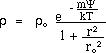
que representa una distribución estacionaria de materia en un gas sin colisiones, en un potencial gravitacional
Y,
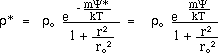
en el cual la fuerza gravitacional se equilibra con la fuerza de presión. Tomemos una solución del mismo tipo para la región antípoda
(21)
Así, debemos resolver la siguiente ecuación
(22)

Tomemos
(23)
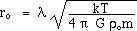
Introduzcamos las siguientes magnitudes sin dimensiones:
(24)

Obtenemos
(24)
que puede resolverse mediante cálculo numérico. Podemos tomar las siguientes condiciones iniciales
j
'o = 0
j
"o = 10
l = 10
Figura 2: Solución de tipo Eddington con simetría esférica. El potencial gravitacional
Figura 3: Solución de tipo Eddington con simetría esférica. Densidades de masa. Si un cúmulo existe en un pliegue, existe un halo difuso asociado en la región conjugada del segundo pliegue.
Versión original (inglés)
The missing mass problem
(p3)
.
- Spherically symmetric solution
In 1916 Eddington derived a spherically symmetric steady-state solution, combining the Vlasov and the Poisson equations. He assumed that the ellipsoid of the velocities was spherically symmetric and pointed towards the center of the system.
Figure 1 (ga3114): Ellipsoid of velocities corresponding
to an Eddington-type solution.
Eddington derived the following relation between the mass density and the gravitational potential
(20)
which represents a steady-state distribution of matter in a collision-free gas, in a gravitational potential
Y,
in which the gravitational force balances the pressure force. Let us take the same kind of a solution for the antipodal region
(21)
So that we have to solve the following equation
(22)
Take
(23)
Introduce the following adimensional quantities :
(24)
We get
(24)
which can be solved by numerical computation. We can take the following initial conditions
j
'o = 0
j
"o = 10
l = 10
Figure 2 : Spherically symmetric Eddington-type solution. The gravitational potential
Figure 3 : Spherically symmetric Eddington-type solution. Mass densities. If a cluster exists in one fold, an associated diffuse halo exists in the conjugated region of the second fold.