SL9 שומקר-לביא השפעה על צדק
סיכום המחקר שנערך בנוגע למסמך SL9
9 בדצמבר 2003
החלק הראשון
נזכור כי מסמך מוזר נמצאו בפורום אינטרנט ופורסם מהקופי-קף בבורדו, שסוקר את האפשרות שהאפקט שנאמר בהמשך היה תוצאה של פיצול והכפפה של גוף שנמצא על ידי אסטרונומים Eugene Schumaker ו- Carolyne Levy באוגוסט 1994. ניתן למצוא את הטקסט המלא בחלק המצורף בסוף הספר האחרון שלי. במחקר זה, שערך האסטרונום A.Cohen, חבר ב- GESTO, הוא סכם את העובדות המאמתות או מפריכות את כל ההשערות הקיימות, תוך ציון המקורות הקשורים.
**לסיכום, **A.Cohen חושף מספר נקודות מוזרות בהשערה הרשמית בנוגע ל"הכפפה, הפיצול והכפפה של קומטה על צדק". הנקודות המרכזיות הן:
-
קשה להבין איך יכולה להתרחש "הכפפה" של "קומטה" או גוף כלשהו על ידי כוכב לכת ענק. זוהי בעיה של שני גופים, בה מופיעות רק חוקי התנועה של קפלר. קומטה היא אובייקט עם מסלול לא מחזורי או עם תקופת חזרה ארוכה, שמסתובבת במסלול בצורת קוני, עם השמש כמוקד. הכפפה דורשת "בעיה של שלושה גופים" (J.M.Souriau). לפחות אפשר להניח שינוי דרמטי במסלול של קומטה שמתנגשת עם צדק (בעיה של שלושה גופים: קומטה - צדק - שמש). אך בתנאים אלו, הקומטה ממשיכה למשוך את השמש "במרכזו", גרביטציונית, גם אם האקסצנטריות של המסלול האליפטי משתנה. בקשר לעוד מספרsatellites של כוכבי לכת במערכת השמש מזכירים כי הכפפות של גופים אדמה שונים נראות כנראה התרחשו ברגע לידת מערכת השמש שלנו, שהיא מאוד לא יציבה, עם מרכז השמש. בנוסף, הפרסומים מציינים כפפה שקרה ב-1920-1930. האובייקט SL9 (לא פוצל) היה מסתובב סביב צדק (עם מסלול מאוד אקסצנטרי) במשך כ-70 שנים, מבלי להימצא.
-
העובדה שגוף, קומטה או אסטרואיד, פוצל, ואפילו התפרק כשעובר בתוך "הכפלה של רוש" של כוכב לכת היא תופעה מובנת היטב על ידי אסטרופיזיקאים. טבעות צדק, כמו גם טבעות של כוכבי לכת ענק אחרים, ככל הנראה נוצרו בצורה זו. מזכירים כי 21 גופים נמצאו במרץ 1993 על ידי Eugene Schumaker (שנפטר שלוש שנים לאחר מכן בתאונת דרכים באוסטרליה) ו- Carolyn Levy היו עדיין רחוקים (קרובים ל-aphélie) מהצדק. הם אז ירדו על הכוכב הענק. Cohen ספק אם האובייקט SL9 יכול להיות קומטה (למה הקומטה לא התחילה להפליט גז במשך 70 שנה, והתחילה לפתע לעשות זאת לאחר הפיצול). בנוסף, הספקטרום של ההפרדה סביב האובייקטים אינו תואם את הספקטרום הקלאסי של đuויות קומטות. האובייקטים, שנקראו "לא טיפוסיים" על ידי אסטרונומים, הוציאו ליתיום. העובדה שהאובייקט G, מספר שעות לפני שנפל על צדק, הוציא יונים של מגנזיום Mg+, נשארת לגמרי לא מובנת. A.Cohen מסכם שברגע האחרון האובייקט יכול להיות אסטרואיד מסוג כונדריט פחמן, עם אלbedo מאוד נמוך, מה שמסביר את אי-ההכפפה שלו לפני הפיצול (...). לפי השערה זו נשאר לפרש למה כל האובייקטים התחלו להוציא סביבות גזיות לאחר הפיצול. לשקף אובייקט בשם "קומטה או אסטרואיד לא טיפוסי" (מה שמכונה "המסקנה הרשמית") הוא מונח מתוחכם לומר שאף לא ניתן להסיק סופי מהניתוח של הנתונים מאלו האובייקטים.
-
בפotos שמופיעות למטה רואים שהעננים סביב האובייקטים מקרינים באדום (זו הצבע האמיתי). זה אינו צבע הקומטות, בדרך כלל, וגם בדיוק בשורה זו מקרין הליתיום. לכן זו קומטה מאוד מוזרה. Cohen מתאימה לעיקרון של מסה פולוורנטית שפוצלה לאחר הפיצול, בקרבת צדק. אלו הם המיקרו-חלקיקים שחררו מחדש באדום. הדבר נשאר... לא ברור, נצטרך להסכים לכך.
-
אך מה שיותר מוזר הוא שהסדר של אובייקטים, שבעצם היו מקרינים מיד לאחר הפיצול, שנמצא בזמן על ידי חישוב ב-8 ביולי 1992, היה מושלם ללא הבחנה עד מרץ 1993. כמובן שאפשר לראות את צדק בכל עת. כוכבי הלכת לא נשארים סטטיים. הארץ מסתובבת. אך התצורה של כוכבי הלכת היא שמאפשרת לשקף את האירוע, שנמצא על ידי Schumaker ו-Lévy במרץ 93, היה ניתן לראות בתקופת החודשים הקודמים, שבהם הכוכב הענק היה עדיין מאוד נראות. מיד כשצדק מתאים לرصد, הוא מיוחס באופן מיידי על ידי אלפי אסטרונומים. A.Cohen מזכיר שתמונות טובות, לאחר הבדיקה ב-93, יכולות להתקבל על ידי חובבים בעלי טלסקופים קטנים עם CCD, עם מראה של עשרה ס"מ בלבד! הוא גם מזכיר תוכניות שנערכו באמצעות טלסקופים עם שדה גדול, שהוקמו במעבדות גדולות, שחקרו את הסביבה של צדק. לכן השאלה של 100 יוקרות היא: למה לא היו ראיות בחודשים שקדמו למרץ 1993, שבהם הרכבת האובייקטים הייתה כבר נראית באופן כללי עם אמצעים יחסית מוגבלים? ---
הערה של A.Cohen:
1/ מבוא ומספר תמונות
המטרה של המסמך הזו היא לסכם את התכונות השונות של האובייקט SL9, לציין את המקורות שלהן, להשוות עם נתונים של גופים שמיוחדים ידועים (קומטות, אסטרואידים, חגורה של קייפר...) כדי לבסס את הנקודות שבעייתיות או דורשות חקירה מתקדמת יותר.
ההצגה תיערך לפי הסדר הכרוני של האירוע: כפפה של הקומטה ומסלול סביב צדק, פיצול, ראייה לפני הכפפה, ראייה במהלך הכפפה, וראייה לאחר הכפפה.
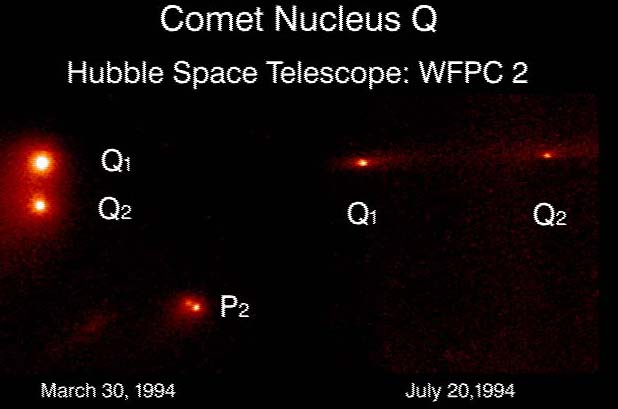
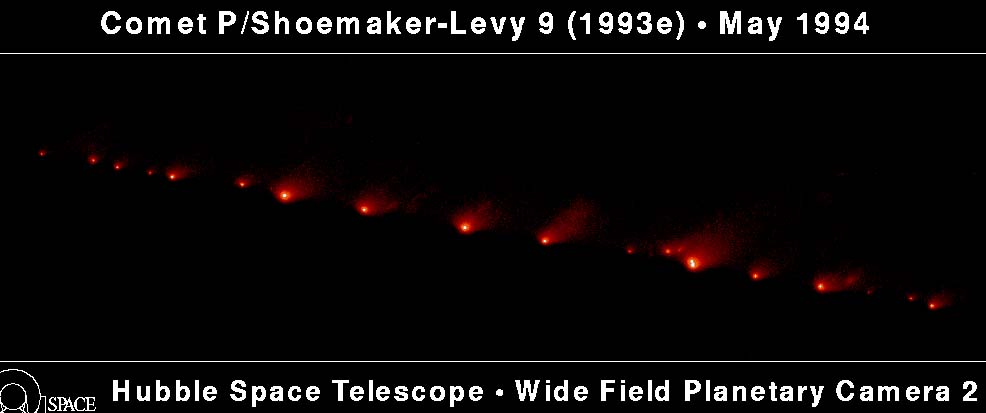
תמונות שנלקחו על ידי הטלסקופ החללי הובלה של SL9 שפורסמו באתרים רבים
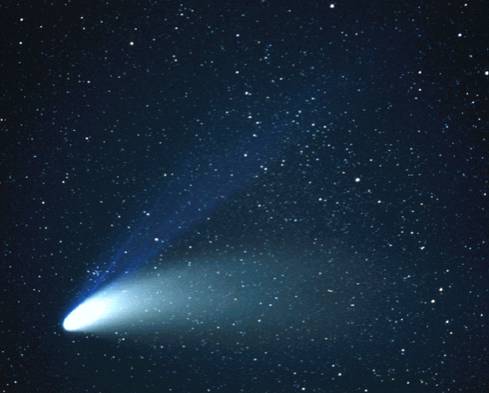
למעלה: קומטה מוגדרת כקלאסית Hale Bope
2/ תכונות מסלול, גילוי ולא גילוי לפני מרץ 1993
הנסיבות של גילויו מוזכרות במספר מאמרים ואתרים, כולל (2), (3), (4):
(2) « הקומטה של שומקר-לביא 9 »,
(3) http://www.astrosurf.org/lombry/sysol-jupiter-sl9-2.htm שמסכם את כל האירועים עד הכפפה עם גלריה יפה של תמונות
(4) http://www2.globetrotter.net/astroccd/biblio/berdtb00.htm שמסכם את גילויו על ידי חובב עם כלי קטן
עם זאת, לפי מאמרים שונים על SL9, ניתוח המסלול שהעלו האסטרונומים (5) מראה שהוא נכלס בערך ב-1920/1930 על ידי צדק ומאז מסתובב סביב צדק בלי להימצא עד פיצולו ב-7 ביולי 1992 (המוכר על ידי Z Sekanina (16) איור 2 עם דיוק של שעה) תוך עبور מתחת לגבול רוש לפני גילויו במרץ 1993.
לכאורה טבעי שקומטות יימצאו מאוחר מאוד ובעיקר על ידי אסטרונומים חובבים, כי עבודות והזווית של טלסקופים גדולים של מקצוענים לא מאפשרות זאת בדרך כלל. עם זאת, במקרה של SL9, האובייקט מסתובב סביב צדק במשך יותר מ-70 שנה, ולכן מדובר לא במעבר חד פעמי אלא חוזר ובמישור קרוב למישור האקליפטי (תקופת המסלול משוערת כ-שנתיים).
2.1 האם היא הייתה חלשה מדי כדי להימצא?
אנחנו צריכים להבדיל כאן בין שתי תקופות: לפני הפיצול ולאחר הפיצול של הקומטה בתוך גבול רוש של צדק ב-7 ביולי 1992
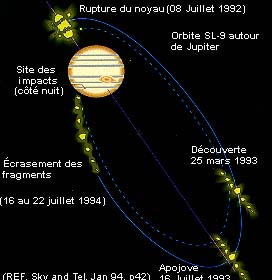
2.1.1 גילוי לאחר פיצול (אחרי 7 ביולי 1992)
למעשה, כפי שמראה האתר הקבוצתי (4), טלסקופ קטן של 10 ס"מ יכול להירשם בו, אם כי חלש, וטלסקופ של 25 ס"מ לא משאיר שום ספק. לכן גילויו אינו מונע של חובבים עשירים, אלא אפשרי לבעלי כלי קלאסיים ואפילו פשוטים, במיוחד בגלל שהוא נמצא ב"השכונה" של צדק, שמכוסה על ידי חובבים.
ברור שהגילוי לאחר הפיצול אפשרי ואמיתי, כל עוד מישהו לקח תמונות באזור זה בין יולי 1992 לבין מרץ 1993. מה שמדהים באמת הוא שאלפי, אם לא מליוני, תמונות של צדק נלקחו על ידי חובבים. במהלך תקופת יולי/אוגוסט 1992, האובייקט הזה, עם מדרגה כללית של 13/14 בקרבתו, חייב היה להופיע בתמונות אלו. יהיה מאוד מעניין למצוא אותן! עד היום לא נמצאו ראיות של תמונות מקצועניות של צדק בתקופת זה. הלאה למטה, מתוך האתר הקבוצתי למעלה, שמתאר Sky and Telescope פברואר 1994, נותן מפה של השמיים שמאפשרת לזהות את מיקום צדק (למעלה) ואת הקומטה (למטה) חודש אחר חודש עד הכפפה ביולי 1994.
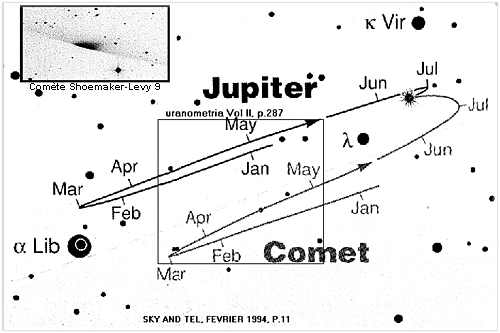
למטה: חיתוך מהאתר הקבוצתי, המראה כיצד חובב עם טלסקופ קטן יכול להירשם על מצלמתו:
- "ה hasten to ask him for the exact position of the comet and he indicated that it was exactly where the ephemerides indicated. By examining my CCD images taken with my small 10cm telescope at F6, captured at the same time as Denis Martel, I realized that it was indeed there, but it was very faint. I simply lacked resolution due to the short focal length of my small 10cm telescope. I reinstalled my camera on my main telescope and on March 11, 1994, I finally obtained my first image of the comet**. The magnitude of this one must have been around +16 and those of the nuclei +17 to +18**. As expected, its position was exactly where the ephemerides indicated. What a sight to see on the computer screen a comet appearing as a LINE OF POINTS IN THE SKY"*
« As equipment, I used a Meade Schmidt-Cassegrain 25cm F10 LX-200 telescope equipped with a focal reducer lens from F10 to F6 (1500 mm focal length), a CCD camera SBIG model ST-6, and URANOMETRIA 2000 sky charts where stars can reach magnitude +9.5. I had recorded the positions of the comet in the American magazines «Sky and Telescope» and «Astronomy» and transcribed them onto my charts. My first attempts began in February 1994. Jupiter was visible in the morning sky to the southeast, and I had to get up around 03:00 to set up my instruments and try to locate the comet. I had to face polar cold with temperatures sometimes reaching -37°C. Remember the record cold of the winter of 1994!» (The problem of positioning comes from the already very narrow field of the 25 cm Cassegrain)
2.1.2 Detection before disintegration (before July 7, 1992)
At least two professional search programs did not detect it, one searching for distant objects in the Solar System (Kuiper Belt Jane Luu and David Jewitt) (6), the other searching for comets near Jupiter Tancredi and Lindgren (7), (8).
Article by Luu and Jewitt:
« Since 1987 we have begun an observation campaign to determine whether the Solar System is truly empty beyond Pluto's orbit or populated with small cold bodies. To collect the faint light reflected by such distant objects, we abandoned traditional photographic plates and used electronic charge-coupled devices (CCD), more sensitive, installed on a large telescope. We carried out most of our study at the 2.2-meter diameter telescope on Mauna Kea in Hawaii. Using a CCD detector coupled to this telescope, we took series of four images of a region of the sky. Each image was exposed for 15 minutes and a computer displayed the sequence of the four images in rapid succession. Objects that move slightly from one image to the next relative to the background stars are members of the solar system . For five years we found nothing ..... »
Tancredi and Lindgren report a negative search for comets near Jupiter in 1992 during a search conducted at ESO in March 1992, that is, one year before the discovery of SL-9 and several months before its disintegration by Jupiter. The telescope used was the 100 cm Schmidt telescope of ESO. The detection limit magnitude was estimated at B = 21.5 (See Appendix 2 for calculation of the probable magnitude of SL9). What would be the characteristics of such an object at this distance for a magnitude of this order?
Let us refer to Z. Sekanina (14), (16), who deduces (14) §6 that the largest fragment has a diameter of about 4 km (assuming an albedo of 0.04), other objects are about 2 to 4 km (14) Figure 2 and (14) Table 1. As for the estimated size of the comet before its passage through the Roche limit, it is (Z Sekanina (16) § 6) about 10 km, with a mass of 10^17 grams assuming a density of 0.2 g/cm³. These values deduced from measurements are confirmed by Sekanina's models (16) § 5.4.
According to J Crovisier (5), relying on Tancredi and Lindgren (7), the magnitude of 21.5 would have corresponded to a body with a maximum diameter of 7.2 km.
It seems therefore that this body could have been detected before its disintegration (the transition from 7 to 10 km corresponds to a doubled equivalent surface area, hence doubled reflection, thus roughly a gain of a small magnitude).
It is also worth noting that this estimate assumes the hypothesis that the comet was completely inactive before disintegration. In the other case, the observed magnitudes (D.E Trilling et al. (15) Figure 1 in red/blue/green), the different fragments (W, V, S, R, Q, L, K, H, G) have magnitudes ranging between 21.5 and 18 (with diameters of about 1 to 4 km!), and a magnitude in the red around 18 to 19. We can also refer to G.P. Chernova et al. (11) Figure 1, which shows that fragment Q (diameter of 4 km) has a visual magnitude of 18.2 and the smallest fragments (diameter of about one kilometer or less) have visual magnitudes around 20.8.
Let us also consider D. Jewitt (9) Figure 2, where we see a plot of all fragments, whose magnitude with a red filter is between 17.5 and 19.2 in March 93 and 20 and 22 in June 1994. This shows that there is a weakening of dissipation, suggesting that during the period July/August 1992 these magnitudes must have been higher (between one and two magnitudes, i.e. Mag 15/16?).
Note on albedos, order of magnitude: Moon: 0.073, Lava of Etna: 0.04, Basalt: 0.05, Ash of Vesuvius 0.16 (19) Atlas of Astronomy, Asteroid 951 Gaspra 0.23, asteroid 253 Mathilde 0.04, Earth 0.36, Carbonaceous chondrites type C asteroids (0.03-0.08 albedo) (20) The New Cosmos § 3.3.2 pp71
Mathilde is considered to have a very, very low albedo.
It therefore seems extremely surprising that this SL9 object went unnoticed for so many years.
To continue along this line, we will try to retrieve professional and amateur images of Jupiter during the period July 1992, we will also try to contact Luu and Jewitt authors to learn more precisely their detection limits, periods, and observation directions during these five years.
At present, this aspect does not contradict the SL9 document, which, according to its logic, explains perfectly its absence simply because it did not exist before. Nothing allows justifying this non-detection, pre or post-disintegration at this stage of the study, nor the classical or "normal" nature of this object.
We estimate that it is very important to be able to retrieve images of Jupiter and its surroundings during the period July 1992 to March 1993.
3/ SL9 a rare comet orbiting around Jupiter? ?
(6) « The Kuiper Belt » by Jane Luu et al.
« The theory of Kuiper remained unknown until Paul Joss of the Massachusetts Institute of Technology calculated in the 1970s that the low probability of gravitational capture by Jupiter was not compatible with the large number of short-period comets observed. ...
In 1988, Canadians Martin Duncan, Thomas Quinn, and Scott Tremaine used numerical simulations to study how giant gas planets captured comets. Like P Joss, they concluded that the capture mechanism is inefficient ..... »
(19) The Solar System / Comets II pp 121 and 126
« The most remarkable perturbations are those in which a long-period orbit transforms, during a close approach to a planet, into an ellipse whose aphelion is located approximately on Jupiter's orbit or slightly beyond: the comets thus captured constitute a family of comets. The Jupiter family* has 68 comets or even more, with periods ranging from 5 to 8 years »
But among these 68, none are in orbit around Jupiter; all are around the Sun. Cf p 126
It therefore appears that the capture of this "comet" and its placement into orbit around Jupiter is an EXTREMELY RARE event in the life of the solar system. The analysis of the comet's orbit further shows that it extends to the very limit of Jupiter's gravitational zone.
Let us now consider the observations made on the "appearance" of this object:
D. Jewitt (9), « Physical observations provide no answer to the comet versus asteroid issue »
R.M West et al. (10), « The main result is therefore that each condensation has two « tails », a fainter one that appears « normal », and a stronger, clockwise curved one that continues to be directed towards Jupiter. The reason for the presence of this anomalous tail and its shape is not known at present. »
G.P. Chernova et al. (11), « No change of appearance of the comet occurred when the comet passed minimum phase angle. This makes it likely that the tails of the subnuclei are synchronic i.e that dust production is not going on at the same time of the observations »
« As we observed the comet very close to opposition, the opposition angle of the tails close to the subnuclei should change significantly. The fact that this is NOT observed speaks against the idea of ongoing dust production as favoured by Sekanina. If, as we think, the tails are synchronic features, they would lie in the comet orbit plane, if the comet were moving under solar force only. Since the earth must pass this plane when the comet passes zero angle, the aspect of the tails as seen from the earth must change. As this was not observed we must conclude that, because of Jupiter's influence on the cometary orbit, this orbit was not anymore located in a plane. Undoubtedly the mechanicial theory of comet tails, when applied to this peculiar object, can give important clues to the history of the observed dust cloud. »
**J.A. Stüwe et al. (12), **« The average colour indices over all fragments and all data sets listed in Table 3 show that the dust of SL-9 is somewhat redder than the Sun, as is expected for sunlight reflected by micro-sized dust particles »
« Our analysis of the spectra in the range 320 nm to 940 nm is consistent with a solar spectrum reflected by the sun**, with NO additional emission** »
**F. Colas et al. (13), **« Only the grains larger than 0.1 mm can have stayed close enough to the fragments for two years to be observed on CCD frames. In our opinion, this is more likely to happened because we did not observe any structure in the cloud, as expected if it is a product of the fragments activity. » .../ ..
« this demonstrates that these grains can be residual of the comet breakup in July 1992, although part of it could come from a faint emission of small grain by the fragments. »
« The exact interpretation of these comae and tails is not obvious. It could be the result of a weak cometary activity or large dust or sub-fragments created during the break up in July 1992 »
**D. E. Trilling et al. (15), **« We do not find significant differences in color among the fragments. We find that the fragments are redder than the sun, and that the colors of SL9 are consistent with those of typical comet. However, changes in color with respect to distance from the center of the fragment are unusual . »
« On the other hand, Chernova et al. (1995) find a reddening trend with increasing distance up to 50 000 km for many but not all fragments. A trend in color with increasing distance may be an indication of a change in particle size distribution with increasing distance. »
Zdenek Sekanina (16), « Although the appearance of P/Shoemaker-Levy 9 was unquestionably unique among observed comets, certain similarities, however remote, can be found with two other tidally split comets, P/Brooks 2 (1889 V) and the Sungrazer 1882 II .
It seems from the analysis of various observations (9,10,11,12,13,14,15,16) that the atypical nature of this object is agreed upon by the vast majority. The same applies to the phenomenon of its capture and orbit (6), (19).
The "tail" does not correspond to a classical comet tail and seems better interpreted as residue of dust generated by the fragmentation of the "comet" during its passage in July 1992 (reddish color, millimeter/centimeter dust, fading, and especially G.P. Chernova et al. (11)), the spectroscopic aspect will also show (see infra) the complete absence of characteristic gaseous emission (OH, CN, ..), on the other hand all fragments appear completely identical.
At present, this does not allow contradicting the SL9 document (reddish halo due to the presence of fluorescent lithium/barium reflecting sunlight). The fading aspect can be explained by gas rarefaction, the lack of dust production (G.P. Chernova et al. (11)), is evident in this case, the lack of degassing as well. The slight difference in redness depending on distance remains to be explained.
4/ Composition / Spectroscopy of object SL9 before impact
The SL9 document refers to the AMPTE experiment as a preamble allowing the generation of a false comet. See the specific AMPTE dossier in Appendix 1, whose conclusions confirm that tests were indeed conducted with this objective using artificial clouds of barium and lithium ions ionized by the solar wind.****
This is not sufficient at present to assert that the rest of the reasoning is true.****
It is also reminded UCL (21)
http://www.mssl.ucl.ac.uk/www_plasma/missions/ampte.html
« Lithium and baryum ions are good tracers ions since they are unusual in naturally occuring space plasmas, so a detection would almost certainly indicate that IRM had been the source »
University College of London (UCL) is the laboratory that provided one of the three satellites of the AMPTE experiment.****
We will therefore focus on studying all spectral analyses and other studies conducted by observatories around the world on object SL9****
It is emphasized that ALL research conducted on the hair and carried out by both terrestrial telescopes and HST, as well as radio telescopes, were negative regarding all the following species: OH, CN, CO+, CO.
J.A Stüwe et al. (12) Table 4 – « The spectral of the individual nuclei in this region show no evidence for molecular emission ../.. since no emission was detected, we determined 3 sigma upper limits to the CN production rate for the five fragments. The upper limits on Qcn are one order of magnitude lower than the values previously determined for the entire cometary train (Cochran et al., 1994 , Icarus) However our average value of log(Qcn)=23.4 is still in the range of production rate values actually measured for low activity comets like for example P/Howell (23.3) or P/Haneda-Campos 1978 J (23.6) » .
J. Crovisier (5) – Table 2 – Spectroscopic Limits (3 sigma) on gas production rates in SL-9 prior to the impacts, confirms the non-detection by five major professional observatories with a high limit of the same order.
When it is mentioned that such spectroscopic detections at distances greater than 5 UA are extremely rare, this argument is debatable since detections have indeed occurred (Chiron 10 UA, P/SW1, 6 UA, P/Halley 4.8 UA) with less powerful tools.
J. Crovisier (5) §2 – « Indeed recent radio observations of P/Schwassmann-Wachmann 1 (P/SW1) an active comet with a nearly circular orbit at Rh=6UA (i.e beyond Jupiter) revealed that its activity may be governed by CO sublimation. The cometary activity which is observed far from the sun now revealed in more and more comets with the increasing sensitivity of modern techniques – is presumably due to the sublimation of such very volatile species .
No comet has ever been observed by so many teams, with so many telescopes, so advanced and for so long. It is reasonable to think that such detection methods used on comets in general would have shown numerous detections of these bodies at such distances.
**Hale Bope (23) ******
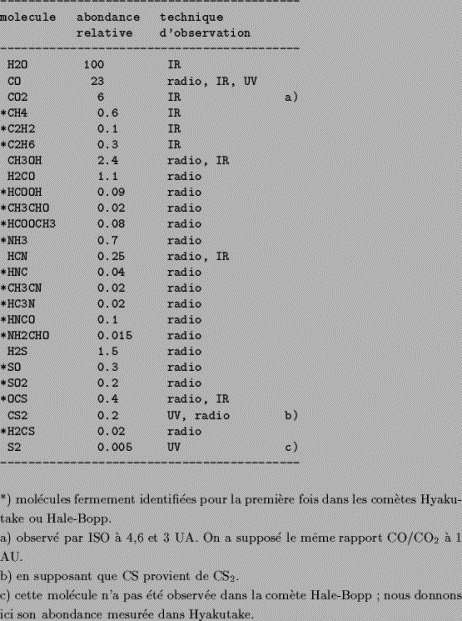
This comet was studied in detail, and gives an idea of the relative magnitudes between the different species detected on a comet. We can assume that these ratios may vary widely depending on the observed bodies, nevertheless, the order of magnitude of the ratios of major bodies should be characteristic.**** * ***** ** ** * *****
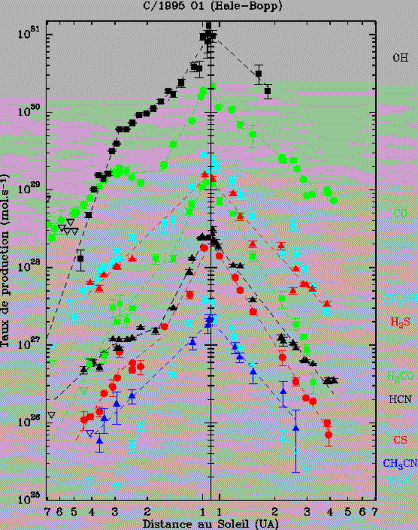
This second graph is very interesting because it gives an idea of the minimum distance from which the comet begins to evaporate and generate gases, as well as the type of gas and the order of magnitude of the associated quantity depending on the distance from the sun in Astronomical Units.
It is evident that water and CO are predominant and far ahead, appearing from about 5 UA.
Regarding the absence of water, the distance from the sun of 5 UA, J. Crovisier (5) §3, it is a fact that the temperature reached does not allow for theoretical sublimation of water. Nevertheless, it has already been observed at these distances:
· detections have already occurred on other comets located at similar distances with emission rates much higher (10e29) Bowell 1982 I, J Crovisier (5) §3 / (A 'Hearn et al. 1984)
and (20) The New Cosmos § 3.1.2 pp 48
« On the other hand, infrared measurements for the major planets, Jupiter, Saturn, and Neptune indicate radiant losses which are 2 to 3 times greater than the absorbed solar radiation . Jupiter : 1.7 +/- 0.1 . This energy is due to the release of gravitational energy or to heat remaining from the time of the formation of the planets . »
· If we want to make a complete energy balance for SL9, we need to add to the solar energy received at the distance of Jupiter, the internal energy radiated by Jupiter, which represents 70% of the previous one, as well as part of the solar energy reflected by Jupiter (Albedo 0.73, so three-quarters of the energy received by Jupiter from the sun is re-emitted). If we look at the orbital distance of SL9 to Jupiter even at its minimum it is at 50,000 km. Considering the solar constant at the distance of 5.4 UA, Jupiter receives 45 W/m² from the sun, its internal energy allows it to emit an additional 32 W/m² besides the reflection by albedo of 31 W/m², which means that SL9 will receive approximately 50 W total considering a cross section of 1 km², negligible compared to the solar constant of 45 W/m².
Therefore, the "proximity" of Jupiter does not change the total energy received by SL09 in its orbit around the planet.
It is finally worth emphasizing once again the assumption of albedo used in detection calculations: 0.04, which is extremely low, meaning that 96% of the solar energy received is absorbed by the SL9 body, i.e. about 43 W/m², which corresponds to an equivalent temperature of 117 K. We find here the value displayed by J Crovisier of 120 K. It indeed seems likely that the body's temperature is not sufficient for significant sublimation of water. Indeed, it is more likely that the actual albedo is higher and in this case the temperature would be even lower.
**בסיום, אנו מוסרים כי היעדר זיהוי של כל סוג של גז (OH, CN, CO+, CO) בזקנת SL9, בכל אורך גל, על ידי הטלסקופים היבשתיים והفضائيים החזקים ביותר, למשך תקופות ארוכות, על ידי צוותים מרובים ומנוסים, שכולל את המזהים הטובים ביותר שנבנו אי פעם, אינו בסיסי לאנומלי בזיהוי הראדיקל OH, אך עבור המינים CO, נראה לפי מדידות אחרות על קומטיות טיפוסיות כי או שהקומטה SL9 היא אופיינית בקצב נמוך מאוד של פליטה של CO, או יותר סביר, שאין פליטה אמיתית כלל. **
**הנקודה האחרונה, מאוד חשובה, היא זיהוי (אקראי!), של פליטה של Mg+ (דיבלט ב-280 ננומטר) שהצטבר על ידי HST על המאובן G ב-14 ביולי 1994, 4 ימים לפני הפגיעה. לא נמצאה עד כה הסבר רציונלי חזק ומבוסס ב факטים. **
ג'י. קרוויזייר* (5) §3 עמוד 9 / וויאר ושות' 1995 ; פלדמן ושות' 1995*
5/ סיכום ניתוח האובייקט SL9 לפני הפגיעה
הניתוחים שנערכו לפני הפגיעה § 2/3/4, מאפשרים להכריע את עובדות הבאות:
האובייקט SL9 הוא אופייני לרוב לפי מסלולו, הالتפסתו, היעדר זיהוי לפני מארס 1993, ה đuיה לא סטנדרטית, היעדר פליטה כללית. מצב אופייני זה מאושר/נזכר על ידי מרבית המחברים שהוזכרו.****
**((27) שיאו וואנג ושות') ****« **לא נצפתה פליטה, רק כמות קטנה של מים נצפתה מהנקודות החשוכות (לאחר הפגיעות), והאלbedo הנמוך של הנקודות החשוכות מצביעים על כך שהקומטה של שומר-ליבי 9 היא סוג חדש של אובייקט שונה מהקומטיות והאסטרואידים הידועים »
נסו ל,classify את האיברים השונים לפי הצעות הסבר אפשריות
סמל: NC: לא מתאים, C: מתאים, I: בדיקות משלימות הנדרשות
מקור SL9 קומטה אסטרואיד טיפוס דוק סל9
** חondrites פחמניים**
טיפוס C
לא זיהוי
לפני פיצול NC/I1 NC/I1 C/I1
לא זיהוי
לאחר פיצול NC/I1 NC/I1 C/I1
đuיה פחמנית NC C C
ללא פליטה
מסלול C C C
יעדר פליטה NC/I2 C C
המראה אדום / אדום יותר שמש C C C/I3
העטיפה האדומה מתפוגמת C C C
אלbedo 0.04 NC C C
זיהוי Mg++ C ? ? C C
נדרשות בדיקות / מידע נוסף על שלושה נקודות לפחות:
I1: לקבל תמונות בסביבות יופיטר במהלך יולי/אוגוסט 1992
I2: לקבל מידע חדש על סטטיסטיקות של פליטה של CO בקומטיות במרחק גדול יותר מ-5 UA
I3: לקבל מידע נוסף על השינוי הקטן בצבע האדום בהתאם לمسת ב đuיה
בשלב זה של המחקר, לא ניתן לשלול אף אחת מהאפשרויות, אך נראה שההיפותזה של קומטה היא הרבה פחות סבירה מזו של אסטרואיד טיפוס חונדריט פחמניים טיפוס C ((20) **היקום החדש § 3.3.2 עמודים 71-72), ((27) שיאו וואנג ושות') **שוכנים בדרך כלל בحزמת האסטרואידים החיצונית, שמתאימים לאלbedo נמוך מאוד של 0.04 ולצפיפות נמוכה, שנשלפו על ידי יופיטר כתוצאה מהתפרצויות גראוויטציונליות.
ההיפותזה של מסמך SL9 לא יכולה להיחשב כמוכחת, כל העובדות שהוזכרו עקביות עם ההסבר שהונח במסמך .****
ההסתברות הנמוכה של נחיתה, מסלול ויעדר זיהוי הם מאוד בעייתיים אך לא קובעי עניין בשלב זה .
6/ ניתוח האובייקט SL9 לאחר הפגיעה
חשוב לציין שבעקבות האנרגיה שנשחררה במהלך הפגיעה, מאוד סביר שקרבות חזקים וปฏיונות כימיות שונות התרחשו וחלק מה מולקולות ו יונים שהיו בSL9 התרכזו מחדש חלקית או בכללה. . (26) בורונוב ושות'
הניתוח הספקטרוסקופי שנערך מאפשר זיהוי של אטומים, אך בוודאות לא של מולקולות שיכלו להיווצר ממקורות שונים ועם היסטוריה כימית מאוד מטושטשת. בנוסף, הרכבה של יופיטר מצוינת מראה בשכבות הגבוהות (השכבות של הפגיעה) חוסר מוחלט של אלמנטים מתכתיים, ובנוסף, קיומם של עננים עם ריכוזים שונים, כולל NH3, NH4SH, H2O, ולכן יהיה מטושטש להסיק משהו מהנוכחות של מולקולות כאלו או מderivatives שלהן לאחר הפגיעה.
חשוב לציין במבוא שהפגיעה החזקה ביותר שנצפתה אינה קשורה למקטעים שנקבעו כגדולים במקור. זה מודגש על ידי מספר מראים .
6.1 / ניתוח ספקטרוסקופי לאחר הפגיעה של SL9
ג'י. קרוויזייר (5) §4 / רשימת הפסים שהזוהו מוצגת ברורה במסמך של ג'י. קרוויזייר, ואנו מוצגים אחת נוספת קצת יותר סינטטית להלן :
טבלה 4-1
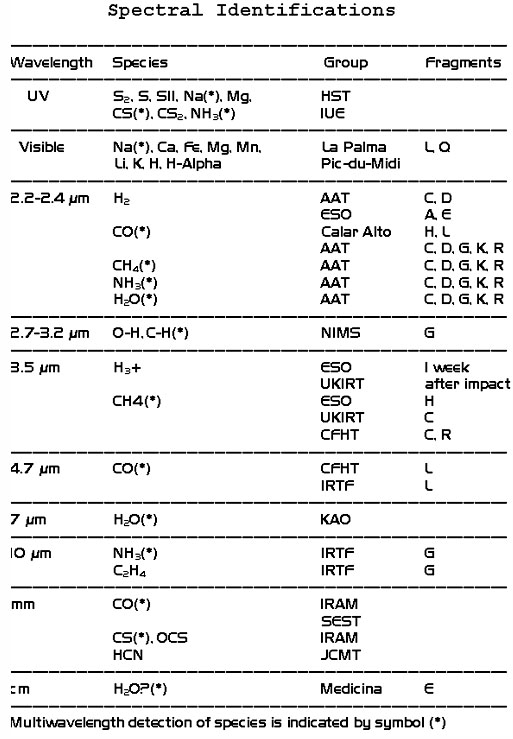
רשימה נוספת מוצגת ב (24) מ. רואס-סארוט ושות' טבלה 2 .
מבחינה אחת נצפתה שפסים מסוימים לא נצפו, ו**מבחינה שנייה, פסים חשובים מאוד של Na, Ca, Fe, ו-Li נצפו לאחר הפגיעה על ידי מספר מראים . **
נכתב במאמר שהפסים נצפו במדידת ספקטרום גס ללא צורך ב טיפול ! !, זיהוי של Mg, Mg+, Fe, Fe+ נצפתה שוב. הפסים מוגזמים לחלוטין, מה שמשמעו שמשום כך לא ניתן להעריך את הכמות הכוללת, ויכול להוביל רק לประมาณ נמוך מאוד .****
בנוסף, הופעת ליתיום רבה (פסים מוגזמים) היא מאוד מטרידה .
ב***(24) מ. רואס-סארוט ושות' ***« אטומים מתכתיים או תרכובות נפוצות לא נמצאות בדרך כלל באטמוספירה של יופיטר. לכן, אנו מכריע שהמתכות שנצפו במהלך הפגיעה L ו-Q1 נפלטו מ חומרים ריאקטיביים של קומטה. לפני האירוע של SL9, הפסים האטומיים נצפו רק בספקטרום של חומרים קומטיים בไฟרברלים (בורוביקה 1993,1994) ובקומטיות שמתקרבות לשמש . המקרה המומשך ביותר הוא של קומטה איקי-סי 1965 VIII שמתקרבה לשמש ל-0.0078 UA (כלומר בתוך הקורונה) ב-21 באוקטובר 1965 . פסים של מספר אטומים מתכתיים (Na, K, Ca, Ca+, V, Cr, Mn, Fe, Co, Ni, Cu) נצפו ברגע זה, וניתן היה להעריך את היחסים בין העשירויות (פרסטון 1967 ; ארפיני 1979) . בזמנו, לא ניתן היה לזיהות את הפס של ליתיום .
פסים רזוננטיים של נתרן נצפו גם בקומטיות רבות שעברו ליד השמש במרחק של פחות מ-1 UA. הרכבה של אבקת קומטה הללי, הכוללת מתכות עד ניקל, נחקרה גם על ידי ספקטרומטר מסה במשגרים חיצוניים (ווגה וג'יטו) (ג'סברגר ושות' 1988) . נמצאה עשירויות קרובות לשל Mặt שמש עבור אלמנטים מפחמן עד ניקל שוב, ליתיום לא נצפתה. » ג'י. קרוויזייר (5) §4 עמוד 14 « פסים מוגזמים לא יכולים להשתנות .... קצב זה נוצף גם עבור הפסים שנצפו על ידי IUE וגם עבור הפסים רבים שנצפו בזיהוי הראות »
לראות גם את התגובה (28) http://www.jpl.nasa.gov/sl9/news35.html שהוזכר להלן
נמשיך עם הרכבות המבוססות של קומטיות, אסטרואידים ומערכת השמש:
(5) ג'י. קרוויזייר טבלה 1, (24) מ. רואס-סארוט ושות' טבלה 4, (20) The New Cosmos § 7.2.7 טבלה 7.5 עמודים 216-217
ליתיום חסר בקומטיות, ליתיום נצף ב מטאוריטים ומערכת השמש, היחס Li/Na הוא 0.001, (20) The New Cosmos , מציין שהעשירות של ליתיום במערכת השמש נמוכה יותר מזו ב מטאוריטים בפקטור של כ-1000, בגלל ש ליתיום נשרף בปฏיונות גרעיניות של השמש בהדרגה, אך מאשר את היחס של 1000 בין Li ל-Na ב מטאוריטים, במיוחד ב חונדריטים פחמניים טיפוס C1 .
הזיהוי של ליתיום בספקטרום לאחר הפגיעה מראה לכן שזה לא יכול להיות קומטה .
העשירות של ליתיום ב SL9 בעייתית ביחס לפרשנות של אסטרואיד טיפוס חונדריט C1, שכן הוא מופיע בזיהוי בפקטור של 60 ! ! עם זאת, תוך התייחסות ל *(24) מ. רואס-סארוט ושות' טבלה 3, נראה ש הפסים של נתרן, קל슘 וקליום מוגזמים, מה שמשמעו שướcונם מוערך נמוך יותר, בעוד שפס ליתיום אינו מוגזם . במקרה זה, אפשר לפרש כ חונדריט C1 ועומד עם היחס הרגיל של 1000, אם נסכים לปรעה מעלה של כמויות נתרן, קליום וקל슘, שמתאימים לירידה מוגזמת שנגרמה עקב הגלגול .
בנוגע לפסים מולקולריים, מאוד קשה להסיק משהו מסוים, בגלל שוב את חשיבות הפגיעה והปฏיונות הכימיות האפשריות שהתרחשו עם מרכיבים שהשתנו כבר באטמוספירה של יופיטר. נדמה לנו מאוד קשה להסיק על מקור המים וסוכנים אחרים שנצפו ויכולים להיבנות מחדש לאחר הפגיעה מרכיבים באטמוספירה של יופיטר .
המדידה הדיסקרימיננטית היחידה לא בוצעה (יחס דאוטריום/הידרוגן) .
(5) ג'י. קרוויזייר § 4.4 רמזים מ אבקות / ניקולסון ושות' 1995
זיהוי של אבקות נצפתה בפס של 10 מיקרון, מיד לאחר הפגיעה של המאובן R במעבדה של מונט פאלומאר, שמתאים ל סיליקטים במשקל של כ-6.1012 גרם עם קוראים ברדיוס של סדר מיקרון וצפיפות של 3.3 גרם/סמ"ק.
** מספר הפעמים שהדף נצפה מאז 3 בדצמבר 2003** :
חזרה לחדשויות חזרה למדריך חזרה לדף הכניסה