Géométrisation de la matière et de l'antimatière par l'action coadjointe d'un groupe sur son espace des moments. 4 :
Le groupe des jumeaux. Description géométrique de l'antimatière de Dirac.
Interprétations géométriques de l'antimatière après Feynman et le théorème dit CPT. (p4)
Quelques remarques sur les métriques.
Tous les éléments du groupe sont construits à partir des éléments du groupe de Lorentz complet, qui obéissent à :
(7)
(4507)

avec
(8)
(4508)
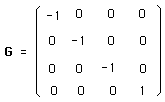
Cette dernière matrice est liée à la métrique :
(9)
(4509)

de sorte que les deux plis ont la même signature. Si elles sont décrites comme des espaces de Minkowski, leurs métriques sont identiques. Mais leurs flèches du temps sont opposées.
Si l'on souhaite décrire les deux plis, les deux univers, il faut choisir sa propre flèche du temps et son orientation spatiale.
Il est clair que la dualité matière-antimatière se produit dans les deux plis. Si nous appelons le second pli "pli jumeau" (A. Sakharov) ou "pli ombre" (Green, Schwarz et Salam) ou "pli fantôme" (choix de l'auteur), la flèche du temps dans ce second pli est opposée (symétrie T), comme prévu par A. Sakharov, et les structures spatiales sont énantiomorphes (symétrie P).
Dans le second pli, la matière est CPT-symétrique par rapport à la nôtre. D'où, dans ce pli, un proton possède une charge négative et un électron une charge positive.
Inversément, un anti-électron de ce pli, PT-symétrique par rapport au nôtre, possède une charge négative, d'où un antiproton du second pli a une charge positive.
En résumé, le second pli est CPT-symétrique par rapport au nôtre. Comme le suggère Andréi Sakharov, on peut s'attendre à ce que la violation du principe de parité puisse être inversée dans ce pli.
Si l'absence d'antimatière dans notre pli est une conséquence directe de la violation du principe de parité, il est possible que cette dissymétrie soit inversée dans l'autre pli.
Plis interagissant.
Tout notre travail en astrophysique et en cosmologie (voir Physique géométrique A) découle d'un système de deux équations de champ couplées :
(10)
S = c ( T - T
- )
(11)
S* =
c ( T
T )
Les deux signes moins ont été introduits comme hypothèse a priori. À la fin de ce travail, fondé sur la théorie des groupes, l'explication émerge. Les deux plis
doivent
avoir des flèches du temps opposées et
doivent
être énantiomorphes afin de satisfaire les contraintes provenant de la structure du groupe.
Ainsi, la matière de l'autre pli, pour un observateur situé dans le premier, se comporte comme si elle possédait une masse négative, ce qui provient de l'action coadjointe et de la symétrie T.
Conclusion.
À partir du travail de référence [3], nous avons modifié le modèle afin d'éviter les rencontres entre particules de masse positive et négative. La solution a été de construire deux plis à dix dimensions (F, F*) comme quotient du groupe par son sous-groupe orthochrone.
Nous obtenons alors deux espaces avec des flèches du temps opposées.
Nous étudions l'impact des différentes composantes du groupe sur les espaces des moments et du mouvement. On montre que la dualité matière-antimatière se produit dans les deux plis, dans les deux univers.
Ce travail donne une nouvelle perspective sur l'antimatière, à travers des outils géométriques.
Par exemple, l'antimatière de Dirac est l'antimatière de notre propre pli.
La matière du second pli est CPT-symétrique par rapport à la nôtre.
Le PT-symétrique d'une particule de matière appartenant à notre pli est l'antimatière de l'autre pli.
Les particules de matière et d'antimatière de notre univers possèdent une masse et une énergie positives.
Les particules de matière et d'antimatière du second pli possèdent une masse et une énergie négatives.
Annexe :
Extension du groupe.
Considérons un groupe composé de matrices :
(1)
(4513)

A est une matrice carrée.
Best une matrice colonne et
O une matrice ligne, composée de termes nuls.
Considérons l'extension :
(2)
(4514)
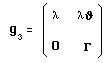
où
Jest la sous-matrice ligne suivante :
(3)
(4515)

Jétant un scalaire.
Vérifiez que (2) est un groupe :
(4)
(4516)
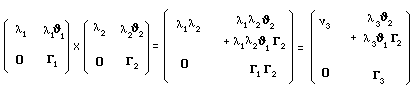
(5)
(4517)

(6)
(4518)

Alors :
(7)
(4519)
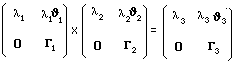
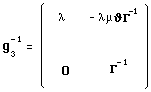
La matrice inverse est :
(8)
(4520)
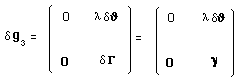
L'élément de l'algèbre de Lie est :
(9)
(4521)
Calculez l'action de
g 3-1 sur l'élément de l'algèbre de Lie
d g 3
(10)
(4522)
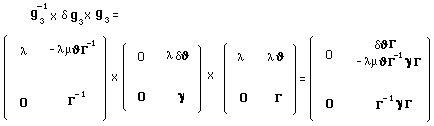
(11)
(4523)

g est une matrice :
(12)
(4524)

de sorte que :
(13)
(4525)
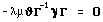
L'identification :
(14)
(4526)
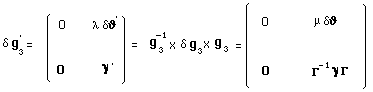
donne :
(15)
(4527)

(16)
(4528)

Version originale (anglais)
Geometrization of matter and antimatter through
coadjoint action of a group on its momentum space. 4 :
The Twin group. Geometrical description of Dirac's antimatter.
Geometrical interpretations of antimatter after Feynmann and so-called CPT-theorem. (p4)
Some comments about the metrics.
All the elements of the group are built from the elements of the complete Lorentz group, which obey :
(7)
(4507)
with
(8)
(4508)
This last matrix is linked to the metric :
(9)
(4509)
So that the two folds have same signature. If they are described as Minkiwski space times, their metrics are identical. But their arrows of time are opposite.
If one wants to describe the two folds, the two universes, one have to choose his own arrow of time and space orientation.
It is clear that the duality matter-antimatter occurs in both folds. If we call the second fold "twin fols" (A.Sakharov) or "shadow fold" (Green, Schwarz and Salam) or " ghost fold" (the author's choice) the arrow of time in this second fold is opposite (T-symmetry), as predicted by A.Sakharov, and space structures are enantiomorphic (P-symmetry).
In the second fold the matter is CPT-symmetric with respect to ours. Whence, in that fold, a proton owns a negative charge and an electron a positive charge.
Conversely, an anti-electron of that fold, PT-symmetric with respect to ours, owns a negative charge, whence an antiproton of the second fold has a positive charge.
To sum up, the second fold is CPT symmetric with respect to ours. As suggested by Andréi Sakharov, we can expect that the violation of the parity principle could be reversed in that fold.
If the absence of antimatter, in our fold, is a direct consequence of the violation of the parity principle, it is possible that such dissymmetry would be reversed in the other fold.
Interacting folds.
All our work in astrophysics and cosmology ( see Geometrical Physics A ) comes from a system of two coupled field equations :
(10)
S = c ( T - T
- )
(11)
S* =
c ( T
T )
The two minus signs were introduced as an a priori hypothesis. At the end of this work, based on group theory, the explanation arises. The two folds
must
have opposite arrows of time and
must
be enantiomorphic in order to fit constrainsts coming from the group structure.
So that the other matter, located in the other fold, for an orbserver located in the first, bahaves as if it own a negative mass, which comes from the coadjoint action and the T-symmetry.
Conclusion.
Starting from the work of reference [3] we have modified the model, in order to avoir encounters between positive and negative mass particles. The solution was to build a two-ten-dimensional folds (F,F*) as the quotient of the group by its orthochron sub-group.
Then we get two spaces with opposite arrows of time.
We study the impact of the different components of the group on momentum and movement spaces. One shows that the duality matter-antimatter occurs in boths folds, in both universes.
This work gives a new insight on antimatter, through geometrical tools.
For an example Dirac's antimatter is the antimatter of our own fold.
The matter of the second fold is CPT-symmetrical with respect to ours.
The PT-symmetrical of a matter particle that belongs to our fold is the antimatter of the other fold.
Matter and antimatter particles of our universe own positive mass and energie.
Matter and antimatter particles of the second fold own negative mass and energy.
Annex
:
Extension of the group.
Consider a group
composed by matrixes :
(1)
(4513)
Ais a square matrix.
Bis a column matric and
Oa ligne matrix, composed by null terms.
Consider the extension :
(2)
(4514)
where
Jis the following ligne sub-matrix :
(3)
(4515)
Jbeing a scalar.
Check that (2) is a group :
(4)
(4516)
(5)
(4517)
(6)
(4518)
Then :
(7)
(4519)
The inverse matrix is :
(8)
(4520)
The element of the Lie algebra is :
(9)
(4521)
Calculate the action of
g 3-1 on the element of the Lie algebra element
d g 3
(10)
(4522)
(11)
(4523)
g
is a matrix :
(12)
(4524)
so that :
(13)
(4525)
The identification :
(14)
(4526)
gives :
(15)
(4527)
(16)
(4528)