cosmologie des univers jumeaux
Cosmologie des univers jumeaux (p 9)
10) Le problème de l'horizon cosmologique.
...Classiquement, l'horizon cosmologique est défini comme ct, ce qui donne lieu à un paradoxe. L'Univers observé est très homogène à grande échelle. Si nous comparons une distance caractéristique R(t) (par exemple la distance moyenne entre les particules) à l'horizon, nous obtenons : Fig. 17 : Comparaison de l'évolution de la longueur caractéristique de l'Univers avec l'horizon cosmologique, dans un modèle d'Einstein-de Sitter.
Dans le modèle actuel, l'horizon cosmologique devient l'intégrale suivante :
(87)
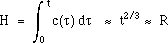
Fig. 18 : Comparaison de l'évolution de la longueur caractéristique R de l'Univers avec l'horizon cosmologique, dans le modèle actuel. Elles présentent la même variation dans le temps.
...Si l'Univers était homogène au départ, le processus collisionnel, toujours présent, tend à maintenir cette homogénéité. S'il ne l'était pas, il tend à l'aplanir. Ceci constitue une alternative à la théorie de l'inflation.
...Cette loi entre R » t2/3 ne doit pas être considérée comme un processus d'expansion, mais comme une conséquence de la variation séculaire des constantes de la physique, un processus de jauge, dont l'effet observable unique est le décalage vers le rouge.
11) Le lien avec la géométrie de Robertson-Walker.
Tout cela est compatible avec la solution (34) si nous donnons la définition non standard du temps cosmologique suivante :
(88)
La dimension de la constante est : (88b)
Dans la définition standard du temps cosmologique à partir de
t = constante × x° (x° = ct), la dimension de la constante est
(88t)
12) L'entropie comme marqueur chronologique meilleur.
...Le calcul détaillé de l'entropie par baryon, tel que défini par :
(89)
où f est la fonction de distribution des vitesses, a été donné dans un article antérieur, avec des « constantes variables ». Voir [13], section 2. ...En résultat, nous avons trouvé :
(90)

...Si R(t) est une fonction croissante de t, l'entropie cosmique croît comme le temps cosmologique. Dans les expériences de laboratoire, nous associons généralement l'entropie au temps et considérons qu'en vertu du deuxième principe, aucun phénomène strictement isentropique n'est possible. Nous considérons que le flux du temps dépend de la variation d'entropie. Dans le modèle classique, il est quelque peu paradoxal de constater que de telles variations énormes du temps s'accompagnent d'une variation nulle d'entropie. Dans le modèle actuel, lorsque le temps t tend vers zéro, s tend vers - ∞
...Nous avons s = constante Log t. Si nous changeons la mesure de l'entropie (en modifiant la valeur de la constante) et écrivons :
(91)
nous obtenons :
(92) dt = 3/2 t ds
Revenons à la métrique de Robertson-Walker.
(92b)
Nous obtenons, avec R = 3/2 ct :
(93)

Dans la représentation { entropie, variables d'espace }, la métrique devient conforme plate et nous avons :
Figure 19 : L'évolution du rayon de courbure R de l'Univers en fonction de l'entropie.
...Dans la description classique (t, s), le physicien éprouve des difficultés à définir une horloge matérielle lorsque t tend vers zéro, car les vitesses des particules tendent vers c. Dans un modèle cosmologique à constantes variables, l'entropie par baryon (99) n'est plus constante et ne cesse jamais de décrire les événements de l'Univers. Notez qu'une description (s, s) fait disparaître le problème de l'origine de l'Univers. En outre, si nous décrivons l'Univers dans un espace des phases (position plus vitesse), nous trouvons que le volume hypercaractéristique associé R³c³ varie comme t.
Version originale (anglais)
twin universe cosmology
Twin Universes cosmology (p 9)
10) The problem of the cosmological horizon.
...Clasically this the cosmologic horizon is defined as is ct., which arises a paradox. The observed Universe is very homogeneous, at large scale. If we compare any characteristic distance R (t) (for an example the mean distance between particles), with the horizon, we get : Fig. 17: Comparizon of the evolution of the characteristic length of the Universe with the cosmological horizon, in an Eintein-de Sitter model.
In the present model the cosmological horizon becomes the following integral :
(87)
Fig. 18 : Comparizon of the evolution of the characteristic length R of the Universe with the cosmological horizon, in the present model. They have the same variation in time.
...If the Universe was homogeneous at the begining, the collisional process, always present, tends to maintain this homogeneity. It it was not, it tends to smooth it. This constitues an alternative to the theory of inflation.
...This law between R » t2/3 must not be considered as an expansion process but as a consequence of the secular variation of the constants of physics, a gauge process, whose single observable effect is the red shift..
11) The link with the Robertson-Walker geometry.
All this is compatible with the solution (34) if we give the following non-standard definition of the cosmic time :
(88)
The dimension of the constant is : (88b)
In the standard definition of the cosmic time from
t = constant x° ( x° = ct) the dimension of the constant is
(88t)
12) Entropy as a better chronological marker.
...The detailed calculation of the entropy per baryon, as defined by :
(89)
where f is the velocity distribution function, was given in a former paper, with "variable constants". See [13] , section 2. ...As a result, we found :
(90)
...If R(t) is an increasing function of t , the cosmic entropy grows like the cosmic time. In lab's experiments we usually relate entropy with time and consider that, according to the second principle, there is no possible strictly isentropic phenomenon. We consider that the time flux depends on the entropy change. In the classical model it is somewhat paradoxal to notice thet such enormous change in time would go with zero entropy variation. In the present model when the time t tends to zero, s tends to - ¥
...We have s = constant Log t . If we change the measure of the entropy (modifying the value of the constant) and write :
(91)
we get :
(92) dt = 3/2 t ds
Let us return to the Robertson Walker metric.
(92b)
We get, with R = 3/2 ct :
(93)
In the representation { entropy, space variables } the metric becomes conformally flat and we have :
Figure 19 ): The evolution of the curvature radius R of the Universe versus the entropy.
...In the classical description (t , s ) the physicist, when t tends to zero, has some difficulty to define any material clock, for the velocities of the particles tend to c. In a "variable constant cosmologic model" the entropy per baryon (99) is no longer constant and never fails to describe the events of the Universe. Notice that in a (s , s) description, the problem of the origin of the Universe falls down. In addition, if we describe the Universe in a phase space (position plus velocity) we found that the associate characteristic hypervolume R3c3 varies like t.