Investigation on nuclear power in France
Investigation on French nuclear power
April 25 - April 30 May 4, 2011 June 12, 2011
********May 12, 2011: Earthquake in Spain, negligence for the Civaux Nuclear Power Plant (audio)
On April 18, 2011, Antenne 2 broadcast an excellent program "Complément d'Enquête", titled
The catastrophe that changes everything
At the moment I am writing these lines, after having been able to work from the broadcast of the program on:
http://www.pluzz.fr/complement-d-enquete-2011-04-18-22h10.html
In case this file cannot be consulted at this address, here are others, indicated by my readers:
http://info.france2.fr/complement-denquete
http://www.youtube.com/watch?v=g8Fp1Cn9DhM&feature=related
http://www.youtube.com/watch?v=3Y9jW1jhBkQ
http://www.youtube.com/watch?v=fysP9Udo6Ag&feature=related
http://www.youtube.com/watch?v=XcBhnQECPSQ
http://www.youtube.com/watch?v=Fgh5hX3k4AQ
http://www.youtube.com/watch?v=D1EPZXrR5jI
http://www.youtube.com/watch?v=ZQp5vNwqV0g
http://videos.next-up.org/France2/Complement_Enquete_Fukushima_Lost_in_radiation/24_04_2011.html
and then, on "to watch again in full"
Many readers help me very effectively, even just by providing useful information. It is the exception in a sea of passivity.
Status as of April 25, 2011
The journalist starts his investigation with questions asked to Florent Vallier, young operator "of the first team", of the Nogent-sur-Seine reactor. The interview is conducted in a room that is a copy of the control room, and is used for staff training and simulations.

Florent Vallier, operator of the first team in the Nogent-sur-Seine nuclear power plant
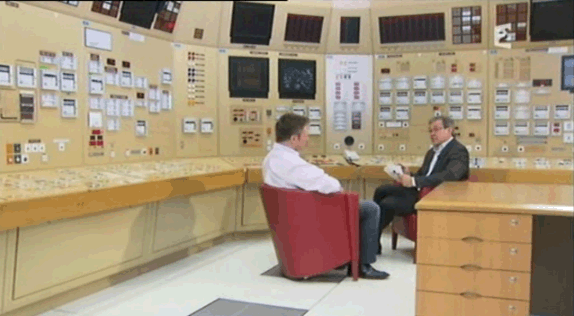
In the exact copy of the control room of the Nogent-sur-Seine nuclear power plant
He ensures the safety and electricity production of the plant, during his shifts

The journalist Benoit Duquesne who is conducting this investigation
When Benoit Duquesne questions the young manager about his reaction after Fukushima, he answers in terms of "experience feedback", of safety improvements. One will hear the same speech from all the people in this French nuclear machinery, as France is "the most nuclearized country in the world."
However, Duquesne quickly says that France has had serious alerts. In the night of December 27 to 28, 1999, the Blayais nuclear power plant in Gironde was flooded, following the storm that swept through France, a completely unpredictable phenomenon.
EDF displaying "a transparent attitude" Duquesne is received by Etienne Dutheil, the young director of this complex, consisting of four reactors each producing 900 megawatts.
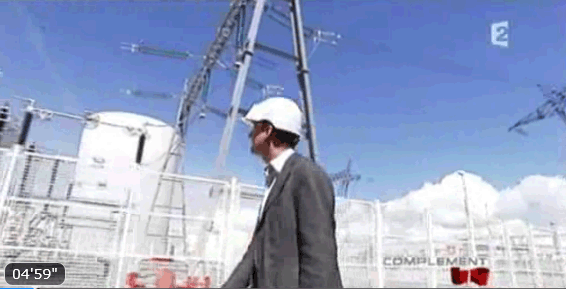
Etienne Dutheil, young director of the Blayais nuclear power plant in Gironde
Facing the 400,000 volts line that carries the electricity produced
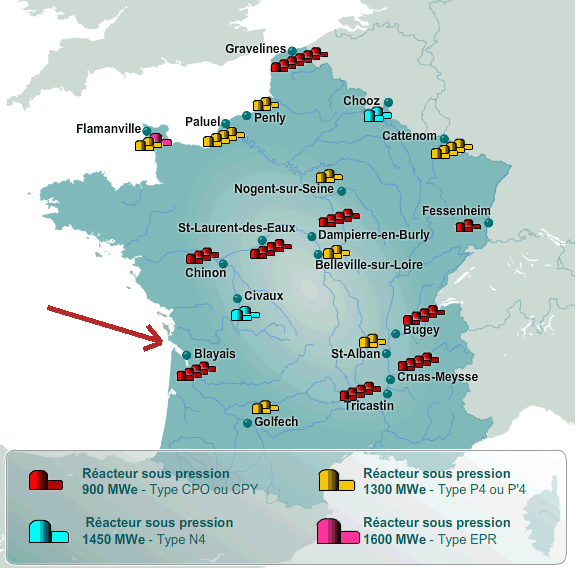
Location of the Blayais power plant, at the mouth of the Gironde
To visit the plant, one is equipped with dosimeters and changes completely clothes.

The young director of the plant, in the locker room
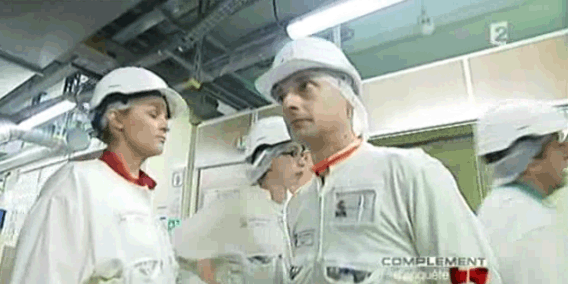
Equipped for this visit
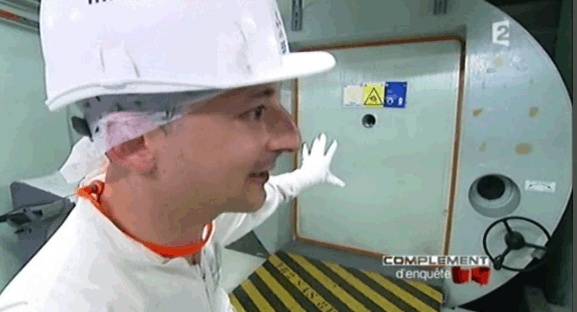
**"Behind a thick door, the heart: nearly 80 tons of radioactive material in fission",
an unbreakable door when the reactor is operating. **
EDF agrees to let us visit its "pool".
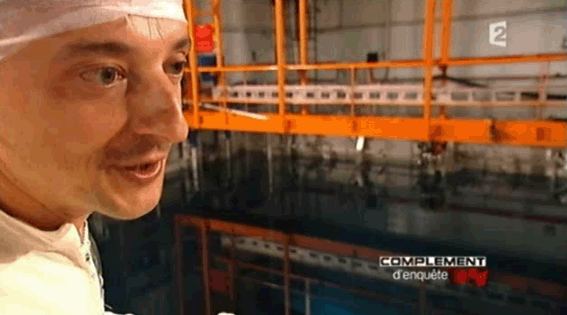
- You have here the pool where the used assemblies are placed, from the reactors ---
**My comment: **
The "pool" of a reactor is a tank filled with ordinary water, a few meters sufficient to shield the radioactivity emissions from new, and especially used, assemblies. These elements have a prismatic shape. The assemblies from the Fukushima reactors are four meters long. The core of a French-type plant contains &&&. The core is a steel vessel, cylindrical in shape, 20 cm thick, ending with a hemispherical base and removable cover. When loading a reactor, a rolling platform (orange in the photo above) transports these assemblies, hanging like hams, and places them parallel in the core. They then bathe in pressurized water, at a pressure of 155 atmospheres. This water, as we will see, has two functions. It is first a "heat transfer fluid", which will allow the heat produced in the core to be recovered and transported to a heat exchanger. It circulates at a temperature of 300°C. It will then be used to heat a secondary circuit.
I think it is useful to make a parenthesis and present the operating diagram of the French civil "pressurized water reactors". Liquid water is a better heat conductor than steam. However, steam is a gas, which can be expanded, whose heat can be converted into velocity, into kinetic energy, thus making a gas turbine work, which is coupled to an alternator, which will produce electric current in 50 cycles and under 4000 volts. Then this current passes through a transformer which raises this voltage to 400,000 volts, which will have the effect of reducing the electric current (which increases as the square of the electric current, according to the Joule effect) by a factor of 100, according to the relation. :
P = electrical power = V1 I1 = V2 I2
The power dissipated by the Joule effect will therefore be reduced by a factor of 10,000
This high voltage transformation will allow the reduction of losses in the lines during the transport of the current. A transformer, upon arrival, will reduce the voltage down to the 220 volts of the domestic user
In order for the heat exchange to be effective, the steam exiting this turbine is reconverted into liquid water in a condenser. To cool this steam and make it turn into liquid water, it is necessary to evacuate the excess calories. These excess calories, contained in the steam, are transferred to the water of a cooling circuit. The steam evolves in a closed circuit. The water of the cooling circuit forms an open circuit. These are the large towers whose appearance is familiar to you. The cooling water falls as rain in an ascending air column. The air enters at the base of the tower and exits at the top. If we wanted to try a comparison, a cloud of droplets and water vapor forms in the tower. At the base of this cloud, it rains. This water is recovered. But the ascending air column carries part of this water vapor. The tower circuits need to be refilled, which corresponds to the second blue pipe. The loss is 500 liters per second. The evaporation of this water represents an energy loss. Therefore, nuclear power plants work with a relatively low thermal efficiency, of 30 %.
*Seventy percent of the energy produced in the core is used to warm the small birds. *
In this illustration, the primary circuit, the water passing through the core, is in purple. The secondary circuit is in blue/red. Blue when the water is in liquid state, red when it is in vapor state. The turbine blades are shown in gray. The "tertiary" circuit, "semi-closed", is in light blue. On the left of the circulation pump, which returns the liquid water to the condenser, there is a second pump that draws 500 liters per second from a river or the sea, as mentioned earlier.
In the core, in red, the prismatic assemblies composing the core. They are made of "pencils", also called "cladding", in zirconium, which contain "nuclear fuel" pellets in uranium oxide. These pellets have the diameter of an aspirin tablet. This oxide has two components. 97 % corresponds to uranium 238 oxide, non-fissile, and 3 % to uranium 235 oxide, fissile. It is this one that, by decomposing, provides energy, with the emission of neutrons. The fission products are radioactive, toxic. Among these dangerous, long-lived waste, cesium 137 and strontium.
In normal operation, these wastes remain in the zirconium pencils. When there is "core meltdown", they mix with the cooling water, which happened at Fukushima, the company TEPCO admitted "that there was a partial meltdown of the cores (when the elements of their upper parts ceased to be bathed in cooling water, the steam being unable to fulfill this function, due to its lower thermal conductivity).
In reactors, after one year of operation, the richness of the uranium oxide mixture decreases. When its content drops to 1 %, the loading is stopped. The reactor must then be "shut down" and "discharged".
The operating regime of a reactor is regulated by "control rods" in cadmium, shown above the core, in black. They absorb the neutrons. If they are fully lowered, the fission reactions stop. But not the exothermic reactions of the fission products. When the rods are lowered, it is necessary to wait a long time before the core temperature decreases and the vessel can be opened and the "used" elements (with 1 % U235) can be replaced by "new" elements (with 3 % U235). These used elements are radioactive, due to the decay of the fission products. They must be stored in these famous pools where the water has two functions. It allows the heat generated by these elements to be evacuated, due to its high thermal conductivity, and it also serves as a barrier, with respect to radiation. This barrier is sufficiently effective to allow one to lean over the surface of these pools without risk. The used assemblies, or waiting to be loaded, are placed in cages. The France 2 documentary shows them;
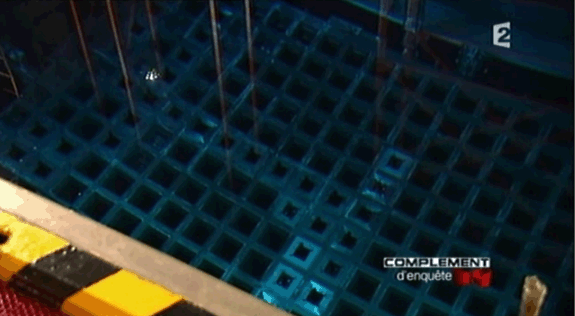
The cages that allow the storage of the "assemblies" in the pool,
** assemblies of MOX, a mixture of depleted uranium, 238 and plutonium**
If this water were not there, not only would the people present be exposed to ionizing radiation, but the elements would no longer be able to dissipate the heat they emit by simple air circulation, which is much less conductive than water. The assemblies would be damaged. The zirconium tubes would melt, as happened at Fukushima ("The catastrophe that changes everything", the title of the program).
By the way, why zirconium and not just stainless steel? Because zirconium does not slow down the neutrons.
I am forced to give these technical details along the way, otherwise the rest of the documentary is only partially understandable. By decoding this documentary, you will understand one thing. If all the projects continue in France, it is "because the machine is running" and going back would put into question a heavy policy, with an entire technological and scientific device and tens of thousands of jobs.
At Fukushima, the earthquake caused the reactors to shut down. The control rods were inserted into the cores. In Japan, these rods are raised, driven by electric motors. They pass through the 20 cm thick steel vessels.
Fukushima is really "the unforeseen catastrophe that questions everything"
A clarification. Standard size of a reactor vessel: 5 to 6 meters in diameter, ten to fifteen meters high.
Illustration extracted from the official TEPCO report (I have only translated the captions)
In Japan, the rods are therefore raised, but the tsunami flooded the fuel tanks supplying the backup diesel generators, tanks placed by the Japanese below the floor level of the plant (10 meters above sea level. But, no luck, the tsunami wave, at this location, resulted in a water rise of more than fourteen meters. The piers were therefore flooded and the fuel tanks submerged...
As we will see in the report made in France, the diesel generators, the backup pumps and the tanks are in underground premises, therefore "ready to be flooded".
At Fukushima, the diesel engines could not be supplied, so they stopped. *In the basement, these backup generators stopped. *No electricity, so the circulation pumps, also in the basement, like at Blayais, stopped. The water from the reactor tanks stopped circulating. The temperature rose. Same in the pools, whose used elements ceased to be covered by water. The zirconium cladding melted. The radioactive waste mixed with the water, both that of the pools and that which normally circulates in the cores.
Back to this Blayais plant. As the report will tell us later, in 1999 a storm, unpredictable and unforeseen, flooded the plant. A storm is characterized by strong winds. But it is also a low pressure system that travels. This creates a "barometric tide". The water level rises. The wind carries this mass of liquid towards the coast. In 1999, we narrowly avoided a catastrophe, and you understand why. The diesel generators and the backup pumps, in the basement, were flooded. By miracle, two out of four continued to function.
It could have been much worse if the hurricane that crossed the region had occurred when the water was high, at a maximum tide.
The journalist notes that the young plant director does his best to avoid questions about the possibility of the water level in the pools dropping. Answer from the young Dutheil:
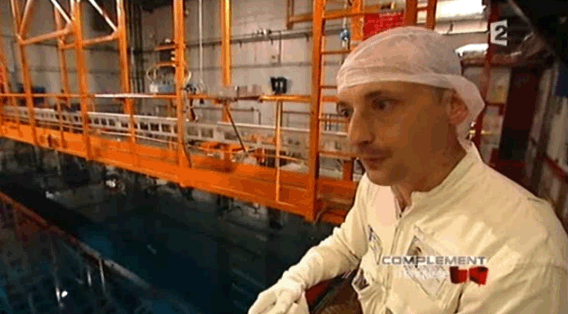
- Uh ... uh ... I can't make a technical comparison ... bla bla bla ... bla bla bla ..
Thanks to the CD recordings that my readers sent me, I was able to more easily rewatch, frame by frame, the scenes of this program. The one that follows is eloquent. After telling us that everything is being done to ensure that the assemblies remain submerged, Etienne Dutheil goes to the device shown in the following image.
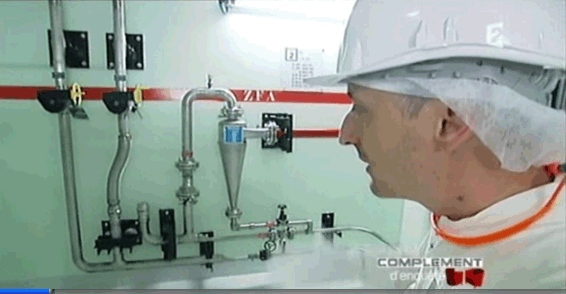
Not very convincing, this water supply system, when considering the volume of the pool.....
Here are his own words:
*- We have integrated modifications to ensure that the pools remain filled with water. Here, you have an additional water supply device, a system that improves the safety of the installation (...). *
And the journalist continues:
*- Mr. Dutheil shows us a backup system to fill the pool. *
We watched these images, with a friend who is a retired engineer, former high-ranking official in civil protection. His reaction:
- This man cannot be the director of the Blayais plant. It's not possible. He's a puppet, a lackey, a clown. Such an installation would not be able to deliver a liter of water per second. At this rate, do the calculation, it would take six weeks to fill this storage pool of 4500 cubic meters of water. This thing would only be able to compensate for evaporation!
And I fully agree with him. Here are the measures that were taken, twelve years after the events, to "secure the plant". It is grotesque, pitiful. This young man, barely 40 years old, is an incompetent parrot manager, who only has the word "safety" on his lips, but who would apparently be incapable of solving a basic school certificate problem, such as: "we have a pool that measures so much by so much. Calculate the volume of water it can contain. Considering a backup supply that can deliver one liter of water per second, estimate the time it would take for ..."
At home, I have an aqua gym pool that can hold 4 cubic meters of water. With my garden hose, it takes me 7 hours to fill it.
I imagine you know what would happen if the water circulation was cut off, if the heat generated by the fuel elements ceased to be evacuated. This water would immediately start to heat up, then boil, and evaporate. When the fuel elements, in the form of prismatic assemblies placed in the cages you saw, would be out of water (which happened at Fukushima when the backup pumping systems were disabled), their temperature would rise to the point of melting the zirconium cladding containing the uranium oxide and plutonium pellets that compose them. From 1000°C, and this is quickly reached, the water molecules decompose into hydrogen and oxygen, mixed in a "stoichiometric" proportion. That is to say the best possible for this gaseous mixture to behave as an explosive.
The overheated fuel elements provide energy to the water, making it dissociate. This can take minutes, dozens of minutes. The gaseous mixture, accumulated in this closed chamber, then explodes upon contact with the slightest spark, and releases this energy in a thousandth of a second. It blows up the building, as happened in reactor number 1 of Fukushima. This explosion creates an updraft that carries with it the radioactive debris of the fuel pellets, released by zirconium cladding, shattered by the heat, when the heat generated, or the leakage due to the cracking of the pool that contained them, put the "assemblies" out of water. The water vapor rises and disperses fine particles of ... anything: uranium 238, fission products, cesium 137, iodine, if it is "used" assemblies and, whether they are "new" or "used", when the reactor is loaded with MOX, **fine particles of plutonium, the most toxic of all. **
And you imagine that the water supply device shown by Etienne Dutheil could oppose such a problem, by realizing "an additional water supply". I have never seen and heard anything more stupid in my life. It is shocking incompetence. And does this guy realize what he is saying? I'm not sure. He must have climbed the ladder due to his unwavering obedience.
In 1999, the hurricane (unforeseen) that crossed France from west to east, tore down the pylons of its electrical supply and flooded its basement of the plant, where its four pumping units were installed. Two engines burned out. Two pumps were disabled.
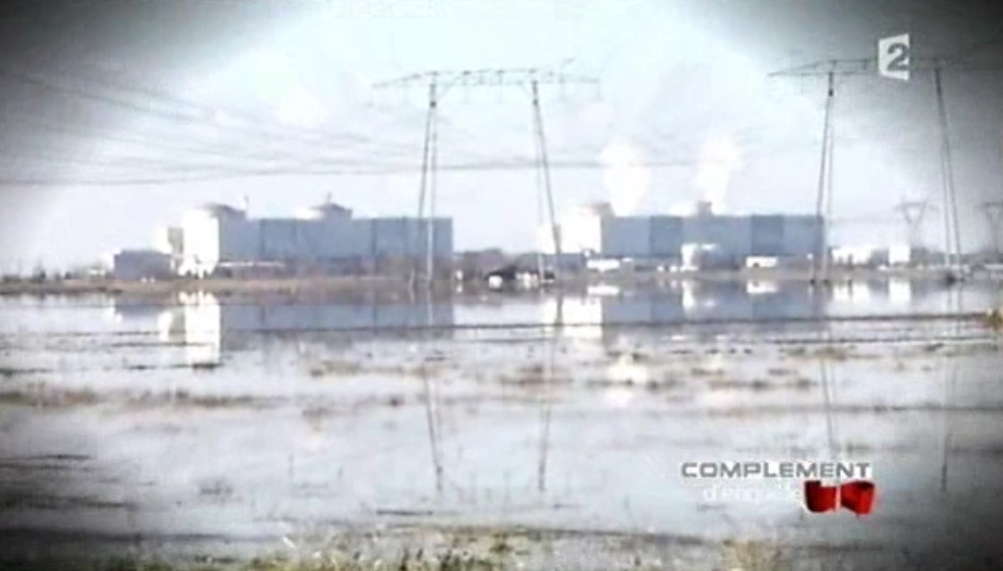
1999: The nuclear power plant flooded, following the passage of a hurricane
If all four pumps of Blayais had been disabled by the flooding (instead of two out of four), the reactor core, continuing to produce heat despite its "shutdown", would have started to heat up. The water of the primary circuit would have turned into steam. Technicians would have had to evacuate some of it, and, the assemblies being out of water, would have melted. We would have had a Fukushima-bis. The damaged, melted assemblies, entangled with each other, would have formed an amorphous mass impossible to evacuate (and where? How, without the measure where the explosion would have reduced the rolling crane to a pile of useless scrap metal.
Moreover, operating reactors with plutonium (with MOX) is madness!
A technician or engineer then tries to make a comment, saying "at Fukushima they watered the elements", but his superior, Etienne Dutheil, with a silly smile, quickly asks him to be quiet. The name of the damaged Japanese plant is a taboo word, which the makers of the program will perfectly understand.

A technician quickly reminded of order, as soon as he tries to speak about Fukushima
On the left, Etienne Dutheil smiles. The technician, pointing to the improvisation:
- Uh ... no ... nothing ... it's just a setup .... ---
I will now make another comment. At one point you will have heard the commentator say that the Blayais reactor is loaded with MOX, a more dangerous fuel than the conventional uranium enriched to 3%. MOX contains 7% of ... plutonium. This requires some explanations. I told you earlier that the cores of the "classic" reactors are loaded with a mixture of two uranium isotopes, 238 and 235. Only the latter is fissile. Natural ores contain 99.3% of 238, non-fissile, and 0.7% of 235, fissile. The ores are enriched, in France, in a large center, at Tricastin, where they perform this refining of a natural ore, imported from Gabon and Niger, by centrifugation. A chemical treatment allows obtaining a uranium compound that is in gaseous state (a compound of fluorine and uranium, UF6).
It is then possible to move the heaviest species to the outside of the centrifuge, the enriched uranium being less dense, being recovered near the axis (235 is lighter than 238). The enrichment is done in successive steps, until the 3% of 235 required to operate the civil reactor.
The operation of these centrifuge batteries consumes two-thirds of the electrical energy of the ... four 900 MW pressurized water reactors installed at Tricastin.
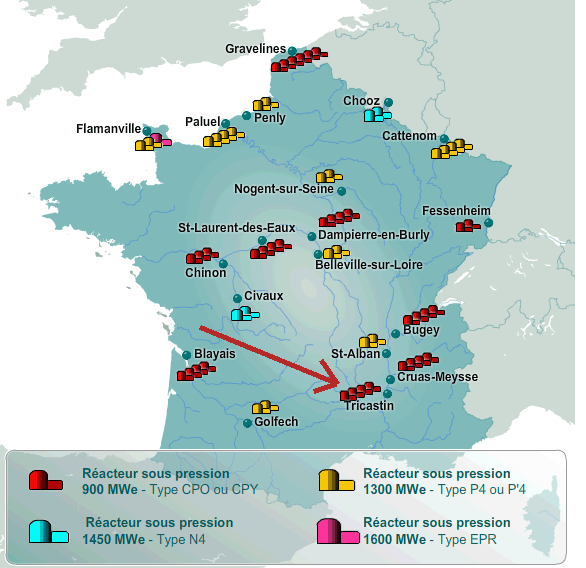
.
Location of the Tricastin power plant, near the Rhône, using water from the Donzère Mondragon dam
These units were put into service in 1980, that is thirty years ago. Initially, the purpose of the Tricastin center was to provide fissile materials for military use.
A comment on the aging of the power plants. The vessels (steel, 20 cm thick) are subjected to a intense neutron flux, which disrupts the metal atom network. By reading a little on this subject, I found, unless I am mistaken, in particular that the neutron irradiation created in the metal transmutations, some of which are composed of helium. However, this cannot be subjected to any standard chemical bond, by sharing electrons. Thus, in a metallic mesh, the presence of a helium atom is comparable to a "hole", a "lack". This implantation of impurities in the metal is accompanied by microcracks. The neutron bombardment tends to increase the brittleness of the metal and reduce its resistance to thermal shocks (rapid temperature changes).
In the program, a EDF representative says "the older our power plants are, the safer they are". This is false.
*The mechanical resistance of the vessels decreases over time. *
It took decades of experience to realize that the bombardments related to the decays had an effect on the materials intended to ensure their containment. This is valid for the steel of the vessels as well as for the concrete, without which they had begun to bury the waste, and which has acquired porosity, due to a double phenomenon of aging, chemical and related to irradiation.
Currently, at the site of the Hague, radioactive waste is buried in resins, without having the hindsight that would allow knowing if their long-term containment could prove effective. These people don't care.
But let's go back to the life cycle of uranium. The reactors were initially loaded with oxides containing 3% of Uranium 235. After a time of the order of a year, the richness in 235 drops to 1% and the density of this isotope is no longer high enough for the fission reactions to occur (the probability of meeting the neutrons emitted by the fission with the U235 rods becomes too low for chain reactions to occur). The amount of energy delivered by the fission reactions then decreases rapidly. The thermal power delivered by the core decreases. After a year, the assemblies contain Uranium 238, 1% of 235, and plutonium 238 obtained by capturing a neutron by the Uranium 238.
Here, we will make a parenthesis on two types of reactors
- Thermal neutron reactors
- Fast neutron reactors
The fission reactions produce neutrons that travel at 20 km/s. This speed is optimal for their capture by the nuclei of 238, to produce plutonium. This atom does not exist in nature (except for the famous exception of Oklo, in Gabon), because on a geological time scale its lifespan is too short. It lives only 24,000 years.
*The plutonium existing on Earth is therefore mainly related to human activities. *
It is a substance with maximum radiotoxicity. If a particle is ingested or inhaled by a human being, it will produce ionizing radiation that will degrade the surrounding biomolecular structures, affect the DNA and cause cancer. Plutonium has the property of permanently fixing in living tissues. Its "biological half-life" is 200 years. If a person inhales 1 milligram of plutonium, death is assured. .
As an anecdote, the way the Americans went about proving the toxicity of this substance was to inject it, without their knowledge, into young recruits of the US army. This experiment was conducted with the written consent of Oppenheimer, the father of the American atomic bomb.
Plutonium is essentially the explosive used to make atomic bombs, not only, as we will see later, because its critical mass is less than that of uranium 235. We produce this plutonium for military use by operating "high-power" reactors.
How do we regulate the regime of a reactor, that is to say the average speed of the neutrons? By using a moderator, which slows down the neutrons. For uranium 235, we obtain a better fission efficiency with slow neutrons, moving at 2 km/s. The best neutron moderator is heavy water, water where the hydrogen atoms are deuterium atoms. An isotope of hydrogen where the nucleus is composed of a proton and a neutron. This efficiency of heavy water, known since before the Second World War, gave rise to the "battle of heavy water", this being produced in Norway.
Using heavy water as a neutron moderator, it is possible to operate a reactor with natural ore, containing 0.7% of uranium 235.
A second moderator, widely used in these first "atomic piles" is graphite. The reactors of Chernobyl were reactors where uranium bars were inserted into a large block of graphite, while being cooled by water (light).
Third moderator: light water. The use of water as a moderator has an advantage, used by the French, with their pressurized water reactors, and by the Americans with their "boiling water reactors": to serve as a heat transfer fluid".
Self-stability of water reactors
Graphite does not expand much with heat. Water does. The expansion increases the distance between water molecules. These collisions between these molecules and the neutrons emitted by the fission slow down the latter. It is then possible to consider using this property to achieve a certain self-stability of reactors whose moderator is water.
Indeed, suppose that the number of fission reactions increases, the rate of fissions rises. The heat production will be greater, at the same pumping rate. The water will expand. The water molecules will then form a less dense medium. A neutron passing through a pipe filled with this water will have less chance of being slowed down by interacting with a molecule.
As the neutrons are less slowed down, the rate of fissions will decrease.
Negative feedback, self-stability.
The Chernobyl reactors did not have this self-stability property and were instead very unstable at low power. See details on Wikipedia.
http://fr.wikipedia.org/wiki/Catastrophe_de_Tchernobyl
Nuclear teratogenic weapons, delayed effects
It takes energy to enrich uranium extracted from natural ore, by centrifugation. Therefore, an optimum is sought and we end up with an enrichment of 3% of 235. One could obtain a better percentage of 235 by continuing the centrifugation. But then too much energy would be spent, whereas with 3% the reactors function.
By the way, when enriching uranium by centrifugation, on one side we obtain a more or less enriched mixture of 235 and, as a consequence, resulting from this "distillation", we obtain depleted uranium, containing less than 0.7% of 235.
Natural ore is not fundamentally dangerous. In its natural state, it is not capable of undergoing chain reactions. Uranium, even with a low percentage of 235, in its natural state, is not good for health, just like all heavy metals. It has the same toxicity as lead. However, uranium has a mechanical property that immediately interested the military. While it is denser than lead (19.1 g/cm3 against 11.35 g/cm3), it is not soft like the latter. It is also pyrophoric, ignites at high temperatures. It is therefore the ideal anti-tank, anti-armor projectile. Inside the tank it ignites and kills the crew. But this depleted uranium also has teratogenic properties. It affects the testicles of mammals and humans and degrades their offspring (generation of monsters), which allows to "punish the enemy", military or civilian alike (Iraq, Kosovo and other places).
The use of depleted uranium shells represents the implementation of nuclear weapons with delayed effects.
Reactors operating on plutonium
The plutonium reaction is favored when the neutrons are fast. The plutonium reactors, used for military purposes, are based on limited moderation. The fast neutrons then strike a "fertile blanket", in uranium 238, which transforms by capture into plutonium 239.
Plutonium 238, like uranium 235, is fissile, and chain reactions occur more easily within it with fast neutrons. One could say that plutonium is
to be used without moderation
These reactors cannot use a coolant fluid like water, which itself is a neutron moderator. We then end up with reactors that are forced to use a coolant fluid that is "transparent to neutrons", neither absorbing nor slowing them down, and this fluid is ... sodium.
The French reactor Phénix, our first breeder reactor, therefore came from this brilliant idea. It was connected to the EDF network in 1974. Before its shutdown, it was the oldest nuclear reactor in France. Its dismantling is planned, but the estimated cost is one billion euros.
The enormous cost of dismantling
Currently, EDF has not been able to complete the dismantling of any reactor.
Why is dismantling so expensive? Because during its operation, a nuclear reactor creates induced radioactivity in all its structures, in the smallest pipe, the smallest valve. Everything becomes radioactive. Dismantling is not limited to "removing the radioactive fuel charge". It is the entire structure that turns into a long-lived poison. The plant must be dismantled piece by piece, transforming all of this into waste of moderate size to be packaged and stored.
A complete headache, expensive.
The extreme danger of fast neutron breeder reactors
To operate a plutonium reactor and have it produce the same substance by bombardment with fast neutrons, we cannot use water as a coolant, because this water slows down the neutrons. Therefore, we must use sodium, which is liquid at 550°C and boils at 880°C.
Sodium has a property well known to chemists: when in direct contact with air, it ignites spontaneously. If it is watered, it is worse: it explodes. We simply do not know how to extinguish sodium fires of more than a few hundred kilograms.
Add the absolute danger of the plutonium charge.
A plutonium reactor contains enough to kill a million people.
But these fast neutron reactors can transform uranium 238 and ... plutonium 239. Hence this name Phoenix, this bird that rises from its ashes. Later, our nuclear bosses designed and built Superphénix, a monster containing 5000 tons of sodium and a ton of plutonium. Anti-nuclear demonstrators tried to oppose its construction and operation. The police reactions were violent. A demonstrator, Michalon, was killed. The "forces of order" shot him at close range with a tear gas grenade, or defensive, directly in the chest.
But nature brings its sanction to the project. The reactor is located in Isère, in Creys Malville. One day in 1998, following a heavy snowfall, the roof sheltering the turbines, the pumps, poorly calculated, collapsed.
The reactor was shut down.
But for EDF and the nuclear bosses, it is only a matter of time. Indeed, the breeder reactor fits into an energy independence plan completed by the construction of the reprocessing plant in La Hague. I had told you that when unloading the core of a reactor, it contains different elements, in the form of oxides. Uranium is present in the form of its two isotopes, the enrichment in 235 having fallen to 1%. There are the radionuclides resulting from fissions, which are radiotoxic. Finally, there is plutonium, resulting from neutron captures by uranium 238 nuclei.
At the end of the operating cycle, the core of a reactor contains 1% of uranium 235 and 1% of plutonium 239.
Until the launch of the La Hague reprocessing plant, where again "the French are leaders", this mixture, resulting from the unloading of reactors, was considered a waste to be stored. But the French developed techniques that allow, on one hand, to isolate the fission waste, which are "embedded in resin". I had written that plutonium was extracted by centrifugation, but a reader pointed out my mistake. Plutonium 239 is not an isotope of uranium 238, it is a chemically different substance, which has different chemical affinities with other bodies. The nucleus of ****uranium contains 92 protons, so its electron shell is composed of 92 electrons. This number goes to 94 for ****plutonium.
The number of electrons in an atom's shell determines its chemical properties, so these are two chemically different substances.
On the recovery of plutonium:
****http://www.laradioactivite.com/fr/site/pages/InventairePlutonium.htm
Therefore, plutonium is extracted chemically, which is easier and less expensive than extracting uranium 235 by centrifugation. A reader will give us more details on the method and its cost. This is how plutonium produced in military reactors was extracted, in the "fertile blankets". This is also why the use of plutonium became established, for the design of A-bombs, fission bombs, compared to uranium bombs. It is less expensive to produce plutonium by bombardment, in a fertile blanket, than to reach the required uranium 235 percentage (90%) by means of costly and endless refining. Because the chemical extraction of plutonium is easier and less expensive.
The "MOX" follows the same logic. It contains 7% plutonium. In reactors using enriched uranium, one could create plutonium by placing a fertile blanket near the core. The plutonium-producing activity of neutrons depends on their speed, which is determined by the presence of a moderator (heavy water, graphite, light water). One can then very well geometrically modulate this moderation according to how the moderator is placed in the core. In military reactors, one arranges to have a flux of fast neutrons, striking a fertile blanket, for example, on top (ease of tele-manipulation).
In reactors using MOX, it is the "U238 diluent" that constitutes the fertile material, distributed throughout the reactor. The MOX rods are cooled. If this cooling is carried out using an effective moderator, like water, then the plutonium-producing effect remains limited. But if this coolant is replaced by a substance that does not provide moderation, like molten sodium, then the plutonium-producing effect is full. From this angle, MOX is the standard fuel for a fast neutron breeder reactor.
The transition from weakly plutonium-producing to strongly plutonium-producing depends on how one can manipulate the moderator's action. This remark illustrates the lack of a clear boundary between civil and military nuclear (essentially plutonium-producing reactors). Documents and testimonies attest to the fact that the deployment project of fast neutron breeders represented a close, unacknowledged link between civil goals (breeding, or fuel regeneration, plutonium), and the simple production of plutonium for military use. From this angle, the EPR reactor is a kind of bridge between these two worlds.
In any case, using plutonium as a fissile element, as "fuel", greatly increases the danger of power plant operations.
But it is cheaper and more profitable. So this criterion prevails, at the expense of safety.
It should be added that this recovery of plutonium in stocks from reactor loadings was intended to work in symbiosis with the formula of the fast neutron breeder reactor. The breeder consisted of operating a fission reactor "at high power", that is, without a moderator, so with sodium as a coolant. The plutonium charge would have been the site of fission, but the neutrons released would have refabricated plutonium from the surrounding uranium 238.
On paper, with numbers, all of this is very interesting. In practice, it amounts to programming suicide or the extermination of populations, a breeder accident being a thousand times worse than that of Chernobyl.
For now, therefore, the project of installing breeders in France is frozen. MOX is also a way to operate the La Hague plant "while waiting for the situation to clear and the green light to be given for the construction of breeders", renamed "fourth-generation reactors". France therefore produces, uses and sells MOX. Reactor number three of Fukushima was loaded with MOX. The EPR is designed to operate with MOX at 100%.
This mixture has all the drawbacks. The assemblies are five times more radioactive than enriched uranium. The characteristic cooling time of the used assemblies reaches a staggering 50 years! And in case of an accident, it is absolute horror. You saw the movie of the explosion of reactor number three, at Fukushima. Is the containment damaged? Has this steel pressure vessel remained intact after an explosion of such violence, which projected concrete debris from the roof hundreds of meters into the air. This explosion is suspicious. In reactor number one, the examination of the remains seems to show that the explosion affected only the upper room, located above the reactor. But for number three, what are the damages? Is the vessel cracked? TEPCO seems to admit it...
In any case, to avoid an explosion, the Japanese first cooled the core with seawater, then performed a cooling by dispersing the contents of the vessel, of which 30% of the assemblies had melted. The cooling water of this reactor number three would contain ... plutonium!
Continuation of the report on the Blayais nuclear plant, 30 years old, the nominal lifespan of such an installation. In 1999, the unexpected hurricane that swept through all of France, breaking thousands of trees, caused flooding of the basement of this nuclear installation.
The journalist asks if the life of this plant will be extended. For its director, Etienne Dutheil, the question does not even arise:
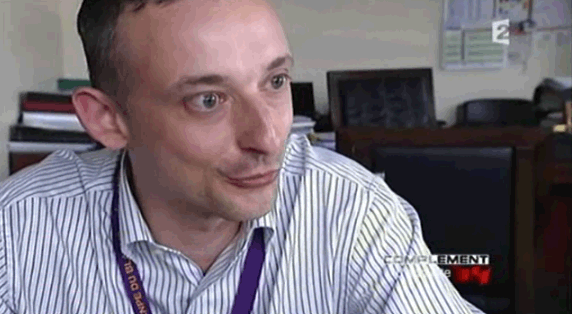
Etienne Dutheil, director of the Blayais plant:
- Despite being 30 years old, the Blayais plant will be extended, as it is a safe plant, which has been constantly modernized
(we had an example of modernization and the race for safety with the plumbing fix shown above)
This extension should extend the life of the plant from 30 to 60 years. And it will operate with MOX, with a core loaded with 7% plutonium. The loading with this type of fuel has already been carried out.
How can you expect Etienne Dutheil to have a critical or even objective view on this subject, when his entire career depends on the position he chooses to adopt? His career imperatives even prevent him from having a different opinion. If he had expressed criticisms regarding "his" plant, he would not have long remained. At best, he manages to convince himself of his own statements. And it is the same for all the "responsible" people who will be interviewed during this broadcast. The "we are a big family (of privileged ones)" attitude nullifies any distance from this "adhesion to nuclear energy".
The investigator then visits an ecologist, Patrice Lapouge, who lives near the plant and presents his ideas about the danger of the installation.
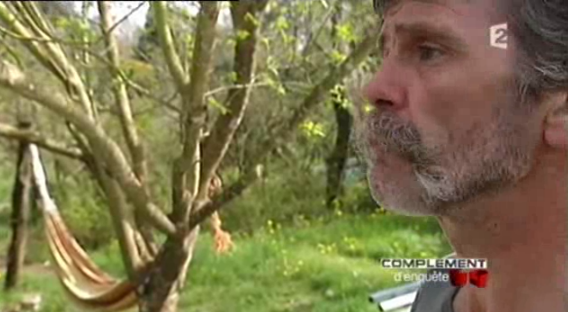
The confrontation between two worlds.
That of Etienne Dutheil and that of Patrice Lapouge, a militant ecologist
Patrice Lapouge, who lives near the plant, explains that the plant is located without a real funnel towards which the entire hydrographic system of the Aquitaine region converges:
Vulnerability of the Blayais plant to a meteorological accident
- The people who built this plant in such a vulnerable place refused to face the truth
We will see later the response of Etienne Dutheil, who will show the dam built after the 1999 flood. He adds "that this dam could now easily cope with the event that occurred this year". But in this speech, one can discern a complete inability to anticipate (does this type have the head of someone capable of anticipating?). Above, the ecologist mentions "the maximum catastrophe". That is to say the simultaneity of different factors.
- Considerable precipitation throughout the entire hydrographic catchment area
- A violent storm, like that of 1999
*- All happening at a time of "high tides" (while the 1999 event happened, by chance, at a time of low tides)
In the face of this, Dutheil could respond:
- There, you are pushing it a bit too far? All these disasters would have to happen at the same time. And the probability ....
The probability: a standard response of an engineer, a proponent of the "non-existence of zero risk" philosophy.
But who could have imagined that a storm of such violence would occur in 1999?
It remains that, despite this incident, "which could now be well managed", the backup pumps, the generators, the fuel tanks will remain in the basement, vulnerable to such events (as was the case at Fukushima). Probably, modifying the installations would be too expensive. If at Fukushima, (instead of doing it for the entire installation, which would have been feasible, on hills adjacent to the site) the backup system, fuel tanks, diesel, the entire generator had been placed ten or fifteen meters higher (which would have been logical in a country where the word tsunami was invented) and if the entire system had been given maximum seismic resistance capabilities, the backup pumping system would not have been disabled by the tsunami.
- But who could have predicted a tsunami of such magnitude? .....
- Who could have predicted a storm of such magnitude?
- Who could have predicted that these phenomena (mentioned above) could have occurred simultaneously?
Etc.....
The list of "unlikely phenomena" is not exhaustive. Tides, including a relatively recent one, which occurred only a few years ago, and which affected the Portuguese coasts, can occur, not because of an earthquake, but because of a submarine landslide. There have been many such events in various regions of the globe, accompanied by sometimes monstrous tides. When Claude Allègre, a specialist in plate tectonics, said in an interview, reproduced by Le Point, in a special issue dedicated to nuclear energy, "we must stop walking on our heads. There will never be a tsunami in France," he was wrong. When he declares that France is not a seismic region, he is simply lying. See below what relates, for example, to Gravelines, in the Pas de Calais.
The properties of tsunamis and their devastation at unlimited distances, often measured in thousands of kilometers. Historically, impressive tides have been created, not by seismic events, but by submarine landslides. These are the coasts with very gradual seabed rises that allow this low- amplitude, very long wavelength wave to strengthen near the coasts. This could well be the case, as Xavier Lafont pointed out to me, for the Gravelines plant "with its feet in the water," destined for power production for export to the benefit of England and for which no tsunami protection system has been planned and where it is highly likely that the backup systems, located in the basement, are ... floodable.
To govern is to foresee
In appendix, the report of the National Assembly on the 1999 incident
**Back to the Gravelines plant: **
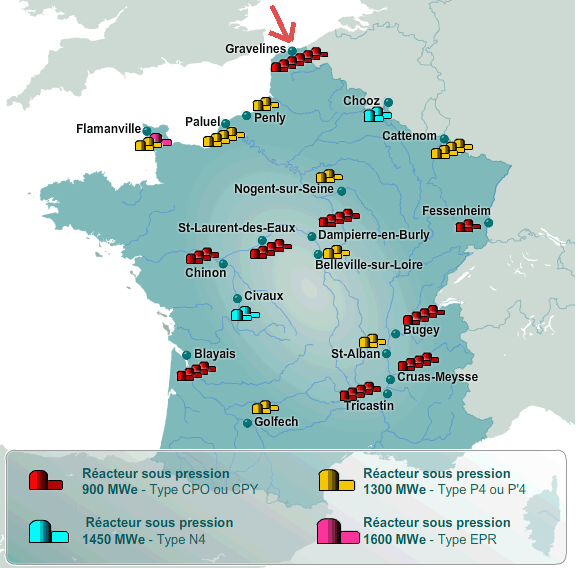
**The location of the Gravelines plant, in the Pas de Calais, "with its feet in the water". **
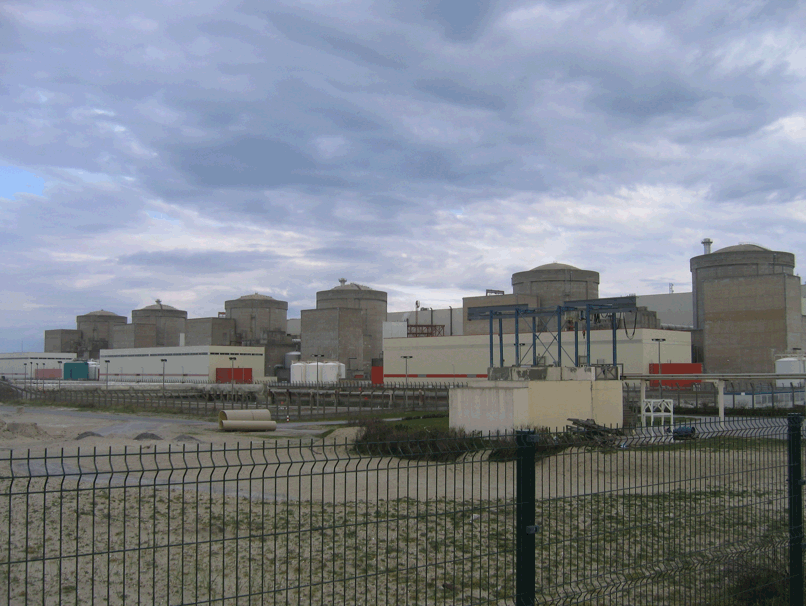
The Gravelines plant, Pas de Calais, near the beach. Six reactors without any protection
During a recent appearance on television, and in an interview given in the special issue of Le Point, the former minister Claude Allègre stated that a scenario similar to that of Fukushima could not occur in a country like France "where there is no high seismicity area".
*- We must stop walking on our heads! France is not a country with high seismicity! *
Such a phrase could reassure us about the risks for this Gravelines site. However, a look in an encyclopedia shows that the region experienced a strong earthquake in 1580. This was brought to my attention by my readers.
http://fr.wikipedia.org/wiki/Tremblement_de_terre_de_1580
Its magnitude was estimated, on the Richter scale, between 5.3 and 6.9. It is interesting to see where the epicenter was located:
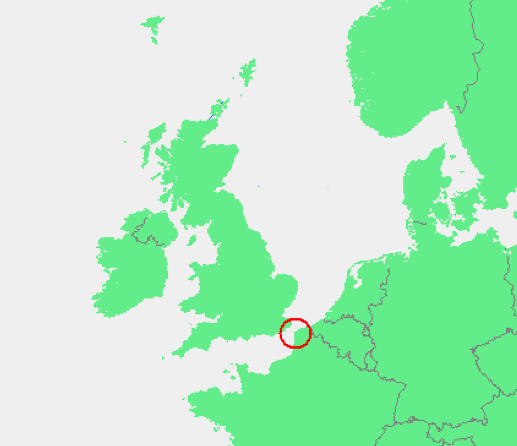
The epicenter of the 1580 earthquake coincides with the site of the Gravelines plant!
But perhaps Allègre is unaware of this past event? Or is he trying to be minister again? Or ... both at the same time?
The Blayais plant, in Gironde, was damaged by a hurricane that swept through France from southwest to northeast. But why not the other way around? Have we planned that the backup generators of the Gravelines reactors, presumably also installed ... in the basement, could be disabled by flooding??
The team of the channel wants to know what happened at the Blayais plant in 1999. EDF asks the staff of that time to "recreate the storm" on a simulator. The actors in this scene claim they never felt unsafe, at their control post.
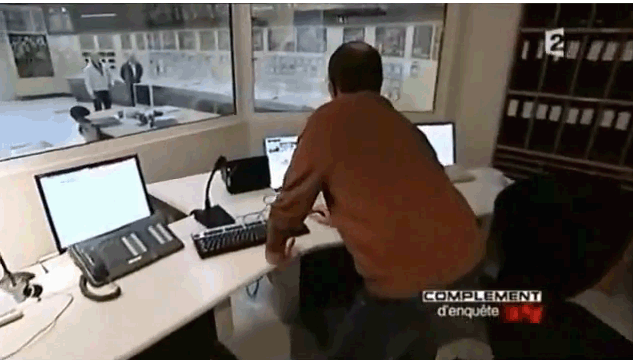
The team of that time replays, on simulator, the great scene of the 1999 flooding
The director and one of his technicians then take the television team into the basement of the Bayais plant, where various devices are located, including the backup devices, that is, the generators and the pumps intended to maintain the water circulation in the cores. In 1999, the flooding caused by the storm flooded these basements with several meters of water.
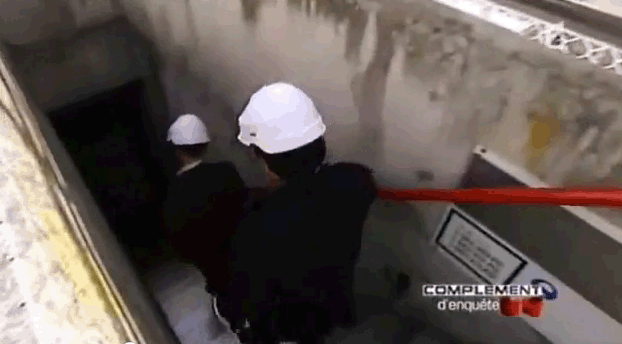
Descent into the basement of the Bayais plant
The comment of the following image;
- This pump draws fresh water from the Gironde to cool the reactors at rest and prevent melting. At the time it was disabled by the flooding.
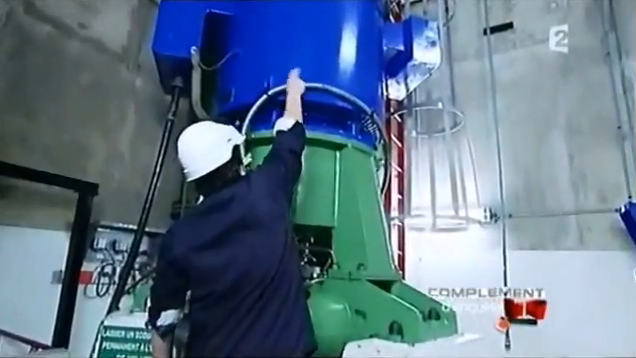
- Water up to there .... - We had two backup pumps and two disabled pumps ....
Referring to the report of the National Assembly and the Senate, we will see that two of the pumps, in the basement, were disabled by flooding of their electric motor.
The journalist then questions Etienne Dutheil, director of the Bayais center:
*- We narrowly avoided the worst? *
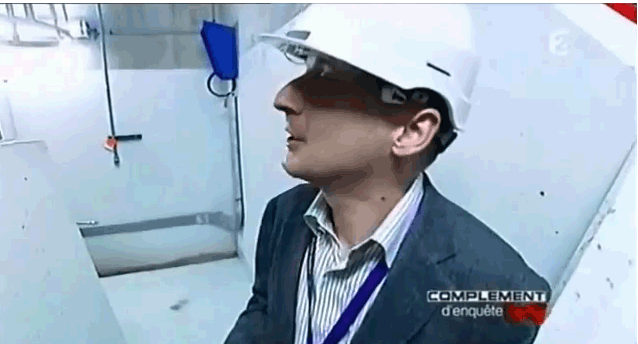
.
- No, we didn't narrowly avoid the worst, because we didn't lose the cooling means. It was an outage that was managed by the normal procedures and the normal means*. *
Etienne Dutheil tries to convey the idea that, since that time, this plant was "safe", since it managed to withstand this unexpected storm. No one, at the design level, had even considered for a moment that by placing the backup devices in the basement (as the Japanese did for all their plants) we created an insecurity due to total lack of foresight.
Bureaucratic jargon....
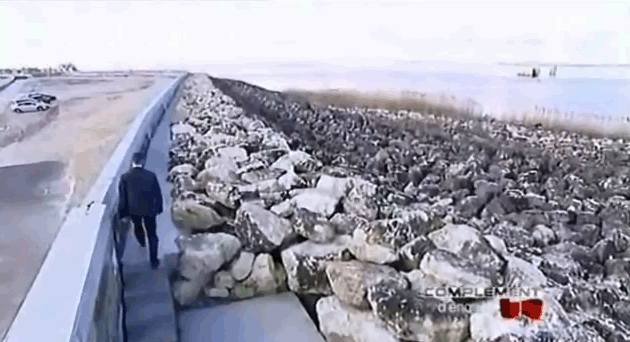
.
**The dike has been raised and equipped with a wave protection
**In light gray, on its left, we can see the extent of the raising work: one meter!

Another view of the works intended to make the plant "more safe"
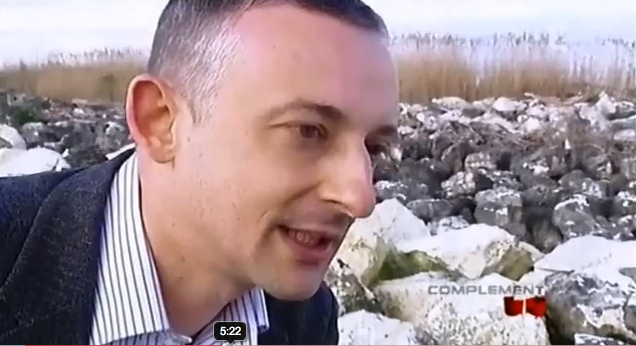
- Today, the dike, raised by one meter, with its wave protection, would protect us from an event like that of 1999 with a good safety margin
In November 1999, a month before the storm, in a letter dated November 19, 1999, addressed to EDF, the Ministry of Industry reminded that it had been demanding work for a year already to ensure the safety of the plant. The date of the storm is December 29, 1999.
and also, source : http://fr.wikipedia.org/wiki/Centrale_nucl%C3%A9aire_du_Blayais
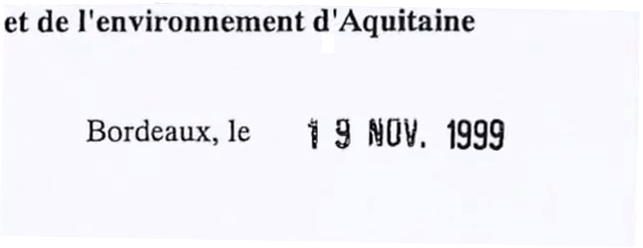
A month before the storm ......
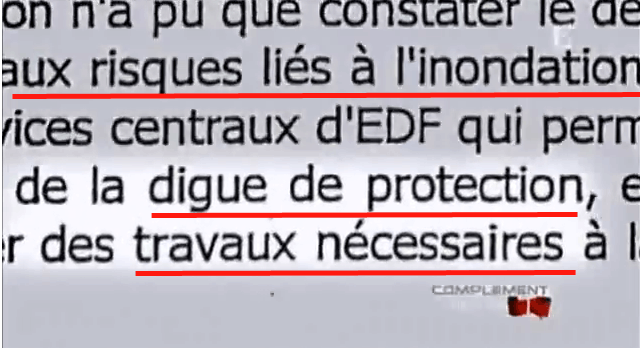
An insistent reminder to order, a month before the hurricane ...
If a safety engineer of the plant had not taken the matter, by calling this journalist from Sud Ouest, the incident would never have been known to the French citizens.

Jean-Pierre Deroudille, journalist at the Sud Ouest newspaper
*- A safety engineer of the plant called me and said "we had an incident during the storm night. Something serious happened, and we narrowly avoided the core melting". *** ---
My comment
The report by the Complément d'Enquête team has produced an important, powerful document. But all "the good questions" have not been asked. The focus was on the event. Imagine that the journalists had said:
*- When the unexpected storm hit the Blayais plant, the backup systems were underground, therefore vulnerable to flooding, and they were flooded: two out of four pumps were disabled. As I was told by Mr. Patrice Lapouge, the chance was that this storm occurred at the time of "low tides", when the sea level was minimal. A storm is a depression that moves. So this wave that caused the flooding was due both to the fact that the wind blowing at 190 km/h pushed the mass of water towards the coast and to the fact that the depression had raised the water level (barometric tide effect &&& a reader will inform us about the rise in water level at Blayais, linked to this effect). What would have happened if this storm had occurred at a time of high tide, when the sea level would have been &&& meters higher (&&& information on the rise in water in this region, due to tides, please). Do you think the plant could have counted on 2 pumps in working condition out of four? What would have happened if all four pumps had been disabled? What were "the normal procedures" planned in such a case? Moreover, the vulnerability of the installation is essentially due to the fact that the backup pumping systems are in the basement, therefore vulnerable to flooding. In principle, the fuel tanks and the generators are also in the basement, or were at the time. Are they still, 12 years after this storm? Could we now visit them? Have you carried out work to move these key elements of "safety" out of the reach of water, at a higher level? * **** ****
The precision did not take long to arrive, coming from an EDF employee:
:
No, no work has ever been done to "dry out the diesel fueling the backup pumps of the Blayais plant. Everything is still submerged. But "it is in project", since the disaster, of 1999 and, at the moment I write these lines, everything has remained as it was for 12 years !!!
These people have incompetence, irresponsibility and are fools. They simply don't care about your face. It's not new and it will continue. It's shameful, scandalous.
THE YOUNG DIRECTOR OF THE PLANT, WHO ONLY HAS THE WORD "SAFETY" ON HIS LIPS, IS PERFECTLY AWARE. THESE PEOPLE ARE FOOLS.
Since 1700, 34 tsunamis along the French coasts. No less than 34 tsunamis have occurred along the mainland coasts since the 18th century, of which 22 in the Mediterranean, 4 in the Atlantic and 8 in the English Channel. There are 28 in French overseas territories. This is the most complete inventory to date. It was carried out by Jérôme Lambert and Monique Terrier, from the Bureau des recherches géologiques et minières (BRGM). "The catalog will continue to grow in the coming years," says Jérôme Lambert, a geophysicist and historian by circumstance.
The website presenting the tsunamis is well made, accompanied by documents that allowed the identification of the large waves that lapped our coasts. These are usually newspaper articles or testimonies that will delight lovers of local history. "It is a tool to draw the public's attention to the risk of tsunamis that can hit the French coasts. Its compilation allowed us to discover unknown tsunamis along the Mediterranean coasts between Marseille and Perpignan," note the two researchers in the latest issue of the journal Natural Hazards and Earth System Sciences where they present their "baby."
From tsunami to tsunami: The first research on the French territory only started after the tsunami in Sumatra in December 2004. The deadly wave from Japan on March 11 will further rekindle them. A research project called Maremoti is currently underway regarding this issue. Indeed, the Nuclear Safety Authority (ASN) has decided to reassess the flood risks that the five EDF power plants located on the coasts might be subjected to: Blayais (Gironde), Flamanville (Manche), Paluel and Penly (Seine-Maritime), Gravelines (Nord).
The term "tsunami" was only adopted by European scientists in 1960, after the magnitude 9.5 earthquake in Chile that caused more than 5,000 deaths. "Before, we only spoke of 'raz-de-marée'," explains Jérôme Lambert, who had a lot of trouble sorting through the archives between tsunamis and false tsunamis (storms, hurricanes...).
"The French mainland has no active volcanoes, nor major seismic faults. Our coasts are much more exposed to extreme weather events," notes Jérôme Lambert.
Every 5,000 years: Things are complex. Thus, several (small) waves were recorded between 1725 and 1850 in the port of Cherbourg, the origin of which remains unexplained.
Without earthquakes, France can be exposed to cliff collapses or, worse, submarine slope failures like the Storegga one, which 8,000 years ago saw nearly 300 km of Norwegian coasts disappear into the sea. "We suspect that there have been and will be major events like that."
"Can we protect ourselves when they occur every 5,000 years?" asks Alexandre Sahal, from Paris-I University.
Our so-called "free encyclopedia" talks about it:
http://fr.wikipedia.org/wiki/Tremblement_de_terre_de_Lisbonne
(8.5 to 8.7 on the Richter scale)
The propagation of the tsunami that destroyed the port of Lisbon (the epicenter was at sea, offshore)
A 15-meter wave on the southwest coast of Spain, 20 meters high on the Morocco, 3 meters on the south of England
The CNRS also talks about it:
http://www2.cnrs.fr/presse/thema/750.htm
And a senator made a report, recommending an early warning system for the Atlantic coast:
http://www.sudouest.fr/2011/03/20/un-systeme-d-alerte-au-tsunami-pour-l-atlantique-347951-5010.php
If the pumps and generators at Blayais are still vulnerable to flooding, we have reason to worry, and to find ways to inform our neighbors.
Have a good day
Pascall
Claude Allègre, former minister and plate tectonics expert, who says that France is not subject to seismicity, must definitely check.
Since 1700, 34 tsunamis along the French coasts. No less than 34 tsunamis have occurred along the mainland coasts since the 18th century, of which 22 in the Mediterranean, 4 in the Atlantic and 8 in the English Channel. There are 28 in French overseas territories. This is the most complete inventory to date. It was carried out by Jérôme Lambert and Monique Terrier, from the Bureau des recherches géologiques et minières (BRGM). "The catalog will continue to grow in the coming years," says Jérôme Lambert, a geophysicist and historian by circumstance.
The website presenting the tsunamis is well made, accompanied by documents that allowed the identification of the large waves that lapped our coasts. These are usually newspaper articles or testimonies that will delight lovers of local history. "It is a tool to draw the public's attention to the risk of tsunamis that can hit the French coasts. Its compilation allowed us to discover unknown tsunamis along the Mediterranean coasts between Marseille and Perpignan," note the two researchers in the latest issue of the journal Natural Hazards and Earth System Sciences where they present their "baby."
From tsunami to tsunami: The first research on the French territory only started after the tsunami in Sumatra in December 2004. The deadly wave from Japan on March 11 will further rekindle them. A research project called Maremoti is currently underway regarding this issue. Indeed, the Nuclear Safety Authority (ASN) has decided to reassess the flood risks that the five EDF power plants located on the coasts might be subjected to: Blayais (Gironde), Flamanville (Manche), Paluel and Penly (Seine-Maritime), Gravelines (Nord).
The term "tsunami" was only adopted by European scientists in 1960, after the magnitude 9.5 earthquake in Chile that caused more than 5,000 deaths. "Before, we only spoke of 'raz-de-marée'," explains Jérôme Lambert, who had a lot of trouble sorting through the archives between tsunamis and false tsunamis (storms, hurricanes...).
"The French mainland has no active volcanoes, nor major seismic faults. Our coasts are much more exposed to extreme weather events," notes Jérôme Lambert.
Every 5,000 years: Things are complex. Thus, several (small) waves were recorded between 1725 and 1850 in the port of Cherbourg, the origin of which remains unexplained.
Without earthquakes, France can be exposed to cliff collapses or, worse, submarine slope failures like the Storegga one, which 8,000 years ago saw nearly 300 km of Norwegian coasts disappear into the sea. "We suspect that there have been and will be major events like that."
"Can we protect ourselves when they occur every 5,000 years?" asks Alexandre Sahal, from Paris-I University.
Other type of question :
- The Blayais power plant operates with MOX, isn't that right? This new fuel is composed of 93% non-fissile uranium 238, and 7% fissile plutonium. The plants loaded with MOX "operate on plutonium" and not on uranium. This is a major change. Why is this change currently being made, which is present in 20% of our plants, replacing the enriched uranium fuel at 3% with another type of fuel containing plutonium. Is it for "economic" reasons, because the facilities in La Hague are "very efficient" for chemical processing, less expensive, this extraction of plutonium, previously considered as either a nuclear explosive or as waste? In these MOX plants, it is the plutonium that produces the energy through fission reactions. As the cores are cooled by water, which plays its role as a moderator, slowing down neutrons, this prevents current plants from operating as breeder reactors, producing large amounts of plutonium, the uranium 238 acting as a "diluent" in the mixture capturing neutrons and transforming into plutonium 239. Does this MOX operation not foreshadow a future transition to breeder reactors? Does this MOX (Mixed oxides: mixture of uranium 238 oxide and plutonium 239 oxide) not constitute the loading mode of future breeder reactors, whose "deployment" is currently blocked. Before talking about breeder reactors, where the moderator is this extremely dangerous substance, sodium, which ignites spontaneously in air and explodes on contact with water, is this MOX formula not a subtle shift, a preparation for the transition to the breeder reactor formula? *
In short, is EDF trying to increase "safety" or is it prioritizing profitability, and satisfying the military's need for high-quality military plutonium at the expense of the safety of French citizens? .. **** ****
http://www.mefeedia.com/watch/33642140
http://www.wat.tv/video/uranium-scandale-france-contaminee-1tutm_2hpl3_.html
http://www.wat.tv/video/uranium-scandale-france-contaminee-1tuzj_2hpl3_.html
http://www.wat.tv/video/uranium-scandale-france-contaminee-1tv1f_2hpl3_.html
http://www.wat.tv/video/uranium-scandale-france-contaminee-1tv4d_2hpl3_.html
http://www.wat.tv/video/uranium-scandale-france-contaminee-1tv6c_2hpl3_.html
http://www.wat.tv/video/uranium-scandale-france-contaminee-1tvfz_2hpl3_.html
The investigation carried out by Elise Lucet on the hidden radioactive waste scattered across the French territory. Broadcast on France 3 in "Pièces à conviction" on February 11, 2009.
To watch or rewatch
:
The Scandal of the Contaminated France.
or
THE MOX IS THE KEY TO EVERYTHING
I am like you. I discover things as I go along and I spread information, in this serial of stupidity and criminal irresponsibility. And you will learn some interesting things.
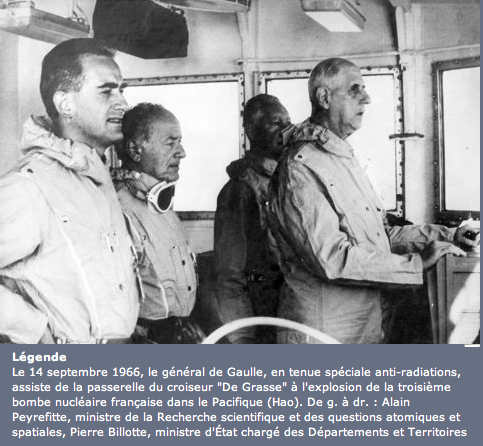
Since the post-war period, according to de Gaulle's wish, the French nuclear power has been under the sign of military applications. The France had to have "its" bomb, "its" missiles and "its" nuclear submarines, to enter the concert of great nations...
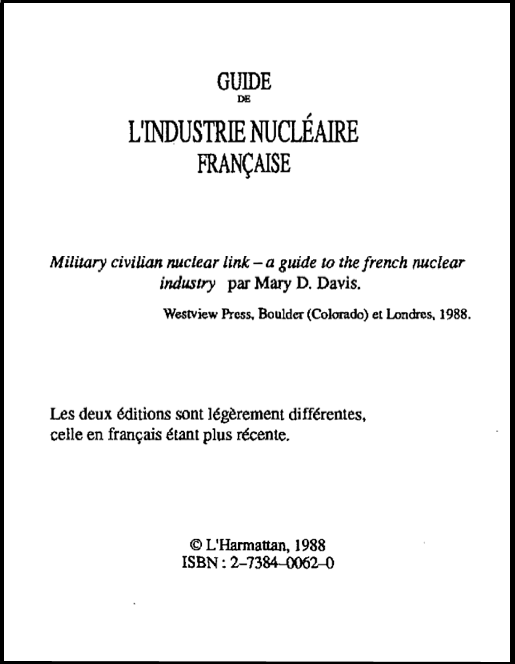
At the following address, you will find excerpts from a book describing the French nuclear policy, the French edition having been published in 1988 by l'Harmattan
Continued:
You will read on page 45 that the fertile cover of the Phoenix breeder reactor in Marcoule provides military quality plutonium. It produces 75 to 100 kilograms of plutonium per year. The Phoenix breeder reactor was part of the French military program, disguised as a civilian program. Since the end of the war of 39-45, it is the Army that leads the way, in complete disregard for human lives.
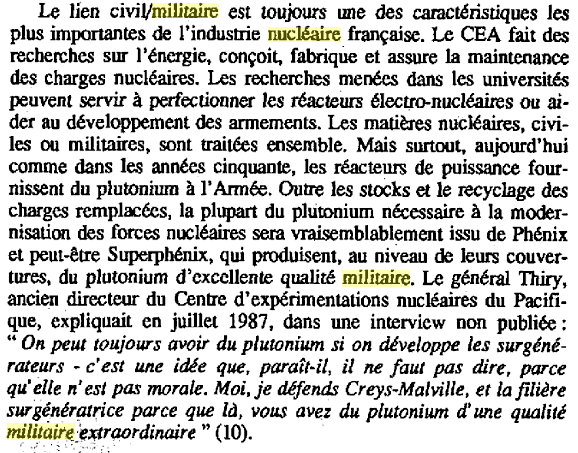
You can still get a copy of this book, if you still have some illusions. But let's get back to the question of MOX. It was said that it was a mixture of uranium oxides and plutonium oxides.
One might have thought that this new fuel (Fukushima made us aware of its existence, since reactor number 3 in Japan was loaded with it, of French manufacture) was a kind of variant of a classic fuel, based on uranium 235 at x%, "doped with plutonium".
Not at all. MOX is a mixture of 93% uranium 238 and 7% plutonium 239!
We are faced with a radical qualitative change: that of the operation of the "new reactors" using the fission of plutonium 239 and not uranium 235. Why this shift?
For two reasons.
France has a large stock of plutonium of various origins, produced by its reactors, including military quality plutonium, now in excessive quantities.
France has recovered the plutonium present in the spent assemblies from its own reactors, and from the assemblies sent by neighboring countries, arriving by entire trains. This recovery is carried out at the reprocessing plant in La Hague.
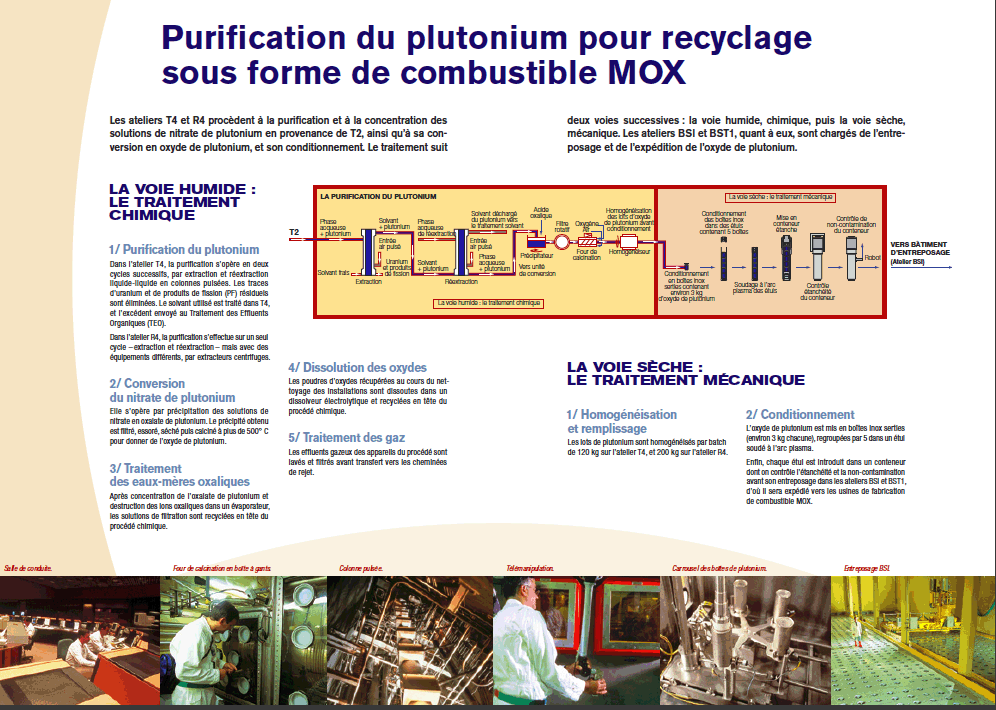
The French are very advanced in this field of plutonium extraction by chemical means, as explained by our "friend" AREVA, a private company.
And here is this two-page AREVA document:
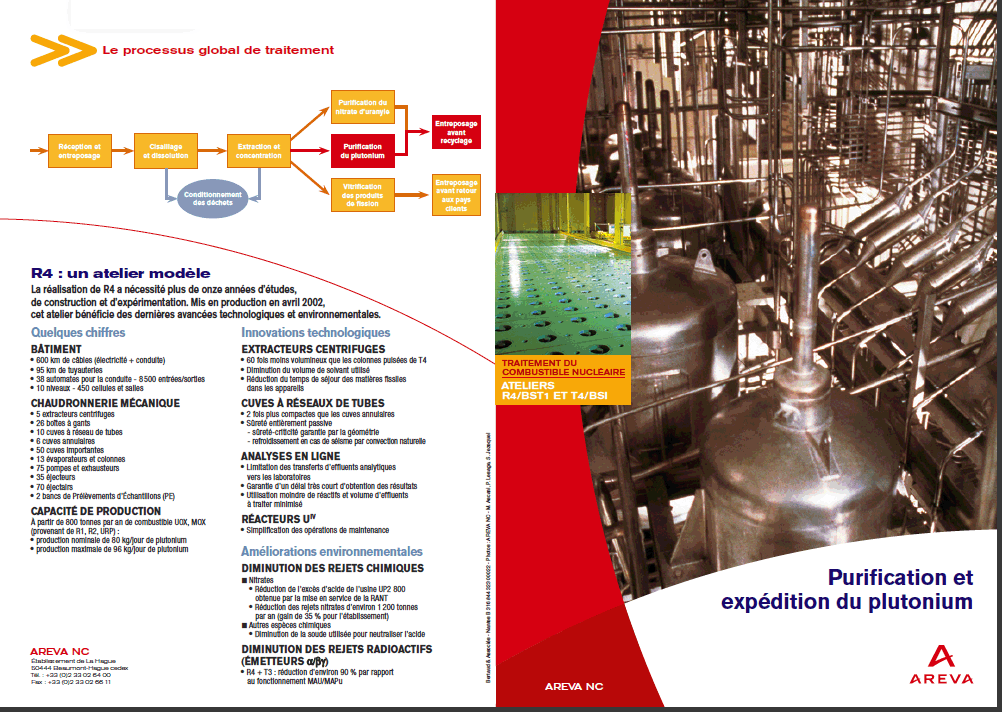
Zoom in on the second sheet. You will read:
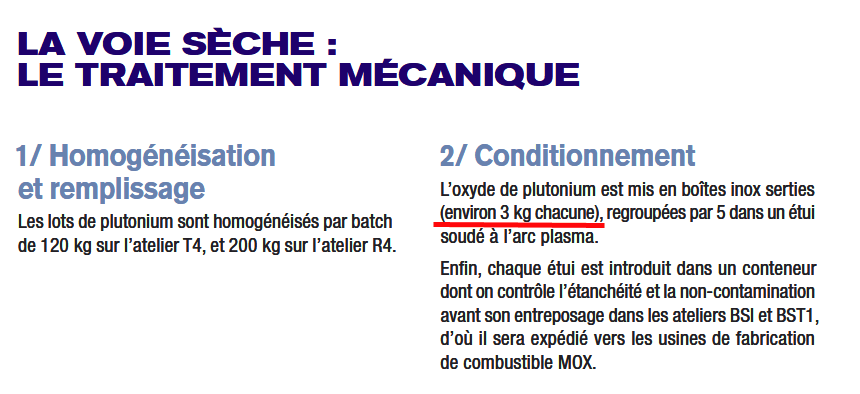
"Batch" in English translates to "furnace". It is ... the devil's bakery. Each "little bread" of plutonium represents 3 kilograms.
With a density of 19 grams per cubic centimeter, this corresponds to a cube of 5.4 cm on each side. The critical mass of plutonium was 8 kilograms, with three small loaves, you have enough to make an A-bomb. Each batch gives enough to make 200 atomic bombs.
The wonderful world of electric energy (AREVA document) It should be noted that in these circuits there is no place for waste
**April 28, 2011: After dealing with this first part and ending it with a joke, let's summarize. **
Nuclear power, in France, was born from the dream of grandeur of a general whose cynicism and machiavellism are no longer to be demonstrated. Under his iron grip, France has acquired the nuclear weapon, built nuclear submarines (to dissuade whom, now, the aliens?). All these operations were carried out in complete disregard for the civilian populations, both French and foreign or metropolitan, North African and Polynesian.
http://www.mefeedia.com/watch/33642140
http://www.wat.tv/video/uranium-scandale-france-contaminee-1tutm_2hpl3_.html
http://www.wat.tv/video/uranium-scandale-france-contaminee-1tuzj_2hpl3_.html
http://www.wat.tv/video/uranium-scandale-france-contaminee-1tv1f_2hpl3_.html
http://www.wat.tv/video/uranium-scandale-france-contaminee-1tv4d_2hpl3_.html
http://www.wat.tv/video/uranium-scandale-france-contaminee-1tv6c_2hpl3_.html
http://www.wat.tv/video/uranium-scandale-france-contaminee-1tvfz_2hpl3_.html
Regarding the storage, discreet, of the by-products of the uranium ore treatment available on the French territory, refer to this investigation, carried out by journalist Evelyne Lucet:
The Contaminated France
De Gaulle tested the French weapons in the Sahara, and later in Polynesia, completely ruining this paradise region. When I have time, I will explain everything to you. Initially, as it was less complicated to dig in the limestone formed by the accumulation of coral, it was there that the first underground tests were carried out.
One day, a ground collapse caused a huge limestone slab to detach, causing a tsunami, which was felt in the surrounding islands. Yet "the studies had shown that ....".
So the engineers built anti-tsunami platforms, on which they would stand during the tests. I will have to scan the book "The Atolls of the Bomb" and put the pdf online, a book lent to me by Christian Nazet, a military engineer, former head of instrumentation on the atoll.
You will see the oceans of money spent so that the general could have his little bomb.
I return to this essential question of MOX, which in France has completely gone unnoticed. Do your own investigation. Ask your surroundings what MOX is. Most people don't know. I myself only heard about it at the time of the Fukushima disaster, learning that reactor number 3 would be loaded with a "new fuel," provided by France. The emphasis is placed, in MOX, on the reuse of the plutonium produced in conventional reactors, and recovered from the waste received from abroad in the La Hague reprocessing plant.
**
http://www.world-nuclear-news.org/RS_Browns_Ferry_hit_by_major_storms_2804112.html
**
Understand one thing clearly: the La Hague reprocessing plant was not designed to "reprocess waste," but to recover the 1% of plutonium resulting from fission in reactors and the transformation of uranium 238. This recovery process directly comes from the techniques used by the military to extract, for military purposes, the plutonium produced by the fertile covers of the plutonium reactors.
The civilians have simply improved this technique.
Previously, the military extracted plutonium from a fertile cover, made of 238 subjected to neutron bombardment. The work consisted of separating "the good grain from the chaff," that is to say, plutonium from the remaining uranium 238. At the limit, with a little patience, it was all the 238 that turned into plutonium.
At La Hague, the "civilians" now know how to extract plutonium by separating the mixture of waste (not present with the "fertile cover" system). A word on the scheme of the plutonium reactor.
A fast neutron hits a uranium 238 nucleus and integrates into it .
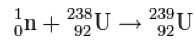
Next to the symbol of the element, on its left, there are two numbers. The top number represents the total number of nucleons (protons plus neutrons) and the bottom number the number of protons (which determines its chemical properties, since these depend on the "electron cloud" and that these electrons are equal in number to the number of protons.
We deduce that the nucleus of Uranium 238 contains 238 - 92 = 146 neutrons.
After capture, we obtain an isotope of uranium, containing one more neutron, which is unstable and decays into Neptunium by beta minus radioactivity. The half-life of this uranium 239 is 23 minutes. The reaction is:

The top number has not changed. There are still as many nucleons. But a neutron has turned into a proton. Therefore, the number of protons goes from 92 to 93. This transformation occurs through the emission of an electron, negatively charged and an "anti-neutrino" (this one, we don't care about, since it escapes through anything).
This Neptunium is not stable and will turn into plutonium 239 in two days, always by the transformation of a neutron into a proton, in the nucleus, and the emission of an electron and an antineutrino. The reaction is:

The number of nucleons does not change, but the number of protons goes from 93 to 94. Therefore, the chemical properties of plutonium 239 are different from those of uranium 238. This will allow a chemical separation, completely different from the separation of isotopes 238 and 235 of uranium, which had to be carried out by centrifugation, operating on uranium fluorides UF6. It was not possible to proceed chemically because these two uranium isotopes are chemically identical. Similarly, the three hydrogens: light, deuterium and tritium, although they have respectively 1, 2 and 3 nucleons, are also chemically identical.
The boundary between civil and military nuclear has always been non-existent. Therefore, the "civil" ones have developed industrial-scale plutonium recovery techniques, not only in fertile blankets, but in the waste provided by our neighbors, whose composition is 97% uranium 238, 1% uranium 235 "unconsumed", 1% plutonium "produced" plus different waste from uranium nucleus fissions.
By recovering the plutonium, AREVA produces "fuel" from the "ashes" from the neighbors' reactors. With a chemical recovery method, you get plutonium of high purity, which could perfectly be used for making bombs. But this plutonium is "sensibly" diluted in uranium 238, "depleted", from the isotopic enrichment of ore, by centrifugation. The plutonium contents are 7% in the current MOX (the one sold to the Japanese) but would rise to 11% in the one that would constitute, up to 100%, the load of future EPR (European pressurized reactors).
First remark: we have, without realizing it, or without being informed, moved from reactors operating on uranium to reactors operating on plutonium, infinitely more dangerous.
Second remark: This technique of chemical plutonium recovery could very well be applied to MOX. By selling this MOX to whoever wants it, France carries out a totally irresponsible diffusion of fissile material, recoverable for making bombs.
We are making a big fuss because the Iranians are laboriously developing an enrichment by centrifugation process. But the French sell to all countries in the world that want it, a nuclear fuel whose plutonium can be chemically extracted. There is, certainly, a certain know-how "where France is very advanced". But this will eventually be known by the whole world.
Third remark: The great brilliant idea of the French was that of a fast neutron breeder reactor (Phoenix, Super phoenix), that is to say a reactor operating on MOX, with a coolant fluid that does not slow down the neutrons, which would have allowed to reprocess plutonium from the "diluent" made of uranium 238, transforming by the above reactions (no longer needing a "fertile blanket"). To not slow down the fission neutrons and allow this "breeding", one must abandon light water as the coolant fluid (which slows down the neutrons) and use sodium (spontaneously flammable in air, explosive if in contact with water). This coolant fluid then circulates in the reactor at 550°C, against 300°C for pressurized water, a substance that vaporizes at 880°C. Disadvantage.
In all these projects, whatever they may be, no one has ever, or has ever, asked themselves the problems:
- Of intrinsic danger - Of waste - Of the cost of dismantling. It's simply crazy. It took the Fukushima disaster for the danger issue to come back to the table.
The Frenchies, the CEA, AREVA, etc. are all disturbed by this unpleasant new development. Everything was going so well. Indeed, there are several aspects in this transition to III and IV generation reactors.
This evolution reflects the deep symbiosis between the civil and military sectors, on a background of complete irresponsibility.
The plutonium recovery technique at La Hague is only a civil adaptation of the techniques used by the military.
By the way, breeder reactors produce military-grade plutonium.
Since the French nuclear industry has been privatized, the only concern has become profit and revenue from exports (building reactors abroad, technology transfers, sale of plutonium "temporarily diluted in uranium 238 in the form of MOX".
When countries do not have the entire, not very discreet, technology of centrifuge enrichment, it was possible to provide them with uranium with 3% of 235 so they could play with a "civil" reactor, promising not to use it as a plutonium reactor. But if we sell them MOX, then the dissemination of fissile material, which can be used for military applications, becomes planetary. We are witnessing, in particular thanks to the French nuclear commercial policy, the banalization of dissemination. It's really suicide, user manual. Let's move on to the EPR, the European Pressurized Reactor, the pinnacle of French know-how in pressurized water reactors. These are "new reactors", intended to replace "the old ones, which have reached the end of their life after thirty years of loyal service". A minor detail: we don't know how to dismantle these reactors at the end of their life, any more than we will know how to dismantle the EPR. AREVA simply focuses on the expected profit. With these monsters (1600 MW electric), we will be able to produce 22% more electricity. Cost: 6 billion euros. Waste management: no solution, we'll see "later". Cost of future dismantling: same reason, same punishment.
Before asking the question "should we get out of nuclear power?" we could ask a preliminary question:
- Should we immediately abandon this extremely dangerous use of plutonium operation, instead of uranium?
Immediate answer from the irresponsible nuclear bosses:
Impossible. What would we do with our La Hague plant? Previously, we bought uranium ore from Africans and enriched it at Tricastin. But Tricastin is reaching the end of its life. We found this trick, with La Hague, to make our fuel by recovering the plutonium present in the waste of other countries.
But this leads to operating on plutonium. It becomes extremely dangerous and involves the uncontrollable dissemination of fissile material that can be turned into bombs?
Yes, but it's more profitable. Otherwise, what would we do? Close La Hague? Then, what would we do with the employees? Moreover, you don't want us to deploy breeder reactors, under the pretext that with sodium, and the ton of plutonium underneath, it would be dangerous. However, we could reprocess fuel from our huge stock of depleted uranium, from 50 years of ore enrichment, which we don't know what to do with, except for shells, but it remains limited. An intermediate solution is to build EPRs - What difference is there with the classic pressurized water reactors?
They are bigger, more powerful. We gain in electricity produced, because of the scale factor. And we have planned an additional containment and a corium collector, below, in case of core meltdown and if it goes through the vessel, to avoid the "Chinese syndrome".
It's not very reassuring, your thing? And it's always with your feet in the water, as usual.
But it creates jobs, and we can export them, manufacturing them abroad. For example, it was almost a miracle that we didn't sell them to Gaddafi when he came to the Elysée. And we sell MOX. It's a very promising market. It improves our balance of payments, right?
In all this, what do we do with the old reactors, at the end of their life?
Well .....
And what will we do with the waste of these new reactors?
We will treat it the same way as we treated the waste of previous reactors.
You mean we ... will store it?
We will find a solution. Studies have shown that in clay ....
But these new reactors, these EPRs, we will have to dismantle them too. Have you calculated how much it could cost.
We will leave this debt to the next generation.
I return to this last idea of DCNS, the naval and submarine construction directorate, which consists of selling nuclear submarine reactors, packaged in a gift box, which is submerged at 100 meters depth near a coast, the mess was capable of powering 100,000 households of a small coastal town. A sector where, according to studies carried out by the house, there is a demand for 200 units. So another promising market.
Transport of a Flexblue unit. It is the type of ship designed to bring offshore oil platforms to their location. The same, submerged near a coast. To those who would try to oppose the project, DCNS responds:
The French naval construction sector, both military and civil, is in crisis. Foreign, Asian competition is too strong. There, with these Flexblue units, we would be at the forefront, competitive. We could export a lot.
But isn't that a bit dangerous?
There is no zero risk. And if we don't start this project, we will have to lay off.
Do citizens finally realize that the atomic world, in the world, and especially in France, is nothing more than a suicidal race, where we pass on the costs to the next generation, leaving them with inedible waste?
It's total irresponsibility. Don't believe that the people running these projects think, or are manipulated by some terrible Machiavellian secret society.
The profit men have simply an extraordinary ability to convince themselves that their actions are in the interest of the general.
.
| April 30, 2011: | I put on the page dedicated to the Fukushima disaster, what happened on April 28, 2011 in Alabama, devastated by a tornado (1 km in diameter, winds swirling at over 300 km/h, 220 dead, 1700 injured). | L | 'electrical supply of the pumping systems of the Browns Ferry nuclear power plant was shattered. The system had to switch to backup power, using generators. | C | omme remarked by a reader, Frédéric Requin, this tornado once again raises | the danger of nuclear installations regarding natural disasters. | At Blayais, unexpected hurricane. At Fukushima, unexpected tsunami. Imagine that "unexpectedly" a tornado "as never seen before, said Obama" passes directly through a nuclear power plant, tears off the ceiling of a pool room, sucks up the water and the fuel assemblies and scatters them over hundreds of square kilometers, after pulverizing them. ...... | | | | | | | | | | | | | | | | | | | | | | | | | | | | | | | | | | | | | | | | | | | | | | | | | | | | | | | | | | | | | | | | | | | | | | | | | | | | | | | | | | | | | | | | | | | | | | | | | | | | | | | | | | | | | | | | | | | | | | | | | | | | | | | | | | | | | | | | | | | | | | | | | | | | | | | | | | | | | | | | | | | | | | | | | | | | | | | | | | | | | | | | | | | | | | | | | | | | | | | | | | | | | | | | | | | | | | | | | | | | | | | | | | | | | | | | | | | | | | | | | | | | | | | | | | | | | | | | | | | | | | | | | | | | | | | | | | | | | | | | | | | | | | | | | | | | | | | | | | | | | | | | | | | | | | | | | | | | | | | | | | | | | | | | | | | | | | | | | | | | | | | | | | | | | | | | | | | | | | | | | | | | | | | | | | | | | | | | | | | | | | | | | | | | | | | | | | | | | | | | | | | | | | | | | | | | | | | | | | | | | | | | | | | | | | | | | | | | | | | | | | | | | | | | | | | | | | | | | | | | | | | | | | | | | | | | | | | | | | | | | | | | | | | | | | | | | | | | | | | | | | | | | | | | | | | | | | | | | | | | | | | | | | | | | | | | | | | | | | | | | | | | | | | | | | | | | | | | | | | | | | | | | | | | | | | | | | | | | | | | | | | | | | | | | | | | | | | | | | | | | | | | | | | | | | | | | | | | | | | | | | | | | | | | | | | | | | | | | | | | | | | | | | | | | | | | | | | | | | | | | | | | | | | | | | | | | | | | | | | | | | | | | | | | | | | | | | | | | | | | | | | | | | | | | | | | | | | | | | | | | | | | | | | | | | | | | | | | | | | | | | | | | | | | | | | | | | | | | | | | | | | | | | | | | | | | | | | | | | | | | | | | | | | | | | | | | | | | | | | | | | | | | | | | | | | | | | | | | | | | | | | | | | | | | | | | | | | | | | | | | | | | | | | | | | | | | | | | | | | | | | | | | | | | | | | | | | | | | | | | | | | | | | | | | | | | | | | | | | | | | | | | | | | | | | | | | | | | | | | | | | | | | | | | | | | | | | | | | | | | | | | | | | | | | | | | | | | | | | | | | | | | | | | | | | | | | | | | | | | | | | | | | | | | | | | | | | | | | | | | | | | | | | | | | | | | | | | | | | | | | | | | | | | | | | | | | | | | | | | | | | | | | | | | | | | | | | | | | | | | | | | | | | | | | | | | | | | | | | | | | | | | | | | | | | | | | | | | | | | | | | | | | | | | | | | | | | | | | | | | | | | | | | | | | | | | | | | | | | | | | | | | | | | | | | | | | | | | | | | | | | | | | | | | | | | | | | | | | | | | | | | | | | | | | | | | | | | | | | | | | | | | | | | | | | | | | | | | | | | | | | | | | | | | | | | | | | | | | | | | | | | | | | | | | | | | | | | | | | | | | | | | | | | | | | | | | | | | | | | | | | | | | | | | | | | | | | | | | | | | | | | | | | | | | | | | | | | | | | | | | | | | | | | | | | | | | | | | | | | | | | | | | | | | | | | | | | | | | | | | | | | | | | | | | | | | | | | | | | | | | | | | | | | | | | | | | | | | | | | | | | | | | | | | | | | | | | | | | | | | | | | | | | | | | | | | | | | | | | | | | | | | | | | | | | | | | | | | | | | | | | | | | | | | | | | | | | | | | | | | | | | | | | | | | | | | | | | | | | | | | | | | | | | | | | | | | | | | | | | | | | | | | | | | | | | | | | | | | | | | | | | | | | | | | | | | | | | | | | | | | | | | | | | | | | | | | | | | | | | | | | | | | | | | | | | | | | | | | | | | | | | | | | | | | | | | | | | | | | | | | | | | | | | | | | | | | | | | | | | | | | | | | | | | | | | | | | | | | | | | | | | | | | | | | | | | | | | | | | | | | | | | | | | | | | | | | | | | | | | | | | | | | | | | | | | | | | | | | | | | | | | | | | | | | | | | | | | | | | | | | | | | | | | | | | | | | | | | | | | | | | | | | | | | | | | | | | | | | | | | | | | | | | | | | | | | | | | | | | | | | | | | | | | | | | | | | | | | | | | | | | | | | | | | | | | | | | | | | | | | | | | | | | | | | | | | | | | | | | | | | | | | | | | | | | | | | | | | | | | | | | | | | | | | | | | | | | | | | | | | | | | | | | | | | | | | | | | | | | | | | | | | | | | | | | | | | | | | | | | | | | | | | | | | | | | | | | | | | | | | | | | | | | | | | | | | | | | | | | | | | | | | | | | | | | | | | | | | | | | | | | | | | | | | | | | | | | | | | | | | | | | | | | | | | | | | | | | | | | | | | | | | | | | | | | | | | | | | | | | | | | | | | | | | | | | | | | | | | | | | | | | | | | | | | | | | | | | | | | | | | | | | | | | | | | | | | | | | | | | | | | | | | | | | | | | | | | | | | | | | | | | | | | | | | | | | | | | | | | | | | | | | | | | | | | | | | | | | | | | | | | | | | | | | | | | | | | | | | | | | | | | | | | | | | | | | | | | | | | | | | | | | | | | | | | | | | | | | | | | | | | | | | | | | | | | | | | | | | | | | | | | | | | | | | | | | | | | | | | | | | | | | | | | | | | | | | | | | | | | | | | | | | | | | | | | | | | | | | | | | | | | | | | | | | | | | | | | | | | | | | | | | | | | | | | | | | | | | | | | | | | | | | | | | | | | | | | | | | | | | | | | | | | | | | | | | | | | | | | | | | | | | | | | | | | | | | | | | | | | | | | | | | | | | | | | | | | | | | | | | | | | | | | | | | | | | | | | | | | | | | | | | | | | | | | | | | | | | | | | | | | | | | | | | | | | | | | | | | | | | | | | | | | | | | | | | | | | | | | | | | | | | | | | | | | | | | | | | | | | | | | | | | | | | | | | | | | | | | | | | | | | | | | | | | | | | | | | | | | | | | | | | | | | | | | | | | | | | | | | | | | | | | | | | | | | | | | | | | | | | | | | | | | | | | | | | | | | | | | | | | | | | | | | | | | | | | | | | | | | | | | | | | | | | | | | | | | | | | | | | | | | | | | | | | | | | | | | | | | | | | | | | | | | | | | | | | | | | | | | | | | | | | | | | | | | | | | | | | | | | | | | | | | | | | | | | | | | | | | | | | | | | | | | | | | | | | | | | | | | | | | | | | | | | | | | | | | | | | | | | | | | | | | | | | | | | | | | | | | | | | | | | | | | | | | | | | | | | | | | | | | | | | | | | | | | | | | | | | | | | | | | | | | | | | | | | | | | | | | | | | | | | | | | | | | | | | | | | | | | | | | | | | | | | | | | | | | | | | | | | | | | | | | | | | | | | | | | | | | | | | | | | | | | | | | | | | | | | | | | | | | | | | | | | | | | | | | | | | | | | | | | | | | | | | | | | | | | | | | | | | | | | | | | | | | | | | | | | | | | | | | | | | | | | | | | | | | | | | | | | | | | | | | | | | | | | | | | | | | | | | | | | | | | | | | | | | | | | | | | | | | | | | | | | | | | | | | | | | | | | | | | | | | | | | | | | | | | | | | | | | | | | | | | | | | | | | | | | | | | | | | | | | | | | | | | | | | | | | | | | | | | | | | | | | | | | | | | | | | | | | | | | | | | | | | | | | | | | | | | | | | | | | | | | | | | | | | | | | | | | | | | | | | | | | | | | | | | | | | | | | | | | | | | | | | | | | | | | | | | | | | | | | | | | | | | | | | | | | | | | | | | | | | | | | | | | | | | | | | | | | | | | | | | | | | | | | | | | | | | | | | | | | | | | | | | | | | | | | | | | | | | | | | | | | | | | | | | | | | | | | | | | | | | | | | | | | | | | | | | | | | | | | | | | | | | | | | | | | | | | | | | | | | | | | | | | | | | | | | | | | | | | | | | | | | | | | | | | | | | | | | | | | | | | | | | | | | | | | | | | | | | | | | | | | | | | | | | | | | | | | | | | | | | | | | | | | | | | | | | | | | | | | | | | | | | | | | | | | | | | | | | | | | | | | | | | | | | | | | | | | | | | | | | | | | | | | | | | | | | | | | | | | | | | | | | | | | | | | | | | | | | | | | | | | | | | | | | | | | | | | | | | | | | | | | | | | | | | | | | | | | | | | | | | | | | | | | | | | | | | | | | | | | | | | | | | | | | | | | | | | | | | | | | | | | | | | | | | | | | | | | | | | | | | | | | | | | | | | | | | | | | | | | | | | | | | | | | | | | | | | | | | | | | | | | | | | | | | | | | | | | | | | | | | | | | | | | | | | | | | | | | | | | | | | | | | | | | | | | | | | | | | | | | | | | | | | | | | | | | | | | | | | | | | | | | | | | | | | | | | | | | | | | | | | | | | | | | | | | | | | | | | | | | | | | | | | | | | | | | | | | | | | | | | | | | | | | | | | | | | | | | | | | | | | | | | | | | | | | | | | | | | | | | | | | | | | | | | | | | | | | | | | | | | | | | | | | | | | | | | | | | | | | | | | | | | | | | | | | | | | | | | | | | | | | | | | | | | | | | | | | | | | | | | | | | | | | | | | | | | | | | | | | | | | | | | | | | | | | | | | | | | | | | | | | | | | | | | | | | | | | | | | | | | | | | | | | | | | | | | | | | | | | | | | | | | | | | | | | | | | | | | | | | | | | | | | | | | | | | | | | | | | | | | | | | | | | | | | | | | | | | | | | | | | | | | | | | | | | | | | | | | | | | | | | | | | | | | | | | | | | | | | | | | | | | | | | | | | | | | | | | | | | | | | | | | | | | | | | | | | | | | | | | | | | | | | | | | | | | | | | | | | | | | | | | | | | | | | | | | | | | | | | | | | | | | | | | | | | | | | | | | | | | | | | | | | | | | | | | | | | | | | | | | | | | | | | | | | | | | | | | | | | | | | | | | | | | | | | | | | | | | | | | | | | | | | | | | | | | | | | | | | | | | | | | | | | | | | | | | | | | | | | | | | | | | | | | | | | | | | | | | | | | | | | | | | | | | | | | | | | | | | | | | | | | | | | | | | | | | | | | | | | | | | | | | | | | | | | | | | | | | | | | | | | | | | | | | | | | | | | | | | | | | | | | | | | | | | | | | | | | | | | | | | | | | | | | | | | | | | | | | | | | | | | | | | | | | | | | | | | | | | | | | | | | | | | | | | | | | | | | | | | | | | | | | | | | | | | | | | | | | | | | | | | | | | | | | | | | | | | | | | | | | | | | | | | | | | | | | | | | | | | | | | | | | | | | | | | | | | | | | | | | | | | | | | | | | | | | | | | | | | | | | | | | | | | | | | | | | | | | | | | | | | | | | | | | | | | | | | | | | | | | | | | | | | | | | | | | | | | | | | | | | | | | | | | | | | | | | | | | | | | | | | | | | | | | | | | | | | | | | | | | | | | | | | | | | | | | | | | | | | | | | | | | | | | | | | | | | | | | | | | | | | | | | | | | | | | | | | | | | | | | | | | | | | | | | | | | | | | | | | | | | | | | | | | | | | | | | | | | | | | | | | | | | | | | | | | | | | | | | | | | | | | | | | | | | | | | | | | | | | | | | | | | | | | | | | | | | | | | | | | | | | | | | | | | | | | | | | | | | | | | | | | | | | | | | | | | | | | | | | | | | | | | | | | | | | | | | | | | | | | | | | | | | | | | | | | | | | | | | | | | | | | | | | | | | | | | | | | | | | | | | | | | | | | | | | | | | | | | | | | | | | | | | | | | | | | | | | | | | | | | | | | | | | | | | | | | | | | | | | | | | | | | | | | | | | | | | | | | | | | | | | | | | | | | | | | | | | | | | | | | | | | | | | | | | | | | | | | | | | | | | | | | | | | | | | | | | | | | | | | | | | | | | | | | | | | | | | | | | | | | | | | | | | | | | | | | | | | | | | | | | | | | | | | | | | | | | | | | | | | | | | | | | | | | | | | | | | | | | | | | | | | | | | | | | | | | | | | | | | | | | | | | | | | | | | | | | | | | | | | | | | | | | | | | | | | | | | | | | | | | | | | | | | | | | | | | | | | | | | | | | | | | | | | | | | | | | | | | | | | | | | | | | | | | | | | | | | | | | | | | | | | | | | | | | | | | | | | | | | | | | | | | | | | | | | | | | | | | | | | | | | | | | | | | | | | | | | | | | | | | | | | | | | | | | | | | | | | | | | | | | | | | | | | | | | | | | | | | | | | | | | | | | | | | | | | | | | | | | | | | | | | | | | | | | | | | | | | | | | | | | | | | | | | | | | | | | | | | | | | | | | | | | | | | | | | | | | | | | | | | | | | | | | | | | | | | | | | | | | | | | | | | | | | | | | | | | | | | | | | | | | | | | | | | | | | | | | | | | | | | | | | | | | | | | | | | | | | | | | | | | | | | | | | | | | | | | | | | | | | | | | | | | | | | | | | | | | | | | | | | | | | | | | | | | | | | | | | | | | | | | | | | | | | | | | | | | | | | | | | | | | | | | | | | | | | | | | | | | | | | | | | | | | | | | | | | | | | | | | | | | | | | | | | | | | | | | | | | | | | | | | | | | | | | | | | | | | | | | | | | | | | | | | | | | | | | | | | | | | | | | | | | | | | | | | | | | | | | | | | | | | | | | | | | | | | | | | | | | | | | | | | | | | | | | | | | | | | | | | | | | | | | | | | | | | | | | | | | | | | | | | | | | | | | | | | | | | | | | | | | | | | | | | | | | | | | | | | | | | | | | | | | | | | | | | | | | | | | | | | | | | | | | | | | | | | | | | | | | | | | | | | | | | | | | | | | | | | | | | | | | | | | | | | | | | | | | | | | | | | | | | | | | | | | | | | | | | | | | | | | | | | | | | | | | | | | | | | | | | | | | | | | | | | | | | | | | | | | | | | | | | | | | | | | | | | | | | | | | | | | | | | | | | | | | | | | | | | | | | | | | | | | | | | | | | | | | | | | | | | | | | | | | | | | | | | | | | | | | | | | | | | | | | | | | | | | | | | | | | | | | | | | | | | | | | | | | | | | | | | | | | | | | | | | | | | | | | | | | | | | | | | | | | | | | | | | | | | | | | | | | | | | | | | | | | | | | | | | | | | | | | | | | | | | | | | | | | | | | | | | | | | | | | | | | | | | | | | | | | | | | | | | | | | | | | | | | | | | | | | | | | | | | | | | | | | | | | | | | | | | | | | | | | | | | | | | | | | | | | | | | | | | | | | | | | | | | | | | | | | | | | | | | | | | | | | | | | | | | | | | | | | | | | | | | | | | | | | | | | | | | | | | | | | | | | | | | | | | | | | | | | | | | | | | | | | | | | | | | | | | | | | | | | | | | | | | | | | | | | | | | | | | | | | | | | | | | | | | | | | | | | | | | | | | | | | | | | | | | | | | | | | | | | | | | | | | | | | | | | | | | | | | | | | | | | | | | | | | | | | | | | | | | | | | | | | | | | | | | | | | | | | | | | | | | | | | | | | | | | | | | | | | | | | | | | | | | | | | | | | | | | | | | | | | | | | | | | | | | | | | | | | | | | | | | | | | | | | | | | | | | | | | | | | | | | | | | | | | | | | | | | | | | | | | | | | | | | | | | | | | | | | | | | | | | | | | | | | | | | | | | | | | | | | | | | | | | | | | | | | | | | | | | | | | | | | | | | | | | | | | | | | | | | | | | | | | | | | | | | | | | | | | | | | | | | | | | | | | | | | | | | | | | | | | | | | | | | | | | | | | | | | | | | | | | | | | | | | | | | | | | | | | | | | | | | | | | | | | | | | | | | | | | | | | | | | | | | | | | | | | | | | | | | | | | | | | | | | | | | | | | | | | | | | | | | | | | | | | | | | | | | | | | | | | | | | | | | | | | | | | | | | | | | | | | | | | | | | | | | | | | | | | | | | | | | | | | | | | | | | | | | | | | | | | | | | | | | | | | | | | | | | | | | | | | | | | | | | | | | | | | | | | | | | | | | | | | | | | | | | | | | | | | | | | | | | | | | | | | | | | | | | | | | | | | | | | | | | | | | | | | | | | | | | | | | | | | | | | | | | | | | | | | | | | | | | | | | | | | | | | | | | | | | | | | | | | | | | | | | | | | | | | | | | | | | | | | | | | | | | | | | | | | | | | | | | | | | | | | | | | | | | | | | | | | | | | | | | | | | | | | | | | | | | | | | | | | | | | | | | | | | | | | | | | | | | | | | | | | | | | | | | | | | | | | | | | | | | | | | | | | | | | | | | | | | | | | | | | | | | | | | | | | | | | | | | | | | | | | | | | | | | | | | | | | | | | | | | | | | | | | | | | | | | | | | | | | | | | | | | | | | | | | | | | | | | | | | | | | | | | | | | | | | | | | | | | | | | | | | | | | | | | | | | | | | | | | | | | | | | | | | | | | | | | | | | | | | | | | | | | | | | | | | | | | | | | | | | | | | | | | | | | | | | | | | | | | | | | | | | | | | | | | | | | | | | | | | | | | | | | | | | | | | | | | | | | | | | | | | | | | | | | | | | | | | | | | | | | | | | | | | | | | | | | | | | | | | | | | | | | | | | | | | | | | | | | | | | | | | | | | | | | | | | | | | | | | | | | | | | | | | | | | | | | | | | | | | | | | | | | | | | | | | | | | | | | | | | | | | | | | | | | | | | | | | | | | | | | | | | | | | | | | | | | | | | | | | | | | | | | | | | | | | | | | | | | | | | | | | | | | | | | | | | | | | | | | | | | | | | | | | | | | | | | | | | | | | | | | | | | | | | | | | | | | | | | | | | | | | | | | | | | | | | | | | | | | | | | | | | | | | | | | | | | | | | | | | | | | | | | | | | | | | | | | | | | | | | | | | | | | | | | | | | | | | | | | | | | | | | | | | | | | | | | | | | | | | | | | | | | | | | | | | | | | | | | | | | | | | | | | | | | | | | | | | | | | | | | | | | | | | | | | | | | | | | | | | | | | | | | | | | | | | | | | | | | | | | | | | | | | | | | | | | | | | | | | | | | | | | | | | | | | | | | | | | | | | | | | | | | | | | | | | | | | | | | | | | | | | | | | | | | | | | | | | | | | | | | | | | | | | | | | | | | | | | | | | | | | | | | | | | | | | | | | | | | | | | | | | | | | | | | | | | | | | | | | | | | | | | | | | | | | | | | | | | | | | | | | | | | | | | | | | | | | | | | | | | | | | | | | | | | | | | | | | | | | | | | | | | | | | | | | | | | | | | | | | | | | | | | | | | | | | | | | | | | | | | | | | | | | | | | | | | | | | | | | | | | | | | | | | | | | | | | | | | | | | | | | | | | | | | | | | | | | | | | | | | | | | | | | | | | | | | | | | | | | | | | | | | | | | | | | | | | | | | | | | | | | | | | | | | | | | | | | | | | | | | | | | | | | | | | | | | | | | | | | | | | | | | | | | | | | | | | | | | | | | | | | | | | | | | | | | | | | | | | | | | | | | | | | | | | | | | | | | | | | | | | | | | | | | | | | | | | | | | | | | | | | | | | | | | | | | | | | | | | | | | | | | | | | | | | | | | | | | | | | | | | | | | | | | | | | | | | | | | | | | | | | | | | | | | | | | | | | | | | | | | | | | | | | | | | | | | | | | | | | | | | | | | | | | | | | | | | | | | | | | | | | | | | | | | | | | | | | | | | | | | | | | | | | | | | | | | | | | | | | | | | | | | | | | | | | | | | | | | | | | | | | | | | | | | | | | | | | | | | | | | | | | | | | | | | | | | | | | | | | | | | | | | | | | | | | | | | | | | | | | | | | | | | | | | | | | | | | | | | | | | | | | | | | | | | | | | | | | | | | | | | | | | | | | | | | | | | | | | | | | | | | | | | | | | | | | | | | | | | | | | | | | | | | | | | | | | | | | | | | | | | | | | | | | | | | | | | | | | | | | | | | | | | | | | | | | | | | | | | | | | | | | | | | | | | | | | | | | | | | | | | | | | | | | | | | | | | | | | | | | | | | | | | | | | | | | | | | | | | | | | | | | | | | | | | | | | | | | | | | | | | | | | | | | | | | | | | | | | | | | | | | | | | | | | | | | | | | | | | | | | | | | | | | | | | | | | | | | | | | | | | | | | | | | | | | | | | | | | | | | | | | | | | | | | | | | | | | | | | | | | | | | | | | | | | | | | | | | | | | | | | | | | | | | | | | | | | | | | | | | | | | | | | | | | | | | | | | | | | | | | | | | | | | | | | | | | | | | | | | | | | | | | | | | | | | | | | | | | | | | | | | | | | | | | | | | | | | | | | | | | | | | | | | | | | | | | | | | | | | | | | | | | | | | | | | | | | | | | | | | | | | | | | | | | | | | | | | | | | | | | | | | | | | | | | | | | | | | | | | | | | | | | | | | | | | | | | | | | | | | | | | | | | | | | | | | | | | | | | | | | | | | | | | | | | | | | | | | | | | | | | | | | | | | | | | | | | | | | | | | | | | | | | | | | | | | | | | | | | | | | | | | | | | | | | | | | | | | | | | | | | | | | | | | | | | | | | | | | | | | | | | | | | | | | | | | | | | | | | | | | | | | | | | | | | | | | | | | | | | | | | | | | | | | | | | | | | | | | | | | | | | | | | | | | | | | | | | | | | | | | | | | | | | | | | | | | | | | | | | | | | | | | | | | | | | | | | | | | | | | | | | | | | | | | | | | | | | | | | | | | | | | | | | | | | | | | | | | | | | | | | | | | | | | | | | | | | | | | | | | | | | | | | | | | | | | | | | | | | | | | | | | | | | | | | | | | | | | | | | | | | | | | | | | | | | | | | | | | | | | | | | | | | | | | | | | | | | | | | | | | | | | | | | | | | | | | | | | | | | | | | | | | | | | | | | | | | | | | | | | | | | | | | | | | | | | | | | | | | | | | | | | | | | | | | | | | | | | | | | | | | | | | | | | | | | | | | | | | | | | | | | | | | | | | | | | | | | | | | | | | | | | | | | | | | | | | | | | | | | | | | | | | | | | | | | | | | | | | | | | | | | | | | | | | | | | | | | | | | | | | | | | | | | | | | | | | | | | | | | | | | | | | | | | | | | | | | | | | | | | | | | | | | | | | | | | | | | | | | | | | | | | | | | | | | | | | | | | | | | | | | | | | | | | | | | | | | | | | | | | | | | | | | | | | | | | | | | | | | | | | | | | | | | | | | | | | | | | | | | | | | | | | | | | | | | | | | | | | | | | | | | | | | | | | | | | | | | | | | | | | | | | | | | | | | | | | | | | | | | | | | | | | | | | | | | | | | | | | | | | | | | | | | | | | | | | | | | | | | | | | | | | | | | | | | | | | | | | | | | | | | | | | | | | | | | | | | | | | | | | | | | | | | | | | | | | | | | | | | | | | | | | | | | | | | | | | | | | | | | | | | | | | | | | | | | | | | | | | | | | | | | | | | | | | | | | | | | | | | | | | | | | | | | | | | | | | | | | | | | | | | | | | | | | | | | | | | | | | | | | | | | | | | | | | | | | | | | | | | | | | | | | | | | | | | | | | | | | | | | | | | | | | | | | | | | | | | | | | | | | | | | | | | | | | | | | | | | | | | | | | | | | | | | | | | | | | | | | | | | | | | | | | | | | | | | | | | | | | | | | | | | | | | | | | | | | | | | | | | | | | | | | | | | | | | | | | | | | | | | | | | | | | | | | | | | | | | | | | | | | | | | | | | | | | | | | | | | | | | | | | | | | | | | | | | | | | | | | | | | | | | | | | | | | | | | | | | | | | | | | | | | | | | | | | | | | | | | | | | | | | | | | | | | | | | | | | | | | | | | | | | | | | | | | | | | | | | | | | | | | | | | | | | | | | | | | | | | | | | | | | | | | | | | | | | | | | | | | | | | | | | | | | | | | | | | | | | | | | | | | | | | | | | | | | | | | | | | | | | | | | | | | | | | | | | | | | | | | | | | | | | | | | | | | | | | | | | | | | | | | | | | | | | | | | | | | | | | | | | | | | | | | | | | | | | | | | | | | | | | | | | | | | | | | | | | | | | | | | | | | | | | | | | | | | | | | | | | | | | | | | | | | | | | | | | | | | | | | | | | | | | | | | | | | | | | | | | | | | | | | | | | | | | | | | | | | | | | | | | | | | | | | | | | | | | | | | | | | | | | | | | | | | | | | | | | | | | | | | | | | | | | | | | | | | | | | | | | | | | | | | | | | | | | | | | | | | | | | | | | | | | | | | | | | | | | | | | | | | | | | | | | | | | | | | | | | | | | | | | | | | | | | | | | | | | | | | | | | | | | | | | | | | | | | | | | | | | | | | | | | | | | | | | | | | | | | | | | | | | | | | | | | | | | | | | | | | | | | | | | | | | | | | | | | | | | | | | | | | | | | | | | | | | | | | | | | | | | | | | | | | | | | | | | | | | | | | | | | | | | | | | | | | | | | | | | | | | | | | | | | | | | | | | | | | | | | | | | | | | | | | | | | | | | | | | | | | | | | | | | | | | | | | | | | | | | | | | | | | | | | | | | | | | | | | | | | | | | | | | | | | | | | | | | | | | | | | | | | | | | | | | | | | | | | | | | | | | | | | | | | | | | | | | | | | | | | | | | | | | | | | | | | | | | | | | | | | | | | | | | | | | | | | | | | | | | | | | | | | | | | | | | | | | | | | | | | | | | | | | | | | | | | | | | | | | | | | | | | | | | | | | | | | | | | | | | | | | | | | | | | | | | | | | | | | | | | | | | | | | | | | | | | | | | | | | | | | | | | | | | | | | | | | | | | | | | | | | | | | | | | | | | | | | | | | | | | | | | | | | | | | | | | | | | | | | | | | | | | | | | | | | | | | | | | | | | | | | | | | | | | | | | | | | | | | | | | | | | | | | | | | | | | | | | | | | | | | | | | | | | | | | | | | | | | | | | | | | | | | | | | | | | | | | | | | | | | | | | | | | | | | | | | | | | | | | | | | | | | | | | | | | | | | | | | | | | | | | | | | | | | | | | | | | | | | | | | | | | | | | | | | | | | | | | | | | | | | | | | | | | | | | | | | | | | | | | | | | | | | | | | | | | | | | | | | | | | | | | | | | | | | | | | | | | | | | | | | | | | | | | | | | | | | | | | | | | | | | | | | | | | | | | | | | | | | | | | | | | | | | | | | | | | | | | | | | | | | | | | | | | | | | | | | | | | | | | | | | | | | | | | | | | | | | | | | | | | | | | | | | | | | | | | | | | | | | | | | | | | | | | | | | | | | | | | | | | | | | | | | | | | | | | | | | | | | | | | | | | | | | | | | | | | | | | | | | | | | | | | | | | | | | | | | | | | | | | | | | | | | | | | | | | | | | | | | | | | | | | | | | | | | | | | | | | | | | | | | | | | | | | | | | | | | | | | | | | | | | | | | | | | | | | | | | | | | | | | | | | | | | | | | | | | | | | | | | | | | | | | | | | | | | | | | | | | | | | | | | | | | | | | | | | | | | | | | | | | | | | | | | | | | | | | | | | | | | | | | | | | | | | | | | | | | | | | | | | | | | | | | | | | | | | | | | | | | | | | | | | | | | | | | | | | | | | | | | | | | | | | | | | | | | | | | | | | | | | | | | | | | | | | | | | | | | | | | | | | | | | | | | | | | | | | | | | | | | | | | | | | | | | | | | | | | | | | | | | | | | | | | | | | | | | | | | | | | | | | | | | | | | | | | | | | | | | | | | | | | | | | | | | | | | | | | | | | | | | | | | | | | | | | | | | | | | | | | | | | | | | | | | | | | | | | | | | | | | | | | | | | | | | | | | | | | | | | | | | | | | | | | | | | | | | | | | | | | | | | | | | | | | | | | | | | | | | | | | | | | | | | | | | | | | | | | | | | | | | | | | | | | | | | | | | | | | | | | | | | | | | | | | | | | | | | | | | | | | | | | | | | | | | | | | | | | | | | | | | | | | | | | | | | | | | | | | | | | | | | | | | | | | | | | | | | | | | | | | | | | | | | | | | | | | | | | | | | | | | | | | | | | | | | | | | | | | | | | | | | | | | | | | | | | | | | | | | | | | | | | | | | | | | | | | | | | | | | | | | | | | | | | | | | | | | | | | | | | | | | | | | | | | | | | | | | | | | | | | | | | | | | | | | | | | | | | | | | | | | | | | | | | | | | | | | | | | | | | | | | | | | | | | | | | | | | | | | | | | | | | | | | | | | | | | | | | | | | | | | | | | | | | | | | | | | | | | | | | | | | | | | | | | | | | | | | | | | | | | | | | | | | | | | | | | | | | | | | | | | | | | | | | | | | | | | | | | | | | | | | | | | | | | | | | | | | | | | | | | | | | | | | | | | | | | | | | | | | |
Here lies the hare: "This is where the hare lies." Yes, one must spend, a lot, by the tens of billions of dollars, euros, rubles, yen, yuan, etc., everywhere. Launching huge works on a global scale, with low technicality, which all countries, even those technologically underdeveloped, could benefit from. A policy that would erase employment problems, erase dependency on scientific and technical expertise. But a policy that would make short-term profits problematic and therefore could only be driven by state powers, through a constellation of nationalized companies.
The cost? The equivalent, on a global scale, of a third world war.
But one must choose. Right now, people are playing with their future, and that of their children.
The warning of Chernobyl was not enough. Here is that of Fukushima. Will this be enough? It is not impossible. The Americans continued their atmospheric nuclear tests until they found cesium 137 in their salads. Then they switched to underground tests. There, they have begun to find it in California, "made in Japan". And given the incompetence of TEPCO and their stinginess, there is little chance this will stop.
We move to the "abundance horn" sequence.
Nuclear power plants are necessarily located in towns. The Blayais plant obtained the approval of the town of Braus & Saint Louis, with 1,400 inhabitants. At that time, in 1973, said its mayor, the innkeeper of the village, only 2% of households were equipped with sanitation. Now the municipality doesn't know what to do with its money. EDF pays 60 million euros to neighboring towns, as part of the professional tax.
This amounts to 1,500 euros per inhabitant for the town of Braud Saint Louis, which can hire 60 municipal employees.
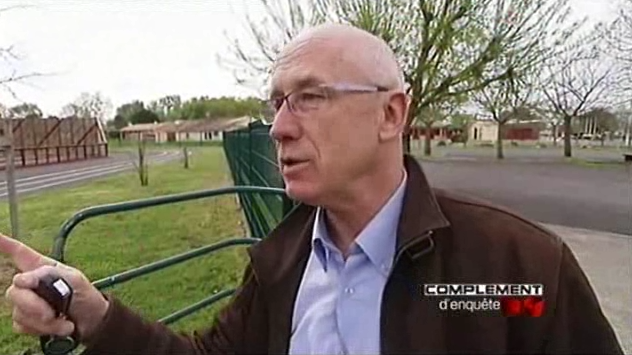
- All of this, these sports facilities, is thanks to the plant
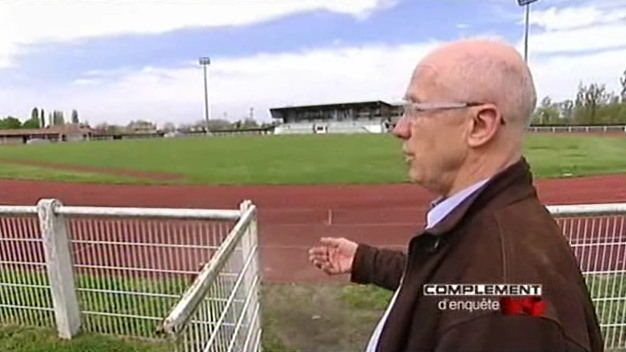
- The stadium, the three tennis courts ....
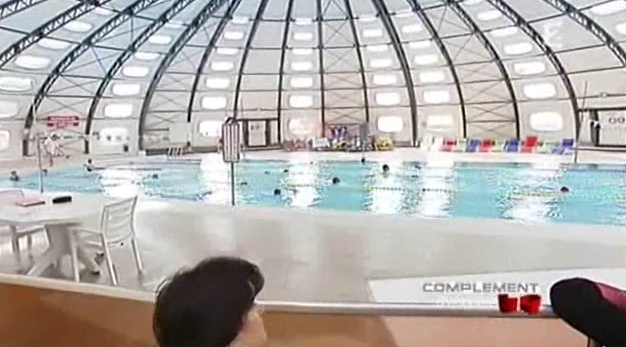
-
The pool...
-
With the salaries, this pool is a deficit of 1,000 euros per day.

- The skate park was paid for by the plant? That's cool!
As a result, the municipal council decided to include the plant on the city's coat of arms, to the left of the asparagus.

As can be seen, the report by the Complément d'Enquête team unfolds before our eyes the main issues. There remains to be addressed: the dismantling of aging power plants and the issue of waste. In both cases, we will see that the nuclear elite has no viable solution.
Next sequence, director Benoît Duquesne interviews Dominique Minière, head of all French nuclear power.
Dominique Minière, Director of Nuclear Production at EDF
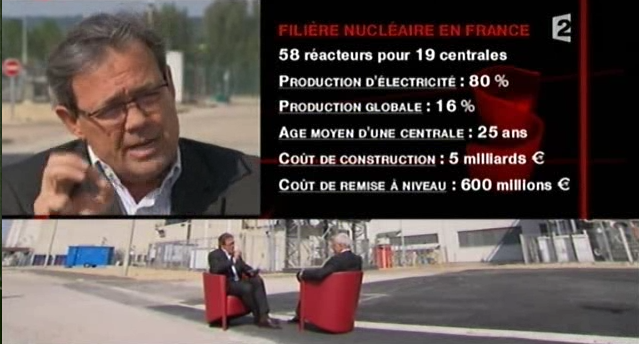
Investment in the construction of power plants, without counting the studies: 58 x 5 = 290 billion euros
Among the numbers produced by Duquesne, one of the most important is the average age of French nuclear power plants: 25 years. In terms of nuclear energy, France must "abandon or double down." The exchange between Duquesne and Minière is interesting. It is no longer a third wheel like Etienne Dutheil, who seems to constantly wonder "did I give the right answers that would satisfy my bosses?", since that has been his main concern since the beginning of his career, his obedience explaining his rise.
There are those who seek a position. Once the goal is achieved, all energy is mobilized to stay in place (or even climb a level, if it exists). Just as there is no room in Etienne Dutheil's head for any reflection, there is none in Minière's either.
When men reach a certain level of power, one might be tempted, as Einstein said about the military, to wonder if, for such individuals, a brain is still necessary, and if a cerebellum, a reflex action engine, would not be more than sufficient.
Trying to make Dutheil question the validity of nuclear energy is like trying to make a country priest reflect on the universality of his religious beliefs. (It reminds me of a conversation I had on a train with a young seminarian full of faith, to whom I asked point blank, "In your opinion, was Christ genetically compatible with the human species?" a question that unsettled this good young man).
But unsettling Minière is an impossible task. This man is a block of concrete, a single crystal of ambition. He has managed to build a thought system where he confuses his own interest with the general interest. The fusion is complete. For him, it is not the heart that has melted, but the brain (or ... both).
Duquesne questions him in the yard of a nuclear power plant, that is, in one of the cathedrals of the atom, as one would question a bishop in his fief. Duquesne's questions leave Minière as cold as a block of marble, concrete. He thinks "why did these stupid Japanese come and mess things up with their stupid disaster? When our business was going so well."
This will be the only time the Fukushima disaster is mentioned during the show. Minière will dismiss the question by uttering a falsehood:
- The cause of the Fukushima disaster was primarily the tsunami.
False, look at this photo, taken on the nearby quay.
Surface cracking near unit 2 at Fukushima
Imagine the power of an earthquake, which disregards all human "hard" achievements. The only things that survive are flexible constructions, capable of absorbing and dissipating energy in a non-destructive way. And there, the Japanese are very advanced (obviously regarding recent buildings). They manage to prevent 35-story buildings from collapsing under the effect of earthquakes, by mounting them on rubber blocks, similar to "cylinder blocks." This is the lesson from the Kobe earthquake in 1995, magnitude 7.2, that is 80 times less powerful than the Fukushima earthquake (magnitude 9).
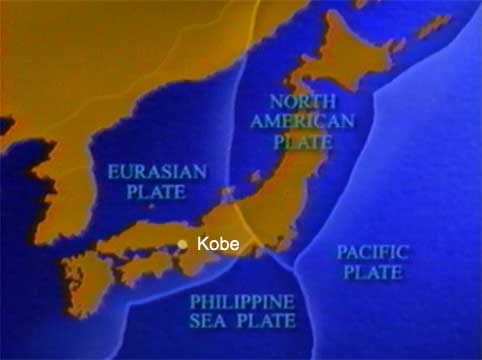
Location of Kobe, far from the places where the plates overlap
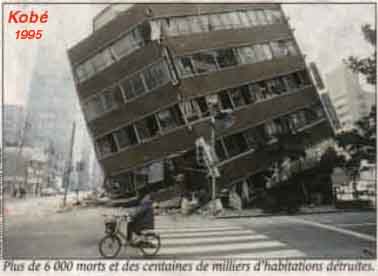
Effect of the Kobe earthquake on a building without seismic protection
It seems as if the Japanese nuclear barons (who are also plutocrats) considered that earthquakes only affect residential buildings, which are now designed to rest on flexible structures (otherwise the potential buyers would not accept to buy the apartments).
Another hypothesis: the Japanese, having bought General Electric American reactors, followed the installation plans literally, without asking any questions. Indeed, when one consults the long technical notice of these boiling water reactors, made in the USA, which I have done, among the possible incidents, there is nowhere the mention "in case of earthquake."
In Japanese nuclear energy, they have remained with the old "hard" structure, the most vulnerable structure in case of an earthquake. We heard a French ASN (Nuclear Safety Authority) official declare:
- One should not forget that the Fukushima reactors are on 8-meter thick concrete slabs.
He wanted to reassure people about the possibility that the "molten corium" could melt the slab and reach the groundwater.
This type is an idiot.
When a surface crack appears after an earthquake, it is only the tip of the iceberg, as the crack extends for kilometers or tens of kilometers below the surface. It seems that in the head of this ASN official, there is a missing "earthquake" box. When earthquakes occur, it doesn't matter if the slabs are 2, 8, or 25 meters thick. They crack.
There were damages at Fukushima due to the seismic shock, in the form of cracks. Perhaps, in Minière's head, the "earthquake" box is also missing. These elements must have been absent from the courses of the prestigious school he graduated from.
This was also the case in the heads of the Japanese who designed the entire Japanese power plants, based on concrete, including the famous pools for storing new or used assemblies. If the Japanese are currently continuously watering these pools, open-air, it is because they are continuously leaking along cracks that are impossible to locate and seal. This spreads unlimited amounts of highly contaminated water into the underground, which is then pumped and placed in storage containers, waiting for ....
This is the image of TEPCO people:
TEPCO people, working on the Fukushima site****
When one details Minière's speech, one finds another sentence, where he says "the people of TECO did not react quickly enough." Duquesne missed a retort. He should have caught the ball and said to him "what should these people have done, according to you?".
I went to the Reuters agency's page to search for the precise chronology of events.
On Friday, March 11 at 2:46 p.m., the magnitude 9 earthquake occurs.
Immediately, all control rods of all reactors are inserted, and take their place in the cores, stopping the fission reactions.
This is an automatic reaction, programmed, triggered by a hydraulic system, activated by seismographs, without manual intervention. This maneuver may be carried out using the backup batteries, as the earthquake, damaging the pylons, cut off the electricity supply immediately. And this before the arrival of the tsunami. There remain the backup pumps, installed in the basement, as is the rule in all nuclear reactors, including that of Nogent-sur-Seine, where Minière is interviewed by Duquesne.
Why in the basement? To be as close as possible to the reactor, limiting the length of the pipes.
The people of TEPCO know that a mega tsunami is coming at them in a few tens of minutes. Before the wave hits the plant, were the backup pumps operating? It is not certain. In fact, it seems that in this Fukushima plant, nothing was designed to withstand an earthquake. Otherwise, these very same pylons, which collapsed and caused the power outage, should have been mounted on elastic supports. A very easy precaution to take, for any intensity of earthquake.
What bends does not break.
Above, a TEPCO technician is shown pointing out a crack running toward a kind of well. The following photo shows the inside of this well, where electrical conductors, damaged by the fall of a concrete block, are visible.
In this cracked well, electrical conductors, damaged by the fall of a concrete block
Did the plant designers take into account the vulnerability of the "nervous system" of the plant? It is not certain either.
Even before the tsunami, it is possible that the control rooms were plunged into darkness, that the generators did not start up, simply due to the destruction caused by the earthquake.
Minière says "they should have reacted faster." What could they have done? A few tens of minutes after the earthquake, seawater flooded the diesel room and drowned the fuel tanks, penetrating through their air vents. Similarly, seawater had flooded the basements of the Blayais plant in Gironde, drowning electrical power motors, bending isolation doors, and drowning fuel tanks.
At Fukushima, seawater did not recede immediately, but after several hours, which gave it plenty of time to flood everything below the plant floor (located 10 meters above sea level).
Excerpt from the official report produced by TEPCO
When consulting the chronology of events, reported by Reuters, one sees that the first explosion (that of reactor number 1) occurred twenty-four hours after the earthquake and flooding.
On Saturday, March 12, at 5:54 p.m. local time, an explosion in the control room of reactor number 1.
On Sunday, March 13, in the afternoon, reactor number 3 explodes.
On Tuesday, March 15, reactors number 2 and 4 follow.
(Later, TEPCO technicians made ... holes in the ceilings of units 5 and 6, to prevent the accumulation of the explosive gas mixture)
Thursday, March 17: timid attempts to water the plant with helicopters (probably inspired by the Russians, at Chernobyl). Then the Japanese began watering with water, using the hoses on the riot control vehicles, brought to the site.
I return to the question that Duquesne could have asked Minière "and what would you have done?".
Even when a reactor is "shut down," it continues to generate 6% of its thermal power. The power of the reactors affected, at Fukushima, ranges between 450 and 740 megawatts. When these units are "shut down," the decomposition of the fission products, contained in the core, still releases between 27 and 44 megawatts, which heat the water present in the reactor, which has stopped circulating.
The steam pressure rises. All that the technicians can do is open valves allowing this steam to escape, and flood the handling room, located above the reactor.
But in the reactor vessel, the water level drops. The parts of the assemblies, prismatic elements 4 meters long, which are no longer covered by water, which can evacuate the heat, but by steam, much less conductive of heat. These elements increase in temperature.
At a thousand degrees, and it is quickly there, the zirconium cladding decomposes the water molecules into a mixture of hydrogen and oxygen.
When the TEPCO technicians open the valves, this is already the case. And it is not only steam that floods the handling room, a closed room located above the reactor containment, but an explosive mixture of hydrogen and oxygen.
On Saturday, March 12, explosion in the control room of reactor 1
On Sunday, March 13, the next day, reactors 2 and 3 do the same. With a big question mark about the exact nature of the explosion of unit 3.
When the temperature of the "zirconium cladding" reaches 2500°C, they release their contents: fuel pellets, plus fission products, radioactive, plus plutonium, in the case of unit 3, which is loaded with the terrible MOX.
- Mr. Minière, in the place of these people, what would you have done?
The question was not asked. A pity. But one cannot think of everything. One could also have said to this "nuclear policy":
- Let's transpose it to the history of Blayais. Imagine that the consequences of the hurricane had been worse and that the four backup pumps had been drowned. What would have had to be done, under these conditions?
Earlier, Dutheil immediately evaded the question. Minière would have done the same immediately, because if one reaches that point, it is guaranteed catastrophe, Fukushima II. And this sword of Damocles is hanging over 1,480 reactors around the world:
- Shutdown of the pumping groups, including the backup units
- Rise in temperature of the water in the reactors
- Obligation to release steam to avoid explosion
- Drop in water in the reactors, exposure of the upper part of the core (70% in unit number 3 of Fukushima)
- Production of the explosive hydrogen-oxygen mixture by decomposition of the water molecule in contact with the zirconium tubes heated to over 1000°C
- At 2500°C, rupture of the cladding, release of its contents.
Same scenario in the pools, where the used elements also release heat and where the cooling water must circulate imperatively. Add that the pools can contain 10 to 30 times the content of the core (from decades of operation).
Duquesne is right to say to Minière "isn't this playing with the devil?", a question all the more relevant since Minière answers "there is no zero risk".
Then this high-level nuclear baron will come out with things that fall to the ground, the older the reactors, the safer they are. He will even go so far as to claim that Fessenheim, one of the oldest, is one of the safest, because the progress of the calculation codes allows a better evaluation of the reaction of this unit to an earthquake.
He forgets to say that the cores of the reactors lose their solidity, due to neutron bombardment, which structurally degrades their steel (same for concrete, which becomes ... porous, as we will see later). But maybe this parameter was forgotten in the calculation codes used by "the authors of the learned studies"? And who knows the exact value of the resistance of the Fessenheim vessels under the effect of pressure rise (the pressure of reactor number 3 did indeed "fissure").
But Minière shows a confidence that is bulletproof. He mentions the creation of a sort of nuclear task force, groups supposedly intervening in case of a failure, composed of "experts in the unpredictable." You know the motto:
| - What is possible, we do it right away | - For the impossible, we ask for a delay |
|---|
Transposing to nuclear energy, one could write:
| - Facing the predictable, we react right away | - For the unpredictable, we ask for a delay. |
|---|
Earlier, I reproduced an animation showing the Fukushimen pumping. Let us note in passing that no progress has been made regarding the strategy adopted (as of May 2, 2011, fifty-two days after the disaster). If the authorities claim "that the situation is under control," it remains that they are spraying everywhere (now projecting water with powerful cement pumps) the reactors and the pools and that this water, carrying with it masses of radionuclides from fission, becoming highly radioactive, flows everywhere, floods basements, where it is pumped and sent to storage tanks, waiting for ....
We are still in the provisional.
As Michio Kaku pointed out in a recent interview, on the ground there are a hundred TEPCO technicians. Whatever they do, these people accumulate the effects of ambient radioactivity. Kaku says it would be smarter to bring in the army (100,000 men), and replace the teams as they reach the maximum dose, of 100 milli-sieverts.
But the Japanese government finds the solution. It raises this maximum dose to 250 milli-sieverts.
No one has asked, or will ask Minière the question:
*- What would have been appropriate to do at Blayais, if the four backup pumps had been damaged by the flooding? *
His implicit answer is that "this is unthinkable." Throughout the interview, he will emphasize the positive side of the incidents and accidents "which allow us to progress towards more safety".
Minière is the French nuclear Shadock

Dominique Minière, Director of Nuclear Production at EDF ---
Articles on seismicity are generally better written in the English Wikipedia
(but many articles on the French side are actually translations of English articles)
P-waves (surface, propagation either linear or radial, from an epicenter) http://en.wikipedia.org/wiki/P-wave
S-waves (torsion waves) http://en.wikipedia.org/wiki/S-wave
Rayleigh waves (comparable to ocean waves) http://en.wikipedia.org/wiki/Rayleigh_wave
Love waves (same, with "discrete" propagation, along dislocations) http://en.wikipedia.org/wiki/Love_wave
These pages contain very informative animations
It would be naive to think that earthquakes only occur at the points of friction of large plates, as was the case for the magnitude 9 earthquake, which originated 240 km off the coast of Fukushima. The Kobe earthquake, of magnitude 7, had its epicenter at a shallow depth ... under the port of Kobe.
The epicenter of the Kobe earthquake, 1995 (6,500 dead):
far from any plate boundary
Geologically, this earthquake occurred on a relatively young fault, which had never shown significant seismic activity. Thus, the Kobe area was considered safe, compared to other regions of Japan.
The damage to the buildings is due to the fact that this earthquake produced strong vertical amplitudes (up to one meter).
The 55 nuclear reactors installed in Japan over the last three decades are a real sword of Damocles. One can consider, in relation to what could happen in the case of an earthquake whose epicenter is closer to reactors (especially those loaded with MOX, thus containing plutonium!), that the Fukushima episode is "a kind of free warning," compared to what could happen in an unpredictable future. The radiological consequences of this catastrophe are far from having been evaluated

TEPCO Society presents its most humble apologies
Considering the consequences of a major nuclear accident, choosing a nuclear energy policy was a serious recklessness on the part of Japanese decision-makers (before the disaster, 68% of Japanese were in favor of nuclear energy, which had been presented as a "clean energy"). A reverse gear and an accelerated development of renewable energy are necessary.
Building nuclear reactors in a country subject to chronic seismicity is equivalent to placing glass bottles filled with an extremely toxic substance on a shelf.
The Complément d'Enquête broadcast on April 16, 2011, continues with the question of radioactive waste storage.
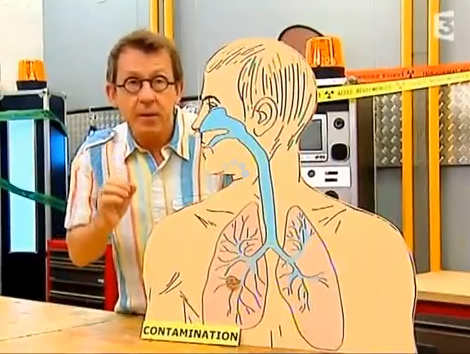
****http://www.youtube.com/watch?v=2SOWCy9N8o4&feature=related
****http://www.youtube.com/watch?v=PGCgqecxBUQ&feature=related
****http://www.youtube.com/watch?v=QNxAuntjsow&feature=related
A good episode of "C'est pas Sorcier" where the toxicity of elements and the different waste and storage systems are well presented
:
1
2
3
Meanwhile, here is a map of French sites, power plants and waste storage sites. 58 reactors in total. 12 reactors out of service, 2 in the process of dismantling (...).
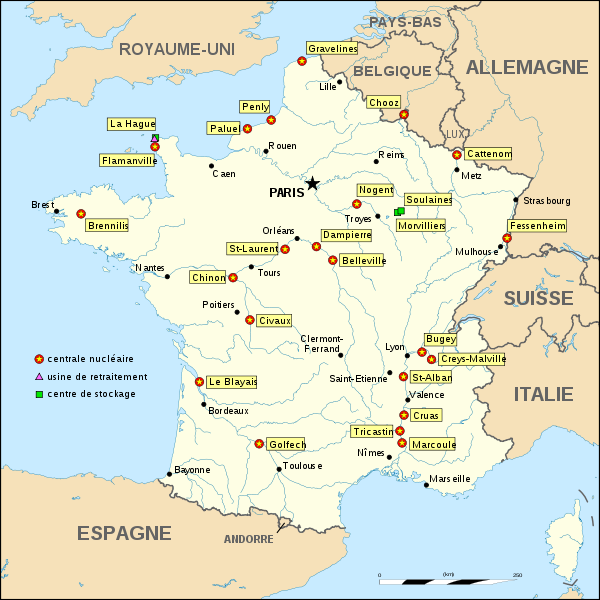
In France, in a forest in the Aube, in Soulaines (map), they have begun to set up a site consisting of 500 hollow parallelepipeds, made of reinforced concrete, 8 meters high and 50 cm thick.
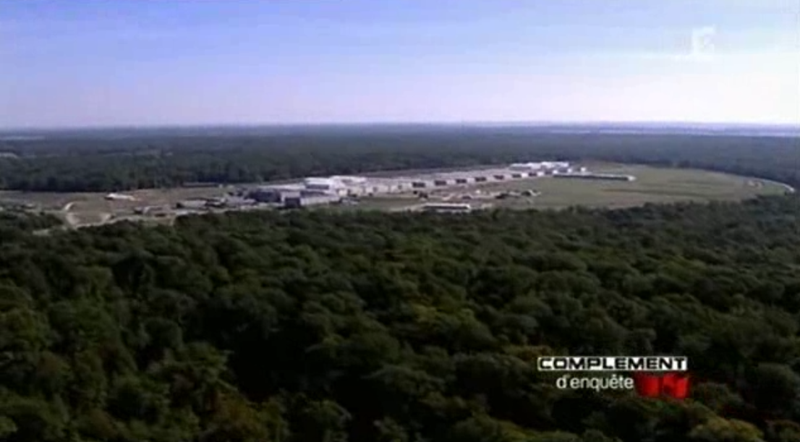
Like you, I discover the largest nuclear necropolis in the world, in Soulaines, in the Aude
An slideshow on the site of Le Monde
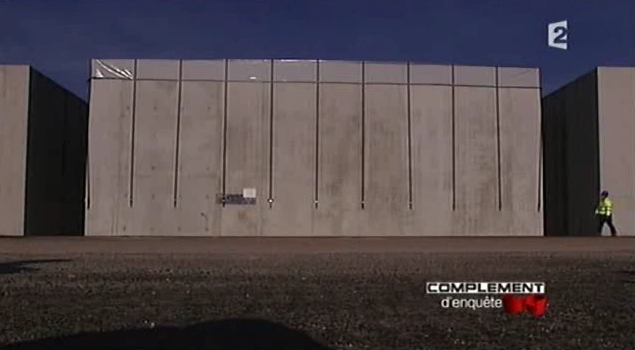
The nuclear cemetery
Here, I want to change the order of presentation of themes. A preliminary question is "why nuclear waste, and in what quantity?"
You imagine the dimensions of nuclear power plants. There is the vessel containing the core, six meters in diameter, fifteen to twenty meters high, twenty centimeters thick, made of steel. You first imagine, as waste, the fuel elements. Then all the elements that make up the "ash" of this modern steam machine. Poisoned ashes, highly radioactive. But all this is only a tiny part of what you inherit when you want to dismantle, deconstruct a power plant. Here, we plunge into complete absurdity. Indeed, only two percent of the elements of such a plant will be recoverable ... recyclable.
We are in the absolute non-recyclable, the ultra-pollutant. Simply because practically everything in a nuclear power plant is subjected to a bombardment and acquires induced radioactivity. Radiation creates, within the smallest pipe, the smallest beam, the smallest valve, by transmutation, nuclei that did not exist in their components and which turn out to be radioactive. In the documentary, you will hear a young woman talk about "short-lived" radioactive waste and you will learn that she is talking about elements that will remain radioactive, dangerous, for "only three hundred years."
There are wastes that will remain radioactive for much longer periods, for hundreds of thousands of years!
What objects?
EDF has been working on the dismantling of a power plant for twenty years, and during this time 50% of the objects that compose it have been able to be "treated".
Treated, how?
Look at these images. Two technicians are working to cut a long and heavy steel beam into 50-centimeter-long sections
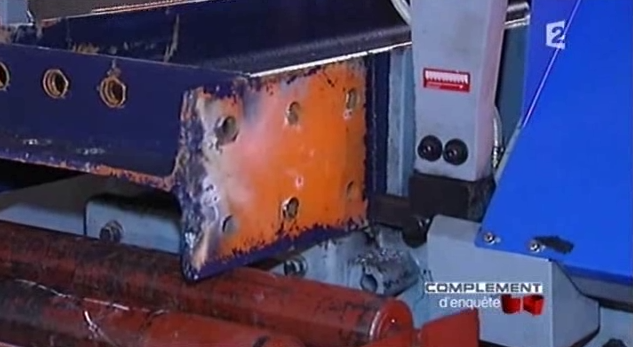
Here is a heavy "I" beam that two workers are finishing cutting
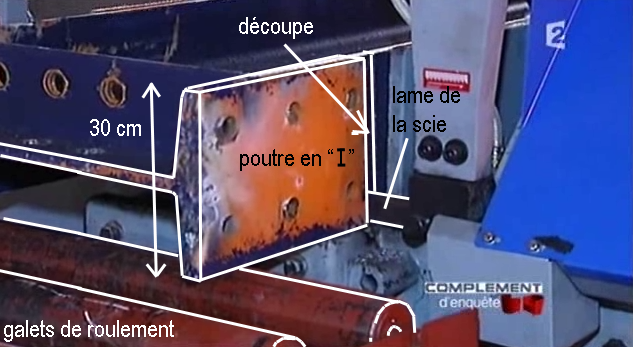
**And here is the same image, with captions. **
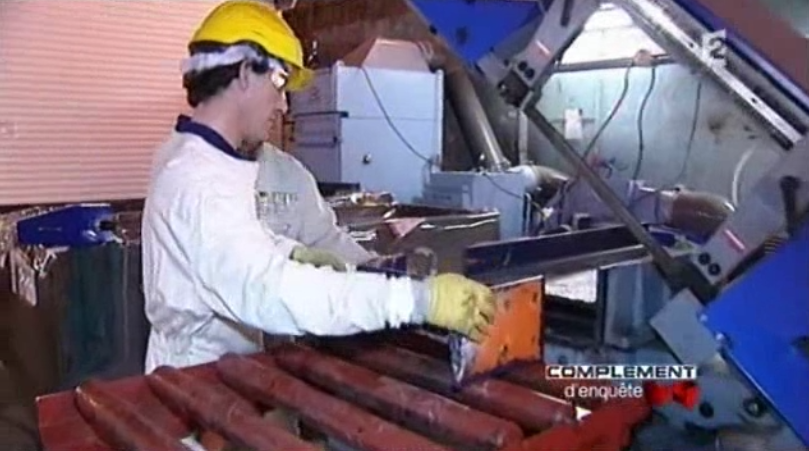
Here, a worker takes the cut beam section. On the right, you see the saw, which has fallen.
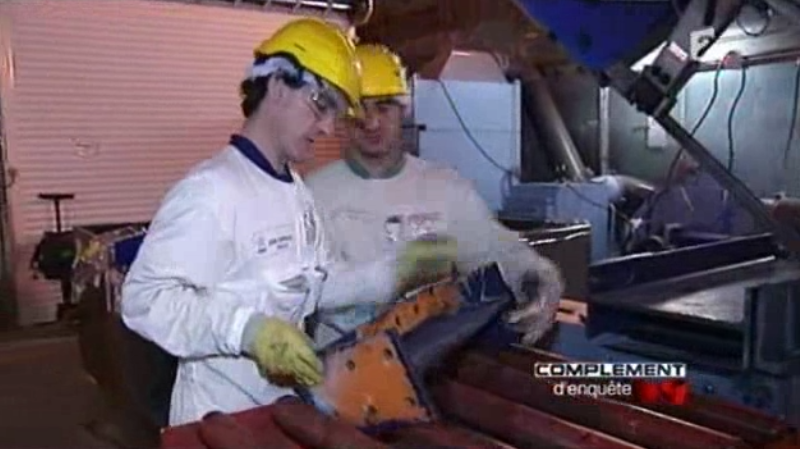
Two workers take the cut section
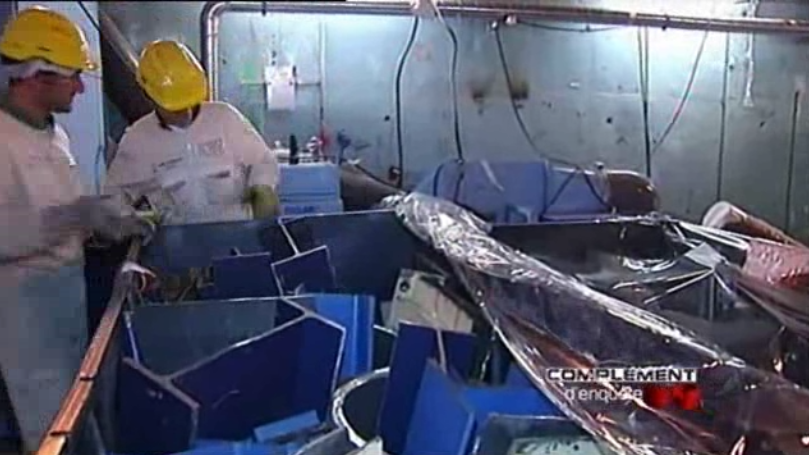
and put it in a container, with other sections of the same kind
The commentary says that the dismantling of a power plant is extremely long and can last ... 35 years, or more. The plant where the team took these images was shut down in 1991 and since then the work of "dismantling" (presented by EDF as a model) has never stopped. In twenty years, half of the work has been done. And this is one of the smaller power plants in France, next to which the EPRs that we plan to build would look like monsters.
Here, you see workers handling metal fragments with their bare hands. These are only weakly radioactive, but too much to "release into nature", to recycle. It is impossible to reuse this metal in a foundry.
Other wastes are much more emissive, and those who handle them cannot approach them for long. Here, you are shown a heavy steam exchanger, through which, during the "life" of the reactor, radioactive water was used to extract the heat.
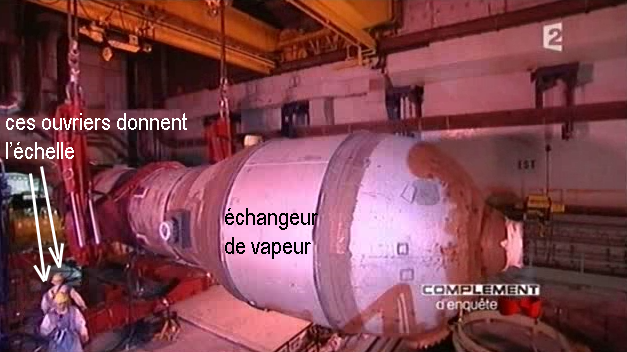
This exchanger will have to be decontaminated (a task that will take months)
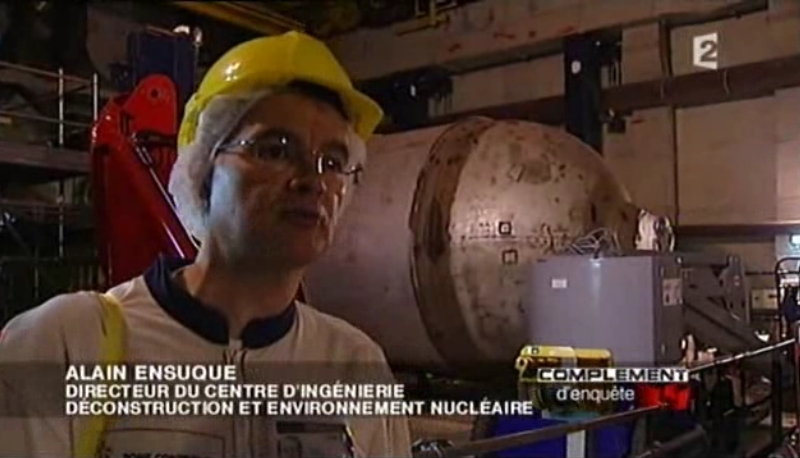
- This exchanger contains contaminated water
Then it will be cut (...). Beyond that, everything you see in the image will also have to be "dismantled," cut into small pieces, everything in the background, including the heavy crane that was used to place this exchanger.
A little further in the dossier put together by the Complément d'Enquête team, we will visit the Breton nuclear plant of Brennilis, which has been shut down for 25 years. For a quarter of a century, they have been trying to dismantle it. The dismantling of the storage center for assemblies, and some annex buildings, has already cost half a billion euros. The reactor building itself is intact. No one knows how to go about it.
In three decades, EDF has not managed to dismantle a single one of its reactors, yet it wants to build dozens more!
The dismantling of the 58 French reactors represents 100,000 tonnes of waste to be stored "somewhere", an average of 2,000 tonnes per reactor. Radioactive waste, with a long-term duration (of the order of several hundred thousand years) represents 482 tonnes.
Producing electricity with nuclear power means spending 5 billion euros for each reactor built. Then, thirty years later, the dismantling of each of these units is equivalent to cutting a medium-sized war building into small enough pieces to fit into 200-liter drums. Then, there remains the handling of these dangerous wastes, with a toxicity surpassing the lifespan of the human species, transporting them, storing them, and ensuring their monitoring over an absolutely unlimited period.
At Brennilis, a beginning of dismantling has already cost half a billion euros. How much will it cost to dismantle Fessenheim, Super Phénix? And how?
French power plants have an average age of 25 years. Many are at the end of their life and will have to be dismantled. Has anyone calculated the cost of such an operation for the 58 existing reactors?
When one talks about the "low cost of electricity production by nuclear power," is the cost of dismantling, storage, and monitoring of waste taken into account?
I have not seen these figures.
The atomic barons are ready to deploy EPRs, fourth-generation reactors, waiting for the next ones. But who will pay for the "deconstruction" of all this? Our descendants, I suppose. A nice inheritance.
**It's time to build a large-scale alternative project to escape from this madness! ** ---
**In the section on waste storage, you will discover the continuation of this generalized irresponsibility. **
Waste is placed in concrete, calling the whole thing a "package." Unfortunately, over time, it becomes ... porous and releases small molecules, like tritium, a radioactive isotope of hydrogen, a link in a decomposition process. Initially planned to generate zero nuclear pollution, the legislator is forced to revise his text and decide that this waste site must not emit radionuclides "at a rate exceeding a value that could harm public health."
The qualities of the best concretes cannot be maintained for more than 120 years. No paint or steel can ensure indefinite containment and eventually oxidizes. All the containers dumped into the sea from 1950 to 1980 have oxidized, degraded, and released their contents into the sea. Absorbed by microorganisms, fish, they eventually ended up ... on our plate.
Soulaines: it seems like a psychiatric hospital. But no, you are in France. In the necropolis of the third millennium, barrels are stacked. A layer of barrels, a layer of concrete.
The report will take you to other sites, where underground storage is considered for long-lived waste. Hundreds of thousands of years. All of this at 450 meters deep, in a clay layer, where tunnels will be dug where a robot will push, at the rate of the deadly barrels, forming the "wine" of the Devil.
Indeed, tons of spent fuel or waste from "reprocessing" are waiting, in large pools, in various locations, including at the Hague, in the Cotentin.
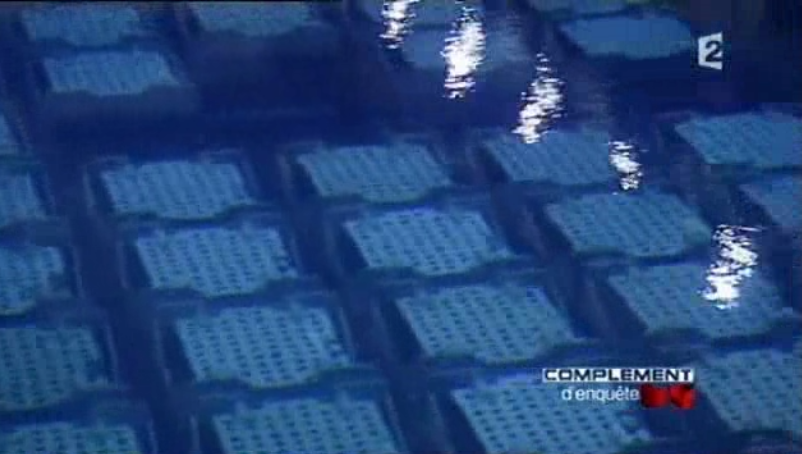
Under clear water, the poison .
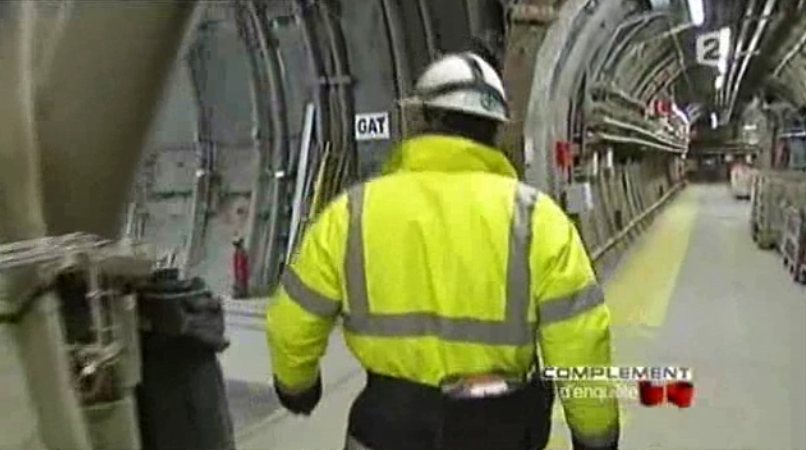
Bure, located at the border between Meuse and Haute Marne.
Tunnels dug at 490 meters depth, in a 60-meter thick clay layer
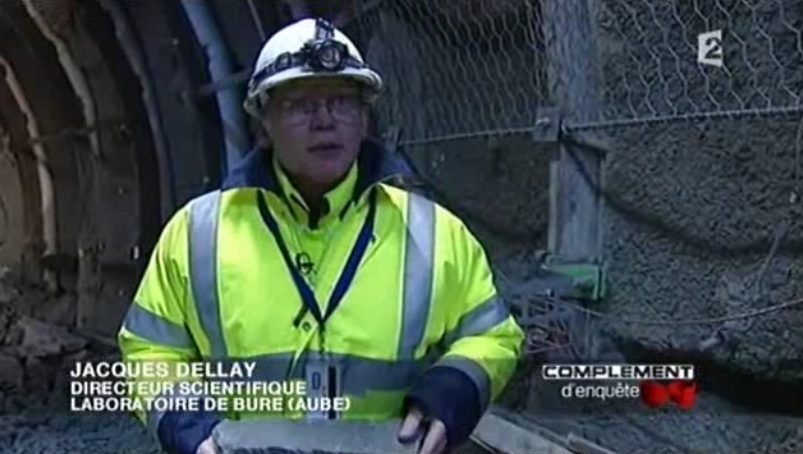
Jacques Delay, champion of "geological storage"
*- All our studies have shown this so far ..... *
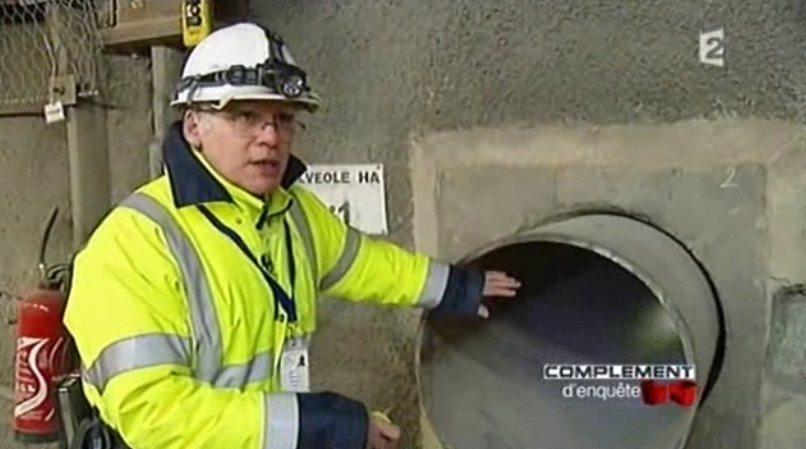
- Radioactive packages will be pushed into this casing, made in the clay layer
Expensive drilling, new studies. Sophisticated equipment. For nuclear power, nothing is too beautiful, nothing is too expensive....
One might think that the choice of this storage site comes from meticulous geological studies. But another criterion comes into play: the region's desolation. It is expected that in a sparsely populated area, where unemployment is rampant, the acceptance of the site's installation will be easier to obtain.
A way to counter this policy, involving heavy investments, would be to demand the construction of solar thermal power plants, in a region where hectares are unused. These plants (1 megawatt per hectare, in sunny regions, with energy storage in molten salt) would provide energy and jobs, reviving regions on the verge of complete desertification.
Simple remark: *The reconversion of the Cararache site (1625 hectares) into a solar power plant would allow the production of 1625 megawatts in "solar-thermal", enough to supply electricity to a large part of the region. In addition, the staff and equipment could be reused. *
The commentator adds, returning to this Bure site:
*- This laboratory, for experimental purposes only, has already cost one billion euros. An additional thirty-five would be needed to dig a site capable of housing all French waste for 100,000 years, and we are asked to believe that everything is under control. We are facing engineers who think that the Earth will never move. But before them, their German nuclear colleagues also believed they had found the ultimate solution, by storing 130,000 radioactive barrels in a salt mine, the Hasse mine, in the 1970s. *
Geologists assured them that this region had been stable for millions of years and that salt was the best insulator.
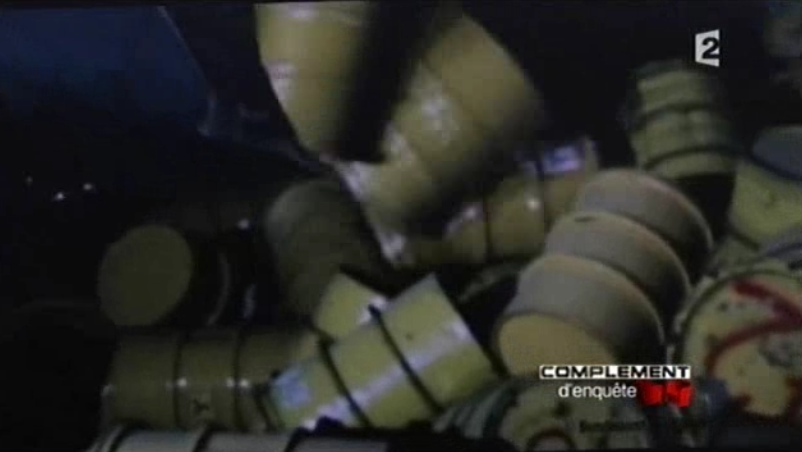
. .
**But this storage has become a real disaster, a time bomb. **
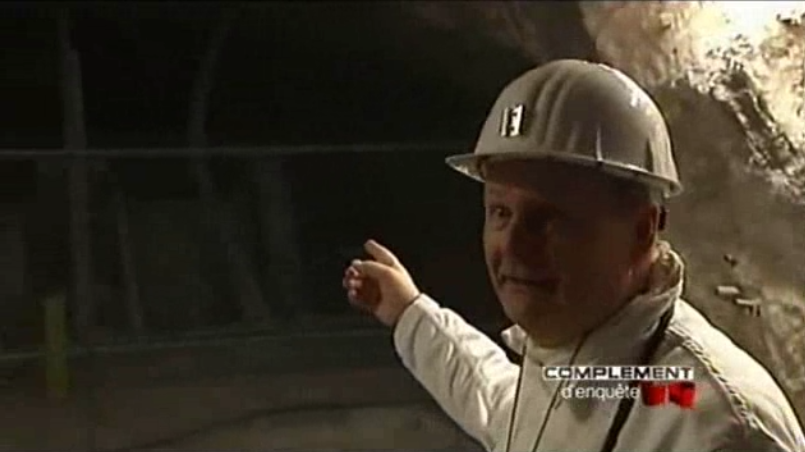
*- Look: the mountain is working. The poles are twisted under pressure. The mine has moved six meters, threatens to collapse. The salt has cracked. The movement reaches ten centimeters per year. There are water infiltrations. This water, now radioactive, accumulates in puddles. The barrels are no longer airtight. In the end, their contents will pollute the groundwater. These barrels will have to be removed. * ---
May 5, 2011: I had promised to add this, even though it wasn't mentioned in the Complément d'Enquête program.
It is interesting to look back on this issue of waste. You know the story of the bomb, beautifully told in a film where Paul Newman plays the role of General Groves, the organizer of the Manhattan Project. A film titled The Shadow Makers (The Masters of the Shadow).

In sites like Hanford, located on the banks of the Columbia River, in the middle of the desert, several plutonium reactors were built, with their cores cooled by the river water. At that time, considering both the ignorance of the effects of radioactivity and the urgency of the war, the Americans were content to draw water, use it to cool the cores, and then discharge it into the Columbia, near the place where the many employees of this secret center bathed to combat the heat.
Later, it turned out that it was necessary to manage large amounts of radioactive waste. Large elliptical concrete containers were then built. But, decades later, these enclosures, although thick, became porous. Work had to be done to extract their poisoned contents. The banks and bed of the river, where salmon spawn and are then consumed, are irreversibly polluted.
May 4, 2011: The face-to-face between Benoit Duquesne and Dame Kusciusko-Morizet
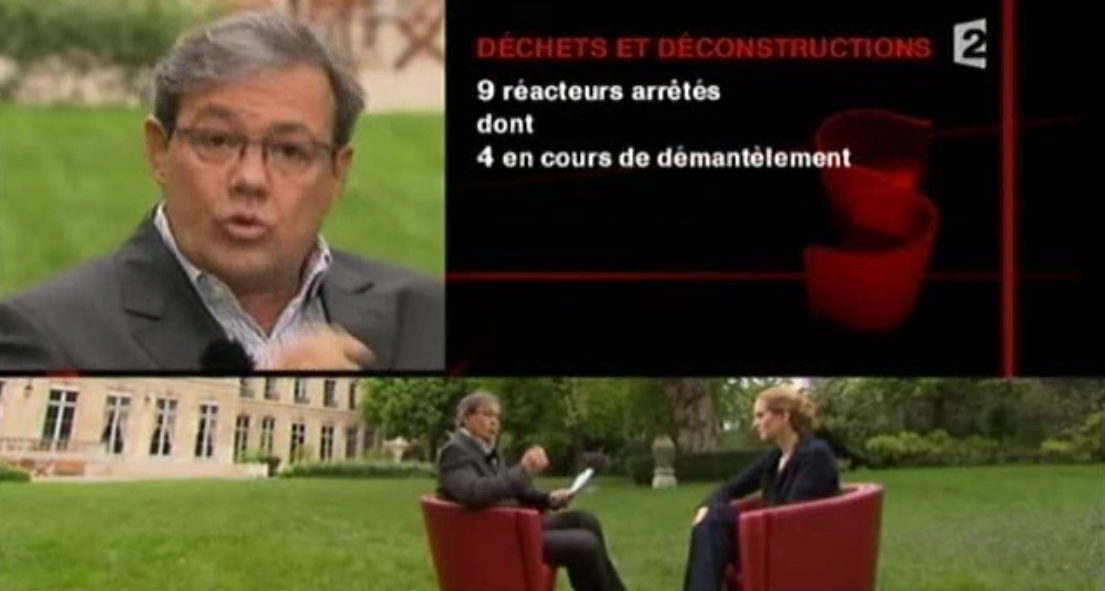
The program continues with a face-to-face between Duquesne and Dame Kusciusko-Morizet, Minister of Ecology, Sustainable Development, Transport and Housing (what a small head to gather so many competences!.)....
This interview will be quite brief. The minister will not be particularly brilliant.
Duquesne and Dame Kusciusko-Morizet, not really in her element.
Minister of Ecology, Sustainable Development, Transport and Housing
Duquesne talks about the attempts at dismantling, like that of the Brennilis plant, specifying that the initial estimate was 25 million euros, but after 25 years it had risen to 500 million euros, and of the 2000 tonnes of waste that a plant to "dismantle" consists of, only one to two percent can be recovered, "recycled".
A well-rehearsed response from the Minister.
*- These are the first plants. The technologies and methods are still under development. *
You have seen the images, above, showing two brave workers laboriously sawing a powerful steel beam. How can one imagine that "more refined methods and techniques" could reduce the cost of these "dismantlings" by a factor of twenty? Sawing these beams with a laser? This woman is playing with our heads. She answers with words. The most beautiful expression is:
- There will need to be greater clarity in the sector.
That's a good one. Anyway, when politicians are caught red-handed in absurdity and waste, they invariably respond that all these things have not been sufficiently explained to the French.
The Blablatron is in motion.
Many decades ago, the linguist and humorist Feu Escarpit published a delightful book titled "Le Litteratron". When he wrote this work, computing was in its infancy. The theme was that a computer, sufficiently fed with data, could generate language without difficulty (just as, later, my Logotron could create tens of thousands of neologisms).
I regret that I can no longer find (unless it exists and I'm unaware of it) versions of the software, created in the 1970s, called "Eliza". This program simulated non-directive behavior (that of a psychoanalyst) by always returning your questions, like the "wall" of a tennis club returning balls. If it no longer exists, someone should create a JavaScript version of it.
There is a program to write, which would be the POLITOTRON. If I had time, I would write it.
To summarize.
The software was designed so that the person using it could believe they were facing a real human being.
http://eliza.levillage.org/index.html
http://www.charabia.net/gen/gendisp.php?gen=1
http://www.presidentielle-2007.net/generateur-de-langue-de-bois.php
May 5, 2011:
I am informed that there are French versions of this software. But they are less effective, compared to the version created in the 1970s. It needs improvement. You can still take a look at:
A
Otherwise, my readers point out
U
a random generator of philosophical texts:
U
a generator of presidential speeches:
Example of "dialogue" with Eliza (according to the program created in the 1970s):
User: Hello, I want to talk to Henri.
Eliza: Why do you particularly want to talk to Henri?
User: Because I want him to return the video cassettes I lent him.
Eliza: But in this request, are you not showing your sense of ownership?
User: But after all, it's normal that I try to recover what belongs to me!
Eliza: Calm down. Why do you consider this action normal?
User: What a ridiculous behavior. Give me Henri, damn it!
By what miracle can a simple computer program formulate answers that create the illusion that you are facing a real interlocutor?
Eliza was a very primitive program, running on a simple Apple II (clocked at 2 megahertz, with 48 K of memory). In fact, the program only recognized sequences, "strings" of characters. It extracted other strings and served them back to you. Take this dialogue and imagine that you change the questions (typed on the keyboard):
User: Hello, I want to RSDFHYU.
Eliza: Why do you particularly want to RSDFHYU?
The computer recognizes the string of characters "I want to" and serves back ... what follows, that is, the string of characters RSDFHYU.
Continue.
User: Because I want him to return NHDCOP that I lent him.
Again, the program recognizes the text in blue and formulates a pre-programmed response:
Eliza: But in this request, are you not showing your sense of ownership?
User: But after all, it's normal that KMFEDSXB!
The program detects that the sentence ends with an exclamation mark, which it interprets as a sign of nervousness from the interlocutor.
Hence the first element of the response:
Eliza: Calm down.
Then, after detecting the string of characters "it's normal that":
the program will display:
Eliza: Why do you consider it normal that KMFEDSXB?
User: What a ridiculous behavior. Give me Henri, damn it!
The blue-colored character strings suggest that the interlocutor, in a rage, has made some language errors. Hence the following reminder:
Eliza: If you cannot maintain your composure and remain polite, we will interrupt this conversation.
With the current computing capabilities, multiplied by millions, it would be possible to produce a program much more elaborate than Eliza, capable of recognizing a larger number of character strings, language segments, and delivering responses that make it more difficult to identify the deception. Take the exchange between Duquesne and this woman, and transpose it:
Duquesne: I want to quote some figures. The WXCVBGY, which was initially budgeted at 25 million, saw its budget explode to 500 million.
Dame Kosciusko-Morizet: I confess that this issue of WXCVBGY is a major concern. But we are only at the beginning. The methods and techniques will progress.
Duquesne: Don't you think that the government is making a mistake by persisting in this PMKGTFD sector?
Dame Kosciusko-Morizet: There is first of all a communication problem. The government has not communicated enough about PMKGTFD. What matters is the clarity of this PMKGTFD sector.
Robotics has made great progress. Duquesne was tricked. He was not facing the minister, but a robot or, in other words, a woman whose brain was unplugged. Only the cerebellum was functioning.
This is also the case for many political figures in the world today. Moreover, sometimes wires touch and these people make slips, revealing programming bugs or remnants of previous programming, like "fellatio", "dildo", or "shit gas".
From now on, you will listen more carefully to the speeches of politicians to perceive the programming elements at work.
Eliza had ready-made phrases when the program was faced with questions it could not analyze. Among these standard sequences, one was very popular:
- Tell me about your mother....
Transposed into the political world, this would give:
- This is a good question, and I thank you for asking it ....
The French were laughing when they discovered the content of François Hollande's first electoral speech, unknowingly repeating the same themes used by Nicolas Sarkozy in his campaign. But maybe the secretary of the Socialist Party used the same automatic speech generation program?
Programmers, to your keyboards. Create automatic speech generation software. You will be surprised at how easy it is, how robust the computer structures are to implement, within the reach of any high school student (if readers create such software, in JavaScript, they will be put on my site, as a demonstration of feasibility, on the theme "become a politician. You will see how easy it is. Anyone can do politics", like cooking, as Master Gustot said in the animated film Ratatouille).
In his book, Escarpit had imagined the first completely computer-generated election speech.
I submit my personal attempt:
*- Frenchmen, Frenchwomen. At a time when purchasing power is eroding, when gloom is settling in, when discouragement seems to take hold of some, confused, tempted by abstentionism, I say to you: it is not the time to give up, quite the contrary. The French have always known, throughout their history, to draw on their own resources, which have allowed them to rebound in situations we have known, which seemed so much more desperate than they are now. I therefore invite the French to rebound with me. Together, let's rebound, focus our energies to build a world our children can be proud of, let's invent a new future. Everything is to be done, to be imagined. Join the party of the rebound. * ********
http://www.presidentielle-2007.net/generateur-de-langue-de-bois.php
http://pdos.csail.mit.edu/scigen/
http://narcissique-corp.fr/generateurs/langue-de-bois/
Readers immediately sent me to several generators embodying Escarpit's idea, 40 years ago:
There are also generators of scientific articles, with graphs, references, etc.
You enter your names as authors and click on "Generate".
Here is a generator of bureaucratic jargon. I think these machines could be improved to the point where we would no longer be able to distinguish what they produce from Sarkozy's speeches.
If you re-listen to the speech of Dame Kosciusko-Morizet, you will find some absurdities.
As the dismantling of nuclear power plants is an insoluble problem, she talks about the energy to be spent to produce photovoltaic sensors and the problem *of the dismantling of solar farms. *
It's really nonsense
When she talks about solar energy, it seems she only knows photovoltaic cells and knows nothing about large-scale solar thermal energy (Andasol). One does not exclude the other, we hasten to add.
It will be necessary, urgently, to produce a complete description of the equipment of vast French regions, in the process of desertification, as solar power plants (thermal, which will put an end to the argument regarding the import of photovoltaic cells from Asian origins) capable of producing hundreds or thousands of megawatts, storing energy in underground and isolated volumes made up of molten salts heated to 400 degrees, equipped with heat exchangers, gas turbines, alternators, rectifiers, to ensure long-distance transport in the form of direct current (and also underground, which will no longer ruin the landscape, as the 250,000 existing high-voltage pylons). This does not exclude wind (a bit rethought), hydro and geothermal.
Do you know, for example, that Iceland could indefinitely exploit its geothermal potential by exporting its electricity, towards the north of England, using a submarine conductor operating in continuous, high-voltage. The Red Gold, so to speak. Before exhausting Iceland's geothermal resources, it will take a long time.
Such installations, located on French territory, must be considered as part of the country's equipment, just like hydroelectric dams, and it will not be necessary to "dismantle" them.
Indeed, here is a "Minister of Ecology" who is doing exactly the opposite of what her function dictates. She defends the most polluting enterprise possible: nuclear power, clings to fallacious arguments, displaying, like Allègre, her ignorance and incompetence.
Nevertheless, there is panic in these high circles. Recently, Dame Kusciusko-Morizet had a "specialist", "expert", "official service" map the seismicity in France. Here it is, updated:
The seismicity map in France, updated at the request of Dame Kusiosko-Morizet
At the top, Gravelines, epicenter of a strong earthquake in 1580. Standing on this historical site, President Sarkozy recently said in May 2011 this historic phrase:
*- No to seismicity! *
It seems to be a "macro-seismicity" map, which does not take into account events that have occurred or may occur on a smaller scale. Pertuis, where I live, is a few miles from the village of Lambesc, completely destroyed by an earthquake of magnitude 6.2 in 1909.
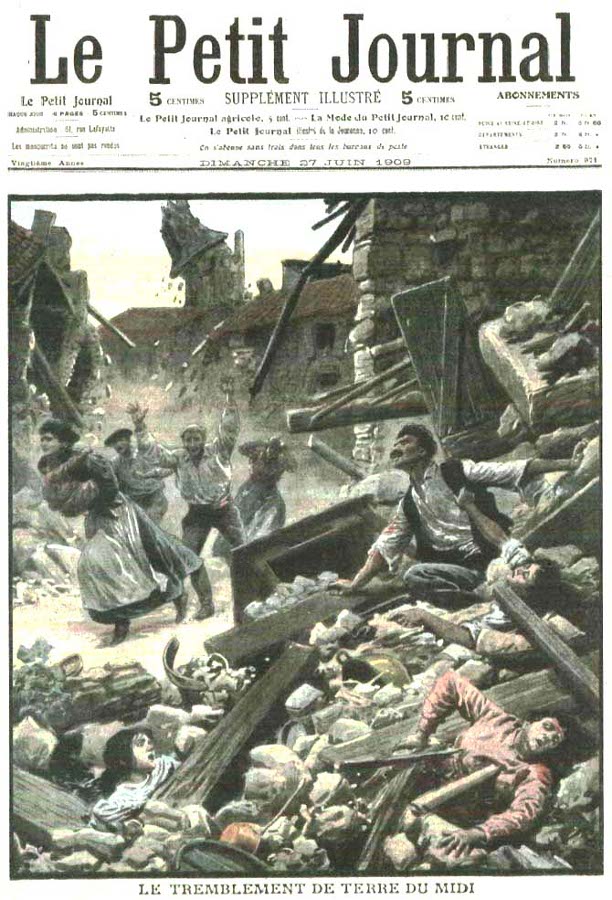
The earthquake in Lambesc, 1909 (46 dead)
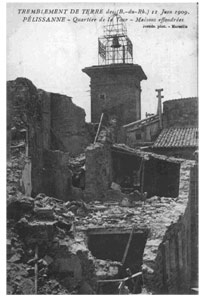
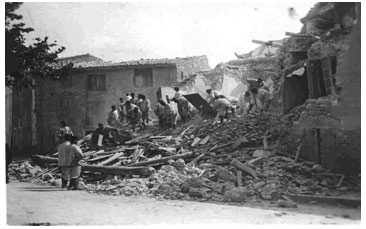
"France is not a country subject to seismicity" (Claude Allègre, April 2011)
The damage spread to neighboring cities, such as Salon de Provence (today 40,000 inhabitants)
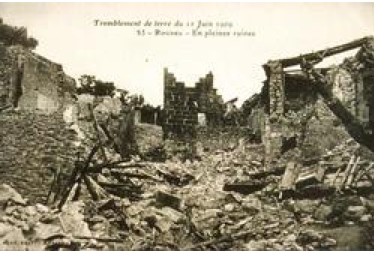
Damage in the neighboring city of Salon de Provence
"Regional micro-seismicity"
My own home had to be seriously repaired (chaining), following this memorable event.
Looking at the rest of the video, you will be faced with the government's policy of restraint regarding solar and wind energy, which will only intensify in the current situation. It is necessary to come to the aid of the nuclear sector.
Journalist Benoit Duquesne is now investigating the photovoltaic sector. In 2009, President Sarkozy made very firm statements, indicating the government's support for this sector.
Sarkozy, during the 2009 visit
followed by his recorded statement by the media:
- France decides to invest in photovoltaics, in the long term, on a long-term basis
[Video clip](/VIDEOS/sarko .avi)
Many companies are investing in this sector. Businessmen are heavily indebted.
"Solar farm"
To encourage this sector to develop, the State announces that it will buy the electricity produced at a price higher than the market. The sector therefore develops very quickly. But in December 2010, a sudden brake. The State retracts its commitments. At the beginning of 2011, this photovoltaic sector is simply collapsing, in silence and indifference.
Businessmen driven to bankruptcy, heavily indebted, who had believed in these commitments
Useless protest letters to the minister, invoking the beautiful declarations of the Grenelle de l'environnement
*Nobody is "governed by elites", but by oligarchies and incompetent policies, who lie daily and serve above all the money powers and dominant lobbies. *
Benoit Duquesne then questions Cécile Duflot, who confirms that this measure is indeed intended to protect the nuclear sector, which has benefited in recent years from 98% of the credits allocated for research in energy, compared to 2% for renewable energy.
The argument advanced by Nathalie Kusciuslo-Morizet, regarding the cost of photovoltaic cells, the cost of materials, their lifespan, can easily be circumvented by mentioning the "solar thermal", as developed in Spain in the installation Andasol, where energy is captured this time by simple steel mirrors.
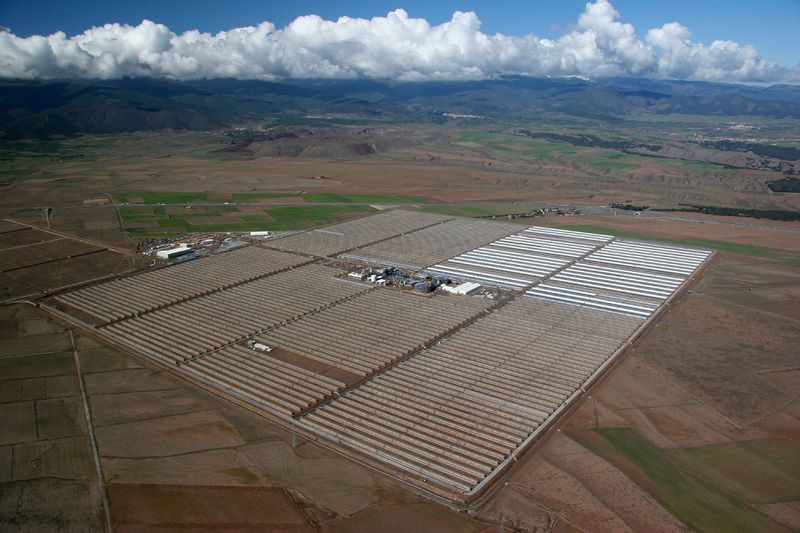
The Andasol site, in Andalusia: 50 megawatts
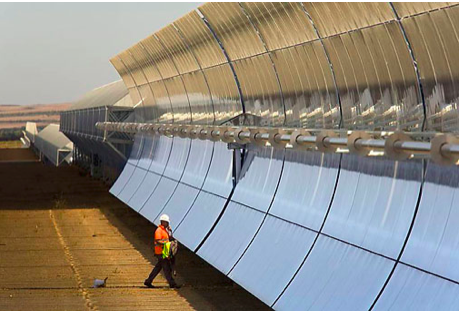
The Andasol mirrors
Such an installation is not "experimental" but completely functional. Its mirrors produce a fluid at 400°, which feeds a set of steam turbine, alternator, in all respects similar to what feeds the core of a nuclear reactor.
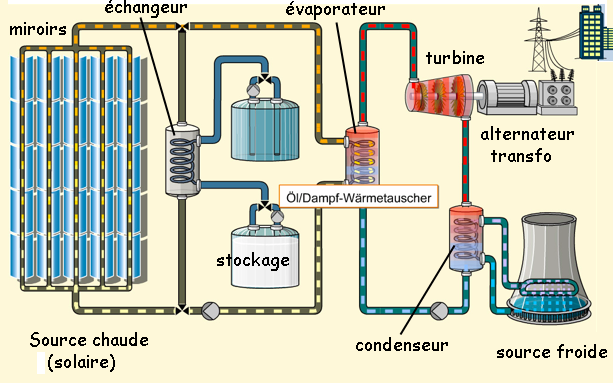
At the center of the installation: the molten salt tanks that store 30% of the energy produced permanently to meet nighttime needs and can provide 7 hours of production at full capacity when the sky is overcast. The alternators produce high-voltage current, which is injected into the grid.
We are planning to visit this installation, to see what the design and cost of an expansion of such a solar power plant would be, reaching 1500 megawatts, that is, producing as much as a nuclear power plant. In the desolated regions, it is not the space that is lacking, anywhere.
Okay, this analysis of the excellent "Complément d'Enquête" program from April 16, 2011, is over. We will now move on to the creation of a program that we could call
Europe - Energy - Ecology
"The 3 E's" (it sounds good, right?)
Then, all that would be missing is a candidate, or a candidate, for the presidential elections.
Hulot? No. He had to let go of the pro-nuclear polytechnicians Jean-Marc Jancovici, after being booed at Strasbourg, at the end of April 2011. The carbon tax does not seem to be a selling concept anymore.

****Nuclear power relies on trust **
May 10, 2011:
Bernard Bigot
(Administrator of the CEA) :
....
Radioactivity without Borders
****Thermal Solar
on the inhumane, ethnocide project of General Hishi,
June 12, 2011:
Before writing anything, I want to reproduce this image, which alone summarizes the distress of the Japanese people in Fukushima:
It's going badly there. We are beginning to know. I don't have time to elaborate on this current topic, completely hidden by the official French media. The TEPCO company is slowly revealing its lies. We know that the reactor cores had melted in the hours following the flooding of the backup systems, foolishly installed in basements (as in the French Blayais nuclear power plant, in Gironde. See above). It would have been sufficient to position the diesel generators and the blocks a few tens of meters higher, on the nearby hill, as TEPCO engineers, like all those who installed the other power plants, have done by placing their reactors at water level.
Stupidity, incompetence, greed.
The demonstration is no longer needed. What should be done now? No one knows anything, and three months have passed without any measure worthy of the situation being taken.
I have mentioned measures to take, such as bringing in remote-controlled large cranes (50 meters) to clear debris that, on the reactors, prevent access, especially to the pools, which are open-air. For this, it would have been necessary to put billions of euros or dollars on the table. But no one does it, nor will they. Not the private sector, nor the corrupt officials of the puppet government, in the pay of the money powers. And there you touch on the philosophy of this globalized liberalism.
These people are there to collect dividends.
But when the matter turns into a catastrophe, they all run away, leaving the bill to the taxpayer.
A heavy operation could have been attempted, very costly, whose goal would have been to extract from these debris, at least, the contents of these pools, to take them elsewhere, immersing them in other storage basins, large enough for active refrigeration not to be necessary. Instead, TEPCO employees have been watering for three months. This water becomes contaminated, in contact with the radionuclides released by the melted assemblies, and will flood the basement of the power plant. Because the reactors and pools have become the barrels of the Danaids. This water also flows through the cracks in the eight-meter thick concrete foundation, probably fractured by the earthquake in many places, and slowly, insidiously, irreversibly contaminates the waters of the Pacific.
Should we block the entrance to the Fukushima port, then pump seawater from this small bay, in order to be able to seal, concrete the coast at this point?
But would that be enough? No one knows the situation under the reactors. Remember, at Chernobyl, engineers and technicians from the Kurtchatov Institute approached the melted core of reactor number 4 by using tunnels starting from the neighboring unit. There they drilled into the graphite and reached the central part, making an opening with a plasma torch. It was there that they were able to measure the extent of the catastrophe, realizing that the temperature of the corium, very concentrated, therefore in a critical state, was such that nothing could resist it, and that very soon, after having drilled through the concrete slabs, it would come into contact with a mass of water accumulated in the basement of the power plant.
Then another decision was made, that of sacrificing firefighters, who went to drain this water. Then to dig at a crazy speed, in a temperature of 50°C, a tunnel to be able to position themselves under the reactor and pour a thick 30-meter by 30-meter concrete slab on which the corium, as it flowed, would see its criticality decrease.
Pumping the water and stopping the descent of the corium aimed to prevent it, upon contact with the water, that contained in the basements, then that of the groundwater, located a few tens of meters under the reactor, from resulting in a monstrous explosion, which would have made Ukraine and Belarus uninhabitable, contaminated the Dniepr and the Black Sea.
We do not know what the future holds for Fukushima. A process of this kind may be underway, in a region with a very high population density. The slab is very likely cracked. Nothing can resist an earthquake of magnitude 9, even if it were 8, 20 or 30 meters of concrete.
It seems that the TEPCO technicians, continuing to water and consulting their screens and instruments that have been out of order for a long time, are waiting ... for a miracle more than anything else.
That's where we are .......
I would like to comment here on the latest images of this report "Complément d'Enquête". The team of journalists accompanied a Japanese woman, whose parents live near Sandaï, who went to the site, despite her French husband's recommendations. Her husband could have, on the way, accompanied her, out of solidarity, or even just out of love. But probably his business kept him in France.
On site, this 50-year-old Japanese woman collects various samples, performs measurements. On return, these samples will be analyzed and reveal what everyone already suspected: that the values communicated to the Japanese population are very below the reality. But what strikes me the most are the conclusions of this woman. Her parents, it is understood, will not leave the land where they have lived, even if it means dying there. And this Japanese woman concludes "if my parents decide that, then I will stay with them".
Another important sentence is extracted from a phone conversation between a Canadian journalist and a Belgian journalist living in Tokyo. The recording is recent, from early June. Two things are learned. A group of retired technicians and engineers, over 65 years old, have declared themselves ready to sacrifice themselves, considering that the cancers they would develop would have a latency period exceeding their lifespan. There, it is all a question of dose. There are some that lead to particularly rapid developments. The case of Chernobyl is there to testify.
The second position comes from a 62-year-old technician, who spent his entire career at the Fukushima plant, and who says "this plant has given me life for 40 years. It is normal that I come to its aid".
The attachment of the Japanese employee to the "mother company", the "patriotic company" is such that at no time, none of them formulate any criticism towards the criminal stupidity, the irresponsible greed of the very designers of this plant. Nor do they seem capable of rebelling against the leaders of this company or against the government officials, who have allowed it for decades, possibly by being corrupted.
It seems that within the Japanese population, any revolt against the established order, the reigning order, is an unsustainable endeavor, to which many prefer to accept tacitly and passively, disguised as courage, to "raise Japan from this terrible trial". It is only timidly that anti-nuclear demonstrations are organized, still few in number.
I think of the film by Clint Eastwood "Letters from Iwo Jima". This island, if it falls into American hands, will put Japan within reach of American bombs. The Japanese soldiers will therefore fight with the energy of despair. The senior officer in charge of organizing its defense tries to proceed as intelligently and efficiently as possible, with the few means at his disposal, without any air cover.
One can understand this patriotism of men ready to give their lives for the motherland. In this nightmare situation, the attitude of this commander seems very human, condemning the brutality towards "those who crack".
But at the end of the film, what does he do? He harangues the surviving soldiers, telling them that all will make a final sortie, with bayonets, since no one has any bullets left. For ... to find a glorious death, rather than the shame of surrender.
And this is what happens. They go out and are stupidly mowed down by American machine guns. Where is the glory in such a gesture, suicidal, which joins that of those who blow themselves up with their last grenade?
This is where we touch on the perfectly incomprehensible, opaque character of this Japanese mentality. At no time do these men, or this man, educated, informed, dare to question the absurd political choices that have plunged Japan into war. Choices preceded by a Machiavellian plan, drawn up as early as the 1930s, at the time of the invasion of Manchuria, the plan to develop biological weapons, to decimate and terrify the American population. Strains of anthrax and plague, contained in bombs, dropped by suicide planes, brought to the site by the largest submarines ever built, in watertight containers. Planes catapulted on the deck of the submarine.
This was not improvised in the chaos of a war's end, but coldly plotted by military men suffering from serious pathologies.
I am not saying this to throw stones at the Japanese people. This attitude is found everywhere, for example, among these Nazis who commit suicide when Hitler has decided to end his life in his bunker. See the film "The Downfall". We witness the suicide, not only of high-ranking military, probably guilty of what are called "war crimes". But also of members of the Hitler Youth. At no time do these young people have the idea of questioning the image of their leader, their Fuhrer, who led Germany into chaos. The same goes for these Japanese at the end of the Second World War, who continued to venerate their emperor, Hirohito, who we now know was much more than a puppet in the hands of the Japanese high command, but gave his written approval to the builder of Unit 731 in Manchuria, where hundreds of thousands of Chinese served as test subjects for the development of biological weapons.
When Italy was liberated by the Allies from the power of the Duce, he tried to flee with his mistress, Clara Petacci. They were discovered, executed, and then displayed, hanged by their feet on meat hooks. The crowd lynched the one who, like Hitler, had led his country into chaos.
Benito Mussolini and his mistress Clara Petacci hanged on meat hooks. The Japanese could enroll the leaders of TEPCO and make them participate in the operations on the site. Or even install them, tied up near the reactor buildings, until death. Because it is their greed as corrupt people that created an avoidable situation.
May the sacrifice of these hundreds of thousands of Japanese men and women not be in vain and make people realize that nuclear power, military or civilian, is suicide, the manual and nothing else. And that the solution is to invest heavily and very quickly in renewable energy. . .
June 12, 2011: Must See
This investigation reveals that the containment buildings of certain power plants, including Fessenheim, built with concrete made with poor quality sand are ... porous. EDF has sealed cracks with resin patches. Internal EDF reports, communicated by employees, show that in case of a nuclear accident, these patches would not hold, due to the high radiation, and that this additional tightness would quickly fall to zero. No technical solution exists currently.
EDF's solution: increase the maximum leakage rate from 1.5% to 3%
In addition, EDF has disguised some installations, by sanding structures to hide the beginning of cracks, "otherwise the result of the inspection would have been catastrophic".
In short, we are no better than the Japanese operators in this regard. Everything is managed with complete disregard for human lives and the risk faced by the population. We are swimming in the most complete irresponsibility, for the sake of big money!
Novelties Guide (Index) Home Page
- .