Dangers of paragliding, part 2 (2008-2009)
Paragliding accidents
February 12, 2009
Updated on February 15, 2009 - Added on February 21, 2009 (see box below)
http://www.lexinter.net/Legislation2/atteinte_a_la_vie_privee.htm#Article_226-1_
**

**
February 21, 2009:
I have to be away until March 10. Some parts of this page have been quickly and temporarily removed, following threats of legal action made by Madame Gensac, instructor of young Ludwig (son of Madame Anny Pujeault), at the paragliding school Arc en Ciel in Bourg Saint Maurice, who died in an accident on his fourth flight, on August 18, 2008 at 12:30 PM.
In her notice of demand, she refers to article 226-1 of the penal code:
reminding that according to this article: anyone who, by any means, voluntarily or involuntarily, infringes on the privacy of others, by capturing, recording or transmitting, without the consent of the author, private or confidential words spoken.
She referred in this case to e-mail exchanges with the victim's mother.
We have taken note of this notice of demand and responded to it. However, we do not consider that the exercise of the profession of paragliding instructor falls under a person's private life.
I will take up everything again when I return. I think that the result of all this will be the creation of a rather quick association under the 1901 law, bringing together parents and relatives of people who have died or been injured in ultralight aircraft. Anyone who believes these activities deserve a thorough investigation into the regulations governing them, their supervisory authorities, the exemptions they benefit from, the procedures, the rules for equipment monitoring, in short, everything related to these sports, can join this initiative.
All people who wish to join this initiative are asked to contact Madame Anny Pujeault. We will review everything when I return.
Personally, I lost my best friend, Michel Katzman, who died in a biplace delta due to the failure of an undersized part under a Tecma wing (see further on). His passenger and client also died in this accident, which occurred in Méribel.
One of my best friends, Robert Dalmau, and his passenger-client, remained severely injured following the in-flight failure of the Chronos wing of their pendular Cosmos ULM.
It turns out that my website has a fairly large audience (40,000 readers, 3,000 daily connections). I will put it at the service of this initiative and it is fortunate that we have such an information organ, as the mainstream press prefers to report on exploits rather than open up the safety and danger issues of certain sports.
See you soon, then
February 21, 2009:
I have to be away until March 10. Some parts of this page have been quickly and temporarily removed, following threats of legal action made by Madame Gensac, instructor of young Ludwig (son of Madame Anny Pujeault), at the paragliding school Arc en Ciel in Bourg Saint Maurice, who died in an accident on his fourth flight, on August 18, 2008 at 12:30 PM.
In her notice of demand, she refers to article 226-1 of the penal code:
reminding that according to this article: anyone who, by any means, voluntarily or involuntarily, infringes on the privacy of others, by capturing, recording or transmitting, without the consent of the author, private or confidential words spoken.
She referred in this case to e-mail exchanges with the victim's mother.
We have taken note of this notice of demand and responded to it. However, we do not consider that the exercise of the profession of paragliding instructor falls under a person's private life.
I will take up everything again when I return. I think that the result of all this will be the creation of a rather quick association under the 1901 law, bringing together parents and relatives of people who have died or been injured in ultralight aircraft. Anyone who believes these activities deserve a thorough investigation into the regulations governing them, their supervisory authorities, the exemptions they benefit from, the procedures, the rules for equipment monitoring, in short, everything related to these sports, can join this initiative.
All people who wish to join this initiative are asked to contact Madame Anny Pujeault. We will review everything when I return.
Personally, I lost my best friend, Michel Katzman, who died in a biplace delta due to the failure of an undersized part under a Tecma wing (see further on). His passenger and client also died in this accident, which occurred in Méribel.
One of my best friends, Robert Dalmau, and his passenger-client, remained severely injured following the in-flight failure of the Chronos wing of their pendular Cosmos ULM.
It turns out that my website has a fairly large audience (40,000 readers, 3,000 daily connections). I will put it at the service of this initiative and it is fortunate that we have such an information organ, as the mainstream press prefers to report on exploits rather than open up the safety and danger issues of certain sports.
See you soon, then
From time to time, relatives or family members of someone who died in paragliding contact me. It's true that there aren't many voices raising concerns about the way this sport is managed.
Six months ago, it was a mother who told me how her son died on one of his very first beginner flights. Then silence. I know all too well the situation of these parents, spouses or children of deceased people, crushed by grief and facing a milieu that immediately takes a stand against the unwelcome one, disturbing their small business. The paragliding world has a super lawyer, a fanatic practitioner of this sport, who knows all the legal tricks and will defend the corporation with all his strength.
The relatives or family members of the victim are then disarmed. Who to turn to? Which lawyer? Who will take on this case? The first lawyer that comes along? The case is then poorly started. It would be better to be able to entrust the case to a lawyer who has lost his son in such an accident, then he would be on equal footing with the defender of the federation's interests.
There is the sport in general, and the risky sports. Everything is more or less risky. But these risks can be limited to their strict minimum. I practice gliding. We are equipped with parachutes, which you won't find in a simple tourist plane. Why? Because the risk of a glider is a mid-air collision. Gliders are faster than 40 years ago. There are also many more of them. As soon as a glider pilot finds an updraft, he spirals into it, but others often join him. Being in a "pump" means being projected into a spinning combat episode. There, everything is left to the judgment of the practitioners. But at the time of the initiation to flying, the word that is most often heard from the glider instructors is "safety, damn it!". Yes, the beginner tends to focus too much on his instruments. The most vicious collision is when a pilot forgets to look up and approaches a glider above him, which cannot see him.
We now have a sophisticated anti-collision system based on GPS called FLARM, which is set to become widespread and is already equipped on most French gliders. The GPS emits and receives. An on-board computer then knows not only where the glider you are flying is, but can also locate those at a given distance. It calculates all of this, and in front of you, you have a small indicator, along with an audible alarm, which visually signals:
- Attention, you have a glider near you, which is on your left, lower and behind. The indicator has small lights that turn on and indicate:

Front
Behind
Right
Left
At "2:30"
At "4:30"
At "7:30"
At "10:30"
A relatively sophisticated FLARM. Ten directions and an indication of altitude and distance
The red light indicates an aircraft approaching, near the direction "10:30"
Still, when you are in an updraft that is a bit "crowded", you can say to yourself:
- I'm flying a glider, okay. But why exactly? For performance, to be the best, to cling like a madman, to stay in the air as long as possible, risking my life and others', or to enjoy this sport? What is the risk margin I am willing to take?
Personally, I have practiced many things. My readers know that. The danger arises when you identify with the sport you practice and want to "piss higher than your ass", to fly or climb beyond your means. When you think you are capable of facing limiting aero-logical situations. In aviation, there is a proverb:
A good pilot is an old pilot
I have always kept that in mind and I hope I will continue to. In gliding, the risk is omnipresent. There are collisions. Despite all rules and safety devices, there are several each year, often fatal.
There is not only the risk of collision. You must remain in an approach cone, which ensures you are always able to return to a field. A glider pilot with a long experience will say:
- Hmm... I'm quite low. But it's the devil if I, who am a real fox, can't find something in the area to gain altitude, for example there...
But it doesn't always work. Then, it's "the cow", the "country landing". It's not always beginners who fall for it, but sometimes pilots with more than 1,000 hours of flight. Breaking the glider is a lesser evil, even if these "flying Rolls-Royces" are getting more expensive. But when it comes to mountain flying, a "country landing" can become very problematic.
Some fall for it. This summer, an old pilot crashed his glider a few hundred meters from a runway entrance. He was missing ten meters of altitude. Glider broken, but the man was unharmed, apart from some bruises. My wife and I will be back this summer. Personally, I prefer to be too cautious than not enough. These sports are too beautiful to have unnecessary scares. That's my opinion.
For ultralight aircraft, it's a whole different matter. No flight log, no airworthiness certificate, no mandatory periodic inspections. Only "recommendations".
It's the "libertarian spirit."
You can even fly without a helmet, if that's your choice. I drew a comic book on the mechanics of flight and took the opportunity to include a passage explaining the inherent danger of paragliding. At least, people will know and it will be translated into 30 languages on the site http://www.savoir-sans-frontieres.com .
How many times have I heard people with a large number of flight hours tell me:
*- I don't know what happened to me. Suddenly my wing went forward and passed under me. It's a miracle I didn't fall into it. *
** ****
Testimony of an experienced pilot, dated January 9, 2009. Hello, I confirm your statements.
If a pilot is caught by the stall of the wing after slowing it down too much and reflexively raises his hands, the wing, which is too abruptly regaining speed, will "shoot" forward until it plunges far below the pilot. A very dangerous phase where the pilot can fall back into his wing as was the case with the young man mentioned in your article on the site. This is a pilot error or over-piloting that I have experienced without wanting to, and it taught me this.
I confirm this rather frightening sensation of being pulled forward by the wing that goes at an incredible speed to plunge far in front of the pilot. I was just lucky not to fall back into the wing, I fell between the suspension lines with my helmet torn off by the passage of my head between the suspension lines. Probably due to this component f that you describe, which is suddenly increased when at the same time the lift and aerodynamic force collapse at the moment of the stall and which is the only active in the phase of the wing's speed recovery when the pilot "raises" his hands abruptly.
Yours faithfully.
Gilbert G.
PS: this subject interests me greatly because I accidentally stalled my paraglider with the described consequences and also because I dislocated my shoulder last summer due to an asymmetric stall at one meter/sol in a gust of wind.
Testimony of an experienced pilot, dated January 9, 2009. Hello, I confirm your statements.
If a pilot is caught by the stall of the wing after slowing it down too much and reflexively raises his hands, the wing, which is too abruptly regaining speed, will "shoot" forward until it plunges far below the pilot. A very dangerous phase where the pilot can fall back into his wing as was the case with the young man mentioned in your article on the site. This is a pilot error or over-piloting that I have experienced without wanting to, and it taught me this.
I confirm this rather frightening sensation of being pulled forward by the wing that goes at an incredible speed to plunge far in front of the pilot. I was just lucky not to fall back into the wing, I fell between the suspension lines with my helmet torn off by the passage of my head between the suspension lines. Probably due to this component f that you describe, which is suddenly increased when at the same time the lift and aerodynamic force collapse at the moment of the stall and which is the only active in the phase of the wing's speed recovery when the pilot "raises" his hands abruptly.
Yours faithfully.
Gilbert G.
PS: this subject interests me greatly because I accidentally stalled my paraglider with the described consequences and also because I dislocated my shoulder last summer due to an asymmetric stall at one meter/sol in a gust of wind.
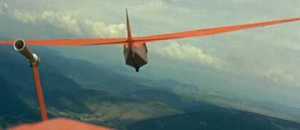
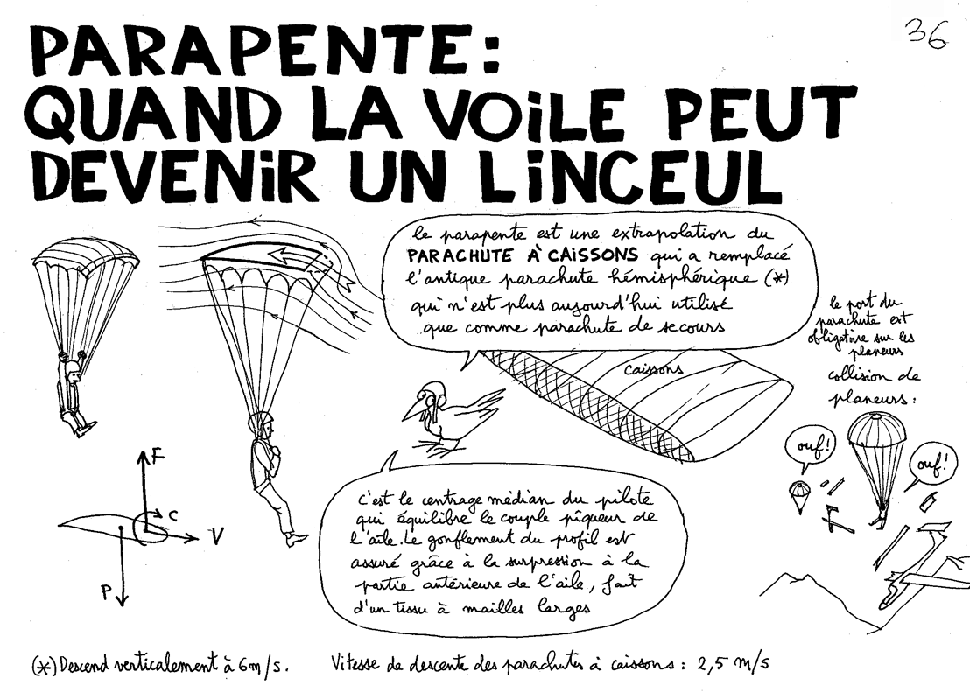
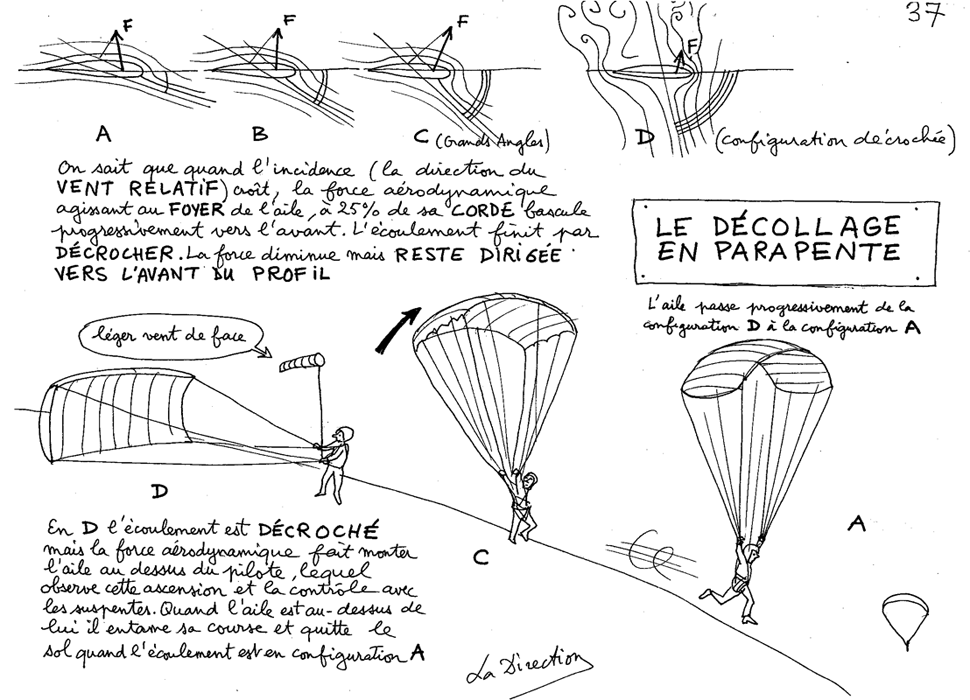
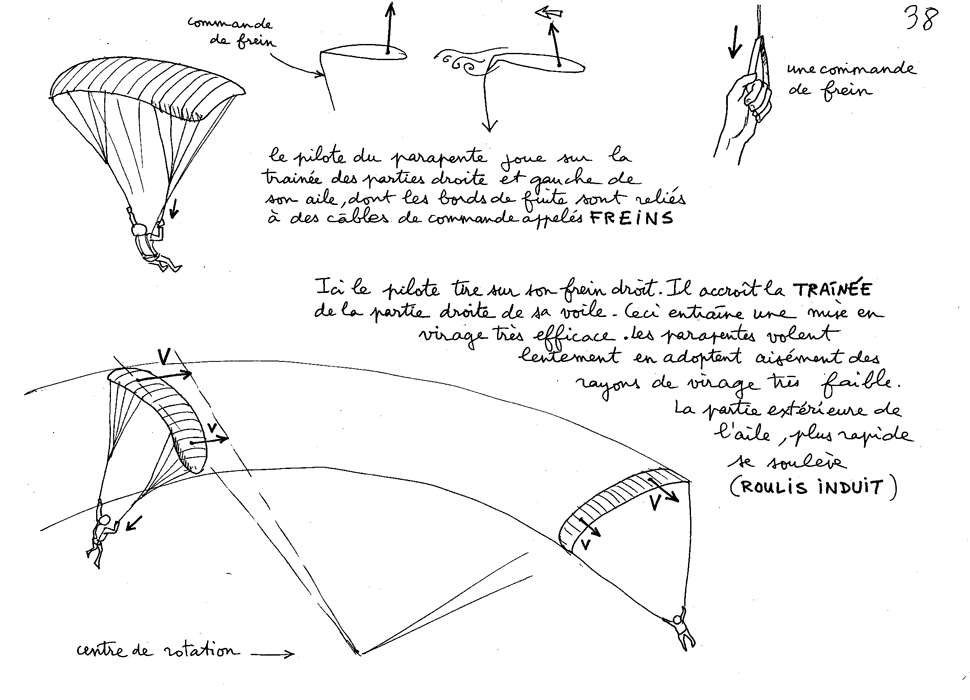
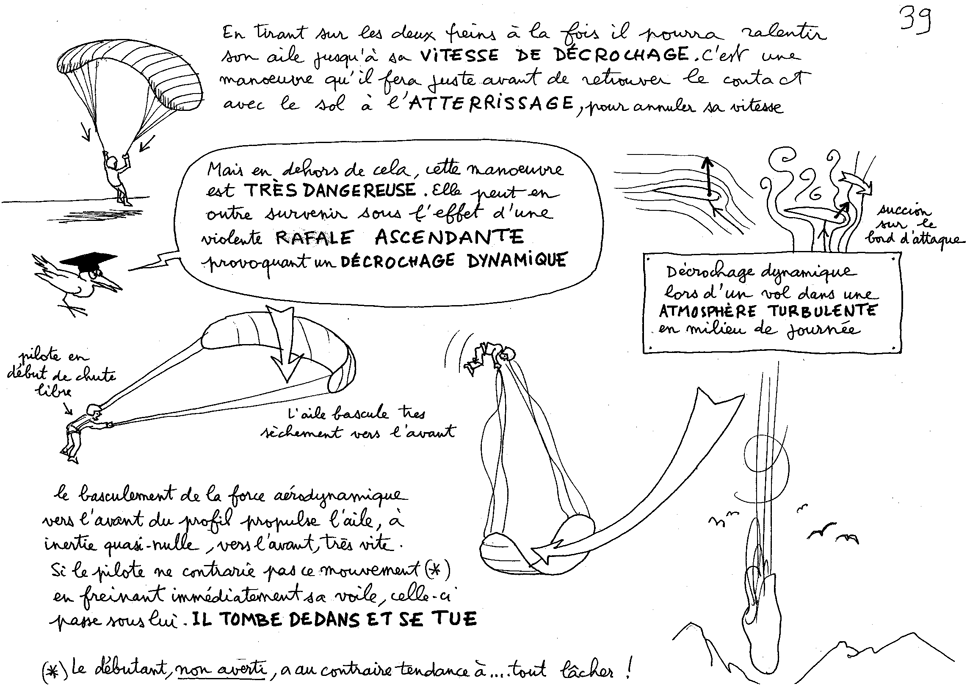
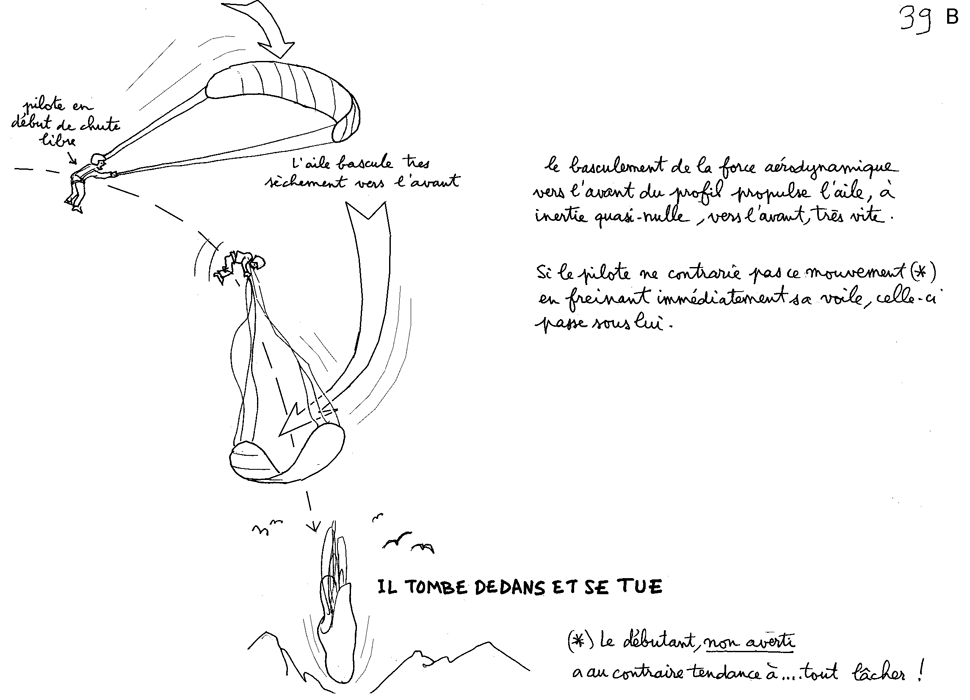
One, a true miracle, even passed through the suspension lines!! Here is a video excerpt showing ****a fatal paragliding accident where the wing suddenly becomes a shroud. What happened? See my comic book MECAVOL, downloadable for free at http://www.savoir-sans-frontieres.com/JPP/telechargeables/Francais/mecavol/mecavol_francais.htm. It is located on pages 36 to 43 (extracts reproduced later).
In passing, our small association, after two years of activity, thanks to donations from my readers (50,000 euros), now has more than 300 albums online, in 30 languages, but no media, no press, written or spoken, has ever mentioned the existence of our association, which lives only on donations from its readers. The JP.Petit silence in the press is in full force. It's ugly, but that's how it is. Let's move on...
Back to this type of paragliding accident. In the matter of flying machines, there is what is called the stall. This is more or less abrupt and depends on the flying machine used. The more flat the wing profile, the more abrupt and brutal it is, functioning on a "all or nothing" basis. It's logical. I flew in the late 1950s on a C-25-S.
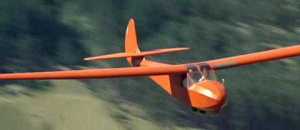
**The C 25 S filmed in the movie "La Grande Vadrouille" **
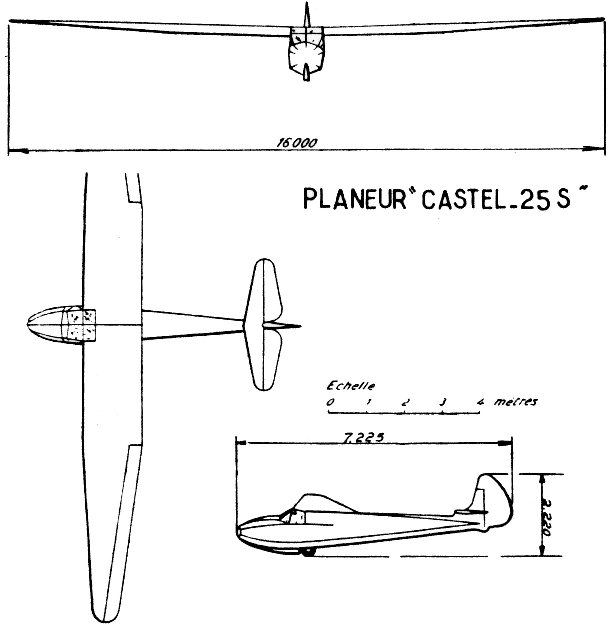
**An ancestor, compared to current machines. The relatively thick wing is clearly visible in the photos **
This glider, you've all seen it. It's the one on which the heroes of La Grande Vadrouille take off at the end of the film. It's a good old school glider, two-seater, not very performant, which has not been used for a long time, with a thick profile that does not ... stall! Or rather: the transition from normal flight to stalled mode is done without a spectacular dive. The C-25-S descended gently in a parachute descent. This doesn't mean you should stay like that. In gliders and airplanes, when you stall, you "let go", push on the stick, dive to quickly regain speed. And you shouldn't wait.
With the structureless wings like paragliders, extensions of "container parachutes" which, in paragliding, have replaced the good old "hemispherical" ones of grandpa, the behavior is completely different.
Since I was thirteen and had the chance to pilot a ... DC-3 ( see my biography ) I have flown on almost anything. Fifteen years ago I wanted to get back into paragliding, which I had practiced around 1960. I had done skydiving and had 200 jumps. That was my "second degree" license, i.e., "free fall," completed in the army (where I was, among other things, head of the military gliding section in Fribourg, Germany. Students from Supaéro joined the army as lieutenants, not as "EOR," reserve officer trainees).
At over sixty, I got back into it, without problems.
The sixties
Since my start in this kind of sport, parachutes have evolved a lot. In the past, the pull handle was sewn onto a strap, at the level of the left breast. Now it is there that the handle for releasing the main parachute and opening the reserve parachute, which is located below the main parachute, at the bottom of the pack. The opening control system is a kind of plastic device, the shape and size of a bottle cap, which is on the right thigh. The movement is, in fact, complex. You have to bring your right hand to your thigh, while putting your left hand in front of your head, to avoid an unintended roll. Without this second movement, you would go on your side.
The pilot was scared. The instructor was scared. The other paragliders were scared, in the small Cessna plane, piloted by a German friend, former Starfighter pilot. They said, "At his age, he will confuse everything. Moreover, he is a researcher, a mathematician, always in the clouds, lost in his calculations." I told them:
*- Don't worry. On the left, the reserve, on the strap, on the right the opening of the main parachute, on the thigh. Everything will go well. *
But I felt they were only half reassured. Nevertheless, there was no problem. I am distracted, but for secondary things. Otherwise I would never have survived decades of climbing, diving, and gliding. It's not because you can exit a building in pajamas that you will forget to hold on to a wing before takeoff.
It was the same with the glider, which I took up this summer after 40 years of break. But I had done other things in the meantime, including 25 years of gliding. On the morning of my jump, Philippe, my instructor, said to Jie, my wife:
- Did Jean-Pierre sleep well? - Yes, why? - Because I didn't at all! ...
Well, everything went very well, as usual. The glider is like a bicycle.....
Back to paragliding, which I took up a few years ago (now, with the state of my spine, it would be problematic, for sure. Fortunately, gliding is an aerial sport for the disabled or semi-disabled. There is even a machine equipped with a "malleable" for paraplegics).
I must testify that when I took up delayed opening paragliding, no one warned me about how a container wing stalls. With these, you open at 600 meters, compared to 300 with the old hemispheres. Increased safety. There is also a barometric (altimetric) system that automatically opens the parachute in case of distress. A technically complex, expensive gadget, but which shows the attention given to safety. They also pay very close attention to folding. With the hemispheres, this operation was much simpler. Here, there are two levels of expertise. A beginner prepares his folding and an approved member, a "inspector," comes to check that everything was done properly before giving his approval for the final packing of the wing. A well-folded parachute does not pose a problem when opening, if the paraglider is in the right position. Moreover, parachutes have a booklet. The number of jumps is listed and the parachute is reformed, destroyed after a certain number of jumps.
In ultralight, this procedure does not exist, or at least is not mandatory. When a practitioner considers that his wing is no longer reliable, he sells it...
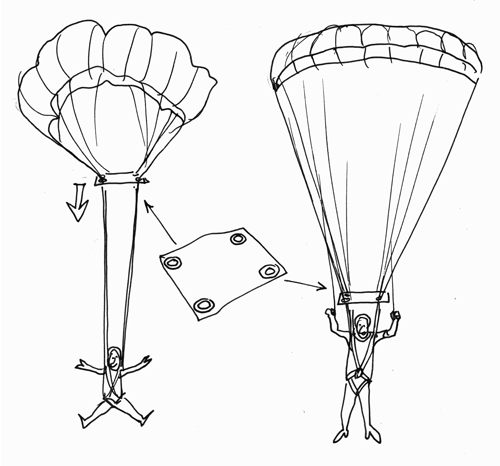
In short, my first jump with a "modern" container wing went very well. The opening of a container parachute is delayed by a "speed reducer":
**The operation of the speed reducer of container parachutes, to reduce the shock at opening **
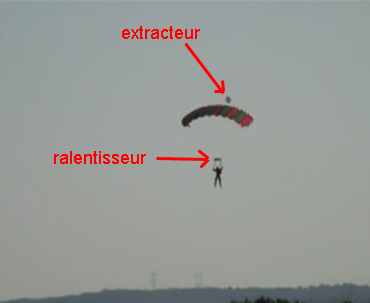
Container parachute, opened. You can see the small deployment parachute and the speed reducer, which is positioned as in the image on the right, above.
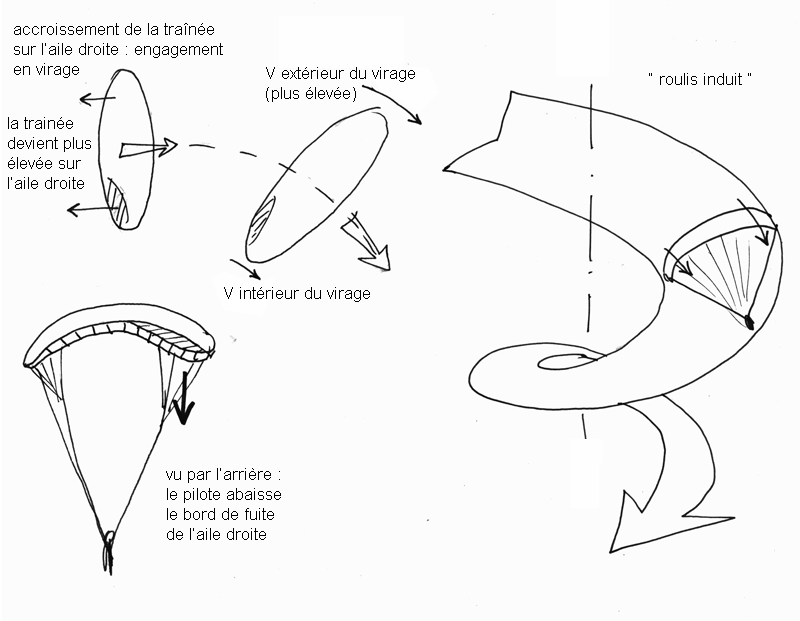
I find myself, with the parachute open, at 600 meters altitude. It is piloted like a bicycle with two brakes that lower the trailing edge of the right or left part of the wing. You brake on the right. The right part slows down, the left part, going a little faster, rises and the bank, which causes the turn, is maintained by the effect of "induced roll."
**The turn in paragliding **
But if you pull both brakes at the same time, you slow down the machine, and below a certain speed, it's the stall. This is what you do near the ground. You pull everything. This reduces the speed, already not very high in stable flight, and the wing stalls. You can land with experience by running, or even at zero speed, feet together. Every good pilot must test the behavior in stall on any machine, at a safe distance from the ground. At 600 meters altitude, I therefore pull these brakes gradually. The wing stalls, and then something happens that I don't analyze at the moment. The wing suddenly goes forward and I find it on the horizon, in front of me. I confess to being unpleasantly surprised, not understanding, because I have engaged this stall very gently.
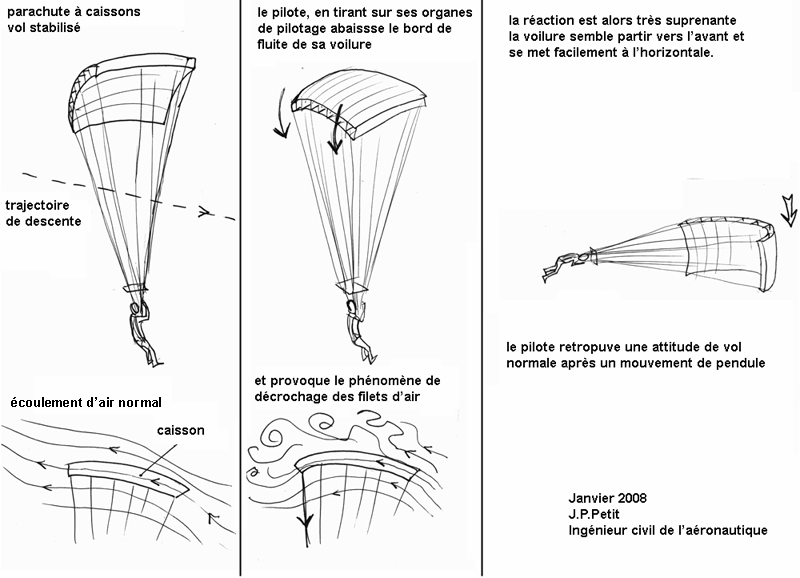
Stall on a container parachute ( all parachutes today )
Of course: reflex: I let go of everything. I have the reflex to remove the cause of this phenomenon, to release the brakes. In an airplane or glider, the same idea. The stall comes from the fact that you pulled too much on the stick, so "you let go." But in fact, what happens with the paraglider is of a completely different nature. I reproduce here the pages I included in Mécavol.
The way the paraglider pulls his wing off the ground at takeoff is there to prove that a wing attacked by the airflows under a very high angle experiences an aerodynamic force that propels it forward. Here is a photo of the unfortunate Ludwig, son of Anny Pugeault, taken during his last flight in Bourg Saint Maurice (details later).
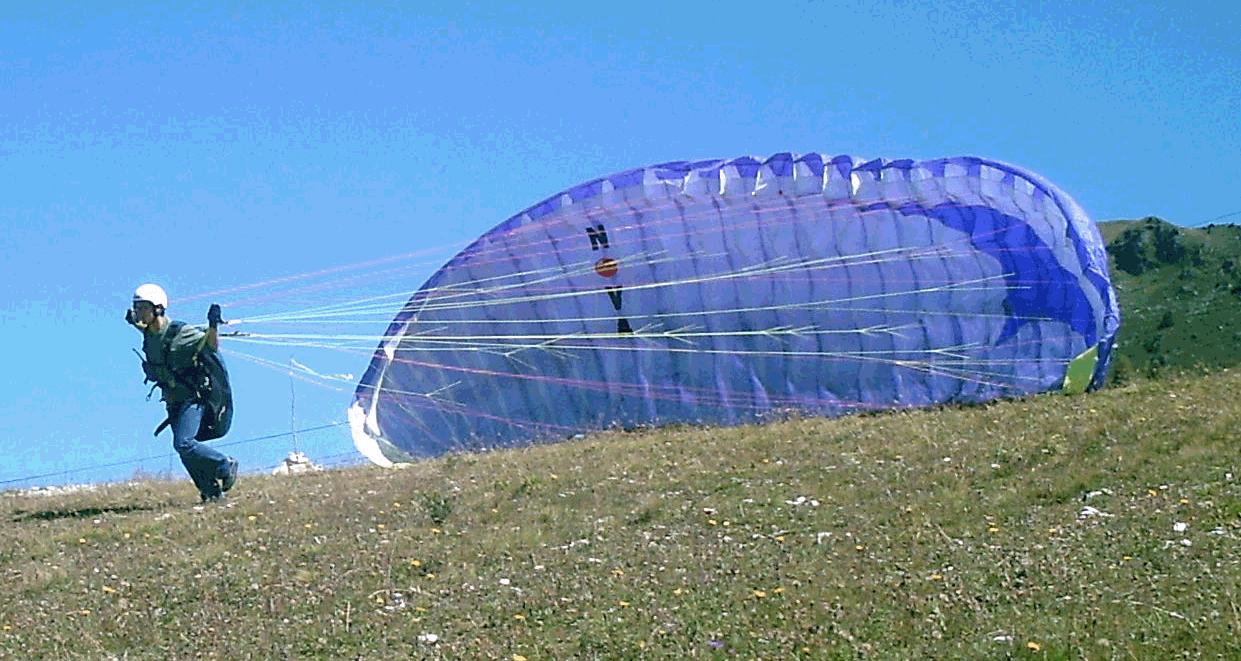
**Ludwig is about to take off for his third and last flight. You can see that the wing is attacked by the wind at a 90° angle. This is what will make it rise quickly. **
Yes, if you have been on a takeoff site, you have seen paragliders lay their wings flat, facing the wind. As soon as they take their first steps, they go above them, exactly like the kite of your childhood.
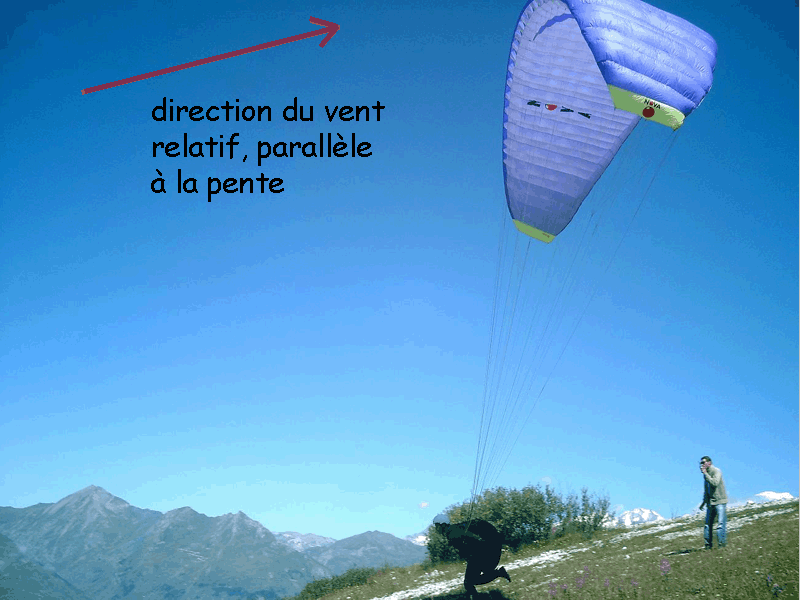
**As soon as the wing leaves the ground, Ludwig starts his run. The angle of the wing reaches 30-35°.
When its incidence (the wing of the wing relative to the relative wind, the airflows) becomes equal, say, to a dozen degrees, the force of lift becomes vertical, balancing the weight and stopping this forward projection of the wing. ** ****
February 21, 2009
: Here is a passage removed from the page, following threats of legal action made by the instructor of Ludwig, Madame Gensac, member of the executive committee of the French Federation of Free Flight (FFVL).
February 21, 2009
: Here is a passage removed from the page, following threats of legal action made by the instructor of Ludwig, Madame Gensac, member of the executive committee of the French Federation of Free Flight (FFVL).
The accident had no impact on the activities of the school or on those of this instructor. There was no investigation by the Ministry of Youth and Sports or any supervisory body, since these activities are not under any.
During e-mail exchanges with the victim's mother, Madame Anny Pujeault
The instructor always claimed that her handling of Ludwig's flight was perfectly in line with the rules and denied having committed the slightest fault. On the contrary, she strongly questioned the victim's psychology.
Back to the technique of takeoff. There is nothing left but to run, accompanying the wing in its natural acceleration. In a normal takeoff, this wing becomes lifting. The paraglider's feet leave the ground and he then controls his takeoff by piloting with his "brakes," not with his feet. You will see this mentioned later in a failed takeoff that caused the death of Madame Patricia Roubaud's husband.
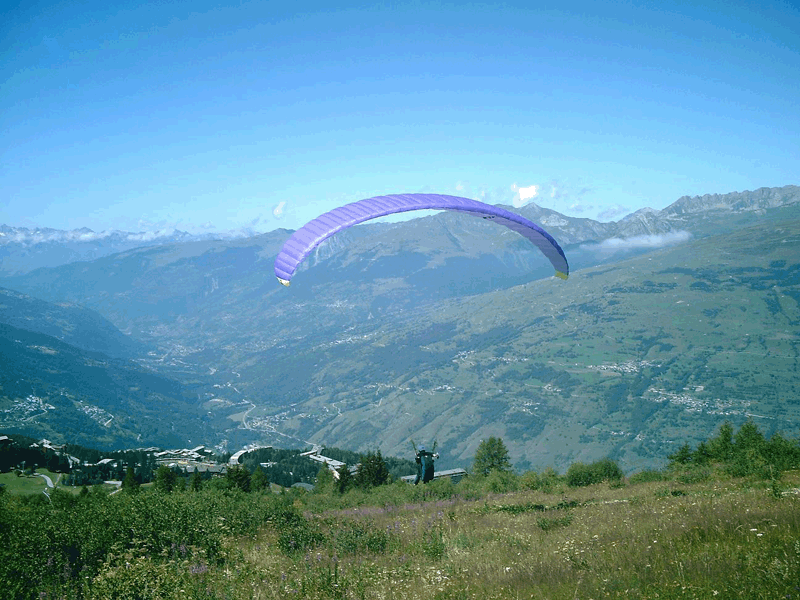
**The slope break will help Ludwig to leave the ground for his last flight, under a wing not suitable for his status as a beginner
The headwind is apparently weak and the takeoff is laborious, despite a sufficient slope. **
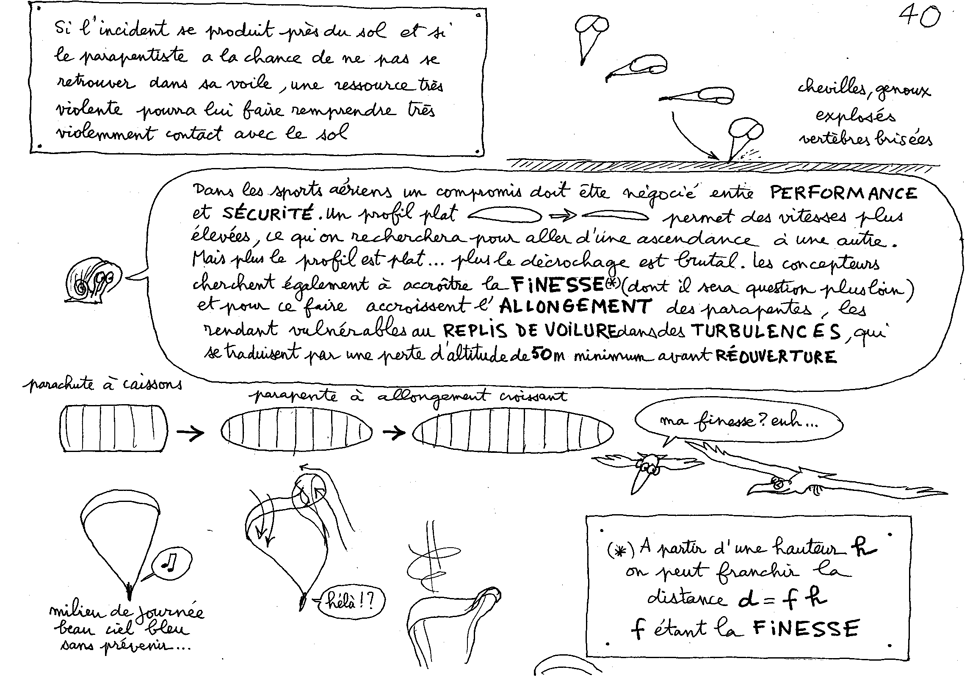
Page 40, you have the example of an accident that I saw unfold before my eyes, near Aix en Provence. A young beginner had made a too long ground run. He erased the field where we were supposed to land and was going to land in bushes on the edge. He wanted to shorten his approach, and for this, pulled on his brakes. He stalled at six to eight meters above the ground. As a result, his wing went forward and his body began this pendulum movement, described above, which would have had no consequences if it had occurred at a higher altitude. Unfortunately, his legs hit the ground. Result: both ankles broken. It would have been better to land in the bushes, even if it meant tearing a bit of nylon.
Six months ago, Madame Anny Pugeault wrote to me. Her son Ludwig (above) died during a beginner's training session. At thirty-two years old, he already had a strong experience in skydiving. He died on his fourth flight, which was conducted by radio by his instructor, Madame Gensac. This beginner's flight took place in August, in the middle of summer and at the hottest time, the most favorable for the establishment of turbulence (August 18, 2008, 12:30 PM!). First mistake. A beginner, we always make him fly in the early morning; when the air is the calmest, to minimize the risks. I had many e-mail exchanges with experienced paragliders claiming that they would have given this boy a wing unsuitable for his status as a beginner. To be debated.
Finally, the instructor asked him by radio to perform actions on the brakes, in the air. He went into a pendulum movement. His wing passed under him, he fell into it and died.
When an accident of this kind occurs, the investigation is entrusted to the air gendarmerie. They quickly exonerate the instructor, and the club.
February 21, 2009
: Here is a passage removed from the page, following threats of legal action made by the instructor of Ludwig, Madame Gensac, member of the executive committee of the French Federation of Free Flight (FFVL). All these aspects will be reviewed upon my return, and reformulated in a way that is legally unassailable.
February 21, 2009
: Here is a passage removed from the page, following threats of legal action made by the instructor of Ludwig, Madame Gensac, member of the executive committee of the French Federation of Free Flight (FFVL). All these aspects will be reviewed upon my return, and reformulated in a way that is legally unassailable.
Free fall: This sport is very regulated, and a student who would take his life lightly would quickly be sent back to automatic jumps, or even banned from jumping, if for example he would do low openings, below the 600 meters regulatory limit. This kind of eccentricity was fashionable in the sixties, when I started free fall, a movement that was quickly stopped by six months jumping bans. The particularity of paragliding is that it is impossible to jump from a private plane. (except now in "cliff jumping", not covered by the paragliding federation).
In normal situations, you go through an approved club, supervised by solid regulations and procedures, or you don't jump. You also cannot jump with a parachute without a jump log. While anyone can practice ultralight, starting with paragliding, anywhere, at their own risk, with a used sail bought from anyone, in any condition. No log testifies to the condition of a paraglider or delta wing at the time of resale. Paradox: you cannot drive a car without being in order regarding the mandatory technical inspection. The registration certificate testifies to the age of the vehicle and its mileage. If you are stopped by a gendarme and you are not in order, it is an infraction, immediately sanctioned. But no gendarme will come to ask you, when you land, your "aircraft log", its technical inspection sheet, your pilot license. And he won't even be able to fine you if you fly without a helmet, since he can't base himself on any regulation that makes it mandatory, at least to my knowledge. In ultralight, technical controls are not prescribed by any officially approved regulation, within a regulatory framework where non-compliance is subject to sanctions (the only guarantee that this measure is respected). There are only "recommendations". I would like to point out that the registration numbers you may see on ULMS, for example, do not correspond to a valid "airworthiness certificate", but to a simple tax and a marking allowing their identification, in case of nuisance for the neighborhood.
The problem of paragliding is the general problem of ultralight. The association will carry out its investigation on possible exemptions that these activities may benefit from. Are they regulated? By whom? How?
If there are weak points in the safety of students, the practitioners, of equipment, we will report them. Since there is no risk-free activity, the public must be warned of the risks they run by practicing ultralight.
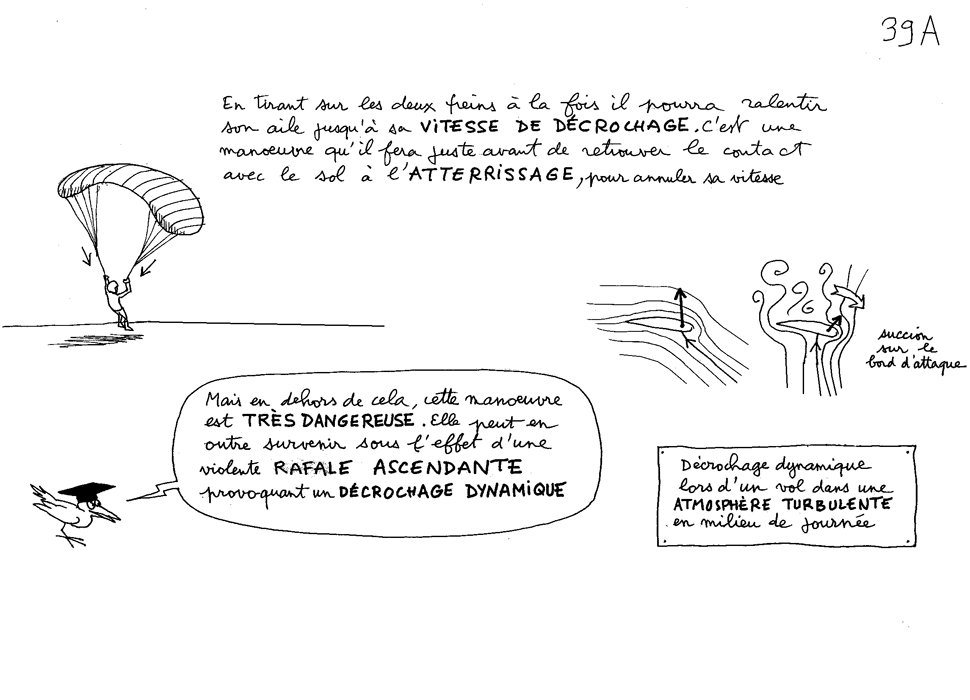
Back to this issue of paraglider stall. We saw the accident of a boy who tried to shorten his takeoff run. Immediate sanction: both ankles broken. But a stall can also occur during a turbulent gust, during crossing a strongly ascending area. Then the incidence, the angle of the airflows with the wing plane is increased and it can go up to what is called a dynamic stall. I know I am the real black sheep in this environment. I have received a flood of insulting letters, which I completely disregard. Every time I propose to the author to reproduce his email, with his name, and it's a lamentable evasion. Insult, yes, sign, no.
Whatever the cause of this stall, the danger is to fall into the sail. What does a beginner, or an untrained practitioner tend to do? He lets go of everything. But that's exactly what you shouldn't do. When the sail goes forward, you should instead brake it, to prevent it from going further, but how many know that? It must be admitted that it's not obvious. Did the instructor warn her student of this risk and the behavior to adopt? She will claim she did. I will go even further. How many flights did this boy have on his record? A stall is an extremely dangerous situation in paragliding, we would like to know how and when beginners are encouraged to try this maneuver. I personally initiated several students in delta flying in the seventies; but, but that was an era when there was no flying wing instructor. There were no radio links either. Immediately, we released our student-friends:
*- Early in the morning - With a helmet and good shoes. - On wings with easy handling, in good flying condition. - From a takeoff field without problems. - In optimal aeronautical conditions: wind well in front, well supporting but moderate. - A large area to land. Wind on the ground well oriented. - For a large number of first flights: Take off, move away as quickly as possible from the terrain. Gentle turns. Ensure a good landing, wind in front, and that's all. - The stall, tighter turns, we'll see after.... *
The test of the stall came much later, at the tenth "big flight", and in a well horizontal flight, always early in the morning, in calm weather, hundreds of meters above the ground or any terrain. In the deltas of the past, this maneuver was safe.
None of the friends I taught to fly have ever, even just sprained an ankle or broken a nail.
The numerous letters I have received have shown me that many pilots, who have a large number of paragliding flights on their record, in all aeronautical conditions, who have seen their sail go between their legs, generally did not understand what had happened to them. This is why the pages I added to my comic strip Mécavol will enlighten many people around the world, and perhaps save some lives along the way. I no longer count the number of pilots who have told me:
*- I have been flying for years. I have a good number of flights on my record, and I didn't know anything about this. *
I would like to point out that this comic strip is downloadable for free and that if schools wish to take these pages for inclusion in their courses, they should not hesitate.
By the way, go check the official manuals to see what is said about paraglider stalls. I would be curious to know.
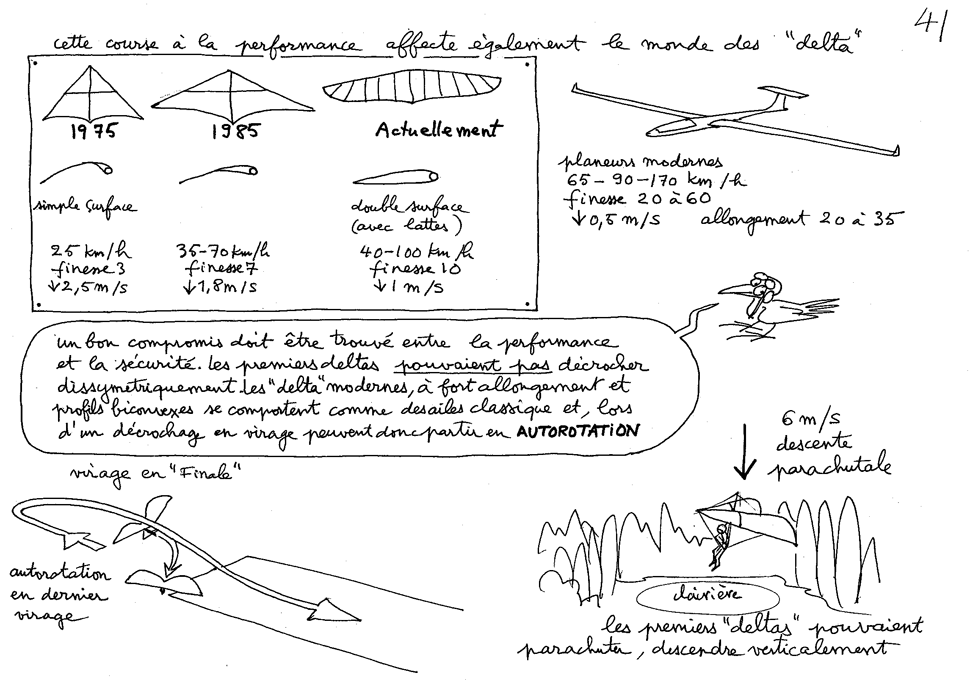
I even added page 41, because it illustrates something that readers can easily understand. The flatter the wing, the more it stalls. Because when the airflows detach from the profile, it happens over almost the entire surface. The residual lift then collapses: that due to the few airflows still attached to the front part of the wing becomes negligible. I spoke earlier about the C-25-S, the glider from the Great Adventure, which smoothly transitioned from normal flight to parachute descent. Last year I returned to gliding, after a forty-year break (in the meantime there were 25 years of delta). So I started from scratch. When you land, the flight ends with a stall. Every landing of an airplane or glider ends with a stall performed just above the ground.
With gliders from forty years ago, like the C-800 twins or the Javelot single, landing finals were always smooth. You had to really pilot like a novice to "crash". Now it's different. Modern gliders have flatter wings, which goes hand in hand with higher flying speeds and better glide ratios, all in the direction of performance. If you stall, even just one meter above the ground, it goes "boom!" and it tires the machine.
The same trend is present in ultralight. We have flattened the wings of paragliders to make them more penetrating, faster. This performance race has even made modern deltas dangerous to land. Personally, I flew on a "Nuage," less performing, but without problems during landing. These devices are devoid of air brakes, of lift destroyers (as in gliders where panels emerging from the wings perform these two functions). Therefore, there are many fatal delta accidents, mainly during landing, when the pilot tries to make a sharp turn too close to the ground and stalls.
I am making this page today because spring, summer will be here quickly. I hope that practitioners or parents will read these lines, see these pages. I say it, I repeat it, a sport like paragliding is not regulated by a strict and well-defined regulation. The ease of learning is misleading, dangerously misleading. I will now address the case of a fatal accident where a family man died in front of his loved ones. We have some photos of him, taken at takeoff. It was a tandem introductory flight, with an instructor. He and his passenger were of similar size, but the passenger was 15 kg heavier. From a rough estimate, the terrain does not seem suitable for takeoff. Witnesses say the headwind was too weak. In a potential trial, I would ask for a precise topographic survey of this takeoff slope. When you take off in paragliding, you cannot run, accelerate. In delta, yes. I have had the opportunity to take off in delta with a very weak headwind, pushing hard on my legs. The tubular structure of the machine allows it. Nothing of the sort in paragliding.
The Roubaud family therefore decided to be introduced to the joys of tandem paragliding during the summer of 2008. Here is the position of the pilot and his passenger (here, me) in a tandem paraglider (above Lake Annecy). Good takeoff runway (at the col de la Forclaz), with a good headwind. Immediate takeoff. Good aeronautical conditions, equipment in good condition, a competent instructor.
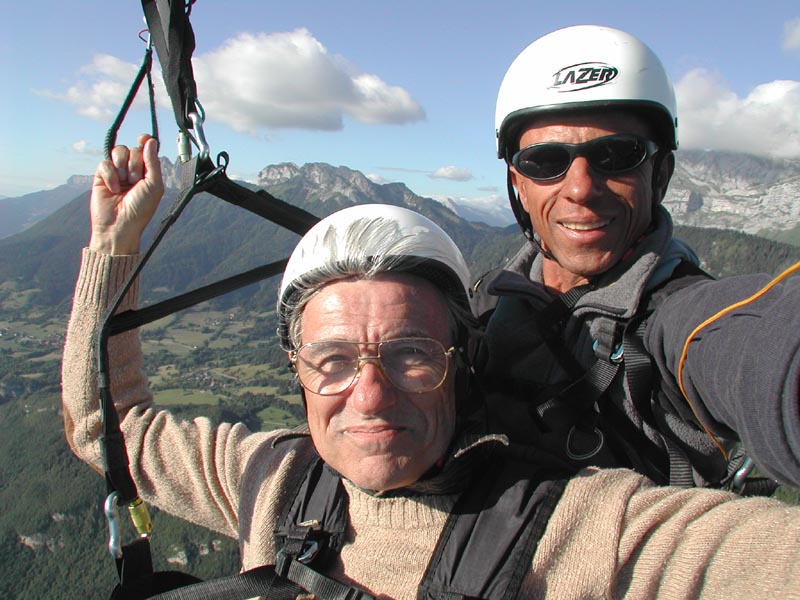
**The instructor managed the takeoff and landing. The rest of the time, I flew. On the right, the control line of his camera **
This view allows you to see the detail of the harness, which is supposed to prevent the passenger from tipping forward ---
February 15, 2009: You will also notice that the type of harness used allows for load distribution. The attachment point of the sail is located directly above the center of gravity of the pilot + passenger. On the "tandem" paraglider on which the second accident occurred, this system is absent. Was this tandem paraglider "conform" and ... conform to what? What is the regulation regarding tandem flights. Reactions from professionals and experienced pilots are coming in. One says that it seems that the pilot, during accident number 2, had the control around his wrist and not in his hand. The original photo should be enlarged. In any case, he lost his head and stopped flying his machine.
*Clients for a paragliding flight: before entrusting your life to a "monitor" (approved?), ask him for his credentials and take a look at his equipment, evaluate its age, its wear and tear. * ---
Regarding tandem flights, some clarifications. At takeoff, with a tandem delta, the pilot holds the trapeze, his passenger holds it by the waist. They run side by side. The passenger is attached a little shorter than the pilot, so that his legs leave the ground first, which allows the pilot to control the end of the run. Both are hung like hams by a strap, on the keel of the device. As the flying is done by weight displacement (forward to dive, backward to climb, right and left for turns), the passenger is asked to be in harmony with the pilot. In the air, the pilot grabs the legs of his passenger with his own when both are in a forward lying position. The opposite maneuver at landing where the pilot releases the passenger's legs and the latter returns to a side-by-side position. I have done many tandem flights with my friend Michel Katzman, pioneer of the free wing (my first flights were solo in 1974, on "Manta".
**Michel Katzman in flight, 1970s, died in 1989 **
At that time, tandem machines did not exist, in 1974. Katzman had started a year or two before me). Michel died, as well as his passenger, in Méribel in 1999, on a TECMA wing, designed by Mr. Mallinjoud, due to an undersized "holey leg," which broke due to fatigue. It was too thin. With half a millimeter more, it would never have happened. An unavoidable accident, the only one known to me.
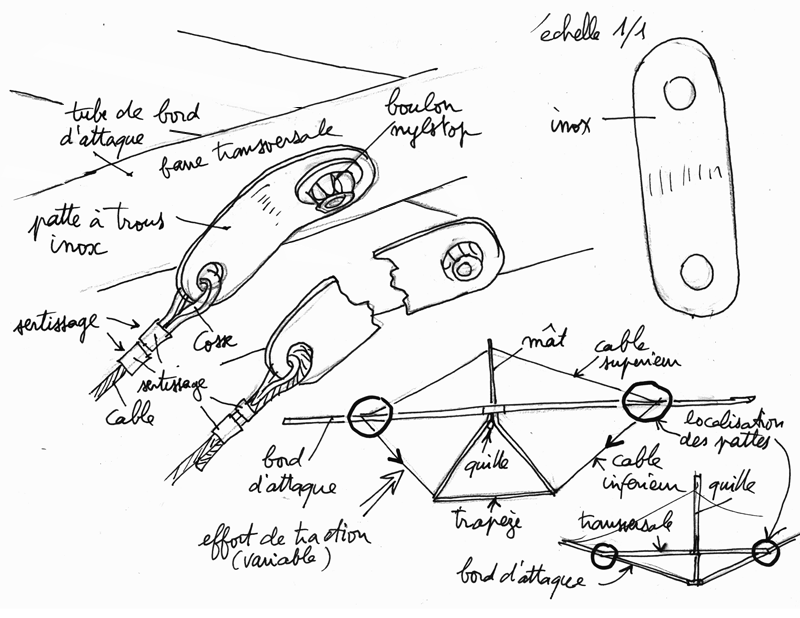
*The stainless steel "holey leg," ensuring the connection between the lower cable, subject to variable tension depending on whether the wing is in horizontal flight or in a turn, subject to a "load factor." The rupture of this piece, costing a few euros, undersized, cost the lives of two men. **
*But in ultralight, where no fatigue calculation or preliminary test was ever performed, the "advancements" of the machines were made at the cost of fatal accidents. *
Let's move on to the way the pilot and his passenger are arranged during a tandem flight, with a delta and with a paraglider.
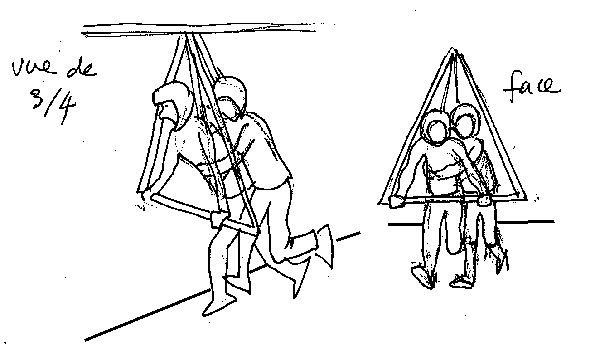
Tandem delta takeoff, the pilot and his passenger run side by side
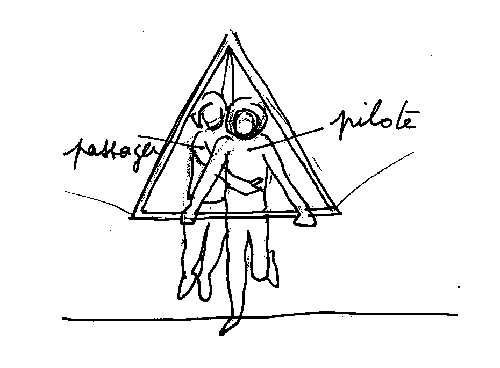
Delta takeoff, end of run. The passenger's legs, attached shorter, leave the ground first
The pilot holds the control bar. The passenger holds him by the waist
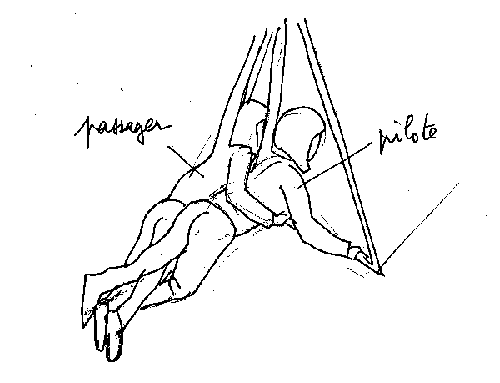
Tandem delta, in flight. The pilot holds the legs of his passenger with his own to better be in harmony with him.
The passenger holds him by the waist and does not touch the control bar
A completely different situation in paragliding where the pilot is at the back and his passenger at the front, both sitting on "saddles," in tandem.
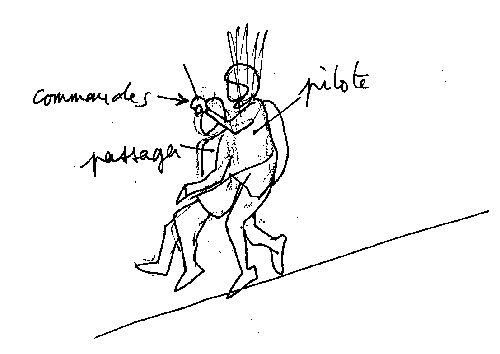
**Diagram of a tandem paraglider takeoff: from the first steps, or even as soon as it rises, the wing has enough lift to carry the passenger.
The pilot controls the run and both his hands are occupied with flying **
This position does not allow running without "getting tangled." When conditions are adequate, as soon as the sail is above the two, it becomes lifting, the lift must be sufficient to lift half the load, that is the passenger. The pilot judges that the takeoff is then possible and controls the acceleration. Otherwise, if he pulls hard on the brakes, the wing tilts backward, acting as a brake and collapsing.
Let's move on to the accident that cost Mr. Roubaud his life. In the following images, his legs are under those of the pilot-instructor, who completely loses contact with the ground (he has his legs apart).* Apparently, the slope is gentle and the wind is not lifting *(confirmed by witnesses). The pilot had indeed hesitated to make the decision to do this third flight, after having taken without problem the wife and son-in-law of Mr. Roubaud. It was Mrs. Patricia Roubaud who gave me these photos and asked me to disseminate them.
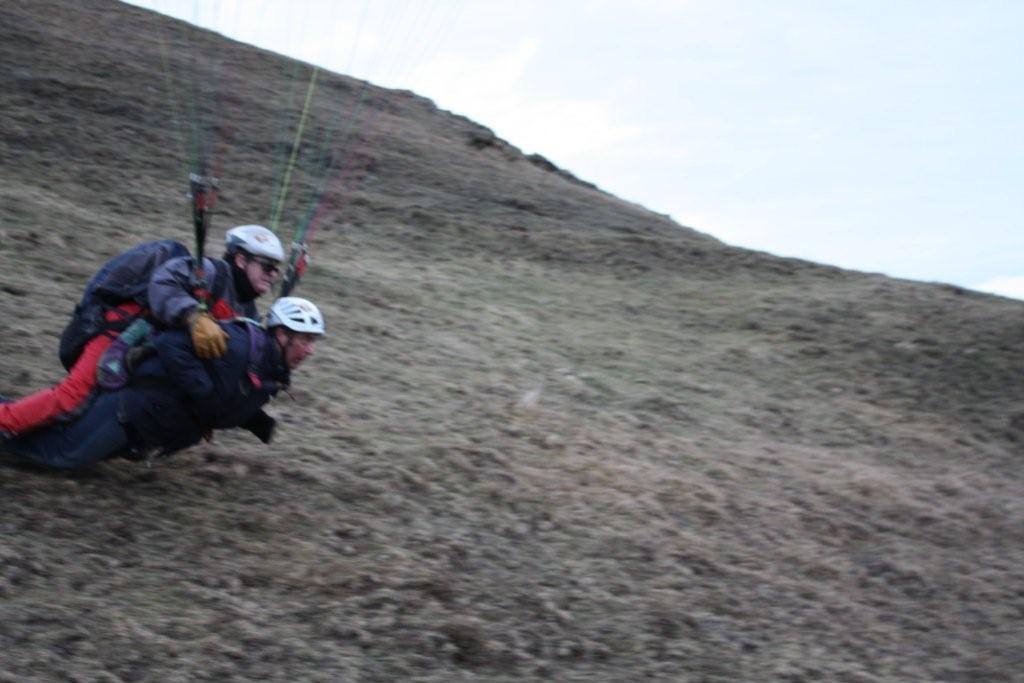

The takeoff is very bad. The pilot-instructor considers holding his passenger and thus stops flying his machine ---
February 15, 2009: According to an experienced pilot, the pilot (please give his name!) has his right control wrapped around his wrist and not in his hand. To verify, enlarge the original photo. If that's the case, it's a serious mistake. Anyway, this guy is no longer flying and has completely lost his head. Finally, compare the attachment system of this paraglider's sail with that of the model I flew in Annecy, which has a bracket that distributes the weight and positions the pull at the pilot-passenger's center of gravity. An examination of the harness is necessary. Before asking the question "was this pilot approved? Was this harness compliant," take a look at the email I received this morning:
Paragliding and paragliding practitioner, I think one of the dangers of paragliding is the fact that this activity can be practiced completely independently.
Anyone can declare themselves a monitor, anyone can offer a tandem flight.
Yet, licenses exist and those who hold them are well trained, there is even a specific tandem license.
But you can very well offer your services as a tandem monitor as a complete charlatan since you don't need anyone else.
In paragliding, we don't have this problem because the practice must be done within a controlled structure, the need to have an airplane to practice is a security in itself since it is not possible to do your business quietly in your corner.
In the case of the tandem accident presented on your site, there is already clearly a problem with the equipment. On all tandem paragliders I have seen, the elevators are attached to the harnesses with a specific system that allows the passenger's load to be well centered.
You can clearly see this system on the photos of your baptism (the elevators are connected to an adapter that allows 4 attachment points, 2 for the passenger's harness and 2 for the pilot's harness) but not on the accident photos.
Then, a tandem takeoff is always very calm, the inflation phase can be a bit violent if there is wind (you can be pulled backward), but once the wing is above your head, the pilot + passenger couple works to take off.
And above all, what we learn as a fundamental principle at takeoff is never to let the sail go beyond the pilot.
Ask a BEES certified instructor for more information.
Paragliding and paragliding practitioner, I think one of the dangers of paragliding is the fact that this activity can be practiced completely independently.
Anyone can declare themselves a monitor, anyone can offer a tandem flight.
Yet, licenses exist and those who hold them are well trained, there is even a specific tandem license.
But you can very well offer your services as a tandem monitor as a complete charlatan since you don't need anyone else.
In paragliding, we don't have this problem because the practice must be done within a controlled structure, the need to have an airplane to practice is a security in itself since it is not possible to do your business quietly in your corner.
In the case of the tandem accident presented on your site, there is already clearly a problem with the equipment. On all tandem paragliders I have seen, the elevators are attached to the harnesses with a specific system that allows the passenger's load to be well centered.
You can clearly see this system on the photos of your baptism (the elevators are connected to an adapter that allows 4 attachment points, 2 for the passenger's harness and 2 for the pilot's harness) but not on the accident photos.
Then, a tandem takeoff is always very calm, the inflation phase can be a bit violent if there is wind (you can be pulled backward), but once the wing is above your head, the pilot + passenger couple works to take off.
And above all, what we learn as a fundamental principle at takeoff is never to let the sail go beyond the pilot.
Ask a BEES certified instructor for more information.
It would be useful to locate this photo on the terrain, which would be easy. In my opinion, the pilot (whose name we would like to give here) had ample opportunity to abort the takeoff maneuver, by pulling both brakes, fully. The sail would have gone backward and acted as a brake. The image evokes that of a pilot who, seeing his passenger slide from his seat, lets go of the control stick to help him. A gendarme claimed he was pulling the left brake. Not credible, as it would have caused an immediate left turn.
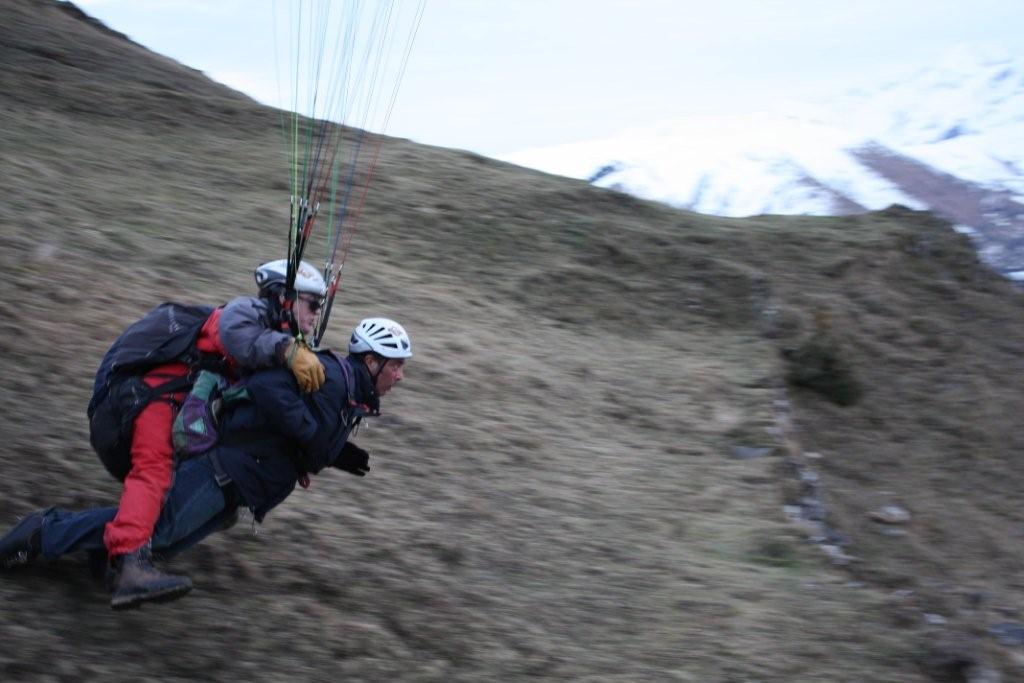
**The pilot, with legs apart, has lost contact with the ground. You can see the brake control that seems wrapped around his wrist. He is no longer flying, but is holding his passenger. **
Again, I think (the production of these photos and at the same time an appeal to witnesses and expert opinions, these messages should be addressed to the widow of the victim:
that the abort of the takeoff should have been immediate.
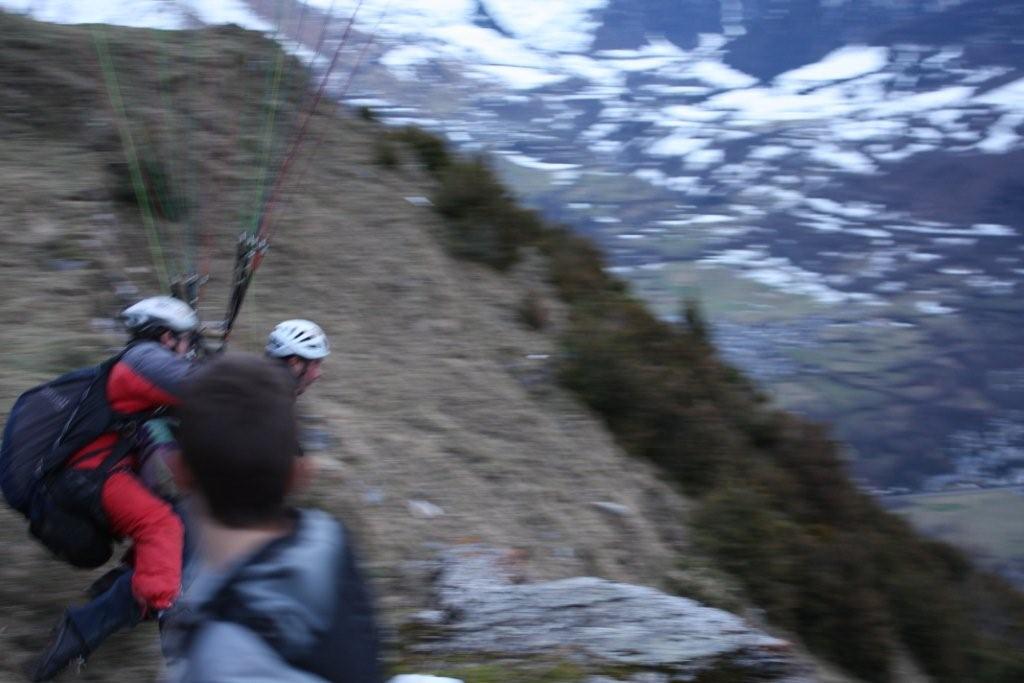
**A spectator masks part of the scene. The pilot, hindered by his passenger's legs, still has his legs apart. He seems to no longer control anything. **
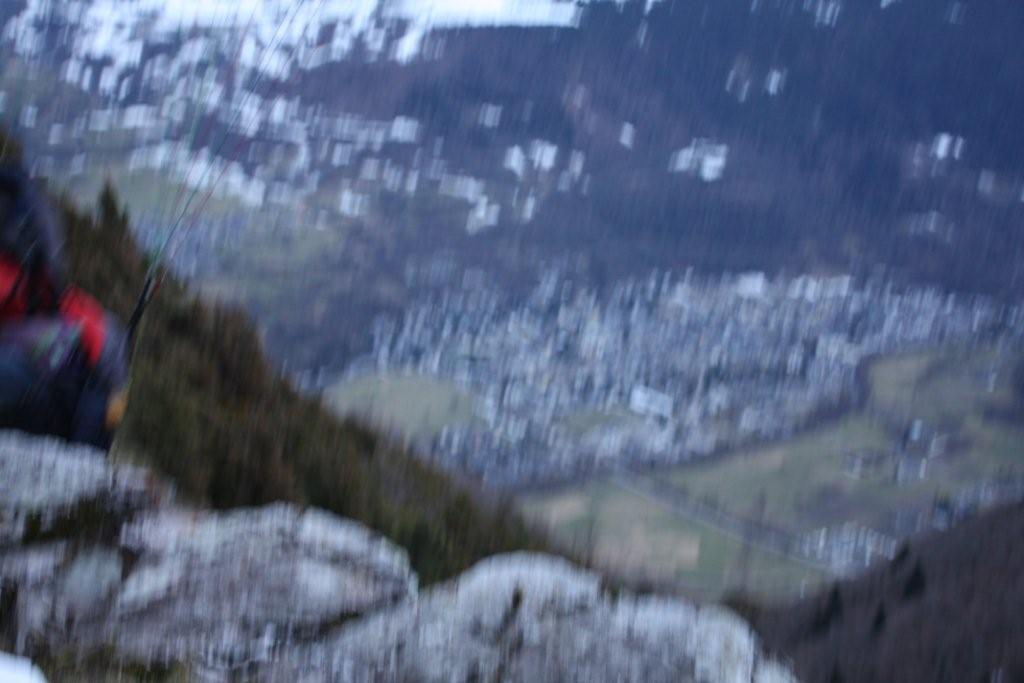
Comments from welcome witnesses
These images suggest that the takeoff terrain has a slope break, but after a climb, in the form of a rocky barrier.
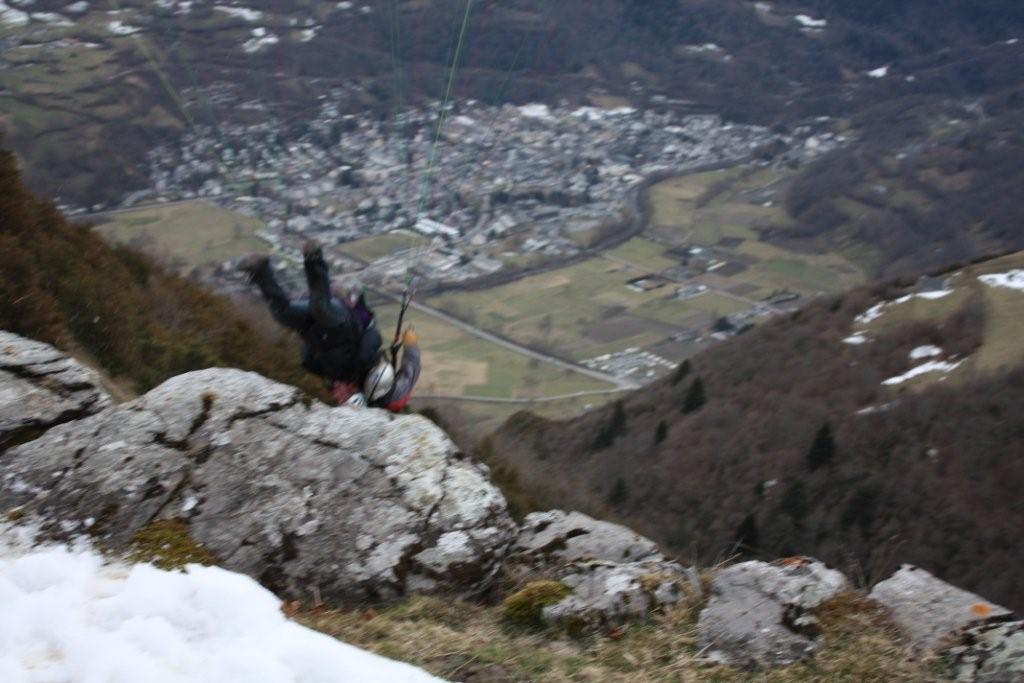
**The passenger has completely moved to the back of the harness (???). His head hits the rocky barrier violently. To be clarified **
Apparently, the pilot's right arm is raised. What this means is that he is thus releasing the brake (I imagine: the brakes) in his search for takeoff at all costs. This photo is problematic and calls for a comment. How can the passenger end up in such a position?!? Had he been properly attached before takeoff? The part of the harness that goes in front of his chest and over his shoulders should in principle prevent his body from tipping forward under the pilot's seat and ending up behind, head down. Has this harness been sealed, examined? A response must be provided to the Roubaud family.
The passenger arrived dead, "with a completely congested face." I will reproduce the testimonies and comments of specialists and experts that you will be kind enough to send me.
One might wonder if the pilot will not invoke "some untimely maneuver from the passenger," in the initial phase of the takeoff (and even if this were the case, it is an imperative reason to interrupt the takeoff maneuver, since the distance remaining in front of the wing allows it). I have done many tandem paragliding flights. It seems difficult, unlike the tandem delta, to perform a run with two people, given the tandem position of the pilot and the passenger. How to lengthen the step, without tripping over the other's legs? It seems to me that the only logical procedure, regarding a tandem takeoff, is that the lift provided by the wing, due to the sole headwind, is sufficient to lift the passenger, allowing the pilot, who is still in contact with the ground, to control the run before takeoff. The question would then be to ask the tandem pilots, and beyond that the manual designers, those who establish the procedures and regulations, who issue the authorizations to carry passengers:
*- Do you consider launching a run with two people, in a tandem, when the passenger's legs are still in contact with the ground? And if the passenger's legs are in contact with the takeoff strip and this risks an incident, do you not decide to pull the brakes fully and cancel the takeoff? *
But it seems that the pilot, in the case of this accident, completely stopped controlling this takeoff, not only by ceasing to manually fly (his hands are occupied holding the passenger's shoulders) but by spreading his legs, that is, losing control of a run that he should have been the only one to control?
**At first glance, and without guarantee ** :
*- A takeoff area with a gentle slope, requiring a well-established headwind, with a flat area ending in a rocky barrier. . - Headwind too weak, insufficiently lifting (witnesses) - Decision to take off, made by a pilot, who weighs 15 kg less than his passenger - The paraglider does not take off, strictly speaking, after a run of dozens of meters. *- The pilot spreads his legs, loses control of the takeoff run, while from the beginning of the run he should have been the only one in contact with the ground. - The decision to brake fully should have been taken immediately. There was still enough space to press the machine to the ground, before the slope break. - A pilot who loses his head, stops flying, spreads his legs, does whatever. - A harness problem, incomprehensible, to be clarified (purpose of the production of these photos )
accident_parapente_1/ludwig3.gif
Epilogue
Once again, we are faced with the problem of ultralights, against the background of a risky sport, or even extreme sports. In the field of freediving, the death of our national champion Loïc Leferme, record holder of this silly activity called "extreme freediving" (which however has its federation!) seems to have slowed down the enthusiasm for this kind of activity, which is extremely dangerous.
In the field of flying machines, this is what is observed. *If, paradoxically, it is strictly impossible to venture on a road with a "rolling machine" that has not received the approval of the mining service, anyone can invent, manufacture and sell a flying machine of their own without any control and let it use the sky's roads. * ---
April 7, 2009: One who escaped death
/legacy/dangers/ultraleger/danger_parapente/accidents_parapente.htm
From:
lolo ailonor@free.fr To:
jppetit1937@yahoo.fr Sent on:
Monday, April 6, 2009, 9:01 PM 03s Subject :
Tandem takeoff Hello After reading this towards the end:
I can offer my small experience in flight duration but nevertheless long due to the number of paragliding flights I have done since 1990.
In January 2007 I did a tandem flight in Gourdon with friends. Two are novices, the third is an "old" paraglider who stopped for health reasons.
The first two flights with the novices went very well. Sufficient wind, good understanding and application of takeoff instructions...
The third, later in the day, was delicate due to very weak wind. But the slope is long on the takeoff from the top and allows to gain speed during the run.
In addition, it's a paraglider I'm transporting!
Oh my, when I see the photos of your article I remember my own situation:
We take our takeoff run, the sail is well raised symmetrically.
We gain speed and approach the break that will allow us to take off comfortably with a good control of the commands.
My passenger, very active at first, does the trick of (falling) at full speed just before the break.
I therefore brake hard, thinking of his teeth that will scratch the rocks and the pool of blood that it will leave !!
Well, no harm, we take off: him lying flat on his stomach between my legs and me relaxed sitting in the saddle. My Fredo plays the man in my legs, arms along the body and legs stretched. Pffff I had the scare of my life. Thank you to the resource of the sail and our good speed.
Not thanks to Fred who chose a very bad moment to falter! Unless I made a mistake?!
On further reflection, I shouldn't have offered it, in addition, he refused to land, which reinforces this conclusion:
Never again without wind, except with someone who wants and can run and fly (and even then).
Thank you for your site. Sincerely Laurent MEYER I found your site while searching for the keywords dynamic stall paragliding:
very little information elsewhere.
Yet a very recent reality for me, also in tandem, recently trimmed to neutral and half-braked at 200kg, but the sail reacted well to my control commands of the descent...
**The show must go on **
I received a letter from an ultralight pilot, who criticized my bias regarding these activities, attributed it to the drama I had experienced, and requested a more careful reading of the texts, with clarification. We quickly fall back on the particularity of this sport: the fact of entrusting users with the responsibility of maintaining their machine and ensuring its good condition, deciding themselves when their machine should be scrapped, destroyed. However, they must have the competence. No flight log, no traceability of the machine's history. I have a dear friend who is ending his life, disabled, after crashing on takeoff with his passenger (also injured as he was) under a French pendulum ultralight, bought second-hand after being used for 200 hours. A "like new" machine. A break in the attachment piece of a lower cable at the level of the transverse leading edge joint. Unavoidable.
I have another friend who is six feet under, due to another in-flight break of a piece, due to fatigue. The list is long ....
I see a thing: the mother of Ludwig and the wife of this man, who is seen to kill himself on the photos*, have not reappeared*. I had suggested to them to set up an association under the 1901 law, aimed at defending parents and relatives of victims of such accidents. My friend Robert Dalmau did not send me, after many years, the drawings of the connecting part which, when breaking, left him seriously disabled, depriving him of sleep every night, and this after multiple requests and promises to follow up. These drawings are... in the hands of his lawyer, and it would have been enough for him to send them to me so that I could show, based on a document produced during the trial, with what technical absurdities people are made to fly. But I know very well what happened, and what I experienced. After the time of the struggle, rather brief, people feel crushed by grief, or by the suffering, the misery of their disability, and are no longer able to do anything. This is what allows manufacturers to continue producing and selling anything, allows owners to get rid of dangerous machines by selling them to anyone who comes along, and schools to teach... in any way. Check the above email for the little information this user was able to find about paragliding disconnection.
This correspondent who protested, wrote to me talking about manufacturers and schools "if these people did this..., the victims would immediately turn against them.....". A big joke. There are victims who are no longer able to turn against anyone. As for the parents and relatives, they should, in order to do so, be able to tear themselves away from the pain crushing them, by starting an exhausting and problematic battle. To this correspondent, whom I will not name, and who speaks with such passion in favor of this libertarian spirit that animates his favorite sport, I would like to write "I wish you would lose a son and then we would see what energy you could invest to turn against this and that...". I think of the phrase by Prévert, paraphrased:
Those who make pens in their coffins with which others will write that everything is fine
Read the file that I had started to compile in 2001.
Nouveautés Guide (Index) Home Page
D ---