Text updated on July 12, 2007
...The craziest thing is that Civil Aviation registers ULMs. It’s just a tax, not a certificate of airworthiness! (&&& written in 2001. A reader will let me know if things have changed since.)
...Those who cling to this freedom they consider so precious say, “It’s up to users to ensure their own safety and maintain their aircraft.” Easy to say when there’s no way to control the design and manufacture of ultralight flying machines.
An attempt to solve the problem (1990).
...After Katzman died in 1990, I contacted two former schoolmates (I mean from Supaéro). Laroze, head of the school’s structures department, had been involved in an ultralight accident. Left with sequelae, he was highly motivated. The other was my friend Daniel Tennenbaum, a Polytechnicien who at the time served as director of the DGAC, the General Delegation for Civil Aviation. Together with Laroze and the technical head of the hang gliding federation, we drew up a plan after meeting in Toulouse. We all agreed that static tests were utterly insufficient to certify an ultralight. Like other flying machines, it was necessary to design fatigue test benches and set standards. The best way to resolve the problem once and for all was to find a young graduate from one of these top aeronautics schools and have him write an engineering doctorate thesis, which Laroze and I could supervise. This young man would have to be a pilot himself, constantly immersed in this sport. In two years he would have solved all pending issues. What is an ultralight to a 23-year-old who’s been taught to calculate Mirage 2000 flight paths? The School offered Katia, a powerful software program focused on structural calculations: a sledgehammer to crack a nut. All this, free of charge.
...I must admit that wing manufacturers were ready to follow us, supplying materials for testing. The federation itself agreed to help fund the project—that is, to cover part of the stipend for this young man, whom we’d then have to find. Our intention wasn’t to cage this financially fragile sport in an iron framework akin to the “Veritas office.” We wanted to help manufacturers, ensuring that at the end of his thesis they’d have easy-to-use PC software to calculate their parts. Eventually, if he proved effective, our doctoral candidate would become a sort of “Mr. Ultralight,” linking technical services and manufacturers. Naively, we imagined he could be paid via subsidies from federations, Civil Aviation, and the Ministry of Youth and Sports. That was in 1990.
...What happened? Nothing. Civil Aviation refused to fund the project. It fell through. Civil Aviation staff passed the buck among themselves. One of them even told me:
“You know what’ll happen. One day, when all these idiots have killed themselves, this sport will disappear on its own and we’ll have peace.”
...They couldn’t care less about the lives lost. Things might have changed if the State had allocated substantial funding to set up a whole bureaucracy filled with well-paid Polytechniciens. Only then, once a hierarchy was in place, could we start addressing problems, comfortably seated in an office.
...Here’s my opinion. For now, I’ve only spoken of the hang glider, which among the three ultralight sports—including paragliding and ULM—is doing best. All should be regulated, minimally at least. But the decision can only be political. It can only come from a deputy or senator whose son or close relative died in one of these sports. If such a person exists, let him contact me:

I’ll show him how to proceed. Otherwise, there’ll be more senseless deaths; their graves will mark every technological advance.
...But, you may ask, how can insurance companies be so foolish as to insure these activities? It’s simple: the insurers are the federations. Manufacturers, unless they make huge blunders, are immune from prosecution: there are no standards nor regulations (&&& written in 2001. If changes occur, let me know and I’ll update this).
...Nothing will change from within the community itself. Everyone bands together to “save these sports,” to preserve this “wonderful freedom” and prevent any authority from locking these feathery creatures in an iron cage. Federations, instructors, schools, manufacturers, and especially specialist journals: everyone stays silent. It’s the law of silence. If one day you die and, from your cloud, can read the report of your accident over a libertarian’s shoulder, you’ll probably be surprised to learn “you made a piloting error” or “you didn’t properly maintain your machine.”
...Even the most skilled, the “old hands” of these sports, those with thousands of flight hours, hesitate to speak out. Instructors and employees fear losing their jobs. Then, one day, when misfortune strikes someone who thought himself invulnerable, two things can happen: either he’s dead, forever silenced, or he’s badly injured, his morale crushed by disability that will accompany him till death; then he tends to hide away and gossip.
That seems to be what happened to Robert Dalmau, who became disabled after an accident in a Cosmo pendulum ULM—a story I’ll discuss later, as his life has since turned into a torment. Since the trial took place, I can mention my own testimony. Had I done so during the multi-year trial, it would have invalidated it. see here.
The ram-air parachute.
...Initially, so-called “hemispherical” parachutes were simply nylon blossoms. Someone invented the “ram-air parachute.”
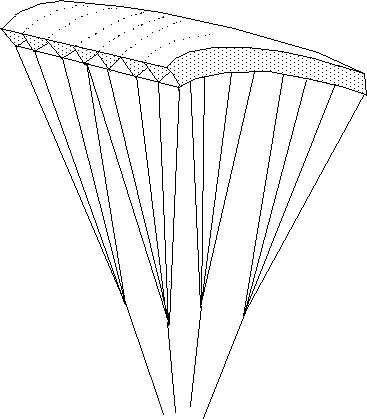
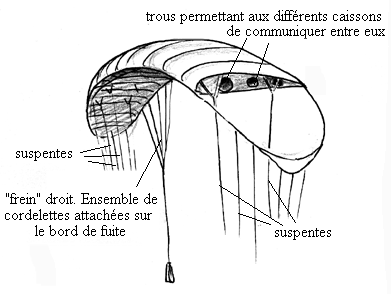
Ram-air parachute.
...This system behaves like a biplane wing. When the user does nothing, the wing assumes maximum fineness. Airflow looks schematically like this:
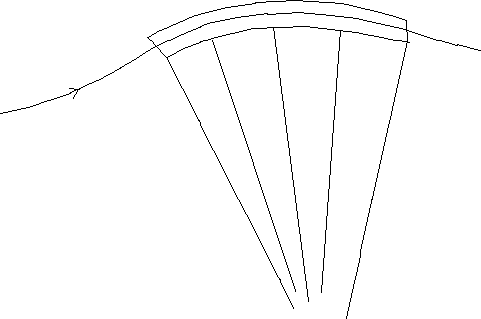
Airflow in a ram-air parachute
...Steering is done by pulling on lines that lower the right and left rear trailing edges. Acting on just one control slows down that part of the wing and initiates rotation.
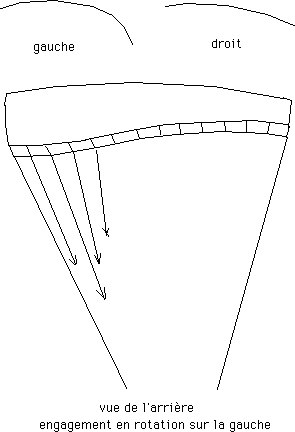
Deformation of trailing edge in a ram-air parachute under pull on one control.
...Compared to deltas, paragliders have smaller turning radii. Once a turn is initiated, autorotation takes over (which the pilot must then control): the outer part of the wing rotates faster than the lower part.
...Pulling both steering lines causes braking and stalling of the wing (at landing).
...Pulling both front line bundles increases speed (and sink rate).
The paraglider.
...Performance of flying machines rises with aspect ratio. There are always aerodynamic losses linked to what’s called marginal vortices, mentioned earlier.
...Hang gliders, Deltaplanes, have followed such development:
...Aspect ratios of deltas reach 5 to 7; sink rates range from 1.5 to 1.2 meters per second (compared to 2.5–3 aspect ratio and 2.5 m/s twenty-five years earlier).
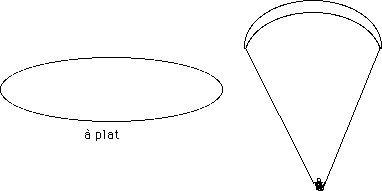
...It was logical that the paraglider, an extrapolation of the ram-air parachute, would follow similar progress in the race for performance. Aspect ratio became much larger, as did number of cells. While the ram-air parachutes used by skydivers remain relatively flat, paragliders are “arched.” An unresolved technological problem for paragliders is the impossibility of creating self-stable “S”-shaped profiles like those of deltas (double curvature). As noted in the federation manual, it’s impossible to sew such a sail because, upon closing, it would prevent reopening. ... This resulted in:
Delta wings or paragliders can be flown in two kinds of weather conditions.
-
Calm air: early morning, when the sun, engine of thermals, hasn’t yet heated the air masses.
-
Midday, when a warm air mass forms at valley bottom and a light wind “triggers” it, producing bubbles of hot air.
These are two completely different flying environments.
Learning to fly.
...How do you take off with a delta or paraglider? You’ll find it fairly well explained in the federation manual:
The Free Flight Manual, Editions Retine, 3 rue Ampère, 94200 Ivry
...This manual is both very well done and comprehensive. Reading it reveals to beginners all the complexity behind the apparent simplicity of ultralight gliders, deltas, and paragliders. ... Novices can receive instruction at various schools. The Free Flight Federation (FFVL) obtained government authorization to be the sole body granting instructor qualifications. At first, before these instructor certificates existed, schools were... pretty much anything goes. Ten years ago (I checked at the time), “paragliding schools” offered “weekend introductory courses” to anyone who’d never flown. I called four such “schools” advertising in a specialist magazine; the conversation went like this:
“As I see, you offer weekend introductory courses. — Yes, sir. — I’ve never flown. What can one do in just one weekend? I assume you can only give some theory lessons? — Not at all. Saturday: theory and slope school. Sunday you go on a big flight. You can even buy your paraglider and leave with it.”
...Today, thankfully, this dangerous charade has disappeared. But this anecdote shows what happens when no supervisory structure can exert control and authority over a sport. Profit motive becomes the sole ruler.
...For paraglider takeoff, a slight headwind (15 km/h) is desirable. Takeoff with tailwind or crosswind: out of the question. No wind: problematic. Fortunately, morning sun striking sun-exposed slopes often creates mild lift, aiding takeoff. In both cases, one must run. The paragliderist must also unfold his sail, initially laid flat on the ground. Getting airborne is surprisingly easy. After a week-long course, a beginner can make his first “big flight.”
...For the delta wing, some centers use very useful accessories. The “bana-bana” helps novice pilots get used to hanging like hams beneath a frame of tubes and canvas.