The Marquis de Sallières, having read our previous article, discovers that the Daumier he purchased in 1986 was actually a fake!
November 8, 2002
In a previous article, we mentioned the recent discovery of a fake artifact at the Cairo Museum. We also encouraged art collectors to conduct some checks on their own artworks. This is exactly what the Marquis de Sallières did regarding the Daumier he bought in 1986 for quite a substantial sum at an auction. Since then, it has adorned the living room of his mansion in Versailles.
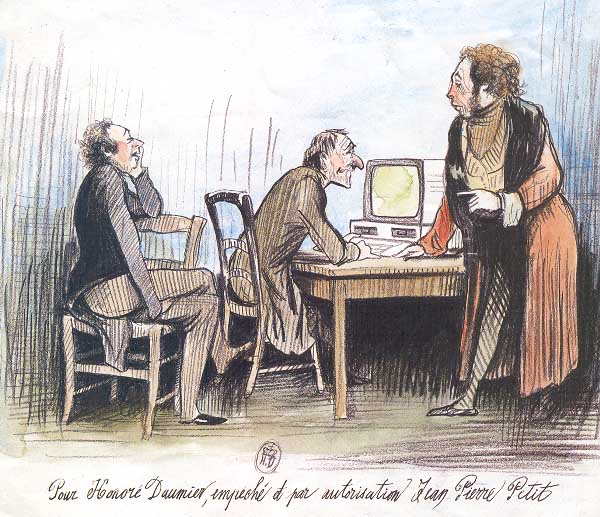
It’s hard to imagine that experts didn’t notice the presence of a microcomputer on the table around which three scribes are seated. This is actually a PC with two 5-inch floppy disk drives. Of course, we also see Jean-Pierre Petit’s signature on this piece; he seems to have created many such fakes during that time. Investigations are currently underway in various French museums. This man managed to place a “crouching Nubian slave” statue in a display case at the Louvre, after carefully aging it. Its presence went unnoticed for several months. In museums, people are more accustomed to theft than to uncontrolled enrichment of cultural heritage.
This HTML page is a hoax! It was I who, twenty-five years ago, created these “artworks”—such as this fake Egyptian fresco or this fake Picasso. All of them feature a microcomputer. A friend of mine had a magazine called “Administrative Computing,” and he asked me to design covers for it. That’s how this series came about. I couldn’t find the fake Toulouse Lautrec I made back then; it depicted a group of prostitutes counting their money using a Macintosh computer. I never imagined that anyone would take these jokes seriously. Who would have thought that museum curators and art experts wouldn’t notice a microcomputer on an Egyptian bas-relief, a Daumier painting, or a Picasso artwork? But some readers actually fell for it, in good faith.
When I posted an article on my website about a test designed to detect stupidity (link), written by Wilfried Wurmstein and Laetitia Paparrazi, some readers rushed to Google to find information about these two researchers. This has become a common practice nowadays. There’s a lesson to be learned from these experiments: I myself was surprised by the results. I’ve often said, “Learn to think for yourself; otherwise, others will do it for you.” These harmless jokes remind us how easily information can be manipulated. Some readers write to me, “We trust your writings.” But that’s not the right approach. You must learn to critically evaluate everything you read, just as I try to do. What’s most interesting about this way of sharing information is its interactivity. Readers constantly write to me saying, “What you say isn’t true; so-and-so never served as president of any Franco-Israeli association…” I take these comments into account. Information on the Internet remains accessible indefinitely, making it dynamic and subject to constant revision. I’m grateful to my readers for this. This interactivity allows me to discuss complex topics like the Israeli-Palestinian conflict or events related to the Algerian War.
Finally, know that Google, despite its impressive performance, was created by the NSA, the U.S. National Security Agency. By becoming the world’s most efficient search engine, Google gains access to your personal data, learns your interests, and can ultimately manipulate you if you give it absolute trust. Can we really trust the NSA? Our world is facing serious challenges; we can’t afford to remain naive. Lies aren’t a modern invention. History serves as a reminder of this; it reveals truths slowly over time.