Paranormal vs. Artefacts – October 14, 2002
Part 1.
Should scientists venture into this extremely slippery territory? I answer “yes”; otherwise it would mean there are taboos in science. In principle, there shouldn’t be any. But in reality, science functions like a religion. For instance, many scientists have never wanted to touch upon the subject of UFOs, thus adopting an irrational attitude. This is why this topic has been left to the “bandar-logs.” Let me share an anecdote. I have a friend who’s a researcher; he’s exceptionally brave and honest. He’s one of the people I respect the most, in every way. Moreover, he’s a highly valuable scientist, having made major discoveries. For a quarter of a century, whenever the subject of UFOs came up in conversation with him, he’d raise his hand in denial and say:
“You know my views…”
Each time, I didn’t insist. But a few months ago, I finally dared to ask him:
“Have you read my books on this subject?”
“No…”
“Then, have you read any books written by others on this topic?”
“Uh… no!”
I didn’t go any further. It was obvious he saw no point in learning more about a subject that seemed to him utterly pointless and meaningless. He answered in all good faith. Yet he’s known me for twenty-five years, as well as my scientific work. He’d never think of me as an unserious researcher; in fact, he’s even defended me vigorously at times. But, surprisingly, he never thought: “How come Jean-Pierre Petit, whom I consider a very reliable scientist, has devoted so much time to studying UFOs?”
What kept this man from showing any interest in this topic? It wasn’t, as is the case with many colleagues, fear of negative consequences for his career. It was simply because it’s a subject he knows nothing about. In fact, the topic of UFOs is generally very poorly understood by scientists. People get the wrong idea about how open-minded scientists actually are. They’re specialists; many of them, though brilliant in their own fields, aren’t curious about anything beyond their “cognitive horizon.” They’re just as susceptible as ordinary people to general brainwashing.
The world of the “paranormal” also falls under scientific taboos. Yet we all face questions of a transcendent nature; the most immediate of these being death. I’ve asked theoretical physicists how they imagine life after death. To them, it seemed like a completely nonexistent world—a nonsensical question. Many live with a rather naive materialistic view of the entire universe. Some even believe that one day we’ll find that famous “Theory of Everything” and that the entire universe—its past, present, and future—can be deduced from some sort of mathematical formalism, perhaps from one ultimate equation. This is, for example, the stance taken by someone like Hawking, who wrote in “A Brief History of Time”:
“The universe contains itself; if it has no beginning nor end, then what use is God?”
Reading such statements makes one want to exclaim:
“At a time when metaphysics is in crisis, it’s reassuring to see that barroom philosophy is still thriving.”
Nobel laureate in neuroscience Edelman expressed his conviction that “one day humans will be able to create thinking, conscious robots.” With such figures, one gets the impression they lack any philosophical perspective whatsoever. In truth, a scientist is primarily someone who believes he has the right to opine on anything. Most are completely unaware that any system of thought is merely an organized set of various beliefs. Some physicists firmly believe the universe has four dimensions: three of space and one of time. Here I quote a sentence from an astrophysicist named Fritz Zwicky, with whom I had the incredible fortune to take a boat trip; he once said:
“If only theorists knew what lies behind an experimental measurement, and if observers knew what lies behind a theoretical calculation, they’d take each other far less seriously.”
An organized system of beliefs operates via a hypothetical-deductive mechanism:
“If… this and if… that, then… this.”
This produces a linguistic machinery called a paradigm, which functions like a kind of “hamster wheel” inside which the thinking human pedals away without realizing it. Progress in knowledge occurs through paradigmatic leaps; it’s essentially discontinuous. One could even use the word catastrophe in its mathematical sense. Etymologically it derives from Greek kata: beside, and strophedein: furrow. If speech could be compared to music produced by a phonograph, sometimes the needle jumps to another groove and a completely different melodic phrase suddenly follows. A quick example: for who knows how long schools taught that orogeny—the formation of mountains—was due to what was called “geosynclines.” That’s why one could find shells on high mountain ranges. It was a very difficult theory to grasp; we basically had to memorize it. I’d love for someone to produce a text from the 1950s describing this supposedly marvelous intellectual fantasy that was then considered law. You know how the story ends: as soon as the first artificial satellite was placed in orbit, used to collect echoes and perform Doppler measurements, it immediately revealed… continental drift, dear to meteorologist Wegener, previously considered utter nonsense. Geophysicists promptly reconstructed their vision of the planet. But instead of paying lasting tribute to this visionary (who hadn’t merely noted the similarity between the coastlines of West Africa and South America but also established continuity in both the nature of terrain and animal species), they preferred to call this new discipline plate tectonics. Thus, over sixty years, these people witnessed a fairly significant paradigmatic leap: during their lifetime, the continents they lived on suddenly began moving. This is quite comparable to abandoning geocentrism, when Earth suddenly started moving through space.
What’s extraordinary is how people—starting with scientists themselves—forget these leaps. After a very short time, they live as if their knowledge “had always existed.” They’re completely unaware of the constant flux of their perception of the world. Between two leaps, a period of conformity arises, based on what Reeves often refers to as “broad consensus.”
Modern science emerged “in the Age of Enlightenment.” It felt it had a duty to combat “obscurantism.” Thus rationalism was born, opposing the “world of belief,” while a world devoid of beliefs is merely an illusion. Thanks to reasoning based on beliefs established by Aristotle, Ptolemy demonstrated in the Almagest that Earth couldn’t possibly move.
Proof:
-
Any moving object must be subjected to a force. This force manifests as vortices. These are perfectly visible, for instance, when pushing a boat away from the dock. When the vortices cease, the boat stops.
-
Massive objects are more sensitive to forces than light ones. Example: a stone versus a feather.
-
Therefore, if Earth were moving, it would necessarily be subjected to a force. We’d also be immersed in this “force field.” Since we’re lighter, Earth would fly off and we’d be left floating in space like idiots.
-
Hence, Earth must remain motionless in space.
Today, the scientific world continues operating with beliefs that stubbornly persist, such as Darwinism or the standard model of cosmology—both fields riddled with flaws. When my theoretical physicist colleagues deny any post-mortem existence, it’s because they firmly believe thought can be reduced to biochemical reactions in the brain; that emotions are, as La Rochefoucauld put it, “poisonings by toxins.” They’re totally unaware that their mode of thinking entails extreme reductionism; Ptolemy’s lesson proved useless to them.
I belong to those who believe that what we call knowledge is merely a loosely organized collection of various beliefs, floating atop an immense ocean of ignorance. If we’re unable to explain or at least model what’s commonly called consciousness (consciousness of existing, becoming, moral consciousness), then we practically know nothing.
There are things we think we can model, and we believe we understand them—a rather bold claim; and there are phenomena we don’t understand at all. Grasping these problems proves especially difficult since these phenomena are non-reproducible. Yet science is essentially the realm of the reproducible. We label these unmanageable phenomena “paranormal.” Personally, I’d prefer to call them “extra-paradigmatic.” We’re capable of appreciating, understanding, and “accepting as evident” only when confronted with “intra-paradigmatic phenomena”—that is, those fitting within our cognitive schemas, our linguistic descriptive capacity, and conceptualization abilities. Sometimes we encounter frauds that are merely intra-paradigmatic phenomena presented as extra-paradigmatic manifestations, as happened during that lamentable session on September 28th.
Stage magic is a perfect example of “fraud” that’s acceptable only when presented as such. Thus, this Mexican medium would fit right in at the Grévin Museum’s small theater, where he could perform a much-appreciated act. But such a performance isn’t appropriate before an audience told they’d witness a transcendent phenomenon. I regret that in such exhibitions we lack, as in old Westerns, tar and feathers to give these illusionists their due. The world of stage magic is formidable; it’s become even more so since high-tech elements have gotten involved. Let me give an infinitely simpler example. Twenty-five years ago, a researcher named Chertok from the CNRS studied suggestion and the possible influence humans can exert on their own bodies. One day he showed us a film he’d shot depicting a woman’s wrist on which he’d placed a five-franc coin (a fairly large coin, which disappeared with the advent of the euro). Chertok then suggested to the woman that “this coin was burning her.” Indeed, after a few minutes, lifting the coin he managed to produce redness and blisters. He also pointed out that these two phenomena are nothing more than effects of blood and water flowing into tissues—the body’s defensive reaction to a local rise in temperature.
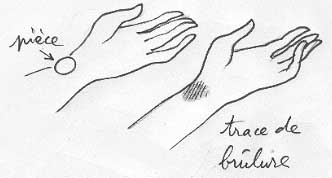
Personally, I wouldn’t dare doubt the authenticity of Chertok’s film nor the soundness of his experimental protocol. It seems plausible that a human can produce such phenomena. Doesn’t anyone blush when embarrassed or shy? Unless shyness itself falls under paranormal phenomena? Incidentally, for an inattentive experimenter, anyone can produce redness on their skin simply by suction. Try it on your elbow crease; it’s easy to make... drops of blood appear, a genuine “stigmata.”
Chertok and I had lunch together; I told him I might be an interesting subject “because I can voluntarily stop my blood circulation, halt my heart.” I asked him to check my pulse, which he did. Then, feigning intense concentration, I stopped my pulse for ten seconds, adding:
“I can’t do this for very long, you understand; it’s still dangerous...”
Chertok was immediately ready to conduct proper experiments on this new phenomenon, but I promptly revealed the trick—there was one—which he would have discovered instantly by placing a stethoscope on my heart. He’d have realized it never stopped beating. One does this simply by putting an object like a potato (or a wooden egg to mend, which works very well) under one’s armpit; then just squeeze one’s arm against the body. This compresses the artery and the pulse disappears. As a magic trick, it’s amusing; as a paranormal phenomenon, it’s pure tar-and-feathers stuff, immediately.
[Previous page](https://www.jp-petit.org/Cuarto de luz/Cuarto_de_luz.htm) Next page
Back to Paranormal vs. Artefacts index
Back to New Releases Back to Guide Back to Home Page
Number of views since October 14, 2002: