Paranormal vs. Artefacts – October 14, 2002
Eighth part
We drew from the world of magic to illustrate the concept of “artefacts”. While the trick performed by the Mexican medium mentioned earlier was relatively crude and easy to debunk, we also encountered other tricks that relied on little-known topological properties that could create illusions. Imagine that, in this experiment, the medium, who needs to reach a key that’s seemingly out of his reach, says, “I can only become intangible in complete darkness.” A thorough inspection of his equipment would yield nothing. You could examine every part of it, check the strength of its connections—which in this case are actually steel cables. You could even X-ray him from head to toe to see if, like Houdini, he had hidden tools in his esophagus or anus to help him escape from handcuffs. You could also verify that no accomplices were helping him. None of this would yield any results; it became clear that “intangibility” was the only possible explanation. Simply put, according to our understanding of the situation, the medium simply couldn’t bring the ring close enough to the key. Only an expert in knot theory could tell you, “Your medium isn’t permanently tied to its starting position.” Admit it: if I hadn’t given you the solution, you wouldn’t have even tried to find it!
There are extremely tricky artefacts. Once, I was called to Brittany by a man named Patrick Marsilli, an inventor and builder of amazing houses called “Domespaces”. Check out his website: http://www.domespace.com
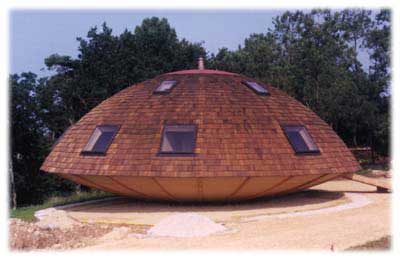
These houses are truly remarkable. They’re made of wood and are very comfortable and pleasant to live in. Additionally, they can rotate around their own axis since they’re built on a circular track filled with gravel. One day, Marsilli called me and invited me to witness a fascinating phenomenon: inside these houses, natural radioactivity is reduced by 40%. It was definitely worth the trip. So, I went there with some engineer friends. We brought our own equipment: Geiger counters. First, we carefully measured the natural radioactivity levels around the building. These levels remained remarkably constant. But then, to our surprise, as soon as we entered the house, the radioactivity levels began to drop, reaching their lowest point right in the center of the house—a reduction of 30–40%. We repeated these measurements several times.
Could the materials used have some unknown properties? Near this “dome”, Marsilli built a conventional garage using exactly the same materials: glued laminated wood, cork insulation, and red cedar cladding. Yet, no reduction in radioactivity occurred there. So, this wasn’t the cause.
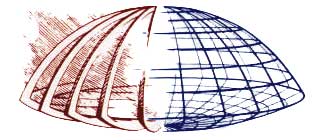
We conducted measurements on several similar buildings. The results were the same. Marsilli even told us that this reduction in radioactivity had been observed in a building still under construction; at that time, it was just a framework, with no floors or cladding yet installed. In the diagram below, taken from Marsilli’s website, you can see the glued laminated wooden beams forming the basic structure.
Another puzzling phenomenon: many Domespaces are supported by cylindrical concrete columns. It’s at the junction between these columns and the house itself that the circular track lies. In the diagram below, you can see these elements. The structural components of the Domespace are bolted onto a cylindrical metal tower, which rests on the concrete foundation via the circular track. The inhabitants walk on a floor above this tower. Between this floor and the lower spherical shell lies a kind of “basement” accessible through a hatch. We entered this area and took more measurements. At the junction between the dome and the cylinder, this shell is interrupted. There’s a circular opening several meters wide leading into the interior of the concrete column. And here’s another surprise: when we moved the Geiger counter near this opening, we noticed a significant increase in radioactivity levels over just ten or twenty centimeters. This gradient is quite substantial. This increase occurs precisely when the probe passes through what seems to be a “virtual surface” completing the lower spherical shell.
Is it possible that the shape of the Domespace affects radioactivity levels? Are we dealing with a reproducible paranormal phenomenon? We were baffled for a long time. What could possibly cause such an effect?
Presumably, it’s radon gas, a radioactive gas constantly emitted by the Breton soil. It’s a heavy gas, so it tends to accumulate near the ground. It’s well known that basements in Brittany must be properly ventilated; otherwise, radioactivity levels rise as radon gas rises to the surface. But we saw that all Domespaces are elevated above ground level. Their floors aren’t at ground level, so they’re not in the layer where radon accumulates. Now, let’s look at measurements taken inside a Domespace built on its concrete pedestal. Inside, there’s just dirt. Thus, radon gas emitted from the soil fills this cylindrical space completely. It then overflows through the circular track. All this means that this cylinder is completely filled with radon gas, hence why we observe such drastic fluctuations in radioactivity levels.
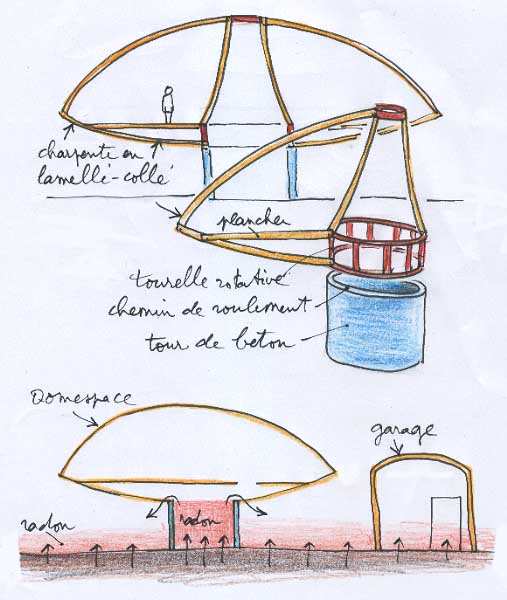
Why did Marsilli notice a decrease in radioactivity levels during construction, before any cladding was added? Perhaps because these houses were already elevated above ground level, and no one thought to measure radioactivity levels at a certain distance from the ground. I must admit that none of us thought about the possibility of radon accumulation near the ground at all. This is just a hypothesis; Marsilli must verify it.
Brittany is far away. Unfortunately, I won’t get the chance to return there. But I’ve informed Marsilli of this issue. He’s quite busy too. Hopefully, he’ll be able to confirm my analysis of this phenomenon.
Was Marsilli a magician or a trickster? Absolutely not. He observed this phenomenon in good faith. When we went there, none of us thought to climb up a ladder and measure radioactivity levels away from the ground. It’s a dangerous trap for people with good intentions; it also makes it easy to appear foolish by drawing hasty conclusions regarding the effects of “shape waves” on physical phenomena.
Back to Paranormal vs. Artefacts index
Back to New Developments Back to Guide Back to Home Page
Number of views since October 14, 2002: