The Pentagongate: Information might be too serious a matter to be entrusted to journalists
One of my readers: M.M
August 2007: Four long years have passed.
Has anything changed? Not really. The press remains just as awful.
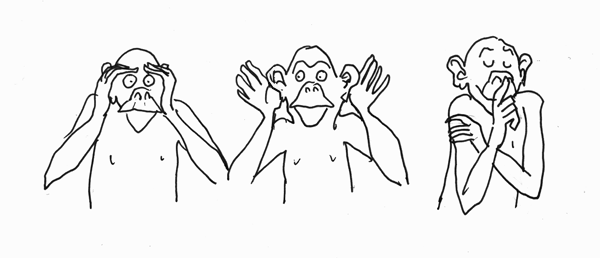
The Press
The press, our politicians, our intellectuals. It’s reached a point where this has been a topic I’ve avoided for years. Recently I decided to address this issue with a touch of dark humor. Occasionally, readers alert me to videos that are sometimes of great quality, like this one. Long (as expected), but convincing.
http://www.syti.net/Videos/Mysteres11Septembre.html
People watch it. So what? No debate, no reflection. It’s appalling.
Page 1
October 6, 2003
I’m returning to the story of the events of September 11. I had gathered a lot of documentation, which was lost when my hard drive crashed this summer. I asked my readers to help me compile it, and I’m doing so again today.
This is a very serious matter. It has never been investigated by anyone—neither by any commission nor by our journalists, who, I’ve come to realize, don’t conduct real investigations but merely parrot whatever they read on their wire services, or else avoid topics deemed “journalistically incorrect.” I’ve lost all illusions about the journalistic community, across all media. It took time, but now I have a fairly clear picture. Regarding television, I’ll repeat the quip I now place at the top of the “new” page—a phrase from my late friend Aimé Michel:
When Yhawey said “you won’t make any images,” he was already thinking of television.
That was forty years ago. Things haven’t improved since.
I’ll open the discussion by presenting several documents and opinions (including my own). The goal isn’t to draw conclusions but to inform. In my view, this topic needs to be examined. America, with the assassination of Kennedy and later the discovery of carefully orchestrated provocation plans involving “the liberation of Cuba”—where it was planned for “fake Cubans” to fire mortar shells at U.S. troops stationed at Guantanamo (potentially killing American soldiers)—the “Operation Norwood” affair has shown us how Machiavellian such manipulations can be.
This isn’t about being anti-American. Nor am I anti-Russian when discussing what’s happening in Chechnya or expressing suspicion regarding the Kursk sinking. I’m not anti-French for believing that the French government authorized secret underground nuclear tests on its own soil. Nor do I consider myself anti-Jewish or anti-Arab based on the articles I’ve published about the Israeli-Palestinian situation. However, I believe our world is becoming increasingly insane (or perhaps it always has been; now this insanity, like pollution, is taking on extremely worrying forms). There’s a book to be written titled “History of Disinformation.” There’s much to say, including about the Reichstag fire.
I believe few French people remember or even know that our late President François Mitterrand, who played both sides, managed repression in Algeria at first before ultimately ending up on the left, holding a red rose and looking like a pious apostle—once staged a fake attack with his accomplice Robert Pesquet. I think it would be good, from time to time, to remind French citizens who tend to forget the “youthful mistakes” of those they vote for. This is the famous “Observatory Gardens Affair”. Young Mitterrand (who wasn’t even an adult at the time) asked a comrade to fire some machine-gun rounds at his vehicle to make it seem like an attack aimed at him. Unfortunately, the accomplice spilled the beans and Mitterrand found himself in trouble, “indicted.” It ended with a fine for unauthorized possession of weapons. The statute of limitations freed François from further trouble. Later, he carried this unsavory episode around for years, which his opponents never failed to bring up periodically. It didn’t ruin his political career, though, since he served two seven-year terms. I believe having steel balls is a prerequisite for becoming a politician.
Thus, fake attacks are common. One might even wonder if the car bomb incident wasn’t simply orchestrated by Putin to reignite the war in Chechnya.
Attacks themselves are heroic acts or acts of barbarism depending on the era and perspective. Do we recall Malraux delivering his theatrical eulogy of Jean Moulin, tortured to death by the Germans after being arrested? This same Jean Moulin, at a young age, seeing how passive the French population was under German occupation, decided to create tension by ordering the murder of a young German naval officer in the metro. A member of his group shot him... in the back. His name: Pierre Georges, later remembered as “Colonel Fabien.” He died later on the front lines in Alsace, having played a major role in the liberation of Paris. Numerous squares bear his name. But really, there should be bronze statues depicting multiple figures, illustrating this act marking the birth of the French Resistance: the young German officer collapsing, and behind him the “hero” with a revolver in hand.
Who still sings the Resistance anthem:
Friends, and you murderers, grab your arms and knives, kill quickly! And you, saboteur, mind your burden: dynamite!
An attack serves a purpose. The one led by Jean Moulin’s group helped create a “Resistance” which, prior to this assassination of the German officer and subsequent repressive measures by the Germans, practically didn’t exist. What’s troubling about September 11 is its implications for foreign and domestic policy. They say “who benefits from the crime?” Truly, this case defies categorization.
Let’s start with information as presented in Thierry Meyssan’s books: (the following text was written in February 2003)
Below is the cover of his book “Pentagongate,” published by Carnot http://www.carnot.fr
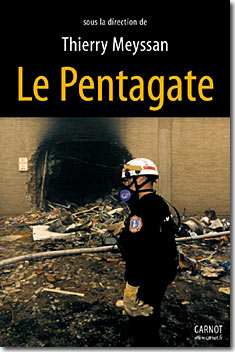
Visiting this site immediately shows that this book, a follow-up to “September 11, 2001: The Horrible Fraud,” has been translated into many languages.
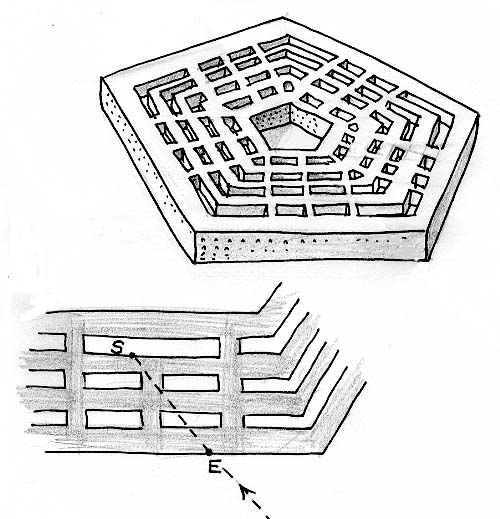
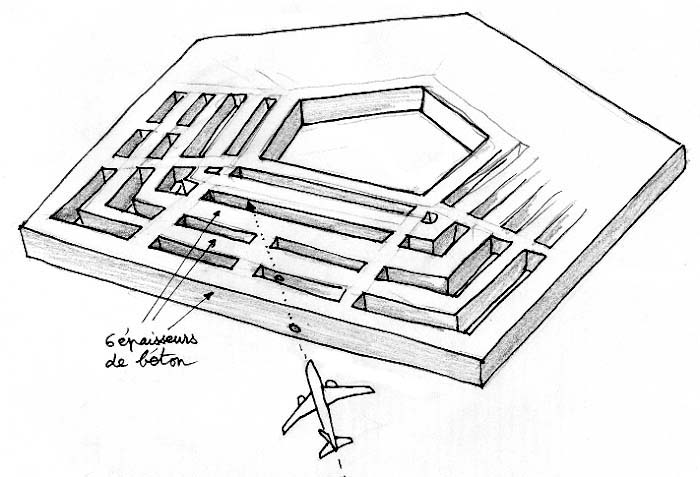
Personally, I received statements from various friends, former airline pilots, with some skepticism. It all seemed way too far-fetched. One immediately thinks of “systematic conspiracy mania.” Indeed, if we entertain this hypothesis and assume there’s some truth to it, the gap widens. If one attack seems suspicious, then all events of September 11, 2001 become suspect. We move from “a cowardly attack against the American people” to an utterly monstrous manipulation. Before exploring this, let’s look at some technical data. We’ll focus on the attack against the Pentagon. We know the building, designed by General Groves, promoter of the Manhattan Project for the military. It can house up to twenty thousand people. As its name suggests, it’s a pentagonal complex, with four floors and an attic. Like Russian dolls, it consists of five concentric pentagonal sub-complexes arranged around a central courtyard. These circular “blocks” are separated by courtyards. We can see this layout in this general view:
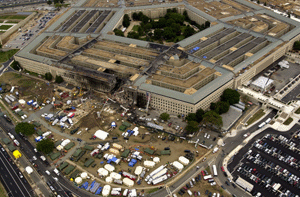
and on plate XI of the book:
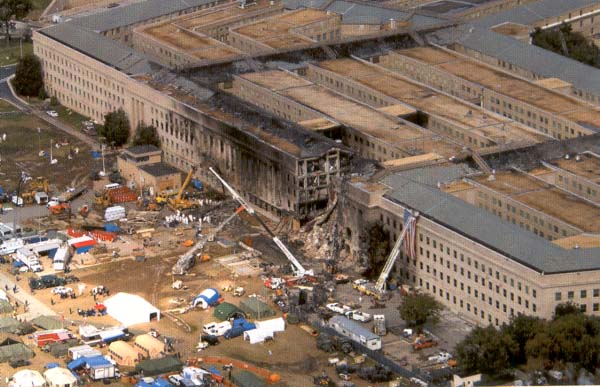
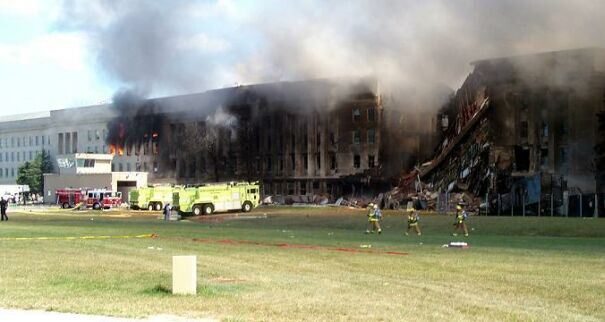
The Pentagon. Impact point with part of the building collapsed due to fire
This photo was taken after the fires following the impact had been put out. The huge breach seen in the foreground didn’t occur at the moment of impact itself but resulted from the collapse of the façade due to the fierce fire that broke out half an hour later—an “urban-type” fire, not the ignition of jet fuel waiting half an hour to burn. An “urban-type” fire emits gray smoke, while jet fuel, a heavy oil, burns producing black smoke.
In October 2003 I obtained a surprising photo showing how the grass remained intact even after the explosion. There’s truly a problem here...
The object penetrated three sections of the building diagonally, as indicated in the photo on plate XV of the book:
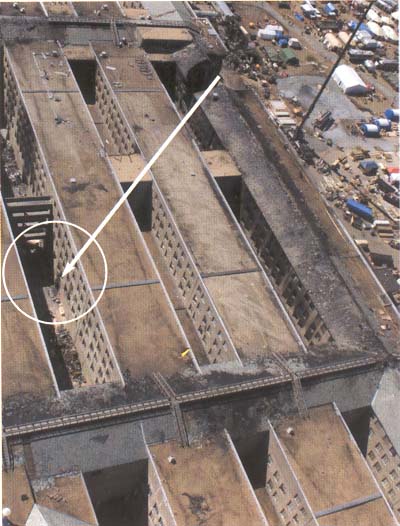
Trajectory of the object
Thus, in the circle we see the exit hole, and at top right the impact point with the whole collapsed, fire-damaged section. The arrow indicates the trajectory followed. The collapse, occurring half an hour after impact, allows us to discern the cross-section of the building, comprising two rooms and two corridors.
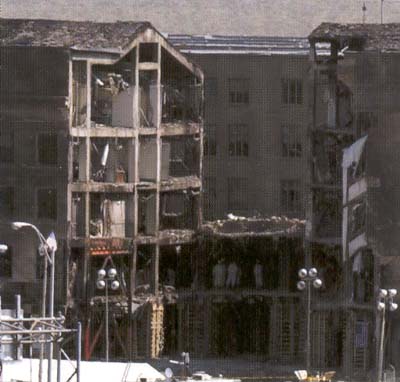
Collapsed section (due to fire) near impact point
In the following drawing, a schematic overview of the Pentagon. The trajectory is indicated: E = entry point, S = exit point, at the third inner courtyard.
The exit hole is visible on Thierry Meyssan’s book cover:
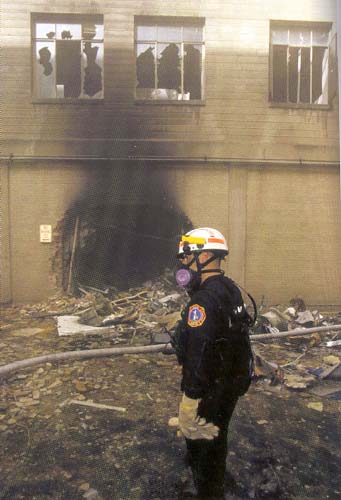
The exit hole
It’s a perfectly round hole, 2.3 meters in diameter. The official theory says a Boeing 757 airliner caused such damage.
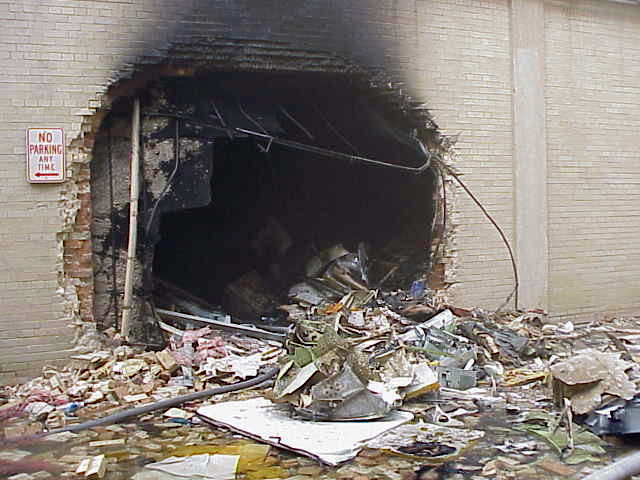
Close-up of the same exit hole
The wall structure suggests reinforced concrete framework with brick cladding. A load-bearing pillar is visible on the right. Such a regular perforation implies a central impact by a compact object. The brick wall then gave way and shattered into countless pieces. We don’t know what the dark gray fragment right after the brick layer represents. To create such a clean hole, one needs an object with strong penetration abilities, especially since it pierced through several buildings (see earlier photo) and numerous partitions. Thus, we imagine a compact object. It’s hard to see how the front of a civilian aircraft, essentially consisting of a thin radome, could possess such penetrating power. If it were an engine, we’d have found and photographed it first. The debris arrangement gives the impression... it was brought in and placed there. Something doesn’t add up in this image; only a reconstruction could lend it any credibility.
In the following photo, investigators (DOD, Department of Defense, Tech. Sgt. Cedric H. Rudisill) show, comparatively, the scaled silhouette of the plane and the building in the background (in this drawing, the plane’s orientation doesn’t match the official DOD version, shown in the next drawing):
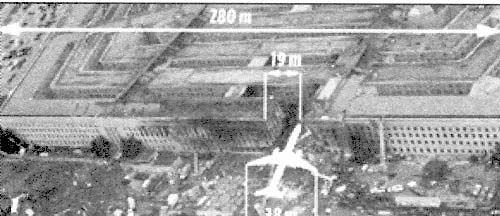
The plane and building, to the same scale.
Next drawing, same scale: building and airliner at impact point, with “fuselage entry hole” opposite it. Facade width: 180 meters. Wingspan: 38 meters.
Photos of the impact area were taken shortly after. There’s also a video. First there was an explosion. Meyssan and his team point out that the images don’t match jet fuel ignition. Let’s digress by considering an image taken after one of the two impacts on the Twin Towers. The tower, 65 meters wide, is built around a central pillar—a kind of concrete cage containing steel columns. To cause the observed destruction, planes had to penetrate these concrete walls. Before that, there were no particular obstacles. The plane entered the tower at one floor level “like through butter.” Its panels tore apart, releasing a hundred tons of jet fuel. It was propelled forward by inertia, along with shredded plane debris. In the photo below, these tens of tons of jet fuel spill into the void, igniting as they go. Black areas indicate fuel that hasn’t yet burned. Ignition of such a mass of hydrocarbon requires oxygen and takes time; heat release isn’t instantaneous. Hence the upward motion doesn’t occur immediately; as seen, the fuel falls back down as flames. The flame is yellow, not indicative of very high temperature.
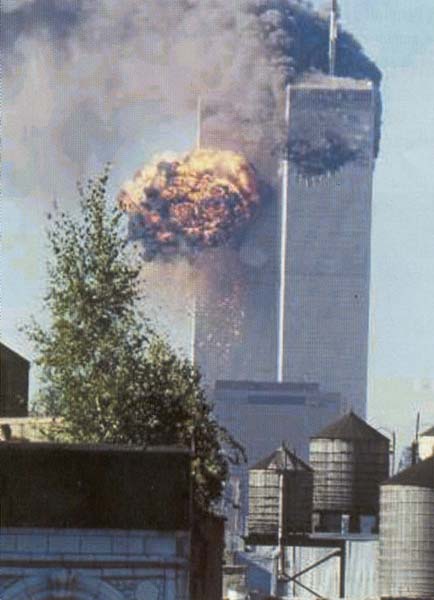
Plane just hit the front tower. Jet fuel spraying and igniting.
When the object struck the Pentagon, things unfolded differently.
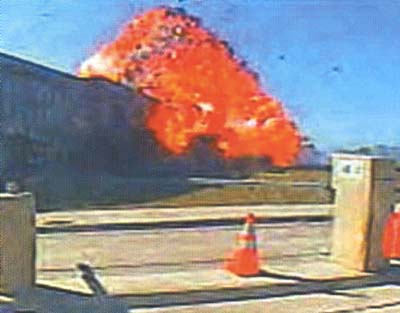
Object just struck the Pentagon.
This is a frame extracted from a video. Explosives don’t “burn.” The explosive material reacts without needing atmospheric oxygen. The chemical reaction is triggered by a “detonation wave”—a shockwave traveling through the substance at thousands of meters per second. Behind this wave, the material compresses and heats up. The reaction occurs very rapidly. The detonation wave is propelled by the chemical reactions behind it. Result: when an explosive detonates, energy release is extremely abrupt. The entire charge generates this energy in a fraction of a millisecond. Gaseous reaction products expand rapidly; unlike hydrocarbon combustion, the explosive cloud rises immediately. That seems to be the case here. Subsequent images show that light emission ceases very quickly—which wouldn’t happen with burning hydrocarbon masses. The next photo was taken shortly after the blast; firefighters hadn’t yet arrived. The impact point is marked by faint redness.
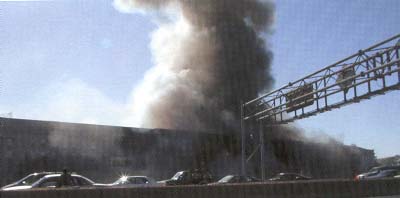
Right after impact.
Had there been jet fuel, it couldn’t have burned so fast. But an “urban-type” fire then broke out inside the building. It can’t be the burning of jet fuel introduced at the same time as the plane’s fuselage, which supposedly penetrated the outer wall. As seen in later images, the entry hole, before the fire started, was relatively small. The theory that wings “folded and were pulled inside” is total nonsense for an aeronautical engineer. If it were a plane, its wings would have smashed against that outer wall. The jet fuel, spilled (especially on the lawn), would then have ignited.