The Pentagon – Page 2 – October 6, 2003
In Thierry Meyssan’s book “The Pentagon”, plate VI shows photographs taken between 9:10 and 10:10 a.m. Firefighters were already on the scene at that time. The text states: “A secondary fire broke out; a truck parked in front of the Pentagon caught fire. The smoke emanating from it was that of hydrocarbon combustion” (black smoke, as opposed to the grayish smoke from the main urban fire.)
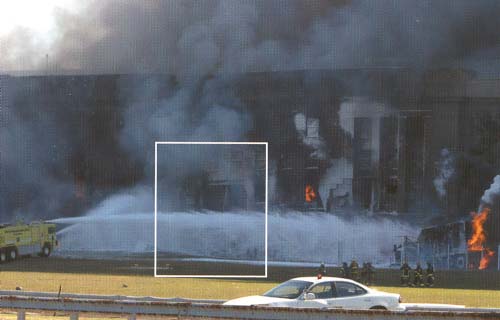
1 – A fire truck is spraying water on a fire that broke out in another truck parked in front of the Pentagon (right). The spot where the object hitting the Pentagon struck the facade is marked by the white rectangle.
The next photograph shows an enlargement of this hole, presented as the point of impact. It’s a very intriguing image. Indeed, the hole appears to be roughly rectangular in shape. Windows above and on either side can be seen. The upper portion seems to be part of a floor surface. The hole spans the space between two windows and is said to be 5–6 meters wide. This would correspond to a wall that had been breached. In front of it, the water spray corresponds to firefighting efforts aimed at the burning truck. It’s unclear exactly what lies inside the hole. Is it a section of a partition seen edge-on, or perhaps a fragment of a beam hanging down?
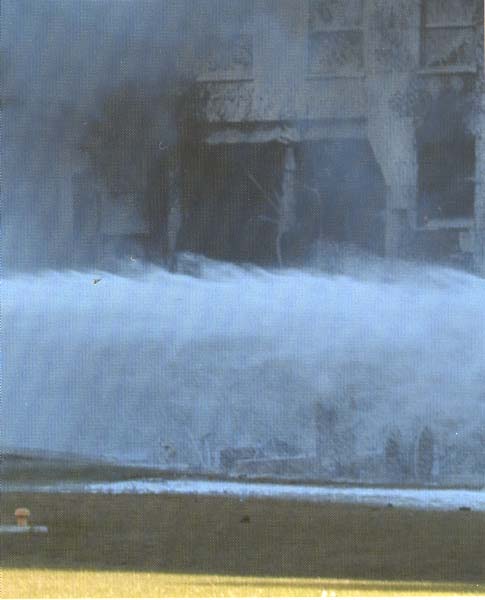
2 – The entrance hole, enlarged.
It’s worth noting that opposite this entrance hole, the lawn remains completely untouched. If this had indeed been caused by an airliner crashing into the building, one would expect to see vast areas covered in burning kerosene. There are no debris whatsoever, nor any traces of the vertical stabilizer striking the facade. When its landing gear isn’t deployed, a Boeing 757-200 measures twelve meters in height.
One more thing stands out—unless I’m completely mistaken: the windows situated directly above the main hole and those to its right, as well as others nearby, appear stained with something resembling dry ice. Regardless of what this substance actually is, the glass remains intact, even though the plane apparently disintegrated completely. Can anyone explain how an airliner could strike a facade and completely disintegrate while leaving nearby windows undamaged?! No bodies are visible, no landing gear fragments; practically nothing remains except bits of aluminum. So, where did everything else go? We’re told it ended up inside. But through which hole did such a massive fuselage carrying sixty passengers, their luggage, cockpit electronics, landing gear components, etc., enter? It couldn’t have been through such a tiny opening. Thus, we must consider a much larger hole. If it’s the largest square-shaped hole, then the tail section should have struck the facade immediately above it. Yet, as we saw earlier, the windows remain intact! This brings us back to the official theory: the plane strikes the facade and “folds up like a peregrine falcon folding its wings” in order to slip inside. A reconstruction is needed here! An airplane wing isn’t merely made up of scraps of aluminum; there’s a strong main spar that absorbs stress. That spar would have slammed into the facade at 450 km/h. Where’s any trace of such an impact?
If, as Milanini notes, there were multiple impacts and several holes, and if these correspond to the penetration of engine blocks into the building, then where did the fuselage strike and where is the mark left by the tail section? Someone please explain this...
Engine blocks are compact structures (see my drawing later on where they’re shown in red). Their axes bear all the thrust generated by the aircraft. They aren’t lightweight alloy assemblies prone to disintegration. In every crash, at least one identifiable engine is always recovered. If none were found outside, it means they entered the interior. How? Had they struck the exterior without penetrating, we’d have found identifiable pieces, if only an engine cowling fragment—not merely “bits of aluminum.” If they penetrated inside and then “sped wildly through,” why did those fragments vanish entirely? According to Milanini, they supposedly crossed three separate buildings yet no intense heat was produced to vaporize them. Look at the hole whose photo appears on Meyssan’s book cover. Something must have struck that wall at the end of its trajectory—the fuselage? It’s too small to account for it. Then, an engine? In that case, near that hole, near the firefighter, there ought to be identifiable debris. Yet there’s none; no “heat like that of a furnace” is evident since windows right above the hole are simply broken.
When a major fire occurs, glass melts. In 1959, I rode in a Dauphine driven by a young Polytechnician who became a general: Gildas Rouvillois. His somewhat reckless driving caused us to leave the road (we were going straight, trying to overtake a truck with no traffic coming toward us), resulting in several rolls. Miraculously, we escaped unharmed. Immediately afterwards, however, the fuel tank ignited; it was full—40 liters of gasoline. All the glass melted; the next day we found it in the form of glass lumps inside the car’s shell. Has anyone ever found melted glass fragments amid Pentagon debris?
In reality, nothing was found because nothing remained, or “investigative elements were deemed classified.” Not only did the plane vanish along with its passengers (and, as Milanini notes, their seats!), but any remnants likewise disappeared. This warrants further investigation, doesn’t it? Yet in the U.S., asking such questions is considered “unpatriotic.” Why do French media refuse to entertain such doubts, limiting themselves to outrage over “primitive anti-Americanism”? This confirms my growing belief: our journalists neither think nor reflect; they parrot whatever they hear, unless explicitly forbidden from doing so. Last possibility—perhaps the most plausible: indifference and lack of professional conscience.
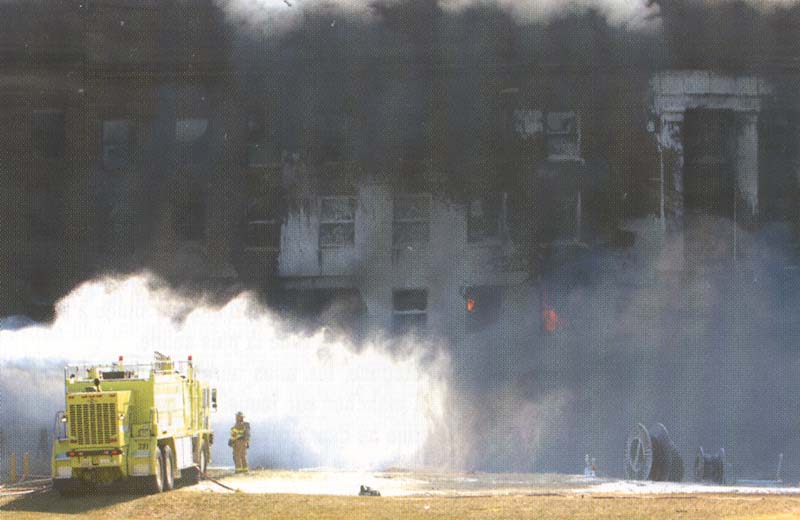
3 – Another view of the entrance hole, now fully open.
This image is interesting. The hole, roughly rectangular in shape, appears wide open this time. The firefighter in the foreground provides scale. Inside, flames from a fire can be seen. One wonders what could have created such a hole. To answer this, let’s examine how an airliner like the Boeing 757-200 is constructed. I should mention that I graduated from France’s National School of Aeronautics in 1961.
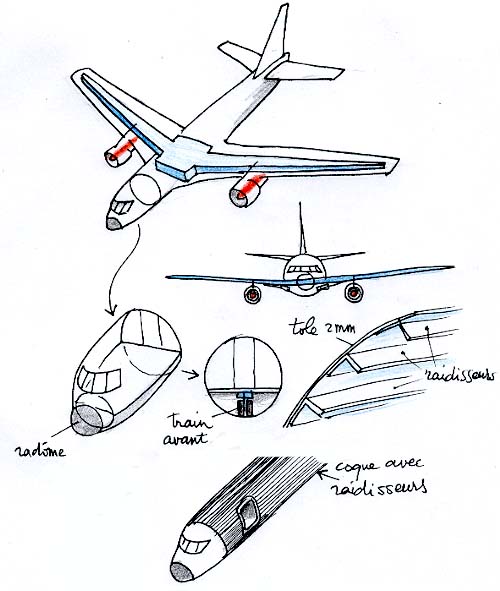
4 – Typical structure of an airliner.
The sturdiest parts, most likely to cause damage upon colliding with a building, are the central sections of the engines, highlighted in red. Next, to a lesser extent, are the two wing spars in blue, plus the framework linking them where the landing gear attaches. Everything else is designed to be as light as possible. The nose cone, for instance, isn’t meant to possess any piercing capability; at best it’s sturdy enough to withstand impact from a seagull. It’s made of carbon fiber allowing radar waves to pass freely. Since WWII, aircraft fuselages have been built using “working skin” technology; a key requirement being resistance to pressurization stresses. Hence most fuselages are circular in cross-section. They’re assembled from 2.5 mm thick metal sheets reinforced with stiffeners originally riveted but sometimes glued. These stiffeners are merely thin L-shaped brackets. Thus, an airliner’s fuselage resembles a cylindrical shell lacking any penetrating ability. Given the angle at which it supposedly struck, if it truly was an airliner, its kinetic energy would certainly have breached the outer wall, yet numerous fragments should have scattered around. We’d expect to find wing shards, tail fragments, landing gear parts. The theory claiming the entire plane squeezed through such a tiny hole, like a falcon folding its wings, is hard to defend.
Kerosene is stored both in the fuselage and wings. Upon impact, it should have sprayed everywhere, spreading and igniting across the lawn, staining and blackening surrounding walls. Complete combustion would require considerable time. Yet almost all traces of fire vanished within a minute after impact. Kerosene ignition should have been instantaneous and prolonged. We’d expect thick black smoke plumes. Yet according to official accounts, the whole aircraft penetrated via that hole, wings and tail included (since no fragments of these components were ever found nearby). Then—for a full thirty minutes—the kerosene failed to ignite despite all evidence pointing otherwise, allowing fire trucks ample time to arrive. Suddenly, it finally caught fire, causing a huge section of the facade to collapse. The ensuing heat vaporized the plane (and its occupants). Immediately after impact, the “fuselage” continued onward, leaving perfectly round holes in successive walls; its forward section ultimately ended in a courtyard, leaving behind this final 2.3-meter-wide hole:
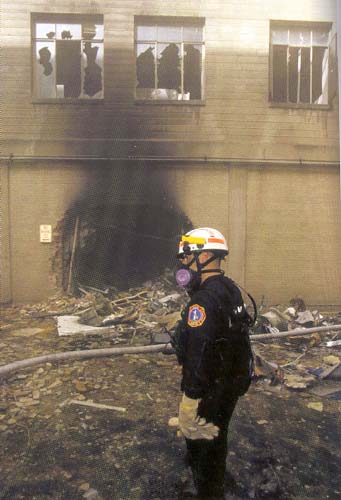
5 – “Exit hole” left by the front section of the fuselage.
Even though this area contained no kerosene whatsoever, miraculously it too vanished without a trace. No remains were ever found in that courtyard—just “a bullet hole without a bullet.”
I regret that the photographic files I received and saved on my hard drive were destroyed along with it. They included computer simulations done at Purdue University showing the Boeing entering the building (wings intact, not folded). It flooded the ground with kerosene. But where are its engines? Perhaps on the lower floors? What does this simulation indicate regarding them?
Suggestion: a proper reconstruction:
A simple, inexpensive experiment could be conducted: a full-scale reconstruction. This matter is serious enough to warrant such an effort. One would construct a 1:1 scale model of the relevant Pentagon section—walls, partitions, roof, windows. The sketches below demonstrate that only a small portion needs recreating. Next, fill a Boeing 757-200 destined for scrap with kerosene, equip it with remote control, and place human mannequins—pilots and passengers—inside. Finally, steer it toward the estimated impact point.
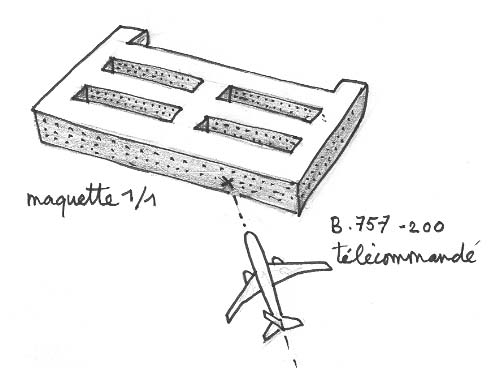
6 – Suggested reconstruction
Thus, two possibilities arise:
-
Either the official theory can be validated.
-
Or this reconstruction will expose the greatest hoax in history.
The Pentagon was repaired; “all traces removed,” yet these photos still circulate worldwide in tens of thousands of copies. Now or in a year or ten years, Americans could attempt such a reconstruction. Moreover, other nations elsewhere might undertake it. Pentagon blueprints aren’t strictly classified. Such a case is grave enough to merit an international inquiry.
What if it was all staged?
For any reconstruction to hold true, an aircraft as bulky as this—38 meters wide—would first need to approach without damaging obstacles. It would smash into the facade, inflicting some damage, yet countless fragments should scatter around the impact zone. Lee Evey, head of Pentagon restoration, explained methodically during a September 15 press conference (Meyssan’s book, page 55) how the plane penetrated the building, successively breaching all internal walls.
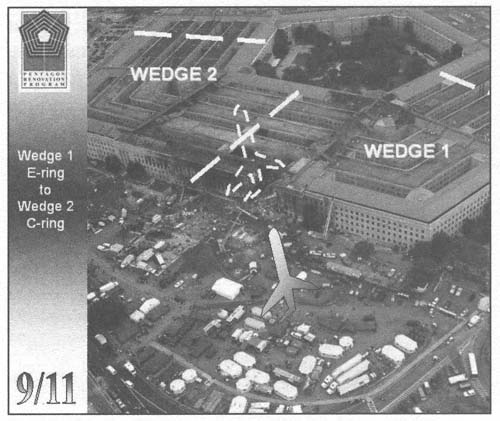
7 – Plane inclination at impact as depicted in Meyssan’s book
If accurate, given the plane’s size, the outer part of its right wing would have detached and flown over the building. Under no circumstances would the impact marks resemble those shown in photos. Multiple traces would exist, including at least one engine fragment. Airplane engines “hang by only three bolts”; mounted in pods they’re cantilevered. Their suspension system is fairly fragile. Example: the quad-jet “Hustler” delta-winged aircraft demonstrated at Le Bourget in the 1950s lost an engine mid-loop due to centrifugal force (I witnessed this firsthand).
(But as we’ll see later, detached engines could also have acted as projectiles inside the building.)
Fuel from ruptured tanks would instantly spread and ignite. Not all kerosene could have entered the building; consequently, the lawn should show significant burn marks. We’d expect yellowish smoke with large black plumes. It seems improbable that the plane’s fuselage alone could pierce successive walls, creating that perfect 2.3-meter circular hole at its front end.
So, if it wasn’t an airliner that struck the Pentagon on September 11, 2001, what else could it have been?
Based on damage patterns, the trajectory must have been nearly horizontal. In one photo, Meyssan identifies what he believes is smoke from a missile engine—presumably launched from a plane, surface facility, or mobile launcher.
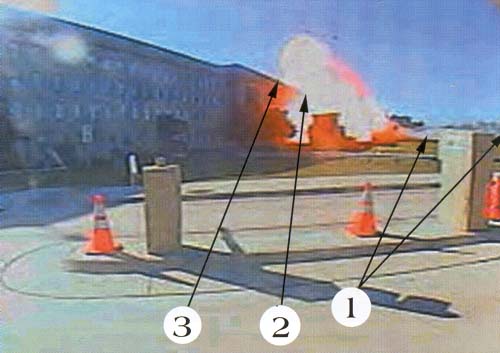
8 – Based on video footage: immediately after explosion (see subsequent images at end of page, retrieved October 2003)
To view this video clip filmed by a Pentagon security camera:
http://www.cnn.com/video/us/2002/03/07/jm.pent.photos.cnn.med.html (archive dated November 19, 2025) http://www.cnn.com/video/us/2002/03/07/jm.pent.photos.cnn.med.html (archive dated November 19, 2025)
Commentated by CNN’s Jamie MacIntyre. He claims to see a plane, though I admit his eyesight surpasses mine.
Explosives expert Pierre-Henri Bunel offers his interpretation in Meyssan’s book, pages 63–86. He explains that highly explosive materials generate brief water-vapor condensation (white clouds) upon detonation; this is what’s visible in 2, illuminated by blast glow. Moments later, intense radiation vaporizes these droplets, turning the cloud red as seen on previous page. He believes 1 shows smoke from a missile engine approaching.
This could thus be a “bunker-buster” missile similar to those successfully used during Gulf War.
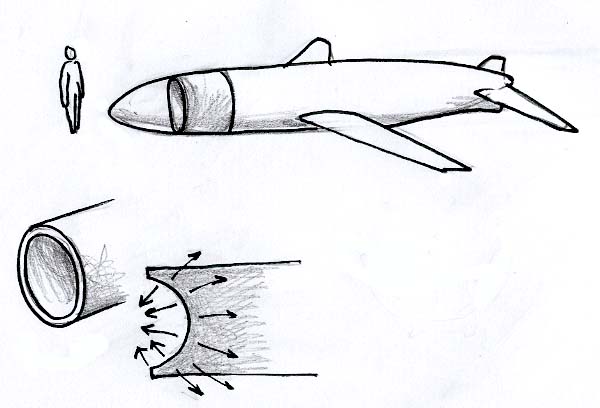
9 – Bunker-buster missile (one among many models...)
Such missiles can be launched from ships, mobile ramps, or dropped from planes. Self-propelled, they accelerate just before impact to maximize penetration efficiency. After breaching initial wall, they trigger hollow-charge detonation. Blast pattern is asymmetrical: rearward expansion occurs radially; forward, spherical shockwave evolves into a hot-gas-and-debris “spear” traveling thousands of meters per second along flight axis. This explains sequential perforation of five successive walls beyond the outer facade. Such scenario accounts for near-total absence of debris or presence of only minuscule fragments—remnants of vaporized missile. Meyssan’s illustration on this point is quite accurate. Hollow charges originated just prior to or during WWII.
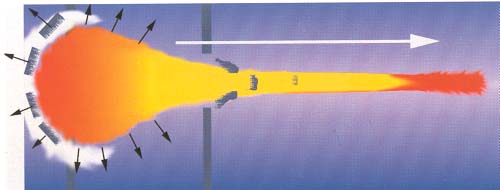
10 – “Spear” formed by hollow charge, right.
Conclusion.
In his writings, Thierry Meyssan suggests all September 11 attacks formed part of a coordinated plot. Numerous ambiguities surround Twin Towers attacks. Planes approaching targets didn’t deploy flaps; lacking additional lift surfaces, their speed necessarily exceeded 400 km/h. Pilots had to hit towers within a five-to-ten meter margin. Towers measured 65 meters wide, yet actual target was their steel-reinforced concrete core. Essentially, each floor hung from this central pillar.
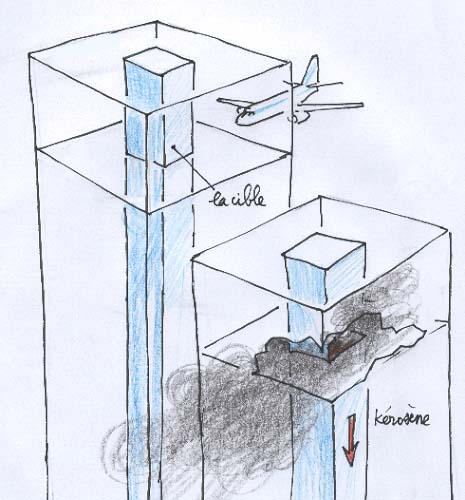
11 – Mechanism of Twin Towers attack
Plane encountered minimal resistance piercing outer wall; however, numerous structural members punctured vulnerable fuel tanks, causing kerosene spillage. Crucially, plane must have punctured inner wall to allow fuel to pool and ignite, softening steel beams. A demolition crew tasked with toppling towers would have placed explosives along these pillars, severing them; they’d subsequently collapsed inward (as observed). Yet no wreckage appeared. Plane seemingly vanished entirely without igniting fuel.
I find this difficult to accept...
October 6, 2003: I reproduce a letter from a French airline pilot currently working, who, for obvious reasons, wished to remain anonymous. Having read on your site that you’re preparing material on the Pentagon attack, I felt compelled to contact you.
As a Boeing 757-200 pilot, I’d like to share some thoughts regarding September 11 attacks. For instance, it seems shocking that the pilot of the Pentagon-bound 757, having lost radio and transponder contact, turned back. Universal aviation rule dictates that communication loss requires strict adherence to flight plan (except in cases involving engine failure etc.). How did plane fly 300 miles without interception? Given numerous military bases surrounding Washington, this seems inconceivable. As aviation enthusiast, you surely know air traffic control workings: no regional control center exists where civilian controllers lack proximity to military radar operators and communication channels... Thus, 45 minutes elapsed without any response?
October 6, 2003: Antithesis to Meyssan’s theory. Source: Marc Milanini, Mining Engineer (marc.milanini@wanadoo.fr):
http://perso.wanadoo.Fr/advisfrance/Pentagon/Pentagon_911.htm
Document authored October 4, 2003 containing multiple photographs. See his own commentary on his site.
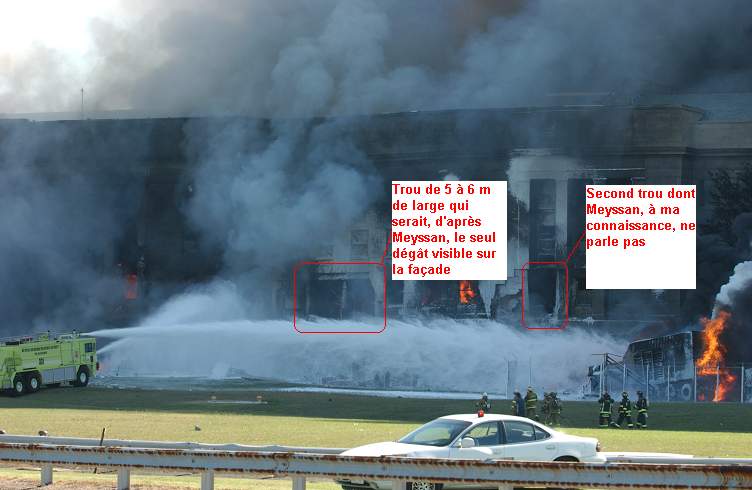
12 – Post-impact scene. Firefighters extinguished blaze in fire truck (right) parked before building.
This photo merits analysis. Pentagon is low-rise (23 meters). Impact point lay near ground level, requiring extremely low-altitude approach—difficult for plane with flaps extended. Flaps retracted, 747 would have traveled at 450 km/h mere meters above ground; impossible to control. Unknown when this photo taken; explosion hadn’t occurred yet, yet fire already burned inside. Right side shows “fire truck” burning; hence firefighters arrived afterward. Minimal debris visible; suggests Boeing 757 disintegrated into tiny alloy fragments beforehand. Wind direction inferred from burning truck smoke; no meteorological records available. Objects in foreground unclear; possibly debris. Need original agency photo for verification. Lastly, kerosene explosion occurred thirty minutes later; yet no flames appeared near hole. Strange fuel indeed...

13 – Overall view of impact site. Photo taken after blast causing building collapse.
Ground clutter visible; left side shows asphalt pathway lined with lampposts. Possibly these objects lay along Boeing 757’s flight path. Miraculously, plane navigated through forest of lampposts and signs without striking any. Any engineering school could assign students task: Determine whether Boeing 757 could have flown along this path without collision, using available software? Does such trajectory exist?
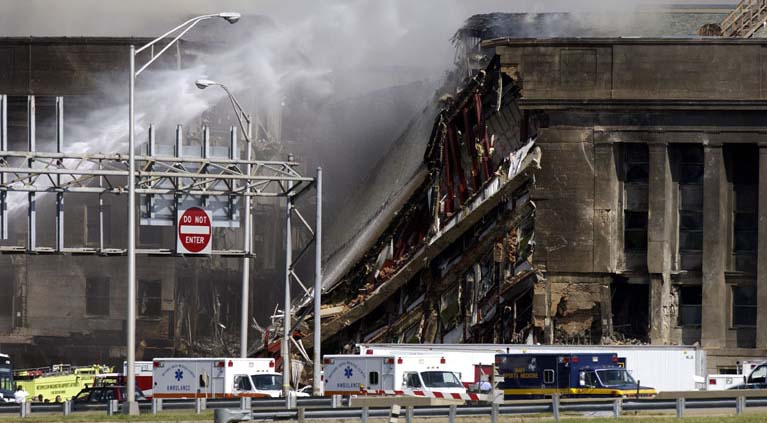
14 – Photographer shifted slightly right.
Milanini pointed out that Meyssan omitted several video frames depicting wing explosion. I obtained these following Figure 8, sourced from:
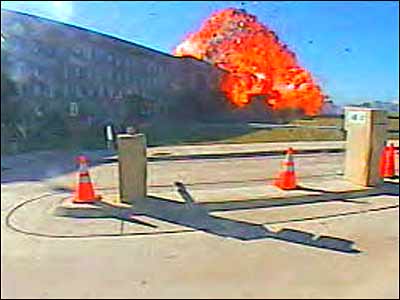
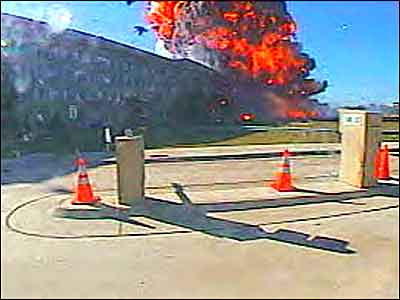
Meyssan cited expert opinion claiming white coloration indicated explosive rather than hydrocarbon fire. Lacking expertise myself, I won’t speculate. Again, proper reconstruction is essential.