Twin Towers
August 2007: Two years after creating this page, watch this video—it’s long but extremely convincing:
http://www.syti.net/Videos/Mysteres11Septembre.html
Some people specialize in analyzing the 9/11 case. It’s a huge task. On my website, where I cover multiple topics alongside my own research, I’ve posted some information regarding the Twin Towers and Pentagon cases. I’ve received feedback from readers; some even shared their own analyses on their own sites. There may have been times when I didn’t include such information. This is due to the flood of emails I receive daily. Not all of them are pointless messages; there’s also plenty of very interesting information that requires me to spend hours each day simply to relay it. Regarding the 9/11 case, my stance is as follows: I believe all viewpoints should be heard. On any website, there’s always room to add links or pages summarizing these issues, and I’d gladly include things like:
“One reader, Mr. ..., believes I’m mistaken in saying... He shares his own analysis at such-and-such location... He argues that... which contradicts...”
We’re not engaging in propaganda; we merely try to gain some clarity based on available evidence. What we can say is that the program aired on April 13, 2004—which included the documentary “9/11 Didn’t Happen”—seems to be an operation that not only completely discredited the show Thema and the channel Arte but also dishonored journalism itself. Indeed, viewers witnessed numerous speakers making all sorts of claims aimed at discrediting Thierry Meyssan. Finally, as a grand finale, viewers saw a “debate” involving several French and German journalists—including the editor-in-chief of Charlie-Hebdo—who simply didn’t invite Meyssan. Personally, I can’t imagine how journalists could willingly participate in such a condemnation by default. This operation alone, a true monument to brainwashing, would suffice to draw attention to these cases. One reader sent me a high-quality DVD copy of the program, which fits onto a single CD. I asked that it be compressed so it could be more easily distributed. I believe viewers should demand that Arte allow them to download this program so they can analyze it thoroughly; it’s a prime example of this kind of content. Lastly, one reader promised to share his own analysis of the various crashes, supporting the official narrative. I eagerly await it and will give it equal coverage as those analyses questioning the official story. If it’s impossible to hold a debate on television, at least contradictory evidence should be made available to the public via websites.
As for me, I’ve stated my position from the outset. These cases are of such grave international significance that proper reconstructions ought to be conducted—with the buildings and their contents, planes and their full fuel tanks, luggage, accessories, human remains, etc., all in place. That’s standard procedure in criminal investigations. If all observed elements can be recreated, then the official narrative can be validated. Otherwise, doubts remain.
May 10, 2004: Reported by Vincent Emery: A missile on one of the Twin Towers?
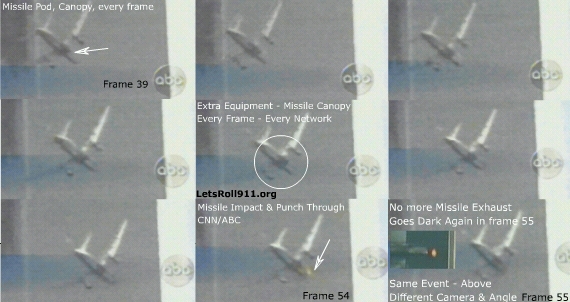
Source:
Clearly visible in the video:
http://www.thewebfairy.com/911/letsroll911/Web/ghostplane.closeup.wmv
This image supposedly depicts one of the planes just before impacting one of the Twin Towers. Unless this photo has been tampered with, one can clearly see, attached asymmetrically to the fuselage, a “pod”—a large external container sometimes carried by military aircraft. This pod appears larger in diameter than the engines themselves. Those who’ve analyzed this video frame-by-frame interpret this as evidence of a missile strike right before impact. There are various videos of this impact taken from different angles. Alongside the image below on the right, there’s another shot from the side showing what looks like an explosive impact (a flash).
These documents prompt several observations:
-
We’d need to examine how the landing gear attaches to this aircraft to see if its placement allows for attaching such a bulky pod. Even so, it would suffice if there were just enough room for it to deploy.
-
If this was indeed a “contact strike,” it recalls the method used by U.S. submarines to destroy Russian submarines via “pseudo-collisions.” See the Kursk case. Technically, detonating a missile mere meters from its target after being located via telemetry wouldn’t pose any problem.
-
If it was a contact strike, why? Some suggest it involved dispersing a substance aiding ignition of jet fuel (an oxidizer). One might also consider a penetrating, explosive missile guided toward a transmitter placed inside the central concrete core, intended to create a hole large enough for fuel to spill out, which would then burn and soften the central support columns, causing collapse.
-
Lastly, it’s hard to imagine how a civilian plane carrying such an unusual device could go unnoticed by air traffic controllers or numerous witnesses, passengers, or staff. Yet in this case, anything is possible—such as this being a specially equipped military or militarized aircraft, while the commercial plane was hijacked and destroyed over the ocean after remote control of its flight systems and communications was achieved. Consider the bizarre nature of the plane’s destruction over Pennsylvania, where debris was found miles away from an impact site seemingly free of wreckage, resembling that of a simple bomb.
-
Of course, there remains the possibility of forged documents, etc.
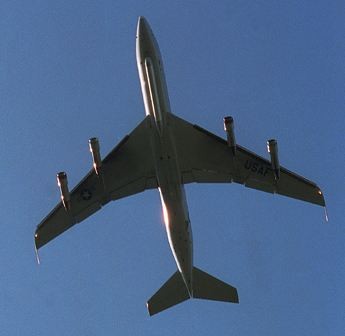
July 10, 2005: Pods under military aircraft.
One reader sent me photos of military aircraft fitted with “pods” or external payloads, which closely resemble photos and video clips showing the plane’s impact on the tower:
Below are photos taken just prior to impact:
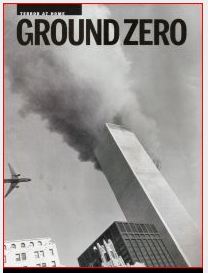
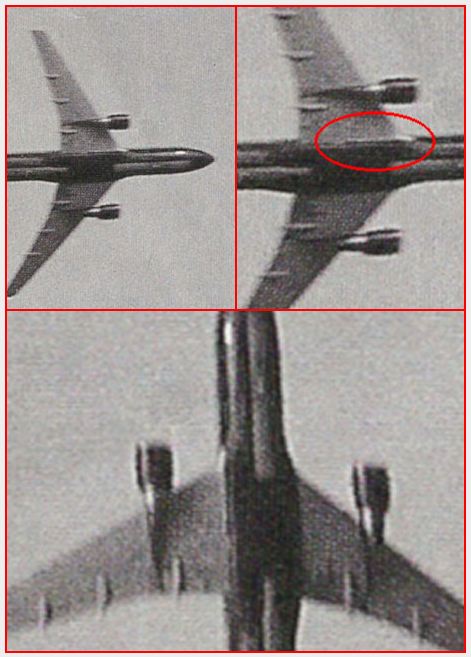
Source: http://www.reopen911.org
May 14, 2004: Regarding the collapse of the adjacent building, “Building 7”
We know that after the Twin Towers collapsed, a nearby building also suffered a dramatic collapse. A map first shows its location; it isn’t right next to the towers but two blocks away. The square-shaped Twin Towers are easy to locate. This building is marked in navy blue with the number 7.

Then there’s an image showing the site in perspective:
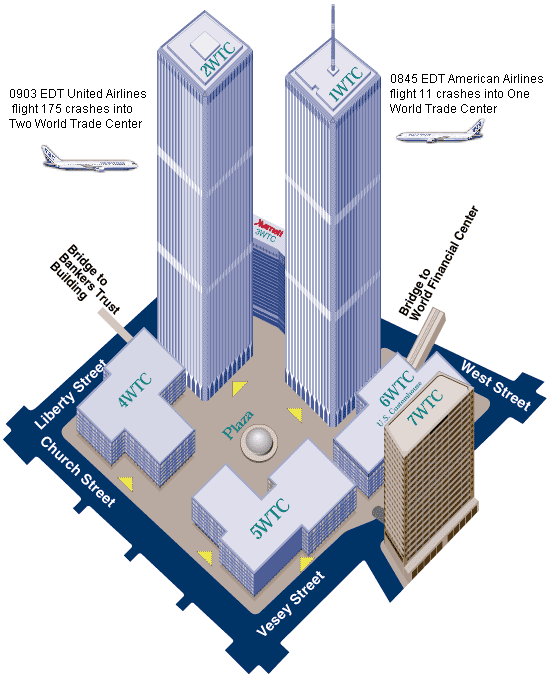
Below is an animated GIF depicting one of many videos referencing this destruction. Finally, a wider view showing the destroyed buildings. Why this third building and not another?
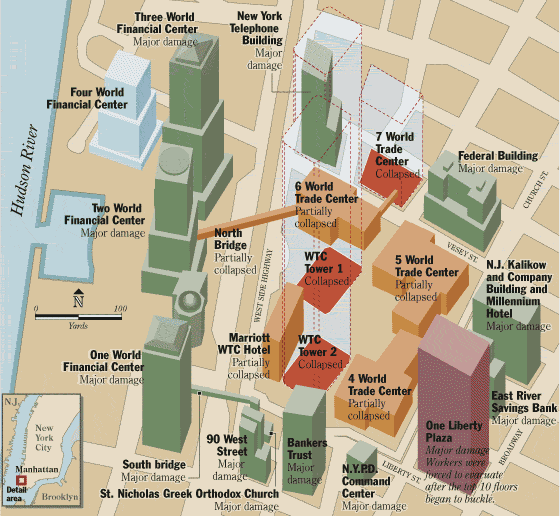
There are others mentioned on this page:
http://www.whatreallyhappened.com/fema_report.html (archive dated August 2, 2008)
For reference, here are the occupants of several floors:
Floor Tenant
46-47 Mechanical floors
28-45 Salomon Smith Barney (SSB)
26-27 Standard Chartered Bank
25 Inland Revenue Service (IRS)
25 Department of Defense (DOD)
25 Central Intelligence Agency (CIA)
24 Inland Revenue Service (IRS)
23 Office of Emergency Management (OEM)
22 Federal Home Loan Bank of New York
21 First State Management Group
19-21 ITT Hartford Insurance Group
19 National Association of Insurance Commissioners (NAIC)
18 Equal Opportunity Commission (EEOC)
14-17 Vacant
13 Provident Financial Management
11-13 Securities and Exchange Commission
9-10 US Secret Service
7-8 American Express Bank International
7 OEM generators and day tank
6 Switchgear, storage
5 Switchgear, generators, transformers
4 Upper level of 3rd floor, switchgear
3 Lobby, SSB Conference Center, rentable space, manage
2 Open to first floor lobby, transformer vault upper level, upper level switchgear
1 Lobby, loading docks, existing Con Ed transformer vaults, fuel storage, lower level switchgear
Thus, the information that this building housed CIA and intelligence services archives is confirmed. This isn’t some “false rumor.” Here’s a diagram of its foundations:
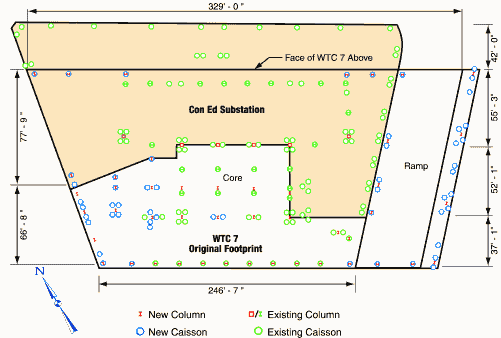
According to the FEMA report, this building’s destruction occurred several hours after the Twin Towers’ collapse. The authors of the document referenced above conclude:
Report on World Trade Center Seven Collapse is reviewed and found to be seriously lacking. At points it is shown to be totally fraudulent. The reviewer concludes that the FEMA Report must be a JOKE.
This report contains serious flaws, to the extent it can be proven entirely fraudulent. This FEMA report is a bad joke.
English-speaking readers should refer to the aforementioned site, which includes a thorough technical study demonstrating that technical documents were falsified. Numerous overlapping photos and videos from various sources exist in these cases, making falsification difficult. This photo showing Building 7 with the collapsing Twin Towers in the background is particularly striking:
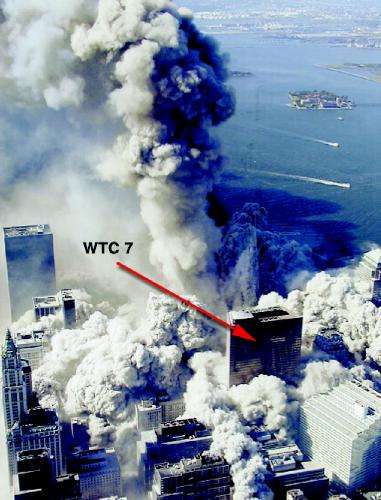
Read this site for all technical details. WTC7 wasn’t constructed like the Twin Towers. The latter featured a sort of “spinal column” made of a square concrete cage enclosing a framework of steel beams, to which successive floors were attached.
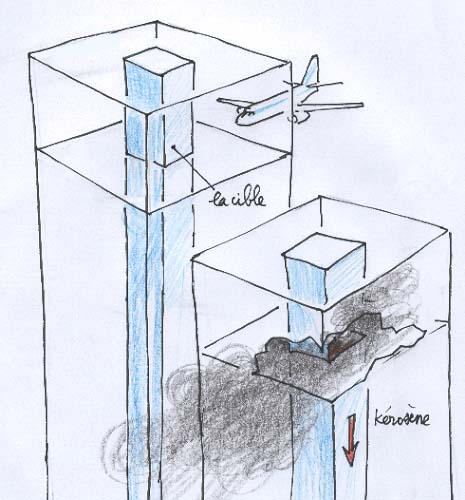
This geometry supports the theory that jet fuel entering through openings in this concrete cage could have flowed inside, burning (but where did the oxygen come from?). This would soften metal structures, eventually leading to collapse. For Building 7, however, the structure differs; it’s called a “cantilever” structure, where the building is held up by a network of intersecting steel beams.
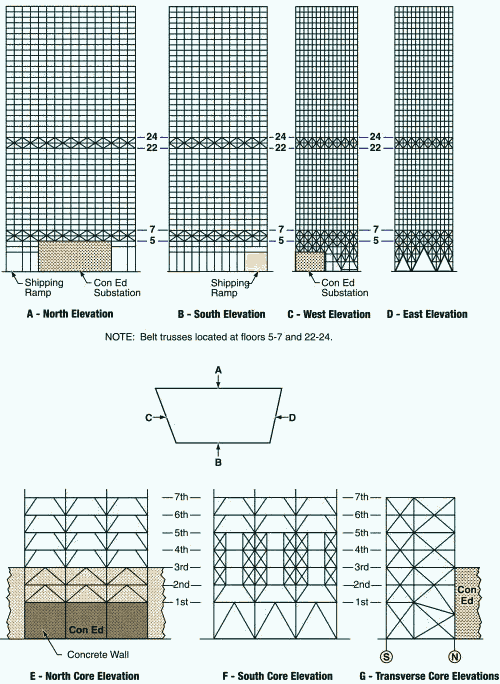
The load-bearing structure of Building 7 of the World Trade Center
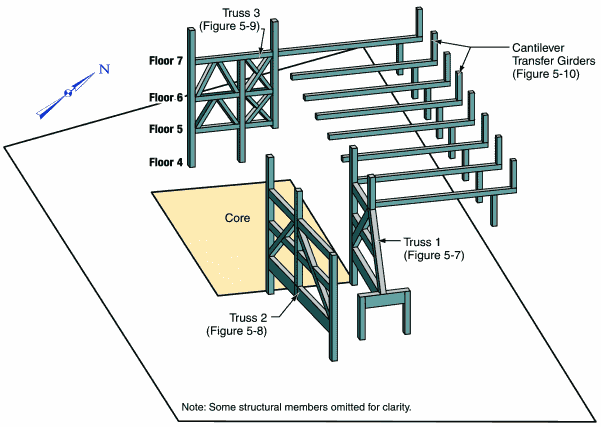
Detail of this structure at ground level.
Vertical, horizontal, and diagonal beams are clearly visible. For the building to “implode” uniformly (vertically), fire would have needed to heat all lower-level beams to the same temperature. Otherwise, it would have tilted during collapse. Yet it seems this fire affected only part of that floor. Clearly, no matter how one looks at this case, nothing is clear. But daring to ask such questions is probably “unpatriotic,” playing into terrorists’ hands, anti-American, anti-democratic, or even... antisemitic (April 13, 2004, Arte’s Thema program).
August 22, 2004: Seismographic data concerning the collapse of the Twin Towers
Source: http://www.americanfreepress.net/09_03_02/NEW_SEISMIC_/new_seismic_.html
This source is the American web-journal AmericanFreePress.net. The article was written by Christopher Bollyn.
Time passes; the events of September 11 gradually fade into our past. Note Dominique Baudis’s involvement: head of the CSA (Superior Council for Audiovisual), he served as representative of the Carlyle Group in France (representing interests of the Bush and Bin Laden families); he allegedly wrote to France-Télévision (source: Voltaire newspaper) advising against Thierry Meyssan’s participation, claiming “he disseminates obviously false information.” See this page discussing expansion of CSA enforcement powers (August 2004).
Thus, private American investigators continue probing the 9/11 case. We previously (see earlier image on this page) proposed a theory regarding the Twin Towers’ collapse: structurally, they were literally attached to a central pillar formed by metal elements within a concrete cage. The idea was that planes, piercing through fragile floors and walls as seen in footage, could have struck this concrete cage, allowing fuel from their tanks (full for transcontinental flights) to leak inside. But for fuel to burn, oxygen is required; how could combustion occur in such closed spaces with no apparent airflow? This raises a new problem requiring technical studies or full-scale simulations.
What happens when some fuel from a plane’s tanks enters a concrete cage and flows hundreds of meters downward? Could it burn efficiently? Not necessarily, since any initial combustion would quickly deplete available oxygen. Such cages are too narrow for convective air renewal. Would the resulting heat soften metal structures? The article notes steel’s melting point is 2800°F. To clarify: the Twin Towers’ load-bearing system comprised 47 massive hollow steel columns anchored 70 feet (23 meters) deep into Manhattan bedrock.
According to Loizeaux (President of Controlled Demolition Inc., consulted as an expert on debris analysis), AFP reported that besides jet fuel combustion, “paper stacks, fuel tanks, and carpets stored at the building’s base” also burned. Yet: 1) would this heat have been sufficient? 2) where did the oxygen originate? Experts dispute this version. Eric Hufschmid, author of Painful Question (“Painful Questions,” published by First Amendment Press, 160 pages, 645 Pennsylvania Ave., Suite 100, Washington DC 20003; phone 1-888-699-6397), argues that mixing fuel with paper, carpet, and other materials at the base of the concrete cage and elevator shafts could only produce a hard-to-ignite mixture lacking sufficient airflow. Keep this in mind.
We’re still at this stage because a sort of taboo surrounds any technical study of 9/11 contradicting the official narrative.
Considering all evidence, expert Loizeaux concludes collapse was an extremely abrupt phenomenon affecting the entire building; all 47 columns supposedly gave way simultaneously. He notes: “Had I wanted to bring these towers down, I’d have blown up their base structure. Their weight alone would’ve caused total collapse, implosion.” Could heating soften these structures enough to cause such collapse? We doubt it until technical clarification occurs.
Here, new data emerges from seismographic recordings made by Columbia University in a lab 21 miles (37 km) north of NYC. The South Tower collapsed at 9:59:04 AM, taking ten seconds; the North Tower’s collapse lasted eight seconds and occurred at 10:28:31 AM. Both produced magnitude 2.1 signals. Plane impacts themselves yielded no significant signals. Logically, the strongest signal should’ve appeared at collapse’s end, when the entire mass fell freely and hit the ground, causing strong tremors. Instead, seismograms show a pronounced peak precisely at the start of collapse, just before structures began descending—images of which everyone remembers as horrifying, signifying thousands of deaths. Seismologist Thorne Lay of UC Santa Cruz examined these recordings, describing brief peaks indicative of explosions. These peaks’ intensity exceeds the entire collapse signal by a factor of 20. According to experts, this contradicts the official theory of structural softening causing collapse, which shouldn’t generate any specific seismic signals. Arthur Lerner-Lam, director of Columbia’s Center for Risk Research, insists this phenomenon needs clarification and research; such signal amplification implies energy release a hundredfold greater. It involves “short-period surface seismic waves reflecting interaction between soil and building foundations.”
Other technical facts:
-
40 tons of ammonium nitrate are required to produce a magnitude 1–2 seismic signal.
-
In 1993, a suicide truck bombing at the WTC produced no seismic signal because it “wasn’t coupled to the ground.” Thus, recorded signal strength suggests explosion energy transmitted via metal structural elements penetrating 23 meters underground.
-
Recorded signal doesn’t match kinetic energy expected from towers’ collapse; it’s far higher than anticipated. Hence: where did this energy originate?
-
Despite numerous witnesses reporting explosions in the towers, FEMA-commissioned engineers didn’t conduct comparative tests supporting intentional explosion hypotheses. Claiming “they weren’t metallurgists,” they focused on selling debris abroad to clear the site.
-
Metal debris is now unreachable for analysis, having been sold by weight to companies outside the U.S.—in Shanghai, India, and elsewhere in Asia. Analyses might’ve revealed explosive traces on fragments now gone, as well as debris from the destroyed Pentagon wing removed within 48 hours. Regardless, it’s unlikely any such analyses occurred while debris remained accessible, given intentional demolition seemed inconceivable. Plane impacts seemingly explained everything.
Thus, much like the Pentagon case, we encounter numerous obscure points and a pattern of scattering debris to hinder future analysis. The hypothesis that after being struck by suicide planes, the towers’ collapse was deliberately triggered by cutting their base columns cannot be dismissed outright; seismographic evidence supports this. Yet which American would realistically entertain such a notion?
Back to Updates Back to Guide Back to Homepage
Number of views since May 10, 2004: