Humor and Mathematics, August 23, 2005
Professor Tardy accidentally discovers the implicit equation of the “quequette”
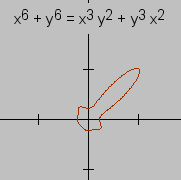
The “Tardy Bitoïd”
Note the extreme simplicity of this sixth-degree implicit equation. It was a purely accidental discovery by Tardy. In fact, he got back to work trying to find what could be considered the “Holy Grail” of mathematics: an appropriately balanced implicit equation describing the Boy surface. This surface was discovered by Werner Boy just before the summer of 1902 in Göttingen. As a young student at that university, he showed it to the famous mathematician Hilbert, who became very interested and agreed with his student to reconsider everything upon the start of the new semester. Sadly, Boy disappeared without a trace. No one knows what happened to him or where his grave is. Some people in Göttingen’s math department suggested creating a “grave for an unknown mathematician” as a tribute to him.
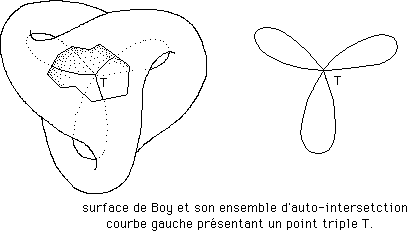
For a quarter of a century, the Palais de la Découverte displayed a representation of this surface, which I invented. Later, together with Jérôme Souriau—son of mathematician Jean-Marie Souriau—I found its first parametric representation; this appears on the last page of Topologicon.
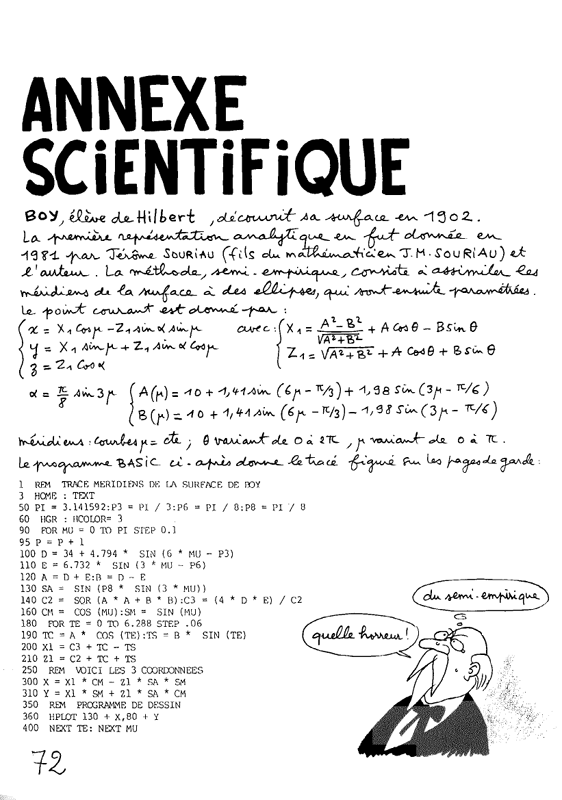
Excerpt from my comic strip “Topologicon”
Below is the BASIC program used to generate the first computer-generated images of this object. Colonna (from École Polytechnique) handled this task; all computer-generated images of the Boy surface found worldwide originate from these parametric equations. The object can be recognized by three unsightly folds surrounding its “pole”; these are merely due to poor parameter adjustments. One day, Tardy and I will tackle this issue of unwanted folds, when we have time.
When the Palais decided to remove this surface from display, I asked to keep it; now it resides at my home, inside a huge box. It resembles an egg being incubated, and it fascinates visitors greatly.
Here, Christophe revisits the problem from a much higher level. Apéry (professor of advanced mathematics, student of blind mathematician Bernard Morin) produced an implicit equation, i.e., of the form:
f(x, y, z) = 0
But, misadvised by his supervisor Morin, he chose the oz axis as the symmetry axis. Consequently, the equation turned out to be complicated and unattractive. Result: the resulting surface has… “rabbit ears.” It’s the “Roger Rabbit” version of the Boy surface. But alas, this is all we have; this is the equation you’ll find in math textbooks worldwide. Yet there exists an infinitely simpler equation. That’s for sure. Consider the equation describing the magnificent Romanian Steiner surface:
x²y² + y²z² + z²x² – 2xyz = 0
One would never guess how rich this equation is. Below is the image generated by Tardy:
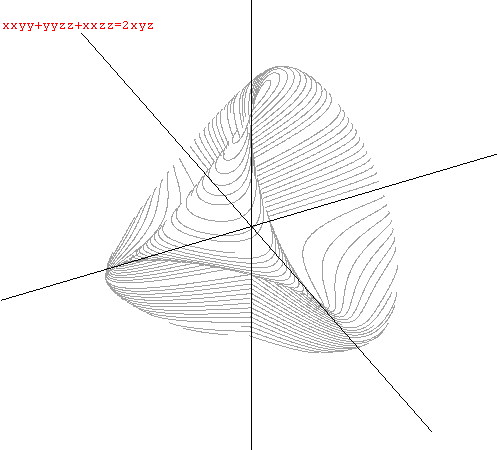
The Romanian Steiner surface, drawn using Winplot. Originally, it had a triple point. On the axes, there are six cusp points.
This image was created using the excellent software Winplot, developed by Richard Paris from Poitiers. Free download available here
See also: http://www.mathcurve.com/surfaces/romaine/romaine.shtml
The Boy surface should be describable by an equally simple equation, with just a few extra terms. It’s a sixth-degree equation. It possesses ternary symmetry; therefore, it makes sense to seek a representation where the vector (1, 1, 1) serves as the symmetry axis, making the equation invariant under cyclic permutations of the variables x, y, and z. Additionally, if we place the origin at the triple point and ensure that the tangent planes at that point are orthogonal, then the lowest-degree term is precisely xyz. (The implicit equation xyz = 0 represents three planes intersecting at the origin.)
Tardy is thus working in this direction, aided by software capable of visualizing surfaces and their cross-sections. While generating one such cross-section, he accidentally stumbled upon the equation of the Bitoïd shown above—an equation noted for its remarkable elegance and simplicity.
August 27, 2005: Rewriting Genesis
This discovery caused quite a stir in the mathematical community; some female representatives closely linked to the MLF vigorously protested. But as one discovery can lead to another, American researcher Kevin Fine, an expert in plasma physics, became interested in the equation:
z(y, y) = x⁶ + y⁶ – x³y² – y³x²
This is a 3D extension of Tardy’s Bitoïd. The images generated via Matlab are as follows:
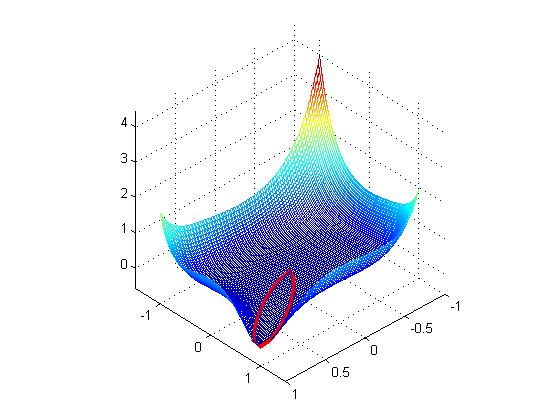
Kevin Fine’s “Foufounoïd”
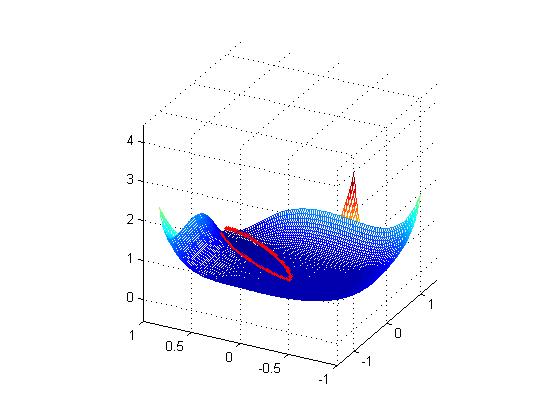
Another view of Kevin Fine’s Foufounoïd
The red curve (schematically drawn) represents the intersection with the plane z = 0.
Genesis states that God created woman from an element taken from man (one of his ribs). This implies the opposite: according to this metaphorical model, man would be a 2D structure, while woman would be a 3D structure; man would merely be a subset (the intersection via the plane z = 0) of woman.
Here’s Kevin Fine’s reaction dated August 28, 2005:
Dear Jean Pierre,
I am honored. Unfortunately, I’m too old (51) for a Fields Medal, but it’s still a great honor to have your name associated with a curve. Imagine my pride at knowing that someday a mathematician might say, “Excuse me, but that’s a Fine Foufounoïd you’ve got there.”
Kevin
Translation:
Dear Jean-Pierre,
I’m honored. Regrettably, I’m too old for a Fields Medal (I’m 51). Still, it’s a great honor to have my name linked to a curve. Imagine my pride at knowing that someday a mathematician might say, “Excuse me, but what you’ve got there is a truly beautiful Foufounoïd.”
Kevin
Back to New Items Back to Guide Back to Home Page
Number of visits since August 24, 2005: