Physics string theory Big Bang superstring
June 2001: The magazine La Recherche caught up in the fashion of elegance in physics.
This dossier consists of two parts. The first will be relatively brief and begins with the reproduction of the editorial of the magazine La Recherche, June 2001 issue. I suggest you read this text first:
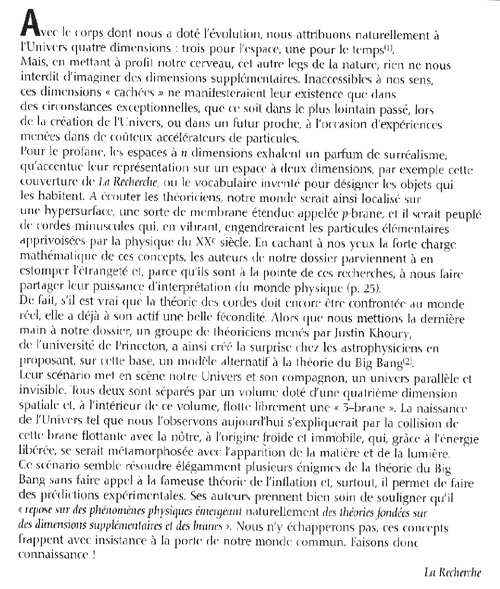
In this text, we find the following passage:
"While we were finishing this dossier, a group of theorists led by Justin Khoury from Princeton University, surprised astrophysicists by proposing an alternative model to the Big Bang theory, based on this. Their scenario presents our universe and its companion, a parallel and invisible universe."
The duality is also coming to the surface, and while the French have a researcher who has been working on this since 1977 and has published a good number of papers in peer-reviewed journals, the eye remains fixed on the slightest rabbit holes coming from the superstring community. It is not ignorance, but a deliberate suppression, not very honest at all. The angry letters from my site's readers to the newspaper editors will not help. The last few months have shown that it is a lost cause. The only thing to do will be for me to wait patiently until my work is actually published, which will allow their injection into these various data banks where "international scientific news" is played out, with tremors, beginnings, and "intellectual vertigo." How all of this is "nonsense"! And no one dares to say it. In any case, one thing seems to be increasingly confirmed. No French science journalist goes to the bottom of things, nor would they be capable of giving a somewhat coherent description of what they vaguely hear about, given that the authors of the documents submitted to them "hide from their eyes the strong mathematical charge..." The bluff is really the number one argument in the world of superstrings (trust us. You know, it's so complicated...). The journalistic imagination then fills up with little wiggling strings, oscillating branes, and especially with words, more and more numerous and grandiose words. Many are convinced that real changes are happening in this world and that "soon there will be observational confirmations." This is what Larousserie from Sciences et Avenir told me, with a trembling voice and a choked throat from emotion. A nice guy who, like thousands of people, had not gone beyond the first hundred pages, for example, of The Elegant Universe by Brian Greene, without simply going to page 415 of this book, just out of curiosity.
Enough of fraud, enough of farce, enough of illusion. Give me concrete facts, please, not hopes for projects and observational confirmations in the next ten years.
Second part: analysis of an article published in the same issue of La Recherche:
I have already inserted a text on my site referring to this famous "string theory." See the portrait of Brian Greene, author of the book "The Elegant Universe" published by Robert Laffont. Before proceeding, I urge the reader to take a look at these few clarifications, so necessary apparently. The era seems to be seized by complete madness. As my mathematician friend Jean-Marie Souriau said so well:
Theoretical physics has become completely crazy, and the worst is that it is the madmen who have taken power.
...The tragedy comes from the fact that theoretical physics, and physics in general, has been in a major crisis for several decades, practically since the last advances of a genius like Feynman. I have already mentioned this point in the book I published with Albin Michel, "On a Perdu la Moitié de l'Univers." What to do with "hundreds of elementary particles"? How to get out of the avalanche of contradictions resulting from astronomical and cosmological observations of our time? ...As our astronomers do their job remarkably well, placing, like artillerymen, increasingly powerful investigation tools in all possible frequency ranges, as much on the theoretical front, it is indigence, to say the least, a catastrophe. We need new ideas. Personally, I have proposed some (see the mentioned book). Following a previous dossier, readers protested to the same magazine about the fact that two authors, in a special issue of La Recherche, dedicated to time, and in an article titled "Do elementary particles have a sense of time," by Gabriel Chardin and Marc Desjardin, seemed to ignore my own work, which obviously had a family relationship with the subject of the article (parallel universe with an inverse time arrow, etc...). See a previous dossier.
...The magazine transmitted this letter to the two authors. One simply declared that he completely ignored my existence. The other gave a rather scandalous response. He began by writing, although pretending to have explored my website where these publications are reproduced, ... that I had not published anything at all. Refer to:
Nuevo Cimento 1994, Astrophysics and Space Science 1995, The Int Jr of Mod Phys, 1999
...I also have works in the process of publication, and I am impatient to finally be able to "return to the game with new balls." Moreover, these people wrote that I had started by creating a site on the Ummites, then gradually removed all references to this matter from my site. This is completely false. They confuse it with other sites with which I have nothing to do. But this only expresses the sentiment of these people: a researcher who has been interested in extraterrestrials, UFOs, can only be a charlatan. It is not possible that he publishes in peer-reviewed journals. His theories cannot stand! They take their desires for reality.
...When my new batch of publications comes out, in a quite proper way, I will have to go up to these people's sanctuaries, and set things straight, one-on-one. In seminars, I have never lost a fight, and when colleagues have dared to tell nonsense about me, it has always cost them dearly, to the point that they often experienced, afterwards, some difficulties in sitting down.....
...But let's get back to this La Recherche dossier. I assume you have read the introduction to the problem of superstrings in the link already mentioned. The author of the article, Ignatios Antoniadis, Research Director at CNRS, attached to the CERN in Geneva, promotes himself, as Greene does in his book. There are big headlines, very catchy:
Experiments are no longer out of reach
...Once again, big words like "unifying theory" are thrown around. But, at the bottom of page 25, don't miss the sentence:
So far, string theory has not received any experimental confirmation.
...Antoniadis writes, page 27:
Supersymmetry
allows the unification
of gravity with the
three other fundamental
interactions
And with observations
...A conditional is missing. It should be written "would allow." Because supersymmetry... does not exist. This "theory" is still at the stage of pure speculation, let us hurry to recall. Next to this beautiful blue poster, read the sentence from Antoniadis:
However, none of these superparticles have been observed in the large accelerators yet.
It doesn't matter, to take the author's words, at the top of page 27:
...**.**The abundance of articles published on the subject and the good positions they occupy in the most cited physics articles...
...I'm sorry. In theoretical physics, it's always the Big Crisis, but no one dares to say out loud that the emperor is naked. We need a Feynman, urgently, and we have only Witten (some of whom, as Greene writes in his book, think he could be "the greatest physicist of all time"). For now, the novel ideas that we are being bombarded with seem hardly fruitful. In what era of the history of science have we seen a theory so cut off from reality, to the point that it is not only unable to account for the slightest phenomenon, but also to make the slightest prediction, to produce the slightest model. One wants to cry out:
How could we have fallen so low?
...Look for the conclusion of this new article. It's simple: by 2005, the future large hadron collider might bring something new, to think about, to consider, to perhaps... have an idea, who knows? Unless, as with astronomical and cosmological observations, it's even worse, and the experimenters get lost in increasingly complicated showers.
...There was a time when planetary trajectories were interpreted using epicycles. The worst is that it worked very well. This theory was not ... falsifiable. Any observational deviation could be quickly included in the model by adding... another circle. At the time when Copernicus published his book, on his deathbed, they were already at 48 circles. The heliocentrists were treated with contempt by the proponents of this beautiful epicycle theory. Well, the poor ones thought that the planets rotated in circles around the sun. Therefore, they arrived at false predictions. Kepler had not yet enunciated his famous laws.
...Do you know what? I think we are pedaling in epicycles, full throttle. A paradigm shift, very deep, impossible to grasp, as usual (how could people obsessed with the "perfection of circularity," an idea stated by Aristotle, have imagined that planetary trajectories would be elliptical?). If I had the solution, I would tell you. But I believe that approaches such as supersymmetry or "string theory" (at the extreme edge of contemporary schizophrenia) resemble the end of the epicycles era. The more it goes, the worse it gets. It's not a good sign......
...Adding extra dimensions? Everyone thinks about it, of course. It could also be that the "support of physics" is not a ... continuum. But that's a big deal. That's a major paradigm shift, which we are currently unable to even imagine, due to a lack of appropriate mathematical tools. ...As shown in the 1954 by J.M. Souriau (Geometry and Relativity, Herman Ed, chapter VII, only a five-dimensional world allows to negotiate both gravity and electromagnetism, this fifth dimension having been introduced in 1921 by the Polish Kaluza. ...But don't imagine that these things are so simple. Imagine that this approach, so commendable, hides an additional scalar and a supernumerary equation, like a sixth toe, without anyone knowing what it is about. I take pleasure in reproducing them (Souriau's book, pages 406 and 407).

...Not easy, mathematical physics! You have an equation in search of a phenomenon before your eyes. And yet, it's the most serious thing on the market. Souriau's works are still a deep source of reflection (even if it's quite difficult to read, I agree).
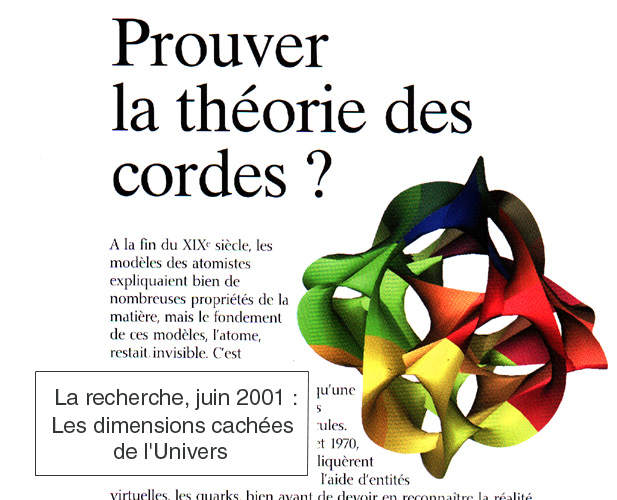
...Back to the La Recherche paper. What do we find there? This time a beautiful image of a "Calabi-Yau variety," in 2D. Souriau fully agrees with me: it's mathematics (by the way, not always very rigorous according to him) that people try to make us take for physics. Souriau has long amused us with his definition of contemporary theoretical physics:
Physics, minus the experiment - Mathematics, minus the rigor.
...Alas, that's the sad reality.
...As for Greene's interview, it's a monument of ... emptiness.
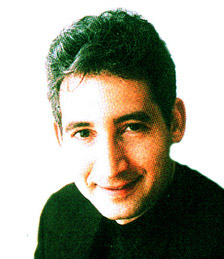
| Brian Greene | Inventor of disposable scientific thought. |
 |
|---|
Feynman and Einstein must be turning in their graves. Take this sentence, page 33:
A major success of string theory concerns black holes.
...We don't even know if these objects exist! But maybe we should simply say that in the kingdom of the blind, the one-eyed are kings.
Stéphanie Ruphy, who interviewed the Bernard Henri Lévy of Physics, had however opened with a rather well-considered question:
For more than thirty years, physicists have been developing string theory, but they have never tested it experimentally. Such longevity without any empirical support is an unprecedented case for a fundamental theory in the history of modern physics. How do you explain the "faith" that string theory inspires?
...Greene talks about subquantum fluctuations of unimaginable violence. Are they observed? No. This unifying theory "is not falsifiable" (Greene, interview from La Recherche, page 33). We are unable to confirm or refute it. But we must be understanding. It's such a young theory, adds Greene (it's actually more than 30 years old, as the journalist from La Recherche reminds us in his opening question...). Great heavens, how much money is spent on grants, conferences, missions, around these things, while it's the greatest scientific fraud of all time and Greene is not worth the superstring to hang him.
...Still, it's not enough to spit in the soup. When my papers are finally published, I will publish another book, the sequel to "On a Perdu la Moitié de l'Univers" and I will go back to the attack on seminars, if I can.... ...I'll tell you an anecdote. A few years ago I asked Omont, who was then directing the Paris Institute of Astrophysics, to give a seminar there. Immediate refusal. Reason:
- You wrote this book, about extraterrestrials.... - But that's not what I want to talk to you about. - Sorry, we cannot separate the two things.
...It took the written pressure of Souriau for Omont to give in and allow me to give a seminar in front of twenty stubborn faces. No questions. Silence, the wall of silence.
14 June 2001 ..............................................Jean-Pierre Petit
