Influenza: Some elements to help you think for yourself
Before others do it for you
October 8, 2009
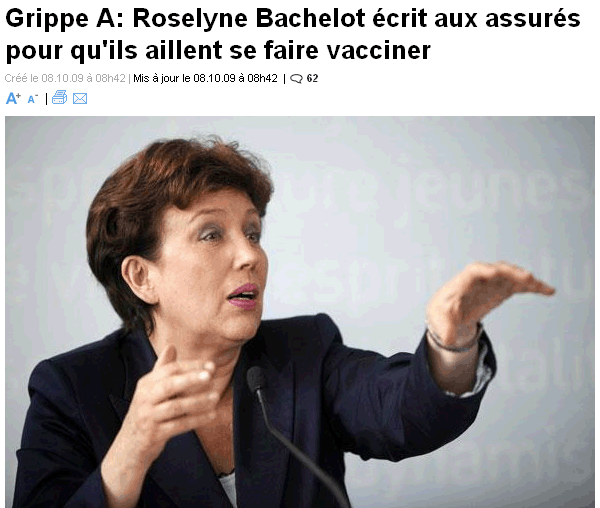
Get vaccinated quickly...
There’s no real urgency, given that this “first pandemic of the 3rd millennium,” as that idiot former pharmaceutical industry representative put it with a smile in our media, hasn’t actually materialized yet.
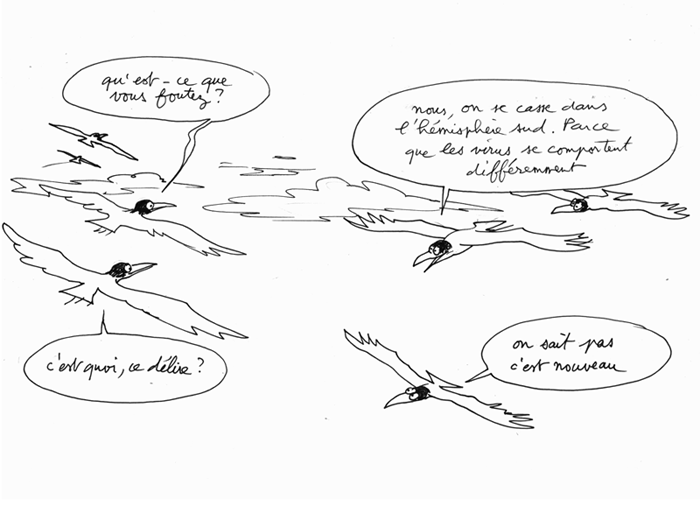
It should be noted that Minister Bachelot is trying to force the sale of 94 million vaccine doses—even though the vaccine hasn’t received its necessary market authorization for any new medication. There’s absolutely no urgency here; the H1N1 flu proved to be relatively mild in the Southern Hemisphere, which experiences winter six months earlier than countries in the Northern Hemisphere. In Argentina, Australia, New Zealand, and New Caledonia, there’s no sign of a “second wave” or “virus mutation” as hyped in our media. These temperate Southern Hemisphere nations, having just emerged from their winter (April–August), are now enjoying spring (September–November).
Why such urgency?
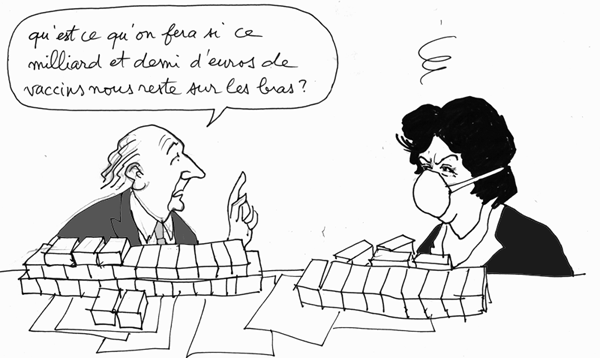
Because if the vaccine doesn’t receive approval, pharmaceutical companies would have to reimburse the government for purchasing those 94 million doses—which, at present, would be illegal. It seems unlikely that no bribes were paid, possibly even at the highest levels of government. Had no bribes been paid for such a huge sum, that would indeed be unprecedented...
In short: There’s no health-related urgency, only political urgency (to justify this costly, ill-considered purchase, likely involving bribes) and financial urgency for pharmaceutical firms to avoid having to refund money for a product already administered.
October 10, 2009: It’s begun!

October 10: Karl Zéro:
Head of staff at Gard Prefecture
The Gard department plans to vaccinate people using vaccines purchased on August 27 from Baxter
Recall that at an Austrian laboratory belonging to U.S.-based Baxter, an H5N1 avian flu strain (lethal in 60% of cases, introduced in active form!) was accidentally mixed with an H3N1 seasonal flu strain. This was revealed in February 2009 by a Czech subcontractor who, after testing the vaccine on ferrets, found they’d died. Also, Czechoslovakia refused vaccination campaigns following infections among 36 individuals due to another “error” by these same labs.
September 17, 2009 – September 21, 2009 September 25, 2009: Announcement regarding VeriChip
September 27, 2009: A France 24 report discussing controversy surrounding vaccination October 6, 2009: Can French citizens be forced to get vaccinated? Legal bases
September 28, 2009: Dr. Girard’s article—definitely worth reading
Just released:
http://livre.fnac.com/a2752109/Marc-Girard-Alertes-grippales?Mn=-1&Ra=-1&To=0&Nu=1&Fr=0
Government plan:
http://www.pandemie-grippale.gouv.fr/IMG/pdf/PLAN_PG_2009.pdf
October 4, 2009: An 81-page report detailing the general lack of pharmacovigilance worldwide.
For weeks, my readers have asked me to analyze and offer opinions regarding this supposed pandemic threat—though I’m neither a doctor nor a biologist. I’ll try my best.
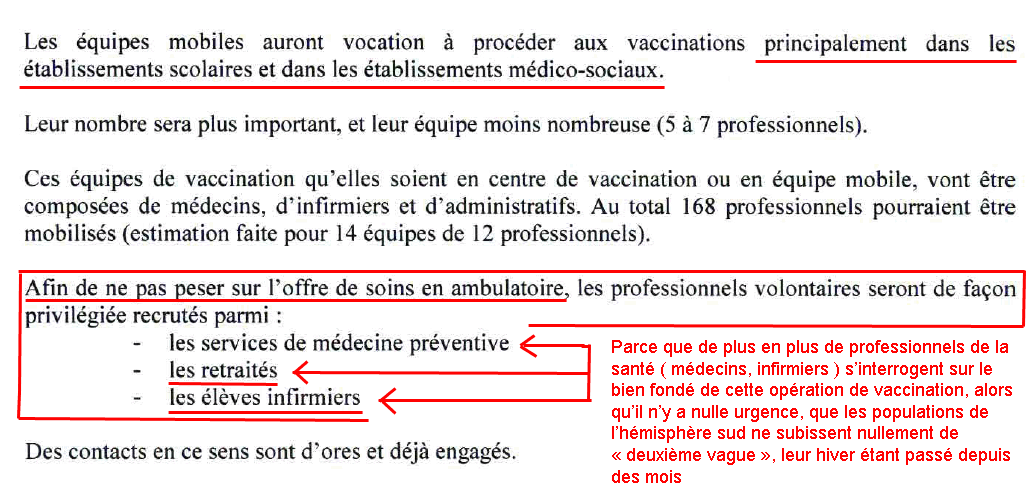
It’s wise to rely on factual evidence. You can download a circular issued on August 21, 2009, by Madame Bachelot and Monsieur Hortefeux outlining the basic vaccination plan.
Source: http://www.sante-sports.gouv.fr/IMG//pdf/Circulaire_vaccination_090824.pdf
Note on page 3:
Vaccination of students and entire educational communities will be carried out by mobile teams within schools.
The same applies to communal living spaces or closed environments housing specific populations (prisoners, foreigners held in administrative detention, residents of medical-social institutions).
We’ll revisit this later. But upon reading it, I notice the signatures of these two politicians:
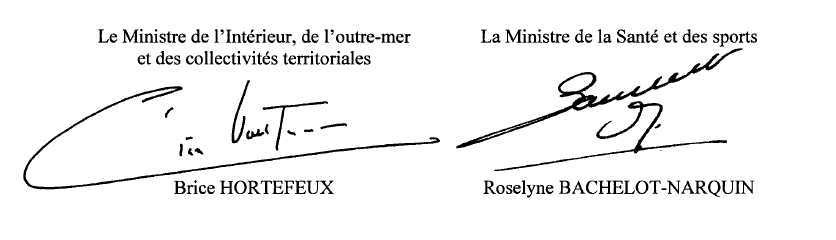
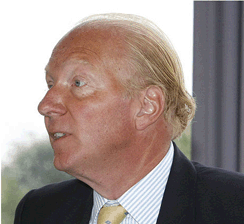

Brice Hortefeux, Roselyne Bachelot—smiling
Politicians often employ communications advisors who advise them on clothing, gestures, smiling, eye contact, etc.
This matters greatly. I recall what a journalist from defunct magazine Actuel told me over twenty years ago:
- On TV, it’s not what you say that counts—it’s how you come across.
Thus, everyone learns to project the right impression. But these advisors lack a good graphologist. When I look at these two signatures, I see where things go awry. Writing is a gesture; remember the book “Gestes qui vous trahissent.” Swiss graphologist Max Pulver, departing from the French Crépieux Jamin school, wrote a book titled Le symbolisme de l’écriture, still available today. It’s easy to read.
One might assume politicians must be ambitious, reserved, even secretive, manipulative. Based on this, these signatures amuse me. Briefly: The H1N1 virus is a “benign” virus, causing minimal harm. Yet, the signature of Roselyne Bachelot shows her as being extremely cautious, almost paranoid. Hortefeux’s signature suggests he’s far more relaxed, even flippant.
Why such disparity?
Because if this vaccine hadn’t received approval, pharmaceutical firms would have to repay the government for purchasing these 94 million doses—currently illegal. It seems unlikely no bribes were paid, possibly at the highest levels of government. Had no bribes been paid for such a huge sum, that would indeed be unprecedented...
In short: No health-related urgency exists; only political urgency (to justify this costly, ill-considered purchase, likely involving bribes) and financial urgency for pharmaceutical firms to avoid refunding money for a product already administered.
**October 21, 2009: A very strange case. VeriChip is one of the first companies to venture into implantable microchips since the early 2000s. http://www.verichipcorp.com/092109.html If you check this company’s history, you’ll see its first justification for implantation was security-related—RFID chips could supposedly aid locating disaster victims. But what follows is far more alarming. The link above leads to an English-language page; below is its French translation: Press release dated September 21, 2009. VeriChip secured exclusive rights to a detection system targeting H1N1 virus, developed in partnership with RECEPTORS, aimed at creating systems for treating large patient groups. ... These systems should identify and detect H1N1 virus. The patent also covers detection of other viruses and biological threats, such as Staphylococcus aureus. ... Last week, the company announced development of integrated sensors for detecting biological threats related to pandemics or bioterrorism. Once again, where lies the boundary between paranoia and naive blindness? Is this technological advancement or mere hype? One can only speculate. We’re accustomed to believing that computing technology constantly evolves toward smaller sizes. Microchips are no exception; we’re moving toward molecular-scale devices, akin to dust particles. This isn’t science fiction: nanotechnology is rapidly advancing. Any mechanical apparatus—dosage systems, analytical tools—can theoretically be miniaturized to dust-particle size, providing ample space for complex molecular arrangements. We’re witnessing an era of madness: technological progress increasingly serves oppressive purposes. Humanity’s future may involve coercive tools remotely controlled from space. The ploutogrippe (from Greek Ploutas: rich) promises immense profits for involved pharmaceutical firms. | Excerpt from a France 24 dossier highlighting controversy over a hastily developed vaccine, unprecedented worldwide. Experts note that immune responses last a lifetime, but secondary effects remain poorly understood (neurotoxic mercury-based preservatives, antibody-stimulating additives). Industry reps claim: “We had no choice; urgency dictated we begin mass production prior to AMM authorization.” U.S. law grants manufacturers immunity from liability claims related to adverse effects. No comparison exists between projected deaths linked to this pandemic versus seasonal flu mortality rates. Seasonal flu kills ~500,000 annually worldwide; thus, estimated 2 million infected individuals translates to negligible risk. Omitting comparative statistics, WHO forecasts two million deaths—yet this figure barely exceeds normal seasonal flu mortality. Neurodegenerative disease specialist commentary warns of grave risks: neurotoxic additives may trigger irreversible damage. | Download PDF version here. English version available at source link. | October 4, 2009: I reference an 81-page EFVV report concluding global pharmacovigilance absence. I once blindly trusted vaccines’ safety and attributed disease reduction solely to vaccination efforts rather than hygiene or improved living standards. This report reveals disturbing secondary effects, prompting urgent reevaluation. Full report available here | October 5, 2009: EU developments | Legal bases for compulsory vaccination
Back to top of page regarding H1N1 influenza