The Law on the Digital Economy
May 25, 2004
This law, announced by Rafarrin with great fanfare, was adopted on May 8 by the National Assembly, despite a massive petition signed by Internet users. It still needs to be approved by the Senate. It contains various provisions that pose a serious threat to the freedom we currently enjoy on the Internet. For example, it makes website hosts jointly responsible for any violations committed by website administrators (webmasters).
A website has been created: http://www.odebi.org which aims to draw attention to this issue. A demonstration was even scheduled for Saturday, May 29 at 2 p.m., in Place du Colonel Fabien in Paris. I believe it’s important for as many people as possible to attend. But before discussing this issue, I’d like to point out that for the French, the Internet remains a relatively new and often mysterious phenomenon. Until recently, very few people had access to it. Today, although many people “connect” and browse websites, few truly understand how it all works or even what a host is. Before moving on to excerpts from the Odebi website, I’d like to provide some clarification regarding websites.
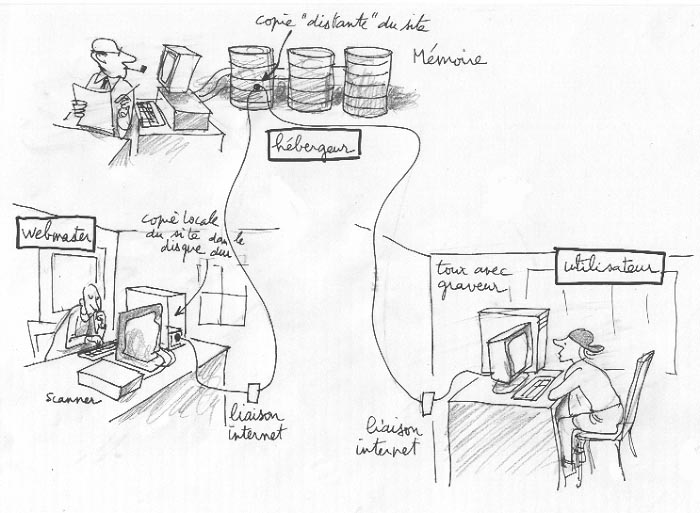
At the bottom left, you see a “webmaster”—basically someone who’s learned how to use software enabling him to create HTML pages that can be assembled into a website. To do this, he uses an “editor.” A word processor like Word is an editor; with it, one can create documents containing text and images. With an HTML page editor such as Dreamweaver, one can also create pages containing text, illustrations, photos, or drawings. These HTML pages aren’t identical to Word documents; they can be of any length—even five or ten times longer than a typical screen display. As I add lines of text and insert images, my page grows longer, and a scrollbar appears on the right, allowing me to scroll through it.
The second key element of websites is hyperlinks. When browsing a site, certain passages appear colored and underlined. Clicking on them takes you elsewhere—anywhere: another section of the same page, another page on the same site, or even another website entirely. This is truly mind-boggling. For instance, if I wrote: “If you want to learn more, click here to read what Mr. So-and-so wrote in his thesis submitted at Ottawa University in 1979,” clicking would instantly take you to that specific page in that thesis. It’s as though, in a fraction of a second, you’d crossed an ocean, entered a library, found the relevant thesis, and landed on the correct page. In reality, that thesis has simply been “digitized”; it no longer resides in a physical library but somewhere on a server hard drive—which could be anywhere, not necessarily in Canada!
You can click repeatedly on such links, but nothing happens. They’re not real links; they’re merely words I’ve underlined and colored blue.
All this is to say that you don’t need to be a computer genius to create a website. The only requirement is having a special page called “index.” When a user visits your site, this is the first page that loads. But right now, this site exists only on the hard drive of the person at the bottom left. He’s composed his pages, added all the desired links, and inserted numerous images (he could also add animations or music, but let’s keep it simple). Once finished, he can test whether his site functions properly by opening its index page from his folder. This action launches a browser program—like Internet Explorer or Netscape. The webmaster then sees his pages exactly as they’ll appear to visitors. At this stage, however, everything remains local; he’s the sole “client” of his own website.
That’s when he needs a host—a company possessing enormous storage capacity. Upon reaching an agreement—a contract between the webmaster and host—the latter allows him to upload his pages to a designated storage space on its servers, either for a fee or free of charge. There are indeed free hosts available. Frankly, I’ve never quite understood how they manage to operate; perhaps a reader can enlighten me.
Personally, I use two hosts.
http://www.jp-petit.com is hosted by Axinet, a paid service.
http://lanturluland.free.fr uses a free host called Free, which generously provides storage space amounting to 100 megabytes.
Once this agreement is in place, the webmaster receives access codes ensuring that only he (and the host) can modify his site. Thus, two copies exist: one on his own hard drive, the other on the host’s servers. The host then assigns him a URL—a website address, such as those mentioned above. This allows any Internet user to enter that URL into their browser, which then connects them to the information stored on the host’s servers. How can thousands of people access these same files simultaneously? Rudyard Kipling offers the answer in his stories:
This is sheer trickery and magic.
At this point, you might wonder: where’s the problem? Let me explain.
A man named Filstrup rents a room somewhere. He gets a phone line installed, buys a computer, and subscribes to Internet service. Then he contacts a free hosting provider and requests storage space to build his website. To do so, he goes to that host’s website. Everything is done via his keyboard. He enters his name and address (they could easily be fake; no ID verification is required). All that’s needed is an address so the host can send him access codes allowing him to upload absolutely anything to that storage space. No controls whatsoever exist. Consequently, this webmaster can commit countless offenses: defame fifteen people, reproduce copyrighted photographs without permission, upload texts or music requiring royalty payments. Afterward, he can simply vanish. He gives notice, leaves his apartment, cancels his subscription. Since he no longer pays his connection fees, service is terminated. As long as his site remains accessible, the host won’t interfere. His content can thus spark massive scandals, distributing unauthorized texts, photos, or music freely.
You might ask: how can such a site gain so much popularity? Several ways exist. Filstrup has a girlfriend who runs her own popular website; she posts links like:
“Check out this site: http://xxxxxx.images.scandaleuses.fr where you’ll find outrageous photos and comments” (xxxxxx represents a free host). The scandal spreads rapidly through word-of-mouth. On such sites, one can also find the latest pirated songs, whatever one desires!
Filstrup changes residences often, yet can continue updating his site from anywhere, provided he has Internet access. Legally, he remains untouchable. Eventually, however, someone reacts and files a complaint. The violations are obvious and varied. Recently, a celebrity filed suit because photos of her appeared on a site without her consent. Her agent warned her, so she sued just as she would if any newspaper published nude photos of her without compensation. Courts then tried to identify the culprit. But the webmaster had disappeared. Merely ordering the host to delete or block his content wasn’t enough. The complainant argued that months of exposure to those photos allowed countless people to view them for free, causing her considerable harm.
Courts ultimately decided to penalize the host, even though it knew nothing about any illegal activity and was deemed indirectly responsible—a precedent-setting ruling.
Thus, a genuine legal vacuum exists within the Internet system, which the Law on the Digital Economy aimed to fill.
The solution adopted was to make hosts legally responsible for any violations occurring on their sites.
This essentially mandates continuous monitoring of website content by hosts—effectively censorship. Technically, this is impossible to implement. Among violations is “defamation,” which can consist of a single sentence or word. How can hosts monitor such content constantly?
Personally, I believe the proper approach is requiring webmasters to regularly provide what we might call “legal contact details.” This isn’t easy, but manageable. Initially, they must submit identification and proof of residence upon launching their site. Later, every three months, they’d have to supply another utility bill bearing their name. Hosts would then maintain paper records for each client. Quarterly verification would require only thirty seconds per client. Yet clearly, hosts cannot possibly monitor all content themselves. In case of legal trouble, they could provide the webmaster’s address dating back no more than three months. Armed with proof of identity, authorities could immediately track down the offender. If the culprit vanished and the offense was severe, warrants could be issued. You can’t blame a hotel owner as an accomplice simply because he housed a thief or fraudster. Hosts are limited in number; they could easily share information about problematic users. Conversely, however, filing lawsuits against overly talkative individuals could deter hosts from serving them, even if those lawsuits ultimately fail. Such harassment tactics would encourage hosts to favor “legitimate” Internet users.
These measures don’t prevent webmasters from listing their names on their sites. But in legal disputes, courts would at least have a contact person to pursue.
A more radical solution would be mandating that webmasters display their name and contact info on their homepage, thereby stating: “You can’t freely insult, slander, or voice controversial opinions while remaining anonymous. The Internet resembles a newspaper—it has an owner, a publisher, and identifiable staff. It has a corporate identity.” Indeed, I myself have disclosed what I consider extremely serious information. In 2000, Antoine Giudicelli, former director of the Marcoule Nuclear Center, sued me for defamation after I revealed his claims denying France conducted underground nuclear tests. Despite having two witnesses, I was heavily convicted. The mechanism of my conviction worked like this: when facing defamation charges, defendants have two mutually exclusive defenses—
-
Either they invoke the “truth defense”—meaning “he told me this, and I can prove it’s true.”
-
Or they claim “good faith”—meaning “I can’t prove it’s true, but there’s reason to believe it, and I have witnesses.”
In my case, the court applied a three-month statute of limitations typical for press-related crimes. My lawyer, Maître Gasser, wisely opted for the second defense strategy. Yet inexplicably, the court ruled this case fell under the “truth defense.” Thus, my testimony—already submitted earlier—had to be re-submitted under strict procedures ten days after the appeal was filed. My attorney simply handed it over during the hearing. Because this procedure wasn’t followed precisely, the court dismissed my case outright, effectively saying: “Your lawyer presented these testimonies publicly before, but legally I consider them nonexistent.” I was stripped of my right to present evidence and convicted. The fine imposed—5,500 euros—was unusually steep for a mere defamation case involving no professional harm, since my accuser was retired.
After a call for help (archived April 21, 2025), readers of my site agreed to help me shoulder this burden. Yet this situation mirrors the classic “potter versus pot” dilemma.
Defamation is one thing, but attacks on webmasters can take many forms. Targeting powerful individuals, perpetrators may employ any conceivable repressive measures, starting with professional retaliation. Civil servants risk career stagnation or transfers; private-sector webmasters may lose their jobs outright. No defamation is required to silence someone. I managed to fight fiercely for years—especially in scientific circles—because I was a CNRS employee, i.e., a civil servant. Now retired, I’m beyond such threats.
Content posted online is considered “published in a newspaper.” Hence, webmasters potentially assume the role of journalists. Revealing their identity exposes them to vastly more powerful adversaries. My proposal would force enemies to confront them openly via legal proceedings, rather than using covert coercive methods.
Increasingly, our media seem under the control of political and economic pressure groups. Nowadays, virtually all journalists operate “on ejectable seats.” The press’s status as a counterweight to power has vanished. Amid such oppression, the Internet remains the sole space of freedom. The purpose of the LEN isn’t solely protecting private interests; it also seeks to suppress independent journalism by exerting pressure on hosts. Numerous countries now feature digital newspapers where authentic journalists—signing with initials or pseudonyms—express opinions and disseminate information, something they’d otherwise avoid due to editorial oversight by media conglomerates.
Returning to shifting responsibility onto hosts: imagine confidential data, military secrets, or defamatory remarks spread via a cell phone voicemail service subscribed to by a customer. These messages cause reputational damage, suicides, and immense harm. Yet the subscriber vanishes. Should the telecom provider be punished? Or should a law mandate that France Telecom becomes liable for all content transmitted via its networks?
Regarding the Internet, information travels across borders at light speed. If a host imposes excessive censorship, clients can migrate to foreign hosts. Yet the LEN stipulates border blocks may be enacted in such cases.
Solutions must be devised; unfortunately, the LEN is the worst possible option.
The following remarks originate from a document posted on http://www.odebi.org:
Direct link to this document:
http://www.odebi.org/lalenpourlesnuls.pdf
The LEN institutes blind, relentless censorship across all websites.
- It introduces Internet filtering, just in case censorship fails.
- Hosts must monitor site content and become legally accountable for it.
- The law legitimizes spam, advertising, and commercial solicitations targeting users.
If a client uses a paid host, he may feel cheated if that host alters his site—something previously prohibited. He could sue, but whom would the host turn to in dispute? Obviously the most powerful party capable of inflicting maximum harm. Hosts thus become unpaid auxiliary enforcers of justice. Penalties include hefty fines and imprisonment.
Article 43-12 of the law, drafted by Madame Fontaine, permits judges to filter Internet content deemed illegal.
For the first time in French history and Western civilization since 1945, courts intend to decide what you may or may not say, hear, read, or view.
No matter how examined, this law entails staggering censorship.
Everyone knows how annoying spam is; countless laws worldwide prohibit it. France innovates by... permitting it, “unless recipients are registered businesses.” Since email origin can’t be verified, spammers can always claim “I targeted professionals only.” This provision makes no sense whatsoever.
This law doesn’t aim to moralize the Net; rather, it seeks to reassert control by placing this supposedly dangerous tool in the hands of the powerful.
June 2, 2004: Victory over the LEN. ODEBI League announcement: http://www.odebi.org
The Socialist Party requested Constitutional Council intervention at the urging of ODEBI League via spokesperson Pascal Cohet. Our lawyer Jean Baptiste Soufron also helped draft the petition. This triumph resulted from sustained lobbying efforts on two fronts:
- Institutional lobbying led by Pascal Cohet, who succeeded in securing ODEBI’s presence in influential circles. Our latest victory grants us leverage in future battles.
- Media outreach, where you actively participated. Without thousands of supporting websites and hundreds of thousands of engaged users, we couldn’t have demanded Constitutional Council review nor drafted relevant clauses (with Reporters Without Borders lawyers).
Thanks to your loyalty, ODEBI is now a leading Internet advocacy group. We’ll further promote our shared values to counter looming legislative threats at national and European levels.
Currently, we’re establishing a European platform with Internautas.org, a Spanish association. Updates will follow.
Thank you once again for your invaluable support...
Warm regards,
The League.
PARIS (Reuters) – The Constitutional Council announced Tuesday it had struck down a provision of the Law on Trust in the Digital Economy (LEN) concerning statutes of limitations for online press violations, while issuing a caveat regarding host liability.
The Council ruled that lawmakers “violated the principle of equality” by extending the three-month statute of limitations for Internet sites but not traditional media. Under the final version passed May 13, online sites became subject to this deadline only after offending content ceased being publicly accessible. For other media, the original deadline remained unchanged, calculated from publication date.
By distinguishing both categories, “the law established wildly disparate civil and criminal prosecution windows contingent on the medium used,” stated the Council in a communiqué.
Regarding host responsibility, the Council determined liability arises only if “illegality is evident or a judge orders removal.”
“This is a major victory for free speech,” declared Julien Pain, head of Reporters Without Borders’ Internet division.
“We’re pleased this absurd, hazardous amendment vanished; we’re glad Industry Minister Patrick Devedjian, who initially backed it, was overruled,” he added.
“Regarding hosts, this compromise seems acceptable. Preliminary analysis indicates hosts can’t be held liable for defamatory content unless illegality is ‘manifest,’ applying only to extreme cases like pedophilia or incitement to crime,” Pain explained.
Throughout drafting, numerous liberty advocates and Internet coalitions condemned provisions they viewed as “repressive.” Their protests culminated in France’s first major Internet demonstration, drawing over a thousand participants in late May.
Sponsored by Yahoo! Groups
To join our online group: http://fr.groups.yahoo.com/group/affiliateodebi/
Back to News Back to Guide Back to Home
Number of views since May 25, 2004: