THE INFLATRON
- Page 1 -
May 8, 2008
Sorry, I couldn’t find the file related to this game. So, I tried to reconstruct it from memory. Do you know Monopoly? It’s a game where each player has their own token and moves forward based on dice rolls. They can then buy properties, build hotels, and charge other players fees, taxes, etc...
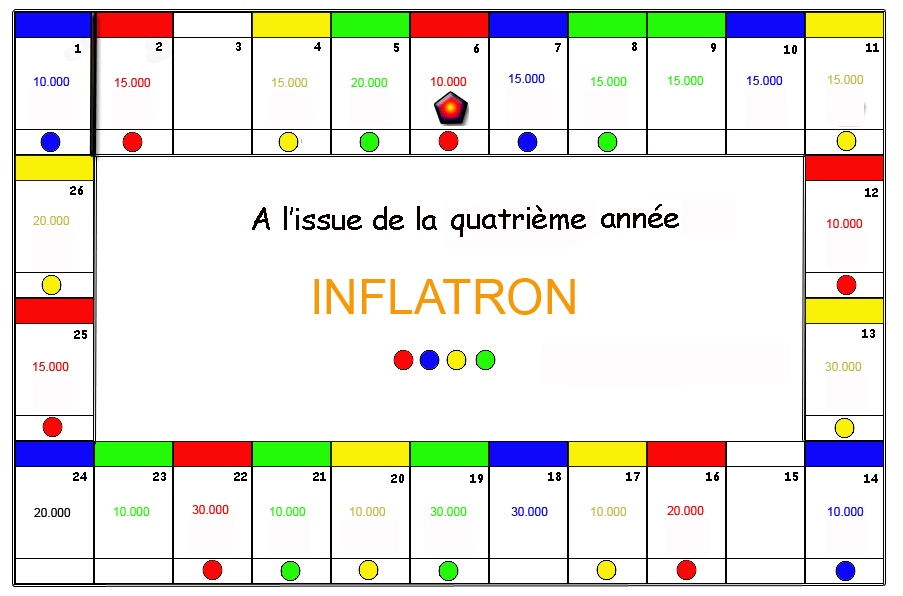
Forty years ago, I came up with the idea of a similar game, but with one single token, the “conjuncture token.” It also moves forward based on dice rolls. But it doesn’t matter who rolls the dice; the token moves regardless. This is what the game looks like:
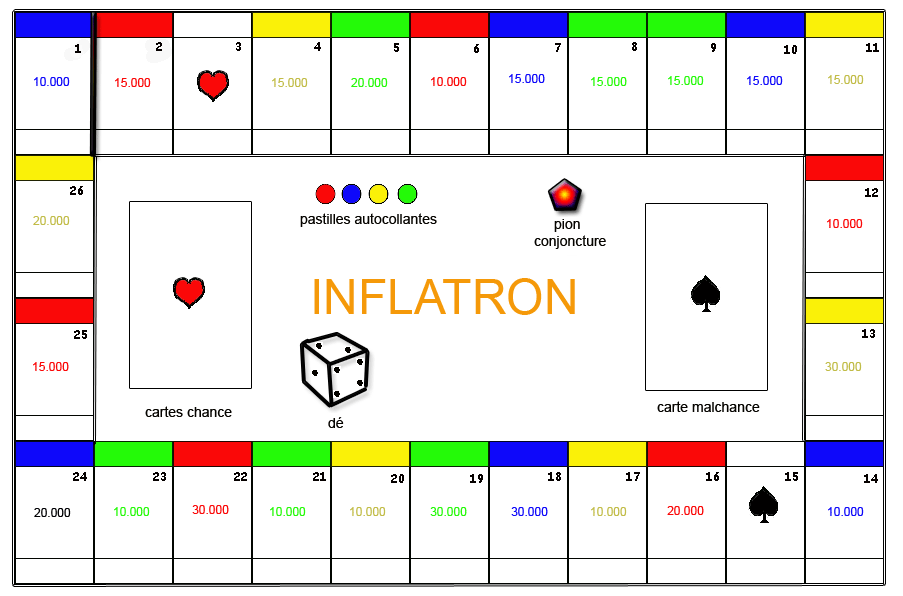
You can imagine countless variations—with more players and different numbers. Today, computers could automatically generate such a board by simply specifying the number of players. You could also vary all kinds of parameters infinitely. But let’s see how this game works as it stands now. The game is designed for four players.
- Red player – Blue player – Green player – Yellow player
First step: Print out the attached sheet on colored paper to create money, just like in Monopoly. Here’s an example sheet with red money. Make as many as needed, in all four colors.
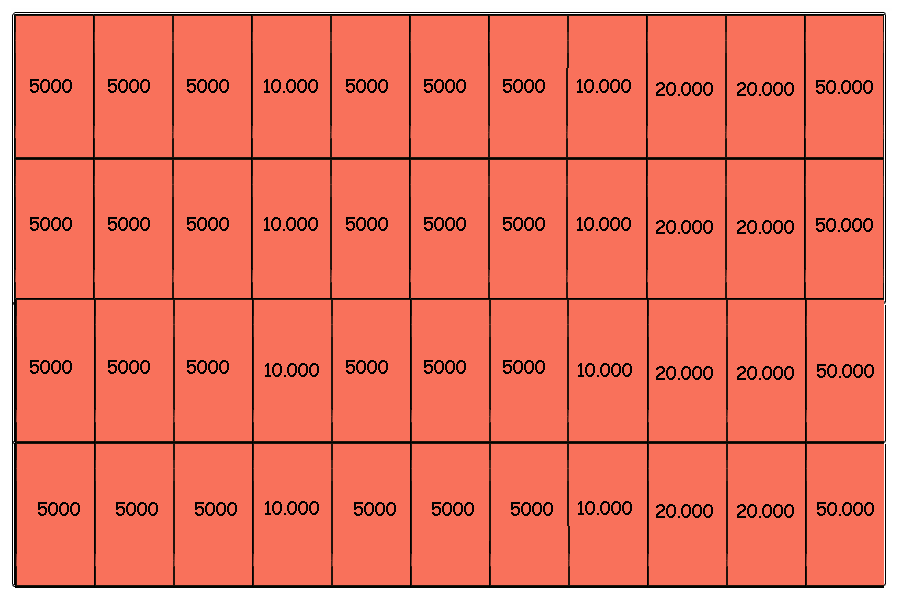
Then distribute:
- To the red player: 100,000 red bills
- To the blue player: 10,000 blue bills
- To the green player: 10,000 green bills
- To the yellow player: 10,000 yellow bills
These four players start off equally. Let’s assume they’re four heirs living in red, blue, green, and yellow countries, each having inherited 100,000 units of their country’s currency. Initially, we assume 1 red = 1 blue = 1 green = 1 yellow. There’s currency parity.
Place the conjuncture token on the top-left square, which we consider “the starting square.” For now, ignore the squares marked with a heart or spade. Leave those squares blank in the game.
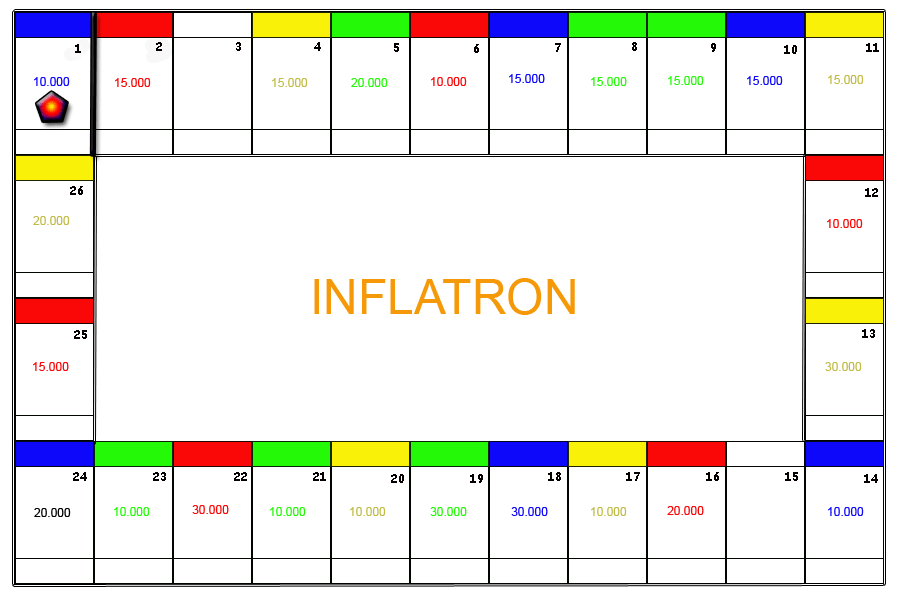
The “conjuncture token” moves along this closed loop of squares, based on dice rolls. Whoever rolls the dice doesn’t matter. A six-sided die yields values:
{ 1 , 2 , 3 , 4 , 5 , 6 }
The average of these values is ( 1 + 2 + 3 + 4 + 5 + 6 ) / 6 = 3.5
This game has 26 squares. On average, it takes 26/3.5 = 7.7 dice rolls per year.
One turn represents one year. There’s a barrier marked by a darker black line. We assume that when the conjuncture token crosses this “border,” one year has passed. Also, upon crossing this barrier, all players must pay “a certain sum” corresponding to their “expenses and costs.”
To whom do they pay?
To an external entity. “Bank” isn’t quite the right term; “the outside world” would be better. Right now, the game is “open”; players interact with this “outside world.” Suppose nothing happens and fixed annual costs are 10,000. After ten turns, these heirs will have foolishly squandered their money. No interest...
Let’s roll the dice. I get a 6. Move the conjuncture token accordingly:
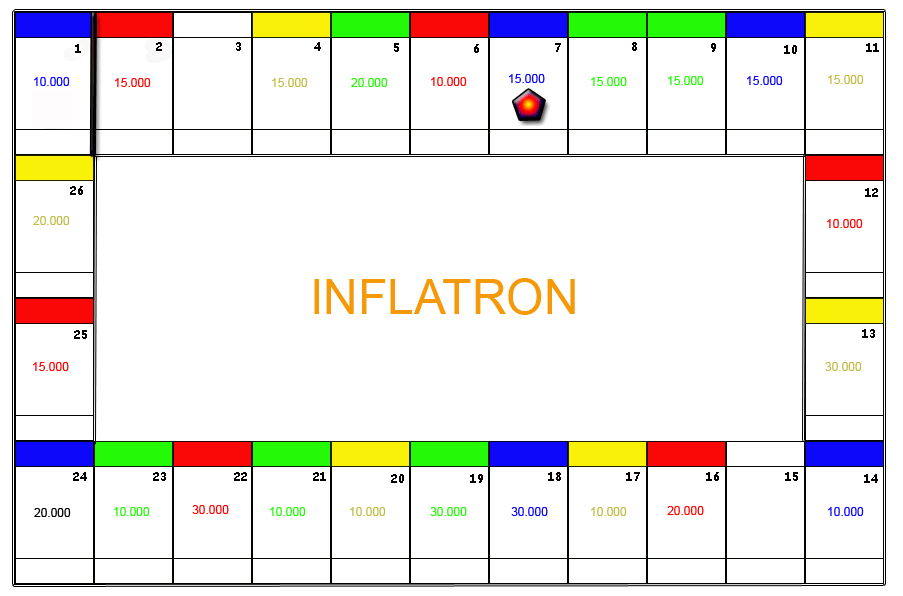
This square is “blue on top” and shows an amount: 15,000. What does this mean?
It’s a market to conquer, an opportunity, an economic activity located in the “blue country.” The first phase of the game is called “market conquest.” This square is then put up for auction. The amount is paid to the “outside world,” i.e., “taken out of the game.” At what price will this square be bought? Any price—that’s what makes the game exciting. Bids are free, and at first, novices have no idea what to bid.
But why buy a square? Because if, by chance, the conjuncture token lands on that square again, the “outside world” will pay 15,000 “blue” units to the player who bought it. Now mark this purchase. This game could be fully computerized; dice rolls would be performed by the computer, which would move the intangible conjuncture token—just an icon on screen. Players place bids; whoever offers the highest amount wins. Then they must pay for their purchase, their “investment in the outside world.” And they must mark themselves as owners of that square.
To do this, go to any stationery store and buy colored sticky dots in all four colors:
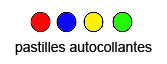
The square up for auction is square #7, “blue on top.” All squares will eventually be bought, since there’s no minimum bid. Suppose the red player buys it:
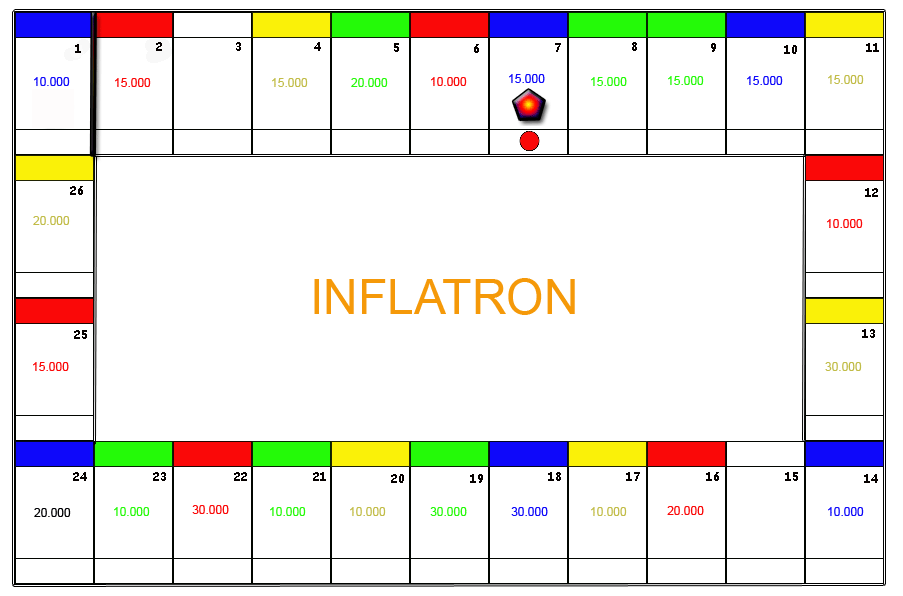
The game continues. Another dice roll. I get a 3. The conjuncture token moves three squares:
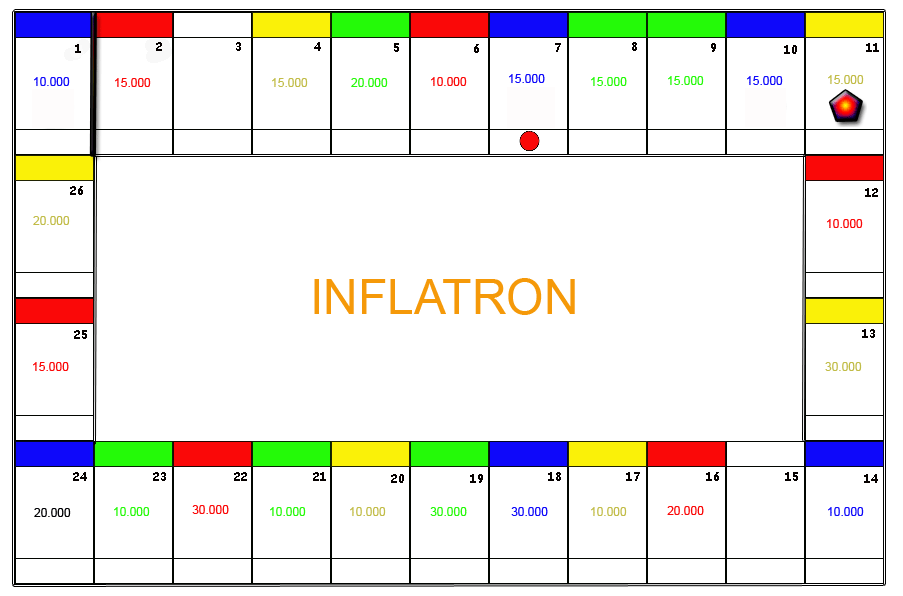
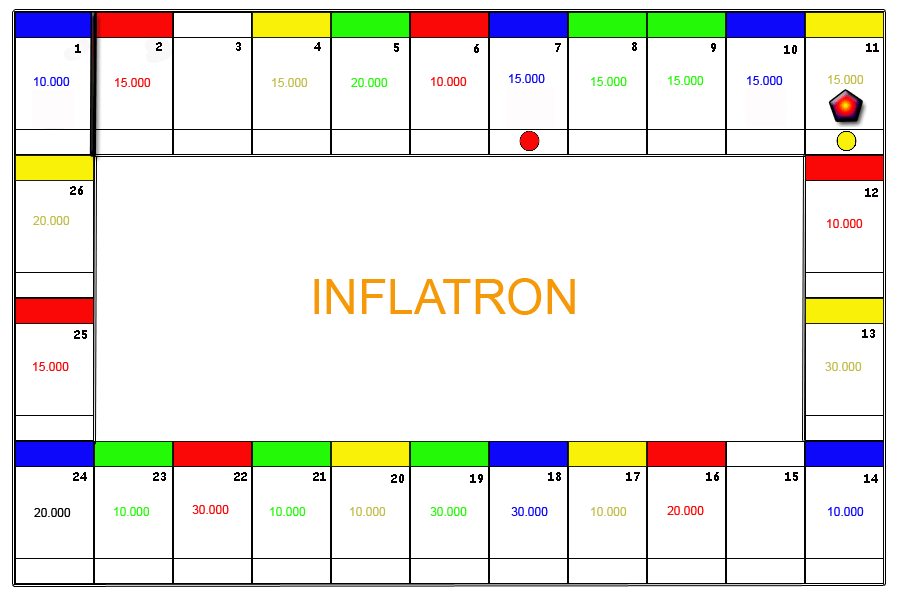
This time it’s a “yellow on top” square. Another auction. The yellow player decides and buys it, marking his purchase with a yellow sticky dot.
What’s the difference?
When the conjuncture token lands on square #7, the red player receives 15,000 “blue” units. But if it lands on square #11, the yellow player gets 15,000 “yellow” units from the “outside world.”
Square #11 represents a “domestic market,” while #7 is the red player exporting to the blue country. Thus he’s paid in that country’s currency. Nothing prevents this, since at this stage all bills have equal value.
The best way to get familiar with this game is... to play it. Of course, squares offering higher amounts are more sought-after. At what price? That’s up to you. Figure it out!
But already we see strategies emerging, dilemmas arising. What should one do? Buy squares quickly hoping to get “fresh cash inflows” ASAP, or... wait until other players have depleted their funds so you can snatch remaining squares at low prices?
Figure it out. This economic machine is YOU. It operates with all human subjectivity, which makes it entertaining. But calculations are possible. There are 26 squares; average movement is 3.5 squares per dice roll. So there are 26/3.5 = 7.4 opportunities per turn, per year. You can calculate how many turns/years it’ll take before the conjuncture token lands on your purchased square.
Add your annual expenses and costs. Incidentally, for now, when the token lands on squares 3 and 15, nothing happens... we roll the dice once more.
The game proceeds like this for... several turns. I recall four was a good number to “close the game.” Imagine the following state after four turns. At the end of these successive years:
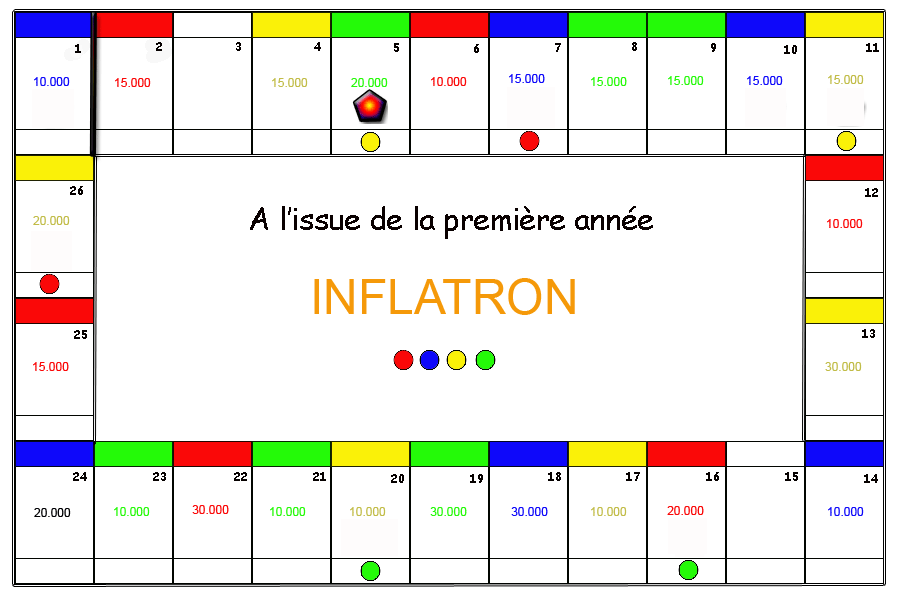
After the first year: 6 squares bought. Obviously: zero profits
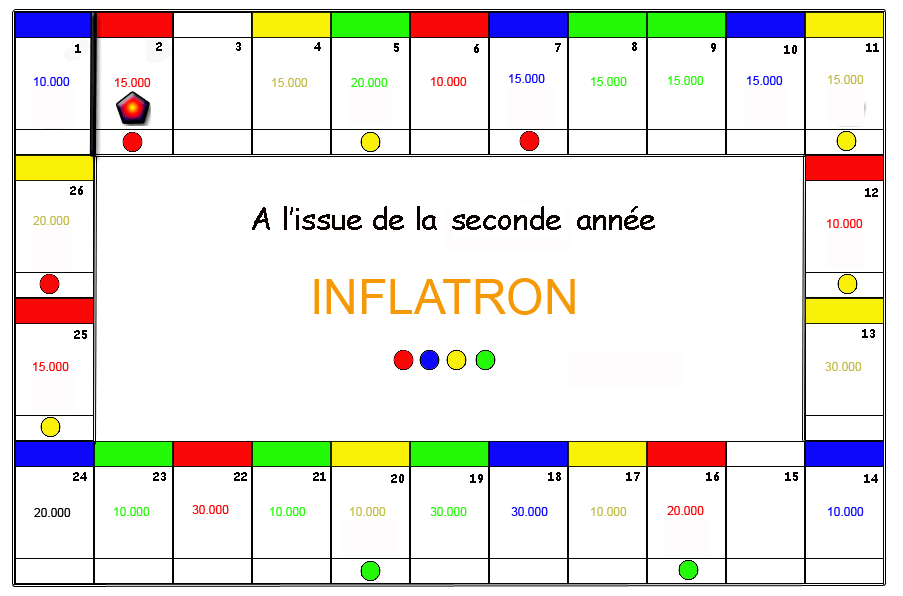
After the second year: 9 squares acquired. The reds earned 15,000 blues and 20,000 yellows; greens got 20,000 reds and 10,000 yellows
Obviously I don’t have the exact holdings of all four players; I can’t be in four places at once. We could set “fixed annual costs” at 5,000, for instance. I don’t know at what price squares were bought; to determine that we’d need a real game session.
Continue.
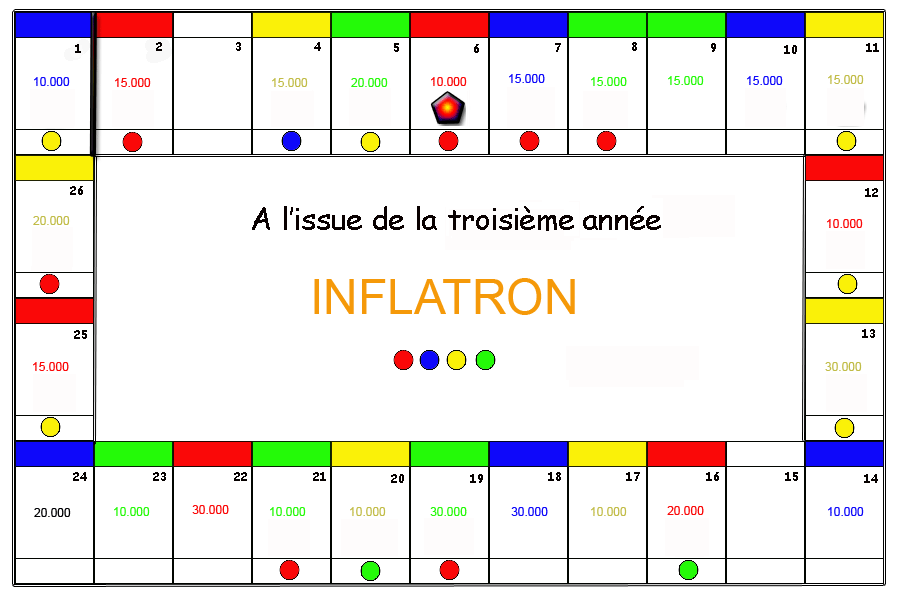
After the third year: some square purchases (60%), but no income that year.
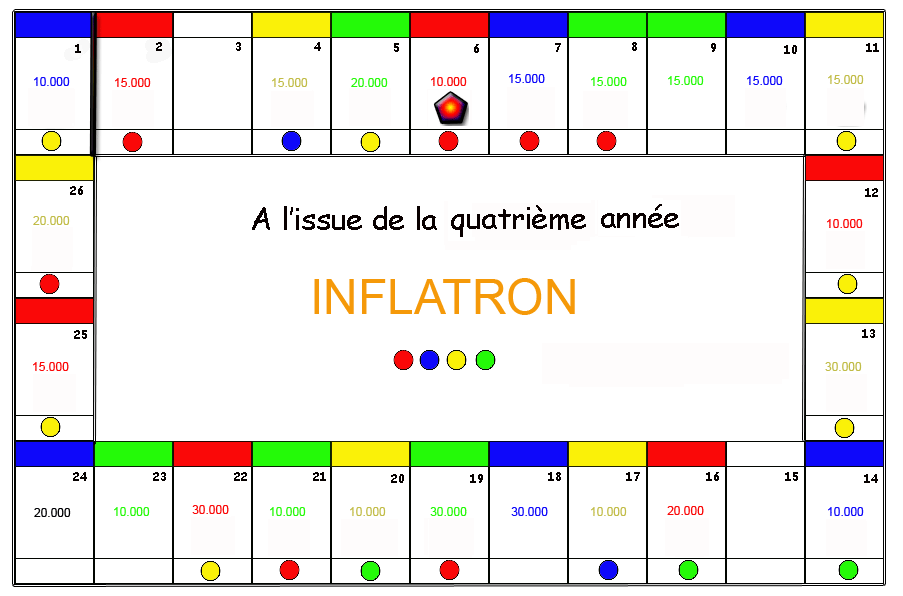
After the fourth year, 19 squares are owned. 80% of auctioned squares have been bought.
We then decide to “close the game” (on itself). Players become... countries, responsible for their own currencies.
Each does their accounting.
Blue player:
Income: zero. The blue player owns... no foreign currency (no bills of any color other than blue).
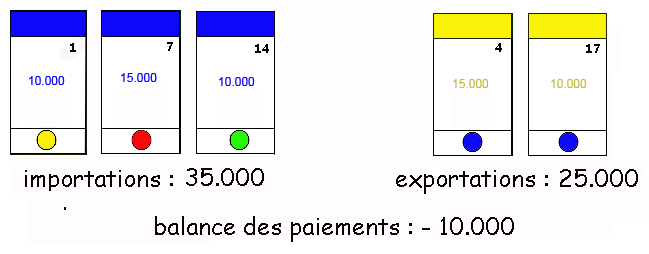
The blue player didn’t invest in domestic markets. He exports exclusively to the yellow country; imports yellow, red, and green bills.
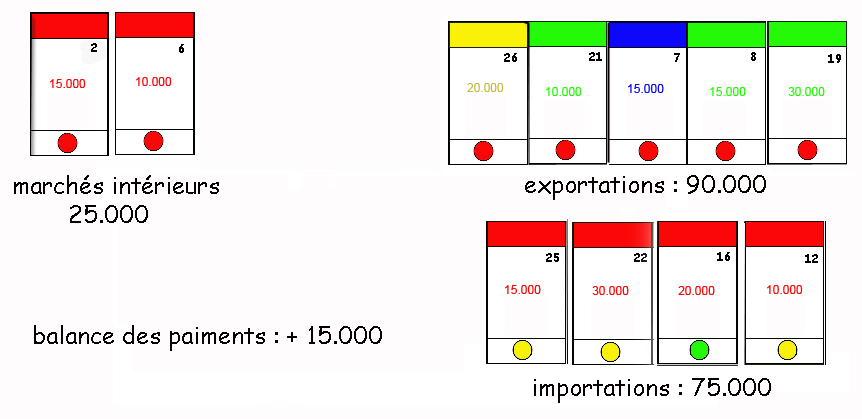
Red player:
Income: 15,000 blues, 55,000 greens, 20,000 yellows. Huge foreign currency holdings. Total: 90,000
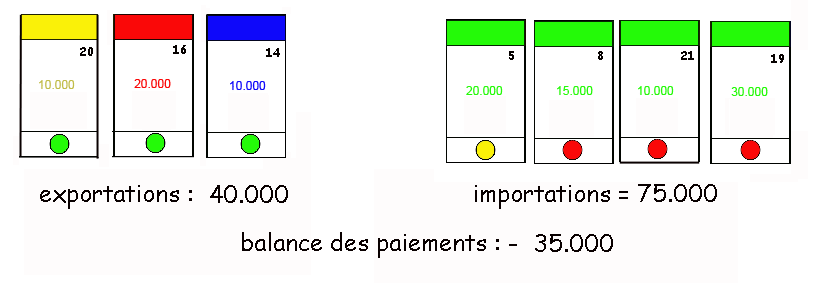
Green player:
Income: 20,000 reds, 20,000 yellows. Total 40,000
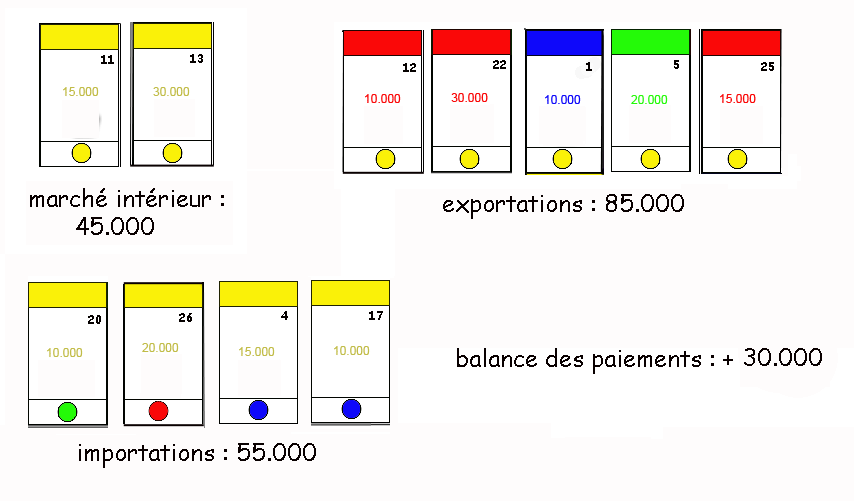
Yellow player:
Income: 10,000 blues. Total 10,000
Immediate check: the sum of all payment balances is zero.
Remark: If players had chosen to invest only in their own countries, there’d be no exports nor imports; payment balances would be zero. Only domestic markets would exist. We’d have this:
Hence, internal economic development:
Blue: 35,000
Red: 100,000
Green: 75,000
Yellow: 100,000
In this version of the game, where investments target exports (which become imports for other players), the blues would lag behind. But this version isn’t realistic, since squares wouldn’t be bought via auctions anymore.
I said earlier that players become countries. The “outside world” disappears from the game; the world is now just these four players. Each can print money in their own color, as they wish. Currently, players possess what remains of their initial inheritance—100,000—plus any gains, in their own currency if they invested domestically, or in “foreign currency,” meaning bills of any color except their own.
Thus a player cares only about others’ currencies!
Roll the dice, buy squares when available. When possible, players can bid, not in their own currency (since they have plenty of it). Those richest in “foreign currency” will snap up remaining squares. Money “leaves the game.” After four turns, the blue player had no foreign currency in non-blue bills. The red player is richest and best positioned. Paradoxically, the green player, with a negative payment balance, also has some foreign currency reserves. He must hurry to buy new squares; otherwise, trouble awaits. Yet the red player will be a tough rival in bidding wars.
What happens if the dice land on square 19? This time, the green player must pay 30,000, in whatever currency he chooses, to the red player. But his payment balance is deeply negative. The balances are:
- Blue player: - 10,000
- Red player: + 15,000
- Green player: - 35,000!!
- Yellow player: + 30,000
Blue and green players are “in the red.” If the game continues, what’ll happen? The yellow player is best positioned (I swear this wasn’t intentional; it’s pure luck). Conversely, the green player will have few revenues and frequent, heavy outflows; green bills will soon be in trouble (again, not intentional). If he uses foreign currency for payments, he’ll soon run out, meaning he won’t be able to buy new squares to improve his situation.
So he can pay using his own color bills, and he certainly will. But what then?
You’ll witness firsthand the phenomenon of inflation when a country’s payment balance is negative. The game will fill with green bills, and to a lesser extent blue ones. If nothing changes, things worsen. Currency parity is undermined. Players may demand that the inflation-causing player exchange those bills for others, quickly depleting his foreign currency reserves (non-green bills). We could set rules regarding this parity requirement, limited in scope and duration.
One solution is to devalue the troubled currency, which slows imports and boosts exports. This lets us observe the phenomena of currency coupling and chain devaluations.
We’ll discuss all this in the next lesson.
Before that, you can replay this game several times with different data, representing various states of this “four-player planet.” You can tweak fixed costs; raising them lowers players’ bids. Indeed, if during this phase a player “goes bankrupt” and can’t pay annual costs, he may sell one of his squares at auction, which another player buys. It could be an export market or a domestic one.
Actually, a more realistic game would use not fixed income amounts but profit rates: ten percent, fifteen, twenty, thirty....
The player bidding highest wins the square. But he also earns income proportional to his investment, according to that profit rate. He might even reinvest in that same square.
Spreading profit rates makes the game more volatile. Fortunes rise rapidly. Those who capture sectors with low profit rates will struggle. To experiment with such a game, it’d need to be computerized. Ideally, multiple internet users could join in real time. The computer would calculate everything in real time, display all players’ holdings and payment balances, and later produce graphs showing the game’s evolution, who grew richer, who got poorer.
Your move!
Download this page’s content as pdf or doc