- page 2 -
Devaluation
May 9, 2008
Let’s revisit the balance of payments.
- Blue Player: -10,000
- Red Player: +15,000
- Green Player: -35,000!!
- Yellow Player: +30,000
Here is their table of imports and exports:
Green Player:
Revenue: 20,000 reds**, 20,000 yellows. Total: 40,000**
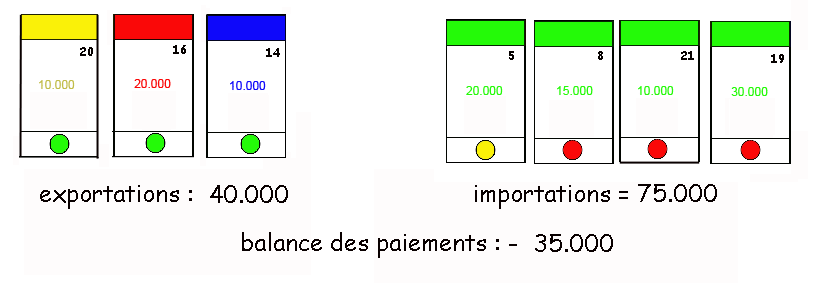
The green player can then consider devaluing his currency by a certain percentage, say 0.8.
The green bill would then be worth only 0.8 red bills, or 0.8 blue bills, or 0.8 yellow bills. Residents of the green country would pay 20% more for imported goods. Conversely, green goods would become 20% cheaper for importers from other countries. Devaluation would boost the green country’s exports while curbing its imports. By how much? Good question.
We can only simulate this phenomenon. For example, schematically we can apply the following formula (which in no way constitutes an economic law):
If a player devalues his currency by x%, we can assume that his exports will increase by a factor of 1.2 and his imports by a factor of 0.8. This means we must adjust the amounts in each cell accordingly. For instance, for the green player, all cells marked “green at top” and those pointing downward will have their amounts changed:
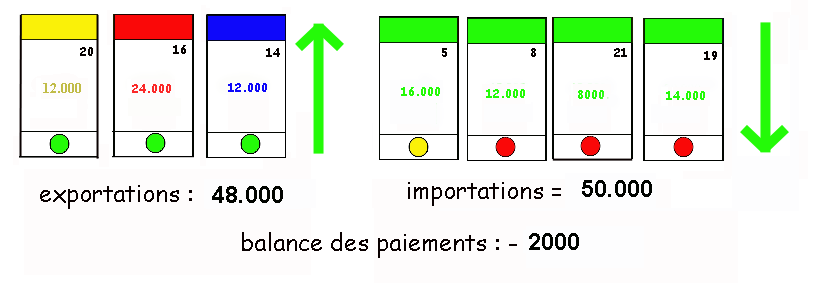
The green player’s balance isn’t yet positive, but it’s significantly better. Here’s the overall table:
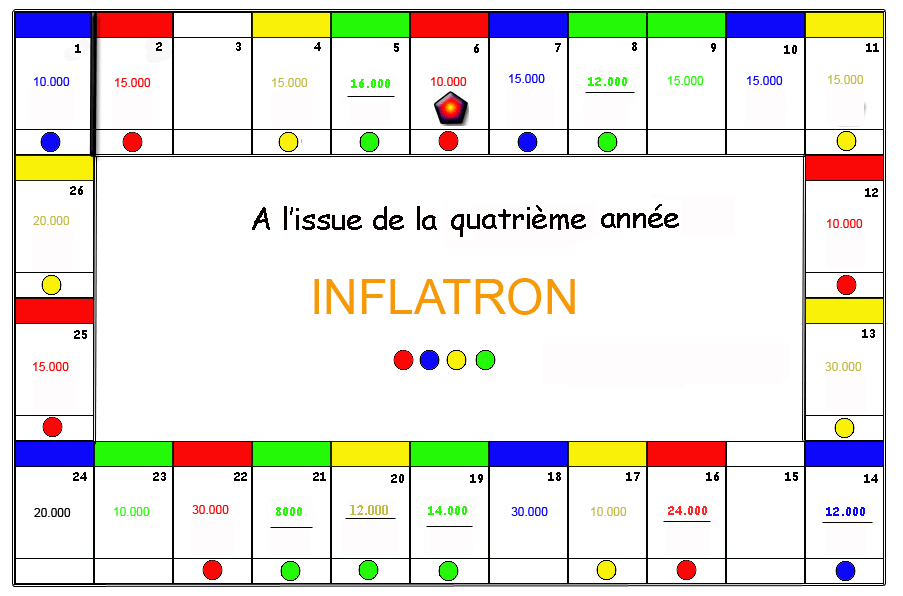
We’ve highlighted the amounts that were modified.
Green businesses reliant on exports will get some “breathing room.” However, residents of the green country won’t appreciate having to pay 20% more for imported goods.
One sector that benefits from devaluation is tourism—stays in red, blue, and yellow countries become 20% cheaper for green country residents.
This rebalancing affects all other players’ balances:
Blue Player:
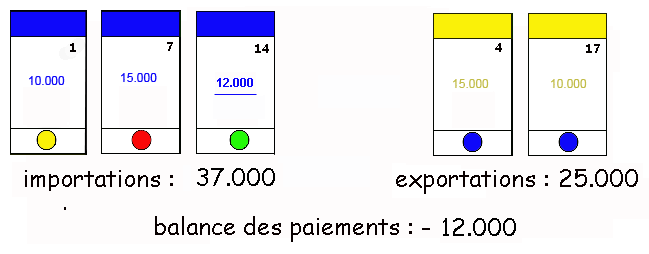
Little effect on this blue player. He had little connection to the green player via trade. Only one cell was affected: cell 14. But the red player suffers; his balance turns negative.
Red Player:
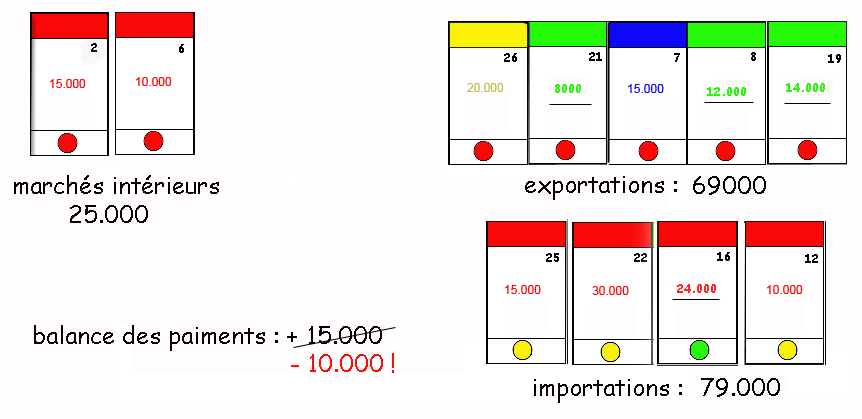
Thus, if a country devalues its currency, it impacts those countries with which it has strong trade ties. Random chance might mean two countries are closely linked; devaluation in one would throw the other out of balance, prompting it to also devalue. This leads to a chain reaction of devaluations.
It’s clear that the monetary system is inherently unstable. This game illustrates several mechanisms, though it truly comes alive when you play it yourself. It shouldn’t be seen as a faithful reflection of economic reality; it’s merely a “toy model” illustrating various mechanisms. I invite readers to help refine it.
We introduced “fixed annual fees,” equal for all. These include all costs, including labor costs. There’s no reason these should weigh equally on all four “countries,” nor that their initial capital should be identical. You can thus tweak parameters: assign different initial assets, allow “poor” countries to have lower labor costs and thus lower annual fees.
All this needs testing.
Currently there are just four players and 26 cells; two remain unused. It’s hard to cover all aspects of the economic world using such a simplistic setup. I recall that when we played INFLATRON 40 years ago, we imagined insolvent players could be “bought out” by others via bidding. Suppose the blue player fully acquires the blue player; the blue country becomes a “satellite” of the red country. The blue currency transforms into red currency. Buying out an insolvent country offers advantages: access to a workforce with lower wages (thus lowering annual costs), etc...
I have no idea how to incorporate “oil” into this game. A richer version would feature profit rates rather than fixed amounts, which quickly lose meaning. Profit rates could vary across industries, which may be impacted differently by events like an “oil shock.”
What is a true “bank”?
In such a game, it’s hard to include as many banks as countries; however, adding a fifth player representing “transnational capitalism” makes sense. To make the game work, we need more players. The bank lets depositors entrust their capital to it. With this liquidity, it can aggressively seize empty cells or acquire cells belonging to struggling players. In return, it provides income to shareholders. If dividends meet expectations, players will channel more capital into the bank.
But here we must simulate the control described in many videos—via issuing “currency,” a “virtual currency” in the form of loans to troubled countries.
I must end this overview here. I have many other urgent tasks involving documents provided by readers. I must summarize a presentation by an INRA expert on soaring agricultural prices.
INFLATRON is a project I present to you; it can be improved. Ideally, people should code, exchange ideas, and play together. Just as in chess, simulating virtual players seems feasible. It requires thought, but it’s an interesting challenge. We could then create imaginary economies and observe phenomena by tweaking parameters.
You know computers can play chess against themselves. Not merely by referencing databases of past games, but by employing evaluation functions. This yields sometimes surprising moves. Once a program analyzes standard positions, pieces under attack, and possible moves, it must choose among a few options.
Historically, early chess programmers, faced with choosing between seemingly equivalent moves, opted for those maximizing piece mobility. This produced sensible choices.
I once worked in “decision theory.” This game offers opportunities to develop similar concepts. But I have other priorities: developing low-density MHD, disseminating information. INFLATRON is a “message in a bottle”—whoever wishes may pick it up.
Much like “ANTIBABEL,” which no one took up. A pity.
I am a message-in-a-bottle launcher
May 10, 2008 Jean-Pierre Petit