Debt
May 12, 2008
We’ve seen that when “a country doesn’t function properly” and its balance of payments is in deficit, one solution is to devalue its currency. Forty years ago, when my friends and I rented the Inflatron to try to develop and improve it, we introduced this mechanism for improving the balance of payments through devaluation. As I mentioned on the previous page, this illustrates the system of chain reactions involving currency devaluations among countries that are closely linked by trade.
This game, with its fixed incomes, is primitive and insufficient. Someone should program it so that instead of fixed incomes, there would be profit rates for each square. Players could then increase their investments by boosting the value of certain squares using their profits. To do this, we must reintroduce “the outside world,” which exists “outside the game.” At any given moment during play, a player has liquidity. Rules should be introduced allowing him to “bet on a square,” which means taking money out of the game.
For example, a player buys a square for 20,000 units; that square yields a 30% return (but not 30% per year!). This means that if the “conjunctural pawn” lands on that square, the player gets back one-third of his investment. But we mustn’t forget that the probability of landing on a particular square increases with the number of turns played. One turn (one year) consists of 7.5 dice rolls. In one day, there’s a 7.5/26 chance of landing on a given square—that is, 0.28. The inverse of this number gives us 3.5 years—the average time before there’s any “return on investment.” That’s not such a bad figure.
Let’s return to that square bought for 20,000 units, yielding 30%... when you land on it again. In reality, its average annual return will be 30% divided by 3.5, i.e., 8.5% per year—though this isn’t guaranteed!
Such an improved game would allow for investments, always subject to luck or misfortune—elements inherent to economic activity.
A player who becomes wealthy can reinvest his earnings by putting money into various sectors. He then faces a choice: he has several profitable squares at his disposal, each with different profit rates.
The “Fifth Player”
There’s presumably another way to improve a country’s productive system: by increasing investments, i.e., borrowing. This leads us to the banking mechanism. A bank performs several functions:
– It protects money from theft. A bank can thus accept deposits from customers. These customers may pay for this service by renting a safe deposit box; such deposits are then paid for.
– But a bank can also conduct financial operations with these deposited funds, thanks to the flexibility granted by the sums deposited by its savers. It encourages people to deposit money by offering them interest; they think, “My money is working for me.”
– The first thing a bank can do is lend the deposited money to others... at an interest rate higher than what it pays its savers.
– Another function: enabling purchases on credit. This is “consumer credit,” which isn’t addressed in the game.
– Finally, a bank can lend money to entities wishing to improve their situation, modernize their production or operating tools.
From this perspective, we could introduce a “Fifth Player” into the game. We could start by giving him empty “boxes.” What might encourage players to entrust their money to this “banker”? Guaranteed interest over time, say annually. By contrast, investing requires waiting an average of 3.5 years for any return—and that’s just the average.
There will be over-indebtedness.
The goal of the game isn’t to have a single winner (though, as Raymon Devos would say, see later) but to highlight certain mechanisms, possibly by adjusting parameters. It should be possible to demonstrate a player’s over-indebtedness and simulate this process.
We left some squares “empty,” marked with a heart and a spade. Forty years ago, we added “lucky” or “unlucky” events to those squares. Now, it’s up to future developers to add more elements. Some agricultural squares might depend on weather conditions—good or bad harvests. There could be booms or recessions in certain sectors.
We’ve seen that the game can feature different “annual fees” for each player; these include labor costs, which may vary due to revolutions or counter-revolutions.
If I were an economics professor, I’d try to develop this game with my students; after all, it could be programmed, displayed on a computer screen, and even projected for everyone to see. The machine would record all actions, and when the game ends, it could show graphs illustrating changes in various parameters.
Globalization
I recall that when creating this game, I envisioned a final scenario where one player eventually swallows up all the others. One thing I hadn’t considered was the active intervention of this... “Fifth Player,” the “stateless banker”—who is actually a real banker, not just a pile of bills like “Monopoly Bank.” The Fifth Player becomes a predator: he can seize economic sectors, marking them with a sticker in his color—black, for instance. He can take over squares belonging to bankrupt players, either all at once or gradually. Computer display makes it easy to visualize how a bank progressively appropriates a sector within a country.
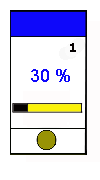
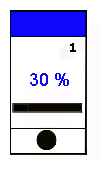
Progressive appropriation of an economic sector or export market by the “Fifth Player”
Ultimately, this may be the game we’re playing, though we’re not fully aware of it. Calling banks or financial groups “multinationals” isn’t very accurate. If you read books or watch videos, you’ll notice that there’s a growing trend toward control by “banks”; this is logical, since money has no nationality. Such “multinational corporations” should really be called “stateless corporations.”
This “Fifth Player” represents that “stateless player.”
Earlier we discussed how the “banking sector” appears as a new player only after the game is already underway. This helps explain the nature of the stock market. A company doesn’t belong solely to one person or family; it’s owned by shareholders. Only majority shareholders can make decisions, including selling the company.
In some countries, the state can prevent foreign buyers from taking control of companies or sectors. China is currently buying many companies and goods abroad (including hotels), while strictly forbidding foreign firms from gaining majority control on its own soil. China benefits from liberalization elsewhere while maintaining tight control over its workforce and foreign investors.
When a company is listed on the stock exchange, it allows small savers to participate. Anyone owning shares becomes a mini-shareholder. Big investors hold many shares.
Shareholders can sell all or part of their holdings; individuals can resell shares too. Whoever holds 51% of shares becomes effectively the “owner” of the company, since no decision can be made without his approval. Groups may attempt to acquire this majority via takeover bids (OPAs). See Largo Winch comics for examples.
Speculation. Gold.
In the primitive version of the game, we simulated total inflation at the moment the game “closes.” Each player can then freely print his own currency, illustrating how players care mainly about other players’ money, which becomes “foreign currencies” for them. This scenario is obviously simplified; yet a well-designed economic game can simulate the phenomena of “strong currencies” and “weak currencies.”
There are other elements hard to incorporate: gold and oil. Gold could be represented by limited “gold-colored bills” with a fluctuating value shown on-screen. It’s akin to having bills whose value changes over time. More precisely, each bill would automatically display its equivalent value in other currencies. Fascinating.
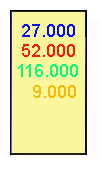
Gold
Gold’s value results from supply and demand; when players scramble for this “safe haven,” its price rises via auction, affecting all other players’ assets. This generates profit without any commercial or manufacturing activity.
I’m unsure how to introduce oil; however, its monetary importance is clear. Until now, the US demanded that oil purchases be made in dollars. Prices rise as demand grows and supply stays static; scarcity makes commodities expensive. Industrialized nations need oil just as poor nations need food.
If all payments are made in dollars, the dollar benefits from strong demand. Currently, the US relies on this arrangement; losing it would threaten its economy, which is already running deficits.
Imports severely harm the US economy, especially imports from abroad.
George W. Bush
Many believe that Saddam Hussein’s decision to demand euro payments triggered the Iraq War; invading and punishing him seemed justified. The same threat hangs over Iran, which also created a stock exchange where dollars aren’t accepted.
China plays an increasingly important role in today’s economy; India will follow suit. Their low production costs (much lower wages than in Western countries) give them an export advantage. Wealthy capitalists hasten their own downfall by relocating factories to China; in return, China imports from those countries, affecting local employment. Financial elites don’t care; some naively assume China will remain limited to low-tech industries while they sell high-tech products. This illusion is dangerous.
Since May 10, 2008, China announced it’s building a domestic manufacturer of 150-seat airliners—equivalent to our medium-haul planes, adapted for domestic routes. Eventually, China will dominate all industrial sectors. Most people realize that China has seven times Japan’s population; until now, economic resources limited its growth. How can a country that was third in space exploration not build Airbuses, TGV trains, or Jumbo Jets???
The Fed
This word is on everyone’s lips: the “Federal Reserve Bank” of the US.
In the Inflatron game, at the moment of “closing the game,” players can print their own currency in any color; this naturally creates instability. Before the euro existed, holders of large European currency reserves could speculate against target currencies, triggering devaluation; buying cheaply after devaluation meant big profits. The dollar became stronger against other currencies overnight.
ATTAC proposed taxing all transactions at 1% to aid poorer nations.
Nobel laureate James Tobin suggested this in 1972 at a rate between 0.05% and 1%. See:
http://fr.wikipedia.org/wiki/Taxe_Tobin
But such a measure would only work with broad consensus.
Europeans created the “European Monetary Snake” (1972) to limit currency fluctuations between member states. After WWII, victorious US leaders insisted that Western trade occur in dollars; they pegged it to gold at $35 per ounce. In 1971, this peg was abandoned; the dollar became a floating currency, leading to 25 years of volatility. This prompted Europe to create the Euro, which acts as a common currency for all members. The dollar remains the sole global reserve currency.
If at any stage of the game, given persistent deficits, you must devalue green or blue currencies to 80% of their original value, which currency should be devalued relative to which? In reality, the US balance-of-payments deficit would require devaluing the dollar by at least 50%; but relative to what standard?
If you’re told to reduce indoor temperature by 80% compared to outdoor temperature, that’s understandable. But reducing outdoor temperature by itself? From the outset, you must ask: Is the external bank truly independent? Do countries only care about other countries’ wealth, since all international transactions are conducted in dollars? Should red receive dollars from green or yellow and give them to blue? Doesn’t this distort the game?
Okay, within the EU, transactions are in Euro; but globally, the EU behaves as one player, while outside it uses dollars. For some economies, trading in Euro would be advantageous; Iran and other oil producers would benefit from a currency revalued by 30% vs. the dollar. Yet they can’t rely on a second reserve currency under IMF rules; that would require changing international agreements.
Regarding the Federal Reserve and the ECB, both are independent currency issuers. Is US monetary policy decided in Washington or by the Fed chairman?
Within the EU, the internal bank doesn’t adjust for balance-of-payments deficits; France, for instance, has a huge deficit yet keeps its strong Euro. The ECB fights inflation globally, treating the EU as one player. France suffers from a strong Euro: exports drop, imports rise, deficits worsen. Companies relocate abroad, shifting economic activity elsewhere. Within the EU, France’s square is devalued from 50,000 to 35,000 units; Romania and Czech Republic squares are revalued from 15,000 to 30,000 units.
Here come crucial questions! These issuing banks can adopt joint policies without favoring any single player. The Fifth Player exploits deficits and surpluses of the other four! He seeks to gain markets; unlike the IMF, he doesn’t help rebalance situations. That’s the crux!
In Inflatron, faced with such circumstances, other players must ally against him. Yet we still face real-world questions!
The ideal scenario described by neoliberal/globalization theories mirrors Inflatron gameplay. But does it reflect reality? Even playing the game shows it doesn’t.
Do governments personally play, or do they pursue “special interests” contrary to their country’s welfare, benefiting the Fifth Player?
In reality, the US spends heavily on military operations in the Middle East, raising its deficit and affecting trade. Its strategy is to expect long-term gains from new markets; to do so, it issues more treasury bonds, increasing its deficit. China, with a surplus, buys these bonds.
This creates a “government loan” square where other players invest; another square—“war spending”—lets players place funds on markets they seek to conquer. They await eventual regularization on squares representing Iraq, Syria, Afghanistan, or Iran.
Clearly, we’re beyond strict game rules. Inflatron reflects liberal trade theory, but to mirror reality, we must introduce internal national economies, government budgets, aggressive/commercial policies, and purely financial mechanisms: independent banks, currency issuers, financial markets, etc. Ultimately, one exchange currency and separate reserve currencies for independent players—financial players.
Financial players don’t directly conquer markets by buying squares for income; they bet on dice rolls determining the conjunctural pawn’s movement. Once exchanges occur on that square, they sell reserve currencies, bonds, and loans to buy others. It’s a financial game within the broader trade game.
Basically, it boils down to “Who controls the conjunctural pawn? And for whom?” Here, the Fifth Player acts entirely selfishly, or with financial players against those investing in markets for profit.
Olivier A. Renard

An article pointed out by a reader
http://www.courtfool.info/fr_Secrets_d_argent_interets_et_inflation.htm (archived 05/01/2024)